Article

Autonomous Mission of Multi-UAV for Optimal Area Coverage
Electronics and Telecommunications Research Institute (ETRI), Daejeon 34129, Korea
*
Author to whom correspondence should be addressed.
Sensors 2021, 21(7), 2482; https://doi.org/10.3390/s21072482
Submission received: 22 February 2021 / Revised: 13 March 2021 / Accepted: 30 March 2021 / Published: 2 April 2021
(This article belongs to the Special Issue Unmanned Aerial Vehicle Control, Networks, System and Application)

Abstract

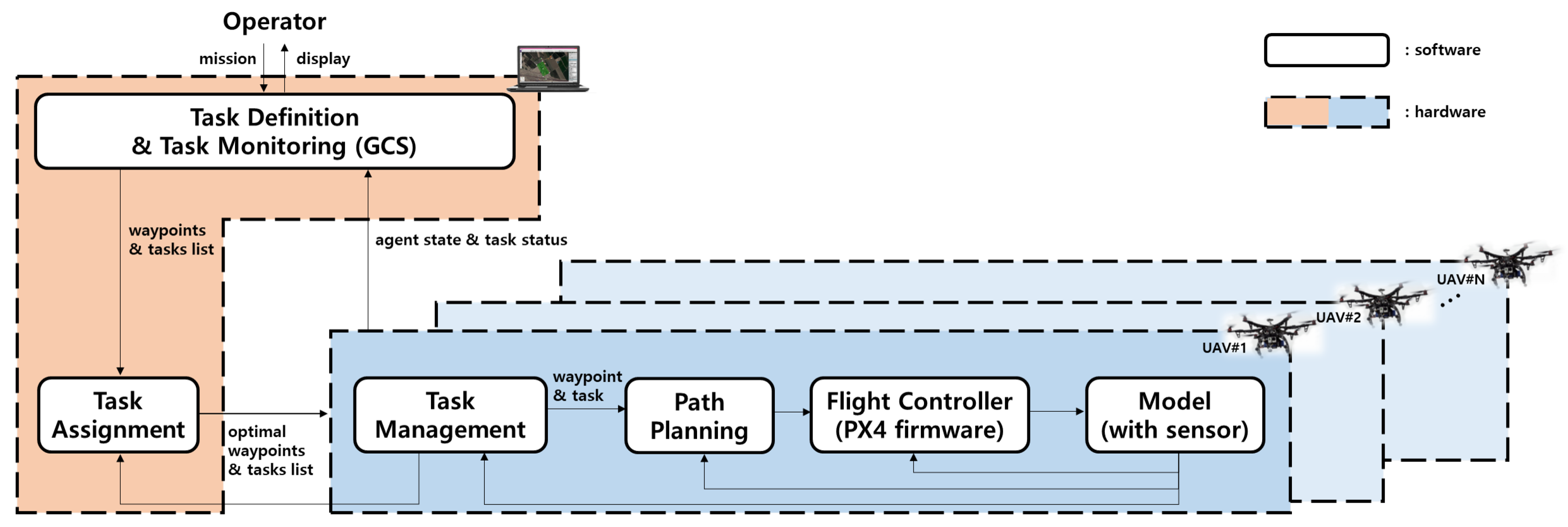
This study proposes an entire hardware and software architecture from operator input to motor command for the autonomous area coverage mission using multiple unmanned aerial vehicles. Despite the rapid growth of commercial drone services, there are many limitations on operations, such as a low decision-making autonomy and the need for experienced operators to intervene in the whole process. For performing the area coverage mission more efficiently and autonomously, this study newly designs an optimization problem that allocates waypoints created to cover that area to unmanned aerial vehicles. With an optimized list of waypoints, unmanned aerial vehicles can fill the given areas with their footprints in a minimal amount of time and do not overlap each other during the mission. In addition, this study performs both various simulations for quantitative analysis and an outdoor experiment through real hardware implementation in order to verify the performance sufficiently. The methodologies developed in this study could be applied to endless applications using unmanned aerial vehicles equipped with mission-specific sensors.
Keywords: unmanned aerial vehicle; mission planning; area coverage; task assignment; mixed integer linear programming; path planning unmanned aerial vehicle; mission planning; area coverage; task assignment; mixed integer linear programming; path planning