


Software-Defined Optimal Computation Task Scheduling in Vehicular Edge Networking †

Abstract
1. Introduction
2. Related Works
3. VEC Architecture and Assumptions
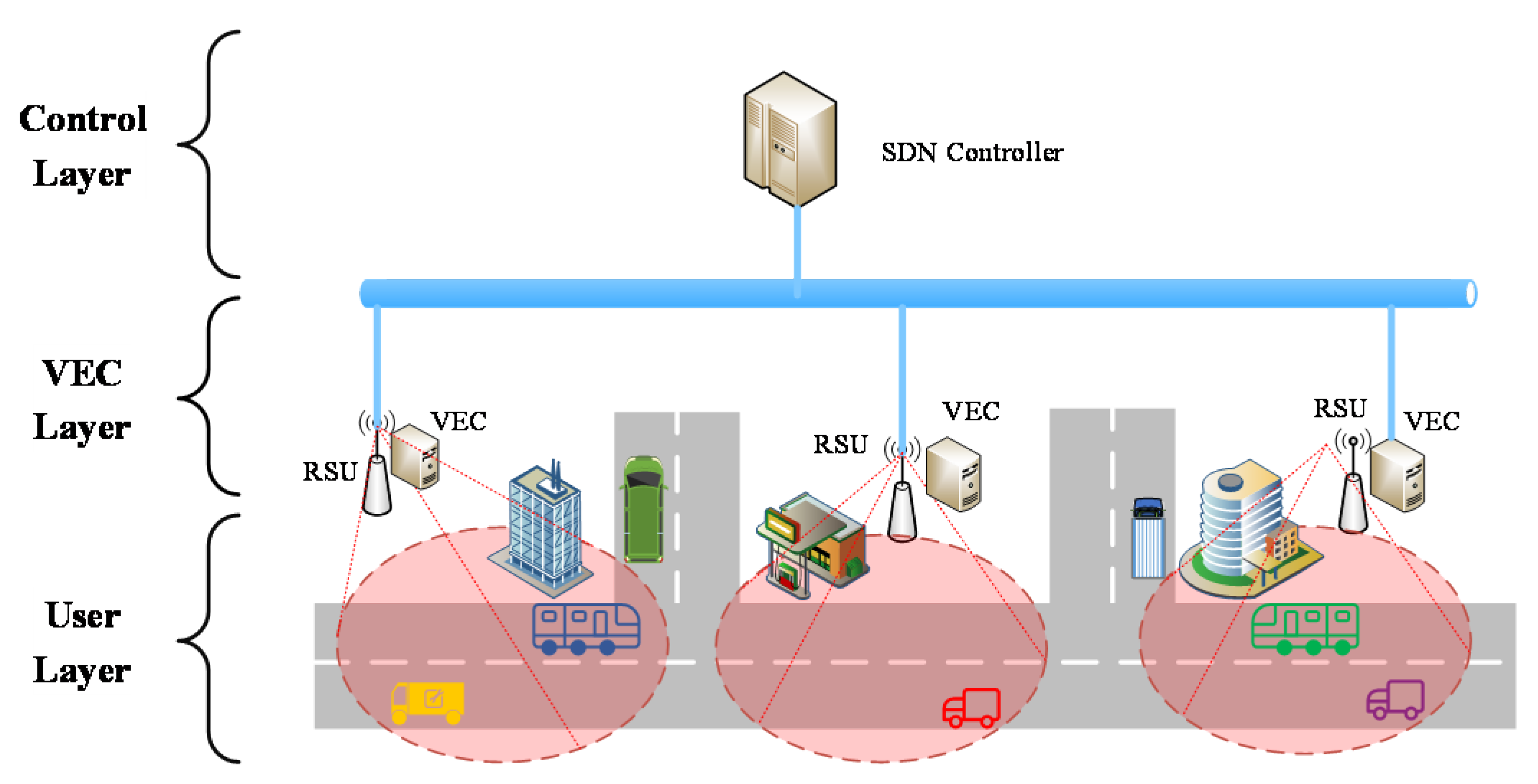
3.1. SD-VEC Networking Layer Architecture
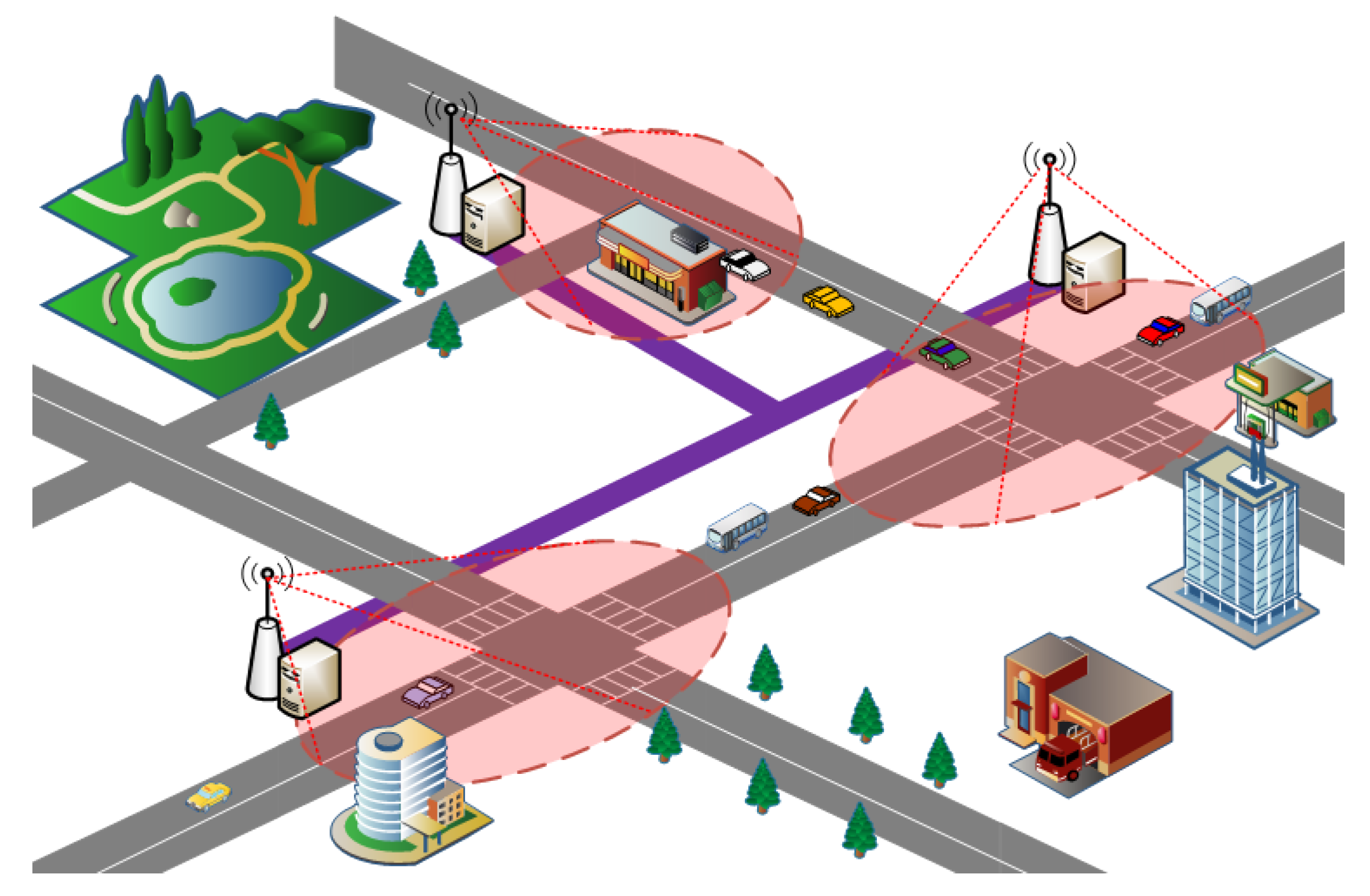
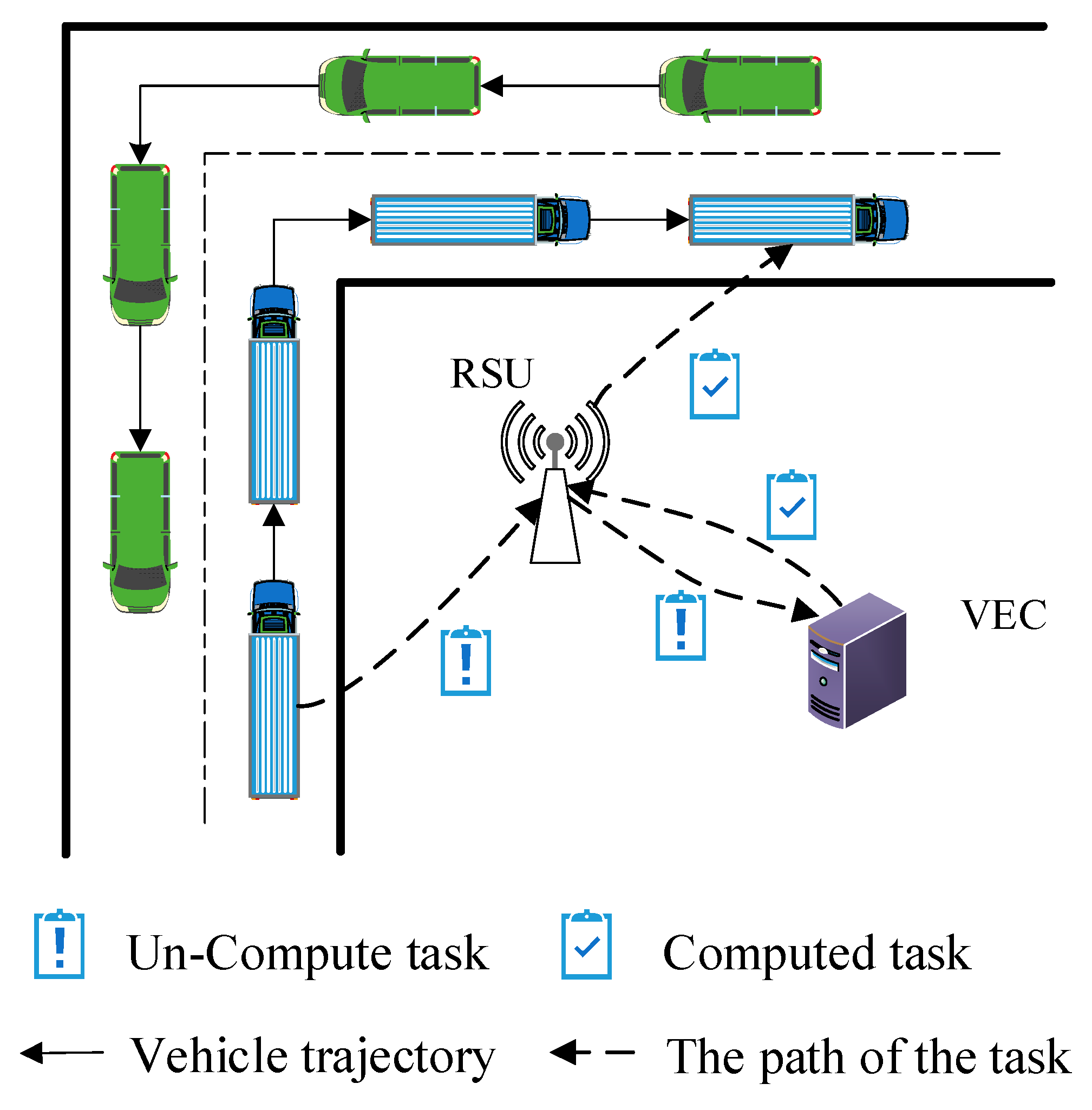
3.2. Network Model Assumptions
4. Vehicular Task queuing Model
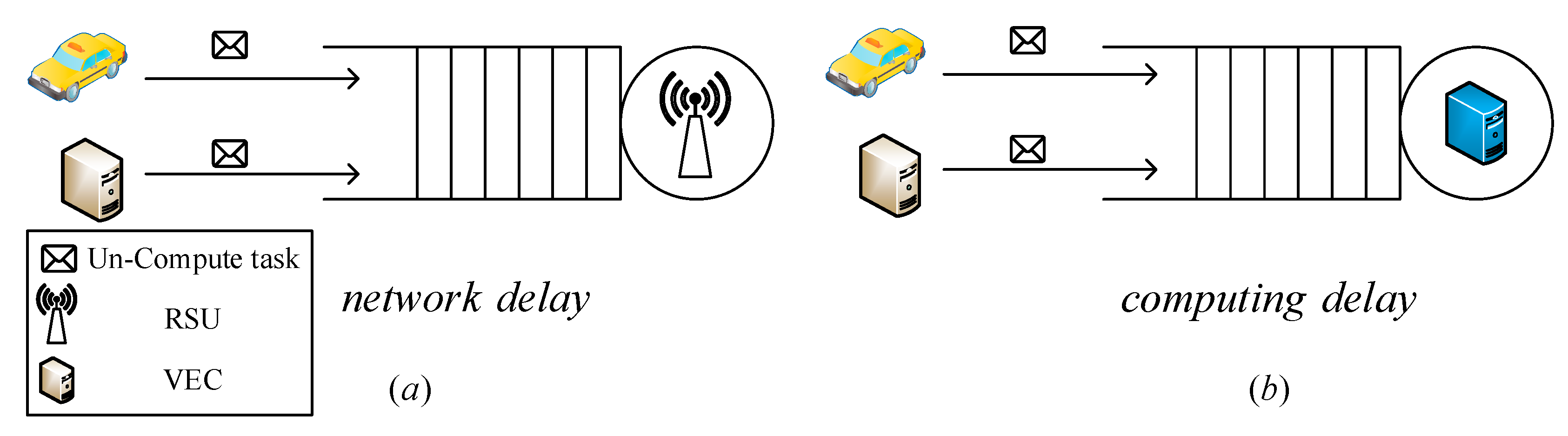
4.1. Task Queuing Model
4.2. Task Computation Model
5. Problem Formulation and Optimal Task Scheduling Solving
| Algorithm 1. OCTS |
| Input: Task arrival numbers, CPU usage of all SBSs, Control parameter , Output: Optimal control , optimal trajectory 1. For ; do 2. Calculate the expected CPU usage of SBSs ; 3. Calculate the fitted curve and based on task arrival numbers; 4. Establish the state vector based on step 2 and 3; 5. Solving the extreme value of ; 6. Get and ; 7. Update the CPU usage of SBSs; 8. End For 9. Return |
6. Experiments
6.1. Experiment Setup
6.2. Performance Evaluation
7. Conclusions
Author Contributions
Funding
Institutional Review Board Statement
Informed Consent Statement
Data Availability Statement
Conflicts of Interest
References
- Linthicum, D. Responsive data architecture for the internet of things. Computer 2016, 49, 72–75. [Google Scholar] [CrossRef] [Scilit]
- Lin, J.; Yu, W.; Zhang, N.; Yang, X.; Zhang, H.; Zhao, W. A survey on internet of things: Architecture, enabling technologies, security and privacy, and applications. IEEE Internet Things J. 2017, 4, 1125–1142. [Google Scholar] [CrossRef] [Scilit]
- Li, Z.; Chen, R.; Liu, L.; Min, G. Dynamic resource discovery based on preference and movement pattern similarity for large-scale social internet of things. IEEE Internet Things J. 2016, 3, 581–589. [Google Scholar] [CrossRef] [Scilit]
- Jiang, Y.; Wang, L.; Chen, H.-H. Covert communications in D2D underlaying cellular networks with antenna array assisted artificial noise transmission. IEEE Trans. Veh. Technol. 2020, 69, 2980–2992. [Google Scholar] [CrossRef] [Scilit]
- Zambrano-Martinez, J.L.; Calafate, C.T.; Soler, D.; Lemus-Zúñiga, L.-G.; Cano, J.-C.; Manzoni, P.; Gayraud, T. A centralized route-management solution for autonomous vehicles in urban areas. Electronics 2019, 8, 722. [Google Scholar] [CrossRef] [Scilit]
- Lee, I.; Lee, K. The Internet of Things (IoT): Applications, investments, and challenges for enterprises. Bus. Horiz. 2015, 58, 431–440. [Google Scholar] [CrossRef] [Scilit]
- Mao, Y.; You, C.; Zhang, J.; Huang, K.; Letaief, K.B. A survey on mobile edge computing: The communication perspective. IEEE Commun. Surv. Tutor. 2017, 19, 2322–2358. [Google Scholar] [CrossRef] [Scilit]
- Shi, W.; Cao, J.; Zhang, Q.; Li, Y.; Xu, L. Edge computing: Vision and challenges. IEEE Internet Things J. 2016, 3, 637–646. [Google Scholar] [CrossRef] [Scilit]
- Roman, R.; Lopez, J.; Mambo, M. Mobile edge computing, Fog et al.: A survey and analysis of security threats and challenges. Future Gener. Comput. Syst. 2018, 78, 680–698. [Google Scholar] [CrossRef] [Scilit]
- Li, Z.; Song, Y.; Bi, J. CADD: Connectivity-aware data dissemination using node forwarding capability estimation in partially connected VANETs. Wirel. Netw. 2017, 25, 379–398. [Google Scholar] [CrossRef] [Scilit]
- Shi, W.; Dustdar, S. The promise of edge Ccomputing. Computer 2016, 49, 78–81. [Google Scholar] [CrossRef] [Scilit]
- Chen, L.; Zhou, S.; Xu, J. Computation peer offloading for energy-constrained mobile edge computing in small-cell networks. IEEE/ACM Trans. Netw. 2018, 26, 1619–1632. [Google Scholar] [CrossRef] [Scilit]
- Kamoun, M.; Labidi, W.; Sarkiss, M. Joint resource allocation and offloading strategies in cloud enabled cellular networks. In Proceedings of the 2015 IEEE International Conference on Communications (ICC), London, UK, 8–12 June 2015; pp. 5529–5534. [Google Scholar]
- Peng, E.; Li, Z. Optimal control-based computing task scheduling in software-defined vehicular edge networks, 2020. In Proceedings of the IEEE International Conference on Internet of Things and Intelligent Applications (ITIA), Zhenjiang, China, 27–29 November 2020. [Google Scholar]
- Chalaemwongwan, N.; Kurutach, W. Mobile cloud computing: A survey and propose solution framework. In Proceedings of the 2016 13th International Conference on Electrical Engineering/Electronics, Computer, Telecommunications and Information Technology (ECTI-CON), Chiang Mai, Thailand, 28 June–1 July 2016; pp. 1–4. [Google Scholar]
- Dai, Y.; Xu, D.; Maharjan, S.; Zhang, Y. Joint load balancing and offloading in vehicular edge computing and networks. IEEE Internet Things J. 2019, 6, 4377–4387. [Google Scholar] [CrossRef] [Scilit]
- Fan, W.; Liu, Y.; Tang, B.; Wu, F.; Zhang, H. TerminalBooster: Collaborative computation offloading and data caching via smart basestations. IEEE Wirel. Commun. Lett. 2016, 5, 612–615. [Google Scholar] [CrossRef] [Scilit]
- Wang, M.; Jin, H.; Zhao, C.; Liang, N. Delay optimization of computation offloading in multi-hop ad hoc networks. In Proceedings of the 2017 IEEE International Conference on Communications Workshops (ICC Workshops), Paris, France, 21–25 May 2017; pp. 314–319. [Google Scholar]
- Liu, L.; Chang, Z.; Guo, X.; Ristaniemi, T. Multi-objective optimization for computation offloading in mobile-edge computing. In Proceedings of the 2017 IEEE Symposium on Computers and Communications (ISCC), Heraklion, Greece, 3–6 July 2017; pp. 832–837. [Google Scholar] [CrossRef] [Scilit]
- Beraldi, R.; Mtibaa, A.; Alnuweiri, H. Cooperative load balancing scheme for edge computing resources. In Proceedings of the 2017 Second International Conference on Fog and Mobile Edge Computing (FMEC), Valencia, Spain, 8–11 May 2017; pp. 94–100. [Google Scholar]
- Liu, L.; Chan, S.; Han, G.; Guizani, M.; Bandai, M. Performance modeling of representative load sharing schemes for clustered servers in multiaccess edge computing. IEEE Internet Things J. 2019, 6, 4880–4888. [Google Scholar] [CrossRef] [Scilit]
- Luo, J.; Deng, X.; Zhang, H.; Qi, H. Ultra-low latency service provision in edge computing. In Proceedings of the 2018 IEEE International Conference on Communications (ICC), Kansas City, MO, USA, 20–24 May 2018; pp. 1–6. [Google Scholar]
- Jian, C.; Chen, J.; Ping, J.; Zhang, M. An improved chaotic bat swarm scheduling learning model on edge computing. IEEE Access 2019, 7, 58602–58610. [Google Scholar] [CrossRef] [Scilit]
- Yü, Y.; Prasanna, V.K. Energy-balanced task allocation for collaborative processing in wireless sensor networks. Mob. Netw. Appl. 2005, 10, 115–131. [Google Scholar] [CrossRef] [Scilit]
- Tian, Y.; Ekici, E. Cross-layer collaborative in-network processing in multihop wireless sensor networks. IEEE Trans. Mob. Comput. 2007, 6, 297–310. [Google Scholar] [CrossRef] [Scilit]
- Jin, Y.; Jin, J.; Gluhak, A.; Moessner, K.; Palaniswami, M. An intelligent task allocation scheme for multihop wireless networks. IEEE Trans. Parallel Distrib. Syst. 2011, 23, 444–451. [Google Scholar] [CrossRef] [Scilit]
- Billet, B.; Issarny, V. From task graphs to concrete actions: A new task mapping algorithm for the future internet of things. In Proceedings of the 2014 IEEE 11th International Conference on Mobile Ad Hoc and Sensor Systems, Philadelphia, PA, USA, 28–30 October 2014; pp. 470–478. [Google Scholar]
- Colistra, G.; Pilloni, V.; Atzori, L. The problem of task allocation in the Internet of Things and the consensus-based approach. Comput. Netw. 2014, 73, 98–111. [Google Scholar] [CrossRef] [Scilit]
- Chen, M.; Hao, Y. Task offloading for mobile edge computing in software defined ultra-dense network. IEEE J. Sel. Areas Commun. 2018, 36, 587–597. [Google Scholar] [CrossRef] [Scilit]
- Subramanya, T.; Goratti, L.; Khan, S.N.; Kafetzakis, E.; Giannoulakis, I.; Riggio, R. SDEC: A platform for software defined mobile edge computing research and experimentation. In Proceedings of the 2017 IEEE Conference on Network Function Virtualization and Software Defined Networks (NFV-SDN), Berlin, Germany, 6–8 November 2017; pp. 1–2. [Google Scholar]
- Li, Z.; Xing, W.; Khamaiseh, S.; Xu, D. Detecting saturation attacks based on self-similarity of openflow traffic. IEEE Trans. Netw. Serv. Manag. 2019, 17, 607–621. [Google Scholar] [CrossRef]
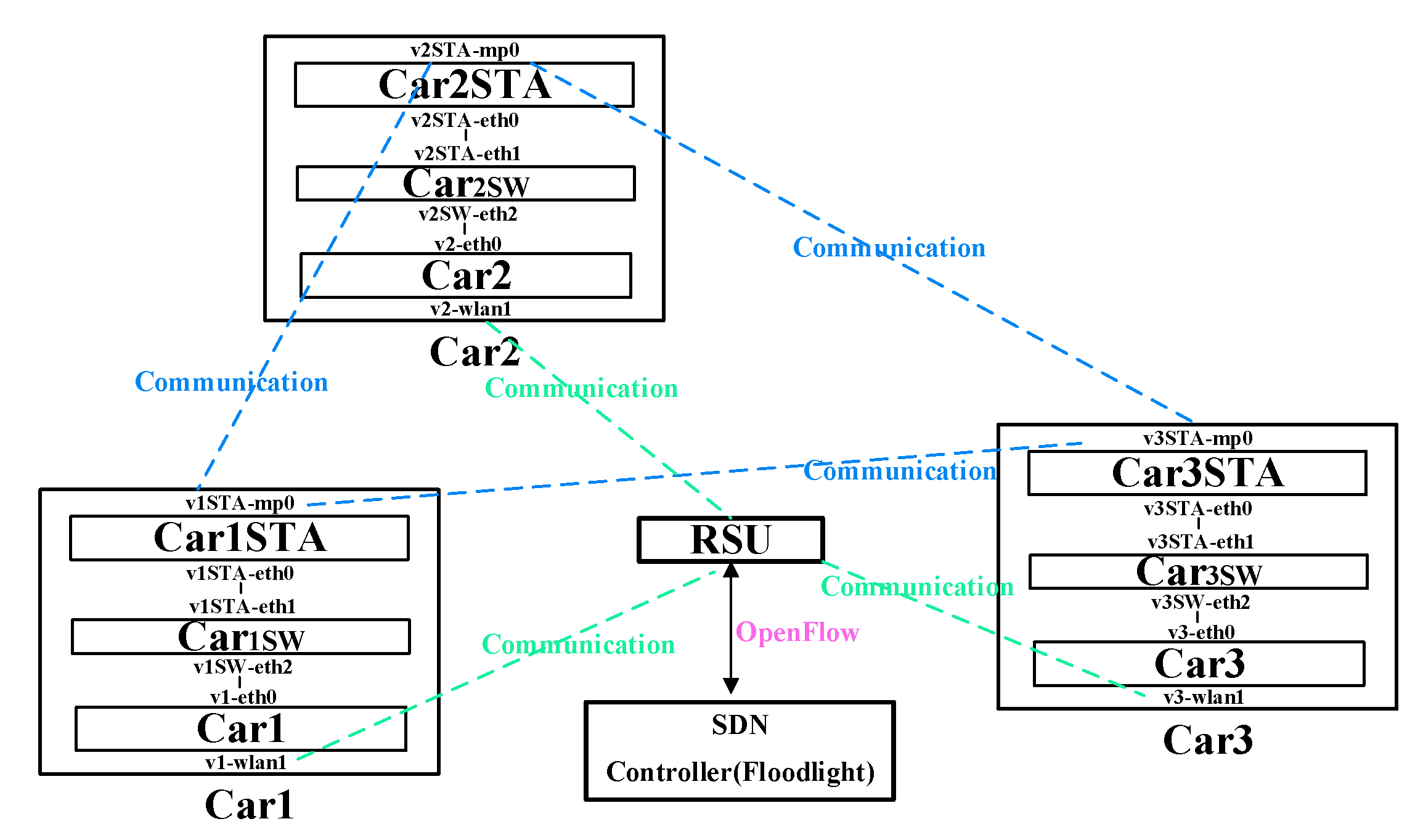
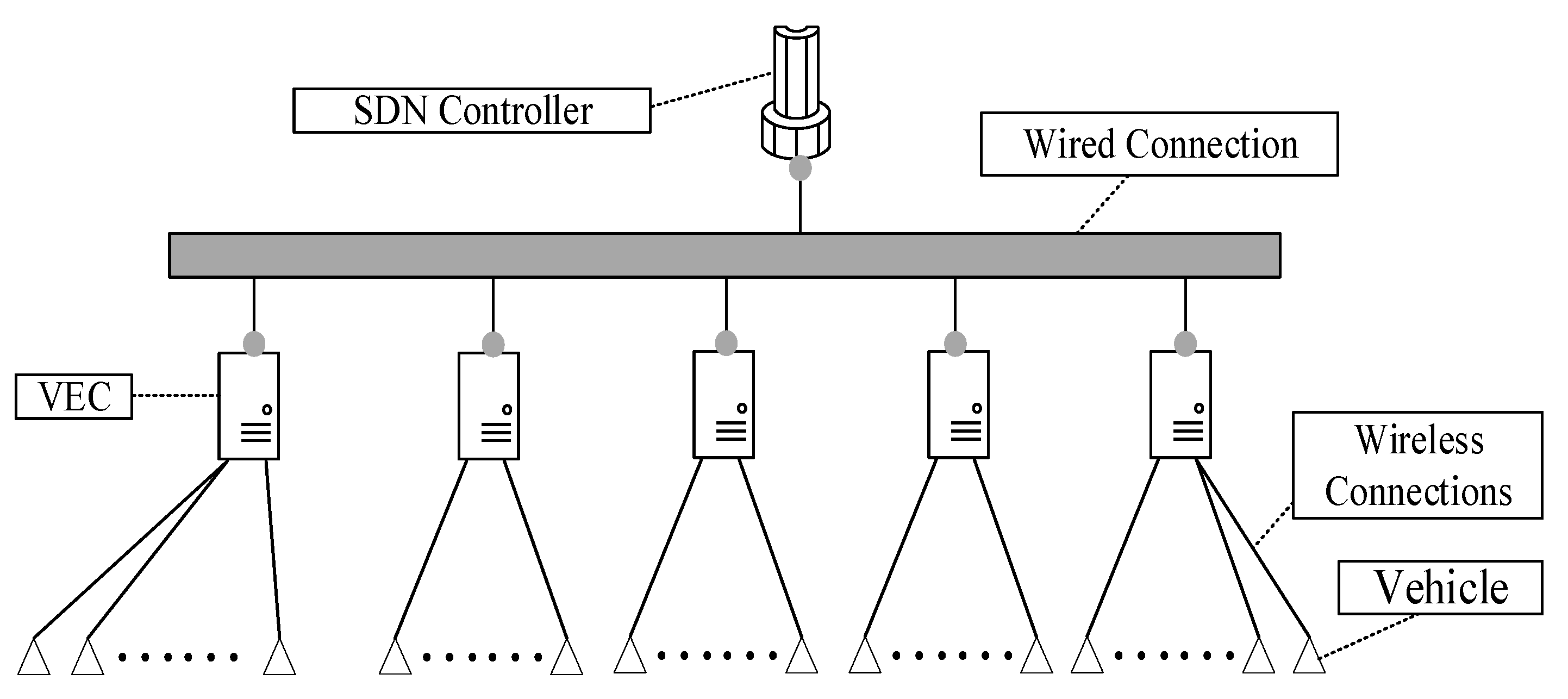
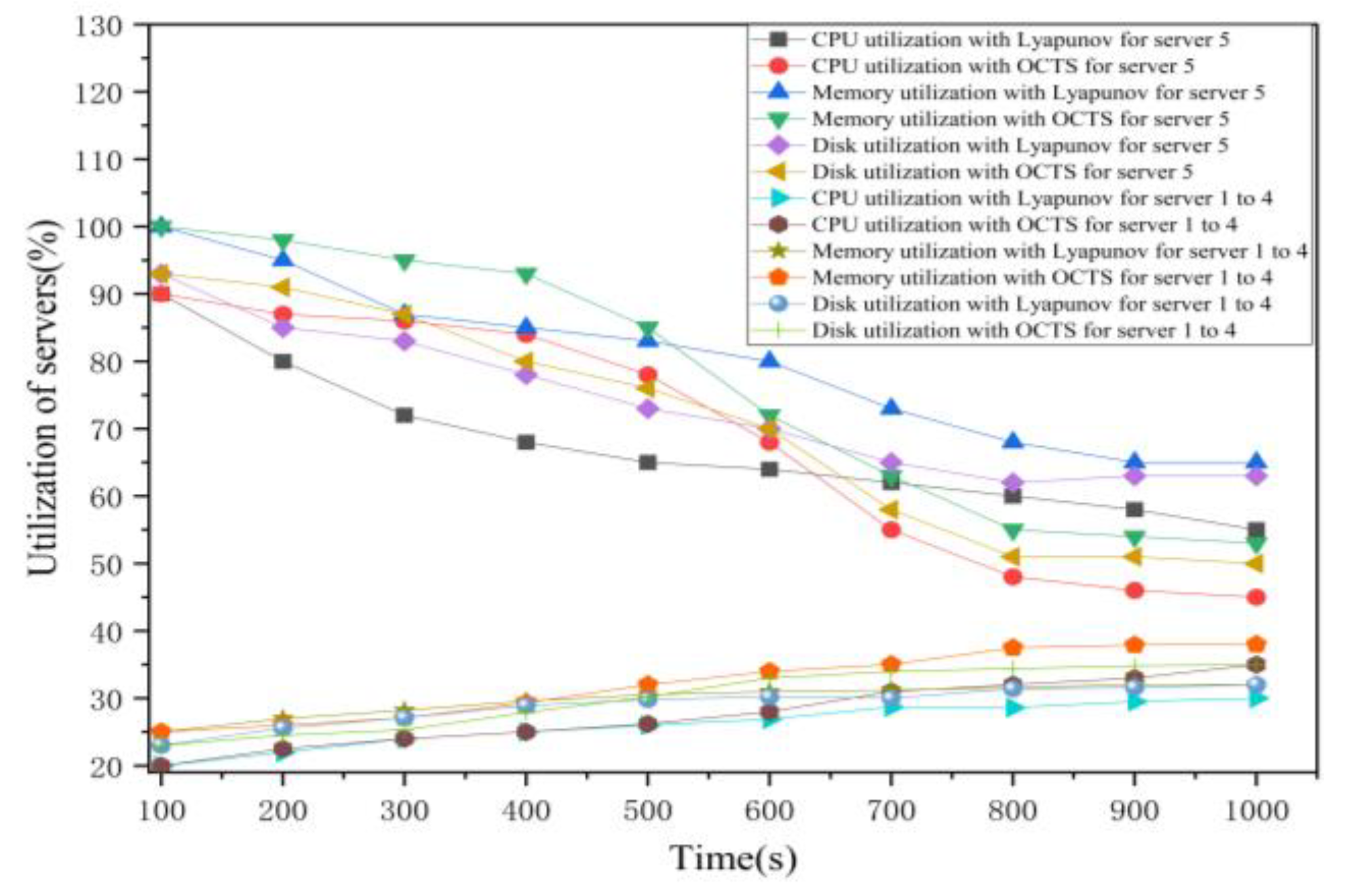
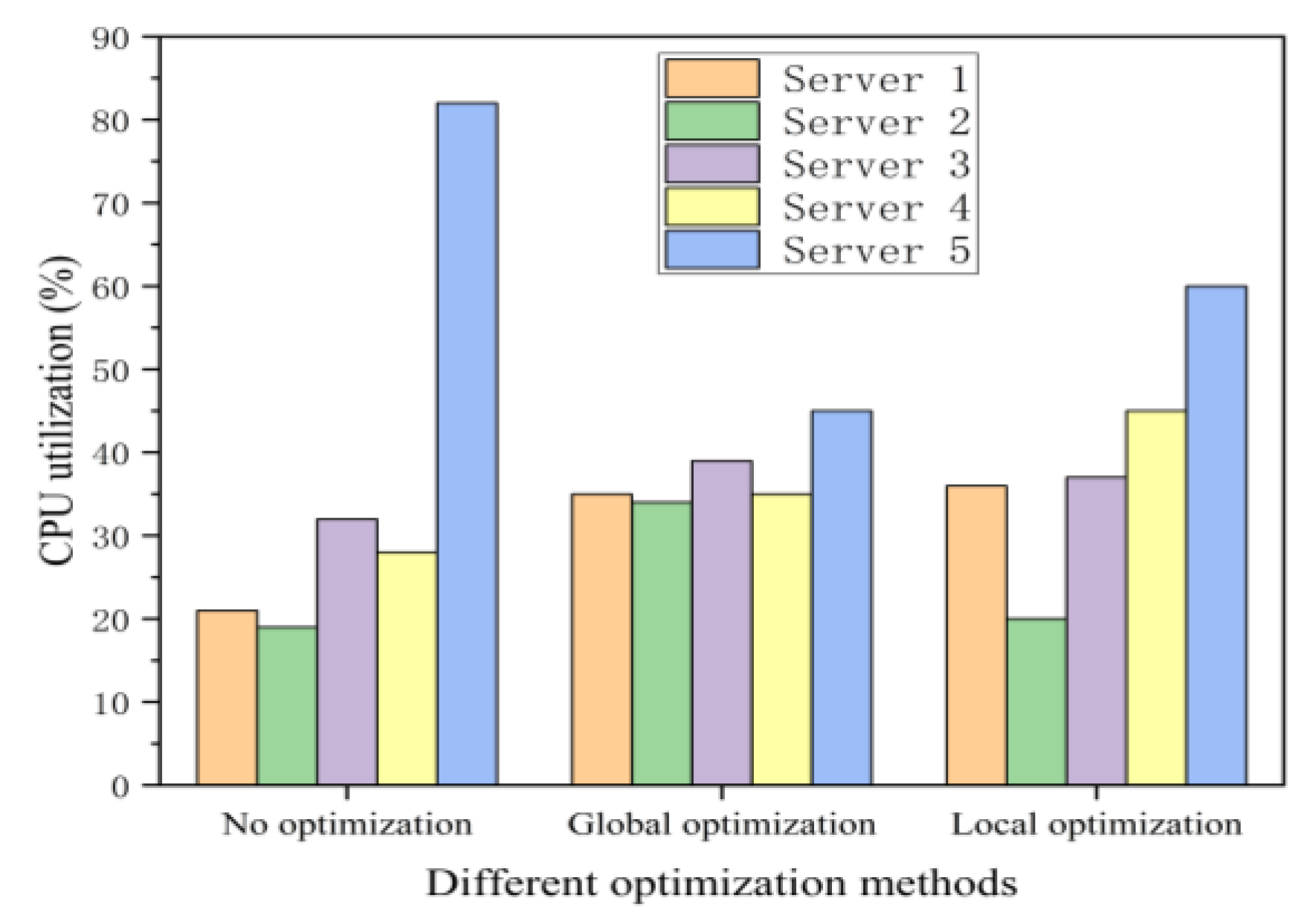
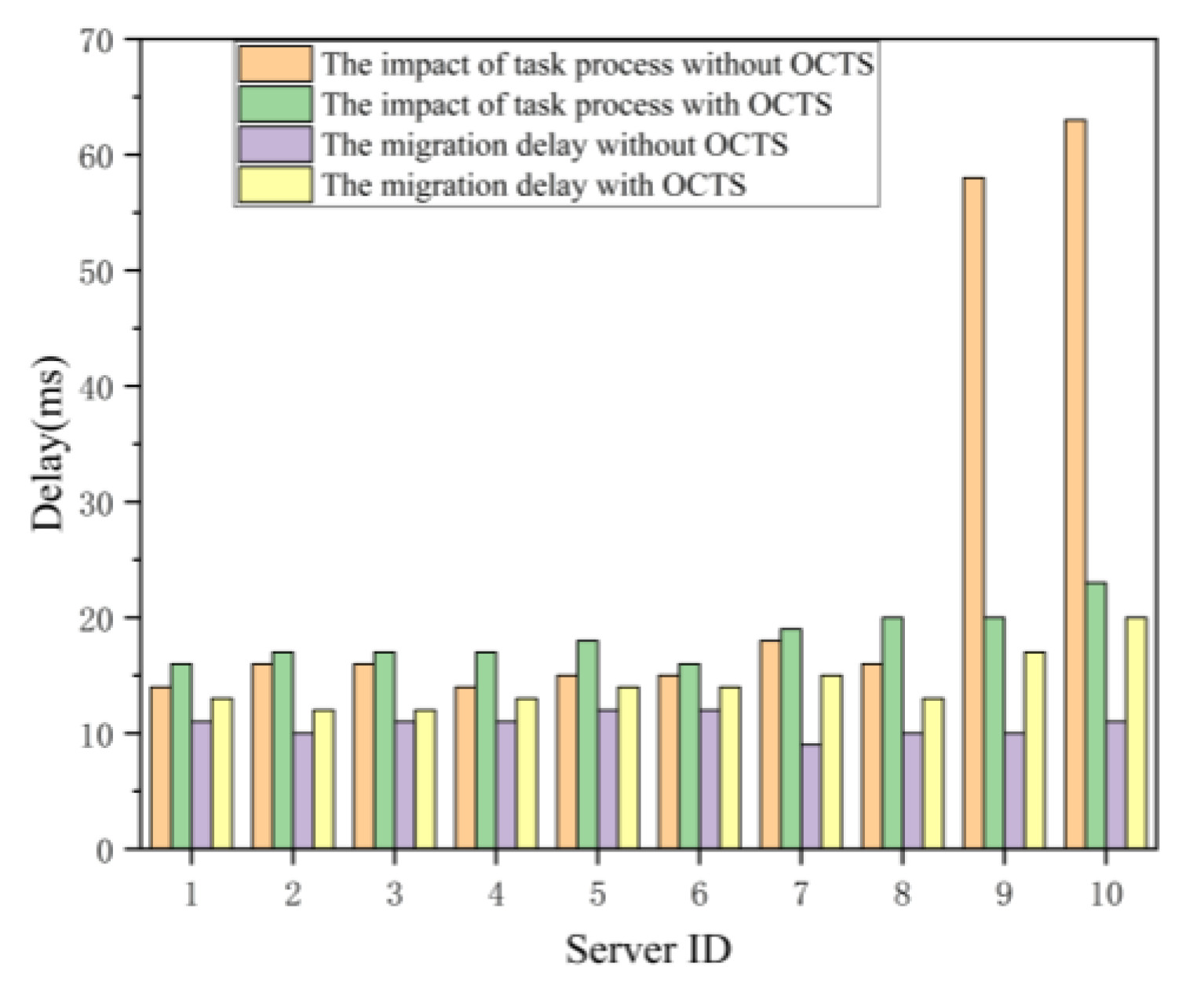
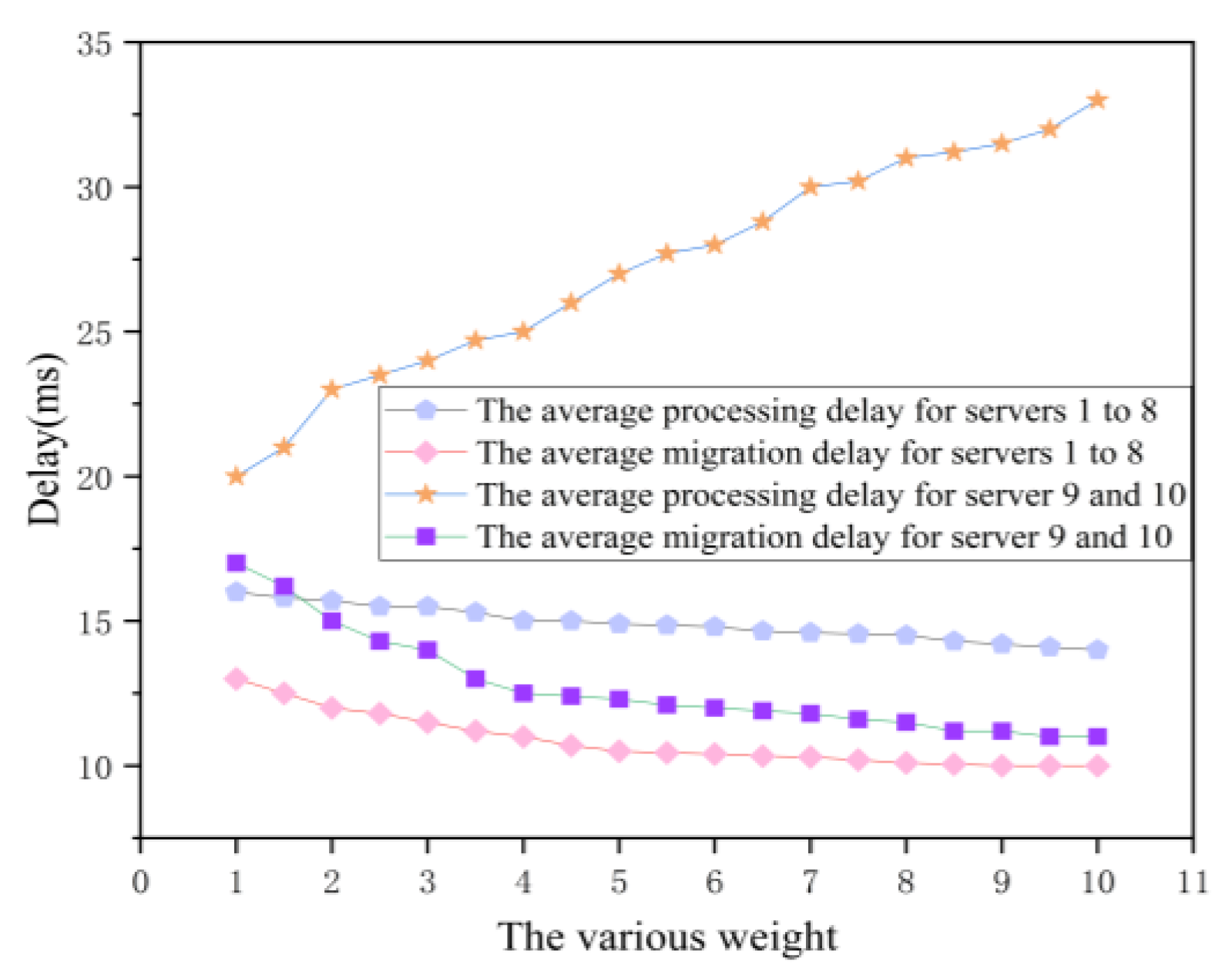

| Symbols | Description |
|---|---|
| The CPU frequency of VEC server | |
| The CPU clock period of VEC server | |
| The number of the tasks arriving at VEC server at time | |
| The task execution time on server at time | |
| The processing time to run tasks on server | |
| The number of the tasks sent form server to server | |
| The task transmission time with no network congestion | |
| The task transmission time on server | |
| The task execution time on server | |
| State variable for VEC server | |
| The convergence cycle of the system at time | |
| The optimal routing trajectory at time | |
| The optimal control vector at time | |
| Threshold value of CPU utilization | |
| The optimum range of CPU utilization for a VEC server | |
| The vector form of | |
| The execution time and transmission time incurred by offloaded task scheduling | |
| A coefficient which is used to adjust the weight of the offloaded task transmission time |
| Impact Factors on CPU Utilization | CPU Utilization of Servers 1 to 5 | ||||
|---|---|---|---|---|---|
| 1 | 2 | 3 | 4 | 5 | |
| The first set of servers without any impact | 20 | 20 | 30 | 30 | 80 |
| The impact of Lyapunov on the first set of servers | 33 | 33 | 35 | 35 | 48 |
| The impact of OCTS on the first set of servers | 35 | 35 | 37 | 37 | 45 |
| The second set of serverswithout any impact | 20 | 20 | 30 | 30 | 90 |
| The impact of Lyapunov on second set of servers | 33 | 33 | 35 | 35 | 53 |
| The impact of OCTS on the second set of servers | 35 | 35 | 39 | 39 | 49 |
Publisher’s Note: MDPI stays neutral with regard to jurisdictional claims in published maps and institutional affiliations. |
© 2021 by the authors. Licensee MDPI, Basel, Switzerland. This article is an open access article distributed under the terms and conditions of the Creative Commons Attribution (CC BY) license (http://creativecommons.org/licenses/by/4.0/).
Share and Cite
Li, Z.; Peng, E. Software-Defined Optimal Computation Task Scheduling in Vehicular Edge Networking. Sensors 2021, 21, 955. https://doi.org/10.3390/s21030955
Li Z, Peng E. Software-Defined Optimal Computation Task Scheduling in Vehicular Edge Networking. Sensors. 2021; 21(3):955. https://doi.org/10.3390/s21030955
Chicago/Turabian StyleLi, Zhiyuan, and Ershuai Peng. 2021. "Software-Defined Optimal Computation Task Scheduling in Vehicular Edge Networking" Sensors 21, no. 3: 955. https://doi.org/10.3390/s21030955
APA StyleLi, Z., & Peng, E. (2021). Software-Defined Optimal Computation Task Scheduling in Vehicular Edge Networking. Sensors, 21(3), 955. https://doi.org/10.3390/s21030955



