


Abstract
Nowadays, the use of insoles in sport practice have been recognized to decrease the foot and lower limb injury patterns. The aim of this study was to analyse the effect of four types of hardness insoles (HI) in the activity patterns of the hip and thigh muscles (HTM) in motoriders during motorcycling sport. The study was a crossover trial. Subjects were elite motoriders. The mean age was 33 ± 5.14 years. Electromyography (EMG) of hip and thigh muscles (HTM) data was registered via surface while subjects were riding on an elite motorcycle simulator. Subjects had to complete different tests with randomly hardest insoles (HI): 1: only polypropylene (58° D Shore); 2: Polypropylene (58° D Shore) with selective aluminium in hallux and metatarsal heads (60 HB Brinell hardness); 3: Ethylene vinyl acetate (EVA) (52° A Shore); and finally, 4: Ordinary EVA (25° A Shore) as the control. EMG patterns of the HTM, riding on an elite motorcycle simulator, showed the lowest peak amplitude with the insoles with polypropylene and selective aluminium. Using the hardest insoles in our study (selective aluminium) the EMG amplitude peaks decreased in all HTM.
1. Introduction
Motorider performance in speed circuit race arises from various elements: motorider physical condition, motorcycle elements composition: tires, suspensions, brakes, chassis, engine and, finally, environmental factors. Competing motorcycles and speed circuits are not identical, and the hip and lower limb muscular fatigue influence in riders remains unmeasurable. Published research focusing on biomechanical and muscular fatigue in riders is relatively sparse [1,2]. Motoriders undergo a high physical load while they quickly accelerate and abruptly decelerate. They attempt to gain control of the centre of mass distribution of the motorcycle in various riding requirements, for example, when a motorider is negotiating straights and turns [3,4].
Muscular tiredness is a very complex phenomenon. It can be depicted as a time-dependent practice induced depletion in the maximum contraction force of each muscle [5]. Loss of strength depends on the duration and intensity of practise and on the kind of muscular shrinkage [6]. Research has focused on upper limb riders injuries [7,8,9]. Hip and thigh muscles play a suitable role across the forces made by the feet on the footpeg in motorcycling performance [10]. Currently, we have found in the scientific literature recent studies that describe the importance and influence of the motorider physical condition on the performance riding on a motorcycle. A poor physical condition produce an increase in muscle fatigue and, therefore, a performance decrease. Likewise, sudden muskuloesqueletal movements riding on the motorcycle with a deficient physical condition will produce injuries [11]. Highlight Achilles tendinophaty, patellofemoral syndrome, shallow soft tissue, knee pain, due to sudden changes on the motorcycle and plantar injury like paraesthesia due to an increase of plantar pressure on the footpeg [11,12,13,14].
Nowadays, the impact of the prevalence and complaints rate of HTM alterations showed an estimated range around of 10% and 40% that commonly appear in the practice of the various types of bicycles that include: 1: bike motocross, 2: motorcycling sport, 3: road bike, 4: stationary cycles and 5: stunt bicycles [13].
These injuries present an assortment of multifactorial reasons associated with: Abnormality of HTM, musculoesqueletal disturbance, features of riding surroundings, male genus morphological characteristics, the kind of boot and foot pedal strength, which continue without be clear due to the complex structure and factors that involve this problem [1,15].
Nonetheless, any prior investigation has evaluated this issue related to EMG patterns in riders during the motorcycling sport and the effects of different HI in the activity of HTM. These tools are generally utilized to assess muscle patterns activity in the cycling. Preceding reports recorded meaningful oscillations in the EMG patterns of HTM during the praxis of cycling sports [14,16,17].
Based on these depositions, the principal purpose of our investigation was to evaluate the effect of four types of hardness CFI in the activity patterns of the hip and thigh muscles (HTM) in healthy people during motorcycling sport. The hypothesis in our inquiry is that participants wearing different HI performing motorcycling may display variations in the EMG of the HTM. The principal main goal is to determinate which material of the HI decrease EMG patterns.
2. Materials and Methods
2.1. Design and Sampling
Nine male healthy motorcycle riders participated in outpatient foot specialist clinic, in the town of Madrid (Spain) from November to December 2018. A crossover study (prospectively registered in ClinicalTrials.gov as NCT03734133 on November 28, 2018) was carried out and a non-random consecutive sampling method was applied to recruit all participants. The inclusion criteria comprised: (1) at least eighteen years old, (2) healthy motorcycle riders without medical problems in the clinical record neither family history with relevant illness and (3) riders who understood and signed the informed consent document for participation in our research. Additionally, the exclusion criteria included: (1) medical trauma and a history of leg problems, (2) musculoskeletal disturbances, (3) vascular diseases, (4) refusal to sign and deliver consent informed document and (5) an inability to understand the protocol to perform our research. Data were collected as previously describe in [18].
Other hand, our study was accomplished succeeding the guidelines and list for Template for Intervention Description and Replication (TIDieR) [19].
2.2. Method
At first time a preliminary evaluation was focused on a general physical condition, socio-demographic data composed by (1) age, (2) sex, (3) height, (4) weight, (5) Body Mass Index (BMI) and (6) foot size, chronic diseases with dysfunction like musculoskeletal disorders and, finally, enjoyment activities. A specialized motorcycle sport podiatrist physically evaluated each subject and took the measurement of anthropometric variables, like height, weight, and BMI.
A professional motorcycle simulator was used in our study. The simulator has the shape of a sport motorcycle and a television screen was at the front of the simulator playing a real motor racing. A video of a speed circuit is projected in the television screen riding at the back of a professional rider. Circuit of the Americas was the speed circuit chosen due to the amount of linked turns and large straights. In this way, riders performed the same movements on a real speed circuit. Participants had to speed up the simulator and then, when taking a turn, decelerate. To performance well, participants had to move their bodies up and down, moving the centre of gravity of the moto-pilot inward and outwards on the simulator to the various degrees required to finish the test. The top inclination of the simulator was 60° and riders had to rest their knees on the floor, like riding on real circuit.
Before starting the test, subjects had the opportunity of accommodation on the motorcycle simulator riding for a period of two-minute. Riders’ accommodation consisted of riding on the simulator, making a first contact on the motorcycle in order to test their adaptation and feeling of comfort with their motorcycle boots on the footpeg. Each rider wore motorcycle boots with a standard template.
During the test, participants were asked to complete more or less maximum speed simulated in straight-a-ways and at reduced speeds in turns, for a riding period of 20 minutes for every HI test accomplished. Participants rested for five minutes between each 20 minutes testing session for each HI on the simulator. Data were collected from the right leg in right and left turns. The order in which HI were tested was random.
We assessed four types of HI: only polypropylene (58° DShore); polypropylene (58° DShore) with selective aluminium in hallux and metatarsal heads (60HB Brinell hardness); ethylene vinyl acetate (EVA) (52° AShore); and, finally, ordinary EVA (25° AShore) as the control.
For our research six right leg muscles were tested with EMG: 1) fibularis brevis, 2) fibularis longus, 3) tibialis anterior, 4) gastrocnemius lateralis, 5) gastrocnemius medialis and 5) soleus. Previously, every subject was prepared for testing in a quiet place. Subject skin was depilated and cleaned with 70% alcohol liquid and, later, electrodes were affixed to the six muscle areas. Previously, each subject was prepared for testing in a quiet place. Subjects’ skin was depilated, cleaned with 70% alcohol liquid, and abraded to decrease electrical impedance between electrodes to less than 5 kΩ.
The accurate whereabouts of the seven electrodes (channel E1 to E7) were as follows:
- E1:
- Biceps femoris: middle line since the ischial tuberosity to the lateral epicondyle of the tibia.
- E2:
- Gluteus maximus: middle line between the sacrum to the bigger trochanter.
- E3:
- Gluteus medius: middle line from the iliaca crest to the trochanter.
- E4:
- Semitendinous: middle line since the ischial tuberosity to the medial epicondyle of the tibia.
- E5:
- Tensor fasciae latae: middle line since the anterior-superior spina iliaca to the lateral femoral condyle.
- E6:
- Vastus lateralis: 2/3 on the line since the anterior-superior spina iliaca to the patella lateral side.
- E7:
- Vastus medialis: since the anterior-superior spina iliaca to the joint space of the medial ligament.
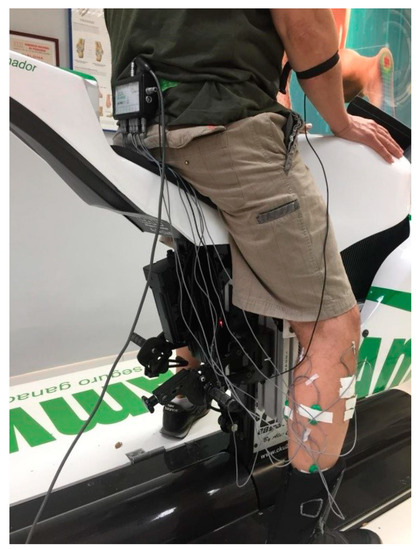
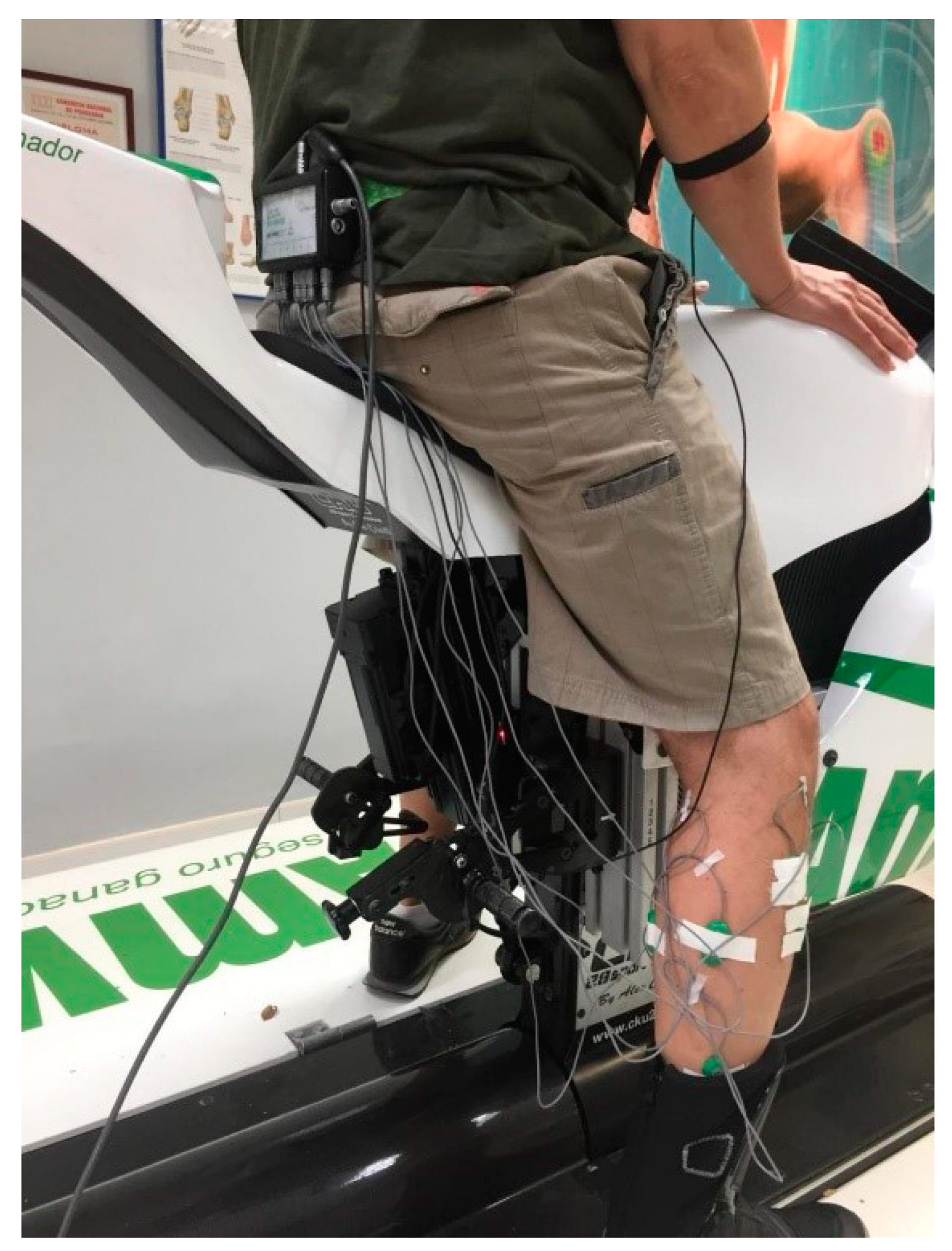
The surface electrodes were placed 2 cm apart (positive and negative) and parallel on the six muscle areas and fixed with hypoallergenic tape to prevent from peeling or moving on the skin (Figure 1) [20].
Figure 1.
Right EMG electrodes positioning and their channels (E1–E7).
Each subject performed, for a duration of eight seconds, three maximum voluntary isometric contractions (MVIC), which were recorded for every muscle analysed [21]. This enabled time for the subject to assemble the contraction and for the trial to steady the lower limb. The purpose was to normalize the maximal amplitude. A well-known limitation is the subject’s veracity in performing the MVIC properly [21]. Even knowing that each contraction varies and decreases due to muscle fatigue in an effort, it is better to normalize values in the way described before than not to establish standard values of normality [22]. Subjects rested for a period of time of one or two minutes to decrease the effect of muscular fatigue [23].
The EMG electrodes came out from a light-handed backpack interface, the model was MWX8. The EMG data was recorded with the program DataLINK (Biometrics Ltd., Ladysmith, VA, USA) (version 5.0).
2.3. Statistical Analysis
Statistical analyses were performed according to the methods proposed by a prior research study [18]. First, Shapiro–Wilk tests were applied to assess normality of the socio-demographic data and outcome measurements. According to these results, a normal distribution was determined if the p-value was ≥ 0.05.
Second, socio-demographic characteristics, including age, BMI, Spanish foot size, height and weight, were described using standard deviations (SDs) and 95% confidence intervals (95% CIs).
Third, reliability was assessed within trials for each rider by intraclass correlation coefficients (ICCs). According to these analyses, ICCs values were considered as poor (ICCs < 0.40), fair (ICCs = 0.40–0.59), good (ICCs = 0.60–0.74), and excellent (ICCs ≥ 0.75) [24,25]. Reliability coefficients > 0.90 were adequate for clinical measurements as proposed by Portney and Watkins [26]. In addition, means and SDs as well as standard error of measurements (SEMs) were calculated [24]. SEMs were determined according to Bland and Altman’s formula (SEMs = SD × sqrt (1−ICC)) [27].
Fourth, minimal detectable changes (MDCs) were calculated in order to determine the minimal change’s magnitudes to get a 95% CI regarding changes observed between two tests to reflect the true changes and avoid measurement errors [28]. MDCs were calculated according to SEMs values (SEMS = 1.96 × SEM × √2).
Fifth, Cohen’s d coefficients were determined in order to report effect sizes for between-groups comparisons. Effect sizes were considered as slight (d ≤ 0.20), fair (d = 0.20–0.49), moderate (d = 0.50–0.79) and large (d > 0.79) [29].
Finally, Mann–Whitney U tests were used to determine statistically significant differences for between-groups comparisons according to non-parametric data results of the Shapiro–Wilk tests. Regarding all tests, p-values < 0.05 were considered as statistically significant. Furthermore, SPSS 19.0 (Windows; IBM; Chicago, IL, USA) was used to carry out all statistical analyses.
3. Results
The sociodemographic characteristics of our study are shown in Table 1.
Table 1.
Sociodemographic characteristics.
Results of the Shapiro–Wilk test of the HTM using randomly HI types performing left and right turns on the simulator are shown in Table 2. Results for EMG activity in the HTM using random HI types for different turns on the simulator are displayed in Table 3.
Table 2.
Normality test of the EMG variables of the thigh and hip muscles for different HI.
Table 3.
Results of the Intraclass correlation coefficient, standard error of measurement and minimal detectable change for electromyography activity patterns of the Hip and Thigh muscles by types of hardness insoles for left and right turns on the simulator.
Table 4 displays the results of EMG peak amplitude patterns by sort of HI for different turns on the simulator. All muscle reduce peak amplitude patterns with harder insoles except for the tensor fasciae latae in right and left turns. This muscle increases the peak amplitude with herder insoles.
Table 4.
Measurement of the Peak amplitude of the electromyographic patterns of the Thigh and Hip muscles for different HI for left and right turns on the simulator.
Table 5 display the comparison between couple of HIs on the EMG peak activity patterns. The smallest amplitude peaks results were obtained with the selective aluminium HI compared with the others templates. The value was p < 0.001 in all muscle analysed. Nevertheless, polypropylene 58° D Shore HI displayed lesser EMG amplitude peaks than EVA compared with ordinary EVA for all muscles analysed (p < 0.001). The results for wearing EVA are lower in comparison with ordinary EVA for all muscles.
Table 5.
Correlation between different kinds of hardness insoles with regard to EMG activity patterns of the Thigh and Hip muscles.
4. Discussion
The aim of the study was to identify hip and thigh muscles and decrease the activity of muscular patterns using hard insoles while riding on a motorcycle. There are several studies about the influence of lower limb muscles during cycling with EMG [30,31,32,33]. Notably, Bousie et al. analysed the variation of the plantar pressures using templates with different hardness during cycling, concluding that contoured templates raised contact area in cycling [31]. Further, Casado et al. described changes in motoriders’ plantar pressures using different custom foot insoles with different hardness when subjects rode on a motorcycle simulator, resulting in metatarsal foot heads and hallux pressures decreasing with the hardest custom foot insoles [34].
Fortier Guillaume et al. analysed EMG patterns of horse riders and their findings were that biceps femoris, gluteus maximus and rectus femoris had a continuous pattern of activation throughout the cross-country course. They suggest that these muscles are stabilisers and coordinators of the horse rider’s [35].
Speed circuit is composed by straights and multiple turns and bends that requires motoriders a high precise control of the dynamics and the distribution of the centre of mass of the sport motorcycle. The rider achieves stability on the motorcycle with the whole body, with the upper limbs supported by the hands on the handlebars and handles, with the leg resting against the motorcycle fairing and, finally, with the foot resting on the footpeg. Motoriders execute load transfers on the motorcycle in the course of variations in speed and quick tilts on turns that demand repeated physical effort [1,32].
In our research, we found lower HTM activity when the subject’s knee was on the motorcycle, specifically in left cornering, being higher in right cornering, that is to say, when the subject knee was on the ground. This difference may be due to the rider having to lift the motorcycle to the vertical position and the maximum strength does it with the leg that is in contact with the ground. There is a lack of research with respect to measurements regarding the thigh and hip muscles strength of riders. We have found research regarding the influence of upper limb muscles on handgrip strength and lumbar isometric strength [1,2,3,36].
Tomida et al analysed the incidence of injuries in elite competitors but in their research there is a lack of lower limb muscle injury patterns. Most of the injuries were about fractures following ligament injury, but not of muscle injuries [37].
In our study, we analysed the alteration in the EMG patterns in the right hip and right leg of each subject cornering in left and right turns using different HIs. Riders get motorcycle stability taking a turn knocking with the knee on the inside of the turn and, consequently, a great force on the footrest with the medial side of the forefoot is applied. On the other hand, the opposite leg rests on the motorcycle chassis, preparing the stability to put the rider in a neutral position once cornering is finished. Biomechanically, the main role of the tensor fascia latae (TFL) muscle is swinging the weight of the body, and performing hip abduction for the non-weight-holding leg during walking [38]. The TFL performs the most muscle activity in both right and left turns. This is due to its main function in abduction and internal rotations of hip and knee flexor. For these reason the TFL is one of the most significant muscles for maintaining steadiness at the time that the knee touches the floor on the turn. These movements are constantly performed by riders in a turn to the right and left.
The results in our study wearing the select aluminium HI had considerably lesser muscle amplitude peaks than the other HIs for the gluteus maximus; gluteus medius; rectus femoris; biceps femoris; semitendinous; vastus lateralis and vastus medialis. For the TFL the select aluminum HI had considerably lesser muscle amplitude peaks than other HIs in different turns, but considerably higher peak amplitude than other muscles. We suppose that the elevated activity of the TFL in right and left turns, when the knee contacts on road and the knee is close to the motorcycle, increases steadiness in riding. Additionally, reduced activity of the other HTM in turns would probably help to reduced fatigue in riding.
More research in sport motorcycling are necessary to study the biomechanical performance of the hip and lower limb muscles due to the complexity of the movements performed by a rider taking multiple turns and the influence of extrinsic factors, such us gravity force and inertia. Data we obtained in our study could assess the overloading of HTM in such situations.
A limitation of our study is the lack of inertial forces and steering control challenges in our simulator that occur when riding a motorcycle on a real speed circuit. Further research is needed on the physical effects of motorcycling during actual sport races.
5. Conclusions
Using the hardest templates in our study (selective aluminium) the EMG amplitude peaks decreased in all HTM. In order from lower amplitude peaks in HIs were polypropylene 58° D Shore, EVA 52° A Shore, and ordinary EVA 25° A Shore. Likewise, the TFL was the only muscle that maintained a constant contraction in right and left turns, being the main stabilizer in sport motorcycling.
Ethical Statement
An ethics committee approved our research (number C.I. 18/506-E). To take part in the research every subject signed a consent inform. Our research procedures complied with the Declaration of Helsinki ethical procedures.
Author Contributions
Conceptualization, I.C.-H., R.B.-d.-B.-V., M.E.L.-I., E.M.M.-J., D.L.-L., C.R.-M., V.M.-P. and C.C.-L.; methodology, I.C.-H., R.B.-d.-B.-V., M.E.L.-I., E.M.M.-J., D.L.-L., C.R.-M., V.M.-P. and C.C.-L.; software, I.C.-H., R.B.-d.-B.-V., M.E.L.-I.; validation, I.C.-H., R.B.-d.-B.-V., M.E.L.-I., E.M.M.-J., D.L.-L., C.R.-M., V.M.-P. and C.C.-L.; formal analysis, I.C.-H., R.B.-d.-B.-V., M.E.L.-I., D.L.-L. and C.C.-L.; investigation, I.C.-H., R.B.-d.-B.-V., M.E.L.-I., E.M.M.-J., D.L.-L., C.R.-M., V.M.-P. and C.C.-L.; resources, I.C.-H., R.B.-d.-B.-V., M.E.L.-I., E.M.M.-J., D.L.-L., C.R.-M., V.M.-P. and C.C.-L.; data curation, I.C.-H.; writing—original draft preparation, I.C.-H., R.B.-d.-B.-V., M.E.L.-I., E.M.M.-J., D.L.-L., C.R.-M., V.M.-P. and C.C.-L.; writing—review and editing, I.C.-H., R.B.-d.-B.-V., M.E.L.-I., E.M.M.-J., D.L.-L., C.R.-M., V.M.-P. and C.C.-L.; visualization, I.C.-H., R.B.-d.-B.-V., M.E.L.-I., E.M.M.-J., D.L.-L., C.R.-M., V.M.-P. and C.C.-L.; supervision, I.C.-H., R.B.-d.-B.-V., M.E.L.-I., E.M.M.-J., D.L.-L., C.R.-M., V.M.-P. and C.C.-L.; project administration, I.C.-H., R.B.-d.-B.-V., M.E.L.-I., E.M.M.-J., D.L.-L., C.R.-M., V.M.-P. and C.C.-L. All authors have read and agreed to the published version of the manuscript.
Conflicts of Interest
The authors declare no conflict of interest.
Abbreviations
| EMG | Electromyography |
| HTM | Hip and thigh muscles |
| HI | Hardest insoles |
| EVA | Ethylene Vinyl Acetate |
| BMI | Body Mass Index |
| MDC | Minimal detectable change |
References
- D’Artibale, E.; Tessitore, A.; Capranica, L. Heart rate and blood lactate concentration of male road-race motorcyclists. J. Sports Sci. 2008, 26, 683–689. [Google Scholar] [CrossRef] [Scilit]
- Gobbi, A.W.; Francisco, R.; Tuy, B.; Kvitne, R.S.; Nakamura, N. Physiological characteristics of top level off-road motorcyclists. Br. J. Sports Med. 2005, 39, 927–931. [Google Scholar] [CrossRef] [Scilit]
- D’Artibale, E.; Laursen, P.B.; Cronin, J.B. Profiling the physical load on riders of top-level motorcycle circuit racing. J. Sports Sci. 2017, 36, 1–7. [Google Scholar] [CrossRef] [Scilit] [PubMed]
- Marina, M.; Rios, M.; Torrado, P.; Busquets, A.; Angulo-Barroso, R. Force-time course parameters and force fatigue model during an intermittent fatigue protocol in motorcycle race riders. Scand. J. Med. Sci. Sports 2014, 25, 406–416. [Google Scholar] [CrossRef] [Scilit] [PubMed]
- Gandevia, S.C. Spinal and supraspinal factors in human muscle fatigue. Physiol. Rev. 2001, 81, 1725–1789. [Google Scholar] [CrossRef] [Scilit] [PubMed]
- Millet, G.Y.; Lepers, R. Alterations of neuromuscular function after prolonged running, cycling and skiing exercises. Sports Med. 2004, 34, 105–116. [Google Scholar] [CrossRef] [Scilit]
- Varley, G.; Spencer-Jones, R.; Thomas, P.; Andrews, D.; Green, A.; Stevens, D. Injury patterns in motorcycle road racers: Experience on the Isle of Man 1989–1991. Injury 1993, 24, 443–446. [Google Scholar] [CrossRef] [Scilit]
- Chapman, M.A.; Oni, J. Motor racing accidents at Brands Hatch, 1988/9. Br. J. Sports Med. 1991, 25, 121–123. [Google Scholar] [CrossRef] [Scilit]
- Horner, C.H.; O’Brien, A.A. Motorcycle racing injuries on track and road circuits in Ireland. Br. J. Sports Med. 1986, 20, 157–158. [Google Scholar] [CrossRef] [Scilit]
- Gregor, R.J.; Wheeler, J.B. Biomechanical Factors Associated with Shoe/Pedal Interfaces. Sports Med. 1994, 17, 117–131. [Google Scholar] [CrossRef] [Scilit]
- Ramos-Ortega, J.; Domínguez-Maldonado, G.; Castillo, J.M.; Fernández-Seguín, L.; Munuera, P.V.; Munuera-Martínez, P.V. Angular position of the cleat according to torsional parameters of the cyclist’s lower limb. Clin. J. Sport Med. 2014, 24, 251–255. [Google Scholar] [CrossRef] [Scilit] [PubMed]
- Mellion, M.B. Common cycling injuries. Sports Med. 1991, 11, 52–70. [Google Scholar] [CrossRef] [Scilit] [PubMed]
- Thompson, M.J.; Rivara, F.P. Bicycle-related injuries. Am. Fam. Physician 2001, 63, 2007–2014. [Google Scholar] [PubMed]
- Momeni, K.; Faghri, P.D.; Evans, M. Lower-extremity joint kinematics and muscle activations during semi-reclined cycling at different workloads in healthy individuals. J. Neuroeng. Rehabil. 2014, 11, 146. [Google Scholar] [CrossRef] [Scilit]
- Brearley, M.; Norton, I.; Kingsbury, D.; Maas, S. Responses of elite road motorcyclists to racing in tropical conditions: A case study. Int. J. Sports Physiol. Perform. 2014, 9, 887–890. [Google Scholar] [CrossRef] [Scilit]
- Baum, B.S.; Li, L. Lower extremity muscle activities during cycling are influenced by load and frequency. J. Electromyogr. Kinesiol. 2003, 13, 181–190. [Google Scholar] [CrossRef] [Scilit]
- Hug, F.; Laplaud, D.; Lucia, A.; Grélot, L. EMG threshold determination in eight lower limb muscles during cycling exercise: A pilot study. Int. J. Sports Med. 2006, 27, 456–462. [Google Scholar] [CrossRef] [Scilit]
- Casado-Hernández, I.; Vallejo, R.B.D.B.; Iglesias, M.E.L.; López-López, D.; Rodríguez-Sanz, D.; Jiménez, E.M.M.; Calvo-Lobo, C. Electromyographic evaluation of the impacts of different insoles in the activity patterns of the lower limb muscles during sport motorcycling: A cross-over trial. Sensors 2019, 19, 2249. [Google Scholar] [CrossRef] [Scilit]
- Hoffmann, T.C.; Glasziou, P.P.; Boutron, I.; Milne, R.; Perera, R.; Moher, D.; Altman, D.G.; Barbour, V.; Macdonald, H.; Johnston, M.; et al. Better reporting of interventions: Template for intervention description and replication (TIDieR) checklist and guide. BMJ 2014, 348, g1687. [Google Scholar] [CrossRef] [Scilit]
- Hermens, H.J.; Freriks, B.; Merletti, R.; Stegeman, D.; Blok, J.; Rau, G.; Disselhorst-Klug, C.; Hägg, G. European Recommendations for Surface ElectroMyoGraphy. Available online: http://www.seniam.org/pdf/contents8.PDF (accessed on 10 January 2020).
- Yang, J.F.; Winter, D.A. Electromyographic amplitude normalization methods: Improving their sensitivity as diagnostic tools in gait analysis. Arch. Phys. Med. Rehabil. 1984, 65, 517–521. [Google Scholar]
- Knutson, L.M.; Soderberg, G.L.; Ballantyne, B.T.; Clarke, W.R. A study of various normalization procedures for within day electromyographic data. J. Electromyogr. Kinesiol. 1994, 4, 47–59. [Google Scholar] [CrossRef] [Scilit]
- Cram, J.R.; Kasman, G.S.; Holtz, J. Introduction to Surface Electromyography; Jones & Bartlett Publishers: Burlington, MA, USA, 1998. [Google Scholar]
- Enderlein, G.; Fleiss, J.L. The Design and Analysis of Clinical Experiments. Wiley, New York—Chichester—Brislane—Toronto—Singapore 1986, 432 S., £38.35. Biom. J. 2007, 30, 304. [Google Scholar] [CrossRef] [Scilit]
- Hallgren, K.A. Computing inter-rater reliability for observational data: An overview and tutorial. Tutor Quant. Methods Psychol. 2012, 8, 23–34. [Google Scholar] [CrossRef] [Scilit] [PubMed]
- Portney, L.; Watkins, M. Foundations of Clinical Research: Applications to Practice; FA Davis: Philadelphia, PA, USA, 2009. [Google Scholar]
- Bland, J.M.; Altman, U. Statistical methods for assessing agreement between two methods of clinical measurement. Lancet 1986, 327, 307–310. [Google Scholar] [CrossRef] [Scilit]
- Stratford, P.W.; Binkley, J.; Solomon, P.; Finch, E.; Gill, C.; Moreland, J. Defining the minimum level of detectable change for the roland-morris questionnaire. Phys. Ther. 1996, 76, 359–365. [Google Scholar] [CrossRef] [Scilit]
- Cohen, J. A power primer. Psychol. Bull. 1992, 112, 155–159. [Google Scholar] [CrossRef]
- Watanabe, K.; Sato, T.; Mukaimoto, T.; Takashima, W.; Yamagishi, M.; Nishiyama, T. Electromyographic analysis of thigh muscles during track cycling on a velodrome. J. Sports Sci. 2015, 34, 1413–1422. [Google Scholar] [CrossRef] [Scilit]
- Bousie, J.; Blanch, P.; McPoil, T.G.; Vicenzino, B.T. Contoured in-shoe foot orthoses increase mid-foot plantar contact area when compared with a flat insert during cycling. J. Sci. Med. Sport 2013, 16, 60–64. [Google Scholar] [CrossRef] [Scilit]
- Yeo, B.K.; Bonanno, D.R. The effect of foot orthoses and in-shoe wedges during cycling: A systematic review. J. Foot Ankle Res. 2014, 7, 31. [Google Scholar] [CrossRef] [Scilit]
- McCormick, C.J.; Bonanno, D.R.; Landorf, K.B. The effect of customised and sham foot orthoses on plantar pressures. J. Foot Ankle Res. 2013, 6, 19. [Google Scholar] [CrossRef] [Scilit]
- Casado-Hernández, I.; Becerro-De-Bengoa-Vallejo, R.; López-López, D.; Gómez-Bernal, A.; Iglesias, M.E.L. Aluminum foot insoles reduce plantar forefoot pressure and increase foot comfort for motorcyclists. Prosthetics Orthot. Int. 2018, 42, 606–611. [Google Scholar] [CrossRef] [Scilit] [PubMed]
- Guillaume, J.F.; Laroche, D.; Babault, N. Kinematics and electromyographic activity of horse riders during various cross-country jumps in equestrian. Sports Biomech. 2019, 1–13. [Google Scholar] [CrossRef] [Scilit] [PubMed]
- Muñoz, C.S.; Rodriguez, M.; Casimiro-Andújar, A.J.; Ortega, F.B.; March, M.M.; Zabala, M. Physical profile of elite young motorcyclists. Int. J. Sports Med. 2011, 32, 788–793. [Google Scholar] [CrossRef] [Scilit] [PubMed]
- Tomida, Y.; Hirata, H.; Fukuda, A.; Tsujii, M.; Kato, K.; Fujisawa, K.; Uchida, A. Injuries in elite motorcycle racing in Japan. Br. J. Sports Med. 2005, 39, 508–511. [Google Scholar] [CrossRef] [Scilit] [PubMed]
- Gottschalk, F.; Kourosh, S.; Leveau, B. The functional anatomy of tensor fasciae latae and gluteus medius and minimus. J. Anat. 1989, 166, 179–189. [Google Scholar]

© 2020 by the authors. Licensee MDPI, Basel, Switzerland. This article is an open access article distributed under the terms and conditions of the Creative Commons Attribution (CC BY) license (http://creativecommons.org/licenses/by/4.0/).