Abstract
Scanning Superconducting Quantum Interference Device (SQUID) Susceptometry simultaneously images the local magnetic fields and susceptibilities above a sample with sub-micron spatial resolution. Further development of this technique requires a thorough understanding of the current, voltage, and flux () characteristics of scanning SQUID susceptometers. These sensors often have striking anomalies in their current–voltage characteristics, which we believe to be due to electromagnetic resonances. The effect of these resonances on the performance of these SQUIDs is unknown. To explore the origin and impact of the resonances, we develop a model that qualitatively reproduces the experimentally-determined characteristics of our scanning SQUID susceptometers. We use this model to calculate the noise characteristics of SQUIDs of different designs. We find that the calculated ultimate flux noise is better in susceptometers with damping resistors that diminish the resonances than in susceptometers without damping resistors. Such calculations will enable the optimization of the signal-to-noise characteristics of scanning SQUID susceptometers.
1. Introduction
Superconducting Quantum Interference Devices (SQUIDs) are superconducting loops interrupted by one or more Josephson weak links [1]. SQUIDs are used to achieve high-precision magnetic sensing for diverse applications, including gravitational-wave astrophysics [2,3], magnetoencephalography [4], quantum information [5], and scanning SQUID microscopy [6]. In scanning SQUID microscopy (SSM), SQUIDs are used to image the local magnetic fields above samples. Enhanced spatial resolution is achieved in SSM by either making very small SQUID loops [7,8,9] or integrating a small “pickup loop” into the body of a larger SQUID through well-shielded superconducting coaxial leads [10,11]. An extension of SSM is scanning SQUID susceptometry, in which susceptibility measurements are made by surrounding the pickup loop in the latter type of SQUID by a co-planar, co-axial single-turn field coil [12], often in a gradiometric configuration (see Figure 1). As sensitive techniques for probing mesoscopic materials, scanning SQUID magnetometry and susceptometry are paving the way for essential advances in superconductor physics [13].
Figure 1.
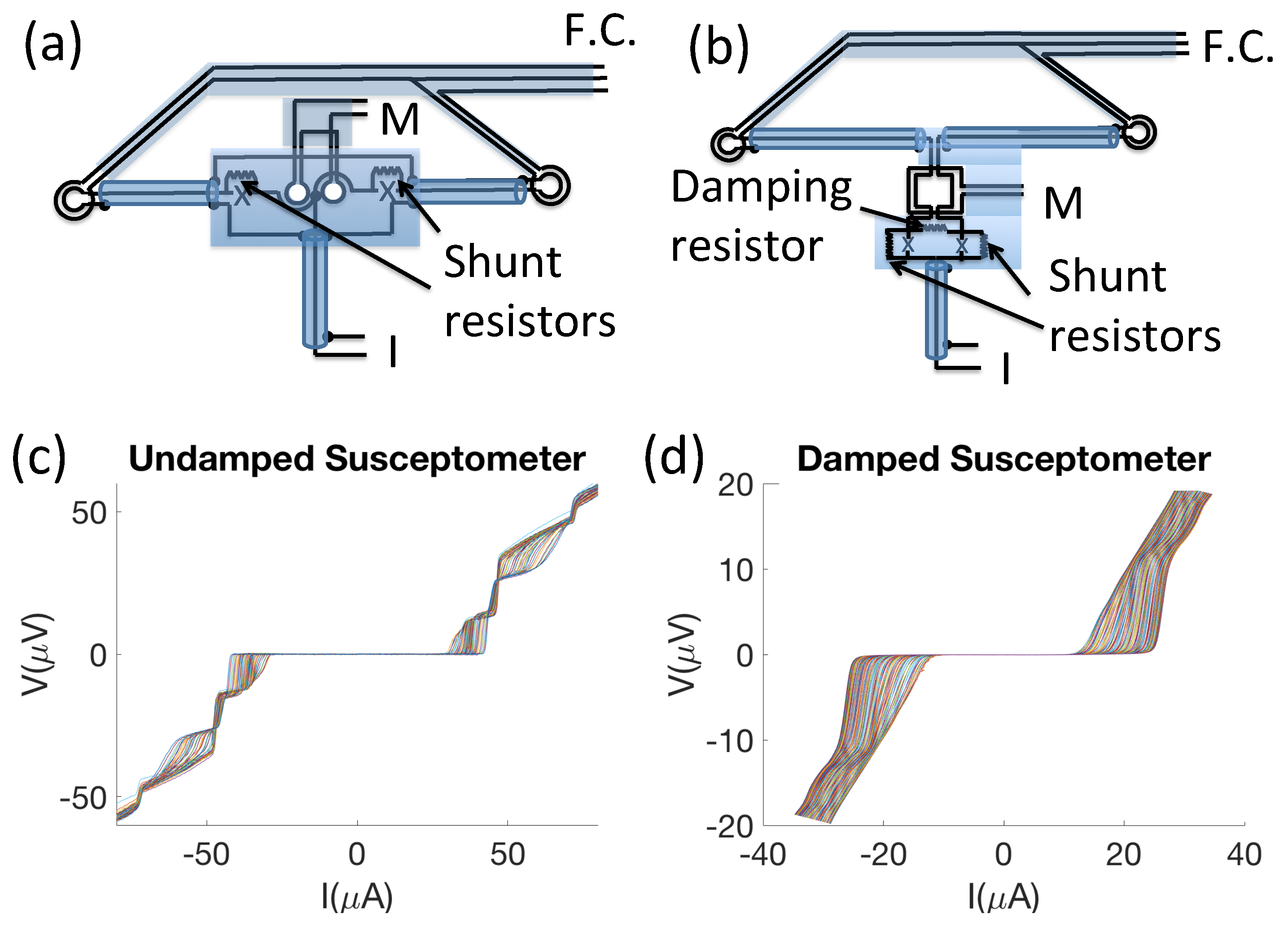
Two types of susceptometer layouts: (a) That of Huber et al. [14,15], without a damping resistor, and (b) that of Gardner et al., [12] with a damping resistor. I labels the current leads, M the modulation coil leads, and the field coil leads. The Josephson junctions are indicated by Xs. The semi-transparent regions indicate superconducting shields. Superconducting coaxial leads connect the central regions with junctions and modulation coils to the pickup loop/field coil pairs to the left and right. (c) Current–voltage (IV) characteristic for an undamped susceptometer at various magnetic fluxes, and (d) IVs for a damped susceptometer.
One necessary step to advancing scanning SQUID technologies is understanding scanning SQUID behaviors. In this paper, we analyze the current–voltage–flux () properties of scanning SQUID susceptometers. Typically, sensitive SQUID magnetic flux measurements are made using a flux-locked loop [1]. Here, we calculate the behaviors of our SQUID susceptometers when current-biased: The voltage across the SQUID at constant current is held fixed by feeding back on the flux through the SQUID using a modulation coil (see Figure 1a,b). The flux through the modulation coil compensates for changes in the flux through the pickup loop. If there is sufficient feedback through the flux-locked loop, the current through the modulation coil is proportional to the flux through the pickup loop. The sensitivity of the SQUID is due to the fact that near the critical current, small changes in flux result in large changes in voltage.
Scanning SQUID susceptometers also measure magnetic susceptibility by applying a localized magnetic field to the sample through the field coils. SQUID susceptometers are laid out in a gradiometric configuration so that they are insensitive to both uniform magnetic fields and currents that pass through both field coils (Figure 1a,b). With this layout, SQUID susceptometers image the local magnetic flux and magnetic susceptibility of materials directly below one of the pickup loop/field coil pairs simultaneously.
To optimize the performance of scanning SQUID sensors, it is important to understand their characteristics in the presence of noise. Although the noise properties of ideal SQUIDs are well understood [16,17], the noise properties of new-generation SQUIDs, such as SQUID susceptometers, are not. One puzzling phenomenon is the presence of anomalies in the characteristics of SQUID susceptometers (Figure 1c). These anomalies take the form of “steps” in voltage (peaks in the dynamic resistance ), which occur at currents that disperse strongly with applied magnetic flux and have a period of one superconducting flux quantum (). Previous studies have shown that the current–voltage and alternating current (a.c.) characteristics of SQUIDs can be affected by parasitic capacitances in their input circuitry [18,19,20] and that the SQUIDs’ performances can be improved by resistive damping of the resultant input coil resonances [21]. We believe our anomalies are of similar origin and therefore refer to them as “resonances”.
To explore the origin and impact of resonances on the characteristics of SQUID susceptometers, we perform an analysis of two-junction, direct current (d.c.) SQUID susceptometers that seeks the answers to two queries: (1) What causes the resonances? and (2) Do the resonances enhance or diminish the sensitivity of SQUID susceptometers?
To address the first query, we develop models of susceptometers that reproduce the resonances in simulations of their characteristics. We hypothesize that the resonances occur due to parasitic capacitances and inductances that arise from complex features of the SQUIDs, such as the field coils, the gradiometric layout, and pickup loops that are integrated into the bodies of the SQUIDs through superconducting coaxial leads (Figure 1). These parasitic inductances and capacitances introduce inductor-capacitor (LC) resonances that are driven by the a.c. Josephson oscillations of the junctions in the voltage state. Consequently, when the LC resonance frequency matches the Josephson frequency, there are voltage steps in the IV characteristics, which translate to peaks in the IR characteristics of the susceptometers.
Our hypothesis is supported by basic estimates of the voltage steps. The resonances in our susceptometers have a characteristic voltage of roughly 10 V (see Figure 1c). Combining the Josephson relations [22],
where is the supercurrent through the junction, is the junction critical current, V is the voltage, and is the quantum mechanical phase drop across the junction, with the resonance frequency for an LC circuit,
we expect voltage steps to occur at
where and are the equivalent lumped parasitic inductance and capacitance of the circuit, respectively. To estimate and , we use the FASTCAP, FASTHENRY, and INDUCT software packages from the Whiteley Research web site [23]. We estimate that the susceptometer of Figure 1a has pH and pF, which results in a characteristic voltage of 6.9 V 12.7 V. Using this intuition, we are able to successfully simulate the complex resonant behavior of the susceptometers. We also reproduce the behavior of susceptometers with damping resistors, which greatly reduce the amplitude of the resonances.
In what follows, we first demonstrate in Section 2.1 that the addition of a parasitic capacitance to the standard model for a SQUID produces peaks in the characteristics similar to those observed experimentally (see Figure 2). We then show that we can qualitatively reproduce the highly complex characteristics of an undamped SQUID using a relatively simple model with distributed parasitic inductances and capacitances, as well as the much simpler characteristics that result when a damping resistor is introduced (see Figure 3). We proceed to calculate SQUID noise in Section 2.2, first demonstrating that we can reproduce previous work on basic SQUID layouts. After confirming our procedure, we calculate the noise in our more complicated undamped and damped models at selected positions in the plane. We conclude that the lowest intrinsic noise in the damped layout is significantly lower than that in the undamped layout for susceptometers for parameters that give similar critical curves.
Figure 2.
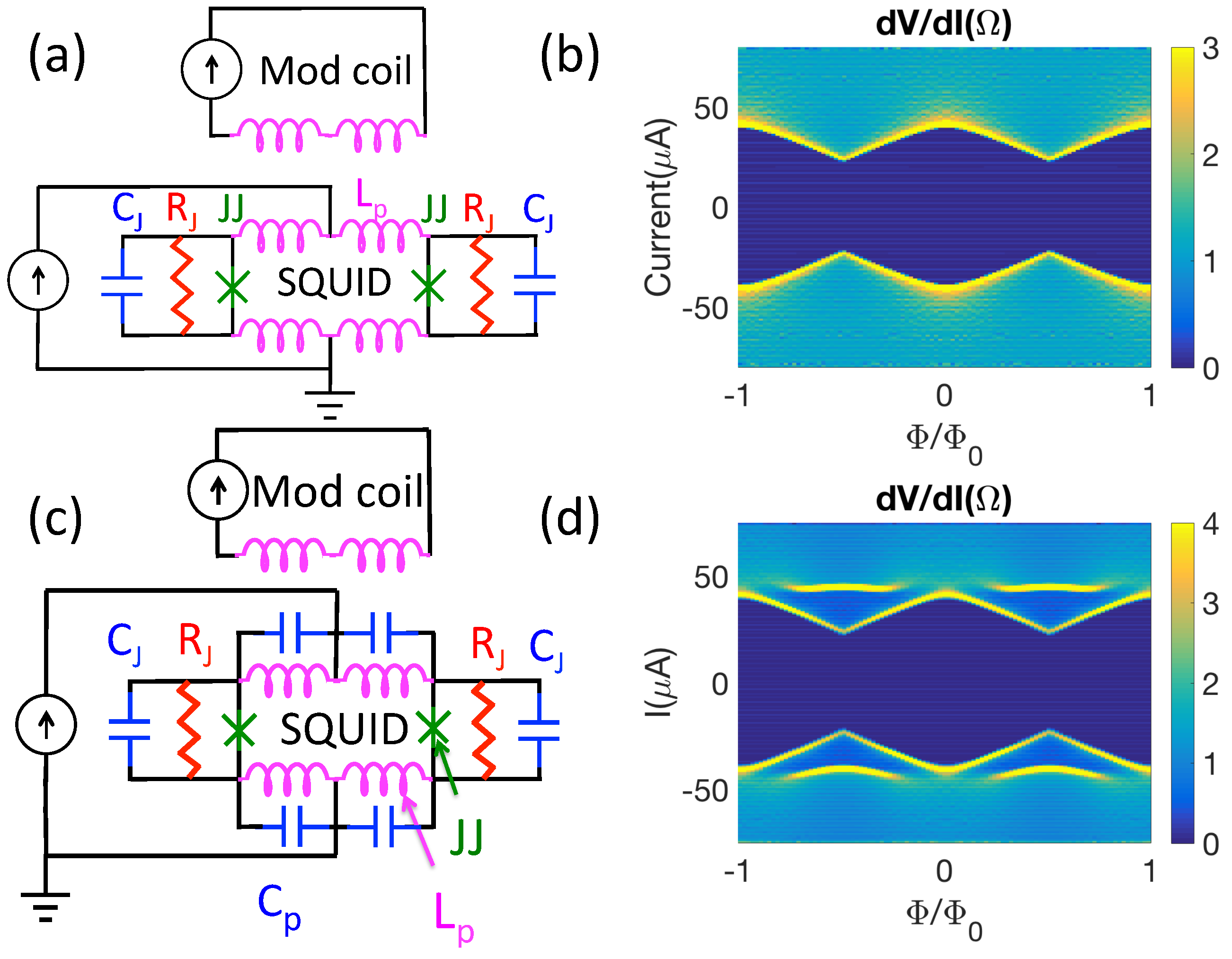
Adding a parasitic capacitance to an ideal Superconducting Quantum Interference Device (SQUID) produces a resonance. (a) Ideal SQUID schematic, and (b) calculated characteristic for an ideal SQUID with no parasitic capacitance at T = 4.2 K. In this instance, the upper inductances = 30 pH, the lower inductances = 1 pH, the Josephson critical currents = 22 A, the shunt resistors = 2 , and the junction capacitances = 10 fF. (c) Schematic with a parasitic capacitance, and (d) calculated characteristic at T = 4.2 K. Here = 22 A, = 2 , = 10 fF, upper = 30 pH, lower = 1 pH, upper = 10 pF, and lower = 1 pF.
Figure 3.
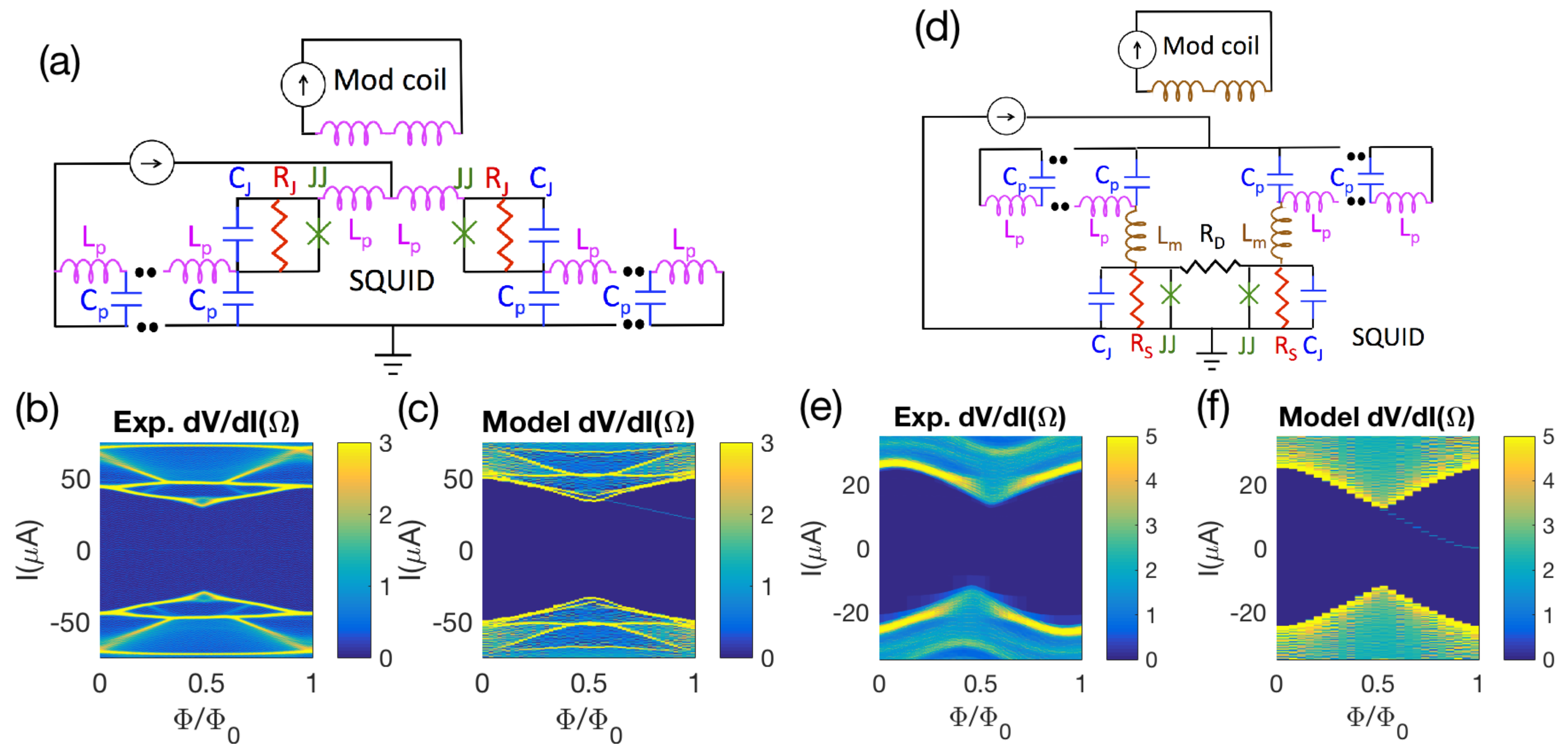
Modeling of vs. I and () for two types of SQUID susceptometers: (a) Undamped schematic, (b) experimental characteristic, and (c) calculated characteristic at T = 4.2 K for a SQUID with the layout of Figure 1a [14,15]. In this model, = 25 A, = 2 , = 10 fF, = 30 pH, = 4 pH, and = 8 pF. There are a total of five pairs in each arm to the left and right of the schematic, representing the coaxial leads to the pickup loops. (d) Damped schematic, (e) experimental characteristic, and (f) calculated characteristic at T = 4.2 K for a SQUID with the layout of Figure 1b [12]. In this model, = 12 A, = 2 , = 4 , = 10 fF, = 30 pH, = 1 pH, and = 8 pF. There are five pairs in each arm of the center of the schematic, representing the coaxial leads to the pickup loops.
2. Modeling
2.1. IR Characteristics
We use commercial software to model our devices: XIC, a layout tool, and WRSPICE, a simulation tool, both developed by Whiteley Research [23]. WRSPICE is based on the JSPICE [24] simulation tool for electronic circuits and includes Josephson junctions. The layout tool XIC produces a list of nodes that specify connections between devices from a schematic. In our case, the devices are resistors R, capacitors C, inductors L, mutual inductances M, and Josephson junctions . Each device has a constitutive equation: for the resistors, for the capacitors, for the inductors, and the Josephson relations (Equation (1)) for the Josephson junctions.
The nodes, devices, and constitutive equations are combined by WRSPICE into a matrix equation of the form , where the elements of the vector X are the device responses and the elements of B are the excitations (e.g., voltage and current sources). In general, the matrix equation is non-linear and is solved by LU (lower, upper) decomposition iteratively with Newton’s method. In our case, we do a transient analysis that produces the time dependence of the circuit response in the presence of d.c. biases, magnetic flux, and noise.
We assume that the pairs of critical currents and shunt resistances for the two Josephson junctions are identical for each SQUID. To calculate the IV characteristics at each flux , we ramp the current through the SQUID at a rate of 1 A/nsec and average the resulting voltage time trace (which has large Josephson oscillations) in bin widths of 1 A. Figure 2b displays typical results for an “ideal” SQUID with parasitic inductance but no parasitic capacitance .
Figure 2c displays the schematic and Figure 2d displays the characteristic for the same circuit as in Figure 2a, but with parasitic capacitances added in parallel with the parasitic inductances. These capacitances could result from, e.g., the overlapping superconducting layers between the junctions in Figure 1a. In this case, there are single resonances at half-integer multiples of and voltages of ≈19 V (≈42 A), but no resonances at higher voltages. The resonances occur at junction voltages in good agreement with Equation (3), taking pH and pH. The simulations also show strong peaks in the variance of the current through the parasitic inductors at 19 V, supporting the hypothesis that the resonances arise when the Josephson oscillations drive the parasitic s at their resonance frequency.
The more complicated schematic of Figure 3a qualitatively reproduces the complex behavior of the resonances seen experimentally for an undamped susceptometer (see Figure 3b,c). In this case, the resonances are generated in a “ladder” of paired s and s, which physically correspond to the distributed inductances and capacitances of the superconducting coaxes leading to the pickup loops. We find that there is not a one-to-one correspondence between the number of resonances and the number of pairs, but rather that the fine details of the resonances depend on the number and values of pairs included in the simulation. The details of the model (listed in the caption of Figure 3) are chosen to fit the experiment by tweaking the various parameters. The quality of the fit is measured by calculating the mean variance between the model and calculated characteristic , where N is the total number of calculated points in the plane. The model results displayed in Figure 3c correspond to . We are not able to find a set of , , , and parameters that cause the modeled peaks in to perfectly overlap with the experimental peaks. Nevertheless, we find the qualitative agreement between experiment and modeling exhibited in Figure 3b,c supports the hypothesis that the structure in the IV characteristics is due to resonances driven by Josephson oscillations.
We also find that in both the modeling and experiment, the resonances can be greatly reduced with the addition of a damping resistor. Figure 3d displays the schematic of a SQUID susceptometer with a damping resistor (see Figure 1b, [12]), with parameters adjusted to fit the experimental IV characteristics.
2.2. Noise
The characteristic time step for the transient analysis in JSPICE is a fraction of the inverse Josephson frequency—typically several GHz. Since we are interested in the noise at frequencies of several hundred Hz or below, such calculations can be very time consuming (see the discussion in Ref. [16]). Noise is introduced into our simulations as Johnson noise from the resistors with a Gaussian distributed voltage in series with the resistors with standard deviation , or equivalently, current sources in parallel with the resistors with standard deviation , where dt is the time interval. For the noise results we report here, we fix the flux and current through the SQUID and solve for the voltage as a function of time, typically recording the voltage in 1 ps intervals over 300 ns. We then Fourier transform to get the power spectral density , fit the results below the frequency (where is the average voltage over the full time trace) to a straight line, and extrapolate to zero frequency to obtain . The data from any currents that have fewer than 100 points in this frequency interval or have a negative intercept from the linear fit are rejected. The transfer function is obtained by subtracting two runs separated by 0.02 centered on the flux of interest, and the flux noise is = . We repeat this procedure ten times. Following Tesche and Clarke [16], we report our results using reduced units. Table 1 lists these units and conversion formulas to obtain them from S.I. units. In this table, is Boltzman’s constant, is the superconducting flux quantum, is the single junction critical current, is the single junction shunt resistance, and T is the temperature.
Table 1.
Dimensionless parameters.
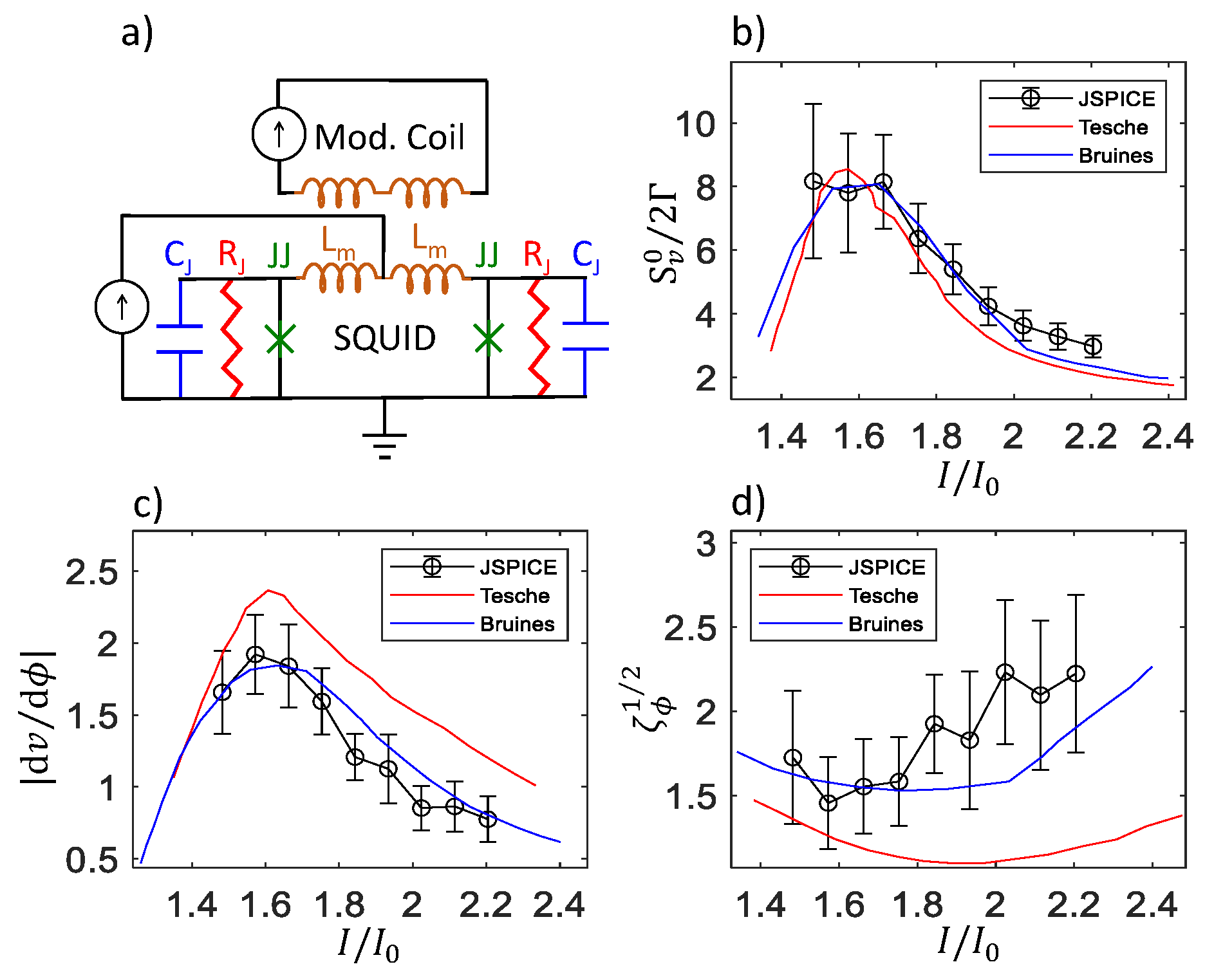
We first verify that we can reproduce previous work. Figure 4a displays the schematic, and Figure 4b–d displays the dimensionless voltage noise power , the dimensionless transfer function , and the dimensionless flux noise respectively for the models used by Tesche and Clarke [16] and Bruines et al. [17]. The results have several qualitative features that are common to all the models studied: The dynamic resistance (not shown), the voltage noise power (Figure 4b), and the transfer function (Figure 4c) have peaks, and the flux noise (Figure 4d) has a broad minimum, at similar flux-dependent currents I. The error bars for , , and are calculated through error propagation. Using the standard error propagation formula, we find that the statistical uncertainty for is proportional to the standard deviation of the fit to the voltage periodogram at low frequencies. Since the amplitude of the voltage noise is greater at large , the statistical uncertainty in is greater in the vicinity of the critical curve and resonance. For , we find that the uncertainty in is proportional to the sum in quadrature of the uncertainties of the voltages at the two fluxes, so the error bars are also greater near the critical curve and resonance. For , the contribution from the error of is proportional to , so the uncertainty in is large where is close to zero. The results from Bruines et al. [17] differ from those by Tesche and Clarke [16] in the transfer function and flux noise because of a numerical error in Tesche and Clarke. Our results agree with the results of Bruines et al. [17] to within statistical uncertainty.
Figure 4.
Comparison with previous work: (a) Schematic of the model used. In this case, the junction critical current = 17.2 A, junction capacitance = 0 pF, modulation inductance = 30 pH, shunt resistance = 2 , , and T = 20.56 K. This choice of parameters leads to , , for direct comparison with Figures 13a, 14a, and 15a of Tesche and Clarke [16], as well as Figures 1a and 2a of Bruines et al. [17]. The curve labelled Bruines in (b) is inferred from the curves labelled Bruines in (c,d).
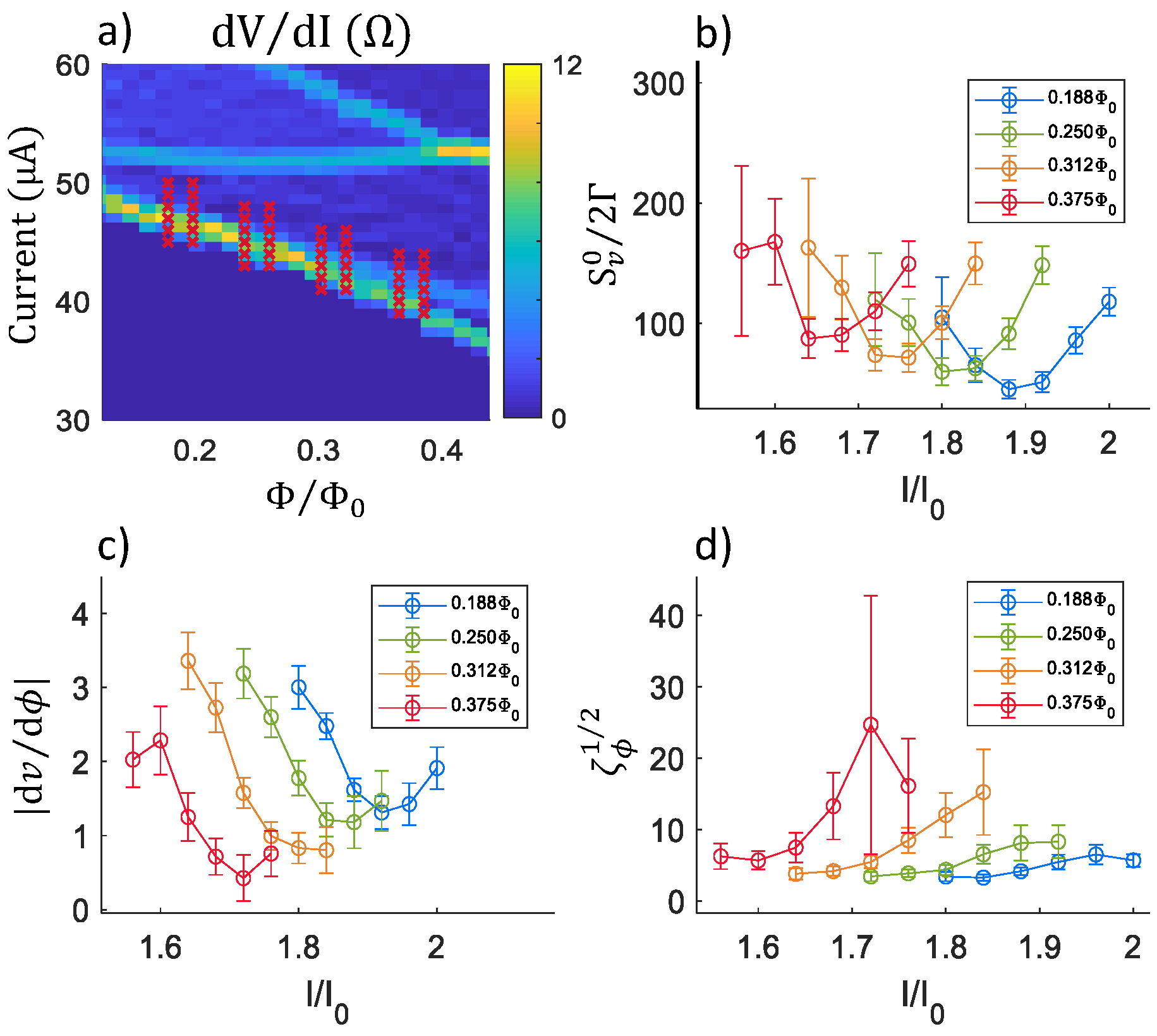
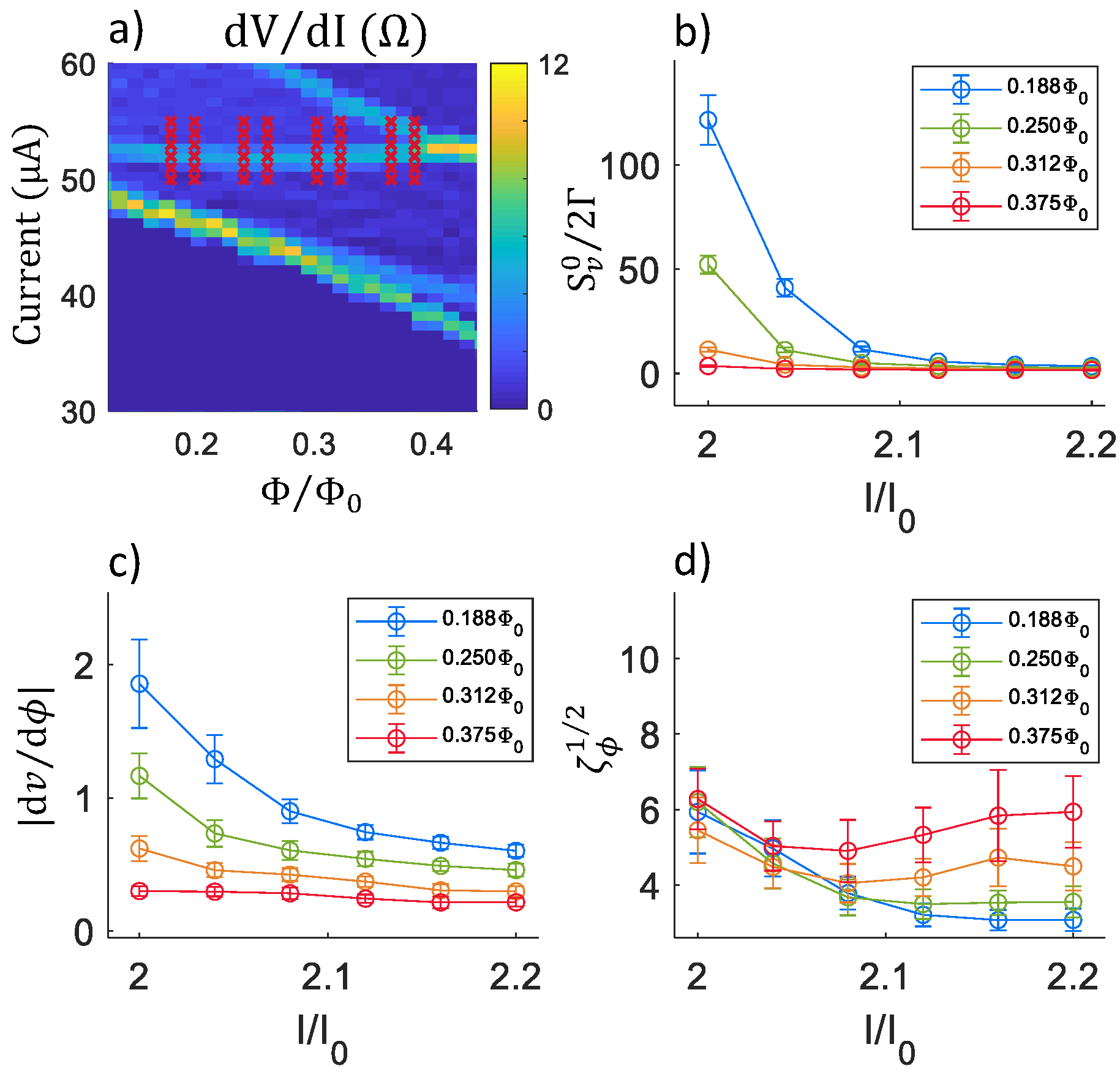
After confirming our procedure by reproducing previous work, we then proceed to calculate the noise for the more complicated undamped susceptometer, with conceptual layout given by Figure 1a, and schematic given by Figure 3a. It would take prohibitively long to calculate the noise for all currents and fluxes. Instead, we choose four values for flux at currents along the “critical curve”, at which the junction is just entering the voltage state. The symbols superimposed on the plot in Figure 5a show the values of current I and flux used for each calculation, with paired fluxes (required to calculate ) separated by 0.02 and centered on each flux value plotted in Figure 5b–d.
Figure 5.
Noise calculations for an undamped SQUID along the critical curve: (a) Plot of vs. current (I) and flux (). The crosses correspond to the values of I and for which noise was calculated. There are two sets of crosses, separated by 0.02 , to enable the calculation of the derivative at each flux value. (b) Plots of the dimensionless low-frequency voltage noise power vs. current I for four different flux values. (c) Plots of the dimensionless transfer junction . (d) Plots of the dimensionless flux noise . The schematic used for these calculations was that of Figure 3a, with = 25 A, = 30 pH, = 2 , = 4 pH, = 10 fF, = 8 pF, and K.
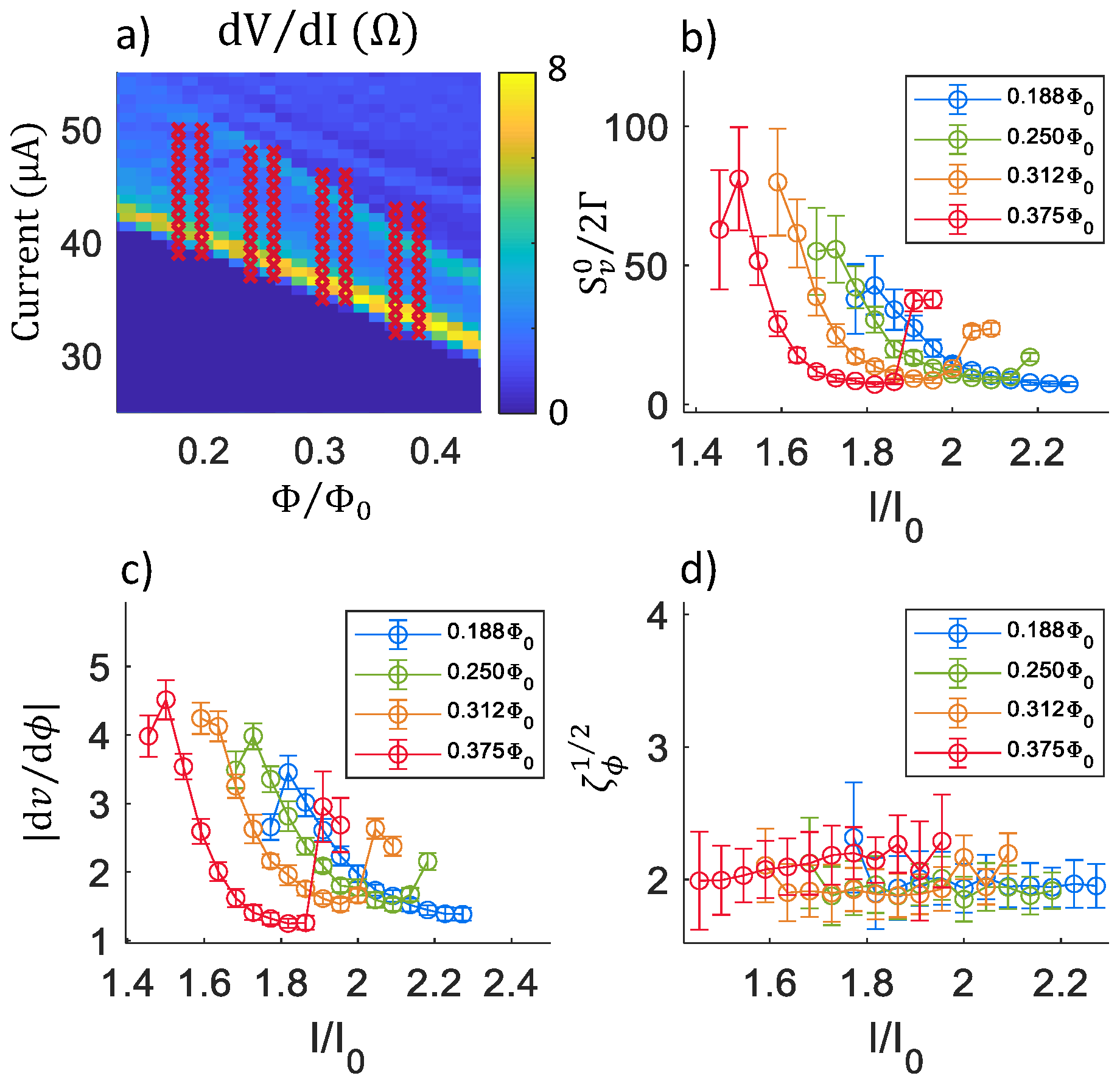
Figure 6 displays similar calculations for the same model and parameters as Figure 5, but for current and flux values along the first resonance in the IR characteristic.
Figure 6.
Noise calculations for an undamped SQUID along resonance at the lowest magnitude bias current (“first resonance”): (a) Plot of vs. current (I) and flux (). The crosses correspond to the values of I and for which noise was calculated. (b) Plots of the dimensionless low-frequency voltage noise power vs. current I for four different flux values. (c) Plots of the dimensionless transfer junction . (d) Plots of the dimensionless flux noise . The schematic used for these calculations was that of Figure 3a, with = 25 A, = 30 pH, = 2 , = 4 pH, = 10 fF, = 8 pF, and T = 4.2 K.
Finally, Figure 7 displays results for the damped SQUID susceptometer model with layout in Figure 1b and schematic in Figure 3d. For these calculations, the parameters were chosen to match those for the undamped SQUID, except for the addition of a damping resistor , for more direct comparison between the damped and undamped cases.
Figure 7.
Noise calculations for a damped SQUID along the critical curve: (a) Plot of vs. current (I) and flux (). The crosses correspond to the values of I and for which noise was calculated. (b) Plots of the dimensionless low-frequency voltage noise power vs. current I for four different flux values. (c) Plots of the dimensionless transfer junction . (d) Plots of the dimensionless flux noise . The schematic used for these calculations was that of Figure 3d, with = 22 A, = 30 pH, = 2 , = 2 , = 1 pH, = 10 fF, = 8 pF, and T = 4.2 K.
2.3. Summary of Noise Calculations
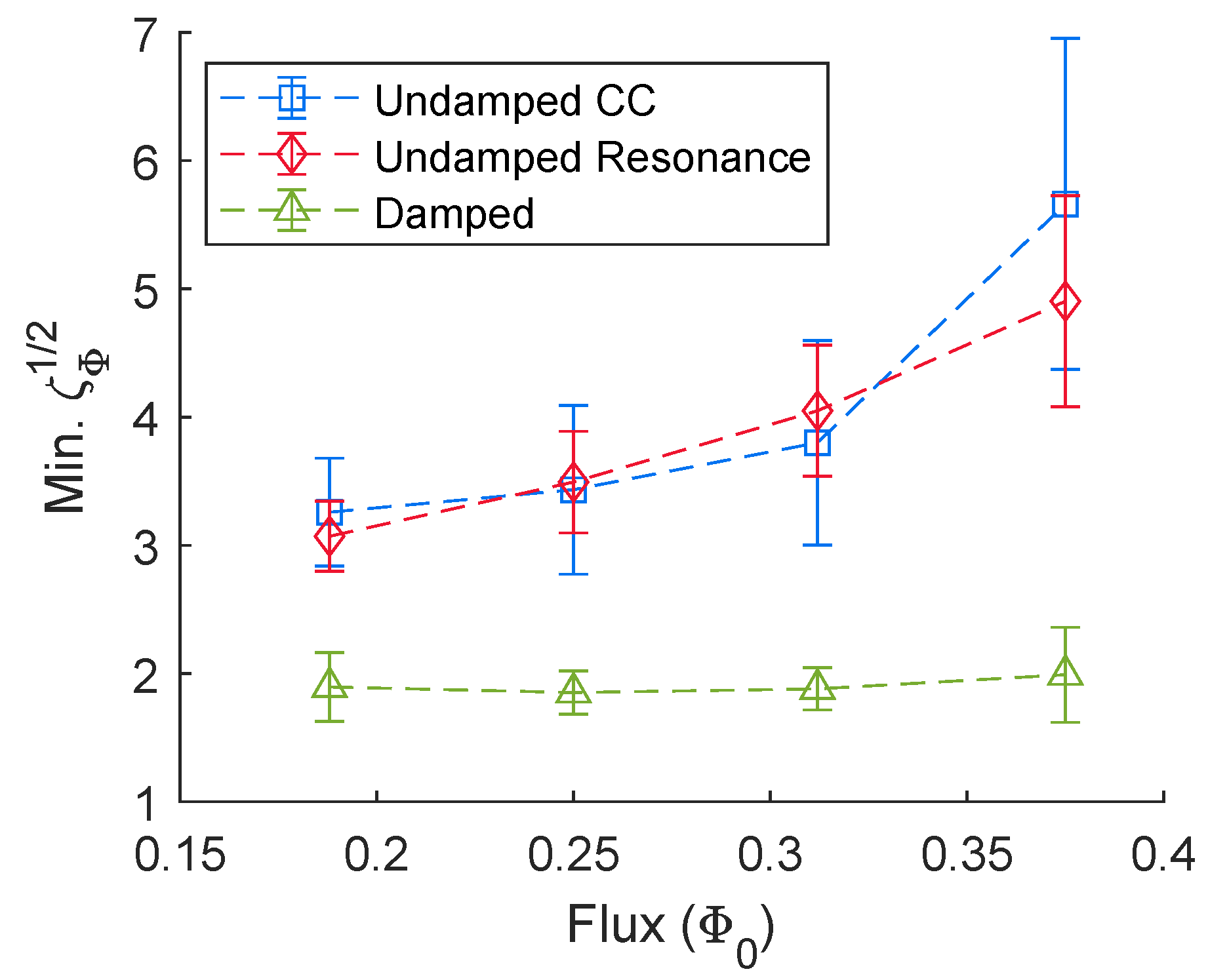
A summary of the noise analysis described in Section 2.2 is reported in Figure 8. The calculated minimum flux noise is similar for the undamped susceptometer model on the critical curve vs. on the first resonance, but is significantly lower for the damped susceptometer model than for the undamped one for parameters that give similar critical curves.
Figure 8.
Minimum flux noise for damped vs. undamped SQUIDs. The square blue symbols correspond to the undamped SQUID along the critical curve, the diamond red symbols are for the undamped SQUID along the first resonance, and the triangular green symbols correspond to the damped SQUID along the critical curve. These data were generated by varying the current (I) at fixed flux.
The noise values that we calculate are comparable to experimentally reported noise floors for scanning SQUID susceptometers. The undamped SQUIDs presented in Figure 1c have a critical current = 25 A and a shunt resistance = 2 . At K, a reduced flux noise of corresponds to = 0.91 /Hz for these values of and . The damped SQUIDs presented in Figure 1d have a critical current = 12.5 A and shunt resistance of = 4 , so corresponds to = 0.86 /Hz at 4.2 K. Gardner et al. [12] report an intrinsic noise of 3 /Hz for damped scanning SQUID susceptometers at 4.2 K. Kirtley et al. [15] report an intrinsic noise of 2 /Hz for undamped susceptometers at 4.2 K, while Huber et al. [14] report a noise of 0.25 /Hz at 125 mK above 10 kHz for undamped susceptometers.
Author Contributions
Conceptualization, J.R.K.; Formal analysis, S.I.D. and J.R.K.; Funding acquisition, K.A.M.; Software, S.I.D. and J.R.K.; Writing–original draft, S.I.D. and J.R.K.; Writing–review and editing, S.I.D. and J.R.K. All authors have read and agreed to the published version of the manuscript.
Funding
This research received no external funding.
Acknowledgments
We would like to thank Diana Chamaki for making some of the IV measurements of damped susceptometers presented in this paper.
Conflicts of Interest
The authors declare no conflict of interest.
References
- Clarke, J.; Braginski, A.I. The SQUID Handbook; Wiley Online Library: Hoboken, NJ, USA, 2004. [Google Scholar]
- Vinante, A.; Mezzena, R.; Prodi, G.A.; Vitale, S.; Cerdonio, M.; Falferi, P.; Bonaldi, M. Dc superconducting quantum interference device amplifier for gravitational wave detectors with a true noise temperature of 16 μK. Appl. Phys. Lett. 2001, 79, 2597–2599. [Google Scholar] [CrossRef]
- Harry, G.M.; Jin, I.; Paik, H.J.; Stevenson, T.R.; Wellstood, F.C. Two-stage superconducting-quantum-interference-device amplifier in a high-Q gravitational wave transducer. Appl. Phys. Lett. 2000, 76, 1446–1448. [Google Scholar] [CrossRef][Green Version]
- Hari, R.; Salmelin, R. Magnetoencephalography: From SQUIDs to neuroscience: Neuroimage 20th anniversary special edition. Neuroimage 2012, 61, 386–396. [Google Scholar] [CrossRef]
- Devoret, M.H.; Wallraff, A.; Martinis, J.M. Superconducting qubits: A short review. arXiv 2004, arXiv:cond-mat/0411174. [Google Scholar]
- Kirtley, J.R.; Wikswo, J.P., Jr. Scanning SQUID microscopy. Annu. Rev. Mater. Sci. 1999, 29, 117–148. [Google Scholar] [CrossRef]
- Black, R.; Mathai, A.; Wellstood, F.; Dantsker, E.; Miklich, A.; Nemeth, D.; Kingston, J.; Clarke, J. Magnetic microscopy using a liquid nitrogen cooled YBa2Cu3O7 superconducting quantum interference device. Appl. Phys. Lett. 1993, 62, 2128–2130. [Google Scholar] [CrossRef]
- Veauvy, C.; Hasselbach, K.; Mailly, D. Scanning μ-superconduction quantum interference device force microscope. Rev. Sci. Instrum. 2002, 73, 3825–3830. [Google Scholar] [CrossRef]
- Finkler, A.; Segev, Y.; Myasoedov, Y.; Rappaport, M.L.; Ne’eman, L.; Vasyukov, D.; Zeldov, E.; Huber, M.E.; Martin, J.; Yacoby, A. Self-aligned nanoscale SQUID on a tip. Nano Lett. 2010, 10, 1046–1049. [Google Scholar] [CrossRef]
- Vu, L.; Wistrom, M.; Van Harlingen, D.J. Imaging of magnetic vortices in superconducting networks and clusters by scanning SQUID microscopy. Appl. Phys. Lett. 1993, 63, 1693–1695. [Google Scholar] [CrossRef]
- Kirtley, J.; Ketchen, M.; Stawiasz, K.; Sun, J.; Gallagher, W.; Blanton, S.; Wind, S. High-resolution scanning SQUID microscope. Appl. Phys. Lett. 1995, 66, 1138–1140. [Google Scholar] [CrossRef]
- Gardner, B.W.; Wynn, J.C.; Björnsson, P.G.; Straver, E.W.; Moler, K.A.; Kirtley, J.R.; Ketchen, M.B. Scanning superconducting quantum interference device susceptometry. Rev. Sci. Instrum. 2001, 72, 2361–2364. [Google Scholar] [CrossRef]
- Kirtley, J. Fundamental studies of superconductors using scanning magnetic imaging. Rep. Prog. Phys. 2010, 73, 126501. [Google Scholar] [CrossRef]
- Huber, M.E.; Koshnick, N.C.; Bluhm, H.; Archuleta, L.J.; Azua, T.; Björnsson, P.G.; Gardner, B.W.; Halloran, S.T.; Lucero, E.A.; Moler, K.A. Gradiometric micro-SQUID susceptometer for scanning measurements of mesoscopic samples. Rev. Sci. Instrum. 2008, 79, 053704. [Google Scholar] [CrossRef] [PubMed]
- Kirtley, J.R.; Paulius, L.; Rosenberg, A.J.; Palmstrom, J.C.; Holland, C.M.; Spanton, E.M.; Schiessl, D.; Jermain, C.L.; Gibbons, J.; Fung, Y.K.K.; et al. Scanning SQUID susceptometers with sub-micron spatial resolution. Rev. Sci. Instrum. 2016, 87, 093702. [Google Scholar] [CrossRef] [PubMed]
- Tesche, C.D.; Clarke, J. dc SQUID: Noise and Optimization. J. Low Temp. Phys. 1977, 29, 301–331. [Google Scholar] [CrossRef]
- Bruines, J.; de Waal, V.; Mooij, J. Comment on: “Dc SQUID: Noise and optimization” by Tesche and Clarke. J. Low Temp. Phys. 1982, 46, 383–386. [Google Scholar] [CrossRef]
- Hilbert, C.; Clarke, J. Measurements of the dynamic input impedance of a dc SQUID. J. Low Temp. Phys. 1985, 61, 237–262. [Google Scholar] [CrossRef]
- Enpuku, K.; Cantor, R.; Koch, H. Modeling the dc superconducting quantum interference device coupled to the multiturn input coil. III. J. Appl. Phys. 1992, 72, 1000–1006. [Google Scholar] [CrossRef]
- Huber, M.E.; Neil, P.A.; Benson, R.G.; Burns, D.A.; Corey, A.; Flynn, C.S.; Kitaygorodskaya, Y.; Massihzadeh, O.; Martinis, J.M.; Hilton, G. DC SQUID series array amplifiers with 120 MHz bandwidth (corrected). IEEE Trans. Appl. Supercond. 2001, 11, 4048–4053. [Google Scholar] [CrossRef]
- Knuutila, J.; Ahonen, A.; Tesche, C. Effects on dc SQUID characteristics of damping of input coil resonances. J. Low Temp. Phys. 1987, 68, 269–284. [Google Scholar] [CrossRef]
- Josephson, B.D. Possible new effects in superconductive tunnelling. Phys. Lett. 1962, 1, 251–253. [Google Scholar] [CrossRef]
- IC Design Software for Linux, OS X and Windows. Available online: http://www.wrcad.com/ (accessed on 13 September 2019).
- JSPICE. Available online: https://ptolemy.berkeley.edu/projects/embedded/pubs/downloads/spice/jspice.html (accessed on 11 March 2019).
© 2019 by the authors. Licensee MDPI, Basel, Switzerland. This article is an open access article distributed under the terms and conditions of the Creative Commons Attribution (CC BY) license (http://creativecommons.org/licenses/by/4.0/).