1. Introduction
1.1. RFID Technology
Radio frequency identification (RFID) is the most common and fastest-growing wireless technology of automatic identification and data capture (AIDC) that identifies and tracks RFID sensors (tags) attached to objects. The tags contain electronically stored information that includes a code defined for each tag individually (predefined before the use of the tag, or modified over the life of the tagged object) [
1]. Two-way radio transmitter-receivers, called interrogators or readers, send electromagnetic field (EMF) to the tag and read its response, with the possibility of modifying the data stored in the tag. An RFID reader is responsible for sensing (reading) and writing data on tags and for powering up the most popular passive tags, which collect energy by wireless interaction from EMF emitted by a nearby RFID reader [
1]. Unlike a barcode, the tag does not need to be within the line of sight of the reader, so it may be embedded inside the tracked object.
The advantages of this technology mean that it has many and rapidly developing applications in shops, warehouses, libraries, enterprises, and even medical centers, prisons, and the public environment, such as:
managing contactless cards (e.g., tolls, access control to rooms or buildings, public transport tickets, payment),
controlling time,
managing, controlling, or monitoring objects (marking goods, wares, devices, books, document tracking in offices, or even patients, biological materials, pharmaceuticals, prisoners or animals).
A physical RFID tag may be incorporated with browser-based software to increase its efficacy as a part of a real-time locating system (known as RTLS). This software allows for different groups or specific personnel to see, store, and archive real-time data relevant to each piece of tracked equipment or personnel, to make use of historical reporting functionality, and to demonstrate compliance with various industry regulations. RTLS provides a powerful data collection tool for facilities seeking to improve operational efficiency and reduce costs of various processes.
An RFID system may replace or supplement barcode systems and may offer another faster method of inventory management and self-service checkout by patrons (e.g., in a public environment such as shops and libraries; over 30 million library items worldwide now contain RFID tags, including some in the Vatican Library in Rome [
2]). It can also act as a security device, taking the place of the more traditional electromagnetic security strips [
3].
Quite a new but very effective, rapidly growing example is the use of RFID technology in healthcare to increase visibility and efficiency and to gather data around relevant interactions. RFID tracking solutions are able to help healthcare facilities manage pharmaceuticals and mobile medical equipment (large or small equipment, e.g., by improving the control of its location, managing single-use items or surgical tools that need sterilization and inventory after the surgical intervention, and even laundry tracking); improve patient and attendee workflow by verifying information on their status or location; monitor environmental conditions and protect patients, staff, and visitors from infection or other hazards; and access control.
Hospitals have been among the first users to combine both active (with a battery which allows a reach of longer distance and emits stronger EMF) and passive (without battery) RFID tags. Many successful deployments in the healthcare industry have been cited where active RFID technology is used to track high-value or frequently moved items, and passive RFID technology is used to track smaller, lower-cost items that only need room-level (short distance) identification [
4]. For example, medical facility rooms can collect data from transmissions of RFID tags worn by patients and employees, e.g., inside the identification badges, as well as from tags assigned to mobile medical devices [
5].
The most commonly used RFID systems in the world are LF (low frequency band: 30–300 kHz; operating typically at 125 kHz), HF (high frequency band: 3–30 MHz; operating typically at 13.56 MHz frequency), UHF (ultra-high frequency band: 300–1000 MHz; operating in the frequency range 860–965 MHz (in Europe, 865–868 MHz) for passive tags and 443 MHz for active tags), and SHF (super-high frequency bands: 2.400–2.4835 GHz and 5.725–5.875 GHz; operating typically at 2.45 and 5.8 MHz frequency) [
1]. They may use fixed readers equipped in antennas of various dimensions, from several centimeters up to one meter. Alternatively, handheld readers usually operate with antennas of dimensions smaller than 20 cm, which are built into small portable electronic intelligent devices or are a kind of periphery accessory attached to small portable computers, tablets, or palmtops.
1.2. Realistic Scenarios of Exposure to EMF Near RFID Devices
The large number of possible applications of RFID technology has resulted in the operators of such devices, along with other people present in the vicinity, being widely exposed to EMF, especially anyone scanned by a reader to check whether any tag is present on the body or clothing. Typically, the operation of such technology is related to the use of RFID devices close to the body. Many applications require the use of handheld RFID readers, recognized as RFID guns. Special attention to EMF exposure is needed when RFID technology is used in the environment accessible to the general public, where an evaluation of the exposure of workers (users of technology) and bystanders (e.g., customers or passengers) may be required.
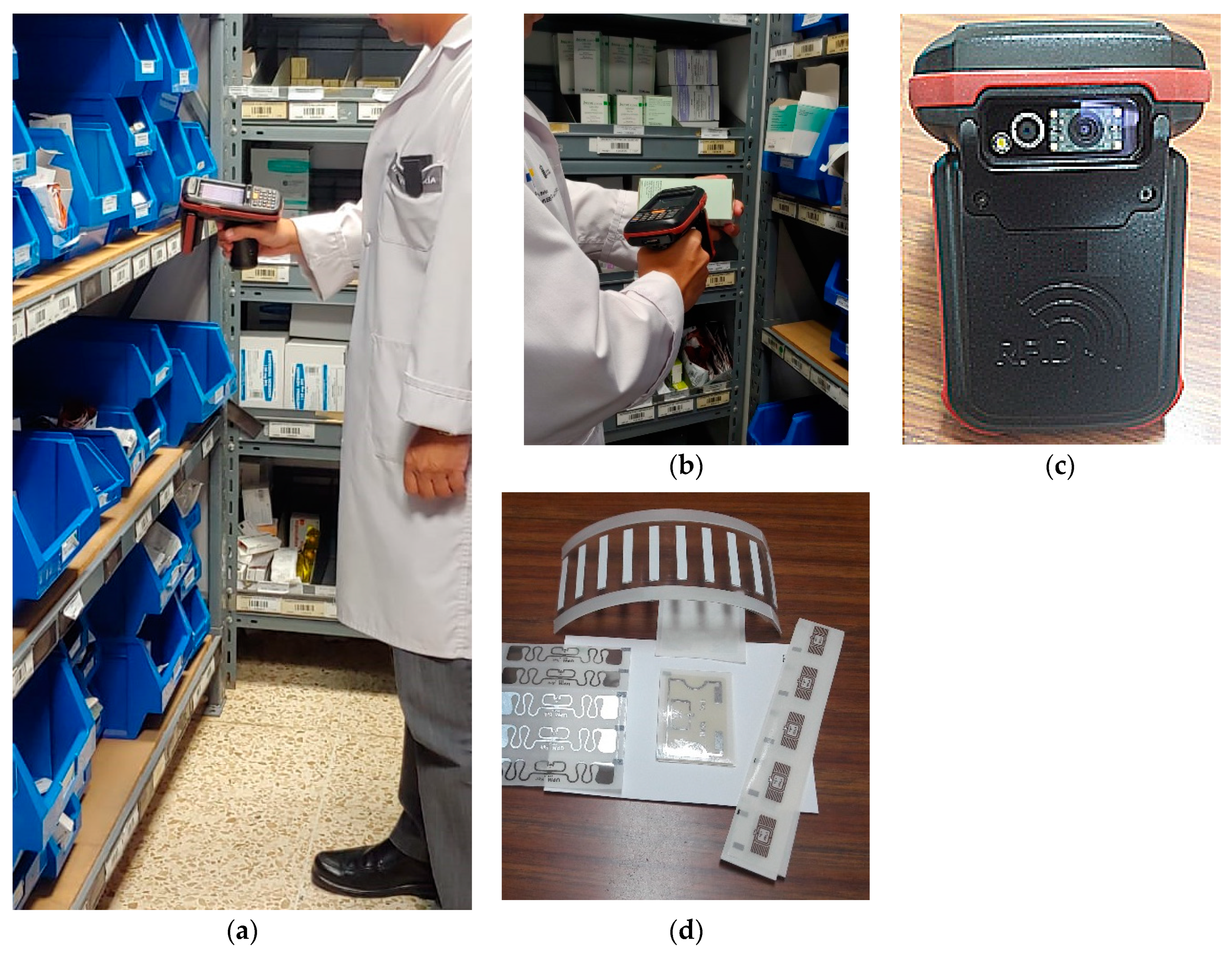
The RFID gun is normally kept in hand or is suspended on the shoulder using special suspenders. While it is used, it is held in the hands at the height of the hips up to the chest (
Figure 1). The result is that EMF emitted by the active gun antenna affects the operator’s palm, chest, head, and hip/legs. When the RFID gun is used to scan any person, or is unintentionally activated near bystanders in the vicinity, they may receive localized EMF exposure near the gun’s position, most probably at chest height. As is shown in
Figure 1a,b, the reader’s device will have a position close to the user’s thorax, with the separation allowed by the forearm (e.g., 15–20 cm). In the case of readings made with the arm extended, the separation of the body would be greater and the operator would receive less EMF exposure, but the performance of the work in this way causes a higher musculoskeletal load (the weight of the RFID gun may be at the level of 0.7 kg) [
6,
7].
1.3. EMF Exposure Metrics and Evaluation
When discussing the protection of humans against electromagnetic hazards, the general public is defined as individuals of all ages and of different health statuses, which may include particularly vulnerable individuals who may have no knowledge of or control over their exposure to EMF. Whereas in the analysis of workers’ EMF exposure, it is usually hypothesized that exposure in the work environment touches only healthy adults who are informed about exposure conditions and trained in how to avoid EMF hazards. These differences may be interpreted towards the need to include more stringent restrictions for the general public as members of the general public would not be suitably trained to mitigate harm from EMF exposure or may not have the capacity to do so.
The international guidelines provided by the ICNIRP (the International Commission on Non-ionizing Radiation Protection), widely used over two decades worldwide, deem the thermal effects from radiofrequency EMF exposure to be the main potentially harmful exposure effect that needs to be limited in order to ensure compliance with the minimum safety requirements on workers and the general public [
8].
Within the 100 kHz to 6 GHz frequency range, the metrics of thermal effects used by ICNIRP is recognized as SAR values (specific energy absorption rate, expressed in watts of absorbed EMF energy per kilogram of exposed tissue, W/kg) and split into two regions: “Head and Torso”—the head, eye, abdomen, back, thorax and pelvis, and “Limbs”—the upper arm, forearm, hand, thigh, leg and foot. The SAR is evaluated as averaged over the entire exposed body (recognised as whole-body averaged SAR—WBSAR) and also as localized SAR averaged in particular smaller parts of the exposed body (over 10 g mass of any continuous tissue—SAR10g) [
9]. SAR values are evaluated by the numerical modeling of EMF interaction between the model of the EMF source and the heterogeneous anatomical body model, usually with the use of finite-difference time-domain (FDTD) numerical code compliant with the requirements of the relevant international standard.
The limit values of SAR are recognized to be basic restrictions in the system of limits defining criteria for an evaluation of EMF exposure parameters. Because of the limited availability of SAR values characterizing EMF exposure in the real environment, the secondary metrics characterizing EMF exposure were derived from the relationship between the level of quasi-homogeneous EMF exposure and SAR values—the strength of the electric and magnetic fields (E, expressed in volt per meter, V/m, and H, expressed in ampere per meter, A/m) affecting the human body—recognized as reference levels. When the EMF exposure is localized, i.e., the level of exposure averaged over the body significantly differs from the maximum exposure of any part of the body, the direct use of an SAR evaluation is recommended by ICNIRP [
8]. There is no general criterion on how to recognize localized exposure needing evaluation with respect to basic restrictions, but a distance between the EMF source and the exposed body shorter than 20 cm is mentioned in several papers [
10,
11]. In the case of localized EMF exposure, the exposure effects in the body (SAR values) may be compliant with the basic restrictions limits even at EMF exposures significantly exceeding the reference levels.
The basic restriction (WBSAR of 0.4 W/kg) for occupational exposure was established taking into account scientific uncertainty as well as differences in thermal baselines, the thermoregulation ability and body core temperature across the population, and a reduction factor of 10 of the threshold of exposure level corresponding to an increase in body core temperature of 1 °C (WBSAR of 4 W/kg averaged over the entire body mass and a 6-min interval). However, the basic restriction for the general public was established with the use of a reduction factor of 50 (WBSAR of 0.08 W/kg).
The limits provided by the ICNIRP for basic restrictions and reference levels applicable for an evaluation of EMF exposure at a frequency band used by UHF RFID systems (at center frequency 900 MHz in that band) are summarised in
Table 1. EMF exposure limitations published by ICNIRP were used in various legislative documents dealing with the formal requirements regarding protection against electromagnetic hazards; for example in the non-binding Council Recommendation 1999/519/EC and binding Directive 2013/35/EU, currently in force in Europe; however, lower exposure limits were set in various countries (for example, in China and India) [
8,
12,
13].
1.4. EMF Emissions from RFID Devices
EMF emissions from an RFID gun (its activation) are at a maximum level of radiated power and continuous in time only during the test mode, which may last up to several minutes and is fully controlled by the test software. In real use mode, the gun is activated only as long as the activation button is pressed, which would seldom last for six consecutive minutes, although it can be much longer than 6 min in discontinuous use.
In accordance with ETSI/EN 302-208 V3.1.1:2016, being a harmonized standard with Directive 2014/53/EU (recognized as the RED directive) in the case of UHF RFID systems, the limit of effective radiated power (ERP) from the antenna is 2 W (for frequency band 865–868 MHz) or 4 W (for frequency band 915–928 MHz) for devices where use does not require special permission (devices equipped with more powerful antennas may be used only when adequate administrative permission has been obtained) [
14,
15]. There is not much investigative data reported in the literature regarding EMF exposure and the evaluation of the biophysical effects of exposure to RFID systems. Reports in the literature on RFID technology are mainly concerned with the design of low cost, technologically simplified antennas with circular polarisation, allowing the reading of tags from the greatest possible range. Fiocchi et al. [
16] calculated the SARs (6-min averaged) for various anatomical human body models exposed to EMF emitted by a UHF RFID reader with an antenna of circular polarisation in various locations and distances (10, 20, 50 cm) against human body models. They concluded that the highest localised SAR10g found in pregnant females was close to the ICNIRP general public limit for 1 W antenna radiated power. In the perspective of the mentioned results of the studies, at the maximum permissible emission from an unregistered UHF RFID system (2 W radiated power in Europe, 4 W in, e.g., North America), the SAR values may be exceeded when exposure lasts for several minutes, at least with respect to general public exposure limits. Near the more powerful readers, SAR values may be exceeded in an exposure time shorter than the 6 min considered above.
1.5. Aim
The aim of this study is to evaluate the SAR values in the body of a person present near handheld UHF RFID readers (recognized as UHF RFID guns) in order to test the hypothesis that the most popular UHF guns may be considered as EMF sources without a significant environmental influence, evaluated with respect to the EMF influence on humans (the operators of RFID guns, or the scanned persons or bystanders) and relevant international safety guidelines in various exposure scenarios mimicking the most typical exposure situations.
4. Discussion
Among the key properties of any RFID system is the reading range, which indicates how far away the tag may be located and still be effectively identified (caught) by the reader. In practice, this defines how fast the reading process can be performed as well as the level of EMF exposure near the reader, which is higher as the reading range increases.
Active tags have a local power source (such as a battery) and may operate typically up to hundred meters away from the RFID reader, while the reading range of passive tags has a typical scale from several centimeters up to several dozens of centimeters, and no more than several dozens of meters [
4].
The radiated power of the particular gun is fixed (to ensure the required reading range) and independent of the distance at which the particular tags are being read (i.e., independent of the physical distance to the tag caught at the moment). As a shorter reading range is required in particular RFID applications, the level of EMF emitted by the gun may be lower (in RFID guns, the level of radiated power may be adjustable by the user) [
24,
25].
The reading range of the UHF RFID system depends on the power radiated by the reader and the sensitivity of the searched passive tag (the sensitivity of the tag is the function of the design of the tag chip and the tag antenna gain). This may be expressed as the strength of the electric field caused by the emission from the reader antenna, which needs to expose (energise) the tag to read (catch) it. The minimum electric field strength (
Etag) needed to power up (read) the UHF RFID tag of a particular sensitivity (
Ptag), defined by its physical structure, can be expressed as follows [
26]:
The data sheets of commercially available UHF RFID passive tags of various physical structures report their different sensitivity:
Ptag ranges from 0.0001 W (−10 dBm) for older solutions, up to 0.00001 W (−20 dBm) for the latest ones. Using the formula expressed by Equation (1), the minimum strength of the electric field emitted from the RFID guns operating at a frequency of 865 MHz, needed to energize passive tags of various physical structures, was evaluated for the typical range of tag sensitivity 0.0001–0.00001 W (
Table 3).
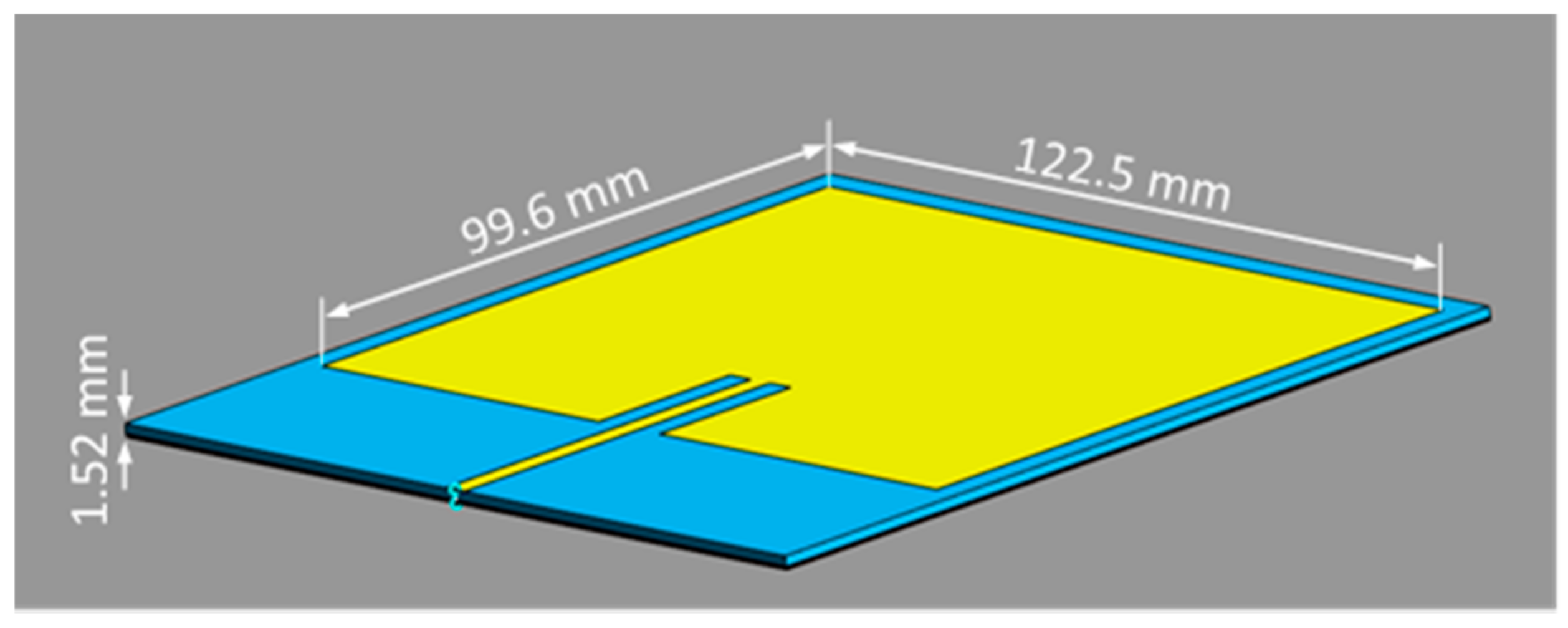
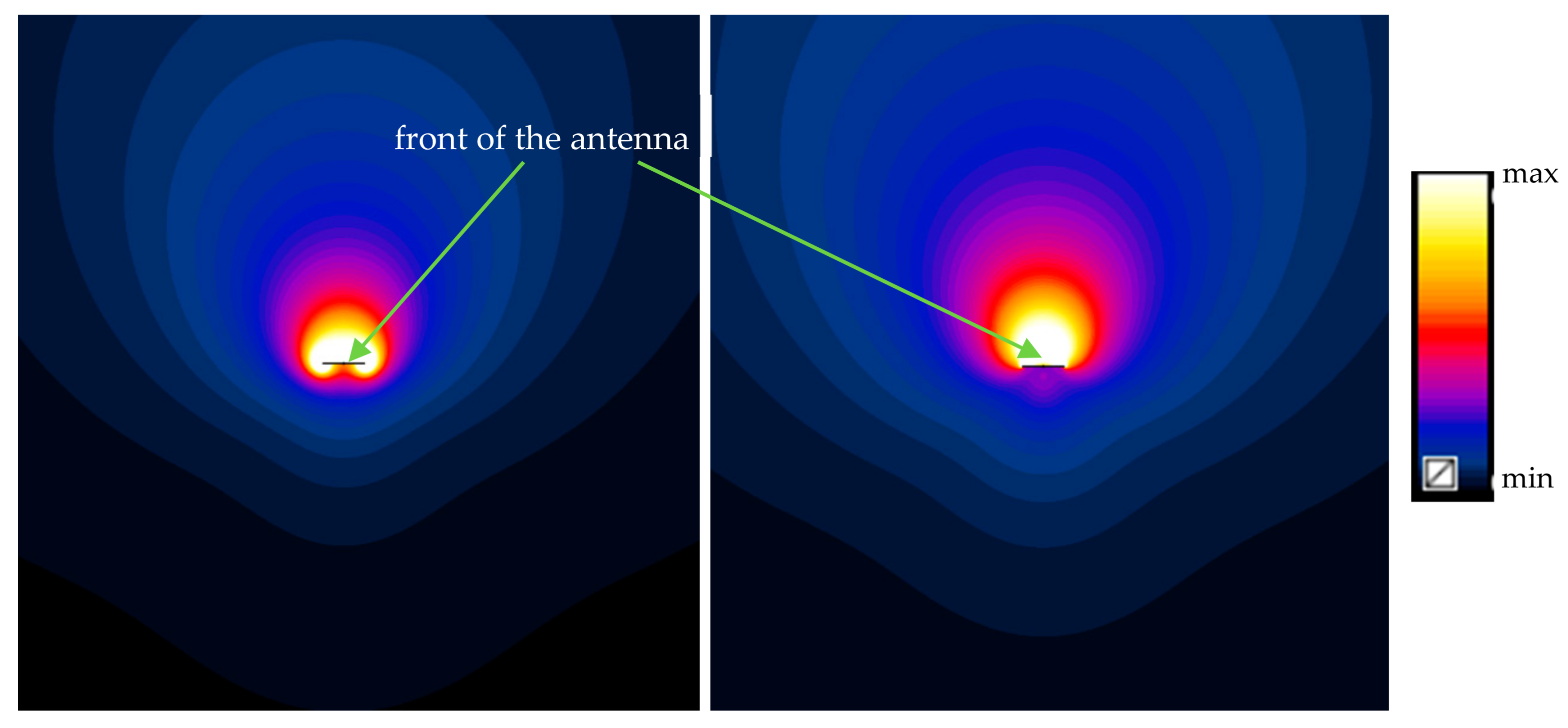
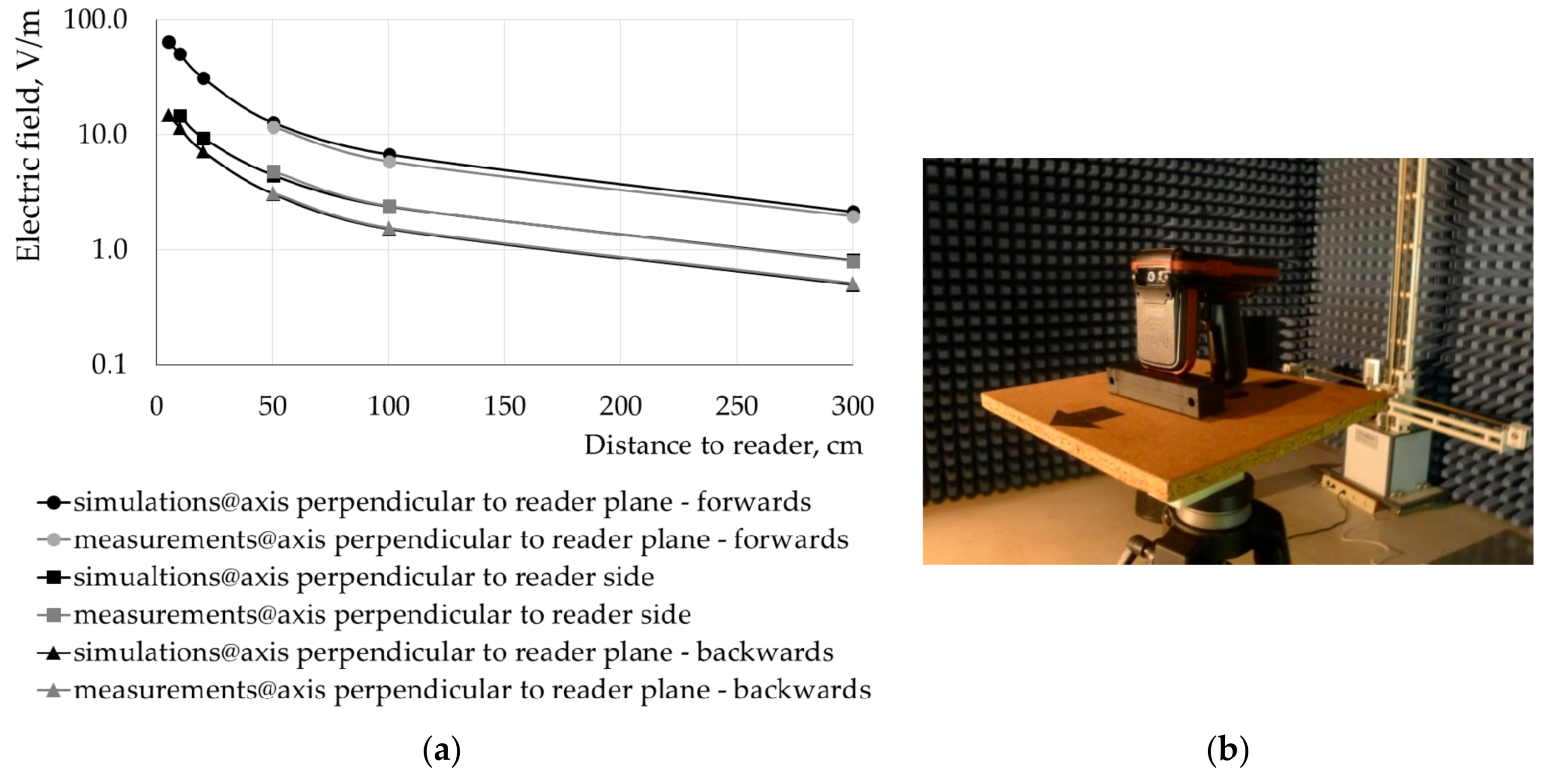
The distribution of the strength of the magnetic and electric fields along an axis perpendicular to the reader antenna plane, near the investigated UHF RFID gun reader (at least 10 cm away from the antenna) shown in
Figure 2, can be estimated by the following formulas:
where
H is the strength of the magnetic field in ampere per meter,
E is the strength of electric field in volt per meter,
r is the distance from the UHF RFID reader antenna in centimeters,
P is the radiated power in watts, and 2.2 [A/W
0.5] and 680 [V/W
0.5] coefficients (power regression) were derived from the field distributions in the front of antenna (as shown at
Figure 5).
Based on Formulas (1) and (3), the dependence of the minimum power of EMF emitted by the UHF RFID gun (
Pmin) required to produce an electric field with the minimum strength required to read a particular tag (
Etag) at a distance from the gun equal to the reader’s reading range (RR) can be expressed by the following equation:
Thus, the minimum power (
Pmin) needed to be radiated from the investigated UHF RFID gun for different reading ranges (RR), and tags sensitivity (
Etag) were estimated, as shown in
Table 4.
The obtained results show that doubling the reading range of the investigated UHF RFID reader requires the power radiating from the reader to be approximately four times higher. This also means the level of EMF exposure doubles near the reader, which doubles its reading range.
The minimum radiated power for the investigated UHF RFID gun related to the particular reading range depends heavily on the tag sensitivity (Ptag), which defines the minimum electric field strength (Etag) needed to read a passive tag. When the use of a UHF RFID gun maintains the same reading range by delivering an electric field strength (Etag) sufficient to read used tags with differing sensitivities, then 0.8, 1.0, 1.3, 1.6, and 2.0 V/m needs 1.8-, 2.7-, 4.6-, 7-, and 11-times higher power from the reader, respectively, in comparison to the use of the most sensitive tags that require a minimum electric field strength of 0.6 V/m. Therefore, in order to reduce the level of exposure to EMF near a UHF RFID gun, the use of tags with high sensitivity (i.e., with low Etag) allows the level of power radiated from RFID reader to be reduced significantly in comparison with the case of using low sensitivity tags (i.e., with high Etag), while maintaining the required reading range.
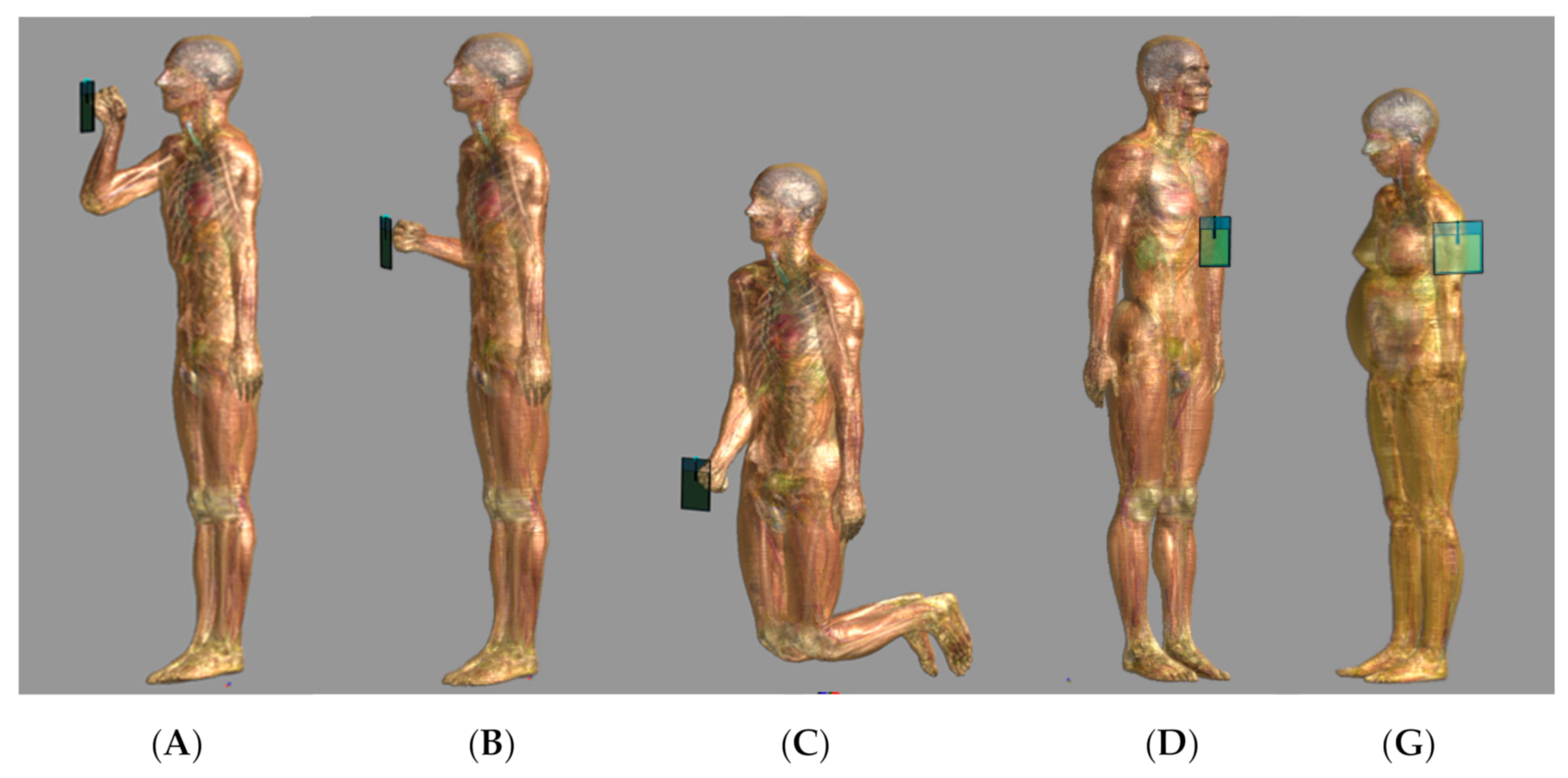
Table 5 presents the level of emissions from the UHF RFID gun (radiated power in watts) that cause SAR values equal to ICNIRP’s general public limits in the considered exposure situations. It was found that in exposure scenarios A, B, and C, the localized NSAR10g in the palm of the user of a UHF RFID gun reader may exceed general public limits even at 1 W of radiated power, which is equal to just 50% of the radiated power allowed in Europe from non-registered RFID use. UHF RFID gun readers with a 1 W level of EMF emission are characterized by a reading range of 350–1100 cm, depending on the sensitivity of particular tags (
Table 3).
The worst-case exposure scenario with respect to SAR evaluation may be counted as 6 min of continuous emission at maximum output power, though a more typical exposure situation is with a shorter exposure duration. In addition, when the required reading range is shorter, the level of radiated power may also be lowered at the stage of manufacturing or use (in some UHF RFID gun readers, the level of radiated power is adjustable by the user).
Under real life conditions of using RFID guns, the SAR values received by the user may be slightly lower than presented in this study because the elements of antenna housing, its fixation, gun handle, and monitor were not included in the RFID gun numerical model, but they may decrease the level of EMF affecting the user. On the other hand, RFID guns with emission levels of multi-watts may be used in various locations without special permission for use (up to 2 W in Europe, established by ETSI/EN 302-208 V3.1.1:2016 [
15], being a harmonized standard with Directive 2014/53/EU [
14,
15]; and 4 W in USA [
27]), and even of higher levels of emission from devices used following special administrative rules.
In both cases, considering realistic exposure, at the very least, UHF RFID guns radiating over 1 W need to be considered as sources of potential EMF exposure to the user, causing SAR values in the palm that exceed ICNIRP’s general public limits (limits used in many countries as the EMF exposure evaluation criterion). The use of UHF RFID guns with a reading range of 5–15 m, which may need the use of radiated power at a level of 2–20 W (depending on the sensitivity of the searched tags) may cause the SAR values to exceed the general public limits not only in the palm of the user but also in the torso of the user, bystander, or a scanned person. At a level of radiated power exceeding 5 W, occupational exposure limits may also be exceeded in the palm, and at above 10 W of emission, also in the torso of the UHF RFID gun users.
On the other hand, RFID reader devices may also be equipped with other systems emitting radiofrequency EMF (e.g., Wi-Fi, GPS, Bluetooth, GSM, LTE, GPRS, HSDPA, WCDMA), which may increase SAR in users that may be activated simultaneously with the reader RFID antenna.
In the investigated exposure scenarios, the posture of the user of an RFID gun reader corresponds to the typical postures of users. It is not easily to reduce SAR values from RFID gun readers in palms. The first idea for how to lower the EMF exposure levels in the head and torso is to increase the distance between the EMF source and the user. The SAR values can be reduced by increasing that distance, but the weight of the gun (0.7 kg in the analyzed case) would be associated with increased fatigue in the limb holding the reader and reduce the work comfort.
Discussing the environmental influence of the use of UHF RFID guns, the safety of the vulnerable population also needs to be considered. The Occupational Health and Safety Framework Directive 89/391/EEC requires, in Article 15 about risk groups, that “Particularly sensitive risk groups must be protected against the dangers that specifically affect them.” According to European Directive 2013/35/EU on the protection of workers against EMF hazards in the work environment (Article 4.5), during the risk assessment process, the employer is obliged to investigate indirect effects from EMF exposure, such as interference from medical electronic equipment and devices (including cardiac pacemakers and other implanted devices) [
14]. The possibility of interference from an electronic device depends on the EMF exposure level and the electromagnetic performance of the device, its settings, and the method of implantation. The clinical relevance of such an EMF exposure effect may depend on the duration of exposure, but also the health status of a particular user of medical implants.
The evaluation of electromagnetic hazards for users of an active implantable medical device (AIMD) may be based on the approach that AIMDs manufactured for use in the European Union are expected to function as described in their product standards as long as the general public reference levels of Council Recommendation 1999/519/EC (
Table 1) are not exceeded by the affecting EMF [
28]. Given that at an emission level of 1 W, the electric field strength at distances up to 20 cm from the UHF RFID reader (18–55 times lower than its reading range) exceeds the level of these general public reference levels, the users of AIMD who are in close proximity to UHF RFID guns should be treated as individuals at particular risk. The other references for an evaluation of situations in which AIMD users may be at particular risk may be taken from the rules of the AIMD immunity tests regarding disturbances in their work from electromagnetic exposure (following the protocol provided by EN 60601-1-2:2015 [
29], the tests are required at exposure levels of 3 and 10 V/m levels, at the 80 MHz to 2.7 GHz frequency band). As RFID tags of low sensitivity need to be energized by an electric field with a minimum strength approaching 2 V/m, the EMF exposure from an RFID reader that is not compliant with the lower level of the mentioned immunity tests may be found even at a distance from the gun of approximately 50% of the reading range.
Employees who are AIMD users need to be aware of the particular risks that they might encounter during their work and should be instructed on how to deal with equipment that is a source of significant EMF exposure in a safe manner. Generally, this means that employees who are AIMD users should be informed about the interference distances or zones of such equipment. Devices should be marked with symbols indicating a threat to the proper functioning of AIMD (e.g., according to ISO 7010:2011 [
30]).
5. Conclusions
The EMF exposure conditions were evaluated in a worst-case scenario with respect to the EMF exposure duration, and in realistic scenarios with respect to the RFID gun position, where the reading gun is next to the operator’s, a bystander’s, or the scanned person’s body.
The results of this study show that the EMF exposure while using UHF RFID gun readers, evaluated by numerical simulations of realistic exposure scenarios, do not cause SAR values exceeding general public limits (set by ICNIRP guidelines and non-binding European Council Recommendation 1999/519/EC) when the emitted power does not exceed 1 W (which corresponds to a reading range of 3.5–11 m, depending on the sensitivity of the searched tags).
The use of UHF RFID guns with a reading range of 5–15 m, which may need the use of emitted power at the level of 2–20 W (depending on the sensitivity of the searched tags) may cause SAR values exceeding general public limits, not only in the palm of the user but also in the torso of the user, a bystander or a scanned person. At a level of over 5 W of radiated power, occupational exposure limits may also be exceeded in the palm, and at over 10 W, also in the torso of the UHF RFID gun users or bystanders.
Given that electric field strength at distances of up to 20 cm from a UHF RFID reader with a radiated power of 1 W exceeds the level of general public reference levels set by Council Recommendation 1999/519/EC, any users of AIMD and pregnant women who are in close proximity to a UHF RFID gun reader should be treated as individuals at particular risk.
Only UHF RFID guns emitting below 1 W may be considered as environmentally insignificant EMF sources.