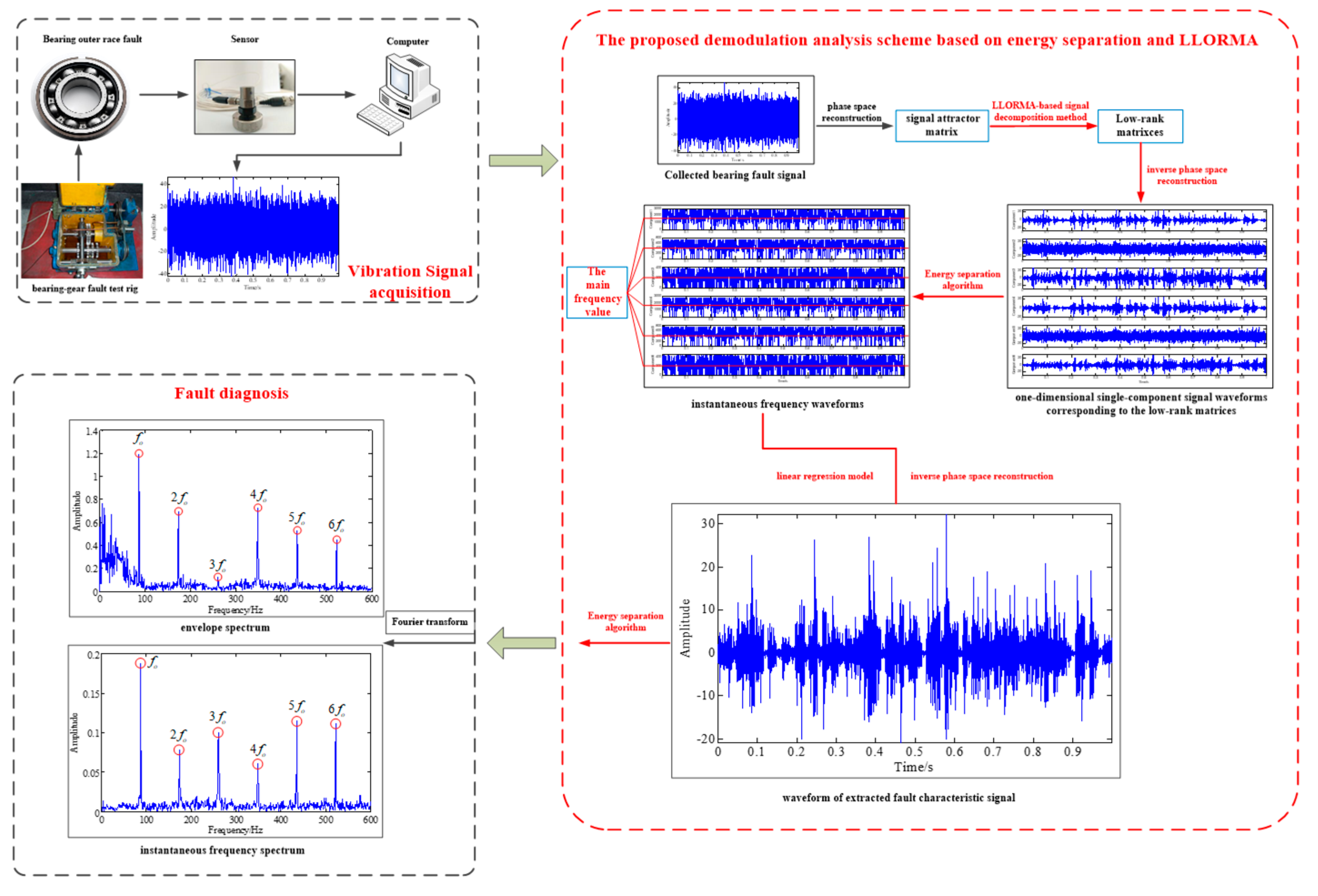
A Novel Demodulation Analysis Technique for Bearing Fault Diagnosis via Energy Separation and Local Low-Rank Matrix Approximation



Abstract
1. Introduction
2. Bearing Fault Vibration Signal Model and Demodulation Analysis through the Energy Separation Algorithm
2.1. Vibration Signal Model of the Bearing Fault
2.2. Demodulation Analysis through the Energy Separation Algorithm
2.2.1. Energy Separation Algorithm based on the Teager Energy Operator
2.2.2. Demodulation Analysis of the Bearing Fault Characteristic Signal via the Energy Separation Algorithm
Amplitude Demodulation
Frequency Demodulation
3. A Novel Demodulation Analysis Technique via Energy Separation and Local Low-Rank Matrix Approximation (LLORMA)
3.1. Decomposing the Signal into Single Components via LLORMA
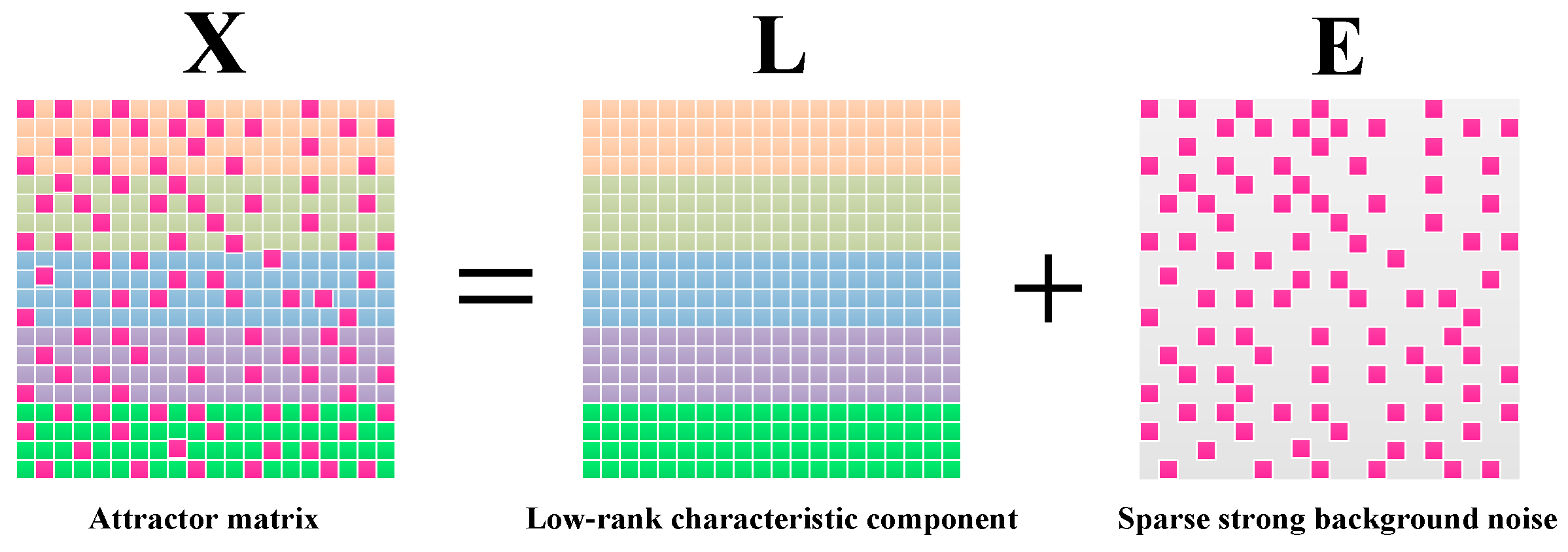
3.1.1. Problem Statement and Fundamental Assumption
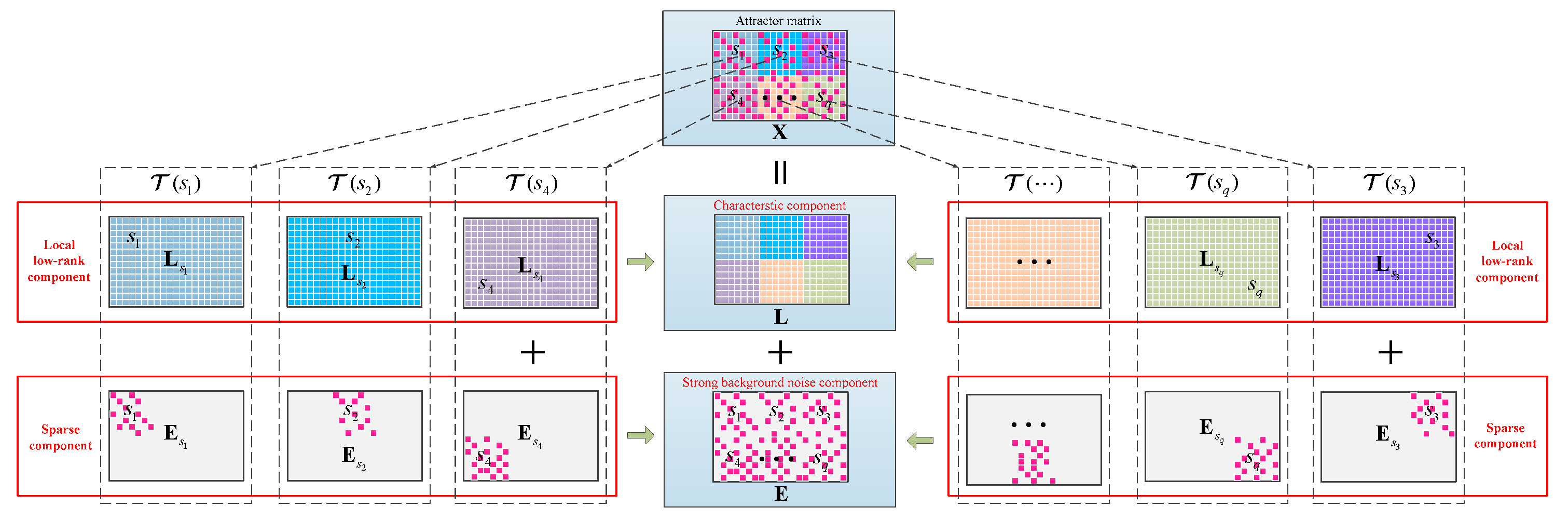
3.1.2. Model Construction and Algorithm Solving
| Algorithm 1: solve (25) by ALM |
| Input: attractor matrix Parameter: number of anchor points: ; local weight coefficient matrix: ; regularization parameter: for all i=1:, parallel do 1. select uniformly in for all a=1: , do end for all b=1:, do end for all end 2. Initialize: , , , , while not converged do 3. fix the others and update by 4. fix the others and update by 5. update the Lagrange multiplier : 6. update : 7. check the convergence conditions: , , end end output: |
3.1.3. Identification of the Fault Characteristic Component
3.2. Process of the Novel Demodulation Analysis Technique
4. Experiments
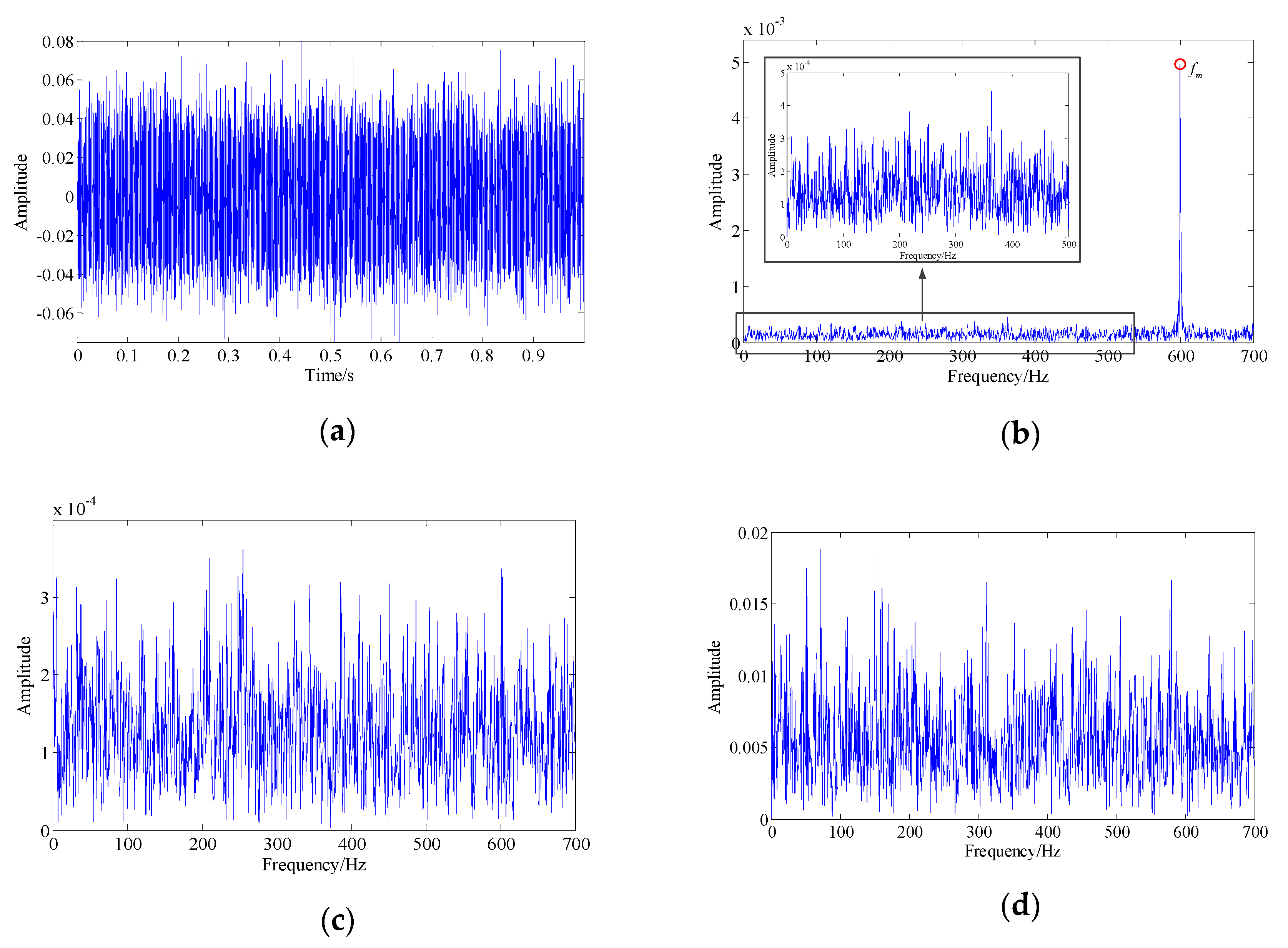
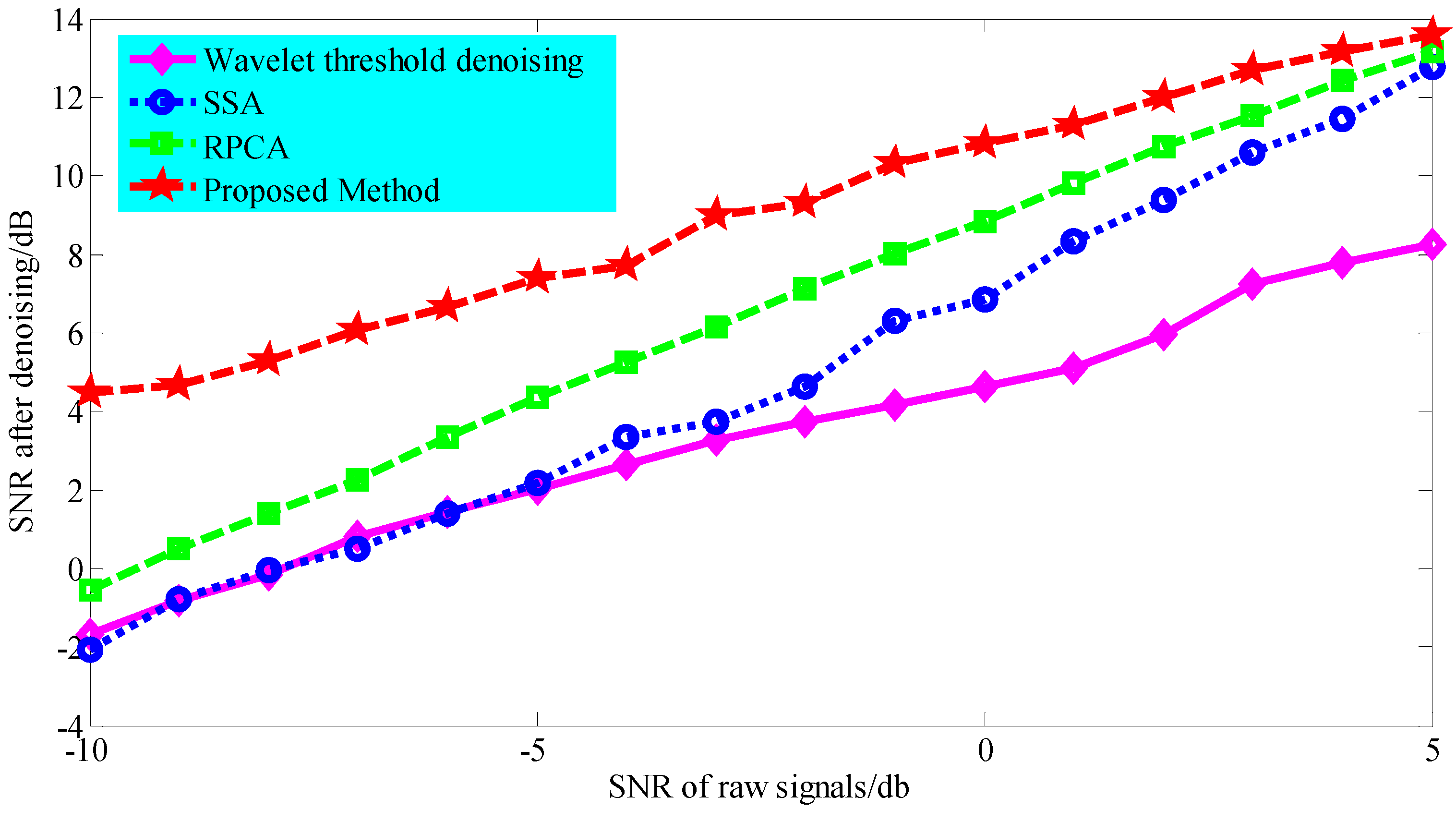
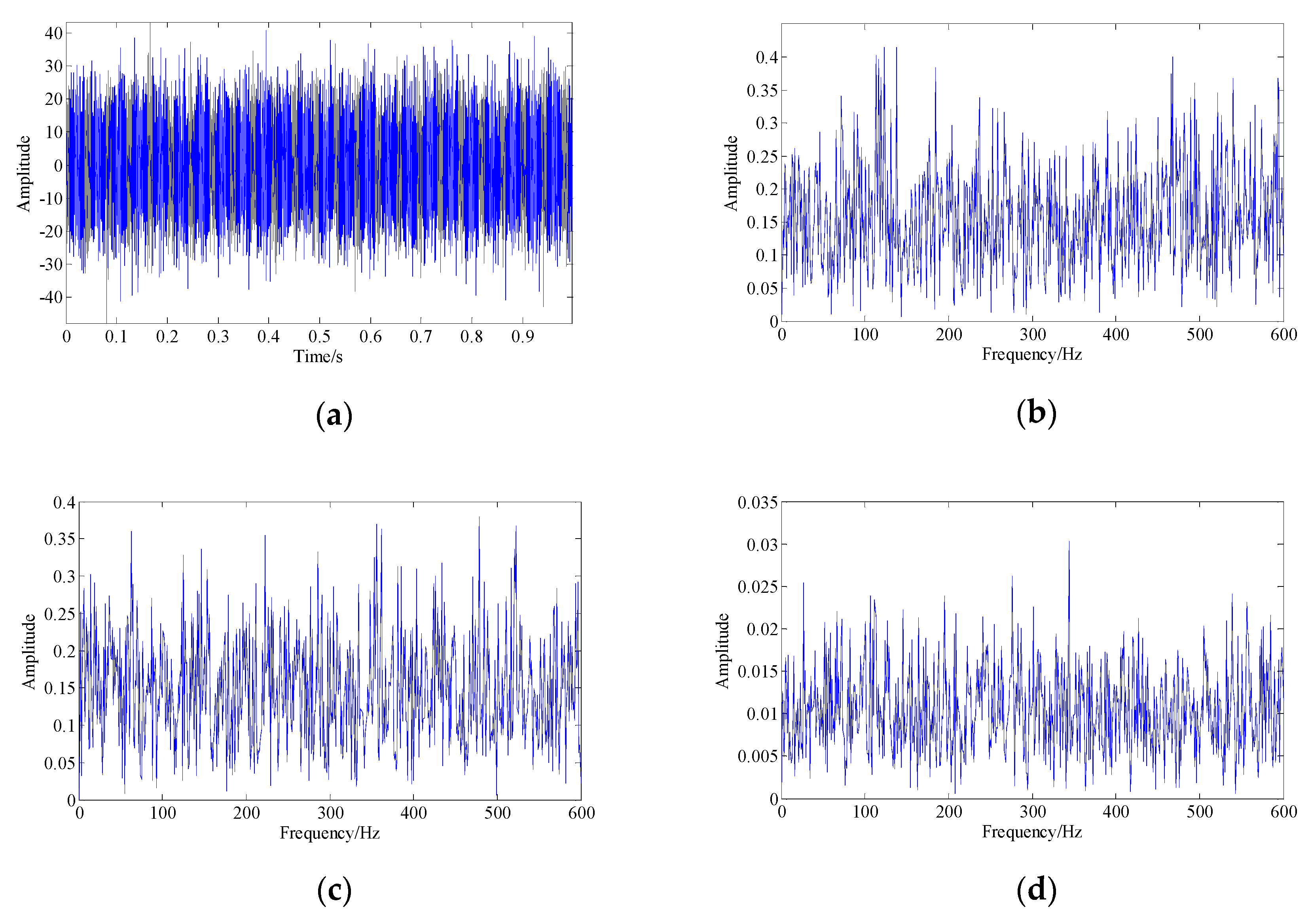
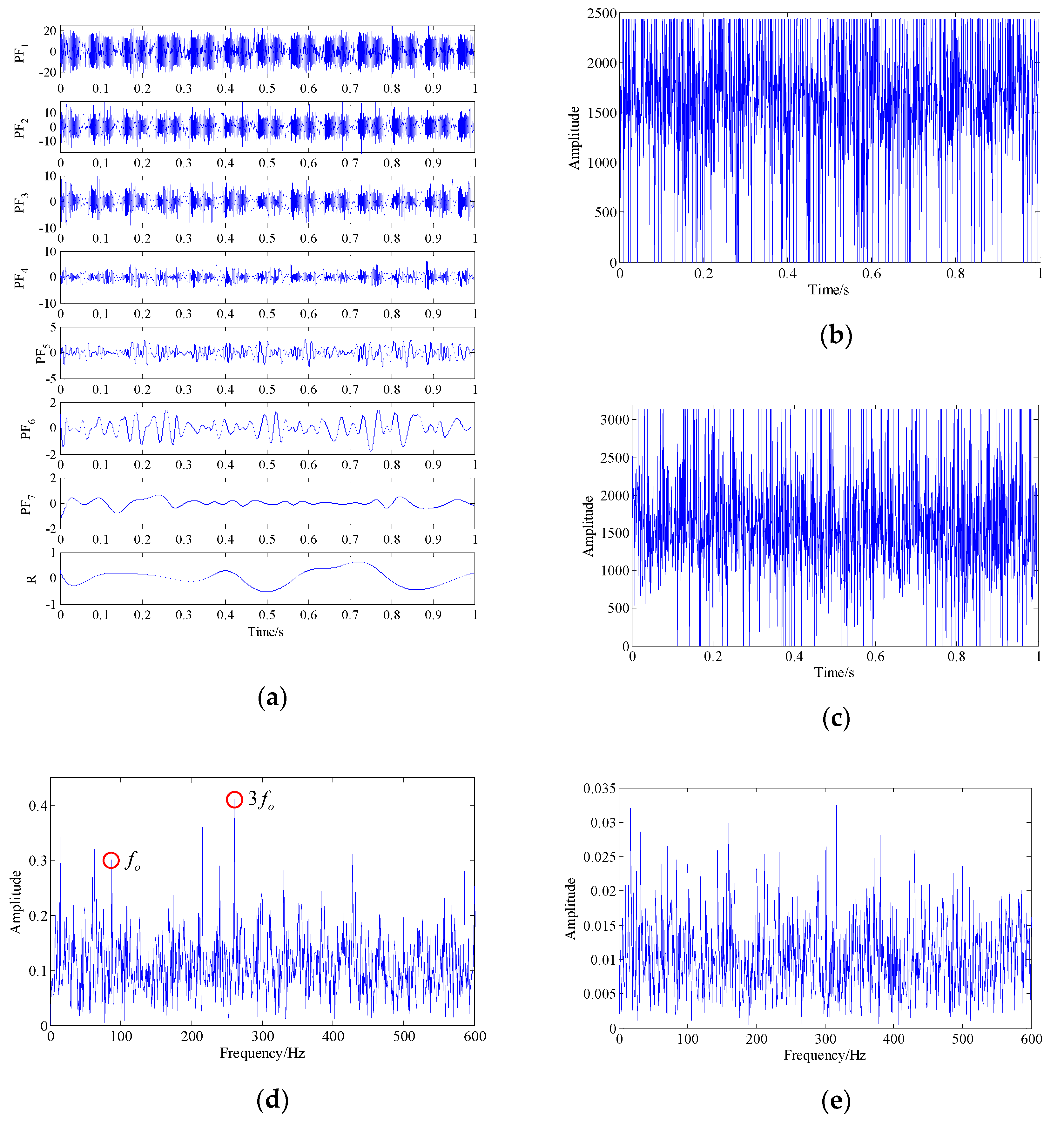
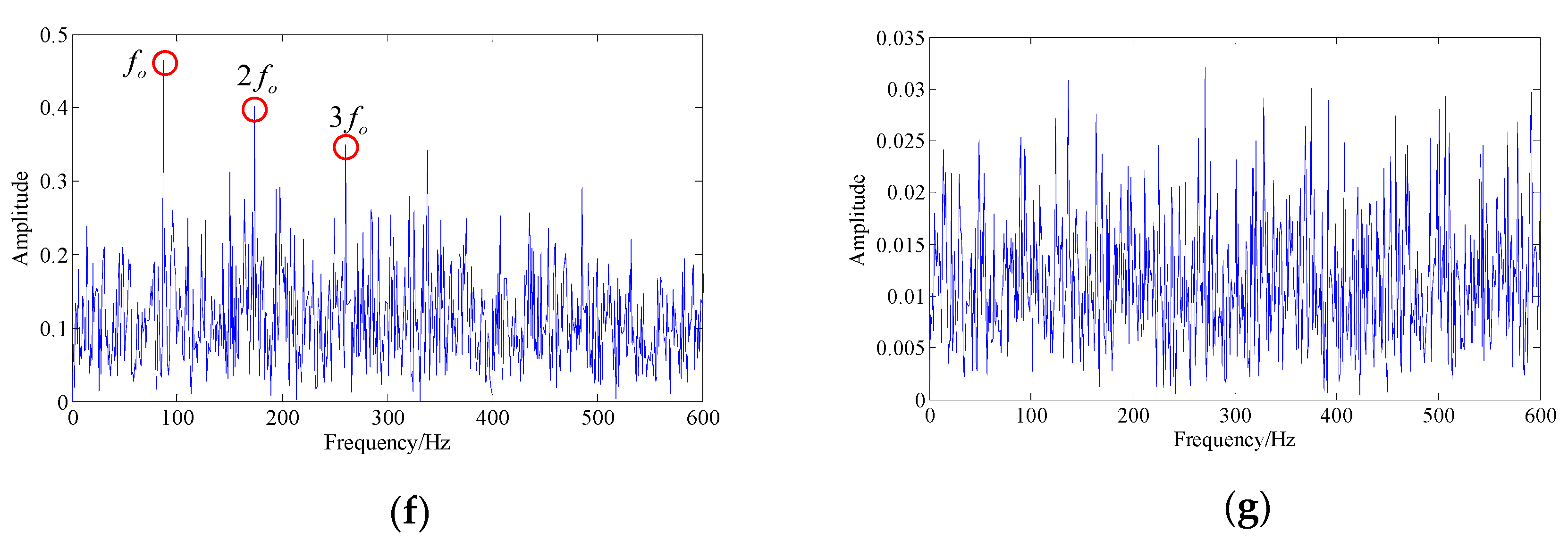
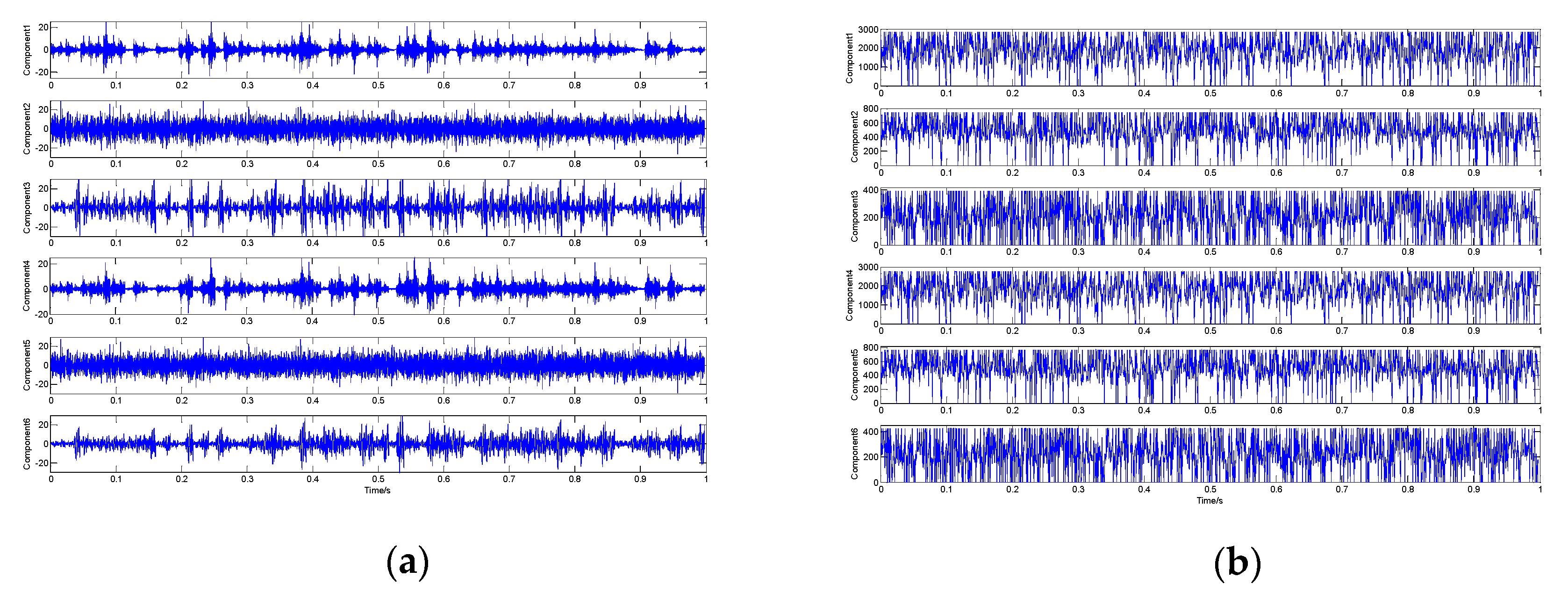
4.1. Numerical Simulation Analysis
4.2. Experimental Signal Analysis
5. Conclusions and Future Work
Author Contributions
Funding
Conflicts of Interest
References
- Lv, Y.; Yuan, R.; Song, G. Multivariate empirical mode decomposition and its application to fault diagnosis of rolling bearing. Mech. Syst. Sig. Process. 2016, 81, 219–234. [Google Scholar] [CrossRef]
- Tang, B.; Song, T.; Li, F.; Deng, L. Fault diagnosis for a wind turbine transmission system based on manifold learning and Shannon wavelet support vector machine. Renewable Energy 2014, 62, 1–9. [Google Scholar] [CrossRef]
- Liu, H.; Han, M. A fault diagnosis method based on local mean decomposition and multi-scale entropy for roller bearings. Mech. Mach. Theory 2014, 75, 67–78. [Google Scholar] [CrossRef]
- Guo, X.; Chen, L.; Shen, C. Hierarchical adaptive deep convolution neural network and its application to bearing fault diagnosis. Measurement 2016, 93, 490–502. [Google Scholar]
- Smith, W.A.; Fan, Z.; Peng, Z.; Li, H.; Randall, R.B. Optimised Spectral Kurtosis for bearing diagnostics under electromagnetic interference. Mech. Syst. Sig. Process. 2016, 75, 371–394. [Google Scholar] [CrossRef]
- Xu, C.; Wang, C.; Liu, W. Nonstationary Vibration Signal Analysis Using Wavelet-Based Time–Frequency Filter and Wigner–Ville Distribution. J. Vib. Acoust. 2016, 138, 1009–1017. [Google Scholar] [CrossRef]
- Ming, Y.; Chen, J.; Dong, G. Weak fault feature extraction of rolling bearing based on cyclic Wiener filter and envelope spectrum. Mech. Syst. Sig. Process 2011, 25, 1773–1785. [Google Scholar] [CrossRef]
- Wang, D.; Shen, C.; Peter, W.T. A novel adaptive wavelet stripping algorithm for extracting the transients caused by bearing localized faults. J. Sound Vib. 2013, 332, 6871–6890. [Google Scholar] [CrossRef]
- Wang, Z.; Zhang, Q.; Xiong, J.; Xiao, M.; Sun, G.; He, J. Fault diagnosis of a rolling bearing using wavelet packet denoising and random forests. IEEE Sens. J. 2017, 17, 5581–5588. [Google Scholar] [CrossRef]
- Daubechies, I.; Lu, J.; Wu, H.T. Synchrosqueezed wavelet transforms: An empirical mode decomposition-like tool. Appl. Comput. Harmon. Anal. 2011, 30, 243–261. [Google Scholar] [CrossRef]
- Hu, Y.; Tu, X.; Li, F.; Meng, G. Joint high-order synchrosqueezing transform and multi-taper empirical wavelet transform for fault diagnosis of wind turbine planetary gearbox under nonstationary conditions. Sensors 2018, 18, 150. [Google Scholar] [CrossRef] [PubMed]
- Feng, Z.; Ma, H.; Zuo, M.J. Amplitude and frequency demodulation analysis for fault diagnosis of planet bearings. J. Sound Vib. 2016, 382, 395–412. [Google Scholar] [CrossRef]
- Wang, Z.; Wang, J.; Kou, Y.; Zhang, J.; Ning, S.; Zhao, Z. Weak fault diagnosis of wind turbine gearboxes based on MED-LMD. Entropy 2017, 19, 277. [Google Scholar] [CrossRef]
- Liang, M.; Bozchalooi, I.S. An energy operator approach to joint application of amplitude and frequency-demodulations for bearing fault detection. Mech. Syst. Sig. Process. 2010, 24, 1473–1494. [Google Scholar] [CrossRef]
- Sabini, E.P.; Lorenc, J.A.; Henyan, O.; Hauenstein, K.L. Bearing Defect Detection Using time Synchronous Averaging (TSA) of an Enveloped Accelerometer Signal. U.S. Patent 6,681,634, 27 January 2004. [Google Scholar]
- Osman, S.; Wang, W. A leakage-free resonance sparse decomposition technique for bearing fault detection in gearboxes. Meas. Sci. Technol. 2018, 29, 1–27. [Google Scholar] [CrossRef]
- Merainani, B.; Benazzouz, D.; Rahmoune, C. Early detection of tooth crack damage in gearbox using empirical wavelet transform combined by Hilbert transform. J. Vib. Control 2017, 23, 1623–1634. [Google Scholar] [CrossRef]
- Zhao, H.; Li, L. Fault diagnosis of wind turbine bearing based on variational mode decomposition and Teager energy operator. IET Renew. Power Gener. 2017, 11, 453–460. [Google Scholar] [CrossRef]
- Ma, J.; Wu, J.; Wang, X. Incipient fault feature extraction of rolling bearings based on the MVMD and Teager energy operator. ISA Trans. 2018, 80, 297–311. [Google Scholar] [CrossRef] [PubMed]
- Zeng, M.; Yang, Y.; Zheng, J.; Cheng, J. Normalized complex Teager energy operator demodulation method and its application to fault diagnosis in a rubbing rotor system. Mech. Syst. Sig. Process 2015, 50, 380–399. [Google Scholar] [CrossRef]
- Deng, L.; Zhao, R. Fault feature extraction of a rotor system based on local mean decomposition and Teager energy kurtosis. J. Mech. Sci. Technol. 2014, 28, 1161–1169. [Google Scholar] [CrossRef]
- Cai, J. Feature extraction of rolling bearing fault signal based on local meandecomposition and Teager energy operator. Ind. Lubr. Tribol. 2017, 69, 872–880. [Google Scholar] [CrossRef]
- Kennel, M.B.; Brown, R.; Abarbanel, H.D. Determining embedding dimension for phase-space reconstruction using a geometrical construction. Phys. Rev. A 1992, 45, 3403. [Google Scholar] [CrossRef] [PubMed]
- Yi, C.; Lv, Y.; Dang, Z.; Xiao, H.; Yu, X. Quaternion singular spectrum analysis using convex optimization and its application to fault diagnosis of rolling bearing. Measurement 2017, 103, 321–332. [Google Scholar] [CrossRef]
- Vautard, R.; Yiou, P.; Ghil, M. Singular-spectrum analysis: A toolkit for short, noisy chaotic signals. Phys. D: Nonlinear Phenom. 1992, 58, 95–126. [Google Scholar] [CrossRef]
- Kouchaki, S.; Sanei, S.; Arbon, E.L.; Dijk, D.J. Tensor based singular spectrum analysis for automatic scoring of sleep EEG. IEEE Trans. Neural Syst. Rehabil. Eng. 2015, 23, 1–9. [Google Scholar] [CrossRef] [PubMed]
- He, R.; Hu, B.G.; Zheng, W.S.; Kong, X.W. Robust principal component analysis based on maximum correntropy criterion. IEEE Trans. Image Process. 2011, 20, 1485–1494. [Google Scholar] [PubMed]
- Erichson, N.B.; Voronin, S.; Brunton, S.L.; Kutz, J.N. Randomized Matrix Decompositions Using R. J. Stat. Software 2019, 89, 1–48. [Google Scholar] [CrossRef]
- Lee, J.; Kim, S.; Lebanon, G.; Singer, Y.; Bengio, S. LLORMA: Local low-rank matrix approximation. The J. Mach. Learn. Res. 2016, 17, 442–465. [Google Scholar]
- Ge, M.; Lv, Y.; Yi, C.; Zhang, Y.; Chen, X. A Joint Fault Diagnosis Scheme Based on Tensor Nuclear Norm Canonical Polyadic Decomposition and Multi-Scale Permutation Entropy for Gears. Entropy 2018, 20, 161. [Google Scholar] [CrossRef]
- Candès, E.J.; Recht, B. Exact matrix completion via convex optimization. Found Comput. Math. 2009, 9, 717. [Google Scholar] [CrossRef]
- Wand, M.P.; Jones, M.C. Kernel Smoothing, 1st ed.; Chapman and Hall/CRC: New York, NY, USA, 1994. [Google Scholar]
- Feng, Z.; Zuo, M.J.; Hao, R.; Chu, F.; Lee, J. Ensemble empirical mode decomposition-based Teager energy spectrum for bearing fault diagnosis. J. Vib. Acoust. 2013, 135, 1013–1033. [Google Scholar] [CrossRef]
- Randall, R.B. A Stochastic Model for Simulation and Diagnostics of Rolling Element Bearings With Localized Faults. J. Vib. Acoust. 2003, 125, 282–289. [Google Scholar]
- Antoni, J.; Randall, R.B. Differential diagnosis of gear and bearing faults. J. Vib. Acoust. 2002, 124, 165–171. [Google Scholar] [CrossRef]
- Li, C.Y.; Zhu, L.; Bao, W.Z.; Jiang, Y.L.; Yuan, C.A.; Huang, D.S. Convex Local Sensitive Low Rank Matrix Approximation. In Proceedings of the 2017 International Joint Conference on Neural Networks (IJCNN), Anchorage, AK, USA, 14–19 May 2017. [Google Scholar]
- Zhang, Z.L.; Cao, Z.Y.; Li, Y.T. Research Based on Euclid Distance with Weights of K_means Algorithm. J. Zhengzhou University (Eng. Sci.) 2010, 31, 89–92. [Google Scholar]
- Ramsay, J.O. Kernel smoothing approaches to nonparametric item characteristic curve estimation. Psychometrika 1991, 56, 611–630. [Google Scholar] [CrossRef]
- Favaro, P.; Vidal, R.; Ravichandran, A. A Closed Form Solution to Robust Subspace Estimation and Clustering. In Proceedings of the Computer Vision and Pattern Recognition 2011, Colorado Springs, CO, USA, 20–25 June 2011. [Google Scholar]
- Candès, E.J.; Li, X.; Ma, Y.; Wright, J. Robust principal component analysis? J. ACM 2011, 58, 11. [Google Scholar] [CrossRef]
- Zhang, H.; Lin, Z.; Zhang, C.; Gao, J. Robust latent low rank representation for subspace clustering. Neurocomputing 2014, 145, 369–373. [Google Scholar] [CrossRef]
- Lin, Z.; Chen, M.; Ma, Y. The Augmented Lagrange Multiplier Method for Exact Recovery of Corrupted Low-Rank Matrices; Coordinated Science Laboratory, University of Illinois at Urbana-Champaign: Urbana, IL, USA, 2009. [Google Scholar]
- Tanner, J.; Wei, K. Normalized iterative hard thresholding for matrix completion. SIAM J.Sci. Comput. 2013, 35, S104–S125. [Google Scholar] [CrossRef]




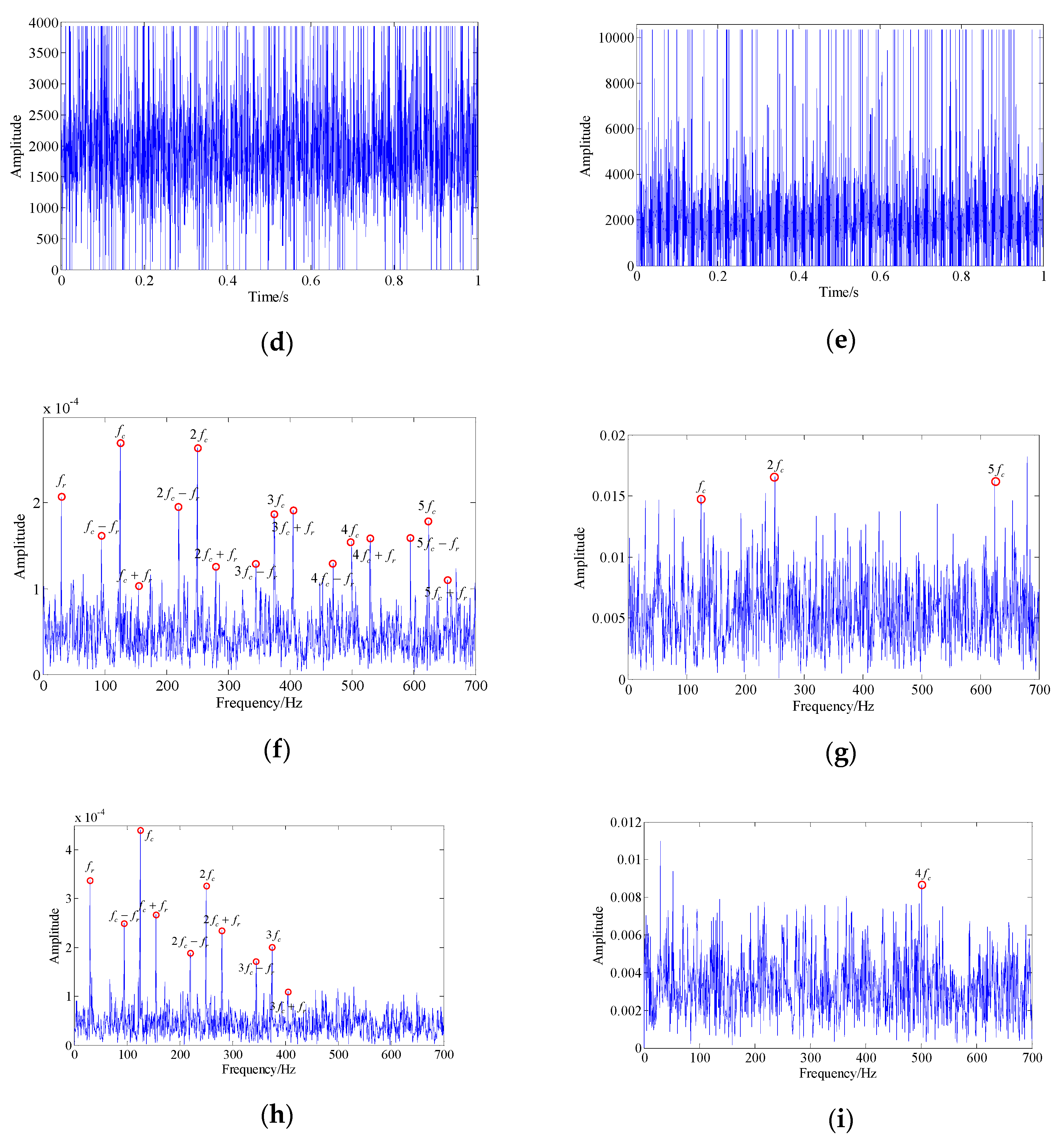
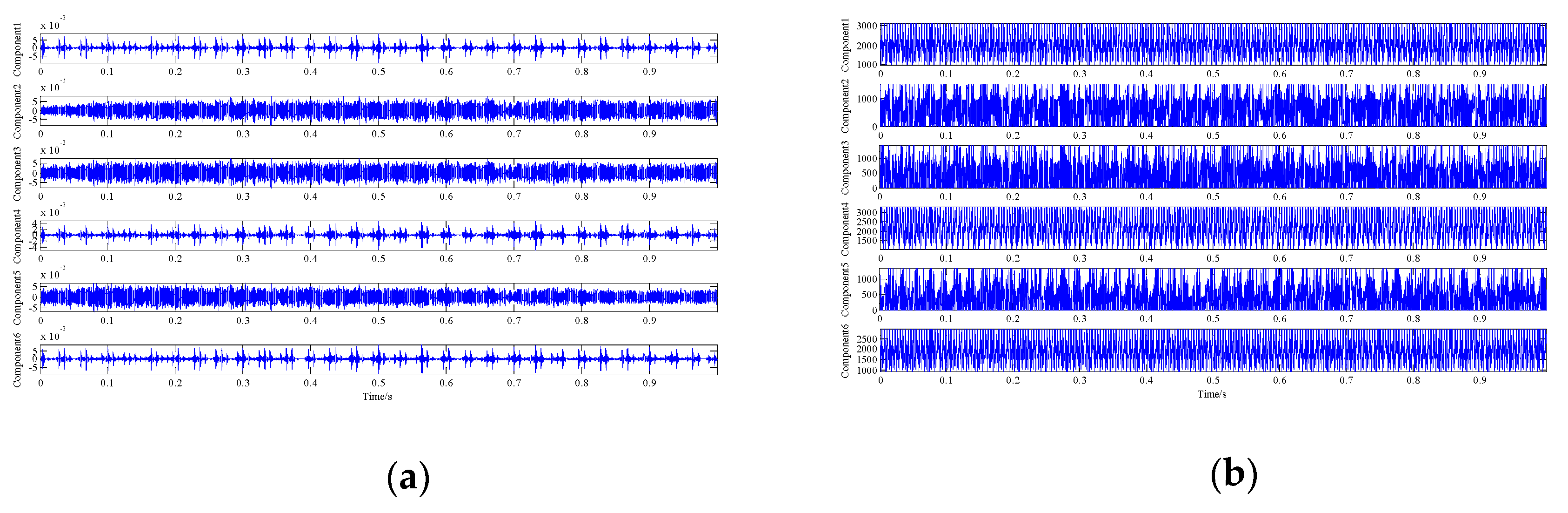
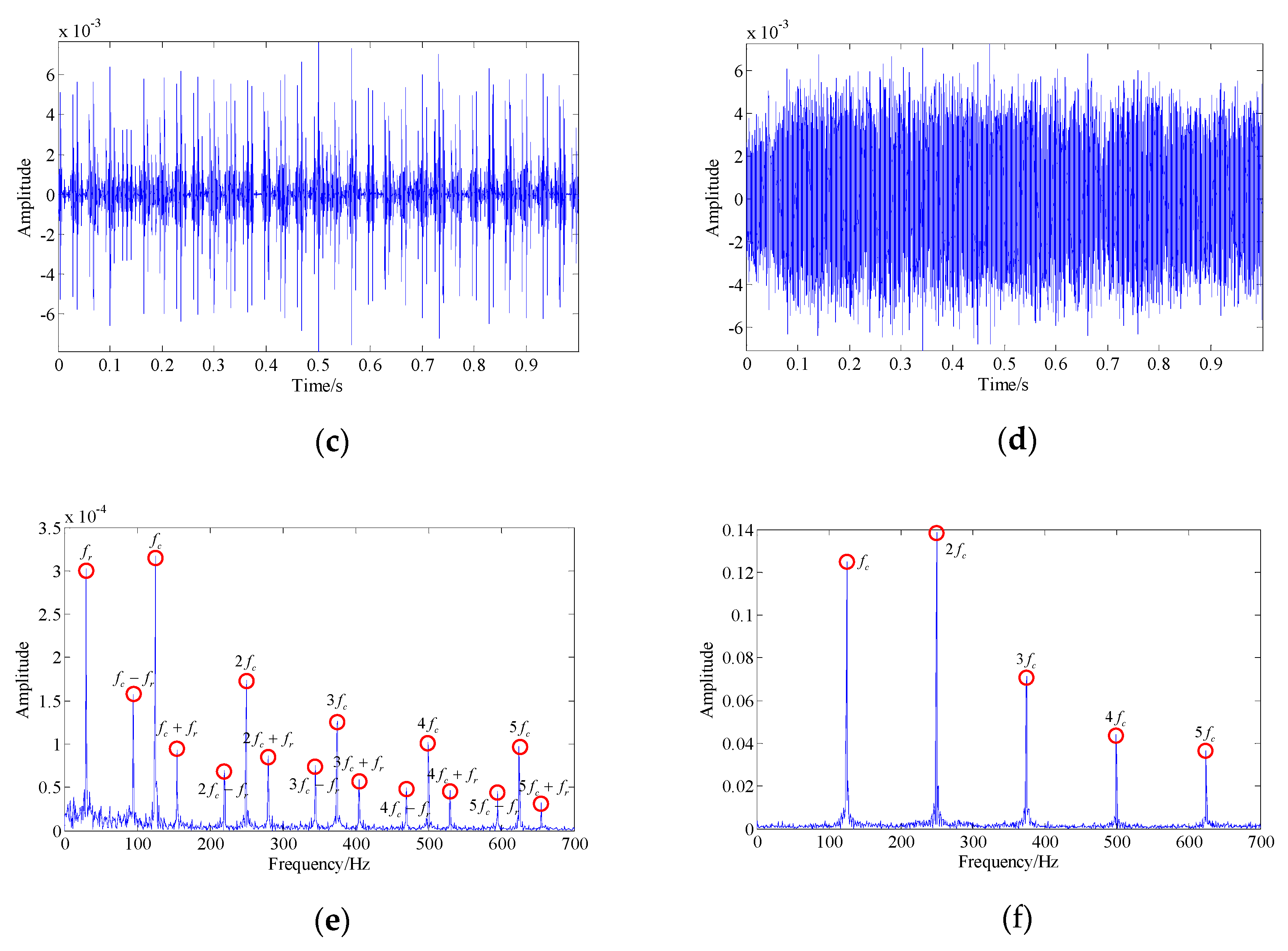
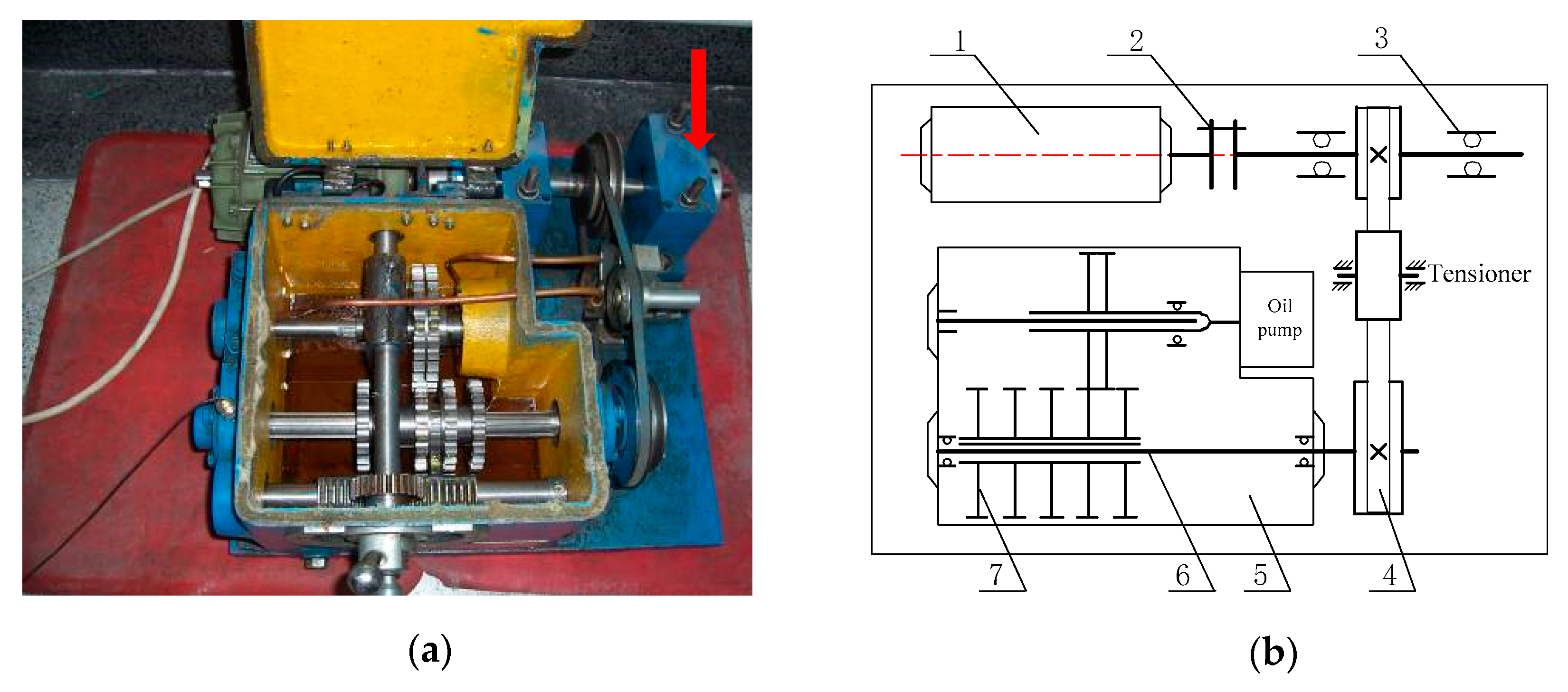

| I | L | C | |||||||||
|---|---|---|---|---|---|---|---|---|---|---|---|
| 2000 Hz | 125 Hz | 30 Hz | 125 | 100 | 3e−4 | 1 | 0 | 0 | 800 | 0.02/ |
| Raw Signal | Component 1 | Component 2 | Component 3 | Component 4 |
| 0.9002 | 0.0013 | 0.0010 | 0.8705 | |
| 0.00046 | 0.9272 | 0.9320 | 0.00056 | |
| Raw Signal | Component 5 | Component 6 | Extracted Fault Characteristic Signal | Extracted Interference Harmonic Signal |
| 0.0013 | 0.8986 | 0.8971 | 0.0013 | |
| 0.9241 | 0.00053 | 0.000509 | 0.9339 |
| Number of Roller Elements | Roller Diameter (mm) | Medium Diameter (mm) | Contact Angle | Rotation Frequency (Hz) | Sampling Frequency (Hz) | Sampling Points | Fault Frequency (Hz) |
|---|---|---|---|---|---|---|---|
| = 9 | = 11.1 | = 53.5 | = 24.17 | = 16,348 | = 16,356 | = 87.01 |
© 2019 by the authors. Licensee MDPI, Basel, Switzerland. This article is an open access article distributed under the terms and conditions of the Creative Commons Attribution (CC BY) license (http://creativecommons.org/licenses/by/4.0/).
Share and Cite
Lv, Y.; Ge, M.; Zhang, Y.; Yi, C.; Ma, Y. A Novel Demodulation Analysis Technique for Bearing Fault Diagnosis via Energy Separation and Local Low-Rank Matrix Approximation. Sensors 2019, 19, 3755. https://doi.org/10.3390/s19173755
Lv Y, Ge M, Zhang Y, Yi C, Ma Y. A Novel Demodulation Analysis Technique for Bearing Fault Diagnosis via Energy Separation and Local Low-Rank Matrix Approximation. Sensors. 2019; 19(17):3755. https://doi.org/10.3390/s19173755
Chicago/Turabian StyleLv, Yong, Mao Ge, Yi Zhang, Cancan Yi, and Yubo Ma. 2019. "A Novel Demodulation Analysis Technique for Bearing Fault Diagnosis via Energy Separation and Local Low-Rank Matrix Approximation" Sensors 19, no. 17: 3755. https://doi.org/10.3390/s19173755
APA StyleLv, Y., Ge, M., Zhang, Y., Yi, C., & Ma, Y. (2019). A Novel Demodulation Analysis Technique for Bearing Fault Diagnosis via Energy Separation and Local Low-Rank Matrix Approximation. Sensors, 19(17), 3755. https://doi.org/10.3390/s19173755