Joint Design of Space-Time Transmit and Receive Weights for Colocated MIMO Radar




Abstract
1. Introduction
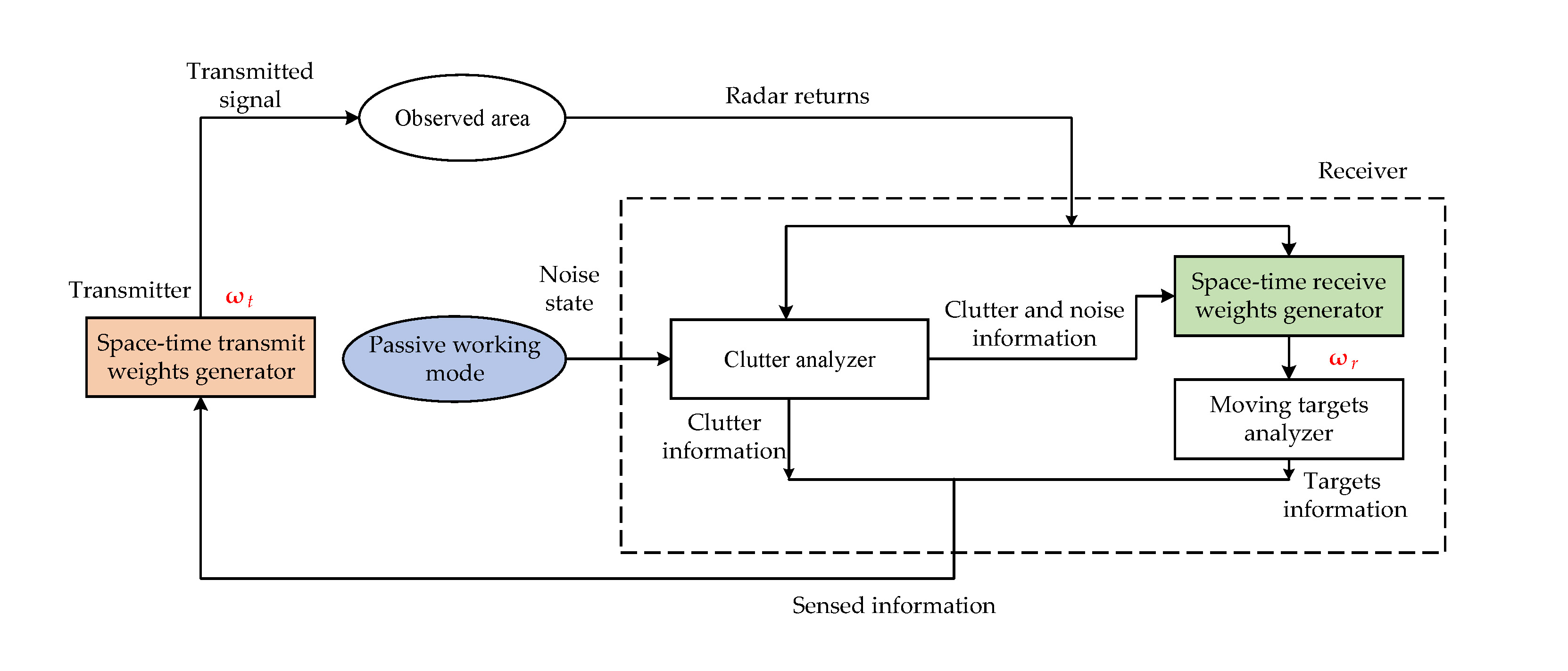
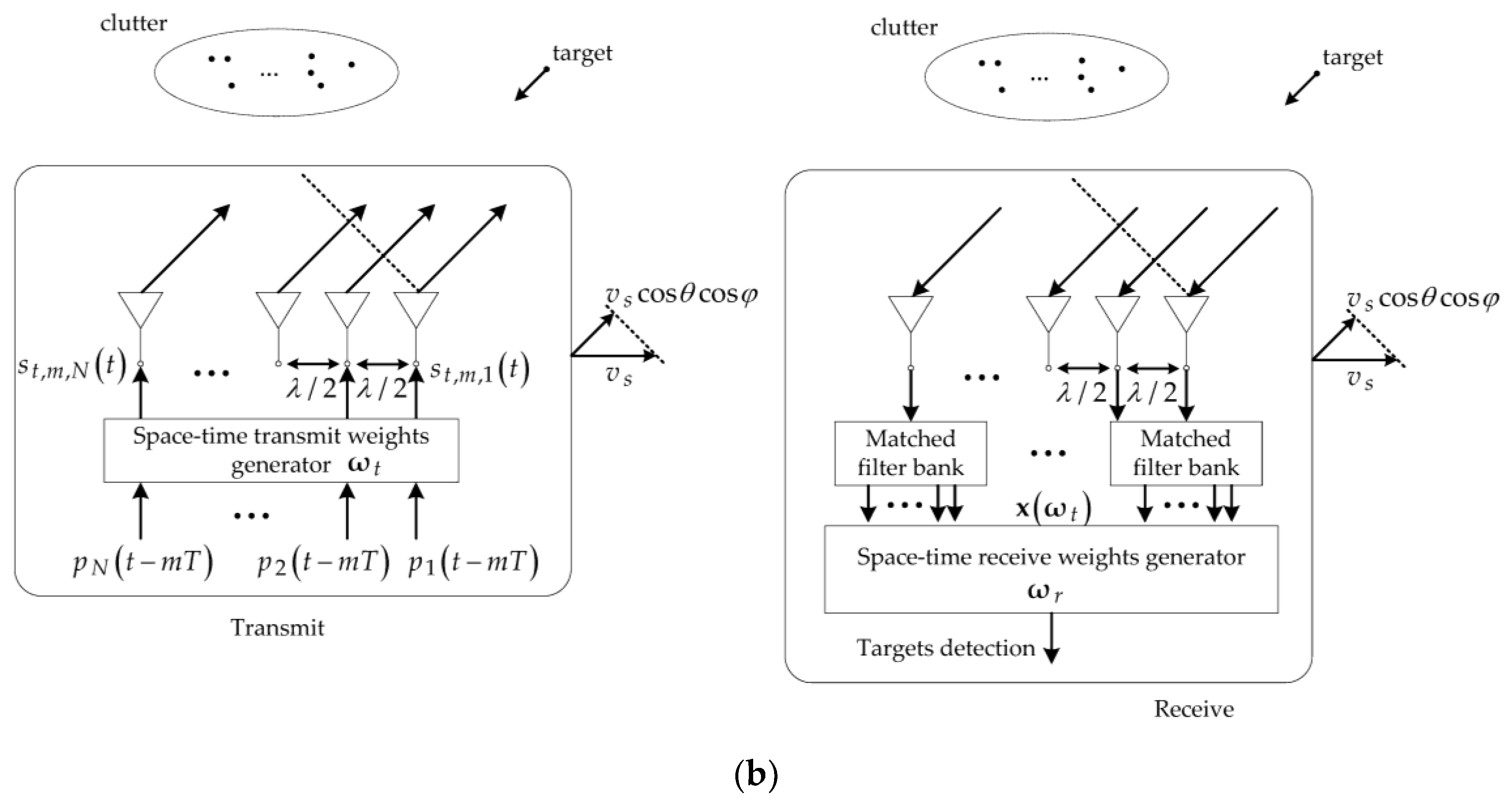
2. Optimization Model for Colocated MIMO Radar
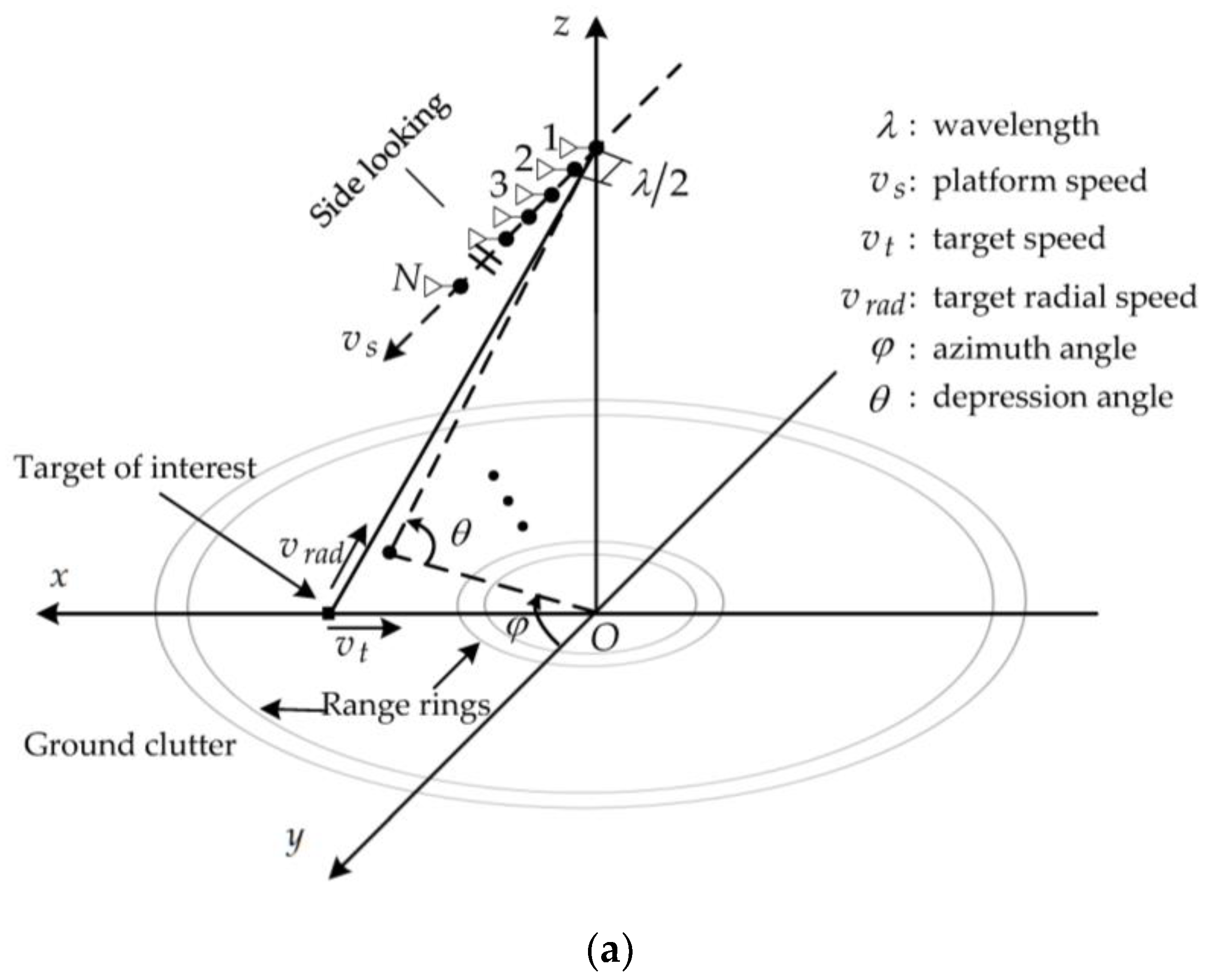
- Platform speed: This is the speed of the platform along the flight path.
- Target speed: This is the speed of one moving target along the moving direction, which can be any direction in the free space.
- Target radial speed: This is the speed of one moving target along the line-of-sight direction.
- Nadir: The nadir is the point on the area directly below the radar phase center, so that the “normal” to the area at the nadir passes through the radar phase center.
- Radar track: As the nadir point moves along the area, it traces out the radar track.
- Depression angle: This is the remaining angle of the off-line angle, which is the angle from the target to the nadir relative to the radar phase center.
- Azimuth angle: This is the clockwise angle from the direction of the radar track to the direction of interest relative to the nadir point viewed from above (i.e., projected to the ground plane).
3. Joint Design of Transmit and Receive Weights
4. Simulation and Analysis
4.1. Simulation Parameters
4.2. Simulation Results and Analysis
5. Conclusions
Author Contributions
Funding
Conflicts of Interest
Appendix A
References
- Forsythe, K.W.; Bliss, D.W.; Fawcett, G.S. Multiple-input multiple-output (MIMO) radar: Performance issues. In Proceedings of the 38th Asilomar Conference on Signals, Systems and Computers, Pacific Grove, CA, USA, 7–10 November 2004; Volume 1, pp. 310–315. [Google Scholar]
- Li, J.; Stoica, P. MIMO radar with colocated antennas. IEEE Signal Process. Mag. 2007, 24, 106–114. [Google Scholar] [CrossRef]
- Stoica, P.; Li, J.; Xie, Y. On probing signal design for MIMO radar. IEEE Trans. Signal Process. 2007, 55, 4151–4161. [Google Scholar] [CrossRef]
- Bliss, D.W.; Forsythe, K.W. Multiple-input multiple-output (MIMO) radar and imaging: Degrees of freedom and resolution. In Proceedings of the 37th Asilomar Conference on Signals, Systems and Computers, Pacific Grove, CA, USA, 9–12 November 2003; Volume 1, pp. 54–59. [Google Scholar]
- Robey, F.C.; Coutts, S.; Weikle, D.; McHarg, J.C.; Cuomo, K. MIMO radar theory and experimental results. In Proceedings of the 38th Asilomar Conference on Signals, Systems and Computers, Pacific Grove, CA, USA, 7–10 November 2004; Volume 1, pp. 300–304. [Google Scholar]
- Khan, H.A.; Zhang, Y.; Ji, C.; Stevens, C.J.; Edwards, D.J.; O’Brien, D. Optimizing Polyphase Sequences for Orthogonal Netted Radar. IEEE Signal Process. Lett. 2006, 13, 589–592. [Google Scholar] [CrossRef]
- Deng, H. Polyphase code design for Orthogonal Netted Radar systems. IEEE Trans. Signal Process. 2004, 52, 3126–3135. [Google Scholar] [CrossRef]
- Liu, B.; He, Z.; Zeng, J.; Liu, B. Polyphase orthogonal code design for MIMO radar systems. In Proceedings of the 2006 CIE International Conference on Radar, Shanghai, China, 16–19 October 2006; pp. 1–4. [Google Scholar]
- Liu, B.; He, Z.; He, Q. Optimization of Orthogonal Discrete Frequency-Coding Waveform Based on Modified Genetic Algorithm for MIMO Radar. In Proceedings of the 2007 International Conference on Communications, Circuits and Systems, Kokura, Japan, 11–13 July 2007; pp. 966–970. [Google Scholar]
- Stoica, P.; He, H.; Li, J. New Algorithms for Designing Unimodular Sequences with Good Correlation Properties. IEEE Trans. Signal Process. 2009, 57, 1415–1425. [Google Scholar] [CrossRef]
- Song, J.; Babu, P.; Palomar, D.P. Optimization Methods for Designing Sequences with Low Autocorrelation Sidelobes. IEEE Trans. Signal Process. 2015, 63, 3998–4009. [Google Scholar] [CrossRef]
- Aubry, A.; Maio, A.D.; Kerahroodi, M.A.; Naghsh, M.M.; Modarres-Hashemi, M. A Coordinate-Descent Framework to Design Low PSL/ISL Sequences. IEEE Trans. Signal Process. 2017, 65, 5942–5956. [Google Scholar]
- Fuhrmann, D.R.; Antonio, G.S. Transmit beamforming for MIMO radar systems using partial signal correlation. In Proceedings of the 38th Asilomar Conference on Signals, Systems and Computers, Pacific Grove, CA, USA, 7–10 November 2004; Volume 1, pp. 295–299. [Google Scholar]
- Stoica, P.; Li, J.; Zhu, X. Waveform synthesis for diversity-based transmit beampattern design. IEEE Trans. Signal Process. 2008, 56, 2593–2598. [Google Scholar] [CrossRef]
- Wang, Y.C.; Wang, X.; Liu, H.; Luo, Z.Q. On the design of constant modulus probing signals for MIMO radar. IEEE Trans. Signal Process. 2012, 60, 4432–4438. [Google Scholar] [CrossRef]
- Jiu, B.; Liu, H.; Wang, X.; Zhang, L.; Wang, Y.; Chen, B. Knowledge-Based Spatial-Temporal Hierarchical MIMO Radar Waveform Design Method for Target Detection in Heterogeneous Clutter Zone. IEEE Trans. Signal Process. 2014, 63, 543–554. [Google Scholar] [CrossRef]
- Aubry, A.; Maio, A.D.; Huang, Y. MIMO Radar Beampattern Design via PSL/ISL Optimization. IEEE Trans. Signal Process. 2016, 64, 3955–3967. [Google Scholar] [CrossRef]
- Aubry, A.; Maio, A.D.; Piezzo, M.; Farina, A.; Wicks, M. Cognitive design of the receive filter and transmitted phase code in reverberating environment. IET Radar Sonar Navig. 2012, 6, 822–833. [Google Scholar] [CrossRef]
- Aubry, A.; Maio, A.D.; Farina, A.; Wicks, M. Knowledge-Aided (Potentially Cognitive) Transmit Signal and Receive Filter Design in Signal-Dependent Clutter. IEEE Trans. Aerosp. Electron. Syst. 2013, 49, 93–117. [Google Scholar] [CrossRef]
- Aubry, A.; Maio, A.D.; Naghsh, M.M. Optimizing Radar Waveform and Doppler Filter Bank via Generalized Fractional Programming. IEEE J. Sel. Top. Signal Process. 2015, 9, 1387–1399. [Google Scholar] [CrossRef]
- Piezzo, M.; Aubry, A.; Buzzi, S.; Maio, A.D.; Farina, A. Non-cooperative code design in radar networks: A game-theoretic approach. EURASIP J. Adv. Signal Process. 2013, 2013, 63. [Google Scholar] [CrossRef]
- Karbasi, S.M.; Aubry, A.; Carotenuto, V.; Naghsh, M.M.; Bastani, M.H. Knowledge-based design of space–time transmit code and receive filter for a multiple-input–multiple-output radar in signal-dependent interference. IET Radar Sonar Navig. 2015, 9, 1124–1135. [Google Scholar] [CrossRef]
- Haghnegahdar, M.; Imani, S.; Ghorashi, S.A.; Mehrshahi, E. SINR Enhancement in Colocated MIMO Radar Using Transmit Covariance Matrix Optimization. IEEE Signal Process. Lett. 2017, 24, 339–343. [Google Scholar] [CrossRef]
- Cui, G.; Yu, X.; Carotenuto, V.; Kong, L. Space-Time Transmit Code and Receive Filter Design for Colocated MIMO Radar. IEEE Trans. Signal Process. 2017, 65, 1116–1129. [Google Scholar] [CrossRef]
- Imani, S.; Nayebi, M.M.; Ghorashi, S.A. Colocated MIMO Radar SINR Maximization under ISL and PSL Constraints. IEEE Signal Process. Lett. 2018, 25, 422–426. [Google Scholar] [CrossRef]
- Bolhasani, M.; Mehrshahi, E.; Ghorashi, S.A. Waveform Covariance Matrix Design for Robust Signal-Dependent Interference Suppression in Colocated MIMO Radars. Signal Process. 2018, 152, 311–319. [Google Scholar] [CrossRef]
- Cumming, I.G.; Wong, F.H. Digital Processing of Synthetic Aperture Radar Data: Algorithms and Implementation; Artech House: Norwood, MA, USA, 2005. [Google Scholar]
- Caves, R.G.; Harley, P.J.; Quegan, S. Clutter statistics along edge features in synthetic aperture radar imagery. J. Electromagn. Waves Appl. 1995, 9, 327–353. [Google Scholar]
- Grossi, E.; Lops, M.; Venturino, L. Track-before-detect for multiframe detection with censored observations. IEEE Trans. Aerosp. Electron. Syst. 2014, 50, 2032–2046. [Google Scholar] [CrossRef]
- Wang, B.; Wang, Y.; Hui, C. Spatial wavelet transform preprocessing for direction of arrival estimation. In Proceedings of the IEEE Antennas and Propagation Society International Symposium, San Antonio, TX, USA, 16–21 June 2002; pp. 672–675. [Google Scholar]
- Brenner, T.; Weiss, G.; Klein, M.; Kuschel, H. Signals and data fusion in a deployable multiband passive-active radar (DMPAR). In Proceedings of the IET International Conference on Radar Systems, Glasgow, UK, 22–25 October 2012; pp. 1–6. [Google Scholar]
- O’Hagan, D.W.; Ummenhofer, M.; Kuschel, H.; Heckenbach, J. A passive/active dual mode radar concept. In Proceedings of the 2013 14th International Radar Symposium, Dresden, Germany, 19–21 June 2013; Volume 1, pp. 136–142. [Google Scholar]
- Ward, J. Space-time adaptive processing for airborne radar. In Proceedings of the IEE Colloquium on Space-Time Adaptive Processing, London, UK, 6 April 1998; pp. 2/1–2/6. [Google Scholar]
- Klemm, R. Principles of Space-Time Adaptive Processing, 3rd ed.; The Institution of Engineering and Technology: London, UK, 2006. [Google Scholar]
- Chong, E.K.P.; Żak, S.H. An Introduction to Optimization, 4th ed.; John Wiley & Sons: New York, NY, USA, 2013. [Google Scholar]
- Kelly, E.J. An Adaptive Detection Algorithm. IEEE Trans. Aerosp. Electron. Syst. 1986, AES-22, 115–127. [Google Scholar] [CrossRef]
- Karbasi, S.M.; Aubry, A.; Maio, A.D.; Bastani, M.H. Robust Transmit Code and Receive Filter Design for Extended Targets in Clutter. IEEE Trans. Signal Process. 2015, 63, 1965–1976. [Google Scholar] [CrossRef]
- Aubry, A.; Maio, A.D.; Foglia, G.; Orlando, D. Diffuse Multipath Exploitation for Adaptive Radar Detection. IEEE Trans. Signal Process. 2015, 63, 1268–1281. [Google Scholar] [CrossRef]
- Cheng, X.; Aubry, A.; Ciuonzo, D.; Maio, A.D.; Wang, X. Robust Waveform and Filter Bank Design of Polarimetric Radar. IEEE Trans. Aerosp. Electron. Syst. 2017, 53, 370–384. [Google Scholar] [CrossRef]
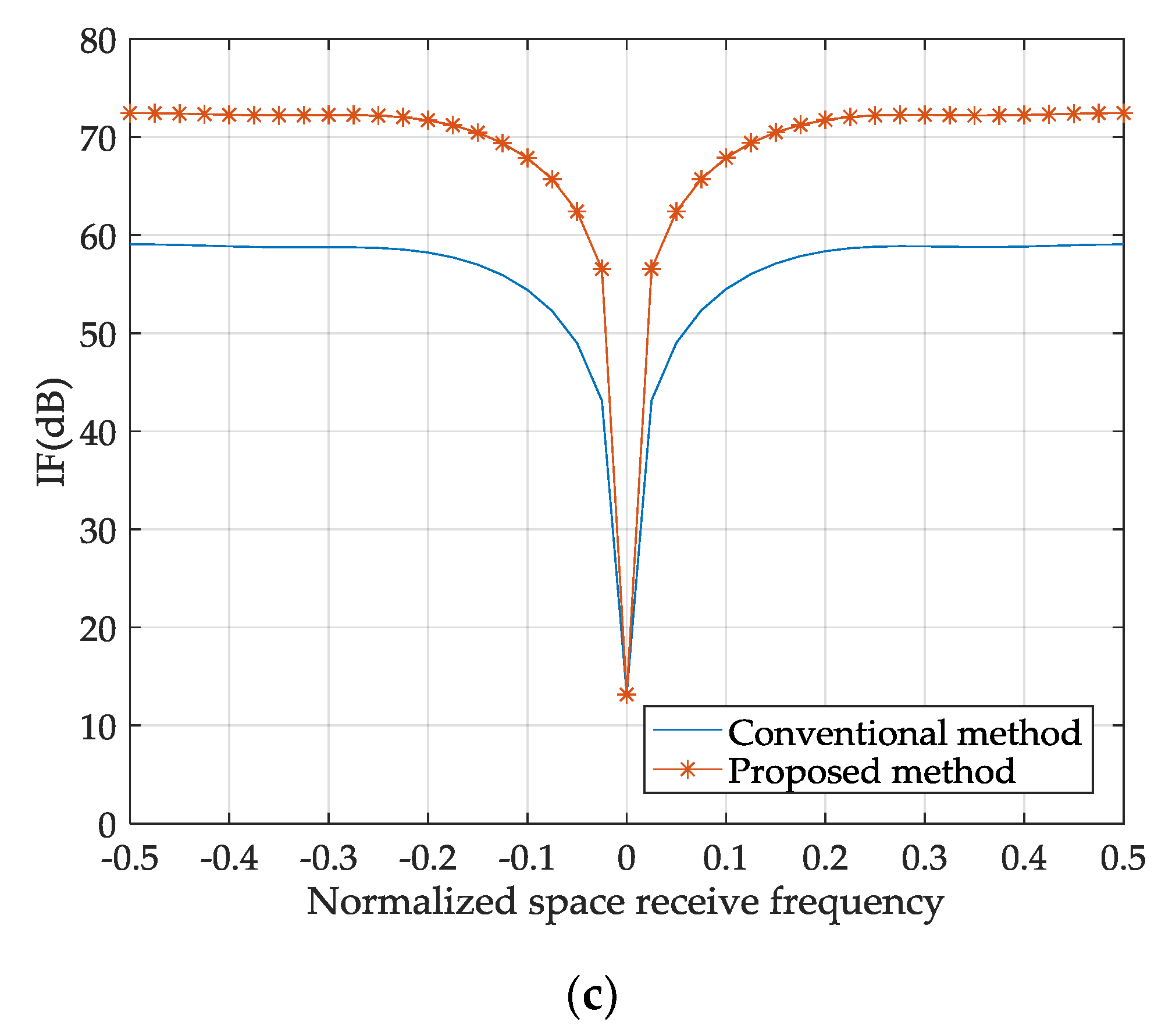
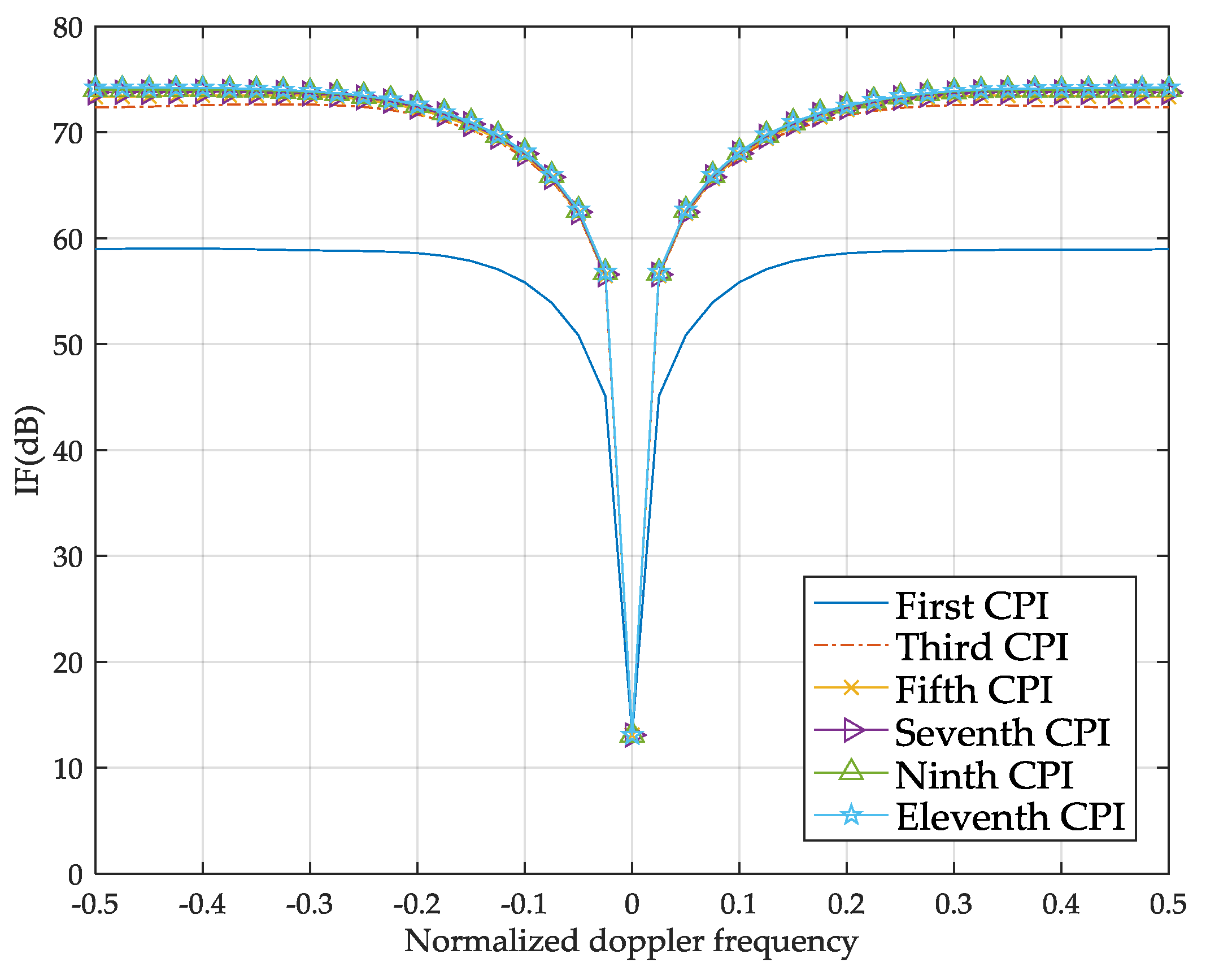

| Parameter | Value |
|---|---|
| carrier frequency | 10 GHz |
| pulse repetition frequency | 12 KHz |
| inter-CPI interval | 0.125 s |
| platform speed | 90 m/s |
| altitude | 3 km |
| number of transmit elements | 4 |
| number of receive elements | 4 |
| transmit sensor spacing | 0.015 m |
| receive sensor spacing | 0.015 m |
| target speed | 56.61 m/s |
| target initial range | 10 km |
| target initial direction | 90° |
| signal/noise ratio | −10 dB |
| clutter/noise ratio | 20 dB |
| number of temporal samples | 8 |
© 2018 by the authors. Licensee MDPI, Basel, Switzerland. This article is an open access article distributed under the terms and conditions of the Creative Commons Attribution (CC BY) license (http://creativecommons.org/licenses/by/4.0/).
Share and Cite
Yu, Z.; Wang, S.; Liu, W.; Li, C. Joint Design of Space-Time Transmit and Receive Weights for Colocated MIMO Radar. Sensors 2018, 18, 2722. https://doi.org/10.3390/s18082722
Yu Z, Wang S, Liu W, Li C. Joint Design of Space-Time Transmit and Receive Weights for Colocated MIMO Radar. Sensors. 2018; 18(8):2722. https://doi.org/10.3390/s18082722
Chicago/Turabian StyleYu, Ze, Shusen Wang, Wei Liu, and Chunsheng Li. 2018. "Joint Design of Space-Time Transmit and Receive Weights for Colocated MIMO Radar" Sensors 18, no. 8: 2722. https://doi.org/10.3390/s18082722
APA StyleYu, Z., Wang, S., Liu, W., & Li, C. (2018). Joint Design of Space-Time Transmit and Receive Weights for Colocated MIMO Radar. Sensors, 18(8), 2722. https://doi.org/10.3390/s18082722