Optimal Atmospheric Correction for Above-Ground Forest Biomass Estimation with the ETM+ Remote Sensor

Abstract
:1. Introduction
2. Materials
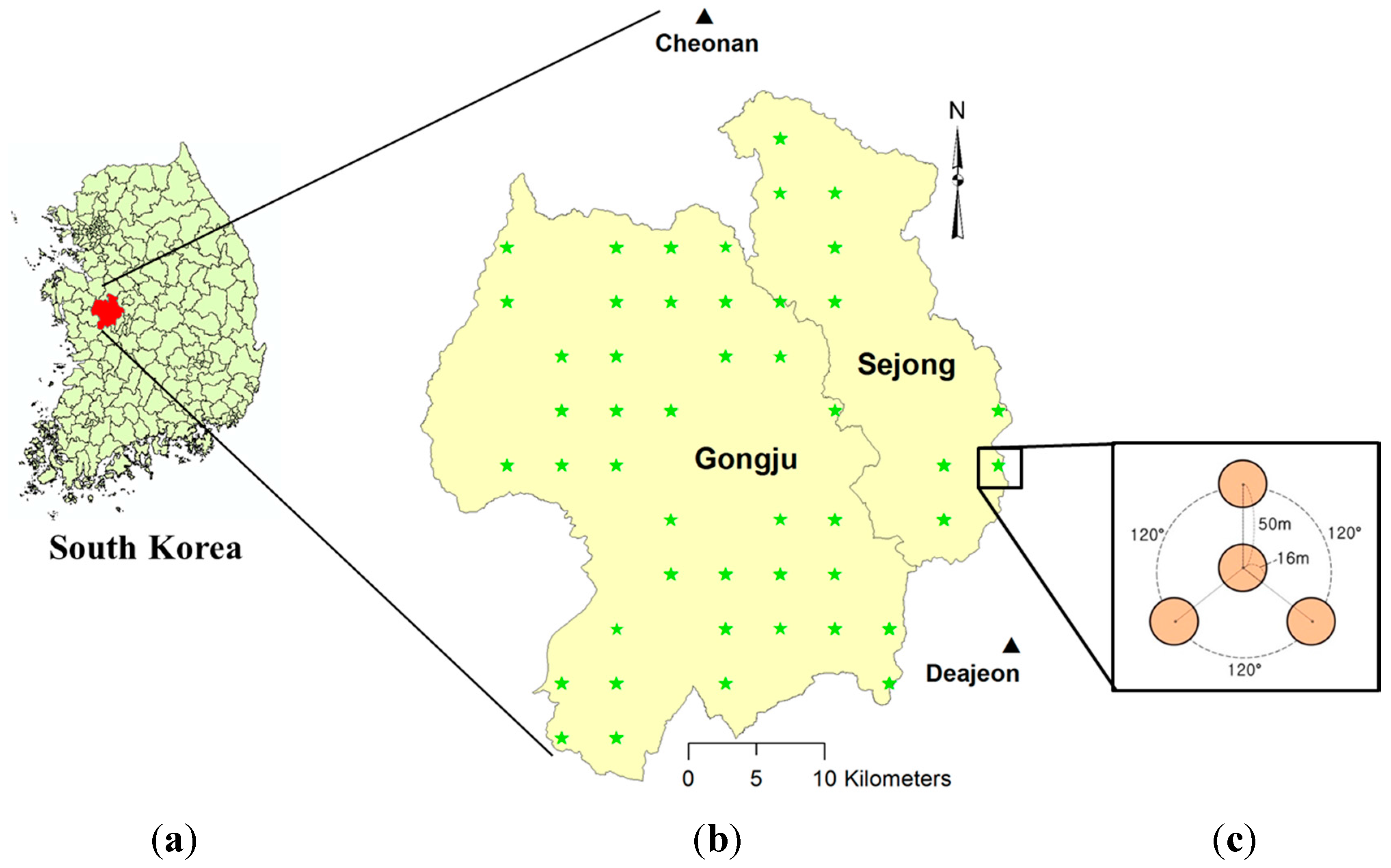
2.1. Study Area
2.2. National Forest Inventory Data

| Atmospheric Conditions | Average Temperature (°C) | The Highest Temperature (°C) | The Lowest Temperature (°C) | Relative Humidity (%) | Rainfall (mm) | Total Water Vapor (g/kg) | |
|---|---|---|---|---|---|---|---|
| 5 April 2011 | Deajeon | 10.8 | 19.5 | 1.7 | 30.6 | 0 | 2.5 |
| Cheonan | 8.7 | 18.5 | −0.9 | 36.6 | 0 | 2.6 | |
| 20 May 2011 | Deajeon | 20.1 | 24.1 | 18.4 | 79.5 | 13.5 | 11.8 |
| Cheonan | 20.1 | 23.9 | 17.0 | 79.3 | 3.0 | 11.7 | |
| 8 August 2010 | Deajeon | 27.9 | 33.2 | 23.9 | 67.6 | 0 | 16.2 |
| Cheonan | 27.6 | 33.6 | 23.5 | 73.3 | 0 | 17.2 | |
| 24 October 2009 | Deajeon | 16.6 | 23.3 | 10.0 | 67.6 | 0 | 8.0 |
| Cheonan | 16.1 | 23.2 | 10.5 | 71.5 | 0 | 8.2 | |
| 15 November 2011 | Deajeon | 6.7 | 13.0 | 2.0 | 57.4 | 0 | 3.5 |
| Cheonan | 5.0 | 12.8 | −0.7 | 65.3 | 0 | 3.5 | |
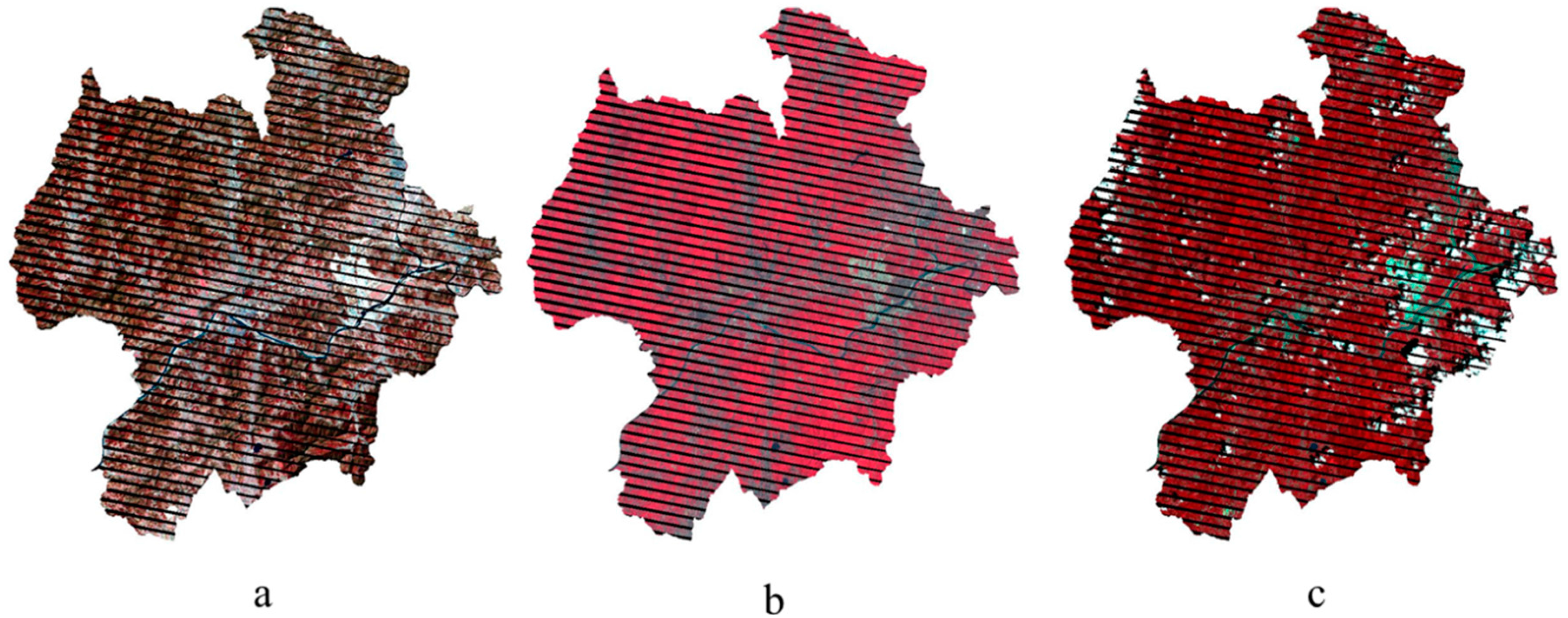
2.3. Remotely Sensed Data
| Scene ID | Date | Path/Row | Season | Sun Azimuth Angle (°) | Sun Elevation Angle (°) |
|---|---|---|---|---|---|
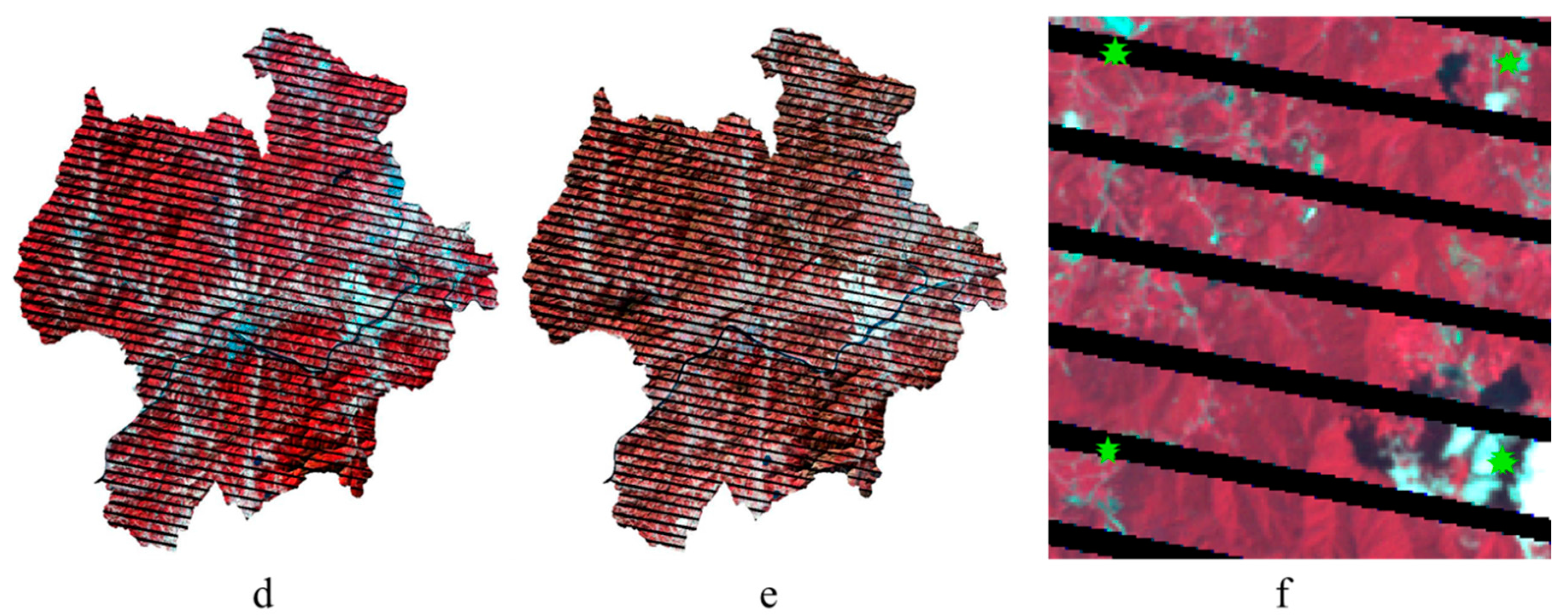
| LE71150352011095EDC00 | 5th April 2011 | 115/35 | Spring | 139 | 53 |
| LE71150352010140EDC01 | 20th May 2011 | 115/35 | Late spring | 124 | 65 |
| LE71150352010220EDC00 | 8th August 2010 | 115/35 | Summer | 126 | 61 |
| LE71150352009297EDC00 | 24th October 2009 | 115/35 | Autumn | 155 | 39 |
| LE71150352011319EDC00 | 15th November 2011 | 115/35 | Late autumn | 159 | 33 |

3. Methodology
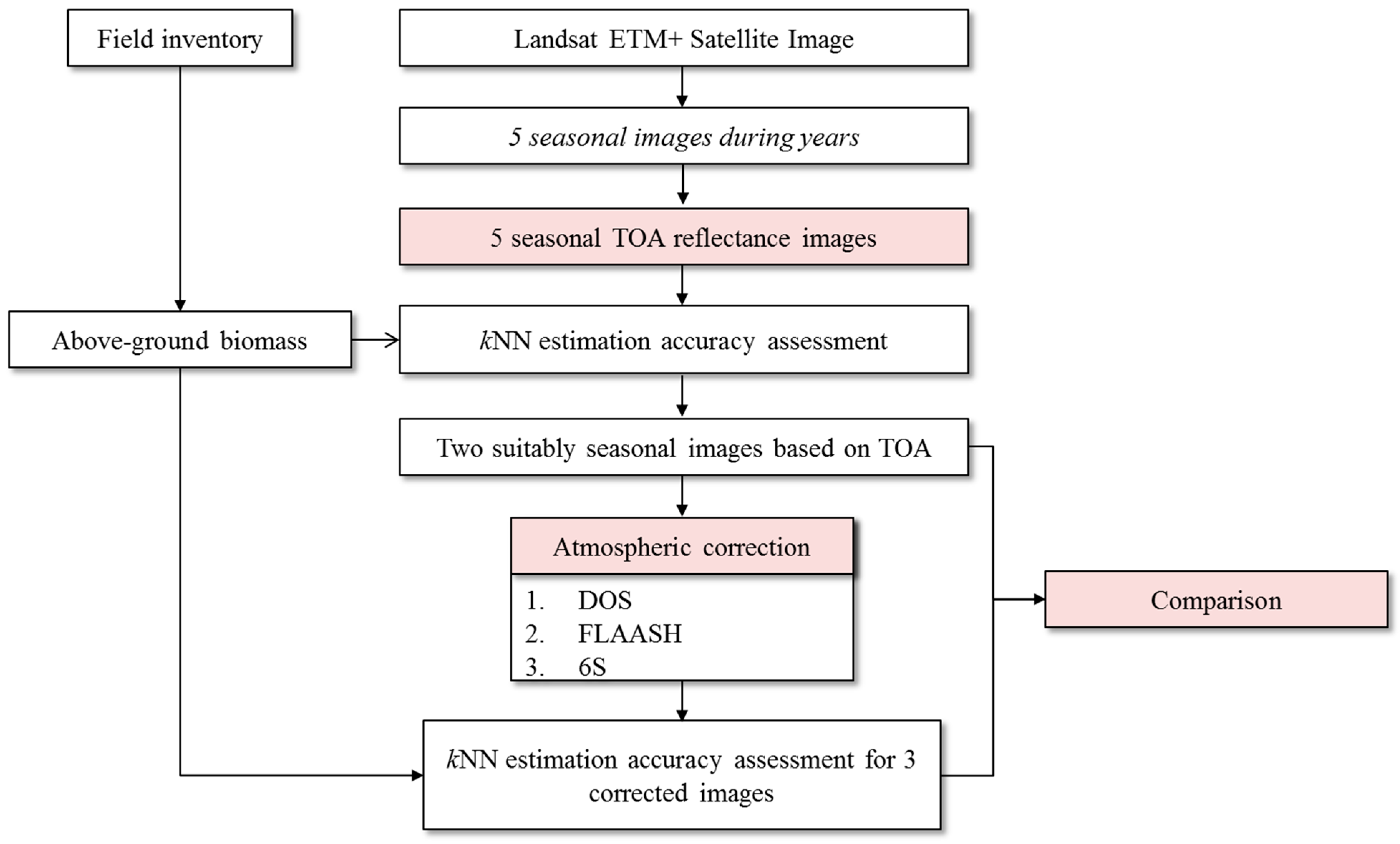
3.1. Atmospheric Correction
- is the Spectral radiance scaled to in units of ,
- is the Spectral radiance scaled to in units of ,
- is the Quantized calibrated pixel value ,
- is the Maximum quantized calibrated pixel value (DN = 255) corresponding to ,
- is the Minimum quantized calibrated pixel value (DN = 0) corresponding to ,
- d is the Earth-Sun distance, in astronomical units,
- is the solar irradiance in units of ,
- θ is the Sun elevation in degrees (given in satellite image meta data).

- is the at-satellite radiance for the given spectral band in units of ,
- is the upwelling atmospheric spectral radiance scattered in the direction of and at the sensor entrance pupil and within the sensor’s field of view, in units of ,
- is the atmospheric transmittance along the path from the ground surface to the sensor,
- is the Solar spectral irradiance on a surface perpendicular to the Sun’s rays outside the atmosphere, in units of ,
- TZ is the angle of incidence of the direct solar flux onto the Earth’s surface (solar zenith angle),
- is the atmospheric transmittance along the path from the sun to the ground surface,
- is the down-welling spectral irradiance at the surface due to the scatted solar flux in the atmosphere, in units of .
- ρ is the pixel surface reflectance,
- is the average surface reflectance for the pixel and the surrounding region,
- S is the spherical albedo of the atmosphere,
- A and B are coefficients that vary according to the atmospheric and geometric conditions but not the surface condition,
- L*a is the radiance backscattered by the atmosphere.
3.2. kNN Estimation
- xi,t is the Reflectance Value (RV) of the target pixel in the ith band,
- xi,r is the RV of the reference pixel corresponding to a subplot in the ith band,
3.3. Accuracy Assessment: 10-Fold Cross-Validation
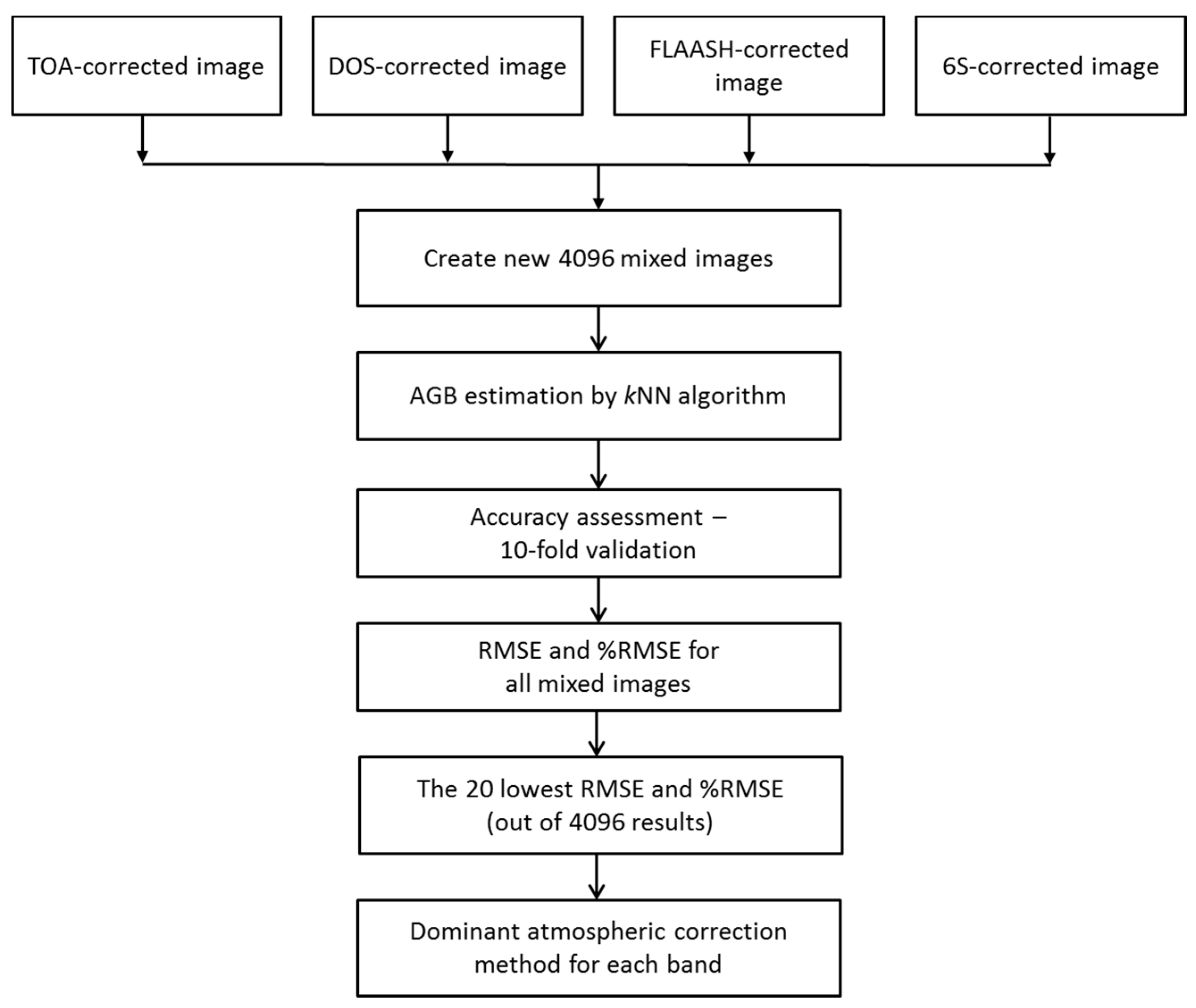
3.4. Optimal Atmospheric Correction Method for Particular Band
4. Results and Discussion
4.1. Seasonal AGB Estimation
| Date | 5 April 2011 | 20 May 2011 | 8 August 2010 | 24 October 2009 | 15 November 2011 | |||||
|---|---|---|---|---|---|---|---|---|---|---|
| Season | Spring | Late Spring | Summer | Autumn | Late Autumn | |||||
| k | RMSE | %RMSE | RMSE | %RMSE | RMSE | %RMSE | RMSE | %RMSE | RMSE | %RMSE |
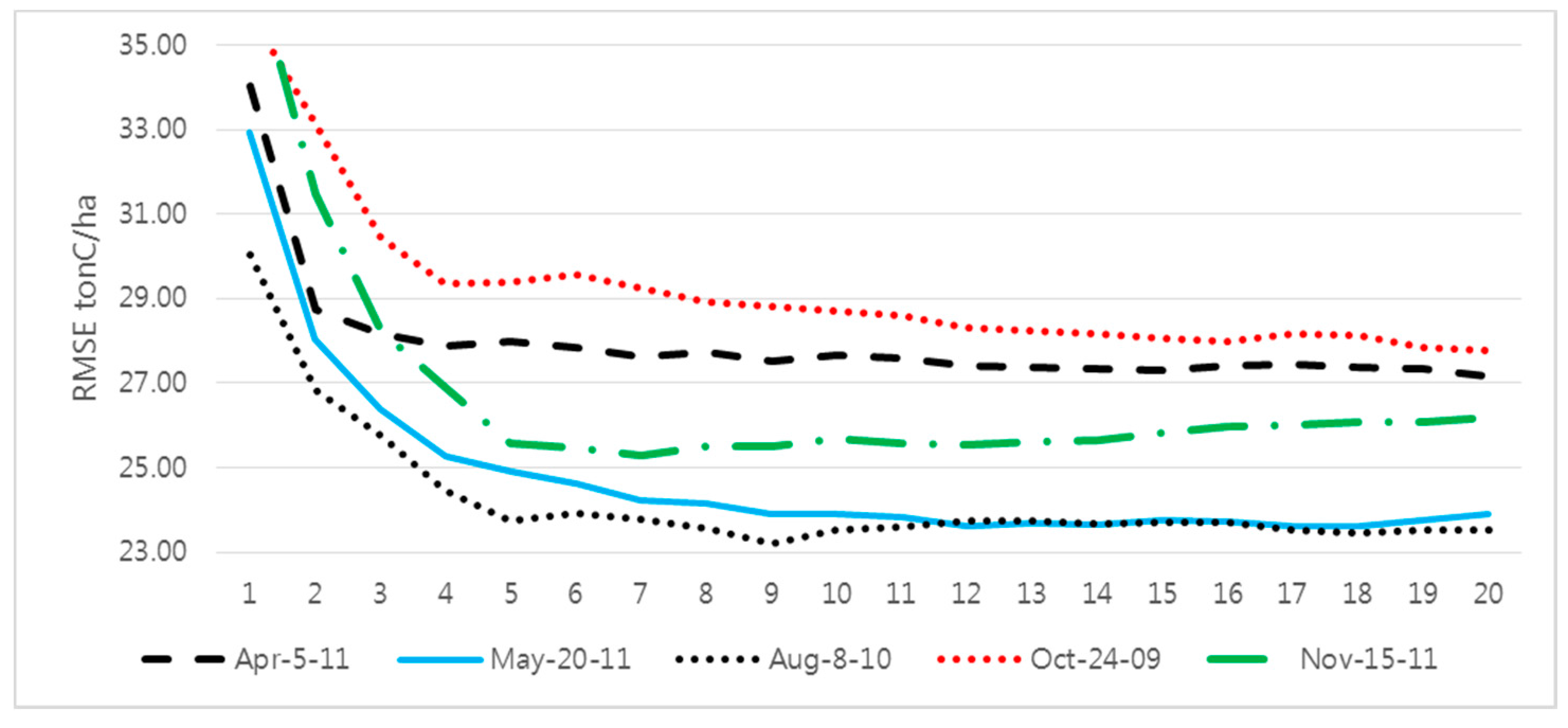
| 1 | 34.0 | 63.6 | 32.9 | 63.0 | 30.1 | 58.2 | 35.8 | 69.5 | 37.2 | 73.8 |
| 2 | 28.8 | 53.7 | 28.1 | 53.6 | 26.8 | 52.0 | 33.2 | 64.4 | 31.5 | 62.5 |
| 3 | 28.2 | 52.6 | 26.4 | 50.4 | 25.8 | 49.9 | 30.5 | 59.2 | 28.3 | 56.1 |
| 4 | 27.9 | 52.1 | 25.3 | 48.3 | 24.5 | 47.4 | 29.4 | 57.0 | 26.9 | 53.4 |
| 5 | 28.0 | 52.3 | 24.9 | 47.6 | 23.8 | 46.0 | 29.4 | 57.1 | 25.6 | 50.8 |
| 6 | 27.9 | 52.0 | 24.6 | 47.1 | 23.9 | 46.3 | 29.6 | 57.5 | 25.5 | 50.6 |
| 7 | 27.7 | 51.6 | 24.2 | 46.4 | 23.8 | 46.1 | 29.3 | 56.8 | 25.3 | 50.2 |
| 8 | 27.7 | 51.8 | 24.1 | 46.2 | 23.6 | 45.6 | 28.9 | 56.2 | 25.5 | 50.6 |
| 9 | 27.5 | 51.4 | 23.9 | 45.7 | 23.2 | 45.0 | 28.8 | 56.0 | 25.5 | 50.7 |
| 10 | 27.7 | 51.7 | 23.9 | 45.7 | 23.5 | 45.6 | 28.7 | 55.8 | 25.7 | 51.0 |
| 11 | 27.6 | 51.5 | 23.8 | 45.6 | 23.6 | 45.8 | 28.6 | 55.6 | 25.6 | 50.7 |
| 12 | 27.4 | 51.2 | 23.6 | 45.1 | 23.7 | 46.0 | 28.3 | 55.0 | 25.6 | 50.7 |
| 13 | 27.4 | 51.2 | 23.7 | 45.3 | 23.8 | 46.0 | 28.3 | 54.9 | 25.6 | 50.9 |
| 14 | 27.3 | 51.1 | 23.6 | 45.2 | 23.7 | 45.9 | 28.2 | 54.8 | 25.6 | 50.9 |
| 15 | 27.3 | 51.0 | 23.8 | 45.4 | 23.7 | 46.0 | 28.1 | 54.5 | 25.8 | 51.3 |
| 16 | 27.4 | 51.2 | 23.7 | 45.4 | 23.7 | 46.0 | 28.0 | 54.4 | 26.0 | 51.6 |
| 17 | 27.5 | 51.3 | 23.6 | 45.2 | 23.5 | 45.6 | 28.2 | 54.8 | 26.0 | 51.6 |
| 18 | 27.4 | 51.1 | 23.6 | 45.2 | 23.5 | 45.5 | 28.2 | 54.7 | 26.1 | 51.8 |
| 19 | 27.3 | 51.0 | 23.8 | 45.4 | 23.5 | 45.6 | 27.8 | 54.1 | 26.1 | 51.8 |
| 20 | 27.2 | 50.7 | 23.9 | 45.7 | 23.5 | 45.6 | 27.8 | 53.9 | 26.2 | 52.0 |
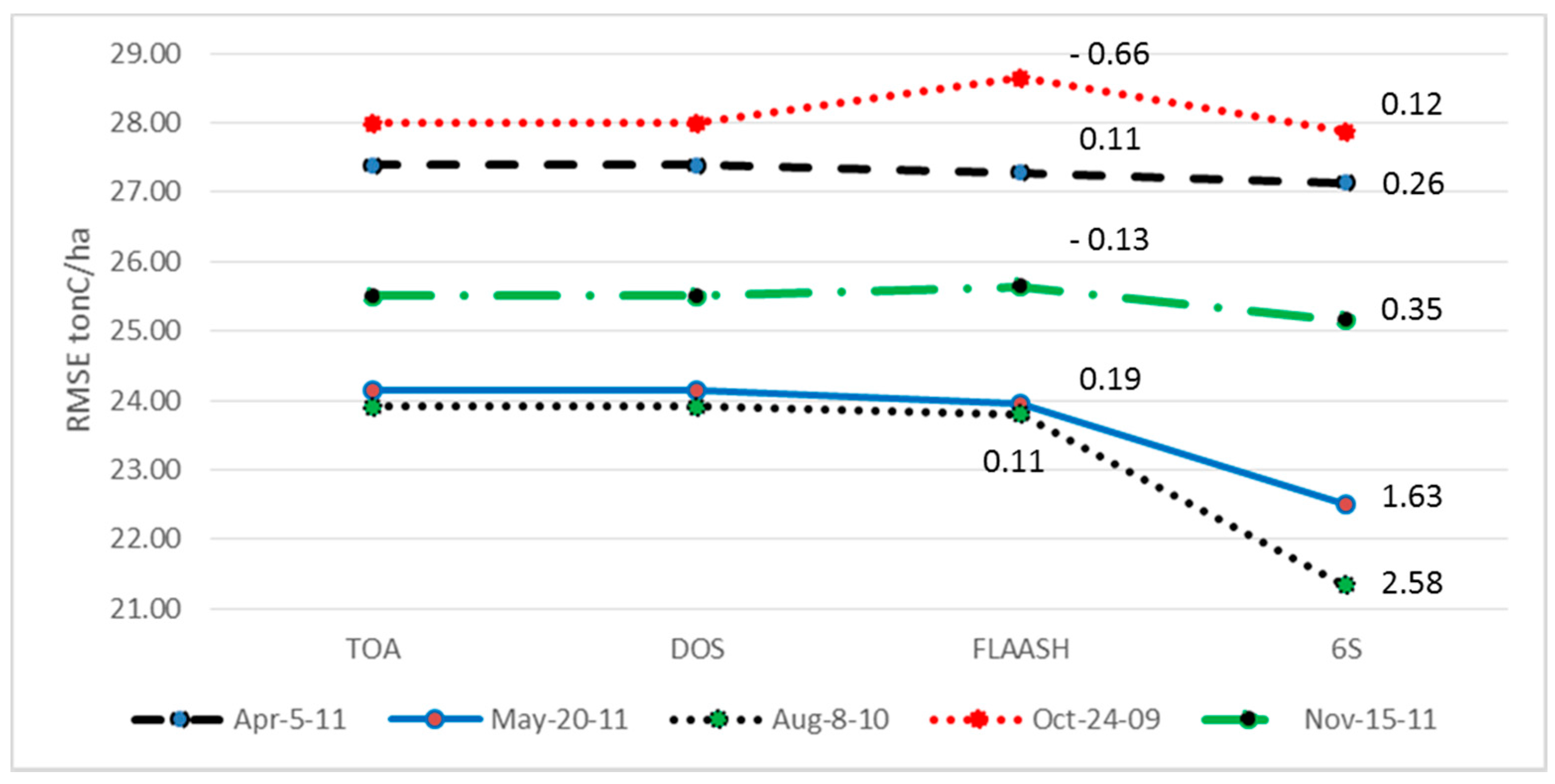
4.2. Comparison of Atmospheric Correction Methods for AGB
| k | TOA Reflectance | DOS | FLAASH | 6S | ||||
|---|---|---|---|---|---|---|---|---|
| RMSE | %RMSE | RMSE | %RMSE | RMSE | %RMSE | RMSE | %RMSE | |
| 1 | 32.9 | 63.0 | 32.9 | 63.0 | 29.1 | 55.6 | 28.8 | 55.1 |
| 2 | 28.1 | 53.6 | 28.1 | 53.6 | 26.7 | 51.1 | 24.9 | 47.6 |
| 3 | 26.4 | 50.4 | 26.4 | 50.4 | 24.5 | 46.8 | 23.5 | 44.9 |
| 4 | 25.3 | 48.3 | 25.3 | 48.3 | 24.5 | 46.9 | 23.0 | 44.0 |
| 5 | 24.9 | 47.6 | 24.9 | 47.6 | 24.4 | 46.7 | 22.9 | 43.7 |
| 6 | 24.6 | 47.1 | 24.6 | 47.1 | 24.1 | 46.1 | 22.5 | 43.1 |
| 7 | 24.2 | 46.4 | 24.2 | 46.4 | 24.0 | 45.9 | 22.9 | 43.7 |
| 8 | 24.1 | 46.2 | 24.1 | 46.2 | 24.0 | 45.8 | 22.5 | 43.1 |
| 9 | 23.9 | 45.7 | 23.9 | 45.7 | 24.1 | 46.0 | 22.7 | 43.4 |
| 10 | 23.9 | 45.7 | 23.9 | 45.7 | 23.8 | 45.6 | 22.9 | 43.7 |
| 11 | 23.8 | 45.6 | 23.8 | 45.6 | 23.7 | 45.3 | 22.9 | 43.8 |
| 12 | 23.6 | 45.1 | 23.6 | 45.1 | 23.5 | 44.9 | 22.7 | 43.3 |
| 13 | 23.7 | 45.3 | 23.7 | 45.3 | 23.5 | 45.0 | 22.7 | 43.5 |
| 14 | 23.6 | 45.2 | 23.6 | 45.2 | 23.7 | 45.3 | 22.9 | 43.9 |
| 15 | 23.8 | 45.4 | 23.8 | 45.4 | 23.7 | 45.4 | 23.1 | 44.1 |
| 16 | 23.7 | 45.4 | 23.7 | 45.4 | 23.6 | 45.2 | 23.3 | 44.6 |
| 17 | 23.6 | 45.2 | 23.6 | 45.2 | 23.6 | 45.2 | 23.4 | 44.8 |
| 18 | 23.6 | 45.2 | 23.6 | 45.2 | 23.7 | 45.4 | 23.4 | 44.8 |
| 19 | 23.8 | 45.4 | 23.8 | 45.4 | 23.8 | 45.5 | 23.5 | 44.9 |
| 20 | 23.9 | 45.7 | 23.9 | 45.7 | 23.8 | 45.5 | 23.4 | 44.7 |
| k | TOA Reflectance | DOS | FLAASH | 6S | ||||
|---|---|---|---|---|---|---|---|---|
| RMSE | %RMSE | RMSE | %RMSE | RMSE | %RMSE | RMSE | %RMSE | |
| 1 | 30.1 | 58.2 | 30.1 | 58.2 | 31.0 | 60.1 | 24.9 | 48.3 |
| 2 | 26.8 | 52.0 | 26.8 | 52.0 | 27.6 | 53.4 | 23.4 | 45.3 |
| 3 | 25.8 | 49.9 | 25.8 | 49.9 | 25.4 | 49.3 | 23.2 | 44.9 |
| 4 | 24.5 | 47.4 | 24.5 | 47.4 | 24.3 | 47.1 | 21.9 | 42.3 |
| 5 | 23.8 | 46.0 | 23.8 | 46.0 | 23.8 | 46.0 | 21.5 | 41.7 |
| 6 | 23.9 | 46.3 | 23.9 | 46.3 | 23.8 | 46.1 | 21.3 | 41.3 |
| 7 | 23.8 | 46.1 | 23.8 | 46.1 | 23.8 | 46.1 | 21.8 | 42.3 |
| 8 | 23.6 | 45.6 | 23.6 | 45.6 | 23.5 | 45.5 | 21.6 | 41.9 |
| 9 | 23.2 | 45.0 | 23.2 | 45.0 | 23.5 | 45.6 | 21.5 | 41.6 |
| 10 | 23.5 | 45.6 | 23.5 | 45.6 | 23.7 | 46.0 | 21.4 | 41.4 |
| 11 | 23.6 | 45.8 | 23.6 | 45.8 | 23.7 | 45.9 | 21.5 | 41.7 |
| 12 | 23.7 | 46.0 | 23.7 | 46.0 | 23.9 | 46.3 | 21.7 | 42.0 |
| 13 | 23.8 | 46.0 | 23.8 | 46.0 | 23.8 | 46.0 | 21.8 | 42.2 |
| 14 | 23.7 | 45.9 | 23.7 | 45.9 | 23.6 | 45.7 | 21.8 | 42.2 |
| 15 | 23.7 | 46.0 | 23.7 | 46.0 | 23.7 | 46.0 | 22.0 | 42.6 |
| 16 | 23.7 | 46.0 | 23.7 | 46.0 | 23.7 | 45.9 | 22.1 | 42.7 |
| 17 | 23.5 | 45.6 | 23.5 | 45.6 | 23.7 | 45.9 | 22.1 | 42.8 |
| 18 | 23.5 | 45.5 | 23.5 | 45.5 | 23.8 | 46.0 | 22.1 | 42.9 |
| 19 | 23.5 | 45.6 | 23.5 | 45.6 | 23.7 | 46.0 | 22.2 | 43.1 |
| 20 | 23.5 | 45.6 | 23.5 | 45.6 | 23.7 | 46.0 | 22.4 | 43.4 |

4.3. Optimal Atmospheric Correction Method for a Particular Band
| RMSE | %RMSE | Band 1 | Band 2 | Band 3 | Band 4 | Band 5 | Band 6 |
|---|---|---|---|---|---|---|---|
| 19.5 | 37.2 | 3 | 4 | 1 | 4 | 4 | 3 |
| 19.5 | 37.2 | 3 | 4 | 2 | 4 | 4 | 3 |
| 19.8 | 38.0 | 1 | 4 | 3 | 4 | 4 | 3 |
| 19.8 | 38.0 | 2 | 4 | 3 | 4 | 4 | 3 |
| 19.9 | 38.0 | 3 | 4 | 3 | 4 | 4 | 3 |
| 19.9 | 38.0 | 4 | 4 | 1 | 4 | 4 | 3 |
| 19.9 | 38.0 | 4 | 4 | 2 | 4 | 4 | 3 |
| 20.1 | 38.5 | 1 | 3 | 1 | 4 | 4 | 3 |
| 20.1 | 38.5 | 2 | 3 | 1 | 4 | 4 | 3 |
| 20.1 | 38.5 | 1 | 3 | 2 | 4 | 4 | 3 |
| 20.1 | 38.5 | 2 | 3 | 2 | 4 | 4 | 3 |
| 20.2 | 38.6 | 4 | 4 | 3 | 4 | 4 | 3 |
| 20.2 | 38.7 | 4 | 2 | 1 | 4 | 4 | 3 |
| 20.2 | 38.7 | 4 | 1 | 1 | 4 | 4 | 3 |
| 20.2 | 38.7 | 4 | 2 | 2 | 4 | 4 | 3 |
| 20.2 | 38.7 | 4 | 1 | 2 | 4 | 4 | 3 |
| 20.2 | 38.7 | 3 | 3 | 1 | 4 | 4 | 3 |
| 20.2 | 38.7 | 3 | 3 | 2 | 4 | 4 | 3 |
| 20.3 | 38.7 | 1 | 2 | 1 | 4 | 4 | 3 |
| 20.3 | 38.7 | 1 | 1 | 1 | 4 | 4 | 3 |
| Optimal method | 3, 4, 2, 1 | 4, 3, 2, 1 | 1, 2, 3 | 4 | 4 | 3 | |
| RMSE | %RMSE | Band 1 | Band 2 | Band 3 | Band 4 | Band 5 | Band 6 |
|---|---|---|---|---|---|---|---|
| 21.2 | 41.1 | 3 | 4 | 4 | 4 | 4 | 2 |
| 21.2 | 41.1 | 3 | 4 | 4 | 4 | 4 | 1 |
| 21.2 | 41.2 | 1 | 4 | 4 | 4 | 4 | 3 |
| 21.2 | 41.2 | 2 | 4 | 4 | 4 | 4 | 3 |
| 21.3 | 41.2 | 4 | 4 | 4 | 4 | 4 | 2 |
| 21.3 | 41.2 | 4 | 4 | 4 | 4 | 4 | 1 |
| 21.3 | 41.2 | 3 | 4 | 4 | 4 | 4 | 3 |
| 21.3 | 41.2 | 3 | 4 | 4 | 4 | 4 | 4 |
| 21.3 | 41.3 | 1 | 4 | 4 | 4 | 4 | 2 |
| 21.3 | 41.3 | 2 | 4 | 4 | 4 | 4 | 2 |
| 21.3 | 41.3 | 1 | 4 | 4 | 4 | 4 | 1 |
| 21.3 | 41.3 | 2 | 4 | 4 | 4 | 4 | 1 |
| 21.3 | 41.3 | 4 | 4 | 3 | 4 | 4 | 3 |
| 21.3 | 41.3 | 4 | 4 | 4 | 4 | 4 | 4 |
| 21.3 | 41.4 | 1 | 4 | 4 | 4 | 4 | 4 |
| 21.3 | 41.4 | 2 | 4 | 4 | 4 | 4 | 4 |
| 21.4 | 41.4 | 4 | 4 | 4 | 4 | 4 | 3 |
| 21.4 | 41.4 | 3 | 4 | 2 | 4 | 4 | 3 |
| 21.4 | 41.4 | 3 | 4 | 1 | 4 | 4 | 3 |
| 21.4 | 41.5 | 4 | 4 | 3 | 4 | 4 | 2 |
| Optimal method | 3, 1, 2, 4 | 4 | 4 | 4 | 4 | 2, 1, 3, 4 | |
4.4. Atmospheric Correction Method for Above-Ground Forest Biomass Estimation
5. Conclusions
Acknowledgments
Author Contributions
Conflicts of Interest
Abbreviations
| kNN | k-Nearest Neighbor |
| DOS | Dark Object Subtraction |
| FLAASH | Fast Line-of-sight Atmospheric Analysis of Spectral Hypercubes |
| 6S | the Second Simulation of Satellite Signal in the Solar Spectrum |
References
- Grace, J.; Lloyd, J.; Mcintyre, J.; Miranda, A.C.; Meir, P.; Miranda, H.S.; Nobre, C.; Moncrieff, J.; Massheder, J.; Malhi, Y.; et al. Carbon-dioxide uptake by an undisturbed tropical rain-forest in southwest amazonia, 1992 to 1993. Science 1995, 270, 778–780. [Google Scholar] [CrossRef]
- Schimel, D.S.; House, J.I.; Hibbard, K.A.; Bousquet, P.; Ciais, P.; Peylin, P.; Braswell, B.H.; Apps, M.J.; Baker, D.; Bondeau, A.; et al. Recent patterns and mechanisms of carbon exchange by terrestrial ecosystems. Nature 2001, 414, 169–172. [Google Scholar] [CrossRef] [PubMed]
- Wang, G.X.; Oyana, T.; Zhang, M.Z.; Adu-Prah, S.; Zeng, S.Q.; Lin, H.; Se, J.Y. Mapping and spatial uncertainty analysis of forest vegetation carbon by combining national forest inventory data and satellite images. For. Ecol. Manag. 2009, 258, 1275–1283. [Google Scholar] [CrossRef]
- Canadell, J.G.; Raupach, M.R. Managing forests for climate change mitigation. Science 2008, 320, 1456–1457. [Google Scholar] [CrossRef] [PubMed]
- Houghton, R.A. Aboveground forest biomass and the global carbon balance. Glob. Chang. Biol. 2005, 11, 945–958. [Google Scholar] [CrossRef]
- Zhu, X.; Liu, D. Improving forest aboveground biomass estimation using seasonal landsat NDVI time-series. Isprs J. Photogramm. 2014, in press. [Google Scholar] [CrossRef]
- Fournier, R.A.; Luther, J.E.; Guindon, L.; Lambert, M.C.; Piercey, D.; Hall, R.J.; Wulder, M.A. Mapping aboveground tree biomass at the stand level from inventory information: Test cases in newfoundland and quebec. Can. J. For. Res. 2003, 33, 1846–1863. [Google Scholar] [CrossRef]
- Parresol, B.R. Assessing tree and stand biomass: A review with examples and critical comparisons. For. Sci. 1999, 45, 573–593. [Google Scholar]
- Hese, S.; Lucht, W.; Schmullius, C.; Barnsley, M.; Dubayah, R.; Knorr, D.; Neumann, K.; Riedel, T.; Schroter, K. Global biomass mapping for an improved understanding of the CO2 balance—the earth observation mission carbon-3D. Remote Sens. Environ. 2005, 94, 94–104. [Google Scholar] [CrossRef]
- Fuchs, H.; Magdon, P.; Kleinn, C.; Flessa, H. Estimating aboveground carbon in a catchment of the siberian forest tundra: Combining satellite imagery and field inventory. Remote Sens. Environ. 2009, 113, 518–531. [Google Scholar] [CrossRef]
- Heo, J.; FitzHugh, T.W. A standardized radiometric normalization method for change detection using remotely sensed imagery. Photogramm. Eng. Remote Sens. 2000, 66, 173–181. [Google Scholar]
- Hadjimitsis, D.G.; Papadavid, G.; Agapiou, A.; Themistocleous, K.; Hadjimitsis, M.G.; Retalis, A.; Michaelides, S.; Chrysoulakis, N.; Toulios, L.; Clayton, C.R.I. Atmospheric correction for satellite remotely sensed data intended for agricultural applications: Impact on vegetation indices. Nat. Hazard. Earth Syst. 2010, 10, 89–95. [Google Scholar] [CrossRef]
- Fraser, R.S.; Bahethi, O.P.; Al-Abbas, A.H. The effect of the atmosphere on the classification of satellite observations to identify surface features. Remote Sens. Environ. 1977, 6, 229–249. [Google Scholar] [CrossRef]
- Kawata, Y.; Ohtani, A.; Kusaka, T.; Ueno, S. Classification accuracy for the mos-1 messr data before and after the atmospheric correction. IEEE Trans. Geosci. Remote Sens. 1990, 28, 755–760. [Google Scholar] [CrossRef]
- Potter, J.F. Haze and sun angle effects on automatic classification of satellite data-simulation and correction. In Proceedings of the Scanners and Imagery Systems for Earth Observation, San Diego, CA, USA, 19 August 1974.
- Song, C.; Woodcock, C.E.; Seto, K.C.; Lenney, M.P.; Macomber, S.A. Classification and change detection using landsat tm data: When and how to correct atmospheric effects? Remote Sens. Environ. 2001, 75, 230–244. [Google Scholar] [CrossRef]
- Kaufman, Y.J. The atmospheric effect on the separability of field classes measured from satellites. Remote Sens. Environ. 1985, 18, 21–34. [Google Scholar] [CrossRef]
- Liang, S.L.; Fang, H.L.; Chen, M.Z. Atmospheric correction of Landsat ETM+ land surface imagery. I. Methods. IEEE Trans. Geosci. Remote Sens. 2001, 39, 2490–2498. [Google Scholar] [CrossRef]
- Duggin, M.J.; Piwinski, D. Recorded radiance indexes for vegetation monitoring using NOAA AVHRR data; atmospheric and other effects in multitemporal data sets. Appl. Opt. 1984, 23, 2620–2623. [Google Scholar] [CrossRef] [PubMed]
- Agapiou, A.; Hadjimitsis, D.G.; Papoutsa, C.; Alexakis, D.D.; Papadavid, G. The importance of accounting for atmospheric effects in the application of NDVI and interpretation of satellite imagery supporting archaeological research: The case studies of palaepaphos and nea paphos sites in Cyprus. Remote Sens. 2011, 3, 2605–2629. [Google Scholar] [CrossRef]
- Lu, D.; Mausel, P.; Brondizio, E.; Moran, E. Assessment of Atmospheric Correction Methods for Landsat TM Data Applicable to Amazon Basin LBA Research. Int. J. Remote Sens. 2002, 23, 2651–2671. [Google Scholar] [CrossRef]
- Courault, D.; Seguin, B.; Olioso, A. Review on estimation of evapotranspiration from remote sensing data: From empirical to numerical modeling approaches. Irrig. Drain. Syst. 2005, 19, 223–249. [Google Scholar] [CrossRef]
- Che, N.; Price, J.C. Survey of radiometric calibration results and methods for visible and near infrared channels of NOAA-7, -9, and -11 AVHRRS. Remote Sens. Environ. 1992, 41, 19–27. [Google Scholar] [CrossRef]
- Mahiny, A.S.; Turner, B.J. A comparison of four common atmospheric correction methods. Photogramm. Eng. Remote Sens. 2007, 73, 361–368. [Google Scholar] [CrossRef]
- Chavez, P.S. Image-based atmospheric corrections revisited and improved. Photogramm. Eng. Remote Sens. 1996, 62, 1025–1036. [Google Scholar]
- Vermote, E.F.; Tanre, D.; Deuze, J.L.; Herman, M.; Morcrette, J.J. Second simulation of the satellite signal in the solar spectrum, 6s: An overview. IEEE Trans. Geosci. Remote Sens. 1997, 35, 675–686. [Google Scholar] [CrossRef]
- Labrecque, S.; Fournier, R.A.; Luther, J.E.; Piercey, D. A comparison of four methods to map biomass from landsat-TM and inventory data in western newfoundland. For. Ecol. Manag. 2006, 226, 129–144. [Google Scholar] [CrossRef]
- Main-Knorn, M.; Cohen, W.B.; Kennedy, R.E.; Grodzki, W.; Pflugmacher, D.; Griffiths, P.; Hostert, P. Monitoring coniferous forest biomass change using a landsat trajectory-based approach. Remote Sens. Environ. 2013, 139, 277–290. [Google Scholar] [CrossRef]
- Powell, S.L.; Cohen, W.B.; Healey, S.P.; Kennedy, R.E.; Moisen, G.G.; Pierce, K.B.; Ohmann, J.L. Quantification of live aboveground forest biomass dynamics with landsat time-series and field inventory data: A comparison of empirical modeling approaches. Remote Sens. Environ. 2010, 114, 1053–1068. [Google Scholar] [CrossRef]
- Reese, H.; Nilsson, M.; Sandstrom, P.; Olsson, H. Applications using estimates of forest parameters derived from satellite and forest inventory data. Comput. Electron. Agric. 2002, 37, 37–55. [Google Scholar] [CrossRef]
- Cohen, W.B.; Goward, S.N. Landsat’s role in ecological applications of remote sensing. Bioscience 2004, 54, 535–545. [Google Scholar] [CrossRef]
- Heo, J.; Kim, J.H.; Park, J.S.; Sohn, H.G. Timber age verification using historical satellite image analysis. For. Ecol. Manag. 2006, 236, 315–323. [Google Scholar] [CrossRef]
- Kim, K.M. Spatially Explicit Estimation and the Uncertainty Analysis of Carbon Stocks in Pine Forest Using Growth Model and Gis: The Case of Danyang Area, Chungcheongbuk-do. Ph.D. Thesis, Seoul National University, Seoul, Korea, 2012. [Google Scholar]
- Korea Forest Research Institute. The 5th National Forest Inventory Surveying: Field Surveying Guide Book Ver. 1.3; Korea Forest Research Institute: Seoul, Korea, 2009; p. 37. [Google Scholar]
- Heo, J.; Park, J.S.; Song, Y.S.; Lee, S.K.; Sohn, H.G. An integrated methodology for estimation of forest fire-loss using geospatial information. Environ. Monit. Assess. 2008, 144, 285–299. [Google Scholar] [CrossRef] [PubMed]
- Korea Meteorological Administration. Domestic Climate Data Historical Data. Available online: http://www.kma.go.kr/ (accessed on 5 April 2015).
- Chander, G.; Markham, B.L.; Barsi, J.A. Revised landsat-5 thematic mapper radiometric calibration. IEEE Geosci. Remote Sens. 2007, 4, 490–494. [Google Scholar] [CrossRef]
- Chavez, P.S. An improved dark-object subtraction technique for atmospheric scattering correction of multispectral data. Remote Sens. Environ. 1988, 24, 459–479. [Google Scholar] [CrossRef]
- Spanner, M.A.; Pierce, L.L.; Peterson, D.L.; Running, S.W. Remote sensing of temperate coniferous forest leaf area index. The influence of canopy closure, understory vegetation and background reflectance. Int. J. Remote Sens. 1990, 11, 95–111. [Google Scholar] [CrossRef]
- Chavez, P.S. Radiometric calibration of landsat thematic mapper multispectral images. Photogramm. Eng. Remote Sens. 1989, 55, 1285–1294. [Google Scholar]
- Berk, A.; Bernstein, L.S.; Anderson, G.P.; Acharya, P.K.; Robertson, D.C.; Chetwynd, J.H.; Adler-Golden, S.M. MODTRAN cloud and multiple scattering upgrades with application to AVIRIS. Remote Sens. Environ. 1998, 65, 367–375. [Google Scholar] [CrossRef]
- Matthew, M.W.; Adler-Golden, S.M.; Berk, A.; Richtsmeier, S.C.; Levine, R.Y.; Bernstein, L.S.; Acharya, P.K.; Anderson, G.P.; Felde, G.W.; Hoke, M.P.; et al. Status of atmospheric correction using a MODTRAN4-based algorithm. In Proceedings of the Algorithms for Multispectral, Hyperspectral, and Ultraspectral Imagery VI, Orlando, FL, USA, 24 April 2000.
- Cooley, T.; Anderson, G.P.; Felde, G.W.; Hoke, M.L.; Ratkowski, A.J.; Chetwynd, J.H.; Gardner, J.A.; Adler-Golden, S.M.; Matthew, M.W.; Berk, A.; et al. Flaash, a MODTRAN4-based atmospheric correction algorithm, its application and validation. In Proceedings of the 2002 IEEE International Geoscience and Remote Sensing Symposium (IGARSS’02), 24 June 2002; Volume 1413, pp. 1414–1418.
- Gao, B.C.; Montes, M.J.; Davis, C.O.; Goetz, A.F.H. Atmospheric correction algorithms for hyperspectral remote sensing data of land and ocean. Remote Sens. Environ. 2009, 113, S17–S24. [Google Scholar] [CrossRef]
- Callieco, F.; Dell’Acqua, F. A comparison between two radiative transfer models for atmospheric correction over a wide range of wavelengths. Int. J. Remote Sens. 2011, 32, 1357–1370. [Google Scholar] [CrossRef]
- Remer, L.A.; Tanré, D.; Kaufman, Y.J. Algorithm for Remote Sensing of Tropospheric Aerosol from Modis: Collection 005; Goddard Space Flight Center: Greenbelt, MD, USA, 2009. [Google Scholar]
- Gao, B.C.; Kaufman, Y.J. Water vapor retrievals using moderate resolution imaging spectroradiometer (modis) near-infrared channels. J. Geophys. Res. Atmos. 2003, 108. [Google Scholar] [CrossRef]
- Zelazowski, P. Landcor—Matlab Routines for Pixel-Based Atmospheric Correction of Optical Satellite Imagery with 6S Radiative Transfer Code. Available online: http://www.eci.ox.ac.uk/research/ecodynamics/landcor/ (accessed on 4 March 2014).
- Zelazowski, P.; Sayer, A.M.; Thomas, G.E.; Grainger, R.G. Reconciling satellite-derived atmospheric properties with fine-resolution land imagery: Insights for atmospheric correction. J. Geophys. Res. Atmos. 2011, 116. [Google Scholar] [CrossRef]
- Fazakas, Z.; Nilsson, M.; Olsson, H. Regional forest biomass and wood volume estimation using satellite data and ancillary data. Agric. For. Meteorol. 1999, 98–99, 417–425. [Google Scholar] [CrossRef]
- Franco-Lopez, H.; Ek, A.R.; Bauer, M.E. Estimation and mapping of forest stand density, volume, and cover type using the k-nearest neighbors method. Remote Sens. Environ. 2001, 77, 251–274. [Google Scholar] [CrossRef]
- Gjertsen, A.K. Accuracy of forest mapping based on landsat tm data and a knn-based method. Remote Sens. Environ. 2007, 110, 420–430. [Google Scholar] [CrossRef]
- Tomppo, E.; Goulding, C.; Katila, M. Adapting finnish multi-source forest inventory techniques to the new zealand preharvest inventory. Scand. J. For. Res. 1999, 14, 182–192. [Google Scholar] [CrossRef]
- Jung, J.; Kim, S.; Hong, S.; Kim, K.; Kim, E.; Im, J.; Heo, J. Effects of national forest inventory plot location error on forest carbon stock estimation using k-nearest neighbor algorithm. Isprs J. Photogramm. 2013, 81, 82–92. [Google Scholar] [CrossRef]
- Kim, C.; Heo, J.; Bin Lee, J.; Han, S.; Jung, J.H.; Jayakumar, S. A synergetic approach to estimating timber age using integrated remotely sensed optical image and insar height data. Int. J. Remote Sens. 2012, 33, 243–260. [Google Scholar] [CrossRef]
- Jung, J.H.; Heo, J.; Yoo, S.H.; Kim, K.M.; Lee, J.B. Estimation of aboveground biomass carbon stock in danyang area using knn algorithm and landsat tm seasonal satellite images. J. Korean Soc. Geospat. Inf. Syst. 2010, 18, 119–129. [Google Scholar]
- Jung, J.; Nguyen, H.C.; Heo, J.; Kim, K.; Im, J. Estimation of aboveground biomass carbon stock by satellite remote sensing—A comparison between k-nearest neighbor and regression tree analysis. Korean J. Remote Sens. 2014, 30, 651–664. [Google Scholar] [CrossRef]
- Shaw, G.E. Aerosol size-temperature relationship. Geophys. Res. Lett. 1988, 15, 133–135. [Google Scholar] [CrossRef]
- Nazeer, M.; Nichol, J.E.; Yung, Y.K. Evaluation of atmospheric correction models and landsat surface reflectance product in an urban coastal environment. Int. J. Remote Sens. 2014, 35, 6271–6291. [Google Scholar] [CrossRef]
- Reese, H.; Nilsson, M.; Pahlen, T.G.; Hagner, O.; Joyce, S.; Tingelof, U.; Egberth, M.; Olsson, H. Countrywide estimates of forest variables using satellite data and field data from the national forest inventory. Ambio 2003, 32, 542–548. [Google Scholar] [CrossRef] [PubMed]
- Tucker, C.J. Red and photographic infrared linear combinations for monitoring vegetation. Remote Sens. Environ. 1979, 8, 127–150. [Google Scholar] [CrossRef]
- Gitelson, A.A.; Gritz, Y.; Merzlyak, M.N. Relationships between leaf chlorophyll content and spectral reflectance and algorithms for non-destructive chlorophyll assessment in higher plant leaves. J. Plant Physiol. 2003, 160, 271–282. [Google Scholar] [CrossRef] [PubMed]
- Liu, J.G.; Pattey, E.; Jego, G. Assessment of vegetation indices for regional crop green LAI estimation from landsat images over multiple growing seasons. Remote Sens. Environ. 2012, 123, 347–358. [Google Scholar] [CrossRef]
- Gitelson, A.A.; Vina, A.; Arkebauer, T.J.; Rundquist, D.C.; Keydan, G.; Leavitt, B. Remote estimation of leaf area index and green leaf biomass in maize canopies. Geophys. Res. Lett. 2003, 30. [Google Scholar] [CrossRef]
- Randel, W.J.; Stolarski, R.S.; Cunnold, D.M.; Logan, J.A.; Newchurch, M.J.; Zawodny, J.M. Atmosphere—Trends in the vertical distribution of ozone. Science 1999, 285, 1689–1692. [Google Scholar] [CrossRef] [PubMed]
- Lee, S.; Ghim, Y.S.; Kim, S.W.; Yoon, S.C. Seasonal characteristics of chemically apportioned aerosol optical properties at seoul and gosan, korea. Atmos. Environ. 2009, 43, 1320–1328. [Google Scholar] [CrossRef]
© 2015 by the authors; licensee MDPI, Basel, Switzerland. This article is an open access article distributed under the terms and conditions of the Creative Commons Attribution license (http://creativecommons.org/licenses/by/4.0/).
Share and Cite
Nguyen, H.C.; Jung, J.; Lee, J.; Choi, S.-U.; Hong, S.-Y.; Heo, J. Optimal Atmospheric Correction for Above-Ground Forest Biomass Estimation with the ETM+ Remote Sensor. Sensors 2015, 15, 18865-18886. https://doi.org/10.3390/s150818865
Nguyen HC, Jung J, Lee J, Choi S-U, Hong S-Y, Heo J. Optimal Atmospheric Correction for Above-Ground Forest Biomass Estimation with the ETM+ Remote Sensor. Sensors. 2015; 15(8):18865-18886. https://doi.org/10.3390/s150818865
Chicago/Turabian StyleNguyen, Hieu Cong, Jaehoon Jung, Jungbin Lee, Sung-Uk Choi, Suk-Young Hong, and Joon Heo. 2015. "Optimal Atmospheric Correction for Above-Ground Forest Biomass Estimation with the ETM+ Remote Sensor" Sensors 15, no. 8: 18865-18886. https://doi.org/10.3390/s150818865
APA StyleNguyen, H. C., Jung, J., Lee, J., Choi, S.-U., Hong, S.-Y., & Heo, J. (2015). Optimal Atmospheric Correction for Above-Ground Forest Biomass Estimation with the ETM+ Remote Sensor. Sensors, 15(8), 18865-18886. https://doi.org/10.3390/s150818865