Habitat Destruction Alters the Mechanisms of Species Coexistence by Modifying Competitive Structure

Abstract
1. Introduction
2. Materials and Methods
2.1. Multispecies Competition Model
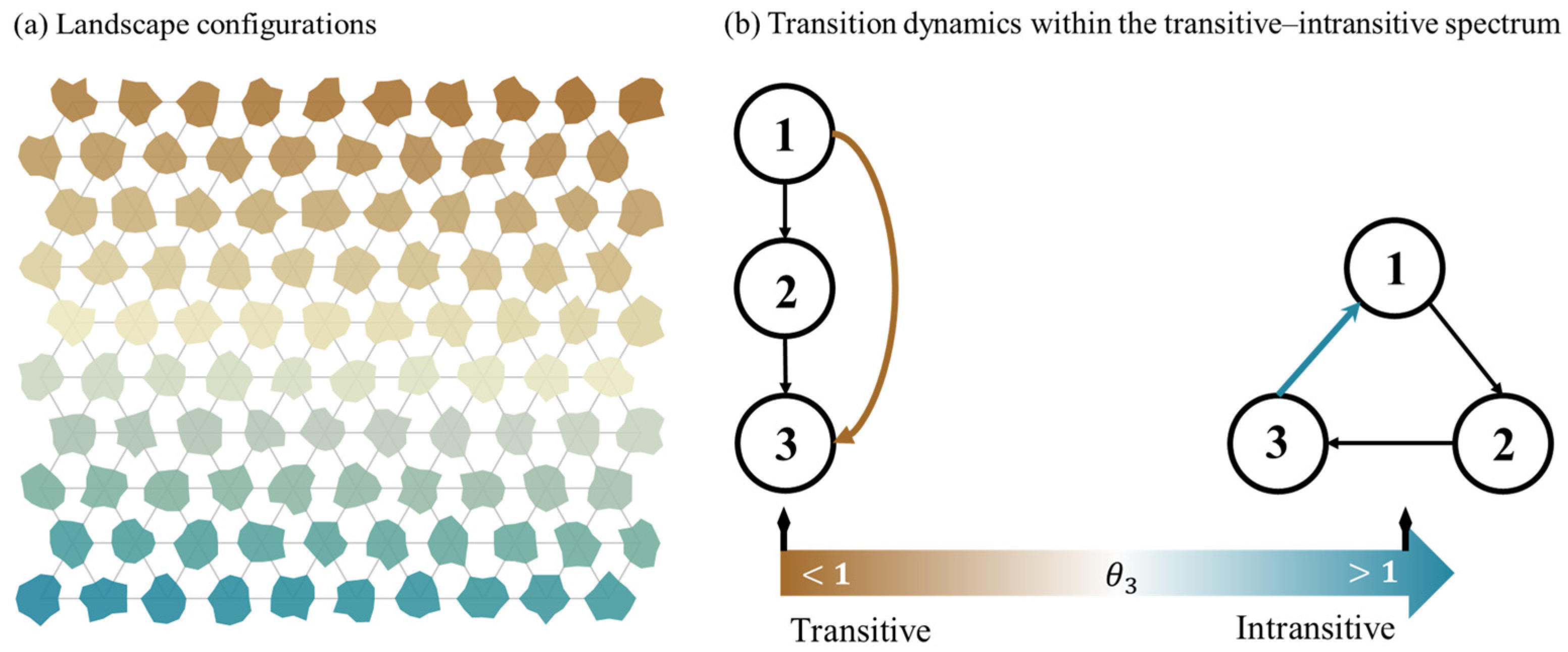
2.1.1. Model Formulation
2.1.2. Competition Matrix
2.2. Coexistence Analysis
2.2.1. Conditions for Multispecies Coexistence
2.2.2. Species Coexistence Space
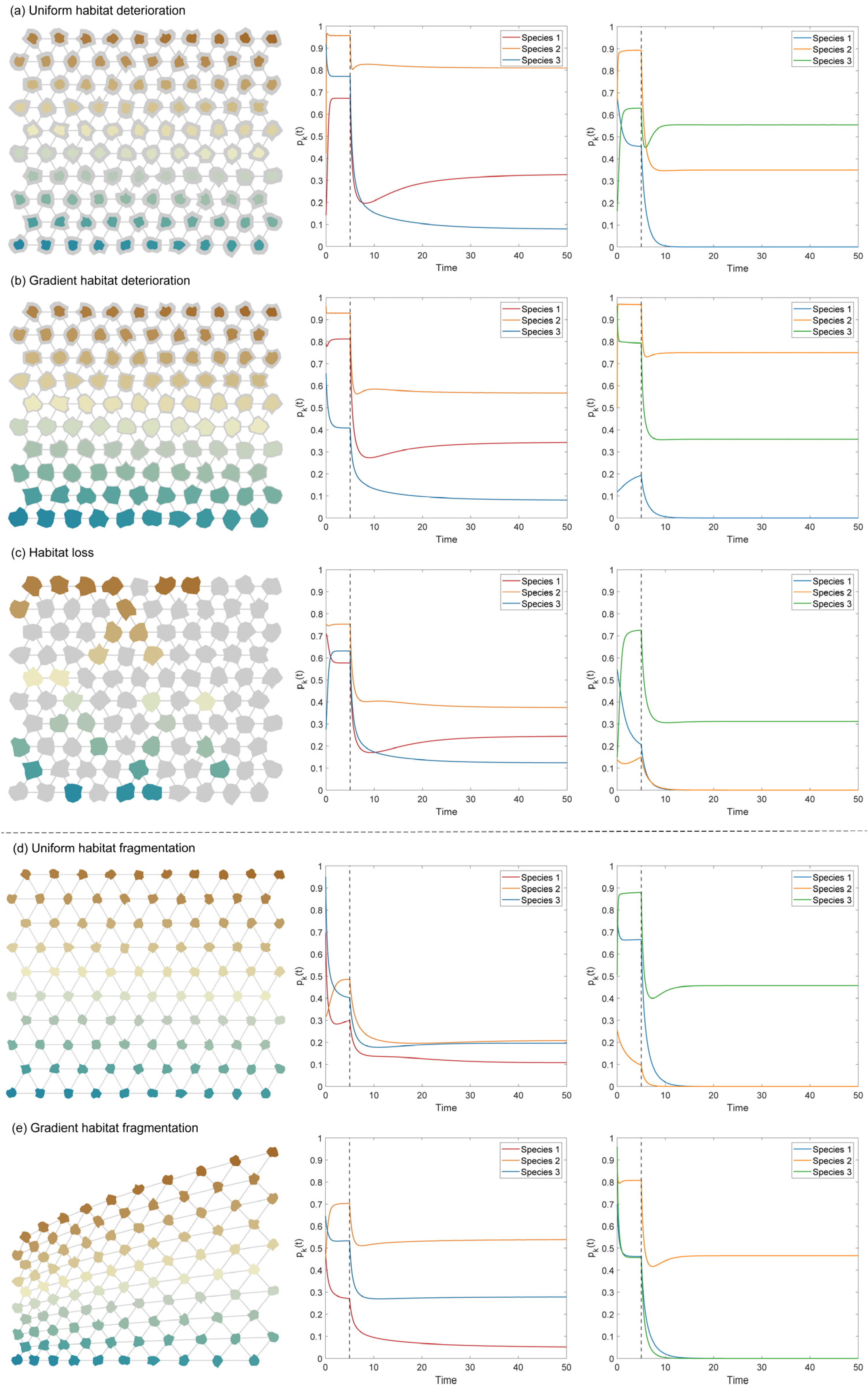
2.3. Habitat Destruction Patterns
2.4. The Implementation of Numerical Simulation
3. Results
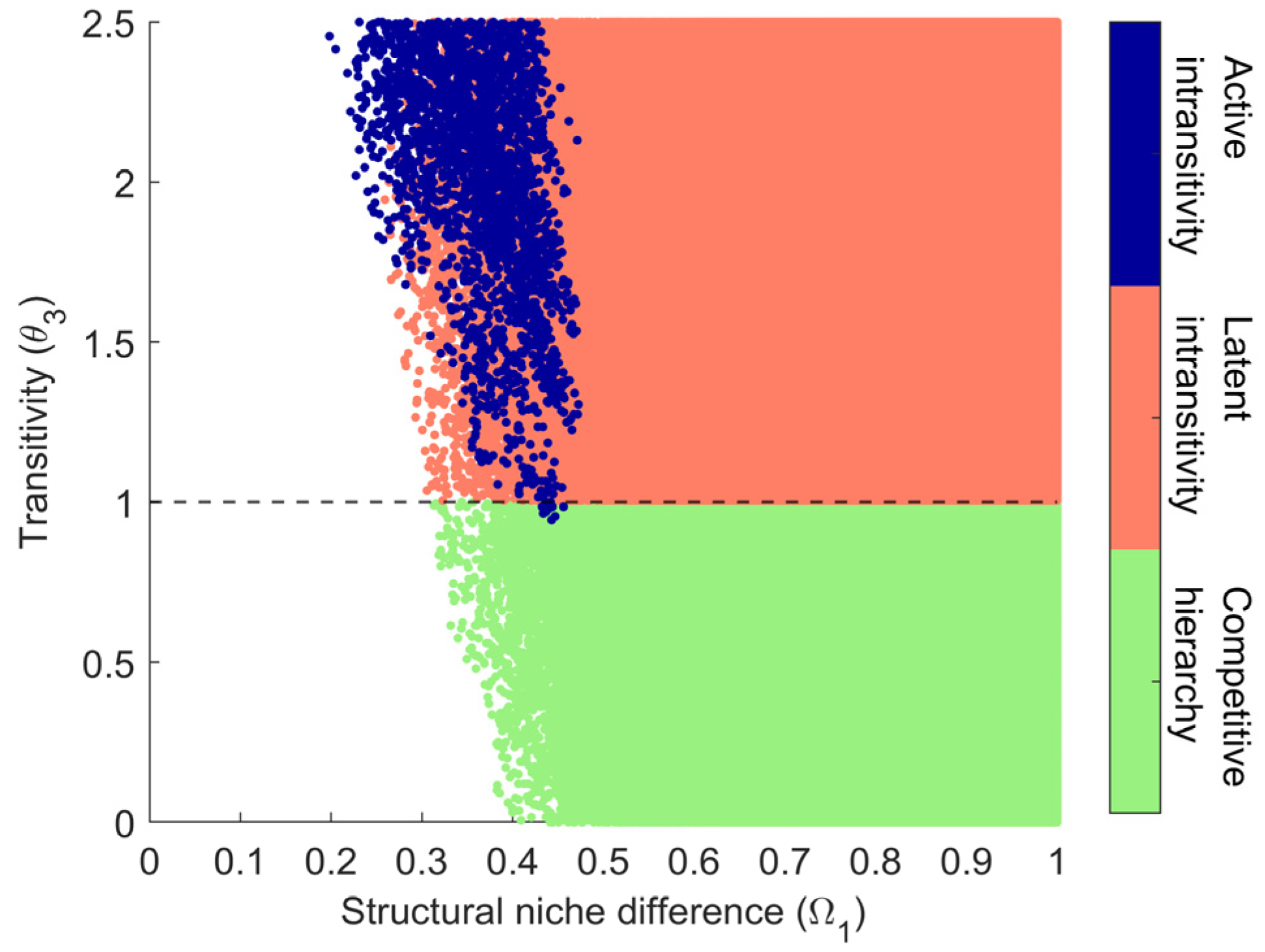
3.1. Mechanisms of Species Coexistence
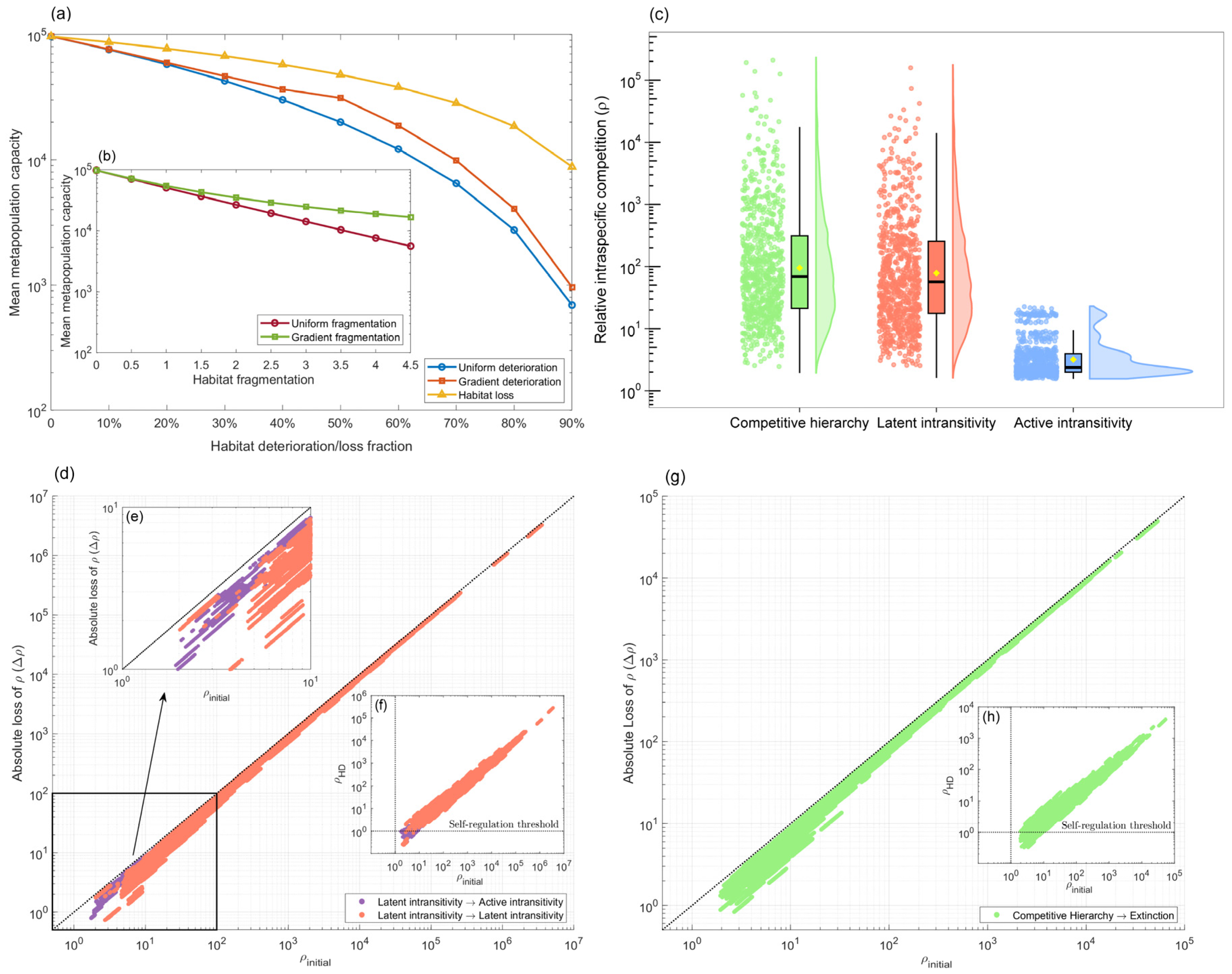
3.2. Effects of Habitat Destruction
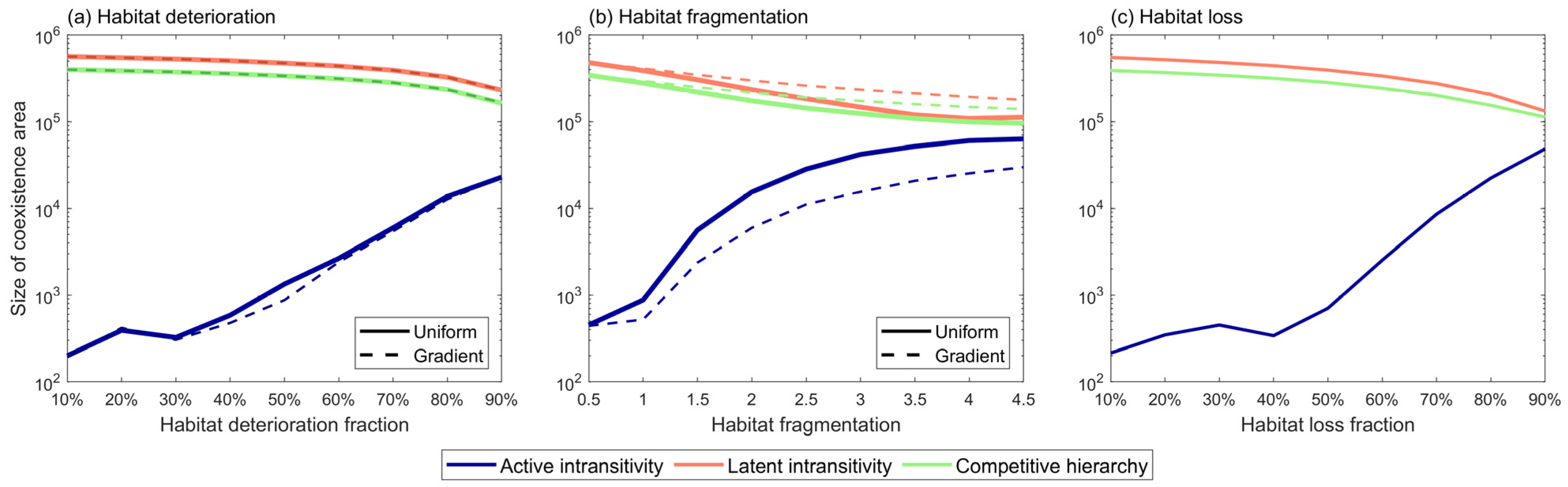
3.2.1. Effects on Coexistence Outcomes
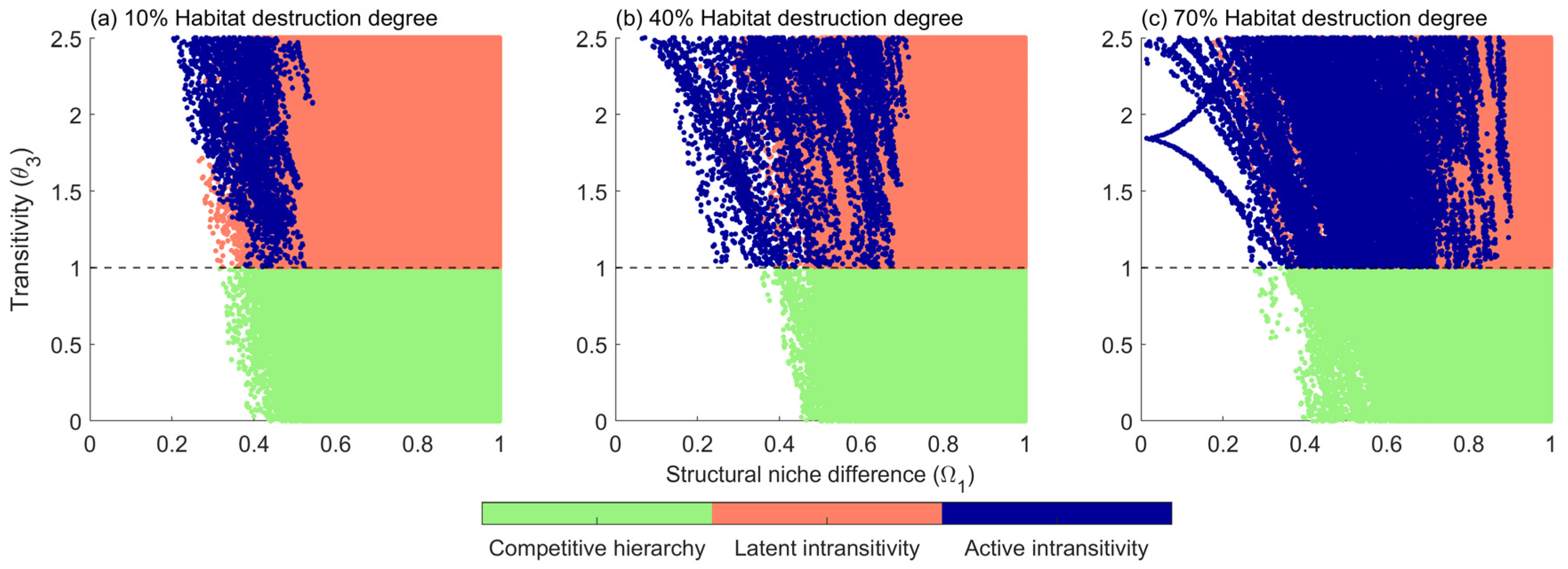
3.2.2. Effects on Coexistence Mechanisms
3.3. Dynamical Transitions Before and After Habitat Destruction
4. Discussion
Author Contributions
Funding
Institutional Review Board Statement
Data Availability Statement
Acknowledgments
Conflicts of Interest
Appendix A. Calculation of Species Invasion Growth Rate
Appendix B. Calculation of the Average Change in Species Invasion Growth Rate
References
- Foley, J.A.; DeFries, R.; Asner, G.P.; Barford, C.; Bonan, G.; Carpenter, S.R.; Chapin, F.S.; Coe, M.T.; Daily, G.C.; Gibbs, H.K.; et al. Global Consequences of Land Use. Science 2005, 309, 570–574. [Google Scholar] [CrossRef] [Scilit] [PubMed]
- Newbold, T.; Hudson, L.N.; Hill, S.L.L.; Contu, S.; Lysenko, I.; Senior, R.A.; Börger, L.; Bennett, D.J.; Choimes, A.; Collen, B.; et al. Global Effects of Land Use on Local Terrestrial Biodiversity. Nature 2015, 520, 45–50. [Google Scholar] [CrossRef] [Scilit] [PubMed]
- Kuipers, K.J.J.; Hilbers, J.P.; Garcia-Ulloa, J.; Graae, B.J.; May, R.; Verones, F.; Huijbregts, M.A.J.; Schipper, A.M. Habitat Fragmentation Amplifies Threats from Habitat Loss to Mammal Diversity across the World’s Terrestrial Ecoregions. One Earth 2021, 4, 1505–1513. [Google Scholar] [CrossRef] [Scilit]
- Yuan, R.; Zhang, N.; Zhang, Q. The Impact of Habitat Loss and Fragmentation on Biodiversity in Global Protected Areas. Sci. Total Environ. 2024, 931, 173004. [Google Scholar] [CrossRef] [Scilit]
- Tilman, D.; May, R.M.; Lehman, C.L.; Nowak, M.A. Habitat Destruction and the Extinction Debt. Nature 1994, 371, 65–66. [Google Scholar] [CrossRef] [Scilit]
- Connell, J.H. Diversity in Tropical Rain Forests and Coral Reefs: High Diversity of Trees and Corals Is Maintained Only in a Nonequilibrium State. Science 1978, 199, 1302–1310. [Google Scholar] [CrossRef] [Scilit]
- Fahrig, L. Effects of Habitat Fragmentation on Biodiversity. Annu. Rev. Ecol. Evol. Syst. 2003, 34, 487–515. [Google Scholar] [CrossRef] [Scilit]
- Didham, R.K.; Kapos, V.; Ewers, R.M. Rethinking the Conceptual Foundations of Habitat Fragmentation Research. Oikos 2012, 121, 161–170. [Google Scholar] [CrossRef] [Scilit]
- Rybicki, J.; Abrego, N.; Ovaskainen, O. Habitat Fragmentation and Species Diversity in Competitive Communities. Ecol. Lett. 2020, 23, 506–517. [Google Scholar] [CrossRef] [Scilit]
- Tylianakis, J.M.; Didham, R.K.; Bascompte, J.; Wardle, D.A. Global Change and Species Interactions in Terrestrial Ecosystems. Ecol. Lett. 2008, 11, 1351–1363. [Google Scholar] [CrossRef] [Scilit]
- Chesson, P. Mechanisms of Maintenance of Species Diversity. Annu. Rev. Ecol. Evol. Syst. 2000, 31, 343–366. [Google Scholar] [CrossRef] [Scilit]
- Chesson, P. Species Competition and Predation. In Encyclopedia of Sustainability Science and Technology; Springer: New York, NY, USA, 2012; pp. 10061–10085. ISBN 978-1-4419-0851-3. [Google Scholar]
- Lotka, A.J. Elements of Physical Biology. Nature 1925, 116, 461. [Google Scholar] [CrossRef] [Scilit]
- Volterra, V. Variations and Fluctuations of the Number of Individuals in Animal Species Living Together. ICES J. Mar. Sci. 1928, 3, 3–51. [Google Scholar] [CrossRef] [Scilit]
- HilleRisLambers, J.; Adler, P.B.; Harpole, W.S.; Levine, J.M.; Mayfield, M.M. Rethinking Community Assembly through the Lens of Coexistence Theory. Annu. Rev. Ecol. Evol. Syst. 2012, 43, 227–248. [Google Scholar] [CrossRef] [Scilit]
- Kininmonth, S.; Ferrando, D.L.; Becerro, M. Neighbourhood Benthic Configuration Reveals Hidden Co-Occurrence Social Diversity. Philos. Trans. R. Soc. B Biol. Sci. 2024, 379, 20230174. [Google Scholar] [CrossRef] [Scilit] [PubMed]
- Molina-Venegas, R.; Verdú, M.; Montesinos-Navarro, A.; Alcántara, J.M.; Garrido, J.L.; Antorán, E.; Calatayud, J. Indirect Reciprocal Facilitation Promotes Species Coexistence in Plant Communities Worldwide. Nat. Ecol. Evol. 2025, 9, 1373–1381. [Google Scholar] [CrossRef] [Scilit] [PubMed]
- May, R.M.; Leonard, W.J. Nonlinear Aspects of Competition Between Three Species. SIAM J. Appl. Math. 1975, 29, 243–253. [Google Scholar] [CrossRef] [Scilit]
- Reichenbach, T.; Mobilia, M.; Frey, E. Mobility Promotes and Jeopardizes Biodiversity in Rock–Paper–Scissors Games. Nature 2007, 448, 1046–1049. [Google Scholar] [CrossRef] [Scilit]
- Allesina, S.; Levine, J.M. A Competitive Network Theory of Species Diversity. Proc. Natl. Acad. Sci. USA 2011, 108, 5638–5642. [Google Scholar] [CrossRef] [Scilit]
- Laird, R.A.; Schamp, B.S. Competitive Intransitivity Promotes Species Coexistence. Am. Nat. 2006, 168, 182–193. [Google Scholar] [CrossRef]
- Godoy, O.; Stouffer, D.B.; Kraft, N.J.B.; Levine, J.M. Intransitivity Is Infrequent and Fails to Promote Annual Plant Coexistence without Pairwise Niche Differences. Ecology 2017, 98, 1193–1200. [Google Scholar] [CrossRef] [Scilit] [PubMed]
- Gallien, L. Intransitive Competition and Its Effects on Community Functional Diversity. Oikos 2017, 126, 615–623. [Google Scholar] [CrossRef] [Scilit]
- Vandermeer, J. Transitive and Intransitive Structures in Competition-Based Ecological Communities. Ecol. Complex. 2024, 60, 101103. [Google Scholar] [CrossRef] [Scilit]
- Amarasekare, P. Competitive Coexistence in Spatially Structured Environments: A Synthesis. Ecol. Lett. 2003, 6, 1109–1122. [Google Scholar] [CrossRef] [Scilit]
- Mouquet, N.; Loreau, M. Community Patterns in Source-Sink Metacommunities. Am. Nat. 2003, 162, 544–557. [Google Scholar] [CrossRef] [Scilit]
- Ying, Z.; Liao, J.; Wang, S.; Lu, H.; Liu, Y.; Ma, L.; Li, Z. Species Coexistence in a Lattice-Structured Habitat: Effects of Species Dispersal and Interactions. J. Theor. Biol. 2014, 359, 184–191. [Google Scholar] [CrossRef] [Scilit]
- Chen, D.; Liao, J.; Bearup, D.; Li, Z. Habitat Heterogeneity Mediates Effects of Individual Variation on Spatial Species Coexistence. Proc. R. Soc. B Biol. Sci. 2020, 287, 20192436. [Google Scholar] [CrossRef] [Scilit]
- Orgeron, J.A.; Asllani, M. Habitat Fragmentation Promotes Spatial Scale Separation under Resource Competition. J. Theor. Biol. 2026, 621, 112367. [Google Scholar] [CrossRef] [Scilit]
- Hanski, I. Metapopulation Dynamics. Nature 1998, 396, 41–49. [Google Scholar] [CrossRef] [Scilit]
- Ovaskainen, O.; Hanski, I. Spatially Structured Metapopulation Models: Global and Local Assessment of Metapopulation Capacity. Theor. Popul. Biol. 2001, 60, 281–302. [Google Scholar] [CrossRef] [Scilit]
- Leibold, M.A.; Holyoak, M.; Mouquet, N.; Amarasekare, P.; Chase, J.M.; Hoopes, M.F.; Holt, R.D.; Shurin, J.B.; Law, R.; Tilman, D.; et al. The Metacommunity Concept: A Framework for Multi-Scale Community Ecology. Ecol. Lett. 2004, 7, 601–613. [Google Scholar] [CrossRef] [Scilit]
- Huang, R.; Pimm, S.L.; Giri, C. Using Metapopulation Theory for Practical Conservation of Mangrove Endemic Birds. Conserv. Biol. 2020, 34, 266–275. [Google Scholar] [CrossRef] [Scilit] [PubMed]
- Li, Y.; Bearup, D.; Liao, J. Habitat Loss Alters Effects of Intransitive Higher-Order Competition on Biodiversity: A New Metapopulation Framework. Proc. R. Soc. B Biol. Sci. 2020, 287, 20201571. [Google Scholar] [CrossRef] [Scilit] [PubMed]
- Luo, M.; Wang, S.; Saavedra, S.; Ebert, D.; Altermatt, F. Multispecies Coexistence in Fragmented Landscapes. Proc. Natl. Acad. Sci. USA 2022, 119, e2201503119. [Google Scholar] [CrossRef] [Scilit] [PubMed]
- Hanski, I.; Ovaskainen, O. The Metapopulation Capacity of a Fragmented Landscape. Nature 2000, 404, 755–758. [Google Scholar] [CrossRef] [Scilit]
- Ovaskainen, O. Habitat Destruction, Habitat Restoration and Eigenvector–Eigenvalue Relations. Math. Biosci. 2003, 181, 165–176. [Google Scholar] [CrossRef] [Scilit]
- Yang, Y.; Hui, C. How Competitive Intransitivity and Niche Overlap Affect Spatial Coexistence. Oikos 2021, 130, 260–273. [Google Scholar] [CrossRef] [Scilit]
- Case, T.J. An Illustrated Guide to Theoretical Ecology. J. Mammal. 2001, 82, 247–248. [Google Scholar]
- Siepielski, A.M.; McPeek, M.A. On the Evidence for Species Coexistence: A Critique of the Coexistence Program. Ecology 2010, 91, 3153–3164. [Google Scholar] [CrossRef]
- Gallien, L.; Zimmermann, N.E.; Levine, J.M.; Adler, P.B. The Effects of Intransitive Competition on Coexistence. Ecol. Lett. 2017, 20, 791–800. [Google Scholar] [CrossRef] [Scilit]
- Barabás, G.; D’Andrea, R.; Stump, S.M. Chesson’s Coexistence Theory. Ecol. Monogr. 2018, 88, 277–303. [Google Scholar] [CrossRef] [Scilit]
- Grainger, T.N.; Letten, A.D.; Gilbert, B.; Fukami, T. Applying Modern Coexistence Theory to Priority Effects. Proc. Natl. Acad. Sci. USA 2019, 116, 6205–6210. [Google Scholar] [CrossRef] [Scilit] [PubMed]
- Spaak, J.W.; Schreiber, S.J. Building Modern Coexistence Theory from the Ground up: The Role of Community Assembly. Ecol. Lett. 2023, 26, 1840–1861. [Google Scholar] [CrossRef] [Scilit]
- Terry, J.C.D. An Experimental Validation Test of Ecological Coexistence Theory to Forecast Extinction Under Rising Temperatures. Ecol. Lett. 2025, 28, e70047. [Google Scholar] [CrossRef] [Scilit] [PubMed]
- Castledine, M.; Padfield, D.; Buckling, A. Estimates of Microbial Community Stability Using Relative Invader Growth Rates Are Robust across Levels of Invader Species Richness. ISME Commun. 2025, 5, ycaf040. [Google Scholar] [CrossRef] [Scilit]
- Saavedra, S.; Rohr, R.P.; Bascompte, J.; Godoy, O.; Kraft, N.J.B.; Levine, J.M. A Structural Approach for Understanding Multispecies Coexistence. Ecol. Monogr. 2017, 87, 470–486. [Google Scholar] [CrossRef] [Scilit]
- Wang, S.; Brose, U.; Van Nouhuys, S.; Holt, R.D.; Loreau, M. Metapopulation Capacity Determines Food Chain Length in Fragmented Landscapes. Proc. Natl. Acad. Sci. USA 2021, 118, e2102733118. [Google Scholar] [CrossRef] [Scilit]
- Chu, C.; Adler, P.B. Large Niche Differences Emerge at the Recruitment Stage to Stabilize Grassland Coexistence. Ecol. Monogr. 2015, 85, 373–392. [Google Scholar] [CrossRef] [Scilit]
- Mittelbach, G.G.; McGill, B.J. Species Coexistence and Niche Theory. In Community Ecology, 2nd ed.; Mittelbach, G.G., McGill, B.J., Eds.; Oxford University Press: Oxford, UK, 2019; pp. 141–157. [Google Scholar]
- Spaak, J.W.; Millet, R.; Ke, P.-J.; Letten, A.D.; De Laender, F. The Effect of Non-Linear Competitive Interactions on Quantifying Niche and Fitness Differences. Theor. Ecol. 2023, 16, 161–170. [Google Scholar] [CrossRef] [Scilit]
- Soliveres, S.; Allan, E. Everything You Always Wanted to Know about Intransitive Competition but Were Afraid to Ask. J. Ecol. 2018, 106, 807–814. [Google Scholar] [CrossRef] [Scilit]
- Ranjan, R.; Koffel, T.; Klausmeier, C.A. The Three-Species Problem: Incorporating Competitive Asymmetry and Intransitivity in Modern Coexistence Theory. Ecol. Lett. 2024, 27, e14426. [Google Scholar] [CrossRef] [Scilit]
- Spaak, J.W.; Laender, F.D. Intuitive and Broadly Applicable Definitions of Niche and Fitness Differences. Ecol. Lett. 2020, 23, 1117–1128. [Google Scholar] [CrossRef] [Scilit]
- Nathan, R.; Muller-Landau, H.C. Spatial Patterns of Seed Dispersal, Their Determinants and Consequences for Recruitment. Trends Ecol. Evol. 2000, 15, 278–285. [Google Scholar] [CrossRef] [Scilit]
- Menge, B.A.; Lubchenco, J.; Bracken, M.E.S.; Chan, F.; Foley, M.M.; Freidenburg, T.L.; Gaines, S.D.; Hudson, G.; Krenz, C.; Leslie, H.; et al. Coastal Oceanography Sets the Pace of Rocky Intertidal Community Dynamics. Proc. Natl. Acad. Sci. USA 2003, 100, 12229–12234. [Google Scholar] [CrossRef] [Scilit]
- Marchesan, J.; Kolasa, J. Habitat Fragmentation Affects Richness—A View Through a Metacommunity Lens. Diversity 2024, 16, 658. [Google Scholar] [CrossRef] [Scilit]
- Kininmonth, S.; Drechsler, M.; Johst, K.; Possingham, H. Metapopulation Mean Life Time within Complex Networks. Mar. Ecol. Prog. Ser. 2010, 417, 139–149. [Google Scholar] [CrossRef] [Scilit]



| Parameter | Description | Value |
|---|---|---|
| θ3 | The degree of competitive transitivity | 0:0.005:2.5 |
| θ | The degree of competitive symmetry | U(0, 0.5) |
| λ | The metapopulation capacity of a fragmented landscape | — |
| ck | The species-specific colonization parameter of species k | U(0.0001, 0.01) |
| ek | The species-specific extinction parameter of species k | 1 |
| zim,k | The scaling exponent of the immigration rate with patch size for species k | U(0, 1) |
| zem,k | The scaling exponent of the emigration rate with patch size for species k | U(−1, 1) |
| zex,k | The scaling exponent of the extinction rate with patch size for species k | U(0, 1) |
| ξk | The characteristic dispersal distance of species k | U(1, 2) |
| A | The size of the patch | |
| D | The distance between pairs of patches | U(0, 10) |
Disclaimer/Publisher’s Note: The statements, opinions and data contained in all publications are solely those of the individual author(s) and contributor(s) and not of MDPI and/or the editor(s). MDPI and/or the editor(s) disclaim responsibility for any injury to people or property resulting from any ideas, methods, instructions or products referred to in the content. |
© 2026 by the authors. Licensee MDPI, Basel, Switzerland. This article is an open access article distributed under the terms and conditions of the Creative Commons Attribution (CC BY) license.
Share and Cite
Li, P.; Gou, Y.; Zeng, X.; Yang, Y. Habitat Destruction Alters the Mechanisms of Species Coexistence by Modifying Competitive Structure. Diversity 2026, 18, 217. https://doi.org/10.3390/d18040217
Li P, Gou Y, Zeng X, Yang Y. Habitat Destruction Alters the Mechanisms of Species Coexistence by Modifying Competitive Structure. Diversity. 2026; 18(4):217. https://doi.org/10.3390/d18040217
Chicago/Turabian StyleLi, Peiyao, Yongxun Gou, Xianpeng Zeng, and Yinghui Yang. 2026. "Habitat Destruction Alters the Mechanisms of Species Coexistence by Modifying Competitive Structure" Diversity 18, no. 4: 217. https://doi.org/10.3390/d18040217
APA StyleLi, P., Gou, Y., Zeng, X., & Yang, Y. (2026). Habitat Destruction Alters the Mechanisms of Species Coexistence by Modifying Competitive Structure. Diversity, 18(4), 217. https://doi.org/10.3390/d18040217