Article

Habitat Destruction Alters the Mechanisms of Species Coexistence by Modifying Competitive Structure

School of Mathematics, Southwest Jiaotong University, Chengdu 611756, China
*
Author to whom correspondence should be addressed.
Diversity 2026, 18(4), 217; https://doi.org/10.3390/d18040217
Submission received: 3 March 2026 / Revised: 3 April 2026 / Accepted: 6 April 2026 / Published: 8 April 2026
(This article belongs to the Section Biodiversity Loss & Dynamics)

Abstract

Habitat destruction is a major driver of biodiversity decline, yet how it reshapes multispecies coexistence by altering interaction structure remains unclear. We adopt a spatially explicit metacommunity model framework under a homogeneity assumption and introduce a tunable parameter controlling intransitive competition. Within this framework, we represent the system using a generalized Lotka–Volterra model to examine how coexistence mechanisms respond to habitat destruction. Our findings demonstrate that (1) coexistence is not driven by a single mechanism: under transitive competition, it highly relies on niche differentiation, whereas in intransitive structures, coexistence can be maintained even with low niche differentiation. (2) Habitat destruction compresses the feasible coexistence space, but regions dominated by different mechanisms respond asymmetrically, with niche-difference-driven coexistence shrinking and intransitive-dominated coexistence expanding under certain conditions. (3) The difference stems from habitat destruction, altering the relative proportions of intraspecific and interspecific competition, driving the community beyond the coexistence threshold. This reduces the probability of coexistence and reshapes the relative importance of several coexistence mechanisms. This finding provides a new theoretical perspective for biodiversity in fragmented landscapes.

1. Introduction

Habitat destruction is widely acknowledged as a principal factor in the current decline in biodiversity [1,2,3,4]. The classical “extinction debt” theory posits that species persistence is hindered as the proportion of available patches declines [5]. In real ecosystems, habitat destruction frequently results in alterations to spatial structure and connectivity. The foundational framework for understanding how such ecological disturbances drive biodiversity changes is the Intermediate Disturbance Hypothesis (IDH) [6], which posits that local species diversity is maximized at intermediate levels of disturbance. Theoretical studies further demonstrate that, despite the regulation of total habitat area, landscape configuration and habitat fragmentation can significantly impact population dynamics and community composition by affecting species dispersal, local extinction, and recolonization processes [7,8,9]. However, current research has predominantly concentrated on the “outcomes” of diversity changes, with insufficient investigation into how habitat destruction affects biodiversity by altering the dynamics of species interactions. In reality, community stability and coexistence patterns are influenced not only by species’ abilities but also by the structure of competition among species [10]. Consequently, comprehending the effects of habitat fragmentation on communities through the framework of interaction structure may be essential for elucidating its fundamental mechanisms.
Modern species coexistence theory provides a systematic framework for comprehending community stability [11,12]. This theory posits that species coexist via stabilizing mechanisms arising from niche differentiation and relative advantage that offset fitness difference. In the most basic framework, most studies have analyzed pairwise competitive structures, suggesting that systems can achieve stable coexistence when intraspecific competition is stronger than interspecific competition [13,14,15]. However, natural communities are typically composed of multiple species, and their complex dynamics often cannot be explained solely by pairwise interactions. Expanding the traditional pairwise perspective reveals that the structural characteristics of diverse ecological networks, such as collaborative and competitive networks, offer additional mechanisms for multispecies coexistence. For example, collaborative interactions such as mutualism and facilitation have been shown to enhance community stability and support species coexistence [16,17]. However, competition drives competitive exclusion and species extinction, maintaining biodiversity in natural systems faces a significant theoretical challenge. Therefore, investigating competitive networks is crucial. Within competitive interactions, for instance, an intransitive loop similar to “rock-paper-scissors” creates cyclical relationships by weakening the advantage of dominant species [18,19,20]. Thus, while collaborative interactions play a role in community stability, unraveling how the structural complexities of competitive networks, particularly intransitive structures, function remains the critical step in understanding biodiversity maintenance. The source of community stability may be determined by the relative contributions of niche differentiation and intransitive competition, which may co-act within the same system. Intransitive competition should be incorporated into traditional species coexistence frameworks, according to an increasing amount of research [21,22,23,24]. However, systematic theoretical studies on how these two mechanisms transform under habitat destruction remain scarce.
By impacting dispersal processes, colonization rates, and local population reproduction processes, habitat destruction may also affect the intensity of species interactions in addition to changing population size [5]. The competition matrix is an efficient result controlled by spatial processes rather than a static parameter when population dynamics incorporate spatial structure. For example, local competition and species dispersal patterns could shape intraspecific and interspecific interactions in spatially explicit models, affecting the likelihood of coexistence [25,26,27,28]. Competitive structures might therefore face asymmetric changes as a result of habitat removal or reconfiguration. Such changes could have effects that go beyond the simple enlargement or contraction of coexistence areas; they could also result in changes to coexistence mechanisms. Additionally, species spatial distributions and competitive intensities can be changed by spatial heterogeneity and fragmented network structures themselves, which can reorganize the relative roles of equalization and stabilization mechanisms [29].
A crucial framework for exploring community dynamics is provided by the metacommunity model under habitat destruction. The metacommunity model, as opposed to the conventional mean-field model, explicitly includes habitat patch structure and species dispersion dynamics in their analysis. This makes it possible to characterize local colonization–extinction processes and connectivity that affect the stability of communities [30,31]. Examining how habitat destruction affects community dynamics within this framework shows strong theoretical consistency since habitat destruction significantly modifies spatial structure, and spatial characteristics are precisely the subject of metacommunity theory. According to recent research, a spatially explicit metacommunity model is especially useful for examining the ways in which competitive network structures and spatial processes interact [32,33,34]. In this context, it is necessary to minimize the influence of environmental heterogeneity when considering the effect of competitive structure itself on coexistence mechanisms. Meanwhile, in many regional-scale or functionally homogeneous habitat systems, the homogeneity assumption may effectively capture the dynamic characteristics of the spatial network, allowing spatial processes to unfold under controlled conditions, despite the general heterogeneity of real landscapes.
Here, we adopt a three-species competitive system within a metacommunity framework that integrates spatial characteristics and intransitive interactions. Under the homogeneity assumption—where all habitat patches have identical areas and constant pairwise distances—the model can be reformulated into a generalized Lotka–Volterra form, allowing structural niche difference to be quantified directly from the competition matrix. By parameterizing the competition coefficients, we then continuously transform the system from a transitive to an intransitive structure through an adjustable intransitive competition strength parameter. On this basis, we considered the mechanisms of niche differentiation, intransitive competition, and their combined impacts. By analyzing the coexistence regions under these mechanisms and their responses to varying degrees of habitat destruction, we focused on answering the following questions: (1) How does habitat destruction change the species persistence conditions? (2) What might be the causes of such changes?

2. Materials and Methods

2.1. Multispecies Competition Model

2.1.1. Model Formulation

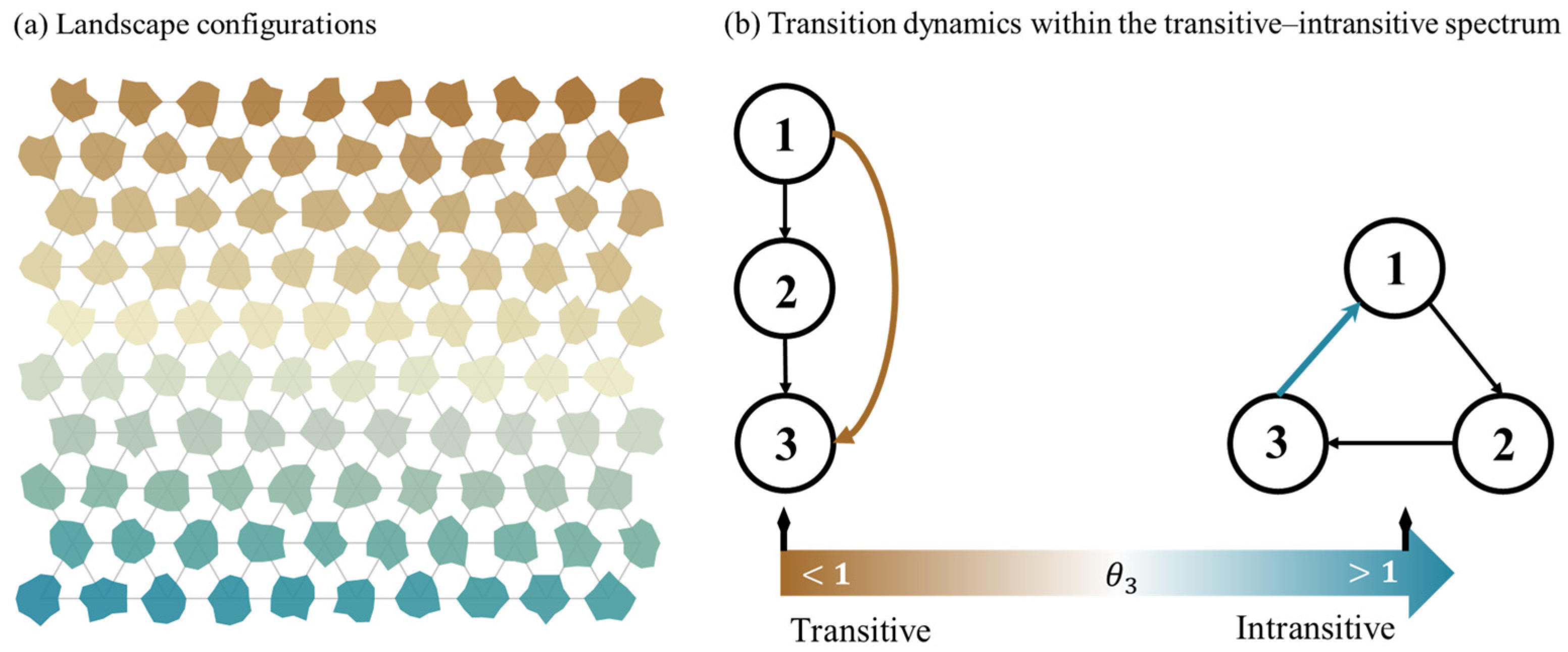
The model framework developed here builds upon the spatially explicit metacommunity model proposed by Luo et al. [35]. This framework integrates species colonization–extinction dynamics, interspecific competition, and landscape configuration into a unified dynamical system. However, analytical investigation of multispecies coexistence under fully heterogeneous landscapes remains challenging due to the high dimensionality introduced by spatial variability. To facilitate theoretical analysis while retaining essential spatial processes, we adopt a spatial homogeneity assumption, under which all habitat patches are assumed to have identical size and constant pairwise distances (Figure 1a). This simplification removes heterogeneity in landscape configuration while preserving colonization–extinction dynamics and dispersal-mediated interactions. Under this assumption, the spatially explicit system can be reformulated into a tractable generalized Lotka–Volterra form, which serves as the core dynamical model in our analysis:
1 p k t d p k t d t = 1 A z e x , k r k l = 1 n α k l p l t
where p k denotes the occupancy probability of species k in any patch. The term r k = c k λ k e k represents the generalized intrinsic growth rate of species k, while the competition coefficient matrix α = (αkl) is given by α k k = c k λ k and for l k , α k l = Q k l e k , where α k l represents the effect of species l on species k. A represents patch area, and z e x , k is the scaling exponent of extinction rate with patch size for species k. The parameter λ k represents the metapopulation capacity of species k, a synthetic spatial metric that integrates landscape configuration [36,37]. In the generalized Lotka–Volterra model, metapopulation capacity λ k is defined as the leading eigenvalue of the landscape matrix M k . The s × s landscape matrix M k (s denotes the number of patches) has entries M k i j specified by:
( M k ) i j = A Z i m , k + Z e x , k + Z e m , k e D ξ k , i f   i j 0 , i f   i = j
The construction of the competition-related parameter Q k l is described in Section 2.1.2. Other relevant parameters and their values are detailed in Table 1. It should be mentioned that model coefficient 1 / A Z m , k is a positive proportional factor that does not affect the stability of equilibrium solutions or the coexistence criteria. Therefore, it will not be included in later studies.

2.1.2. Competition Matrix

We apply Equation (1) to parameterize multispecies competitive interactions for the purpose of investigating variations in coexistence mechanisms across multiple species under different competitive structures. Specifically, we adopt Yang and Hui’s [38] competitive structure design approach to establish interspecific interaction of three species (species 1, species 2, species 3) as follows: the interaction strengths of species 1 on species 2, species 1 on species 3, and species 2 on species 3 are all set to 1. The parameter θ controls the strength of interaction about species 2 on species 1, and species 3 on species 2, whereas the parameter θ3 controls the strength of interaction about species 3 on species 1 (Figure 1b). Consequently, the competition matrix Q is defined as:
Q = 0 θ θ 3 1 0 θ 1 1 0
In this context, the system’s paired competition symmetry is controlled by parameter θ, whereas the degree of intransitive competition is modulated by parameter θ3. The system displays transitive competition when θ3 < 1, yet an intransitive loop is formed via competitive interactions when θ3 > 1. Table 1 provides specific parameter values. The competition coefficient matrix α in Equation (1) could be explicitly obtained from the metacommunity model’s parameters, taking the form:
α = c 1 λ 1 Q 12 e 1 Q 13 e 1 Q 21 e 2 c 2 λ 2 Q 23 e 2 Q 31 e 3 Q 32 e 3 c 3 λ 3 c 1 λ 1 θ e 1 θ 3 e 1 e 2 c 2 λ 2 θ e 2 e 3 e 3 c 3 λ 3

2.2. Coexistence Analysis

2.2.1. Conditions for Multispecies Coexistence

Invasion criterion is capable of being utilized to assess if multiple species coexist under Equation (1) [11,39,40]. In particular, when one species is absent and the other species are in stable equilibrium, we investigate if any species may effectively invade the system [41,42,43]. The system meets the requirement for multispecies coexistence if each species has a positive invasion growth rate when acting as an invader, that is, d p k d t · 1 p k > 0 for every species k. Let R k be the invasion growth rate of species k in equilibrium with the other species. The specific calculation method for the invasion growth rate of species k is detailed in Appendix A. The system fulfills the requirement for multispecies coexistence when every species in the system satisfies R k > 0 as invaders ( k   =   1 ,   2 ,   3 ). This criterion has been employed in the studies that follow to figure out whether a system state in the parameter space is conducive to coexistence [44,45,46].

2.2.2. Species Coexistence Space

We further describe the species coexistence space along two dimensions: niche difference and intransitive competition, assessing multispecies coexistence. We use the structural niche difference Ω proposed by Saavedra et al. [47] to quantify niche difference in multispecies systems. The mathematical expression for n species is Ω = 2 n det α π n / 2 0 + e x T α T α x d x , where α is the matrix of competition coefficients. However, in a two-species system, regions of coexistence and exclusion based on niche difference have a clear division, whereas in a multispecies system, the division becomes diffuse, making coexistence more difficult to interpret. Luo et al. [35] further extended this idea in multispecies systems that take habitat fragmentation and landscape configuration into account, suggesting an improved structural niche difference Ω1, defined as Ω 1 = Ω 1 / ( n 1 ) . Given that our study focuses on multispecies coexistence under varying competitive structures, we adopt the rescaled metric Ω1 to provide a comparable quantification of niche differentiation.
The presence of an intransitive structure does not necessarily imply that it contributes to coexistence. Thus, intransitive metrics alone are insufficient to assess their actual effect. We use the average change in invasion growth rate R ¯ to reflect the extent to which intransitivity promotes coexistence [38,41]. Specifically, when any other species is removed from the system, the average change in the invasion growth rate of species k is described by Δ R k , and the average change in the invasion growth rate of three species is described by R ¯ = ( Δ R 1 + Δ R 2 + Δ R 3 ) / 3 ; details are in Appendix B. This measure characterizes the total effect of intransitive competition on the average invasion growth rate. Intransitive structure typically increases species invasion growth rates, which promotes coexistence among multiple species when R ¯ > 0 . Conversely, it suggests that intransitive competition does not facilitate coexistence within that system if R ¯ < 0 .

2.3. Habitat Destruction Patterns

We provide three categories and five typical habitat destruction scenarios inside the previously specified model framework in order to comprehensively investigate the impact of various forms of habitat destruction on the processes of multispecies coexistence. From three angles, these patterns describe the process of habitat destruction: decreasing the area of all patches proportionally, increasing the distance between each pair of patches, and removing a fraction of patches randomly.
According to Luo et al. [35], the first category is habitat deterioration (Category A), which reduces patch area. It is further classified as uniform and gradient habitat deterioration. Under uniform habitat degradation (Pattern A1), the area of each patch shrinks simultaneously by an identical proportion. Gradient habitat deterioration (Pattern A2), on the other hand, decreases patch area in a gradient fashion, resulting in differing levels of area loss in different patches. Nonetheless, the total area reduction across all patches is consistent with that under uniform habitat deterioration, guaranteeing that the two types are comparable in terms of the overall severity of loss.
The second category is habitat fragmentation (Category B), which involves increasing the distance between patches without changing the patch area directly [48]. Additionally, there are two types of habitat fragmentation. With uniform habitat fragmentation (Pattern B1), species dispersion connectivity between patches is evenly reduced when distances between all patches rise synchronously by the same amount. Gradient habitat fragmentation (Pattern B2), on the other hand, results in unequal isolation levels between various patch pairings by increasing patch distances in a gradient fashion. Nonetheless, the overall distance increase stays the same as in uniform fragmentation, guaranteeing that the two types’ overall isolation levels are constant.
The third category is the habitat loss (Category C, Pattern C) [35,48], which uses the direct removal of whole patches to mimic total habitat loss. In this case, certain patches are completely removed from the landscape, which changes the structure and connectivity of the landscape while also decreasing the amount of habitat that is accessible.

2.4. The Implementation of Numerical Simulation

We performed numerical simulations of Equation (1) to evaluate species coexistence across parameter space. In each simulated community, the number of habitat patches was fixed at 100. Model parameters ( c k ,   e k ,   z i m , k ,   z e m , k ,   z e x , k ,   ξ k ,   A ,   D ) were randomly drawn from predefined distributions (Table 1), generating 5000 independent parameter sets. For each parameter set, the transitivity strength θ 3 was varied from 0 to 2.5 in increments of 0.005, reconstructing the corresponding competition matrix and evaluating coexistence conditions at each value using MATLAB R2024a (MathWorks, Natick, MA, USA). Habitat destruction was implemented by proportionally reducing patch size or removing a fraction of patches, and proportionally increasing the distance between patches.

3. Results

3.1. Mechanisms of Species Coexistence

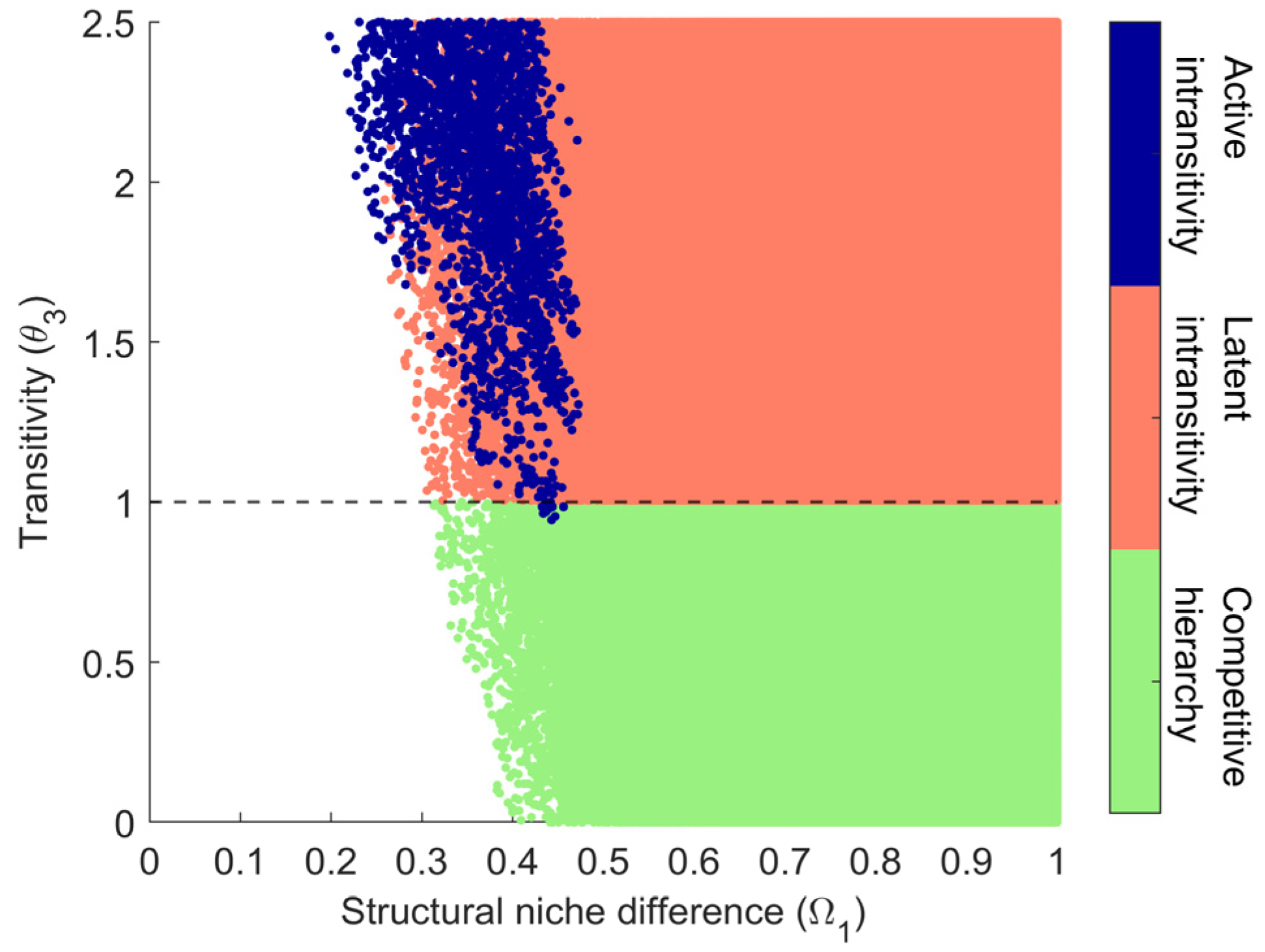
We plotted the coexistence regions of different mechanisms on a parameter space defined by structural niche difference Ω 1 and intransitive structural strength as coordinate axes. According to simulation results (Figure 2), when θ 3 < 1 , the system displays a typical competitive hierarchy pattern. In order to prevent competitive exclusion and preserve community stability, species with varying degrees of competitive advantage mostly depend on adequate niche differentiation. Intransitive competition is present in the system when θ 3 > 1 , but their effects on coexistence vary, resulting in different coexistence mechanisms. Specifically, depending on the direction of the average change in invasion growth rate ( Δ R ¯ ), the coexistence area divides into two subregions, Latent Intransitivity and Active Intransitivity, each having unique mechanism features along the structural niche difference. The relatively large range of Ω 1 is where the Latent Intransitivity area is mainly found. Even though the system has intransitive competitive structures, their ability to stabilize coexistence is minimal in this area ( Δ R ¯ < 0 ). The basic factor sustaining coexistence is structural niche differences. Conversely, regions with greater θ 3 and lower Ω 1 are concentrated in the Active intransitivity region. Intransitive competition is the primary mechanism maintaining species coexistence in this area, as evidenced by the corresponding coexistence states, which indicate a considerable contribution of intransitive competition to the system’s stable coexistence ( Δ R ¯ > 0 ). Competitive hierarchy, latent intransitivity, and active intransitivity are the three mechanistic domains into which we classify coexistence areas as a result of the clear structural distribution that appears in this parameter space.

3.2. Effects of Habitat Destruction

In this section, we explore how patterns of species coexistence are modified by habitat destruction. We simulate species coexistence responses under various types and intensities of habitat destruction by manipulating patch area and the distance between patches in this spatial implicit metacommunity model.

3.2.1. Effects on Coexistence Outcomes

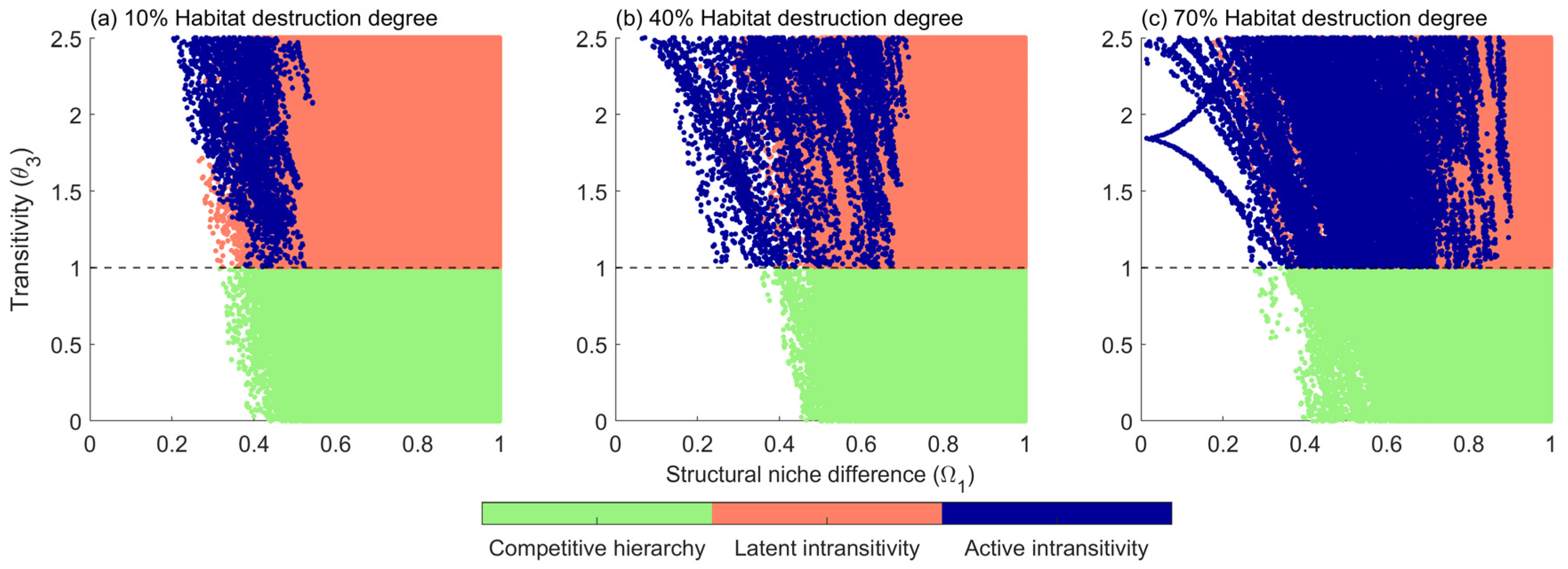
We first examine the impact of gradient habitat deterioration (Pattern A2) on species coexistence (Figure 3). Overall, the parameter space enabling species coexistence has a general shrinkage tendency as habitat destruction rises from 10% to 40% and then to 70%. Nonetheless, distinct coexistence mechanisms reflect varying evolutionary trends in reaction to habitat destruction. There is a decreasing tendency in both the coexistence zones for latent intransitivity and competitive hierarchy. Both competitive hierarchy and latent intransitivity must rely on a strong structural niche difference ( Ω 1 ) to keep species coexistence, since habitat destruction reduces these mechanisms’ ability to counteract competitive exclusion. In stark contrast, habitat destruction did not reduce the area that was dominated by active intransitivity. Instead, its distribution spread over both low Ω 1 and high θ 3 regions as a result of more severe habitat destruction, and intransitive competition took over as the main factor maintaining system coexistence.
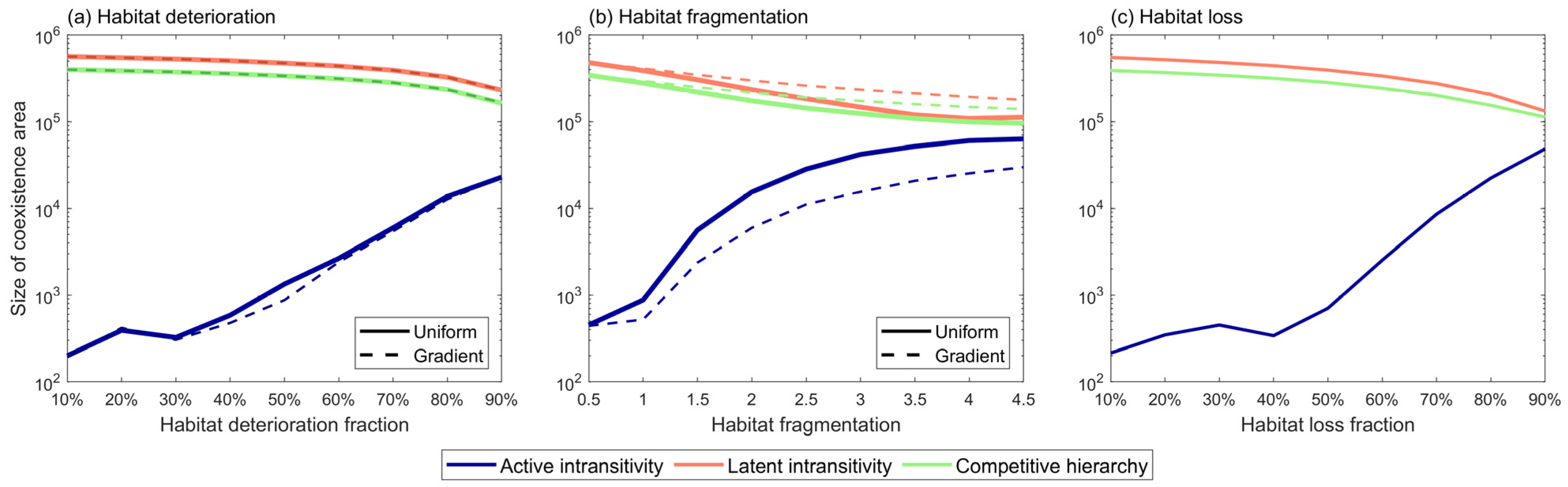
We also explored five distinct types of habitat destruction. The findings demonstrated that the particular pattern of habitat degradation had no discernible impact on the previously described behaviors (Figure 4). The changes in coexistence areas corresponding to the three mechanisms—competitive hierarchy, latent intransitivity, and active intransitivity—showed identical variations as habitat destruction degree increased, regardless of whether patch area was reduced via uniform or gradient (Figure 4a), patch distance was increased via uniform or gradient (Figure 4b), or entire patches were eliminated (Figure 4c). In particular, there was a monotonically declining trend in the coexistence regions for both latent intransitivity and competitive hierarchy. On the other hand, when habitat destruction increased, the coexistence area for active intransitivity exhibited a rising tendency. The main finding that “habitat destruction suppresses coexistence under competitive hierarchy and latent intransitivity while promoting coexistence under active intransitivity” holds across all types of habitat destruction, despite minor variations in particular values and rates of change—for instance, uniform habitat fragmentation considerably increases active intransitivity more than gradient habitat fragmentation.

3.2.2. Effects on Coexistence Mechanisms

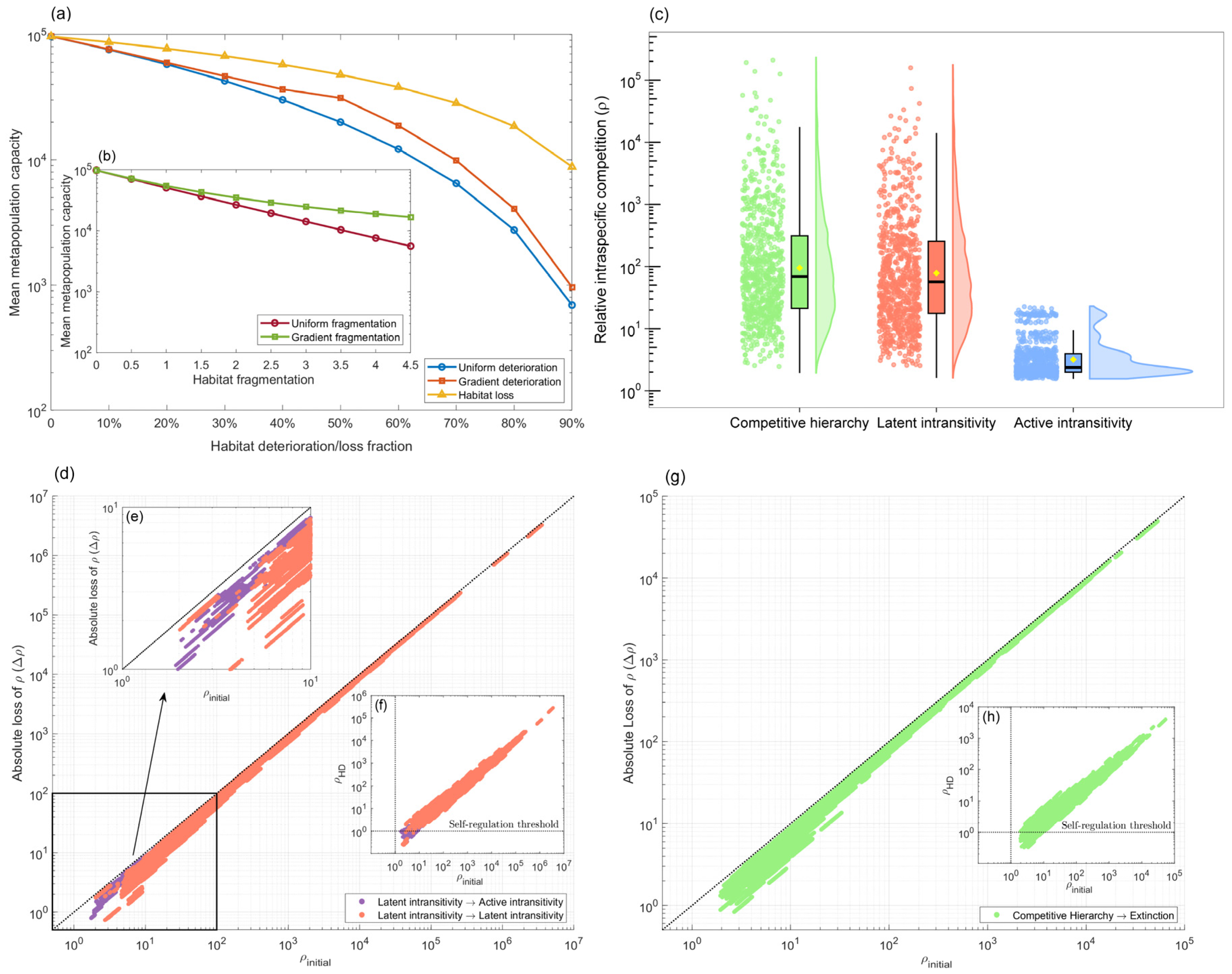
To examine how coexistence responds to habitat destruction under different mechanisms, we first analyzed metapopulation capacity λ, a crucial spatial metric. Mean λ declined sharply with increasing habitat destruction across all five destruction scenarios (Figure 5a,b). The competitive structure within communities is directly impacted by the reduction in λ. For the purpose of measuring the structural features, we quantified the ratio of intraspecific to interspecific competition ( ρ = α ¯ i i / α ¯ i j ). Under undisturbed conditions, ρ distributions differed among coexistence mechanisms (Figure 5c): Compared to the other two mechanisms, the active intransitivity region exhibited markedly lower ρ values, suggesting weaker intraspecific competition and coexistence rely on interspecific intransitivity structure. In contrast, latent intransitivity and competitive hierarchy both show wide and high distributions of ρ values, indicating coexistence maintained by strong intraspecific competition, where substantial niche difference masks potential intransitive structures.
To uncover the mechanism driving the transition from latent intransitivity to active intransitivity, we analyzed the relationship between the initial self-regulation strength ( ρ i n i t i a l ) and its absolute destruction ( ρ ) following habitat destruction. (Figure 5d). The data exhibit a strict linear relationship in log-log space, indicating that habitat destruction uniformly erodes a constant fraction of self-regulation capacity, independent of the community’s initial dynamic state. Our findings reveal that structurally robust communities suffered larger absolute destruction yet maintained their dynamic state, while marginally stable communities transitioned despite minimal destruction. As shown in Figure 5f, the transition to active intransitivity is governed by the proximity to the self-regulation threshold ( ρ = 1 , where intraspecific effects equal interspecific effects). Communities that retained their latent intransitivity status (orange points) originated from regions of high structural redundancy ( ρ i n i t i a l 1 ). Conversely, communities that underwent a regime shift (purple points) were clustered exclusively in the region of minimal stability margins. For these structurally vulnerable communities, the proportional destruction was sufficient to drive the system below the threshold ( ρ H D < 1 ), thereby activating underlying intransitive loops to sustain coexistence. In contrast, the community itself lacked intransitive structures in the competitive hierarchy region, even if its ρ value had decreased comparably much. As a result, biodiversity was eventually lost as it was unable to sustain stable coexistence through competitive hierarchy (Figure 5g,h).

3.3. Dynamical Transitions Before and After Habitat Destruction

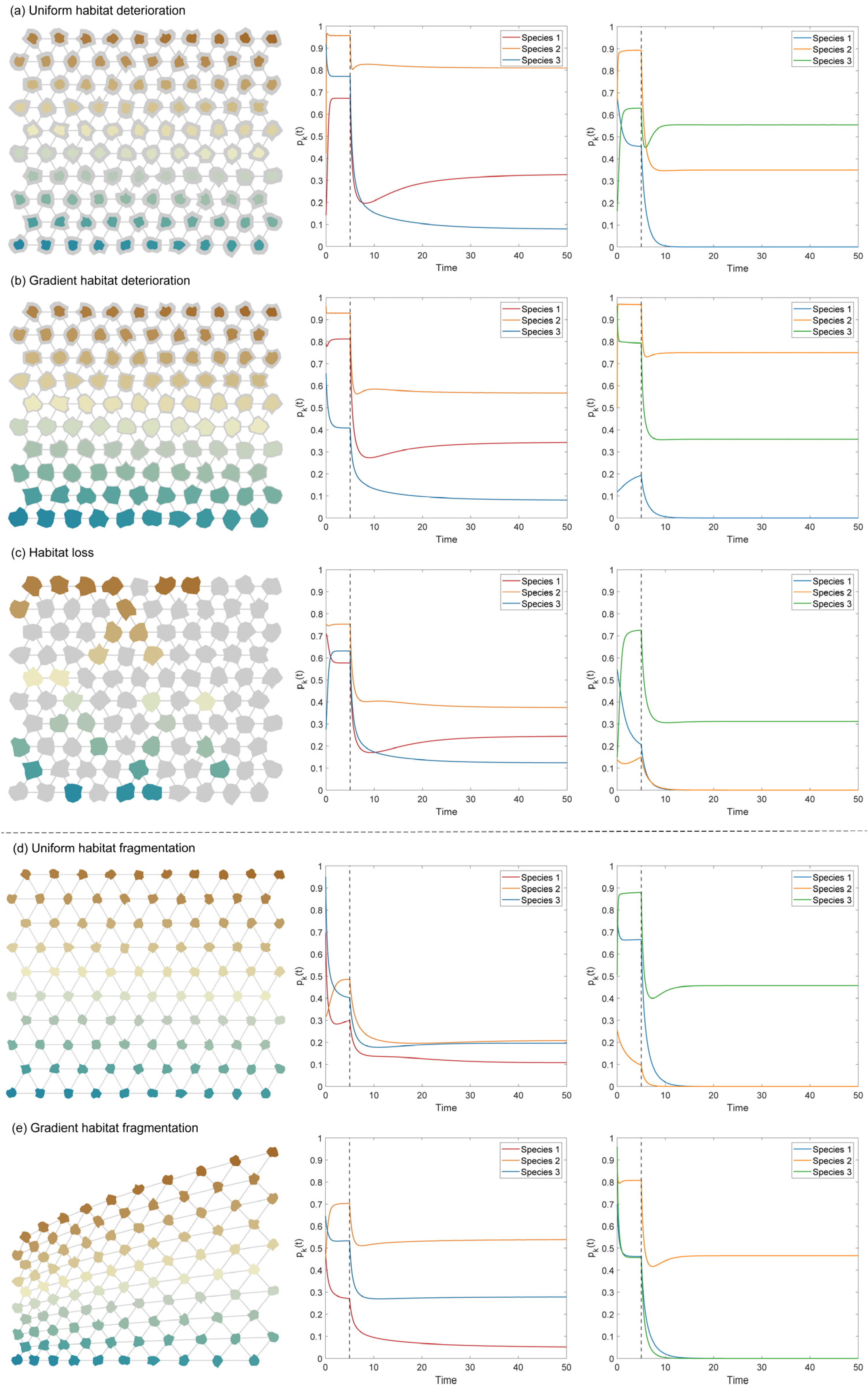
We tracked the temporal evolutionary trajectories of five different habitat destruction patterns and chose example communities before and after habitat destruction in order to graphically illustrate the real-time influence of habitat destruction on species coexistence dynamics (Figure 6). The point at which habitat destruction took place is displayed by the dashed line (t = 5).
Regardless of the type of habitat destruction experienced, the occupancy probability of species for communities that were initially in latent intransitivity experience significant fluctuations and reorganization. Intransitive competition mechanisms, on the other hand, encourage species to quickly form new equilibrium connections, allowing them to effectively shift to active intransitivity and sustain a new steady state of coexistence (see Figure 6, second column). Communities that rely on the competitive hierarchy, on the other hand, lack an intransitive structure. The occupancy probability of disadvantaged species quickly approaches zero under comparable habitat disturbances because they are unable to endure survival stresses. The system quickly degenerates into systems with one or two species (see Figure 6, third column). The vital function that active intransitivity plays after habitat destruction is well supported by this dynamic process.

4. Discussion

Our study investigates how competitive structures and niche differentiation patterns are impacted by habitat destruction, hence reshaping mechanisms for multispecies coexistence. We adopted a multispecies coexistence space based on the generalized Lotka–Volterra framework, which originated from spatially explicit metacommunity models under the homogeneity assumption. This space simultaneously integrates structural niche difference, intransitive competition, and the actual contribution of intransitive competition through a controllable intransitive parameter. The findings indicate that a single mechanism does not always sustain multispecies coexistence. Niche differentiation, intransitive competition, or their combined impacts could identify coexistence scenarios. Under diverse processes, communities respond differently to habitat destruction; coexistence regions controlled by intransitive competition show a growing tendency. Additionally, habitat destruction weakens species coexistence and various coexistence mechanisms have different reactions.
Only in situations of strong structural niche difference ( Ω 1 ), which takes the form of the competitive hierarchy structure, can multispecies coexistence take place when the competitive structure is primarily transitive ( θ 3 < 1 ). This finding is consistent with the predictions of classical niche theory, which holds that structural niche difference is necessary for multispecies coexistence to balance out fitness difference by reducing interspecific competition in comparison to intraspecific competition [11,49,50,51]. In other words, the main mechanism maintaining coexistence in a system devoid of intransitive structures is structural niche difference. Coexistence is divided into two areas under intransitive competitive structures ( θ 3 > 1 ). Intransitive competition only exists as a latent structure in one sort of coexistence area, which nevertheless mostly depends on high Ω 1 to sustain coexistence. Under the lower Ω 1 criteria, the other kind obtains sustained coexistence, suggesting that intransitive competitive structures directly support coexistence. The ecological significance of intransitive structures depends on whether they change the competitive outcomes between species, as demonstrated by recent research showing that these structures do not necessarily foster coexistence [22,38,41,52,53].
By decreasing the metapopulation capacity λ, habitat destruction has notably varied consequences on coexistence states. The entire coexistence space shrinks as λ decreases, which is in keeping with the traditional metapopulation theory result that species persistence is constrained by metapopulation capacity [36,37]. The coexistence space’s internal structure, however, is systematically reorganized: areas that rely on high Ω 1 , such as the competitive hierarchy and latent intransitivity zones, decline and are compelled to move in the direction of higher Ω 1 regions. This suggests that coexistence mechanisms that just rely on niche differentiation need more structural support to endure in unfavorable situations. This is in line with recent studies that examine the connection between stability mechanisms and competitive structure. According to Ranjan et al. [53], the total competitive structure determines three-species coexistence. The coexistence region significantly reduces when competition is hierarchical and niche differentiation is inadequate. On the other hand, when habitat is being damaged, especially when habitat fragmentation is consistent, the active intransitivity area shows an expanding tendency. This suggests that intransitive competition might distribute competitive pressure to maintain species persistence under particular competitive structures. Intransitivity structures can increase species invasion capacity and persistent coexistence probability under specific conditions [41], which is compatible with recent invasion analysis findings and the cyclic competition maintenance mechanism uncovered by the classic three-species intransitivity model [18]. As a result, habitat destruction not only shrinks the “parameter space for coexistence”, but it also fundamentally alters the relative significance of various coexistence mechanisms.
Further analysis reveals that the previously indicated pattern change is caused by habitat destruction, which alters the system’s overall competitiveness, rather than the intransitive structural strength θ 3 itself. According to the empirical results [33], habitat destruction results in a decrease in metapopulation capacity. This study showed that the intensity of intraspecific competition was weakened in comparison to interspecific competition when the area of Peneonanthe pulverulenta pulverulenta was reduced, resulting in a considerable fall in metapopulation capacity. In early communities where intraspecific competition had initially provided little benefit, this weakening impact was particularly noticeable. When habitat destruction decreases the relative advantage of intraspecific competition over interspecific competition, communities dominated by latent intransitivity mechanisms that have intraspecific competition slightly greater than interspecific competition are more likely to fall below the critical threshold for intraspecific competition-dominated coexistence. The transition from latent to active intransitivity mechanisms is brought about by the intransitive structure, which was previously inadequate to maintain coexistence alone. According to the paradigm of contemporary coexistence theory, which holds that stabilizing mechanisms rely on the relative advantage of intraspecific vs. interspecific competition, this change represents the systematic reworking of competitive ratio structures under habitat degradation [11]. The coexistence border varies systematically when habitat changes reduce the relative benefit of intraspecific competition [54]. Therefore, habitat destruction triggered changes in dominance within coexistence mechanisms via altering competitive intensity structures, rather than just decreasing community size. On the other hand, under the same habitat destruction-induced changes, communities that are governed by competitive hierarchy processes and do not have regulation of intransitive competitive structures are more likely to go extinct. As a result, this mechanism’s range of coexistence decreases after habitat destruction. These patterns suggest that, rather than only decreasing community size, habitat destruction causes internal community reorganization by changing competitive ratio structures.
Our model framework is intended as a general theoretical approach to isolate and analyze coexistence mechanisms within spatially structured ecological systems. The results are most applicable to systems satisfying two important conditions: populations are organized across discrete habitat patches, and these patches are connected through dispersal, allowing indirect interactions to emerge across space. For example, plant communities in fragmented landscapes often exhibit such patch-based dynamics via seed dispersal across habitat networks [55], and benthic or intertidal communities are similarly structured by discrete substrate patches with dispersal mediated by larval stages [56]. In order to include the impacts of intricate landscape features into a single metapopulation capacity, we use a spatial homogeneity assumption. This method highlights how competitive structures and dynamic responses caused by habitat destruction alter the processes of multispecies coexistence. Although this method emphasizes how habitat change affects coexistence mechanisms, it ignores local interactions and spatial heterogeneity between patches. According to earlier research, local interactions and spatial heterogeneity may significantly change competitive outcomes [9,57]. Additionally, extending the current model to more realistic multispecies scenarios require considering more complex network structures. Indeed, network topology can strongly influence metapopulation dynamics and persistence [58]. Incorporating such structural complexity may therefore modify the effects of intransitive competition and habitat loss identified in this study. Consequently, one of the most important ways to comprehend the ecological relevance of intransitive competition is to embed it into explicit spatial structure and network topology, and to investigate its scale dependency and topological effects in actual environments.

Author Contributions

Conceptualization, P.L. and Y.Y.; methodology, P.L. and Y.Y.; software, P.L.; validation, Y.G. and X.Z.; formal analysis, P.L. and Y.G.; writing—original draft preparation, P.L.; writing—review and editing, P.L. and Y.Y.; funding acquisition, Y.Y. All authors have read and agreed to the published version of the manuscript.

Funding

This research was funded by Sichuan Science and Technology Program, grant number 2026NSFSC0133 and Fundamental Research Funds for the Central Universities, grant number 2682025ZTPY017.

Institutional Review Board Statement

Not applicable.

Data Availability Statement

The original contributions presented in this study are included in the article. Further inquiries can be directed to the corresponding author.

Acknowledgments

During the preparation of this manuscript, the authors used ChatGPT, version 5.2 and Gemini, version 3.0 for the purposes of text editing. The authors have reviewed and edited the output and take full responsibility for the content of this publication.

Conflicts of Interest

The authors declare no conflict of interest.

Appendix A. Calculation of Species Invasion Growth Rate

We use the invasion growth rate to evaluate the conditions for multispecies coexistence. The invasion growth rate of species k, R k , is defined by Gallien et al. [41] as the species’ tendency to increase from a tiny population size while other resident species are at their equilibrium. The per capita growth rate d p k d t · 1 p k can be regarded as such if the density of species k is determined to be insignificant, and the other species’ densities are at their potential equilibriums. As mentioned in Section 2.1.1, the coefficient 1 / A Z m , k in Equation (1) is omitted. For a three-species system, if species i and species j are present in the community, then by neglecting the rare invasion of species k, the invasion growth rate of species k is
R k = d p k d t 1 p k = c k λ k e k Q k i e k p i * Q k j e k p j * ,
the equilibrium solutions p i * and p j * can be determined according to
d p i d t 1 p i = c i λ i e i c i λ i p i Q i j e i p j d p j d t 1 p j = c j λ j e j c j λ j p j Q j i e j p i
derived as follows:
p i * = c i λ i c j λ j c j λ j e i c j λ j Q i j e i + Q i j e i e j c i λ i c j λ j Q i j e i Q j i e j p j * = c i λ i c j λ j c i λ i e j c i λ i Q j i e j + Q j i e j e i c i λ i c j λ j Q i j e i Q j i e j
Using Equation (A3), we finally obtain
R k = c k λ k e k Q k i e k · c i λ i c j λ j c j λ j e i c j λ j Q i j e i + Q i j e i e j c i λ i c j λ j Q i j e i Q j i e j Q k j e k · c j λ j c i λ i c i λ i e j c i λ i Q j i e j + Q j i e j e i c j λ j c i λ i Q j i e j Q i j e i   .
When every species as invaders (k = 1, 2, 3) in the system satisfies R k > 0 , the system achieves the requirement for multispecies coexistence.

Appendix B. Calculation of the Average Change in Species Invasion Growth Rate

To evaluate the contribution of competitive intransitivity to species coexistence, we utilize the metric Δ R ¯ introduced by Gallien et al. [41]. This metric quantifies the average change in the invasion growth rate of a focal species when one resident species is removed from the same community. Specifically, the change in the invasion growth rate for species i is defined as: R i = 1 s 1 j 1 , j = 1 s ( R i R i , j ) , where s denotes the total number of species in the system. The term R i represents the invasion growth rate of species i from a small population density when all other resident species are at their equilibrium states (the detailed calculation of R i is provided in Appendix A). The term R i , j corresponds to the invasion growth rate of species i in the same system after the removal of species j . Consequently, the difference R i R i , j captures the specific effect of eliminating species j on the invasion growth rate of species i . Note that, as mentioned in Section 2.1.1, the coefficient 1 / A Z m , k in Equation (1) has been omitted for these calculations. Consider a three-species system. If species j is removed, leaving only species k present in the community, the invasion growth rate R i , j is formulated as:
R i , j = d p i d t 1 p i = c i λ i e i Q i k e i p k *   ,
the equilibrium solution of the resident species k , denoted as p k * , is derived from its dynamics
d p k d t 1 p k = c k λ k e k c k λ k p k   ,
solving Equation (A6) yields
p k * = c k λ k e k c k λ k   ,
substituting Equation (A7) into Equation (A5), we obtain the expression for R i , j
R i , j = c i λ i e i Q i k e i · c k λ k e k c k λ k   .
The value Δ R i provides the mean change in the invasion growth rate of species i resulting from the removal of any other single species in the system. For our specific three-species system, these values are computed as follows:
R 1 = ( R 1 R 1 , 2 ) + ( R 1 R 1 , 3 ) 2
R 2 = ( R 2 R 2 , 1 ) + ( R 2 R 2 , 3 ) 2
R 3 = ( R 3 R 3 , 1 ) + ( R 3 R 3 , 2 ) 2
after calculating Δ R i for each species, we estimate the overall importance of competitive intransitivity to species coexistence by averaging these mean changes across all s species ( R ¯ = i = 1 s Δ R i / s ). For the three-species system, this ultimately yields:
R ¯ = R 1 + R 2 + R 3 3   .

References

  1. Foley, J.A.; DeFries, R.; Asner, G.P.; Barford, C.; Bonan, G.; Carpenter, S.R.; Chapin, F.S.; Coe, M.T.; Daily, G.C.; Gibbs, H.K.; et al. Global Consequences of Land Use. Science 2005, 309, 570–574. [Google Scholar] [CrossRef] [PubMed]
  2. Newbold, T.; Hudson, L.N.; Hill, S.L.L.; Contu, S.; Lysenko, I.; Senior, R.A.; Börger, L.; Bennett, D.J.; Choimes, A.; Collen, B.; et al. Global Effects of Land Use on Local Terrestrial Biodiversity. Nature 2015, 520, 45–50. [Google Scholar] [CrossRef] [PubMed]
  3. Kuipers, K.J.J.; Hilbers, J.P.; Garcia-Ulloa, J.; Graae, B.J.; May, R.; Verones, F.; Huijbregts, M.A.J.; Schipper, A.M. Habitat Fragmentation Amplifies Threats from Habitat Loss to Mammal Diversity across the World’s Terrestrial Ecoregions. One Earth 2021, 4, 1505–1513. [Google Scholar] [CrossRef]
  4. Yuan, R.; Zhang, N.; Zhang, Q. The Impact of Habitat Loss and Fragmentation on Biodiversity in Global Protected Areas. Sci. Total Environ. 2024, 931, 173004. [Google Scholar] [CrossRef]
  5. Tilman, D.; May, R.M.; Lehman, C.L.; Nowak, M.A. Habitat Destruction and the Extinction Debt. Nature 1994, 371, 65–66. [Google Scholar] [CrossRef]
  6. Connell, J.H. Diversity in Tropical Rain Forests and Coral Reefs: High Diversity of Trees and Corals Is Maintained Only in a Nonequilibrium State. Science 1978, 199, 1302–1310. [Google Scholar] [CrossRef]
  7. Fahrig, L. Effects of Habitat Fragmentation on Biodiversity. Annu. Rev. Ecol. Evol. Syst. 2003, 34, 487–515. [Google Scholar] [CrossRef]
  8. Didham, R.K.; Kapos, V.; Ewers, R.M. Rethinking the Conceptual Foundations of Habitat Fragmentation Research. Oikos 2012, 121, 161–170. [Google Scholar] [CrossRef]
  9. Rybicki, J.; Abrego, N.; Ovaskainen, O. Habitat Fragmentation and Species Diversity in Competitive Communities. Ecol. Lett. 2020, 23, 506–517. [Google Scholar] [CrossRef]
  10. Tylianakis, J.M.; Didham, R.K.; Bascompte, J.; Wardle, D.A. Global Change and Species Interactions in Terrestrial Ecosystems. Ecol. Lett. 2008, 11, 1351–1363. [Google Scholar] [CrossRef]
  11. Chesson, P. Mechanisms of Maintenance of Species Diversity. Annu. Rev. Ecol. Evol. Syst. 2000, 31, 343–366. [Google Scholar] [CrossRef]
  12. Chesson, P. Species Competition and Predation. In Encyclopedia of Sustainability Science and Technology; Springer: New York, NY, USA, 2012; pp. 10061–10085. ISBN 978-1-4419-0851-3. [Google Scholar]
  13. Lotka, A.J. Elements of Physical Biology. Nature 1925, 116, 461. [Google Scholar] [CrossRef]
  14. Volterra, V. Variations and Fluctuations of the Number of Individuals in Animal Species Living Together. ICES J. Mar. Sci. 1928, 3, 3–51. [Google Scholar] [CrossRef]
  15. HilleRisLambers, J.; Adler, P.B.; Harpole, W.S.; Levine, J.M.; Mayfield, M.M. Rethinking Community Assembly through the Lens of Coexistence Theory. Annu. Rev. Ecol. Evol. Syst. 2012, 43, 227–248. [Google Scholar] [CrossRef]
  16. Kininmonth, S.; Ferrando, D.L.; Becerro, M. Neighbourhood Benthic Configuration Reveals Hidden Co-Occurrence Social Diversity. Philos. Trans. R. Soc. B Biol. Sci. 2024, 379, 20230174. [Google Scholar] [CrossRef] [PubMed]
  17. Molina-Venegas, R.; Verdú, M.; Montesinos-Navarro, A.; Alcántara, J.M.; Garrido, J.L.; Antorán, E.; Calatayud, J. Indirect Reciprocal Facilitation Promotes Species Coexistence in Plant Communities Worldwide. Nat. Ecol. Evol. 2025, 9, 1373–1381. [Google Scholar] [CrossRef] [PubMed]
  18. May, R.M.; Leonard, W.J. Nonlinear Aspects of Competition Between Three Species. SIAM J. Appl. Math. 1975, 29, 243–253. [Google Scholar] [CrossRef]
  19. Reichenbach, T.; Mobilia, M.; Frey, E. Mobility Promotes and Jeopardizes Biodiversity in Rock–Paper–Scissors Games. Nature 2007, 448, 1046–1049. [Google Scholar] [CrossRef]
  20. Allesina, S.; Levine, J.M. A Competitive Network Theory of Species Diversity. Proc. Natl. Acad. Sci. USA 2011, 108, 5638–5642. [Google Scholar] [CrossRef]
  21. Laird, R.A.; Schamp, B.S. Competitive Intransitivity Promotes Species Coexistence. Am. Nat. 2006, 168, 182–193. [Google Scholar] [CrossRef]
  22. Godoy, O.; Stouffer, D.B.; Kraft, N.J.B.; Levine, J.M. Intransitivity Is Infrequent and Fails to Promote Annual Plant Coexistence without Pairwise Niche Differences. Ecology 2017, 98, 1193–1200. [Google Scholar] [CrossRef] [PubMed]
  23. Gallien, L. Intransitive Competition and Its Effects on Community Functional Diversity. Oikos 2017, 126, 615–623. [Google Scholar] [CrossRef]
  24. Vandermeer, J. Transitive and Intransitive Structures in Competition-Based Ecological Communities. Ecol. Complex. 2024, 60, 101103. [Google Scholar] [CrossRef]
  25. Amarasekare, P. Competitive Coexistence in Spatially Structured Environments: A Synthesis. Ecol. Lett. 2003, 6, 1109–1122. [Google Scholar] [CrossRef]
  26. Mouquet, N.; Loreau, M. Community Patterns in Source-Sink Metacommunities. Am. Nat. 2003, 162, 544–557. [Google Scholar] [CrossRef]
  27. Ying, Z.; Liao, J.; Wang, S.; Lu, H.; Liu, Y.; Ma, L.; Li, Z. Species Coexistence in a Lattice-Structured Habitat: Effects of Species Dispersal and Interactions. J. Theor. Biol. 2014, 359, 184–191. [Google Scholar] [CrossRef]
  28. Chen, D.; Liao, J.; Bearup, D.; Li, Z. Habitat Heterogeneity Mediates Effects of Individual Variation on Spatial Species Coexistence. Proc. R. Soc. B Biol. Sci. 2020, 287, 20192436. [Google Scholar] [CrossRef]
  29. Orgeron, J.A.; Asllani, M. Habitat Fragmentation Promotes Spatial Scale Separation under Resource Competition. J. Theor. Biol. 2026, 621, 112367. [Google Scholar] [CrossRef]
  30. Hanski, I. Metapopulation Dynamics. Nature 1998, 396, 41–49. [Google Scholar] [CrossRef]
  31. Ovaskainen, O.; Hanski, I. Spatially Structured Metapopulation Models: Global and Local Assessment of Metapopulation Capacity. Theor. Popul. Biol. 2001, 60, 281–302. [Google Scholar] [CrossRef]
  32. Leibold, M.A.; Holyoak, M.; Mouquet, N.; Amarasekare, P.; Chase, J.M.; Hoopes, M.F.; Holt, R.D.; Shurin, J.B.; Law, R.; Tilman, D.; et al. The Metacommunity Concept: A Framework for Multi-Scale Community Ecology. Ecol. Lett. 2004, 7, 601–613. [Google Scholar] [CrossRef]
  33. Huang, R.; Pimm, S.L.; Giri, C. Using Metapopulation Theory for Practical Conservation of Mangrove Endemic Birds. Conserv. Biol. 2020, 34, 266–275. [Google Scholar] [CrossRef] [PubMed]
  34. Li, Y.; Bearup, D.; Liao, J. Habitat Loss Alters Effects of Intransitive Higher-Order Competition on Biodiversity: A New Metapopulation Framework. Proc. R. Soc. B Biol. Sci. 2020, 287, 20201571. [Google Scholar] [CrossRef] [PubMed]
  35. Luo, M.; Wang, S.; Saavedra, S.; Ebert, D.; Altermatt, F. Multispecies Coexistence in Fragmented Landscapes. Proc. Natl. Acad. Sci. USA 2022, 119, e2201503119. [Google Scholar] [CrossRef] [PubMed]
  36. Hanski, I.; Ovaskainen, O. The Metapopulation Capacity of a Fragmented Landscape. Nature 2000, 404, 755–758. [Google Scholar] [CrossRef]
  37. Ovaskainen, O. Habitat Destruction, Habitat Restoration and Eigenvector–Eigenvalue Relations. Math. Biosci. 2003, 181, 165–176. [Google Scholar] [CrossRef]
  38. Yang, Y.; Hui, C. How Competitive Intransitivity and Niche Overlap Affect Spatial Coexistence. Oikos 2021, 130, 260–273. [Google Scholar] [CrossRef]
  39. Case, T.J. An Illustrated Guide to Theoretical Ecology. J. Mammal. 2001, 82, 247–248. [Google Scholar]
  40. Siepielski, A.M.; McPeek, M.A. On the Evidence for Species Coexistence: A Critique of the Coexistence Program. Ecology 2010, 91, 3153–3164. [Google Scholar] [CrossRef]
  41. Gallien, L.; Zimmermann, N.E.; Levine, J.M.; Adler, P.B. The Effects of Intransitive Competition on Coexistence. Ecol. Lett. 2017, 20, 791–800. [Google Scholar] [CrossRef]
  42. Barabás, G.; D’Andrea, R.; Stump, S.M. Chesson’s Coexistence Theory. Ecol. Monogr. 2018, 88, 277–303. [Google Scholar] [CrossRef]
  43. Grainger, T.N.; Letten, A.D.; Gilbert, B.; Fukami, T. Applying Modern Coexistence Theory to Priority Effects. Proc. Natl. Acad. Sci. USA 2019, 116, 6205–6210. [Google Scholar] [CrossRef] [PubMed]
  44. Spaak, J.W.; Schreiber, S.J. Building Modern Coexistence Theory from the Ground up: The Role of Community Assembly. Ecol. Lett. 2023, 26, 1840–1861. [Google Scholar] [CrossRef]
  45. Terry, J.C.D. An Experimental Validation Test of Ecological Coexistence Theory to Forecast Extinction Under Rising Temperatures. Ecol. Lett. 2025, 28, e70047. [Google Scholar] [CrossRef] [PubMed]
  46. Castledine, M.; Padfield, D.; Buckling, A. Estimates of Microbial Community Stability Using Relative Invader Growth Rates Are Robust across Levels of Invader Species Richness. ISME Commun. 2025, 5, ycaf040. [Google Scholar] [CrossRef]
  47. Saavedra, S.; Rohr, R.P.; Bascompte, J.; Godoy, O.; Kraft, N.J.B.; Levine, J.M. A Structural Approach for Understanding Multispecies Coexistence. Ecol. Monogr. 2017, 87, 470–486. [Google Scholar] [CrossRef]
  48. Wang, S.; Brose, U.; Van Nouhuys, S.; Holt, R.D.; Loreau, M. Metapopulation Capacity Determines Food Chain Length in Fragmented Landscapes. Proc. Natl. Acad. Sci. USA 2021, 118, e2102733118. [Google Scholar] [CrossRef]
  49. Chu, C.; Adler, P.B. Large Niche Differences Emerge at the Recruitment Stage to Stabilize Grassland Coexistence. Ecol. Monogr. 2015, 85, 373–392. [Google Scholar] [CrossRef]
  50. Mittelbach, G.G.; McGill, B.J. Species Coexistence and Niche Theory. In Community Ecology, 2nd ed.; Mittelbach, G.G., McGill, B.J., Eds.; Oxford University Press: Oxford, UK, 2019; pp. 141–157. [Google Scholar]
  51. Spaak, J.W.; Millet, R.; Ke, P.-J.; Letten, A.D.; De Laender, F. The Effect of Non-Linear Competitive Interactions on Quantifying Niche and Fitness Differences. Theor. Ecol. 2023, 16, 161–170. [Google Scholar] [CrossRef]
  52. Soliveres, S.; Allan, E. Everything You Always Wanted to Know about Intransitive Competition but Were Afraid to Ask. J. Ecol. 2018, 106, 807–814. [Google Scholar] [CrossRef]
  53. Ranjan, R.; Koffel, T.; Klausmeier, C.A. The Three-Species Problem: Incorporating Competitive Asymmetry and Intransitivity in Modern Coexistence Theory. Ecol. Lett. 2024, 27, e14426. [Google Scholar] [CrossRef]
  54. Spaak, J.W.; Laender, F.D. Intuitive and Broadly Applicable Definitions of Niche and Fitness Differences. Ecol. Lett. 2020, 23, 1117–1128. [Google Scholar] [CrossRef]
  55. Nathan, R.; Muller-Landau, H.C. Spatial Patterns of Seed Dispersal, Their Determinants and Consequences for Recruitment. Trends Ecol. Evol. 2000, 15, 278–285. [Google Scholar] [CrossRef]
  56. Menge, B.A.; Lubchenco, J.; Bracken, M.E.S.; Chan, F.; Foley, M.M.; Freidenburg, T.L.; Gaines, S.D.; Hudson, G.; Krenz, C.; Leslie, H.; et al. Coastal Oceanography Sets the Pace of Rocky Intertidal Community Dynamics. Proc. Natl. Acad. Sci. USA 2003, 100, 12229–12234. [Google Scholar] [CrossRef]
  57. Marchesan, J.; Kolasa, J. Habitat Fragmentation Affects Richness—A View Through a Metacommunity Lens. Diversity 2024, 16, 658. [Google Scholar] [CrossRef]
  58. Kininmonth, S.; Drechsler, M.; Johst, K.; Possingham, H. Metapopulation Mean Life Time within Complex Networks. Mar. Ecol. Prog. Ser. 2010, 417, 139–149. [Google Scholar] [CrossRef]
Figure 1. Conceptual framework of the modeling approach. (a) Landscape configurations. The colored polygons represent habitat patches within the model Equation (1), and the connecting gray lines indicate the dispersal distances between neighboring patches. The varying colors of the patches serve to visually distinguish them from one another. By assuming uniform patch areas and structures, we simplify complex landscapes, facilitating the formulation of the generalized Lotka–Volterra framework. (b) Transition within the transitive–intransitive spectrum by Q in three species system. The parameter θ3 regulates the competitive structure: θ3 < 1 represents a transitive hierarchy, while θ3 > 1 leads to an intransitive loop.
Diversity 18 00217 g001
Figure 2. The impact of different competitive structures and structural niche differences on species coexistence. Each point represents one randomly generated parameter set (i.e., one realization of our model). Within the parameter space defined by structural niche differences (Ω1) and intransitivity strength (θ3), the scatter plot reveals the range of stable coexistence. The colorbar represents different coexistence mechanisms: blue denotes active intransitivity, orange denotes latent intransitivity, and green denotes competitive hierarchy. The region below the dashed line (θ3 < 1) corresponds to the competitive hierarchy mechanism. The region above the dashed line (θ3 > 1) is further divided into latent intransitivity ( Δ R ¯ < 0 ) and active intransitivity ( Δ R ¯ > 0 ) based on the sign of Δ R ¯ , the contribution of intransitive structure to species coexistence.
Diversity 18 00217 g002
Figure 3. Impact of gradient habitat deterioration (Pattern A2) on species coexistence. The coexistence regions corresponding to the habitat destruction degree of (a) 10%, (b) 40%, and (c) 70% under this scenario are shown from left to right. These regions are plotted in the parameter space of structural niche difference (Ω1) and transitivity strength (θ3). The colorbar represents three coexistence mechanisms: competitive hierarchy (green), latent intransitivity (orange), and active intransitivity (blue).
Diversity 18 00217 g003
Figure 4. Trends in coexistence area size under different habitat destruction patterns. As the degree of habitat destruction increases, the trends in the area occupied by the three coexistence mechanisms—competitive hierarchy, latent intransitivity, and active intransitivity—within the parameter space. (a) Habitat deterioration is achieved by reducing patch size. Solid lines represent uniform habitat deterioration; dashed lines represent gradient habitat deterioration. (b) Habitat fragmentation is achieved by increasing the distance between patches. Solid lines represent uniform habitat fragmentation; dashed lines represent gradient habitat fragmentation. (c) Habitat loss is achieved by directly removing entire patches.
Diversity 18 00217 g004
Figure 5. Effects of aggregate population carrying capacity and competitive structure characteristics on coexistence mechanisms. (a,b) Display the evolution of the mean metapopulation capacity λ ¯ with loss severity under two habitat destruction dimensions: patch size and the distance of patches in the first panel. (c) Distribution patterns of relative intraspecific competition ρ for the three mechanisms—competitive hierarchy, latent intransitivity, and active intransitivity—under initial conditions in the second panel. (df) Display the dynamic responses of communities initially under the latent intransitivity mechanism following habitat destruction in the third panel: (d) shows the linear relationship between initial ρ and absolute destruction amount on a double-logarithmic coordinate system; (e) is a local magnification of its low-value region, (f) shows the correspondence between initial ρ and post-destruction ρ, where the dashed line ρHD = 1 represents the self-regulation threshold. Purple and orange points represent communities transitioning to active intransitivity and those maintaining latent intransitivity after habitat destruction, respectively. (g,h) Data showing the extinction of communities initially governed by the competitive hierarchy mechanism following habitat destruction in the fourth panel, including (g) the linear relationship between ρ and Δρ, and (h) the distribution changes in initial ρ and post-habitat-destruction ρ.
Diversity 18 00217 g005
Figure 6. Dynamic responses of species to various patterns of habitat destruction, including coexistence and extinction. Each row corresponds to a specific type of habitat destruction scenario. The first column displays the conceptual schematics of the landscape configuration, where polygons represent individual habitat patches, and the different colors represent the different patches. Gray areas above the horizontal dashed line—(a) uniform habitat deterioration (Pattern A1), (b) gradient habitat deterioration (Pattern A2), and (c) habitat loss (Pattern C)—indicate diminished portions or completely lost patches. Below the dashed line, the schematics for (d) uniform habitat fragmentation (Pattern B1) and (e) gradient habitat fragmentation (Pattern B2) show scenarios where patch areas remain constant, but the patch distances are increased, expanding equally in (d) and gradually along spatial axes in (e). The second column depicts the temporal dynamics of a community initially in the latent intransitivity area; following the onset of habitat destruction (indicated by the vertical dashed lines), the system switches to an active intransitivity mechanism, allowing the three species to coexist steadily. The third column illustrates a community previously in the competitive hierarchy area; following habitat destruction, the system no longer supports coexistence, resulting in species extinction.
Diversity 18 00217 g006
Table 1. Parameters.
ParameterDescriptionValue
θ3The degree of competitive transitivity0:0.005:2.5
θThe degree of competitive symmetryU(0, 0.5)
λThe metapopulation capacity of a fragmented landscape
ckThe species-specific colonization parameter of species kU(0.0001, 0.01)
ekThe species-specific extinction parameter of species k1
zim,kThe scaling exponent of the immigration rate with patch size for species kU(0, 1)
zem,kThe scaling exponent of the emigration rate with patch size for species kU(−1, 1)
zex,kThe scaling exponent of the extinction rate with patch size for species kU(0, 1)
ξkThe characteristic dispersal distance of species kU(1, 2)
AThe size of the patch 10 N 1,0.5 2
DThe distance between pairs of patchesU(0, 10)
Disclaimer/Publisher’s Note: The statements, opinions and data contained in all publications are solely those of the individual author(s) and contributor(s) and not of MDPI and/or the editor(s). MDPI and/or the editor(s) disclaim responsibility for any injury to people or property resulting from any ideas, methods, instructions or products referred to in the content.