Article

Seasonal Dynamics of Avian Dietary and Foraging Location Guilds in Relation to Urban Land Cover Structure: A Case Study from Taizhou, China

1
Jiangsu Academy of Forestry, Nanjing 211153, China
2
Jiangsu Yangzhou Urban Ecosystem Observation and Research Station, Yangzhou 225000, China
3
Taizhou Natural Resources and Planning Bureau, Taizhou 225300, China
4
Nanjing Liangtian Ecological Technology Co., Nanjing 210036, China
*
Author to whom correspondence should be addressed.
These authors contributed equally to this work.
Diversity 2026, 18(2), 65; https://doi.org/10.3390/d18020065 (registering DOI)
Submission received: 9 December 2025 / Revised: 19 January 2026 / Accepted: 21 January 2026 / Published: 26 January 2026
(This article belongs to the Special Issue Biodiversity Conservation in Urbanized Ecosystems)

Abstract

Understanding how avian assemblages respond to seasonal dynamics within urban land-cover structure is crucial for biodiversity conservation in rapidly urbanizing environments. Here, we investigated seasonal variation in avian dietary and foraging location guilds in central Taizhou City, China. Field surveys were conducted using the line transect method from April to November 2024. We assessed seasonal changes in community composition and the relationships between bird guilds and land cover types using multi-response permutation procedure (MRPP), non-metric multidimensional scaling (NMDS), and fourth-corner analysis. Bird community composition exhibited significant seasonal variations (MRPP, p < 0.05), with NMDS ordination showing a clear seasonal separation. Foraging location guilds exhibited more pronounced seasonal fluctuations in individual abundance than the dietary guilds. The Shannon diversity index for dietary guilds peaked in spring, followed by summer and autumn, whereas foraging location guilds exhibited higher diversity in summer and autumn. Fourth-corner analysis identified significant associations between guilds and land cover types, with foraging location guilds demonstrating stronger and more consistent responses to habitat structure than dietary guilds. Together, these results indicate that in urban landscapes, the spatial arrangement of habitats may shape avian foraging behavior more strongly than food availability alone, highlighting the need to integrate both structural and resource-based habitat features into urban planning and conservation.

1. Introduction

With the rapid development of global socioeconomics and population growth, urbanization has become one of the most significant drivers shaping regional ecological environments and biodiversity [1,2]. It has led to the widespread replacement of natural landscapes with artificial surfaces, profoundly altering land-use configurations [3]. Concurrently, urban landscape configurations have evolved from traditional single-function zones to more complex, multifunctional structures, giving rise to heterogeneous spatial arrangements, including densely populated residential areas, commercial centers, and industrial parks [4]. While these transformations drive economic and societal progress, they also impose substantial pressure on the structure and functioning of urban ecosystems, raising concerns regarding biodiversity conservation [5,6,7,8].
Birds are a crucial component of urban biodiversity and play essential ecological roles [6,9,10], including controlling pests through predation and facilitating plant reproduction via pollination and seed dispersal; moreover, they can serve as indicators of environmental health [11,12]. Bird persistence in urban environments is shaped by temporal dynamics—such as seasonal shifts in climate and resource availability—and spatial heterogeneity in land-cover composition and structure [1,8,9,13]. Understanding how these spatiotemporal factors jointly influence avian communities is critical for effective urban conservation.
Land-cover type is a critical determinant of bird habitat selection and spatial distribution [7,14,15]. Natural and anthropogenic land covers often differ markedly in vegetation complexity, resource diversity, and habitat heterogeneity, leading to divergent outcomes for avian communities [2,10,16,17]. Natural forests, characterized by multilayered canopy structure and diverse trophic resources, typically sustain high avian diversity [18]. In contrast, urban green spaces often exhibit simplified vegetation architecture and reduced food diversity [2,9,16], while agricultural areas can support granivorous and insectivorous birds, but are frequently compromised by pesticide use and habitat homogenization [15]. Industrial and residential areas favor generalist species that exploit anthropogenic subsidies, whereas specialists decline [12,15,19]. Aquatic habitats (e.g., lakes and wetlands) are critical for waterbirds, whose occurrence is tightly linked to water quality, benthic or aquatic prey abundance [20,21].
Bird functional traits—morphological and behavioral characteristics closely related to survival, growth, and reproduction—are key to understanding how species respond to environmental changes [22,23,24]. Among these, foraging-related traits are particularly valuable for assessing how avian communities adapt to anthropogenic landscapes, as they directly mediate interactions with spatially heterogeneous resources [13,25]. Importantly, while morphological traits such as body size and beak shape are largely phylogenetically conserved, certain foraging behaviors (e.g., flexibility in foraging height or substrate use) exhibit greater plasticity, enabling rapid adjustment to dynamic urban conditions [17,26,27].
Functional guilds comprise species that perform similar ecological roles based on shared functional traits [22,28]. Classifying bird communities into functional guilds allows us to move beyond taxonomic composition and examine how functional structure responds to environmental gradients [17,25]. This approach clarifies trait–environment relationships and helps evaluate how biodiversity changes translate into shifts in ecosystem functioning across urban habitat types [16,22,23]. Most studies on how urbanization shapes the functional traits of bird communities in China have focused on mountainous cities, particularly in the south, where topographic complexity influences habitat heterogeneity and species composition [1,8,10,12,29,30]. In contrast, the flat, densely built-up plains of central and eastern China have received far less research attention.
In this study, we investigate seasonal shifts in avian dietary and foraging location guilds across a heterogeneous urban land-cover mosaic in central Taizhou City, China. Assuming land-cover composition remains relatively stable over the study period, we address two questions: (1) Do dietary and foraging location guilds exhibit divergent patterns of seasonal turnover in composition and diversity? (2) How do the associations between these guilds and specific land-cover types differ in strength and consistency across seasons? By integrating temporal dynamics with spatial habitat structure through a trait-based analysis, our work can provide basic insights into designing multifunctional urban landscapes that sustain functional avian diversity year-round.

2. Materials and Methods

2.1. Study Area

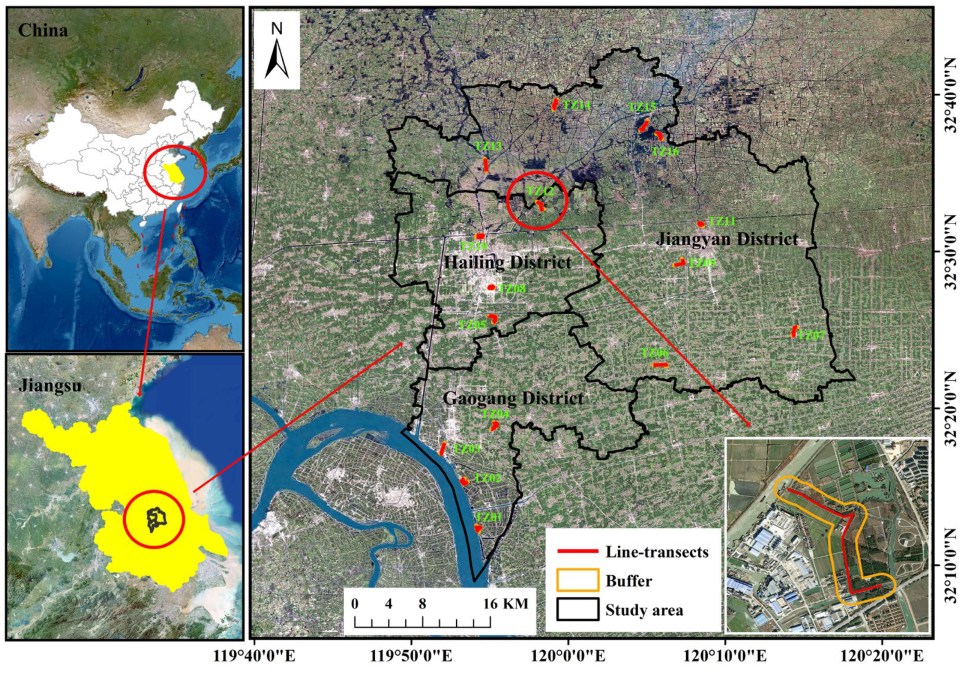
Taizhou (119°38′24″–120°32′20″ E, 32°01′57″–33°10′59″ N), situated in the central part of Jiangsu Province on the northern bank of the lower reaches of the Yangtze River, occupies a pivotal position along the East Asian-Australasian flyway (http://tj.jiangsu.gov.cn/, accessed on 25 July 2025). This region has varied terrain, including extensive plains and abundant wetland resources such as lakes, rivers, marshes, and artificial wetlands (http://tj.jiangsu.gov.cn/, accessed on 25 July 2025). These natural conditions make it an ideal habitat for wildlife, particularly avian species, for roosting, foraging, and breeding. In recent years, Taizhou has witnessed continuous economic growth and urban development, with a resident population reaching 4.507 million by the end of 2023 and an urbanization rate of 70.08%, marking an approximate increase of 11% compared to a decade ago (https://tjj.taizhou.gov.cn/, accessed on 25 July 2025). This study primarily focused on the central urban area of Taizhou, comprising the Hailing, Gaogang, and Jiangyan districts (Figure 1). Hailing district features a densely populated urban center, whereas Gaogang District is noted for its well-developed industrial and agricultural lands. Jiangyan District represents a blend of traditional agriculture and modern urban development. By investigating these three representative areas, we aimed to comprehensively assess the impact of urban construction on bird communities.

2.2. Study Design and Bird Surveys

Line transect surveys are among the most commonly employed methods for ecological monitoring, particularly for avian species [31]. We established 16 transects, each 1.5 km in length, using a random sampling approach based on habitat types, topographical features, and accessibility (Figure 1). Three surveys were conducted between April 2024 and November 2024, with one survey per season: spring (April), summer (August), and autumn (November). During the field surveys, observers walked along predetermined transect lines at approximately 2 km/h. They were equipped with binoculars and recorded species and counts of birds seen or heard on either side of the transect. Birds flying from behind the observer were not recorded to avoid duplicate entries. Furthermore, to minimize the impact of meteorological factors on the survey outcomes, all observations were conducted within three hours after sunrise and three hours before sunset on clear weather days. Additionally, the same observers participated in all surveys to prevent observer bias in bird identification and population estimation. The bird taxonomy and nomenclature used in the present study adhered to the guidelines outlined in A Checklist on the Classification and Distribution of Birds of China (fourth edition) [32].

2.3. Environmental Variables Selection

To quantify the environmental variables, we delineated a 100 m buffer zone around each transect [19]. Within these buffers, the area occupied by each land-cover type was extracted, normalized to the total buffer zone area, and expressed as a percentage. The land-cover data were derived from the 1 m resolution China Land Cover Dataset published by Li Zhuohong et al. [33]. Six land use types were incorporated into the analysis, namely road, tree cover, cropland, built-up areas, barren land, and water bodies. Land-cover composition varied widely across the 16 transects: cropland (16–91%), built-up areas (3–62%), water bodies (0–44%), roads (2–12%), tree cover (0–2%), and barren land (0–1%). This variation—especially in cropland and built-up cover—provides a sufficient environmental gradient for analysis. Detailed land-cover composition data for each transect are provided in the Supplementary Material (data.xlsx).

2.4. Classification of Bird Guilds

We utilized the global bird dataset of Wilman et al. to classify bird species into dietary and foraging location guilds [34]. This dataset documents the feeding proportions of each bird species for ten food types, along with their utilization proportions in seven foraging strata. We first consolidated similar food items and foraging layers to construct a simplified classification system for both variables (Table 1). A composite score was then calculated for each species within each category, and the species was assigned to the guild with the highest score. Furthermore, we calculated the Shannon diversity index separately for dietary and foraging location guilds, using the abundance of individuals within each functional group per transect: H = i = 1 S p i ln p i , where pi is the proportion of individuals in the i-th guild and S is the total number of guilds in that category.

2.5. Data Analysis

We assessed the normality of bird guild abundance distributions using the Shapiro–Wilk test, which revealed that all distributions deviated from normality. Therefore, we applied the Kruskal–Wallis test to assess differences among seasons, followed by pairwise comparisons between groups using the Wilcoxon rank-sum test with Bonferroni correction.
To evaluate the effects of seasonal and environmental factors on bird community composition, we first utilized multi-response permutation procedures (MRPP) to determine whether bird community composition exhibited statistically significant differences across different seasons. We then performed non-metric multidimensional scaling (NMDS) to visually represent these differences. Both analyses were based on a sample-by-species matrix of raw abundance counts, with Bray–Curtis dissimilarity used as the distance metric—a standard choice for ecological count data that often contain many zeros. In the NMDS ordination plot, each point represents a sample, with the distances between points indicating the degree of similarity between samples; closer points denote higher similarity, whereas greater distances signify larger dissimilarities [19]. We further incorporated land cover variables into the ordination space using the “envfit” function from the “vegan” R package (2.6-8) to explore their relationship with dietary guild distributions. Finally, to gain deeper insights into the influence of land cover on the distribution of functional guilds, we employed a fourth-corner analysis to detect associations and their statistical significance between each feeding guild and land cover variables [35]. Fourth-corner analysis was conducted using the “fourthcorner” function in the R package “ade4” (1.7-22), with the D2 statistic (squared correlation coefficient) to assess associations between land-cover variables and functional guild attributes. Significance was evaluated via 999 row-wise permutations of the species abundance matrix, and Benjamini–Hochberg FDR correction was applied to adjust p-values.
All statistical analyses were performed using R version 4.0.1, and statistical significance was set at p < 0.05.

3. Results

3.1. General Survey Results

A total of 4434 individual birds were observed and recorded, representing 86 species across 14 orders and 37 families (classified according to the fourth edition of The Checklist of Birds of China, Classification and Distribution). Among Passeriformes, the Muscicapidae family exhibited the highest species richness, with six species recorded. Among the non-Passeriformes, Ardeidae exhibited the greatest diversity, with eight species recorded. Additionally, several nationally protected bird species were documented, including the Chinese hwamei (Garrulax canorus), Common Kestrel (Falco tinnunculus), Pheasant-tailed Jacana (Hydrophasianus chirurgus), and Besra (Accipiter virgatus). Seasonally, 58 species (1723 individuals) were recorded in spring, 52 species (1513 individuals) in summer, and 59 species (1198 individuals) in autumn.

3.2. Seasonal Variation in Bird Community Composition and Functional Guilds

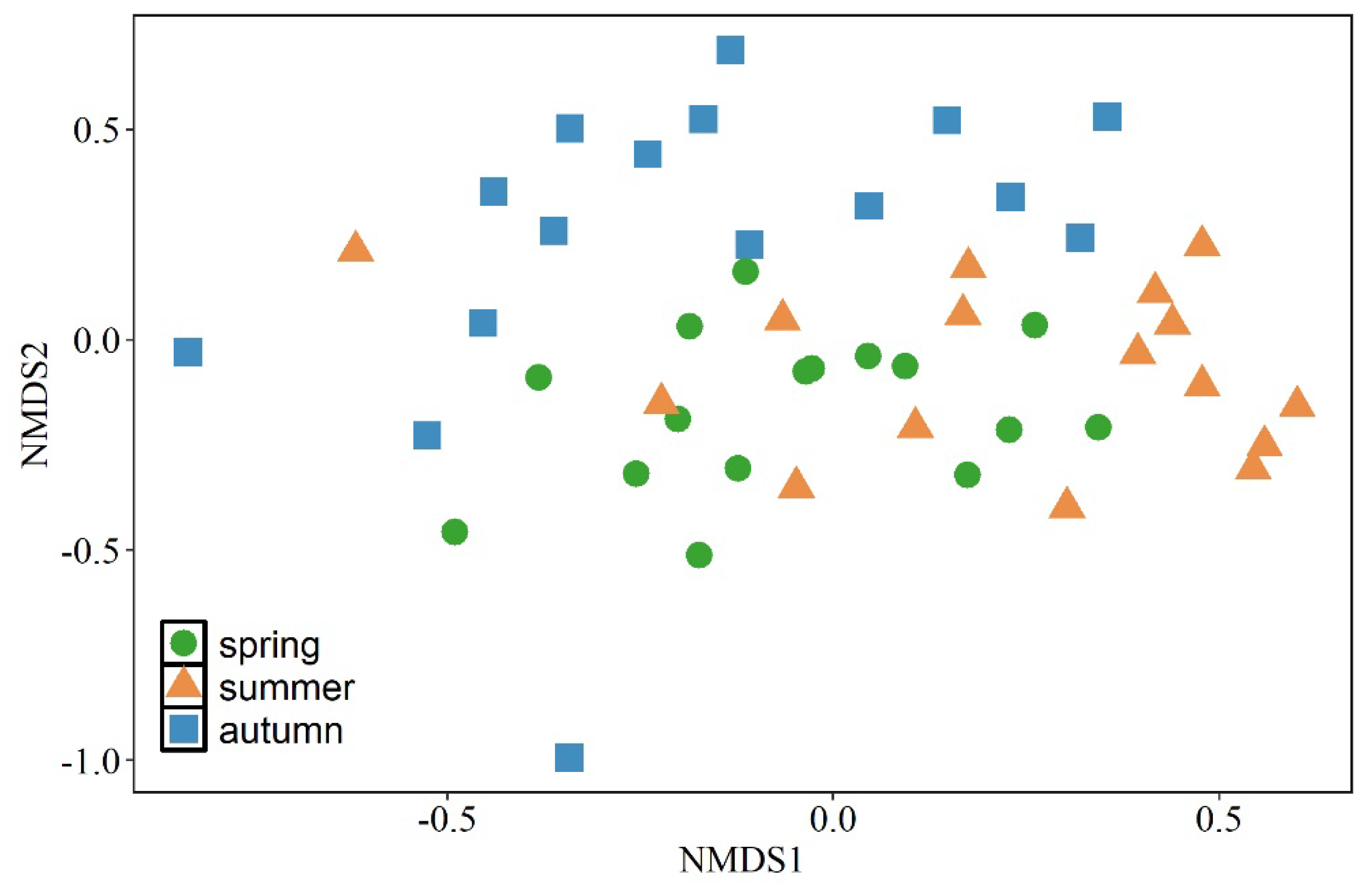
The MRPP analysis revealed significant differences in bird community composition across seasons (p < 0.05). This seasonal turnover is visually reflected in the NMDS ordination (Figure 2): spring samples are primarily distributed on the left side of the NMDS1 axis (NMDS1 < 0), whereas summer samples are mostly located on the right (NMDS1 > 0). Along the NMDS2 axis, autumn samples are concentrated in the upper half of the ordination space, while both spring and summer samples are largely restricted to the lower half.
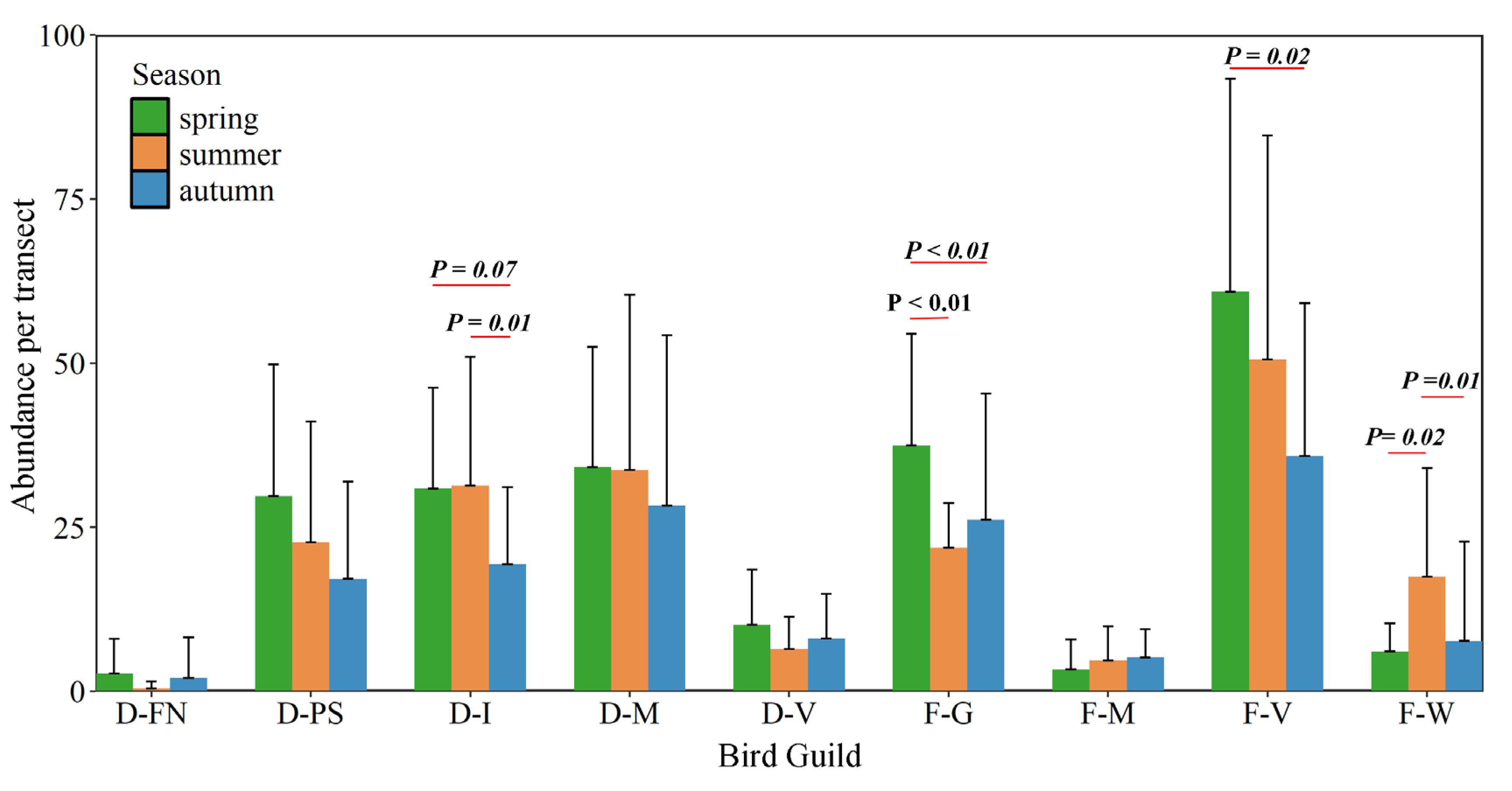
Analysis of these differences revealed pronounced seasonal fluctuations in the composition of bird functional guilds, both in terms of dietary classification and foraging location (Figure 3). Among the five dietary guilds, invertebrate feeders were the most abundant in spring and summer, with a marked decline in autumn. The remaining four guilds—plant-seed feeders, fruit-nectar feeders, vertebrate feeders, and mixed feeders—also showed seasonal variation in the number of individuals, although the magnitude of change was comparatively less pronounced.
More distinct seasonal patterns were observed among foraging location guilds (Figure 3). Of the four guilds classified by foraging strata, three exhibited significant seasonal variations, with the exception of the multilayer foragers. Ground Foragers reached their highest number in spring, which was significantly higher than in summer and autumn. Similarly, Vegetation Layer Foragers were the most abundant in spring, followed by a significant decline in summer. In contrast, Water Foragers peaked in summer in significantly higher amounts than in spring and autumn.
Notably, fruit-nectar feeders, Vertebrate Feeders, and multi-layer foragers consistently exhibited lower species amount across all seasons compared to other guilds. This pattern suggests that the specific resources required by these guilds, such as fruiting plants, vertebrate prey, and structurally complex vegetation, are relatively scarce in the study area.
The Shannon diversity index calculated for dietary guilds was highest in spring (1.30 ± 0.14), with slightly lower values in summer (1.26 ± 0.09) and autumn (1.24 ± 0.16). In contrast, the Shannon diversity index for foraging location guilds exhibited the opposite trend, exhibiting the lowest value in spring (1.08 ± 0.11) and relatively higher values in both summer and autumn (1.15 ± 0.14 for both). Although these seasonal differences were not statistically significant, they may reflect underlying ecological patterns.

3.3. Influence of Land Cover on Birdfunctional Guilds

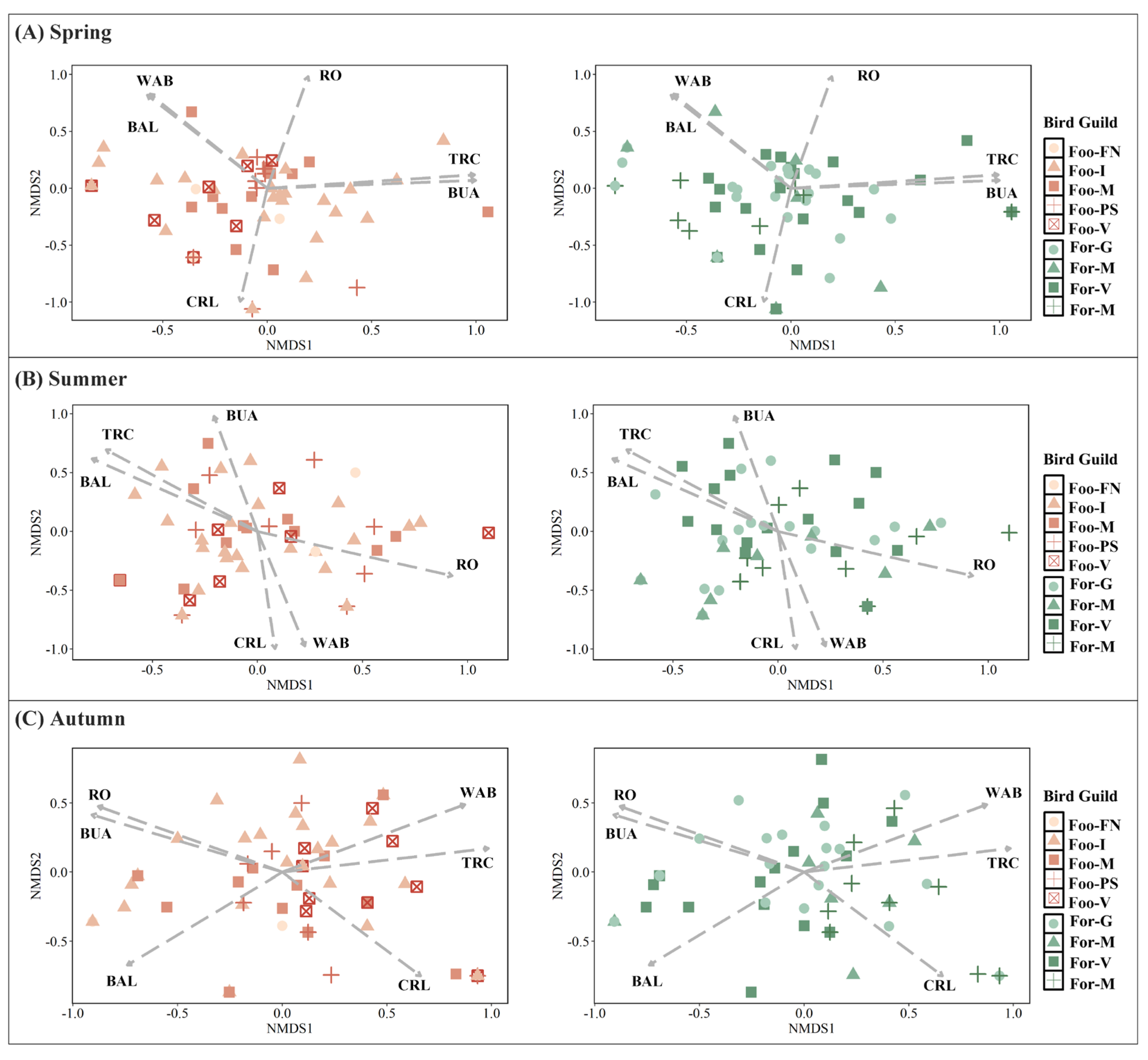
The NMDS ordination plots, with land-cover variables fitted using the “envfit” function, visually illustrate how bird functional guilds are influenced by environmental variation across seasons (Figure 4). For example, plant-seed feeders often formed acute angles with roads in the ordination space, suggesting a possible association with areas of higher road density. Vertebrate feeders aligned more closely with open land cover types, such as croplands, water bodies, or bare lands, indicating a preference for open habitats. Water foragers consistently exhibited strong positive associations with water bodies across multiple seasons, highlighting their dependence on the aquatic environment. Foragers in the vegetation layer foragers formed acute angles to roads or built-up areas, suggesting a tendency to be more active in such environments. However, the statistical significance of these observed associations cannot be inferred from ordination plots alone and requires formal hypothesis testing.
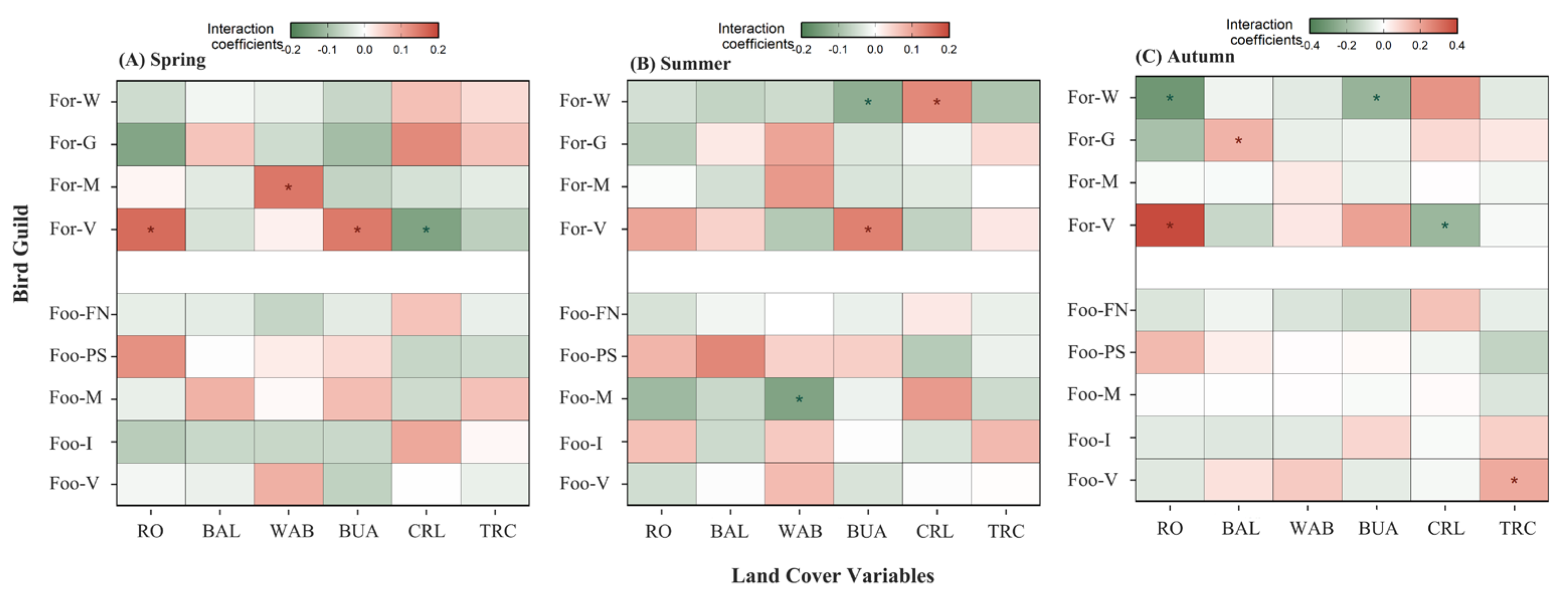
To validate these patterns, we conducted a fourth-corner analysis, which statistically confirmed several significant correlations between land cover variables and bird-feeding guilds, particularly those defined by foraging location (Figure 5). For example, vegetation layer foragers showed significant positive correlations with roads in spring and autumn and with built-up areas in spring and summer, while exhibiting significant negative correlations with croplands in spring and autumn. Ground foragers displayed a significant positive correlation with bare lands in autumn. Water foragers showed significant negative correlations with built-up areas and significant positive correlations with croplands, particularly in summer. These significant relationships indicate that certain land cover types consistently affected the distribution of bird functional guilds across seasons, with habitat structure influencing foraging locations more than diet.

4. Discussion

In this study, we categorized birds into functional guilds based on two key foraging traits, dietary preference and foraging location, to examine seasonal patterns in urban bird communities and their associations with land-cover composition.
Previous studies in rural or natural landscapes have often reported pronounced seasonal dynamics among functional dietary guilds [27,36], particularly those with specialized diets. Consistent with this, we found that invertebrate birds were significantly more abundant in spring and summer but decreased markedly in autumn. However, it should be noted that our functional guild assignments were based on species-level trophic preferences from the literature (typically reflecting non-breeding diets), and thus the observed seasonal patterns reflect shifts in the distribution of species with fixed functional identities rather than within-individual dietary plasticity during the breeding season. This pattern likely results from temperature-driven variations in insect availability: insects are more active and abundant during warmer seasons, whereas their availability drops significantly as temperatures fall [37]. In contrast, most dietary functional guilds in our study, such as plant-seed feeders and fruit nectar feeders, exhibited relatively stable populations across seasons, without significant seasonal fluctuations (Figure 3). We partly attributed this stability to the ecological buffering capacity of the urban environment. Anthropogenic food sources can supplement natural diets and reduce the reliance on seasonally available resources [38], while urban microclimates may further buffer seasonal fluctuations by altering local biological phenology [39]. All foraging location guilds except mixed foragers exhibited significant seasonal dynamics. Ground foragers and vegetation-layer foragers were more abundant in spring, possibly due to the abundance of emerging insects and new vegetation providing shelter and foraging sites. Water foragers were the most abundant in summer, likely because of their higher productivity in aquatic habitats and greater prey availability during this period. Warmer temperatures may also increase the water intake and bathing frequency of birds, further promoting their use of aquatic environments [40,41].
Our findings aligned with those of several studies reported that habitat structure and land cover change influence bird distribution and behavior [2,13,17]. The fourth-corner analysis revealed significant associations between bird-feeding guilds and land-cover types, particularly for foraging location functional guilds (Figure 5). For example, vegetation layer foragers were positively correlated with roads and built-up areas across multiple seasons, suggesting that some bird species can adapt to urban structures by using buildings and street trees as foraging substrates [42]—a pattern consistent with the urban environmental filter that favors synanthropic species in human-modified landscapes [43,44]. Ground foragers were significantly associated with bare ground in autumn—a habitat feature often shaped by urban land management practices [30], benefiting from open vistas and enhanced foraging efficiency over low vegetation or barren patches, which facilitated the detection of surface insects and seeds [45].
Our study had several notable findings. Firstly, Fruit-Nectar Feeders, Vertebrate Feeders, and multi-layer foragers maintained consistently low numbers throughout all seasons. The low abundance of these functional guilds in urban areas indicates that, while essential resources may be present, they are often too scarce or of limited quality to sustain larger populations [38]. These patterns highlight the importance of improving habitat complexity in urban planning to better support bird species with specialized habitat requirements. The planning strategies must include incorporating native nectar- and fruit-bearing plants, maintaining multi-tiered vegetation structures, and conserving remnant natural patches. Second, we observed that the Shannon diversity indices for dietary guild diversity were the highest in spring, followed by summer and autumn, whereas foraging location functional guilds showed the opposite trend, with higher diversity in summer and autumn. Although the seasonal differences were not statistically significant, the contrasting patterns suggest that different functional dimensions may respond to urban environmental conditions in distinct ways. Finally, we found that foraging location guilds showed greater seasonal variation and were more closely associated with habitat spatial configuration than dietary guilds. This pattern suggests that spatial habitat may have a more profound impact on the behavior and distribution patterns of urban birds than food type alone.

5. Conclusions

Our results reveal that seasonal dynamics in bird functional structure are co-vary with urban land-cover composition. Guilds classified by foraging location exhibited more pronounced seasonal fluctuations than those grouped by dietary preference. Moreover, foraging location guilds showed higher sensitivity to habitat spatial structure, suggesting that the spatial configuration of habitats may be more closely linked to foraging behavior than food resource availability in urban settings. Although, like most point-count surveys, our data may be subject to detection biases—such as underestimating cryptic species or overcounting highly mobile ones—these are unlikely to alter the reported patterns of functional guild responses. These findings suggest that effective urban conservation and planning could benefit from considering both resource availability and habitat spatial structure.

Supplementary Materials

The following supporting information can be downloaded at: https://www.mdpi.com/article/10.3390/d18020065/s1.

Author Contributions

Conceptualization, J.D., J.Y. and L.Z.; methodology, X.W. and L.W.; software, X.W. and L.W.; formal analysis, X.W.; investigation, X.W., B.W., L.W., J.Y. and L.Z.; writing—original draft preparation; X.W.; writing—review and editing, J.D. and L.W. All authors have read and agreed to the published version of the manuscript.

Funding

This work was financially supported by the Jiangsu Province Wildlife Resources Monitoring Project and the Taizhou Wildlife Resources Census Project.

Institutional Review Board Statement

Not applicable.

Data Availability Statement

The data presented in this study are available on request from the corresponding author due to data protection restrictions imposed by the government funding agency. The anonymized occurrence data, environmental variables, and functional trait data supporting the findings of this study are openly available in the Supplementary Materials (file: date.xlsx).

Acknowledgments

We thank Xuan Wang, Ping Yuan, and Mingzhi Zhang, for their help during the field surveys.

Conflicts of Interest

Author B.W. was employed by Nanjing Liangtian Ecological Technology Co., Ltd. The remaining authors declare that the research was conducted in the absence of any commercial or financial relationships that could be construed as a potential conflict of interest.

References

  1. Xiong, Y.; Li, Z.; Ruan, L.; Dai, S.; Hu, L. Comparison of avian diversity between urban parks adjacent to mountain and river in the largest megacity Guangzhou, South China. Urban For. Urban Green. 2022, 77, 127756. [Google Scholar] [CrossRef]
  2. Chen, Y.; Rasool, M.A.; Hussain, S.; Meng, S.; Yao, Y.; Wang, X.; Liu, Y. Bird community structure is driven by urbanization level, blue-green infrastructure configuration and precision farming in Taizhou, China. Sci. Total Environ. 2023, 859, 160096. [Google Scholar] [CrossRef] [PubMed]
  3. Liu, Y.; Huang, C.; Zhang, L. The Spatio-Temporal Patterns and Driving Forces of Land Use in the Context of Urbanization in China: Evidence from Nanchang City. Int. J. Environ. Res. Public Health 2023, 20, 2330. [Google Scholar] [CrossRef] [PubMed]
  4. Ding, Q.; Pan, T.; Lin, T.; Zhang, C. Urban Land-Cover Changes in Major Cities in China from 1990 to 2015. Int. J. Environ. Res. Public Health 2022, 19, 16079. [Google Scholar] [CrossRef]
  5. Yang, J.; Xing, Z.; Cheng, C. How Urban Fringe Expansion Affects Green Habitat Diversity? Analysis from Urban and Local Scale in Hilly City. J. Environ. Public Health 2022, 2022, 8566686. [Google Scholar] [CrossRef]
  6. Sun, B.; Lu, Y.; Yang, Y.; Yu, M.; Yuan, J.; Yu, R.; Bullock, J.M.; Stenseth, N.C.; Li, X.; Cao, Z.; et al. Urbanization affects spatial variation and species similarity of bird diversity distribution. Sci. Adv. 2022, 8, eade3061. [Google Scholar] [CrossRef]
  7. Barik, S.; Saha, G.K.; Mazumdar, S. Influence of land cover features on avian community and potential conservation priority areas for biodiversity at a Ramsar site in India. Ecol. Process. 2022, 11, 25. [Google Scholar] [CrossRef]
  8. Xie, S.; Ouyang, Z.; Gong, C.; Meng, N.; Lu, F. Seasonal fluctuations of urban birds and their responses to immigration: An example from Macau, China. Urban For. Urban Green. 2021, 59, 126936. [Google Scholar] [CrossRef]
  9. Lee, M.-B.; Peabotuwage, I.; Gu, H.; Zhou, W.; Goodale, E. Factors affecting avian species richness and occupancy in a tropical city in southern China: Importance of human disturbance and open green space. Basic Appl. Ecol. 2019, 39, 48–56. [Google Scholar] [CrossRef]
  10. Liang, J.; Yu, C.; Jiang, X.; Liu, R.; Tan, Y.; Du, Z.; Zhang, J. Supporting effect of landscape characteristics of urban green ecotone on avian community: A case study of Huangshan City Center, 2024. Authorea 2024. preprint. [Google Scholar] [CrossRef]
  11. Whelan, C.J.; Şekercioğlu, Ç.H.; Wenny, D.G. Why birds matter: From economic ornithology to ecosystem services. J. Ornithol. 2015, 156, 227–238. [Google Scholar] [CrossRef]
  12. Wang, X.; Wang, X.; Dai, S.; Zhai, F.; Ding, J.; Wang, L. The dual lens of diversity: Seasonal variability of avian community structure in urban hills. Glob. Ecol. Conserv. 2024, 54, e03200. [Google Scholar] [CrossRef]
  13. Panda, B.P.; Prusty, B.A.K.; Panda, B.; Pradhan, A.; Parida, S.P. Habitat heterogeneity influences avian feeding guild composition in urban landscapes: Evidence from Bhubaneswar, India. Ecol. Process 2021, 10, 31. [Google Scholar] [CrossRef]
  14. Tu, H.-M.; Fan, M.-W.; Ko, J.C.-J. Different Habitat Types Affect Bird Richness and Evenness. Sci. Rep. 2020, 10, 1221. [Google Scholar] [CrossRef] [PubMed]
  15. Davis, K.P.; Sofaer, H.R.; Pejchar, L. Land cover differentially affects abundance of common and rare birds. Glob. Change Biol. 2023, 29, 2999–3009. [Google Scholar] [CrossRef]
  16. Fraissinet, M.; Ancillotto, L.; Migliozzi, A.; Capasso, S.; Bosso, L.; Chamberlain, D.E.; Russo, D. Responses of avian assemblages to spatiotemporal landscape dynamics in urban ecosystems. Landsc. Ecol. 2023, 38, 293–305. [Google Scholar] [CrossRef]
  17. Bernard, T.; Kodikara, K.A.S.; Sleutel, J.; Wijeratne, G.G.N.K.; Hugé, J.; Kumara, M.P.; Weerasinghe, M.A.Y.N.; Ranakawa, D.P.D.; Thakshila, W.A.K.G.; Dahdouh-Guebas, F. Assessing the Influence of Anthropogenic Land-Use Changes on Bird Diversity and Feeding Guilds—A Case Study of Kalametiya Lagoon (Southern Sri Lanka). Diversity 2023, 15, 383. [Google Scholar] [CrossRef]
  18. Husna, F.; Nurhayati, N.; Patria, M.P.; Winarni, N.L. Diversity of bird-feeding guilds in Bukit Mas Village, North Sumatra, Indonesia. Biodiversitas 2024, 25. [Google Scholar] [CrossRef]
  19. Wang, X.; Zhu, G.; Ma, H.; Wu, Y.; Zhang, W.; Zhang, Y.; Li, C.; de Boer, W.F. Bird communities’ responses to human-modified landscapes in the southern Anhui Mountainous Area. Avian Res. 2022, 13, 100006. [Google Scholar] [CrossRef]
  20. Xie, S.; Marzluff, J.M.; Su, Y.; Wang, Y.; Meng, N.; Wu, T.; Gong, C.; Lu, F.; Xian, C.; Zhang, Y.; et al. The role of urban waterbodies in maintaining bird species diversity within built area of Beijing. Sci. Total Environ. 2022, 806, 150430. [Google Scholar] [CrossRef]
  21. Wong, J.S.; Soh, M.C.; Low, B.W.; Er, K.B. Tropical bird communities benefit from regular-shaped and naturalised urban green spaces with water bodies. Landsc. Urban Plan. 2023, 231, 104644. [Google Scholar] [CrossRef]
  22. Neate-Clegg, M.H.C.; Tonelli, B.A.; Youngflesh, C.; Wu, J.X.; Montgomery, G.A.; Şekercioğlu, Ç.H.; Tingley, M.W. Traits shaping urban tolerance in birds differ around the world. Curr. Biol. 2023, 33, 1677–1688. [Google Scholar] [CrossRef]
  23. Sohil, A.; Sharma, N. Assessing the bird guild patterns in heterogeneous land use types around Jammu, Jammu and Kashmir, India. Ecol. Process 2020, 9, 49. [Google Scholar] [CrossRef]
  24. Violle, C.; Navas, M.-L.; Vile, D.; Kazakou, E.; Fortunel, C.; Hummel, I.; Garnier, E. Let the concept of trait be functional! Oikos 2007, 116, 882–892. [Google Scholar] [CrossRef]
  25. Ding, Z.; Liang, J.; Hu, Y.; Zhou, Z.; Sun, H.; Liu, L.; Liu, H.; Hu, H.; Si, X. Different responses of avian feeding guilds to spatial and environmental factors across an elevation gradient in the central Himalaya. Ecol. Evol. 2019, 9, 4116–4128. [Google Scholar] [CrossRef] [PubMed]
  26. Golab, M.J.; Sniegula, S.; Brodin, T. Cross-Latitude Behavioural Axis in an Adult Damselfly Calopteryx splendens (Harris, 1780). Insects 2022, 13, 342. [Google Scholar] [CrossRef]
  27. Ahmed, T.; Khan, A. Avifaunal feeding guilds’ response to landscape compositional heterogeneity and their drivers in forest mosaic, Uttarakhand, India. J. Trop. Ecol. 2022, 38, 183–193. [Google Scholar] [CrossRef]
  28. Swartz, T.M.; Gleditsch, J.M.; Behm, J.E. A functional trait approach reveals the effects of landscape context on ecosystem services provided by urban birds. Landsc. Urban Plan. 2023, 234, 104724. [Google Scholar] [CrossRef]
  29. Li, B.; Bibi, N.; Ma, S.; Chen, W.; Yang, M.; Xiang, N.; Cui, Q.; Tan, L. Taxonomic and functional nestedness of bird communities in urban parks of Liuzhou, China. Biodivers. Data J. 2025, 13, e154385. [Google Scholar] [CrossRef]
  30. Lin, S.; Liang, W. Geographic variation in urbanization filter effects on birds in China. Environ. Monit. Assess. 2025, 197, 1015. [Google Scholar] [CrossRef]
  31. Bibby, C.J. Bird Census Techniques, 2nd ed.; Academic Press: Cambridge, MA, USA, 2000; ISBN 9780120958313. [Google Scholar]
  32. Zheng, G. A Checklist on the Classification and Distribution of the Birds of China, 4th ed.; Science Press: Beijing, China, 2023; ISBN 9787030754165. [Google Scholar]
  33. Li, Z.H.; He, W.; Cheng, M.F.; Hu, J.X.; An, X.; Huang, Y.; Yang, G.Y.; Zhang, H.Y. SinoLC-1: The first 1-meter resolution national-scale land-cover map of China created with the deep learning framework and open-access data (User guide V2.4). Earth Syst. Sci. Data 2023, 15, 4749–4780. [Google Scholar] [CrossRef]
  34. Wilman, H.; Belmaker, J.; Simpson, J.; de La Rosa, C.; Rivadeneira, M.M.; Jetz, W. Elton-Traits 1.0: Species-level foraging attributes of the world’s birds and mammals. Ecology 2014, 95, 2027. [Google Scholar] [CrossRef]
  35. Dray, S.; Choler, P.; Dolédec, S.; Peres-Neto, P.R.; Thuiller, W.; Pavoine, S.; ter Braak, C.J.F. Combining the fourth-corner and the RLQ methods for assessing trait responses to environmental variation. Ecology 2014, 95, 14–21. [Google Scholar] [CrossRef] [PubMed]
  36. Pabico, L.; Duya, M.; Fidelino, J.; Ong, P.; Duya, M.R. Bird Feeding Guild Assemblage along a Disturbance Gradient in the Pantabangan-Carranglan Watershed and Forest Reserve, Central Luzon Island, Philippines. Philipp. J. Sci. 2021, 150, 237–255. [Google Scholar] [CrossRef]
  37. Damos, P.; Savopoulou-Soultani, M. Temperature-Driven Models for Insect Development and Vital Thermal Requirements. Psyche A J. Entomol. 2012, 2012, 123405. [Google Scholar] [CrossRef]
  38. Tryjanowski, P.; Skórka, P.; Sparks, T.H.; Biaduń, W.; Brauze, T.; Hetmański, T.; Martyka, R.; Indykiewicz, P.; Myczko, Ł.; Kunysz, P.; et al. Urban and rural habitats differ in number and type of bird feeders and in bird species consuming supplementary food. Environ. Sci. Pollut. Res. Int. 2015, 22, 15097–15103. [Google Scholar] [CrossRef]
  39. Fatima, Z.; Ahmed, M.; Hussain, M.; Abbas, G.; Ul-Allah, S.; Ahmad, S.; Ahmed, N.; Ali, M.A.; Sarwar, G.; Haque, E.U.; et al. The fingerprints of climate warming on cereal crops phenology and adaptation options. Sci. Rep. 2020, 10, 18013. [Google Scholar] [CrossRef]
  40. Smit, B.; Woodborne, S.; Wolf, B.O.; McKechnie, A.E. Differences in the use of surface water resources by desert birds are revealed using isotopic tracers. Auk 2019, 136, uky005. [Google Scholar] [CrossRef]
  41. Lee, A.T.K.; Wright, D.; Barnard, P. Hot bird drinking patterns: Drivers of water visitation in a fynbos bird community. Afr. J. Ecol. 2017, 55, 541–553. [Google Scholar] [CrossRef]
  42. Santos, E.G.; Wiederhecker, H.C.; Pompermaier, V.T.; Gainsbury, A.M.; Schirmer, S.C.; Morais, C.V.F.; Fontenele, J.L.; Morais de Santana, M.C.; Marini, M.Â. Urbanization reduces diversity, simplifies community and filter bird species based on their functional traits in a tropical city. Sci. Total Environ. 2024, 935, 173379. [Google Scholar] [CrossRef]
  43. Stukenholtz, E.E.; Stevens, R.D. Taxonomic and functional components of avian meta-community structure along an urban gradient. PLoS ONE 2022, 17, e0271405. [Google Scholar] [CrossRef]
  44. Sidemo-Holm, W.; Ekroos, J.; Reina García, S.; Söderström, B.; Hedblom, M. Urbanization causes biotic homogenization of woodland bird communities at multiple spatial scales. Glob. Change Biol. 2022, 28, 6152–6164. [Google Scholar] [CrossRef]
  45. Adam, M.E.A.; Mohamed, M.A.E. Bird Habitats in Urban Environments: A Case from an Urban Landfill in and around Tayba Al Hasanab Landfill, Khartoum, Sudan. J. Environ. Prot. 2024, 15, 887–905. [Google Scholar] [CrossRef]
Figure 1. The location of the study area in China and the transect lines used for this study.
Diversity 18 00065 g001
Figure 2. Ordination results of non-metric multidimensional scaling (NMDS) method representing the avian communities across different seasons.
Diversity 18 00065 g002
Figure 3. Mean abundance per transects of bird individuals in each of the nine functional guilds across different seasons. Guild abbreviations correspond to those listed in Table 1. Significant differences (p-values) were determined using the Wilcoxon rank-sum test; red lines connect the pairs of groups being compared. Error bars indicate standard deviations (SD).
Diversity 18 00065 g003
Figure 4. Relationships between avian functional guilds and land cover types, as revealed by non-metric multidimensional scaling (NMDS), across different seasons: (A) spring; (B) summer; (C) autumn. Abbreviations for functional guilds are as listed in Table 1; land cover abbreviations are as follows: RO = road; TRC = tree cover; BUA = built-up areas; CRL = cropland; WAB = water bodies; BAL = barren land.
Diversity 18 00065 g004
Figure 5. Interaction coefficients obtained from fourth-corner analysis for testing the relationship between avian functional guilds and land cover types across different seasons: (A) spring; (B) summer; (C) autumn. Positive associations are shown in red, and negative associations in green. * Indicates statistically significant relationships (p < 0.05). Abbreviations for functional guilds are as listed in Table 1; land cover abbreviations are as follows: RO = road; TRC = tree cover; BUA = built-up areas; CRL = cropland; WAB = water bodies; BAL = barren land.
Diversity 18 00065 g005
Table 1. Classification of bird guilds based on dietary preference and foraging location.
AttributeBird GuildDescription
DietaryFruit-Nectar Feeders
(Foo-FN)
Primarily consume fruits, drupes, nectar, pollen, plant exudates, and gums (>50% of use)
Plant-Seed Feeders
(Foo-PS)
Mainly feed on seeds, maize, nuts, spores, wheat, grains, and other plant materials (>50% of use)
Invertebrate Feeders
(Foo-I)
Predominantly consume invertebrates (>50% of use)
Vertebrate Feeders
(Foo-V)
Feed extensively on vertebrates including mammals, birds, reptiles, fish, and scavenge (>50% of use)
Mixed Feeders
(Foo-M)
Do not exceed 50% use in any of the above categories
Foraging LocationVegetation Layer Foragers
(For-V)
Forage predominantly in the understory, mid-high, and canopy layers (>50% of use)
Ground Foragers
(For-G)
Mainly forage on the ground (>50% of use)
Water Foragers
(For-W)
Primarily forage on water surfaces or underwater (>50% of use)
Multi-layer Foragers
(For-M)
Do not exceed 50% use in any of the above categories
Disclaimer/Publisher’s Note: The statements, opinions and data contained in all publications are solely those of the individual author(s) and contributor(s) and not of MDPI and/or the editor(s). MDPI and/or the editor(s) disclaim responsibility for any injury to people or property resulting from any ideas, methods, instructions or products referred to in the content.