Article

Environmental Controls on Benthic Ostracod Assemblages in a Mangrove-Fringed Lagoon: Insights from Sharm El-Luli, Red Sea Coast, Egypt


1
Geology Department, Faculty of Science, Cairo University, Cairo 12613, Egypt
2
Department of Palaeontology, Faculty of Earth Sciences, Geography and Astronomy, University of Vienna, 1090 Vienna, Austria
3
Marine Geology Department, Faculty of Marine Science, King Abdulaziz University, P.O. Box 80200, Jeddah 21589, Saudi Arabia
4
Department of Geology, Faculty of Earth Sciences, Geography and Astronomy, University of Vienna, 1090 Vienna, Austria
5
Department of Geology, Faculty of Science, Beni-Suef University, Beni-Suef 62511, Egypt
*
Author to whom correspondence should be addressed.
Diversity 2026, 18(2), 130; https://doi.org/10.3390/d18020130
Submission received: 14 January 2026 / Revised: 13 February 2026 / Accepted: 19 February 2026 / Published: 21 February 2026
(This article belongs to the Section Marine Diversity)

Abstract

Sharm El-Luli, located along the southern Red Sea coast of Egypt, is a semi-enclosed, shallow, mangrove-fringed lagoon characterized by limited hydrodynamic exchange, high salinity, and low terrigenous input. This study investigates the influence of sediment properties, hydrodynamic gradients, and mangrove-associated microhabitats on the spatial distribution of benthic ostracod assemblages within this lagoonal system. Eighteen surface sediment samples (W1–W18) were collected along an onshore–offshore gradient and analyzed for ostracod composition, sediment texture, carbonate and organic matter content, and water parameters including temperature, salinity, dissolved oxygen, pH, redox potential, and total dissolved solids. Thirty-four ostracod taxa were identified, revealing a pronounced inner–outer ecological partitioning across the lagoon. Redundancy analysis (RDA) demonstrates that ostracod distribution is primarily controlled by substrate heterogeneity, organic enrichment, salinity, and conductivity-related variables. The inner, low-energy mangrove margin is dominated by Aglaiocypris triebeli, Paranesidea fracticorallicola, and Hiltermannicythere rubrimaris, reflecting stressed, low-diversity conditions associated with organic-rich sediments and restricted circulation. In contrast, mid- and outer-lagoon stations host more diverse assemblages dominated by Xestoleberis spp., Neonesidea schulzi, Loxocorniculum ghardaquensis, and Jugosocythereis borchersi, indicative of better-flushed environments with higher carbonate content and stable marine salinity. These results demonstrate that benthic ostracods respond sensitively to fine-scale environmental gradients in mangrove-fringed lagoons, underscoring their value for assessing ecological health and sedimentary dynamics in semi-enclosed Red Sea coastal systems.

1. Introduction

Benthic ostracods (phylum Arthropoda, class Ostracoda) are minute, bivalved crustaceans that inhabit nearly all aquatic environments, from deep-marine to marginal and brackish-water settings [1,2,3,4,5]. Ostracods are among the most diverse and long-ranging microfaunal groups in the geological record [6]. Their calcareous carapaces are readily preserved in sediments, providing valuable archives for reconstructing paleoenvironmental and paleoecological conditions after death [7,8,9]. Benthic ostracods are highly sensitive to variations in temperature, salinity, oxygen levels, and substrate type, making them powerful bioindicators for deciphering marine and marginal-marine depositional settings [1,10,11,12,13,14]. Ecologically, they contribute to benthic community structure, organic matter degradation, and trophic interactions at the sediment–water interface [15,16]. Through their abundance, diversity, and rapid evolutionary rates, ostracods play a key role in documenting paleoceanographic changes and global biotic responses to climatic and sea-level fluctuations [17,18].
Due to their ecological sensitivity, short life cycles, and rapid response to environmental changes, ostracods are widely applied in ecological and environmental studies [1]. Numerous investigations have demonstrated the utility of ostracods in assessing water quality, salinity fluctuations [19], and pollution levels [1], as well as in reconstructing past environmental conditions [20,21]. Additionally, other studies employed ostracods as bioindicators for monitoring salinity and oxygen variations in marginal marine environments [22,23,24]. Their species-specific tolerances to temperature and nutrient availability also make them valuable proxies for understanding ecological gradients and anthropogenic impacts in aquatic systems [2]. Thus, ostracods provide critical insights into both present-day ecological processes and long-term environmental change, and their use in ecological and biomonitoring studies continues to expand across different geographic and climatic settings.
Along the Egyptian Red Sea coast, benthic ostracods are abundant and diverse, where their distribution patterns remain insufficiently explored. Previous studies have mainly focused on restricted or distant locations such as Hurghada Bay [25], the Gulf of Aqaba [26,27,28], and Safaga Bay [29,30]. However, little attention has been given to the ecological controls shaping ostracod assemblages in the Wadi El-Gemal protectorate, particularly in the Sharm El-Luli area, which is ecologically important within the protected area and hosts mangrove forests, intertidal flats, and diverse nearshore habitats.
Sharm El-Luli is a shallow coastal embayment located along the Red Sea coast of Egypt, representing one of the most ecologically sensitive and geologically dynamic nearshore marine systems in the region [31]. The area is characterized by a distinctive combination of coral reefs, seagrass meadows, and sandy lagoons, with continuous interaction between marine and terrestrial influences [32,33]. Owing to its semi-enclosed nature and proximity to arid landmasses, Sharm El-Luli is subjected to pronounced fluctuations in physico-chemical conditions, including temperature, salinity, and nutrient availability, driven by seasonal changes in the Red Sea, including evaporation, tidal circulation, and freshwater input [32,34,35]. Such environmental variability strongly controls sedimentation patterns, organic matter accumulation, and biotic distribution within the ecosystem [36,37]. In addition, increasing anthropogenic pressures related to tourism, coastal development, and recreational activities have introduced localized ecological stress, threatening the stability of its benthic habitats and water quality [38]. Therefore, Sharm El-Luli provides an ideal natural laboratory for assessing biogeochemical processes, marine ecosystem responses, and environmental indicators under fluctuating subtropical coastal conditions.
The present study aims to document the distribution and diversity of benthic ostracods in the Sharm El-Luli area and to evaluate how environmental variables shape their spatial patterns. By establishing the ecological framework of ostracod assemblages in this understudied area, this work contributes to a deeper understanding of how sediment characteristics, hydrodynamic gradients, and mangrove-associated microhabitats structure benthic ostracod assemblages within a semi-enclosed lagoonal system. It provides a baseline for future environmental monitoring using ostracods as bioindicators.

2. Study Area Description

Sharm El-Luli is a pristine, gently sloping, open sandy beach located approximately 60 km south of Marsa Alam in the Wadi El-Gemal National Park (Figure 1). It is characterized by an exceptional mosaic of shallow lagoons and fringing coral reefs [31,39,40]. It lies within the broader Red Sea mangrove ecoregion, where Avicennia marina and Rhizophora mucronata dominate coastal vegetation, forming low-stature stands (rarely exceeding ~2 m) due to high salinity and carbonate-rich soils [41]. These mangrove ecosystems serve as critical nursery grounds for juvenile fish, crustaceans, and invertebrates, and support rich marine biodiversity, including migratory and resident birds [41].
The site features comprise highly clear, turquoise waters and a biologically rich coral reef system accessible directly from the shore, making it particularly favorable for snorkeling and shallow diving. These reefs, especially near the eastern flank, sustain robust coral cover and minimal human disturbance. The coastal oceanography is shaped by a semi-enclosed Red Sea regime marked by elevated salinity (>40 psu), clear waters, and limited freshwater input [42,43]. The east–west orientation of the beach supports sheltering the lagoon from prevailing winds, generating tranquil, and shallow waters (depth gradually increasing to ~4 m). These calm hydrological conditions favor coral growth and help maintain exceptional underwater visibility, making the area ideal for reef-associated organisms [44,45].
The intertidal zone, extending roughly 100 m in width, is submerged beneath about 50 cm of water during high tide. Its rocky substrate is overlain by a thin lamina of biogenic coarse sand. The mangrove trees occur along both flanks of the downstream entrance, their roots firmly anchored in the rocky seabed. Unlike many Red Sea coastal zones, this site lacks coral reef development.
Mangrove ecosystems in tropical and subtropical coastal settings commonly develop in sheltered environments such as lagoons, estuaries, and embayments [46,47]. In these settings, mangrove root systems enhance the trapping and consolidation of fine-grained sediments, generating spatially heterogeneous substrates within the intertidal zone that strongly influence benthic habitat structure [48]. In the investigated area, mangrove-associated sediments are dominated by slightly gravelly muddy sand, with finer sand fractions prevailing across intertidal flats; these sediments are generally poorly sorted, exhibit near-symmetrical, coarse-skewed grain-size distributions, and display mesokurtic to leptokurtic characteristics in the fine sand fraction. Along the Red Sea coast, mangrove environments have been examined primarily from ecological and botanical perspectives [49,50,51,52,53], with studies spanning several Egyptian coastal sectors [47,54,55,56]. However, despite documented variability in substrate type and hydrodynamic setting, the influence of mangrove-related sedimentary heterogeneity on benthic microfaunal assemblages, particularly ostracods, remains insufficiently constrained. It is noteworthy that high mangrove primary productivity in these environments contributes substantial detrital organic inputs to the ecosystem, reinforcing benthic food availability and geochemical gradients that directly affect microfaunal distribution [57].
In particular, the marine vegetation of Sharm El-Luli is diverse and widespread. Macroalgae occur primarily at depths of 50–60 cm, where species such as the creeping green algae Caulerpa racemosa are distributed in scattered colonies across sandy bottoms and dead coral surfaces. Additionally, trivial occurrences of Halimeda tuna were observed to be interwoven among coral branches. Seagrass meadows are also prominent, composed mainly of Halophila stipulacea and Halodule uninervis. Of these, H. stipulacea is the dominant species, forming discontinuous yet extensive patches across sandy-mud substrates.

3. Materials and Methods

3.1. Sampling Strategy and Processing

The sampling design was explicitly structured to capture spatial variability in environmental gradients across the Sharm El-Luli mangrove-fringed lagoon and to evaluate their influence on benthic ostracod assemblages. Accordingly, stations were stratified into inner-, mid-, and outer-lagoonal sub-environments based on their proximity to mangrove stands, degree of hydrodynamic exposure, and sedimentological characteristics, allowing direct comparison of ostracod assemblages across contrasting microhabitats within a consistent temporal framework. Notably, the inner lagoon was dominated by sand except for the muddy, organic-rich sample of W10 and was occupied by mangrove trees in the southeastern part, whereas the northern part (beside W1 and W2) was heavily used by boats, as observed during the field survey. In contrast, the mid-lagoon is composed of mixed sediments, while the outer lagoon is dominated by sandy/carbonate sediments.
In February 2022, a total of 18 bottom marine sediment samples were obtained via scuba diving from the Sharm El-Luli area along transects oriented perpendicular to the shoreline (Figure 1). The inner stations are located in the direction of the coastline, while the mid and outer stations are located further away toward the open sea. At each station, approximately 500 g of sediment was collected by plastic coring tubes into the top 0–1 cm of the bottom substrate. Samples were subsequently washed through a 63 μm sieve and oven-dried at 60 °C overnight.
Concurrently, the oceanographic variables were measured in situ for each sampling site using a hydrolab Surveyer4 (Hydrolab Corporation Texas, USA). These included water depth, temperature, salinity, dissolved oxygen (DO), pH, total dissolved solids (TDS), oxidation–reduction potential (Eh), and specific conductivity (SPC) (Table 1).
To ensure the reliability of the collected sediment sample processing, quality control procedures were applied. All samples were air-dried at room temperature, homogenized, and processed using standardized laboratory protocols. The grain-size analyses were performed in duplicate for randomly selected samples, with results showing high reproducibility. In addition, the LOI550 and carbonate contents were determined with replicate measurements yielding relative standard deviations within acceptable limits (≤5–10%). Moreover, all analytical instruments used (for water or sediment parameters) were regularly calibrated where applicable (balances, temperature-controlled furnaces, and Hydrolab Surveyor).

3.2. Benthic Ostracods Analysis

For the benthic ostracods analysis, ~50 g was examined under a stereomicroscope at 40× magnification, where the sediment fraction (>125 μm) was used to inspect and pick the ostracod specimens. The benthic ostracod assemblages were identified and quantified, with articulated specimens as one complete carapace, while single valves of adult taxa were considered half an individual for population counts [58]. The ostracod nomenclature and identification approach have been implemented using Moore [59], Von Morkhoven [60], Hartmann [25], Mostafawi et al. [61], and the online database World Register of Marine Species (WoRMS).
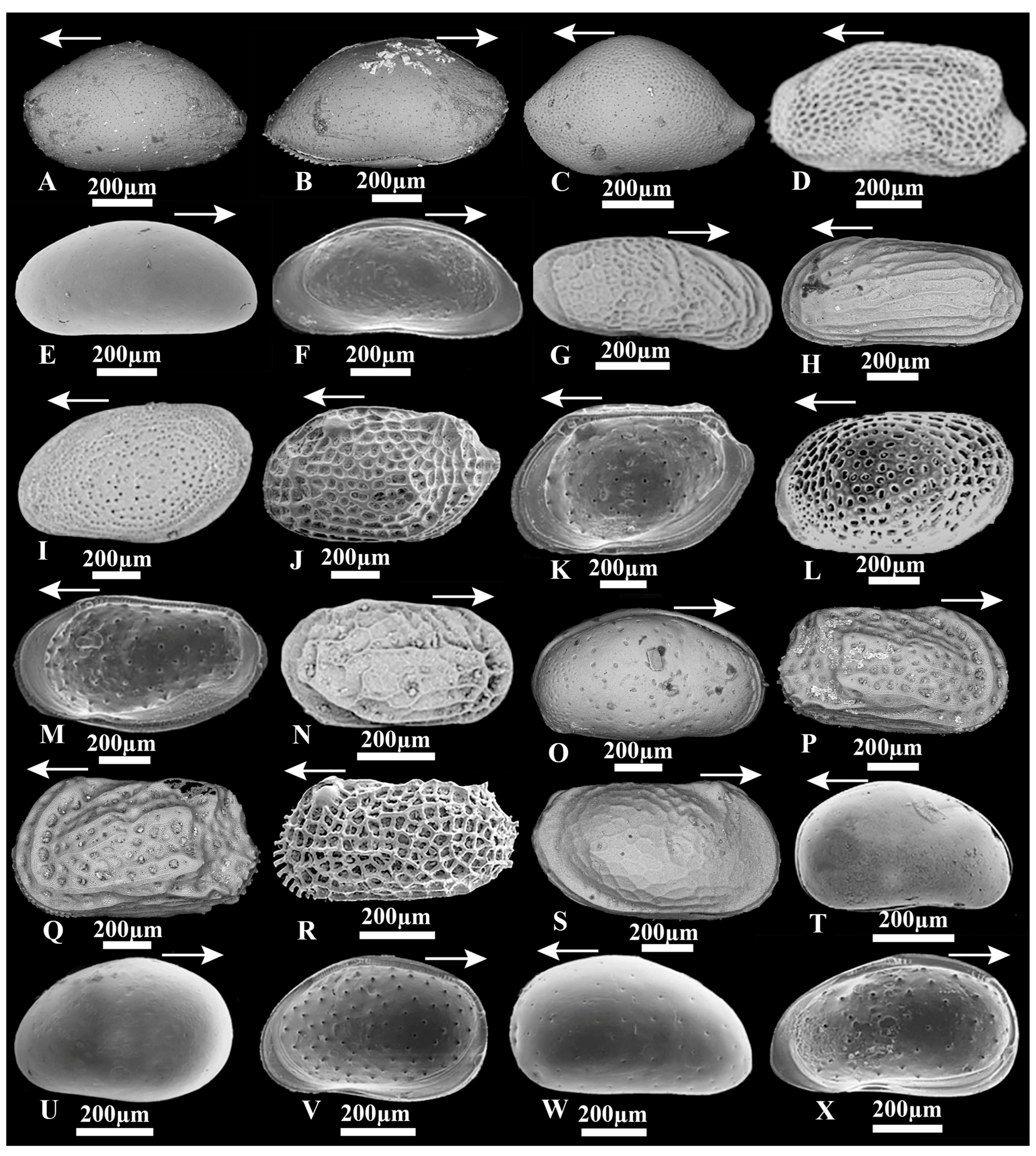
The living ostracod specimens were counted (300 specimens for the statistical approach) based on microscopic observations, where the presence of intact soft parts and appendages is evident for living forms, while empty, sediment-filled, or visibly abraded valves were considered part of the dead assemblage. In the present work, we relied on the living forms to diagnose and evaluate the ecological conditions favored by the benthic ostracod community. Scanning electron microscope (SEM) micrographs were obtained using a Quanta FEG 250 operated at 30 kV at the Mineral Resources and Mining Industries Authority to illustrate selected ostracod taxa (Figure 2).

3.3. Data Analysis

Multivariate statistical techniques were applied to evaluate ostracod community structure and its relationship with environmental variables. Consequently, the ostracod taxa with frequencies greater than 1% were used to decipher distribution patterns in response to the ecological variables. Hierarchical cluster analyses were performed using both Q-mode (samples) and R-mode (species) classifications to explore similarities in their distributional patterns. The analyses employed the Bray–Curtis similarity index with a complete linkage algorithm to delineate groups of comparable samples and taxa. Additionally, the statistical significance of the clusters identified was assessed in both Q-mode and R-mode hierarchical analyses via a similarity profile (SIMPROF) test performed in the R version 4.5.2 (clustsig package), based on 999 permutations. In addition, the robustness of the dendrograms was assessed using the cophenetic correlation coefficient (CCC) (0.70 for R-mode, and 0.61 for Q-mode), which displayed a moderate-to-good fit between the original similarity matrix and the hierarchical clustering pattern.
To further investigate the influence of environmental parameters on ostracod assemblage distribution, redundancy analysis (RDA) was performed. Prior to implementing RDA, multicollinearity among environmental variables was assessed using variance inflation factors (VIFs) implemented in the vegan package in R. Variables with high collinearity (VIF > 10) were removed via a stepwise selection procedure to obtain a parsimonious and ecologically interpretable model. Accordingly, highly correlated parameters, including grain-size fractions (sand and gravel), conductivity-related variables (TDS and SPC), and redox potential (Eh), were excluded. The ultimate RDA was performed using a reduced set of eight non-collinear sedimentological and physicochemical variables (carbonate, LOI550, water depth, mud, temperature, salinity, pH, and DO. Preliminary detrended correspondence analysis (DCA) indicated a short gradient length (<3 SD; [62]), justifying the use of a linear ordination method (i.e., RDA).
To quantitatively assess the ostracod community structure, significant ecological indices were calculated for each sample. The abundance and species richness were determined. Furthermore, two composite diversity indices were computed: the Dominance Index (D), which reflects the relative importance of the most abundant species, and the Shannon–Weiner Index (H’), which incorporates both species richness and their relative abundance (evenness). These indices were used to provide a comprehensive overview of community diversity, dominance patterns, and overall ecological complexity within the study area. All statistical analyses were performed using the PAST (PAleontological Statistics) software, version 5.2.1 [62].
Spatial distribution maps of environmental parameters and benthic ostracod metrics were generated using the Inverse Distance Weighted (IDW) interpolation method implemented in ArcGIS Desktop 10.8. The IDW interpolation was applied to estimate values at unsampled locations, assuming that observations closer together are more similar than those farther apart.
Pearson’s correlation coefficients were calculated to observe the relationships among the environmental parameters, and benthic ostracod taxa distribution, as well as their dependent-based ecological indices (Supplementary Materials S1). Furthermore, multiple-comparison correction test was applied, with p-values corrected using the Benjamini–Hochberg (BH) false discovery rate (FDR) procedure (p < 0.05), as shown in Table 2 using Python version 3.14.3 (statsmodels).

4. Results

4.1. Ecological Variables

4.1.1. Water Characteristics

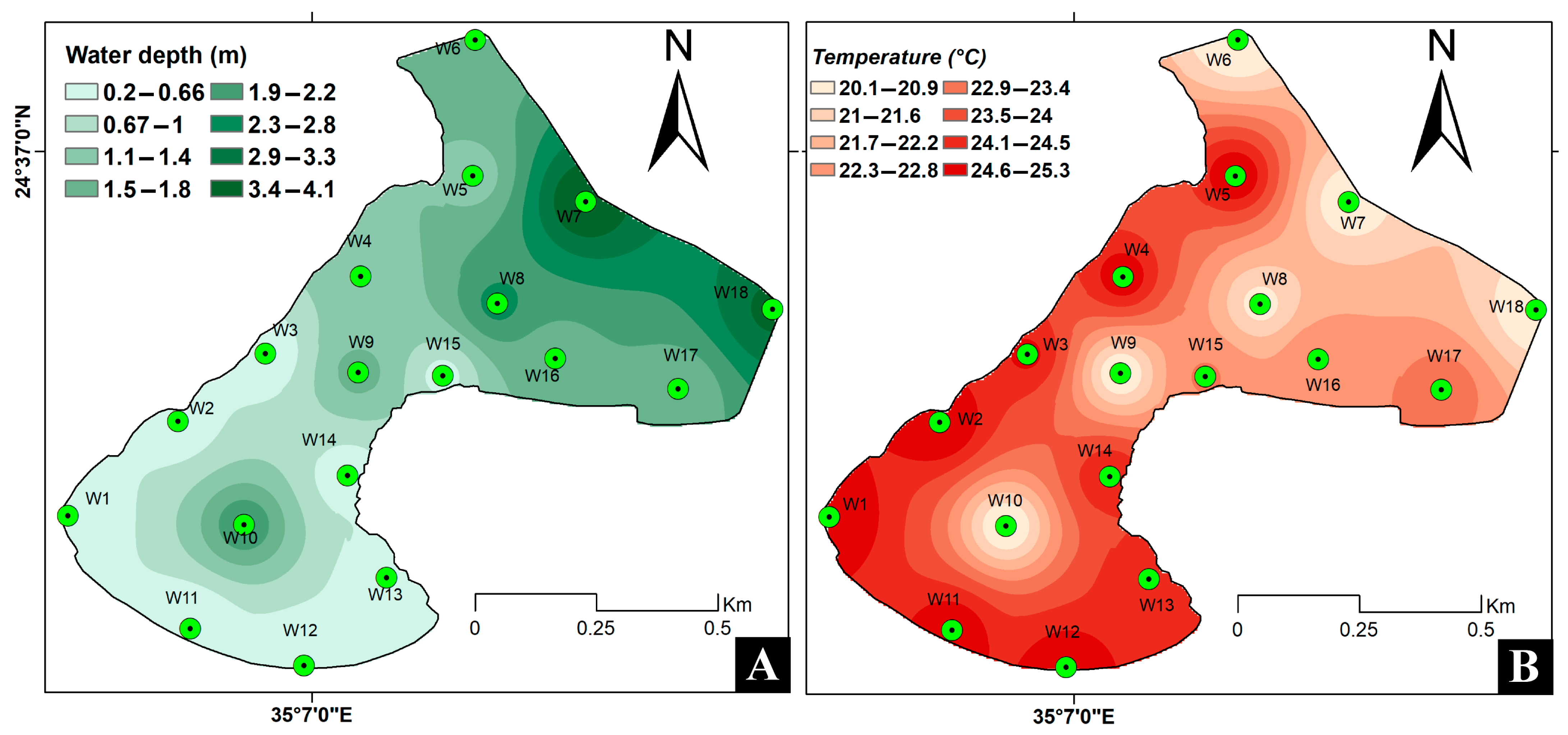
The water depths ranged from 0.2 m (W11) to 4.1 m (W7), with an average of 1.3 m (Table 1, Figure 3A). The shallower stations (W1–W5, W11–W14) correspond to nearshore zones, whereas deeper values characterize more central and outer basin stations, reflecting the geomorphological slope of the ecosystem. The water temperature ranged from 20.1 °C (W10) to 25.3 °C (W2), with an average of 23.1 °C (Table 1, Figure 3B). Noteworthy, the elevated temperatures were recorded in the shallow northern stations, consistent with greater solar exposure and reduced water exchange.
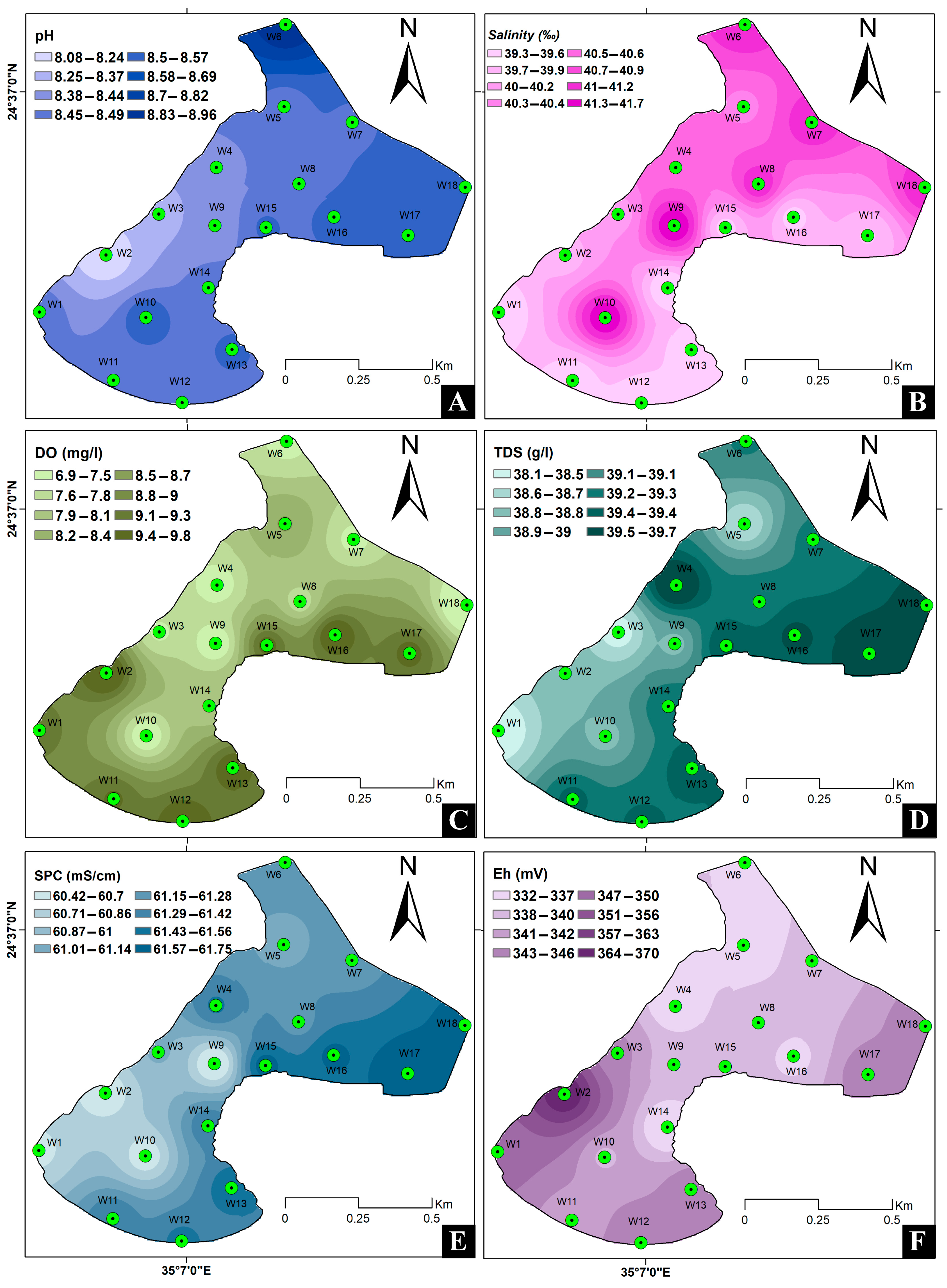
The pH values were consistently alkaline, ranging from 8.08 (W2) to 8.96 (W6), with an average of 8.48 (Table 1, Figure 4A). This narrow range indicates stable marine conditions with limited acidification influences. The recorded salinity values were relatively high and stable, ranging between 39.26‰ (W14) and 41.75‰ (W9), with a mean of 40.1‰ (Table 1, Figure 4B). The slightly higher salinities in mid- and deeper stations (W6–W10) indicate limited freshwater input and intense evaporative concentration. The dissolved oxygen (DO) concentrations varied markedly, ranging from 6.90 mg/L (W18) to 9.84 mg/L (W2), with a mean of 8.39 mg/L (Table 1, Figure 4C). Elevated DO levels in the shallower, well-mixed stations (W1–W5, W11–W16) contrast with lower values in deeper or more stagnant areas, implying variable oxygenation linked to water circulation and organic matter degradation. The total dissolved solids (TDS) ranged between 38.14 g/L (W1) and 39.70 g/L (W4), averaging at 39.1 g/L (Table 1, Figure 4D). The minor spatial variation in TDS suggests a homogenous ionic composition across the stations, typical of semi-enclosed marine basins. Specific Conductivity (SPC) values varied between 60.42 µS/cm (W9) and 61.75 µS/cm (W17), with a mean of 61.2 µS/cm (Table 1, Figure 4E). The uniformity of SPC across the study area aligns with the narrow range in salinity and TDS, confirming relatively stable hydro-chemical conditions. The redox-potential (Eh) values ranged from 332 mV (W14) to 370 mV (W2), with a mean of 342 mV (Table 1, Figure 4F). These positive values reflect generally oxidizing bottom conditions, although slightly reduced potentials in some inner stations may indicate localized organic enrichment and early diagenetic activity.

4.1.2. Bottom Sediments Characteristics

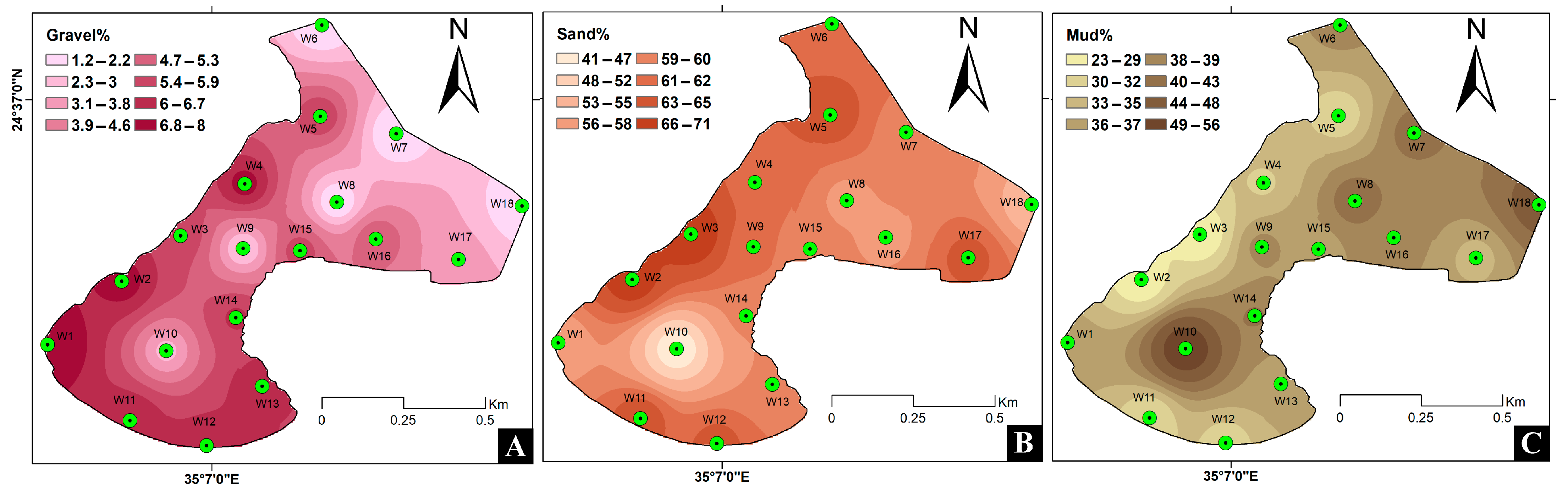
Overall, the Sharm El-Luli ecosystem shows enriched percentages of sand content, followed by mud and gravel, respectively. The gravel content ranged from 1.2% (W7) to 8.0% (W1), with a mean of 5.0% (Table 1, Figure 5A). Higher gravel percentages were observed near the inlet and shallower margins, indicating coarser sediment deposition influenced by higher hydrodynamic energy. The sand content ranged from 41.0% (W10) to 71.2% (W3), with an average of 59.6% (Table 1, Figure 5B). The dominance of sandy fractions suggests active sediment reworking in most parts of the basin, particularly in stations W2–W5. The mud fractions varied between 23.0% (W3) and 56.3% (W10), with a mean of 36.4% (Table 1, Figure 5C). Finer sediments (mud) prevailed in the inner and deeper stations (e.g., W8–W10 and W18), reflecting lower-energy depositional environments.
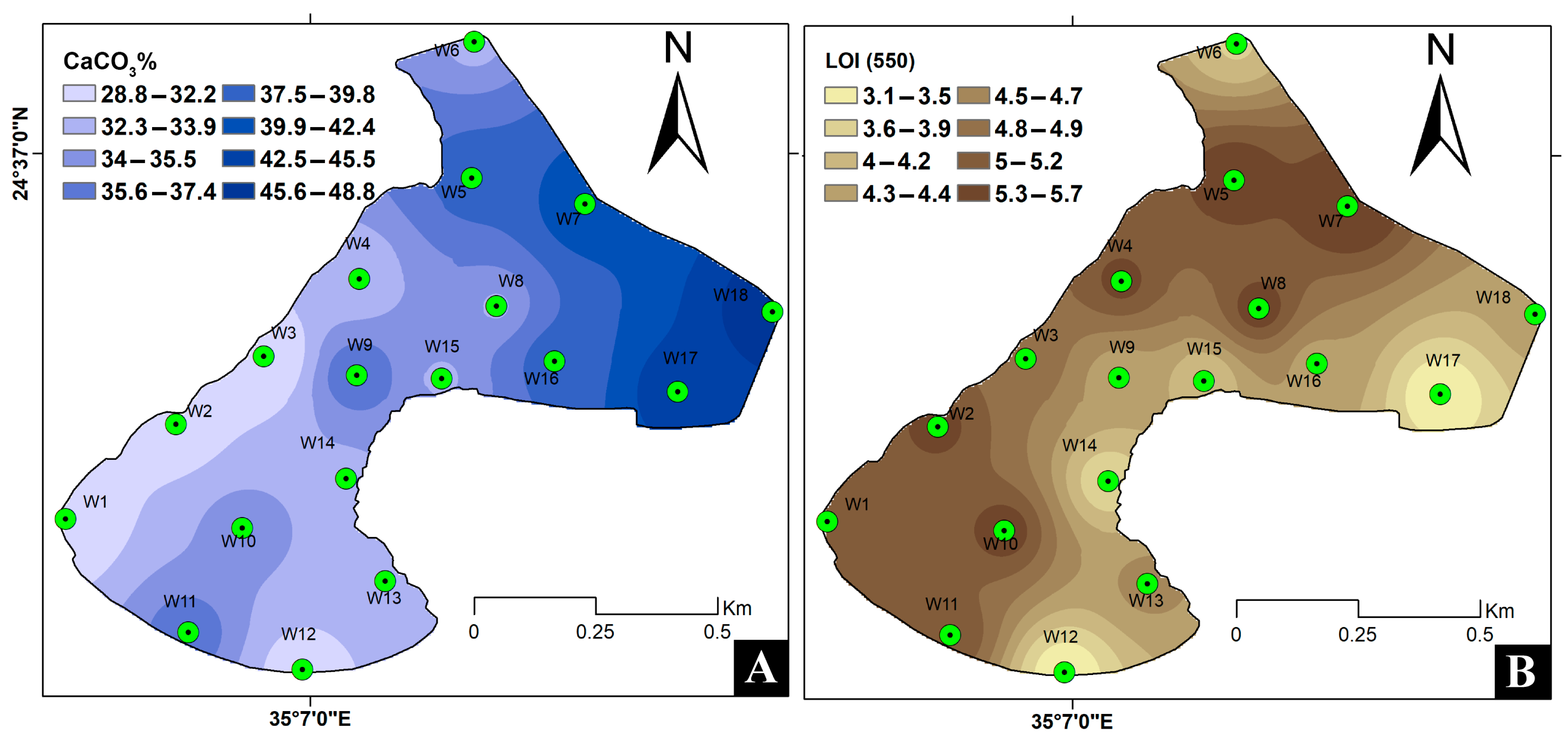
The carbonate values ranged from 28.8% (W3) to 48.8% (W18), with a mean of 35.5% (Table 1, Figure 6A). The lowest carbonate concentration was observed in the shallower stations near the coastal margin, while higher values were found toward the outer stations, suggesting enhanced biogenic input and lower terrigenous dilution.
The organic matter content, represented by Loss on Ignition (LOI), varied between 3.1% (W12 and W17) and 5.7% (W7), averaging 4.6% (Table 1, Figure 6B). Higher LOI values were generally associated with fine-grained sediments (muddy substrates), implying greater organic matter retention in these areas.

4.2. Benthic Ostracods Assemblage

The examined benthic ostracod assemblage comprises 34 taxa across 24 genera, distributed across 18 samples. The assemblage displays a distinct increase in abundance and diversity from the lower (inner bay) to upper (outer bay) samples toward marine settings. The assemblage is dominated by Xestoleberis rotunda, which exhibits the highest relative abundance (15.49%), followed by Jugosocythereis borchersi (14.63%) and Xestoleberis rhomboidea (12.48%) (Supplementary Materials S2). These dominant species, together with Aglaiocypris triebeli (9.04%), Loxoconcha ornatovalvae (7.32%), and Xestoleberis multiporosa (7.03%), collectively account for more than half of the total assemblage, reflecting a well-developed shallow-marine, subtidal to inner-neritic environment.
Furthermore, taxa with moderate contributions include Loxocorniculum ghardaquensis, which shows consistent though variable distribution across stations, along with Caudites levis and Sclerochilus rectomarginatus, which occasionally peak above 10% (notably at W4 and W14). In contrast, Paranesidea fracticorallicola, Hiltermannicythere rubrimaris, and Neonesidea schulzi are present at lower abundances, usually ranging between 1 and 7% (Supplementary Materials S2).
A suite of minor taxa, such as Moosella striata, Triebelina sertata, Xestoleberis ghardaqae, and Cyprideis torosa, appear sporadically and in low relative abundances (<5%). Rare occurrences are represented by Paradoxostoma spp., Lankacythere elaborata, Cytherelloidea sp., Chartocythere arenicola, and Abditacythere subterranea, which are restricted to isolated stations and contribute negligibly to the overall assemblages.
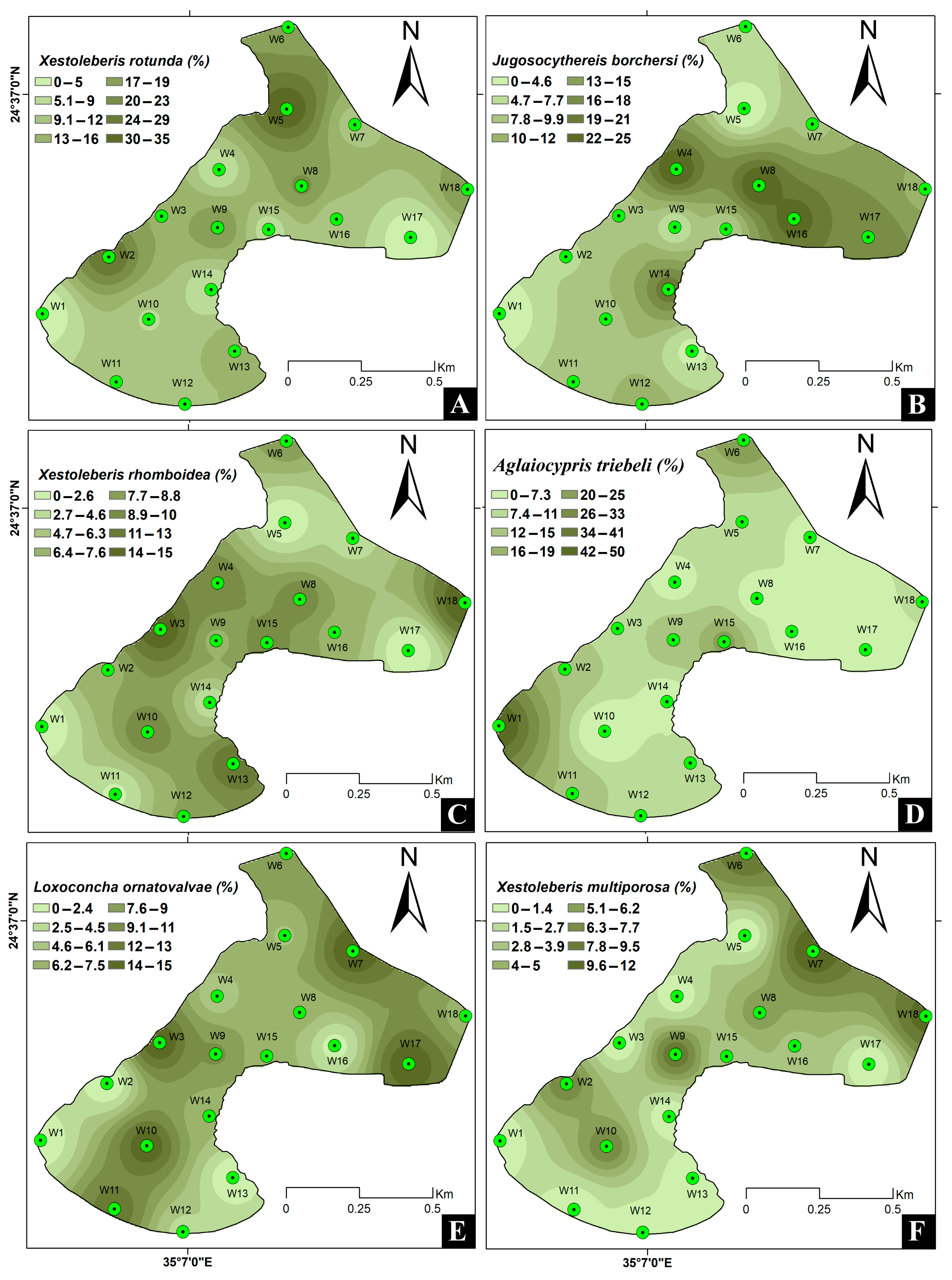
The six most abundant taxa distribution patterns are described below (Figure 7). The X. rotunda reached its highest abundance at W5 (35.3%), followed by W2 (28.6%) and W8 (20.3%), while the lowest values were observed at W14 (4.6%) (Figure 7A). This taxon exhibited a clear tendency to dominate in selected stations, reflecting ecological specialization in particular microhabitats. Jugosocythereis borchersi ranged from 3.0% (W13) to a maximum of 25.4% (W8), where relatively high contributions were also evident at W4 (25.0%), W16 (23.2%), and W14 (20.0%) (Figure 7B). This indicates a preference for multiple stations with relatively stable but patchy occurrences, often forming secondary dominance in assemblages. Xestoleberis rhomboidea exhibited low-to-moderate values, with complete absence in several samples (W1, W5, W17), and a maximum of 15.4% at W3 and 15.1% at W18 (Figure 7C). Its distribution was sporadic but widespread, suggesting opportunistic behavior within the assemblages. Aglaiocypris triebeli displayed the highest variability among the studied taxa, with values ranging from absence at some stations (W10, W14, W17) up to a maximum of 50% at W1 (Figure 7D). Its highest dominance was clearly restricted to W1, while moderate contributions were recorded at W6 (22.6%) and W15 (20.8%). Overall, the taxon shows a heterogeneous distribution with localized peaks, suggesting potential sensitivity to habitat heterogeneity. Loxoconcha ornatovalvae was generally present in low proportions, with minimum absence at several stations and a maximum of 15.5% at W3 and W7 (Figure 7E). It occurred consistently at small-to-moderate values across the dataset, indicating broad tolerance but low dominance in the community structure. Xestoleberis multiporosa was absent in multiple stations (e.g., W1, W3–W5, W11–W14), while its maximum contribution was recorded at W7 (11.9%) and W18 (10.4%) (Figure 7F). Its patchy distribution suggests that local environmental constraints limit its occurrence to specific conditions.

4.3. Diversity Indices

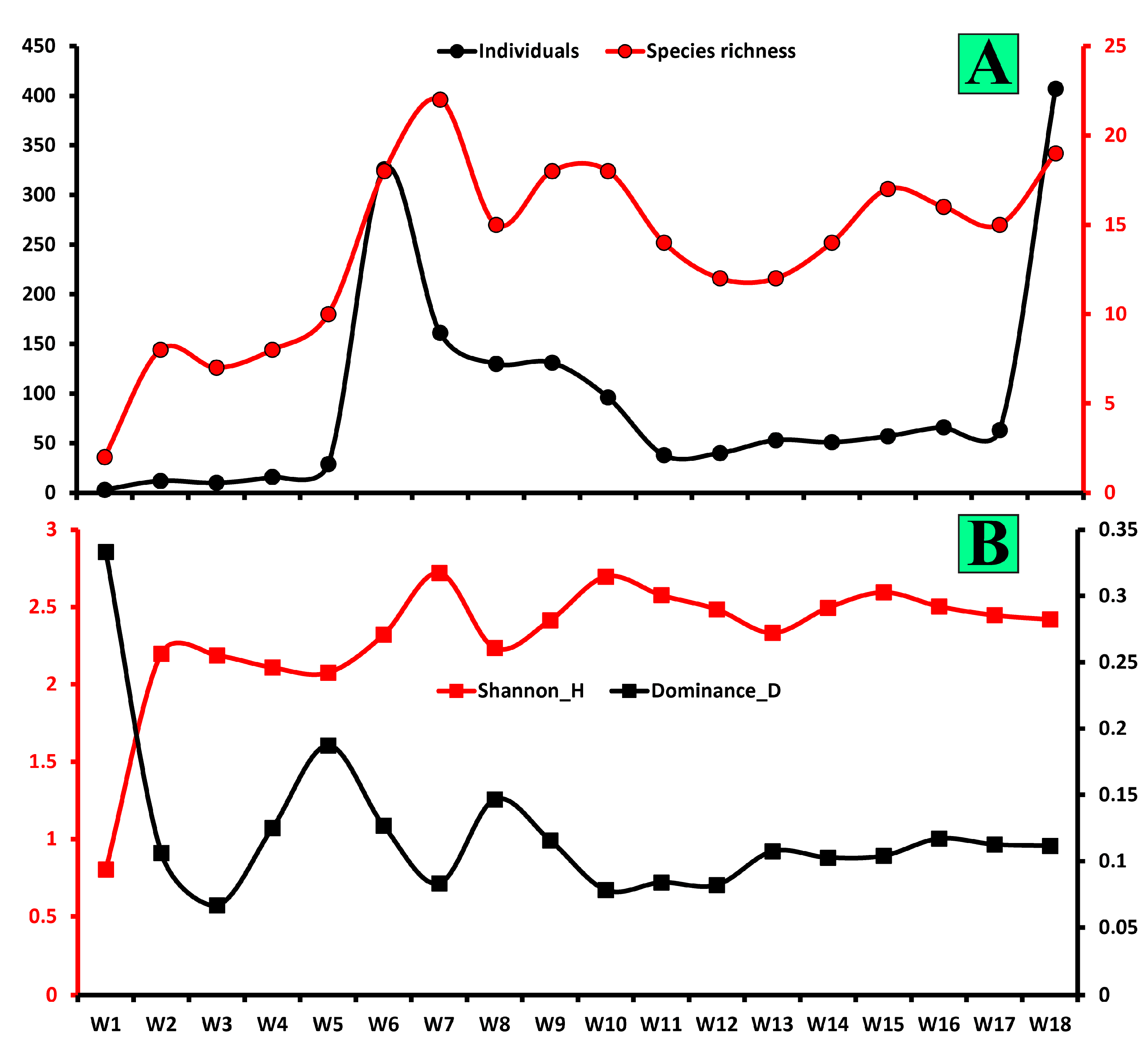
The diversity indices of the ostracod assemblages from Sharm El-Luli reveal spatial heterogeneity across the 18 sampled sites (Figure 8). Species richness (S) varies considerably, ranging from only 2 species at W1 to a maximum of 22 species at W7, reflecting the strong environmental gradient along the studied transects. Similarly, the number of individuals (N) shows a wide variation, with the lowest abundance at W1 (3 individuals) and the highest at W18 (407 individuals), followed closely by W6 (326 individuals). Dominance (D) values, which measure the extent to which a few species dominate the assemblages, are highest at W1 (0.333) and W5 (0.187), indicating communities strongly controlled by one or a few taxa. In contrast, lower dominance values (e.g., W3 = 0.067 and W10 = 0.078) indicate a more even species distribution. Shannon diversity (H′), which integrates both richness and evenness, highlights the ecological structure of ostracod communities. Diversity is lowest at W1 (H′ = 0.803) due to the low number of taxa and strong dominance, while the highest values occur at W7 (H′ = 2.72) and W10 (H′ = 2.67), corresponding to stations with high richness and balanced community composition. Overall, sites in the central part of the transects (W6–W10, W14–W16) tend to host the most diverse and evenly distributed ostracod assemblages, whereas marginal stations, such as W1, W2, and W5, are characterized by low richness and high dominance. These patterns suggest that environmental parameters, such as substrate composition, water depth, and physicochemical conditions, are key in structuring ostracod communities across Sharm El-Luli.

4.4. Statistical Analysis

4.4.1. Cluster Analysis

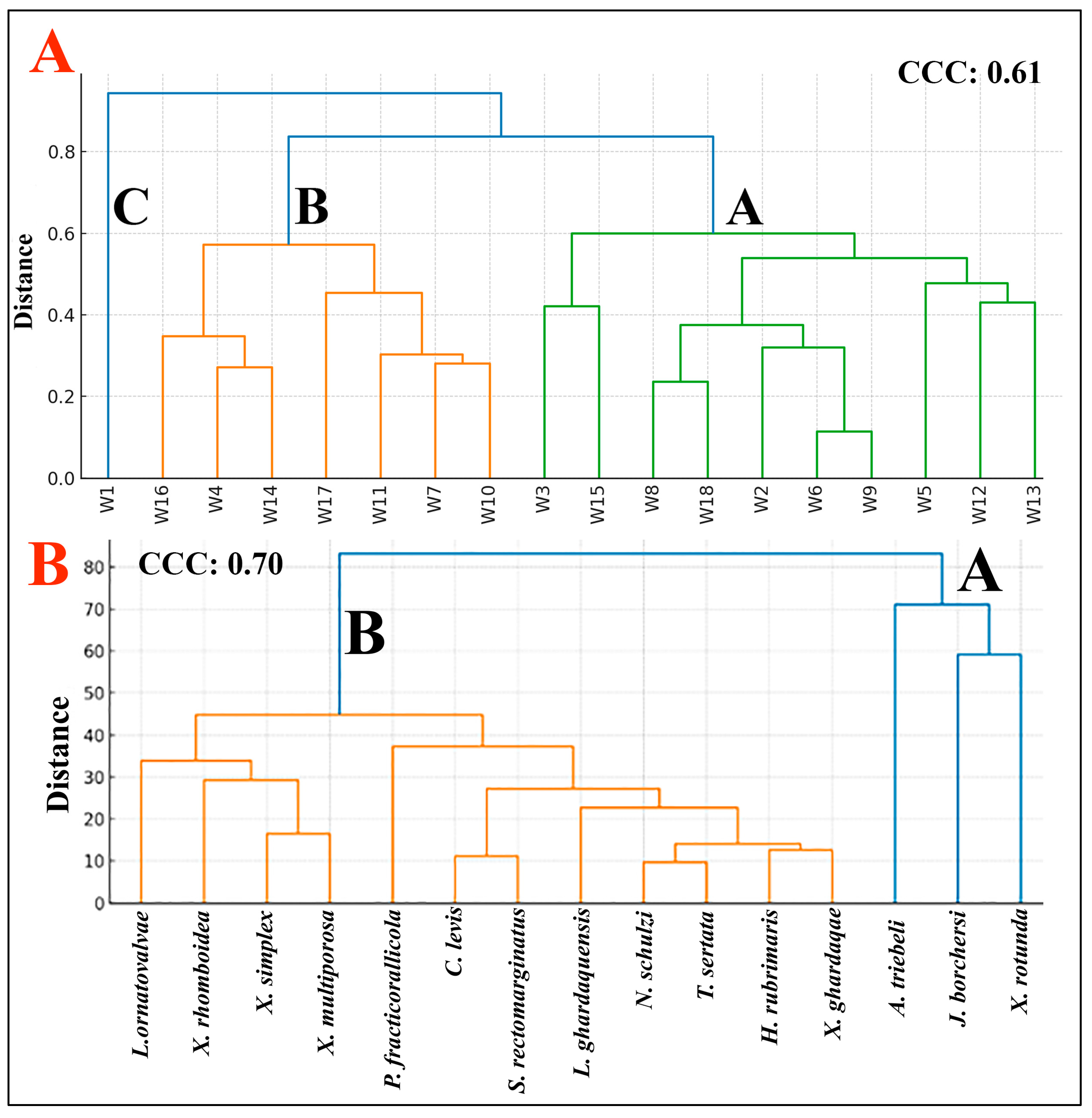
The cluster analysis of both samples (Q-mode) and ostracod taxa (R-mode) reveals clear ecological structuring across the study area, respectively (Figure 9A,B). Three Q-mode clusters (A, B, C) are discriminated against (Figure 9A), and two R-mode clusters (A, B) are also illustrated (Figure 9B). Clusters A and B emerged from a main cluster, each of which has its characteristic benthic ostracod assemblage. Accordingly, cluster A involves ten stations, whereas cluster B comprises seven stations (W4, W7, W10, W11, W14, W16, W17), and cluster C has only one station W1 (Figure 9A).
Station W1 forms a highly distinct and isolated cluster, being strongly dominated by A. triebeli (50%) and P. fracticorallicola (25%). This composition indicates a monospecific or low-diversity assemblage, suggesting a stressed or atypical microhabitat likely situated at the landward, more restricted margin of the study area.
A large cluster encompassing stations W2, W3, W5, W6, W8, W9, W12, W13, W15, and W18 is characterized by high abundances of Xestoleberis spp., particularly X. rotunda, X. rhomboidea, X. simplex, and X. multiporosa. These assemblages exhibit greater faunal evenness and internal similarity, reflecting sandy to slightly muddy substrates in well-flushed, moderately shallow marine environments. Noteworthy, C. torosa is found exclusively at W13 (4.55%), suggesting localized brackish influence.
Stations W4, W7, W10, W11, W14, W16, and W17 form a secondary group defined by elevated proportions of J. borchersi (peaking at W4 = 25%, W8 = 25.36%, and W16 = 23.17%) along with notable occurrences of L. ornatovalvae. This pattern suggests moderately energetic, stable substrates with patchy vegetation cover or localized hard-ground elements that support mixed benthic communities. Notably, C. levis and S. rectomarginatus reach maximum abundances at W4 (15% and 10%, respectively), distinguishing this site from surrounding stations. Furthermore, L. ghardaquensis occurs frequently at W7, W11, and W17, typically associated with algal-rooted or seagrass habitats.
The A. triebeli, J. borchersi, and L. ghardaquensis form a closely related cluster (A), reflecting similar environmental tolerances and overlapping habitat ranges. The Xestoleberis complex (X. rotunda, X. rhomboidea, X. simplex, X. multiporosa, and X. ghardaqae) forms a tight, cohesive cluster (B), suggesting a shared ecological niche within well-oxygenated sandy substrates (Figure 9B). Paranesidea fracticorallicola and L. ornatovalvae tend to cluster with reef-associated or seagrass taxa, indicating a linkage to coral rubble or vegetated microenvironments. In contrast, S. rectomarginatus and C. levis appear more isolated, consistent with distinct ecological tolerances and possibly broader habitat ranges. Accordingly, the clustering patterns reveal strong ecological partitioning within ostracod assemblages, primarily driven by substrate type, salinity, oxygen availability, and hydrodynamic energy. Taxa forming tight clusters reflect specialized environmental preferences, whereas isolated species exhibit broader ecological adaptability.

4.4.2. Redundancy Analysis (RDA)

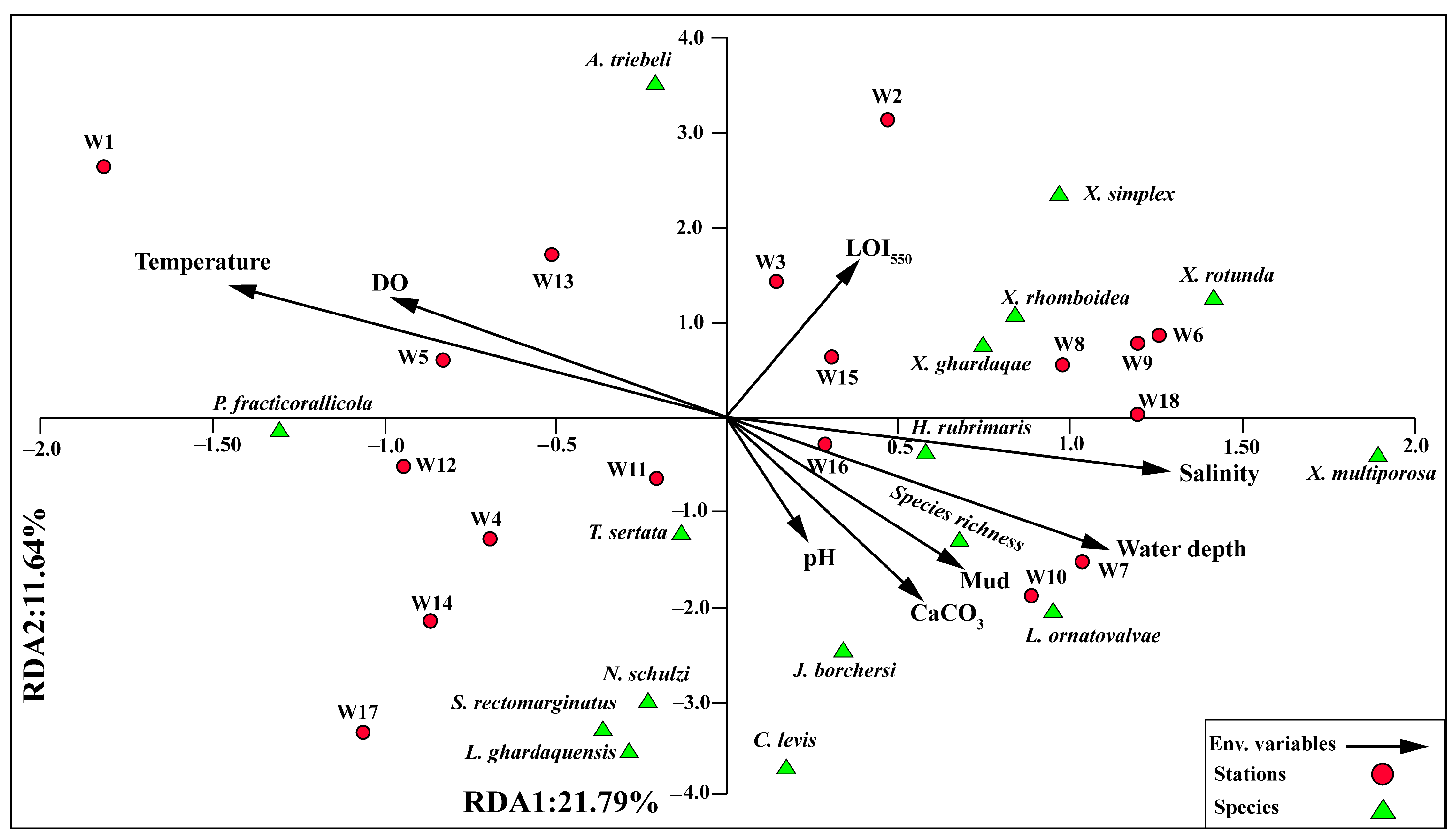
The RDA produced twenty-four ordination axes, of which the first eight were canonical axes constrained by the measured environmental variables. The first two canonical axes explain the largest proportion of the species–environment relationship and therefore provide the most ecologically meaningful interpretation (Figure 10). The first canonical axis (Axis 1) has an eigenvalue of 2.99, accounting for 21.79% of the total variance in the constrained dataset, while the second canonical axis (Axis 2) has an eigenvalue of 1.60, explaining an additional 11.64% of the variance. Together, these two axes account for 33.42% of the cumulative variance, indicating that they capture the dominant environmental gradients structuring ostracod assemblage distribution. The relatively high species–environment correlations (R = 0.906 for Axis 1 and R = 0.716 for Axis 2) demonstrate strong and reliable relationships between the biological assemblages and the selected environmental variables. Subsequent canonical axes each explain less than 7.2% of the variance individually, suggesting a progressively diminishing contribution to the overall ecological structure of the dataset.
Axis 1 represents the principal environmental gradient controlling ostracod community composition. Species with strong positive scores along Axis 1 include X. multiporosa (+0.59), X. simplex (+0.38), X. rotunda (+0.26), X. rhomboidea (+0.25), L. ornatovalvae (+0.28), and species richness (+0.18). These taxa and assemblage attributes are therefore associated with conditions represented on the positive side of Axis 1 (Figure 10). Conversely, species such as P. fracticorallicola (–0.39), A. triebeli (–0.04), N. schulzi (–0.05), and S. rectomarginatus (–0.07) plot toward the negative end of the axis, indicating contrasting ecological preferences.
The environmental loadings along Axis 1 indicate that this gradient is primarily driven by increasing salinity (+0.38), water depth (+0.32), mud content (+0.18), and carbonate content (+0.16), opposed by temperature (–0.41) and dissolved oxygen (–0.27). Accordingly, the positive side of Axis 1 reflects deeper, more saline, fine-grained, and carbonate-rich environments characterized by relatively stable hydrochemical conditions. These settings favor higher ostracod diversity and species adapted to low-energy marine environments. In contrast, the negative side of Axis 1 corresponds to warmer, more oxygenated, and likely shallower environments, which are typically subject to greater hydrodynamic influence and environmental variability. Species positioned along this end of the gradient appear to be more tolerant of fluctuating conditions and potentially higher ecological stress.
The ordination of sampling sites along Axis 1 reveals a clear spatial differentiation in environmental conditions. Sites with high positive Axis 1 scores, including W6 (+2.32), W7 (+1.90), W8 (+1.82), W9 (+2.27), W10 (+1.64), and W18 (+2.30), are associated with deeper, finer-grained, and more saline environments. These stations support more diverse ostracod assemblages dominated by taxa such as X. multiporosa, X. simplex, and X. rotunda. In contrast, sites with strongly negative Axis 1 scores, notably W1 (–4.41), W4 (–1.39), W5 (–1.46), W12 (–1.93), and W17 (–2.04), are associated with warmer, more oxygenated, and relatively shallower settings, where opportunistic or stress-tolerant species are more prevalent.
Axis 2 accounts for an additional 11.64% of the explained variance and represents a secondary environmental gradient influencing ostracod distribution. Species with positive scores along Axis 2 include A. triebeli (+0.37), X. rotunda (+0.24), X. simplex (+0.13), and species richness (–0.20, moderately negative), whereas species such as C. levis (–0.50), S. rectomarginatus (–0.33), N. schulzi (–0.30), and L. ghardaquensis (–0.34) show negative associations with this axis.
Environmental variable loadings indicate that Axis 2 is influenced primarily by organic matter (LOI550= +0.15), temperature (+0.12), and dissolved oxygen (+0.11), opposed by carbonate content (–0.25), depth (–0.19), mud (–0.21), and pH (–0.14). This pattern suggests that Axis 2 represents an organic enrichment and oxygenation gradient, distinguishing relatively warm, oxygenated, and organic-rich environments (positive scores) from deeper, carbonate- and mud-dominated settings with comparatively lower oxygen availability (negative scores).
Along Axis 2, sites such as W1 (+2.97), W2 (+3.11), W3 (+1.55), and W13 (+1.60) plot toward the positive end of the gradient, reflecting warmer, more oxygenated, and organic-enriched conditions. In contrast, sites including W7 (–1.82), W10 (–2.17), W14 (–2.35), and W17 (–3.38) occupy the negative side of Axis 2, corresponding to deeper, finer-grained, and more carbonate-rich environments. This separation highlights the role of secondary hydrochemical and sedimentological gradients in structuring local ostracod assemblages beyond the dominant salinity–depth gradient represented by Axis 1.

4.4.3. Correlation Analysis (Benjamini–Hochberg) and Linkage to RDA Axes

Pearson correlation analysis revealed several significant relationships between environmental variables and benthic ostracod parameters after applying the Benjamini–Hochberg false discovery rate correction (q < 0.05; Table 2). Temperature exhibited a strong negative correlation with both X. multiporosa abundance (r = −0.84) and species richness (r = −0.81), indicating a decline in ostracod abundance and diversity under higher thermal conditions. In contrast, water depth showed strong positive correlations with X. multiporosa (r = 0.77) and species richness (r = 0.69), suggesting more favorable ecological conditions at deeper stations.
Salinity was also positively correlated with X. multiporosa (r = 0.77), reflecting the preference of this species for more stable offshore conditions. Other correlations that were significant at the uncorrected level did not remain significant after FDR correction and were therefore not considered further. Thus, the BH-filtered correlations highlight temperature and water depth as the dominant environmental gradients structuring the distribution of benthic ostracods across the study area.
Notably, after applying the Benjamini–Hochberg correction for multiple comparisons, only a limited subset of species–environment correlations remain statistically significant (Table 2). The patterns observed in the RDA ordination are strongly supported by the Benjamini–Hochberg (BH)-corrected Pearson correlation analysis (Table 2). The correlation matrix, filtered to retain only statistically significant relationships after false discovery rate correction (q < 0.05), highlights the same environmental gradients identified by the first two canonical RDA axes.
Axis 1 of the RDA, which represents the dominant salinity–depth–substrate stability gradient, is reinforced by significant positive BH-corrected correlations between salinity and water depth, as well as between these variables and mud and carbonate content. These variables show significant positive associations with species richness and with ostracod taxa such as X. multiporosa, X. simplex, and X. rotunda, all of which plot on the positive side of Axis 1 in the ordination space. In contrast, temperature and dissolved oxygen, which load negatively on Axis 1, exhibit significant negative BH-corrected correlations with depth-associated variables, confirming the opposing environmental conditions represented along this primary gradient.
Axis 2 of the RDA, interpreted as a secondary organic matter–oxygenation gradient, is similarly supported by the BH-filtered correlation structure. The LOI550 and DO show significant positive correlations with each other and with warm-water, shallow-associated taxa, consistent with their positive loadings along Axis 2. Conversely, carbonate content, mud fraction, and water depth display significant negative correlations with LOI550 and oxygen, aligning with the negative side of Axis 2 and with species adapted to deeper, low-energy environments.
Significantly, many weaker correlations observed in the uncorrected matrix are no longer significant after BH correction, indicating that the main ecological signal is driven by a limited number of robust species–environment relationships. This statistical filtering strengthens the interpretation of the RDA by demonstrating that the ordination axes are structured by environmentally meaningful and statistically reliable gradients rather than spurious correlations.

5. Discussion

Environmental variables such as substrate type, salinity gradients, organic matter content, and associated vegetation strongly influence benthic ostracod communities by regulating species richness, diversity, and microhabitat preferences [1,13]. In particular, the heterogeneous coastal setting of the Wadi El-Gemal area, especially the Sharm El-Luli site, which includes sandy, muddy, and gravelly substrates, provides a mosaic of ecological niches that foster distinct ostracod assemblages, consistent with patterns documented in Red Sea mangrove and lagoonal habitats [63]. Moreover, the interaction between mangrove ecosystems, tidal dynamics, and fine-grained sediment deposition creates microhabitats that support specific ostracod taxa, reflecting the known role of mangrove geomorphology and sedimentary processes in shaping benthic community structure [64,65].

5.1. Composition and Diversity of Ostracod Assemblages

The benthic ostracod fauna recovered from Sharm El-Luli comprises a moderately diverse assemblage of thirty-four taxa dominated by the genera Xestoleberis, Jugosocythereis, Aglaiocypris, and Loxoconcha. This faunal composition is consistent with published works from the Egyptian Red Sea coast, which report comparable shallow-marine assemblages where Xestoleberis spp. and various cytheroids are numerically important in well-flushed, carbonate-rich habitats [58,63,66,67,68], and where Aglaiocypris occurs frequently in more restricted mangrove and sheltered settings [30]. The predominance of Xestoleberis taxa, known for their tolerance to elevated salinities and stable marine conditions [2,7], suggests deposition within a warm, well-oxygenated, shallow-marine habitat, likely influenced by moderate water energy and normal marine salinity [2,7]. The consistent occurrence of J. borchersi and Loxoconcha further supports this interpretation, as these taxa typically inhabit nearshore carbonate platforms and seagrass-associated substrates [69,70].
Less abundant taxa, such as Hiltermannicythere rubrimaris, Caudites levis, and Neonesidea schulzi, indicate localized environmental variability, possibly reflecting fluctuations in substrate composition or oxygenation levels. The relatively low percentages of lagoonal or brackish indicators (e.g., Cyprideis torosa, 0.43%) imply limited freshwater influence and overall marine stability [69]. Collectively, the assemblage reflects a typical Red Sea-type shallow-marine ostracod fauna with dominance of the genera Xestoleberis and Jugosocythereis, signifying deposition under warm, oligotrophic, and high-salinity conditions.
The distinct inner-to-outer gradient observed in Sharm El-Luli, where a low-diversity assemblage dominated by A. triebeli gives way to richer, Xestoleberis- and Jugosocythereis-dominated communities toward the mid and outer stations (marine direction), reflects a well-recognized ecological zonation within Red Sea lagoonal and mangrove systems. Comparable distributional trends have been reported by Helal and Abdel-Wahab [63], who identified four characteristic sub-environments along the Egyptian Red Sea coast. They noted that the inner mangrove zone was characterized by fine-grained, organic-rich substrates, which were typically inhabited by a limited number of tolerant species. In contrast, the transition toward more open, sandy habitats was accompanied by an increase in species richness and Shannon diversity. Similarly, El-Kahawy et al. [1] emphasized that stations influenced by muddy or polluted conditions tend to exhibit reduced diversity and higher dominance by opportunistic taxa. In contrast, Xestoleberis and other cytheroids prevail under cleaner, well-oxygenated conditions. The convergence of these findings suggests that spatial gradients in substrate texture, organic enrichment, and hydrodynamic energy primarily drive faunal zonation at Sharm El-Luli. Thus, environmental filtering rather than biogeographic isolation appears to play the dominant role in shaping the observed ostracod assemblage structure.
Comparisons with non-Egyptian tropical lagoons further reinforce these inferences. Studies from Indo-Pacific shallow marine settings indicate that Xestoleberis species are strongly correlated with clear, oxygenated waters and low turbidity [11]. Moreover, Xestoleberis has been widely reported in seagrass-associated ostracod assemblages and is a recognized proxy for seagrass habitats [71], where substrate stability and food resources (e.g., epiphytic algae and microflora) sustain higher species richness [11,72]. Conversely, monospecific or low-diversity assemblages dominated by opportunistic or tolerant taxa are typical of inner lagoon, estuarine, or mangrove root zones subject to high organic loading and low flushing [63,73]. Local microhabitats such as macroalgal beds can elevate ostracod diversity by providing structural complexity, epiphytic food, and shelter; Helal and Abd El-Wahab [63] reported significantly greater species richness in macroalgae-dominated Red Sea sites compared to mangrove root sediments, and a follow-up study found that structurally complex algae (e.g., Sargassum) consistently supported higher ostracod diversity, including Xestoleberis spp. This pattern is evident in Sharm El-Luli, where mid-lagoon stations adjacent to macrophyte cover exhibit higher richness and evenness compared to the mangrove flats.
The diversity indices for ostracod assemblages show spatial heterogeneity that closely tracks the environmental gradient across the 18 sampled stations. These patterns are consistent with well-documented ecological controls on benthic ostracods. Habitat complexity and the presence of macrophytes or algal beds frequently improve and enhance ostracod richness and abundance by providing epiphytic food, microhabitats, and refuge from predators [71,74]. In the Red Sea, Helal and Abd El-Wahab [63] explicitly reported higher ostracod abundance and species richness associated with macroalgal substrates than with mangrove root sediments, supporting our observation that mid-transect, algae-rich stations host the most diverse faunas. Furthermore, several studies have demonstrated that ostracod diversity and dominance patterns are strongly regulated by water depth [22,75], substrate characteristics such as grain size and macrophyte cover [1,21,58,63,66], and water-column parameters including oxygenation, salinity, and hydrodynamic energy [7,76]. Several reef-flat and lagoonal studies show that outer, better-oxygenated flats and seagrass fringes often sustain more even assemblages, whereas shallow, restricted, or highly stressed margins (e.g., hypersaline/muddy mangrove pools) favor low-diversity, dominance-type communities by a few opportunistic taxa [13,76]. Our highest abundances at W6, W7, W17, and W18, and the clustering of high H′ values in the central transect, therefore likely reflect an interplay of optimal depth, stable substrate, and favorable physico-chemical conditions (higher oxygenation, clearer water, and abundant epiphytic algae) that promote both colonization and preservation of diverse species. Notably, the low diversity observed at marginal stations, such as W1 and W5, is more plausibly linked to episodic terrigenous influx from nearby wadis. Since the western margin of Sharm El-Luli is bordered by the Red Sea Mountain catchments, where infrequent but intense rainfall events generate flash-flood discharges that deliver pulses of coarse-to-fine siliciclastic sediment into the lagoonal margin. Such wadi-derived sedimentation typically produces unstable substrates, rapid burial conditions, and turbidity, all of which suppress benthic ostracod richness and favor opportunistic, stress-tolerant taxa [7,77].

5.2. Ecological Zonation and Assemblage Structure

The ostracod assemblages from Sharm El-Luli display a pronounced onshore–offshore ecological zonation that is consistent with classic mangrove-lagoon gradients: an inner, low-diversity, stress-tolerant assemblage located in the mangrove fringe; transitional mid-lagoon assemblages associated with mixed substrates; and diverse outer-lagoon/shoreface assemblages dominated by sand- and carbonate-affiliated taxa. The inner stations (W1–W3) are dominated by Aglaiocypris triebeli and Paranesidea fracticorallicola, taxa that commonly characterize restricted, organic-rich, and low-oxygen microhabitats adjacent to mangrove roots or tidal flats. This pattern is compatible with earlier work along the Egyptian Red Sea, where mangrove and lagoonal interiors host low-diversity, opportunistic ostracod assemblages adapted to elevated organic load and reduced circulation [63].
Moving seaward, the mid-lagoon sites (W4–W8) show mixed assemblages with notable abundances of the genera Jugosocythereis and Loxoconcha, indicating moderately energetic substrates with intermittent flushing and patchy vegetated microhabitats. The outer stations (W15–W18) record the highest richness, dominated by multiple Xestoleberis spp. and other cytheroids that prefer well-oxygenated, higher-salinity, sandy to slightly muddy carbonate substrates, conditions characteristic of lagoon mouths and open shoreface settings. Similar compositional shifts from restricted, low-diversity inner assemblages to diverse outer assemblages have been documented in other marginal-marine systems, where Xestoleberis and related genera are typified as indicators of normal-marine salinity and stable substrate conditions [11].
The drivers of this zonation at Sharm El-Luli are consistent with established ecological controls, including salinity/TDS, substrate type (sand vs. mud, and carbonate content), dissolved oxygen, and hydrodynamic energy. Our RDA reveals strong associations/correlations between Xestoleberis/Jugosocythereis and higher CaCO3, SPC/TDS, and salinity, whereas Aglaiocypris and Paranesidea are associated with higher temperature, coarse fractions, and high DO. These multivariate linkages are congruent with correlation-based ecological models that relate ostracod occurrence to measured environmental gradients in shallow marine settings [11,78,79] and with regional field surveys that emphasize substrate and salinity as dominant controls on Red Sea ostracod distributions [58].

5.3. Limitations

While the assemblage–environment relationships are robust, several limitations warrant discussion. First, the temporal snapshot (surface sediments, one season) may not capture seasonal variation. Accordingly, investigating multiple seasonal variabilities and small-scale habitat heterogeneity is recommended and would clarify whether the observed patterns within a season are stable or reflect short-term environmental fluctuations. Second, the state of conservation due to phenomena such as valve dissolution or transport may subtly affect assemblage composition; therefore, taphonomic assessments should be taken into consideration. Future work integrating seasonal sampling, geochemical proxies, and molecular approaches would further refine the use of ostracods as bioindicators and enhance our understanding of ecosystem functioning in the Wadi El-Gemal–Hamata coastal sector.

6. Conclusions

This study aimed to examine the current ecological factors controlling the distribution of benthic ostracods in the Sharm El-Luli ecosystem, based on retrieved data from 18 sampling stations along the Red Sea coast in Egypt. Our findings demonstrate that the combined influence of bottom sediment characteristics, hydrodynamic regime, and mangrove-associated microhabitats governs the spatial distribution of benthic ostracod assemblages in the Sharm El-Luli. A pronounced inner–outer environmental gradient is expressed by a clear shift in community structure, from low-diversity, stress-tolerant taxa inhabiting fine-grained, organically enriched inner flats (e.g., W11, W12) to more diverse assemblages dominated by Xestoleberis, Jugosocythereis, and other marine-affiliated species at better-flushed outer stations (e.g., W7, W18). Accordingly, the retrieved assemblages indicate a progressive stabilization of marine conditions and a shift toward more favorable habitats for benthic ostracods. This trend suggests a gradual transition from a restricted marginal-marine setting toward more open, stable shallow-marine conditions, possibly linked to enhanced marine circulation, reduced terrigenous input, or seagrass colonization. Substrate heterogeneity, ranging from muddy mangrove sediments to sandy and gravelly substrates, represents a primary control on species distribution, while salinity stability and vegetation cover further modulate habitat suitability. The ostracod fauna of Sharm El-Luli thus constitutes a sensitive and reliable indicator of environmental gradients within this semi-enclosed Red Sea system. The distinct ecological partitioning observed across the lagoon underscores the value of ostracods for reconstructing microhabitat dynamics and tracking environmental changes in mangrove-fringed coastal environments. These outcomes provide an important ecological baseline for future monitoring of Red Sea mangrove lagoons under increasing anthropogenic and climatic pressures.

Supplementary Materials

The following supporting information can be downloaded at https://www.mdpi.com/article/10.3390/d18020130/s1. Supplementary Materials S1: Pearson correlation matrix visualized via heatmap for the measured environmental factors and the most abundant ostracod taxa in the Sharm El-Luli stations (n = 18 sample). Note: the boxed values denote significant values at p < 0.05; Supplementary Materials S2: The relative abundance of the retrieved benthic ostracods taxa from Sharm El-Luli stations.

Author Contributions

Conceptualization, R.M.E.-K. and P.H.; methodology, R.M.E.-K. and M.M.S.; validation, M.M.S., P.H. and R.M.E.-K.; formal analysis, D.M.S. and R.M.E.-K.; investigation, R.A.H. and R.M.E.-K.; data curation, R.M.E.-K. and P.H.; writing—original draft preparation, R.M.E.-K. and P.H.; writing—review and editing, R.M.E.-K., M.M.S., P.H., D.M.S., R.A.H. and A.M.; visualization, R.M.E.-K., P.H. and A.M. All authors have read and agreed to the published version of the manuscript.

Funding

This research received no external funding.

Institutional Review Board Statement

Not applicable.

Informed Consent Statement

Not applicable.

Data Availability Statement

All data are available in the manuscript.

Acknowledgments

The authors express their appreciation to the late Sobhi Helal, who assisted in providing us with solutions for some technical issues. Open Access Funding by the University of Vienna.

Conflicts of Interest

The authors declare that they have no conflicts of interest.

References

  1. El-Kahawy, R.M.; Heinz, P.; Sayed, M.M.; Mannaa, A.; Haredy, R.A.; Wagreich, M. Benthic Ostracods as Indicators of Nearshore Pollution: An Example from Hurghada Bay, Red Sea Coast, Egypt. J. Mar. Sci. Eng. 2025, 13, 1555. [Google Scholar] [CrossRef]
  2. Horne, D.J.; Cohen, A.; Martens, K. Taxonomy, morphology and biology of Quaternary and living Ostracoda. Geophys. Monogr. Ser. 2002, 131, 5–36. [Google Scholar]
  3. Horne, D.J.; Martens, K. Evolutionary Biology and Ecology of Ostracoda: Theme 3 of the 13th International Symposium on Ostracoda (ISO97); Springer Science & Business Media: Berlin/Heidelberg, Germany, 2013; Volume 148. [Google Scholar]
  4. Rajkumar, A.; Hussain, S.; Nishath, N.M.; Dewi, K.; Sivapriya, V.; Radhakrishnan, K. Recent ostracod biodiversity from shelf to slope sediments of Gulf of Mannar, India: Ecologic and Bathymetric implications. J. Palaeontol. Soc. India 2020, 65, 73–80. [Google Scholar] [CrossRef]
  5. Ruiz, F.; Abad, M.; Bodergat, A.-M.; Carbonel, P.; Rodríguez-Lázaro, J.; Yasuhara, M. Marine and brackish-water ostracods as sentinels of anthropogenic impacts. Earth-Sci. Rev. 2005, 72, 89–111. [Google Scholar] [CrossRef]
  6. Ikeya, N.; Tsukagoshi, A.; Horne, D.J. Preface: The phylogeny, fossil record and ecological diversity of ostracod crustaceans. Hydrobiologia 2005, 538, vii–xiii. [Google Scholar] [CrossRef]
  7. Boomer, I.; Horne, D.J.; Slipper, I.J. The use of ostracods in palaeoenvironmental studies, or what can you do with an ostracod shell? Paleontol. Soc. Pap. 2003, 9, 153–180. [Google Scholar] [CrossRef]
  8. Holmes, J.; Sayer, C.D.; Liptrot, E.; Hoare, D.J. Complex controls on ostracod palaeoecology in a shallow coastal brackish-water lake: Implications for palaeosalinity reconstruction. Freshw. Biol. 2010, 55, 2484–2498. [Google Scholar] [CrossRef]
  9. Holmes, J.A.; De Deckker, P. The chemical composition of ostracod shells: Applications in Quaternary palaeoclimatology. In Developments in Quaternary Sciences; Elsevier: Amsterdam, The Netherlands, 2012; Volume 17, pp. 131–143. [Google Scholar]
  10. Çapraz, Ç.; Külköylüoğlu, O.; Akdemir, D.; Yavuzatmaca, M. Determining effective environmental factors and ecology of non-marine Ostracoda (Crustacea) in Giresun, Turkey. Int. J. Limnol. 2022, 58, 3. [Google Scholar] [CrossRef]
  11. Hong, Y.; Yasuhara, M.; Iwatani, H.; Mamo, B. Baseline for ostracod-based northwestern Pacific and Indo-Pacific shallow-marine paleoenvironmental reconstructions: Ecological modeling of species distributions. Biogeosciences 2019, 16, 585–604. [Google Scholar] [CrossRef]
  12. Pint, A.; Frenzel, P. Ostracod fauna associated with Cyprideis torosa–an overview. J. Micropalaeontol. 2017, 36, 113–119. [Google Scholar] [CrossRef]
  13. Raynusha, C.; Rozaimi, M.; Omar, R.; Faiz, N.N.; Hesan, N.M.; Hanis, S.N.; Abdullah, S.A.; Izzati, E. Species composition and habitat preferences of benthic ostracod and foraminifera in seagrass and non-seagrass systems within a tropical estuary. J. Mar. Biol. Assoc. UK 2020, 100, 1229–1246. [Google Scholar] [CrossRef]
  14. Rodríguez, M.; Not, C. Calibration of Mg/Ca and Sr/Ca in coastal marine ostracods as a proxy for temperature. Biogeosciences 2021, 18, 1987–2001. [Google Scholar] [CrossRef]
  15. Canuel, E.A.; Spivak, A.C.; Waterson, E.J.; Emmett Duffy, J. Biodiversity and food web structure influence short-term accumulation of sediment organic matter in an experimental seagrass system. Limnol. Oceanogr. 2007, 52, 590–602. [Google Scholar] [CrossRef]
  16. Olszewski, P.; Bruhn-Olszewska, B.; Namiotko, L.; Sell, J.; Namiotko, T. Co-cultured non-marine ostracods from a temporary wetland harbor host-specific microbiota of different metabolic profiles. Hydrobiologia 2020, 847, 2503–2519. [Google Scholar] [CrossRef]
  17. Bassetti, M.-A.; Carbonel, P.; Sierro, F.; Perez-Folgado, M.; Jouët, G.; Berne, S. Response of ostracods to abrupt climate changes in the Western Mediterranean (Gulf of Lions) during the last 30 kyr. Mar. Micropaleontol. 2010, 77, 1–14. [Google Scholar] [CrossRef]
  18. Cronin, T.M. Ostracods and sea level. In Handbook of Sea-Level Research; John Wiley & Sons, Ltd.: Hoboken, NJ, USA, 2015; pp. 249–257. [Google Scholar]
  19. Keatings, K.; Holmes, J.; Flower, R.; Horne, D.; Whittaker, J.E.; Abu-Zied, R.H. Ostracods and the Holocene palaeolimnology of Lake Qarun, with special reference to past human–environment interactions in the Faiyum (Egypt). Hydrobiologia 2010, 654, 155–176. [Google Scholar] [CrossRef]
  20. Parameswari, E.; Davamani, V.; Kalaiarasi, R.; Ilakiya, T.; Arulmani, S. Utilization of ostracods (Crustacea) as bioindicator for environmental pollutants. Int. Res. J. Pure Appl. Chem. 2020, 21, 73–93. [Google Scholar] [CrossRef]
  21. Ruiz, F.; Abad, M.; Bodergat, A.; Carbonel, P.; Rodríguez-Lázaro, J.; González-Regalado, M.; Toscano, A.; García, E.; Prenda, J. Freshwater ostracods as environmental tracers. Int. J. Environ. Sci. Technol. 2013, 10, 1115–1128. [Google Scholar] [CrossRef]
  22. Yasuhara, M.; Hunt, G.; van Dijken, G.; Arrigo, K.R.; Cronin, T.M.; Wollenburg, J.E. Patterns and controlling factors of species diversity in the Arctic Ocean. J. Biogeogr. 2012, 39, 2081–2088. [Google Scholar] [CrossRef]
  23. Boomer, I.; Eisenhauer, G. Ostracod faunas as palaeoenvironmental indicators in marginal marine environments. Geophys. Monogr. Ser. 2002, 131, 135–149. [Google Scholar]
  24. Frenzel, P.; Boomer, I. The use of ostracods from marginal marine, brackish waters as bioindicators of modern and Quaternary environmental change. Palaeogeogr. Palaeoclimatol. Palaeoecol. 2005, 225, 68–92. [Google Scholar] [CrossRef]
  25. Hartmann, G. Neontological and paleontological classification of Ostracoda. Pubbl. Stn. Zool. Napoli 1964, 33, 550–587. [Google Scholar]
  26. Bonaduce, G.; Masoli, M.; Pugliese, N. Ostracoda from the Gulf of Aqaba (Red Sea). Pubbl. Stn. Zool. Napoli 1976, 40, 372–428. [Google Scholar]
  27. Bonaduce, G.; Masoli, M.; Minichelli, G.; Pugliese, N. Some new benthic marine ostracoda species from the Gulf of Aqaba (Red Sea). Boll. Soc. Paleontol. Ital. 1980, 19, 143–178. [Google Scholar]
  28. Bonaduce, G.; Ciliberto, B.; Minichelli, G.; Masoli, M.; Pugliese, N. The Red Sea benthic ostracodes and their geographical distribution. In Proceedings of the 8th International Symposium on Ostracoda: Applications of Ostracoda, Houston, TX, USA, 26–29 July 1983; pp. 472–491. [Google Scholar]
  29. Helal, S.; Abd El-Wahab, M. Recent ostracodes from marine sediments of Safaga Bay, Red Sea, Egypt. Egypt. J. Paleontol. 2004, 4, 75–93. [Google Scholar]
  30. Helal, S.; Abd El-Wahab, M. Zoogeography and taxonomy of the Recent marine Ostracoda in the Egyptian Red Sea Mangrove protected areas. In Proceedings of the Fifth International Conference on the Geology of the Tethys Realm, South Valley University, Qena, Egypt, 12 January 2010; pp. 55–70. [Google Scholar]
  31. Ismail, M.; Rahman, M.A. Assessment of the coral reef habitats, damage indicators and corals-reef fish relationship In Wadi El-Gemal National Park, Red Sea, Egypt. Uttar Pradesh J. Zool. 2022, 43, 77–92. [Google Scholar] [CrossRef]
  32. El-Din, S.B. Management Plan for Wadi El-Gemal–Hamata; International Resources Group with Winrock International: Washington, DC, USA, 2003. [Google Scholar]
  33. Mansour, A.; El-Alft, Z.; Ahmed, A. Assessment of the natural aggregates in the area between Marsa Alam and wadi Lahmi, Red Sea coast, Egypt. In Proceedings of the Third International Conference on the Geology of Africa, Assiut, Egypt, 7–9 December 2003; pp. 77–97. [Google Scholar]
  34. Abdelmongy, A.S.; El-Moselhy, K.M. Seasonal variations of the physical and chemical properties of seawater at the Northern Red Sea, Egypt. Open J. Ocean Coast. Sci. 2015, 2, 1–17. [Google Scholar] [CrossRef]
  35. Albarakati, A.M.; Ahmad, F. Red Sea coastal lagoons: Their dynamics and future challenges. In Oceanographic and Biological Aspects of the Red Sea; Springer: Berlin/Heidelberg, Germany, 2018; pp. 123–131. [Google Scholar]
  36. Hanafy, M. Effects of recreational scuba diving and snorkeling on coral reefs of the sheltered bays of the Red Sea, Egypt. Egypt. J. Aquat. Biol. Fish. 2012, 16, 43–56. [Google Scholar] [CrossRef]
  37. Madkour, H.A. Geochemical and environmental studies of recent marine sediments and some hard corals of Wadi El-Gemal area of the Red Sea, Egypt. Egypt. J. Aquat. Res. 2005, 31, 69–91. [Google Scholar]
  38. Davenport, J.; Davenport, J.L. The impact of tourism and personal leisure transport on coastal environments: A review. Estuar. Coast. Shelf Sci. 2006, 67, 280–292. [Google Scholar] [CrossRef]
  39. Ghallab, A.; Hussein, H.N.; Madkour, H.; Osman, A.; Mahdy, A. Status of coral reefs along the Egyptian Red Sea coast. In Coral Reefs and Associated Marine Fauna Around the Arabian Peninsula; CRC Press: Boca Raton, FL, USA, 2024; pp. 32–46. [Google Scholar]
  40. Mustafa, F. State of Red Sea coral reefs. In Egypt‘s Fifth National Report to the CBD. The Conservation on 21. Biological Diversity; Egyptian Environmental Affairs Agency, Ministry of Environment: Cairo, Egypt, 2014; pp. 67–78. [Google Scholar]
  41. Khattab, R.; Gaballa, A.; Zakaria, S.; Ali, A.A.; Sallam, I.; Temraz, T. Phytochemical analysis of Avicennia marina and Rhizophora mucronata by GC-MS. Catrina Int. J. Environ. Sci. 2012, 7, 115–120. [Google Scholar]
  42. Carvalho, S.; Kürten, B.; Krokos, G.; Hoteit, I.; Ellis, J. The Red Sea. In World Seas: An Environmental Evaluation; Elsevier: Amsterdam, The Netherlands, 2019; pp. 49–74. [Google Scholar]
  43. Hussein, M.M.; Kamel, M.S.; Radwan, A.A. Red Sea Salinity Profiles Estimation. Egypt. J. Aquat. Biol. Fish. 2024, 28, 1169–1182. [Google Scholar] [CrossRef]
  44. Dullo, W.-C. Coral growth and reef growth: A brief review. Facies 2005, 51, 33–48. [Google Scholar] [CrossRef]
  45. Osinga, R.; Schutter, M.; Griffioen, B.; Wijffels, R.H.; Verreth, J.A.; Shafir, S.; Henard, S.; Taruffi, M.; Gili, C.; Lavorano, S. The biology and economics of coral growth. Mar. Biotechnol. 2011, 13, 658–671. [Google Scholar] [CrossRef] [PubMed]
  46. Kennish, M.J. Practical Handbook of Marine Science, 4th ed.; CRC Press: Boca Raton, FL, USA, 2019; p. 501p. [Google Scholar]
  47. Waleed, T.; Abdel-Maksoud, Y.; Kanwar, R.; Sewilam, H. Mangroves in Egypt and the Middle East: Current status, threats, and opportunities. Int. J. Environ. Sci. Technol. 2025, 22, 1225–1262. [Google Scholar] [CrossRef]
  48. Fouda, M. Status of mangrove resources in the Sultanate of Oman. J. Fac. Sci. UAE Univ. 1995, 8, 169–183. [Google Scholar]
  49. Almahasheer, H.; Aljowair, A.; Duarte, C.M.; Irigoien, X. Decadal stability of Red Sea mangroves. Estuar. Coast. Shelf Sci. 2016, 169, 164–172. [Google Scholar] [CrossRef]
  50. Dor, I.; Levy, I. Primary productivity of the benthic algae in the hard-bottom mangal of Sinai. Hydrobiol. Mangal 1984, 20, 179–191. [Google Scholar]
  51. Galal, N. Studies on the Coastal Ecology and Management of the Nabq Protected Area, South Sinai, Egypt. Ph.D. Thesis, University of York, York, UK, 1999. [Google Scholar]
  52. Khraiwesh, B.; Pugalenthi, G.; Fedoroff, N.V. Identification and analysis of red sea mangrove (Avicennia marina) microRNAs by high-throughput sequencing and their association with stress responses. PLoS ONE 2013, 8, e60774. [Google Scholar] [CrossRef]
  53. Saenger, P. Ecological assessment of mangroves in Egypt. In Rehabilitation, Conservation, Sustainable Utilization of Mangroves in Egypt. TCP/EGY/FAO of the United Nations; Food and Agriculture Organization of the United Nations: Rome, Italy, 2002; pp. 1–28. [Google Scholar]
  54. Abdel-Hamid, A.; Dubovyk, O.; Abou El-Magd, I.; Menz, G. Mapping mangroves extents on the Red Sea coastline in Egypt using polarimetric SAR and high resolution optical remote sensing data. Sustainability 2018, 10, 646. [Google Scholar] [CrossRef]
  55. Ibrahim, M. Biodiversity of mangrove macrofauna in different sites of Aqaba Gulf, Red Sea. Int. J. Environ. Sci. Technol. 2024, 21, 2627–2638. [Google Scholar] [CrossRef]
  56. Mohammed, A.H.; Salem, M.; Farg, E.; Mohamed, S.A. Earth observation data for mangrove monitoring and management at the Red Sea coastline, Egypt. In Modelling and Advanced Earth Observation Technologies for Coastal Zone Management; Springer: Berlin/Heidelberg, Germany, 2025; pp. 145–175. [Google Scholar]
  57. Price, A.; Medley, P.; McDowall, R.; Dawson-Shepherd, A.; Hogarth, P.; Ormond, R. Aspects of mangal ecology along the Red Sea coast of Saudi Arabia. J. Nat. Hist. 1987, 21, 449–464. [Google Scholar] [CrossRef]
  58. El-Kahawy, R.; El-Shafeiy, M.; Helal, S.; Aboul-Ela, N.; Abd El-Wahab, M. Benthic ostracods (crustacean) as a nearshore pollution bio-monitor: Examples from the Red Sea Coast of Egypt. Environ. Sci. Pollut. Res. 2021, 28, 31975–31993. [Google Scholar] [CrossRef] [PubMed]
  59. Moore, R.C. Treatise on Invertebrate Paleontology: Pt. Q Arthropoda 3, Crustacea, Ostracoda; Geological Society of America: Boulder, CO, USA, 1961. [Google Scholar]
  60. Von Morkhoven, F.J.E. Amsterdam. In Post Palaeozoic Ostracoda; Elsevier: Amsterdam, The Netherlands, 1963; Volume 2, p. 478. [Google Scholar]
  61. Mostafawi, N.; Nabavi, S.M.B.; Moghaddasi, B. Ostracods from the Strait of Hormuz and Gulf of Oman, Northern Arabian Sea. Rev. Española Micropaleontol. 2010, 42, 243–265. [Google Scholar]
  62. Šmilauer, P.; Lepš, J. Multivariate Analysis of Ecological Data Using CANOCO 5; Cambridge University Press: Cambridge, UK, 2014. [Google Scholar]
  63. Helal, S.A.; Mohamed, A.E.-W. Distribution of podocopid ostracods in mangrove ecosystems along the Egyptian Red Sea Coast. Crustaceana 2012, 85, 1669–1696. [Google Scholar] [CrossRef]
  64. Booth, J.M.; Fusi, M.; Marasco, R.; Daffonchio, D. The microbial landscape in bioturbated mangrove sediment: A resource for promoting nature-based solutions for mangroves. Microb. Biotechnol. 2023, 16, 1584–1602. [Google Scholar] [CrossRef]
  65. Perrois, G.; Jöst, A.B.; Lee, K.-T.; Pons, L.M.; Yang, H.-S.; Son, Y.B.; Park, H.-S.; Kang, D.-H.; Kim, T. Environmental impact on marginal coastal benthic communities within the Jeju Island, South Korea temperate transition zone. Front. Mar. Sci. 2024, 11, 1345518. [Google Scholar] [CrossRef]
  66. Aljahdali, M.H.; El-Kahawy, R.M.; Elhag, M.; Al-Mur, B.A.; Quicksall, A.N.; Alsaaq, F.; Ghandour, I.M. Benthic ostracods as pollution indicator: A case study from Sharm Obhur, red sea Coast, Saudi Arabia. Earth Syst. Environ. 2024, 8, 1615–1637. [Google Scholar] [CrossRef]
  67. Keyser, D.; Mohammed, M. Taxonomy of recent shallow marine ostracods from Al-Hudeida City-Yemen. Mar. Micropaleontol. 2021, 164, 101974. [Google Scholar] [CrossRef]
  68. Mohammed, M.; Keyser, D. Recent ostracods from the tidal flats of the coast of Aden City, Yemen. Mar. Biodivers. 2012, 42, 247–280. [Google Scholar] [CrossRef]
  69. Keyser, D.; Aladin, N. Noding in Cyprideis torosa and its causes. Stud. Quat. 2004, 21, 19–24. [Google Scholar]
  70. Yasuhara, M.; Cronin, T.M. Climatic influences on deep-sea ostracode (Crustacea) diversity for the last three million years. Ecology 2008, 89, S53–S65. [Google Scholar] [CrossRef]
  71. Forsey, G.F. Ostracods as proxies for past seagrass: A review. Palaeogeogr. Palaeoclimatol. Palaeoecol. 2016, 447, 22–28. [Google Scholar] [CrossRef]
  72. Whatley, R.; Wall, D. The Relationship Between Ostracoda and Algae in Littoral and Sublittoral Marine Environments; Paleontological Research Institution: Ithaca, NY, USA, 1975. [Google Scholar]
  73. Yasuhara, M.; Yamazaki, H.; Tsujimoto, A.; Hirose, K. The effect of long-term spatiotemporal variations in urbanization-induced eutrophication on a benthic ecosystem, Osaka Bay, Japan. Limnol. Oceanogr. 2007, 52, 1633–1644. [Google Scholar] [CrossRef]
  74. Gibbons, E.G.; Quijon, P.A. Macroalgal features and their influence on associated biodiversity: Implications for conservation and restoration. Front. Mar. Sci. 2023, 10, 1304000. [Google Scholar] [CrossRef]
  75. Peng, P.; Zhu, L.; Frenzel, P.; Wrozyna, C.; Ju, J. Water depth related ostracod distribution in Lake Pumoyum Co, southern Tibetan Plateau. Quat. Int. 2013, 313, 47–55. [Google Scholar] [CrossRef]
  76. Tian, S.Y.; Langer, M.; Yasuhara, M.; Wei, C.-L. Reefal ostracod assemblages from the Zanzibar Archipelago (Tanzania). Biogeosciences 2024, 21, 3523–3536. [Google Scholar] [CrossRef]
  77. Yasuhara, M. Holocene ostracod palaeobiogeography of the Seto Inland Sea, Japan: Impact of opening of the strait. J. Micropalaeontol. 2008, 27, 111–116. [Google Scholar] [CrossRef][Green Version]
  78. McCormack, J.; Viehberg, F.; Akdemir, D.; Immenhauser, A.; Kwiecien, O. Ostracods as ecological and isotopic indicators of lake water salinity changes: The Lake Van example. Biogeosciences 2019, 16, 2095–2114. [Google Scholar] [CrossRef]
  79. Hoehle, M.; Wrozyna, C. Spatio-temporal distribution of ostracod species in saline inland lakes (Mansfeld lake area; Central Germany). PeerJ 2022, 10, e13668. [Google Scholar] [CrossRef] [PubMed]
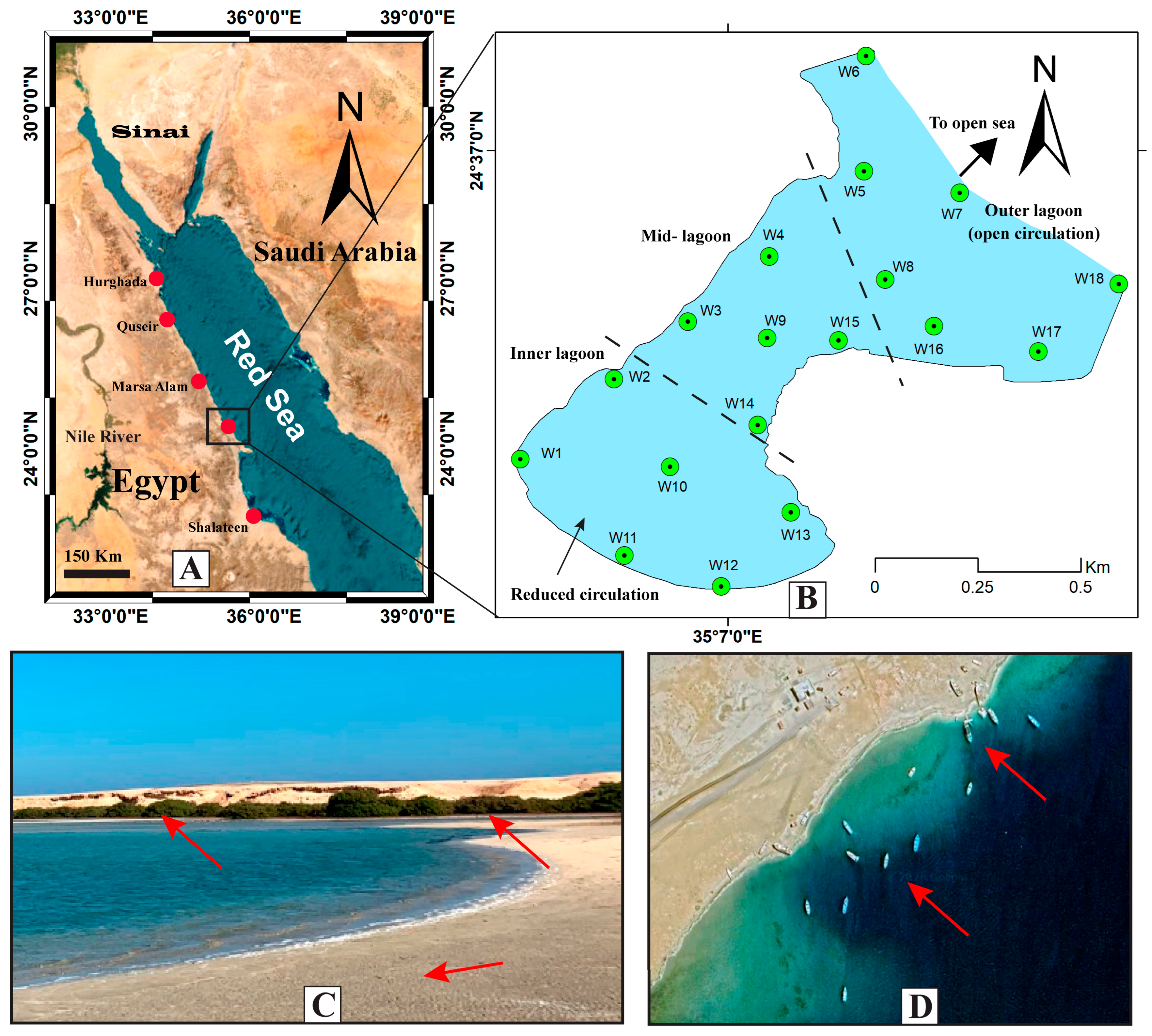
Figure 1. (A) Regional Google Earth map for the Egyptian Red Sea coastal cities. (B) Spatial distribution map for the collected samples from Sharm El-Luli stations. (C) Field photo shows the mangrove trees along the inner lagoon with sandy substrate of the proximal shore stations. (D) Google Earth shot displaying the boats occupying the northern part of the inner lagoonal environment.
Diversity 18 00130 g001
Figure 2. Microphotographs of some benthic ostracod assemblages retained from the investigated site, the arrows indicate the anterior direction of the ostracod valves: (A) Neonesidea schulzi (Hartmann, 1964), external, lateral view, left valve, sample W7, (B) Neonesidea schulzi (Hartmann, 1964), external, lateral view, right valve, sample W7, (C) Paranesidea fracticoralicola Maddocks, 1969, external, lateral view, left valve, sample W8, (D) Triebelina sertata Triebel, 1948, external, lateral view, left valve, sample. W3, (E) Aglaiocypris triebeli Hartmann, 1964, external, lateral view, right valve, sample W6, (F) Aglaiocypris triebeli (Hartmann, 1964), internal, lateral view, left valve, sample W15, (G) Chartocythere arenicola (Hartmann, 1964), external, lateral view, right valve, sample W17, (H) Moosella striata Hartmann, 1964, external, lateral view, left valve, sample W3, (I) Sclerochilus rectomarginatus Hartmann, 1964, external, lateral view, left valve, sample W4, (J) Loxocorniculum ghardaquensis (Hartmann, 1964), external, lateral view, left valve, sample W7, (K) Loxocorniculum ghardaquensis (Hartmann, 1964), internal, lateral view, left valve, sample W7, (L) Loxoconcha gurneyi Bate & Gurney, 1981, external, lateral view, left valve, sample W14, (M) Loxoconcha gurneyi Bate & Gurney, 1981, external, lateral view, right valve, sample W14, (N) Loxoconcha ornatovalvae Hartmann, 1964, external, lateral view, right valve, sample W3, (O) Cyprideis torosa (Jones, 1850), external, lateral view, right valve, sample W8, (P) Jugosocythereis borchersi (Hartmann, 1964), external, lateral view, right valve, sample W5, (Q) Jugosocythereis borchersi (Hartmann, 1964), external, lateral view, left valve, sample W5, (R) Lankacythere elaborata Whatley & Zhao, 1988, external, lateral view, left valve, sample W14, (S) Alocopocythere reticulata (Hartmann, 1964), external, lateral view, right valve, sample W15, (T) Xestoleberis multiporosa Hartmann, 1964, external, lateral view, left valve, sample W9, (U) Xestoleberis rotunda Hartmann, 1964, external, lateral view, right valve, sample W2, (V) Xestoleberis rotunda Hartmann, 1964, internal, lateral view, right valve, sample W2, (W) Xestoleberis ghardaqae Hartmann, 1964, external, lateral view, left valve, sample W2, (X) Xestoleberis ghardaqae Hartmann, 1964, internal, lateral view, left valve, sample W2.
Diversity 18 00130 g002
Figure 3. Spatial distribution maps for the measured water depth (A), and water temperature (B).
Diversity 18 00130 g003
Figure 4. Spatial distribution maps for the values of the measured in situ ecological variables: (A) pH, (B) Salinity, (C) Dissolved oxygen, (D) Total dissolved solids, (E) Specific conductivity, and (F) Redox-potential.
Diversity 18 00130 g004
Figure 5. Spatial distribution maps of the sediment characteristics of the bottom substrate in the Sharm El-Luli ecosystem: (A) Gravel%, (B) Sand%, and (C) Mud%.
Diversity 18 00130 g005
Figure 6. Spatial distribution maps for the measured carbonate content (A), and LOI (B) of Sharm El-Luli stations.
Diversity 18 00130 g006
Figure 7. Spatial distribution maps for the highest relative abundance (%) taxa of the recorded benthic ostracods assemblage in the Sharm El-Luli ecosystem, where (A) Xestoleberis rotunda, (B) Jugosocythereis borchersi, (C) Xestoleberis rhomboidea, (D) Aglaiocypris triebeli, (E) Loxoconcha ornatovalvae, (F) Xestoleberis multiporosa.
Diversity 18 00130 g007
Figure 8. (A) Species richness and individuals (number of the counted individuals per 50 g/dry weight) of the total living ostracod assemblages retrieved from the studied stations. (B) Diversity indices (Shannon and Dominance) for the total living ostracod assemblages in the investigated stations.
Diversity 18 00130 g008
Figure 9. Dendrograms (R and Q-mode) derived from cluster analysis with SIMPROF test on the similarity of the benthic ostracods assemblage and their sampling stations. Note, the Q-mode is illustrated by (A), while R-mode by (B) subfigures.
Diversity 18 00130 g009
Figure 10. Triplot ordination for RDA along the first two axes (RDA1 and RDA2) showing the relationship between benthic ostracods distribution patterns, sampling sites, and their controlling environmental variables.
Diversity 18 00130 g010
Table 1. The measured oceanographic parameters and the characteristics of the bottom sediments of the Sharm El-Luli stations.
SamplesCarbonate%LOI 550Depth (m)Gravel%Sand%Mud%T (°C)SalinityDOpHTDSEhSPC
W129.95.20.38563625.1639.299.178.4838.1434860.65
W230.75.30.47.268.524.325.3239.759.848.0838.7937060.56
W328.84.90.35.871.22324.6640.027.438.3138.2834361.02
W432.45.31.17.16131.924.9540.577.298.4239.733461.45
W538.65.51.25.964.13025.0840.338.428.4538.4933461.05
W633.43.81.51.560.53820.1641.127.398.9639.1633761.16
W742.65.74.11.25840.820.3241.147.398.4839.1833861.18
W833.65.42.41.356.74220.6241.167.628.4639.2133961.22
W937.44.21.62.159.93820.1841.757.158.4138.7933860.42
W1034.95.42.22.74156.320.141.667.168.5438.7933960.57
W1136.75.20.26.76429.324.9539.339.368.4839.3334061.43
W1230.83.10.36.36330.724.9839.319.68.4939.3234561.46
W1333.44.50.46.55835.524.5139.49.558.539.434561.53
W1433.63.50.46.158.239.724.5939.267.838.4739.2933261.4
W1533.63.80.55.758.33622.8639.499.488.539.4333961.65
W1638.64.31.65.356.73822.7539.59.728.5139.4533661.61
W1744.63.11.53.26333.823.1839.619.438.5239.5334561.75
W1848.84.33.51.353.245.520.2841.126.98.5339.4734561.64
Table 2. Pearson correlation coefficients between environmental variables and benthic foraminiferal parameters after Benjamini–Hochberg false discovery rate (FDR) correction. Only statistically significant correlations (q < 0.05) are shown.
Environmental VariableBiological VariablePearson rp-Valueq-Value (BH)Interpretation
TemperatureX. multiporosa−0.8440.000010.0014Strong negative
TemperatureSpecies richness−0.8130.000040.0026Strong negative
Water depthX. multiporosa0.7730.000170.0058Strong positive
SalinityX. multiporosa0.7710.000180.0058Strong positive
Water depthSpecies richness0.6910.001480.0379Moderate positive
Disclaimer/Publisher’s Note: The statements, opinions and data contained in all publications are solely those of the individual author(s) and contributor(s) and not of MDPI and/or the editor(s). MDPI and/or the editor(s) disclaim responsibility for any injury to people or property resulting from any ideas, methods, instructions or products referred to in the content.