Article

Climate Refugia of Endangered Mammals in South Korea Under SSP Climate Scenarios: An Ensemble Species Distribution Modeling Approach


1
National Institute of Ecology, Seocheon 33657, Republic of Korea
2
Department of Biological Sciences, Konkuk University, Seoul 05029, Republic of Korea
*
Author to whom correspondence should be addressed.
Diversity 2026, 18(1), 19; https://doi.org/10.3390/d18010019
Submission received: 17 November 2025 / Revised: 22 December 2025 / Accepted: 24 December 2025 / Published: 26 December 2025
(This article belongs to the Special Issue Bison and Beyond: Achievements and Problems in Wildlife Conservation)

Abstract

Climate change is expected to alter the distribution of many threatened mammals, yet national-scale identification of climate refugia and conservation priorities remains limited for South Korea. This study aimed to map current hotspots and future refugia for 10 endangered mammal species and evaluate conservation implications under SSP climate scenarios. We compiled occurrence records from nationwide field surveys and protected-area monitoring and fitted ten species distribution models (GLM, GAM, GBM, CTA, ANN, SRE, FDA, MARS, RF, and MaxEnt) using biomod2 with climatic, topographic, and anthropogenic predictors at 1 km resolution. A weighted ensemble model achieved strong predictive performance (mean AUC = 0.840). Current richness hotspots were concentrated along the Baekdudaegan mountain range, and several national parks emerged as core multi-species areas. Variable-importance analysis indicated that topographic constraints (elevation and slope) dominated for most species, consistent with mountain-dependent habitat use. Future projections showed relatively stable richness patterns under SSP2–4.5 but pronounced contractions under SSP5–8.5 by the 2070s, with persistent high-suitability areas converging in the northern Baekdudaegan. The resulting suitability and richness layers provide spatial decision-support for protected-area strengthening, connectivity-oriented management, and targeted monitoring to support national climate-adaptation planning.

1. Introduction

The Earth is experiencing an unprecedented biodiversity crisis during the Anthropocene, often referred to as the “Sixth Mass Extinction” [1,2]. Unlike the previous five mass extinctions that were largely triggered by major natural catastrophes, the current crisis is driven by multiple interacting pressures. Human activities constitute a major accelerating force, while background natural variability and stochastic processes can also contribute to extinction dynamics [3,4]. Climate change acts as a key amplifier of biodiversity loss because it interacts with habitat loss, overexploitation, invasive species, and disease, thereby increasing extinction risk across taxa [5,6,7].
Mammals can be particularly sensitive to rapid environmental change due to their relatively slow life histories, large space requirements, and dependence on landscape connectivity for dispersal and range shifts [8,9,10,11]. Rare and range-restricted species may be especially vulnerable because limited population sizes and narrow distributions can reduce demographic resilience under rapidly changing conditions [12,13]. Moreover, land-use change and fragmentation can reduce landscape connectivity and may constrain dispersal or range shifts that facilitate responses to climate change, although the magnitude of such effects is species- and landscape-dependent [10,11].
Species distribution models (SDMs) relate occurrence data to environmental predictors to estimate habitat suitability and potential geographic distributions [14,15]. SDMs are widely used to assess climate-change impacts by projecting expected range shifts, contraction risks, and persistence areas under future scenarios, thereby supporting spatial prioritization and conservation planning [16,17,18,19]. However, projections can vary among algorithms and can be affected by sampling bias and spatial autocorrelation; therefore, ensemble approaches that integrate multiple SDMs are increasingly recommended to improve robustness and reduce method-specific uncertainty [20,21,22,23,24,25]. Recent studies in Asia have increasingly applied habitat-suitability modeling with climate projections to identify persistence areas and support conservation prioritization for threatened mammals, highlighting the need for comparable national-scale assessments in South Korea [26,27,28].
South Korea spans strong latitudinal and altitudinal gradients and contains a mountainous ecological network centered on the Baekdudaegan range, which functions as a major habitat backbone for mammalian biodiversity [29,30,31]. Rapid land-use change and habitat fragmentation have reduced and subdivided natural habitats, increasing extinction risk for many species [32]. The Korean Ministry of Environment legally designates endangered wildlife species (ME Classes I–II), including mammals, and provides national protection status [33,34]. Meanwhile, observed warming and scenario-based projections indicate continued temperature increases in the coming decades, raising concern for climate-sensitive mammals and emphasizing the need for quantitative, scenario-based assessments of habitat change and potential climate refugia in the country [35,36,37].
In this study, we focus on 10 endangered mammal species designated by the Korean Ministry of Environment (ME Classes I–II). These focal species were selected because they are of high conservation-policy priority and because sufficient nationwide georeferenced occurrence records were available from long-term surveys and monitoring programs to support consistent 1 km2 modeling; their taxonomic status is summarized in Table 1. We aimed to (1) develop and evaluate AUC-weighted ensemble SDMs using 10 algorithms implemented in biomod2; (2) quantify key environmental determinants of habitat suitability across species; (3) map current habitat suitability and multi-species richness patterns and assess the conservation relevance of protected areas; and (4) project future suitability changes and identify potential climate refugia under SSP2-4.5 and SSP5-8.5 for the 2030s, 2050s, and 2070s. We tested three a priori hypotheses: (H1) habitat suitability and richness hotspots will contract and shift toward higher latitudes and/or elevations, with stronger contractions under SSP5-8.5, especially by the 2070s; (H2) climate refugia will be concentrated along the northern Baekdudaegan due to topographic complexity and climatic buffering; and (H3) predicted refugia/hotspots will not fully overlap with current protected areas, indicating spatial conservation gaps and the need for connectivity-oriented management.

2. Materials and Methods

2.1. Study Area

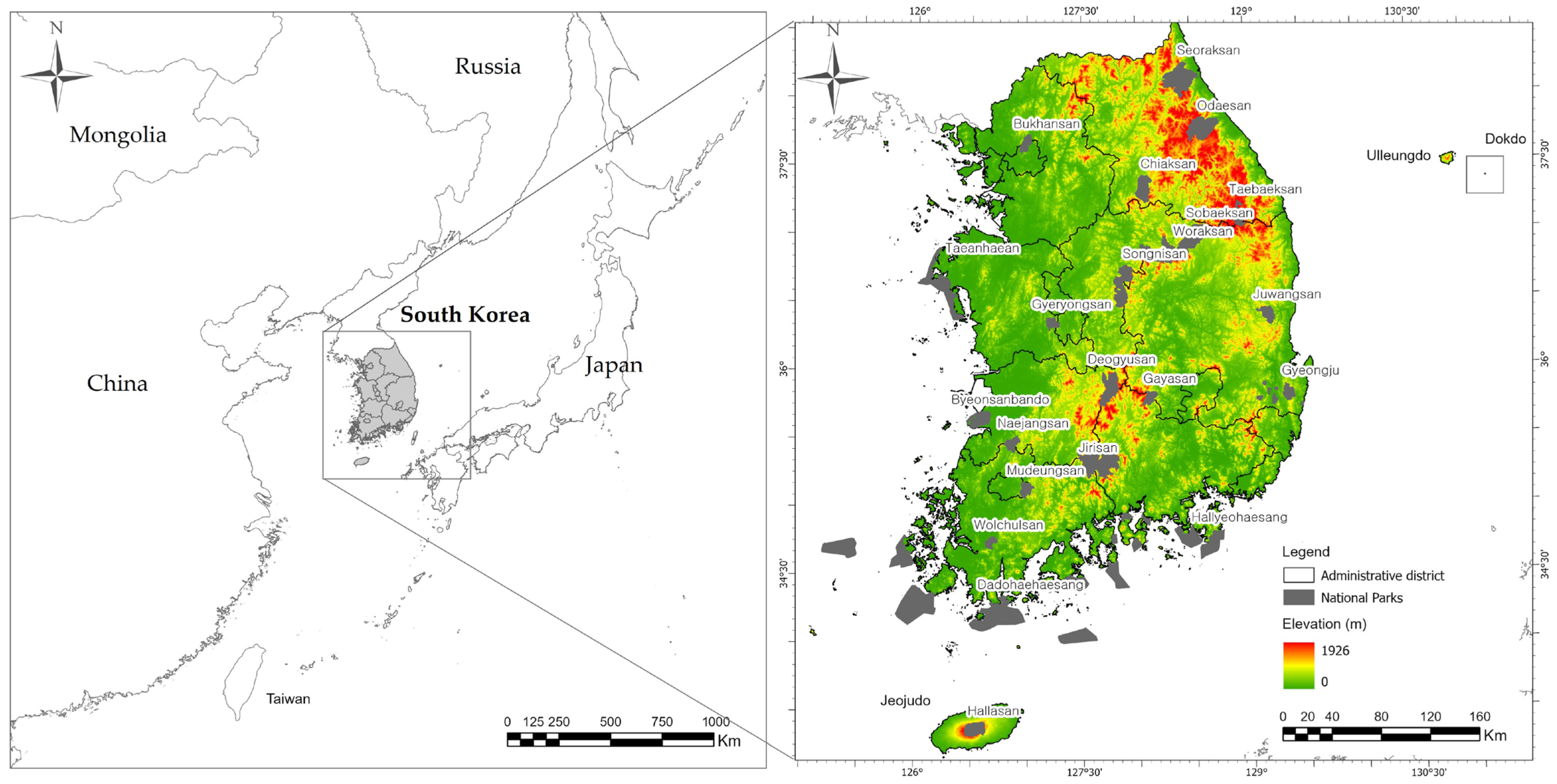
This study was conducted across the entire territory of South Korea, covering an area of approximately 100,210 km2 (Figure 1). South Korea is located in the temperate monsoon climate zone of East Asia, with an average annual temperature ranging from 10 °C to 15 °C and annual precipitation between 1200 mm and 1500 mm, with over 60% of the precipitation occurring during the summer months (June to August) [32,38]. Geographically, the eastern and northern regions are characterized by the Baekdudaegan mountain range, with the highest peak, Daecheongbong of Mt. Seoraksan, reaching an altitude of 1708 m. The western and southern regions are dominated by plains and rolling hills [29]. Approximately 63% of the country is covered by forests, which are vertically and horizontally distributed depending on altitude and latitude, with coniferous forests, broadleaf forests, and mixed forests [30,39]. The Baekdudaegan mountain ecological corridor is a core area for biodiversity in South Korea, providing essential habitats for endangered mammals and other forest-dependent taxa [31,40]. However, in recent decades, habitat fragmentation has been accelerating due to industrialization, urbanization, and agricultural development, making climate change a major threat to biodiversity [32].

2.2. Species Occurrence Data

We modeled 10 mammal species designated as endangered wildlife species (Grades I and II) by the Korean Ministry of Environment [33,34]. The focal species and their taxonomic status (order and family) are summarized in Table 1, and the distribution of the focal taxa across orders and families is presented in Table 2. Overall, the study species comprise four orders (Artiodactyla, Carnivora, Chiroptera, Rodentia) and seven families. In South Korea, Grades I and II are national legal categories for endangered wildlife designated by the Ministry of Environment, where Grade I indicates the highest protection priority and Grade II indicates high priority. These national grades are not directly equivalent to IUCN Red List categories, which provide global conservation status and are reported for reference.
Species occurrence data were compiled from three nationwide and long-term monitoring sources: (1) the National Institute of Ecology (NIE)’s National Natural Environment Survey (1997–2021), (2) the National Park Service’s Natural Resource Survey (2003–2022), and (3) the NIE Endangered Species Restoration Center monitoring dataset (2001–2022). All occurrence records were georeferenced using GPS coordinates in the WGS84 coordinate system, and only records with positional accuracy < 1 km were retained for analysis.
To improve data quality and reduce spatial bias, we applied a multi-step filtering procedure [41,42]. Records with obvious spatial errors (e.g., locations in marine areas or outside South Korea) or uncertain species identification were excluded. To match the 1 km resolution of predictor variables and to minimize spatial autocorrelation, occurrences were aggregated to a 1 km2 grid and duplicate records within the same grid cell were consolidated into a single representative presence point [41,43].

2.3. Environmental Variables

For species distribution modeling, a total of 10 environmental variables related to bioclimatic, topographic, and human activity factors were selected (Table 3). The bioclimatic variables were based on high-resolution (1 km) climate data provided by the Korea Meteorological Administration (KMA). This data was produced by statistically ensembling five regional climate models (HadGEM3-RA, WRF, CCLM, GRIMs, RegCM4) based on the IPCC AR6’s Shared Socioeconomic Pathways (SSP) scenarios [44]. From the 19 available bioclimatic variables, the following were selected for analysis: annual mean temperature (BIO1), mean diurnal temperature range (BIO2), isothermality (BIO3), annual precipitation (BIO12), precipitation of the wettest month (BIO13), and precipitation of the driest month (BIO14) [45]. Topographic variables, including elevation and slope, were derived from the Shuttle Radar Topography Mission (SRTM) Digital Elevation Model (DEM) at a 90-m resolution. These variables were calculated using QGIS 3.28 software and then resampled to a 1 km2 resolution [46]. To assess multicollinearity among the environmental variables, Pearson correlation coefficients were calculated, and pairs of variables with a correlation coefficient higher than 0.7 were evaluated. Based on ecological significance and prior studies, only one variable from each correlated pair was retained for analysis [47]. Human activity-related variables, such as the distance to the nearest water body and the distance to roads, were also included in the model. These variables are relevant for understanding the potential influence of human activities on species distributions. The distance to water bodies was derived from the WAMIS (Water Management Information System) database, while the distance to roads was calculated using spatial data from the National Geographic Information Institute of Korea (NGII).

2.4. Species Distribution Modeling (SDM)

Species distribution modeling was conducted using the biomod2 package (version 4.2-5) in R (version 4.2.3) [23,48]. A total of 10 SDMs were applied, including Generalized Linear Models (GLM), Generalized Additive Models (GAM), Generalized Boosted Models (GBM), Classification Tree Analysis (CTA), Artificial Neural Networks (ANN), Surface Range Envelope (SRE), Flexible Discriminant Analysis (FDA), Multivariate Adaptive Regression Splines (MARS), Random Forest (RF), and Maximum Entropy (MAXENT) [49,50,51]. Given the limited occurrence data for endangered species, 10,000 random background points (pseudo-absence) were generated for each species [52]. For model training and validation, a bootstrap cross-validation approach was employed. The data were randomly divided into 70% training data and 30% validation data, and this process was repeated 10 times [53]. The performance of each model was evaluated using three metrics: (1) Area Under the Curve (AUC), (2) True Skill Statistic (TSS), and (3) Kappa statistic [54,55]. AUC values range from 0.5 (random) to 1.0 (perfect prediction), with values above 0.7 being considered as acceptable models [56]. The predictions from individual models were integrated using ensemble techniques. Two ensemble methods were applied: (1) simple average ensemble (EM) and (2) weighted average ensemble (EMW). In the weighted average ensemble, each model’s weight was calculated based on its AUC value [22].
The weight w i for each model was calculated as follows (1):
w i = A U C i 0.5 j = 1 n ( A U C j 0.5 )
Here, wi is the weight of model i, AUCi is the AUC value of model i, and n is the total number of models. The final ensemble prediction Pensemble was calculated as a weighted sum of the individual model predictions (2):
P e n s e m b l e =   i = 1 n w i   ×   P i
where Pensemble is the ensemble prediction, and Pi is the prediction from model i.
The relative importance of environmental variables was assessed using the variable permutation method [51]. This method involves randomly reshuffling the values of each variable and measuring the resulting decrease in model performance, thereby quantifying the importance of each variable. The importance scores were then standardized on a scale from 0 (no influence) to 1 (maximum influence).

2.5. Climate Change Scenarios and Future Projections

To predict future habitat changes under climate change, the study applied two Shared Socioeconomic Pathways (SSP) scenarios from the IPCC AR6: SSP2-4.5 (moderate emissions scenario) and SSP5-8.5 (high emissions scenario) [57,58]. SSP2-4.5 represents a middle-of-the-road pathway with moderate climate mitigation efforts, while SSP5-8.5 assumes continued fossil fuel-driven development and the highest emissions trajectory [59]. Future climate data were obtained from the Korea Meteorological Administration (KMA) and are based on a statistical ensemble of five regional climate models (HadGEM3-RA, WRF, CCLM, GRIMs, RegCM4) at a 1 km2 resolution [44]. These datasets were divided into three time periods: the 2030s (2021–2040), the 2050s (2041–2060), and the 2070s (2061–2080), with each period representing a 20-year average climate condition. The ensemble models, developed using baseline climate data derived from the 1981–2010 normals (hereafter, the ‘2010 baseline’), were projected onto future climate conditions to estimate habitat suitability changes for each species. For environmental variables such as elevation and slope, as well as human activity-related factors (e.g., distance to roads and water bodies), it was assumed that these variables would remain constant over time [18]. The projection was conducted with a clamping option to minimize extrapolation errors for environmental conditions that fall outside the range of training data [60].

2.6. Habitat Suitability Classification and Species Richness

Habitat suitability values for each species were calculated on a continuous scale ranging from 0 (very unsuitable) to 1 (very suitable). For binary classification (presence/absence), a suitability threshold was established to determine whether a species would be present in a given area. In this study, the threshold was set to maximize the sum of sensitivity and specificity (TSS-based threshold), which generally resulted in a threshold value around 0.5 for most species [54,55]. Species richness was calculated by summing the number of species predicted to be suitable for a given 1 km2 grid cell. The resulting species richness maps were generated at the national level, by local government units (city/district), and by national parks to assess the spatial distribution of species across these different spatial scales. For the identification of climate refugia, regions with consistently high habitat suitability (≥0.7) across all time periods, from the present to the 2070s, were defined as potential refugia. These areas were considered key conservation zones for species survival under future climate change scenarios, as they are expected to provide long-term habitat suitability despite climate change [61,62].

3. Results

3.1. Model Performance Evaluation

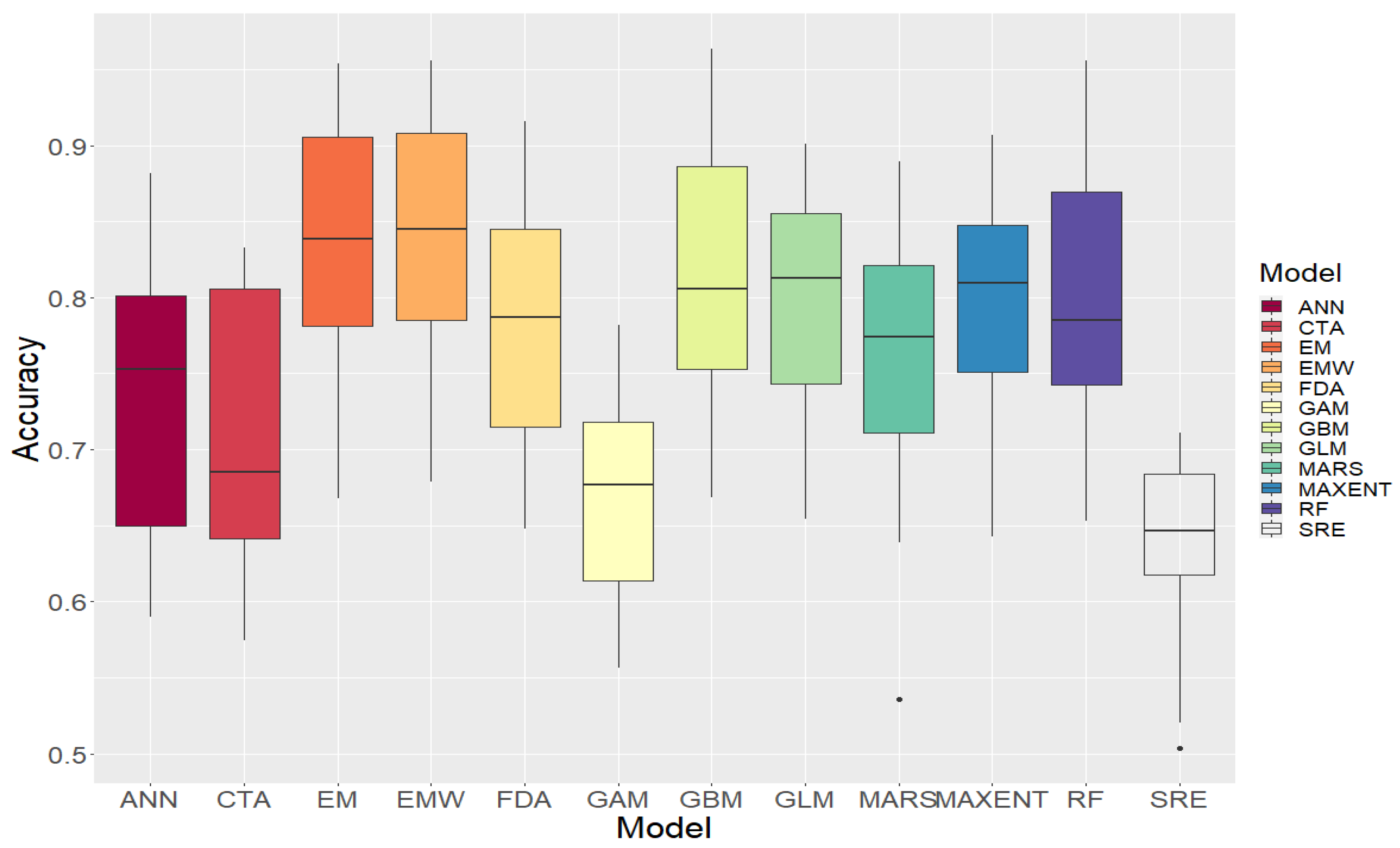
Model performance across the 10 SDM algorithms and the two ensemble models is summarized in Figure 2. The corresponding numerical AUC values are provided in Table S1 (Supplementary Materials). Among the individual models, the Generalized Boosted Model (GBM) achieved the highest accuracy (AUC = 0.817), followed by Random Forest (RF) (AUC = 0.802) and Maximum Entropy (MAXENT) (AUC = 0.800). Models with lower performance included Surface Range Envelope (SRE) (AUC = 0.633) and Generalized Additive Model (GAM) (AUC = 0.671). Ensemble models outperformed individual models, with the weighted average ensemble (EMW) yielding the highest AUC of 0.840, followed by the simple average ensemble (EM) with an AUC of 0.835. The ensemble models showed more consistent performance, as indicated by lower standard deviations compared to individual models.

3.2. Species-Specific Model Performance

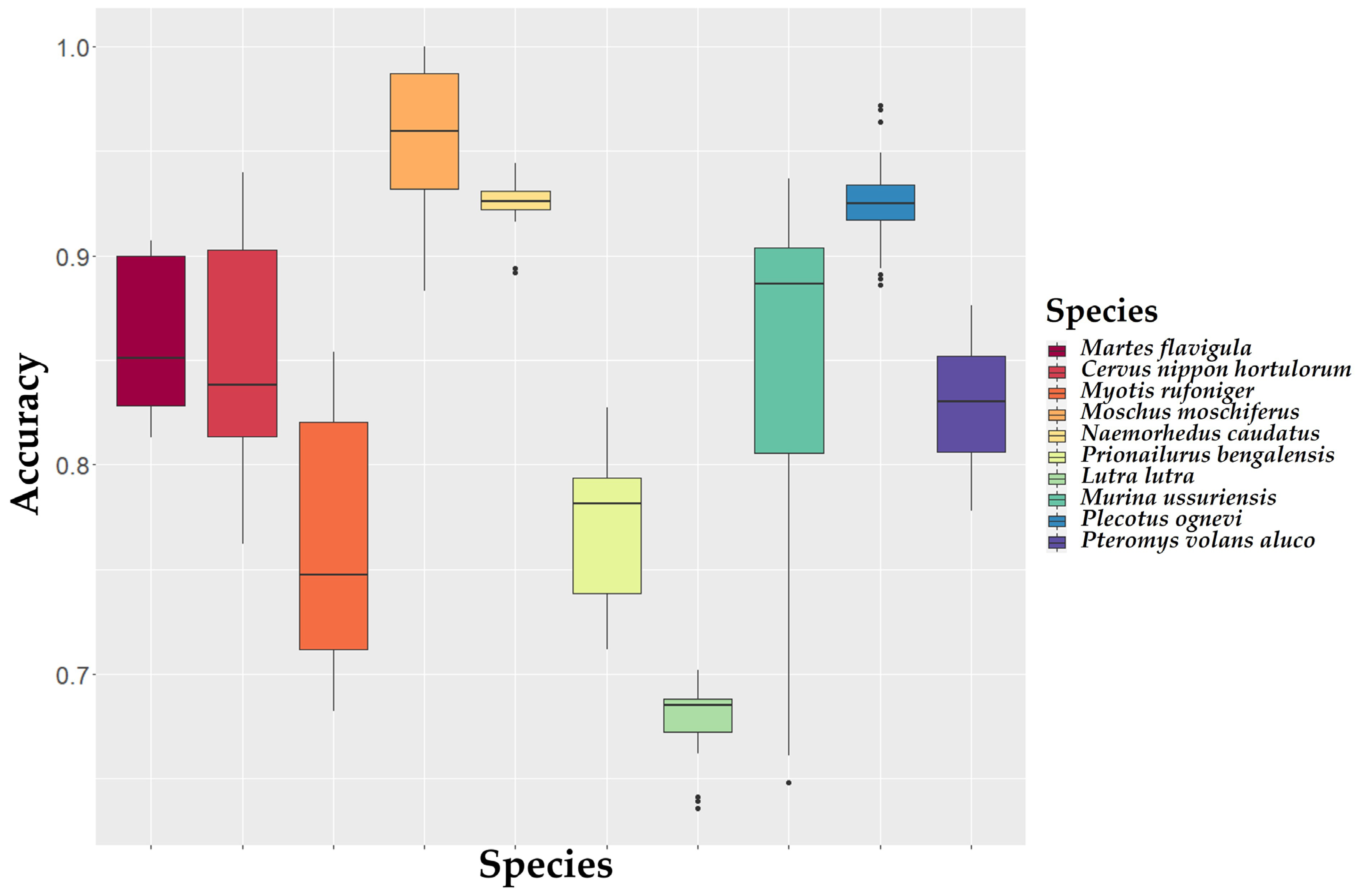
The accuracy of each species-specific prediction was evaluated using the Random Forest model, with performance varying across species (Figure 3). The corresponding numerical AUC summary statistics are provided in Table S2 (Supplementary Materials). The average AUC values ranged from 0.679 (L. lutra) to 0.956 (M. moschiferus), with an overall average of 0.827 across all species. M. moschiferus achieved the highest AUC of 0.956 (standard deviation = 0.037, range: 0.883–1.000), followed by P. ognevi with an average AUC of 0.925 (standard deviation = 0.022, range: 0.886–0.972), and N. caudatus with 0.924 (standard deviation = 0.013, range: 0.892–0.944). Medium-high performance species included M. flavigula (AUC = 0.860 ± 0.035), C. nippon hortulorum (AUC = 0.851 ± 0.048), M. ussuriensis (AUC = 0.838 ± 0.092), and P. volans aluco (AUC = 0.827 ± 0.030). These species all had an AUC greater than 0.8, indicating good model performance. Lower-performing species included Prionailurus bengalensis (AUC = 0.771 ± 0.036) and M. rufoniger (AUC = 0.764 ± 0.058), which both showed performance within the acceptable range but lower than the higher-performing species. L. lutra had the lowest AUC at 0.679 (standard deviation = 0.017, range: 0.636–0.702), although its low AUC was accompanied by low variability in predictions. The variability in performance was further assessed using the standard deviation. N. caudatus and P. ognevi exhibited very low variability (standard deviations of 0.013 and 0.022, respectively), indicating highly consistent predictions. In contrast, M. ussuriensis showed the highest variability (standard deviation = 0.092), likely due to a limited number of occurrence records. Overall, nine out of ten species had AUC values above 0.7, demonstrating the reliability of the model predictions for the majority of species.

3.3. Environmental Variables Importance

Species-specific rankings of predictor importance derived from the Random Forest model are summarized in Table 4 (rank 1 = highest importance). Topographic variables ranked first for five of the ten species: elevation was the top-ranked predictor for M. flavigula and C. nippon hortulorum, whereas slope ranked first for M. rufoniger, M. moschiferus, and N. caudatus. The climatic predictor BIO1 (annual mean temperature) ranked first for Prionailurus bengalensis and P. volans aluco. Among the landscape variables, distance to water bodies ranked first for L. lutra and M. ussuriensis, and distance to roads ranked first for P. ognevi.

3.4. Current Species Richness Distribution

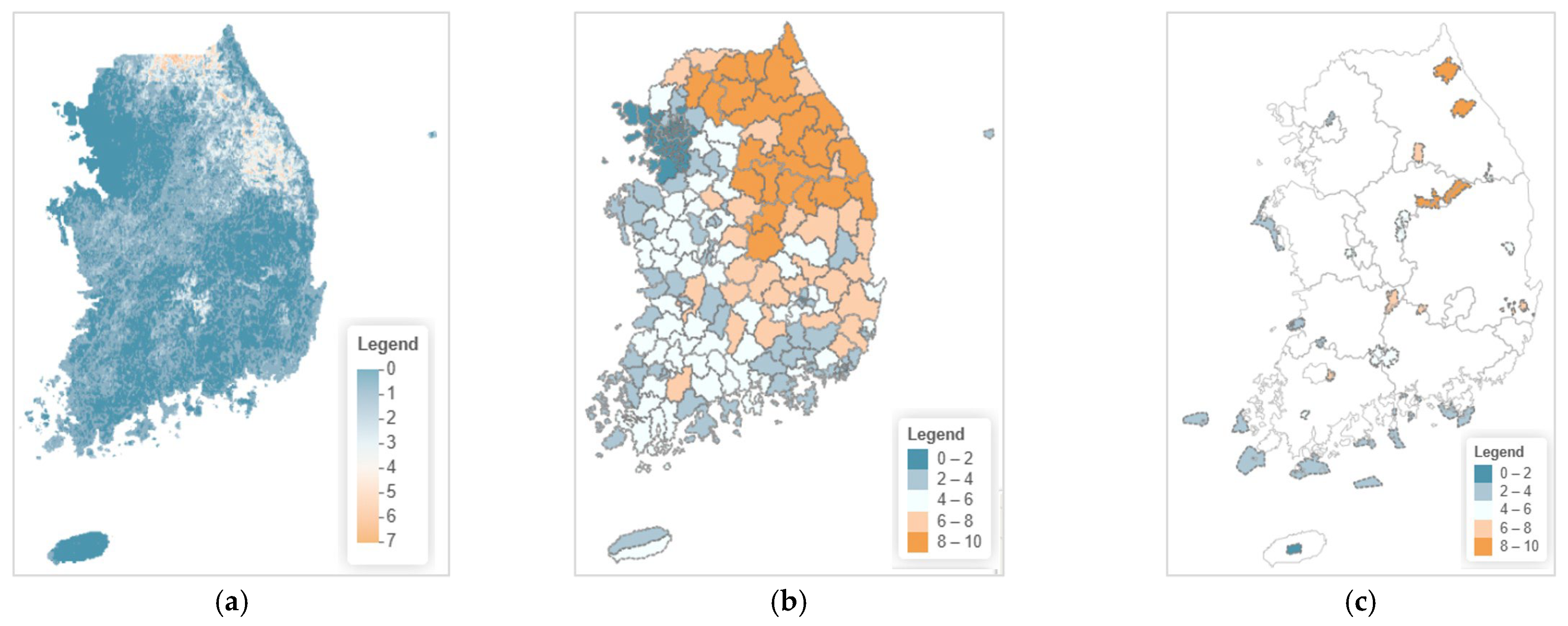
Species richness was calculated by predicting habitat suitability for the 10 endangered mammal species using the weighted average ensemble model (EMW) under baseline climate conditions (1981–2010 normals; hereafter, the ‘2010 baseline’) (Figure 4). Species richness ranged from 0 to a maximum of 10 species per grid cell, showing distinct spatial patterns.

3.4.1. Overall Species Richness Distribution Pattern

The national-level species richness analysis revealed that areas with high species richness (7 or more species) were concentrated primarily in the mountainous regions of Gangwon Province and Gyeongsangbuk-do, particularly along the Baekdudaegan mountain range (Figure 4a). The highest species richness was observed along the Baekdudaegan ridge connecting Mt. Seoraksan, Mt. Odaesan, Mt. Taebaeksan, and Mt. Sobaeksan. Areas with moderate species richness (4–6 species) were distributed across forested regions in Chungcheongbuk-do, Jeollabuk-do, and Gyeongsangnam-do, while regions with low species richness (1–3 species) were predominantly found in the western plains and urban areas. The southern coastal areas, including Jeju Island, showed the lowest species richness, with most areas recording fewer than 3 species.

3.4.2. Current Species Richness by Local Government Units

Analysis of species richness by local government unit revealed that some areas in the mountainous regions of Gangwon-do showed high species richness (7–8 species) (Figure 4b). The northern parts of Gyeongsangbuk-do (e.g., Bonghwa, Uljin) and eastern Chungcheongbuk-do (e.g., Danyang) also exhibited moderate-to-high species richness (5–7 species). In contrast, local governments in the capital region (Seoul, Incheon, and most of Gyeonggi-do) and the southwestern plains (Jeollanam-do and western Chungcheongnam-do) recorded low species richness (1–3 species). Inland plain areas that are not adjacent to the Baekdudaegan also generally showed species richness ranging from 2 to 4 species.

3.4.3. Current Species Richness by National Parks

Species richness by national park showed that Mt. Odaesan National Park had the highest richness, with 9 species recorded, followed by Mt. Seoraksan and Mt. Sobaeksan National Parks, each with 8 species (Figure 4c). Mt. Deogyusan National Park recorded 6 species, while Mt. Jirisan National Park had 5 species. Inland mountainous national parks (Mt. Seoraksan, Mt. Odaesan, Mt. Sobaeksan, Mt. Deogyusan, and Mt. Jirisan) exhibited high species richness (5–9 species), whereas coastal and marine national parks (Hallyeohaesang, Taeanhaean) and lowland parks (Mt. Mudeungsan) recorded low species richness (2–3 species). Mt. Hallasan National Park showed moderate species richness, with 4 species. A clear difference in species richness was observed between inland mountainous national parks and coastal/lowland national parks, indicating that the habitats of endangered mammals are concentrated in higher-altitude mountainous areas. National parks located along the Baekdudaegan ecological corridor (Mt. Seoraksan, Mt. Odaesan, and Mt. Sobaeksan) maintained high species richness, with over 7 species present.

3.5. Future Habitat Changes Predictions

The changes in species richness under the SSP2-4.5 (moderate emissions scenario) and SSP5-8.5 (high emissions scenario) for the 2030s, 2050s, and 2070s were predicted. This analysis utilized species richness maps and local government and national park-level species richness maps to assess the impact of climate change on species richness and habitat suitability across different time points.

3.5.1. National-Level Species Richness Change

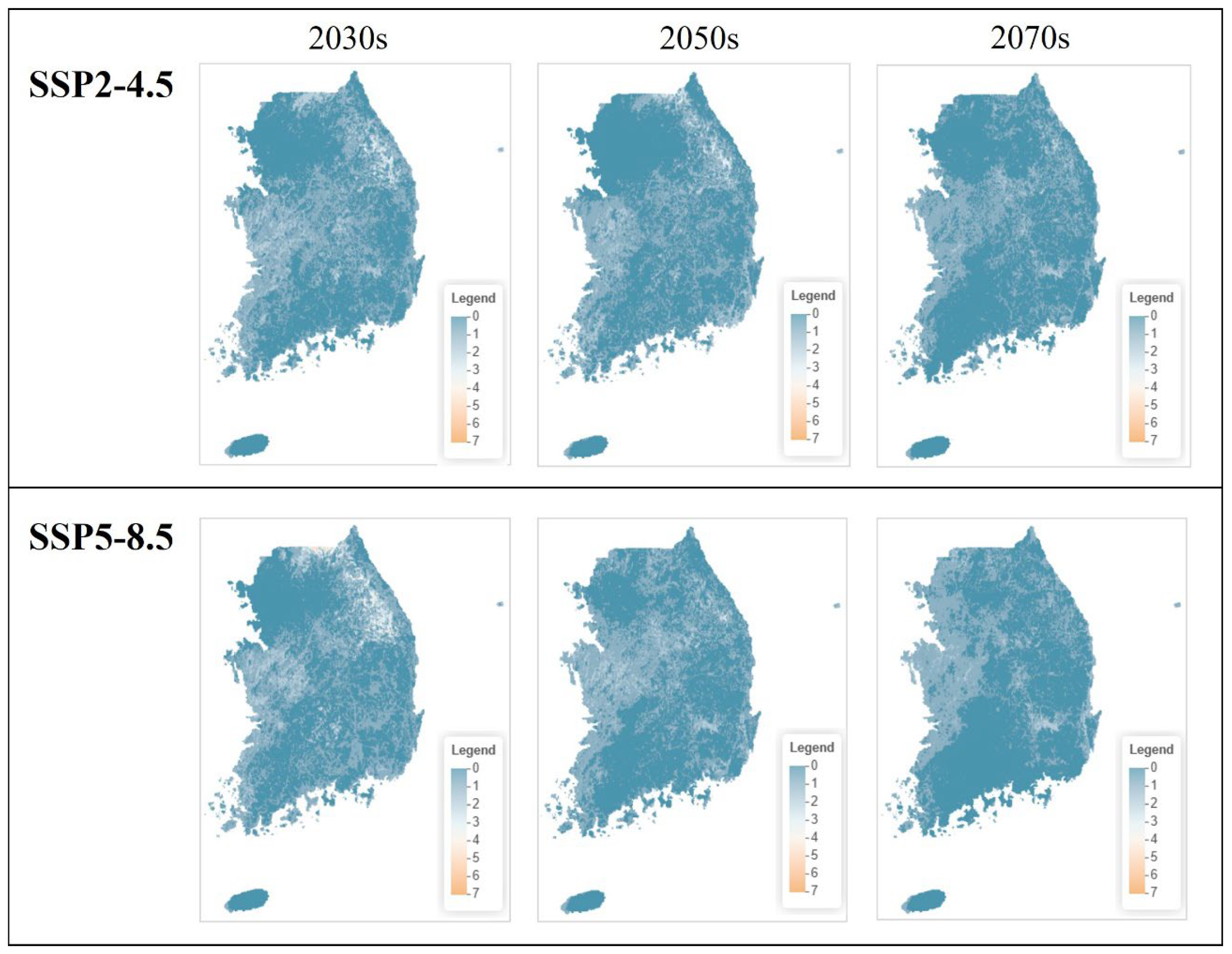
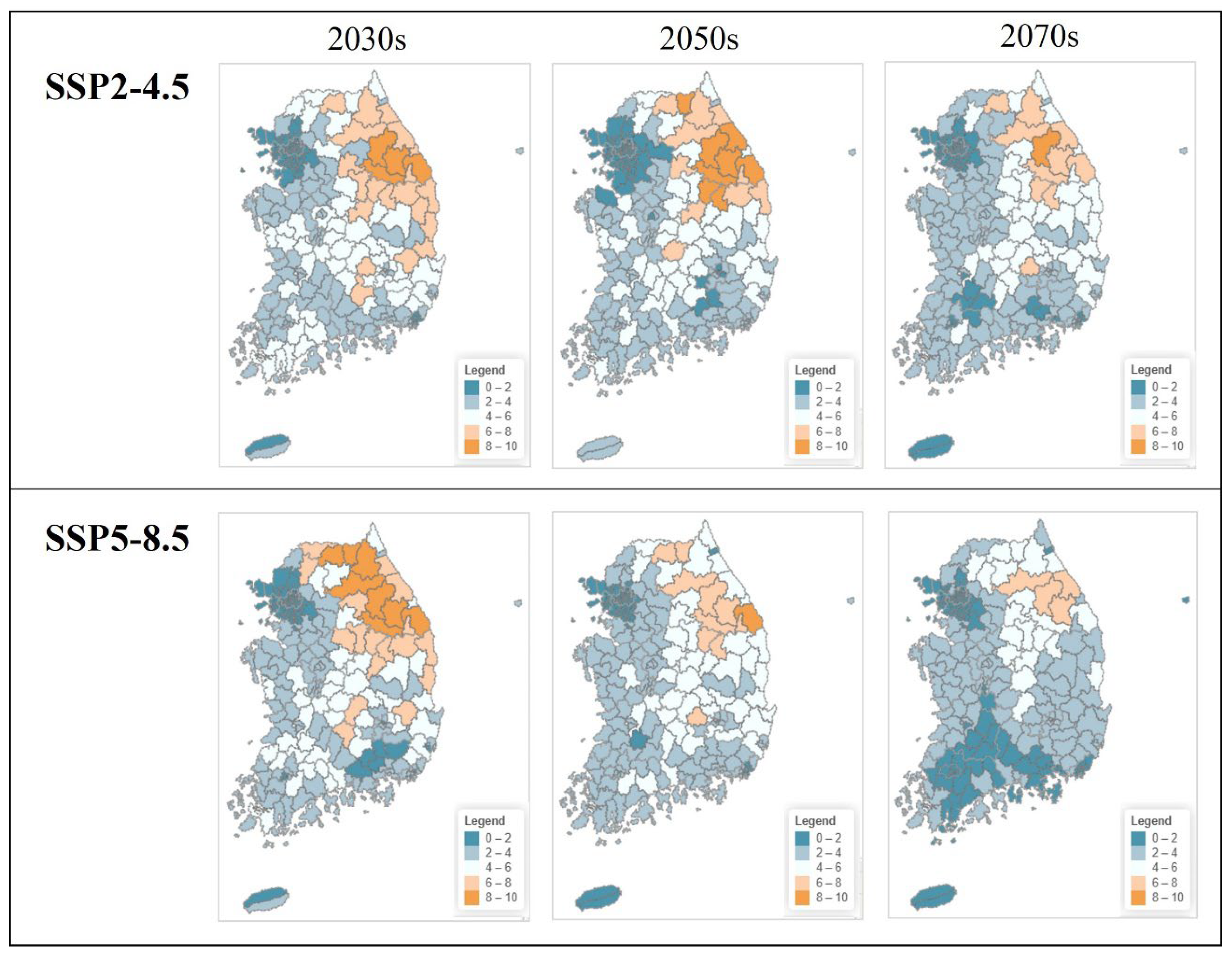
Under the SSP2-4.5 scenario, species richness patterns remained relatively stable from the 2030s to the 2070s. High species richness areas (5–7 species), centered around the Baekdudaegan mountain range, showed similar spatial distributions across all three time periods, while low species richness areas (0–2 species) in lowland and plain regions remained unchanged. A slight decrease in species richness was observed in some central inland regions by the 2070s, although the change was minor. In contrast, under the SSP5-8.5 scenario, species richness showed a marked decrease over time. In the 2030s, species richness patterns were similar to those in the SSP2-4.5 scenario; however, from the 2050s onwards, species richness decreased in the southern Baekdudaegan region and central mountainous areas. By the 2070s, high species richness areas were confined to a limited region in the northern Baekdudaegan, while central and southern mountainous areas saw a decline to medium species richness (3–4 species). Low species richness areas in lowland plains remained consistent in both scenarios (Figure 5).

3.5.2. Projected Species Richness by Local Government Units Under SSP Scenarios

Species richness at the local government level showed relative stability under the SSP2-4.5 scenario (Figure 6). Mountainous local governments in Gangwon-do were consistently classified in the highest richness class (6–8 species) from the 2030s to the 2070s, while several local governments in northern Gyeongsangbuk-do and eastern Chungcheongbuk-do remained in the moderate-to-high class (4–6 species) across the same periods. In contrast, many local governments in the capital region and western lowland/plains were consistently categorized in the lowest richness class (0–2 species). A modest decline in the richness class was observed in parts of northern Gyeonggi-do and the Chungcheong region by the 2070s.
Under the SSP5-8.5 scenario, a clearer downward shift in richness classes was evident over time (Figure 6). In the 2030s, local governments in Gangwon-do were largely classified as 6–8 species, but this pattern shifted toward 4–6 species by the 2050s, and several areas further declined to the 2–4 species class by the 2070s. In addition, some local governments in northern Gyeongsangbuk-do and eastern Chungcheongbuk-do that were classified as 4–6 species in the 2030s shifted to the 2–4 species class by the 2070s. Across both scenarios, low richness classes (0–2 species) persisted in many lowland/plain areas, including parts of the capital region.

3.5.3. Projected Species Richness by National Parks Under SSP Scenarios

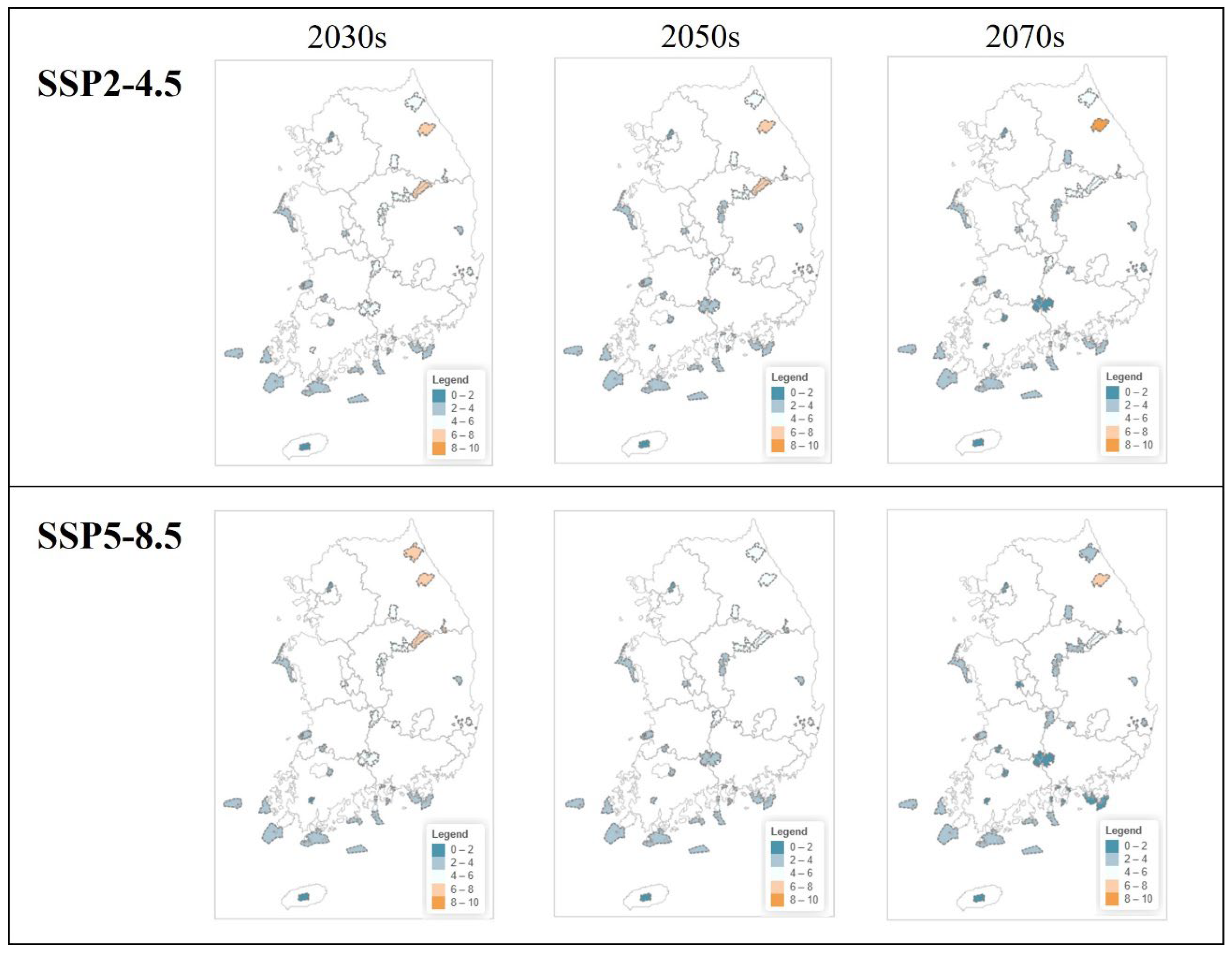
Species richness by national park remained relatively stable under the SSP2-4.5 scenario. Mt. Seoraksan, Mt. Odaesan, and Mt. Sobaeksan National Parks maintained high species richness (6–8 species) from the 2030s to the 2070s. Mt. Jirisan and Mt. Deogyusan National Parks showed species richness in the 4–6 species range, with little change over time. Coastal and lowland national parks consistently showed low species richness (2–4 species) in all three time periods. Under the SSP5-8.5 scenario, different change patterns emerged across national parks. In the 2030s, most mountainous national parks maintained high species richness; however, from the 2050s onwards, species richness began to decrease in southern and central national parks (Mt. Jirisan, Mt. Deogyusan). By the 2070s, only Mt. Seoraksan and Mt. Odaesan National Parks retained high species richness (6–8 species), while Mt. Sobaeksan National Park decreased to 4–6 species, and Mt. Jirisan and Mt. Deogyusan National Parks dropped to 2–4 species. Coastal and lowland national parks showed little change in species richness in both scenarios (Figure 7).

3.5.4. Comparison Between Scenarios and Time Periods

Across spatial summaries (national 1 km grid, local government units, and national parks), projections under SSP2-4.5 and SSP5-8.5 were broadly similar in the 2030s, but differences increased in the 2050s and were most pronounced in the 2070s (Figure 5, Figure 6 and Figure 7). At the national scale, SSP2-4.5 maintained the main high-richness pattern along the Baekdudaegan corridor with only minor changes through the 2070s, whereas SSP5-8.5 showed a clearer downward shift in richness classes and a contraction of higher-richness areas toward the northern Baekdudaegan by the 2070s (Figure 5).
A consistent pattern was observed at finer administrative and protected-area scales. At the local government level, several mountainous jurisdictions retained relatively higher richness under SSP2-4.5 across time periods, while under SSP5-8.5, multiple jurisdictions shifted from moderate (e.g., 4–6) to lower (e.g., 2–4) richness classes by the 2070s (Figure 6). At the national park level, richness remained relatively stable under SSP2-4.5; under SSP5-8.5, reductions became clearer by the 2070s, with only Mt. Seoraksan and Mt. Odaesan remaining in the highest richness class (6–8 species), while Mt. Sobaeksan decreased to 4–6 species and Mt. Jirisan and Mt. Deogyusan declined to 2–4 species (Figure 7).

4. Discussion

4.1. Superiority of Ensemble Modeling

In this study, the ensemble models (EM, EMW) showed higher predictive performance than all individual models, with average AUC values of 0.835 and 0.840, respectively. These results align with previous studies indicating that ensemble approaches reduce the uncertainty of single models and improve prediction accuracy [21,22,24]. The weighted average ensemble (EMW) performed better than the simple average ensemble (EM), with the former achieving an AUC of 0.840. This indicates that assigning weights based on model performance is effective. Weighted ensembles can minimize the influence of weaker models while maximizing the contributions of stronger ones [22]. Among individual models, machine learning SDMs like GBM (0.817), RF (0.802), and MAXENT (0.800) showed the best performance, which can be attributed to their ability to effectively model complex, nonlinear species-environment relationships [48,49,50]. GBM’s high performance stems from its boosting technique, which sequentially minimizes errors during the learning process [63], while RF’s ensemble learning through decision trees helps prevent overfitting [64]. MAXENT, optimized for presence-only data, provides reliable results even with limited occurrence data [65].
On the other hand, simpler SDMs like SRE (0.633) and GAM (0.671) performed relatively poorly. SRE, which only considers the range of environmental variables, fails to capture the complexity of species-environment relationships [66]. However, even such simple models contribute useful information under ensemble modeling, enhancing the robustness of overall predictions [23]. The standard deviation of ensemble models (EMW 0.085, EM 0.087) was lower than most individual models, indicating higher consistency in predictions across species. This suggests that the ensemble approach offsets individual SDM biases and provides more stable predictions [67]. The minimum-maximum range for EMW (0.277) was narrower than the individual model average (0.312), effectively reducing prediction variance across species. These findings demonstrate that ensemble modeling can provide reliable predictions, even with limited occurrence data for endangered species. In particular, EMW proved to be a consistent and robust predictive tool, achieving an AUC greater than 0.7 for all species, which supports its use as a preferred approach in conservation planning [25,68].

4.2. Species-Specific Model Performance Differences

Recent SSP-based applications across Asia similarly use habitat-suitability modeling with climate projections to identify persistence areas and translate projections into conservation prioritization. For example, administrative-scale suitability outputs have been used to support decision-making based on field survey data [26], while regional assessments of mesocarnivores emphasize integrating projected suitability changes with protected-area networks and connectivity planning [27]. In addition, cervid-focused projections report climate-driven redistribution and contraction of suitable habitat under future warming, which is consistent with our scenario-based patterns and the identification of persistent high-suitability areas [28].
Species-specific accuracy, based on the Random Forest model, varied significantly, with AUC ranging from 0.956 (Moschus moschiferus) to 0.679 (Lutra lutra). These differences were influenced by ecological and methodological factors. First, habitat specialization affected model performance. Specialist species such as M. moschiferus (0.956) and Naemorhedus caudatus (0.924) showed higher accuracy due to clearer species-environment relationships. This aligns with studies suggesting that habitat specialists exhibit higher model performance [69,70]. Similarly, Plecotus ognevi (0.925) performed well due to its preference for specific habitats like caves [71]. Second, sample size and spatial distribution influenced model accuracy. The low accuracy of L. lutra (0.679) can be attributed to its linear distribution, which is difficult to capture with grid-based environmental variables [72]. Additionally, the wide-ranging and mobile nature of L. lutra means occurrence data may not reflect its true habitat preferences [73]. Despite this, the low standard deviation (0.017) suggests stable modeling even with lower accuracy. Third, limited sample sizes and uneven spatial distributions led to increased uncertainty, particularly for rare species. Murina ussuriensis had a high standard deviation (0.092) and a wide range (0.648–0.937), which increased model variability. This is consistent with studies showing that small sample sizes lead to higher prediction variability in rare species [71,74]. Lastly, species’ ecological traits and detectability influenced model performance. Bat species, such as Myotis rufoniger and P. ognevi, show strong sampling biases due to their nocturnal behavior and flight abilities [74,75]. Despite these challenges, the high performance (0.925) and low standard deviation (0.022) of P. ognevi suggest that clear habitat signals, such as caves, can enhance model accuracy.
In conclusion, these findings underscore the need for species-specific modeling approaches. For species like L. lutra, which rely on linear habitats, river network-based modeling may be useful [76]. Multi-layered models that distinguish between roosting and foraging ranges are recommended for bats [77]. Furthermore, increasing sample size through additional field surveys is essential for improving model performance in rare species [74].

4.3. Environmental Variables and Species Ecology

Table 4 (rank 1 = highest importance) shows clear species-specific structuring of habitat suitability by three main drivers: topography, climate, and landscape constraints. Topographic predictors dominated five species, with elevation ranked first for M. flavigula and C. nippon hortulorum, and slope ranked first for M. rufoniger, M. moschiferus, and N. caudatus. Temperature sensitivity was most evident for P. bengalensis and P. volans aluco, for which BIO1 (annual mean temperature) ranked first.
In contrast, landscape variables were primary for riparian- and disturbance-linked taxa: distance to water bodies ranked first for L. lutra and M. ussuriensis, whereas distance to roads ranked first for P. ognevi. These rankings are ecologically coherent and provide direct management implications. The strong role of elevation/slope supports the importance of conserving mountainous habitat structure and connectivity for terrain-associated mammals [78,79,80,81,82,83,84]. The prominence of BIO1 (and consistently high ranks of BIO14 for several species, e.g., M. moschiferus and M. rufoniger) suggests that warming and dry-season moisture constraints may jointly shape future suitability for climate-sensitive taxa [85,86,87]. Finally, the first-rank effects of D_water for L. lutra and M. ussuriensis highlight the need to maintain riparian habitat quality and continuity, while the first-rank effect of D_road for P. ognevi supports prioritizing road-impact mitigation (e.g., avoiding high-disturbance areas and improving safe movement routes) [73,88,89,90,91,92].

4.4. Species Richness Patterns and Conservation Implications

The current species richness analysis highlights the importance of the Baekdudaegan mountain range, particularly in Gangwon-do and Gyeongsangbuk-do, as a key habitat for endangered mammals in South Korea. High species richness areas (7+ species) were observed along the Baekdudaegan ridge, which connects Mt. Seoraksan, Mt. Odaesan, and Mt. Sobaeksan, indicating that these areas are critical for multi-species conservation.

4.4.1. Ecological Importance of the Baekdudaegan

The high species richness in the Baekdudaegan mountain range can be attributed to several ecological factors. First, Baekdudaegan provides essential ecological connectivity, facilitating species movement and gene flow across the region [29,31]. As an ecological corridor, it enhances species’ adaptive capacity to climate change and habitat disruption by preventing population isolation [93]. Second, the range encompasses diverse altitudes, from high mountain peaks above 1000 m to lowland areas below 500 m, supporting a wide variety of species with different habitat requirements [94]. Third, the region’s relatively low human impact and well-preserved forests provide suitable habitats for large mammals and bats, contributing to its ecological significance [95].

4.4.2. Role of National Parks in Conservation

Species richness analysis by national park shows that Mt. Odaesan (9 species), Mt. Seoraksan (8 species), and Mt. Sobaeksan (8 species) National Parks have the highest species richness, demonstrating that these protected areas play a crucial role as refugia for endangered species. National parks minimize habitat loss and disturbance through legal protection, while systematic monitoring and management contribute to maintaining biodiversity [96,97]. Inland mountainous national parks, such as Mt. Seoraksan, Mt. Odaesan, and Mt. Sobaeksan, support higher species richness (5–9 species) compared to coastal and lowland parks (2–3 species), reinforcing the dependency of endangered mammals on mountainous habitats. However, national parks alone are insufficient for the conservation of endangered species, as significant portions of high species richness areas lie outside park boundaries, indicating that current protected area networks do not fully encompass critical habitats [98,99]. Expanding existing national parks and establishing new protected areas, particularly to enhance connectivity along the Baekdudaegan corridor, are urgently needed [100].

4.4.3. Habitat Fragmentation and Decline in Lowland Species Richness

Low species richness in the capital region and western plains (1–3 species) results from habitat loss and fragmentation due to urbanization and agricultural expansion. South Korea has experienced rapid economic development and urban sprawl over the past 50 years, leading to a significant decline in lowland natural habitats [32,101]. Habitat fragmentation reduces population sizes, decreases genetic diversity, and increases the risk of local extinction [11,102]. Large mammals, in particular, require vast home ranges and face challenges to long-term survival in fragmented habitats [103]. The low species richness in regions with high road density further highlights the negative impact of roads on wildlife movement, increasing traffic-related mortality and acting as barriers to habitat connectivity [90]. Strategic placement of wildlife corridors is essential for restoring habitat connectivity [104].

4.4.4. Local Government-Level Conservation Priorities

The species richness analysis by the local government provides valuable insights for regional conservation planning. Mountainous local governments in Gangwon-do (7–8 species) should be prioritized for conservation, with strict development regulations and habitat restoration efforts. Local governments in northern Gyeongsangbuk-do and eastern Chungcheongbuk-do (5–7 species) are important as buffer zones for maintaining connectivity with the Baekdudaegan corridor, requiring sustainable land-use planning [105]. Even low-species richness areas can support species like Lutra lutra that depend on river ecosystems, highlighting the need for river ecosystem restoration and riparian zone conservation. Urban rivers, in particular, can serve as ecological corridors, contributing to biodiversity maintenance through proper management [106].

4.4.5. Need for an Integrated Conservation Strategy

This study underscores the necessity for multi-layered and integrated conservation strategies. First, the expansion and effective management of core protected areas, such as national parks, should be prioritized. Second, regions with high species richness outside protected areas should be designated as new protected areas or incentivized for private land conservation [107]. Third, strengthening habitat connectivity along the Baekdudaegan ecological corridor and installing wildlife crossings in key roads are essential for mitigating barriers to species movement. Fourth, local government-based conservation plans should be developed to apply region-specific management approaches. Finally, restoring river ecosystems in lowland and urban areas is crucial for improving habitats for aquatic species.

4.5. Climate Change Projections and Conservation Strategies

Our results indicate marked differences in projected future habitat changes between the SSP2-4.5 and SSP5-8.5 scenarios. These differences become especially pronounced by the 2050s and 2070s. The species richness patterns under these two scenarios showed distinct differences, emphasizing the importance of greenhouse gas mitigation efforts for biodiversity conservation.

4.5.1. Species Richness Change Patterns by Scenario

Under the SSP2-4.5 scenario, species richness remained relatively stable until the 2070s. High species richness areas (5–7 species) centered around the Baekdudaegan mountain range maintained similar spatial distribution across all three time periods, with key national parks such as Mt. Seoraksan, Mt. Odaesan, and Mt. Sobaeksan continuing to show high species richness (6–8 species). This suggests that under a moderate climate change scenario, the current protected area network remains effective for endangered species conservation. Local government-level analysis also indicated that mountainous regions of Gangwon-do maintained high species richness (6–8 species) through to the 2070s, demonstrating the region’s resilience to climate change [108]. In contrast, the SSP5-8.5 scenario showed a significant decline in species richness over time. While species richness patterns in the 2030s were similar to those under the SSP2-4.5 scenario, the 2050s saw a decline in species richness in southern Baekdudaegan and central mountainous areas. By the 2070s, high species richness areas were confined to a limited region in northern Baekdudaegan, and species richness in southern national parks (Mt. Jirisan, Mt. Deogyusan) dropped to 2–4 species. This highlights the insufficiency of current protected areas under the high emissions scenario, indicating the need for additional adaptation strategies [109].

4.5.2. Species-Specific Climate Change Impacts

Temperature rise is expected to cause elevational and latitudinal shifts in species distributions [8,110]. In this study, the northern Baekdudaegan region maintained relatively high species richness under both scenarios, suggesting its potential role as a climate refuge. Climate refugia maintain suitable environmental conditions despite climate change, playing a critical role in long-term species conservation [61,62]. Temperature-sensitive species, such as Pteromys volans aluco (0.827), are predicted to be most affected under the SSP5-8.5 scenario. This species, inhabiting cool-temperate mixed forests, is expected to shift to higher elevations due to temperature increases [111]. However, the limited height of South Korea’s highest peaks, such as Daecheongbong (1708 m) in Mt. Seoraksan, may restrict such upward shifts, putting these species at risk of “summit trap” effects [35,36]. Similarly, alpine species like Moschus moschiferus and Naemorhedus caudatus are vulnerable to climate change, as rising temperatures reduce the area of suitable habitat [84]. Reduced precipitation during dry seasons could also impact these herbivores by lowering food availability [112]. Intensive monitoring and habitat management are crucial to assess population trends and establish early response systems for these species.

4.5.3. Identification of Priority Conservation Areas

Under the SSP5-8.5 scenario, northern Baekdudaegan maintained high species richness through the 2070s. This region’s high elevation, complex terrain, and low human disturbance suggest it has a strong buffer capacity against climate change [113]. National parks such as Mt. Seoraksan and Mt. Odaesan, which retained 6–8 species in both scenarios, are predicted to remain key conservation areas in the future. Therefore, enhancing the protection levels of these areas and expanding adjacent buffer zones are necessary [114]. In contrast, southern mountainous regions (Mt. Jirisan, Mt. Deogyusan) showed a sharp decline in species richness after the 2050s under the SSP5-8.5 scenario, primarily due to lower elevations and higher temperature increases. While these regions remain important for biodiversity conservation, proactive adaptive management strategies are required. For example, creating a high-altitude stepping-stone habitat network could facilitate species migration [13].

4.5.4. Climate Adaptation Strategies

This study emphasizes the need for multi-layered climate adaptation strategies. First, priority should be given to protecting core habitats, such as northern Baekdudaegan, through stringent development regulations. Second, areas predicted to serve as climate refugia should be identified and designated as protected areas [115]. Third, strategic placement of wildlife corridors should facilitate species movement and enhance habitat connectivity [116]. Fourth, species monitoring programs should be established for different climate scenarios to track actual distribution changes and develop early warning systems [117]. Fifth, community-based conservation programs should incentivize private land conservation, and climate-adaptive land-use planning should be implemented [118]. Finally, greenhouse gas reduction policies are crucial, as the stark contrast between the SSP2-4.5 and SSP5-8.5 scenarios demonstrates the direct impact of climate change mitigation efforts on biodiversity conservation [33]. National carbon neutrality policies and international commitments like the Paris Agreement are essential for the long-term survival of endangered species [119].

4.6. Study Limitations and Future Research

This study primarily focused on climate and topographic variables, excluding biological factors such as vegetation structure, food availability, and interspecific interactions, which also significantly influence species distributions [120,121]. For instance, the distribution of Moschus moschiferus and Naemorhedus caudatus may have been influenced by the historical presence of predators like wolves or leopards [122]. Vegetation structure is a key determinant of habitat suitability for many mammal species, and integrating remote sensing-based vegetation indices (e.g., NDVI, EVI) and land cover data could improve model accuracy [123,124]. Including variables that reflect the spatial distribution of food resources would also enhance predictions for herbivores [125]. Additionally, this study relied solely on climate scenarios, without considering land-use changes. Habitat loss and fragmentation can significantly impact biodiversity, possibly more than climate change itself [126,127]. Given the ongoing urban expansion and infrastructure development in South Korea, integrating land-use change scenarios with climate models is crucial for more accurate predictions [128,129]. The study did not account for species dispersal capacity and adaptive potential. Species distribution models generally predict environmental suitability but do not assess whether species can actually move to new suitable habitats [130]. In areas with high habitat fragmentation, dispersal limitations can significantly constrain species’ ability to adapt to climate change [131]. Evolutionary adaptation is another factor, with some species capable of adapting quickly to environmental changes, while large mammals, with longer generation times, are likely to adapt more slowly [132]. Finally, uncertainty in climate models remains. This study used an ensemble of five regional climate models (RCMs), but predictions across global climate models (GCMs) still exhibit considerable variation [66,133]. Future research should aim to quantify the full range of uncertainties by incorporating various GCMs and RCMs into the predictive models [134].

5. Conclusions

This study used ensemble species distribution modeling to quantify current and future habitat suitability for 10 endangered mammal species in South Korea. The AUC-weighted ensemble achieved high performance (mean AUC = 0.840; 0.679–0.956 across species). Current richness hotspots were concentrated along the Baekdudaegan mountain range, with Mt. Odaesan, Mt. Seoraksan, and Mt. Sobaeksan National Parks identified as core areas. Topographic predictors (elevation and slope) dominated habitat suitability for most species, highlighting the importance of mountainous environments. Future projections diverged between scenarios: patterns remained relatively stable under SSP2-4.5, whereas SSP5-8.5 indicated substantial richness declines and a northward contraction of high-richness areas by the 2070s, suggesting that the northern Baekdudaegan may function as a key climate refugium.
The habitat suitability, richness, and refugia maps can be used as decision-support layers to (i) prioritize protected-area strengthening/expansion and buffer-zone designation around persistent hotspots and refugia, and (ii) target connectivity measures (corridors and wildlife crossings) and long-term monitoring in areas projected to persist or decline under SSP5-8.5. Together, these outputs support climate-adaptive, evidence-based conservation planning for endangered mammals in temperate East Asia.

Supplementary Materials

The following supporting information can be downloaded at https://www.mdpi.com/article/10.3390/d18010019/s1. Table S1. Predictive performance (AUC) of individual SDMs and ensemble models (EMca and EMw); Table S2. Species-specific AUC summary statistics of the Random Forest model.

Author Contributions

Conceptualization, J.-H.L. and C.-W.S.; methodology, J.-H.L. and C.-W.S.; software, J.-H.L. and C.-W.S.; validation, J.-H.L., J.-S.L. and C.-W.S.; formal analysis, J.-H.L.; investigation, J.-H.L.; resources, C.-W.S.; data curation, J.-H.L. and C.-W.S.; writing—original draft preparation, J.-H.L.; writing—review and editing, J.-H.L., M.-S.S., E.-S.L., J.-S.L. and C.-W.S.; visualization, J.-H.L. and C.-W.S.; supervision, C.-W.S.; project administration, C.-W.S.; funding acquisition, C.-W.S. All authors have read and agreed to the published version of the manuscript.

Funding

This research was supported by the Korea Environment Industry & Technology Institute (KEITI) under the Climate Change R&D Project for the New Climate Regime (RS-2022-KE002369).

Data Availability Statement

The data presented in this study are available upon request from the corresponding author.

Conflicts of Interest

The authors declare no conflicts of interest.

Abbreviations

The following abbreviations are used in this manuscript:
AUCArea under the receiver operating characteristic curve
ROCReceiver operating characteristic
TSSTrue Skill Statistic
SDMSpecies distribution model
BIOBioclimatic variable
ANNArtificial neural network
CTAClassification tree analysis
DEMDigital elevation model
EMEnsemble mean
EMWAUC-weighted ensemble mean
FDAFlexible discriminant analysis
GAMGeneralized additive model
GBMGeneralized boosted model
GLMGeneralized linear model
IUCNInternational Union for Conservation of Nature
KMAKorea Meteorological Administration
MAXENTMaximum entropy
MARSMultivariate adaptive regression splines
MEMinistry of Environment (Korea)
NGIINational Geographic Information Institute
NIENational Institute of Ecology
RFRandom forest
SSPShared Socioeconomic Pathway
SRESurface range envelope
WAMISWater Management Information System

References

  1. Ceballos, G.; Ehrlich, P.R.; Barnosky, A.D.; García, A.; Pringle, R.M.; Palmer, T.M. Accelerated modern human-induced species losses: Entering the sixth mass extinction. Sci. Adv. 2015, 1, e1400253. [Google Scholar] [CrossRef] [PubMed]
  2. Cowie, R.H.; Bouchet, P.; Fontaine, B. The Sixth Mass Extinction: Fact, fiction or speculation? Biol. Rev. 2022, 97, 640–663. [Google Scholar] [CrossRef]
  3. Barnosky, A.D.; Matzke, N.; Tomiya, S.; Wogan, G.O.U.; Swartz, B.; Quental, T.B.; Marshall, C.; McGuire, J.L.; Lindsey, E.L.; Maguire, K.C.; et al. Has the Earth’s sixth mass extinction already arrived? Nature 2011, 471, 51–57. [Google Scholar] [CrossRef]
  4. IPBES. Global Assessment Report on Biodiversity and Ecosystem Services; Intergovernmental Science-Policy Platform on Biodiversity and Ecosystem Services: Bonn, Germany, 2019. [Google Scholar]
  5. Pimm, S.L.; Jenkins, C.N.; Abell, R.; Brooks, T.M.; Gittleman, J.L.; Joppa, L.N.; Raven, P.H.; Roberts, C.M.; Sexton, J.O. The biodiversity of species and their rates of extinction, distribution, and protection. Science 2014, 344, 1246752. [Google Scholar] [CrossRef]
  6. World Wildlife Fund (WWF). Living Planet Report 2020; World Wildlife Fund: Gland, Switzerland, 2020. [Google Scholar]
  7. Bellard, C.; Bertelsmeier, C.; Leadley, P.; Thuiller, W.; Courchamp, F. Impacts of climate change on the future of biodiversity. Ecol. Lett. 2012, 15, 365–377. [Google Scholar] [CrossRef]
  8. Chen, I.C.; Hill, J.K.; Ohlemüller, R.; Roy, D.B.; Thomas, C.D. Rapid range shifts of species associated with high levels of climate warming. Science 2011, 333, 1024–1026. [Google Scholar] [CrossRef] [PubMed]
  9. Davidson, A.D.; Hamilton, M.J.; Boyer, A.G.; Brown, J.H.; Ceballos, G. Multiple ecological pathways to extinction in mammals. Proc. Natl. Acad. Sci. USA 2009, 106, 10702–10705. [Google Scholar] [CrossRef]
  10. Schipper, J.; Chanson, J.S.; Chiozza, F.; Cox, N.A.; Hoffmann, M.; Katariya, V.; Lamoreux, J.; Rodrigues, A.S.L.; Stuart, S.N.; Temple, H.J.; et al. The status of the world’s land and marine mammals: Diversity, threat, and knowledge. Science 2008, 322, 225–230. [Google Scholar] [CrossRef]
  11. Haddad, N.M.; Brudvig, L.A.; Clobert, J.; Davies, K.F.; Gonzalez, A.; Holt, R.D.; Lovejoy, T.E.; Sexton, J.O.; Austin, M.P.; Collins, C.D.; et al. Habitat fragmentation and its lasting impact on Earth’s ecosystems. Sci. Adv. 2015, 1, e1500052. [Google Scholar] [CrossRef]
  12. Andreychev, A.; Kuznetsov, V.; Lapshin, A. Distribution and Population Density of the Russian Desman (Desmana moschata L., Talpidae, Insectivora) in the Middle Volga of Russia. For. Stud. Metsanduslikud Uurim. 2019, 71, 48–68. [Google Scholar] [CrossRef]
  13. Crisfield, V.E.; Blanchet, F.G.; Raudsepp-Hearne, C.; Gravel, D. How and Why Species Are Rare: Towards an Understanding of the Ecological Causes of Rarity. Ecography 2024, 2024, e07037. [Google Scholar] [CrossRef]
  14. Guisan, A.; Zimmermann, N.E. Predictive habitat distribution models in ecology. Ecol. Model. 2000, 135, 147–186. [Google Scholar] [CrossRef]
  15. Elith, J.; Leathwick, J.R. Species distribution models: Ecological explanation and prediction across space and time. Annu. Rev. Ecol. Evol. Syst. 2009, 40, 677–697. [Google Scholar] [CrossRef]
  16. Franklin, J. Mapping Species Distributions: Spatial Inference and Prediction; Cambridge University Press: Cambridge, UK, 2010. [Google Scholar]
  17. Guisan, A.; Thuiller, W.; Zimmermann, N.E. Habitat Suitability and Distribution Models: With Applications in R; Cambridge University Press: Cambridge, UK, 2017. [Google Scholar]
  18. Araújo, M.B.; Peterson, A.T. Uses and misuses of bioclimatic envelope modeling. Ecology 2012, 93, 1527–1539. [Google Scholar] [CrossRef]
  19. Qiao, H.; Soberón, J.; Peterson, A.T. No silver bullets in correlative ecological niche modelling: Insights from testing among many potential algorithms for niche estimation. Methods Ecol. Evol. 2015, 6, 1126–1136. [Google Scholar] [CrossRef]
  20. Pearson, R.G.; Thuiller, W.; Araújo, M.B.; Martinez-Meyer, E.; Brotons, L.; McClean, C.; Miles, L.; Segurado, P.; Dawson, T.P.; Lees, D.C. Model-based uncertainty in species range prediction. J. Biogeogr. 2006, 33, 1704–1711. [Google Scholar] [CrossRef]
  21. Araújo, M.B.; New, M. Ensemble forecasting of species distributions. Trends Ecol. Evol. 2007, 22, 42–47. [Google Scholar] [CrossRef] [PubMed]
  22. Marmion, M.; Parviainen, M.; Luoto, M.; Heikkinen, R.K.; Thuiller, W. Evaluation of consensus methods in predictive species distribution modelling. Divers. Distrib. 2009, 15, 59–69. [Google Scholar] [CrossRef]
  23. Thuiller, W.; Lafourcade, B.; Engler, R.; Araújo, M.B. BIOMOD—A platform for ensemble forecasting of species distributions. Ecography 2009, 32, 369–373. [Google Scholar] [CrossRef]
  24. Hao, T.; Elith, J.; Guillera-Arroita, G.; Lahoz-Monfort, J.J. A review of evidence about use and performance of species distribution modelling ensembles like BIOMOD. Divers. Distrib. 2019, 25, 839–852. [Google Scholar] [CrossRef]
  25. Stohlgren, T.J.; Ma, P.; Kumar, S.; Rocca, M.; Morisette, J.T.; Jarnevich, C.S.; Benson, N. Ensemble habitat mapping of invasive plant species. Risk Anal. 2010, 30, 224–235. [Google Scholar] [CrossRef]
  26. Liu, W.; Nie, X.; Chen, F.; Guo, N.; Zhang, Y.; Xiao, S.; Huang, Y.; Xie, Y. Field Survey Data for Conservation: Evaluating Suitable Habitat of Chinese Pangolin at the County-Level in Eastern China (2000–2040). Ecol. Evol. 2024, 14, e11512. [Google Scholar] [CrossRef]
  27. Abedin, I.; Mukherjee, T.; Kim, A.R.; Lee, S.R.; Kim, H.-W.; Kundu, S. Fragile Futures: Evaluating Habitat and Climate Change Response of Hog Badgers (Arctonyx) in the Conservation Landscape of Mainland Asia. Ecol. Evol. 2024, 14, e70160. [Google Scholar] [CrossRef]
  28. Raqeeb, M.; Shoukat, H.B.; Kabir, M.; Mushtaq, A.; Qasim, S.; Mahmood, T.; Belant, J.L.; Akrim, F. Forecasting Impacts of Climate Change on Barking Deer Distribution in Pakistan. Sci. Rep. 2025, 15, 29035. [Google Scholar] [CrossRef]
  29. Lee, D.K.; Jeon, S.W. Estimating the value of ecological connectivity of the Korean Peninsula. J. Environ. Policy Plan. 2015, 17, 417–433. [Google Scholar]
  30. Kong, W.S. Criteria for selecting the vertical vegetation zones in high mountains in Korea. J. Korean Geogr. Soc. 2004, 39, 629–645. [Google Scholar]
  31. Kim, M.K.; Lee, W.S.; Kim, H.G.; Cho, Y.H.; Choi, S.H. Distribution and management of Korean endemic plants along the Baekdudaegan mountain range. J. Ecol. Environ. 2011, 34, 333–345. [Google Scholar]
  32. Hong, S.H.; Lee, Y.H.; Lee, G.; Lee, D.-H.; Adhikari, P. Predicting Impacts of Climate Change on Northward Range Expansion of Invasive Weeds in South Korea. Plants 2021, 10, 1604. [Google Scholar] [CrossRef]
  33. Ministry of Environment. Endangered Wild Species List (Revised in 2022); Ministry of Environment: Sejong, Republic of Korea, 2022. (In Korean)
  34. National Institute of Biological Resources (NIBR). 2022 National Biodiversity Statistics; National Institute of Biological Resources: Incheon, Republic of Korea, 2023. (In Korean)
  35. Korea Meteorological Administration. Climate Change Scenario Report for IPCC AR6; Korea Meteorological Administration: Seoul, Republic of Korea, 2024.
  36. IPCC. Climate Change 2021: The Physical Science Basis; Contribution of Working Group I to the Sixth Assessment Report of the Intergovernmental Panel on Climate Change; Cambridge University Press: Cambridge, UK, 2021. [Google Scholar]
  37. Chun, J.H.; Lee, C.B. Assessing the effects of climate change on the geographic distribution of Pinus densiflora in Korea using ecological niche model. Korean J. Agric. For. Meteorol. 2018, 20, 219–233. [Google Scholar]
  38. Adhikari, P.; Jeon, J.Y.; Kim, H.W.; Shin, M.-S.; Adhikari, P.; Seo, C. Potential Impact of Climate Change on Plant Invasion in the Republic of Korea. J. Ecol. Environ. 2019, 43, 36. [Google Scholar] [CrossRef]
  39. Yim, Y.J.; Kira, T. Distribution of forest vegetation and climate in the Korean Peninsula: I. Distribution of some indices of thermal climate. Jpn. J. Ecol. 1975, 25, 77–88. [Google Scholar]
  40. Oh, H.K.; Choi, T.Y. Distribution and management of the Baekdudaegan mountain range ecosystem in Korea. Korean J. Environ. Ecol. 2004, 18, 145–151. [Google Scholar]
  41. Boria, R.A.; Olson, L.E.; Goodman, S.M.; Anderson, R.P. Spatial filtering to reduce sampling bias can improve the performance of ecological niche models. Ecol. Model. 2014, 275, 73–77. [Google Scholar] [CrossRef]
  42. Hijmans, R.J. Cross-validation of species distribution models: Removing spatial sorting bias and calibration with a null model. Ecology 2012, 93, 679–688. [Google Scholar]
  43. Kramer-Schadt, S.; Niedballa, J.; Pilgrim, J.D.; Schröder, B.; Lindenborn, J.; Reinfelder, V.; Stillfried, M.; Heckmann, I.; Scharf, A.K.; Augeri, D.M.; et al. The importance of correcting for sampling bias in MaxEnt species distribution models. Divers. Distrib. 2013, 19, 1366–1379. [Google Scholar] [CrossRef]
  44. Korea Meteorological Administration. Climate Information Portal: Climate Change Scenario Data. Available online: https://www.climate.go.kr (accessed on 15 October 2025).
  45. Fick, S.E.; Hijmans, R.J. WorldClim 2: New 1-km spatial resolution climate surfaces for global land areas. Int. J. Climatol. 2017, 37, 4302–4315. [Google Scholar] [CrossRef]
  46. Jarvis, A.; Reuter, H.I.; Nelson, A.; Guevara, E. Hole-Filled SRTM for the Globe Version 4, Available from the CGIAR-CSI SRTM 90m Database. 2008. Available online: http://srtm.csi.cgiar.org (accessed on 20 September 2023).
  47. Dormann, C.F.; Elith, J.; Bacher, S.; Buchmann, C.; Carl, G.; Carré, G.; Marquéz, J.R.G.; Gruber, B.; Lafourcade, B.; Leitão, P.J.; et al. Collinearity: A review of methods to deal with it and a simulation study evaluating their performance. Ecography 2013, 36, 27–46. [Google Scholar]
  48. Thuiller, W.; Georges, D.; Gueguen, M.; Engler, R.; Breiner, F. biomod2: Ensemble Platform for Species Distribution Modeling. R Package Version 4.2-5. 2020. Available online: https://CRAN.R-project.org/package=biomod2 (accessed on 10 October 2023).
  49. Elith, J.; Graham, C.H.; Anderson, R.P.; Dudík, M.; Ferrier, S.; Guisan, A.; Hijmans, R.J.; Huettmann, F.; Leathwick, J.R.; Lehmann, A.; et al. Novel methods improve prediction of species’ distributions from occurrence data. Ecography 2006, 29, 129–151. [Google Scholar] [CrossRef]
  50. Phillips, S.J.; Anderson, R.P.; Schapire, R.E. Maximum entropy modeling of species geographic distributions. Ecol. Model. 2006, 190, 231–259. [Google Scholar] [CrossRef]
  51. Breiman, L. Random forests. Mach. Learn. 2001, 45, 5–32. [Google Scholar]
  52. Barbet-Massin, M.; Jiguet, F.; Albert, C.H.; Thuiller, W. Selecting pseudo-absences for species distribution models: How, where and how many? Methods Ecol. Evol. 2012, 3, 327–338. [Google Scholar]
  53. Araújo, M.B.; Pearson, R.G.; Thuiller, W.; Erhard, M. Validation of species–climate impact models under climate change. Glob. Change Biol. 2005, 11, 1504–1513. [Google Scholar]
  54. Allouche, O.; Tsoar, A.; Kadmon, R. Assessing the accuracy of species distribution models: Prevalence, kappa and the true skill statistic (TSS). J. Appl. Ecol. 2006, 43, 1223–1232. [Google Scholar] [CrossRef]
  55. Liu, C.; White, M.; Newell, G. Selecting thresholds for the prediction of species occurrence with presence-only data. J. Biogeogr. 2013, 40, 778–789. [Google Scholar] [CrossRef]
  56. Swets, J.A. Measuring the accuracy of diagnostic systems. Science 1988, 240, 1285–1293. [Google Scholar] [CrossRef]
  57. O’Neill, B.C.; Tebaldi, C.; van Vuuren, D.P.; Eyring, V.; Friedlingstein, P.; Hurtt, G.; Knutti, R.; Kriegler, E.; Lamarque, J.F.; Lowe, J.; et al. The Scenario Model Intercomparison Project (ScenarioMIP) for CMIP6. Geosci. Model Dev. 2017, 9, 3461–3482. [Google Scholar] [CrossRef]
  58. Riahi, K.; van Vuuren, D.P.; Kriegler, E.; Edmonds, J.; O’Neill, B.C.; Fujimori, S.; Bauer, N.; Calvin, K.; Dellink, R.; Fricko, O.; et al. The Shared Socioeconomic Pathways and their energy, land use, and greenhouse gas emissions implications: An overview. Glob. Environ. Change 2017, 42, 153–168. [Google Scholar] [CrossRef]
  59. Tebaldi, C.; Debeire, K.; Eyring, V.; Fischer, E.; Fyfe, J.; Friedlingstein, P.; Knutti, R.; Lowe, J.; O’Neill, B.; Sanderson, B.; et al. Climate model projections from the Scenario Model Intercomparison Project (ScenarioMIP) of CMIP6. Earth Syst. Dyn. 2021, 12, 253–293. [Google Scholar] [CrossRef]
  60. Elith, J.; Kearney, M.; Phillips, S. The art of modelling range-shifting species. Methods Ecol. Evol. 2010, 1, 330–342. [Google Scholar] [CrossRef]
  61. Keppel, G.; Van Niel, K.P.; Wardell-Johnson, G.W.; Yates, C.J.; Byrne, M.; Mucina, L.; Schut, A.G.; Hopper, S.D.; Franklin, S.E. Refugia: Identifying and understanding safe havens for biodiversity under climate change. Glob. Ecol. Biogeogr. 2012, 21, 393–404. [Google Scholar]
  62. Ashcroft, M.B.; Gollan, J.R.; Warton, D.I.; Ramp, D. A novel approach to quantify and locate potential biodiversity refugia from climate change. Glob. Change Biol. 2012, 18, 1866–1879. [Google Scholar] [CrossRef]
  63. Elith, J.; Leathwick, J.R.; Hastie, T. A working guide to boosted regression trees. J. Anim. Ecol. 2008, 77, 802–813. [Google Scholar] [CrossRef]
  64. Cutler, D.R.; Edwards, T.C.; Beard, K.H.; Cutler, A.; Hess, K.T.; Gibson, J.; Lawler, J.J. Random forests for classification in ecology. Ecology 2007, 88, 2783–2792. [Google Scholar] [CrossRef]
  65. Phillips, S.J.; Dudík, M. Modeling of species distributions with Maxent: New extensions and a comprehensive evaluation. Ecography 2008, 31, 161–175. [Google Scholar] [CrossRef]
  66. Buisson, L.; Thuiller, W.; Casajus, N.; Lek, S.; Grenouillet, G. Uncertainty in ensemble forecasting of species distribution. Glob. Change Biol. 2010, 16, 1145–1157. [Google Scholar] [CrossRef]
  67. Grenouillet, G.; Buisson, L.; Casajus, N.; Lek, S. Ensemble modelling of species distribution: The effects of geographical and environmental ranges. Ecography 2011, 34, 9–17. [Google Scholar] [CrossRef]
  68. Porfirio, L.L.; Harris, R.M.B.; Lefroy, E.C.; Hugh, S.; Gould, S.F.; Lee, G.; Bindoff, N.L.; Mackey, B. Improving the use of species distribution models in conservation planning and management under climate change. PLoS ONE 2014, 9, e113749. [Google Scholar] [CrossRef]
  69. McPherson, J.M.; Jetz, W. Effects of species’ ecology on the accuracy of distribution models. Ecography 2007, 30, 135–151. [Google Scholar]
  70. Syphard, A.D.; Franklin, J. Differences in spatial predictions among species distribution modeling methods vary with species traits and environmental predictors. Ecography 2009, 32, 907–918. [Google Scholar] [CrossRef]
  71. Rydell, J.; Arita, H.T.; Santos, M.; Granados, J. Acoustic identification of insectivorous bats (order Chiroptera) of Yucatan, Mexico. J. Zool. 2009, 257, 27–36. [Google Scholar] [CrossRef]
  72. Bean, W.T.; Stafford, R.; Brashares, J.S. The effects of small sample size and sample bias on threshold selection and accuracy assessment of species distribution models. Ecography 2012, 35, 250–258. [Google Scholar] [CrossRef]
  73. Kruuk, H. Otters: Ecology, Behaviour and Conservation; Oxford University Press: Oxford, UK, 2006. [Google Scholar]
  74. Hernandez, P.A.; Graham, C.H.; Master, L.L.; Albert, D.L. The effect of sample size and species characteristics on performance of different species distribution modeling methods. Ecography 2006, 29, 773–785. [Google Scholar] [CrossRef]
  75. Rebelo, H.; Jones, G. Ground validation of presence-only modelling with rare species: A case study on barbastelles Barbastella barbastellus (Chiroptera: Vespertilionidae). J. Appl. Ecol. 2010, 47, 410–420. [Google Scholar] [CrossRef]
  76. Peterson, E.E.; Theobald, D.M.; Ver Hoef, J.M. Geostatistical modelling on stream networks: Developing valid covariance matrices based on hydrologic distance and stream flow. Freshw. Biol. 2011, 52, 267–279. [Google Scholar] [CrossRef]
  77. Rebelo, H.; Tarroso, P.; Jones, G. Predicted impact of climate change on European bats in relation to their biogeographic patterns. Glob. Change Biol. 2010, 16, 561–576. [Google Scholar]
  78. Körner, C. The use of ‘altitude’ in ecological research. Trends Ecol. Evol. 2007, 22, 569–574. [Google Scholar] [CrossRef] [PubMed]
  79. McCain, C.M.; Grytnes, J.A. Elevational gradients in species richness. In Encyclopedia of Life Sciences; John Wiley & Sons: Chichester, UK, 2010. [Google Scholar]
  80. Zhou, Y.B.; Newman, C.; Xu, W.T.; Buesching, C.D.; Zalewski, A.; Kaneko, Y.; Macdonald, D.W.; Xie, Z.Q. Biogeography of Chinese martens: Niche overlap analysis predicts future expansion of pine marten (Martes martes) at the expense of sable (Martes zibellina) in Northeast China. Divers. Distrib. 2008, 17, 1137–1149. [Google Scholar]
  81. Mysterud, A.; Yoccoz, N.G.; Stenseth, N.C.; Langvatn, R. Effects of age, sex and density on body weight of Norwegian red deer: Evidence of density-dependence in body composition. Proc. R. Soc. Lond. B 2001, 268, 911–919. [Google Scholar] [CrossRef]
  82. Lovari, S.; Ferretti, F.; Corazza, M.; Minder, I.; Troiani, N.; Ferrari, C.; Saddi, A. Unexpected consequences of reintroductions: Competition between increasing red deer and threatened Apennine chamois. Anim. Conserv. 2009, 17, 488–498. [Google Scholar]
  83. Shackleton, D.M. Wild Sheep and Goats and Their Relatives: Status Survey and Conservation Action Plan for Caprinae; IUCN: Gland, Switzerland, 1997. [Google Scholar]
  84. Guo, Z.; Jiang, Z.; Xiao, F.; Cui, G.; Li, M. Habitat suitability evaluation of Sichuan takin (Budorcas taxicolor tibetana) using remote sensing and GIS technology. Acta Ecol. Sin. 2018, 38, 1966–1973. [Google Scholar]
  85. Selonen, V.; Painter, J.N.; Rantala, S.; Hanski, I.K. Mating system and reproductive success in the flying squirrel Pteromys volans. J. Mammal. 2010, 94, 1283–1291. [Google Scholar]
  86. Reunanen, P.; Nikula, A.; Monkkonen, M.; Hurme, E.; Inkeröinen, J. Biogeography of voles in Fennoscandian boreal forests: The role of climate and habitat quality. J. Biogeogr. 2002, 29, 1533–1543. [Google Scholar]
  87. Augustine, D.J.; McNaughton, S.J. Ungulate effects on the functional species composition of plant communities: Herbivore selectivity and plant tolerance. J. Wildl. Manag. 1998, 62, 1165–1183. [Google Scholar] [CrossRef]
  88. Weinberger, I.C.; Muff, S.; de Jongh, A.; Kranz, A.; Bontadina, F. Flexible habitat selection paves the way for a recovery of otter populations in the European Alps. Biol. Conserv. 2016, 199, 88–95. [Google Scholar] [CrossRef]
  89. Krüger, F.; Clare, E.L.; Symondson, W.O.C.; Keišs, O.; Pētersons, G. Diet of the insectivorous bat Pipistrellus nathusii during autumn migration and summer residence. Mol. Ecol. 2012, 23, 3672–3683. [Google Scholar] [CrossRef]
  90. Forman, R.T.T.; Alexander, L.E. Roads and their major ecological effects. Annu. Rev. Ecol. Syst. 1998, 29, 207–231. [Google Scholar] [CrossRef]
  91. Coffin, A.W. From roadkill to road ecology: A review of the ecological effects of roads. J. Transp. Geogr. 2007, 15, 396–406. [Google Scholar] [CrossRef]
  92. Altringham, J.D. Bats: From Evolution to Conservation, 2nd ed.; Oxford University Press: Oxford, UK, 2011. [Google Scholar]
  93. Crooks, K.R.; Sanjayan, M. Connectivity Conservation; Cambridge University Press: Cambridge, UK, 2006. [Google Scholar]
  94. Whittaker, R.J.; Willis, K.J.; Field, R. Scale and species richness: Towards a general, hierarchical theory of species diversity. J. Biogeogr. 2001, 28, 453–470. [Google Scholar] [CrossRef]
  95. Jang, G.S.; Kim, E.S.; Choi, S.H.; Jeon, S.W. Estimating carbon storage in urban forests of South Korea. Forests 2018, 9, 625. [Google Scholar]
  96. Bruner, A.G.; Gullison, R.E.; Rice, R.E.; da Fonseca, G.A.B. Effectiveness of parks in protecting tropical biodiversity. Science 2001, 291, 125–128. [Google Scholar] [CrossRef] [PubMed]
  97. Gaston, K.J.; Jackson, S.F.; Cantú-Salazar, L.; Cruz-Piñón, G. The ecological performance of protected areas. Annu. Rev. Ecol. Evol. Syst. 2008, 39, 93–113. [Google Scholar] [CrossRef]
  98. Choi, J.Y.; Jeong, S.; Kim, K.G. Impact of climate change on the habitat of the Winter Olympic Games: Skiing and ski jumping. Sustainability 2017, 9, 1141. [Google Scholar]
  99. Park, Y.-S.; Chung, Y.-J.; Moon, Y.-S. Potential Habitat and Priority Conservation Areas for Endangered Species in South Korea. Animals 2025, 15, 1158. [Google Scholar] [CrossRef]
  100. Jongman, R.H.G.; Külvik, M.; Kristiansen, I. European ecological networks and greenways. Landsc. Urban Plan. 2004, 68, 305–319. [Google Scholar] [CrossRef]
  101. Lee, S.W.; Lee, M.B. Analysis of the landscape ecological changes of mountains in Seoul Metropolitan Area. J. Korean Inst. Landsc. Archit. 2014, 42, 1–13. [Google Scholar]
  102. Fahrig, L. Effects of habitat fragmentation on biodiversity. Annu. Rev. Ecol. Evol. Syst. 2003, 34, 487–515. [Google Scholar] [CrossRef]
  103. Woodroffe, R.; Ginsberg, J.R. Edge effects and the extinction of populations inside protected areas. Science 1998, 280, 2126–2128. [Google Scholar] [CrossRef] [PubMed]
  104. Clevenger, A.P.; Waltho, N. Factors influencing the effectiveness of wildlife underpasses in Banff National Park, Alberta, Canada. Conserv. Biol. 2000, 14, 47–56. [Google Scholar] [CrossRef]
  105. Margules, C.R.; Pressey, R.L. Systematic conservation planning. Nature 2000, 405, 243–253. [Google Scholar] [CrossRef]
  106. Jansson, R.; Nilsson, C.; Malmqvist, B. Restoring freshwater ecosystems in riverine landscapes: The roles of connectivity and recovery processes. Freshw. Biol. 2007, 52, 589–596. [Google Scholar] [CrossRef]
  107. Rissman, A.R.; Lozier, L.; Comendant, T.; Kareiva, P.; Kiesecker, J.M.; Shaw, M.R.; Merenlender, A.M. Conservation easements: Biodiversity protection and private use. Conserv. Biol. 2007, 21, 709–718. [Google Scholar] [CrossRef]
  108. Dawson, T.P.; Jackson, S.T.; House, J.I.; Prentice, I.C.; Mace, G.M. Beyond predictions: Biodiversity conservation in a changing climate. Science 2011, 332, 53–58. [Google Scholar] [CrossRef]
  109. Hannah, L.; Flint, L.; Syphard, A.D.; Moritz, M.A.; Buckley, L.B.; McCullough, I.M. Fine-grain modeling of species’ response to climate change: Holdouts, stepping-stones, and microrefugia. Trends Ecol. Evol. 2014, 29, 390–397. [Google Scholar] [CrossRef]
  110. Lenoir, J.; Bertrand, R.; Comte, L.; Bourgeaud, L.; Hattab, T.; Murienne, J.; Grenouillet, G. Species better track climate warming in the oceans than on land. Nat. Ecol. Evol. 2020, 4, 1044–1059. [Google Scholar] [CrossRef] [PubMed]
  111. Selonen, V.; Hanski, I.K. Young flying squirrels (Pteromys volans) dispersing in fragmented forests. Behav. Ecol. 2004, 15, 564–571. [Google Scholar] [CrossRef]
  112. Pettorelli, N.; Mysterud, A.; Yoccoz, N.G.; Langvatn, R.; Stenseth, N.C. Importance of climatological downscaling and plant phenology for red deer in heterogeneous landscapes. Proc. R. Soc. B 2007, 274, 701–708. [Google Scholar] [CrossRef]
  113. Loarie, S.R.; Duffy, P.B.; Hamilton, H.; Asner, G.P.; Field, C.B.; Ackerly, D.D. The velocity of climate change. Nature 2009, 462, 1052–1055. [Google Scholar] [CrossRef]
  114. Wilson, K.A.; Auerbach, N.A.; Sam, K.; Magini, A.G.; Moss, A.S.L.; Langhans, S.D.; Budiharta, S.; Terzano, D.; Meijaard, E. Conservation research is not happening where it is most needed. PLoS Biol. 2016, 14, e1002413. [Google Scholar] [CrossRef] [PubMed]
  115. Keppel, G.; Mokany, K.; Wardell-Johnson, G.W.; Phillips, B.L.; Welbergen, J.A.; Reside, A.E. The capacity of refugia for conservation planning under climate change. Front. Ecol. Environ. 2015, 13, 106–112. [Google Scholar] [CrossRef]
  116. Heller, N.E.; Zavaleta, E.S. Biodiversity management in the face of climate change: A review of 22 years of recommendations. Biol. Conserv. 2009, 142, 14–32. [Google Scholar] [CrossRef]
  117. Lindenmayer, D.B.; Likens, G.E. The science and application of ecological monitoring. Biol. Conserv. 2010, 143, 1317–1328. [Google Scholar] [CrossRef]
  118. Armsworth, P.R.; Acs, S.; Dallimer, M.; Gaston, K.J.; Hanley, N.; Wilson, P. The cost of policy simplification in conservation incentive programs. Ecol. Lett. 2012, 15, 406–414. [Google Scholar] [CrossRef] [PubMed]
  119. Nunez, S.; Arets, E.; Alkemade, R.; Verwer, C.; Leemans, R. Assessing the impacts of climate change on biodiversity: Is below 2°C enough? Clim. Change 2019, 154, 351–365. [Google Scholar] [CrossRef]
  120. Soberón, J.; Peterson, A.T. Interpretation of models of fundamental ecological niches and species’ distributional areas. Biodivers. Inform. 2005, 2, 1–10. [Google Scholar] [CrossRef]
  121. Wisz, M.S.; Pottier, J.; Kissling, W.D.; Pellissier, L.; Lenoir, J.; Damgaard, C.F.; Dormann, C.F.; Forchhammer, M.C.; Grytnes, J.A.; Guisan, A.; et al. The role of biotic interactions in shaping distributions and realised assemblages of species: Implications for species distribution modelling. Biol. Rev. 2013, 88, 15–30. [Google Scholar] [CrossRef]
  122. Hayward, M.W.; Hofmeyr, M.; O’Brien, J.; Kerley, G.I.H. Prey preferences of the leopard (Panthera pardus). J. Zool. 2006, 270, 298–313. [Google Scholar] [CrossRef]
  123. Cord, A.F.; Klein, D.; Gernandt, D.S.; de la Rosa, J.A.P.; Dech, S. Remote sensing data can improve predictions of species richness by stacked species distribution models: A case study for Mexican pines. J. Biogeogr. 2014, 41, 736–748. [Google Scholar] [CrossRef]
  124. He, K.S.; Bradley, B.A.; Cord, A.F.; Rocchini, D.; Tuanmu, M.N.; Schmidtlein, S.; Turner, W.; Wegmann, M.; Pettorelli, N. Will remote sensing shape the next generation of species distribution models? Remote Sens. Ecol. Conserv. 2015, 1, 4–18. [Google Scholar] [CrossRef]
  125. Van Beest, F.M.; Uzal, A.; Vander Wal, E.; Laforge, M.P.; Contasti, A.L.; Colville, D.; McLoughlin, P.D. Increasing density leads to generalization in both coarse-grained habitat selection and fine-grained resource selection in a large mammal. J. Anim. Ecol. 2014, 83, 147–156. [Google Scholar] [CrossRef] [PubMed]
  126. Sala, O.E.; Chapin, F.S.; Armesto, J.J.; Berlow, E.; Bloomfield, J.; Dirzo, R.; Huber-Sanwald, E.; Huenneke, L.F.; Jackson, R.B.; Kinzig, A.; et al. Global biodiversity scenarios for the year 2100. Science 2000, 287, 1770–1774. [Google Scholar] [CrossRef] [PubMed]
  127. Jetz, W.; Wilcove, D.S.; Dobson, A.P. Projected impacts of climate and land-use change on the global diversity of birds. PLoS Biol. 2007, 5, e157. [Google Scholar] [CrossRef] [PubMed]
  128. Titeux, N.; Henle, K.; Mihoub, J.B.; Regos, A.; Geijzendorffer, I.R.; Cramer, W.; Verburg, P.H.; Brotons, L. Biodiversity scenarios neglect future land-use changes. Glob. Change Biol. 2017, 22, 2505–2515. [Google Scholar] [CrossRef]
  129. Rounsevell, M.D.A.; Reginster, I.; Araújo, M.B.; Carter, T.R.; Dendoncker, N.; Ewert, F.; House, J.I.; Kankaanpää, S.; Leemans, R.; Metzger, M.J.; et al. A coherent set of future land use change scenarios for Europe. Agric. Ecosyst. Environ. 2006, 114, 57–68. [Google Scholar] [CrossRef]
  130. Engler, R.; Randin, C.F.; Vittoz, P.; Czáka, T.; Beniston, M.; Zimmermann, N.E.; Guisan, A. Predicting future distributions of mountain plants under climate change: Does dispersal capacity matter? Ecography 2009, 32, 34–45. [Google Scholar] [CrossRef]
  131. Travis, J.M.J.; Delgado, M.; Bocedi, G.; Baguette, M.; Bartoń, K.; Bonte, D.; Boulangeat, I.; Hodgson, J.A.; Kubisch, A.; Penteriani, V.; et al. Dispersal and species’ responses to climate change. Oikos 2013, 122, 1532–1540. [Google Scholar] [CrossRef]
  132. Lavergne, S.; Mouquet, N.; Thuiller, W.; Ronce, O. Biodiversity and climate change: Integrating evolutionary and ecological responses of species and communities. Annu. Rev. Ecol. Evol. Syst. 2010, 41, 321–350. [Google Scholar] [CrossRef]
  133. Thuiller, W.; Guéguen, M.; Renaud, J.; Karger, D.N.; Zimmermann, N.E. Uncertainty in ensembles of global biodiversity scenarios. Nat. Commun. 2019, 10, 1446. [Google Scholar] [CrossRef]
  134. Harris, R.M.B.; Grose, M.R.; Lee, G.; Bindoff, N.L.; Porfirio, L.L.; Fox-Hughes, P. Climate projections for ecologists. WIREs Clim. Change 2014, 5, 621–637. [Google Scholar] [CrossRef]
Figure 1. Study area in South Korea. The (left) panel shows the location of South Korea in East Asia, and the (right) panel shows the national extent used for modeling. Administrative boundaries were obtained from the National Geographic Information Institute (NGII), and national park boundaries were obtained from the Korea National Park Service (KNPS)/Korean Public Data Portal; basemap layers were derived from publicly available map services.
Diversity 18 00019 g001
Figure 2. Predictive performance of 10 species distribution model (SDM) algorithms and ensemble models across the 10 focal mammal species. Boxplots show the distribution of AUC values by model (median, interquartile range, and whiskers; points indicate outliers). EM denotes the ensemble mean and EMW denotes the AUC-weighted ensemble mean.
Diversity 18 00019 g002
Figure 3. Species-specific predictive performance of the Random Forest model for the 10 endangered mammal species. Boxplots summarize AUC values across repeated model runs (median, interquartile range, and whiskers; points indicate outliers).
Diversity 18 00019 g003
Figure 4. Current species richness patterns for the baseline period (1981–2010). Species richness was calculated as the number of species predicted to be suitable within each spatial unit based on binary habitat suitability maps. Panels show richness at (a) 1 km grid cells, (b) local government units, and (c) national parks. Administrative boundaries were obtained from NGII and national park boundaries from KNPS/Korean Public Data Portal.
Diversity 18 00019 g004
Figure 5. Projected species richness under SSP2–4.5 and SSP5–8.5 climate scenarios for the 2030s (2021–2040), 2050s (2041–2060), and 2070s (2061–2080). Species richness is shown at 1 km resolution as the number of species predicted to be suitable within each grid cell, derived from ensemble habitat suitability projections.
Diversity 18 00019 g005
Figure 6. Projected species richness by local government unit under SSP2–4.5 and SSP5–8.5 for the 2030s, 2050s, and 2070s. Values indicate the number of focal species predicted to have suitable habitat within each administrative unit; administrative boundaries were obtained from NGII.
Diversity 18 00019 g006
Figure 7. Projected species richness by national park under SSP2–4.5 and SSP5–8.5 for the 2030s, 2050s, and 2070s. Values indicate the number of focal species predicted to have suitable habitat within each national park; national park boundary layers were obtained from the KNPS/Korean Public Data Portal.
Diversity 18 00019 g007
Table 1. Taxonomic classification and conservation status of the 10 endangered mammal species used in this study.
OrderFamilySpecies (Scientific Name)ME Grade *IUCN Status **
ArtiodactylaBovidaeNaemorhedus caudatusIVU
CervidaeCervus nippon hortulorumILC
MoschidaeMoschus moschiferusIVU
CarnivoraFelidaePrionailurus bengalensisIILC
MustelidaeLutra lutraINT
MustelidaeMartes flavigulaIILC
ChiropteraVespertilionidaeMurina ussuriensisILC
VespertilionidaeMyotis rufonigerILC
VespertilionidaePlecotus ogneviIILC
RodentiaSciuridaePteromys volans alucoIILC
* ME grade: Endangered Wildlife Class I (I) or Class II (II) under the Korean Ministry of Environment classification (I indicates a higher protection level than II). ** IUCN status (global) abbreviations: LC = Least Concern; NT = Near Threatened; VU = Vulnerable.
Table 2. Distribution of the 10 endangered mammal species by order and family.
OrderFamilyNo. of Species
ArtiodactylaTotal3
Bovidae1
Cervidae1
Moschidae1
CarnivoraTotal3
Felidae1
Mustelidae2
ChiropteraTotal3
Vespertilionidae3
RodentiaTotal1
Sciuridae1
Total10
Table 3. Environmental Variables List and Characteristics.
CategoryVariable CodeDescriptionUnitSourceResolution
BioclimaticBIO1Annual mean temperature°CKMA1 km
BioclimaticBIO2Mean diurnal temperature range°CKMA1 km
BioclimaticBIO3Isothermality (BIO2/BIO7 × 100; BIO7 = annual temperature range (BIO5 − BIO6))-KMA1 km
BioclimaticBIO12Annual precipitationmmKMA1 km
BioclimaticBIO13Precipitation of wettest monthmmKMA1 km
BioclimaticBIO14Precipitation of driest monthmmKMA1 km
TopographicElevationElevation above sea levelmSRTM DEM90 m
(resampled
to 1 km)
TopographicSlopeTerrain slopedegreeSRTM DEM90 m
(resampled
to 1 km)
HydrologicalDist_waterDistance to nearest water bodymWAMIS1 km
Human activityDist_roadDistance to nearest roadmNGII1 km
Note: BIO7 denotes the annual temperature range (BIO5–BIO6) used to compute BIO3.
Table 4. Species-specific ranks of predictor importance derived from the Random Forest model. Note: 1 indicates the highest importance (rank), and larger numbers indicate lower importance.
SpeciesBIO1BIO2BIO3BIO12BIO13BIO14ElevSlopeD_RoadD_Water
M. flavigula39871061245
C. nippon hortulorum41057931862
M. rufoniger47951023168
M. moschiferus31098524176
N. caudatus25987341106
P. bengalensis11086927435
L. lutra29687451031
M. ussuriensis37698521041
P. ognevi29107368514
P. volans aluco13108256479
Note: Numbers indicate the relative importance rank of each environmental variable for each species (1 = highest importance, 10 = lowest).
Disclaimer/Publisher’s Note: The statements, opinions and data contained in all publications are solely those of the individual author(s) and contributor(s) and not of MDPI and/or the editor(s). MDPI and/or the editor(s) disclaim responsibility for any injury to people or property resulting from any ideas, methods, instructions or products referred to in the content.