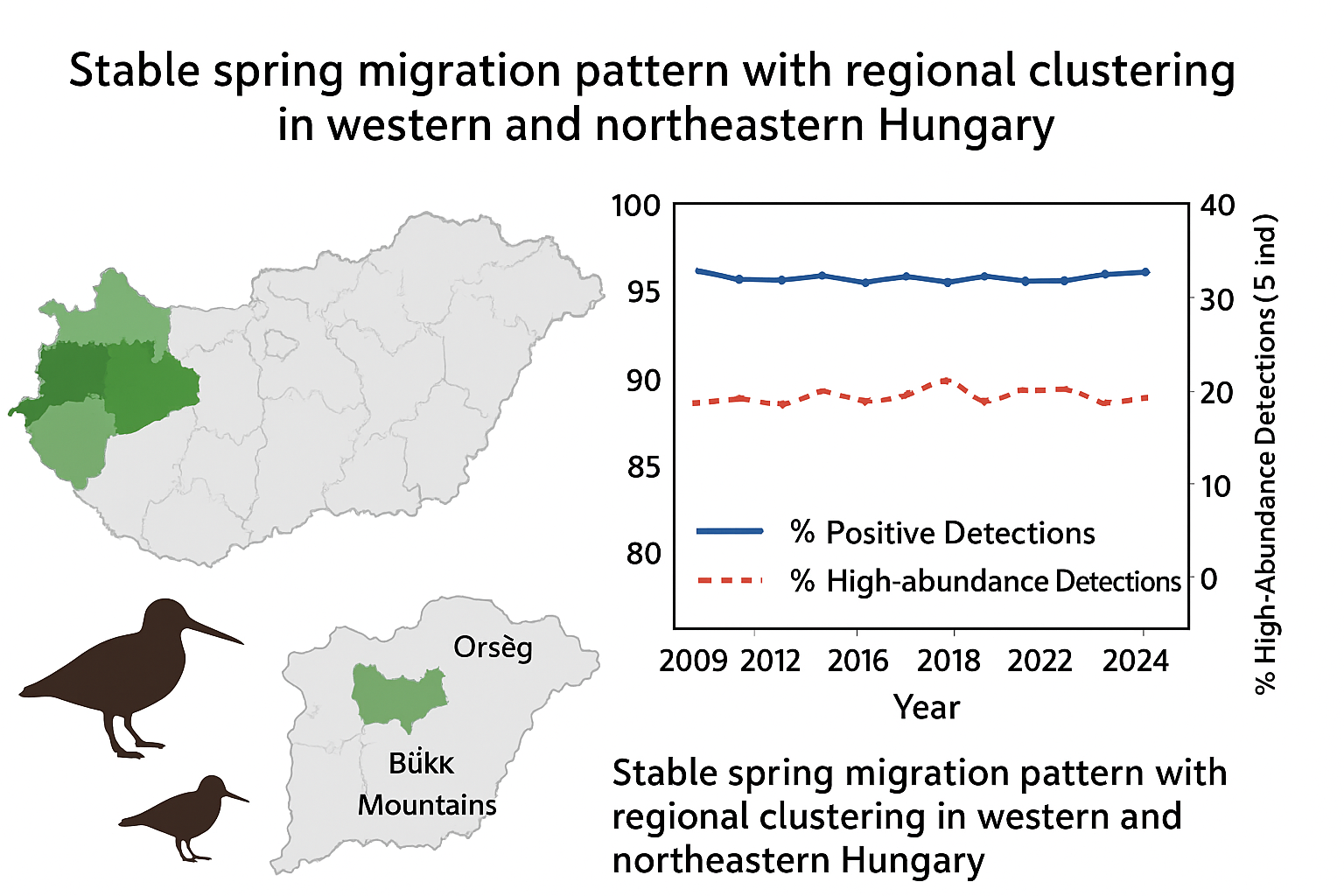

Spring Detection Patterns of Eurasian Woodcock (Scolopax rusticola) in Hungary Between 2009–2024: Long-Term Trends of Distribution and Conservation Implications



Abstract
1. Introduction
- Describe the spatial distribution of Eurasian woodcock presence in Hungary during the spring migration period.
- Evaluate long-term trends of woodcock presence and abundance across the 16-year study period.
- Identify regional ecological hotspots that may function as key stopover areas.
2. Materials and Methods
2.1. Monitoring Program and Data Collection
2.2. Roding Surveys and Sampling Design
2.3. Definition of Detection Categories
2.4. Statistical and Spatial Analysis
3. Results
3.1. General Detection Patterns (2009–2024)
Temporal Trends in Detection
3.2. Spatial Pattern of Detections
4. Discussion
5. Conclusions
Author Contributions
Funding
Institutional Review Board Statement
Data Availability Statement
Acknowledgments
Conflicts of Interest
References
- Duriez, O.; Ferrand, Y.; Binet, F.; Corda, E.; Gossmann, F.; Fritz, H. Habitat Selection of the Eurasian Woodcock in Winter in Relation to Earthworms Availability. Biol. Conserv. 2005, 122, 479–490. [Google Scholar] [CrossRef]
- Cramp, S.; Simmons, K.E.L. (Eds.) Handbook of the Birds of Europe the Middle East and North Africa: The Birds of the Western Palearctic. Volume 2: Hawks to Bustards; Oxford University Press: Oxford, UK, 1980; Volume 2, p. 913. ISBN 978-0-19-857506-1. [Google Scholar]
- Ferrand, Y.; Gossmann, F. Elements for a Woodcock (Scolopax rusticola) Management Plan. Game Wildl. Sci. 2001, 18, 115–139. [Google Scholar]
- Hoodless, A.N.; Lang, D.; Aebischer, N.J.; Fuller, R.J.; Ewald, J.A. Densities and Population Estimates of Breeding Eurasian Woodcock Scolopax rusticola in Britain in 2003. Bird Study 2009, 56, 15–25. [Google Scholar] [CrossRef]
- Heward, C.; Hoodless, A.; Conway, G.; Fuller, R.; Maccoll, A.; Aebischer, N. Habitat Correlates of Eurasian Woodcock Scolopax rusticola Abundance in a Declining Resident Population. J. Ornithol. 2018, 159, 955–965. [Google Scholar] [CrossRef]
- Hoodless, A.; Hirons, G. Habitat Selection and Foraging Behaviour of Breeding Eurasian Woodcock Scolopax rusticola: A Comparison between Contrasting Landscapes. Ibis 2007, 149, 234–249. [Google Scholar] [CrossRef]
- Guzmán, J.L.; Ferrand, Y.; Arroyo, B. Origin and Migration of Woodcock Scolopax rusticola Wintering in Spain. Eur. J. Wildl. Res. 2011, 57, 647–655. [Google Scholar] [CrossRef]
- Bauthian, I.; Gossmann, F.; Ferrand, Y.; Julliard, R. Quantifying the Origin of Woodcock Wintering in France. J. Wildl. Manag. 2007, 71, 701–705. [Google Scholar] [CrossRef]
- Richardson, W.J. Timing of Bird Migration in Relation to Weather: Updated Review. In Bird Migration; Gwinner, E., Ed.; Springer: Berlin/Heidelberg, Germany, 1990; pp. 78–101. [Google Scholar]
- Alerstam, T.; Hedenstrom, A. The Development of Bird Migration Theory. J. Avian Biol. 1998, 29, 343. [Google Scholar] [CrossRef]
- Alerstam, T. Optimal Bird Migration Revisited. J. Ornithol. 2011, 152, 5–23. [Google Scholar] [CrossRef]
- Baillie, S.; Robinson, R.; Fiedler, W.; Arizaga, J.; Jiguet, F.; Nikolov, S.; van der Jeugd, H.P.; Franks, S. The Eurasian African Bird Migration Atlas—Documenting Migration and Movements Using Ringing and Tracking Data. Available online: https://pure.knaw.nl/portal/en/publications/the-eurasian-african-bird-migration-atlas-documenting-migration-a/ (accessed on 6 April 2022).
- Schally, G.; Csányi, S.; Palatitz, P. Spring Migration Phenology of Eurasian Woodcocks Tagged with GPS-Argos Transmitters in Central Europe. Ornis Fenn. 2022, 99, 104–116. [Google Scholar] [CrossRef]
- Schally, G.T. Analysis of Observation and Hunting Bag Data of Eurasian Woodcock (Scolopax rusticola Linnaeus, 1758) in Hungary Between 2009–2018. Ph.D. Thesis, Szent István University, Gödöllő, Hungary, 2020. [Google Scholar]
- Schally, G.; Csányi, S. Eurasian Woodcock Monitoring in Hungary between 2009–2021. Rev. Agric. Rural Dev. 2022, 11, 168–175. [Google Scholar] [CrossRef]
- Fuller, R.J. Birds and Habitat: Relationships in Changing Landscapes; Cambridge University Press: Cambridge, UK, 2012; ISBN 978-1-139-85130-5. [Google Scholar]
- Morgan, R.; Shorten, M. Breeding of the Woodcock in Britain. Bird Study 1974, 21, 193–199. [Google Scholar] [CrossRef]
- Hirons, G.J.M.; Johnson, D. Woodcock Foraging Behavior. Biol. Conserv. 1987, 42, 307–319. [Google Scholar]
- Ferrand, Y.; Gossmann, F.; Bastat, C.; Guénézan, M. Monitoring of the Wintering and Breeding Woodcock Populations in France. Rev. Catalana D’ornitologia 2008, 24, 44–52. [Google Scholar]
- IUCN Scolopax rusticola: BirdLife International: The IUCN Red List of Threatened Species 2025: E.T22693052A155471018. 2016. Available online: https://www.iucnredlist.org/en (accessed on 4 December 2025).
- Eaton, M.; Aebischer, N.; Brown, A.; Hearn, R.; Lock, L.; Musgrove, A.; Noble, D.; Stroud, D.; Gregory, R. Birds of Conservation Concern 4: The Population Status of Birds in the UK, Channel Islands and Isle of Man. Br. Birds 2015, 108, 708–746. [Google Scholar]
- Sládeček, M.; Pešková, L.; Chajma, P.; Brynychová, K.; Koloušková, K.; Trejbalová, K.; Kolešková, V.; Petrusová Vozabulová, E.; Šálek, M.E. Eurasian Woodcock (Scolopax rusticola) in Intensively Managed Central European Forests Use Large Home Ranges with Diverse Habitats. For. Ecol. Manag. 2023, 550, 121489. [Google Scholar] [CrossRef]
- Lindström, Å.; Green, M.; Paulson, G.; Smith, H.G.; Devictor, V. Rapid Changes in Bird Community Composition at Multiple Temporal and Spatial Scales in Response to Recent Climate Change. Ecography 2013, 36, 313–322. [Google Scholar] [CrossRef]
- Ferrand, Y.; Gossmann, F.; Bastat, C. Breeding Woodcock Scolopax rusticola Monitoring in France. Ornis Hung. 2003, 12, 293–296. [Google Scholar]
- Hirons, G. The Significance of Roding by Woodcock Scolopax Rusticola: An Alternative Explanation Based on Observations of Marked Birds. Ibis 1980, 122, 350–354. [Google Scholar] [CrossRef]
- Szemethy, L. Results Hungarian Woodcock Monitoring. Rev. Agric. Rural Dev. 2014, 3, 12–19. [Google Scholar] [CrossRef]
- Schally, G.; Bleier, N.; Szemethy, L. Monitoring the Migration of Eurasian Woodcock in Hungary. Hung. Agric. Res. 2012, 1, 13–17. [Google Scholar]
- Schally, G.; Frank, K.; Heltai, B.; Fehér, P.; Farkas, Á.; Szemethy, L.; Stéger, V. High Genetic Diversity and Weak Population Structuring in the Eurasian Woodcock in Hungary during Spring. Ornis Fenn. 2018, 95, 61–69. [Google Scholar] [CrossRef]
- Tuti, M.; Rodrigues, T.M.; Bongi, P.; Murphy, K.J.; Pennacchini, P.; Mazzarone, V.; Sargentini, C. Monitoring Eurasian Woodcock (Scolopax rusticola) with Pointing Dogs in Italy to Inform Evidence-Based Management of a Migratory Game Species. Diversity 2023, 15, 598. [Google Scholar] [CrossRef]
- Baillie, S.R. Integrated Population Monitoring of Breeding Birds in Britain and Ireland. Ibis 1990, 132, 151–166. [Google Scholar] [CrossRef]
- Yoccoz, N.G.; Nichols, J.D.; Boulinier, T. Monitoring of Biological Diversity in Space and Time. Trends Ecol. Evol. 2001, 16, 446–453. [Google Scholar] [CrossRef]
- Schally, G. Assessment of the Breeding and Wintering Sites of Eurasian Woodcock (Scolopax rusticola) Occurring in Hungary Based on Ringing Recovery Data. Ornis Hung. 2019, 27, 110–116. [Google Scholar] [CrossRef]



| Lag Class | Average Dist. | Moran’s I | p < 0.05 Critical |
|---|---|---|---|
| 1 | 16,847 | 0.08 | 0.07 |
| 2 | 52,685 | 0.02 | 0.03 |
| 3 | 98,857 | 0.01 | 0.03 |
| 4 | 147,560 | −0.02 | 0.03 |
| 5 | 194,220 | −0.03 | 0.03 |
| 6 | 240,920 | −0.01 | 0.03 |
| 7 | 288,680 | −0.04 | 0.04 |
| 8 | 337,790 | 0.07 | 0.06 |
| 9 | 385,710 | −0.06 | 0.09 |
| 10 | 431,280 | −0.02 | 0.19 |
| Lag Class | Average Dist. | Moran’s I | p < 0.05 Critical |
|---|---|---|---|
| 1 | 16,847 | 0.10 | 0.07 |
| 2 | 52,685 | 0.10 | 0.03 |
| 3 | 98,857 | 0.02 | 0.03 |
| 4 | 147,460 | −0.03 | 0.03 |
| 5 | 194,220 | −0.06 | 0.03 |
| 6 | 240,920 | −0.03 | 0.03 |
| 7 | 288,680 | −0.05 | 0.04 |
| 8 | 337,790 | 0.01 | 0.06 |
| 9 | 385,710 | −0.05 | 0.09 |
| 10 | 431,280 | −0.05 | 0.19 |
Disclaimer/Publisher’s Note: The statements, opinions and data contained in all publications are solely those of the individual author(s) and contributor(s) and not of MDPI and/or the editor(s). MDPI and/or the editor(s) disclaim responsibility for any injury to people or property resulting from any ideas, methods, instructions or products referred to in the content. |
© 2025 by the authors. Licensee MDPI, Basel, Switzerland. This article is an open access article distributed under the terms and conditions of the Creative Commons Attribution (CC BY) license.
Share and Cite
Malatji, I.K.; Narh, M.; Csányi, S.; Schally, G. Spring Detection Patterns of Eurasian Woodcock (Scolopax rusticola) in Hungary Between 2009–2024: Long-Term Trends of Distribution and Conservation Implications. Diversity 2026, 18, 12. https://doi.org/10.3390/d18010012
Malatji IK, Narh M, Csányi S, Schally G. Spring Detection Patterns of Eurasian Woodcock (Scolopax rusticola) in Hungary Between 2009–2024: Long-Term Trends of Distribution and Conservation Implications. Diversity. 2026; 18(1):12. https://doi.org/10.3390/d18010012
Chicago/Turabian StyleMalatji, Itumeleng Kwena, Mabel Narh, Sándor Csányi, and Gergely Schally. 2026. "Spring Detection Patterns of Eurasian Woodcock (Scolopax rusticola) in Hungary Between 2009–2024: Long-Term Trends of Distribution and Conservation Implications" Diversity 18, no. 1: 12. https://doi.org/10.3390/d18010012
APA StyleMalatji, I. K., Narh, M., Csányi, S., & Schally, G. (2026). Spring Detection Patterns of Eurasian Woodcock (Scolopax rusticola) in Hungary Between 2009–2024: Long-Term Trends of Distribution and Conservation Implications. Diversity, 18(1), 12. https://doi.org/10.3390/d18010012