Article

Drivers of Variation in Avian Community Composition Across a Tropical Island Montane Elevational Gradient

1
Department of Natural Sciences, Manchester Metropolitan University, All Saints Building, Manchester M15 6BH, UK
2
Department of Energy Environment and Society, School of Humanities, Social Sciences and Law, University of Dundee, Dundee DD1 4HN, UK
3
Department of Environmental Conservation, University of Massachusetts, Amherst, MA 01003, USA
*
Author to whom correspondence should be addressed.
Diversity 2026, 18(1), 13; https://doi.org/10.3390/d18010013
Submission received: 13 November 2025 / Revised: 21 December 2025 / Accepted: 22 December 2025 / Published: 24 December 2025

Abstract

Elevational variation in avian community composition can be significantly influenced by habitat degradation, fragmentation and secondary forest growth. Few studies have identified the drivers of changes in bird community composition across disturbed montane elevational gradients of smaller tropical islands. We examined patterns of avian diversity using long-term mist-net data (2008–2014) across three different forest elevations along a tropical montane elevational gradient in the Northern Range of Trinidad, West Indies. All three sites (lowland mature secondary forest, mid-elevation highly disturbed secondary forest, and undisturbed high elevation forest) were found to have distinctive bird communities. Turnover rather than nestedness explained most of the total dissimilarity between sites. Whilst some turnover could be attributed to elevation, changes to diversity at the mid-elevation site result more from local habitat heterogeneity related to human activities and secondary growth, with increased species richness attributable to habitat-generalist species indicative of disturbance. Significant anti-nestedness in species occupancy was observed, underpinned by the loss of ground-dwelling and understory insectivores from the mid-elevation site. Differences in bird community composition, in contrast, were driven by the abundance of specialist nectarivores in the highest elevation undisturbed montane forest, and by generalist nectarivores and frugivores at lower elevations.

1. Introduction

Patterns of avian diversity across different spatiotemporal scales are driven by topographic heterogeneity, and both climatic and biotic assembly processes [1,2,3,4], with additional constraints imposed by extent of habitat [5] and geographic isolation [6]. Human activity is further shaping these patterns, with urbanization and agricultural intensification exacerbating habitat loss and degradation, with a concomitant reduction in bird taxonomic and functional diversity [7]. Across tropical montane elevational gradients, changes in avian community composition reflect degrees of habitat specialization driven by topographical and climatic variation [8,9], compounded by interspecific competition [4,10]. Quantifying changes in diversity along tropical montane elevational gradients can improve our understanding of habitat specialization by birds at different elevational zones and ecotones, and how habitat heterogeneity along these gradients helps to maintain diversity, as well as identifying the impacts of anthropogenic activities on montane bird communities [11].
Much of this above-mentioned research has focused on key areas in the South American Andes (e.g., [12,13]) and in Central America (e.g., [9,14,15]), but broad patterns of avian diversity in elevational gradients have been studied in subtropical and temperate latitudes across the globe ([8], and references therein). Elevational changes in avian diversity have also been studied on large island systems such as Madagascar [16] and New Guinea [17], but less is known regarding patterns of elevational diversity of montane bird communities on smaller islands, where bird diversity is typically lower due to differences in area, climate and isolation [6].
Measures of community composition in any given habitat or region are commonly described in terms of observed species richness and several alpha (α) diversity indices [18]. Beta (β) diversity refers to the difference in diversity between two or more communities, though there are many different concepts and measures of β-diversity [18,19]. This dissimilarity can result from two opposing processes: species turnover—the replacement of some species by others; nestedness—the degree to which species found in sites of low species richness are a subset of those present in richer sites, resulting from non-random loss [20]. Partitioning β-diversity into these two components can help to determine the ecological processes that underpin observed differences [20,21].
Changes in bird community composition can also result from differences in species abundance, with some studies reporting that increased abundance of just a small number of species can drive significant changes in community composition between forest edges and interior habitat [22]. Although several β-diversity metrics have been described and their performance assessed (see [23,24,25]), few studies have used these approaches to examine the drivers of changes to avian community composition across smaller tropical island montane elevational gradients.
Here we begin to address this knowledge gap using bird mist-netting data from seven consecutive breeding seasons, to describe and quantify variation in avian community composition at three different forest sites along an elevational gradient in the Northern Range mountains of the island of Trinidad and identify the primary drivers of these patterns. Specifically, across the elevation gradient, we: (1) describe patterns of alpha diversity (species richness and evenness) and determine how this differs spatially (between sites) and temporally (over the 7-year study period); (2) examine patterns of beta (β) diversity between sites and between different years to quantify the relative contributions of species turnover and nestedness, and identify the bird species unique to each site; (3) determine whether species with specific ecological traits may be driving differences in community composition and whether these patterns correlate with elevation or levels of anthropogenic disturbance.

2. Materials and Methods

2.1. Study Sites

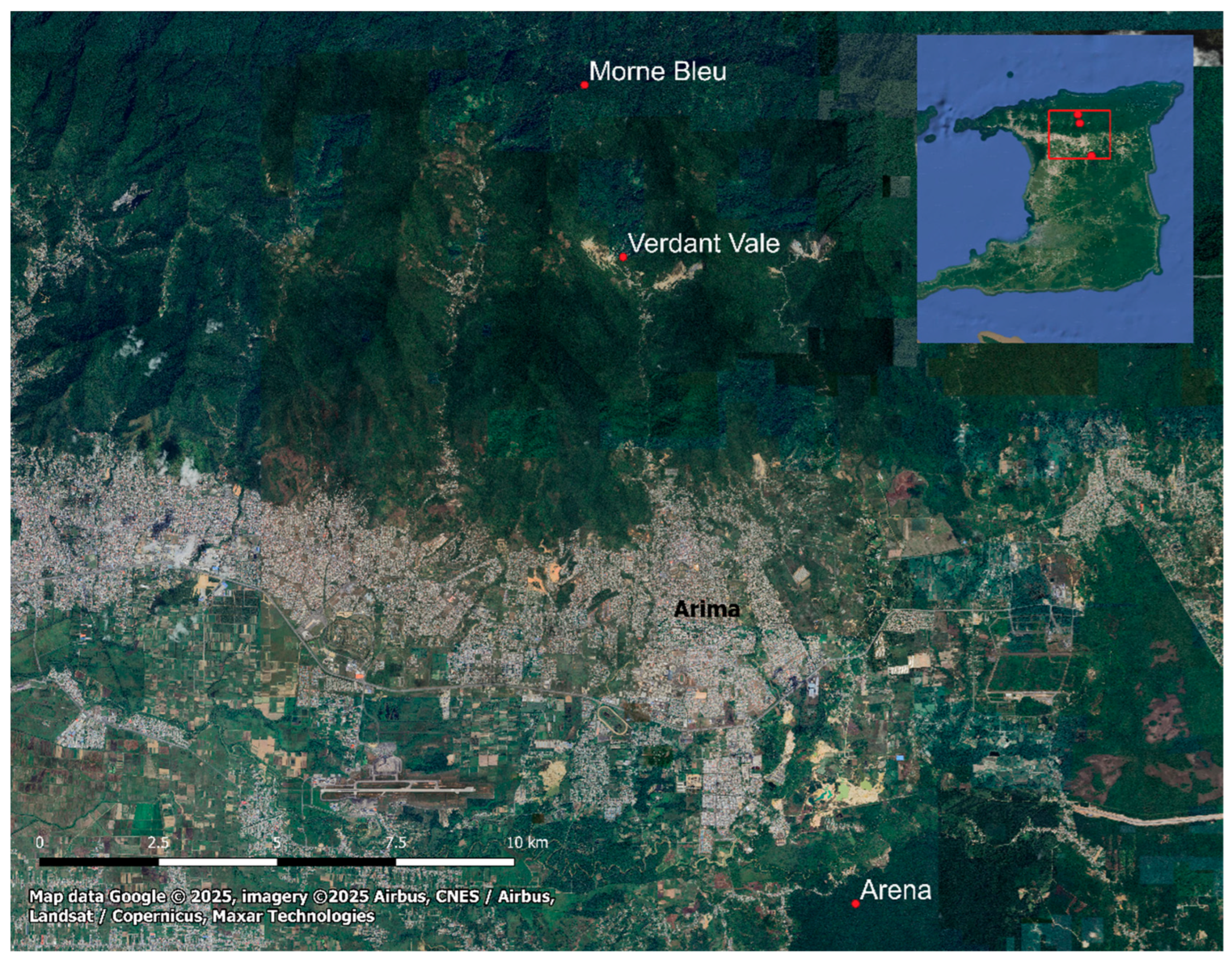
Between 2008 and 2014, staff and students from the University of Dundee (UK) used mist nets to capture and ring birds from three forest sites, differing in elevation and degree of anthropogenic disturbance, in the Northern Range mountains (Figure 1), Trinidad, West Indies. This island is situated 11 km from the northeast coast of Venezuela, having separated from the mainland during the Pliocene, approximately 4 Ma. This proximity, combined with the periodic formation of land bridges, means the island’s flora and fauna resembles most closely that of the South American continent, albeit less species rich [26]. The Northern Range is an 88 km long metamorphic mountain range spanning east to west in the north of the island, with peaks and ridges varying between 456 and 760 m above sea level (the highest peak, Cerro del Aripo, reaches 940 m). The first survey site, Arena, is located approx. 8 km southeast of the town of Arima, in the Arena Forest Reserve, at 30 m above sea level. Throughout much of the 19th and 20th centuries, the lowland forest was managed for timber logging and charcoal production, which ceased to operate in the 1980s. The site has since been managed by the forestry bureau for recreational purposes. The lowland mature secondary forest here shows irregular vegetation stratification, with an upper layer of occasional emergent trees (30–42 m), a continuous middle canopy (12–27 m) and a continuous lower sub-canopy, with abundant palms and liana species.
The second site, Verdant Vale, sits in the Arima Valley in the foothills of the Northern Range, at an elevation of 250 m. The disturbed seasonal deciduous forest at this mid-elevation site was previously partially cultivated with cacao (Theobroma cacao) and citrus (Citrus spp.) trees, with these areas abandoned and more recently dominated by fast-growing species such as mahogany (Swietenia sp.) and bamboo (Bambusa vulgaris) [27]. The semi-open canopy is low (3–9 m) with emergent trees reaching 18 m. The ground layer is sparse, except on steep slopes when shrubby vegetation appears. Industrial-scale quarrying for limestone has been undertaken in Verdant Vale since the 1940s. Although mining operations in the region waned during the 1980s and 90s, open pit limestone mining as well as illegal quarrying and timber harvesting have proliferated over the last 20 years [28].
The final site is located at Morne Bleu, on the ridge of the Northern Range mountains. This higher elevation site is dominated by undisturbed transitional vegetation between lower montane and montane evergreen forest, with a closed canopy (21–30 m in height) and a dense, unstratified understory dominated by tree ferns and small palms. The ridge is relatively exposed, with the northern slope particularly steep, and at an elevation of 725 m above sea level the forest is often shrouded in clouds, creating wet conditions.

2.2. Mist Net Sampling and Data Management

Bird communities at each site were sampled using 5–8 mist nets (18 m length, 2 m height) positioned in freshly cut transects. Nets were opened from just before dawn (0600) until mid-afternoon (approx. 1500). Each bird caught was extracted, identified, and ringed following the standard methodology described by the British Trust for Ornithology [29]. Birds were ringed using metal alloy rings with unique identification numbers obtained from the BTO by the licensed trainer on the expeditions, the exception being hummingbird species (due to the short tarsi which prevents ringing). Thus, for each individual hummingbird three small dots of acrylic paint were painted on the back of the head, enabling identification of recaptured birds. For all other birds caught, the species, ring number, recapture status, age and sex (where identifiable), wing length and weight were recorded. Mist nets were checked every twenty to thirty minutes to reduce the risk of predation and distress to the birds, and nets were temporarily closed together during periods of severe rain. Each site was sampled twice, for 2 to 3 consecutive days each time, between June and August of each sampling year (corresponding to the majority of their known breeding season). Sampling effort was constant across sites and years (32 net days per site per year) except for 2013, where operational constraints reduced the sampling effort at Morne Bleu (24 net days) and Arena (16 net days).
Ringing logs provided by the expedition were converted to a matrix of community data by first grouping the data by species, then counting the number of unique ring numbers that occurred of each species in each location in each of the seven years. Using this method ensured that no individual was counted more than once within each year but included individuals that may have been counted more than once across different years. Records for destroyed or lost rings (28 and 5 records, respectively) were removed from the dataset. The same process was used to create matrices of community data grouped only by year, and by location. Hummingbirds were painted with temporary paint that remained for less than 4 weeks, and so individuals from different years were painted with the same order of paint (e.g., Red White White, RWW). Given the risk of hummingbirds from different years being incorrectly identified as the same individual, the paint codes were amended so that each was counted separately. Catching and ringing of birds was conducted with the annual approval of the Wildlife Section, Ministry of Agriculture, Land and Fisheries Dept., Government of the Republic of Trinidad and Tobago. Permission was kindly granted to Dr. Alan Barclay by the BTO for use of their rings in Trinidad (code: FW: 4/10/3, 17 June 2010; code 5/10/7, 1 June 2013; code 4/10/3, 12 June 2014).

2.3. Statistical Analyses—Alpha Diversity Measures

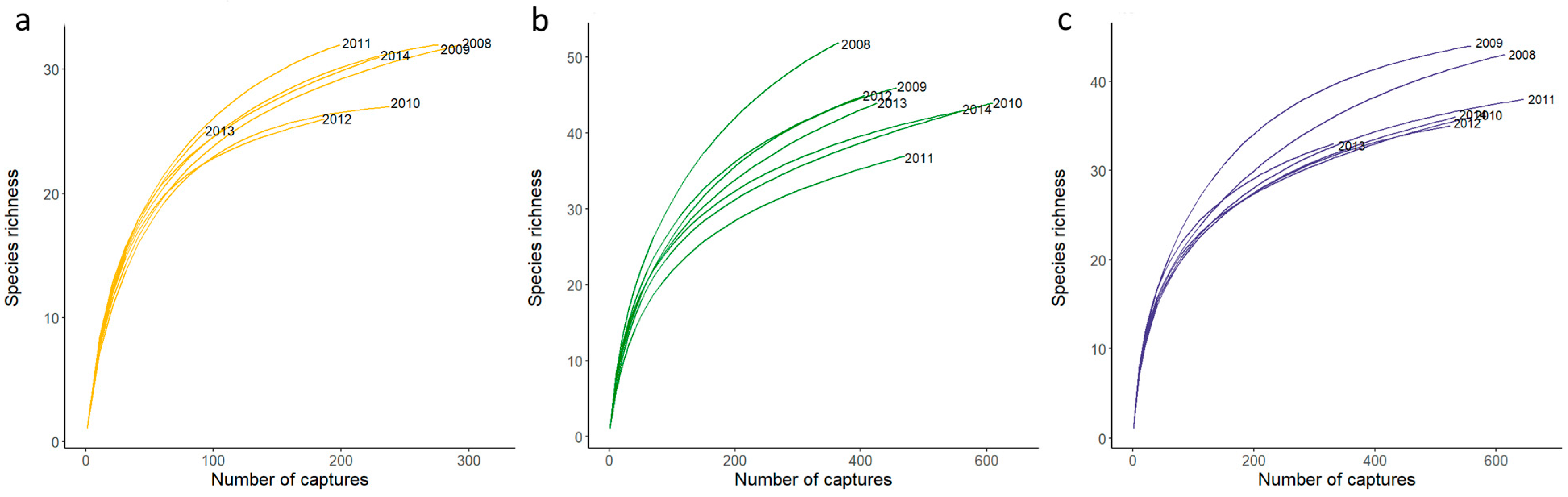
All analyses were conducted in R v. 4.4.1 [30] using the IDE RStudio version 2024.12.0+467 [31]. Rarefaction curves were used to visually determine whether the number of captures were likely to be sufficient for the observed species richness to approach the actual species richness at each site, and each year.
Alpha diversity was estimated for the bird communities at each site using first, second and third-order Hill numbers, which can be considered as the effective number of equally abundant species and includes a parameter q that determines the extent to which species frequencies are considered. First-order Hill numbers (q = 0), 0D, denote the species richness. For values of 0 < q < 1, rare species have a greater weighting, but as q increases beyond 1, the resulting Hill numbers become more sensitive to dominant species [32]. Second-order Hill numbers (q = 1), 1D, equal to the exponential of Shannon’s diversity index (H), give the effective number of species, whilst third-order Hill numbers (q = 2), 2D, are the effective number of dominant species in a community, equivalent to the inverse of the Simpson’s diversity index. All diversity values were compared between sites using 95% confidence intervals (CI); if no overlap is seen at the 95% CI for diversity values, the differences between sites can be interpreted as being significant at the p < 0.05 level [33,34]. Hill numbers for each site were calculated using functions in the iNEXT package [35].
Multiple linear regression was used to model observed species richness as a function of year, site, and the interaction between the two. The model was simplified using backward stepwise selection based on statistical significance, and model residuals confirmed as satisfactory through model-checking plots. Observed species richness between sites was further analyzed as a linear mixed effects model, with year included as a random factor to account for interannual variation in temperature, precipitation, etc., using the R package nlme [36].

2.4. Beta (β) Diversity and Nestedness

Beta (β) diversity between the three different elevations (all years combined and within each year) was calculated using Sørensen and Jaccard dissimilarity indices, using the betapart package (Table A1) [37]. Both indices use species incidence, rather than species abundance, to quantify beta diversity; the Jaccard index calculates the number of unique species as a proportion of the total number of species recorded, whilst the Sørensen index gives double the weight to the shared species [38]. For each dissimilarity index, the β-diversity was partitioned into two components: species turnover and nestedness-resultant dissimilarities (Table A1). β-diversity between successive years, for each site and for all sites combined, was also calculated, and simple linear regression used to model the relationship between each measure of β-diversity (total β-diversity, species turnover or nestedness-resultant dissimilarities, for both Sørensen and Jaccard indices) and year. Nestedness between the three sites was estimated using the Nestedness metric based on Overlap and Decreasing Filling (NODF) metric [39]. In addition to the overall nestedness of the community occupancy matrix, the NODF metric also gives an estimation of the nestedness in species composition between sites (NODF among rows, NODFr), and in species occupancy (NODF among columns, NODFc). The significance of the NODF indices were evaluated through comparisons against 1000 null model simulations, using occupancy matrices generated with the ‘quasiswap’ algorithm that maintains both row and column frequencies [40]. Nestedness between years, both overall and within each site, was investigated in the same manner through occupancy matrices of bird species occurrence against year. NODF analyses were carried out using the nestednodf method in the oecosimu function in the vegan package [41].

2.5. Bird Community Dissimilarity

Differences in species relative abundance (total number caught during mist net sampling) and differences in avian community composition based on Bray–Curtis dissimilarities between the three Trinidad sites were examined using non-metric multidimensional scaling (NMDS). NMDS ordination was also used to examine the dissimilarities in the bird assemblages caught each year, for all sites combined. PERMANOVA was used to test the significance of the distance between the centroids of the locations and years, and thus the differences in composition and/or relative abundances of the bird communities, in the adonis2 function in the vegan package [41]. To better understand which bird species had the greatest contributions to the observed distances between the three sites, similarity percentages for each species between Arena (low elevation)-Verdant Vale (mid-elevation), Arena (low elevation)-Morne Bleu (high elevation) and Verdant Vale (mid-elevation)-Morne Bleu (high elevation) locations were calculated using the simper function in the R package vegan [41]. Bird species were categorized into trophic-behavioral guilds (fruit and/or nectar feeders, insectivores, omnivores and seed eaters) according to [42].

3. Results

3.1. Measures of Bird Alpha Diversity Across Sites and Years

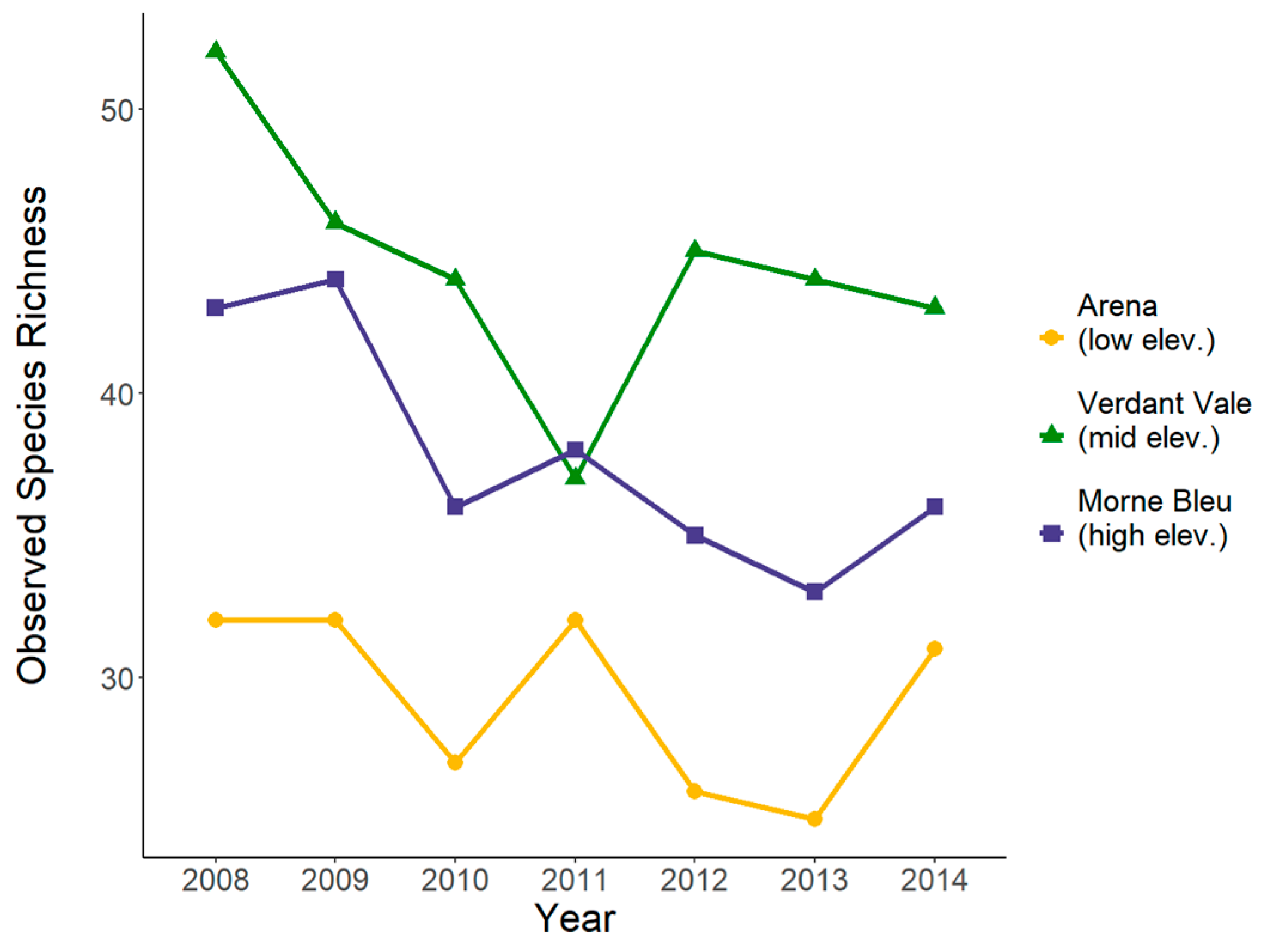
Over the seven-year period, a total of 8584 bird captures were recorded, corresponding to 7054 individuals across 103 species (Table 1). Rarefaction curves for each site and each year were close to asymptotic but did not fully plateau, suggesting that the sampling effort may not have been sufficient to fully capture the species richness at each site (Figure 2). Whilst for most years the highest number of captures was at the higher elevation Morne Bleu site, observed species richness was higher for the mid-elevation disturbed Verdant Vale site, and lowest for the lowland elevation Arena site (Table 1 and Figure 3). Both Year and Location (elevation) were found to have a significant effect on observed species richness (βyear = −1.095, p = 0.007, βMorne Bleu = 8.57, p < 0.001, βVerdant Vale = 15.14, p < 0.001), and these two covariates explained around 80% of the variation in observed species richness (Adj. R2 = 0.806). A further model that included an interaction term showed no significant interaction between Year and Location on observed species richness (F = 0.543, p = 0.592). Year and location remained significant when species richness from 2013, when full sampling effort was not reached, was excluded (βyear = −0.995, p = 0.028, βMorne Bleu = 8.67, p < 0.001, βVerdant Vale = 14.5, p < 0.001). The effect of location on species richness persisted when year was modelled as a random factor (β0:Arena = 29.29, p < 0.001, βMorne Bleu = 8.57, p < 0.001, βVerdant Vale = 15.14, p < 0.001, between year variance = 2.55).
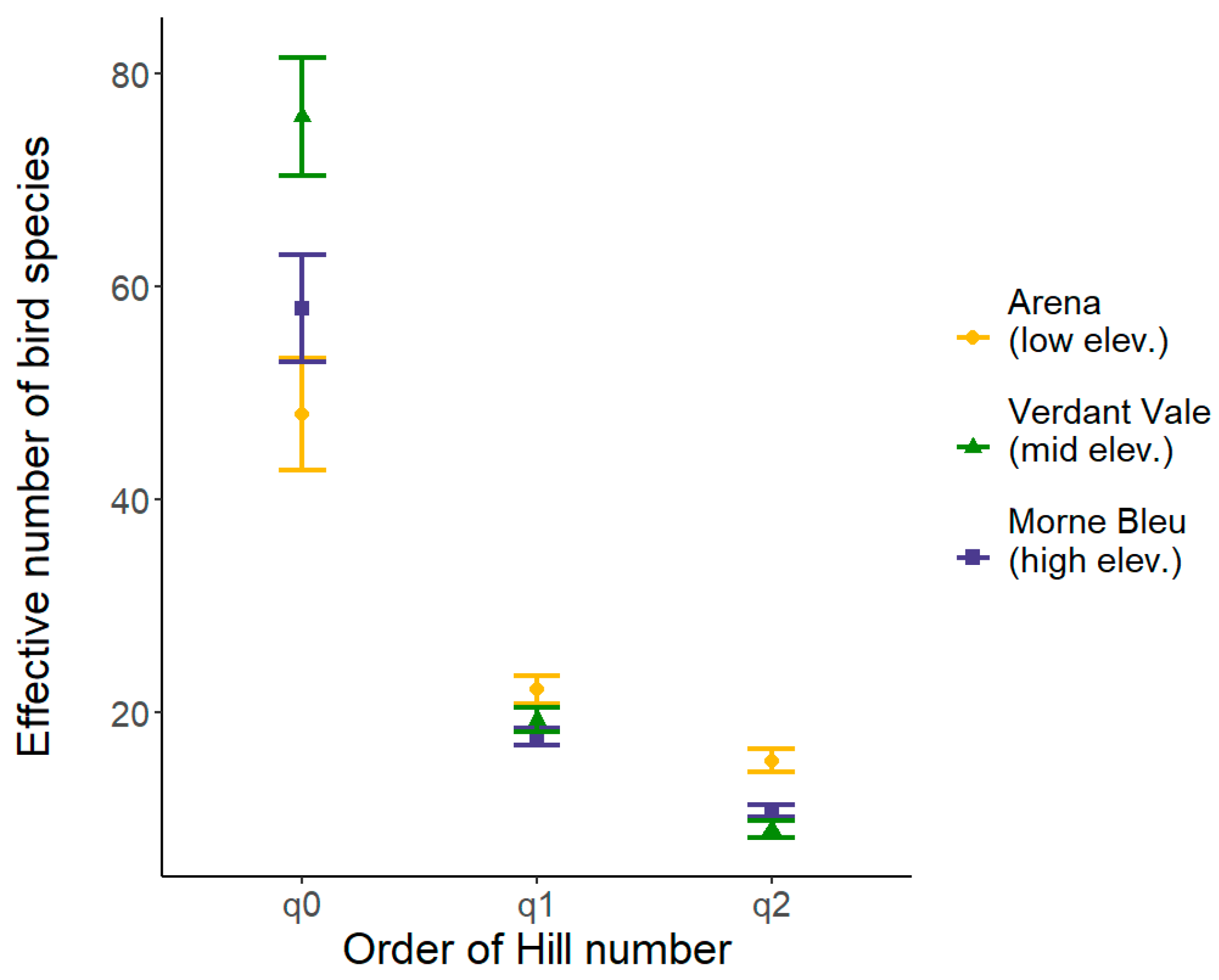
Verdant Vale, the mid-elevation disturbed site, showed significantly greater observed species richness than either Arena or Morne Bleu (Hill numbers q = 0, Figure 4). However, the steep decline in diversity with increasing Hill number order for Verdant Vale shows this site to be the most uneven in terms of the distribution of relative abundances (Figure 4, [43]). In contrast, although captures were lowest and fewest species were caught at the site at the lowest elevation, Arena, this site displayed the greatest effective number of species and the greatest effective number of dominant species (Hill numbers q = 1 and q = 2), and the least steep decline with increasing Hill number order, demonstrating greater evenness of relative abundances (Figure 4).

3.2. Beta Diversity and Nestedness Between Elevations

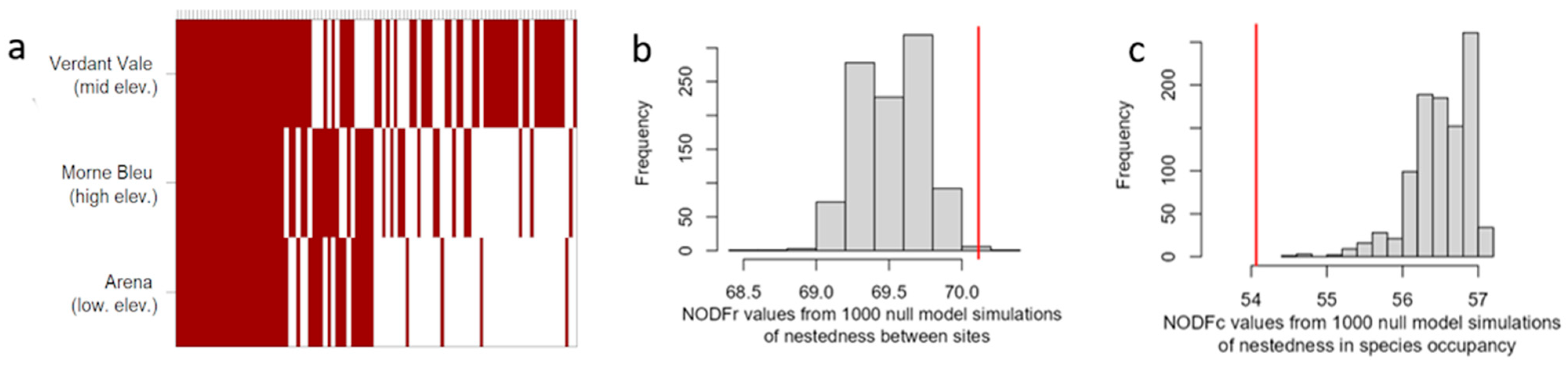
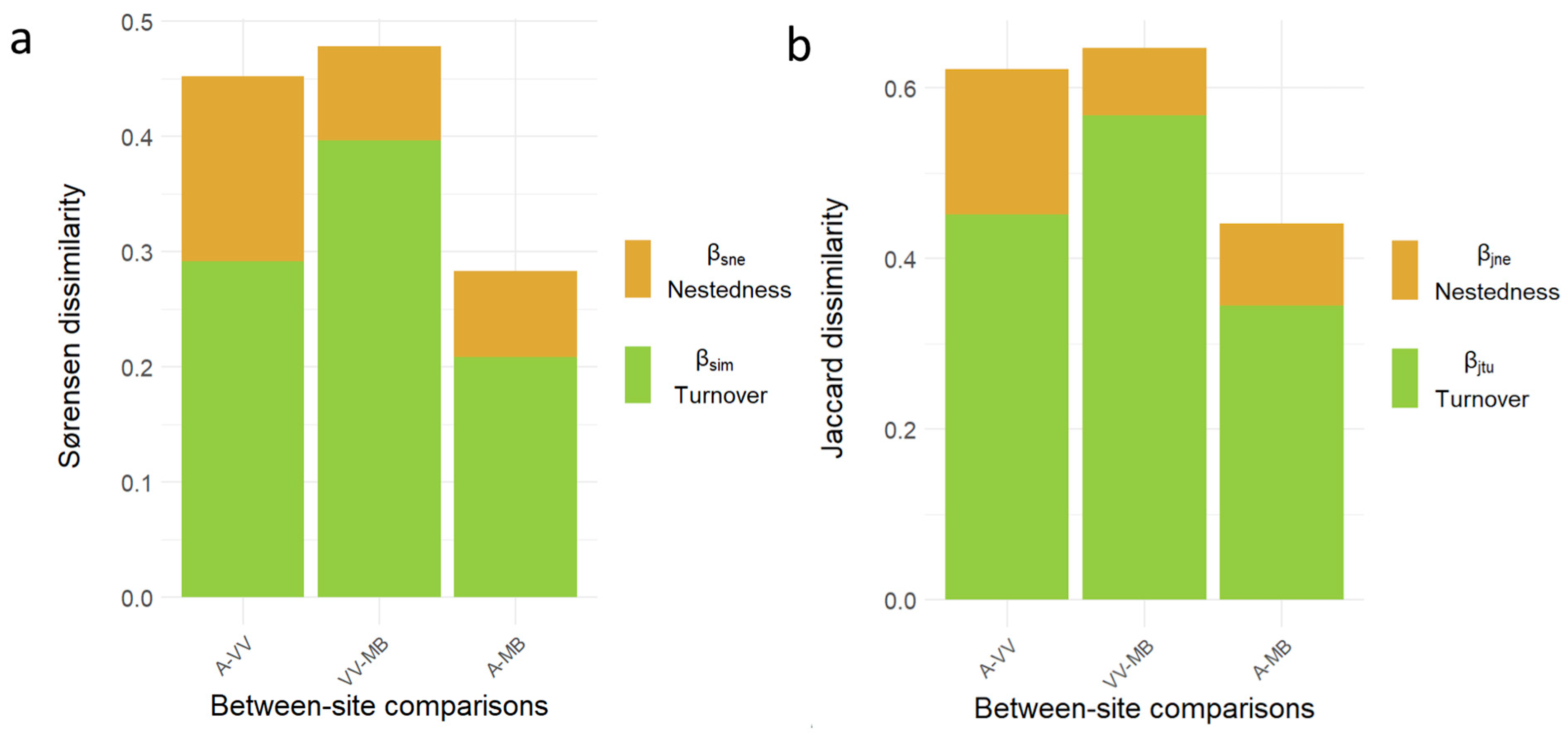
Sørensen and Jaccard dissimilarities both showed similar levels of β-diversity between the mid-elevation Verdant Vale site and both the higher-elevation Morne Bleu and lowland Arena sites. Low β-diversity between lowland Arena and high elevation Morne Bleu suggested a higher level of similarity between these two bird communities despite these being the two most widely separated elevational sites (Figure 5a,b). Turnover was a greater contributor to the dissimilarities in species assemblages than nestedness in all between-site comparisons but was greatest between mid-elevation Verdant Vale and high-elevation Morne Bleu (Figure 5a,b). Dissimilarities due to nestedness was greatest between Verdant Vale and Arena, and more similar between Morne Bleu and both other sites. Overall, the bird communities sampled at the three forest sites showed significant anti-nestedness (Nobs = 54.07, Nexp = 56.51, Z-value = −6.25, p = 0.001; Figure 6a).
The observed NODFr between sites (Nobs = 70.11) was significantly higher than expected from the null model (Nexp = 69.53, Z-value = 2.66, p = 0.015), indicating that the extent to which sites with lower species richness were sub-sets of sites with higher species richness was significantly greater than from a random distribution (Figure 6b). This is perhaps not surprising, as generalist forest bird species were present across all three elevations. In contrast, the observed NODFc (Nobs = 54.06) was significantly lower than expected from the null model (Nexp = 56.50, Z-value = −6.25, p = 0.001), meaning that uncommon species were less frequently found at the sites of greater species richness (Figure 6c). The disturbed mid-elevation Verdant Vale site was the most species rich, including 35 species not recorded at the lower and higher elevation sites, but there were more infrequently recorded species found only at the lowland Arena and/or high-elevation Morne Bleu than would be expected by chance (Table A2 and Table A3). Within each year, total β-diversity was lower between Arena and Morne Blue than between Verdant Vale/Morne Blue and Verdant Vale/Arena for both the Sørensen and Jaccard indices, reflecting the same pattern as when sites are compared across years (Table A4 and Table A5). Again turnover, rather than nestedness, formed the greater component of β-diversity in all pairwise comparisons between sites within years, and, apart from 2014, the smallest dissimilarities due to nestedness were between Verdant Vale and Morne Bleu.

3.3. β-Diversity and Nestedness Between Successive Years

β-diversity was smaller between successive years than between sites, both overall and within each site (Table A6), a consequence of the short time frame in which species could be lost and/or replaced. There was no obvious trends and no significant relationship between year and either total β-diversity, species turnover or nestedness-resultant dissimilarities within each site or overall, for both Sørensen and Jaccard indices. There was a slight increase in total β-diversity over successive years at the lowland Arena site that was close to significant (βsor coefficient = 0.022, p = 0.050, βjac coefficient = 0.031, p = 0.050; Table A7). Nestedness of species of birds caught between years across the three sites combined in Trinidad was highly significant (Nobs = 68.33, Nexp = 68.01, Z-value = 1.78, p = 0.007). This was not due to the species caught in more depauperate years being a nested subset of those caught in richer years, as the observed NODFr of the birds caught across sites between years did not differ significantly from that of the null models (Nobs = 82.43, Nexp = 82.38, Z-value = 0.35, p = 0.732). However, there was highly significant nestedness in species occupancy, as shown by the greater observed NODFc than the null models (Nobs = 68.27, Nexp = 67.95, Z-value = 1.78, p = 0.007). Within each site, the NODF metric showed that the sampled bird communities were not significantly more or less nested than random between years, either in terms of species composition or species occupancy (Table 2). In contrast to the total yearly catches, there was also no nestedness in species occupancy within sites between years, and no overall nestedness.

3.4. Bird Community Dissimilarity

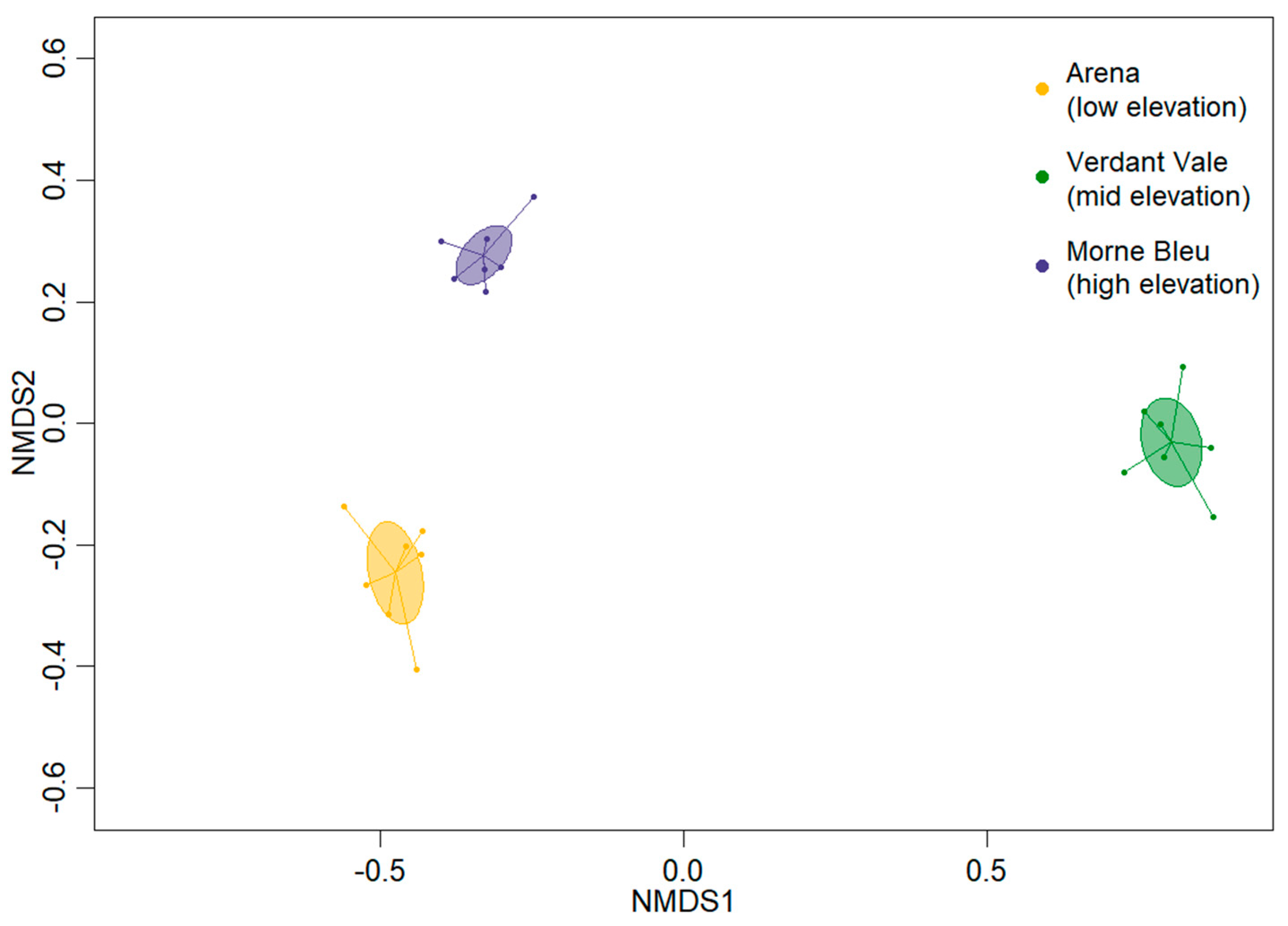
The NDMS ordination analyses (stress = 0.0452) revealed a clear distinction in the community composition of birds between all three elevations (Figure 7). The overall difference in the community composition between locations was highly significant (F2,18 = 28.53, p = 0.001), with location explaining 76.0% of the variation observed. In contrast, there was no distinction between the composition of birds sampled across the three sites when grouped by year, with the distances between the centroids of the ellipses for each year not significant (F6,14 = 0.251, p = 0.999). Between nine and ten bird species were responsible for making the greatest contribution to the patterns of dissimilarity of the avian community composition between each pair of forest sites (Table 3).

4. Discussion

4.1. Elevational Variation in Alpha and Beta Diversity

Mist-net sampling conducted over seven consecutive breeding seasons across the elevational gradient revealed significantly higher observed species richness at the disturbed Verdant Vale mid-elevation site (Figure 3 and Figure 4). When species diversity was weighted by abundance, however, the lower number of effective species at Verdant Vale compared with Arena (Hill numbers q = 1), and lower number of effective dominant species than both Arena and Morne Bleu (Hill numbers q = 2) indicates this to be the least even of the three sites, instead being most greatly dominated by a small number of species.
Whilst some montane systems show a monotonic decline in bird species richness with increasing elevation, increases in bird species richness at mid-elevational gradients as observed here are well documented, particularly when differences in surface area of each elevational ‘belt’ are considered [8,44]. However, the bird assemblages at Verdant Vale were more dissimilar (higher β-diversity) to those in the Arena lowland forest and the high elevation Morne Bleu forest than these two sites were to each other (Figure 5 and Figure 7), indicating additional factors are driving the increased avian richness and diversity at the mid-elevation habitats in this montane range.
The ongoing quarrying and timber harvesting around Verdant Vale has resulted in a heterogeneous landscape of bare land, localized development, forest edge habitat, and a patchwork of secondary forest at various stages of succession. Consequently, this landscape mosaic may be influencing the mid-elevation site bird community composition by supporting a greater range of edge specialists and habitat generalists [45,46]. Ref. [47] showed that the alpha diversity of birds from this study region was similar across actively managed cacao shade plantations, secondary forest of different ages and primary forest but community dissimilarity increased with increasing age difference between forest habitats, underpinned by a decrease in the proportion of obligate forest-dependent bird species. More broadly, bird species richness tends to be, on average, around 12% lower in secondary forests compared to primary forests [48]. Whilst this contrasts with the increased species richness observed in Verdant Vale, it is consistent with the lower species richness and number of captures at the more mature Arena secondary lowland forest.
Of the 78 species recorded from Verdant Vale, almost half (35 species) were not found at either Morne Bleu or Arena, including species indicative of more disturbed habitats. Whilst two forest specialist granivores (grey fronted dove Leptotila rufaxilla and lined quail dove Zentrygon linearis) were only present at the higher elevation Morne Bleu and lowland Arena site, granivorous species including Lesson’s seedeater (Sporophila bouvronides), chestnut-bellied seed finch (Sporophila angolensis) and ruddy ground dove (Columbina talpacoti), found predominantly in shrub and cultivated land [49], were captured only at the mid-elevation Verdant Vale site. In addition, the greater abundance of C. talpacoti and the blue-black grassquit (Volatinia jacarina), another shrubland seedeater at Verdant Vale, contributed to the dissimilarity of the three bird communities (Table 3).

4.2. Species Turnover Between Sites and Elevation

Species turnover has been reported to be a greater contributor than nestedness to elevational changes in assemblages of birds and other taxa in both tropical [50,51] and temperate [52,53] montane environments. However, β-diversity in temperate systems tends to be lower, so nestedness may play a stronger role in the reduction in diversity seen at higher elevations [54]. Known elevational species ranges can provide a partial explanation of turnover; however, the environmental gradients of a given montane system may further restrict ecological distributions [9,55]. A sharp decline in bird species richness at 1750 m elevation in the Bolivian Andes, for example, corresponded to many species reaching their upper elevational limit between 1250 and 1700 m, resulting in high turnover, though other peaks in turnover did not correspond to clusters of known elevational species limits [56]. At 725 m, the elevation of Morne Bleu perhaps does not preclude occupancy by bird species found elsewhere based on their upper elevational limits, but lower elevational limits may explain some of the observed turnover. Species found only at the high elevation Morne Bleu site include hepatic tanager (Piranga flava) and orange-billed nightingale thrush (Catharus aurantiirostris), which are typically only found at elevations above 400 m; yellow-legged thrush (Turdus flavipes), commonly found above 600 m; and speckled tanager (Tangara guttata) and stripe-breasted spinetail (Synallaxis cinnamomea), found above 700 m [57].

4.3. Nestedness in Species Composition Between Sites

We found significant nestedness in the species composition between the mid-elevation Verdant Vale and the other two less species-rich sites, reflecting the prevalence of widespread forest species present at all three elevations. There was significant anti-nestedness overall, driven by anti-nestedness in species occupancy; specifically, there were more infrequently recorded species found only in the lowland Arena and/or higher elevation Morne Bleu site than would be expected by chance (Figure 6). Nine of the 10 species absent only from Verdant Vale were understory and terrestrial insectivores. Insectivorous species richness has been shown to decrease along tropical montane elevational gradients (e.g., [50]), but the absence of insectivores from the mid-elevation Verdant Vale site alone is more likely due to the current levels of anthropogenic disturbance and less favorable structure of recent secondary forest growth. Several studies have shown that many terrestrial and understory insectivorous bird species are sensitive to tropical forest disturbance and fragmentation [58,59,60,61]. Whilst the forest at Verdant Vale is not heavily fragmented, the disturbance from areas of quarrying and timber harvesting creates edge habitats, which is known to adversely affect understory insectivore populations [22].

4.4. Dissimilarities in Bird Communities

Most of the species that contributed to the dissimilarities between elevations were frugivores and nectarivores (Table 3). The greater abundance of bananaquits (Coereba flaveola), palm tanagers (Thraupis palmarum) at Verdant Vale strongly contributed to the differences in community composition between sites (Table 3). Both species are abundant and widespread in Trinidad [47], with broad habitat preferences including forest edges, shrubland, open disturbed woodlands, and gardens [62]. In contrast, the high-elevation Morne Blue bird community composition was strongly influenced by the greater abundance of hummingbirds, the nectivorous purple honeycreeper (Cyanerpes caeruleus), and two frugivorous, golden-headed manakin (Pipra erythrocephala) and bay-headed tanager (Tangara gyrola). Nectarivores generally show little variation in species richness across elevational gradients [12,50], or across mature tropical forests and successional vegetation in the Peruvian Andes [63], though habitat loss may reduce species diversity [64] or result in a high species turnover that relates to changes in the plant community composition associated with forest fragmentation [65]. We suspect that the shift from hummingbirds dominating the undisturbed high-elevation Morne Bleu forest, to the increase in bananaquits and palm tanager captures at Verdant Vale, is likely to reflect food source available. Nectarivores and frugivores are common montane elevational migrants [14,66,67]. In our study, sampling occurred during the same two months of each breeding season and may not have adequately captured variation in bird community composition due to elevational migration since no recaptured marked birds were found at any different site to the one in which they were first caught.

4.5. Temporal Changes in Avian Community Composition

There was only a small variation in the number of bird species caught each year across the three sites and a small yet significant decline in the number of species caught each year at each site. Consequently, β-diversity was smaller between successive years than between sites, with no significant nestedness in species composition between years detected. This suggests that the species either not present or not caught in more depauperate sampling years was more likely random; however, given that sampling effort between years was near constant, the occurrence of rarer bird species in more species-rich years, as evident from the significant nestedness in species occupancy, may be attributed to other factors.
Accounting for species’ detectability may be necessary to detect patterns of turnover or nestedness in species loss over time [68]. No nestedness in species composition or occupancy was observed between years within each elevation sampled as with the overall yearly species captures. This, in part, may be due to the use of mist-netting as the sole sampling method, since mist nets capture only a subset of the bird community that utilize mid-story to ground level, and under-sample canopy-dwellers, particularly larger-sized species [15,69]. Whilst some avian β-diversity studies have used only capture data (e.g., [22,70]), most use either auditory and visual counts (e.g., [9,47]), or a combination of both (e.g., [71,72]), with statistical assessments of species detectability [65,68] to produce more comprehensive species lists. A similar approach for small island tropical montane forest ecosystems would enable both alpha and β-diversity to be estimated with greater certainty and help better infer the mechanisms driving any shifts in community composition [73].
Diversity metrics can also be calculated based on the phylogenetic relatedness among species [74] or on the extent of functional differences among the species present [75]. Changes in species richness do not necessarily reflect changes in functional diversity, although increased species richness in fragmented tropical forests can be accompanied by a reduction in functional traits at lower elevations [55]. Along tropical montane elevational gradients, avian functional diversity tends to be overdispersed at lower elevations and clustered at higher elevations, driven by resource availability [76]. Increased land use changes (caused by selective logging and agriculture) can affect the retention of functional traits in bird communities, leading to substantial reductions in the functional traits, particularly for both frugivores and insectivores [77]. Future studies of smaller island tropical montane elevational gradients should focus on quantifying the differences in functional diversity using characteristics beyond broad feeding guilds based on morphological traits [77] or ecological traits [78]. For the Northern Range in Trinidad, such research would give better insights into the range of niches supported along the elevational gradient and the effect of disturbance on the resilience of the montane bird assemblages. Sampling at additional points along the montane gradient, at sites with different levels of disturbance, would enable the direct effect of elevation on species diversity to be more precisely modelled.

Author Contributions

Conceptualization, H.W., A.B. and H.L.; Methodology, H.W., A.B. and H.W., Formal Analysis, H.W. and H.L.; Investigation, H.W., A.B. and H.L.; Resources, A.B.; Data Curation, H.W. and A.B.; Writing—Original Draft Preparation, H.W.; Writing—Review and Editing, H.L.; Visualization, H.W. All authors have read and agreed to the published version of the manuscript.

Funding

Field work was supported with funding from the Carnegie Trust, Gilchrist Educational Trust and the British Ecological Society.

Institutional Review Board Statement

Catching and ringing of birds was conducted with the annual approval of the Wildlife Section, Ministry of Agriculture, Land and Fisheries Dept., Government of the Republic of Trinidad and Tobago. Permission was kindly granted to Dr. Alan Barclay by the BTO for use of their rings in Trinidad. (code: FW: 4/10/3, 17 June 2010; code 5/10/7, 1 June 2013; code 4/10/3, 12 June 2014).

Data Availability Statement

The dataset presented in this article is not readily available as it is part of ongoing study and analysis at the University of Dundee. Requests to access the datasets should be directed to Professor Stephen Hubbard (s.f.hubbard@dundee.ac.uk).

Acknowledgments

Thanks to Steve Hubbard, Jane Wishart and the undergraduate students from the University of Dundee who ran the expeditions and worked tirelessly in the field to collect the data. Permission to conduct the research was granted by the Wildlife Section: Forestry Division, Ministry of Agriculture, Government of the Republic of Trinidad and Tobago (permits FW: 4/10/3 and 5/10/7). Mist-netting and bird ringing was conducted under license S3771 (for A. Barclay).

Conflicts of Interest

The authors declare no conflicts of interest. Funders had no role in the study design, data collection or analysis, manuscript writing, or publication decisions.

Appendix A

This section presents additional information on the details of bird community composition analyses (Table A1), lists of bird species unique to each elevation site (Table A2), list of bird species absent from only one site (Table A3), Partitioning of Sørensen dissimilarity beta diversity between sites in each year (Table A4), partitioning of Jaccard dissimilarity beta diversity between different elevation sites in each year (Table A5), the range of Sorensen and Jaccard dissimilarity beta diversity indices between sites within each year, and between years within each site (Table A6), the coefficients and significance of linear regression models of year against Sørensen and Jaccard dissimilarity beta diversity indices (Table A7).
Table A1. Formulae for the measures of alpha and beta diversity measures used in this study.
MetricNotationDescription aReference
Hill Number qD D q = i = 1 S p i q 1 / ( 1 q ) [43]
Sørensen dissimilarity index βsor β s o r = b + c 2 a + b + c [20,37]
Simpson dissimilarity index (turnover fraction of Sørensen dissimilarity)βsim β s i m = m i n   ( b , c ) a + m i n   ( b , c ) [20,37]
Nestedness fraction of Sørensen dissimilarityβsne β s n e = b + c 2 a + b + c m i n   ( b , c ) a + m i n   ( b , c ) [20,37]
Jaccard dissimilarity indexβjac β j a c = b + c a + b + c [21,37]
Turnover fraction of Jaccard dissimilarityβjtu β j t u = 2   m i n   ( b , c ) a + 2   m i n   ( b , c ) [21,37]
Nestedness fraction of Jaccard dissimilarityβjne β j n e = b + c a + b + c 2   m i n   ( b , c ) a + 2   m i n   ( b , c ) [21,37]
a where pi is the proportion of individuals found in the ith species, S is the total number of species, a is the number of species present in both sites, b is the number of species present in the first site but not in the second, and c is the number of species present in the second site but not in the first. The parameter q determines the sensitivity of Hill number to the relative frequencies.
Table A2. Bird species unique to each site across the study period.
Arena (4 spp. Total)Verdant Vale (35 spp. Total)Morne Bleu (13 spp. Total)
Dusky-Capped Flycatcher
Myiarchus tuberculifer
Lesser Elaenia
Elaenia chiriquensis
Red-Crowned Ant Tanager
Habia rubica
Yellow-Breasted Flycatcher
Tolmomyias flaviventris
Amazonian White-Tailed (Green-backed) Trogon
Trogon viridis
Barred Antshrike
Thamnophilus doliatus
Blue Dacnis
Dacnis cayana
Chestnut-Bellied Seed Finch
Sporophila angolensis
Ferruginous Pygmy Owl
Glaucidium brasilianum
Fuscous Flycatcher
Cnemotriccus fuscatus 
Great Kiskadee
Pitangus sulphuratus
Grey-Breasted Martin
Progne chalybea
Greyish Saltator
Saltator coerulescens
Lesson’s Seedeater
Sporophila bouvronides
Lineated Woodpecker
Dryocopus lineatus
Long-Billed Starthroat
Heliomaster longirostris
Mouse-Coloured Tyrannulet
Phaeomyias murina
Pale-Breasted Spinetail
Synallaxis albescens
Piratic Flycatcher
Legatus leucophaius
Red-Eyed Vireo
Vireo olivaceus
Ruby Topaz
Chrysolampis mosquitus
Ruddy Ground-Dove
Columbina talpacoti
Rufous-Shafted Woodstar
Chaetocercus jourdanii
Silver-Beaked Tanager
Ramphocelus carbo
Small-Billed Elaenia
Elaenia parvirostris
Smooth-Billed Ani
Crotophaga ani
Southern House Wren
Troglodytes aedon
Southern Rough-Winged Swallow
Stelgidopteryx ruficollis
Streaked Flycatcher
Myiodynastes maculatus
Streaked Xenops
Xenops rutilans
Trinidad Euphonia
Euphonia trinitatis
Tropical Kingbird
Tyrannus melancholicus
Tropical Mockingbird
Mimus gilvus
Tufted Coquette
Lophornis ornatus
Turquoise Tanager
Tangara mexicana
Variegated Flycatcher
Empidomus varius
White-Tipped Dove
Leptotila verreauxi
Yellow Bellied Elaenia
Elaenia flavogaster
Yellow Oriole
Icterus nigrogularis
Black-Faced Antthrush
Formicarius analis
Brown Violet-ear
Colibri delphinae
Chestnut Woodpecker
Celeus elegans
Collared Trogon
Trogon collaris
Great Antshrike
Taraba major
Grey-Rumped Swift
Chaetura cinereiventris
Hepatic Tanager
Piranga flava
Lined Quail Dove
Zentrygon linearis
Olive-Striped Flycatcher
Mionectes olivaceus
Orange-Billed Nightingale Thrush
Catharus aurantiirostris
Speckled Tanager
Tangara guttata
Stripe-Breasted Spinetail
Synallaxis cinnamomea
Yellow-Legged Thrush
Turdus flavipes 
▲ = fruit and/or nectar feeders, ■ = invertebrate feeders, ● = omnivores, ♦ = seed eaters (Feeding guilds from [42,49]).
Table A3. Species absent from only one site across the study period.
Absent from Arena Only
(7 spp.)
Absent from Verdant Vale Only
(10 spp.)
Absent from Morne Bleu Only
(6 spp.)
Spectacled Thrush
Turdus nudigenis
Black-Throated Mango
Anthracothorax migricollis
Blue-Grey Tanager
Thraupis episcopus
Copper-Rumped Hummingbird
Amazilia tobaci
Palm Tanager
Thraupis palmarum
Red-Legged Honeycreeper
Cyanerpes cyaneus
Southern Beardless Tyrannulet
Camptostoma obsoletum
Golden-Olive Woodpecker
Colaptes rubiginosus
Grey-Fronted Dove
Leptotila rufaxilla
Grey-Throated Leaftosser
Sclerurus albigularis
Plain Antvireo
Dysithamnus mentalis
Red-Rumped Woodpecker
Veniliornis kirkii
White-Bellied Antbird
Myrmeciza longipes
White-Flanked Antwren
Myrmotherula axillaris
White-Shouldered Tanager
Tachyphonus luctuosus
White-Throated Spadebill
Platyrinchus mystaceus
Yellow-Olive Flycatcher
Tolmomyias sulphurescens
American Pygmy Kingfisher
Chloroceryle aenea
Blue-Black Grassquit
Volatinia jacarina
Forest Elaenia
Myiopagis gaimardii
Rufous-Browed Peppershrike
Cyclarhis gujanensis
Shiny Cowbird
Molothrus bonariensis
Tropical Parula
Parula pitiayumi
▲ = fruit and/or nectar feeders, ■ = insectivores, ● = omnivores, ♦ = seed eaters, ▌ = fish (feeding guilds from [42,49]).
Table A4. Partitioning of Sørensen dissimilarity beta diversity between sites in each year.
2008200920102011201220132014
βsimβsneβsor βsimβsneβsor βsimβsneβsor βsimβsneβsor βsimβsneβsor βsimβsneβsor βsimβsneβsor
Arena—Verdant Vale0.4060.1410.5480.5000.0900.5900.3330.1600.4930.5630.0320.5940.4620.1440.6060.3600.1760.5360.5000.0730.573
Verdant Vale—Morne Bleu0.4190.0550.4740.5680.0100.5780.3890.0610.4500.4860.0070.4930.4860.0640.5500.4850.0740.5580.4440.0490.494
Arena—Morne Bleu0.2500.1100.3600.1560.1330.1330.1480.1220.2700.3440.0560.4000.2310.1130.3440.1600.1160.2760.3750.0360.412
βSIMβSNEβSOR βSIMβSNEβSOR βSIMβSNEβSOR βSIMβSNEβSOR βSIMβSNEβSOR βSIMβSNEβSOR βSIMβSNEβSOR
Overall beta diversity (multiple-site dissimilarity)0.4330.1030.5360.4950.0660.5610.3700.1190.4890.5220.0300.5520.4730.1080.5810.4200.1250.5450.5060.0550.561
Table A5. Partitioning of Jaccard dissimilarity beta diversity between sites in each year.
2008200920102011201220132014
βjtuβjneβjacβjtuβjneβjtuβjneβjacβjtuβjneβjtuβjneβjacβjtuβjneβjtuβjtuβjneβjacβjneβjac
Arena—Verdant Vale0.5780.1300.7080.6670.7520.5780.1300.7080.6670.7520.5780.1300.7080.6670.7520.5290.1690.6980.6670.0620.729
Verdant Vale—Morne Bleu0.5900.0530.6430.7250.0080.5900.0530.6430.7250.0080.5900.0530.6430.7250.0080.6530.0640.7170.6150.0460.661
Arena—Morne Bleu0.4000.1290.5290.2700.1790.4000.1290.5290.2700.1790.4000.1290.5290.2700.1790.2760.1570.4320.5450.0380.583
βJTUβJNEβJAC βJTUβJNEβJTUβJNEβJAC βJTUβJNEβJTUβJNEβJAC βJTUβJNEβJTUβJNEβJAC βJTUβJNEβJAC
Overall beta diversity (multiple-site dissimilarity)0.6050.0940.6980.6620.0570.6050.0940.6980.6620.0570.6050.0940.6980.6620.0570.5920.1140.7060.6720.0470.719
Table A6. Range of Sorensen and Jaccard dissimilarity beta diversity indices between sites within each year, and between years within each site.
βSORβJAC
Overall beta diversity between sites0.4870.655
Range of beta diversity between sites, within each year0.489–0.5810.657–0.735
Overall beta diversity between years0.4110.583
Range of beta diversity between years, within each site0.085–0.3640.156–0.538
Table A7. Coefficients and significance of linear models of year against Sørensen and Jaccard dissimilarity beta diversity indices.
Sørensen DissimilarityJaccard Dissimilarity
Turnover
βsim
Nestedness
βsne
Total Beta Diversity βsorTurnover
βjtu
Nestedness
βjne
Total Beta Diversity βjac
Coeff.pCoeff.pCoeff.pCoeff.pCoeff.pCoeff.p
Arena0.0140.2850.0080.4390.0220.05010.0210.2800.0110.4940.0310.0501
Verdant Vale −0.0040.747−0.0060.466−0.0100.416−0.0050.765−0.0090.469−0.0140.389
Morne Bleu−0.0060.667−0.0010.874−0.0070.476−0.0080.706−0.0020.858−0.0100.489
Sites combined−0.0030.689−0.0010.897−0.0050.145−0.0050.725−0.0020.889−0.0070.147

References

  1. Gaston, K.J. Global Patterns in Biodiversity. Nature 2000, 405, 220–227. [Google Scholar] [CrossRef]
  2. Davies, R.G.; Orme, C.D.L.; Storch, D.; Olson, V.A.; Thomas, G.H.; Ross, S.G.; Ding, T.-S.; Rasmussen, P.C.; Bennett, P.M.; Owens, I.P.F.; et al. Topography, Energy and the Global Distribution of Bird Species Richness. Proc. R. Soc. B Biol. Sci. 2007, 274, 1189–1197. [Google Scholar] [CrossRef] [PubMed]
  3. Rahbek, C.; Gotelli, N.J.; Colwell, R.K.; Entsminger, G.L.; Rangel, T.F.L.V.B.; Graves, G.R. Predicting Continental-Scale Patterns of Bird Species Richness with Spatially Explicit Models. Proc. Biol. Sci. 2007, 274, 165–174. [Google Scholar] [CrossRef]
  4. Jankowski, J.E.; Londoño, G.A.; Robinson, S.K.; Chappell, M.A. Exploring the Role of Physiology and Biotic Interactions in Determining Elevational Ranges of Tropical Animals. Ecography 2013, 36, 1–12. [Google Scholar] [CrossRef]
  5. Jetz, W.; Rahbek, C. Geometric Constraints Explain Much of the Species Richness Pattern in African Birds. Proc. Natl. Acad. Sci. USA 2001, 98, 5661–5666. [Google Scholar] [CrossRef]
  6. Kalmar, A.; Currie, D.J. A Global Model of Island Biogeography. Glob. Ecol. Biogeogr. 2006, 15, 72–81. [Google Scholar] [CrossRef]
  7. Martínez-Núñez, C.; Martínez-Prentice, R.; García-Navas, V. Land-Use Diversity Predicts Regional Bird Taxonomic and Functional Richness Worldwide. Nat. Commun. 2023, 14, 1320. [Google Scholar] [CrossRef]
  8. McCain, C.M. Global Analysis of Bird Elevational Diversity. Glob. Ecol. Biogeogr. 2009, 18, 346–360. [Google Scholar] [CrossRef]
  9. Jankowski, J.E.; Ciecka, A.L.; Meyer, N.Y.; Rabenold, K.N. Beta Diversity along Environmental Gradients: Implications of Habitat Specialization in Tropical Montane Landscapes. J. Anim. Ecol. 2009, 78, 315–327. [Google Scholar] [CrossRef]
  10. Freeman, B.G.; Strimas-Mackey, M.; Miller, E.T. Interspecific Competition Limits Bird Species’ Ranges in Tropical Mountains. Science 2022, 377, 416–420. [Google Scholar] [CrossRef] [PubMed]
  11. Jetz, W.; Wilcove, D.S.; Dobson, A.P. Projected Impacts of Climate and Land-Use Change on the Global Diversity of Birds. PLoS Biol. 2007, 5, e157. [Google Scholar] [CrossRef]
  12. Terborgh, J. Bird Species Diversity on an Andean Elevational Gradient. Ecology 1977, 58, 1007–1019. [Google Scholar] [CrossRef]
  13. Montaño-Centellas, F.A.; Loiselle, B.A.; Tingley, M.W. Ecological Drivers of Avian Community Assembly along a Tropical Elevation Gradient. Ecography 2021, 44, 574–588. [Google Scholar] [CrossRef]
  14. Blake, J.G.; Loiselle, B.A. Diversity of Birds along an Elevational Gradient in the Cordillera Central, Costa Rica. Auk 2000, 117, 663–686. [Google Scholar] [CrossRef]
  15. Blake, J.G.; Loiselle, B.A. Bird Assemblages in Second-Growth and Old-Growth Forests, Costa Rica: Perspectives from Mist Nets and Point Counts. Auk 2001, 118, 304–326. [Google Scholar] [CrossRef]
  16. Goodman, S.M.; Rasolonandrasana, B.P.N. Elevational Zonation of Birds, Insectivores, Rodents and Primates on the Slopes of the Andringitra Massif, Madagascar. J. Nat. Hist. 2001, 35, 285–305. [Google Scholar] [CrossRef]
  17. Beehler, B. Ecological Structuring of Forest Bird Communities in New Guinea. In Biogeography and Ecology of New Guinea: Part One–Seven; Gressitt, J.L., Ed.; Springer: Dordrecht, The Netherlands, 1982; pp. 837–861. ISBN 978-94-009-8632-9. [Google Scholar]
  18. Magurran, A.E. Measuring Biological Diversity; Wiley: Hoboken, NJ, USA, 2004; ISBN 978-0-632-05633-0. [Google Scholar]
  19. Koleff, P.; Gaston, K.J.; Lennon, J.J. Measuring Beta Diversity for Presence–Absence Data. J. Anim. Ecol. 2003, 72, 367–382. [Google Scholar] [CrossRef]
  20. Baselga, A. Partitioning the Turnover and Nestedness Components of Beta Diversity. Glob. Ecol. Biogeogr. 2010, 19, 134–143. [Google Scholar] [CrossRef]
  21. Baselga, A. The Relationship between Species Replacement, Dissimilarity Derived from Nestedness, and Nestedness. Glob. Ecol. Biogeogr. 2012, 21, 1223–1232. [Google Scholar] [CrossRef]
  22. Banks-Leite, C.; Ewers, R.M.; Metzger, J.-P. Edge Effects as the Principal Cause of Area Effects on Birds in Fragmented Secondary Forest. Oikos 2010, 119, 918–926. [Google Scholar] [CrossRef]
  23. Anderson, M.J.; Crist, T.O.; Chase, J.M.; Vellend, M.; Inouye, B.D.; Freestone, A.L.; Sanders, N.J.; Cornell, H.V.; Comita, L.S.; Davies, K.F.; et al. Navigating the Multiple Meanings of β Diversity: A Roadmap for the Practicing Ecologist. Ecol. Lett. 2011, 14, 19–28. [Google Scholar] [CrossRef]
  24. Barwell, L.J.; Isaac, N.J.B.; Kunin, W.E. Measuring β-Diversity with Species Abundance Data. J. Anim. Ecol. 2015, 84, 1112–1122. [Google Scholar] [CrossRef]
  25. Podani, J.; Ricotta, C.; Schmera, D. A General Framework for Analyzing Beta Diversity, Nestedness and Related Community-Level Phenomena Based on Abundance Data. Ecol. Complex. 2013, 15, 52–61. [Google Scholar] [CrossRef]
  26. Arkle, J.C.; Owen, L.A.; Weber, J.C. Trinidad and Tobago. In Landscapes and Landforms of the Lesser Antilles; Allen, C.D., Ed.; Springer International Publishing: Cham, Switzerland, 2017; pp. 267–291. ISBN 978-3-319-55787-8. [Google Scholar]
  27. Rutherford, M.; Bhukal, R.; Deacon, A.; Farrell, A.; Kanhai, L.D.K.; Mohammed, R.; Murphy, J.C.; Parasram, S.; Rosant, L.V.; Sewlal, J.-A.; et al. Arima Valley Bioblitz 2013 Final Report; The University of the West Indies: Saint Augustine, Trinidad and Tobago, 2013. [Google Scholar]
  28. Agard, J.; Alkins-Koo, M.; Cropper, A.; Garcia, K.; Homer, F.; Maharaj, S. Report of an Assessment of the Northern Range, Trinidad and Tobago: People and the Northern Range; State of the Environment Report 2004; Environmental Management Authority of Trinidad and Tobago: Port of Spain, Trinidad, 2005. [Google Scholar]
  29. Redfern, C.P.F.; Clark, J.A. Ringers’ Manual, 4th ed.; British Trust for Ornithology: Thetford, UK, 2001. [Google Scholar]
  30. R Core Team. R: A Language and Environment for Statistical Computing; The R Core Team: Vienna, Austria, 2024. [Google Scholar]
  31. Posit Team. RStudio: Integrated Development Environment for R; Posit Software; Posit Team: Boston, MA, USA, 2024. [Google Scholar]
  32. Tan, X.; Shan, Y.; Wang, X.; Liu, R.; Yao, Y. Comparison of the Predictive Ability of Spectral Indices for Commonly Used Species Diversity Indices and Hill Numbers in Wetlands. Ecol. Indic. 2022, 142, 109233. [Google Scholar] [CrossRef]
  33. MacGregor-Fors, I.; Payton, M.E. Contrasting Diversity Values: Statistical Inferences Based on Overlapping Confidence Intervals. PLoS ONE 2013, 8, e56794. [Google Scholar] [CrossRef] [PubMed]
  34. Alvarez-Alvarez, E.A.; Almazán-Núñez, R.C.; Corcuera, P.; González-García, F.; Brito-Millán, M.; Alvarado-Castro, V.M. Land Use Cover Changes the Bird Distribution and Functional Groups at the Local and Landscape Level in a Mexican Shaded-Coffee Agroforestry System. Agric. Ecosyst. Environ. 2022, 330, 107882. [Google Scholar] [CrossRef]
  35. Hsieh, T.C.; Ma, K.H.; Chao, A. iNEXT: An R Package for Rarefaction and Extrapolation of Species Diversity (Hill Numbers). Methods Ecol. Evol. 2016, 7, 1451–1456. [Google Scholar] [CrossRef]
  36. Pinheiro, J.; Bates, D. Nlme: Linear and Nonlinear Mixed Effects Models, Version 3.1-168; R Core Team: Vienna, Austria, 1999.
  37. Baselga, A.; Orme, D.; Villeger, S.; De Bortoli, J.; Leprieur, F.; Logez, M.; Martinez-Santalla, S.; Martin-Devasa, R.; Gomez-Rodriguez, C.; Crujeiras, R.M. Betapart: Partitioning Beta Diversity into Turnover and Nestedness Components, R Package Version 1.6; R Core Team: Vienna, Austria, 2023.
  38. Hao, M.; Corral-Rivas, J.J.; González-Elizondo, M.S.; Ganeshaiah, K.N.; Nava-Miranda, M.G.; Zhang, C.; Zhao, X.; von Gadow, K. Assessing Biological Dissimilarities between Five Forest Communities. For. Ecosyst. 2019, 6, 30. [Google Scholar] [CrossRef]
  39. Almeida-Neto, M.; Guimarães, P.; Guimarães, P.R., Jr.; Loyola, R.D.; Ulrich, W. A Consistent Metric for Nestedness Analysis in Ecological Systems: Reconciling Concept and Measurement. Oikos 2008, 117, 1227–1239. [Google Scholar] [CrossRef]
  40. Miklós, I.; Podani, J. Randomization of Presence–Absence Matrices: Comments and New Algorithms. Ecology 2004, 85, 86–92. [Google Scholar] [CrossRef]
  41. Oksanen, J.; Simpson, G.L.; Blanchet, F.G.; Kindt, R.; Legendre, P.; Minchin, P.R.; O’Hara, R.B.; Solymos, P.; Stevens, M.H.H.; Szoecs, E.; et al. Vegan: Community Ecology 2022. Available online: https://cran.r-project.org/package=vegan (accessed on 21 December 2025).
  42. Wilman, H.; Belmaker, J.; Simpson, J.; de la Rosa, C.; Rivadeneira, M.M.; Jetz, W. EltonTraits 1.0: Species-Level Foraging Attributes of the World’s Birds and Mammals. Ecology 2014, 95, 2027. [Google Scholar] [CrossRef]
  43. Chao, A.; Gotelli, N.J.; Hsieh, T.C.; Sander, E.L.; Ma, K.H.; Colwell, R.K.; Ellison, A.M. Rarefaction and Extrapolation with Hill Numbers: A Framework for Sampling and Estimation in Species Diversity Studies. Ecol. Monogr. 2014, 84, 45–67. [Google Scholar] [CrossRef]
  44. Rahbek, C. The Relationship among Area, Elevation, and Regional Species Richness in Neotropical Birds. Am. Nat. 1997, 149, 875–902. [Google Scholar] [CrossRef]
  45. Burivalova, Z.; Şekercioğlu, Ç.H.; Koh, L.P. Thresholds of Logging Intensity to Maintain Tropical Forest Biodiversity. Curr. Biol. 2014, 24, 1893–1898. [Google Scholar] [CrossRef]
  46. Carrara, E.; Arroyo-Rodríguez, V.; Vega-Rivera, J.H.; Schondube, J.E.; de Freitas, S.M.; Fahrig, L. Impact of Landscape Composition and Configuration on Forest Specialist and Generalist Bird Species in the Fragmented Lacandona Rainforest, Mexico. Biol. Conserv. 2015, 184, 117–126. [Google Scholar] [CrossRef]
  47. Arnold, H.; Deacon, A.E.; Hulme, M.F.; Sansom, A.; Jaggernauth, D.; Magurran, A.E. Contrasting Trends in Biodiversity of Birds and Trees during Succession Following Cacao Agroforest Abandonment. J. Appl. Ecol. 2021, 58, 1248–1260. [Google Scholar] [CrossRef]
  48. Sayer, C.A.; Bullock, J.M.; Martin, P.A. Dynamics of Avian Species and Functional Diversity in Secondary Tropical Forests. Biol. Conserv. 2017, 211, 1–9. [Google Scholar] [CrossRef]
  49. Tobias, J.A.; Sheard, C.; Pigot, A.L.; Devenish, A.J.M.; Yang, J.; Sayol, F.; Neate-Clegg, M.H.C.; Alioravainen, N.; Weeks, T.L.; Barber, R.A.; et al. AVONET: Morphological, Ecological and Geographical Data for All Birds. Ecol. Lett. 2022, 25, 581–597. [Google Scholar] [CrossRef]
  50. Jankowski, J.E.; Merkord, C.L.; Rios, W.F.; Cabrera, K.G.; Revilla, N.S.; Silman, M.R. The Relationship of Tropical Bird Communities to Tree Species Composition and Vegetation Structure along an Andean Elevational Gradient. J. Biogeogr. 2013, 40, 950–962. [Google Scholar] [CrossRef]
  51. Soininen, J.; Heino, J.; Wang, J. A Meta-Analysis of Nestedness and Turnover Components of Beta Diversity across Organisms and Ecosystems. Glob. Ecol. Biogeogr. 2018, 27, 96–109. [Google Scholar] [CrossRef]
  52. Ding, Z.; Liang, J.; Yang, L.; Wei, C.; Hu, H.; Si, X. Deterministic Processes Drive Turnover-Dominated Beta Diversity of Breeding Birds along the Central Himalayan Elevation Gradient. Avian Res. 2024, 15, 100170. [Google Scholar] [CrossRef]
  53. Lin, H.; Wang, X.; Zhong, M.; Tang, K.; Du, Y.; Xu, H.; Yi, J.; Liu, W.; Hu, J. Elevational Patterns and Assembly Processes of Multifaceted Bird Diversity in a Subtropical Mountain System. J. Biogeogr. 2024, 51, 1276–1289. [Google Scholar] [CrossRef]
  54. Montaño-Centellas, F.; Loiselle, B.A.; McCain, C. Multiple Dimensions of Bird Beta Diversity Support That Mountains Are Higher in the Tropics. J. Biogeogr. 2021, 48, 2455–2468. [Google Scholar] [CrossRef]
  55. Santillán, V.; Quitián, M.; Tinoco, B.A.; Zárate, E.; Schleuning, M.; Böhning-Gaese, K.; Neuschulz, E.L. Direct and Indirect Effects of Elevation, Climate and Vegetation Structure on Bird Communities on a Tropical Mountain. Acta Oecologica 2020, 102, 103500. [Google Scholar] [CrossRef]
  56. Herzog, S.K.; Kessler, M.; Bach, K. The Elevational Gradient in Andean Bird Species Richness at the Local Scale: A Foothill Peak and a High-elevation Plateau. Ecography 2005, 28, 209–222. [Google Scholar] [CrossRef]
  57. BirdLife International. The IUCN Red List. Available online: https://datazone.birdlife.org/about-our-science/the-iucn-red-list (accessed on 8 September 2024).
  58. Thiollay, J.-M. Disturbance, Selective Logging and Bird Diversity: A Neotropical Forest Study. Biodivers. Conserv. 1997, 6, 1155–1173. [Google Scholar] [CrossRef]
  59. Gray, M.A.; Baldauf, S.L.; Mayhew, P.J.; Hill, J.K. The Response of Avian Feeding Guilds to Tropical Forest Disturbance. Conserv. Biol. J. Soc. Conserv. Biol. 2007, 21, 133–141. [Google Scholar] [CrossRef]
  60. Bregman, T.P.; Sekercioglu, C.H.; Tobias, J.A. Global Patterns and Predictors of Bird Species Responses to Forest Fragmentation: Implications for Ecosystem Function and Conservation. Biol. Conserv. 2014, 169, 372–383. [Google Scholar] [CrossRef]
  61. Powell, L.L.; Cordeiro, N.J.; Stratford, J.A. Ecology and Conservation of Avian Insectivores of the Rainforest Understory: A Pantropical Perspective. Biol. Conserv. 2015, 188, 1–10. [Google Scholar] [CrossRef]
  62. ffrench, R. A Guide to the Birds of Trinidad and Tobago; Helm Field Guides; Bloomsbury Publishing: London, UK, 2003; ISBN 978-0-7136-6759-2. [Google Scholar]
  63. Ausprey, I.J.; Newell, F.L.; Robinson, S.K. Sensitivity of Tropical Montane Birds to Anthropogenic Disturbance and Management Strategies for Their Conservation in Agricultural Landscapes. Conserv. Biol. 2023, 37, e14136. [Google Scholar] [CrossRef]
  64. Hadley, A.S.; Frey, S.J.K.; Robinson, W.D.; Betts, M.G. Forest Fragmentation and Loss Reduce Richness, Availability, and Specialization in Tropical Hummingbird Communities. Biotropica 2018, 50, 74–83. [Google Scholar] [CrossRef]
  65. Jones, H.H.; Barreto, E.; Murillo, O.; Robinson, S.K. Turnover-Driven Loss of Forest-Dependent Species Changes Avian Species Richness, Functional Diversity, and Community Composition in Andean Forest Fragments. Glob. Ecol. Conserv. 2021, 32, e01922. [Google Scholar] [CrossRef]
  66. Loiselle, B.A.; Blake, J.G. Temporal Variation in Birds and Fruits along an Elevational Gradient in Costa Rica. Ecology 1991, 72, 180–193. [Google Scholar] [CrossRef]
  67. Barçante, L.; Vale, M.M.; Alves, M.A.S. Altitudinal Migration by Birds: A Review of the Literature and a Comprehensive List of Species. J. Field Ornithol. 2017, 88, 321–335. [Google Scholar] [CrossRef]
  68. Tingley, M.W.; Beissinger, S.R. Cryptic Loss of Montane Avian Richness and High Community Turnover over 100 Years. Ecology 2013, 94, 598–609. [Google Scholar] [CrossRef]
  69. Chmel, K.; Riegert, J.; Paul, L.; Novotný, V. Vertical Stratification of an Avian Community in New Guinean Tropical Rainforest. Popul. Ecol. 2016, 58, 535–547. [Google Scholar] [CrossRef]
  70. Martensen, A.C.; Ribeiro, M.C.; Banks-Leite, C.; Prado, P.I.; Metzger, J.P. Associations of Forest Cover, Fragment Area, and Connectivity with Neotropical Understory Bird Species Richness and Abundance. Conserv. Biol. 2012, 26, 1100–1111. [Google Scholar] [CrossRef]
  71. Robinson, W.D.; Brawn, J.D.; Robinson, S.K. Forest Bird Community Structure in Central Panama: Influence of Spatial Scale and Biogeography. Ecol. Monogr. 2000, 70, 209–235. [Google Scholar] [CrossRef]
  72. Renner, S.C.; Waltert, M.; Mühlenberg, M. Comparison of Bird Communities in Primary vs. Young Secondary Tropical Montane Cloud Forest in Guatemala. In Forest Diversity and Management; Hawksworth, D.L., Bull, A.T., Eds.; Springer: Dordrecht, The Netherlands, 2006; pp. 485–515. ISBN 978-1-4020-5208-8. [Google Scholar]
  73. Si, X.; Cadotte, M.W.; Zhao, Y.; Zhou, H.; Zeng, D.; Li, J.; Jin, T.; Ren, P.; Wang, Y.; Ding, P.; et al. The Importance of Accounting for Imperfect Detection When Estimating Functional and Phylogenetic Community Structure. Ecology 2018, 99, 2103–2112. [Google Scholar] [CrossRef] [PubMed]
  74. Graham, C.H.; Fine, P.V.A. Phylogenetic Beta Diversity: Linking Ecological and Evolutionary Processes across Space in Time. Ecol. Lett. 2008, 11, 1265–1277. [Google Scholar] [CrossRef] [PubMed]
  75. Petchey, O.L.; Gaston, K.J. Functional Diversity (FD), Species Richness and Community Composition. Ecol. Lett. 2002, 5, 402–411. [Google Scholar] [CrossRef]
  76. Hanz, D.M.; Böhning-Gaese, K.; Ferger, S.W.; Fritz, S.A.; Neuschulz, E.L.; Quitián, M.; Santillán, V.; Töpfer, T.; Schleuning, M. Functional and Phylogenetic Diversity of Bird Assemblages Are Filtered by Different Biotic Factors on Tropical Mountains. J. Biogeogr. 2019, 46, 291–303. [Google Scholar] [CrossRef]
  77. Bregman, T.P.; Lees, A.C.; MacGregor, H.E.A.; Darski, B.; de Moura, N.G.; Aleixo, A.; Barlow, J.; Tobias, J.A. Using Avian Functional Traits to Assess the Impact of Land-Cover Change on Ecosystem Processes Linked to Resilience in Tropical Forests. Proc. R. Soc. B Biol. Sci. 2016, 283, 20161289. [Google Scholar] [CrossRef] [PubMed]
  78. Rigo, F.; Paniccia, C.; Anderle, M.; Chianucci, F.; Obojes, N.; Tappeiner, U.; Hilpold, A.; Mina, M. Relating Forest Structural Characteristics to Bat and Bird Diversity in the Italian Alps. For. Ecol. Manag. 2024, 554, 121673. [Google Scholar] [CrossRef]
Figure 1. Location of the three forest sites in Trinidad, West Indies.
Diversity 18 00013 g001
Figure 2. Rarefaction curves for each sampling year at (a) Arena (low elevation), (b) Verdant Vale (mid elevation) and (c) Morne Bleu (high elevation).
Diversity 18 00013 g002
Figure 3. Observed bird species richness across years at the three Trinidad forest sites.
Diversity 18 00013 g003
Figure 4. Hill numbers for bird diversity at the three Trinidad sites combined across years, plotted as a function of q. Error bars show 95% CI.
Diversity 18 00013 g004
Figure 5. Partitioning of (a) Sørensen dissimilarity beta diversity and (b) Jaccard dissimilarity between sites. A: Arena (low elevation), VV: Verdant Vale (mid elevation), MB: Morne Bleu (high elevation).
Diversity 18 00013 g005
Figure 6. NODF analysis between sites, with years combined. (a) NODF occupancy matrix (58.9% fill); (b) NODF values from 1000 null model simulations of the nestedness of species between sites; (c) NODF values from 1000 null model simulations of nestedness in species occupancy. Red lines in (b,c) show the observed NODFr and NODFc value, respectively. NODF = nestedness metric based on Overlap and Decreasing Filling; NODF = nestedness metric based on Overlap and Decreasing Filling in species composition between sites (among rows); NODFc = nestedness metric based on Overlap and Decreasing Filling in species occupancy (among columns).
Diversity 18 00013 g006
Figure 7. NMDS ordination plot of the compositions of bird communities for the three Trinidad forest sites. Ellipses show the 95% confidence regions for the locations of the group centroids.
Diversity 18 00013 g007
Table 1. Total number of mist net captures, individual birds and number of species caught each year and at each forest site. Arena = low-elevation; Verdant Vale = mid-elevation, and Morne Bleu = high elevation.
YearSiteNumber of CapturesNumber of IndividualsNumber of Species
By SiteYearly TotalBy SiteYearly TotalBy SiteYearly Total
2008Arena294127326311573276
Verdant Vale36532452
Morne Bleu61457043
2009Arena276129224511803275
Verdant Vale45740746
Morne Bleu55952844
2010Arena238140720212492761
Verdant Vale61053544
Morne Bleu55951236
2011Arena199131518812213264
Verdant Vale47043337
Morne Bleu64660038
2012Arena187111716510062667
Verdant Vale40636945
Morne Bleu52447235
2013Arena *94852897832562
Verdant Vale42638444
Morne Bleu *33231033
2014Arena230132819711863268
Verdant Vale56549343
Morne Bleu53349636
Number of capturesNumber of individualsNumber of species
All Years combinedArena1518112648
Verdant Vale3299270976
Morne Bleu3767321958
* indicates full sampling effort was not achieved.
Table 2. Results of NODF nestedness analysis for species by year matrices of Trinidad birds, with each site considered separately.
SiteNODF IndexNobsNexp (SD)Z-Valuep
ArenaNODF69.5669.74 (0.433)−0.4330.566
NODFr71.3571.30 (0.508)0.1080.916
NODFc69.5269.71 (0.437)−0.4390.566
Verdant Vale NODF66.8466.51 (0.268)1.2480.105
NODFr77.4877.42 (0.214)0.2860.734
NODFc66.7666.43 (0.269)1.2470.105
Morne BleuNODF68.5068.47 (0.299)0.0810.932
NODFr82.6682.70 (0.190)−0.2050.848
NODFc68.3268.30 (0.296)0.0830.924
NODF = nestedness metric based on Overlap and Decreasing Filling; NODF = nestedness metric based on Overlap and Decreasing Filling in species composition between sites (among rows); NODFc = nestedness metric based on Overlap and Decreasing Filling in species occupancy (among columns).
Table 3. Cumulative contributions of the most influential species of bird to the dissimilarity between each pair of Trinidad forest sites. A = Arena; MB = Morne Bleu; VV = Verdant Vale.
Arena-Verdant ValeArena—Morne BleuVerdant Vale—Morne Bleu
SpeciesCumulative ContributionSpeciesCumulative ContributionSpeciesCumulative Contribution
Bananaquit (VV)
Coereba flaveola
0.215Bananaquit (MB)
Coereba flaveola
0.210Golden-headed manakin (MB)
Pipra erythrocephala
0.126
Palm tanager (VV)
Thraupis palmarum
0.287Golden-headed manakin (MB)
Pipra erythrocephala
0.341Bananaquit (VV)
Coereba flaveola
0.219
Plain brown woodcreeper (A)
Dendrocincla fuliginosa
0.348Rufous-breasted hermit (MB)
Glaucis hirsutus
0.409Palm tanager (VV)
Thraupis palmarum
0.281
Blue-black Grassquit (VV)
Volatinia jacarina
0.400Purple honeycreeper (MB)
Cyanerpes caeruleus
0.473Green hermit (MB)
Phaethornis guy
0.342
Violaceous euphonia (VV)
Euphonia violacea
0.447Green hermit (MB)
Phaethornis guy
0.536Purple honeycreeper (MB)
Cyanerpes caeruleus
0.390
Rufous-breasted hermit (VV)
Glaucis hirsutus
0.489White-chested emerald (MB)
Amazilia brevirostris
0.585Blue-black Grassquit (VV)
Volatinia jacarina
0.437
Spectacled thrush (VV)
Turdus nudigenis
0.531Blue-chinned sapphire (MB)
Chlorestes notata
0.628White-necked thrush (MB)
Turdus albicollis
0.481
White-bearded manakin (A)
Manacus manacus
0.566Plain brown woodcreeper (A)
Dendrocincla fuliginosa
0.671Spectacled thrush (VV)
Turdus nudigenis
0.518
Ruddy ground dove (VV)
Columbina talpacoti
0.600Bay-headed tanager (MB)
Tangara gyrola
0.704Plain brown woodcreeper (MB)
Dendrocincla fuliginosa
0.552
Golden-headed manakin (A)
Pipra erythrocephala
0.631 Ruddy ground dove (VV)
Columbina talpacoti
0.583
Disclaimer/Publisher’s Note: The statements, opinions and data contained in all publications are solely those of the individual author(s) and contributor(s) and not of MDPI and/or the editor(s). MDPI and/or the editor(s) disclaim responsibility for any injury to people or property resulting from any ideas, methods, instructions or products referred to in the content.