Article

Patterns of Species Dominance in Two Coastal Restorations: Evidence of Sustained Seagrass Success over Long Time Scales


Department of Integrative Biology, University of South Florida, Tampa, FL 33620, USA
*
Author to whom correspondence should be addressed.
Diversity 2025, 17(12), 832; https://doi.org/10.3390/d17120832 (registering DOI)
Submission received: 30 September 2025 / Revised: 25 November 2025 / Accepted: 27 November 2025 / Published: 2 December 2025

Abstract

Restoration in coastal settings by reconstructing seagrass coverage after widespread loss has generally been monitored over a short time, with few studies extending ≥5 years. We assemble monitoring data available from two seagrass restoration areas in Florida, USA, to examine community development of benthic macrophytes from 1989 to 2025 after planting of the early successional seagrass, Halodule wrightii. Using field data collected at varying intervals, we (1) examined patterns of species persistence, investigating species replacement or persistence of benthic macrophyte taxa and (2) compared temporal patterns of species dominance in restored versus nearby natural reference sites. The pattern and tempo of seagrass expansion by H. wrightii at each of the two restoration areas differed. At Lassing Park, episodes of H. wrightii dominance were intermixed with a period of multi-species composition and co-dominance. After a bloom of the macroalga, Caulerpa prolifera, displaced seagrass in 2006, H. wrightii quickly recolonized the restoration site. At Shell Key, H. wrightii was the only species recorded at the restoration site over two decades. Species dominance by H. wrightii was recorded in both restoration and natural sites. Our findings illustrate the value of long-term monitoring for evaluating the resilience of restoration efforts and adopting extended monitoring programs. Such efforts would be enhanced by the genesis of innovative ideas for data collection and new methods for following the post-planting of seagrass.

1. Introduction

Seagrass meadows, formed by marine angiosperms in subtidal waters rimming coastlines worldwide, have been increasingly recognized for their ecological and economic value [1]. The most extensive cover of seagrass in the USA is found along the Florida coast, where approximately 890,000 hectares of seagrass are composed of species with tropical-subtropical distributions [2]. The coastal waters of heavily populated Florida are strongly influenced by human interactions and, in some areas, past (e.g., Tampa Bay, 1950s [3]) and recent (e.g., Indian River Lagoon, 2019 to present [4]) seagrass loss has been recorded. Similar to other coastal wetland vegetation (mangroves and salt marshes) [5,6,7,8], restoration efforts utilizing planting of targeted seagrass species into sediments have been attempted in selected locales to reconstruct lost coverage of these valuable foundational species and to shorten their successional recovery after widespread meadow loss. Unlike other wetlands, the success of rebuilding underwater assemblages is highly influenced by water quality and physical and biological disturbances that threaten the persistence of planted seagrass [9,10,11].
Recently, Rezek et al. [12] examined restoration studies conducted in Florida, largely available only in agency documents, that focused on rebuilding seagrass communities in shallow subtidal areas and noted that 88% of restoration sites, when revisited, supported seagrass, which greatly exceeds a reported global average (22–42%) [13]. Historically, evaluation of seagrass restoration success has been directed mainly at studies on temperate seagrass species (e.g., Zostera marina, Posidonia oceanica) [14,15,16]. However, in subtropical/tropical settings, the seagrass Halodule wrightii has been the overwhelmingly key species planted in restoration projects (e.g., [17,18]). Therefore, past reports on seagrass plantings and restoration success in subtropical/tropical settings have typically addressed the fate of this focal seagrass taxon, well known to be an opportunistic species [19].
In general, monitoring of seagrass restoration efforts has often been limited to a relatively short duration (1–3 years). Proportionately fewer studies have assessed restoration outcomes by continuing to monitor a site for ≥5 years post-planting [20,21,22,23]. In tropical/subtropical projects, longer-term monitoring can be especially critical, given that cover expansion by H. wrightii by this species occurs mainly by rhizome elongation [17], which can sometimes be slow. Moreover, after a disturbance, a diverse set of seagrass species may only develop after decades and subsequently reach full coverage of climax species in subtropical/tropical regions in Florida [24].
In this study, we assemble monitoring data available from two Florida restoration sites to examine patterns of seagrass community diversity over decades in restoration efforts initiated by the planting of H. wrightii, potentially providing a unique view of restoration outcomes in the subtropical setting. We focus on seagrass taxa but also include benthic macroalgae, as they have been historically present intermixed with seagrass in our region of interest. We thereby combine seagrass and macroalgae into a functional group of benthic macrophytes. Building upon earlier reports [21,25,26], we (1) examine patterns of species dominance, investigating potential species replacement or persistence of benthic macrophytes over this long time scale, and (2) compare patterns of species dominance in restored versus nearby natural reference sites to evaluate whether restored and natural assemblages display similar trajectories over the time period.

2. Materials and Methods

2.1. Restoration at Study Sites

Two seagrass restoration locations—Lassing Park (N 27.754612; W 82.628747) and Shell Key (N 27.668893, W 82.734690)—from the West Central Florida, USA coast (Figure S1) were chosen for study, given the unique decades of data available. The seagrass restoration effort at Lassing Park initiated in 1987 followed the filling of an expansive pre-existing swimming hole with dredged material and the subsequent planting of seagrass, H. wrightii [25,27]. Restoration of seagrass at Shell Key was initiated in 2002, also using planting units of H. wrightii. Median sediment grain size at both locations was 0.250 mm. Planting units of H. wrightii for both restoration locations were sourced from local nearby meadows. Specifics of planting design and methodology are available in [26]. Data collected on benthic macrophytes at these two restoration sites and companion natural seagrass beds were examined in this study.

2.2. Site Monitoring

Information on seagrass species identity and abundance of benthic macrophytes was gathered from a variety of published and unpublished studies/collections, including short-term surveys and long-term monitoring and experimental studies (Table 1) [28,29]. Data collected was based on availability from both restoration and natural reference sites in the two locations. The frequency and mode of data collection varied over the decadal time scales, reflecting variation in funding sources and the nature of inquiry. Data were not available for all years at either location, although data were available from restored and natural sites for each year included in the investigation. Specific details of data collection at each of the restoration locations are presented below.

2.2.1. Lassing Park

At Lassing Park, two types of data reflecting species abundance were collected—aboveground biomass and Braun–Blanquet coverage abundance (BB score) of individual species of benthic macrophyte at both the restoration and natural reference sites. The natural reference site was 150–400 m away from the restoration site. Data were collected at varying intervals between 1989 and 2025. Aboveground biomass was assessed from 1989 through 2010 by taking cores at a frequency of 2–4 times per year. Given the nature of the available data, we assembled information on the percent composition of the aboveground biomass of individual species of benthic macrophytes. The seasonal timing of the collection of cores and the total area sampled by cores varied across dates (Table 1). For each species, the percent composition by weight of the total biomass of benthic macrophytes was calculated for each year. Additionally, in 2008, 2018, and 2025, species contribution to the percent of benthic coverage was collected using visual surveys in the field or from underwater video. Coverage abundance was determined using the BB abundance (BB score) ranking method (i.e., [12,31]). Specifically, the percent cover of macrophytes was determined for each quadrat, and the cover score was converted to a BB rank. A mean BB score by year for each macrophyte taxon was calculated. This methodology for data collection was identical in natural and restoration sites.

2.2.2. Shell Key

All data on macrophyte abundance at Shell Key collected from field surveys were recorded using BB scores. The number of plots surveyed varied by date/year for each of the 12 planted plots. In each plot, 1500 points were ranked using BB scores to determine coverage abundance for the site. Each of the 12 plots was surveyed yearly through 2009, with the exception of 2006, when only 3 plots were surveyed [21,26]. Shell Key was reassessed in 2018, 2024, and 2025 using 5–30 haphazardly placed 0.25 m2 quadrats within the restoration plots, and BB scores obtained on these dates. A natural seagrass bed adjacent to the restoration site, which is assessed annually using 0.25 m2 quadrats as part of transect surveys in the Tampa Bay [30], was used as the natural reference site for cover abundance of benthic macrophytes in Shell Key.

2.3. Data Analysis

Dominance Index and Species Abundance

Seagrass meadows in Florida can be mono- or multi-specific, so the development of species abundance/diversity was of major interest after restoration planting of H. wrightii. We examined two metrics of community diversity: species abundance (number and identity of macrophytes) and dominance of benthic macrophytes for each restoration and reference natural site. Benthic diversity, as a count of the number of different species of benthic macrophytes present, was determined for natural and restoration sites at both Lassing Park and Shell Key locations. The dominance index [32] was calculated using data on aboveground biomass using the following:
DI   =   S T
where S refers to the percent composition of a given species, and T represents the total percent composition (100%) of all species for each year. When datasets comprised surveys taken using BB scores, midpoint values for each BB category were used to assign a corresponding percent cover (BB) score (=TxEl values; addressed in [33]) for each species and year. For each year, mean TxEl values for an individual species were used as S, and the sum of TxEl for all species present was used as T. For our purposes, we consider species with a DI score ≥ 0.10 as a dominant species.

3. Results

3.1. Benthic Macrophyte: Identity and Abundance

3.1.1. Lassing Park

Halodule. wrightii, the species selected for planting in 1987, was present in the Lassing Park restoration site for up to 17 years. Here, over time, the assemblage that emerged was composed of 1–4 benthic macrophytes, with H. wrightii being the taxon encountered most consistently across all dates (Figure 1A,B). The greatest number of species present in the restoration site was recorded during 2010–2018, with H. wrightii being the only species encountered from 1990 to 1998 (Figure 1A). Ruppia maritima was found infrequently at the restoration site but was absent from natural sites (Figure 1A,D). Likewise, Syringodium filiforme, an uncommon taxon encountered at the restoration site, contributed to a large proportion of seagrass cover at natural sites in 2018. In 2025, H. wrightii was essentially a monospecific assemblage across restoration and natural sites.
In restoration and natural sites at Lassing Park, H. wrightii and T. testudinum together composed the largest percentage of benthic macrophyte biomass in samples over 18 years after initial seagrass plantings (Figure 1A,D). However, only Caulerpa prolifera was found in restoration plots in 2006. After being completely absent in 2006, H. wrightii was again recorded in 2007 at the restoration site and in all subsequent sampling dates as either a monospecific or in a mixed assemblage accompanied by 1–3 other seagrass taxa. Although C. prolifera was also present in the natural sites at Lassing Park prior to 2006, it never attained comparably high levels of cover similar to that recorded in the restoration site. Instead, both H. wrightii and T. testudinum maintained relatively similar patterns of species presence after the initial 11 years and together composed the majority of seagrass biomass across all years at the natural sites. In 2010, T. testudinum and S. filiforme were the only two species of seagrass recorded at the natural site.

3.1.2. Shell Key

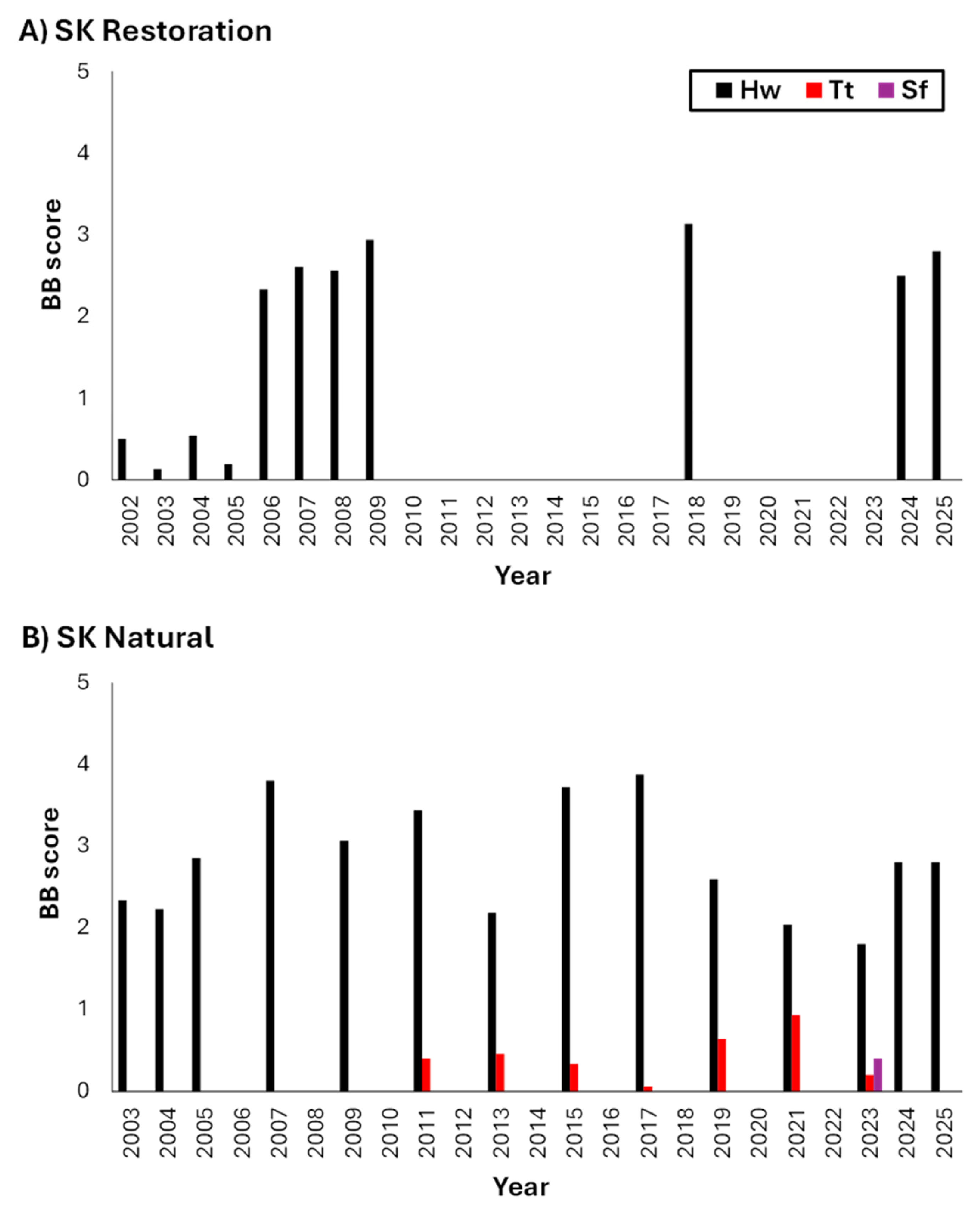
At Shell Key, the seagrass H. wrightii was the lone species recorded at restoration sites across the 22 years post-planting (Figure 2A). Low cover of seagrass during the beginning phases of seagrass plot development (through 2005) was followed by a persistent level of moderate cover by H. wrightii through to the most current sampling date. In natural sites, H. wrightii consistently maintained moderate levels of benthic cover over all dates, with two additional seagrass species—T. testudinum and S. filiforme—displaying low levels of cover from 2010 to 2023 (Figure 2B). No benthic macroalgae were found at Shell Key.

3.2. Benthic Macrophyte Dominance

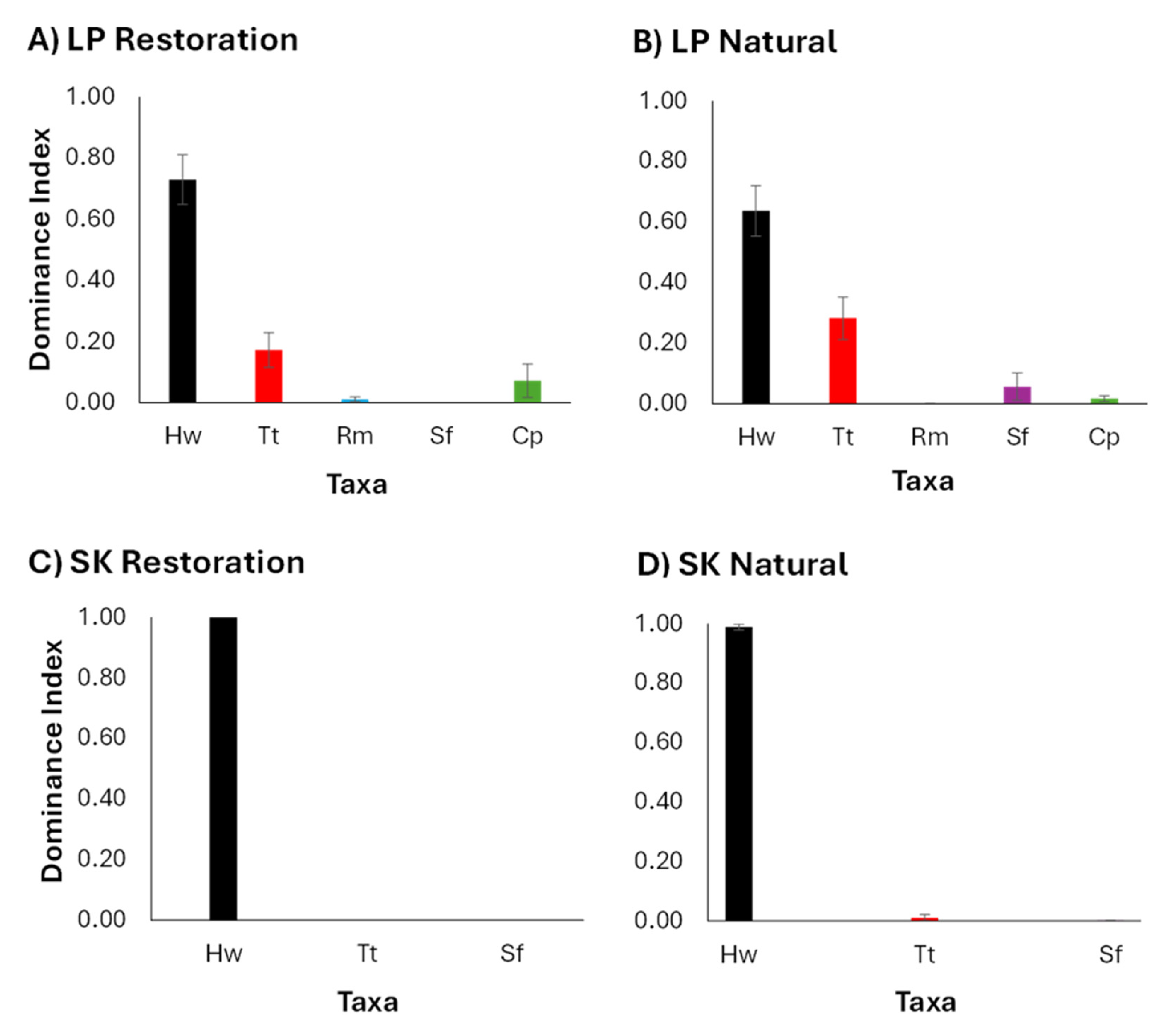
When viewed over all dates combined (Figure 3), H. wrightii displayed clear dominance by biomass or cover. Among the five species of benthic macrophytes recorded at natural and restoration sites at Lassing Park, H. wrightii had the highest dominance index in 16 out of 18 dates in restoration sites (Figure 3A) and in 10 out of 16 dates in natural sites (Figure 3B) (Table 2). The seagrass T. testudinum had the second highest dominance index at both reference and restoration sites over a similar period (Figure 3A,B). In Shell Key, the mean dominance index for H. wrightii at both restored and natural sites over all dates again indicated dominance of spatial cover by H. wrightii with but negligible contribution by two other seagrass species (Figure 3C,D) (Table 2).

4. Discussion

Our investigation into the diversity of two restoration studies offers a collective view of the dynamics of benthic macrophyte assemblages in a subtropical marine setting. Our synthesis of data spanning almost two decades of monitoring of mainly seagrass communities revealed a compelling example of convergence of restored and natural sites at each of two areas (Shell Key and Lassing Park) based upon species dominance, macrophyte identity, and number of taxa. This unique data set provides evidence that H. wrightii, the seagrass used as planting units in restoration at each location, displayed not only successful establishment but also persistence when viewed over this time period. Up to five species of benthic macrophytes were encountered in the data collection, but assessment of restoration response was focused on one taxon, H. wrightii, that overwhelmingly dominated measures of biomass or cover.
While similar patterns of community development, especially species dominance, were recorded between the two restoration sites, the pattern and tempo of seagrass expansion by H. wrightii at the restoration sites differed. At Lassing Park, the dominant seagrass, H. wrightii, demonstrated continuous colonization of bottom sediments after planting. Recovery of the seagrass taxon after the bloom of the benthic macroalga, C. prolifera in 2006 was evident in 2007. In contrast, at Shell Key, an initially slow rate of expansion of seagrass coverage was followed by a substantial increase in H. wrightii coverage during 2006 [21]. Comparison of restoration dynamics between Lassing Park and Shell Key areas from 2010 to 2023 is somewhat limited by a reduced data set, and some dynamic changes in benthic macrophytic species may have been undetected. Yet, despite some differences in community development between areas in 2018 and 2024 during which three major hurricanes passed over both Lassing Park and Shell Key, similar patterns of H. wrightii dominance have continued.
In addition to dominance by H. wrightii in restoration sites at Lassing Park, other benthic macrophyte species periodically contributed greater than 10% (DI ≥ 0.10) to total macrophyte abundance, consistent with our definition of dominance (Figure 3). Most notable was C. prolifera, which represented only a low to moderate proportion of macrophyte abundance in 2002–2005 in both restoration and natural sites at Lassing Park. However, C. prolifera, increasing to 100% of macrophyte abundance in 2006 at the restoration site at Lassing Park, was notable. Stafford and Bell [34] found that C. prolifera can out-compete H. wrightii for space, and this may explain, in part, the rapid increase in the benthic macroalga. Halodule wrightii recovery after the macroalgal bloom ended may have been expedited by colonization by fragments transported to the area [35]. Additionally, recovery in the restoration area could have been the result of colonization from local seagrass beds or from remnant shoots/rhizomes of H. wrightii that remained after C. prolifera declined. Interestingly, C. prolifera has not reappeared at Lassing Park restoration or natural sites since 2006. Such algal boom and bust characteristics and coordinated loss of seagrass have been noted in other systems (e.g., Canary Islands [36]) but, overall, remain poorly explained.
The dominance of H. wrightii at restoration sites reflects patterns seen in natural seagrass beds throughout shallow subtidal waters in the Tampa Bay [37], following trends widely reported in other areas such as the east coast of Florida [38], south Florida [39], and coastal waters of Texas [40,41]. The life history characteristic of H. wrightii as comparatively fast-growing [19] underlies the selection of H. wrightii as a popular primary source of planting units in restoration studies, as rapid development of broad seagrass coverage is often a goal. Dominance of H. wrightii during early stages of community succession has been documented from deeper seagrass beds in Florida Bay, and this seagrass has been recognized as the taxon appearing at first/early stages of seagrass recovery following die-off [24]. Halodule wrightii dominance does not persist in deeper waters of Florida Bay, where it is typically replaced by later successional stage species—S. filiforme and T. testudinum [24]. We expect that H. wrightii will likely continue to be utilized for restoration in coastal regions like those rimming Tampa Bay, given its demonstrated persistence in restoration sites and its consistent presence in natural sites in coastal locations.
Our multidecadal examination of restoration outcomes provided an opportunity to evaluate a complex set of responses by the benthic macrophytic community. Rezek et al. [12] revisited restoration sites of varying ages in Florida and reported that 60% of studies older than 5 years had the same or greater number of species in restoration sites compared to those at natural sites. This relationship appears to be true at Lassing Park and Shell Key after the first five years. Specifically, at Lassing Park, we did not see a trajectory of continual increase in the number of species or evidence of successional patterns of H. wrightii being replaced by T. testudinum/S. filiforme over time. Rather, episodes of H. wrightii dominance were intermixed with a period of multi-species composition and co-dominance (2006–2018). Displacement of H. wrightii by Caulerpa may have impacted the successional development of a multi-species community at Lassing Park. At Shell Key, H. wrightii was the only species recorded at the restoration site over two decades. In 2011–2023, T. testudinum and S. filiforme occurred at very low abundances (not meeting our criteria for dominance) in natural sites at Shell Key. In 2024 and 2025, H. wrightii dominance prevailed in both restoration and natural sites at Lassing Park and Shell Key, and no consistent pattern of additional species occupation persisted across time at any site.
Long-term monitoring of seagrass restoration, as shown here, offers an additional perspective on the persistence of restoration efforts and supports the efficacy of these management strategies. Clearly, some of the more intriguing patterns of response by seagrasses and a macrobenthic alga, such as the algal bloom and seagrass recovery at Lassing Park in 2007 and the delayed then rapid increase and sustained dominance of H. wrightii 2006–2025 at Shell Key, would have been undetected with short-term monitoring. Our findings support the conclusion that future monitoring using a combined approach that includes both short- and long-term assessments offers the opportunity for increased detection of species loss and recovery as part of a post-restoration history. Although the benefits of long-term monitoring are obvious and can potentially address calls for assessing the permanency of restoration projects, the logistics of assembling the needed information remain challenging unless some mechanism for direct funding of project assessment over decadal time periods exists. It is likely that developing partnerships with community groups, governmental agencies, and educational institutions might be the best option when funding is extremely limited or unlikely to be championed. Innovative ideas and new methods for following the post-planting of seagrass could expedite the adoption of extended monitoring programs. Communicating the value of long-term studies of restoration projects supported by demonstrated findings is an essential step in attracting support for such efforts.

Supplementary Materials

The following supporting information can be downloaded at https://www.mdpi.com/article/10.3390/d17120832/s1, Figure S1. Map displaying two study locations. Lassing Park (purple) and Shell Key (orange) and Restored (star) and Natural sites (circle). Figure S2. (A). Example of planted seagrass unit of Halodule wrightii. Sampling collection techniques used to follow seagrass bed development included use of (8–10 cm diameter) cores (B) to collect seagrass aboveground biomass, field visual surveys of benthic macrophyte presence in quadrats (C) emplaced in the field, and quadrats emplaced on digital images to quantify macrophyte presence from underwater video collected with a camera on a benthic sled (D) representing a 0.5 m × 1.0 m field of view.

Author Contributions

Conceptualization, K.L.M. and S.S.B.; methodology, K.L.M. and S.S.B.; investigation, K.L.M. and S.S.B.; resources, S.S.B.; data curation, K.L.M. and S.S.B.; writing—original draft preparation, K.L.M.; writing—review and editing, S.S.B.; funding acquisition, S.S.B. All authors have read and agreed to the published version of the manuscript.

Funding

This research was funded in part by a grant from NSF Biological Oceanography: OCE0337052 and a 2024 award from Ecosphere Restoration Institute.

Institutional Review Board Statement

Not applicable.

Data Availability Statement

The original contributions presented in this study are included in the article/Supplementary Material. Further inquiries can be directed to the corresponding author.

Acknowledgments

We thank two reviewers who provided helpful comments on an earlier version of the manuscript. We were assisted by a team of undergraduate and graduate students who helped in field sampling and data collection.

Conflicts of Interest

The authors declare no conflicts of interest. The funders had no role in the design of the study; in the collection, analyses, or interpretation of data; in the writing of the manuscript; or in the decision to publish the results.

Abbreviations

The following abbreviations are used in this manuscript:
NNorth Latitude
WWest Longitude

References

  1. do Amaral Camara Lima, M.; Bergamo, T.F.; Ward, R.D.; Joyce, C.B. A review of seagrass ecosystem services: Providing nature-based solutions for a changing world. Hydrobiologia 2023, 850, 2655–2670. [Google Scholar] [CrossRef]
  2. Larkum, A.; Orth, R.; Duarte, C.M. Seagrasses; Springer: Dordrecht, The Netherlands, 2006. [Google Scholar]
  3. Robbins, B.D. Quantifying temporal change in seagrass areal coverage: The use of GIS and low resolution aerial photography. Aquat. Bot. 1997, 58, 259–267. [Google Scholar] [CrossRef]
  4. Morris, L.J.; Hall, L.M.; Jacoby, C.A.; Chamberlain, R.H.; Hanisak, M.D.; Miller, J.D.; Virnstein, R.W. Seagrass in a changing estuary, the Indian River Lagoon, Florida, United States. Front. Mar. Sci. 2022, 8, 789818. [Google Scholar] [CrossRef]
  5. Gerona-Daga, M.E.B.; Salmo, S.G. A systematic review of mangrove restoration studies in Southeast Asia: Challenges and opportunities for the United Nation’s Decade on Ecosystem Restoration. Front. Mar. Sci. 2022, 9, 987737. [Google Scholar] [CrossRef]
  6. Su, J.; Yin, B.; Chen, L.; Gasparatos, A. Priority areas for mixed-species mangrove restoration: The suitable species in the right sites. Environ. Res. Lett. 2022, 17, 065001. [Google Scholar] [CrossRef]
  7. Pausch, R. Testing strategies to enhance transplant success under stressful conditions at a tidal marsh restoration project. Restor. Ecol. 2024, 32, e14117. [Google Scholar] [CrossRef]
  8. Tanner, K.E.; Parker, I.M.; Fountain, M.C.; Thomsen, A.S.; Wasson, K. Unfriendly neighbors: When facilitation does not contribute to restoration success in tidal marsh. Ecol. Appl. 2025, 35, e3079. [Google Scholar] [CrossRef]
  9. Lirman, D.; Cropper, W.P. The Influence of Salinity on Seagrass Growth, Survivorship, and Distribution within Biscayne Bay, Florida: Field, Experimental, and Modeling Studies. Estuaries 2003, 26, 131–141. [Google Scholar] [CrossRef]
  10. Kaldy, J.E.; Dunton, K.H.; Kowalski, J.L.; Lee, K.S. Factors controlling seagrass revegetation onto dredged material deposits: A case study in Lower Laguna Madre, Texas. Coast. Res. 2004, 20, 292–300. [Google Scholar] [CrossRef]
  11. Barros, K.V.D.S.; Rocha-Barreira, C.D.A. Influence of environmental factors on a Halodule wrightii Ascherson meadow in northeastern Brazil. BJAST 2014, 18, 31–41. [Google Scholar] [CrossRef]
  12. Rezek, R.J.; Furman, B.T.; Jung, R.P.; Hall, M.O.; Bell, S.S. Long-term performance of seagrass restoration projects in Florida, USA. Sci. Rep. 2019, 9, 15514. [Google Scholar] [CrossRef] [PubMed]
  13. van Katwijk, M.M.; Thorhaug, A.; Marbà, N.; Orth, R.J.; Duarte, C.M.; Kendrick, G.A.; Al-thuizen, I.H.J.; Balestri, E.; Bernard, G.; Cambridge, M.L.; et al. Global analysis of seagrass restoration: The importance of large-scale planting. J. Appl. Ecol. 2016, 53, 567–578. [Google Scholar] [CrossRef]
  14. Boudouresque, C.F.; Blanfuné, A.; Pergent, G.; Thibaut, T. Restoration of seagrass meadows in the Mediterranean Sea: A critical review of effectiveness and ethical issues. Water 2021, 13, 1034. [Google Scholar] [CrossRef]
  15. Ward, M.; Beheshti, K. Lessons learned from over thirty years of eelgrass restoration on the US West Coast. Ecosphere 2023, 14, e4642. [Google Scholar] [CrossRef]
  16. Petersen, T.; Gransten, S.B.; Elbrønd, F.; Johnstad-Møller, C.A.; Christensen, C.V.; Brodersen, K.E. Effects of European green crabs (Carcinus maenas) on transplanted Eelgrass (Zostera marina): Potential protective measures. Restor. Ecol. 2025, 33, e70074. [Google Scholar] [CrossRef]
  17. Fonseca, M.S.; Whitfield, P.E.; Kenworthy, W.J.; Colby, D.R.; Julius, B.E. Use of two spatially explicit models to determine the effect of injury geometry on natural resource recovery. Aquat. Conserv. Mar. Freshw. Ecosyst. 2004, 14, 281–298. [Google Scholar] [CrossRef]
  18. Thorhaug, A.; Belaire, C.; Verduin, J.J.; Schwarz, A.; Kiswara, W.; Prathep, A.; Gallagher, J.B.; Huang, X.P.; Berlyn, G.; Yap, T.-K.; et al. Longevity and sustainability of tropical and subtropical restored seagrass beds among Atlantic, Pacific, and Indian Oceans. Mar. Pollut. Bull. 2020, 160, 111544. [Google Scholar] [CrossRef]
  19. Gallegos, M.E.; Merino, M.; Rodriguez, A.; Marbà, N.; Duarte, C.M. Growth patterns and demography of pioneer Caribbean seagrasses Halodule wrightii and Syringodium filiforme. Mar. Ecol. Prog. Ser. 1994, 109, 99–104. [Google Scholar] [CrossRef]
  20. Thom, R.M.; Diefenderfer, H.L.; Vavrinec, J.; Borde, A.B. Restoring Resiliency: Case Studies from Pacific Northwest Estuarine Eelgrass (Zostera marina L.). Ecosystems 2012, 35, 78–91. [Google Scholar] [CrossRef]
  21. Bell, S.S.; Middlebrooks, M.L.; Hall, M.O. The Value of Long-Term Assessment of Restoration: Support from a Seagrass Investigation. Restor. Ecol. 2014, 22, 304–310. [Google Scholar] [CrossRef]
  22. Bacci, T.; Scardi, M.; Tomasello, A.; Valiante, L.M.; Piazzi, L.; Calvo, S.; Badalamenti, F.; di Nuzzo, F.; Raimondi, V.; Assenzo, M.; et al. Long-term response of Posidonia oceanica meadow restoration at the population and plant level: Implications for management decisions. Restor. Ecol. 2025, 33, e14360. [Google Scholar] [CrossRef]
  23. Kendrick, G.A.; Austin, R.; Ferretto, G.; van Keulen, M.; Verduin, J.J. Lessons learnt from revisiting decades of seagrass restoration projects in Cockburn Sound, southwestern Australia. Restor. Ecol. 2025, 33, e70040. [Google Scholar] [CrossRef]
  24. Hall, M.O.; Bell, S.S.; Furman, B.T.; Durako, M.J. Natural recovery of a marine foundation species emerges decades after landscape-scale mortality. Sci. Rep. 2021, 11, 6973. [Google Scholar] [CrossRef] [PubMed]
  25. Bell, S.S.; Ann Clements, L.J.; Kurdziel, J. Production in Natural and Restored Seagrasses: A Case Study of a Macrobenthic Polychaete. Ecol. Appl. 1993, 3, 610–621. [Google Scholar] [CrossRef] [PubMed]
  26. Bell, S.S.; Tewfik, A.; Hall, M.O.; Fonseca, M.S. Evaluation of seagrass planting and monitoring techniques: Implications for assessing restoration success and habitat equivalency. Restor. Ecol. 2008, 16, 407–416. [Google Scholar] [CrossRef]
  27. Fonseca, M.S.; Kenworthy, W.J.; Courtney, F.X. Development of planted seagrass beds in Tampa Bay, Florida, USA. I. Plant components. Mar. Ecol. Prog. Ser. 1996, 132, 127–139. [Google Scholar] [CrossRef]
  28. Jacobson, S.B. Seagrass Restoration at Lassing Park, St. Petersburg, Florida: Analysis After 13.5 Years. Master’s Thesis, University of South Florida, Tampa, FL, USA, 2002. [Google Scholar]
  29. Richards, C.L. (University of South Florida, Tampa, FL, USA); Bell, S.S. (University of South Florida, Tampa, FL, USA); Burns, B. (University of South Florida, Tampa, FL, USA); MacLeod, K. (University of South Florida, Tampa, FL, USA). Population genomics on Halodule wrightii Restoration. Unpublished report, 2025. [Google Scholar]
  30. Tampa Bay Seagrass Transect Dashboard. Available online: https://tbep.org/seagrass-assessment/ (accessed on 18 September 2025).
  31. Braun-Blanquet, J. Plant Sociology: The Study of Plant Communities; Fuller, G.D., Conard, H.S., Eds. and Translators; Authorized English translation of Pflanzensoziologie; McGraw-Hill: New York, NY, USA, 1932. [Google Scholar]
  32. Duan, J.; Jia, Z.; Ge, S.; Li, Y.; Kang, D.; Li, J. Dominant Species Composition, Environmental Characteristics and Dynamics of Forests with Picea jezoensis Trees in Northeast China. Diversity 2024, 16, 731. [Google Scholar] [CrossRef]
  33. Furman, B.T.; Leone, E.H.; Bell, S.S.; Durako, M.J.; Hall, M.O. Braun-Blanquet data in ANOVA designs: Comparisons with percent cover and transformations using simulated data. Mar. Ecol. Prog. Ser. 2018, 597, 13–22. [Google Scholar] [CrossRef]
  34. Stafford, N.B.; Bell, S.S. Space competition between seagrass and Caulerpa prolifera (Forsskaal) Lamouroux following simulated disturbances in Lassing Park, FL. J. Exp. Mar. Biol. Ecol. 2006, 333, 49–57. [Google Scholar] [CrossRef]
  35. Morris, L.J.; Virnstein, R.W. The demise and recovery of seagrass in the northern Indian River Lagoon, Florida. Estuaries 2004, 27, 915–922. [Google Scholar] [CrossRef]
  36. Tuya, F.; Hernandez-Zerpa, H.; Espino, F.; Haroun, R. Drastic decadal decline of the seagrass Cymodocea nodosa at Gran Canaria (eastern Atlantic): Interactions with the green algae Caulerpa prolifera. Aquat. Bot. 2013, 105, 1–6. [Google Scholar] [CrossRef]
  37. Robbins, B.D.; Bell, S.S. Dynamics of a subtidal seagrass landscape: Seasonal and annual change in relation to water depth. Ecology 2000, 81, 1193–1205. [Google Scholar] [CrossRef]
  38. Virnstein, R.W. Seagrass landscape diversity in the Indian River Lagoon, Florida: The importance of geographic scale and pattern. Bull. Mar. Sci. 1995, 57, 67–74. [Google Scholar]
  39. Lirman, D.; Thyberg, T.; Santos, R.; Schopmeyer, S.; Drury, C.; Collado-Vides, L.; Bellmund, S.; Serafy, J. SAV communities of western Biscayne Bay, Miami, Florida, USA: Human and natural drivers of seagrass and macroalgae abundance and distribution along a continuous shoreline. Estuaries Coasts 2014, 37, 1243–1255. [Google Scholar] [CrossRef]
  40. Onuf, C.P. Biomass patterns in seagrass meadows of the Laguna Madre, Texas. Bull. Mar. Sci. 1996, 58, 404–420. [Google Scholar]
  41. Congdon, V.M.; Hall, M.O.; Furman, B.T.; Campbell, J.E.; Durako, M.J.; Goodin, K.L.; Dunton, K.H. Common ecological indicators identify changes in seagrass condition following disturbances in the Gulf of Mexico. Ecol. Indic. 2023, 156, 111090. [Google Scholar] [CrossRef]
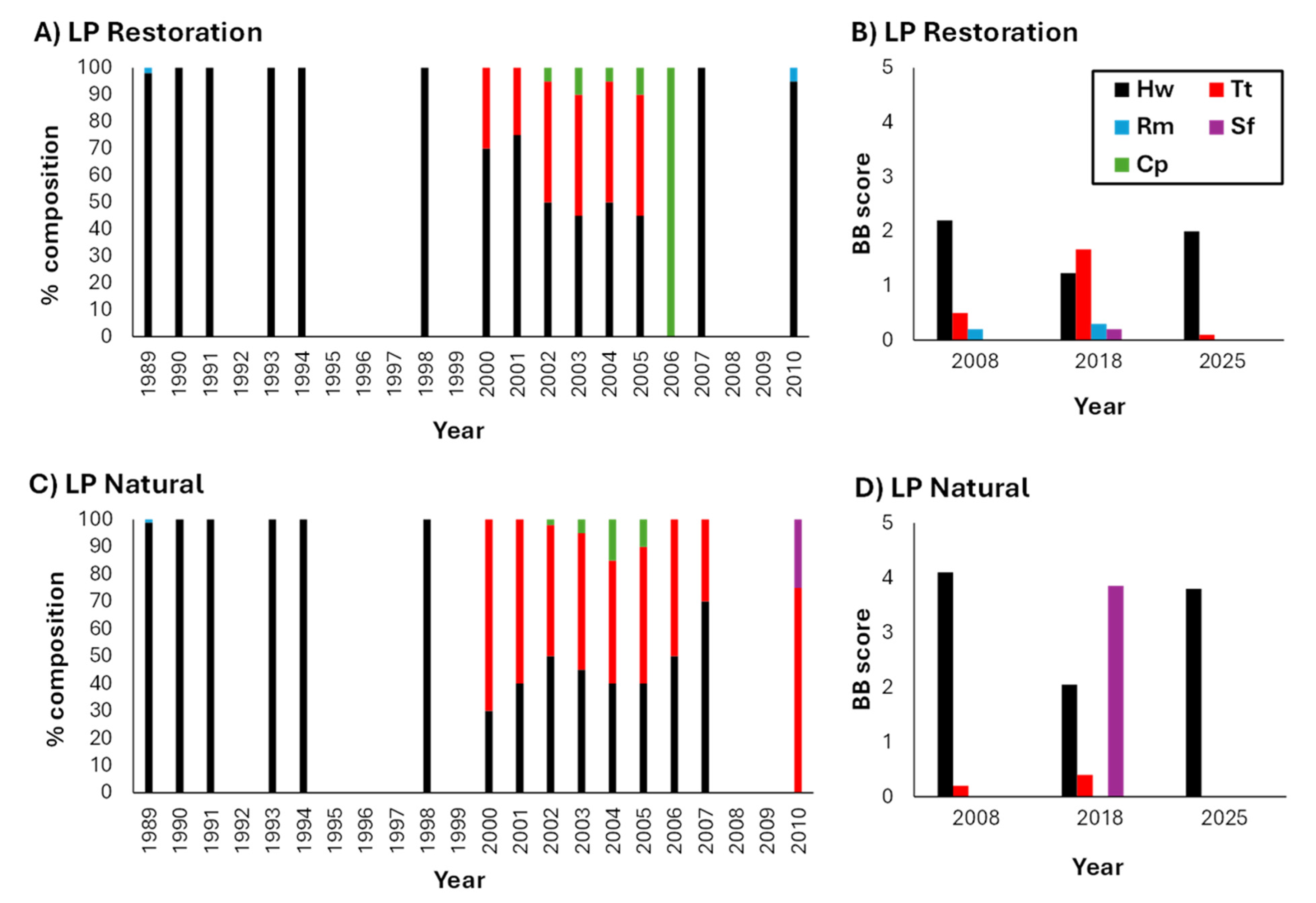
Figure 1. Abundance of benthic macrophyte taxa at Lassing Park (LP), Florida, USA. Percent composition of benthic macrophyte taxa from 1989 to 2010 (A,C) and mean BB score of benthic macrophyte taxa from 2008, 2018, 2025 (B,D) are shown for restoration (A,B) and natural (C,D) sites. Benthic macrophyte taxa: Halodule wrightii (Hw), Thalassia testudinum (Tt), Ruppia maritima (Rm), Syringodium filiforme (Sf), and Caulerpa prolifera (Cp). See Table 1 for details about sampling efforts for each year.
Diversity 17 00832 g001
Figure 2. Abundance of benthic macrophyte taxa at Shell Key (SK), Florida, USA. Seagrass was planted in 2002. Mean BB score of benthic macrophyte taxa at restoration (A) and natural (B) sites from 2003 to 2025. Benthic Macrophyte taxa: Halodule wrightii (Hw), Thalassia testudinum (Tt), and Syringodium filiforme (Sf). See Table 1 for details about sampling efforts for each year.
Diversity 17 00832 g002
Figure 3. Dominance indices (DI) (mean ± SE) of benthic macrophyte species at Lassing Park restoration (A), Lassing Park natural (B), Shell Key restoration (C), and Shell Key natural (D) sites. Benthic macrophyte taxa: Halodule wrigthii (Hw), Thalassia testudinum (Tt), Syringodium filiforme (Sf), Ruppia maritima (Rm), Caulerpa prolifera (Cp).
Diversity 17 00832 g003
Table 1. Chronological listing of specific features of long-term data collection for benthic macrophytes at restoration and natural reference sites at Lassing Park (LP) and Shell Key (SK) locations. For each year for which data were available, information on sampling method and metrics is presented, along with the number of samples for each year. Data sources are from published and unpublished sources [12,21,25,26,28,29,30]. AGB = aboveground biomass; BB quadrats = macrophyte abundance from surveys. (V) = underwater video; (number in parentheses indicates the number of plots within which points were examined). See Figure S2 for more information on survey methods. * = unpublished data set, S. S. Bell.
YearSurvey TypeNumber of ReplicatesData Source
(A) LP Restoration
1989–1990AGB cores24 [25]
1991, 1993, 1994, 1998AGB cores12 *
2000–2001AGB cores12 [28]
2002–2007AGB cores10 *
2008BB quadrats (v)10 *
2010AGB cores10 *
2018BB quadrats30 [12]
2025BB quadrats5 [29]
(B) LP Natural
1989–1990AGB cores24 [25]
1991, 1993, 1994, 1998AGB cores12 *
2000–2001AGB cores12 [28]
2002–2007AGB cores10 *
2008BB quadrats (v)10 *
2010AGB cores10 *
2018BB quadrats20 [12]
2025BB quadrats5 [29]
(C) SK Restoration
2002–2005BB points (12)6000 [26]
2006BB points (3)1500 [21]
2007–2009BB points (12)6000 [21]
2018BB quadrats30 [12]
2024–2025BB quadrats5 [29]
(D) SK Natural
2003BB quadrats18 [31]
2005BB quadrats10 [31]
2007BB quadrats15 [31]
2009BB quadrats16 [31]
2011BB quadrats16 [31]
2013BB quadrats11 [31]
2015BB quadrats9 [31]
2017BB quadrats8 [31]
2019BB quadrats11 [31]
2021BB quadrats14 [31]
2023BB quadrats15 [31]
2024–2025BB quadrats5 [29]
Table 2. Count of the number of years during which a benthic macrophyte taxon was dominant. Total sample years varied by site and location: for Lassing Park (LP), either Natural or Restoration sites, n = 18; for Shell Key (SK) Restoration, n = 11; for Shell Key (SK) Natural, n = 14.
LPSK
RestorationNaturalRestorationNatural
Halodule wrightii16171114
Thalassia testudinum7901
Syringodium filiforme0200
Caulerpa prolifera3900
Disclaimer/Publisher’s Note: The statements, opinions and data contained in all publications are solely those of the individual author(s) and contributor(s) and not of MDPI and/or the editor(s). MDPI and/or the editor(s) disclaim responsibility for any injury to people or property resulting from any ideas, methods, instructions or products referred to in the content.