Article

Interactions Between Invasive Plants and Native Plants on the Northern Coast of China and Their Implications for Ecological Restoration


1
School of Chemical Safety, North China Institution of Science and Technology, Langfang 065201, China
2
School of Ecology and Natural Conservation, Beijing Forestry University, Beijing 100083, China
3
Beijing Tongzhou District Forestry Work Station, Beijing 101100, China
*
Author to whom correspondence should be addressed.
Diversity 2025, 17(11), 765; https://doi.org/10.3390/d17110765
Submission received: 5 September 2025 / Revised: 30 October 2025 / Accepted: 31 October 2025 / Published: 1 November 2025
(This article belongs to the Section Plant Diversity)

Abstract

Spartina alterniflora has become one of the most serious invasive species and competes with native Phragmites australis and Suaeda salsa in northern China. This study conducted controlled container experiments with no competition, intraspecific competition, two-species competition, and three-species competition to compare the growth conditions of Spartina alterniflora (ramet, genet, and mixture), Phragmites australis, and Suaeda salsa. Results showed the following: (1) Spartina alterniflora exhibited obviously stronger interspecific competitiveness than that interspecific competition (RYab > 1), with significant differences in height, basal diameter, number of blades, fresh weight, and dry weight (p < 0.05); (2) among reproductive strategies, Spartina alterniflora competitiveness followed the order of ramets > genets > mixture; (3) under multispecies competition, height, basal diameter, and number of blades of Spartina alterniflora showed significant differences (p < 0.05); (4) the competitiveness of Spartina alterniflora in height, basal diameter, and number of blades on native species followed the order Suaeda salsa > Phragmites > Suaeda salsa + Phragmites > competition > no competition. This study suggests the following: (1) controlling established ramets should be prioritized; (2) genet seedlings should be removed within the same year; (3) monitoring of genets should be strengthened. Furthermore, container conditions in this study may not fully capture field environments. Future research should integrate long-term field experiments, tidal gradients, and nutrient manipulations.

1. Introduction

Alien invasive plants constitute one of the most serious threats to native ecosystems, affecting both native species assemblages and natural habitat environments [1]. Wetlands are particularly vulnerable, as many invaders form monotypic stands that alter habitat structure, reduce biodiversity, modify nutrient cycling and productivity, and disrupt food webs [2]. Consequently, understanding the interaction mechanisms between invasive and native species is essential for the effective conservation and management of wetland ecosystems.
Spartina alterniflora (S. alterniflora) was officially listed as a Chinese harmful invasive species in 2003 [3]. Introduced from North America in 1979 to prevent coastal erosion, it rapidly expanded and distributed along the coastline due to its high competition ability and reproductive capacity, causing extensive ecological impacts, including the replacement of native plants and the loss of critical habitats for waterbirds [4,5]. S. alterniflora occupied a niche similar to that of native Chinese marsh plants, such as Phragmites australis (P. australis), Suaeda salsa (S. salsa), Scirpus mariqueter (S. mariqueter), and mangrove plants [6,7], and it is a C4 plant whose ratio of photosynthesis to respiration is more than one, so that it can rapidly invade the habitat of native species and eliminate them [8,9,10]. Intraspecific and interspecific competitions play a key role in shaping plant community structure, encompassing factors such as intraspecific variation, nutritional polymorphism, or speciation, and so on [11,12]. However, invasive species often surpass the adaptive capacity of native plants, encroach upon ecological space, and inhibit native plant growth, thereby altering the local ecosystem [13,14]. As the most prominent alien invasive plant in China, numerous previous studies have examined the interaction between S. alterniflora and native species, including interspecific competition with P. australis along the environmental gradients such as elevation, salinity, tidal level, and nutrient availability; in interspecific competition, S. alterniflora total biomass remained stable while P. australis biomass decreased significantly compared to intraspecific competition [15,16,17,18,19,20,21], the effects of sediment type on the competition between bulrush [22,23], and the invasion mechanisms of S. alterniflora into the S. salsa communities [24,25], and so on. Most previous studies focused on the pairwise interaction between S. alterniflora and a single native plant. However, S. alterniflora co-occurs with both P. australis and S. salsa in single- and mixed-species communities along the northern part of the Chinese coasts [26]. Therefore, studying the competitive relationships among S. alterniflora, P. australis, and S. salsa is critical to simulate realistic natural scenarios.
This study aims to explore the interspecific competition mechanisms among S. alterniflora, P. australis, and S. salsa using a controlled experimental setup, with sample plants collected from the coastal wetlands in Hebei Province, in order to clarify the implications of ecological restoration. Based on this study objective, the hypotheses are proposed: regardless of plant density, the invasion of S. alterniflora would reduce the biomass of both P. australis and S. salsa. Specifically, the study addressed the following questions: (1) How does the competitiveness of S. alterniflora vary among its different reproductive strategies? (2) How does S. alterniflora perform under multi-species competitions? (3) How do the growth traits of S. alterniflora, P. australis, and S. salsa compare across different competitive scenarios? (4) What management recommendations can be derived to support ecological restoration and environmental conservation?

2. Materials and Methods

2.1. Site Description

Tangshan city is located in the eastern of Hebei Province, along the northern coast of Bohai Bay (38°55′ N–40°28′ N, 117°31′ E–119°9′ E), the coastal zone spans Fengnan District, Luanan County, Caofeidian District, and Laoting County (Figure 1), with a total coastline length of 334.8 km, comprising 124.9 km of silt-bound coastline, 74.4 km of sandy coastline, and 135.5 km of island coastline. The region contains approximately 452,000 hm2 of mudflats and supports abundant biological resources, with vegetation dominated by marsh plant communities. Key conservation reserves include Luanhe Estuary wetland and Nanbu wetland [27]. Native plant species such as P. australis and S. salsa are widely distributed along the coastline [28]. However, S. alterniflora has invaded the coastal wetlands of Tangshan City since 2015, with the area reaching 3.24 hm2 in Luannan County and 6.39 hm2 in Fengnan District [29].

2.2. Experimental Approach

2.2.1. Sampling and Planting

The experimental clones and seedlings used in this study were collected from the Shahe and Douhe estuaries in Fengnan District (Figure 1). Although environmental differences in geographic distance are not related to genetic distance, all clones and seedlings of S. alterniflora were sampled within a relatively small area to minimize the individual variability, including asexual (ramet) and sexual (genet) seedlings. P. australis reproduces both sexually and asexually [30]; however, sexual seedlings were not observed at the collection site, and thus all collected P. australis clones were asexual. S. salsa, an annual species [31], was collected exclusively as sexual seedlings. S. alterniflora shares a similar reproduction strategy with P. australis [32], and its ramets and genets were readly distinguishable in the field, allowing for separate collection. Field sampling was carried out in early May 2024 to ensure that the height of the wild clones and seedlings remained within a reasonable height range. To reduce the experiment errors, we set a standard for each species and randomly sampled them in a small area. The collected clones measured 25–30 cm for P. australis, 15–20 cm for S. salsa, 25–30 cm for S. alterniflora ramets, and approximately 5 cm for S. alterniflora genets. The entire root systems of all clones and seedlings were excavated using the transplanting shovel, after which they were promptly sorted and placed in an incubator. Sufficient water was applied during transportation to maintain high survival rates for subsequent controlled experiments.
Cylindrical plastic buckets (25.5 cm in diameter and 27.8 cm in depth) were used as the experimental containers. Each bucket was filled with a substrate consisting of a 1:1 mixture of soil and sand to a depth of 20 cm. A total of 20 experimental scenarios were established, each replicated four times, resulting in 80 containers in total. Following transplantation, clones and seedlings were watered twice daily (morning and evening) for the first three days to facilitate recovery, and thereafter irrigation was applied three times per week (Tuesday, Thursday, and Saturday mornings). The irrigation water was prepared by mixing tap water with salt collected from the original sampling site to a salinity of approximately 13‰, which was comparable to the sediment in the natural habitats.

2.2.2. Experimental Design

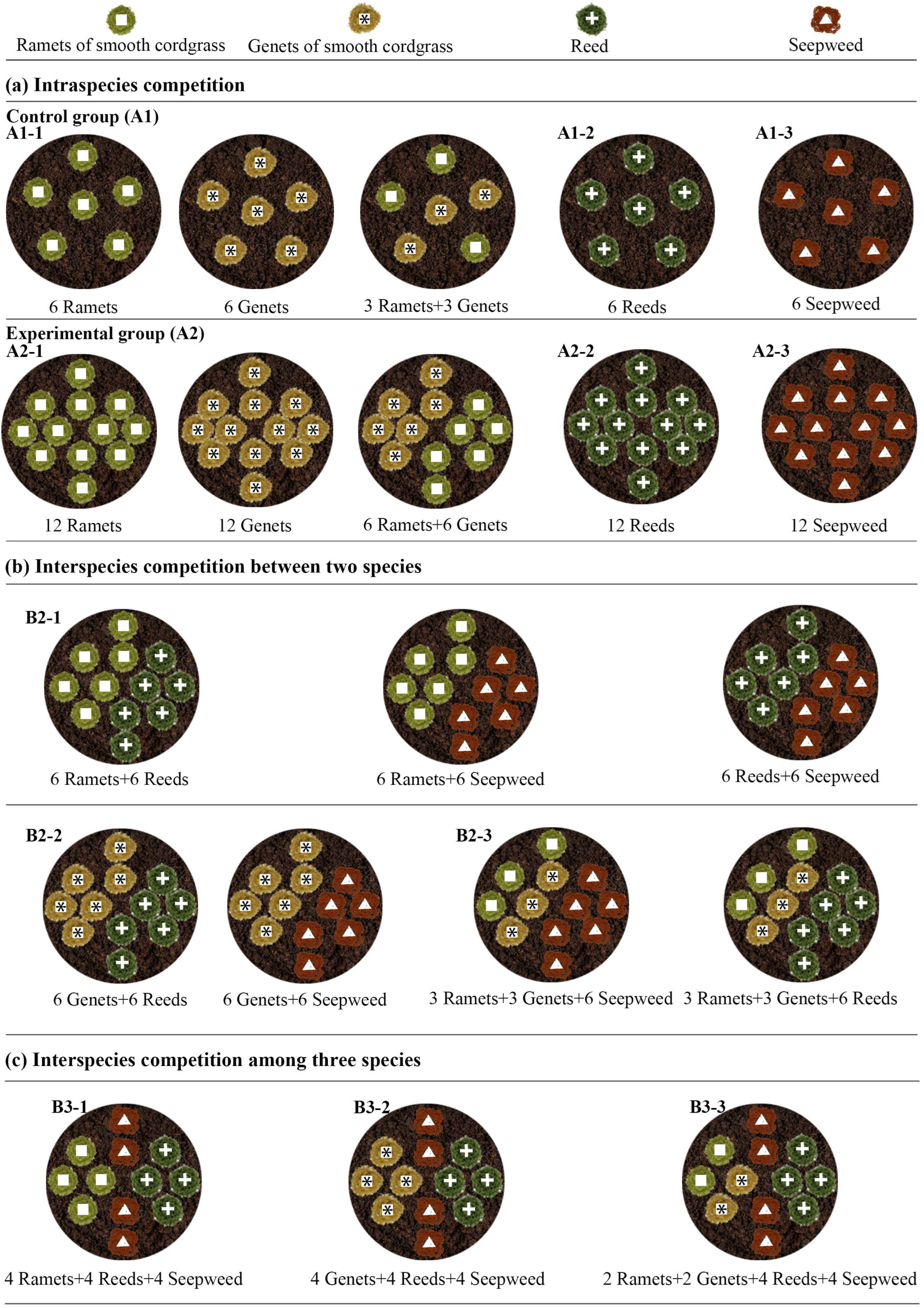
The intraspecific competition experiments were established as follows (Figure 2). In the control group (Figure 2a-A1), six individuals of each species were planted per container. Five scenarios were included: Ramets of S. alterniflora, genets of S. alterniflora, a mixture of ramets and genets of S. alterniflora, P. australis, and S. salsa. In the experimental group (Figure 2a-A2), the same five scenarios were applied, but with 12 individuals of each species per container to examine the intraspecific competition. The interspecific competition experiments between two species were designed as shown in Figure 2b. Group A2 (Figure 2b) served as the control group, while the experimental group (Figure 2b-B2) included three scenarios in the this group (Figure 2b-B2-1, ramets + reeds, ramets + seepweed, reeds + seepweed), two scenarios in the genets group (Figure 2b-B2-2, genets + reeds, genets + seepweed), and two scenarios in the mixture of ramets and genets group (Figure 2b-B2-3, mixture + seepweed, mixture + reeds). The interspecific competition experiments involving three species were designed as shown in Figure 2c. Group A2 (Figure 2b) still served as the control group; three scenarios in the experimental group (Figure 2c-B3) included ramets (Figure 2c-B3-1, ramet + reeds + seepweed), genets (Figure 2c-B3-2, genets reeds + seepweed), and the mixture of ramets and genets (Figure 2c-B3-3, mixture + reeds + seepweed). In summary, a total of 15 experimental scenarios of S. alterniflora were established due to the inclusion of mixture by ramets and genets, and nine scenarios of P. australis and S. salsa, respectively.

2.2.3. Data Collection and Organization

The harvest was carried out on 1 October 2024. Because the weather will become cold and dry after 1 October in the northern part of China, which will affect the biomass of the plants, especially the fresh weight and dry weight. Before harvest, the measures of height, basal diameter, and the number of blades were recorded; then, all the aboveground parts were harvested, recording the fresh weight and dry weight. The fresh plant parts harvested were oven-dried at 84 °C for 24 h until their weight remained constant. Mean value of each measure was calculated for each replicate, including height, basal diameter, the number of blades, fresh weight, and dry weight. For instance, ramets were divided by two, genets were divided by two, P. australis were divided by four, and S. salsa was divided by four in the Figure 2c-B3-3 scenario. Finally, the five measures’ values of the individual plant per container were recorded in the dataset for subsequent analyses.

2.2.4. Statistics and Analysis

Mean values and standard deviation were calculated with raw data to examine the dataset distribution, firstly. To normalize the data distribution, a log10 transformation was performed, and all subsequent analyses were based on the transformed data. First, one-way ANOVA analysis with R software (version 4.4.2) was used to examine growth measures of S. alterniflora, P. australis, and S. salsa across the different experimental scenarios, and two-way PERMANOVA was conducted to examine the comparisons in 15 scenarios of S. alterniflora′s five growth measures (other five scenarios only had P. australis and S. salsa, without S. alterniflora), one group was divided by reproductive types (ramet, genet, and mixture), another group by competition scenarios (no competition, intraspecific competition, interspecific competition with P. australis, interspecific competition with S. salsa, interspecific competition among three species). Relative yield (RY) and attack coefficient (A) were calculated between intraspecific and interspecific competitions to explore the competition relationships between invasive and native species (Table 1). In the formulas, a and b represent invasive and native species, respectively. Ya represents species a mean biomass per plant in the single species scenario, Yab represents species a mean biomass per plant in the scenario of the competition between a and b, RYab represents the relative yield of species a when species a invading into species b in the competition scenario. RYab > 1, which indicates that the competitiveness of invasion from a to b is greater than the intensity of the invasion itself; RYab = 1, which indicates that the competitiveness of invasion from a to b is equal to the intensity of the invasion itself; RYab < 1 indicates that lower invasion competitiveness of a into b than itself also illustrates intraspecific competition is greater than interspecific competition. A < 0 represents that a is lower competitiveness than b, A = 0 represents equal competitiveness, and A > 0 represents that a is larger than b [33,34,35,36,37]. Multifactor histograms of the growth measures for S. alterniflora, P. australis, and S. salsa were generated in the Origin Pro 2021 software to illustrate the differences in their growth conditions under the different scenarios. All calculations were executed using Microsoft Excel 2021 software.

3. Results

3.1. Growth Measures Comparison

Across the 15 competition scenarios among S. alterniflora, P. australis, and S. salsa, all growth measures of S. alterniflora differed significantly (Table 2), including height (p < 0.05), basal diameter (p < 0.001), number of blades (p < 0.05), fresh weight (p < 0.001), and dry weight (p < 0.001). For P. australis in nine scenarios, only the measure of basal diameter showed a significant difference in nine scenarios (p < 0.05). For S. salsa in nine scenarios, both height (p < 0.05) and basal diameter (p < 0.001) were significantly different across the nine scenarios. In Table 3, the results of two-way PERMANOVA showed that reproductive types had a significant influence on basal diameter (R2 = 0.435, p < 0.001), fresh weight (R2 = 0.424, p < 0.001), and dry weight (R2 = 0.501, p < 0.001). Competitive scenarios had a significant influence on height (R2 = 0.159, p < 0.05), basal diameter (R2 = 0.236, p < 0.05), and number of blades (R2 = 0.260, p < 0.001). The interaction of both factors indicated that the effects of reproductive types on basal diameter was interdependent on the competitive scenarios (R2 = 0.114, p < 0.016). Moreover, the comparisons between the pairs are shown in the Table S1.

3.2. Competitiveness of S. alterniflora

Using ramets and genets of S. alterniflora as the invasive species, P. australis and S. salsa as the native species, the competitiveness of S. alterniflora was evaluated based on intraspecific competition and interspecific competition between the two species (Table 4). S. alterniflora in different reproductive types invading P. australis and S. salsa generally exhibited higher competitive intensity than that of their own (RYab > 1). Exceptions included height (RYab = 0.768), number of blades (RYab = 0.829), and fresh weight (RYab = 0.846) in the ramets + reeds scenario, as well as wet height (RYab = 0.843) and dry weight (RYab = 0.644) in the genets + seepweed scenario. Overall, S. alterniflora displayed higher competitiveness in most scenarios, as indicated by positive attack coefficients (A > 0).

3.3. Measures Performance in Various Scenarios

3.3.1. Performance of S. alterniflora

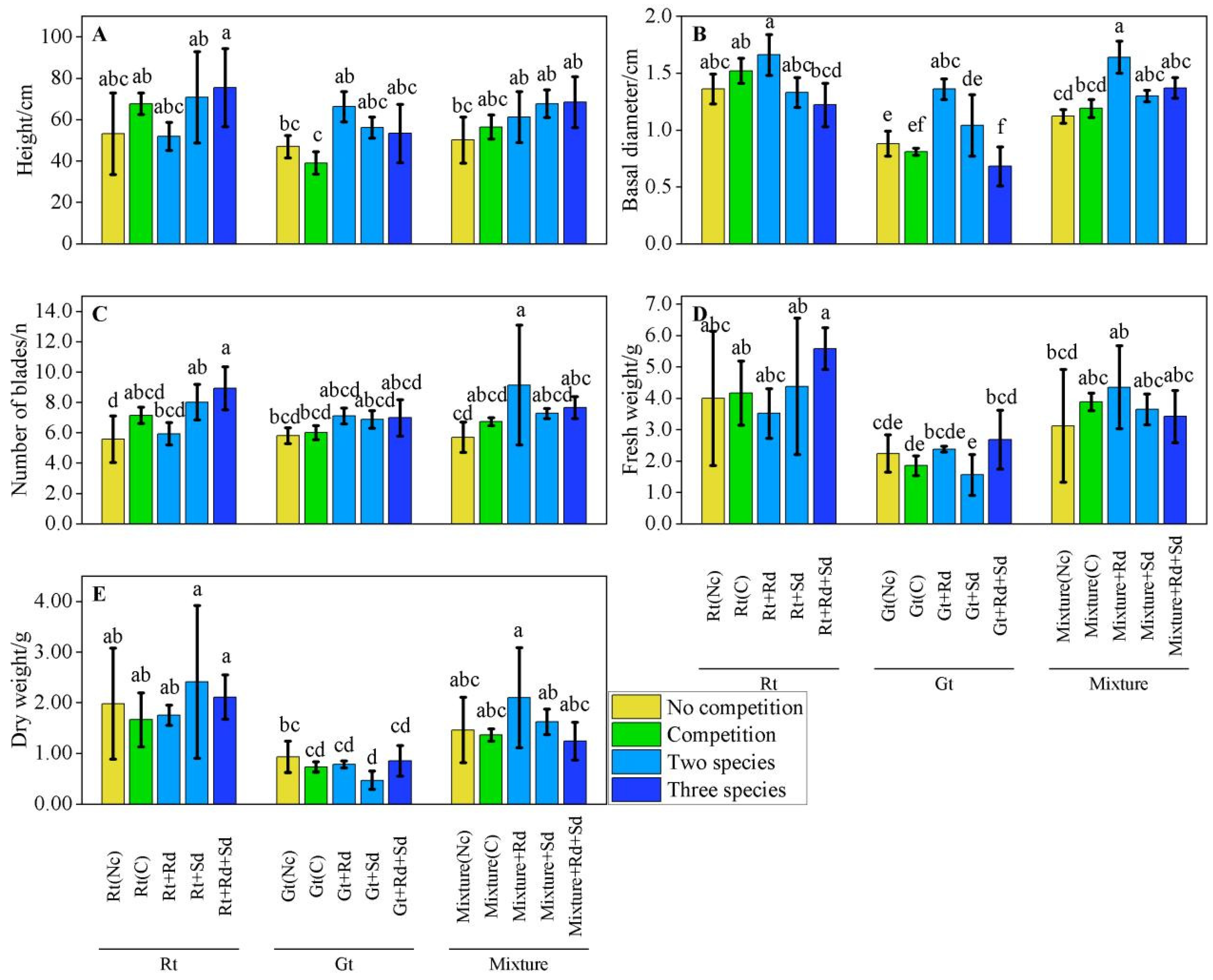
In Figure 3, the growth measures of S. alterniflora did not show significant differences between no competition and intraspecific competition, but under interspecific competition were clearly higher than in both no competition and intraspecific competition (all blue columns were higher than the yellow and green ones). This illustrates that S. alterniflora exhibits stronger competitive intensity than that within its own. Growth patterns among different reproductive types followed the order: ramet > mixture > genet, with corresponding mean values of each measure, respectively, being height (63.82 cm, 60.79 cm, 52.38 cm), basal diameter (1.41 cm, 1.32 cm, 0.95 cm), number of blades (7.12, 7.30, 6.56), fresh weight (4.33 g, 3.68 g, 2.14 g), and dry weight (1.98 g, 1.56 g, 0.75 g). Notably, height, basal diameter, and number of blades in the genet scenarios showed significant differences, while height and basal diameter in the mixture scenarios also showed significant differences between intraspecific and interspecific competition. Across different competition combinations, most growth measures of S. alterniflora followed the trend: seepweed > reed > seepweed + reed > competition > no competition.

3.3.2. Performance of P. australis

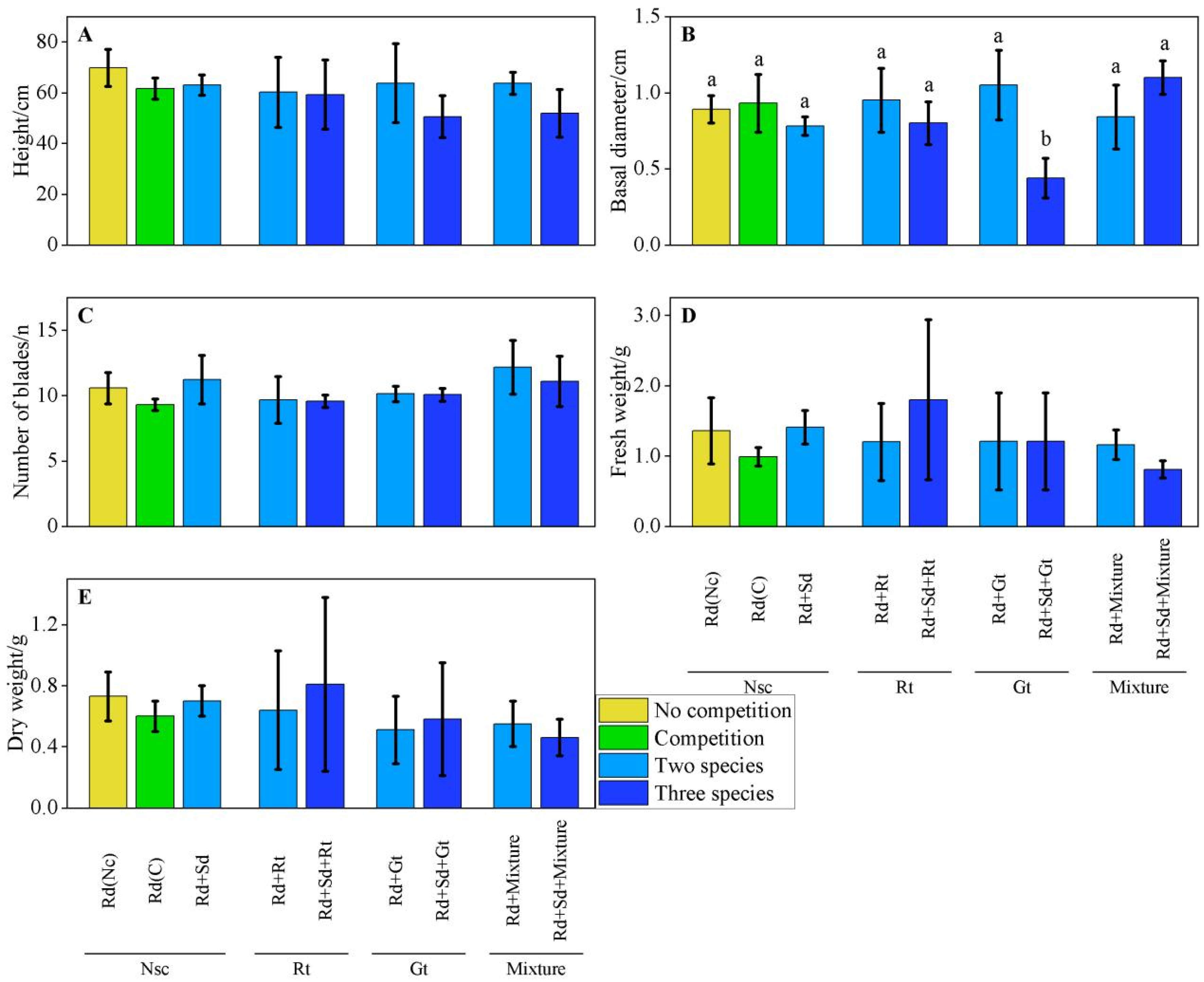
In Figure 4, most growth measures of P. australis did not show a significant difference across the various scenarios, except for basal diameter. Generally, growth measures in the no interspecific competition are higher than those in intraspecific or interspecific competition. All measures in scenarios without S. alterniflora exceeded those in the scenarios with S. alterniflora, and most measures in two-species competition were higher than those in three-species competition. No consistent pattern was observed among the reproductive types of S. alterniflora (ramet, genet, and mixture). These results demonstrated that the growth of P. australis is suppressed by S. alterniflora and S. salsa. Although the inhibitory effect was not significant.

3.3.3. Performance of S. salsa

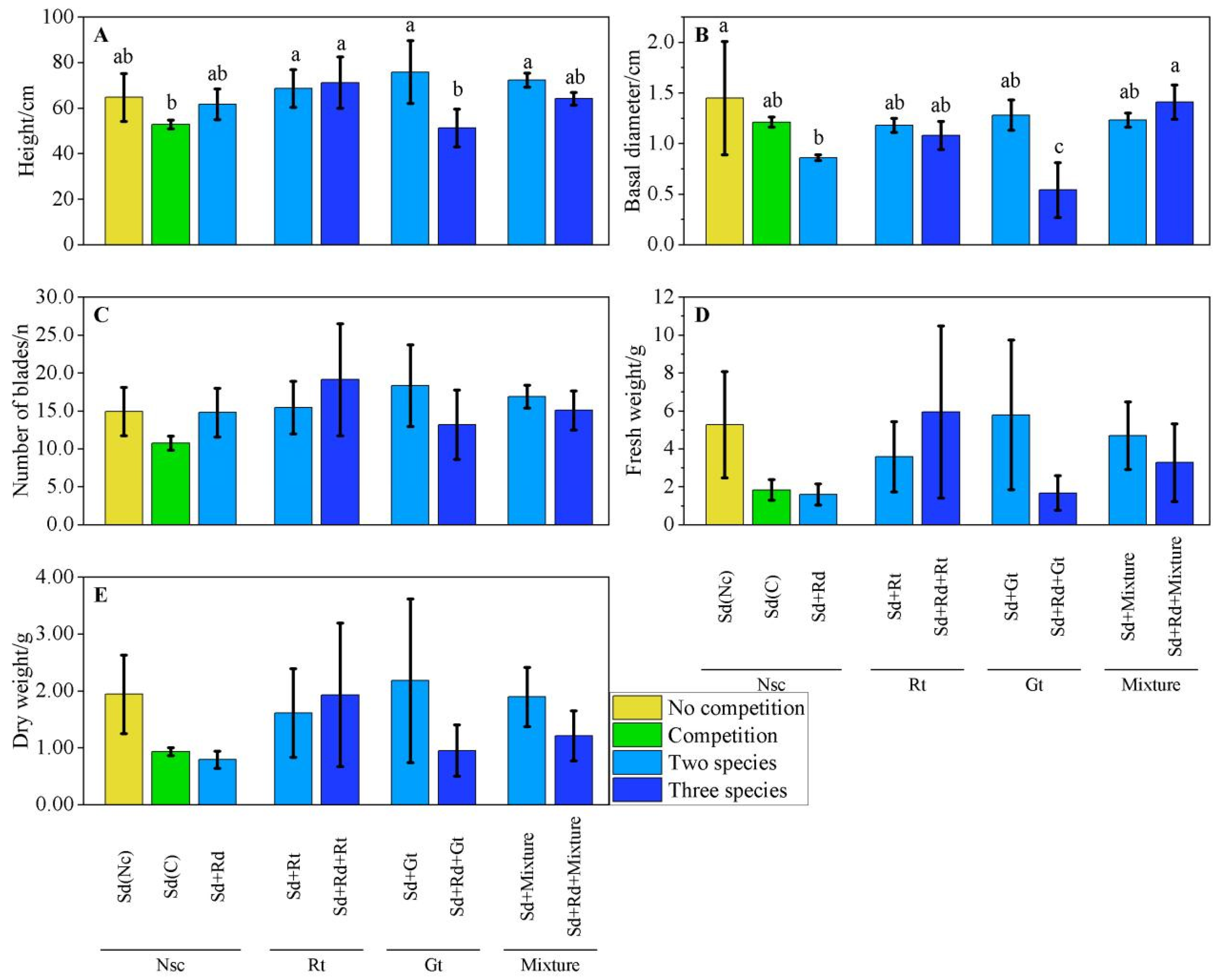
In Figure 5, the growth measures of S. salsa showed significant differences in height and basal diameter; values under no intraspecific competition were higher than those under interspecific competition. The effects of S. alterniflora on S. salsa did not exhibit an obvious trend. Among different reproductive strategies, the growth measures followed the order: ramet < mixture < genet. Measures under two-specific competition are higher than those under three-specific competition. These results reveal that S. salsa growth measures were not strongly affected by S. alterniflora or P. australis, although the inhibitory effect of P. australis relative to S. alterniflora followed the order: ramet > mixture > reed > genet.
In general, S. alterniflora exhibited strong competitiveness across various communities with P. australis and S. salsa, with the competitive hierarchy among its reproductive strategies following the order: ramet > mixture > genet. Its growth measures, including height, basal diameter, and number of blades, showed a significant competitive advantage. The competitiveness of P. australis was lower than that of the ramet and mixture of S. alterniflora but higher than that of the genet. The growth conditions of S. salsa were simultaneously inhibited by S. alterniflora and P. australis.

4. Discussion

4.1. Competitiveness in Different Reproductive Methods

The experiments in this study demonstrated that S. alterniflora exhibited stronger competitive intensity against other species than against conspecifics. Its growth measures of S. alterniflora were obviously better under interspecies competition compared to both no competition and intraspecific competition scenarios (Table 4 and Figure 3). Among the different reproductive strategies, basal diameter, fresh weight, and dry weight showed significant differences, with competitiveness following the order: ramet > mixture > genet (Table 4 and Figure 3). In contrast, P. australis did not display a consistent trend across scenarios involving ramets, gents, and mixtures of S. alterniflora (Figure 4), whereas S. salsa clearly followed the order: ramet > mixture > genet (Figure 5).
Previous studies have focused on comparing growth measures between ramets and genets of S. alterniflora, as well as intraspecific competition or pairwise interspecific competition. In various suitable habitats, the measures of S. alterniflora ramets in height, blade length, number of blades, blade width, blade thickness, and seeding were higher than genets, reflecting a higher invasive potential of ramets compared to genets [38,39]. Similarly, Potentilla anserina ramets suppressed the growth and reproduction of the genets [40]. Under competition conditions, plants often increase their root diameter and root to enhance competitiveness, while allocating fewer nutrients to the number of blades, fresh weight, and dry weight, thereby prioritizing structural maintenance maintain structure and survival [41,42]. Increased height, basal diameter, number of blades, and biomass of ramets allow them to more effectively capture sunlight and maximize photosynthesis [43]. The “connectedness” of clonal plants promotes survival and growth in single-species and single-factor studies; however, size-based asymmetrical competition is relatively unimportant, and clonal integration varies among species in a community. In contrast, genets act as independent individuals and lack the protection and support provided by integration [44]. In a competition environment, genet seedlings are disadvantage in accessing sunlight, water, and nutrients, rendering them less able to compete with established clones or other plants, which generally inhibition their growth [45], and genetic variability is also another important factor in the different competition ability, which was not considered in this study.
This study is the first to systematically compare the performance of three reproduction types (ramet, genet, mixture) of S. alterniflora under identical experimental conditions when intraspecific competition and competing with P. australis and S. salsa, the effect of S. alterniflora′s different reproductive strategies on native species has not been examined in previous studies. The results demonstrated that there was no significant difference between no competition and intraspecific competition, but the biomass of dry weight in no competition was more than that in intraspecific competition; other measures did not show the same trend. Ramets possessed a significant competitive advantage, while the genets were inhibited in growth and exhibited greater sensitivity to environmental and neighboring individual pressures. Mixtures displayed intermediate traits. These findings suggest that the invasion intensity of S. alterniflora is influenced by the reproductive strategy and also reflect the interaction between population structure and competitive environment. From a management perspective, several implications emerge: Since ramets are superior in competition and resource acquisition, controlling established ramets should be prioritized. Meanwhile, since genets are highly sensitive to environmental stress and adjacent competition, close monitoring of the seedling recruitment is essential, and they should be removed within the same year to prevent their growth into ramets that subsequently enhance competitiveness against native species. Furthermore, it should be noted that this study is constrained by the experimental environment and short time scale, and does not account for more complex tidal regimes, salinity gradients, or long-term community succession. Future studies should combine population genetics and root integration mechanisms across broader spatial and temporal scales to better elucidate the combined effects of different reproductive pathways on invasion success, thereby providing a more comprehensive and robust scientific basis for the restoration and management of coastal ecosystems.

4.2. Competitiveness in Different Competitive Treatments

Regarding S. alterniflora, its growth measures did not show significant differences between no competition and intraspecific competition but showed significantly lower values than those under interspecific competition, revealing a clear competitiveness against other species (Table 4 and Figure 3). Height, basal diameter, and number of blades also showed significant differences across no competition, intraspecific competition, two-specific competition, and three-specific competition (Table 4). For P. australis, most growth measures in no competition were higher than those in intra- and inter-specific competition; measures under intraspecific competition were lower than interspecific competition, and two-species competition measures were higher than those in three-species competition (Figure 4). Similarly, the measures of S. salsa in no competition were higher than those in intraspecific competition, two-species competition, and three-species competition, with two-species competition measures exceeding those in three-species competition. The overall inhibiting effect of S. alterniflora and P. australis is as follows: ramet > mixture > reed > genet.
Most previous studies focused on the competition between S. alterniflora and either P. australis or S. salsa individually. One study also demonstrated that interspecific relationships among S. alterniflora, P. australis, and S. salsa were negative, both with and without freshwater introduction [25]. The interspecific interactions between S. alterniflora and P. australis varied along the tidal gradient; S. alterniflora consistently maintained a negative interaction, whereas P. australis was negative in the high and middle tidal zones but positive in the low tidal zone [46]. Shoot, rhizome, root, and total biomass of S. alterniflora were significantly higher than those of P. australis. In interspecific competition, S. alterniflora total biomass remained stable while P. australis biomass decreased significantly compared to intraspecific competition [15]. In New England, native S. alterniflora was not significantly affected by non-native P. australis invasion, and competition negatively affected the aboveground biomass of P. australis [47]. P. australis invading the S. alterniflora in North America, interspecific competition between two species of P. australis and S. alterniflora significantly reduced aboveground biomass, shoot length production, density, and survival compared to four species of P. australis, S. alterniflora, and two other native plants [48]. The results of this study are consistent with those of the above findings. However, some studies report different outcomes, such as transplanting S. alterniflora in a mixed community by P. australis and S. salsa did not show a significant effect on the traits in a field experiment [26]. The discrepancy may be due to differences in experimental conditions: this study used controlled plastic containers rather than in the field, the nutrients in the containers were limited, creating a competitive situation, whereas nutrients in field conditions were freely available, so that reducing competition.
Regarding the performance of S. alterniflora under no competition, intraspecific competition, two-species competition, and three-competition, height, basal diameter, and number of blades exhibited a clear trend from strong to weak: seepweed > reed > seepweed + reed > competition > no competition (Table 4 and Figure 3). Few previous studies have examined this aspect, so direct comparisons are limited. The observation that growth in no competition scenarios was lower than in intraspecific competition, which probably caused by some plants are able to recognize neighbor plants as either genetically identical or different [49,50], same plants including clonal growth and seed dispersal can provide a mechanism for escape from competition, potentially resulting in reduced intraspecific competition and enhanced growth under certain conditions [51].
In summary, this study provides the first integrated evidence of how S. alterniflora competes with P. australis and S. salsa under no-, intra-, two-species, and three-species competition. Unlike previous studies primarily focusing on pairwise interactions, these results demonstrate that multi-species competition imposes stronger suppression and highlights the superior adaptability of S. alterniflora. This experimental framework advances invasion ecology by linking different species combinations to better simulate the field scenarios. Although this study was conducted under container conditions, these findings offer novel insights into the mechanisms underlying interspecific competition. Future field-based and long-term studies are needed to validate these dynamics across environmental gradients.

5. Conclusions

This study explored the competitive mechanism by controlled experiments with no competition, intraspecific competition, two-species competition, and three-species competition to compare the growth conditions of S. alterniflora (ramet, genet, and mixture), P. australis, and S. salsa. The results showed that (1) S. alterniflora exhibited obviously stronger interspecific competitiveness than that intraspecific competition (RYab > 1), with significant differences in height, basal diameter, number of blades, fresh weight, and dry weight of S. alterniflora across the 15 experimental scenarios (p < 0.05); (2) among reproductive strategies, ramets displayed the highest competitive advantages, followed by mixture and genets, with basal diameter, fresh weight, and dry weight were significant differences among the three strategies (p < 0.001); (3) under multi-species competition, height, basal diameter, and number of blades of S. alterniflora showed significant differences (p < 0.05), with lower values in no competition and intraspecific competition than those in interspecific competition; (4) the competitiveness intensity of S. alterniflora in height, basal diameter, and number of blades on native species followed the order: seepweed > reed > seepweed + reed > competition > no competition. These findings indicate that the invasion intensity is influenced by its reproductive strategies and highlight differential interactions across the scenarios of multi-species competitions. This study suggest the following: (1) since the ramet have the strongest competitiveness, controlling established ramet should be prioritized; (2) genet seedlings should be removed within the same year to prevent they growth into ramets in the next years increasing in the competitiveness; (3) monitoring of genets should be strengthened, as they spread more easily than ramets; and (4) the pure S. alterniflora communities with both ramets and genets and communities mixed by S. salsa should be prioritized for removal, as their growth conditions are the best. Nonetheless, this study was conducted under controlled container conditions and a limited timescale, which may not fully capture field heterogeneity, long-term dynamics, and seasonal variability, and this study did not consider the genetic differences between different individuals of the same species. Future research should integrate long-term field experiments, tidal gradients, nutrient manipulations, and the genetic differences to validate the generality of these results and inform adaptive management strategies for coastal wetland ecosystems.

Supplementary Materials

The following supporting information can be downloaded at: https://www.mdpi.com/article/10.3390/d17110765/s1, Table S1: Growth measures comparison of Spartina alterniflora in 15 scenarios between each pairs using two-way PREMANOVA, Ramet (Rt), Genet (Gt), Mixture (Mix), Reed (Rd), Seepweed (Sd), no intraspecific competition (Nc), and intraspecific competition (C).

Author Contributions

Conceptualization, X.L.; methodology, X.L., S.H., M.Z. and X.M.; software, S.H. and S.L.; validation, X.L., S.L., S.H. and Y.Z. (Yufei Zhang); formal analysis, X.L., S.H. and S.L.; investigation, D.Z., S.Z., G.Z., N.Z. and J.X.; resources, X.L.; data curation, S.H., S.L., Y.Z. (Yufei Zhang), D.Z., S.Z., G.Z., N.Z., H.D., J.X. and Y.Z. (Yijue Zhang); writing—original draft preparation, X.L. and S.H.; writing—review and editing, X.L., S.H., M.Z. and X.M.; visualization, X.L. and S.H.; supervision, X.L.; project administration, X.L.; funding acquisition, X.L. All authors have read and agreed to the published version of the manuscript.

Funding

This research was supported by S&T Program of Hebei-Central Government Guides Local Funds for Science and Technology Development (236Z3304G), Biodiversity Survey and Assessment Project in Tongzhou District, Beijing (06TI02), and North China Institution of Science and Technology Class A fund in 2023 (3142023028).

Data Availability Statement

The data presented in this study are available on request from the corresponding author due to confidentiality and the need to protect sensitive research information.

Acknowledgments

The authors would like to thank Huanghua Natural Resources Bureau, Tangshan Natural Resources Bureau, Fengnen Natural Resources Bureau, and Luanan Natural Resources Bureau, providing assistance with the field investigation and sampling. The authors also acknowledge Tongzhou District Landscape and Forestry Bureau and Tongzhou District Forestry Work Station, providing the experimental site. And authors acknowledge YuChuan Sun for helping to analyze the data using R software (version 4.4.2).

Conflicts of Interest

The authors declare that they have no known competing financial interests or personal relationships that could have appeared to influence the work reported in this paper.

References

  1. Gratton, C.; Denno, R.F. Restoration of Arthropod Assemblages in a Spartina Salt Marsh following Removal of the Invasive Plant Phragmites australis. Restor. Ecol. 2005, 13, 358–372. [Google Scholar] [CrossRef]
  2. Zedler, J.B.; Kercher, S. Causes and consequences of invasive plants in wetlands: Opportunities, opportunists, and outcomes. Crit. Rev. Plant Sci. 2004, 23, 431–452. [Google Scholar] [CrossRef]
  3. Weber, E.; Sun, S.; Li, B. Invasive alien plants in China: Diversity and ecological insights. Biol. Invasions 2008, 10, 1411–1429. [Google Scholar] [CrossRef]
  4. Gong, H.; Liu, H.; Jiao, F.; Lin, Z.; Xu, X. Pure, shared and coupling effects of climate change and sea level rise on the future distribution of Spartina alterniflora along the Chinese coast. Ecol. Evol. 2019, 9, 5380–5391. [Google Scholar] [CrossRef]
  5. Xia, S.; Wang, W.; Song, Z.; Kuzyakov, Y.; Guo, L.; Van Zwieten, L.; Li, Q.; Hartley, I.P.; Yang, Y.; Wang, Y.; et al. Spartina alterniflora invasion controls organic carbon stocks in coastal marsh and mangrove soils across tropics and subtropics. Glob. Change Biol. 2021, 27, 1627–1644. [Google Scholar] [CrossRef]
  6. Mo, X.; Chen, J.; Pan, Y.; Zhang, M.; Zhang, Z.; Liu, J. Impact of applying imazapyr on the control of Spartina alterniflora and its eco-environments in the Yellow River Delta, China. Watershed Ecol. Environ. 2022, 4, 211–218. [Google Scholar] [CrossRef]
  7. Ning, Z.; Xie, T.; Liu, Z.; Bai, J.; Cui, B. Native herbivores enhance the resistance of an anthropogenically disturbed salt marsh to Spartina alterniflora invasion. Ecosphere 2019, 10, e02565. [Google Scholar] [CrossRef]
  8. Mallott, P.G.; Jeffries, A.J.; Hotton, N.J. Carbon dioxide exchange in leaves of Spartina anglica Hubbard. Oecology 1975, 20, 351–358. [Google Scholar] [CrossRef]
  9. Long, S.P.; Incoll, L.D.; Woolhouse, H.W. C4 photosynthesis in plants from cool temperature regions, with particular reference to Spartina townsendii. Nature 1975, 257, 622–624. [Google Scholar] [CrossRef]
  10. Pomeroy, L.R.; Wiegert, R.G. The Ecology of a Salt Marsh; Springer: New York, NY, USA, 1981; pp. 39–67. [Google Scholar]
  11. Svanbäck, R.; Bolnick, D.I. Intraspecific competition drivers increased resource use diversity within a natural population. Proc. R. Soc. B Biol. Sci. 2007, 274, 839–844. [Google Scholar] [CrossRef]
  12. Wu, J.; Zeng, H.; Zhao, F.; Chen, C.; Singh, A.K.; Jiang, X.; Yang, B.; Liu, W. Plant hydrological niches become narrow but stable as the complexity of interspecific competition increases. Agric. For. Meteorol. 2022, 320, 108953. [Google Scholar] [CrossRef]
  13. Liu, Y.; Du, Y.; Li, C.; Li, Y.; Wang, C.; Du, D. Co-invasion of three invasive alien plants increases plant taxonomic diversity and community invasibility. Plant Divers. 2025, in press. [Google Scholar] [CrossRef]
  14. Song, X.; Liu, G.; Li, X.; Chen, Y.; Wang, J.; Zhang, C.; Ye, X.; Zhu, Z. Phylogenetically close alien Asteraceae species with minimal niche overlap are more likely to invade. Plant Divers. 2025, 47, 804–813. [Google Scholar] [CrossRef] [PubMed]
  15. Li, Q.; Gao, J.; Guo, Y.; Liang, J.; Yu, F. Effects of biochar on nitrogen competition between invasive Spartina alterniflora and native Phragmites australis. J. Plant Ecol. 2025, 18, rtaf063. [Google Scholar] [CrossRef]
  16. Tang, L.; Gao, Y.; Li, B.; Wang, C.; Wang, Q.; Zhao, B. Spartina alterniflora with high tolerance to salt stress changes vegetation pattern by outcompeting native species. Ecosphere 2014, 5, art116. [Google Scholar] [CrossRef]
  17. Wails, C.N.; Baker, K.; Blackburn, R.; Del Vallé, A.; Heise, J.; Herakovich, H.; Holthuijzen, W.A.; Nissenbaum, M.P.; Rankin, L.; Savage, K.; et al. Assessing changes to ecosystem structure and function following invasion by Spartina alterniflora and Phragmites australis: A meta-analysis. Biol. Invasions 2021, 23, 2695–2709. [Google Scholar] [CrossRef]
  18. Zhao, Y.J.; Qing, H.; Zhao, C.J.; Zhou, C.F.; Zhang, W.G.; Xiao, Y.; An, S.Q. Phenotypic plasticity of Spartina alterniflora and Phragmites australis in response to nitrogen addition and intraspecific competition. Hydrobiologia 2010, 637, 143–155. [Google Scholar] [CrossRef]
  19. Li, Q.; Zhang, X.; Liang, J.; Gao, J.; Xu, X.; Yu, F. High nitrogen uptake and utilization contribute to the dominance of invasive Spartina alterniflora over native Phragmites australis. Biol. Fertil. Soils 2021, 57, 1007–1013. [Google Scholar] [CrossRef]
  20. Mckee, K.L.; Patrick, W.H. The relationship of smooth cordgrass (Spartina alterniflora) to tidal datums: A review. Estuaries 1988, 11, 143–151. [Google Scholar] [CrossRef]
  21. Vasquez, E.A.; Glenn, E.P.; Guntenspergen, G.R.; Brown, J.J.; Nelson, S.G. Salt tolerance and osmotic adjustment of Spartina alterniflora (Poaceae) and the invasive M haplotype of Phragmites australis (Poaceae) along a salinity gradient. Am. J. Bot. 2006, 93, 1784–1790. [Google Scholar] [CrossRef]
  22. Li, H.; Wang, Y.; An, S.; Zhi, Y.; Lei, G.; Zhang, M. Sediment type affects competition between a native and an exotic species in coastal China. Sci. Rep. 2014, 4, 6748. [Google Scholar] [CrossRef]
  23. Nunes, L.S.C.; Camargo, A.F.M. The interspecific competition of tropical estuarine macrophytes is not density-dependent. Aquat. Bot. 2020, 164, 103233. [Google Scholar] [CrossRef]
  24. Huang, Y.; Liu, Z.; Zheng, G.; Zhao, C. Identification of Spartina alterniflora habitat expansion in a Suaeda salsa dominated coastal wetlands. Ecol. Indic. 2022, 145, 109704. [Google Scholar] [CrossRef]
  25. Dou, Z.; Cui, L.; Li, W.; Lei, Y.; Zuo, X.; Cai, Y.; Yan, R. Effect of freshwater on plant species diversity and interspecific associations in coastal wetlands invaded by Spartina alterniflora. Front. Plant Sci. 2022, 13, 965426. [Google Scholar] [CrossRef]
  26. Zhang, L.; Wang, B. The influence of nutrient addition on the invasion of “Spartina alterniflora” towards the non-tidal wetlands in the Chinese Yellow River delta. J. Coast. Conserv. 2019, 23, 623–631. [Google Scholar] [CrossRef]
  27. Lu, C. Coastal wetland conservation in Tangshan. Wetl. Sci. Manag. 2006, 2, 28–40. [Google Scholar]
  28. Kang, Y. Landscape Pattern Evolution and Ecosystem Health Assessment of Coastal Wetlands in Hebei Province, China. Master’s Thesis, Hebei GEO University, Shijiazhuang, China, 2024. [Google Scholar]
  29. Zhang, Y.; Tian, D. Spatio-temporal dynamics of Spartina alterniflora in Tianjin-Hebei coastal area. Remote Sens. Technol. Appl. 2025, 40, 485–494. [Google Scholar] [CrossRef]
  30. Alvarez, M.G.; Tron, F.; Mauchamp, A. Sexual versus asexual colonization by Phragmites australis: 25-year reed dynamics in a mediterranean marsh, southern France. Wetlands 2005, 25, 639–647. [Google Scholar] [CrossRef]
  31. Song, J.; Wang, B. Using euhalophytes to understand salt tolerance and to develop saline agriculture: Suaeda salsa as a promising model. Ann. Bot. 2015, 115, 541–553. [Google Scholar] [CrossRef]
  32. Xiao, Y.; Zhao, H.; Yang, W.; Qing, H.; Zhou, C.; Tang, J.; An, S. Variations in growth, clonal and sexual reproduction of Spartina alterniflora responding to changes in clonal integration and sand burial. Clean-Soil Air Water 2015, 43, 1100–1106. [Google Scholar] [CrossRef]
  33. Crombie, A.C. Interspecific Competition. J. Anim. Ecol. 1947, 16, 44–73. [Google Scholar] [CrossRef]
  34. Donald, C.M. Competition among crop and pasture plants. Adv. Agron. 1963, 15, 1–118. [Google Scholar] [CrossRef]
  35. Fowler, N. Competition and Coexistence in a North Carolina Grassland: III. Mixtures of Component Species. J. Ecol. 1982, 70, 77–92. [Google Scholar] [CrossRef]
  36. Wilson, J.B. Shoot Competition and Root Competition. J. Appl. Ecol. 1988, 25, 279–296. [Google Scholar] [CrossRef]
  37. Wit, C.T.D.; Bergh, J.P.V.D. Competition between herbage plants. Neth. J. Agric. Sci. 1965, 13, 212–221. [Google Scholar] [CrossRef]
  38. Pang, B.; Xie, T.; Ning, Z.; Cui, B.; Zhang, H.; Wang, X.; Gao, F.; Zhang, S.; Lu, Y. Invasion patterns of Spartina alterniflora: Response of clones and seedlings to flooding and salinity—A case study in the Yellow River Delta, China. Sci. Total Environ. 2023, 877, 162803. [Google Scholar] [CrossRef]
  39. Xu, W.; Wang, G.; Liu, J.; Chen, Z.; Hang, Z.; Wang, H. Two reproductive mode of Spartina alterniflora on coastal wetland of North Jiangsu. Acta Ecol. Sin. 2014, 34, 3839–3847. [Google Scholar] [CrossRef]
  40. Rautiainen, P.; Koivula, K.; Hyvarinen, M. Effect of within-genet and between-genet competition on sexual reproduction and vegetative spread in Potentilla anserina ssp. egedii. J. Ecol. 2004, 92, 505–511. [Google Scholar] [CrossRef]
  41. Franklin, K.A. Shade avoidance. New Phytol. 2008, 179, 930–944. [Google Scholar] [CrossRef] [PubMed]
  42. Weiner, J. Allocation, plasticity and allometry in plants. Perspect. Plant Ecol. Evol. Syst. 2004, 6, 207–215. [Google Scholar] [CrossRef]
  43. Amsberry, L.; Baker, M.A.; Ewanchuk, P.J.; Bertness, M.D. Clonal Integration and the Expansion of Phragmites australis. Ecol. Appl. 2000, 10, 1110–1118. [Google Scholar] [CrossRef]
  44. Trnková, V. Co-connected Spaces. Serdica Math. J. 1998, 24, 25–36. [Google Scholar]
  45. Pennings, S.C.; Callaway, R.M. The advantages of clonal integration under different ecological conditions: A community-wide test. Ecology 2000, 81, 709–716. [Google Scholar] [CrossRef]
  46. Yuan, Y.; Wang, K.; Li, D.; Pan, Y.; Lv, Y.; Zhao, M.; Gao, J. Interspecific Interactions between Phragmites australis and Spartina alterniflora along a Tidal Gradient in the Dongtan Wetland, Eastern China. PLoS ONE 2013, 8, e53843. [Google Scholar] [CrossRef]
  47. Legault, R.; Zogg, G.P.; Travis, S.E. Competitive interactions between native Spartina alterniflora and non-native Phragmites australis depend on nutrient loading and temperature. PLoS ONE 2018, 13, e0192234. [Google Scholar] [CrossRef]
  48. Peter, C.R.; Burdick, D.M. Can Plant Competition and Diversity Reduce the Growth and Survival of Exotic Phragmites australis Invading a Tidal Marsh? Estuaries Coasts 2010, 33, 1225–1236. [Google Scholar] [CrossRef]
  49. Falik, O.; Reides, P.; Gersani, M.; Novoplansky, A. Self/Non-Self Discrimination in Roots. J. Ecol. 2003, 91, 525–531. [Google Scholar] [CrossRef]
  50. Mahall, B.E.; Callaway, R.M. Effects of Regional Origin and Genotype on Intraspecific Root Communication in the Desert Shrub Ambrosia dumosa (Asteraceae). Am. J. Bot. 1996, 83, 93–98. [Google Scholar] [CrossRef]
  51. de Roij-Van Der Goes, P.; van der Putten, W.; Peters, B. Effects of sand deposition on the interaction between Ammophila arenaria, plant-parasitic nematodes and pathogenic fungi. Can. J. Bot. 1995, 73, 1141–1150. [Google Scholar] [CrossRef]
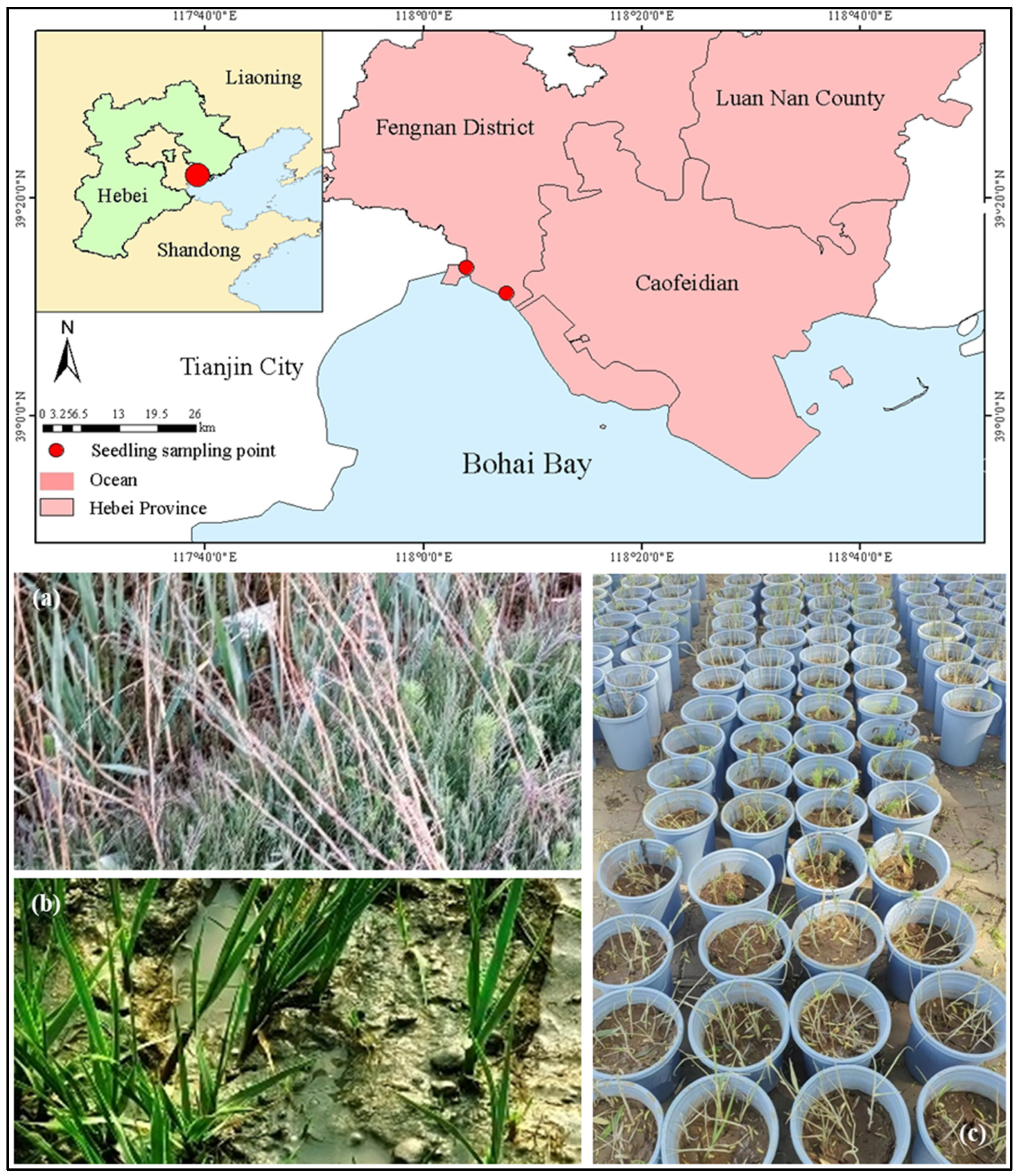
Figure 1. Spatial schematic diagram of the clone and seedling sampling points; (a) S. alterniflora, P. australis, and S. salsa mixed community in the field; (b) Ramets and genets S. alterniflora mixed community in the field; (c) Control experiments.
Diversity 17 00765 g001
Figure 2. Various scenarios of the control and experimental groups, (a) the intraspecific competition; (b) interspecies competition between two species; (c) interspecies competition among three species. S. alterniflora (smooth cordgrass), P. australis (reeds), S. salsa (seepweed).
Diversity 17 00765 g002
Figure 3. Growth patterns in different reproductive methods of S. alterniflora in various competition scenarios, ramet (Rt), genet (Gt), P. australis (reed, Rd), S. salsa (seepweed, Sd), no competition (Nc), and intraspecific competition (C). Black horizontal line represented the same group, and “a”, “b”, “c”, “d”, “e” and “f” represented the significant difference between scenarios; the same letters indicated no significant difference. (A) height, (B) basal diameter, (C) number of blades, (D) fresh weight, and (E) dry weight.
Diversity 17 00765 g003
Figure 4. Growth patterns of P. australis in various competition scenarios, no S. alterniflora (Nsc), ramet (Rt), ramet (Rt), genet (Gt), P. australis (reed, Rd), S. salsa (seepweed, Sd), no competition (Nc), and intraspecific competition (C). Black horizontal line represented the same group, and “a” and “b” represented the significant difference between scenarios; the same letters indicated no significant difference. (A) height, (B) basal diameter, (C) number of blades, (D) fresh weight, and (E) dry weight.
Diversity 17 00765 g004
Figure 5. Growth patterns of P. salsa in various competition scenarios, no S. alterniflora (Nsc), ramet (Rt), ramet (Rt), genet (Gt), P. australis (reed, Rd), S. salsa (seepweed, Sd), no competition (Nc), and intraspecific competition (C). Black horizontal line represented the same group, and “a”, “b” and “c” represented the significant difference between scenarios; the same letters indicated no significant difference. (A) height, (B) basal diameter, (C) number of blades, (D) fresh weight, and (E) dry weight.
Diversity 17 00765 g005
Table 1. Formulas of the competition coefficient.
FormulaCode
RY ab   = Y ab Y a (1)
A = RYabRYba(2)
Table 2. Growth measures comparison of different species using one-way ANOVA, mean (M), Standard Deviation (SD), and p-value.
VariablesS. alternifloraP. australisS. salsa
MSDpMSDpMSDp
Height56.425.810.01261.614.280.55052.751.920.019
Basal diameter1.190.080.0000.930.190.0141.210.050.000
Number of blades6.720.260.0129.320.440.46310.750.930.356
Fresh weight3.880.280.0000.990.130.7981.830.540.248
Dry weight1.360.120.0000.600.10.8770.930.070.370
Table 3. Growth measures comparison of S. alterniflora in 15 scenarios using two-way PERMANOVA, reproductive types (group1, G1), competition scenarios (group2, G2).
VariablesHeightBasal
Diameter
Number of BladesFresh WeightDry Weight
R2pR2pR2pR2pR2p
G10.0940.0550.4350.0010.0250.5140.4240.0010.5010.001
G20.1590.0480.2360.0070.2600.0010.0470.6220.0130.952
G1:G20.1790.1170.1140.0160.1460.1980.0930.3240.0890.295
Table 4. Growth measures comparison among the different scenarios.
ScenariosMeasuresMSD RY ab A
Ramets + ReedsHeight51.936.700.768−0.209
Basal diameter1.660.181.0920.070
Number of blades5.930.740.829−0.210
Fresh weight3.520.790.846−0.366
Dry weight1.750.201.0940.027
Ramets + SeepweedHeight70.8022.051.046−0.255
Basal diameter1.330.130.875−0.100
Number of blades8.011.171.120−0.313
Fresh weight4.382.181.053−0.903
Dry weight2.411.511.452−0.279
Genets + ReedsHeight66.327.341.6980.663
Basal diameter1.360.091.6790.550
Number of blades7.110.521.1830.095
Fresh weight2.380.091.2860.064
Dry weight0.780.071.0680.218
Genets + SeepweedHeight56.165.181.4380.001
Basal diameter1.040.271.2840.226
Number of blades6.890.581.146−0.560
Fresh weight1.560.650.843−2.321
Dry weight0.470.180.644−1.700
Mixture + ReedsHeight61.2412.361.0850.051
Basal diameter1.640.141.3780.475
Number of blades9.143.951.3600.053
Fresh weight4.351.321.121−0.051
Dry weight2.10.991.5440.627
Mixture + SeepweedHeight67.716.611.200−0.169
Basal diameter1.30.051.0920.075
Number of blades7.280.331.083−0.487
Fresh weight3.650.490.941−1.622
Dry weight1.620.251.191−0.852
Disclaimer/Publisher’s Note: The statements, opinions and data contained in all publications are solely those of the individual author(s) and contributor(s) and not of MDPI and/or the editor(s). MDPI and/or the editor(s) disclaim responsibility for any injury to people or property resulting from any ideas, methods, instructions or products referred to in the content.