


Abstract
Our study addresses how large-scale hydrological alterations shape zooplankton biodiversity in floodplain ecosystems, which are highly sensitive to changes in river connectivity. Following the operation of the Gabčíkovo hydroelectric power plant in the Danube inland delta, we examined the long-term responses of crustacean zooplankton communities, as these organisms are key indicators of hydromorphological disturbance. Based on previous evidence that river regulation often reduces habitat heterogeneity, we hypothesized that hydrological alterations in the Danube riverscape would promote increasing taxonomic and functional homogenization within sites, while simultaneously enhancing differentiation between sites over the past three decades. A total of 121 planktonic crustacean species were recorded across six monitored sites between 1991 and 2020, comprising 49 copepods and 72 cladocerans. Communities showed rising species richness, especially during the first decade of the hydropower plant’s operation. While overall richness increased, dam-induced hydromorphological changes triggered habitat-specific community shifts. In the main channel and adjacent parapotamal arm, taxonomic and functional homogenization occurred, dominated by resilient tychoplanktonic species with a gathering or secondary filter-feeding strategy. In contrast, isolated side arms experienced gradual eutrophication, favoring euplanktonic and primary filter-feeding taxa. The observed taxonomic and functional convergence within both habitat groups reflects the loss of connectivity and the cessation of artificial flooding.
1. Introduction
The Danube and its tributaries form one of Europe’s largest and world’s most international river systems, directly or indirectly influencing the existence of 80 million people in Europe [1]. As a key biodiversity hotspot, the Danube serves as a vital bio-corridor, linking diverse bioregions across the European continent. Before the multiple impoundments in the upper and middle Danube catchment areas, and the embankment and endikement in Germany, Austria, Slovakia and Hungary, the Danube was a free-flowing braided river with a wide flood plain. These river regulation measures markedly reduced the extent and frequency of natural inundation events, disrupting the hydrological connectivity between the main channel and its floodplain and leading to a loss of habitat heterogeneity [2,3]. In this context, national and international monitoring initiatives (e.g., Slovak-Hungarian monitoring of the natural environment) play a crucial role in assessing changes in water quality and hydrological conditions, as well as in evaluating the consequent ecological impacts across the entire Danube region [4]. They also facilitate the development of an international strategy for protecting the Danube catchment area in accordance with the UNECE Convention on the Protection and Use of Transboundary Watercourses and International Lakes (Helsinki Convention). The interconnection of these national and international monitoring activities and the integration of their results is essential not only for regional conservation efforts but also for an overarching international strategy to preserve the Danube’s biodiversity [5,6]. Especially, long-term monitoring programs enable tracking spatio-temporal succession in aquatic communities and interactions within river ecosystems, as well as assessing local environmental threats [7]. Such data provide a robust basis for understanding the present taxonomic and functional structure of biocenoses, which are shaped not only by local environmental conditions and species dynamics but also by regional processes such as dispersal, native species extinction, and the spread of non-native or invasive taxa [8,9]. As these mechanisms typically operate simultaneously, they jointly define the spectrum of community dynamics across both local and regional scales [10,11].
Diversity, a fundamental attribute of ecological communities, can change over time at both local and regional scales [12,13,14]. When regional species richness remains stable, an increase in local (alpha, within-site) diversity often leads to a reduction in between-site (beta, species turnover) diversity—A phenomenon referred to as biotic homogenization [15]. In contrast, communities where species turnover persists due to natural colonization and extinction processes, without shifts in local or regional richness, are considered species-saturated [16]. In ecosystems that are not species-saturated, increases in both local and regional richness are possible, a dynamic described as biotic differentiation [17,18].
In natural ecosystems, the scale and intensity of regional disturbances play a crucial role in shaping the outcomes of local colonization and extinction events on beta diversity [19]. Moderate disturbances may foster a heterogeneous riverine landscape by creating a patchwork of diverse habitats, thereby promoting higher between-site biodiversity. In contrast, more severe and widespread disturbances can diminish environmental heterogeneity at the regional level, ultimately driving metacommunity homogenization [20,21]. Within this framework, biotic homogenization emerges as a complex and multifaceted process that entails the erosion of taxonomic, genetic, and functional distinctiveness across spatial and temporal scales [22]. As previously noted, this process is mediated by two core ecological mechanisms: species colonization (or invasion) and local extirpation. The extent and mode in which these mechanisms operate within an ecosystem can lead to varying degrees of community homogenization or differentiation [23]. Increasingly, the effects of these dynamics on community structure and ecosystem functioning are being assessed through shifts in the composition of functional traits [10]. Functional traits help explain variations in zooplankton community structure and ecosystem functioning. Unlike conventional analyses of taxonomic diversity, this approach emphasizes trait diversity over species identity, linking community traits to environmental processes [24,25]. Here, species are grouped by shared morphological, physiological, or ecological characteristics, such as body size, feeding strategy, or habitat preference, highlighting functional patterns of the community rather than its taxonomic composition [26,27]. Zooplankton functional traits allow identification of the drivers responsible for various environmental changes in aquatic ecosystems, including trophic status [24,28], temperature and hydrological conditions [29,30], and human-induced activities [25]. These drivers act as components of an environmental filter that eliminates non-adapted species and leads to the homogenization of traits by forming assemblages with common ecological tolerance. In contrast, competition acts as a factor of trait divergency that leads to the ecological differentiation of co-existing zooplankton species [31,32] emphasizes that environmental filtering and competition often operate simultaneously and can result in either trait convergence or divergence. The outcome depends largely on the resilience and complexity of ecosystem processes. On the other hand, communities with similar functionalities are not necessarily composed of the same species, but they are characterized by the same pattern of functional traits, such as body size, feeding strategy and habitat utilization [24,25,27].
Therefore, the taxonomical and functional approach together provide complex insights into the ecological heterogeneity of the communities, whether related to differences in their structural or functional features [33]. Numerous studies have demonstrated that the taxonomical and functional heterogeneity of zooplankton assemblages can be reduced under extreme environmental conditions, such as elevated trophic status [31], the presence of fine or coarse suspended particles [34], or intense anthropogenic pressures [25]. Conversely, moderate environmental gradients or spatial variability—such as habitat heterogeneity tend to promote both taxonomic and functional diversity within zooplankton communities [35,36,37,38,39] emphasized that zooplankton communities in riverine floodplain waterbodies are shaped mainly by two factors: the degree of hydrological connectivity with the river and the disturbances caused by inundation events. Two contrasting hypotheses describe how the hydrological connection between a floodplain lake and the main river influences zooplankton communities. Refs. [40,41] reported higher zooplankton densities in hydrologically isolated lakes, where stable conditions and the development of macrophytes, providing habitat and food resources, support greater diversity and abundance of planktonic crustaceans. In contrast, periodic inflows of river water into connected lakes can destabilize environmental conditions; lower temperature and reduced transparency limit macrophyte growth and thus zooplankton habitat. Conversely, Refs. [42,43] proposed that hydrological connectivity enhances zooplankton diversity and abundance compared to isolated lakes.
Over the past four decades, extensive research has been conducted on zooplankton communities in the middle stretch of the Danube River floodplain. Ref. [44] examined the right-bank branches of the main river channel in Austria. Long-term investigations of crustacean assemblages have been carried out in the Szigetköz floodplain area on the Hungarian right bank [45,46,47], etc. Zooplankton communities on the left-bank side in Slovakia have also been the focus of several studies, e.g., [48,49,50]. Additionally, the crustacean zooplankton in the floodplain region affected by the operation of the Gabčíkovo hydroelectric power plant (GHP) has been documented through research efforts [50,51,52,53,54,55]. The last two studies assessed environmental changes in the monitored biotopes using the Floodplain Index [56], which reflects the degree of disruption to lateral connectivity in the floodplain area. In the case of the middle stretch of the Danube, this disruption was caused by the construction and operation of the GHP since 1992. The results of the annual zooplankton monitoring have also been summarized in brief yearly reports, which are prepared in accordance with the agreement between the Slovak and Hungarian Republics on joint Slovak-Hungarian monitoring of the natural environment.
Despite these extensive efforts, most previous studies have focused on either short-term changes, individual floodplain sections, or specific methodological approaches (e.g., the Floodplain Index), leaving long-term, integrative assessments of both taxonomic and functional zooplankton dynamics across multiple sites relatively scarce. In this study, we therefore analyzed changes in crustacean zooplankton over a 30-year period (1991–2020). Our specific aims were to: (i) characterize long-term changes in the taxonomic richness and community structure of copepods and cladocerans at individual monitoring sites and across the entire area, and (ii) identify corresponding shifts in the functional composition of both groups within the same spatio-temporal framework. Building on previous findings of disrupted hydrological connectivity and altered habitat conditions in the Danube inland delta, we hypothesized that crustacean plankton assemblages have become more taxonomically and functionally homogeneous within sites over the past three decades, while reduced lateral connectivity has promoted greater differentiation among sites, resulting in enhanced community divergence at the regional scale. Our assumption of within-site homogenization and between-site differentiation of the community is based on the gradual decline in artificial spring and summer floods in the GHP bypass section over the past three decades. These artificial floods were originally introduced to substitute for the natural flooding regime of the Danube inland delta, which was disrupted due to a significant reduction in discharge (approximately one-fifth of the original flow) after the GHP began operation in late 1992. Between 1995 and 2002, simulated floods were implemented regularly, providing at least short-term lateral and longitudinal connectivity among riverine habitats. From 2003 to 2015, both the intensity and extent of flooding declined and were mostly confined to the lower part of the inland delta. From 2015 to 2020, artificial spring/summer floods had been entirely absent.
2. Methods
2.1. Description of Danube Inland Delta and Monitored Sites
The area encompassing all monitored sites lies in the central part of the intermountain depression between the Alps and the Carpathians, within the Danube Basin—referred to in Slovakia as the Podunajská nížina (Danubian Lowland). A geological transition between granite and andesite bedrock, along with tectonic subsidence, contributes to a decreased surface slope and a reduction in the Danube’s flow velocity in this region. These conditions facilitated the formation of a distinct riverine landscape known as the Danube inland delta—an alluvial fan stretching from river kilometer (rkm) 1799 to 1856 below the granite threshold near Bratislava. Geographically, the delta spans the Szigetköz region in northwestern Hungary and adjacent Slovak territories. It exhibits characteristic features of lowland river systems, including a branching main channel, lotic and semi-lotic side arms, oxbow lakes, marshlands, meanders, and coarse sediment deposits.
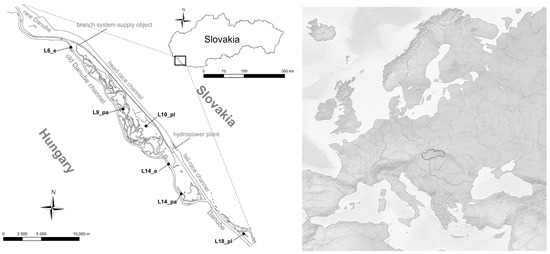
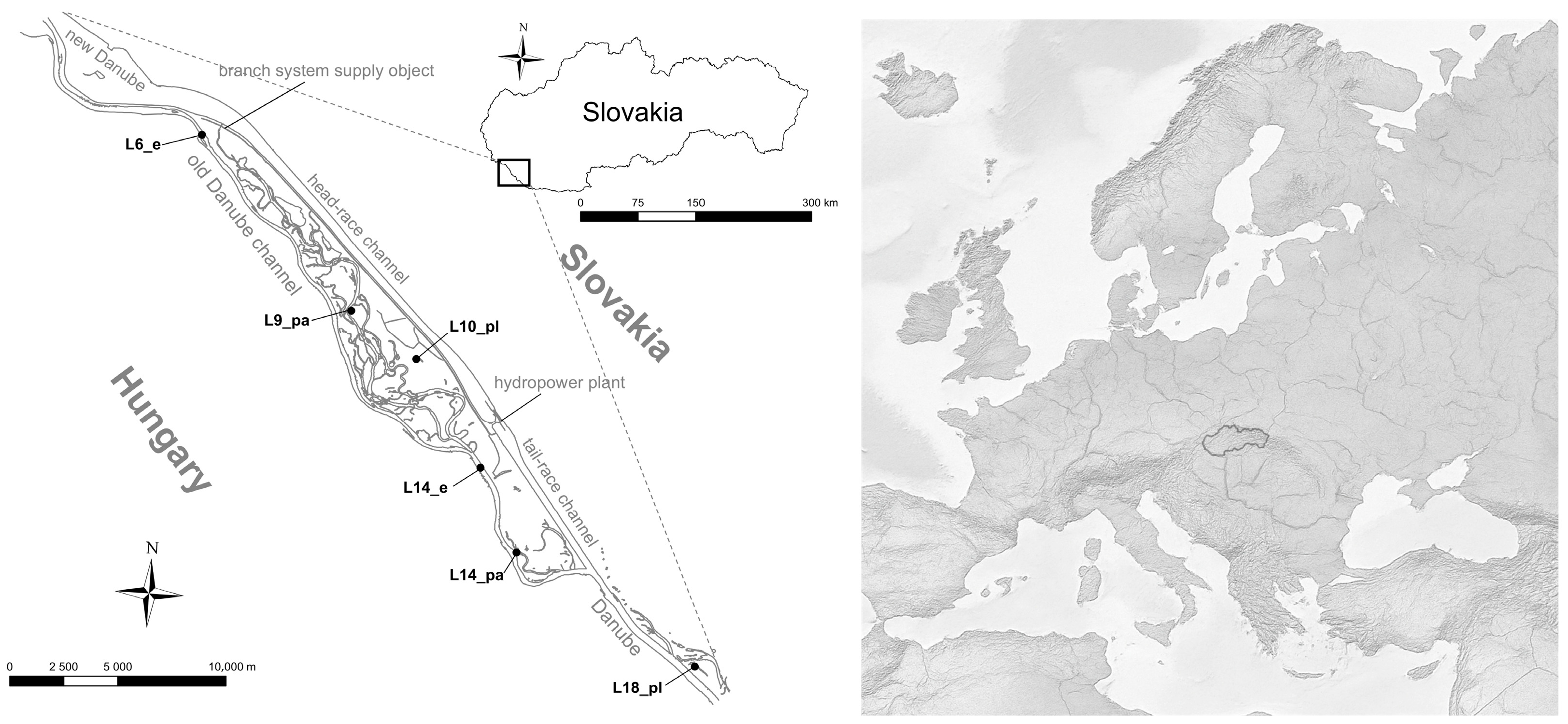
Prior to the construction of embankments and dikes at the end of the 19th and beginning of the 20th century, the Danube downstream of Bratislava was a free-flowing, braided river with no defined main channel and a wide floodplain. The subsequent establishment of flood protection dikes on both riverbanks led to the formation of a single main channel, often cutting through former meanders. This engineering intervention concentrated the river’s flow and significantly reduced connectivity and interaction among the side arms. In October 1992, the hydrological regime of the Danube inland delta between Rusovce and Gabčíkovo (rkm 1856–1820) underwent major changes following the commissioning of the GHP, which diverted the main flow into a bypass canal, effectively isolating the original main channel and its associated floodplain side arms (see Figure 1).
Figure 1.
Map of localization of the Gabčíkovo barrage system with monitored sites indicated by black points with labels. Explanation: e—eupotamál habitat, pa—parapotamal habitat, and pl—plesiopotamál habitat.
Following the GHP entering operation in October 1992, the reduction of discharge in the original main channel—approximately one-fifth of the original flow (around 2000 m3·s−1)—has disrupted connectivity within the river arm system, significantly altering the hydrological regime of the floodplain. The operation of the GHP has resulted in lowered groundwater and surface water levels, as well as changes to the local flood regime.
Until 2002, this disruption was partially mitigated by relatively regular artificial spring and summer floods delivered through the water supply system near Dobrohošť village. After 2002, limited reconnection between riverine habitats (especially in the lower part of the inland delta) has occurred during periods of elevated Danube discharge (exceeding 3500 m3·s−1 at the Bratislava-Devín station) via controlled inflow through water management structures into the Danube inland delta. The monitored sites represent three types of floodplain river habitats: lotic (main channel), semi-lotic (connected/open side arms), and lentic (isolated oxbow lakes). A brief description of the monitoring sites and plots is provided below:
Sites L6e and L14e are situated in the original main channel of the Danube, extending from the reservoir to the confluence with the tail-race channel, between rkm 1851 and 1811. The average annual discharge in the bypassed section, measured at rkm 1848.4, has significantly decreased, from app. 2000 m3·s−1 prior to the diversion to approximately 350 m3·s−1 after GHP went into operation in October 1992. During normal GPH operations, the flow rate in the original riverbed is limited to 250 m3·s−1 in winter and 600 m3·s−1 during the growing season [57]. The reduction in water levels was particularly notable in the upper bypassed section of the Danube. Maximum current velocity has decreased from 2.0 to 3.5 m·s−1 to approximately 1.0 m·s−1 [50].
Monitoring sites L9pa, L14pa, and L10pl are situated in the within-dike zone between the bypass canal and the original Danube riverbed (Table 1). Sites L9pa and L14pa are situated in the blind side arms. Since 1993, the Bodíky branch system, where L9pa is located, has been permanently fed via an intake structure at Dobrohošť, with a discharge of 40–180 m3·s−1. In the upper part, this branch system is blocked by weirs and undergoes continuous aggradation of fine and clayey sediments. The reduced current velocity has led to a significant increase in littoral macrophyte biomass. The blind side arm, where site L14pa is situated, originally ranged in depth from 1.5 to 5.6 m but has shallowed significantly post-diversion. It is at a considerably advanced stage of terrestrialization, and floods occur only during high-discharge events due to water backing up from the confluence area. The gravel bottom supports a limited macrophyte community during stagnant periods, although its overall contribution remains low.
Table 1.
List of long-term-monitored sites with their localization and classification to potamon type.
Sites L10pl and L18pl are situated in the habitats representing the dead arms. The dead side arm with site L10pl is immediately at the foot of the dike. It is flooded only during high water levels in the original Danube channel (approximately 6.5 m at the Dobrohošť gauging station situated in the upper part of the delta). Connectivity with the former channel is gradually weakening as the frequency of flooding decreases. Monitoring site MP18 is located within the dike zone, downstream of the tailrace canal’s confluence with the original Danube channel. It now contains shallow water (less than 1 m deep) with a muddy bottom and dense macrophyte growth covering about 80% of the surface. Though not directly impacted by the GHP, the site has been periodically flooded only during natural flood events since the damming.
2.2. Field Sampling and Data Processing
Between 1991 and 2020, samples of planktonic crustacean communities, as part of the overall zooplankton, were collected seasonally—three times per year (in spring, summer, and autumn) at six permanently monitored sites. Samples were obtained from the pelagic and the littoral zones. Pelagic zooplankton samples were collected either by multiple vertical hauls from a boat or by multiple oblique hauls (from bottom to surface) using a hand-thrown plankton net with a mesh size of 85 µm from the shore. Littoral zooplankton samples were collected using hand-held plankton net by sweeping near-shore shallow habitats and aquatic vegetation. Collected samples were preserved in a 4% formaldehyde solution.
In the laboratory, individuals of the Cladocera and Copepoda groups were removed from the sample and preserved in vials in 75% ethyl alcohol solution. The 100 & 50 & rare/species count method was chosen to determine and count the species diversity, in which at least 100 individuals of the most common taxon and 50 individuals of the rare taxon are counted simultaneously. The entire sample is then visually analyzed to find taxa that were not recorded. It is a modification of the method used by [58] and is considered to be the most accurate and efficient counting method [59]. Species were identified using a Leica DMLB microscope and identification keys for Copepoda [59,60,61,62,63] and Cladocera [59,64,65].
In line with the objectives of this thesis, samples from each habitat type and within a given year were pooled, and the relative abundance of each taxon within the community was subsequently calculated.
2.3. Homogenization Measurement and Statistical Analysis
Changes in alpha and beta diversity were used to analyze the degree of taxonomic and functional homogenization or differentiation within individual planktonic communities and the whole metacommunity. Quantification of biodiversity change is generally based on spatio-temporal shifts in two key measures: alpha and beta diversity [66]. Directional changes in these measures reflect increasing or decreasing dissimilarity among communities over time and space, referred to as ‘biotic homogenization’ and ‘biotic differentiation’, respectively [15,67].
For taxonomic alpha diversity, commonly used expressions include species richness, Simpson and Shannon diversity indices. Unlike the last two, species richness is a simple metric that does not account for species abundance. Relationships between species richness and year were analyzed using polynomial (linear, quadratic, cubic, and quartic) models, as well as exponential and logarithmic models. Selection of the best-fitting model was performed using the Akaike Information Criterion (AIC), which provides a measure to compare the relative quality of statistical models for a given dataset by balancing model fit and complexity. Taxonomic beta diversity based on presence/absence data was assessed using Sørensen dissimilarity (βsor), which comprises two additive components: species turnover and nestedness-resultant dissimilarity (βsne). Simpson dissimilarity (βsim) quantifies the turnover component of beta diversity independently of species richness gradients [68]. When βsor equals βsim, no nestedness is present between the two communities. Conversely, the difference between them represents the nestedness-resultant component, calculated as βsne = βsor − βsim [69]. Therefore, the contribution of species turnover to overall beta diversity was explicitly quantified.
Within-site beta diversity (temporal beta diversity) was represented as vectors of Sørensen (βsor), and Simpson (βsim) dissimilarities across successional years. Between-site beta diversity (also known as spatio-temporal beta diversity) was expressed as matrices of pairwise dissimilarities (βsor, βsim) among communities for each monitored year. Temporal changes in taxonomic beta diversity at both the within-site level and for the entire metacommunity were analyses using polynomial, exponential and logarithmic models. The best-fitting model was also selected using the AIC. The dynamics of overall taxonomic community composition were compared with the within-site community dynamics over time using Principal Response Curves (PRCs), a multivariate statistical method. PRC analysis was applied to relative abundance data. For each year, the reference community consisted of taxa for which the relative abundance was calculated as the mean value of their relative abundance across the sites.
The functional alpha diversity of the individual communities and the metacommunity was expressed as functional dispersion (FDis) [70], which defines the convex hull volume in trait space and the average distance of taxa to the trait centroid. Calculations were based on a relative abundance data matrix. The trait matrix included maximum body size, mesohabitat affinity, feeding type, and locomotion type of the taxa (Table A1 and Table A2). The affinity of copepod taxa to mesohabitat types was taken from [50], and that of cladocerans from [71]. Feeding and locomotion strategies were obtained from the trait database published by [72]. Relationships between functional alpha diversity and year were examined using polynomial, exponential and logarithmic models. The best-fitting model was selected based on the AIC value.
The within-site functional beta diversity was expressed as the vector of Euclidean distances (calculated using relative abundance data for each year), reflecting the communities’ functional dissimilarity between successional years. For each site, a matrix of the communities’ functional composition was constructed by multiplying the year × species matrix with the species × trait matrix. The between-site functional beta diversity was expressed as the matrix of pairwise Euclidean distances (calculated using relative abundance data for each year) of the communities’ functional composition. For each year, the matrix of assemblages’ functional composition was constructed by multiplying the site × species matrix with the species × trait matrix. Temporal changes in the functional beta diversity of within-site as well as between-site communities were modeled using polynomial, exponential and logarithmic functions. The AIC was used to identify the best-fitting model.
Similarly to taxonomic data, the dynamics of the overall functional community composition relative to within-site community dynamics over time were compared and visualized using PRC (Principal Response Curves). The matrix of communities’ functional composition was constructed by combining the abundance class data matrix with the species trait matrix. For each year, the reference community was defined by taxa whose abundances were calculated as the mean values of their relative abundances across all sites.
All analyses were performed in Rversion 4.2.1 [73] using the vegan [74], FD [75], and ade4 [76] packages.
3. Results
Over a 30-year monitoring period of planktonic crustaceans in the Danube inland delta, a total of 121 species were identified (Table A3). Of these, 49 species belonged to the taxonomic group Copepoda, and 72 species represented members of the group Cladocera.
Among the copepods, seven species exhibited a constant presence throughout the entire monitoring period within the study area, representing approximately 17% of all identified Copepoda species. These species were: Eucyclops serrulatus (Koch, 1836), Eurytemora velox (Müller, 1785), Macrocyclops albidus (Jurine, 1820), Mesocyclops leuckarti (Claus, 1857), Nitocra hibernica (Daday, 1902), Thermocyclops crassus (Fischer, 1851), and Thermocyclops oithonoides (G.O. Sars, 1863).
In the case of Cladocera, nine species were consistently recorded throughout the entire monitoring period within the study area, representing approximately 13% of all identified Cladocera species. These species were: Alona rectangula Sars, 1862, Bosmina longirostris (O.F. Müller, 1776), Chydorus sphaericus (O.F. Müller, 1776), Macrothrix laticornis (Jurine, 1820), Moina micrura Kurz, 1875, Pleuroxus aduncus (Jurine, 1820), Scapholeberis mucronata (O.F. Müller, 1776), Sida crystallina (O.F. Müller, 1779), and Simocephalus vetulus (O.F. Müller, 1776).
3.1. Spatio-Temporal Patterns in Taxonomic Diversity
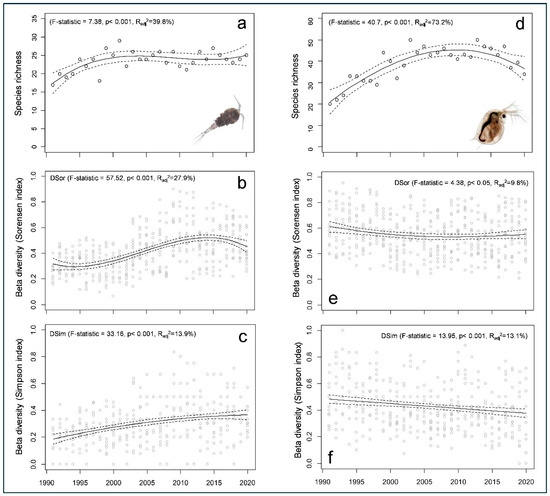
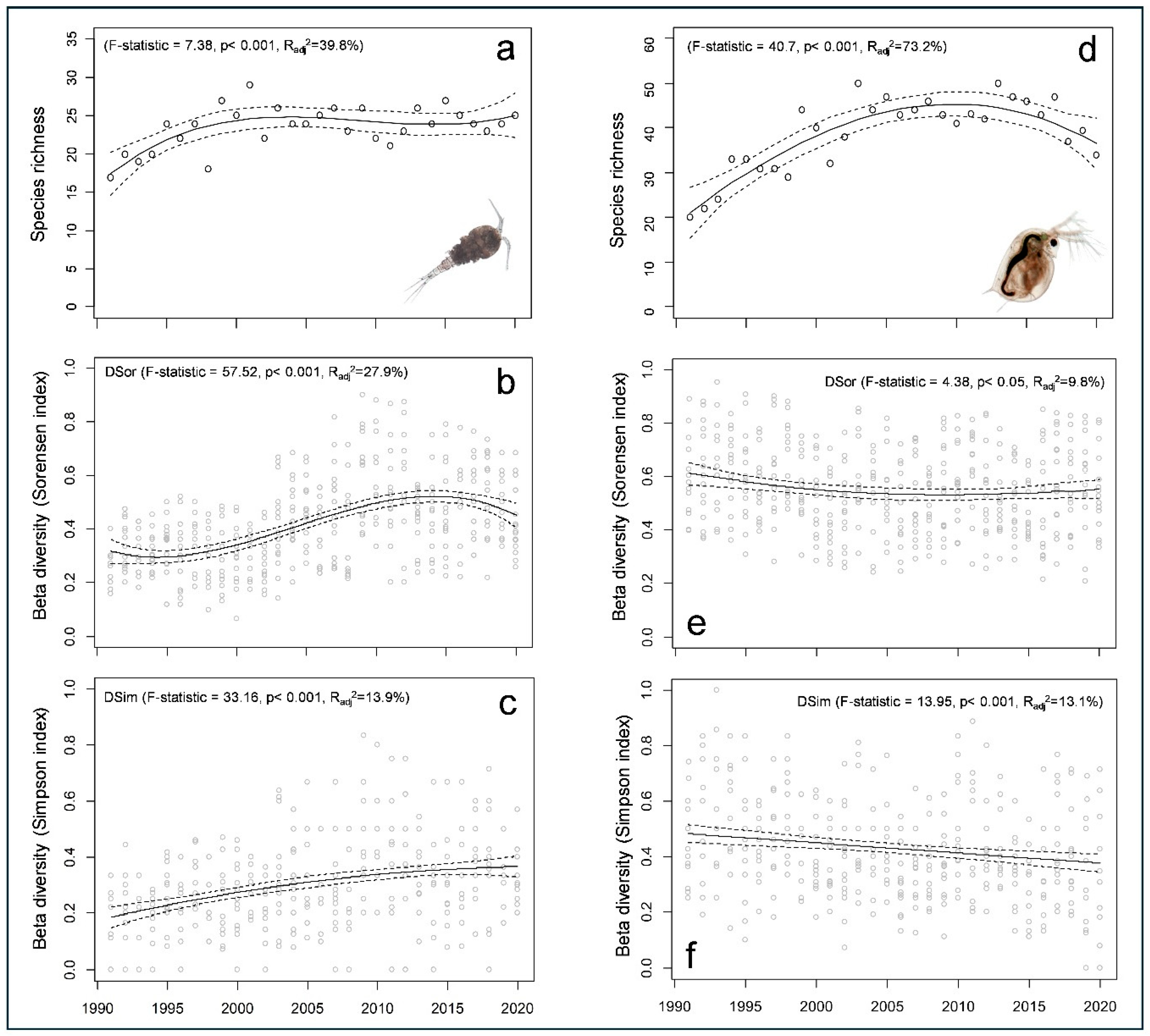
In both taxonomic groups of crustacean zooplankton, the lowest species richness was found in eupotamal sites, while species richness was similar at para- and plesiopotamal biotopes (Table 2 and Table 3). In copepods, the change in species richness was best reflected by a cubic trend line in eu- and parapotamal biotopes, whereas at plesiopotamal sites, the change in species number was best fitted by a quadratic trend line (Table 2, Figure A1). In eu- and parapotamal, a significant increase in copepod species richness was observed during the first ten years after the GHP went into operation. After this period, the number of recorded species significantly decreased, especially in eupotamal biotopes. At all monitoring sites, similar trajectories in beta diversity and taxonomic turnover of copepods were observed. With the exception of L10pl, a slight increase in both beta diversity and taxonomic turnover was identified.
Table 2.
Species richness and the best-fitting model describing temporal changes in species richness of the copepod community at each monitored site and the entire area during the period 1991–2020.
Table 3.
Species richness and the best-fitting model describing temporal changes in species richness of the cladoceran community at each monitored site and the entire area during the period 1991–2020.
In Cladocera, the change in species richness was best reflected by a quadratic trend line in all monitored biotopes (Table 3, Figure A1). Species richness gradually increased there until around 2010, followed by either a stabilization in the number of detected species or a slight decline. Across all sites, the observed increases in species richness were accompanied by a gradual decline in beta diversity and taxonomic turnover.
Over the course of 30 years, species richness of both Copepoda and Cladocera increased across the entire monitored area. In Copepoda, species richness increased during the first decade after the GHP became operational, while in Cladocera, the upward trend persisted until around 2010 (Figure 2a,d). Subsequently, the increase in observed species number stopped. In copepods, the rise in species richness during the 1990s was not accompanied by noticeable changes in between-habitat (beta) diversity of the community, which was primarily driven by taxonomic turnover (Figure 2b,c). After 2000, a significant increase in beta diversity was observed, primarily due to species nestedness—the second component of beta diversity. In Cladocera, the increasing trend in species richness was accompanied by a decrease in between-habitat diversity and taxonomic turnover throughout the entire monitoring period (Figure 2e,f).
Figure 2.
Changes in taxonomic richness (a,d) and beta-diversity (b,e) (Sorensen pairwise dissimilarity based on presence/absence data) and taxonomic turnover (c,f) (Simpson pairwise dissimilarity based on presence/absence data) of the copepod (left) and cladoceran (right) community, along with their predictions for the entire study area during the monitoring period (1991–2020).
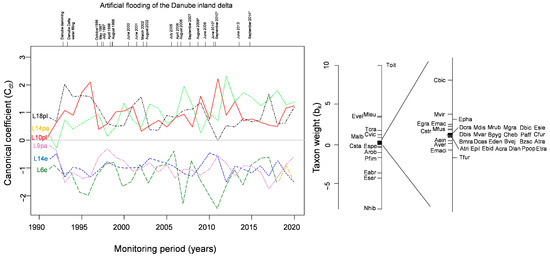
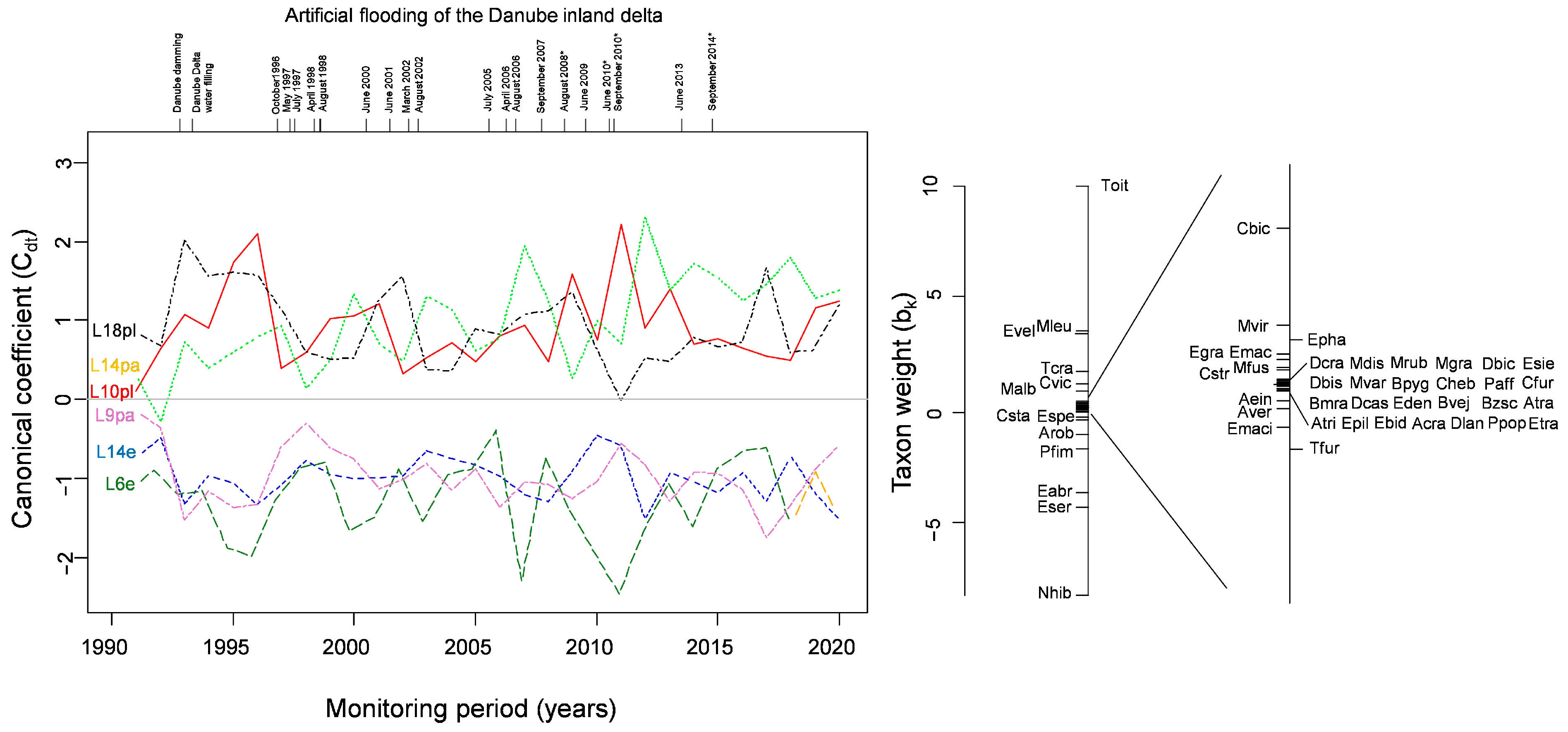
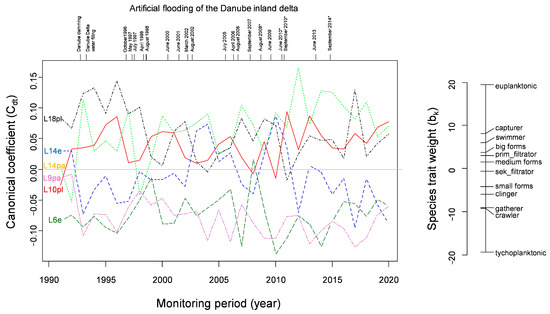
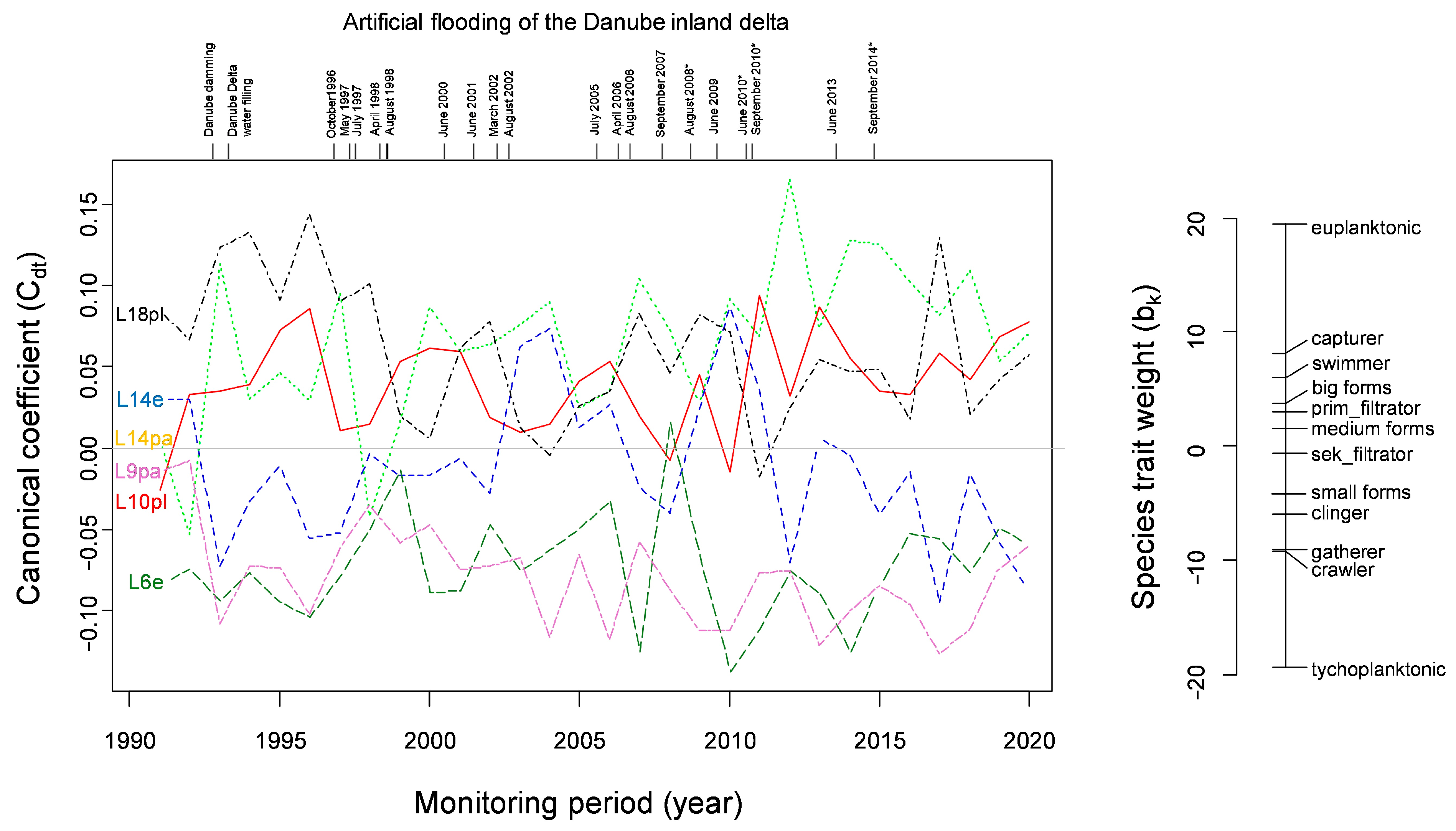
In Copepoda, the PRC analysis based on relative abundance data indicated that 74.9% of the total variation in species structure was explained by temporal changes across sites (constrained variation), while 25.1% was attributable to spatial variation between sites independent of time (conditional variation). The PRC diagram displays 24.3% of the total variation (i.e., the variation captured by the first canonical axis). In the PRC analysis, the product of bk × Cdt (denoted as Tdtk) determines the response pattern of each taxon over time. Specifically, Cdt represents the canonical coefficient for the effect of site (d) at time (t), capturing the deviation of the community from the overall mean along the first canonical axis of the partial RDA. The parameter bk is a species-specific score (or weight) that scales the canonical coefficient according to each species’ affinity to the response pattern. Thus, Tdtk (bk × Cdt) expresses the relative abundance change of species k over time compared to its average abundance. The PRC analysis revealed a distinct taxonomic differentiation between the eupotamal biotopes/upper parapotamal site and the plesiopotamal biotopes/lower parapotamal site (Figure 3). In the eupotamal and upper parapotamal sites, the copepod community became more homogeneous due to an increase in the abundance of certain species, such as Nitocra hibernica, Ectinosoma abrau, and Eucyclops serrulatus. In the plesiopotamal sites (mainly at MP10) and lower parapotamal sites, there was a successive increase in abundance during the monitoring period, especially of Thermocyclops oithonoides, Mesocyclops leuckarti, and Eurytemora velox.
Figure 3.
Principal Response Curves (PRCs) showing temporal changes in the structure of copepod communities at the monitoring sites. The vertical axes (left and right) represent the first canonical axis of the Redundancy Analysis conducted on the relative abundance data of individual copepod species. Explanation: * next to the year indicates that year only the lower part of the delta was flooded (sites L14e, L14pa, L18pl). Copepoda species abbreviations: Aein—Acanthocyclops einslei, Arob—Acanthocyclops robustus, Atra—Acanthocyclops trajani, Aver—Acanthocyclops vernalis, Atri—Attheyella trispinosa, Acra—Attheyella crassa, Bmra—Bryocamptus mrazeki, Bvej—Bryocamptus vejdovskyi, Bpyg—Bryocamptus pygmaeus, Bzsc—Bryocamptus zschokkei, Csta—Canthocamptus staphylinus, Cbic—Cryptocyclops bicolor, Cfur—Cyclops furcifer, Cheb—Cyclops heberti, Cstr—Cyclops strenuus, Cvic—Cyclops vicinus, Dbic—Diacyclops bicuspidatus, Dbis—Diacyclops bisetosus, Dcra—Diacyclops crassicaudis, Dlan—Diacyclops languidoides, Dcas—Diaptomus castor, Eabr—Ectinosoma abrau, Epha—Ectocyclops phaleratus, Epil—Echinocamptus pilosus, Ebid—Elaphoidella bidens, Esie—Ergasilus sieboldi, Eden—Eucyclops denticulatus, Emaci—Eucyclops macruroides, Emac—Eucyclops macrurus, Eser—Eucyclops serrulatus, Espe—Eucyclops speratus, Egra—Eudiaptomus gracilis, Etra—Eudiaptomus transylvanicus, Evel—Eurytemora velox, Malb—Macrocyclops albidus, Mdis—Macrocyclops distinctus, Mfus—Macrocyclops fuscus, Mvir—Megacyclops viridis, Mleu—Mesocyclops leuckarti, Mgra—Metacyclops gracilis, Mbic—Microcyclops bicolor, Mrub—Microcyclops rubellus, Mvar—Microcyclops varicans, Nhib—Nitocra hibernica, Paff—Paracyclops affinis, Pfim—Paracyclops fimbriatus, Ppop—Paracyclops poppei, Tcra—Thermocyclops crassus, Toit—Thermocyclops oithonoides, and Tfur—Tisbe furcata.
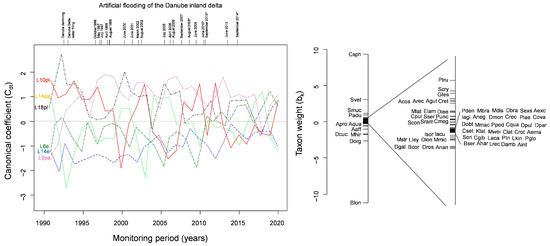
In the cladoceran community, PRC analysis showed that 80.4% of the total variation in species composition was explained by temporal changes across sites (constrained variation), while 19.6% was due to spatial differences between sites independent of time (conditional variation). The PRC diagram illustrates 25.2% of the total variation, corresponding to the first canonical axis. In the community, clear successional homogenization was observed, particularly after 2010, when the continuous artificial floodings were discontinued. In the eupotamal sites, this was caused by a decrease in the abundance of Bosmina longirostris, Diaphanosoma orghidani, Daphnia cucullata, and Macrothrix hirsuticornis (Figure 4). In the plesiopotamal sites, a clear, continuous decline in the abundance of Chydorus sphaericus, Simocephalus vetulus, Scapholeberis mucronata, and Pleuroxus aduncus was observed.
Figure 4.
Principal Response Curves (PRCs) showing temporal changes in the structure of cladoceran communities at the monitoring sites. The vertical axes (left and right) represent the first canonical axis of the Redundancy Analysis conducted on the relative abundance data of individual cladoceran species. Explanation: * next to the year indicates that year only the lower part of the delta was flooded (sites L14e, L14pa, L18pl). Cladocera species abbreviations: Ahar—Acroperus harpae, Aneg—Acroperus neglectus, Aaff—Alona affinis, Acos—Alona costata, Agut—Alona guttata, Aint—Alona intermedia, Apro—Alona protzi, Aqua—Alona quadrangularis, Arec—Alona rectangula, Aexc—Alonella excisa, Anan—Alonella nana, Aema—Anchistropus emarginatus, Bcor—Bosmina coregoni, Blon—Bosmina longirostris, Bser—Bunops serricaudata, Crec—Camptocercus rectirostris, Clat—Ceriodaphnia laticaudata, Cmeg—Ceriodaphnia megops, Cqua—Ceriodaphnia quadrangula, Cret—Ceriodaphnia reticulata, Crot—Ceriodaphnia rotunda, Cset—Ceriodaphnia setosa, Csph—Chydorus sphaericus, Damb—Daphnia ambigua, Dcuc—Daphnia cucullata, Dgal—Daphnia galeata, Dlon—Daphnia longispina, Dobt—Daphnia obtusa, Dpar—Daphnia parvula, Dpul—Daphnia pulicaria, Dbra—Diaphanosoma brachyurum, Dmon—Diaphanosoma mongolianum, Dorg—Diaphanosoma orghidani, Dlee—Disparalona leei, Dros—Disparalona rostrata, Elam—Eurycercus lamellatus, Gtes—Graptoleberis testudinaria, Iagi—Ilyocryptus agilis, Isor—Ilyocryptus sordidus, Lrec—Lathonura rectirostris, Lkin—Leptodora kindtii, Laca—Leydigia acanthocercoides, Lley—Leydigia leydigii, Mhir—Macrothrix hirsuticornis, Mlat—Macrothrix laticornis, Mstr—Mixopleuroxus striatoides, Mbra—Moina brachiata, Mmac—Moina macrocopa, Mmic—Moina micrura, Mdis—Monospilus dispar, Padu—Pleuroxus aduncus, Plae—Pleuroxus laevis, Ptri—Pleuroxus trigonellus, Ptru—Peracantha truncata, Punc—Pleuroxus uncinatus, Pped—Polyphemus pediculus, Pglo—Pseudochydorus globosus, Seri—Scapholeberis erinaceus, Smuc—Scapholeberis mucronata, Sram—Scapholeberis rammneri, Scry—Sida crystallina, Scon—Simocephalus congener, Sexs—Simocephalus exspinosus, Sser—Simocephalus serrulatus, and Svet—Simocephalus vetulus.
3.2. Spatio-Temporal Patterns in Functional Diversity
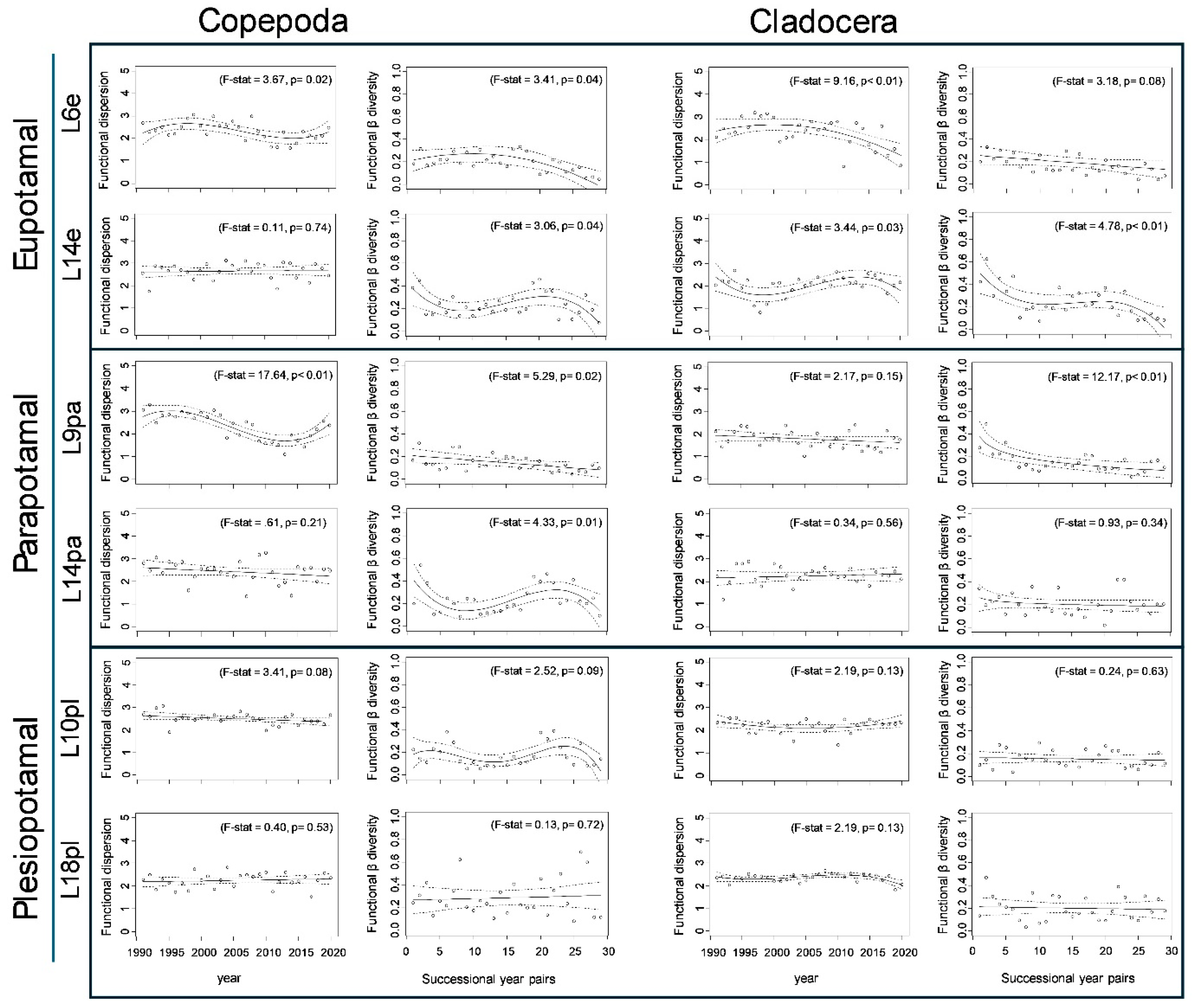
In both taxonomic groups of crustacean zooplankton, no evident differences in functional diversity (mean functional dispersion) were found between the monitored biotopes (Table 4 and Table 5). During the study period, no significant decrease/increase in functional dispersion of communities were observed in most of the monitored sites (Figure A2). In copepods, a slight decrease in functional dispersion was observed in the upper part of the Danube inland delta (L6e, L9pa) during the period when artificial floodings were realized (1997–2010). In Cladocera, a significant decline in the functional dispersion of the community was observed at the upper eupotamal site (L6e), particularly after the cessation of regular artificial flooding after 2010.
Table 4.
Functional diversity and the best-fitting model describing temporal changes in functional diversity of the copepod community at each monitored site and the entire area during the period 1991–2020.
Table 5.
Functional diversity and the best-fitting model describing temporal changes in functional diversity of the cladoceran community at each monitored site and the entire area during the period 1991–2020.
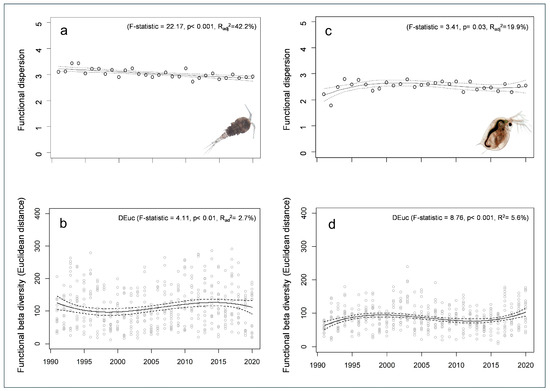
Globally, across the entire area, a slight linear decline in functional diversity within the copepod community was observed during the monitoring period, whereas in Cladocera, functional diversity remained nearly unchanged (Figure 5a,c). Regarding between-habitat functional heterogeneity, the two taxonomic groups displayed opposite temporal patterns (Figure 5b,d). In copepods, functional beta diversity showed a weak but significant decline following the commencement of GHP operation, lasting approximately until 2000. After 2000, an increase was observed, peaking around 2015, followed by a slight decrease in functional heterogeneity. In contrast, functional beta diversity in Cladocera gradually increased after the onset of GHP operation, reaching a peak around 2000. After this period, a steady decline was observed until approximately 2015, followed by a noticeable increase in the functional heterogeneity of the cladoceran community.
Figure 5.
Changes in functional alpha diversity (a,c) and beta-diversity (b,d) (Euclidean pairwise dissimilarity) of the copepod (left) and cladoceran (right) community, along with their predictions for the entire study area during the monitoring period (1991–2020).
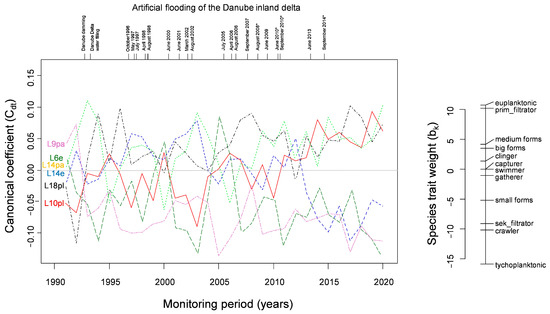
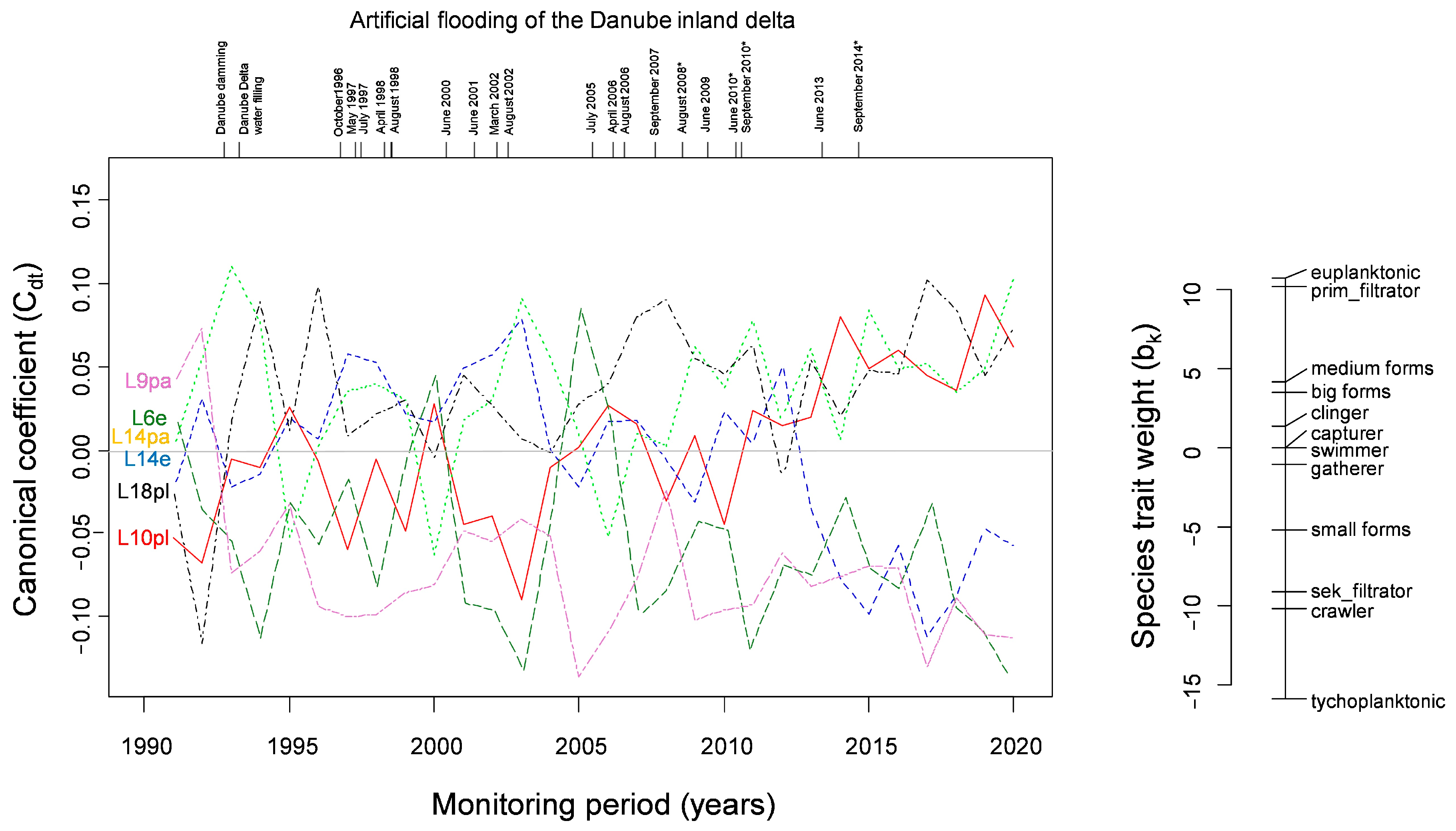
The PRC analysis revealed that 88.6% of the total variation in functional composition of copepods was explained by between-site variation, including its interaction with year, while 11.4% was attributed to pure spatial (between-sites) variation. The first canonical axis of the PRC analysis accounted for 75.3% of the total variation. Similarly to PRC analysis based on taxonomical data, the multiple of bk × Cdt determines the response pattern of each species trait proportion in the community over time. From the PRC plot (Figure 6), it is evident that during the period of extensive flooding, a homogenization of copepod communities occurred among the eupotamal sites and the upper parapotamal biotope, as well as among the plesiopotamal sites and the lower parapotamal biotope. This internal homogenization of both groups led to an increasing differentiation between them during the period without artificial flooding (i.e., when hydrological connectivity between biotopes was disrupted). During the period of increasing differentiation, contrasting shifts in functional group dominance were observed between the two main biotope clusters. In the eupotamal and upper parapotamal sites, an increasing prevalence of tychoplanktonic species, crawlers, and gatherers was detected. In contrast, the plesiopotamal and lower parapotamal biotopes exhibited a growing dominance of euplanktonic species, swimmers, and capturers. These divergent functional trajectories contributed to the increasing separation of the PRCs, indicating enhanced functional differentiation between the two biotope groups following the cessation of artificial floodings.
Figure 6.
Principal Response Curves (PRCs) showing temporal changes in the structure of copepod communities at the monitoring sites. The vertical axes (left and right) represent the first canonical axis of the Redundancy Analysis conducted on the copepod functional traits weighed by species relative abundance data. Explanation: * next to the year indicates that year only the lower part of the delta was flooded (sites L14e, L14pa, L18pl).
In the cladoceran community, the PRC analysis revealed that 78.1% of the total variation in functional composition was attributed to temporal changes across sites, whereas 21.9% reflected spatial heterogeneity (i.e., differences between sites that were independent of time). The first canonical axis of the PRC, which is visualized in the diagram, represents 58.3% of the total variation. From the PRC plot (Figure 7), similarly to copepods, homogenization of cladoceran communities occurred among the eupotamal sites and the upper parapotamal biotope, as well as among the plesiopotamal sites and the lower parapotamal biotope. This internal homogenization within both groups of sites resulted in increasing successional differentiation between them following the end of regular artificial flooding in the inland delta (after 2010). In Cladocera, an increasing prevalence of tychoplanktonic and small-sized species, crawlers, and secondary filter feeders was observed in the eupotamal and upper parapotamal sites. Conversely, euplanktonic and medium- to large-sized species with a primary filter-feeding strategy became increasingly dominant in the plesiopotamal and lower parapotamal biotopes.
Figure 7.
Principal Response Curves (PRCs) showing temporal changes in the structure of cladoceran communities at the monitoring sites. The vertical axes (left and right) represent the first canonical axis of the Redundancy Analysis conducted on the cladoceran functional traits weighed by species relative abundance data. Explanation: * next to the year indicates that year only the lower part of the delta was flooded (sites L14e, L14pa, L18pl).
4. Discussion
The results of this long-term monitoring highlight that the Danube inland delta represents a unique biotope in terms of crustacean zooplankton diversity. Over the study period, we recorded 49 copepod and 72 cladoceran taxa, comparable to findings from broader surveys in the Hungarian Danube floodplain (e.g., [46,77,78,79,80,81]). Several dominant species, such as Eucyclops serrulatus and Acanthocyclops robustus, were consistently observed, although the latter declined after 2006. The high overlap in species composition between the Slovak inland delta and the Hungarian Szigetköz floodplain suggests the existence of a shared regional species pool, highlighting the ecological similarity of these adjacent habitats despite differing national boundaries and management regimes. This resilience of the core copepod and cladoceran community structure indicates a remarkable capacity of the Middle Danube floodplain to maintain biodiversity under long-term hydromorphological pressures.
As a result of the damming of the Danube in October 1992, the main channel of the river between rkm 1851 and 1811 became a former riverbed. Since the diversion, the average annual discharge in this bypassed section has declined significantly [82], accompanied by a drop in water levels and a considerable reduction in flow velocity [50]. In large lowland rivers, dams typically have a negative impact on hydrological connectivity between the main river channel and adjacent water bodies [83], resulting in disrupted lateral connectivity. The ecological importance of maintaining such connectivity within lowland floodplain systems is well documented and has been described within the framework of the Flood Pulse Concept [84]. After GHP went into operation, connectivity between the main channel and the side-arm system was disrupted, and natural flooding ceased across the entire former inundation zone. The restriction of lateral connectivity, the disappearance of lentic habitats in the littoral zone of the main channel and the accumulation of fine sediments, especially in the main channel and upper parapotamal sites, altered the trophic relationships there. The accumulation of fine sediments in gravel beds there created suitable habitats for harpacticoid species (Nitocra, Ectinosoma) and Paracyclops fimbriatus, which are primarily gatherers and predominantly detritivores [61]. The strong association of P. fimbriatus with the main channel of the Danube River has been corroborated by several studies, e.g., [79,80]. An increase in the dominance of littoral species, particularly N. hibernica, E. abrau, and E. serrulatus, was recorded in the years immediately following the damming. These species-maintained dominance in the crustacean potamoplankton throughout the entire monitoring period at the eupotamal and upper parapotamal sites. Their increasing prevalence reduced the contribution of rarer and habitat-specific taxa, resulting in communities at different sites converging towards a similar taxonomic composition, that is, a taxonomic homogenization of these biotopes. A comparable pattern was observed in the cladoceran community of the main channel, where the proportion of euplanktonic species gradually declined. A decrease in the dominance of Bosmina longirostris was recorded throughout the monitoring period, particularly after the regular artificial floodings were reduced or definitively stopped. This observation is consistent with the findings of [85], who reported a significant decline of this species in the main channel of the Danube at rkm 1669, attributing the decrease to the impacts of damming. Over the medium to long term, littoral species, primarily Scapholeberis mucronata and Simocephalus serrulatus, as well as some chydorids (e.g., Pleuroxus aduncus, Chydorus sphaericus) became dominant. The accumulation of fine sediments in gravel beds created suitable habitats for members of the Ilyocryptidae family, which are typically associated with muddy substrates [86], as a result, these species have become more dominant in the eupotamal cladoceran community.
A different situation was observed in the lower parapotamal side-arm (L14p), which is not supplied with water from the main channel during normal water level in the old Danube. Following the diversion of the Danube, this arm became progressively shallower, leading to a partial loss of connectivity with the main channel. Over time, its environmental conditions have increasingly resembled those of plesiopotamal arms. Euplanktonic and primary filter-feeder species, primarily Thermocyclops oithonoides and Mesocyclops leuckarti, gradually increased in dominance there, particularly during the period following the cessation of artificial floods. During periods of limited connectivity between floodplain water bodies and the main river channel, nutrient recycling becomes dominant, potentially leading to increased primary productivity of phytoplankton and eutrophic conditions [87]. A similar trend was observed in the upper plesiopotamal side-arm (L10pl), likely due to the lentic character of these habitats and the presence of more abundant littoral macrophyte vegetation there [88]. Throughout the monitoring period, a slight increase in the relative abundance of the tychoplanktonic species Eurytemora velox was also recorded, probably as a result of the gradual shallowing of the side arms, particularly during the years without regular artificial flooding.
A similar trend was observed in the cladoceran community, where the relative abundance of some littoral species (e.g., Ch. sphaericus, S. vetulus) declined during the monitoring period, while certain euplanktonic and primarily filter-feeding species (e.g., Daphnia cucullata, Diaphanosoma orghidani, B. longirostris) became more dominant. According to [89] D. cucullata and D. orghidani are typical euplanctonic species inhabiting very slow-running or stagnant waters. Ultimately, this led to a certain degree of taxonomic homogenization of the cladoceran community across all monitored biotopes, while simultaneously resulting in functional differentiation between the eupotamal/upper parapotamal sites and the plesiopotamal/lower parapotamal sites. Thus, taxonomic convergence in Cladocera across all monitored biotopes can be attributed not only to the widespread success of a few tolerant species but also to the appearance of several new species (e.g., Pleuroxus denticulatus, Bosmina coregoni, and Bosmina longispina) in nearly all sites. This pattern was reflected in a general increase in cladoceran species richness at each monitored locality. The spread of P. denticulatus was particularly rapid, with the species colonizing multiple Danubian side arms within a relatively short period [90]. The latter two species were recorded after major flood events: B. coregoni first appeared in August 1997, and B. longispina in October 2002 [53]. Both are considered natural immigrants from adjacent geographical regions, such as the Alps and Bohemian Highlands [91]. On the other hand, environmental divergence between the main channel and isolated arms ultimately led to functional niche separation. This dual trend highlights the complex and scale-dependent response of zooplankton communities to hydromorphological alteration in large river floodplains.
Patterns of community homogenization and differentiation observed in our study correspond well with findings from other floodplain river systems. Hydrological connectivity has repeatedly been identified as a key driver of plankton dynamics, influencing both local and regional scales of community organization [92,93]. In floodplain lakes with stable hydrological regimes, zooplankton assemblages often converge towards similar compositions dominated by tolerant and generalist taxa, resulting in local homogenization [42,43]. Conversely, reduced connectivity and site-specific disturbances promote differentiation among communities, as dispersal is limited and environmental filters act more strongly at the local scale [42,43].
Our results from the Danube inland delta highlight the same duality: long-term hydromorphological alterations have led to increasing similarity within sites, while at the same time enhancing compositional differences among sites. This suggests that homogenization and differentiation are not mutually exclusive but rather complementary processes that emerge simultaneously under altered floodplain conditions. Such patterns have also been reported in other European floodplains, where regional dispersal limitation combined with local disturbance regimes contributed to increased beta-diversity despite homogenization at smaller scales [94,95].
Importantly, hydrology does not act alone. Several other environmental factors interact with connectivity and disturbance regimes to further shape zooplankton communities in floodplain ecosystems. Water temperature and nutrient availability are key determinants of seasonal succession and species dominance, as they directly influence reproductive rates and food resources [96]. Similarly, water transparency and macrophyte coverage can mediate whether homogenizing or differentiating processes dominate. Reduced transparency, often linked to nutrient enrichment or suspended sediments, favors the persistence of generalist taxa, thereby reinforcing homogenization. In contrast, macrophyte-rich habitats provide spatial refuges and trophic niches, supporting higher cladoceran diversity and thus contributing to community differentiation [97,98,99]. Taken together, these findings suggest that homogenization and differentiation in large floodplain rivers emerge from the combined action of hydrological drivers and other environmental determinants, and their balance ultimately defines long-term biodiversity trajectories in the Danube and other regulated rivers.
5. Conclusions
This long-term study of crustacean zooplankton communities in the Danube inland delta reveals that despite significant hydromorphological alterations following damming and flow regulation, the region remains a biodiversity hotspot within the Middle Danube. The recorded diversity matches or exceeds values reported in broader regional studies from the Hungarian Danube floodplain, confirming the importance of this section as a key refuge and reservoir of zooplankton diversity. Our findings illustrate divergent responses of copepods and cladocerans to altered hydrological conditions. Copepods showed taxonomic and functional homogenization within more connected habitats and more isolated habitats, especially when artificial regular flooding was absent. Cladocerans displayed both taxonomic convergence, driven by the spread of tolerant and newly colonizing species, and functional divergence between eupotamal and para/plesiopotamal sites, even after artificial flooding was stopped. The gradual shallowing and nutrient retention in isolated arms, combined with the absence of natural/artificial floods, promoted shifts toward euplanktonic and filter-feeding species.
Overall, this long-term monitoring study highlights the critical role of maintaining hydrological connectivity and seasonal flow variability in preserving the ecological integrity of floodplain systems. Such sustained monitoring is essential not only for detecting delayed and cumulative effects of river regulation but also for informing adaptive management strategies aimed at restoring natural ecological processes in regulated rivers. The findings also emphasize the resilience and adaptability of crustacean zooplankton communities, which can reflect both local habitat conditions and broader regional ecological processes.
Author Contributions
Conceptualization, P.B.; Methodology, P.B. and I.M.; Formal Analysis, P.B.; Investigation, I.K.; Data Curation, I.M. and I.K.; Writing—Original Draft Preparation, P.B.; Writing—Review and Editing, P.B., I.K. and I.M.; Visualization, P.B.; Supervision, I.M.; Project Administration, I.M.; Funding Acquisition, I.M. All authors have read and agreed to the published version of the manuscript.
Funding
The research was supported by the Slovak Grant Agency VEGA of the Ministry of Education, Science, Research and Sport of the Slovak Republic (grants no. 1/0555/20 and 2/0087/25).
Data Availability Statement
Data is contained within the article.
Acknowledgments
This study is dedicated to the memory of Marta Illyová, who studied the zooplankton communities of the Danube inland delta for almost 30 years. We would also like to thank the professional English reviewer for correcting the English of this paper and the anonymous reviewers for their valuable comments on the manuscript.
Conflicts of Interest
The authors declare that the research was conducted without any commercial or financial relationships that could be construed as a potential conflict of interest.
Appendix A
Table A1.
List of species traits used for the classification of copepod and cladoceran functional groups.
Table A2.
Functional trait database of identified copepod and cladoceran species at the monitored sites. Mesohabitat affinity: 1—tychoplanktonic species, 2—euplanktonic species; Maximum body size: 1—small forms, 2—medium forms, 3—big forms; Feeding type: 1—capturer, 2—primary filtrator, 3—secondary filtrator, 4—gatherer; Locomotion type: 1—swimmer, 2—crawler, 3—clinger. A detailed explanation of each trait is provided in Table A1.
Table A3.
List of identified copepod and cladoceran species at the monitored sites. Numbers represent the frequency of occurrence of a species at a site.
Figure A1.
Changes in species richness, beta-diversity (Sorenson pairwise dissimilarity—Dsor), and taxonomic turnover (Simpson pairwise dissimilarity—Dsim), based on presence/absence data, and their predictions during the monitoring period (1991–2020). Explanation: black solid and dashed lines represent the predictions.
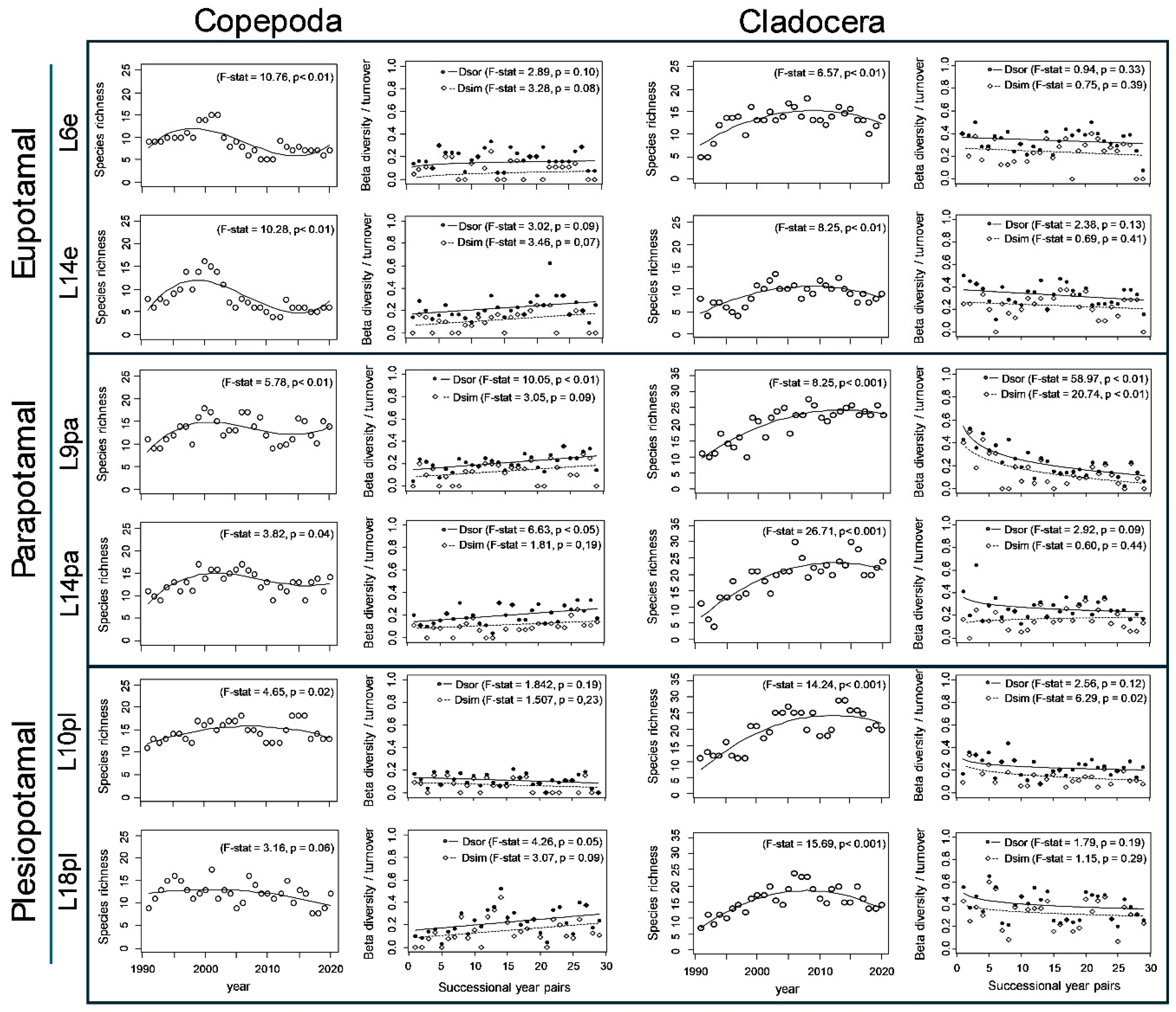
Figure A2.
Changes in functional alpha- (functional dispersion) and beta-diversity (Euclidean pairwise dissimilarity) of the copepod and cladoceran communities, along with their predictions for each study site during the monitoring period (1991–2020). Explanation: black solid lines represent predictions, and dashed lines represent the 95% confidence interval for the prediction lines.
References
- Sommerwerk, N.; Hein, T.; Schneider-Jacoby, M.; Baumgartner, C.; Ostojic, A.; Siber, R.; Bloesch, J.; Paunovic, M.; Tockner, K. The Danube River Basin. In Rivers of Europe; Tockner, K., Robinson, C.T., Uehlinger, U., Eds.; Academic Press: Oxford, UK, 2009; pp. 59–112. [Google Scholar]
- Tockner, K.; Schiemer, F.; Baumgartner, C.; Kum, G.; Weigand, E.; Zweimüller, I.; Ward, J.V. The Danube restoration project: Species diversity patterns across connectivity gradients in the floodplain system. Regul. Rivers Res. Manag. 1999, 15, 245–258. [Google Scholar] [CrossRef] [Scilit]
- Ward, J.V.; Tockner, K.; Arscott, D.B.; Claret, C. Riverine Landscape Diversity: Riverine Landscape Diversity. Freshw. Biol. 2002, 47, 517–539. [Google Scholar] [CrossRef] [Scilit]
- Mănoiu, V.M.; Crăciun, A.I. Danube River water quality trends: A qualitative review based on the open access web of science database. Ecohydrol. Hydrobiol. 2021, 21, 613–628. [Google Scholar] [CrossRef] [Scilit]
- Tittizer, T.; Banning, M. Biological assessment in the Danube catchment area: Indications of shifts in species composition induced by human activities. Eur. Water Manag. 2001, 3, 35–45. [Google Scholar]
- Bloesch, J. The International Association for Danube Research (IAD)—Portrait of a transboundary scientific NGO. Environ. Sci. Pollut. Res. 2009, 16, 116–122. [Google Scholar] [CrossRef] [Scilit] [PubMed]
- Naiman, R.J.; Magnuson, J.J.; McKnight, D.M.; Stanford, J.A.; Karr, J.R. Freshwater ecosystems and management: A national initiative. Science 1995, 270, 584–585. [Google Scholar] [CrossRef] [Scilit]
- Tilman, D.; Reich, P.B.; Knops, J.M.H. Biodiversity and ecosystem stability in a decade-long grassland experiment. Nature 2006, 441, 629–632. [Google Scholar] [CrossRef] [Scilit]
- Sukhotin, A.; Berger, V. Long-term monitoring studies as a powerful tool in marine ecosystem research. Hydrobiologia 2013, 706, 1–9. [Google Scholar] [CrossRef] [Scilit]
- Wardle, D.A.; Bardgett, R.D.; Callaway, R.M.; Van der Putten, W.H. Terrestrial ecosystem responses to species gains and losses. Science 2011, 332, 1273–1277. [Google Scholar] [CrossRef] [Scilit]
- Tatsumi, S.; Iritani, R.; Cadotte, M.W. Temporal changes in spatial variation: Partitioning the extinction and colonisation components of beta diversity. Ecol. Lett. 2021, 24, 1063–1072. [Google Scholar] [CrossRef] [Scilit]
- Sax, D.F.; Gaines, S.D. Species diversity: From global decreases to local increases. Trends Ecol. Evol. 2003, 18, 561–566. [Google Scholar] [CrossRef] [Scilit]
- Thomas, C.D. Local diversity stays about the same, regional diversity increases, and global diversity declines. Proc. Natl. Acad. Sci. USA 2013, 110, 19187–19188. [Google Scholar] [CrossRef] [Scilit] [PubMed]
- Vellend, M.; Baeten, L.; Myers-Smith, I.H.; Elmendorf, S.C.; Beauséjour, R.; Brown, C.D.; De Frenne, P.; Verheyen, K.; Wipf, S. Global meta-analysis reveals no net change in local-scale plant biodiversity over time. Proc. Natl. Acad. Sci. USA 2013, 110, 19456–19459. [Google Scholar] [CrossRef] [Scilit]
- Olden, J.D.; Rooney, T.P. On defining and quantifying biotic homogenization. Glob. Ecol. Biogeogr. 2006, 15, 113–120. [Google Scholar] [CrossRef] [Scilit]
- Elmendorf, S.C.; Harrison, S.P. Is plant community richness regulated over time? Contrasting results from experiments and long-term observations. Ecology 2011, 92, 602–609. [Google Scholar] [CrossRef] [Scilit] [PubMed]
- Sax, D.F.; Gaines, S.D. Species invasions and extinction: The future of native biodiversity on islands. Proc. Natl. Acad. Sci. USA 2008, 105, 11490–11497. [Google Scholar] [CrossRef] [Scilit] [PubMed]
- Blowes, S.A.; McGill, B.; Brambilla, V.; Chow, C.F.Y.; Engel, T.; Fontrodona-Eslava, A.; Martins, I.S.; McGlinn, D.; Moyes, F.; Sagouis, A.; et al. Synthesis reveals approximately balanced biotic differentiation and homogenization. Sci. Adv. 2024, 10, eadj9395. [Google Scholar] [CrossRef] [Scilit]
- Caswell, H.; Cohen, J.E. Communities in patchy environments: A model of disturbance, competition, and heterogeneity. In Ecological Heterogeneity; Kolasa, J., Pickett, S.T.A., Eds.; Springer: New York, NY, USA, 1991; pp. 97–122. [Google Scholar]
- Gustafsson, L.; Baker, S.C.; Bauhus, J.; Beese, W.J.; Brodie, A.; Kouki, J.; Lindenmayer, D.B.; Lõhmus, A.; Pastur, G.M.; Messier, C. Retention forestry to maintain multifunctional forests: A world perspective. BioScience 2012, 62, 633–645. [Google Scholar] [CrossRef] [Scilit]
- Kouki, J.; Salo, K. Forest disturbances affect functional groups of macrofungi in young successional forests: Harvests and fire lead to different fungal assemblages. For. Ecol. Manag. 2020, 463, 118039. [Google Scholar] [CrossRef] [Scilit]
- Olden, J.D.; Poff, N.L.; Douglas, M.R.; Douglas, M.E.; Fausch, K.D. Ecological and evolutionary consequences of biotic homogenization. Trends Ecol. Evol. 2004, 19, 18–24. [Google Scholar] [CrossRef] [Scilit]
- Olden, J.D.; Poff, N.L. Toward a mechanistic understanding and prediction of biotic homogenization. Am. Nat. 2003, 162, 442–460. [Google Scholar] [CrossRef] [Scilit]
- Barnett, A.; Beisner, B.E. Zooplankton biodiversity and lake trophic state: Explanations invoking resource abundance and distribution. Ecology 2007, 88, 1675–1686. [Google Scholar] [CrossRef] [Scilit] [PubMed]
- Simões, N.R.; Braghin, L.S.M.; Duré, G.A.V.; Santos, J.S.; Sonoda, S.L.; Bonecker, C.C. Changing taxonomic and functional β-diversity of cladoceran communities in Northeastern and South Brazil. Hydrobiologia 2020, 847, 3845–3856. [Google Scholar] [CrossRef] [Scilit]
- Naeem, S.; Wright, J.P. Disentangling biodiversity effects on ecosystem functioning: Deriving solutions to a seemingly insurmountable problem. Ecol. Lett. 2003, 6, 567–579. [Google Scholar] [CrossRef] [Scilit]
- Sodré, E.d.O.; Bozelli, R.L. How planktonic microcrustaceans respond to environment and affect ecosystem: A functional trait perspective. Int. Aquat. Res. 2019, 11, 207–223. [Google Scholar] [CrossRef] [Scilit]
- Moody, E.K.; Wilkinson, G.M. Functional shifts in lake zooplankton communities with hypereutrophication. Freshw. Biol. 2019, 64, 608–616. [Google Scholar] [CrossRef] [Scilit]
- Balkić, A.G.; Ternjej, I.; Špoljar, M. Hydrology-driven changes in the rotifer trophic structure and implications for food web interactions. Ecohydrology 2018, 11, 1–12. [Google Scholar]
- Obertegger, U.; Flaim, G. Taxonomic and functional diversity of rotifers, what do they tell us about community assembly? Hydrobiologia 2018, 823, 79–91. [Google Scholar] [CrossRef] [Scilit]
- Goździejewska, A.M.; Koszałka, J.; Tandyrak, R.; Grochowska, J.; Parszuto, K. Functional responses of zooplankton communities to depth, trophic status, and ion content in mine pit lakes. Hydrobiologia 2021, 848, 2699–2719. [Google Scholar] [CrossRef] [Scilit]
- Chesson, P. Mechanisms of maintenance of species diversity. Annu. Rev. Ecol. Syst. 2000, 31, 343–366. [Google Scholar] [CrossRef] [Scilit]
- Cadotte, M.; Albert, C.H.; Walker, S.C. The ecology of differences: Assessing community assembly with trait and evolutionary distances. Ecol. Lett. 2013, 16, 1234–1244. [Google Scholar] [CrossRef] [Scilit] [PubMed]
- Goździejewska, A.M.; Gwoździk, M.; Kulesza, S.; Bramowicz, M.; Koszałka, J. Effects of suspended micro- and nanoscale particles on zooplankton functional diversity of drainage system reservoirs at an open-pit mine. Sci. Rep. 2019, 9, 16113. [Google Scholar] [CrossRef] [Scilit]
- Gauthier, J.; Prairie, Y.T.; Beisner, B.E. Thermocline deepening and mixing alter zooplankton phenology, biomass and body size in a whole-lake experiment. Freshw. Biol. 2014, 59, 998–1011. [Google Scholar] [CrossRef] [Scilit]
- Dias, J.D.; Simões, N.R.; Meerhoff, M.; Lansac-Tôha, F.A.; Velho, L.F.M.; Bonecker, C.C. Hydrological dynamics drives zooplankton matacommunity structure in a Neotropical floodplain. Hydrobiologia 2016, 781, 109–125. [Google Scholar] [CrossRef] [Scilit]
- Dittrich, J.; Dias, J.D.; Bonecker, C.C.; Lansac-Tôha, F.A.; Padial, A.A. Importance of temporal variability at different spatial scales for diversity of floodplain aquatic communities. Freshw. Biol. 2016, 61, 316–327. [Google Scholar] [CrossRef] [Scilit]
- Anderson, S.M.A.; Bonecker, C.C. Rotifers in different environments of the Upper Parana River floodplain (Brazil): Richness, abundance and the relationship with connectivity. Hydrobiologia 2004, 522, 281–290. [Google Scholar] [CrossRef] [Scilit]
- Schöll, K.; Kiss, A.; Dinka, M.; Berczik, A. Flood-Pulse effects on zooplankton assemblages in a river-floodplain system (Gemenc Floodplain of the Danube, Hungary). Int. Rev. Hydrobiol. 2012, 97, 41–54. [Google Scholar] [CrossRef] [Scilit]
- Kobayashi, T.; Ralph, T.J.; Ryder, D.S.; Hunter, S.J.; Shiel, R.J.; Segers, H. Spatial dissimilarities in plankton structure and function during flood pulses in a semi-arid floodplain wetland system. Hydrobiologia 2015, 747, 19–31. [Google Scholar] [CrossRef] [Scilit]
- Lemke, M.J.; Paver, S.F.; Dungey, K.E.; Velho, L.F.M.; Kent, A.D.; Rodrigues, L.C.; Kellerhals, D.M.; Randle, M.R. Diversity and succession of pelagic microorganisms communities in a newly restored Illinois River floodplain lake. Hydrobiologia 2017, 804, 35–58. [Google Scholar] [CrossRef] [Scilit]
- Hein, T.; Baranyi, C.; Reckendorfer, W.; Schimer, F. The impact of surface water exchange on the nutrient and particle dynamics in side-arms along the River Danube, Austria. Sci. Total Environ. 2004, 328, 207–218. [Google Scholar] [CrossRef] [Scilit] [PubMed]
- Kasten, J. Innundation and isolation: Dynamics of phytoplankton communities in seasonal inundated flood plain waters of the Lower Odra Valley National Park—Northeast Germany. Limnologica 2003, 33, 99–111. [Google Scholar] [CrossRef] [Scilit]
- Heiler, G.; Hein, T.; Schiemer, F. The significance of hydrological connectivity for limnological processes in Danubian backwaters. Verhandlungen Des Int. Ver. Limnol. 1994, 25, 1674–1679. [Google Scholar] [CrossRef] [Scilit]
- Gulyás, P. Tägliche Zooplankton Untersuchungen im Donau-Nebenarm bei Ásványráró im Sommer 1985. Wissenschaftliche Kurzreferate, 26; Arbeitstagung der IAD: Passau, Deutschland, 14–18 September 1987; pp. 123–126. [Google Scholar]
- Gulyás, P. Studies on Rotatoria and Crustacea in the various water-bodies of Szigetköz. Limnol. Aktuelle 1994, 2, 63–78. [Google Scholar]
- Bothár, A.; Ráth, B. Abundance dynamics of Crustacea in different littoral biotopes of the “Szigetköz” side arm system, River Danube, Hungary. Verhandlungen Des Int. Ver. Limnol. 1994, 25, 1684–1687. [Google Scholar]
- Vranovský, M. Zooplankton of two side arms of the Danube at Baka (1820.5–1822.5 river km). Work. Inst. Fish. Res. Hydrobiol. 1985, 5, 47–100. [Google Scholar]
- Vranovský, M. Zooplankton of the Danube side arm under regulated ichthyocoenosis conditions. Verhandlungen Des Int. Ver. Limnol. 1991, 24, 2505–2508. [Google Scholar] [CrossRef] [Scilit]
- Vranovský, M. Impact of the Gabčíkovo hydropower plant operation on planktonic copepod assemblages in the River Danube and its floodplain downstream of Bratislava. Hydrobiologia 1997, 347, 41–49. [Google Scholar] [CrossRef] [Scilit]
- Illyová, M. Cladoceran taxocoenoses in the territory affected by the Gabčíkovo barrage system. Biologia 1996, 51, 501–508. [Google Scholar]
- Illyová, M. Planktonic crustaceans (Crustacea) in the littoral zone of the Danube inland delta (r km 1841–1804). Folia Faun. Slovaca 1998, 3, 23–30. [Google Scholar]
- Illyová, M.; Némethová, D. Long-term changes in cladoceran assemblage in the Danube floodplain area (Slovak–Hungarian stretch). Limnologica 2005, 35, 274–282. [Google Scholar] [CrossRef] [Scilit]
- Illyová, M.; Matečný, I. Ecological validity of river-floodplain system assessment by planktonic crustacean survey (Branchiata: Branchiopoda). Environ. Monit. Assess. 2014, 186, 4195–4208. [Google Scholar] [CrossRef] [Scilit]
- Illyová, M.; Beracko, P.; Vranovský, M.; Matečný, I. Long-term changes in copepod assemblages in the area of the Danube floodplain (Slovak–Hungarian stretch). Limnologica 2017, 65, 22–33. [Google Scholar] [CrossRef] [Scilit]
- Waringer, J.; Chovanec, A.; Straif, M.; Graf, W.; Reckendorfer, W.; Waringer-Löschenkohl, A.; Waidbacher, H.; Schultz, H. The Floodplain Index—Habitat values and indication weights for molluscs, dragonflies, caddisflies, amphibians and fish from Austrian Danube floodplain waterbodies. Lauterbornia 2005, 54, 177–186. [Google Scholar]
- Mucha, I. (Ed.) Gabčíkovo Part of the Hydroelectric Power Project Environmental Impact Review (Evaluation Based on Two Year Monitoring); Comenius University: Bratislava, Slovakia, 1995. Available online: http://www.gabcikovo.gov.sk/ (accessed on 1 March 2025).
- Mack, H.R.; Conroy, J.D.; Blocksom, K.A.; Stein, R.A.; Ludsin, S.A. A comparative analysis of zooplankton field collection and sample enumeration methods. Limnol. Oceanogr. Methods 2012, 10, 41–53. [Google Scholar] [CrossRef] [Scilit]
- Bledzki, L.A.; Rybak, J.I. (Eds.) Freshwater Crustacean Zooplankton of Europe: Cladocera & Copepoda (Calanoida, Cyclopoida). Key to Species Identification, with Notes on Ecology, Distribution, Methods and Introduction to Data Analysis; Springer: Cham, Switzerland, 2016; pp. XV–918. [Google Scholar]
- Šrámek-Hušek, R. Naši klanonožci; Nakladetelstí ČSAV: Praha, Československo, 1953; pp. 1–61. [Google Scholar]
- Dussart, B.H.; Defaye, D. Copepoda: Introduction to the Copepoda; SPB Academic Publishing: Amsterdam, The Netherlands; The Hague, The Netherlands, 1995; pp. 1–277. [Google Scholar]
- Janetzky, W.; Enderle, R.; Noodt, W. Crustacea: Copepoda: Gelyelloida und Harpacticoida. In Süsswasserfauna von Mitteleuropa; Schwoerbel, J., Zwick, P., Eds.; Gustav Fischer Verlag, Bd.: Stuttgart, Germany, 1996; Volume 8, pp. 1–228. [Google Scholar]
- Přikryl, I.; Bláha, M. Klíče středoevropských Cyclopidae a Diaptomidae (bez druhů podzemních vod). Unpublished work.
- Amoros, C. Introduction pratique à la systématique des organismes des eaux continentales françaises—5. Crustacés cladocères. Publ. De La Société Linnéenne De Lyon 1984, 53, 72–107. [Google Scholar]
- Gulyás, P.; Forró, L. Az ágascsápú rárok (Cladocera) kishatározója; Környezetgazdálkodási Intézet (KGI): Budapest, Hungary, 1999; pp. 1–237. [Google Scholar]
- Whittaker, R.H. Evolution and measurement of species diversity. Taxon 1972, 21, 213–251. [Google Scholar] [CrossRef] [Scilit]
- Magurran, A.E.; Dornelas, M.; Moyes, F.; Gotelli, N.J.; McGill, B. Rapid biotic homogenization of marine fish assemblages. Nat. Commun. 2015, 6, 8405. [Google Scholar] [CrossRef] [Scilit]
- Koleff, P.; Gaston, K.J.; Lennon, J.J. Measuring beta diversity for presence–absence data. J. Anim. Ecol. 2003, 72, 367–382. [Google Scholar] [CrossRef] [Scilit]
- Baselga, A. Partitioning the turnover and nestedness components of beta diversity. Glob. Ecol. Biogeogr. 2010, 19, 134–143. [Google Scholar] [CrossRef] [Scilit]
- Laliberté, E.; Legendre, P. A distance-based framework for measuring functional diversity from multiple traits. Ecology 2010, 91, 299–305. [Google Scholar] [CrossRef] [Scilit]
- Hudec, I. Fauna Slovenska III—Anomopoda, Ctenopoda, Haplopoda, Onychopoda (Crustacea: Branchiopoda); VEDA: Bratislava, Slovakia, 2010; p. 496. [Google Scholar]
- Gavrilko, D.E.; Shurganova, G.V.; Kudrin, I.A.; Yakimov, B.N. Identification of freshwater zooplankton functional groups based on the functional traits of species. Povolzhskiy J. Ecol. 2020, 3, 290–306. (In Russian) [Google Scholar] [CrossRef] [Scilit]
- R Core Team. R: A Language and Environment for Statistical Computing; R Foundation for Statistical Computing: Vienna, Austria, 2022; Available online: https://www.R-project.org/ (accessed on 20 February 2025).
- Oksanen, J.; Simpson, G.; Blanchet, F.; Kindt, R.; Legendre, P.; Minchin, P.; O’Hara, R.; Solymos, P.; Stevens, M.; Szoecs, E.; et al. vegan: Community Ecology Package, R package version 2.6-4; R Foundation for Statistical Computing: Vienna, Austria, 2022. [Google Scholar]
- Laliberté, E.; Legendre, P.; Shipley, B. FD: Measuring Functional Diversity from Multiple traits, and Other Tools for Functional Ecology; R package version 1.0-12.3; R Foundation for Statistical Computing: Vienna, Austria, 2014. [Google Scholar]
- Dray, S.; Dufour, A. The ade4 Package: Implementing the Duality Diagram for Ecologists. J. Stat. Softw. 2007, 22, 1–20. [Google Scholar] [CrossRef] [Scilit]
- Kiss, A. Long-term changes of Crustacean (Cladocera, Ostracoda, Copepoda) assemblages in Szigetkoz Floodplain Area (Hungary) 1991–2002. Int. Assoc. Danub. Res. 2004, 35, 2–7. [Google Scholar]
- Schöll, K.; Kiss, A. Spatial and temporal distribution patterns of zooplankton assemblages (Rotifera, Cladocera, Copepoda) in the water bodies of the Gemenc Floodplain (Duna-Dráva National Park, Hungary). Opusc. Zool. Bp. 2008, 39, 65–76. [Google Scholar]
- Kiss, A.; Schöll, K. Checklist of the Crustacea (Cladocera, Ostracoda, Copepoda) fauna in the active floodplain area of the Danube (1843–1806, 1669 and 1437–1489 rkm). Opusc. Zool. Bp. 2009, 40, 27–39. [Google Scholar]
- Kiss, A.; Ágoston-Szabó, E.; Dinka, M.; Schöll, K.; Berczik, Á. Microcrustacean (Cladocera, Copepoda, Ostracoda) diversity in three side arms in the Gemenc floodplain (Danube River, Hungary) in different hydrological situations. Acta Zool. Bulg. 2014, 7, 135–141. [Google Scholar]
- Kazakov, S.; Schöll, K.; Kalchev, R.; Pehlivanov, L.; Kiss, A. Comparison of zooplankton species diversity in Hungarian and Bulgarian Danube sections. Acta Zool. Bulg. 2014, 7, 91–96. [Google Scholar]
- Commission of the European Community (CEC). Working Group Report of Variant C of the Gabčíkovo-Nagymaros Project; Commission of the European Community, Czech and Slovak Federative Republic, Republic of Hungary: Budapest, Hungary, 1992. [Google Scholar]
- Pringle, C.M.; Freeman, M.C.; Freeman, B.J. Regional effects of hydrological alterations on riverine macrobiota in the new world: Tropical temperate comparisons. BioScience 2000, 50, 807–823. [Google Scholar] [CrossRef] [Scilit]
- Junk, W.J.; Bayley, P.B.; Sparks, R.E. The flood-pulse concept in river-floodplain systems. Can. J. Fish. Aquat. Sci. Spec. Publ. 1989, 106, 110–127. [Google Scholar]
- Bothár, A. Qualitative und quantitative Planktonuntersuchungen in der Donau bei God/Ungarn (1969 Strom km) II. Zooplankton 30; Arbeitstagung der IAD: Dubendorf, Switzerland, 1994; pp. 4–144. [Google Scholar]
- Štifter, P. A review of the genus Ilyocryptus (Crustacea, Anomopoda) from Europe. Hydrobiologia 1991, 225, 1–8. [Google Scholar] [CrossRef] [Scilit]
- Natho, S.; Tschikof, M.; Bondar-Kunze, E.; Hein, T. Modelling the effect of enhanced lateral connectivity on nutrient retention capacity in large river floodplains: How much connected floodplain do we need? Front. Environ. Sci. 2020, 8, 74. [Google Scholar] [CrossRef] [Scilit]
- Beracko, P.; Kubalová, S.; Matečný, I. Aquatic macrophyte dynamics in the Danube Inland Delta over the past two decades: Homogenisation or differentiation of taxonomic and functional community composition? Environ. Monit. Assess. 2025, 197, 332. [Google Scholar] [CrossRef] [Scilit]
- Dumont, H.J.; Negrea, S. A conspectus of the Cladocera of the subterranean waters of the world. Hydrobiologia 1996, 325, 1–30. [Google Scholar] [CrossRef] [Scilit]
- Illyová, M.; Némethová, D. Littoral cladoceran and copepod (Crustacea) fauna in the Danube and Morava river floodplains. Biologia 2002, 57, 171–180. [Google Scholar]
- Hudec, I. Origin and penetrating ways of cladocerans (Crustacea, Branchiopoda) in Slovakia. Ochr. Prírody 1998, 16, 125–129. [Google Scholar]
- Goździejewska, A.; Glińska-Lewczuk, K.; Obolewski, K.; Grzybowski, M.; Kujawa, R.; Lew, S.; Grabowska, M. Effects of lateral connectivity on zooplankton community structure in floodplain lakes. Hydrobiologia 2016, 774, 7–21. [Google Scholar] [CrossRef] [Scilit]
- Chaparro, G.; O’Farrell, I.; Hein, T. Hydrological conditions determine shifts of plankton metacommunity structure in riverine floodplains without affecting patterns of species richness along connectivity gradients. Aquat. Sci. 2023, 85, 171–180. [Google Scholar] [CrossRef] [Scilit]
- Ward, J.V.; Tockner, K. Biodiversity: Towards a unifying theme for river ecology. Freshw. Biol. 2001, 46, 807–819. [Google Scholar] [CrossRef] [Scilit]
- Napiórkowski, P.; Bakowska, M.; Mrozińska, N.; Szymańska, M.; Kolarova, N.; Obolewski, K. The Effect of Hydrological Connectivity on theZooplankton Structure in Floodplain Lakes of aRegulated Large River (the Lower Vistula, Poland). Water 2019, 11, 1924. [Google Scholar] [CrossRef] [Scilit]
- Galir, A.; Stević, F.; Čmelar, K.; Špoljarić Maronić, D.; Žuna Pfeiffer, T.; Bek, N. A Decade of Change in the Floodplain Lake: Does Zooplankton Yield or Resist? Water 2025, 17, 2638. [Google Scholar] [CrossRef] [Scilit]
- Choi, J.Y.; Jeong, K.S.; Kim, S.K.; La, G.H.; Chang, K.H.; Joo, G.J. Role of macrophytes as microhabitats for zooplankton community in lentic freshwater ecosystems of South Korea. Ecol. Inform. 2014, 24, 177–185. [Google Scholar] [CrossRef] [Scilit]
- Thomaz, S.M.; Bini, L.M.; Bozelli, M. Floods increase similarity among aquatic habitats in river-floodplain systems. Hydrobiologia 2007, 579, 1–13. [Google Scholar] [CrossRef] [Scilit]
- Van den Brink, F.W.B.; Van Katwijk, M.M.; Van der Velde, G. Impact of hydrology on phyto- and zooplankton community composition in floodplain lakes along the Lower Rhine and Meuse. J. Plankton Res. 1994, 16, 351–373. [Google Scholar] [CrossRef] [Scilit]

Disclaimer/Publisher’s Note: The statements, opinions and data contained in all publications are solely those of the individual author(s) and contributor(s) and not of MDPI and/or the editor(s). MDPI and/or the editor(s) disclaim responsibility for any injury to people or property resulting from any ideas, methods, instructions or products referred to in the content. |
© 2025 by the authors. Licensee MDPI, Basel, Switzerland. This article is an open access article distributed under the terms and conditions of the Creative Commons Attribution (CC BY) license (https://creativecommons.org/licenses/by/4.0/).