


Abstract
The Alboran Sea is the westernmost sub-basin of the Mediterranean Sea, and it is connected to the Atlantic Ocean through the Strait of Gibraltar. The Alboran Ridge is located in the middle of the Alboran Sea and represents a hotspot of biodiversity in the Mediterranean Sea. Besides their critical importance, there are few studies on the communities and changes in biodiversity, and they mostly concentrate on infralittoral and circalittoral bottoms. In this work, the composition, structure and bathymetric and temporal changes of megafauna of the Alboran Ridge were examined. Samples were collected from MEDITS surveys carried out between 2012 and 2022 at depths ranging from 100 to 800 m. Analyses were performed separately for each of the taxonomic groups: osteichthyes, chondrichthyes, crustaceans, molluscs, echinoderms and “other groups”. There was no common spatial organization for each of the faunistic groups studied, although most of them displayed differences between the shelf and the slope. The continental shelf was characterized by the highest values of community metrics such as abundance, biomass, species richness and mean weight of species for all groups except for chondrichthyes and crustaceans. Decreasing trends of some community metrics were detected in some of the faunistic groups throughout the study period.
1. Introduction
The Alboran Sea is the westernmost sub-basin of the Mediterranean Sea, and it is connected with the Atlantic Ocean through the Strait of Gibraltar. This sub-basin receives the surficial Atlantic water flowing through the Strait, while Mediterranean waters flow close to the bottom into the Atlantic Ocean. This phenomenon promotes singular oceanographic and hydrological conditions that support an exceptional marine biodiversity and a privileged transitional ecosystem between these two big basins [1,2,3,4], resulting in the confluence of organisms from different biogeographical areas (Lusitanian, Mauritanian and Mediterranean) in the Alboran Sea which has been frequently considered a biodiversity hotspot, a biogeographical sector and a self-standing ecoregion [5,6].
The Alboran Island, located in the middle of the Alboran Sea, is a small island of volcanic origin that is the emerged part of an underwater ridge that extends in a north–northeast direction. The privileged location of the Alboran Island and the adjacent platform, from a biogeographical point of view, has been previously highlighted, as it harbors some typical Mediterranean species, together with species of subtropical origin, from the African margin (North Africa and the Mauritanian region) and also from northwestern European margin (Atlantic–Lusitanian regions and even boreal regions) (see, [7,8,9,10,11,12]). Moreover, the Alboran Island and the Alboran Ridge harbor a wide variety of types of bottoms and habitats. For such reasons, among others, the Alboran Island (and its platform) is a hotspot of biodiversity within the Alboran Sea and may represent a key area for monitoring biodiversity changes in the Mediterranean Sea.
Despite their critical importance, there are few studies on communities and changes in biodiversity in this unique ecosystem of the Alboran Ridge. Some of the first research studies were carried out in the infralittoral and circalittoral bottoms. In 1985 and 1986, the benthic communities from bottoms exploited for red coral (Corallium rubrum) located between 75 and 130 m depth were characterized by Templado et al. [13]. This seminal study summarized general data and preliminary results regarding the fauna, while later, some reports were published focusing on particular taxonomic groups [14,15,16]. Fauna IV expedition (1996) included some sampling stations around the platform and slope of the Alboran Ridge using scuba diving techniques at 0–60 m depth and trawling techniques down to 450 m depth. A general monograph on the benthic fauna and flora surrounding the island was published in 2006 by Templado et al. [11]. One of the most recent research studies carried out around the Alboran Island down to 400 m was carried out by Gofas et al. [12] within the framework of the INDEMARES LIFE+ project. This latest study contributed to the declaration of a Site of Community Importance (SCI) in the platform of the Alboran Ridge known as “Espacio Marino de Alborán”. Nowadays, there is still scarce knowledge of the biological communities from the deep areas of the Alboran Ridge.
The isolation of the ridge and the island from the Iberian and Moroccan continental margins and the fact that it is almost constantly subjected to strong currents result in very good water quality and in a good state of conservation of several habitats and benthic communities [3,10,11,12]. The relevance and specificity of the marine communities and resources of the seabed of the Alboran Ridge have determined the establishment of several types of Marine Protected Areas (MPAs) [4]. The first two MPAs surrounding the island, a Marine Reserve of 4.29 km2 and a Fishing Reserve of about 490 km2, were declared in 1997 by the Spanish Ministry of Agriculture, Fisheries and Food. The Fishing Reserve extends in outer waters up to 12 miles from the Alboran Island, excluding the Marine Reserve zones [11]. In 2001, the Alboran Island and its adjacent platform were included in the list of Specially Protected Areas of Mediterranean Importance (SPAMI) according to the Barcelona Convention. In 2003, the Andalusian Government declared the island and its platform (ca. 264.56 km2) as a Natural Area (Paraje Natural), and the management plan for this and the associated SPAMI was approved in 2005. In 2003, the terrestrial section (ca. 0.8 km2) was also declared as a Special Protected Area (SPA ES0000336). In 2006, an SCI (SCI ES6110015) coincident with the marine part of the Natural Area (ca. 263 km2) was approved for the Alboran Island platform. In 2014, following the LIFE+ INDEMARES project, a new SCI proposal was adopted and named “Espacio Marino de Alborán”.
One of the main anthropogenic activities in the Alboran Ridge is bottom trawling, which is only allowed in some areas of the Fishing Reserve and and it represents the most important fisheries targeting the deep-water species in Alboran Sea such as Aristeus antennatus (the blue and red shrimp). This crustacean species represents the most important resource of the bottom trawling carried out in the Alboran Ridge.This area corresponds to one of the Geographical Sub-Areas (GSAs) established by the General Fisheries Commission for the Mediterranean (GFCM) in 2009 (GSA 2: Alboran Island). Nevertheless, little is known about the communities occurring in the fishing grounds of the Alboran Ridge where the bottom trawling fleet operates, except for some general studies on molluscs [17,18], crustaceans [19] and echinoderm assemblages [20] of the Alboran Sea, which include some sampling stations in the Alboran Ridge. Therefore, research on the patterns of distribution and temporal variation of megafauna in the soft bottoms of the Alboran Ridge is crucial for improving the current knowledge of the biological communities of this ridge, the potential effects of these fisheries on the ecosystem, and for supporting future decisions about policies and strategies for the management and conservation of deep resources.
The aim of the present study is to analyze the composition and structure of megafauna caught during 10 surveys carried out in the soft bottoms of the shelf and slope of the Alboran Ridge. Moreover, the study aims to characterize bathymetric and temporal trends of the main faunistic groups. The study has used data from International Bottom Trawl Surveys in the Mediterranean (MEDITS), which provides annual information on demersal and epibenthic species of trawlable grounds of the northern part of the Alboran Sea, including the Alboran Ridge.
2. Materials and Methods
2.1. Data Collection
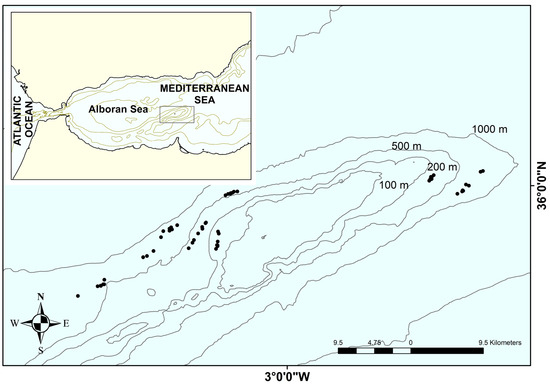
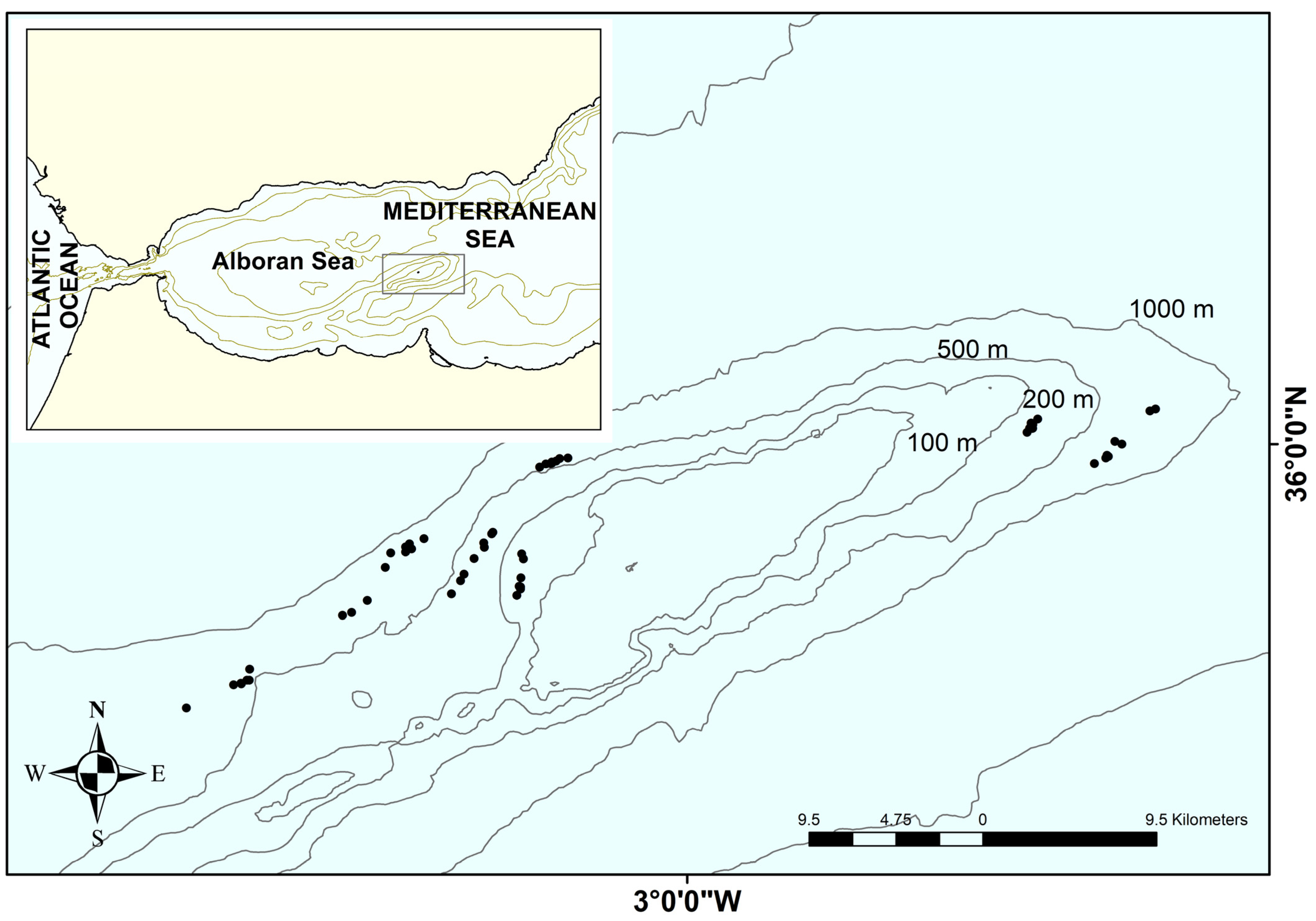
Biological data were compiled from a 10-year database of MEDITS surveys carried out along the Iberian Mediterranean coast by the Spanish Institute of Oceanography (I.E.O.). This specific work is based on those samples (hauls) taken on the Alboran Ridge (Figure 1) from 2012 to 2022 at depths between 100 and 800 m.
Figure 1.
Map of the study area (Alboran Ridge) showing samples from the MEDITS survey from 2012 to 2022 (black points). Bottom trawling is not allowed at depths of less than 100 m depth and more than 1000 m depth (Ministerial Order, B.O.E. 233, ref. A-1998-22,628). No survey could be conducted in 2020 due to COVID-19 lockdown restrictions.
According to the MEDITS standardized protocol [21,22], the survey took place every year in spring. Sampling stations were chosen by applying a stratified random sampling scheme using depth as the stratification parameter. In the Alboran Ridge, the sampled bathymetric strata were 100–200 m (10 hauls), 201–500 m (20 hauls) and 501–800 m (44 hauls), which correspond to Continental Shelf (CS), Upper Slope (US) and Middle Slope (MS), respectively. The duration of the hauls was fixed to 30 min for depths less than 200 m and 60 min for greater depths. The average swept area during each haul was 0.04958 km2 for CS, 0.10208 km2 for US and 0.11128 km2 for MS. The sampling was carried out with a bottom trawl gear (GOC-73) designed for experimental purposes with a codend mesh size of 20 mm; the average vertical opening was 2.5 m, and the average horizontal opening was 18.5 m. For each sampling station, haul specimens were sorted, identified, counted and weighed on board.
For each species, the total number and weight (g) of the individuals were calculated. The frequency of occurrence of each species was calculated as the ratio between the number of occurrences of a species and the total number of hauls (hauls occurrence) or the number of years of occurrences of a species and the total of surveys years (years occurrence) (%). Pelagic species have been included in the analyses for considering the whole fauna inhabiting the study area, and their relevance in bottom trawl catches.
2.2. Statistical Analyses
For each haul, the number and weight of individuals per species were standardized to 1 km2 in order to calculate both species abundance (number of individuals per km2) and biomass (g per km2). The mean individual weight was obtained for each species by dividing the biomass of the species by the number of individuals of that species. In order to identify bathymetric trends, multivariate analyses, such as cluster and nMDS, were carried out using abundance data. Previously, the data were log (x + 1) transformed in order to reduce the differences of the most dominant species. In each case, a resemblance matrix was obtained using the Bray–Curtis similarity index. SIMPER analysis was applied to reveal the contribution of each species to the similarity of the depth intervals (CS, US and MS). To study the temporal variation, the study period was divided into three time intervals—1, surveys from 2012 to 2015; 2, surveys from 2016 to 2018; 3, surveys from 2019 to 2022—in order to increase the number of observations and make the temporal analysis more robust. Two-way crossed ANOSIM analyses were applied to detect potential differences between the depth and time intervals. For each depth interval, the abundance (N), biomass (B), mean weight (M.W.), species richness (S) and Shannon–Wiener diversity index (H’: log10) [23] were calculated. In order to test the significant differences among depth intervals and time intervals, a non-parametric analysis of variance (Kruskal–Wallis test) was carried out. Subsequently, the Local Polynomial Regression Fitting function (LOESS) was applied in those cases where the Kruskal–Wallis analysis resulted in significant temporal changes for better visualization of the long-term trends throughout the plotted time series. Analyses were performed separately by taxonomic groups, osteichthyes, chondrichthyes, crustaceans, molluscs, echinoderms and “other groups”, which comprised all remaining taxa such as ascidians, thaliaceans, cnidarians, poriferans, brachiopods, annelids, sipunculans and algae. Those endangered, threatened and vulnerable species included in regional, national and/or international conservation lists (e.g., IUCN Red List, Berne Convection—Anex II, Barcelona Convention—Anex II or III, Habitat Directive or the Andalusian Red List of Invertebrates) were selected for further temporal analyses. From those, only the most frequent and abundant species were considered for studying the temporal changes of their abundance and biomass throughout the same time intervals (as described previously) using the Kruskal–Wallis analysis.
Scientific names assigned to all taxa followed the nomenclature of the World Register of Marine Species (WoRMS) [24].
3. Results
3.1. Biological Composition
A total of 329 taxa (including species and superior taxonomic groups) were identified during the ten MEDITS surveys. These were distributed in 13 diverse taxonomic groups: 99 taxa (30%) were osteichthyes, 62 (19%) molluscs, 59 (18%) crustaceans, 34 (10%) echinoderms, 18 (5%) chondrichthyes and 57 (17%) “other groups”. Of these 329 taxa, 124 (38%) were reported as occasional as they occurred in no more than 1 or 2 samples and 139 (42%) were only reported in 1 or 2 years. On the other hand, 65 species (20%) were constantly reported during the study period, with Galeus melastomus (chondrichthyes) as the most frequently occurring species (86.5%). Nineteen species are included in lists of species with some protection status (including endangered, threatened and vulnerable species) such as the IUCN Red List, Berne Convection (Anex II), Barcelona Convention (Anex II or III), Habitat Directive or the Andalusian Red List of Invertebrates. From those, 12 species occurred in no more than 1 or 2 samples, while another 12 occurred in no more than 1 or 2 years. The most frequent species was the gastropod Ranella olearium, detected in 21 samples (during 8 years of surveys), followed by the elasmobranch Dalatias licha, detected in 8 samples (during 7 years of surveys) (Table 1).
Table 1.
Taxa (including species and superior taxonomic groups) detected in haul samples during MEDITS 2012-2022 in the Alboran Ridge. N: total abundance (individuals); W: total weight (g); F: frequency of occurrence (%); Min Depth and Max Depth: depth range of reported species (m). Nomenclature according to WoRMS [24]. (*) indicates those species included in lists of species with some protection status (endangered, threatened and vulnerable species).
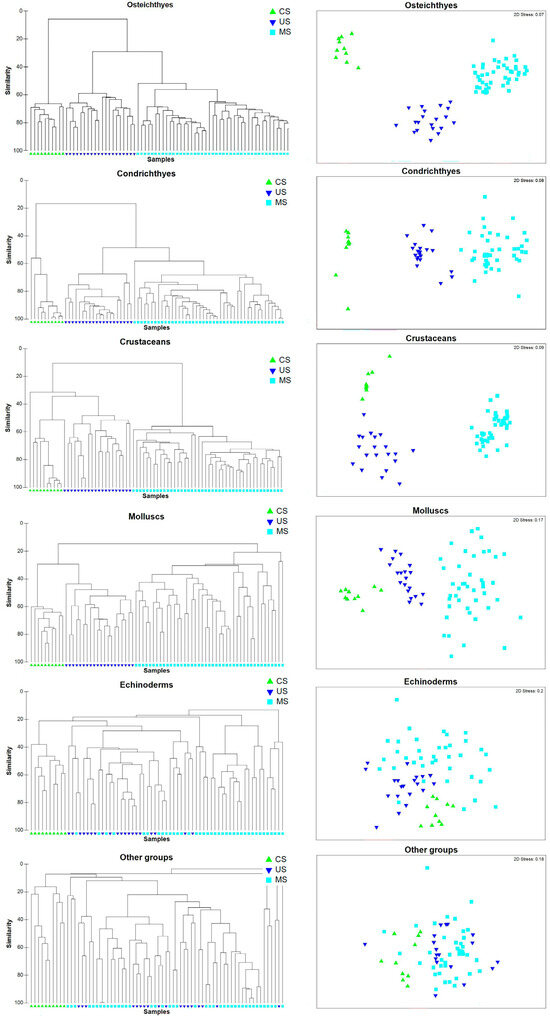
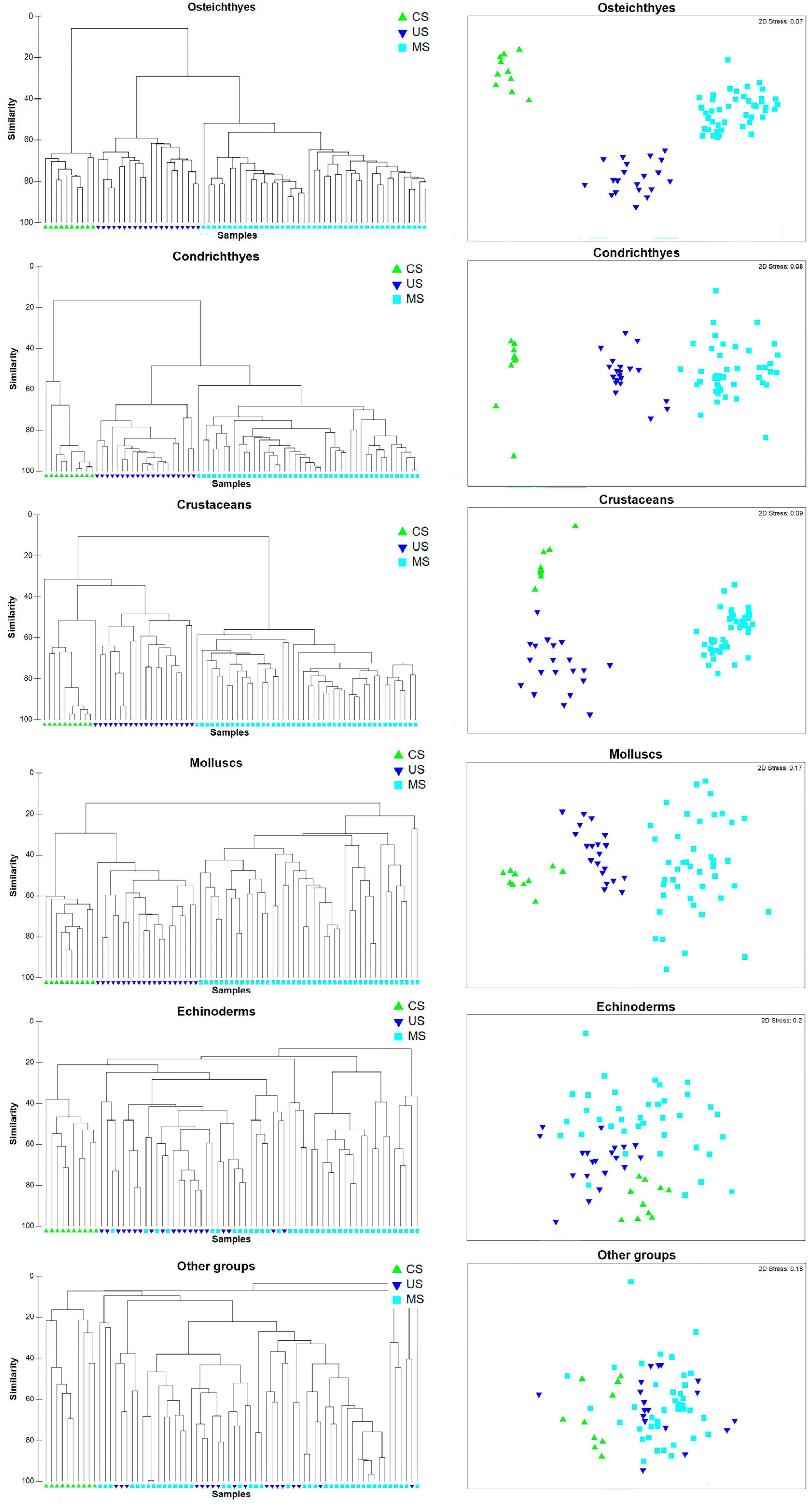
Cluster and nMDS results displayed some differences for each of the faunistic groups analyzed. Nevertheless, in almost all cases, a bathymetric trend of groupings of samples (interpreted as different assemblages) was detected (Figure 2). Regarding osteichthyes, two main groupings of samples were detected in relation to depth: one with samples from the shelf (CS; 100–200 m) and another one with those from the slope. In addition, two sub-groupings were identified in the slope, corresponding to upper slope (US; 201–500) and middle slope (MS; 501–800 m) samples. Regarding chondrichthyes, similar groupings with CS and slope samples were also detected. In the slope, two sub-groupings were also identified, which corresponded to US and MS samples but, in this case, displayed a lower similarity between them when compared to those of the osteichthyes. For crustaceans, two groupings were identified with CS and US in one grouping and MS samples in the other. In addition, two sub-groupings were also detected, one between 500 and 600 m depth and another one at depths larger than 600 m. Regarding molluscs, similar groupings of samples as those of crustaceans were detected, but no sub-groupings could be differentiated in the MS grouping. Regarding echinoderms, groupings of samples in relation to depth were less evident. Finally, no clear groupings of samples were detected for “other groups” (combining the data of remaining groups).
Figure 2.
Results of cluster and nMDS analyses for each faunistic group carried out with abundance data (log (x + 1) transformed) from MEDITS 2012–2022. CS: 100–200 m depth; US: 201–500 m; MS: 501–800 m.
SIMPER analyses were carried out on each of the sample groupings (interpreted as different assemblages) for each depth interval (CS, US and MS). Table 2 shows those species characterizing each sample grouping by depth interval. For osteichthyes, the most representative species of these depth intervals were Trachurus trachurus, Coelorinchus caelorhincus and Nezumia aequalis, for CS, US and MS, respectively; for chondrichthyes, Scylirohinus canicula (CS) and G. melastomus (in both, US and MS); for crustaceans, Pagurus prideaux, Macropipus tuberculatus and Plesionika martia, for CS, US and MS respectively; for molluscs, Neopycnodonte cochlear, Rhombosepion orbignyanum and Todarodes sagitattus, for CS, US and MS respectively; for echinoderms, Parastichopus regalis (CS and MS) and Gracilechinus acutus; and for “other groups”, Megerlia truncata, Pyrosoma atlanticum and Actinauge richardi, for CS, US and MS respectively. The average similarity values within the groupings of these depth intervals were highest for chondrichthyes (79.48%, 79.13% and 73.89% for US, CS and MS, respectively) and lowest for “other groups” (26.26%, 22.14% for CS and US, respectively) and echinoderms (19.13%, MS).
Table 2.
Results of SIMPER analyses carried out with abundance data (log (x + 1) transformed) from MEDITS 2012–2022 regarding different faunistic groups and depth intervals. Cum%: cumulative % of species contribution. Cut off for low contributions: 50%. CS: 100–200 m depth; US: 201–500 m depth; MS: 501–800 m depth.
The two-way crossed ANOSIM analyses between depth and time intervals (using abundance data) indicated high and significant differences among depth intervals across all time intervals for osteichthyes (RANOSIM = 0.978, p ≤ 0.01), chondrichthyes (RANOSIM = 0.941, p ≤ 0.01), crustaceans (RANOSIM = 0.992, p ≤ 0.01) and molluscs (RANOSIM = 0.715, p ≤ 0.01). These differences were also significant but less acute for echinoderms (RANOSIM = 0.347, p ≤ 0.01) and “other groups” (RANOSIM = 0.40, p ≤ 0.01). Regarding different time intervals (groupings of years of MEDITS surveys) across depth intervals, RANOSIM values were very low, generally <0.10 and not significant (p > 0.01), for osteichthyes, chondrichthyes and crustaceans, indicating no differences between the considered time intervals. Nevertheless, significant and a bit larger RANOSIM values were detected for molluscs (RANOSIM = 0.107, p < 0.01), echinoderms (RANOSIM = 0.183, p < 0.01) and “other groups” (RANOSIM = 0.150; p ≤ 0.01). In general, RANOSIM values according to time interval comparisons were much lower than those detected in the depth interval comparisons. This indicates that the bathymetric variability is larger than the temporal variability of those intervals throughout the study period.
3.2. Community Metrics
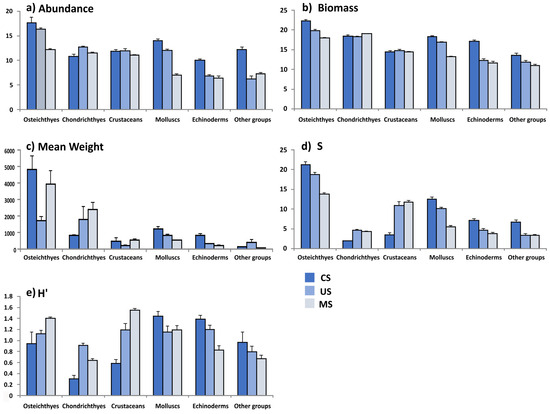
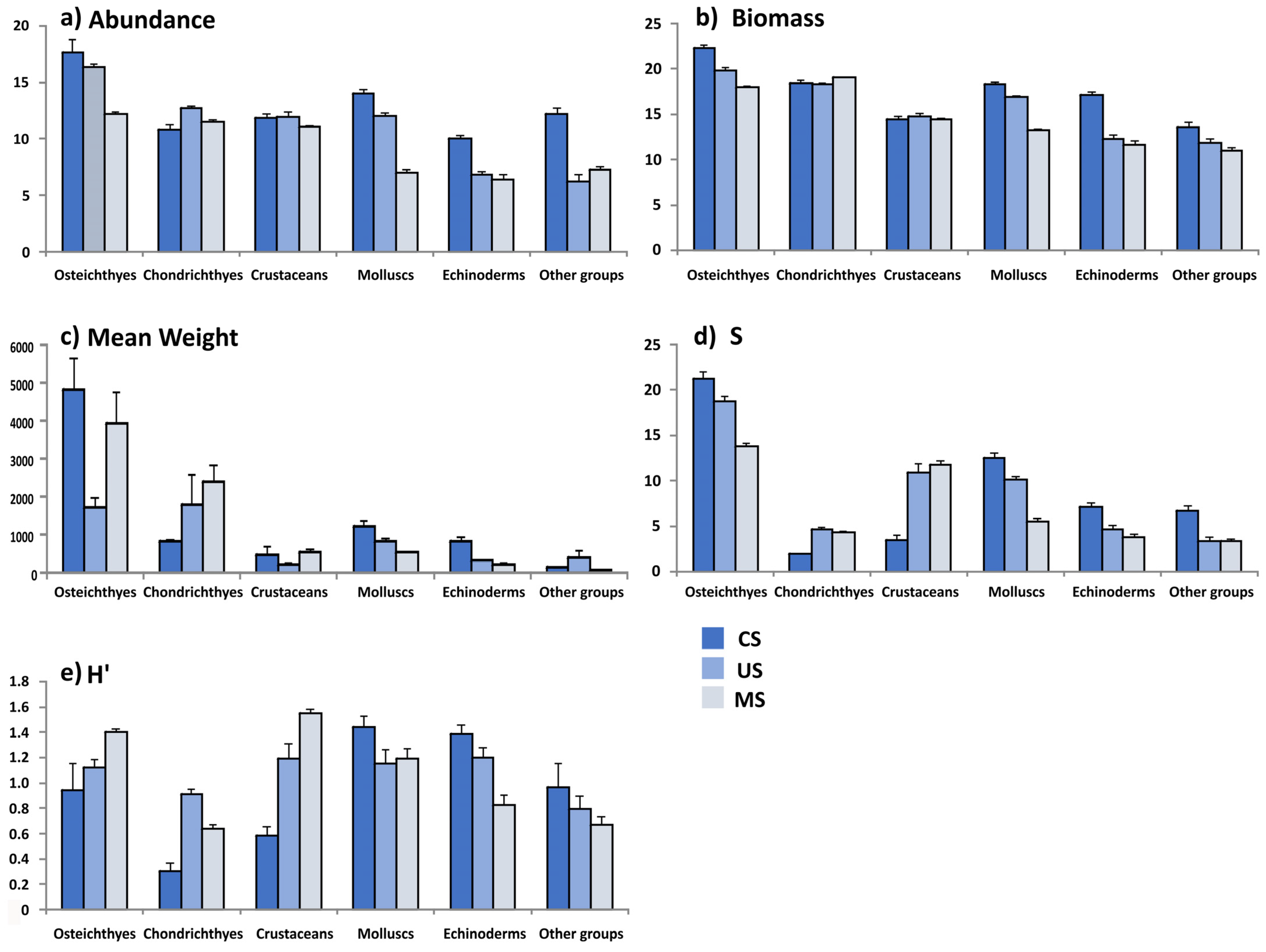
Trends in community metrics regarding depth intervals were different for each faunistic group (Table 3; Figure 3). For abundance, maximum significant mean values were recorded on the CS assemblage in almost all faunistic groups, except for chondrichthyes that displayed maxima in the US assemblage. No significant differences between depth intervals were detected in the mean abundance of crustaceans. Regarding biomass, mean values for osteichthyes, molluscs, echinoderms and “other groups” showed significant decreasing trends with depth. In chondrichthyes, maximum mean values were recorded in the MS assemblage, whereas no significant differences were detected for crustacean biomass across depth intervals. Regarding mean weight, osteichthyes, molluscs and echinoderms showed significant maxima in CS, whereas chondrichthyes showed a significant increase with depth and “other groups” displayed maxima in the US assemblage. Crustaceans did not show significant differences between depth intervals. Species richness (S) showed significant maximum values in the CS assemblage for all taxonomic groups except for chondrichthyes and crustaceans, which showed an opposite trend with significant maxima in the US and MS assemblages. Finally, the Shannon–Wiener diversity index (H’) significantly increased with depth in osteichthyes and crustaceans but decreased with depth in echinoderms with maxima in CS. No significant differences of H’ were detected for molluscs and “other groups”.
Table 3.
Results of Kruskal–Wallis (H values) testing differences of abundance (N), biomass (B), mean weight (M.W.), species richness (S) and Shannon–Wiener index (H’) among depth intervals for each of the faunistic group analyzed. Data from MEDITS 2012–2022. ***: p <0.01; **: p < 0.05.
Figure 3.
Mean values (± standard errors) of community metrics: (a) abundance (number of individuals/km2) (log (x + 1) transformed); (b) biomass (g/km2) (log (x + 1) transformed); (c) mean weight (g); (d) species richness (S); (e) Shannon–Wiener diversity index (H’). CS: 100–200 m depth; US: 201–500 m depth; MS: 501–800 m depth.
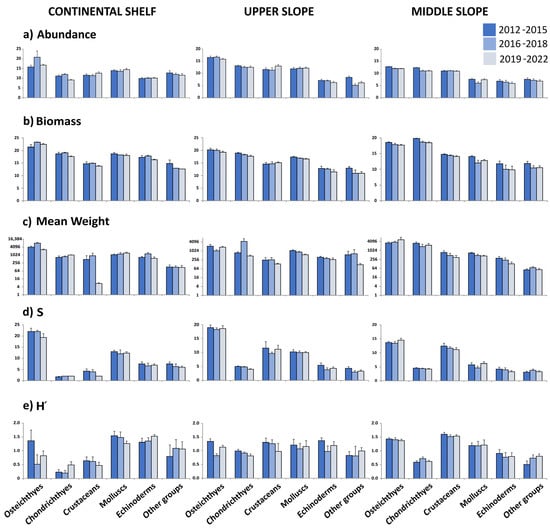
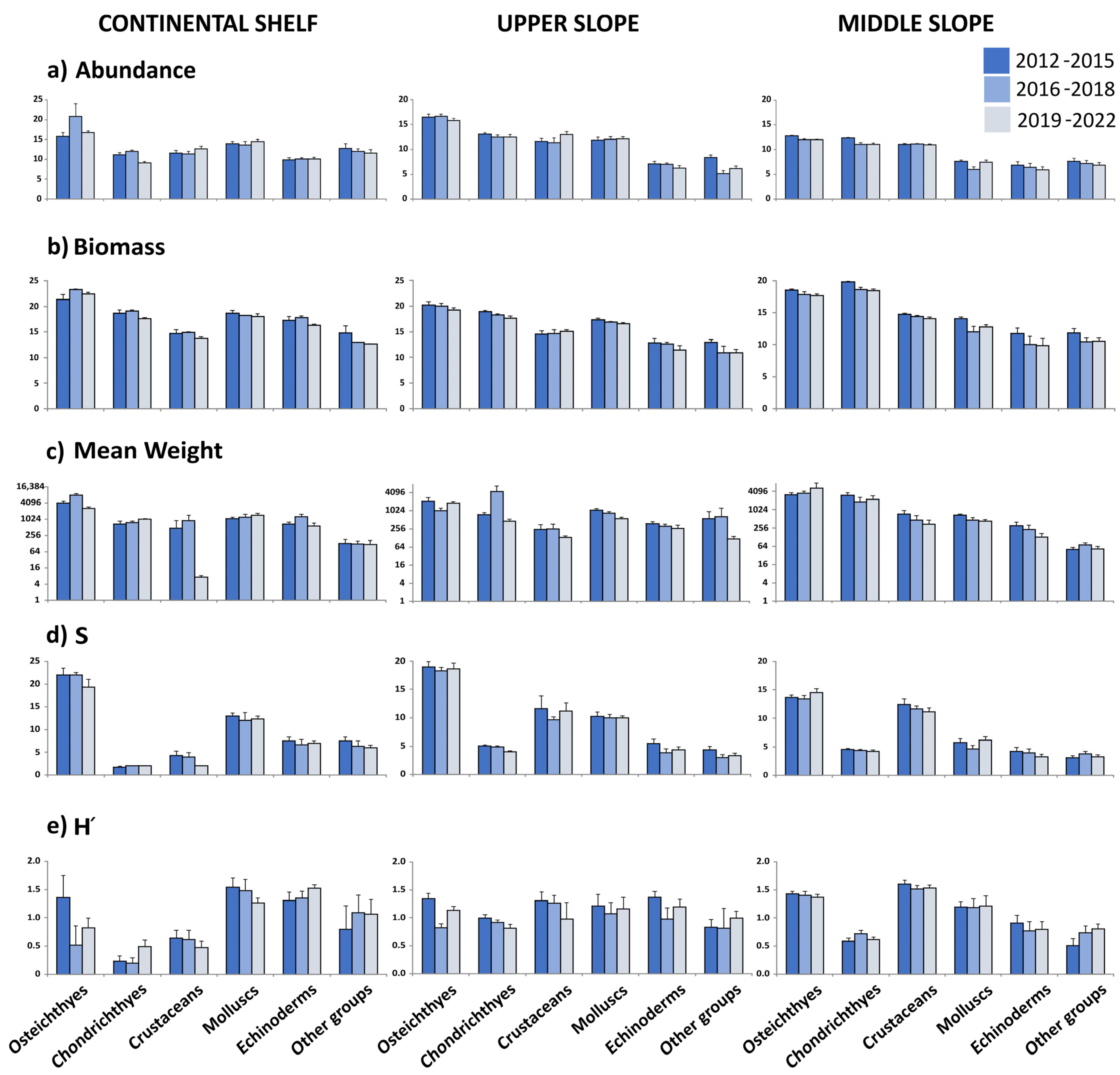
For analysis of temporal changes, the study period was differentiated into the same three year groups (time intervals) as in the multivariate analyses: 1 (surveys of 2012–2015), 2 (2016–2018) and 3 (2019–2022). Significant differences in the community metrics over these time intervals were tested using the Kruskal–Wallis analysis. (Table 4; Figure 4). Regarding abundance, significant temporal differences were detected for osteichthyes and chondrichthyes in the MS assemblages, both of them showing decreasing trends throughout the study period and for “other groups” in the US assemblage. Regarding biomass, a significant temporal decrease in the mean values was also detected for chondrichthyes and molluscs of the MS assemblages. Mean weight osteichthyes of the CS assemblage and molluscs of the US assemblage displayed significant differences throughout the study period. Regarding species richness, no significant temporal differences were detected for any of the faunistic groups and assemblages. Finally, for the Shannon–Wiener diversity index, significant temporal changes were only detected for osteichthyes of the US assemblage. Crustaceans and echinoderms did not display significant differences between time intervals in any of the community metrics. LOESS was applied in those cases where the Kruskal–Wallis analysis resulted in significant temporal changes for better visualization of the long-term trends throughout the time series plotted (Figure S1).
Table 4.
Results of Kruskal–Wallis (H values) testing differences of abundance (N), biomass (B), mean weight (M.W.), species richness (S) and Shannon–Wiener diversity index (H’) between groups of years for each of the faunistic group analyzed. Data from MEDITS 2012–2022. ***: p <0.01; **: p < 0.05.
Figure 4.
Mean values (±standard errors) of community metrics of different faunistic groups on CS (left panel), US (middle panel) and MS (right panel). (a) Abundance (number of individuals/km2) (log (x + 1) transformed); (b) biomass (g/km2) (log (x + 1) transformed); (c) mean weight (g) (logarithmic scale); (d) species richness (S); (e) Shannon–Wiener diversity index (H’). CS: 100–200 m depth; US: 201–500 m depth; MS: 501–800 m depth.
The temporal changes of the abundance and biomass of threatened, vulnerable and endangered species could only be studied in the most abundant and frequent species, such as the chondrichthyes Dalatias licha and Leucoraja melitensis, the crustacean Palinurus elephas, the molluscs Charonia lampas and Ranella olearium and the cnidarian Eunicella filiformis. Some decreasing trends were detected in the abundance and biomass of those species over the study period, however the Kruskal-Wallis analyses finally indicated no significant differences in any of those trends (H < 3.3, p > 0.05 in all cases).
4. Discussion
In the present work, the composition, structure and bathymetric and temporal variability of benthic and demersal megafauna were examined on the continental shelf and upper and middle slope of the Alboran Ridge as part of the transitional ecosystem between the Mediterranean Sea and the Atlantic Ocean. The study provides detailed and novel quantitative information on some species and assemblages of circalittoral and bathyal soft bottoms around the Alboran Island. These were not generally considered in previous studies, which mainly focused on the intertidal, infralittoral and some circalittoral communities, such as coralligenous communities, rhodolith beds and bioclastic and gravel bottoms [11,12]. The present study reveals that a high number of species occur in those circalittoral and bathyal soft bottoms, which is consistent with the findings by previous authors for shallower areas around the island. Moreover, the present study has listed eight species (e.g., the bivalve Chama gryphoides, the annelid Chloeia venusta, the echinoderms Coscinasterias tenuispina and Ophiocten abyssicolum, among others) that were not previously included in the review of megabenthic invertebrates of Mediterranean trawlable soft bottoms made by Stamouli et al. [25] for the Alboran Sea. The high biodiversity detected in this and some previous studies consolidates the Alboran Ridge (where different Marine Protected Areas have been designated) as a biodiversity hotspot for the Alboran Sea and, therefore, for the whole Mediterranean Sea [4,12]. Previous works indicated that the insular shelf of the Alboran Ridge hosts more than a quarter (26.87%) of the total Mediterranean species richness of 11 benthic groups [2,12]. The high biodiversity detected on the Alboran Ridge is the result of its location and the complex environmental conditions (e.g., interaction of Atlantic and Mediterranean water masses, high diversity of bottom types and habitats), which promote a complex ecosystem with vulnerable marine ecosystems and protected/endangered species, contributing to its designation as both a Marine and a Fishing Reserve.
The Alboran Ridge is also a site included in the list of Specially Protected Areas of Mediterranean Importance (SPAMI) that harbor populations of threatened species, as it has been detected in the present study. Two vulnerable chondrichthyes species (D. licha and Galeorhinus galeus) and four critically endangered chondrichthyes species (Centrophorus uyato, Leucoraja melitensis, L. circularis and Oxynotus centrina), according to the International Union for Conservation of Nature (IUCN) [26], were reported in this study. In the Mediterranean Sea, chondrichthyes have shown a decline in species richness and abundance in recent decades [26,27,28], so monitoring of this group of fishes is particularly needed for an ecosystem-based approach [29]. In our study, chondrichthyes exhibited a high diversity compared to other areas of the Mediterranean surveyed with the same MEDITS protocol, such as the Tyrrhenian [30,31]. In contrast, insular areas generally have a higher diversity of chondrichthyes, such as those of Corsica, Sardinia and Sicily [32] as well as Malta [33,34]. Other threatened species reported in the present study are the lobster Palinurus elephas, a crustacean largely exploited due to its high commercial value with declining populations in the northern Alboran Sea [4] and the molluscs Charonia lampas, R. olearium and Babelomurex benoiti. The populations of the gastropod C. lampas are probably maintained in the Alboran Ridge thanks to their isolation from the Iberian and Moroccan continental margins, the absence of pollution [35] and the lower fishing pressure compared to the Iberian continental margin [17]. These C. lampas populations of the Alboran Ridge could be crucial for the conservation of this gastropod in the Alboran Sea since it is in serious decline along the Iberian continental margin. [36,37]. Other species detected in the Alboran Ridge and included in conservation lists are the echinoderms Asterina gibbosa, Centrostephanus longispinus and Hacelia attenuata; the sponge Axinella polypoides; and the cnidarians Eunicella filiformis, Isidella elongata, Spinimuricea atlantica and Paramuricea clavata. The latter gorgonian is not very common in the northern Alboran Sea, with a higher occurrence in the Strait of Gibraltar and the Alboran Ridge than in the northeastern sector of the Alboran Sea (except in Seco de los Olivos seamount – Chella bank) [37]. Finally, the algae Laminaria ochroleuca, which mostly occurs in cold and temperate areas of the NE Atlantic Ocean, can be found in the Alboran Ridge and in the Sicily channel. Nowadays, this species is considered a glacial relict in the Mediterranean, and its populations remain in localized areas with colder waters, such as those around the Alboran Island [38,39]. Some of the dominant species included in the conservation lists (e.g., Dalatias licha, Leucoraja melitensis, Charonia lampas, Ranella olearium, etc.) did not display any significant temporal changes in the Alboran Ridge, but some declining trends were detected throughout the study period. Further studies combining data obtained with other sampling methods (e.g., underwater images, beam-trawling, scuba-diving transects, etc.) and other areas and habitats of the Alboran Ridge should be carried out for better detection of potential declines in the populations of those species.
All faunistic groups, except echinoderms and “other groups”, displayed a significant relationship with depth in the multivariate analyses, with a different bathymetric organization depending on the group. The faunistic segregation among CS, US and MS assemblages was similar to those previously reported for different faunistic groups in the western Mediterranean Sea (fish, [40]; chondrichthyes, [34]; crustaceans, [19,41]; molluscs (cephalopods), [42]; molluscs, [17]; megabenthic fauna, [43]). The segregation between shelf and slope is probably related to the response of organisms to wider changes in environmental variables and substrate types in the shelf when compared to the slope [17]. Further, down the slope, Carney [44] identified the 500 m depth (approximate boundary between the US and MS) as a zone of high species turnover mainly in response to biological factors such as food [45]. In addition, it should be noted that in the Mediterranean Sea, the water masses become more stable in terms of salinity and temperature below 150–200 m depth. Moreover, the slope bottoms are generally less heterogeneous, mainly composed of mud, and the light practically disappears [17,46].
Osteichthyes were very diverse in species, abundant and frequent in the samples, and it was the faunistic group with the clearest segregation of samples in relation to depth. These results are similar to other previous works on the structure of fish assemblages in the Mediterranean Sea [31,40,47], showing that fishes are strongly organized along a depth gradient due to their preference for specific environmental conditions [48]. However, in spite of the similarity of the assemblages from the Iberian continental margin [40] and the Alboran Ridge, some differences were identified in some of the most representative species. The fish Capros aper, for example, was very abundant in both areas (the continental margin and the Alboran Ridge) but displayed a deeper distribution in the Alboran Ridge as was previously reported for the Gulf of Vera [49]. This deeper distribution could be due to different environmental drivers because this is a species with limited swimming abilities that drifts with currents [50], so it could represent a potential indicator of the inflow of Atlantic water masses. Differences were also found in the abundance of Lepidotrigla dieuzeidei, which was one of the most abundant species in the CS of the Alboran Ridge with lower catches in the Iberian continental margin [51] and the Levante and Catalan coasts [52]. This is likely due to the type of bottom sediment of the Alboran Ridge platform, which is gravelly muddy sand of bioclastic origin, and this sediment type is more scarce in the continental margin [12,18]. The high dependence of this species upon the bottom sediment has also been reported in other studies with a density peak in specific sandy and gravelly bottoms [53].
Regarding crustaceans, two groupings were detected, one containing CS and US samples and the other one containing the MS samples. In addition, two sub-groups could also be differentiated: one between 500 and 600 m depth and another between 600 and 800 m. The depths of 500 and 650 m were also interpreted as faunal boundaries for decapod crustaceans by Cartes et al. [54] on the Cantabrian Sea and for all invertebrates in the western Mediterranean Sea [55]. Some of the most representative crustacean species of the present study also displayed differences in their bathymetric distribution in the Alboran Ridge when compared with the Iberian continental margin. For example, Plesionika heterocarpus and Parapenaeus longirostris displayed a deeper distribution in the bottoms around the Alboran Ridge than in the continental margin [19]. Both decapods also showed differences in their bathymetric distribution between the Gulf of Cádiz (Atlantic Ocean) and the northern Alboran Sea continental margin [56] or between the Algerian sub-basin and the Balearic sub-basin in the western Mediterranean Sea [57]. In the case of P. heterocarpus, those bathymetric differences were related to local environmental variables such as small-scale topographic features, bottom characteristics and local differences in primary production [57,58,59], as well as the different fishing pressure among the studied areas [60]. On the other hand, Colloca et al. [61] reported that the high sensitivity of P. longirostris to sea temperature variability, combined with its fast growth and high reproductive capability, makes this crustacean an indicator candidate species for detecting water temperature changes in the Mediterranean Sea.
Regarding molluscs, there were two main assemblages, one occurring in the CS and US and another one in the MS, being therefore similar to the bathymetric patterns reported by Ciércoles et al. [17]. Ciércoles et al. [17] and Moya-Urbano et al. [18] found that mollusc assemblages displayed geographical differences in composition and structure between the Alboran Ridge and the Iberian continental margin. Nevertheless, differences among those areas were less acute in the MS, probably due to higher environmental similarities between different areas in bathyal soft bottoms. The bivalves N. cochlear and Tetrarca tetragona were more abundant in the Alboran Ridge due to their habitat preference because these species generally inhabit bioclastic bottoms, and these types of bottoms are more common at 80–200 m depth on the Alboran Ridge platform than in the Iberian continental margin [12,17,18]. Another species with high catches in the present study, Loligo forbesii, also displayed differences between the continental margin and the Alboran Ridge, being more abundant in the latter [17]. This cephalopod occurs throughout the Mediterranean Sea but is scarce in the northwestern Mediterranean except in the Sicily Channel and northeastern Ionian Sea [62] as well as in the Balearic Islands [63]. These differences in the distribution of this species have been attributed to spatial surface temperature changes [62].
Groupings of samples related to depth were less clear for echinoderms and “other groups”. The lack of acute changes in the composition and structure of those assemblages between the shelf and slope may indicate that several species, especially those with high abundances, are largely distributed independently of the environment [48]. Species such as Parastichopus regalis, which is the most abundant echinoderm species, showed a wide bathymetric range, from 115 to 800 m, suggesting that this holothuroid was poorly associated with depth. A wide bathymetric range was also detected for the echinoid Cidaris cidaris (115–771 m depth) and the asteroid Tethyaster subinermis (125–800 m depth). These echinoderms displayed a high contribution in shelf and slope samples, probably promoting similarities among them. It is worth mentioning the catch of the congeneric species Parastichopus tremulus during the 2022 survey in the Alboran Ridge. This is a species previously known only from the northeastern Atlantic Ocean until Ordines et al. [64] reported it for the first time in the Mediterranean Sea around the Seco de los Olivos seamount (Alboran Sea) in a scientific survey in 2017. This species has generally been collected in sedimentary habitats from the nearby Gulf of Cadiz from 500 to 800 m depth [64].
Regarding community metrics, the Alboran Ridge shelf was characterized by higher abundance and biomass in all groups except chondrichthyes and crustaceans. The reduction in abundance or biomass of osteichthyes and cephalopods with depth (with crustaceans and elasmobranchs displaying a different trend) was reported by other studies carried out in other Mediterranean areas [17,47,48,65]. According to Colloca et al. [48], the trend in osteichthyes and mollusc is partially related to the size–depth distribution of the dominant species, which perform ontogenetic migrations along the depth gradient. Higher mean weight values of osteichthyes and molluscs reported in CS could be partially related to the distribution of some shelf-dominant species, such as Pagellus acarne or Octopus vulgaris. Nevertheless, osteichthyes mean weight showed minimum values in the US that increased again in MS due to some dominant species, such as Trachyrincus scabrus. It seems that depth may influence the species richness in different ways. The number of species of nearly all taxa, except chondrichthyes and crustaceans, decreased with depth, while chondrichthyes increased significantly from the shelf to the middle slope. The latter increasing trend was previously detected for elasmobranches by Colloca et al. [48].
Neither chondrichthyes nor osteichthyes reported significant temporal changes, according to ANOSIM analyses. Nevertheless, in relation to community metrics, significant declining trends were detected in the abundance of both faunistic groups and the biomass of chondrichthyes in the MS assemblage. Regarding chondrichthyes, the differences in abundance and biomass values seemed to be due to the significant temporal decrease in catches of G. melastomus (Kruskal-Wallis analysis: H = 28.8, p < 0.01 and H = 25.6, p < 0.01, respectively) (Figure S2), which represents one of the most abundant species of the MS assemblage. Another chondrichthyan species, E. spinax, also very abundant in MS, showed a decreasing trend in catches (but it was not significant). In the osteichthyes group, decreasing trends (not significant) were reported for two species, T. scabrus and N. aequalis. It should be taken into account that the main activity carried out on the fishing grounds of Alboran Ridge is bottom trawling targeting demersal communities, with Aristeus antennaus being the most important resource between 500 and 800 m depth. The above-mentioned species constitute an important part of the discard; in fact, G.melastomus constitutes one of the most important species of the by-catch composition in Alboran Ridge [66], considering that the declining trends detected could be related to the fishing activity in recent years in the area. However, further studies are needed to contrast the trends of fishing pressure and important environmental factors on the populations of those species in the study area through the years.
5. Conclusions
The present study contributes to increas the knowledge of the fauna and assemblages occurring in the soft bottoms of the shelf and slope of the Alboran Ridge. The singularity of the Alboran Ridge ecosystem was highlighted due to differences in the composition and bathymetric distribution of assemblages and species in comparison to the Iberian continental margin. These differences may be related to the geographical location of the Alboran Ridge since it is considered to be a singular Atlantic–Mediterranean site due to the particular circulation of the surrounding water masses [7], its location (e.g., it is far from coastal activities and sewage or river discharge and lower fishing pressure) and some of its habitats that display a higher diversity and a healthier status than in other parts of the Alboran Sea [17]. There were no common bathymetric trends for each of the faunistic groups studied, although most of them displayed differences between the shelf and the slope. The shelf assemblage was characterized by higher values of community metrics such as abundance, biomass, species richness and mean weight of species for all groups except for chondrichthyes and crustaceans. On the middle slope, the abundance of osteichthyes and the abundance and biomass of chondrichthyes displayed significant decreasing trends throughout the study period. This seems to be related to decreasing trends of some of the most abundant species in that depth interval. However, more focused research on the effects of environmental factors and fishing efforts on the benthic and demersal megafauna will need to be performed in forthcoming studies. Finally, this study provides a baseline scenario for future analyses of Mediterranean biodiversity in European waters, such as the one carried out within the Marine Strategy Framework Directive (Directive 2008/56/EC).
Supplementary Materials
The following supporting information can be downloaded at: https://www.mdpi.com/article/10.3390/d16110686/s1, Figure S1: Sample values of community metrics for year of survey for each faunistic group and depth interval; Figure S2: Sample values of abundance and biomass of Galeus melastomus for year of survey in the MS interval.
Author Contributions
Conceptualization, C.G.-R., M.H., C.C., M.G.-A., P.T., J.U. and J.L.R.; methodology, C.G.-R. and M.H.; formal analysis, C.G.-R.; writing—original draft preparation, C.G.-R., M.H. and J.L.R.; writing—review and editing, C.G.-R., M.H., C.C., M.G.-A., P.T., J.U. and J.L.R. All authors have read and agreed to the published version of the manuscript.
Funding
The MEDITS scientific surveys are co-funded by the European Union through the European Maritime Fisheries and Aquaculture Fund (EMFAF) within the National Program of collection, management and use of data in the fisheries sector and support for scientific advice regarding the Common Fisheries Policy.
Institutional Review Board Statement
For this study, real data were obtained in the framework of the MEDITS research surveys following a sampling scheme and standardized protocol approved by international authorities (EU/DG Mare, FAO/GFCM). If a live specimen of a rare species or a species subject to conservation measures was caught, it was quickly sampled and returned to the sea unharmed following the recommendation GFCM (http://www.gfcmonline.org/decisions/) on fisheries management measures for the conservation of sharks and rays in the GFCM area.
Data Availability Statement
Data sharing is not applicable to this article. In any case, access to the MEDITS database is formerly regulated by the EU Reg. 199/2008 (Data Collection Framework) and (EU) 2017/1004 (recast).
Acknowledgments
The authors want to thank the works of all participants and crew during MEDITS scientific surveys. We also want to thank the support of the Secretaría General de Pesca for sampling in the Alboran Ridge. We appreciate the valuable comments and suggestions made by some reviewers on earlier drafts of this manuscript. We thank Terence W. Edwards (English grammar teacher at Sunny View School) for the English grammar revision on the final draft of the manuscript.
Conflicts of Interest
The authors declare no conflict of interest.
References
- Templado, J. La diversidad marina en España. In Biodiversidad: Aproximación a la Diversidad Botánica y Zoológica en España; Viejo, J.L., Ed.; Memoria Real Sociedad Española de Historia Natural: Madrid, Spain, 2011; pp. 343–362. [Google Scholar]
- Templado, J.; Luque, A.A.; Moreno, D.; Tierno de Figueroa, J.M.; Sánchez-Tocino, L.; Aguilar, R.; De la Torriente, A. Invertebrates: The Realm of Diversity. In Alboran Sea–Ecosystems and Marine Resources; Báez, J.C., Vázquez, J.T., Camiñas, J.A., Malouli, M., Eds.; Springer: Cham, Switzerland; Dordrecht, The Netherlands, 2021; pp. 359–430. [Google Scholar]
- Rueda, J.L.; Gofas, S.; Aguilar, R.; de la Torriente, A.; García Raso, J.E.; Lo Iacono, C.; Luque, A.A.; Marina, P.; Mateo-Ramírez, A.; Moya-Urbano, E.; et al. Benthic Fauna of Littoral and Deep-Sea Habitats of the Alboran Sea: A Hotspot of Biodiversity. In Alboran Sea–Ecosystems and Marine Resources; Báez, J.C., Vázquez, J.T., Camiñas, J.A., Malouli, M., Eds.; Springer: Cham, Switzerland; Dordrecht, The Netherlands, 2021; pp. 285–358. [Google Scholar]
- Mateo-Ramírez, A.; Marina, P.; Moreno, D.; Alcántara, L.F.; Aguilar, R.; Báez, J.C.; Bárcenas, P.; Baro, J.; Caballero-Herrera, J.A.; Camiñas, J.A.; et al. Marine protected areas and key biodiversity areas of the Alboran Sea and adjacent areas. In Alboran Sea–Ecosystems and Marine Resources; Báez, J.C., Vázquez, J.T., Camiñas, J.A., Malouli, M., Eds.; Springer: Cham, Switzerland; Dordrecht, The Netherlands, 2021; pp. 819–923. [Google Scholar] [CrossRef] [Scilit]
- Bianchi, C.N.; Morri, C. Marine Biodiversity of the Mediterranean Sea: Situation, Problems and Prospects for Future Research. Mar. Pollut. 2000, 40, 367–376. [Google Scholar] [CrossRef] [Scilit]
- Spalding, M.D.; Fox, H.E.; Allen, G.R.; Davidson, N.; Ferdaña, Z.A.; Finlayson, M.; Halpern, B.S.; Jorge, M.A.; Lombana, A.L.; Lourie, S.A.; et al. Marine ecoregions of the world: A bioregionalization of coastal and shelf areas. Bioscience 2007, 57, 573–583. [Google Scholar] [CrossRef] [Scilit]
- Maldonado, M.; Uriz, M.J. Biotic affinities in a transitional zone between the Mediterranean and the Atlantic: A biogeographical approach based on sponges. J. Biogeogr. 1995, 22, 89–110. [Google Scholar] [CrossRef] [Scilit]
- Gofas, S. Marine molluscs with a very restricted range in the Strait of Gibraltar. Divers. Distrib. 1999, 4, 255–266. [Google Scholar]
- Calvo, M.; Templado, J.; Moreno, D.; Ramos, M. La Reserva Marina de la isla de Alborán: Peculiaridades y estado actual de conocimiento sobre su flora y fauna bentónicas. In I Jornadas Internacionales sobre Reservas Marinas; Ministerio de Agricultura Pesca y Alimentación, Secretaría General de Pesca: Madrid, Spain, 2001; pp. 53–70. [Google Scholar]
- Moreno, D.; Capítulo, V. Tesoros sumergidos: La flora y fauna marinas. In Entre África y Europa. Historia Natural de las Isla de Alborán; Paracuellos, M., Nevado, J.C., Mota, J.F., Eds.; RENPA, Consejería de Medio Ambiente, Junta de Andalucía: Sevilla, Spain, 2006; pp. 69–85. [Google Scholar]
- Templado, J.; Calvo, M.; Moreno, D.; Flores-Moya, A.; Conde, F.; Abad, R.; Rubio, J. Flora y Fauna de la Reserva Marina y Reserva de Pesca de la isla de Alborán; Secretaría General de Pesca Marítima (Ministerio de Agricultura, Pesca y Alimentación), Museo Nacional de Ciencias Naturales (Consejo Superior de Investigaciones Científicas): Madrid, Spain, 2006; 269p. [Google Scholar]
- Gofas, S.; Goutayer, J.; Luque, A.A.; Salas, C.; Templado, J. Espacio marino de Alborán, Proyecto LIFE+INDEMARES Fundación Biodiversidad del Ministerio de Agricultura; Alimentación y Medio Ambiente: Madrid, Spain, 2014. [Google Scholar]
- Templado, J.; Luque, A.A. Braquiópodos de los fondos de Corallium rubrum (L.) próximos a la isla de Alborán (SE de España). Bol. Inst. Español Oceanogr. 1986, 3, 111–114. [Google Scholar]
- Maldonado, M. Demosponges of the red coral bottoms from the Alboran Sea. J. Nat. Hist. 1992, 26, 1131–1161. [Google Scholar] [CrossRef] [Scilit]
- Maldonado, M. Demosponjas Litorales de Alborán. Faunística y Biogeografía. Ph.D. Thesis, Universidad Central de Barcelona, Barcelona, Spain, 1993. [Google Scholar]
- García-Raso, J.E. Resultados de la segunda campaña del IEO para la exploración de los fondos de coral rojo en el mar de Alborán. Bol. Inst. Español Oceanogr. 1989, 5, 27–36. [Google Scholar]
- Ciércoles, C.; García-Ruiz, C.; González, M.; Ortiz de Urbina, J.; López-González, N.; Urra, J.; Rueda, J.L. Molluscs collected with bottom otter trawl in the northern Alboran Sea: Main assemblages, spatial distribution and environmental linkage. Mediterr. Mar. Sci. 2018, 19, 209–222. [Google Scholar] [CrossRef] [Scilit]
- Moya-Urbano, E.; Urra, J.; Gofas, S.; Gallardo-Núñez, M.; Mateo-Ramírez, A.; Farias, C.; Ordinas, F.; Caballero-Herrera, J.A.; Bárcenas, P.; García-Ruiz, C.; et al. Molluscan assemblages in shelf and slope sedimentary habitats of the Northern Alboran Sea and their linkage to environmental variables. Reg. Stud. Mar. Sci. 2023, 65. [Google Scholar] [CrossRef] [Scilit]
- Ciércoles, C.; García-Ruíz, C.; Abelló, P.; Hidalgo, M.; Torres, P.; Gonzalez, M.; Mateo-Ramírez, A.; Rueda, J.L. Decapod crustacean assemblages on trawlable grounds in the northern Alboran Sea and Gulf of Vera. Sci. Mar. 2022, 86, e039. [Google Scholar] [CrossRef] [Scilit]
- Moya-Urbano, E.; Urra, J.; Majón-Cabeza, E.; Gallardo-Núñez, M.; Mateo-Ramínrez, A.; Farias, C.; Ordinas, F.; Moya, F.; Bárcenas, P.; García-Ruiz, C.; et al. Echinoderm assemblages from circalittoral and bathyal sedimentary habitats of the northern Alboran Sea (Western Mediterranean): Diversity, distribution and relationships with environmental variables. Thalasas in press.
- Bertrand, J.A.; Gil de Sola, L.; Papaconstantinou, C.; Relini, G.; Souplet, A. The general specifications of the MEDITS surveys. Sci. Mar. 2002, 66, 9–17. [Google Scholar] [CrossRef] [Scilit]
- Spedicato, M.T.; Massutí, E.; Mérigot, B.; Tserpes, G.; Jadaud, A.; Relini, G. The MEDITS trawl survey specifications in an ecosystem approach to fishery management. Sci. Mar. 2020, 83 (Suppl. 1), 9–20. [Google Scholar] [CrossRef] [Scilit]
- Krebs, C.J. Ecological Methodology; Harper Collins: New York, NY, USA, 1989; pp. 1–645. [Google Scholar]
- WoRMS Editorial Board. World Register of Marine Species. Available online: https://www.marinespecies.org (accessed on 1 January 2024).
- Stamouli, C.; Zenetos, A.; Kalliniotis, A.; Voultsadou, E. Megabenthic invertebrate diversity in Mediterranean trawlable soft bottoms: A synthesis of current knowledge. Mediterr. Mar. Sci. 2022, 23, 447–459. [Google Scholar] [CrossRef] [Scilit]
- Serena, F.; Abella, A.J.; Bargnesi, F.; Barone, M.; Colloca, F.; Ferretti, F.; Fiorentino, F.; Jenrette, J.; Moro, S. Species diversity, taxonomy and distribution of Chondrichthyes in the Mediterranean and Black Sea. Eur. Zool. J. 2020, 87, 497–536. [Google Scholar] [CrossRef] [Scilit]
- Walker, P.; Cavanagh, R.D.; Ducrocq, M.; Fowler, S.L. Chapter 7–Regional Overviews: Northeast Atlantic (including Mediterranean and Black Sea). In Sharks, Rays and Chimaeras: The Status of the Chondrichthyan Fishes; Fowler, S.L., Cavanagh, R.D., Camhi, M., Burgess, G.H., Cailliet, G.M., Fordham, S.V., Simpfendorfer, C.A., Musick, J.A., Eds.; IUCN/SSC Shark Specialist Group IUCN Publications Services Unit: Gland, Switzerland; Cambridge, UK, 2005; pp. 71–95. [Google Scholar]
- Ferretti, F.; Myers, R.A.; Serena, F.; Lotze, H. Loss of large predatory sharks from the Mediterranean Sea. Conserv. Biol. 2008, 22, 952–964. [Google Scholar] [CrossRef] [Scilit]
- Stevens, J.D.; Bonfil, R.; Dulvy, N.K.; Walker, P.A. The effects of fishing on sharks, rays, and chimaeras (chondrichthyans), and the implications for marine ecosystems. ICES J. Mar. Sci. 2000, 57, 476–494. [Google Scholar] [CrossRef] [Scilit]
- Biagi, F.; Sartor, P.; Ardizzone, G.D.; Belcari, P.; Belluscio, A.; Serena, F. Analysis of demersal fish assemblages of the Tuscany and Latium coasts (north western Mediterranean). Sci. Mar. 2002, 66 (Suppl. 2), 233–242. [Google Scholar] [CrossRef] [Scilit]
- Ungaro, N.; Marano, C.A.; Marsan, R.; Martino, M.; Marzano, M.C.; Strippoli, G.; Vlora, A. Analysis of demersal species assemblages from trawl surveys in the South Adriatic Sea. Aquat. Living Resour. 1999, 12, 177–185. [Google Scholar] [CrossRef] [Scilit]
- Bertrand, J.; Gil De Sola, L.; Papaconstantinou, C.; Relini, G.; Souplet, A. Contribution on the distribution of elasmobranchs in the Mediterranean (from the MEDITS surveys). Biol. Mar. Mediterr. 2000, 7, 385–399. [Google Scholar]
- Dimech, M.; Camilleri, M.; Hiddink, J.G.; Kaiser, M.J.; Ragonese, S.; Schembri, P.J. Differences in demersal community structure and biomass size spectra within and outside the Maltese Fishery Management Zone (FMZ). Sci. Mar. 2008, 72, 669–682. [Google Scholar] [CrossRef] [Scilit]
- Ramírez-Amaro, S.; Ordines, F.; Terrasa, B.; Esteban, A.; García, C.; Guijarro, B.; Massutí, E. Demersal chondrichthyans in the western Mediterranean: Assemblages and biological parameters of their main species. Mar. Freshw. Res. 2015, 67, 636–652. [Google Scholar] [CrossRef] [Scilit]
- Templado, J.; Ballesteros, E.; García Raso, J.E.; San Martín, G.; López-García, E.; Salas, C.; Luque, A.A.; Sánchez-Lizaso, J.L.; Moreno, D. Las praderas de Posidonia oceanica. La comunidad posidonícola. In Praderas y Bosques Marinos de Andalucía; Luque, A.A., Templado, J.C., Eds.; Consejería de Medio Ambiente, Junta de Andalucía: Sevilla, Spain, 2004; pp. 89–116. [Google Scholar]
- Templado, J. Las especies del género Charonia (Mollusca: Gastropoda) en el Mediterráneo. In Les Espèces Marines à Protéger en Méditerranée; Bouderesque, C.F., Avon, M., Gravez, V., Eds.; GIS Posidonie: Marseille, France, 1991; pp. 133–140. [Google Scholar]
- Barea-Azcón, J.M.; Ballesteros-Duperón, E.; Moreno, D. Libro Rojo de los Invertebrados de Andalucía; 4 tomos; Consejería de Medio Ambiente, Junta de Andalucía: Sevilla, Spain, 2008. [Google Scholar]
- Franco, J.N.; Tuya, F.; Bertocci, I.; Rodríguez, L.; Martínez, B.; Sousa-Pinto, I.; Arenas, F. The “golden kelp” Laminaria ochroleuca under global change: Integrating multiple eco-physiological responses with species distribution models. J. Ecol. 2018, 106, 47–58. [Google Scholar] [CrossRef] [Scilit]
- Flores-Moya, A. Warm temperate seaweed communities: A case study of deep-water kelp forests from the Alboran Sea (SW Mediterranean Sea) and the Strait of Gibraltar. In Seaweed Ecophysiology and Ecology. Novel Insights into Ecophysiology, Ecology and Utilization; Wiencke, C., Bischof, K., Eds.; Ecological Studies; Springer: Berlin, Germany, 2012; Volume 219, pp. 315–327. [Google Scholar]
- García-Ruiz, C.; Lloris, D.; Rueda, J.L.; García-Martínez, M.C.; Gil de Sola, L. Spatial distribution of ichthyofauna in the northern Alboran Sea (western Mediterranean). J. Nat. Hist. 2015, 49, 19–20. [Google Scholar] [CrossRef] [Scilit]
- Abelló, P.; Valladares, F.J.; Castellón, A. Analysis of the structure of decapod crustacean assemblages off the Catalan coast (North-West Mediterranean). Mar. Biol. 1988, 98, 39–49. [Google Scholar] [CrossRef] [Scilit]
- González, M.; Sánchez, P. Cephalopod assemblages caught by trawling along the Iberian Peninsula Mediterranean coast. Sci. Mar. 2002, 66, 199–208. [Google Scholar] [CrossRef] [Scilit]
- Abad, E.; Preciado, I.; Serrano, A.; Baro, J. Demersal and epibenthic assemblages of trawlable grounds in the northern Alboran Sea (western Mediterranean). Sci. Mar. 2007, 71, 513–524. [Google Scholar] [CrossRef] [Scilit]
- Carney, R.S. Zonation of deep biota in continental margins. Oceanogr. Mar. Biol. Annu. Rev. 2005, 43, 211–278. [Google Scholar]
- Cartes, J.E.; Carrassón, M. Influence of trophic variables on the depth-range distributions and zonation rates of deep-sea megafauna: The case of the Western Mediterranean assemblages. Deep-Sea Res. I Oceanogr. Res. Pap. 2004, 51, 263–279. [Google Scholar] [CrossRef] [Scilit]
- Cartes, J.E.; Maynou, F.; Sardá, F.; Company, J.B.; Lloris, D.; Tudela, S. The Mediterranean deep-sea ecosystems. An overview of their diversity, structure, functioning and anthropogenic impacts. In The Mediterranean Deep-Sea Ecosystems. An Overview of Their Diversity, Structure, Functioning and Anthropogenic Impacts with a Proposal for Their Conservation; Tudela, S., Simard, F., Eds.; Coords; IUCN The World Conservation Union: Rome, Italy, 2004; pp. 9–38. [Google Scholar]
- Labropoulou, M.; Papaconstantinou, C. Community structure and diversity of demersal fish assemblages: The role of fishery. Sci. Mar. 2004, 68, 215–226. [Google Scholar] [CrossRef] [Scilit]
- Colloca, F.; Cardinale, M.; Belluscio, A.; Ardizzone, G. Pattern of distribution and diversity of demersal assemblages in the central Mediterranean Sea. Estuar. Coast. Shelf Sci. 2003, 56, 469–480. [Google Scholar] [CrossRef] [Scilit]
- García-Ruiz, C.; Ciércoles, C.; González-Aguilar, M.; Torres, P.; Serna, J.M.; Rueda, J.L. Patrones de distribución espacio-temporal de especies ícticas demersales circalitorales y batiales en el mar de Alborán. In Proceedings of the XXV Bienal de la Real Sociedad Española de Historia Natural; Pérez de Rubín, J., Ramírez, T., Eds.; Real Sociedad Española de Historia Natural: Madrid, Spain, 2023; pp. 255–270. [Google Scholar]
- Cooper, L.H.N. The boar fish, Capros aper (L.), as a possible biological indicator of water movement. J. Mar. Biol. Assoc. UK 1952, 31, 351–362. [Google Scholar] [CrossRef] [Scilit]
- García-Ruiz, C. Estudio de la Distribución y Diversidad Ictiofaunística del Mar de Alborán. Ph.D. Thesis, University of Málaga, Málaga, Spain, 2012. [Google Scholar]
- García-Rodríguez, M.; Abelló, P.; Fernández, A.; Esteban, A. Demersal assemblages on the soft bottoms off the Catalan-Levante coast of the Spanish Mediterranean. J. Mar. Biol. 2011, 976396. [Google Scholar] [CrossRef] [Scilit]
- Katsanevakis, S.; Maravelias, C.D.; Damalas, D.; Karageorgis, A.P.; Tsitsika, E.V.; Anagnostou, C.; Papaconstantinou, C. Spatio-temporal distribution and habitat use of commercial demersal species in the eastern Mediterranean Sea. Fish. Oceanogr. 2009, 18, 439–457. [Google Scholar] [CrossRef] [Scilit]
- Cartes, J.E.; Serrano, A.; Velasco, F.; Parra, S.; Sánchez, F. Community structure and dynamics of deep-water decapod assemblages from Le Danois Bank (Cantabrian Sea, NE Atlantic): Influence of environmental variables and food availability. Prog. Oceanogr. 2007, 75, 797–816. [Google Scholar] [CrossRef] [Scilit]
- Cartes, J.E.; Maynou, F.; Fanelli, E.; Romano, C.; Mamouridis, V.; Papiol, V. The distribution of megabenthic, invertebrate epifauna in the Balearic Basin (western Mediterranean) between 400 and 2300 m: Environmental gradients influencing assemblages composition and biomass trends. J. Sea Res. 2009, 61, 244–257. [Google Scholar] [CrossRef] [Scilit]
- Garcia-Ruiz, C.; Delgado, M.; Hidalgo, M. Patterns of spatial changes on demersal species in the Gulf of Cadiz and northern Alboran Sea. Mediterr. Mar. Sci. 2022, 23, 55–68. [Google Scholar] [CrossRef] [Scilit]
- Guijarro, B.; Fanelli, E.; Moranta, J.; Cartes, J.E.; Massutí, E. Small-scale differences in the distribution and population dynamics of pandalid shrimps in the western Mediterranean in relation to environmental factors. Fish. Res. 2012, 119–120, 33–47. [Google Scholar] [CrossRef] [Scilit]
- Carbonell, A.; Abelló, P. Distribution characteristics of pandalid shrimps (Decapoda: Caridea: Pandalidae) along the western Mediterranean Sea. J. Nat. Hist. 1998, 32, 1463–1474. [Google Scholar] [CrossRef] [Scilit]
- Carbonell, A.; Palmer, M.; Abelló, P.; Torres, P.; Alemany, R.; Gil de Sola, L. Mesoscale geographical patterns in the distribution of pandalid shrimps Plesionika spp. in the Western Mediterranean. Mar. Ecol. Prog. Ser. 2003, 247, 151–158. [Google Scholar] [CrossRef] [Scilit]
- Abelló, P.; Carbonell, A.; Torres, P. Biogeography of epibenthic crustaceans on the shelf and upper slope off the Iberian Peninsula Mediterranean coasts: Implications for the establishment of natural management areas. Sci. Mar. 2002, 66, 183–198. [Google Scholar] [CrossRef] [Scilit]
- Colloca, F.; Mastrantonio, G.; Lasinio, G.J.; Ligas, A.; Sartor, P. Parapenaeus longirostris (Lucas, 1846) an early warning indicator species of global warming in the central Mediterranean Sea. J. Mar. Syst. 2014, 138, 29–39. [Google Scholar] [CrossRef] [Scilit]
- Pierce, G.J.; Sauer, W.; Allcock, A.L.; Smith, J.; Wangvoralak, S.; Jereb, P.; Hastie, L.; Lefkaditou, E. Advances in Squid Biology. Ecology and Fisheries Part I; Rosa, R., O’Dor, R., Pierce, G., Eds.; Nova Science Publisher Inc.: Hauppauge, NY, USA, 2013; pp. 73–108. ISBN 978-1-62808-33. [Google Scholar]
- Quetglas, A.; Ordines, F.; Gonzalez, M.; Zaragoza, N.; Mallol, S.; Valls, M.; De Mesa, A. Uncommon pelagic and deep-sea cephalopods in the Mediterranean: New data and literature review. Mediterr. Mar. Sci. 2013, 14, 69–85. [Google Scholar] [CrossRef]
- Ordines, F.; Ferriol, P.; Moya, F.; Farias, C.; Rueda, J.L.; García Ruiz, C. First record of the sea cucumber Parastichopus tremulus (Gunnerus, 1767) (Echinodermata: Holothuroidea: Aspidochirotida) in the Mediterranean Sea (Alboran Sea, western Mediterranean). Cah. Biol. Mar. 2019, 60, 111–115. [Google Scholar]
- Tsagarakis, K.; Mytilineou, C.; Haralabous, J.; Lorance, P.; Politou, C.Y.; Dokos, J. Mesoscale spatio- temporal dynamics of demersal assemblages of the Eastern Ionian Sea in relationship with natural and fisheries factors. Aquat. Living Resour. 2013, 26, 381–397. [Google Scholar] [CrossRef] [Scilit]
- González Aguilar, M.; García-Ruiz, C.; García, T.; Serna, J.M.; Ciércoles, C.; Baro, J. Demersal Resources. In Alboran Sea—Ecosystems and Marine Resources; Báez, J.C., Vázquez, J.T., Camiñas, J.A., Malouli Idrissi, M., Eds.; Springer: Cham, Switzerland; Dordrecht, The Netherlands, 2021; pp. 285–358. ISBN 978-3-030-65515-0. [Google Scholar]

Disclaimer/Publisher’s Note: The statements, opinions and data contained in all publications are solely those of the individual author(s) and contributor(s) and not of MDPI and/or the editor(s). MDPI and/or the editor(s) disclaim responsibility for any injury to people or property resulting from any ideas, methods, instructions or products referred to in the content. |
© 2024 by the authors. Licensee MDPI, Basel, Switzerland. This article is an open access article distributed under the terms and conditions of the Creative Commons Attribution (CC BY) license (https://creativecommons.org/licenses/by/4.0/).