Abstract
The present study aimed to investigate the structure, composition and diversity of the over-wintering aquatic bird community of Poyang Lake, including Poyang Lake National Nature Reserve (PNNR), Nanji National Nature Reserve (NNNR) and Duchang Provincial Nature Reserve (DPNR), China. After the preliminary survey, birds surveyed from vantage points at each study site between the years 2016 and 2020 in the winter season. A total of 58 bird species belonging to nine orders and 13 families were observed. The study showed variation in effective species numbers (Species richness, Shannon’s diversity and Simpson’s diversity) among the three study sites and the survey years. Nanji National Nature Reserve had the highest avian diversity, whereas Duchang Provincial Nature Reserve had the lowest. Globally threatened bird species, Siberian Crane (critically endangered), Oriental Stork (endangered), found in our study sites. However, the current management practices of the nature reserve and conservation of this globally threatened bird species are inadequate, especially of Duchang Provincial Nature Reserve. Therefore, for long term conservation of birds in these areas, it needs continuing intentional improvement of the sites and awareness creation to the local community.
1. Introduction
Poyang Lake is the largest freshwater lake in East Asia [1] and is of global importance for conserving migratory aquatic bird of the East Asian–Australasian Flyway [2,3]. It is connected to the Yangtze River and lies on the Northern border of Jiangxi Province. The main rivers that drain to Poyang lake (Ganjiang, Fuhe, Xinjiang, Raohe and Xiushui) are discharged into the Yangtze River from a narrow outlet in the North [4,5]. Among the five major rivers, Ganjiang is the largest in the region, extending 750 km and contributes almost 55% of the total discharge into the Poyang Lake [1]. In addition to the main tributaries that drain into the lake, a seasonal reverse-flow system has also significantly contributed to the complexity of its yearly hydrological variation [6,7]. This variation, both within and among years, directly contributes to the large biomass of plant life [5,8], which provides a wide range of foraging options for many aquatic bird species [2,9,10,11].
Aquatic birds are species that entirely depend on wetlands for a variety of activities such as foraging, loafing and molting [7,12]. Poyang Lake is a significant global biodiversity area that harbors more than 400,000 aquatic birds belonging to about 87 species [3,13,14] in the winter season. For instance, geese and swans were the most abundant aquatic birds found in Poyang lake followed by shorebirds. During summer, Poyang lake was covered by water and flood, while in winter, the water reduces exposing rivers, channels and smaller sub lakes. Sub lakes, which play an essential role in aquatic bird conservation, are mainly located in the western and southern parts of the Poyang lake [10]. Therefore, to conserve the wetland ecosystem of Poyang Lake and endangered migratory birds, the Chinese government has established two National nature reserves and four Provincial Nature Reserves. These are Poyang Lake National Nature Reserve (denoted hereafter as PNNR in this study), Nanji National Nature Reserve (denoted hereafter as NNNR), Duchang Provincial Nature Reserve (denoted hereafter as DPNR in this study), Baishazhou Provincial Nature Reserve, Kangshan Provincial Nature Reserve and Qingfeng Provincial Nature Reserve) [14,15].
Among the National Nature Reserve and Provincial Nature Reserves located in the western, southwestern and northeastern part of Poyang lake, PNNR, NNNR and DPNR had high aquatic bird richness, abundance and a high proportion of IUCN endangered species [16]. Thus, they are important areas for aquatic bird protection [16,17]. Mainly, during the winter season, these areas serve as stopping over for many migratory birds. Hence understanding species composition and abundance patterns among sub lakes of Poyang lake is very crucial in the conservation of the aquatic birds.
Biodiversity measurement and assessment is an active research focus of ecology [18,19]. Richness and abundance estimates are two of the simplest ways to describe biodiversity and are essential to consider when assessing any ecosystem [20]. They are also used to generate more complex ecological indices [21], including Hill numbers. Species richness features significantly in foundational models of community ecology [22,23] and is a crucial metric in conservation biology [24,25]. Despite its intuitive and universal application, conversely, species richness is a problematic index of biodiversity (i.e., sampling intensity and species abundance problem). Hill numbers overcome many of the traditional diversity measure shortcomings [18].
Previously, some scholars studied aquatic birds of Poyang Lake, but most of their studies focused on long-term trends of aquatic birds and limited species, especially cranes [26,27]. Similarly, they used the traditional methods to measure and assess biological diversity (biodiversity). Therefore, there is a need to understand more about the composition and diversity of aquatic bird community over a longer time scale [15,28] and using different biologic diversity measures different from traditional methods. Thus, this study intended to provide the current composition and diversity of wintering aquatic bird species in three representative areas of Poyang Lake (i.e., PNNR, NNNR and DPNR). Additionally, Hill numbers biodiversity measure was used instead of the traditional diversity measures (species richness, Shannon index, Simpson index) [18,29]. Hill numbers are a mathematically unified family of biologic diversity indices that integrate relative abundance and species richness, which facilitate the precise comparison of diversity [30].
2. Materials and Methods
2.1. Study Area Description
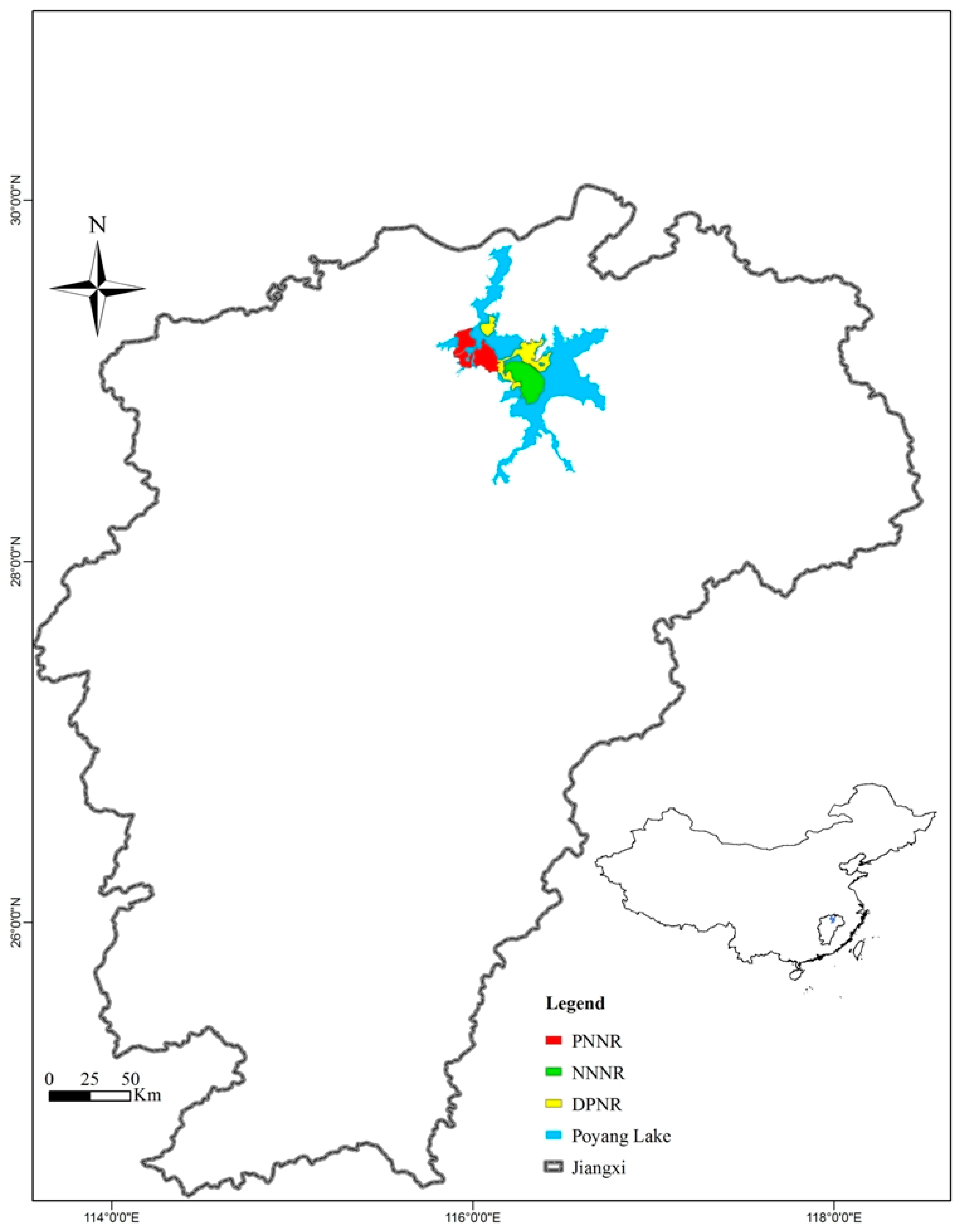
Poyang Lake, the largest freshwater lake in China, is located at the south bank of Yangtze River in Jiangxi province between 28°24′–29°46′ N and 115°49′–116°46′ E (Figure 1), covering an area of approximately 4000 km2 [1]. This study conducted in three nature reserves of Poyang lake, namely PNNR, NNNR and DPNR (Table 1), located in the western, southwestern and northeastern parts of Poyang Lake, respectively. They support a high proportion of the globally threatened species, such as critically endangered Siberian Crane (Grus leucogeranus), endangered Oriental Stork (Ciconia boyciana), vulnerable Swan Goose (Anser cygnoides) and White-naped Crane (Grus vipio) [6,31,32]. The topography of the Poyang Lake catchment varies from high mountainous regions (maximum elevation of about 2200 m above sea level) to alluvial plains in the lower reaches of the primary watercourses. Poyang Lake has a humid subtropical climate with an annual average temperature of 16.7–17.7 °C, with average annual precipitation of 1400–1900 mm [2]. Carex spp., Phragmites australis, Potamogeton spp. and Polygonum spp. that are essential food sources of various birds dominate the wetland vegetation of Poyang Lake [9].
Figure 1.
Location of the study area. Sub-section of Poyang Lake, Jiangxi Province, China.
Table 1.
List of sub-lakes surveyed.
2.2. Methods
The total area of Poyang lake (4000 km2) was covered by water and flood during summer (July–August), while in winter, it reduces to less than 1000 km2, exposing mudflats and smaller independent sub lakes. We conducted this study in two National nature reserve and one Provincial nature reserve of Poyang lake (i.e., 16 sub lakes from each PNNR and NNNR, 10 sub lakes from DPNR) (Table 1). Each winter surveys (20–27 Jan 2016; 09–26 Jan 2017; 25–28 Jan 2018; 09–26 Jan 2019 and 07–15 Jan 2020) were carried out in each of the 42 sub lakes when the population of birds was relatively stable [2,3,31].
Birds surveyed from one to five vantage points in each sub lakes with binoculars and a spotting scope for five consecutive winter seasons. However, some sub lakes of DPNR were not surveyed during the Survey 3 (2018) due to weather conditions and transportation problem. The distance between any two observation points was at least 2–3 km to avoid double counting and at least 20% to 25% of the study area was covered. Large flocks counted by dividing them into groups of 10, 20 or 50 individuals to improve the accuracy of counting [33]. The time spent at the survey site varied depending on the size of the sub lakes, bird population size and visibility. For identification and categorization of birds to respective taxonomic groups, digital camera photographs, bird identification guide books and published literature [34,35,36] were used. Similarly, the conservation status was determined using the latest IUCN assessment [32], published literature and field guide books [37].
After the collection of data, we computed effective species numbers, known as Hill numbers or actual diversities [18,30,38] (of order 0, 1 and 2) in the iNEXT package of R software version 3.61 [39]. The three Hill numbers are species richness (q = 0), the exponential of Shannon’s diversity index (q = 1) and the inverse of Simpson’s diversity (q = 2). Confidence intervals around Hill numbers were developed to facilitate the comparison of both rarefied and extrapolated samples by bootstrap methods [30,38].
3. Results
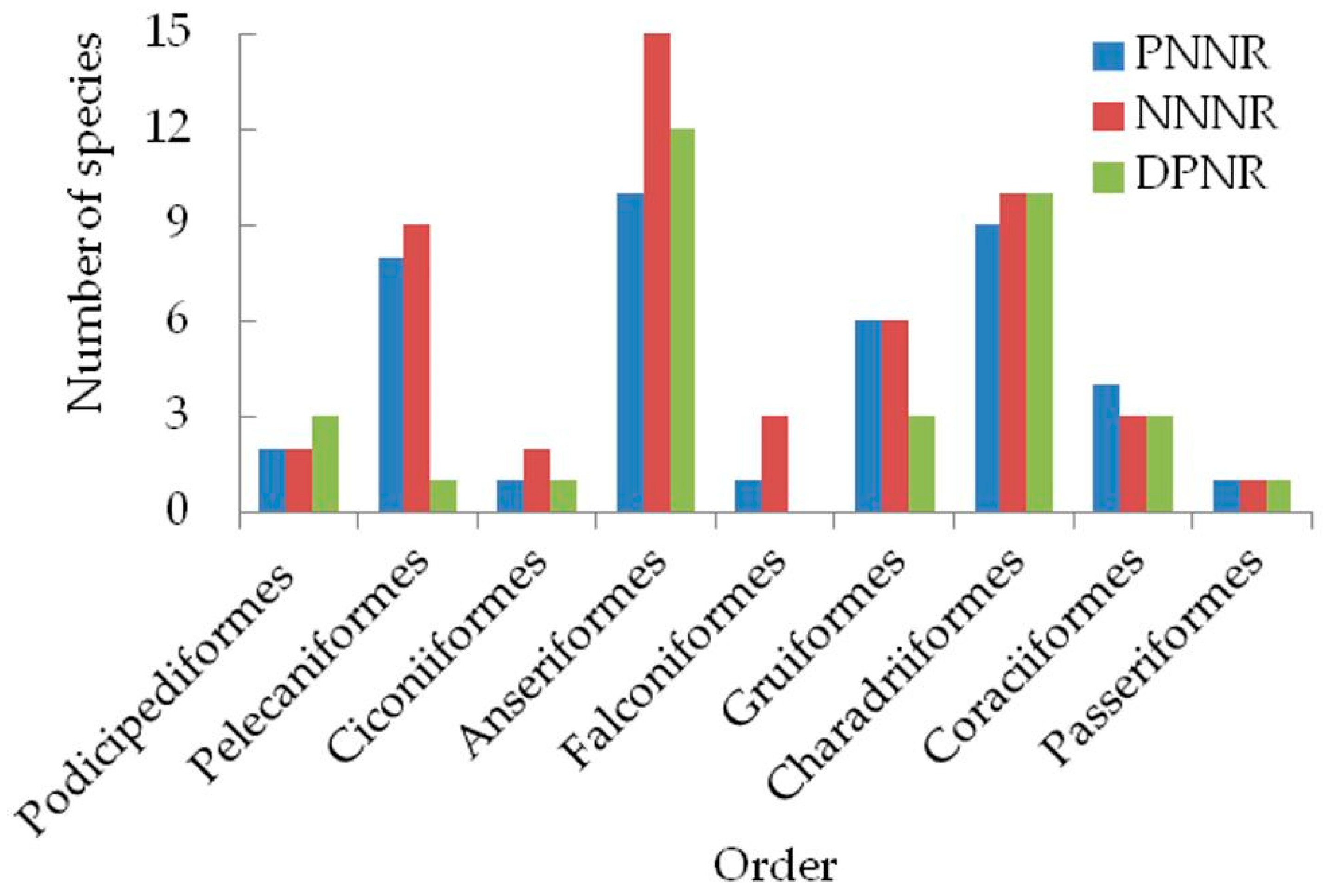
In total, 58 bird species grouped into 9 orders and 13 families were observed in the study sites (Appendix A). The order Charadriiformes consisted of a high number of families (4 families and 13 species). The number of species in the order Anseriformes recorded was exceptionally high (15 spp.) followed by Charadriiformes (13 spp.). The number of species in the order Anseriformes was higher in NNNR than PNNR and DPNR (Figure 2). Two globally threatened bird species, Siberian Crane (critically endangered) and Oriental Stork (endangered), Eurasian Curlew, Black-tailed Godwit and Northern Lapwing were near-threatened bird species recorded in our study sites. Hence this study sites were not only harbored the highest waterbird richness and abundance, but also provided a home for the highest proportion of most endangered species (Table A1).
Figure 2.
Composition of bird orders in the study site of Poyang Lake.
Our survey data showed that the Siberian Crane and White-naped Crane were wintering at all sites on Poyang Lake (PNNR, NNNR and DPNR) (Table A1). Similarly, our results suggest that the highest number of Oriental Stork and Siberian Crane mainly distributed in PNNR. Oriental Stork were recorded in all the five consecutive years in each study sites (Table A1 and Table 2). DPNR had the highest proportion of Ruddy Shelduck and the lowest Lesser White-fronted Goose and Swan Goose (Table A1 and Table 2).
Table 2.
Vulnerable and Endangered over-wintering aquatic bird species counts at each section of Poyang Lake between the years 2016 and 2020 in the winter season at the three study sites.
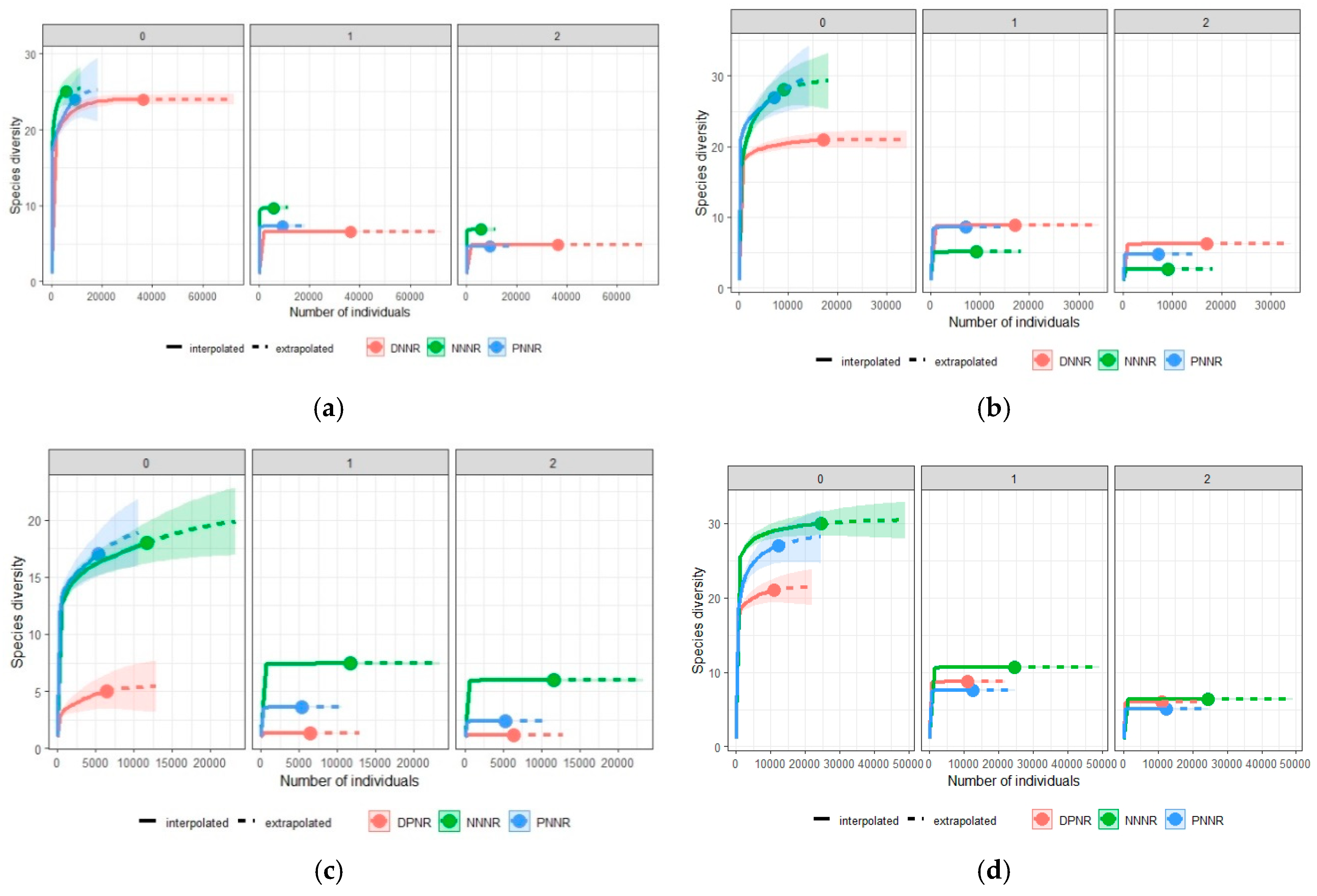
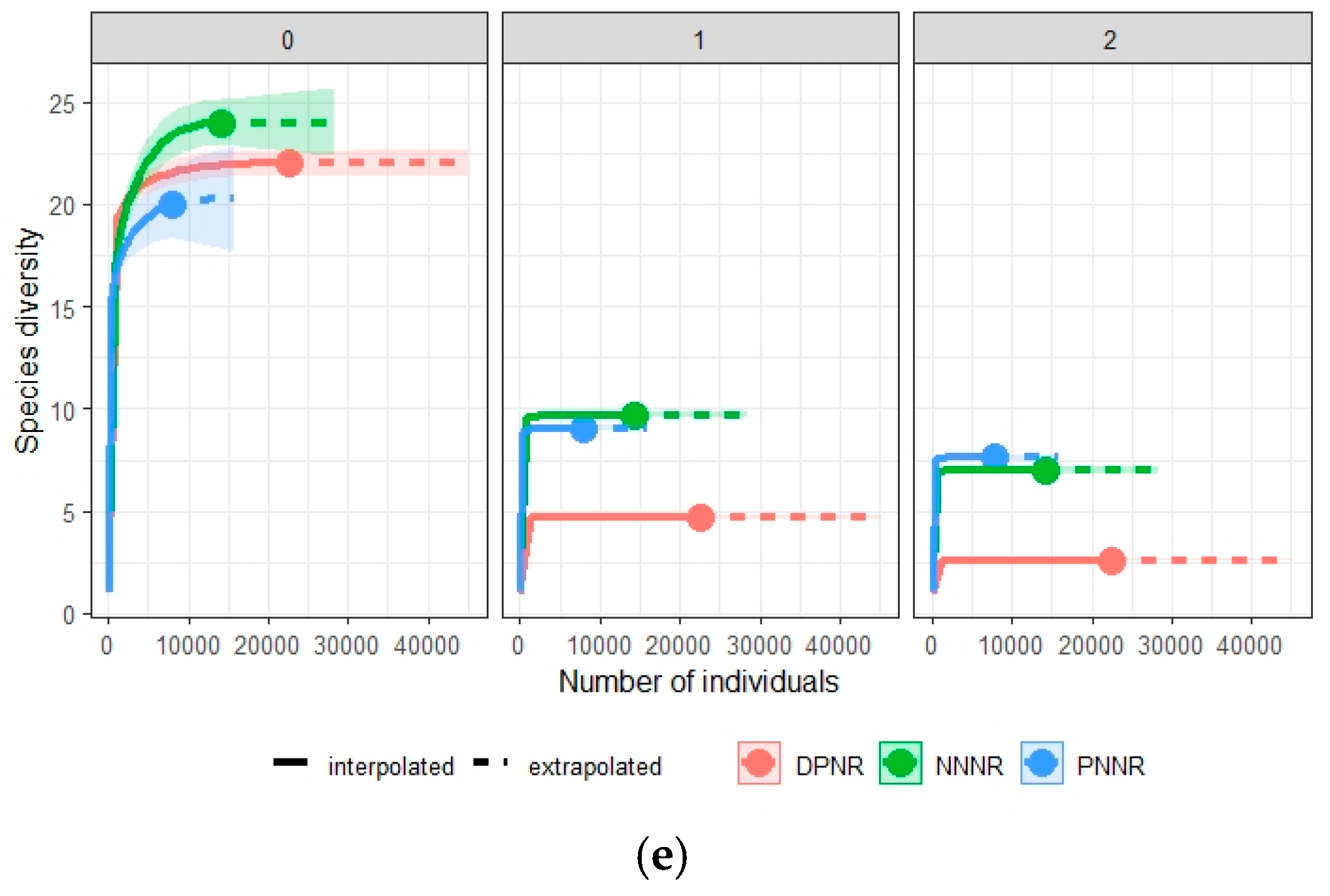
This study showed variation in effective species numbers among each three study sites and each survey year (Figure 3). For example, in Survey 1, 2016, the highest observed effective species number, 25 bird species, 9.70 Shannon index and 6.84 Simpson index were observed in NNNR with the corresponding asymptotic estimator of 26, 2.27 and 0.85, respectively, followed by DPNR (24, 6.57 and 4.85) (Figure 3a). The plot of the confidence interval of species richness of all surveys is overlapping except DPNR, which shows no significant species difference in all surveys of the two nature reserves. However, the Shannon diversity and Simpson diversity plot of Survey 3 (Figure 3c) were not overlapped. Hence significant differences in Shannon diversity and Simpson diversity were observed between the survey sites in Survey 3.

Figure 3.
Rarefaction and extrapolation based on Hill numbers (for order q = 0, 1, 2), species richness (q = 0), Shannon’s diversity (q = 1) and inverse Simpson’s diversity (q = 2) of reference sample collected from the study sites in the five consecutive survey years ((a). Survey 1; (b). Survey 2; (c). Survey 3; (d). Survey 4; (e). Survey 5) 2016–2020. The solid line is the rarefaction curve and the dotted line is the extrapolation curve, which goes up to double the size of the reference sample. The shaded area represents 95% confidence intervals obtained using the bootstrap method based on 200 replication.
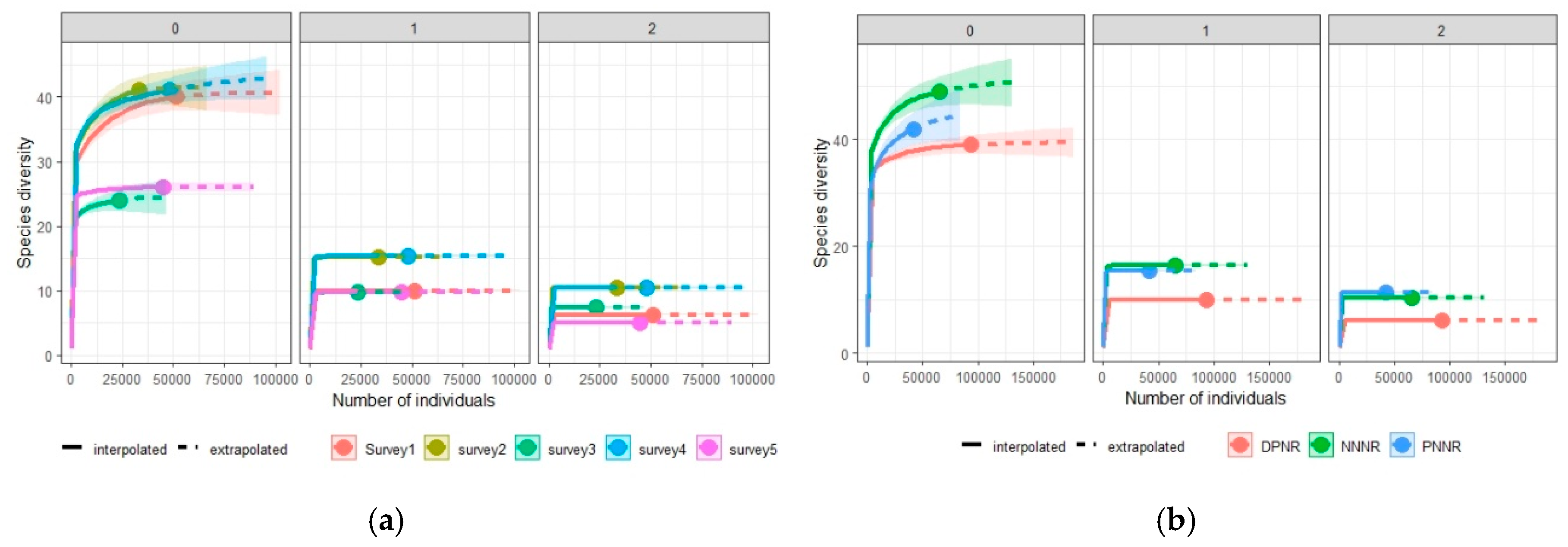
This study showed that there is an essential temporal variation in biodiversity indices among the five consecutive surveys (Figure 4a) during the whole study time. Hence, the highest values of diversity in the reference sample (nonstandardized data) were found in Survey 4 (2019) where 41 species richness, 15.34 Shannon index and 10.46 Simpson diversity index (solid points in Figure 4a) with the corresponding asymptotic hill numbers for q = 0, 1, 2 are 44, 2.73, 0.91. In contrast, the lowest values of the three metrics were noted in Survey 3 (2018): 24, 9.74 and 7.44 (solid points in Figure 4a) with the corresponding asymptotic estimator for species richness, Shannon diversity and Simpson diversity 25, 2.28 and 0.87, respectively. However, in Survey 1, Survey 2 and Survey 4, there was no significant difference in species richness (q = 0) because the plot of the confidence interval did not overlap.
Figure 4.
Abundance data-based rarefaction and extrapolation of Hill numbers for order q = 0,1,2 (species richness (q = 0), Shannon’s diversity (q = 1) and inverse Simpson’s diversity (q = 2)). For the entire five consecutive survey years (a) and for the three study site during the whole study periods (b). The solid line is the rarefaction curve and the dotted line is the extrapolation curve, which goes up to double the size of the reference sample. The shaded area represents 95% confidence intervals obtained using the bootstrap method based on the 200 replication.
Similarly, temporal variation in biodiversity indices among the study sites (PNNR, NNNR and DNNR) was observed. For instance, the highest values of diversity in the reference sample (nonstandardized data) were found in NNNR, where 49 species richness, 16.37 Shannon index and 10.35 Simpson diversity index (solid points in Figure 4b) were observed. The asymptotic estimator for species richness, Shannon diversity and Simpson diversity (i.e., Hill numbers for q = 0, 1, 2) were 51, 2.80 and 0.90, respectively. In contrast, the lowest values of the three metrics were noted in DPNR: 39, 9.92 and 6.11 (Solid points in Figure 4b) and their corresponding respective asymptotic hill numbers are 40, 2.30 and 0.84.
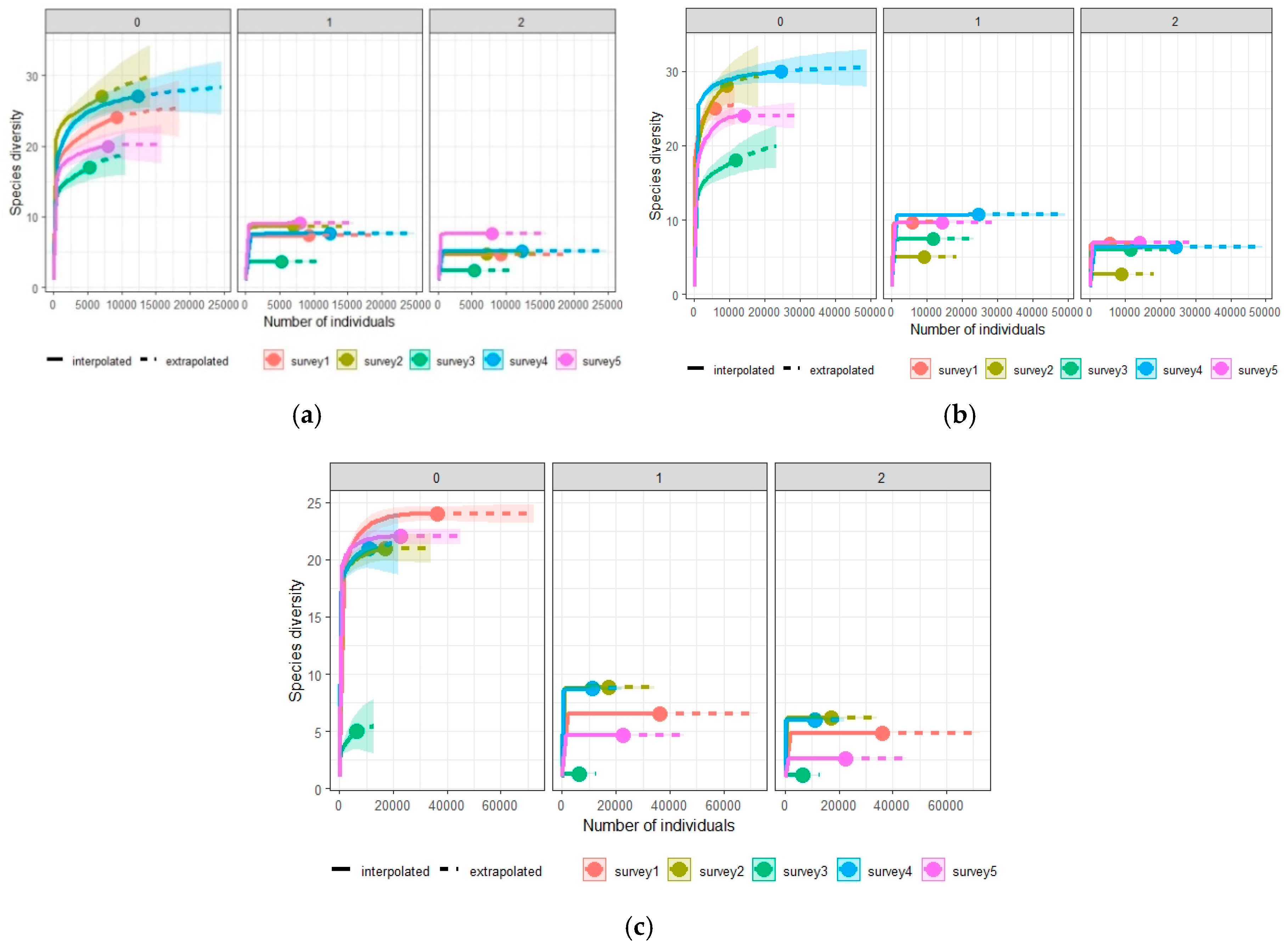
The number of species observed in each entire survey year of each study site ranged from 29 (NNNR) to 4 (DPNR) (Figure 5). For example, in PNNR Survey 2, 2017 (Figure 5a), the highest effective number, 27 bird species, 8.62 Shannon index and 4.77 Simpson index were observed, with the corresponding asymptotic estimator for species richness, Shannon diversity and Simpson diversity 27, 1.99 and 0.78, respectively. Similarly, the lowest species richness 17, Shannon index 3.61 and 2.36 Simpson diversity index were noted in Survey 3, 2018 (solid point in Figure 5a) with the corresponding asymptotic estimator 20, 0.58 and 1.29, respectively.
Figure 5.
Abundance data-based rarefaction and extrapolation of Hill numbers for order q = 0–2 (species richness (q = 0), Shannon’s diversity (q = 1) and inverse Simpson’s diversity (q = 2)). For the five consecutive survey years (2016–2020) of PNNR (a), NNNR (b), and DNNR (c). The solid line is the rarefaction curve and the dotted line is the extrapolation curve, which goes up to double the size of the reference sample. The shaded area represents 95% confidence intervals obtained using the bootstrap method.
4. Discussion
The western and southwestern parts of Poyang Lake are playing essential roles in the conservation of wintering aquatic bird species. It contains high species richness and abundant waterbird species during the winter season. This may be due to the existence of large intra-wetland variation [2,40,41,42] and more abundant food sources [15,43,44,45] during the winter season. Additionally, fewer disturbances exist in the western and southwestern areas.
PNNR, NNNR and DPNR are a vital wetland ecosystem that provides habitat to various aquatic birds. Every sub lakes with continuous water surface and distinct boundaries within Poyang Lake accommodate various waterbird species during the winter. However, the distributions of waterbirds were not the same. Some areas were populated by some species, whereas some of them were only observed to have a few birds. For example, Ruddy Shelduck was only recorded in DPNR. Moreover, inside the sub lakes, aquatic birds showed slight changes in their distribution. The distributional changes of the aquatic birds may be due to food availability [7,9,46,47], habitat area and water depth [28,41,48,49,50,51,52], protection status [53,54] and vegetation availability [5,6,12,15].
Temporal variation in biodiversity indices was observed among the three study sites and the survey years. The highest value of diversity observed in NNNR and Survey 4 (2019), whereas the lowest noted in DPNR and Survey 3. During Survey 3 (2018), because of the weather condition and transportation (Ferry) problem, some sub lakes of the study areas were not surveyed. Consequently, the lowest number of species recorded. Additionally, the difference in species diversity among the different study sites and survey year could also be associated with differences in habitat characteristics and feeding habits of birds [41,43,55]. For example, DPNR covered the main water body of Poyang lake and had a large area of deep water, which lowers its suitability for some bird species. Consistent with previous studies [3,56,57], all the study areas provide essential habitats and supporting a considerable number of bird species, including the essential wintering endangered migratory aquatic birds.
Similarly, in agreement with the investigation of other studies in the same area [3,58,59], Anseriformes was the most dominant order, followed by Charadriiformes. The composition of the aquatic birds in the study areas took considerable changes during the study time. For instance, Black-tailed Godwit, which was recorded in the earlier study [17,26] only observed in our first survey. White-naped Crane and Hooded Crane were mainly observed in PNNR (i.e., Zhu Shi Hu, Bang Hu, Da Hu Chi and Sha Hu).
A significant population of Greater and Lesser White-fronted Geese (Anser albifrons and Anser erythropus), Swan Geese (Anser cygnoides) and Tundra Swans (Cygnus columbianus), inhabited Poyang Lake during winter seasons, which may be a reflection of the equal availability of their preferred habitats [28,59,60]. However, their abundance has greatly fluctuated in agreement with a previous study [58,59] and their global population was declining due to habitat destruction [54,61,62]. Globally threatened species, such as Siberian Crane, White-naped Crane and Oriental Stork, were also had a relatively high abundance. The estimated total population of Siberian Cranes were 3800–4000 [32]. In the entire Poyang Lake, an earlier study recorded 3750 Siberian Cranes [32]. However, in this study 159–2483 (minimum and maximum, hereafter min and max) Siberian Cranes were recorded. The estimated total population of White-naped Cranes was 6250–6750 [63] and in the entire Poyang Lake, an earlier study recorded 500–1000 [63]. Whereas in this study 525–3489 (min and max) White-naped Cranes were recorded. Similarly, the estimated total population of Oriental Storks was 1000–2499 [64] and an earlier study recorded 4052 [64] in the entire Poyang Lake. However, in this study, we recorded 83–838. This study showed that 20.21% (Siberian Crane), 52.8% (White-naped Crane) and 43% (Oriental Stork) were found in PNNR, NNNR and DPNR.
From this, we conclude that the study areas’ (24.2% of the entire Poyang lake) waterbird population number showed variation in each year. This may be because of the population decrease or overestimation of population size in the earlier study. According to this study, the average yearly abundances in three study sites of Poyang Lake (24.2% of Poyang Lake) and the proportion of IUCN of this globally threatened species were 10.11%, 6.09% and 99.04%, respectively. The Storks were also commonly found in only a few sub lakes (i.e., Chang Hu, Zhan Bei Hu and San Ni Wan in NNNR and Mei Xi Hu in DPNR). Whereas the Siberian Crane and White-naped Crane commonly found in PNNR (i.e., Bang Hu and Da Cha Hu) consistent with other studies on Crane [6,26].
All the three nature reserves had some infrastructure and competent staff and have been doing well in aquatic bird monitoring [6,41]. However, some local people lack awareness about conservation laws [58] and DPNR had a lack of funds. Additionally, an essential constraint to aquatic bird protection is a lack of administration of most sub lakes [16,29,65]. Therefore, continuous monitoring and awareness creation [66,67,68] among local communities regarding long term conservation of birds around sub lakes is required. Similarly, continuous quantitative survey and ecological study of wintering waterbird in the entire sub lakes of Poyang Lake also need more attention.
5. Conclusions
The study demonstrated that a large number of bird species were over-wintering in Poyang Lake. Interestingly some of the globally endangered bird species inhabited in the sub lakes of Poyang Lake, thus making this site an important conservation area. Therefore, an intense conservation action with harmonized and protected promising wintering stop sites should be performed to increase bird diversity in such a large fresh wetlands area. Similarly, for long term conservation of birds around the wetland, continuous monitoring of bird species, intentional improvement of the sites and awareness creation to the local community are recommended. In particular, DPNR needs more attention. Future studies should also focus on the flyway of the migratory bird species and organizing online taxonomic database of Poyang Lake waterbird.
Author Contributions
Conceptualization, Q.W. and M.T.D.; methodology, M.T.D. and Q.W.; software, M.T.D.; validation, Q.W. and M.T.D.; formal analysis, M.T.D.; investigation, Q.W., M.T.D., L.C., Z.X. and Z.L.; resources, M.T.D. and Q.W.; data curation, Q.W. and M.T.D.; writing—original draft, M.T.D.; writing—review and editing, Q.W. and X.S.; visualization, M.T.D.; supervision, Q.W.; project administration, Q.W.; funding acquisition, Q.W. All authors have read and agreed to the published version of the manuscript.
Funding
This research supported by National Natural Science Foundation of China (Grant number, 31401978), the Fundamental Research Funds for the Central Universities (Grant number, 2572019BE04) and the Academic and Technical Leader Training Program of Jiangxi provincial (Grant number, 20153BCB22007).
Acknowledgments
Special thanks go to Mulualem Tigabu for their constructive comments on an earlier version of the manuscript. This research supported by National Natural Science Foundation of China, the Fundamental Research Funds for the Central Universities and the Academic and Technical Leader Training Program of Jiangxi provincial. We are also very grateful for the comments and suggestions made by the anonymous reviewers.
Conflicts of Interest
No conflict of interest.
Appendix A
Table A1.
List of wintering waterbird species and the total individual numbers recorded in five consecutive winter season surveys at each study site of Poyang Lake, China.
Table A1.
List of wintering waterbird species and the total individual numbers recorded in five consecutive winter season surveys at each study site of Poyang Lake, China.
| Order/Family Common Name | Scientific Name/Conservation Status | Study Site | RS | ||
|---|---|---|---|---|---|
| PNNR | NNNR | DPNR | |||
| PODICIPEDIFORMES | |||||
| Podicipedidae | |||||
| Little Grebe | Tachybaptus ruficollis | 167 | 1048 | 818 | R |
| Black-necked Grebe | Podiceps nigricollis | 0 | 0 | 338 | W |
| Great Crested Grebe | Podiceps cristatus | 110 | 177 | 817 | W |
| PELECANIFORMES | |||||
| Phalacrocoracidae | |||||
| Great Cormorant | Phalacrocorax carbo | 609 | 355 | 122 | W |
| Ardeidae | |||||
| Black-crowned Night Heron | Nycticorax nycticorax | 0 | 957 | 0 | R |
| Chinese Pond-heron | Ardeola bacchus | 1 | 0 | 0 | S |
| Grey Heron | Ardea cinerea | 1159 | 1739 | 710 | R |
| Great White Egret | Ardea alba | 54 | 0 | 22 | W |
| Intermediate Egret | Ardea intermedia | 3 | 2 | 5 | S |
| Little Egret | Egretta garzetta | 173 | 42 | 0 | S |
| Threskiornithidae | |||||
| Eurasian Spoonbill | Platalea leucorodia | 2162 | 3952 | 2494 | W |
| Eurasian Bittern | Botaurus stellaris | 3 | 2 | 66 | S |
| CICONIIFORMES | |||||
| Ciconiidae | |||||
| Black Stork | Ciconia nigra | 0 | 4 | 0 | W |
| Oriental Stork | Ciconia boyciana EN | 5982 | 1766 | 913 | W |
| ANSERIFORMES | |||||
| Anatidae | |||||
| Tundra Swan | Cygnus columbianus NT | 1108 | 11,415 | 6898 | W |
| Swan Goose | Anser cygnoides VU | 6444 | 2752 | 2716 | W |
| Bean Goose | Anser fabalis | 5495 | 13,125 | 27,032 | W |
| Greater White-fronted Goose | Anser albifrons | 4426 | 1601 | 285 | W |
| Lesser White-fronted Goose | Anser erythropus VU | 732 | 421 | 311 | W |
| Greylag Goose | Anser anser | 1578 | 5881 | 461 | W |
| Ruddy Shelduck | Tadorna ferruginea | 0 | 228 | 21,222 | W |
| Eurasian Wigeon | Mareca penelope | 46 | 212 | 0 | W |
| Gadwall | Mareca strepera | 0 | 41 | 0 | W |
| Common Teal | Anas crecca | 0 | 1251 | 2487 | W |
| Mallard | Anas platyrhynchos | 1204 | 2657 | 44 | W |
| Chinese Spot-billed Duck | Anas zonorhyncha | 1313 | 601 | 2822 | R |
| Northern Pintail | Anas acuta | 0 | 406 | 0 | W |
| Northern Shoveler | Spatula clypeata | 0 | 200 | 0 | W |
| Red-breasted Merganser | Mergus serrator | 0 | 45 | 0 | W |
| Common Pochard | Aythya ferina | 0 | 0 | 172 | W |
| Tufted Duck | Aythya fuligula | 2 | 0 | 664 | W |
| FALCONIFORMES | |||||
| Accipitridae | |||||
| Hen Harrier | Circus cyaneus | 6 | 6 | 0 | W |
| Eastern Marsh Harrier | Circus spilonotus | 0 | 3 | 0 | W |
| Pied Harrier | Circus melanoleucos | 0 | 1 | 0 | W |
| GRUIFORMES | |||||
| Gruidae | |||||
| Common Crane | Grus grus | 427 | 462 | 675 | W |
| Siberian Crane | Grus leucogeranus CR | 2641 | 730 | 419 | W |
| White-naped Crane | Grus vipio VU | 1586 | 176 | 218 | W |
| Hooded Crane | Grus monacha VU | 524 | 38 | 0 | W |
| Rallidae | |||||
| Common Coot | Fulica atra | 39 | 1416 | 0 | W |
| Common Moorhen | Gallinula chloropus | 1 | 1 | 0 | R |
| CHARADRIIFORMES | |||||
| Recurvirostridae | |||||
| Pied Avocet | Recurvirostra avosetta | 60 | 3911 | 11,431 | W |
| Charadriidae | |||||
| Northern Lapwing | Vanellus vanellus NT | 580 | 843 | 523 | W |
| Gray-headed Lapwing | Vanellus cinereus | 4 | 0 | 0 | S |
| Scolopacidae | |||||
| Eurasian Curlew | Numenius arquata NT | 0 | 4 | 0 | W |
| Common Greenshank | Tringa nebularia | 101 | 3 | 200 | W |
| Spotted Redshank | Tringa erythropus | 499 | 340 | 1330 | W |
| Common Redshank | Tringa totanus | 1319 | 2267 | 4 | W |
| Common Sandpiper | Actitis hypoleucos | 1302 | 0 | 41 | W |
| Black-tailed Godwit | Limosa limosa NT | 0 | 300 | 418 | W |
| Laridae | |||||
| Herring Gull | Larus argentatus | 2 | 1 | 445 | W |
| Black-headed Gull | Larus ridibundus | 13 | 1453 | 5683 | W |
| Black-tailed Gull | Larus crassirostris | 0 | 0 | 499 | W |
| Whiskered Tern | Chlidonias hybrida | 0 | 2272 | 0 | W |
| CORACIIFORMES | |||||
| Alcedinidae | |||||
| Common Kingfisher | Alcedo atthis | 1 | 5 | 1 | W |
| White-breasted Kingfisher | Halcyon smyrnensis | 4 | 0 | 0 | W |
| Pied Kingfisher | Ceryle rudis | 8 | 198 | 25 | W |
| Crested Kingfisher | Megaceryle lugubris | 1 | 8 | 3 | W |
| PASSERIFORMES | |||||
| Motacillidae | |||||
| White Wagtail | Motacilla alba | 19 | 3 | 2 | R |
| Total number of species | 42 | 49 | 39 | ||
PNNR—Poyang National Nature Reserve; NNNR—Nanji National Nature Reserve; DPNR—Duchang Provincial Nature Reserve; CR—critically endangered; EN—endangered; VU—vulnerable; NT—near threatened; RS—residence type; R—residence; S—summer; W—winter.
References
- Shankman, D.; Keim, B.D.; Song, J. Flood frequency in China’s poyang lake region: Trends and teleconnections. Int. J. Climatol. 2006, 26, 1255–1266. [Google Scholar] [CrossRef]
- Wang, L.; Dronova, I.; Gong, P.; Yang, W.; Li, Y.; Liu, Q. A new time series vegetation-water index of phenological-hydrological trait across species and functional types for poyang lake wetland ecosystem. Remote Sens. Environ. 2012, 125, 49–63. [Google Scholar] [CrossRef]
- Ji, W.; Zeng, N.; Wang, Y.; Gong, P.; Xu, B.; Bao, S. Analysis on the waterbirds community survey of poyang lake in winter. Geogr. Inf. Sci. 2007, 13, 51–64. [Google Scholar] [CrossRef]
- Li, X.; Zhang, Q.; Ye, X. Capabilities of satellite-based precipitation to estimate the spatiotemporal variation of flood/drought class in poyang lake basin. Adv. Meteorol. 2013, 2013, 1–9. [Google Scholar] [CrossRef]
- Wan, R.; Dai, X.; Shankman, D. Vegetation response to hydrological changes in poyang lake, China. Wetlands 2018, 2, 1–14. [Google Scholar] [CrossRef]
- Li, F.; Wu, J.; Harris, J.; Burnham, J. Number and distribution of cranes wintering at poyang lake, China, during 2011–2012. Chin. Birds 2012, 3, 180–190. [Google Scholar] [CrossRef]
- Lee, S.D.; Jablonski, P.G.; Higuchi, H. Winter foraging of threatened cranes in the demilitarized zone of korea: Behavioral evidence for the conservation importance of unplowed rice fields. Biol. Conserv. 2007, 138, 286–289. [Google Scholar] [CrossRef]
- Feng, L.; Hu, C.; Chen, X.; Cai, X.; Tian, L.; Gan, W. Assessment of inundation changes of poyang lake using MODIS observations between 2000 and 2010. Remote Sens. Environ. 2012, 121, 80–92. [Google Scholar] [CrossRef]
- Zhang, L.; Yin, J.; Jiang, Y.; Wang, H. Relationship between the hydrological conditions and the distribution of vegetation communities within the poyang lake national nature reserve, China. Ecol. Inform. 2012, 11, 65–75. [Google Scholar] [CrossRef]
- Nakayama, T.; Watanabe, M. Role of flood storage ability of lakes in the changjiang river catchment. Glob. Planet. Change 2008, 63, 9–22. [Google Scholar] [CrossRef]
- Cao, L.; Barter, M.; Lei, G. New anatidae population estimates for eastern China: Implications for current flyway estimates. Biol. Conserv. 2008, 141, 2301–2309. [Google Scholar] [CrossRef]
- Munoz-Pedreros, A.; Merino, C. Diversity of aquatic bird species in a wetland complex in southern chile. J. Nat. Hist. 2014, 1453–1465. [Google Scholar] [CrossRef]
- Li, H.; An, S.; Jiang, J.; Fang, S.; Zhi, Y.; Li, H.; Xu, C.; Guan, B.; Wang, Z.; Deng, Z.; et al. China’s natural wetlands: Past problems, current status, and future challenges. AMBIO A J. Hum. Environ. 2007, 36, 335–342. [Google Scholar]
- Han, X.; Chen, X.; Feng, L. Four decades of winter wetland changes in poyang lake based on landsat observations between 1973 and 2013. Remote Sens. Environ. 2014, 156, 426–437. [Google Scholar] [CrossRef]
- Tang, X.; Li, H.; Xu, X.; Yang, G.; Liu, G.; Li, X.; Chen, D. Changing land use and its impact on the habitat suitability for wintering anseriformes in China’s poyang lake region. Sci. Total Environ. 2016, 557–558, 296–306. [Google Scholar] [CrossRef]
- Wang, W.; Fraser, J.D.; Chen, J. Wintering waterbirds in the middle and lower yangtze river floodplain: Changes in abundance and distribution. Bird Conserv. Int. 2017, 27, 167–186. [Google Scholar] [CrossRef]
- Cao, L.; Zhang, Y.; Barter, M.; Lei, G. Anatidae in eastern China during the non-breeding season: Geographical distributions and protection status. Biol. Conserv. 2010, 143, 650–659. [Google Scholar] [CrossRef]
- Chao, A.; Gotelli, N.J.; Hsieh, T.C.; Sander, E.L.; Ma, K.H.; Colwell, R.K.; Ellison, A.M. Rarefaction and extrapolation with hill numbers: A framework for sampling and estimation in species diversity studies. Ecol. Monogr. 2014, 84, 45–67. [Google Scholar] [CrossRef]
- Magurran, A.E. Measuring Biological Diversity, 2nd ed.; Blackwell Publishing: Carlton, Australia, 2004. [Google Scholar]
- Stirling, G.; Wilsey, B. Empirical relationships between species richness, evenness, and proportional diversity. Am. Nat. 2001, 158, 286–299. [Google Scholar] [CrossRef]
- Magurran, A.E. Why Diversity? Ecol. Divers. Its Meas. 1988, 1–5. [Google Scholar] [CrossRef]
- Chisholm, R.A.; Burgman, M.A.; Hubbell, S.P.; Borda-De-Água, L. The unified neutral theory of biodiversity and biogeography: Comment. Ecology 2004, 85, 3172–3178. [Google Scholar] [CrossRef]
- Rowhani, P.; Lepczyk, C.A.; Linderman, M.A.; Pidgeon, A.M.; Radeloff, V.C.; Culbert, P.D.; Lambin, E.F. Diversity in tropical rain forests and coral reefs. Ecosystems 2008, 11, 1302–1310. [Google Scholar] [CrossRef]
- May, R.M. How many species are there on earth? Science 1988, 241, 1441–1449. [Google Scholar] [CrossRef]
- Brook, B.W.; Sodhi, N.S.; Ng, P.K.L. Catastrophic extinctions follow deforestation in singapore. Nature 2003, 424, 420–426. [Google Scholar] [CrossRef]
- Jia, Y.; Zhang, Y.; Lei, J.; Jiao, S.; Lei, G.; Yu, X.; Liu, G. Activity patterns of four cranes in poyang lake, China: Indication of habitat naturalness. Wetlands 2017, 1–9. [Google Scholar] [CrossRef]
- Kanai, Y.; Ueta, M.; Germogenov, N.; Nagendran, M.; Mita, N.; Higuchi, H. Migration routes and important resting areas of siberian cranes (grus leucogeranus) between northeastern siberia and China as revealed by satellite tracking. Biol. Conserv. 2002, 106, 339–346. [Google Scholar] [CrossRef]
- Guan, L.; Jia, Y.; Saintilan, N.; Wang, Y.; Liu, G.; Lei, G.; Wen, L. Causality between abundance and diversity is weak for wintering migratory waterbirds. Freshw. Biol. 2016, 61, 206–218. [Google Scholar] [CrossRef]
- Jost, L. Entropy, and diversity. Oikos 2006, 113, 363–375. [Google Scholar] [CrossRef]
- Colwell, R.K.; Chao, A.; Gotelli, N.J.; Lin, S.Y.; Mao, C.X.; Chazdon, R.L.; Longino, J.T. Models, and estimators linking individual-based and sample-based rarefaction, extrapolation and comparison of assemblages. J. Plant. Ecol. 2012, 5, 3–21. [Google Scholar] [CrossRef]
- Cui, P.; Chen, B.; Wu, Y.; Lu, X.; Ding, H.; Wu, J.; Chen, L.; Xu, H.; Cao, M. Status of wintering waterbirds at selected locations in China. Waterbirds 2014, 37, 402–409. [Google Scholar] [CrossRef]
- IUCN 2019. The IUCN Red List of Threatened Species. Version 2019-3. Available online: http://www.Iucnredlist.Org (accessed on 12 December 2019).
- Bibby, C.J.; Burgess, N.D.; Hill, D.A.; Mustoe, S.H. Birds Census Techniques; Academic Press: Cambridge, UK, 2000. [Google Scholar]
- Hackett, S.J.; Kimball, R.T.; Reddy, S.; Bowie, R.C.K.; Braun, E.L.; Braun, M.J.; Chojnowski, J.L.; Cox, W.A.; Han, K.L.; Harshman, J.; et al. A phylogenomic study of birds reveals their evolutionary history. Science 2008, 320, 1763–1768. [Google Scholar] [CrossRef] [PubMed]
- Prum, R.O.; Berv, J.S.; Dornburg, A.; Field, D.J.; Townsend, J.P.; Lemmon, E.M.; Lemmon, A.R. A comprehensive phylogeny of birds (aves) using targeted next-Generation DNA sequencing. Nature 2015, 526, 569–573. [Google Scholar] [CrossRef] [PubMed]
- Jarvis, E.D.; Ye, C.; Liang, S.; Yan, Z.; Zepeda, M.L.; Campos, P.F.; Missael, A.; Velazquez, V.; Samaniego, J.A.; Avila-arcos, M.; et al. A phylogeny of modern birds. Science 2014, 346, 1126–1138. [Google Scholar] [CrossRef]
- Brazil, M. Field Guide to the Birds of East. Asia Eastern China, Taiwan, Korea, Japan, and Eastern Russia; Christopher Helm: London, UK, 2009. [Google Scholar]
- Gotelli, N.J.; Chao, A. Measuring and Estimating Species Richness, Species Diversity, and Biotic Similarity from Sampling Data; Elsevier Ltd.: Waltham, MA, USA, 2013; Volume 5. [Google Scholar] [CrossRef]
- Hsieh, T.C.; Ma, K.H.; Chao, A. INEXT: An r package for rarefaction and extrapolation of species diversity (hill numbers). Methods Ecol. Evol. 2016, 7, 1451–1456. [Google Scholar] [CrossRef]
- Ye, X.C.; Li, Y.L.; Li, X.H.; Xu, C.Y.; Zhang, Q. Investigation of the variability and implications of meteorological dry/wet conditions in the poyang lake catchment, China, during the period 1960–2010. Adv. Meteorol. 2015, 2015. [Google Scholar] [CrossRef]
- Mirande, C.M.; Harris, J.T. Crane Conservation Strategy; International Foundation: Baraboo, WI, USA, 2019. [Google Scholar]
- Paracuellos, M. How can habitat selection affect the use of a wetland complex by waterbirds? Biodivers. Conserv. 2006, 15, 4569–4582. [Google Scholar] [CrossRef]
- Chen, X.; Zong, Y.; Zhang, E.; Xu, J.; Li, S. Human impacts on the changjiang (yangtze) river basin, China, with special reference to the impacts on the dry season water discharges into the sea. Geomorpholog 2001, 41, 111–123. [Google Scholar] [CrossRef]
- Wei, Z.; Li, Y.; Xu, P.; Qian, F.; Shan, J.; Tu, X. Patterns of change in the population and spatial distribution of oriental white storks (ciconia boyciana) wintering in poyang lake. Zool. Res. 2016, 37, 338–346. [Google Scholar] [CrossRef]
- Merkens, M.; Bradbeer, D.R.; Bishop, C.A. Landscape and field characteristics affecting winter waterfowl grazing damage to agricultural perennial forage crops on the lower fraser river delta, BC, Canada. Crop. Prot. 2012, 37, 51–58. [Google Scholar] [CrossRef]
- Liu, D.; Ren, C.; Tang, X.; Liu, C.; Dong, Z.; Jia, M.; Li, L.; Wang, Z. Assessment of habitat suitability for waterbirds in the west songnen plain, China, using remote sensing and GIS. Ecol. Eng. 2013, 55, 94–100. [Google Scholar] [CrossRef]
- Karr, J.R. Seasonality, resource availability, and community diversity in tropical bird communities. Am. Nat. 2002, 110, 973–994. [Google Scholar] [CrossRef]
- Poot, M.; Ntamoa-Baidu, Y.; Wiersma, P.; Gordon, C.; Piersma, T.; Battley, P. Water depth selection, daily feeding routines and diets of waterbirds in coastal lagoons in Ghana. Ibis 2008, 140, 89–103. [Google Scholar] [CrossRef]
- Gonzalez-Gajardo, A.; Sepulveda, P.V.; Schlatter, R. Waterbird assemblages and habitat characteristics in wetlands: Influence of temporal variability on species-habitat relationships. Waterbirds 2009, 32, 225–233. [Google Scholar] [CrossRef]
- Sebastian-Gonzalez, E.; Green, A.J. Habitat use by waterbirds in relation to pond size, water depth, and isolation: Lessons from a restoration in southern spain. Restor. Ecol. 2014, 22, 311–318. [Google Scholar] [CrossRef]
- Van Eerden, M.R.; Lenselink, G.; Zijlstra, M. Long-term changes in wetland area and composition in the netherlands affecting the carrying capacity for wintering waterbirds. Ardea 2011, 98, 265–282. [Google Scholar] [CrossRef]
- Golden Kroner, R.E.; Krithivasan, R.; Mascia, M.B. Effects of protected area downsizing on habitat fragmentation in yosemite national park (USA), 1864–2014. Ecol. Soc. 2016, 21. [Google Scholar] [CrossRef]
- Maheswaran, G.; Rahmani, A.R. Effects of water level changes and wading bird abundance on the foraging behaviour of blacknecked storks ephippiorhynchus asiaticus in dudwa national park, india. J. Biosci. 2001, 26, 373–382. [Google Scholar] [CrossRef]
- Getachew, M.; Ambelu, A.; Tiku, S.; Legesse, W.; Adugna, A.; Kloos, H. Ecological assessment of cheffa wetland in the borkena valley, northeast ethiopia: Macroinvertebrate and bird communities. Ecol. Indic. 2012, 15, 63–71. [Google Scholar] [CrossRef]
- Goss-Custard, J.D. Competition for food and interference among waders. Ardea 2015, 38–90, 31–52. [Google Scholar] [CrossRef]
- Jiang, F.; Qi, S.; Liao, F.; Ding, M.; Wang, Y. The vulnerability of Siberian crane habitat to water level in poyang lake wetland, China. GISci. Remote Sens. 2014, 51, 662–676. [Google Scholar] [CrossRef]
- Chen, B.; Cui, P.; Xu, H.; Lu, X.; Lei, J.; Wu, Y.; Shao, M.; Ding, H.; Wu, J.; Cao, M.; et al. Assessing the suitability of habitat for wintering siberian cranes (leucogeranus leucogeranus) at different water levels in poyang lake area, China. Polish J. Ecol. 2016, 64, 84–97. [Google Scholar] [CrossRef]
- Maming, R.; Zhang, T.; Blank, D.; Ding, P.; Zhao, X. Geese, and ducks killed by poison and analysis of poaching cases in China. Goose Bull. 2012, 15, 2–11. [Google Scholar]
- McKinney, R.A.; Raposa, K.B.; Trocki, C.L. Status and distribution of wintering waterfowl in narragansett bay, Rhode Island, 2005–2014. Northeast. Nat. 2015, 22, 730–745. [Google Scholar] [CrossRef]
- Kirtaev, G.V.; Soloviev, M.Y.; Ivanov, M.N.; Rogova, N.V.; Rozenfeld, S.B. Estimation of the spatial and habitat distribution of anseriformes in the yamal-nenets and khanty-mansi autonomous regions (experience from the use of ultralight aircrafts). Biol. Bull. 2018, 44, 960–979. [Google Scholar] [CrossRef]
- Ward, M.P.; Semel, B.; Herkert, J.R. Identifying the ecological causes of long-term declines of wetland-dependent birds in an urbanizing landscape. Biodivers. Conserv. 2010, 19, 3287–3300. [Google Scholar] [CrossRef]
- Ronka, M.; Tolvanen, H.; Lehikoinen, E.; Von Numers, M.; Rautkari, M. Breeding habitat preferences of 15 bird species on south-western finnish archipelago coast: Applicability of digital spatial data archives to habitat assessment. Biol. Conserv. 2008, 141, 402–416. [Google Scholar] [CrossRef]
- BirdLife International. Antigone vipio. The IUCN Red List of Threatened Species 2018:e.T22692073A131927305.en. 2018. Available online: www.iucnredlist.org (accessed on 3 June 2020).
- BirdLife International. Ciconia boyciana. The IUCN Red List of Threatened Species 2018:e.T22697695A131942061.en. 2018. Available online: www.iucnredlist.org (accessed on 3 June 2020).
- Li, C.L.; Yang, Y.; Wang, Z.; Yang, L.; Zhang, D.; Zhou, L. The relationship between seasonal water level fluctuation and habitat availability for wintering waterbirds at shengjin lake, China. Bird Conserv. Int. 2018, 1–15. [Google Scholar] [CrossRef]
- Battisti, C.; Franco, D.; Luiselli, L. Searching the conditioning factors explaining the (in)effectiveness of protected areas management: A case study using a SWOT approach. Environ. Pract. 2013, 15, 401–408. [Google Scholar] [CrossRef]
- Jacobson, S.K.; McDuff, M.D.; Monroe, M.C. Conservation Education, and Outreach Techniques, 2nd ed.; Oxford University Press: Oxford, UK, 2015. [Google Scholar]
- Salafsky, N.; Salzer, D.; Statters field, A.J.; Hilton-Taylor, C.; Neugarten, R.; Butchart, S.H.M.; Collen, B.; Cox, N.; Master, L.L.; O’Connor, S.; et al. A standard lexicon for biodiversity conservation: Unified classifications of threats and actions. Conserv. Biol. 2008, 22, 897–911. [Google Scholar] [CrossRef]
© 2020 by the authors. Licensee MDPI, Basel, Switzerland. This article is an open access article distributed under the terms and conditions of the Creative Commons Attribution (CC BY) license (http://creativecommons.org/licenses/by/4.0/).