Communication

Synthesis and Characterization of Acylhydrazone Derivative from Strictic Acid

School of Pharmacy, Guizhou University of Traditional Chinese Medicine, No. 4, Dongqing Road, Guiyang 550025, China
*
Author to whom correspondence should be addressed.
Molbank 2026, 2026(5), M2229; https://doi.org/10.3390/M2229
Submission received: 5 August 2026 / Revised: 21 August 2026 / Accepted: 3 September 2026 / Published: 7 September 2026
(This article belongs to the Section Natural Product Chemistry)

Abstract

Under the application of a semi-synthesis strategy, an acylhydrazone derivative from strictic acid (SA), a natural neo-clerodane diterpenoid with a unique 5,10-seco skeleton isolated from Schnabelia terniflora, has been synthesized via a two-step synthetic pathway including hydrazide formation from the carboxylic acid moiety of SA and further hydrazonation with p-methylcinnamaldehyde. The target structure was confirmed by 1H NMR, 13C NMR and HRMS data.

1. Introduction

Naturally occurring products are primarily generated through dedicated biosynthetic enzyme cascades, featuring a higher proportion of sp3-hybridized carbon atoms and dense stereochemical centers. These architectural traits enable them to more effectively populate bioactive chemical space, which empirically correlates with elevated clinical trial success rates [1]. Consequently, natural products remain an indispensable wellspring of lead structures for drug discovery. However, due to intrinsically modest pharmacological potencies and unfavorable toxicity profiles, few unmodified natural scaffolds have advanced directly into clinical agents [2]. Instead, they are more commonly leveraged as privileged lead compounds undergoing structural modification and optimization for drug development [3,4]. Representative clinical successes illustrate this trajectory: Irinotecan, a semi-synthetic derivative of the natural Topoisomerase I inhibitor camptothecin, circumvents the latter’s poor aqueous solubility and severe toxicological liabilities, and is now approved as a first-line agent for advanced colorectal cancer; similarly, etoposide—derived from the lignan podophyllotoxin—exerts potent Topoisomerase II inhibition and is clinically established for treating non-small-cell lung cancer and ovarian malignancies. In another paradigm, bifendate (biphenyl dimethyl dicarboxylate), structurally inspired by the natural schisandrin C, overcomes the sourcing bottleneck and negligible oral bioavailability of its parent scaffold, earning approval as a therapy for chronic persistent hepatitis [5]. Collectively, structural optimization remains the most viable route for the clinical translation of natural leads [6]. Among various approaches, rational hybridization with privileged pharmacophores stands out as a predominant strategy for overcoming the intrinsic liabilities of native scaffolds and enhancing their druggability [7].
Acylhydrazones, defined by their characteristic Schiff-base imine (C=N) architecture, have attracted sustained attention owing to their broad-spectrum bioactivities, encompassing antibacterial, antiviral, antitumor, and anti-inflammatory profiles [8,9]. Beyond their pharmacological merits, these scaffolds offer distinct medicinal chemistry advantages: straightforward synthetic accessibility for rapid library generation, appreciable hydrolytic stability of the imine linkage under physiological and mild conditions, and multidentate O,N-donor capacity that enables stable metallodrug complexation to potentiate bioactivity [10]. Consequently, the acylhydrazone motif is widely recognized as a privileged pharmacophore routinely grafted onto natural-product frameworks for lead optimization [11,12].
Strictic acid (SA), a gram-scale diterpenoid isolated from Schnabelia terniflora, is a neo-5,10-seco-clerodane characterized by a distinctive ten-membered ring framework [13]. Biological assays revealed appreciable antiproliferative effects of this compound against MCF-7 breast cancer cells, highlighting its promise as an oncological lead. The C-18 carboxyl group serves as a viable structural handle for the semi-synthesis of acylhydrazone derivatives, holding promise for further enhancement of the antitumor profile. Accordingly, we report here for the first time the semi-synthesis of SA acylhydrazone derivative 6-(2-(furan-3-yl)ethyl)-6,7-dimethyl-10-methylene-N’-((E)-3-(p-tolyl)allylidene)cyclodeca-1,3-diene-1-carbohydrazide via a two-step pathway: initial hydrazide formation from the native carboxylic acid moiety, followed by hydrazonation with p-methylcinnamaldehyde to produce the target molecule.

2. Results and Discussion

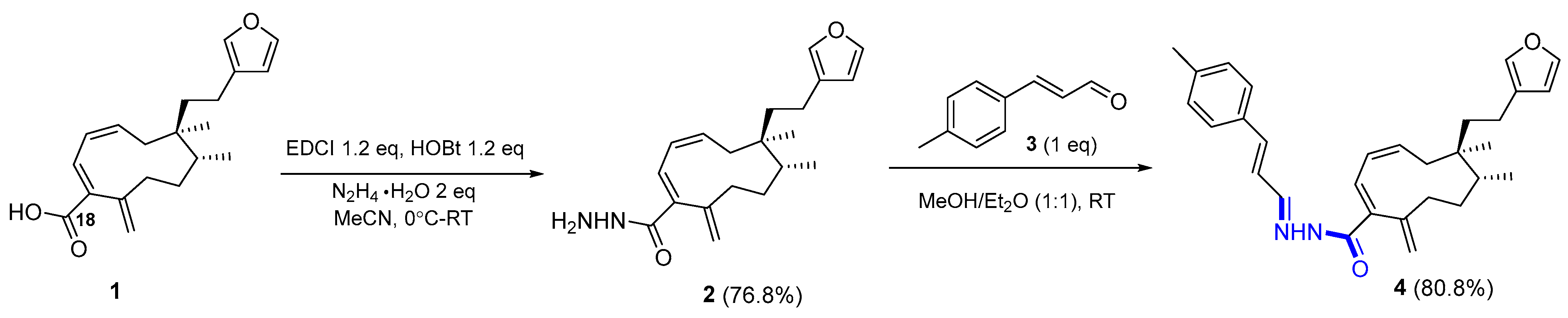
Compound 4 was synthesized in two steps outlined in Scheme 1. Briefly, SA was condensed with hydrazine hydrate in the presence of 1-hydroxybenzotriazole (HOBt) and 1-(3-dimethylaminopropyl)-3-ethylcarbodiimide hydrochloride (EDCI) to produce the acylhydrazide intermediate 2 [14]. Following purification by silica gel column chromatography, intermediate 2 was subsequently subjected to a Schiff-base condensation with p-methylcinnamaldehyde at room temperature. The desired acylhydrazone 4 was finally furnished after flash column chromatography on silica gel [15].
The structure of target molecule 4 was elucidated based on NMR and HRMS spectral data. In the 1H NMR spectrum, the characteristic signals for SA were observed, including a furan-3-yl group [δH 7.25 (s, 1H), 7.22 (s, 1H), 6.27 (s, 1H)], three consecutive double bonds [δH 7.36 (overlap), 5.92 (d, J = 10.8 Hz), 5.42 (tdd, J = 12.1, 4.4, 1.9 Hz), 5.27 (s, 1H), 5.06 (s, 1H)], and two methyl groups [δH 0.77 (d, J = 6.8 Hz, 3H), 0.72 (s, 3H)]. In addition, the signals for the hydrazinic NH group [δH 8.74 (d, J = 6.5 Hz)], the trans-CH=CH-C=N [δH 7.86 (d, J = 9.1 Hz), 7.03 (dd, J = 16.0, 9.1 Hz), 6.85 (d, J = 15.9 Hz)] segment and the 4-methylphenyl group [δH 7.36 (overlap), 7.17 (d, J = 7.8 Hz), 2.36 (s)] were consistent with successful hydrazonation. In the 13C NMR spectrum, aside from the resonances fully consistent with the 1H NMR assignments, particular attention was directed to the acylhydrazone carbonyl carbon at δC 162.1. This signal exhibited a pronounced upfield shift relative to the native C-18 carboxylic acid resonance in unmodified SA, an effect readily attributable to the newly formed -CONH- group [16]. This diagnostic displacement provides unambiguous spectroscopic corroboration for the successful functionalization at the C-18 position. High-resolution mass spectrometry (HRMS) showed an [M+H]+ ion at m/z 457.2857 (calcd for C30H37N2O2+, 457.2855), providing definitive mass evidence for the proposed constitution.
With the weak anti-breast cancer activity of the parent compound SA in the preliminary studies, we plan to synthesize a series of target compound analogs following the established procedure prior to anti-breast cancer activity evaluation, with the aim of discovering anti-breast cancer lead molecules.

3. Materials and Methods

3.1. General Information

All the solvents and reagents were commercially purchased without further purification. Column chromatography (CC) was performed on a self-packed column with silica gel 200–300 mesh (Qingdao Ocean Chemical Engineering Company, Qingdao, China). Thin-layer chromatography (TLC) analyses were carried out with spots visualized by a UV lamp at 254 nm. Solvent evaporation and concentration were performed under reduced pressure using an EYELA Rotary Evaporator N-1300D (Tokyo Rikakikai Co., Ltd., Tokyo, Japan). NMR spectra were recorded in deuterium solvent on a Bruker Avance Neo 600 MHz (Bruker, Ettlingen, Germany) NMR spectrometer at room temperature. Chemical shifts (δ) were expressed in ppm with tetramethylsilane (TMS) as an internal standard, and coupling constant values (J) were calculated in Hz. HRMS spectra were obtained on a Waters G2-S (quadrupole time-of-flight) mass spectrometer (Waters Corporation, Milford, MA, USA). SA was isolated in our laboratory following the previously reported separation procedure [13].

3.2. Synthesis of 6-(2-(Furan-3-yl)ethyl)-6,7-dimethyl-10-methylenecyclodeca-1,3-diene-1-carbohydrazide (2)

SA (1, 0.2 mmol, 62.8 mg) was dissolved in acetonitrile at 0 °C. To this solution, HOBt (1.2 equiv) and EDCI (1.2 equiv) were sequentially added. After stirring at 0 °C until a clear solution was obtained, hydrazine hydrate (2.0 equiv) was added dropwise. The reaction mixture was allowed to warm to room temperature and stirred for 3 h, with the progress monitored by TLC. Upon completion, the mixture was diluted with water and extracted with ethyl acetate. The combined organic layers were washed once with saturated aqueous NaCl, dried over anhydrous Na2SO4, and concentrated under reduced pressure. The crude product was purified by silica gel column chromatography eluting with CH2Cl2/MeOH (20:1, v/v) to produce the corresponding SA hydrazide intermediate 2 [14].
6-(2-(furan-3-yl)ethyl)-6,7-dimethyl-10-methylenecyclodeca-1,3-diene-1-carbohydrazide (2): pale yellow solid, yield: 50.4 mg, 76.8%. Rf = 0.32 (petroleum ether:AcOEt:Et3N 1:1:0.01 v/v/v); 1H NMR (400 MHz, CDCl3) δ 7.33 (d, J = 1.7 Hz, 1H), 7.20 (overlap, 2H), 7.08 (d, J = 2.3 Hz, 1H), 6.25 (d, J = 1.8 Hz, 1H), 5.88 (d, J = 11.5 Hz, 1H), 5.39 (tdd, J = 12.1, 4.3, 1.9 Hz, 1H), 5.17 (s, 1H), 4.95 (s, 1H), 3.97 (s, 2H), 2.81–2.31 (m, 3H), 2.27 (t, J = 13.2 Hz, 1H), 2.11 (td, J = 13.7, 2.6 Hz, 1H), 1.81 (d, J = 14.0 Hz, 1H), 1.61 (td, J = 13.9, 2.8 Hz, 1H), 1.56–1.46 (m, 1H), 1.46–1.39 (m, 1H), 1.38–1.28 (m, 1H), 0.81 (dddd, J = 14.2, 9.2, 4.8, 2.6 Hz, 1H), 0.74 (d, J = 6.8 Hz, 3H), 0.70 (s, 3H); 13C NMR (101 MHz, CDCl3) δ 166.9, 144.4, 142.8, 138.5, 137.8, 136.8, 128.3, 127.5, 125.8, 120.1, 111.1, 37.94, 37.86, 35.8, 35.6, 34.2, 29.1, 19.6, 18.6, 13.8.

3.3. Synthesis of 6-(2-(Furan-3-yl)ethyl)-6,7-dimethyl-10-methylene-N’-((E)-3-(p-tolyl)allylidene)cyclodeca-1,3-diene-1-carbohydrazide (4)

The intermediate 2 (0.1 mmol) and the p-methylcinnamaldehyde (1.0 equiv) were dissolved in a mixed solvent of methanol and diethyl ether (1:1, v/v). The solution was stirred at room temperature overnight. Reaction completion was confirmed by TLC. Water was then added to the system, and the mixture was extracted with ethyl acetate. The combined organic phases were washed with brine, dried over anhydrous Na2SO4, and evaporated under reduced pressure. The residue was purified by flash column chromatography on silica gel using petroleum ether/ethyl acetate (5:1, v/v) as the eluent to yield the target molecule 4 [15].
6-(2-(furan-3-yl)ethyl)-6,7-dimethyl-10-methylene-N’-((E)-3-(p-tolyl)allylidene)cyclodeca-1,3-diene-1-carbohydrazide (4): white liquid, yield: 36.9 mg, 80.8%. Rf = 0.35 (petroleum ether:AcOEt 5:1 v/v); 1H NMR (600 MHz, CDCl3) δ 8.74 (d, J = 6.5 Hz, 1H), 7.86 (d, J = 9.1 Hz, 1H), 7.36–7.33 (m, 3H), 7.25 (s, 1H), 7.22 (s, 1H), 7.17 (d, J = 7.8 Hz, 2H), 7.03 (dd, J = 16.0, 9.1 Hz, 1H), 6.85 (d, J = 15.9 Hz, 1H), 6.27 (s, 1H), 5.92 (d, J = 10.8 Hz, 1H), 5.42 (tdd, J = 12.1, 4.4, 1.9 Hz, 1H), 5.27 (s, 1H), 5.06 (s, 1H), 2.46–2.38 (m, 2H), 2.36 (s, 3H), 2.31 (t, J = 13.1 Hz, 1H), 2.17 (t, J = 12.3 Hz, 1H), 1.83 (d, J = 14.7 Hz, 1H), 1.68 (dd, J = 25.4, 13.2 Hz, 2H), 1.53 (ddd, J = 13.5, 10.9, 5.8 Hz, 1H), 1.47–1.39 (m, 1H), 1.35 (dt, J = 13.3, 6.6 Hz, 1H), 0.91–0.81 (m, 1H), 0.77 (d, J = 6.8 Hz, 3H), 0.72 (s, 3H); 13C NMR (151 MHz, CDCl3) δ 162.1, 149.9, 144.7, 142.8, 140.5, 139.6, 138.7, 138.6, 138.0, 133.1, 129.8, 128.5, 127.6, 127.3, 125.9, 124.1, 120.7, 111.2, 38.0, 37.9, 35.9, 35.7, 34.5, 29.1, 21.5, 19.7, 18.7, 13.9; HRMS (ESI+): m/z 457.2857 (Calcd. for C30H37N2O2 [M+H]+, err 0.4 ppm).

4. Conclusions

In summary, an acylhydrazone derivative of SA was successfully synthesized via a concise two-step sequence, as detailed in the experimental section. As a bioactive neo-clerodane diterpenoid featuring a distinctive 5,10-seco skeleton, SA was strategically modified through initial hydrazide formation, followed by a subsequent condensation with p-methylcinnamaldehyde. The structural integrity of the final conjugate was rigorously authenticated by comprehensive spectroscopic analyses, including 1H NMR, 13C NMR, and HRMS. This work not only validates a straightforward semi-synthetic strategy for modifying this unique scaffold but also provides a valuable molecular entity for advancing natural product-based drug discovery.

Supplementary Materials

The following supporting information can be downloaded online. Figure S1: 1H NMR spectrum of compound 2 (400 MHz, CDCl3); Figure S2: 13C NMR spectrum of compound 2 (101 MHz, CDCl3); Figure S3: 1H NMR spectrum of compound 4 (600 MHz, CDCl3); Figure S4: 13C NMR spectrum of compound 4 (151 MHz, CDCl3); Figure S5: HRMS spectrum of compound 4.

Author Contributions

Conceptualization, T.L.; methodology, M.L. and H.C.; validation, L.S.; investigation, M.L. and H.C.; data curation, M.L. and L.S.; writing—original draft preparation, M.L.; writing—review and editing, T.L.; supervision, T.L.; project administration, T.L.; funding acquisition, T.L. All authors have read and agreed to the published version of the manuscript.

Funding

Youth Guidance Program for Basic Research from the Department of Science and Technology of Guizhou Province, grant number QKHJCQN [2025]333.

Data Availability Statement

The data presented in this study are available in this article and supporting Supplementary Materials.

Acknowledgments

The authors gratefully acknowledge the National Demonstration Center for Experimental Pharmacy of Chinese Materia Medica (Ethnopharmacy) from Guizhou University of Traditional Chinese Medicine for providing the necessary facilities and support.

Conflicts of Interest

The authors declare no conflicts of interest.

References

  1. Boufridi, A.; Quinn, R.J. Harnessing the properties of natural products. Annu. Rev. Pharmacol. Toxicol. 2018, 58, 451–470. [Google Scholar] [CrossRef] [Scilit] [PubMed]
  2. Newman, D.J.; Cragg, G.M. Natural products as sources of new drugs over the nearly four decades from 01/1981 to 09/2019. J. Nat. Prod. 2020, 83, 770–803. [Google Scholar] [CrossRef] [Scilit] [PubMed]
  3. Ding, Y.; Xue, X. Medicinal chemistry strategies for the modification of bioactive natural products. Molecules 2024, 29, 689. [Google Scholar] [CrossRef] [Scilit] [PubMed]
  4. Gagare, S.; Patil, P.; Jain, A. Natural product-inspired strategies towards the discovery of novel bioactive molecules. Future J. Pharm. Sci. 2024, 10, 55. [Google Scholar] [CrossRef] [Scilit]
  5. Luo, Z.; Yin, F.; Wang, X.; Kong, L. Progress in approved drugs from natural product resources. Chin. J. Nat. Med. 2024, 22, 195–211. [Google Scholar] [CrossRef] [Scilit] [PubMed]
  6. Xiao, Z.; Morris-Natschke, S.L.; Lee, K.H. Strategies for the optimization of natural leads to anticancer drugs or drug candidates. Med. Res. Rev. 2016, 36, 32–91. [Google Scholar] [CrossRef] [Scilit] [PubMed]
  7. Acharya, A.; Nagpure, M.; Roy, N.; Gupta, V.; Patranabis, S.; Guchhait, S.K. How to nurture natural products to create new therapeutics: Strategic innovations and molecule-to-medicinal insights into therapeutic advancements. Drug Discov. Today 2024, 29, 104221. [Google Scholar] [CrossRef] [Scilit] [PubMed]
  8. Socea, L.-I.; Barbuceanu, S.-F.; Pahontu, E.M.; Dumitru, A.C.; Nitulescu, G.M.; Sfetea, R.C.; Apostol, T.-V. Acylhydrazones and their biological activity: A review. Molecules 2022, 27, 8719. [Google Scholar] [CrossRef] [Scilit] [PubMed]
  9. Thota, S.; Rodrigues, D.A.; Pinheiro, P.S.M.; Lima, L.M.; Fraga, C.A.M.; Barreiro, E.J. N-acylhydrazones as drugs. Bioorg. Med. Chem. Lett. 2018, 28, 2797–2806. [Google Scholar] [CrossRef] [Scilit] [PubMed]
  10. Noufiya, T.N.; Sasi, S. Therapeutic potential of dihydrazones and their metal complexes: A comprehensive review. Polyhedron 2026, 283, 117830. [Google Scholar] [CrossRef] [Scilit]
  11. Skroban, J.; Kruk-Slomka, M.; Popiolek, L. Exploring acylhydrazones’ properties against neurodegenerative diseases and other clinical applications: A review. Pharmaceuticals 2026, 19, 679. [Google Scholar] [CrossRef] [Scilit] [PubMed]
  12. Cai, J.; Pan, B.-W.; Zheng, L.-L.; Tian, Y.-P.; Dong, Z.-C.; Liu, L.-J.; Feng, T.-T.; Zhou, Y.; Liu, X.-W.; Shi, Y. Synthesis and antitumor evaluation of oleanolic acid acylhydrazone derivatives. Mol. Divers. 2026, 30, 4355–4369. [Google Scholar] [CrossRef] [Scilit] [PubMed]
  13. Li, Y.; Zhao, N.; Ye, J.; Xu, F.; Li, T.; Lang, T. The crystal structure of strictic acid, C20H26O3. Z. Krist.-N. Cryst. Struct. 2023, 238, 177–179. [Google Scholar] [CrossRef] [Scilit]
  14. Carvalho, S.A.; Feitosa, L.O.; Soares, M.; Costa, T.E.; Henriques, M.G.; Salomão, K.; de Castro, S.L.; Kaiser, M.; Brun, R.; Wardell, J.L.; et al. Design and synthesis of new (E)-cinnamic N-acylhydrazones as potent antitrypanosomal agents. Eur. J. Med. Chem. 2012, 54, 512–521. [Google Scholar] [CrossRef] [Scilit] [PubMed]
  15. Zhao, Y.; Chen, J.-R.; Xiao, W.-J. Synthesis of hydrazide-containing chroman-2-ones and dihydroquinolin-2-ones via photocatalytic radical cascade reaction of aroylhydrazones. Org. Lett. 2016, 18, 6304–6307. [Google Scholar] [CrossRef] [Scilit] [PubMed]
  16. Tandon, S.; Rastogi, R.P. Strictic acid, a novel diterpene from Conyza stricta. Phytochemistry 1979, 18, 494–495. [Google Scholar] [CrossRef] [Scilit]
Scheme 1. Synthetic pathway for 6-(2-(furan-3-yl)ethyl)-6,7-dimethyl-10-methylene-N’-((E)-3-(p-tolyl)allylidene)cyclodeca-1,3-diene-1-carbohydrazide (4).
Molbank 2026 m2229 sch001
Disclaimer/Publisher’s Note: The statements, opinions and data contained in all publications are solely those of the individual author(s) and contributor(s) and not of MDPI and/or the editor(s). MDPI and/or the editor(s) disclaim responsibility for any injury to people or property resulting from any ideas, methods, instructions or products referred to in the content.