Short Note

Bis([1,2,5]thiadiazolo)[3,4-f:3′,4′-h]quinoxaline-8,9-dicarbonitrile

by
Anastasiya S. Yushkova
,
Ekaterina A. Knyazeva
* and
Oleg A. Rakitin
N. D. Zelinsky Institute of Organic Chemistry Russian Academy of Sciences, 47 Leninsky Prospekt, Moscow 119991, Russia
*
Author to whom correspondence should be addressed.
Molbank 2026, 2026(4), M2214; https://doi.org/10.3390/M2214
Submission received: 14 July 2026 / Revised: 28 July 2026 / Accepted: 31 July 2026 / Published: 4 August 2026

Abstract

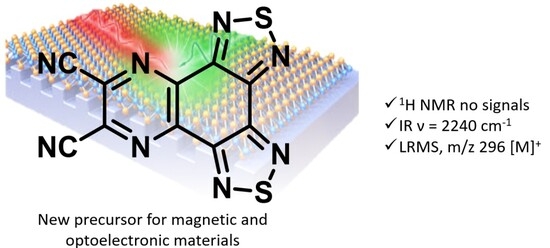
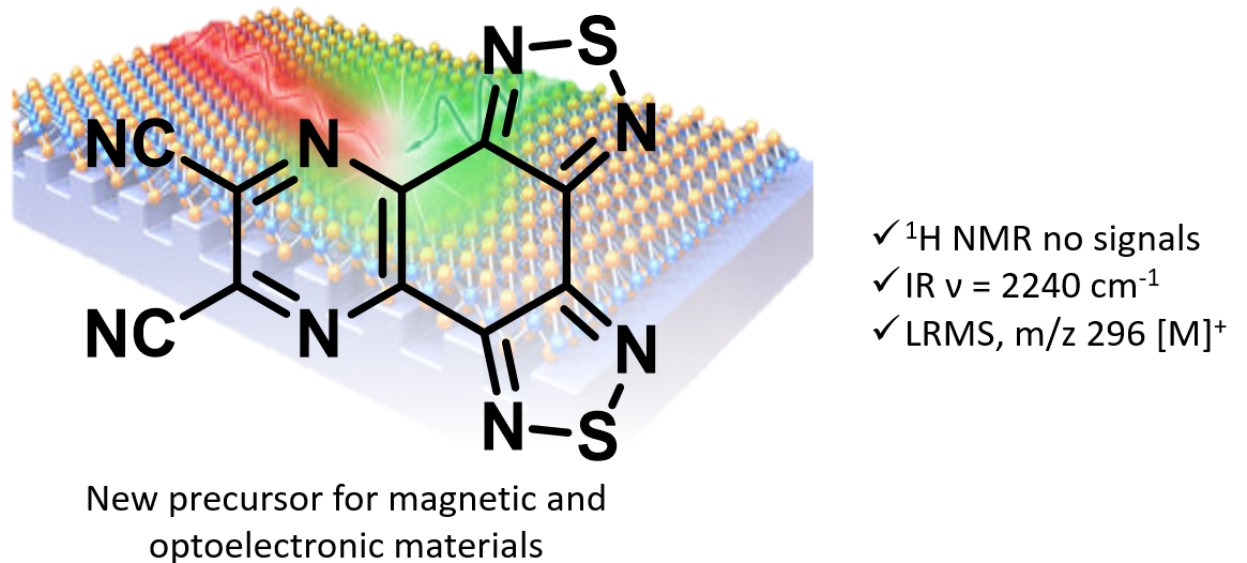
Compounds containing electron-withdrawing dicyanopyrazine and 1,2,5-chalcogenadiazole fragments are promising for the design of magnetic and optoelectronic materials. In this paper, bis([1,2,5]thiadiazolo)[3,4-f:3′,4′-h]quinoxaline-8,9-dicarbonitrile was prepared via Körner–Hinsberg condensation of benzo[1,2-c:3,4-c′]bis([1,2,5]thiadiazole)-4,5-dione with 2,3-diaminomaleonitrile in the presence of catalytic amounts of TsOH in refluxing ethanol. The structure of the newly synthesized compound was established via elemental analysis, mass spectrometry, 13C NMR, and IR spectroscopy.

Graphical Abstract

1. Introduction

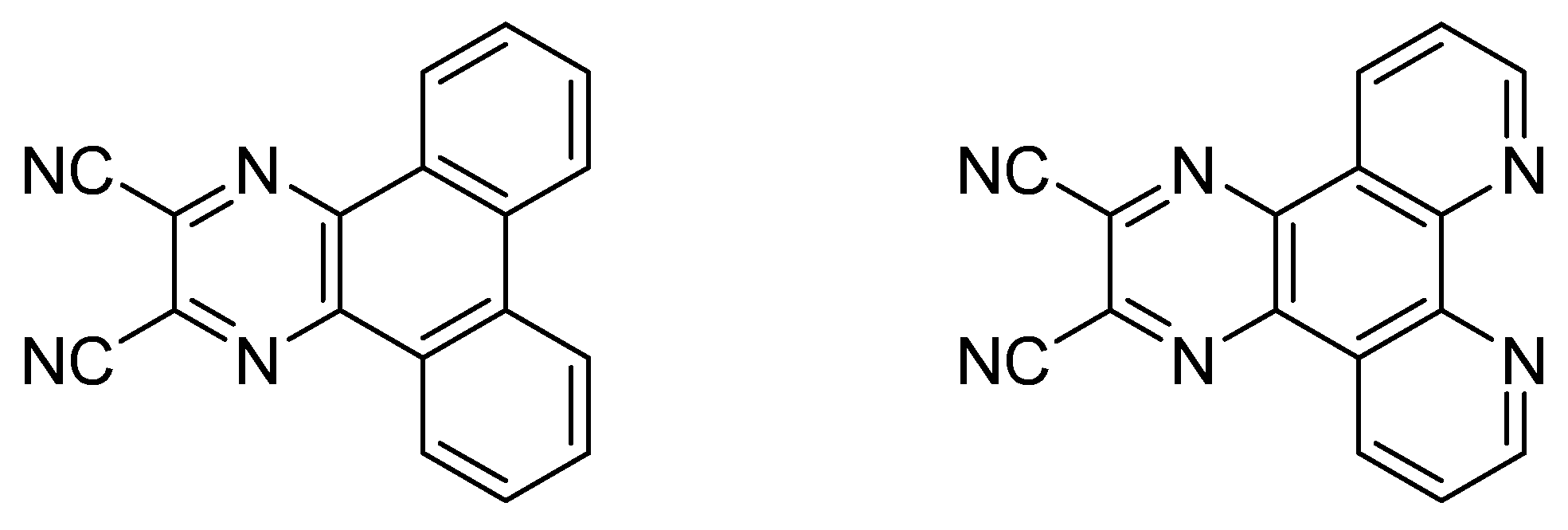
Fused 2,3-dicyanopyrazines have been actively studied. Among these compounds, 6,9-alkoxydithieno[2,3-f:3′,2′-h]quinoxaline-2,3-dicarbonitriles have been used as photocatalysts to enable the photoredox chemodivergent reduction in nitroaromatics to nitroso, bis-(N,O-diacetyl)-N-arylhydroxylamine, azoxy, azo and amino derivatives [1,2]. 13,14-Dihydroindolo[2,3-a]pyrazino[2,3-c]carbazole-6,7-dicarbonitrile was proposed as a colorimetric sensor for the visual detection of fluoride anion [3]. 1,2,5-Chalcogenadiazoles fused with benzene and various heterocycles constitute an important class of heterocyclic compounds owing to their broad applications in science and technology [4,5]. Also of great interest are compounds containing two electron-withdrawing fragments in the molecule: dicyanopyrazine and 1,2,5-chalcogenadiazole. 1,2,5-Selenadiazolo-[3,4-b]pyrazine-5,6-dicarbonitrile was used for the design and synthesis of anionic complexes with halide anions featuring Se–X chalcogen bonding [6] and radical anionic homospin [Na(18-crown-6)]+ salt, which revealed weak antiferromagnetic exchange interactions [7]. Macrocyclic complexes of tetrapyrazinoporphyrazines were prepared by template cyclotetramerization of 1,2,5-thiadiazolo-[3,4-b]pyrazine-5,6-dicarbonitrile in the presence of Mg butoxide and indium(III) chloride [8]. Herein, we report the synthesis of bis([1,2,5]thiadiazolo)[3,4-f:3′,4′-h]quinoxaline-8,9-dicarbonitrile 1 as a new small molecule containing two electron-withdrawing dicyanopyrazine and 1,2,5-thiadiazole fragments that may serve as a promising precursor for the design of new magnetic and optoelectronic materials [9,10]. For example, polycyclic dicyanopyrazines such as dibenzo[f,h]quinoxaline-2,3-dicarbonitrile and pyrazino[2,3-f][1,10]phenanthroline-2,3-dicarbonitrile (Figure 1) have previously been successfully employed as organic components in TADF OLEDs [11,12,13], as well as in NIR TADF OLEDs [14,15].

2. Results and Discussion

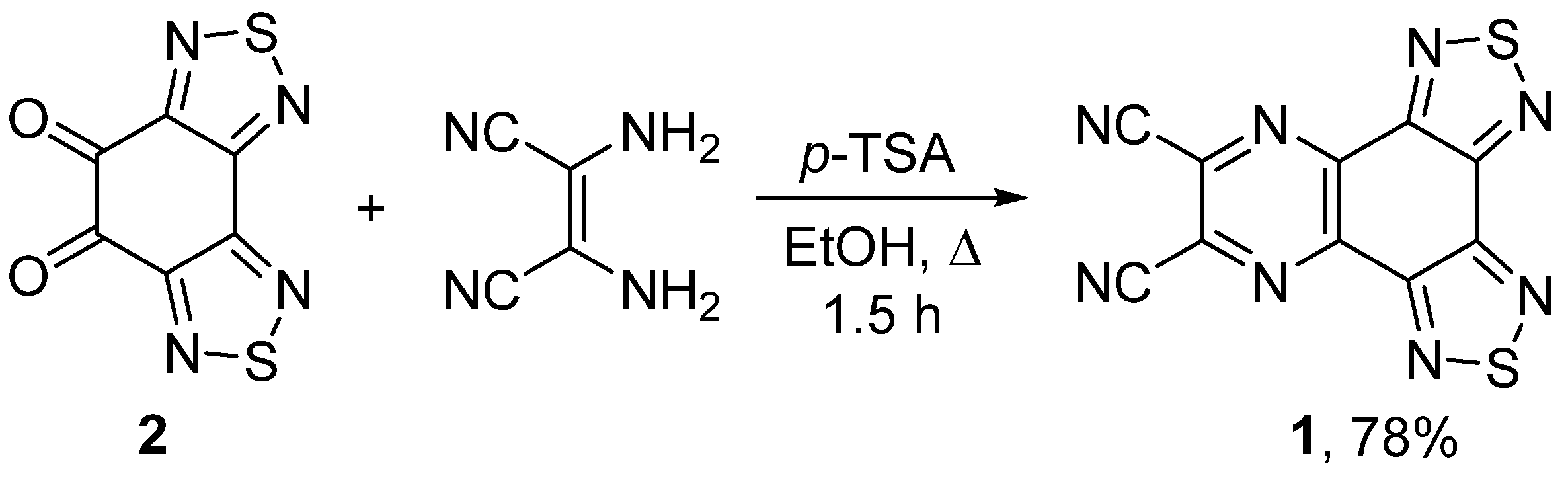
To synthesize the target bis([1,2,5]thiadiazolo)[3,4-f:3′,4′-h]quinoxaline-8,9-dicarbonitrile 1, various Körner–Hinsberg condensation conditions of benzo[1,2-c:3,4-c′]bis([1,2,5]thiadiazole)-4,5-dione 2 [9] with 2,3-diaminomaleonitrile were investigated (Table 1, Scheme 1). The reaction proceeded only under acidic conditions, and when refluxing in acetic acid, despite complete conversion of the starting diketone 2, the yield of the product is low (46%, entry 1). Hydrochloric acid as a catalyst also afforded a low yield of the product (25%, entry 3), while the addition of TsOH resulted in a substantial increase in the yield of the target product 1. Increasing the catalytic excess of the acid (entry 5) or the reaction time (entry 6) did not significantly improve the yield. Thus, refluxing in ethanol for 1.5 h in the presence of a catalytic amount of TsOH (0.05 equiv.) afforded compound 1 in a high yield of 78% (entry 4).
The structure of bis([1,2,5]thiadiazolo)[3,4-f:3′,4′-h]quinoxaline-8,9-dicarbonitrile 1 was established via elemental analysis, mass spectrometry, 13C NMR, and IR spectroscopy. Elemental analysis and mass spectrometry confirm the molecular formula of compound 1. The IR spectrum showed the absence of amino and keto groups and the presence of a cyano group at 2240 cm−1.
In conclusion, bis([1,2,5]thiadiazolo)[3,4-f:3′,4′-h]quinoxaline-8,9-dicarbonitrile 1 was synthesized via the reaction of benzo[1,2-c:3,4-c′]bis([1,2,5]thiadiazole)-4,5-dione 2 and 2,3-diaminomaleonitrile in the presence of catalytic amounts of TsOH in ethanol. The resulting compound is a promising precursor for the design of new magnetic and optoelectronic materials.

3. Materials and Methods

Benzo[1,2-c:3,4-c′]bis([1,2,5]thiadiazole)-4,5-dione [16] was prepared according to the published method and validated by spectral data. 2,3-Diaminomaleonitrile and the other reagents and solvents were purchased from commercial sources and used as received. Elemental analysis was performed on a Perkin Elmer 2400 Elemental Analyser (Perkin Elmer-Inc., Waltham, MA, USA). The melting point was determined on a Kofler hot-stage apparatus and is uncorrected. 1H and 13C NMR spectra were recorded on a Bruker AM-300 spectrometer (Bruker AXS Handheld Inc., Kennewick, WA, USA) (at frequencies of 300.1 and 75.5 MHz, respectively) in DMSO-d6 solution, with the residual solvent signal used as the internal standard. The mass spectrum (EI, 70 eV) was obtained with a Finnigan MAT INCOS 50 instrument (Hazlet, NJ, USA). The IR spectrum was recorded with a Bruker “Alpha-T” instrument (Bruker Corporation, Billerica, MA, USA) in KBr pellet.

Experimental Procedure for the Synthesis of Compound 1

A mixture of benzo[1,2-c:3,4-c′]bis([1,2,5]thiadiazole)-4,5-dione (0.892 mmol, 200 mg), 2,3-diaminomaleonitrile (0.892 mmol, 96 mg), and p-toluenesulfonic acid (0.045 mmol, 9 mg) in ethanol (10 mL) was stirred for 1.5 h at reflux. The reaction mixture was then cooled to 0 °C and held for 30–60 min. The resulting precipitate was filtered off under vacuum, washed with ice-cold ethanol (2 × 3 mL), and air-dried. The crude product was dissolved in a minimal volume (5 mL) of boiling chloroform. The hot solution was filtered, and methanol was added to the filtrate. The mixture was cooled to 0 °C, and the resulting precipitate was filtered off, washed with cold methanol (2 × 2 mL), and air-dried to constant weight. Yield: 206 mg (78%), beige solid, m.p. > 300 °C (decomp.), Rf = 0.2 (ethanol). 1H NMR (300 MHz, DMSO-d6): no signals observed. 13C NMR (75 MHz, DMSO-d6): δ 152.4, 150.1, 139.7, 133.0, 114.2. IR (ν, cm−1): 2240, 2214, 1555, 1440, 1340, 1289, 1195, 1156, 1091, 826. LRMS, m/z (%): 296 [M]+ (100), 244 (6), 192 (8), 116 (12), 108 (15), 84 (21), 64 (26), 46 (30), 32 (65). Anal. Calcd. for C10N8S2: C 40.54; N, 37.82; S, 21.64. Found: C, 40.35; N, 37.65; S, 21.45.

Supplementary Materials

The following supporting information can be downloaded online: copies of the 1H, 13C NMR, IR, and mass spectra for the compound 1. Figure S1. 1H NMR spectrum of bis([1,2,5]thiadiazolo)[3,4-f:3′,4′-h]quinoxaline-8,9-dicarbonitrile 1. Figure S2. 13C NMR spectrum of bis([1,2,5]thiadiazolo)[3,4-f:3′,4′-h]quinoxaline-8,9-dicarbonitrile 1. Figure S3. IR spectrum of bis([1,2,5]thiadiazolo)[3,4-f:3′,4′-h]quinoxaline-8,9-dicarbonitrile 1. Figure S4. LRMS spectrum of bis([1,2,5]thiadiazolo)[3,4-f:3′,4′-h]quinoxaline-8,9-dicarbonitrile 1.

Author Contributions

Conceptualization, methodology, O.A.R.; software, E.A.K.; validation, O.A.R.; formal analysis, investigation, E.A.K. and A.S.Y.; resources, A.S.Y.; data curation, E.A.K.; writing—original draft preparation, O.A.R.; writing—review and editing, O.A.R.; visualization, O.A.R.; supervision, O.A.R.; project administration, O.A.R.; funding acquisition, O.A.R. All authors have read and agreed to the published version of the manuscript.

Funding

This research was funded by the Russian Science Foundation (grant number: 25-23-01216).

Data Availability Statement

The original contributions presented in this study are included in the article/Supplementary Material. Further inquiries can be directed to the corresponding author.

Conflicts of Interest

The authors declare no conflicts of interest.

References

  1. Burešová, Z.; Grygarová, M.; Prokopová, E.; Klikar, M.; Pytela, O.; Váňa, J.; Mansur Muhammed Fahim, A.; Jana, K.; Zubova, E.; Bartáček, J.; et al. Divergent Photoreduction of Nitroaromatic Compounds Catalysed by Dithienoquinoxaline. J. Catal. 2025, 445, 116033. [Google Scholar] [CrossRef]
  2. Bures, F.; Profopova, E.; Buresova, Z.; Grigarova, M. Fused Quinoline-2,3-dicarbonitrile Derivatives, Their Photochemical Synthesis and Use Thereof. Patent WO 2026/082222, 23 April 2026. [Google Scholar]
  3. Liu, X.-M.; Zhao, Q.; Li, Y.; Song, W.-C.; Li, Y.-P.; Chang, Z.; Bu, X.-H. Two New Indole Derivatives as Anion Receptors for Detecting Fluoride Ion. Chin. Chem. Lett. 2013, 24, 962–966. [Google Scholar] [CrossRef]
  4. Rakitin, O.A. Chapter Six-Fused 1,2,5-Thia- and 1,2,5-Selenadiazoles with Extended Conjugation: Synthesis and Application in Materials Science. Adv. Heterocycl. Chem. 2026, 149, 327–388. [Google Scholar] [CrossRef]
  5. Rakitin, O.A. Chapter Four-Strategies for the Annulation of Five-Membered Sulfur-Nitrogen Rings to Benzene and Heterocycles. Adv. Heterocycl. Chem. 2024, 142, 227–281. [Google Scholar] [CrossRef]
  6. Radiush, E.A.; Pritchina, E.A.; Chulanova, E.A.; Dmitriev, A.A.; Bagryanskaya, I.Y.; Slawin, A.M.Z.; Woollins, J.D.; Gritsan, N.P.; Zibarev, A.V.; Semenov, N.A. Chalcogen-Bonded Donor–Acceptor Complexes of 5,6-Dicyano[1,2,5]Selenadiazolo[3,4-b]Pyrazine with Halide Ions. New J. Chem. 2022, 46, 14490–14501. [Google Scholar] [CrossRef]
  7. Semenov, N.A.; Radiush, E.A.; Chulanova, E.A.; Slawin, A.M.Z.; Woollins, J.D.; Kadilenko, E.M.; Bagryanskaya, I.Y.; Irtegova, I.G.; Bogomyakov, A.S.; Shundrin, L.A.; et al. Design, Synthesis and Isolation of a New 1,2,5-Selenadiazolidyl and Structural and Magnetic Characterization of Its Alkali-Metal Salts. New J. Chem. 2019, 43, 16331–16337. [Google Scholar] [CrossRef]
  8. Mikhailov, M.S.; Hamdoush, M.; Islyaikin, M.K.; Koifman, O.I.; Stuzhin, P.A. 1,2,5-Thiadiazolo[3,4-b]Pyrazine-5,6-Dicarbonitrile and Derived Porphyrazines: Synthesis and Electrochemical Study. Arkivoc 2017, 2017, 130–139. [Google Scholar] [CrossRef]
  9. Müller, M.; Koser, S.; Tverskoy, O.; Rominger, F.; Freudenberg, J.; Bunz, U.H.F. Thiadiazolo-Azaacenes. Chem. Eur. J. 2019, 25, 6082–6086. [Google Scholar] [CrossRef] [PubMed]
  10. Verbitskiy, E.V.; Krynina, E.M.; Kvashnin, Y.A.; Charushin, V.N. 1,4-Diazatriphenylene and Its Hetero-Fused Analogs: Synthesis and Applications. Molecules 2026, 31, 2197. [Google Scholar] [CrossRef] [PubMed]
  11. Cao, X.; Zhang, D.; Zhang, S.; Tao, Y.; Huang, W. CN-Containing Donor–Acceptor-Type Small-Molecule Materials for Thermally Activated Delayed Fluorescence OLEDs. J. Mater. Chem. C 2017, 5, 7699–7714. [Google Scholar] [CrossRef]
  12. Zielinska, A.; Bosiak, M. A Compound, an Organic Light Emitting Diode Comprising the Derivates, a Use of the Diode, and a Consumer Product. European Patent EP 4674855 A1, 7 January 2026. [Google Scholar] [PubMed]
  13. Yu, X.; Zheng, S.; Wei, D.; Tang, C.; Zhou, R.; Ding, H.; Chen, Z. An Organic Electroluminescent Compound and Its Application. Chinese Patent CN 121537399 A, 17 February 2026. [Google Scholar]
  14. Wang, S.; Yan, X.; Cheng, Z.; Zhang, H.; Liu, Y.; Wang, Y. Highly Efficient Near-Infrared Delayed Fluorescence Organic Light Emitting Diodes Using a Phenanthrene-Based Charge-Transfer Compound. Angew. Chem. Int. Ed. 2015, 54, 13068–13072. [Google Scholar] [CrossRef] [PubMed]
  15. Kim, J.H.; Yun, J.H.; Lee, J.Y. Recent Progress of Highly Efficient Red and Near-Infrared Thermally Activated Delayed Fluorescent Emitters. Adv. Opt. Mater. 2018, 6, 1800255. [Google Scholar] [CrossRef]
  16. Mataka, S.; Ikezaki, Y.; Shimojo, Y.; Tashiro, M.; Tori-I, A. 4H,5H-Benzo[1,2-c;3,4-c′]Bis[1,2,5]Thiadiazole-4,5-dione. Chem. Ber. 1993, 126, 2767–2769. [Google Scholar] [CrossRef]
Figure 1. Polycyclic dicyanopyrazines.
Molbank 2026 m2214 g001
Scheme 1. Synthesis of bis([1,2,5]thiadiazolo)[3,4-f:3′,4′-h]quinoxaline-8,9-dicarbonitrile 1.
Molbank 2026 m2214 sch001
Table 1. Reaction of benzo[1,2-c:3,4-c′]bis([1,2,5]thiadiazole)-4,5-dione 2 with 2,3-diaminomaleonitrile.
EntrySolventCatalyst (Equiv.)T, °CTime, hYield of 1, %
1AcOH-1181.546
2EtOH-7840
3EtOHconc. HCl (0.05)781.525
4EtOHTsOH (0.05)781.578
5EtOHTsOH (0.2)781.572
6EtOHTsOH (0.05)78464
Disclaimer/Publisher’s Note: The statements, opinions and data contained in all publications are solely those of the individual author(s) and contributor(s) and not of MDPI and/or the editor(s). MDPI and/or the editor(s) disclaim responsibility for any injury to people or property resulting from any ideas, methods, instructions or products referred to in the content.