Short Note

(Z)-3′-(3-Chloro-4-fluorophenyl)-5-fluoro-5′-((6-methoxypyridin-3-yl)methylene)spiro[indoline-3,2′-thiazolidine]-2,4′-dione

1
Department of Organic Chemistry, Medical University of Lublin, 4A Chodzki Street, 20-093 Lublin, Poland
2
Department of Pharmaceutical, Organic and Bioorganic Chemistry, Danylo Halytsky Lviv National Medical University, 69 Pekarska St., 79010 Lviv, Ukraine
3
Molecular Design Center, Danylo Halytsky Lviv National Medical University, Pekarska 69, 79010 Lviv, Ukraine
*
Author to whom correspondence should be addressed.
Molbank 2026, 2026(4), M2212; https://doi.org/10.3390/M2212
Submission received: 22 June 2026 / Revised: 29 July 2026 / Accepted: 31 July 2026 / Published: 4 August 2026

Abstract

A novel spiro[indoline-3,2′-thiazolidine]-2,4′-dione derivative incorporating 3-chloro-4-fluorophenyl and 6-methoxypyridin-3-yl fragments was synthesized and characterized. The synthetic route involved a two-step procedure, including the preparation of the spirocyclic scaffold via cyclocondensation of 5-fluoroisatin with 3-chloro-4-fluoroaniline in the presence of mercaptoacetic acid, followed by Knoevenagel condensation with 6-methoxypyridine-3-carbaldehyde. The reactions were carried out under reflux conditions and afforded the desired product in a satisfactory yield after purification by recrystallization. The structure of the synthesized compound was confirmed by 1H and 13C NMR spectroscopy, LC–MS analysis, FT-IR and elemental analysis, all of which were consistent with the proposed molecular structure. The presence of multiple pharmacologically relevant heterocyclic motifs within a single framework suggests that this compound may serve as a useful scaffold for further biological evaluation.

1. Introduction

In recent years, heterocyclic compounds have found numerous applications in medicinal chemistry due to their biological significance and therapeutic potential [1]. Among these, isatin, 4-thiazolidinone and pyridine derivatives have attracted considerable attention due to their broad spectrum of biological activities and their role as biologically relevant structural scaffolds in the design of new compounds with therapeutic potential [2,3,4,5].
A large number of 4-thiazolidinone derivatives have been reported to exhibit antibacterial, antifungal, anticonvulsant, and anticancer activities, underscoring the pharmacological importance of this heterocyclic scaffold [6,7,8]. Similarly, isatin derivatives have attracted considerable interest due to their diverse pharmacological properties, including antimicrobial and anticancer activities [9,10]. Pyridine derivatives are also frequently incorporated into bioactive molecules due to their favorable biological and physicochemical properties [11]. The combination of different biologically relevant heterocyclic scaffolds within a single molecular framework represents an attractive strategy in medicinal chemistry for the development of new bioactive compounds [12].
Herein, we report the synthesis of (Z)-3′-(3-chloro-4-fluorophenyl)-5-fluoro-5′-((6-methoxypyridin-3-yl)methylene)spiro[indoline-3,2′-thiazolidine]-2,4′-dione as a potential candidate for further biological studies.

2. Results and Discussion

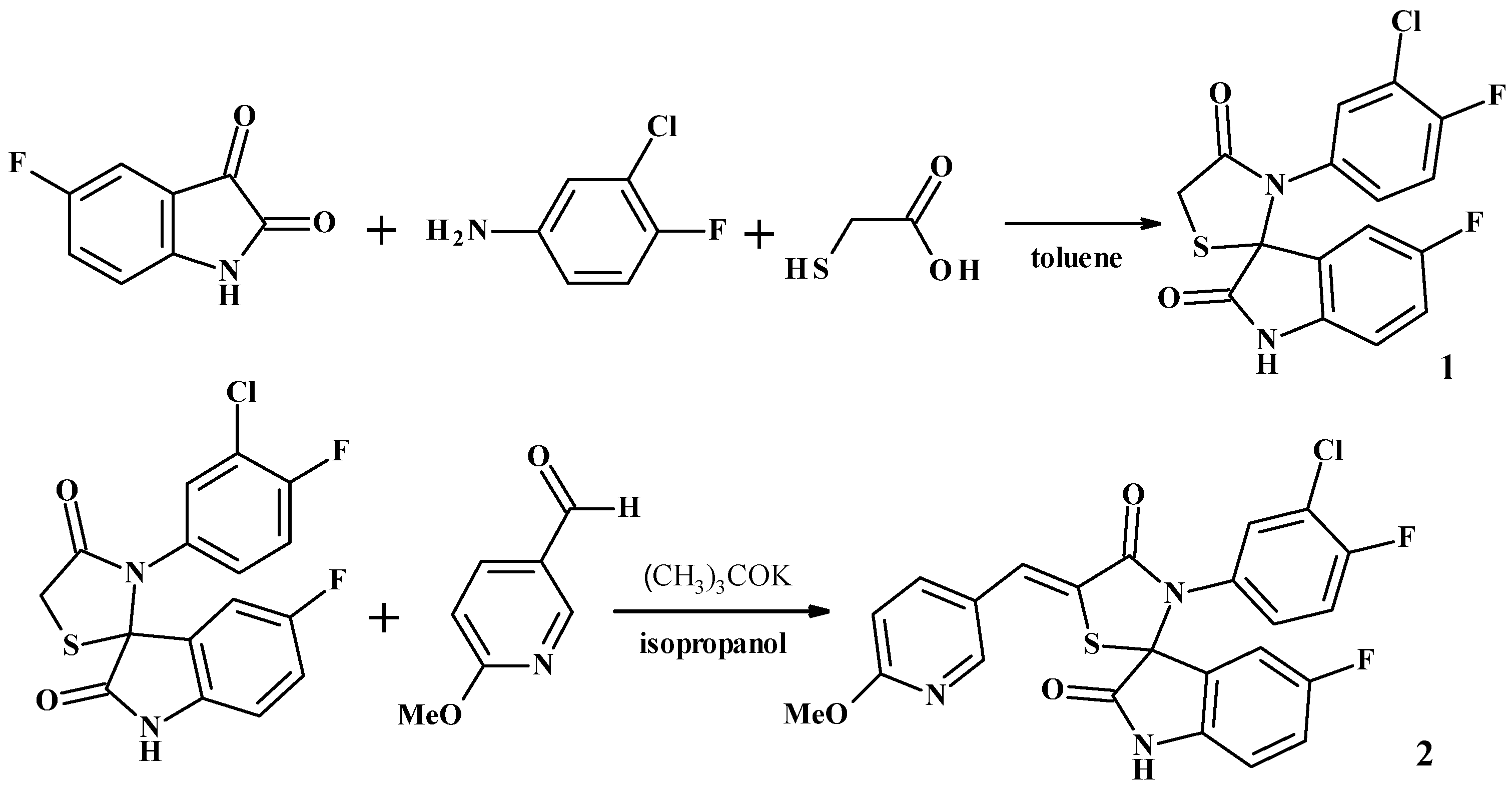
The target compound 2 was synthesized via a two-step procedure, as depicted in Scheme 1. Initially, 3′-(3-chloro-4-fluorophenyl)-5-fluoro-spiro[indoline-3,2′-thiazolidine]-2,4′-dione (1) was prepared using a three-component one-pot protocol, which involved the reaction of equimolar amounts of 5-fluoroisatin and 3-chloro-4-fluoroaniline with a threefold excess of mercaptoacetic acid in dry toluene using a Dean-Stark apparatus for 24 h. The purity and structure of the resulting scaffold were confirmed by TLC, as well as NMR spectroscopy. In the subsequent stage, the title compound 2 was obtained via the Knoevenagel condensation of the synthesized derivative 1 with 6-methoxypyridine-3-carbaldehyde in propan-2-ol, utilizing a 20% molar excess of the aldehyde. The reaction mixture was refluxed for 3 h, followed by the portion-wise addition of potassium tert-butoxide (50% molar excess). Upon cooling, the resulting precipitate was collected by filtration and purified by recrystallization from butan-2-ol, yielding compound 2 in 73% yield.
The structure of the synthesized compounds 1 and 2 was confirmed by 1H, 13C NMR, FT-IR, LC–MS spectra, and elemental analysis data. In the 1H NMR spectrum of compound 1 CH2 group protons resonate as a pair of doublets as 4.05 and 4.18 ppm with J = 15.7 Hz. Broad signals at 10.91 (for 1) and 11.11 (for 2) ppm were assigned to the NH protons of the indole moiety. In the 1H NMR spectrum of compound 2, the singlet observed at 7.66 ppm corresponded to the exocyclic methine proton (CH=), while the singlet at 3.91 ppm was attributed to the methoxy group. The remaining resonances in the aromatic region between 6.80 and 8.46 ppm were consistent with the expected protons of the 6-methoxypyridyl, indoline, and 3-chloro-4-fluorophenyl fragments.
The 13C NMR spectra further supported the proposed structures, displaying two characteristic carbonyl signals at δ 176.5 and 172.3 ppm (for 1) and 174.3 and 166.5 ppm (for 2). Doublet signals at δ 158.8 and 157.2 ppm (for 1) and 159.0 and 157.4 ppm (for 2), each showing large 13C-19F coupling constants (1JC-F = 223.5 and 234.1 Hz for 1 and 206.8 and 215.9 Hz for 2), confirm the presence of two fluorinated aromatic carbons. The methoxy-group carbon of compound 2 resonated at 54.1 ppm, whereas the spiro carbons appeared at 70.0 ppm (for 1) and 69.6 (for 2) ppm. CH2 group carbon of compound 1 resonate as a singlet at 32.6 ppm. The remaining carbon resonances were observed in the expected aromatic and olefinic region and were fully consistent with the proposed molecular framework.
The FT-IR spectrum of compound 2 displayed characteristic absorption bands at 3427 cm−1 for NH stretching and at 3064 cm−1 for aromatic C–H vibrations. Strong bands at 1744 and 1689 cm−1 confirmed the presence of two carbonyl groups, while the absorption at 1605 cm−1 was consistent with C=C/C=N stretching vibrations. The LC–MS spectrum exhibited a molecular ion peak at m/z 486/488 ([M + H]+), in agreement with the expected isotopic pattern for a monochlorinated compound and with the calculated molecular formula C23H14ClF2N3O3S.
Copies of the 1H NMR, 13C NMR, FT-IR, and LC-MS spectra supporting the structural characterization of compounds 1 and 2 are available in the Supplementary Materials (Figures S1–S8).

3. Materials and Methods

3.1. General

All commercially available reagents and solvents were obtained from Merck Co. (Darmstadt, Germany) and used as received without additional purification. Melting points were measured using an Electrothermal Standard 120 VAC apparatus (Cole-Parmer, Wertheim, Germany) and are reported uncorrected. 1H and 13C NMR spectra were recorded on a Bruker Avance DPX 600 spectrometer (Bruker Co., Billerica, MA, USA). DMSO-d6 was used as the solvent, and tetramethylsilane (TMS) served as the internal reference. Chemical shifts are reported in δ (ppm). Signal multiplicities are denoted using standard abbreviations: broad singlet (br s), singlet (s), doublet (d), doublet of doublets (dd), triplet (t), and multiplet (m). The FT-IR spectrum of compound 1 was recorded on a Bruker Vertex 70 FT-IR spectrometer equipped with a diamond ATR crystal (Bruker Optik GmbH, Ettlingen, Germany). The FT-IR spectrum of compound 2 was obtained on a Nicolet 6700 spectrometer (Thermo Scientific, Philadelphia, PA, USA). LC–MS spectra were recorded using a Finnigan MAT INCOS-50 instrument (Thermo Finnigan LLC, San Jose, CA, USA). Elemental composition was determined on an AMZ 851 CHX analyzer (PG, Gdansk, Poland), and the experimental values were found to be within ±0.4% of the calculated values.

3.2. Synthesis of 3′-(3-Chloro-4-fluoro-phenyl)-5-fluoro-spiro[indoline-3,2′-thiazolidine]-2,4′-dione (1)

Compound was prepared by refluxing 5-fluoroisatin (10 mmol) with 3-chloro-4-fluoroaniline (10 mmol) in purified toluene (70 mL) in the presence of a catalytic amount of acetic acid for 6 h. Mercaptoacetic acid (30 mmol) was then added, and the reaction mixture was heated for an additional 24 h in a Dean-Stark apparatus. Upon completion, the solvent was removed under reduced pressure using a rotary evaporator, and the residue was treated with aqueous sodium hydrogen carbonate. The resulting precipitate was collected by filtration and purified by recrystallization from ethanol or acetic acid.
White powder, yield 64%, mp 167–169 °C (ethanol). 1H NMR (600 MHz, DMSO-d6, δ): 10.91 (br s, 1H, NH), 7.68 (dd, J = 8.0, 2.7 Hz, 1H, arom.), 7.44 (t, J = 9.0 Hz, 1H, arom.), 7.39 (dd, J = 6.7, 2.6 Hz, 1H, arom.), 7.15–7.06 (m, 2H, arom.), 6.80 (dd, J = 8.6, 4.1 Hz, 1H, arom.), 4.18 (d, J = 15.7 Hz, 1H, CH2), 4.05 (d, J = 15.7 Hz, 1H, CH2). 13C NMR (151 MHz, DMSO-d6, δ): 176.5 (C=O), 172.3 (C=O), 158.8 (d, JC-F = 223.5 Hz), 157.2 (d, JC-F = 234.1 Hz), 138.1, 133.4 (d, JC-F = 4.5 Hz), 131.35, 129.6 (d, JC-F = 7.5 Hz), 126.7 (d, JC-F = 9.0 Hz), 120.4 (d, JC-F = 19.6 Hz), 118.6 (d, JC-F = 22.6 Hz), 118.3 (d, JC-F = 21.1 Hz), 114.6 (d, JC-F = 25.7 Hz), 112.4 (d, JC-F = 7.5 Hz), 70.0, 32.6 (CH2). FT-IR: 3226 (NH), 3064 (Ar–CH), 1740, 1699 (C=O), 1595 (C=C) 1257 (C-N/C-F). LCMS (ESI+). m/z 366/368 (100.0%, [M + H]+). Anal. Calc. For C16H9ClF2N2O2S: C, 52.40%; H, 2.47%; N, 7.64%. Found: C, 52.60%; H, 2.60%; N, 7.80%.

3.3. Synthesis of (Z)-3′-(3-Chloro-4-fluorophenyl)-5-fluoro-5′-((6-methoxypyridin-3-yl)methylene)spiro[indoline-3,2′-thiazolidine]-2,4′-dione (2)

Compound 1 (0.70 g, 1.91 mmol) and 6-methoxypyridine-3-carbaldehyde (0.31 g, 2.29 mmol, 1.2 equiv.) were suspended in propan-2-ol (10 mL). Potassium tert-butoxide (0.32 g, 2.86 mmol, 1.5 equiv.) was added portionwise, and the mixture was refluxed for 2–3 h. After cooling, the precipitate was filtered, washed with cold isopropanol, and recrystallized from butan-2-ol to give compound 2 as a yellowish powder.
Yellowish powder, yield 73%, mp 224–226 °C (butan-2-ol). 1H NMR (600 MHz, DMSO-d6, δ): 11.11 (br s, 1H, NH), 8.46 (d, J = 2.5 Hz, 1H, arom.), 7.89 (dd, J = 8.8, 2.5 Hz, 1H, arom.), 7.84 (dd, J = 8.0, 2.6 Hz, 1H, arom.), 7.66 (s, 1H, CH=), 7.50 (t, J = 8.9 Hz, 1H, arom.), 7.48–7.44 (m, 1H, arom.), 7.21–7.15 (m, 2H, arom.), 6.97 (d, J = 8.7 Hz, 1H, arom.), 6.85 (d, J = 8.8 Hz, 1H, arom.), 3.91 (s, 3H, CH3). 13C NMR (151 MHz, DMSO-d6, δ): 174.3 (C=O), 166.5 (C=O), 163.8, 159.0 (d, JC-F = 206.8 Hz), 157.4 (d, JC-F = 215.9 Hz), 149.7, 139.2, 138.6, 133.0, 131.6, 130.1 (d, JC-F = 7.5 Hz), 125.7 (d, JC-F = 9.1 Hz), 124.3, 124.2, 122.8, 120.6 (d, JC-F = 18.1 Hz), 119.1 (d, JC-F = 24.1 Hz), 118.4 (d, JC-F = 22.6 Hz), 115.0 (d, JC-F = 25.6 Hz), 112.8 (d, JC-F = 7.7 Hz), 111.5, 69.6, 54.1 (CH3). FT-IR: 3427 (NH), 3064 (Ar–CH), 1744, 1689 (C=O), 1605 (C=C/C=N). LCMS (ESI+). m/z 486/488 (100.0%, [M + H]+). Anal. Calc. For C23H14ClF2N3O3S: C, 56.86%; H, 2.90%; N, 8.65%. Found: C, 57.00%; H, 3.10%; N, 8.90%.

4. Conclusions

In summary, a novel spiro[indoline-3,2′-thiazolidine]-2,4′-dione derivative bearing 3-chloro-4-fluorophenyl and 6-methoxypyridin-3-yl fragments was successfully synthesized via a two-step procedure involving a three-component protocol followed by Knoevenagel condensation. The applied synthetic approach proved to be efficient and straightforward, affording the target compound in a satisfactory yield. The structure of the obtained compound was confirmed by 1H and 13C NMR spectroscopy, FT-IR, LC–MS analysis, and elemental analysis. The presence of multiple pharmacologically relevant heterocyclic moieties within a single molecular framework makes this compound a promising candidate for further biological evaluation.

Supplementary Materials

The following supporting information can be downloaded: Figure S1: 1H NMR spectrum of compound 1; Figure S2: 13C NMR spectrum of compound 1; Figure S3. FT-IR spectrum of compound 1; Figure S4: LC-MS spectrum of compound 1; Figure S5: 1H NMR spectrum of compound 2; Figure S6: 13C NMR spectrum of compound 2; Figure S7: FT-IR spectrum of compound 2; Figure S8: LC–MS spectrum of compound 2.

Author Contributions

Conceptualization, D.K. (Dmytro Khylyuk); methodology, D.K. (Dmytro Khylyuk); validation, D.K. (Dominika Kuceł) and J.S.; formal analysis, D.K. (Dominika Kuceł); investigation, D.K. (Dominika Kuceł), J.S., and S.H.; resources, D.K. (Dmytro Khylyuk); writing—original draft preparation, D.K. (Dominika Kuceł) and J.S.; writing—review and editing, D.K. (Dmytro Khylyuk); visualization, S.H., and D.K. (Dominika Kuceł); supervision, D.K. (Dominika Kuceł); project administration, D.K. (Dmytro Khylyuk); funding acquisition, D.K. (Dmytro Khylyuk). All authors have read and agreed to the published version of the manuscript.

Funding

This research received no external funding.

Data Availability Statement

The data are contained within the article and Supplementary Materials.

Conflicts of Interest

The authors declare no conflicts of interest.

Abbreviations

CHmethine proton
Araromatic
br sbroad singlet
ssinglet
ddoublet
dddoublet of doublets
ttriplet
mmultiplet
δchemical shift (ppm)
Jcoupling constant (Hz)
1H NMRproton nuclear magnetic resonance
13C NMRcarbon-13 nuclear magnetic resonance
FT-IRFourier Transform Infrared Spectroscopy
LC–MSliquid chromatography–mass spectrometry
TLCthin-layer chromatography
mpmelting point
DMSO-d6deuterated dimethyl sulfoxide
TMStetramethylsilane

References

  1. Barbuceanu, S.F.; Olaru, O.T. Synthesis and Evaluation of Biologically Active Compounds from Heterocycles Class. Molecules 2025, 30, 394. [Google Scholar] [CrossRef] [PubMed]
  2. Zeng, F.; Qi, T.; Li, C.; Li, T.; Li, H.; Li, S.; Zhu, L.; Xu, X. Synthesis, Structure-Activity Relationship and Binding Mode Analysis of 4-Thiazolidinone Derivatives as Novel Inhibitors of Human Dihydroorotate Dehydrogenase. MedChemComm 2017, 8, 1297–1302. [Google Scholar] [CrossRef] [PubMed]
  3. Nain, S.; Mathur, G.; Anthwal, T.; Sharma, S.; Paliwal, S. Synthesis, Characterization, and Antibacterial Activity of New Isatin Derivatives. Pharm. Chem. J. 2023, 57, 196–203. [Google Scholar] [CrossRef] [PubMed]
  4. Marinescu, M.; Popa, C.-V. Pyridine Compounds with Antimicrobial and Antiviral Activities. Int. J. Mol. Sci. 2022, 23, 5659. [Google Scholar] [CrossRef] [PubMed]
  5. Khylyuk, D.; Holota, S.; Finiuk, N.; Stoika, R.; Rumynska, T.; Lesyk, R. Design and Optimization of Spiro-Isatin-Thiazolidinone Hybrids with Promising Anticancer Activity. Pharmaceuticals 2025, 18, 1502. [Google Scholar] [CrossRef] [PubMed]
  6. Patel, N.B.; Shaikh, F.M. Synthesis and Antimicrobial Activity of New 4-Thiazolidinone Derivatives Containing 2-Amino-6-Methoxybenzothiazole. Saudi Pharm. J. 2010, 18, 129–136. [Google Scholar] [CrossRef] [PubMed]
  7. Sydorenko, I.A.; Mishchenko, M.V.; Shtrygol’, S.Y.; Lozynskyy, A.V.; Soronovych, I.I.; Holota, S.M.; Lesyk, R.B. The Synthesis and the Anticonvulsant Activity Screening of New 5-Substituted 2-Imino-4-Thiazolidinone Derivatives. J. Org. Pharm. Chem. 2022, 20, 12–20. [Google Scholar] [CrossRef]
  8. Asati, V.; Mahapatra, D.K.; Bharti, S.K. Thiazolidine-2,4-Diones as Multi-Targeted Scaffold in Medicinal Chemistry: Potential Anticancer Agents. Eur. J. Med. Chem. 2014, 87, 814–833. [Google Scholar] [CrossRef] [PubMed]
  9. Pervez, H.; Iqbal, M.S.; Tahir, M.Y.; Nasim, F.-H.; Choudhary, M.I.; Khan, K.M. In Vitro Cytotoxic, Antibacterial, Antifungal and Urease Inhibitory Activities of Some N4—Substituted Isatin-3-Thiosemicarbazones. J. Enzym. Inhib. Med. Chem. 2008, 23, 848–854. [Google Scholar] [CrossRef] [PubMed]
  10. Ibrahim, H.S.; Abou-Seri, S.M.; Ismail, N.S.M.; Elaasser, M.M.; Aly, M.H.; Abdel-Aziz, H.A. Bis-Isatin Hydrazones with Novel Linkers: Synthesis and Biological Evaluation as Cytotoxic Agents. Eur. J. Med. Chem. 2016, 108, 415–422. [Google Scholar] [CrossRef] [PubMed]
  11. Vitaku, E.; Smith, D.T.; Njardarson, J.T. Analysis of the Structural Diversity, Substitution Patterns, and Frequency of Nitrogen Heterocycles among U.S. FDA Approved Pharmaceuticals. J. Med. Chem. 2014, 57, 10257–10274. [Google Scholar] [CrossRef] [PubMed]
  12. Shaveta; Mishra, S.; Singh, P. Hybrid Molecules: The Privileged Scaffolds for Various Pharmaceuticals. Eur. J. Med. Chem. 2016, 124, 500–536. [Google Scholar] [CrossRef] [PubMed]
Scheme 1. Synthesis of compound 2.
Molbank 2026 m2212 sch001
Disclaimer/Publisher’s Note: The statements, opinions and data contained in all publications are solely those of the individual author(s) and contributor(s) and not of MDPI and/or the editor(s). MDPI and/or the editor(s) disclaim responsibility for any injury to people or property resulting from any ideas, methods, instructions or products referred to in the content.