
Short Note

Synthesis and X-Ray Characterization of a New 1,2-Dichloroethane Solvate of 5,10,15,20-Tetraphenylporphyrin-21,23-Diium Dichloride

1
Dipartimento di Chimica, University of Torino, Via P. Giuria 7, 10125 Torino, Italy
2
Centre for Crystallography (CrisDi), University of Torino, 10125 Torino, Italy
3
Dipartimento di Chimica, University of Milano, Via C. Golgi 19, 20133 Milano, Italy
*
Author to whom correspondence should be addressed.
Molbank 2026, 2026(4), M2207; https://doi.org/10.3390/M2207
Submission received: 16 June 2026 / Revised: 17 July 2026 / Accepted: 27 July 2026 / Published: 30 July 2026
(This article belongs to the Section Structure Determination)

Abstract

1,2-Dichloroethane was found to stabilize the lattice of chloride anions associated with the protonated porphyrin of formula [C44H32N4]Cl2·4C2H4Cl2. The synthesis and X-ray characterization of this compound are reported and compared with analogous solvates. The porphyrin macrocycle displays a distorted saddle conformation, with chloride anions positioned above and below the mean plane of the ring, further surrounded by two dichloroethane molecules that stabilize the crystal packing. The Second-Harmonic Generation response was evaluated using the Kurtz–Perry powder technique with a ND:YAG laser (1064 nm).

1. Introduction

Porphyrins and their derivatives are widely studied due to their importance in the biological field and for the development of new functional materials [1,2]. Porphyrin molecules are highly flexible aromatic systems, with low-energy barriers between different conformations in which marked distortions from the planarity of the ring are observed, without compromising their stability. When all the nitrogen atoms of the porphyrin ring are protonated, porphyrin dications or porphyriniums are obtained: molecules with two positive charges and a conformation strongly distorted from planarity, due to the strain caused by the interaction of the four hydrogen atoms in the core of the ring. The distorted geometries of the porphyrinium ring are described as saddled, ruffled, domed, propeller-shaped, or waved [3,4]. The saddled geometry is the most common and can be exploited to obtain materials with nanometric channels into which guest molecules can be introduced [5,6]. Until today, few tetraphenylporphyrinium (H4TPP2+) solvates with chloride ions have been synthesized and characterized by XRD: solvates with water (H4TPPCl2·H2O [7]), chloroform (H4TPPCl2·8CHCl3 [8]), water/acetonitrile (H4TPPCl2·H2O·C2H3N) [9], and water/acetone (H4TPPCl2·H2O·2C3H6O) [10] are known.
For many years, we have been studying a peculiar Second-Harmonic Generation (SHG) behavior of some metallic 5,10,15,20-tetraphenylporphyrinates in the solid state [11,12,13], which exhibit a peculiar SHG behavior: regardless of the presence of the inversion center, their initial efficiency is close to zero but it rapidly increases under irradiation, reaching, in few seconds, a plateau of approximately 50 times that of sucrose. This intriguingly high efficiency appears to be related to the presence of the metal atom in the core of the porphyrinate. To confirm this assumption, we decided to analyze the possible SHG properties of a tetraphenylporphyrin derivative without a central metal atom, but with two heteroatoms interacting with the porphyrin ring. This work, therefore, discusses the chemistry and structural aspects of a new dichloroethane solvate of the porphyrin dication 5,10,15,20-tetraphenylporphyrin-21,23-diium dichloride, with the formula [C44H32N4]Cl2·4C2H4Cl2, in relation to its SHG response. The structure of the compound was determined by single-crystal X-ray diffraction (XRD), and its SHG behavior was evaluated on powders using the Kurtz–Perry technique.

2. Results and Discussion

5,10,15,20-Tetraphenylporphyrin and HCl were mixed in a 1:4 stoichiometric ratio. The reaction occurs immediately, as evidenced by the instantaneous color change in the solution from purple to dark green upon contact of the two reactants. When the solution is evaporated to dryness, the excess hydrochloric acid evolves, which is thus removed from the product. Blue–green crystals of suitable size for XRD were obtained by allowing a solution of the product in dichloroethane to evaporate for a few days. The high acidity of the solution is necessary to protonate the porphyrin ring, which, by acquiring two positive charges, strongly attracts the chloride atoms present in the solution; these, in turn, are surrounded by solvent molecules to stabilize the molecular structure.
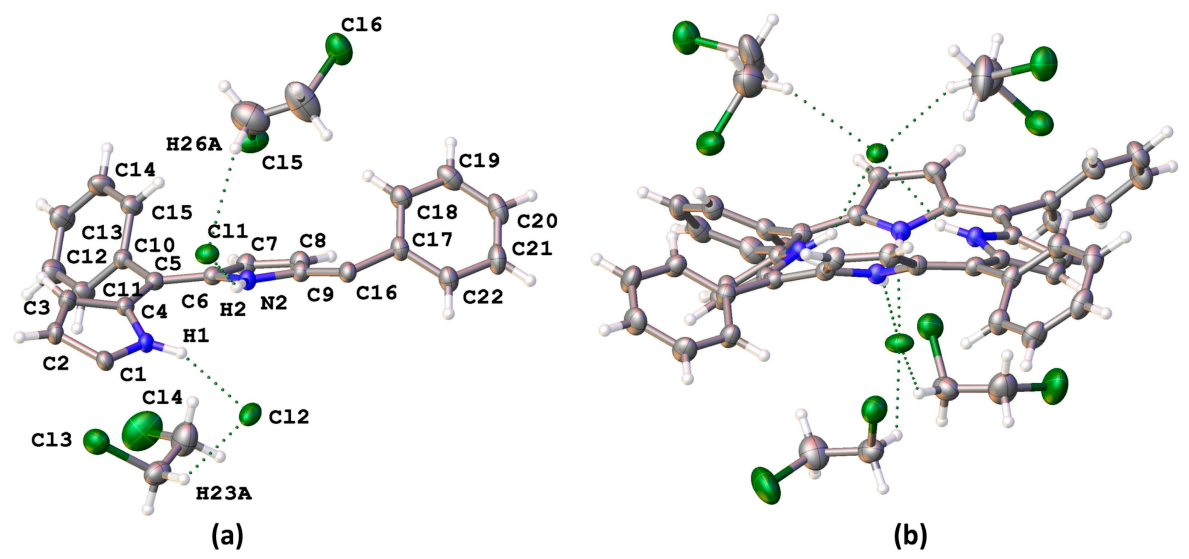
The asymmetric unit of the compound consists of half a molecule of tetraphenylporphyrinium, two half chloride atoms—one below and the other above the plane of the ring—and two independent molecules of dichloroethane (Figure 1a). By applying the two-fold axis, a whole molecule of tetraphenylporphyrinium, two chlorides, and four solvent molecules are obtained (Figure 1b). The relevant bond distances of the tetraphenylporphyrinium ring are reported in Table 1.
The two chlorides are bonded through strong hydrogen bonds to two hydrogens connected to the nitrogen atoms of the ring (distances 2.23, 2.33, Table 2), and on the opposite side to two dichloroethane molecules with weaker hydrogen bonds (distances 2.75, 2.72, 3.06, Table 2).
The porphyrin ring is distorted into a saddled conformation, as are all the other solvates reported in the literature [4,5,6,7]. This conformation minimizes the steric hindrance of the four hydrogen atoms inside the ring and maximizes the interaction with the two chlorides above and below the plane of the ring.
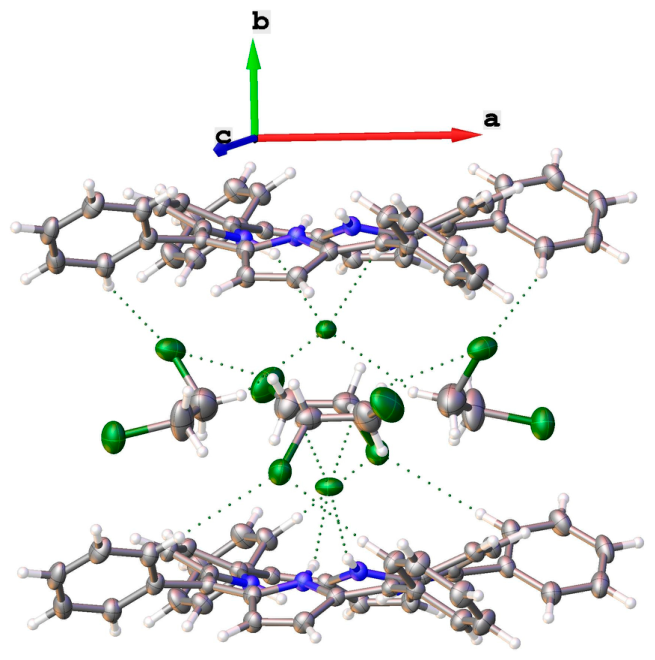
The tetraphenylporphyrinium molecules are stacked parallel along the direction of the b-axis, interspersed with two chlorides and four dichloroethane molecules linked to each other by hydrogen bonds (Figure 2). The phenyl rings of the tetraphenylporphyrinium molecules are appropriately rotated with respect to the mean plane of the molecule to optimize the hydrogen bonds with the chlorides of these four solvent molecules.
Since the structure of the compound is centrosymmetric, theoretically we should not expect it to exhibit SHG properties. However, in our previous works on tetraphenylporphyrinates, we observed that many of them are activated by appropriate lasers and emit a high-intensity SHG signal.
The SHG signal of crystals of the compound ground in an agate mortar and loaded into a capillary was null confirming that the high SHG intensity found in metallic tetraphenylporphyrinates is essentially linked to the presence of the metal atom inside the ring, and a weak interaction with the chloride ion is not sufficient to activate this property.

3. Materials and Methods

3.1. Synthesis of [C44H32N4]Cl2·4C2H4Cl2

5,10,15,20-tetraphenylporphyrin (H2TPP) was purchased from PorphyChem (Longvic, France). HCl solution (37%) and dichloroethane were purchased from Sigma-Aldrich (Saint Louis, MO, USA) and used without additional purification.
A total of 0.025 g of H2TPP was partially dissolved in 1 mL of acetone and mixed with 0.08 mL of an HCl solution (37%). The purplish porphyrin solution turns dark green. The mixture is then evaporated to dryness by heating it at approximately 373 K on a stirring plate, forming a bright blue–green precipitate. The precipitate is redissolved in dichloroethane, and the intense green-colored solution is allowed to evaporate slowly at room temperature. After a few days, blue–green crystals suitable for single-crystal X-ray diffraction are formed.

3.2. Single-Crystal X-Ray Diffraction (XRD)

X-ray diffraction data were collected at 173 K using a Xcalibur Atlas S2 Gemini R Ultra diffractometer (The Woodlands, TX, USA), equipped with graphite monochromatized Mo-Kα radiation (0.71073 Å), and with a nitrogen low-temperature device. The CrysAlisPro [14] package was used for data collection and integration. The structure was solved using SHELXT [15], refined with SHELXL [16] and Olex2 [17] was used for graphics.
Crystal data: Monoclinic, space group C2/c, Z = 8, a = 25.0053(4) Å, b = 8.7105(1) Å, c = 23.5163(3) Å, V = 5097.1(1) Å3. A total of 29,402 reflections were collected, of which 4504 were unique (Rint = 0.0461). Final refinement indices: R1 = 0.0524 (I > 2σ(I)), wR2 = 0.1492 (all data). All non-hydrogen atoms were refined with anisotropic displacement parameters. Although hydrogen atom positions were visible in the difference Fourier maps, they were placed in calculated positions and refined using a riding model with the Uiso = 1.2 or 1.5 × Ueq of the parent atom. The interested reader can find further details on crystal data, data collection, least-squares refinements, and bond lengths and angles in the Supporting Information (Tables S1–S4) and CIF file (CCDC 2560559).

3.3. Second-Harmonic Generation Measurements

SHG efficiency was measured with a modified Kurtz–Perry powder setup equipped with a nanosecond Nd:YAG pulsed (10 Hz) laser with the fundamental 1064 nm, an elliptical mirror and a photomultiplier.

4. Conclusions

This work reports the synthesis and X-ray characterization of a new dicloroethane solvate of tetraphenylporphyrinium dichloride. The porphyrinium ring exhibits the same saddle conformation as the few analogous solvates found in the literature.
Its SHG efficiency does not exhibit the peculiar behavior of metal tetraphenylporphyrinates, remaining indefinitely close to zero. Therefore, we confirmed that the weak interaction of the chloride ions above and below the molecular plane is not sufficient to impart the SHG property that has instead been observed in metalloporphyrins.

Supplementary Materials

The following supporting information can be downloaded online, Table S1. Crystal data and structure refinement for (H4TPP)2+·2Cl·4(C2H4Cl2); Table S2. Bond Lengths for (H4TPP)2+·2Cl·4(C2H4Cl2); Table S3. Bond Angles for (H4TPP)2+·2Cl·4(C2H4Cl2); Table S4. Torsion Angles for (H4TPP)2+·2Cl·4(C2H4Cl2).

Author Contributions

Conceptualization, P.B. and D.M.; methodology, D.M.; validation, D.M.; formal analysis, P.B., D.M. and E.C.; investigation, P.B., D.M. and E.C.; data curation, D.M.; writing—original draft preparation, D.M.; writing—review and editing, P.B., D.M. and E.C.; supervision, D.M.; project administration, D.M.; funding acquisition, D.M. All authors have read and agreed to the published version of the manuscript.

Funding

This research was funded by MUR (Ministero dell’Università e della Ricerca).

Data Availability Statement

The crystallographic data for this study have been deposited at the Cambridge Crystallographic Data Centre (CCDC 2560559). These data can be obtained free of charge via www.ccdc.cam.ac.uk/structures/ (accessed on 7 May 2026). Additional data supporting the findings of this study are available from the corresponding author upon reasonable request.

Acknowledgments

Financial support from MIUR (Ministero dell’Istruzione, dell’Università e della Ricerca) is acknowledged.

Conflicts of Interest

The authors declare no conflicts of interest.

References

  1. Gandhi, V.; Thomson, M.I.; Lash, T.D. Porphyrins with exocyclic rings. Part 24. Synthesis and spectroscopic properties of pyrenoporphyrins, potential buildin blocks for porphyrin molecular wires. Tetrahedron 2010, 66, 1787–1799. [Google Scholar] [CrossRef]
  2. Bhuse, D.V.; Giri, P.; Deshmukh, S.; Agawane, G.; Patel, C.; Sarkar, S.; Rathod, V.; Suresh, S.; Maru, M.; Amaravadi, R.; et al. Critical review of metalloporphyrin drawbacks and additive adverse effects in porphyrin DSSCs toward high efficiency metal free porphyrin sensitizers, Critical review of metalloporphyrin drawbacks and additive adverse effects in porphyrin DSSCs toward high efficiency metal free porphyrin sensitizers. Discov. Chem. 2026, 3, 132–167. [Google Scholar] [CrossRef]
  3. Senge, M.O.; Forsyth, T.P.; Nguyen, L.T.; Smith, K.M. Sterically Strained Porphyrins—Influence of Core Protonation and Peripheral Substitution on the Conformation of Tetra-meso-, Octa-β-, and Dodeca-Substituted Porphyrin Dications. Angew. Chem. Int. Ed. 1995, 33, 2485–2487. [Google Scholar] [CrossRef]
  4. Kingsbury, C.J.; Senge, M.O. The shape of porphyrins. Coord. Chem. Rev. 2021, 431, 213760–213782. [Google Scholar] [CrossRef]
  5. Kojima, T.; Nakanishi, T.; Harada, R.; Ohkubo, K.; Yamauchi, S.; Fukuzumi, S. Selective Inclusion of Electron-Donating Molecules into Porphyrin Nanochannels Derived from the Self-Assembly of Saddle-Distorted, Protonated Porphyrins and Photoinduced Electron Transfer from Guest Molecules to Porphyrin Dications. Chem. Eur. J. 2007, 13, 8714–8725. [Google Scholar] [CrossRef] [PubMed]
  6. Nakanishi, T.; Kojima, T.; Ohkubo, K.; Hasobe, T.; Nakayama, K.; Fukuzumi, S. Photoconductivity of Porphyrin Nanochannels Composed of Diprotonated Porphyrin Dications with Saddle Distortion and Electron Donors. Chem. Mater. 2008, 20, 7492–7500. [Google Scholar] [CrossRef]
  7. Wu, Y.H.; Hu, L.L.; Zhang, J.; Yu, J.; Tong, S.L.; Yan, Y. Schiff base bridged biporphyrin: Synthesis, characterization and spectral properties. Inorg. Chem. Commun. 2014, 45, 10–14. [Google Scholar] [CrossRef]
  8. Aparici Plaza, L.; Chojnacki, J. Influence of chloroform on crystalline products yielded in reactions of 5,10,15,20-tetraphenylporphyrin with HCl and copper(II) salts. Acta Cryst. 2012, C68, m24–m28. [Google Scholar] [CrossRef]
  9. Larsen, F.B.; Hansen, F.G.; McKenzie, C.J. Synchrotron study of a fully protonated tetra-phenyl porphyrin. Acta Cryst. 2004, E60, o497–o499. [Google Scholar] [CrossRef]
  10. Wagner, B.; Weigend, F.; Heine, J. CCDC 2049725: Experimental Crystal Structure Determination; 2021. [Google Scholar] [CrossRef]
  11. Antoniotti, P.; Canepa, C.; Cariati, E.; Cioci, A.; Laurenti, E.; Marabello, D.; Benzi, P. The peculiar SHG behaviour of Co-5, 10, 15, 20-tetraphenilporphyrinate in the solid state. An experimental and theoretical study. J. Mol. Struct. 2023, 1294, 136340–136348. [Google Scholar] [CrossRef]
  12. Cioci, A.; Antoniotti, P.; Benzi, P.; Canepa, C.; Cariati, E.; Laurenti, E.; Marabello, D. SHG behavior of the solid isomorphic compounds Ni-and Cu-5, 10, 15, 20-tetraphenylporphyrinate. An experimental and theoretical study. J. Mol. Struct. 2024, 1317, 139201–139210. [Google Scholar] [CrossRef]
  13. Cioci, A.; Mortati, L.; Antoniotti, P.; Benzi, P.; Canepa, C.; Cariati, E.; Marabello, D. Photo-activatable second harmonic generation in centrosymmetric zinc porphyrinates: Experimental and theoretical study. J. Mol. Struct. 2026, 1361, 145586–145595. [Google Scholar] [CrossRef]
  14. CrysAlisPro. Agilent Technologies, Version 1.171.37.31 (Release 14-01-2014 CrysAlis171.NET). Available online: https://www.rigaku.com/products/crystallography/crysalis (accessed on 1 January 2015).
  15. Sheldrick, G.M. SHELXT-Integrated Space-Group and Crystal-Structure Determination. Acta Cryst. 2015, A71, 3–8. [Google Scholar] [CrossRef]
  16. Sheldrick, G.M. Crystal Structure Refinement with SHELXL. Acta Cryst. 2015, C71, 3–8. [Google Scholar] [CrossRef]
  17. Dolomanov, O.V.; Bourhis, L.J.; Gildea, R.J.; Howard, J.A.K.; Puschmann, H. OLEX2: A Complete Structure Solution, Refinement and Analysis Program. J. Appl. Cryst. 2009, 42, 339–341. [Google Scholar] [CrossRef]
Figure 1. View of the asymmetric unit of [C44H32N4]Cl2·4C2H4Cl2 (a), and of the whole molecule generated by the two-fold axis (b).
Molbank 2026 m2207 g001
Figure 2. View of the packing motif of H4TPPCl2 along the [010] direction.
Molbank 2026 m2207 g002
Table 1. Selected bond distances (Å) of the tetraphenylporphyrinium ring.
BondDistance
N1–C11.365(4)
N1–C41.372(4)
N2–C61.364(4)
N2–C91.368(4)
C1–C21.434(4)
C1–C16 11.410(4)
C2–C31.358(4)
C3–C41.428(4)
C4–C51.401(4)
C5–C61.408(4)
C6–C71.431(4)
C7–C81.356(4)
C8–C91.433(4)
C9–C161.402(4)
1 1-X,+Y,1/2-Z.
Table 2. List of hydrogen bonds.
D–H···A (Å)H···A (Å)D···A (Å)D–H (Å)D–H···A (°)
N1–H1···Cl22.233.1090.88149
N2–H2···Cl12.333.1190.88149
C11–H11···Cl33.043.9460.95161
C12–H12···Cl33.033.7060.95129
C18–H18···Cl53.063.9350.95155
C22–H22···Cl33.053.9700.95162
C23–H23A···Cl22.753.5350.99136
C26Y–H26A···Cl12.723.6490.99156
C24–H24A···Cl13.063.0920.99144
Disclaimer/Publisher’s Note: The statements, opinions and data contained in all publications are solely those of the individual author(s) and contributor(s) and not of MDPI and/or the editor(s). MDPI and/or the editor(s) disclaim responsibility for any injury to people or property resulting from any ideas, methods, instructions or products referred to in the content.