Short Note

(4aS,5R,6aS,7R,11aS,11bR)-9-(1-Benzyl-1H-benzo[d]imidazol-2-yl)-4,4,7,11b-tetramethyl-1,2,3,4,4a,5,6,6a,7,11,11a,11b-dodecahydrophenanthro[3,2-b]furan-5-yl Acetate


by
Jessica A. Perez-Rangel
1,
Alejandro Islas-Jácome
2,
Luis Chacón-García
1,
Armando Talavera-Alemán
3,* and
Carlos J. Cortés-García
1,*
1
Laboratorio de Diseño Molecular, Instituto de Investigaciones Químico Biológicas, Universidad Michoacana de San Nicolás de Hidalgo, Ciudad Universitaria, Morelia C.P. 58030, Michoacán, Mexico
2
Departamento de Química, Universidad Autónoma Metropolitana-Iztapalapa, Av. Ferrocarril San Rafael Atlixco 186, Col. Leyes de Reforma 1A Sección, Iztapalapa, Ciudad de México C.P. 09310, Mexico
3
Laboratorio de Química de Productos Naturales, Instituto de Investigaciones Químico Biológicas, Universidad Michoacana de San Nicolás de Hidalgo, Ciudad Universitaria, Morelia C.P. 58030, Michoacán, Mexico
*
Authors to whom correspondence should be addressed.
Molbank 2026, 2026(4), M2206; https://doi.org/10.3390/M2206
Submission received: 3 July 2026 / Accepted: 16 July 2026 / Published: 17 July 2026
(This article belongs to the Section Natural Product Chemistry)

Abstract

A new benzimidazole–6β-acetoxyvouacapane (4aS,5R,6aS,7R,11aS,11bR)-9-(1-benzyl-1H-benzo[d]imidazol-2-yl)-4,4,7,11b-tetramethyl-1,2,3,4,4a,5,6,6a,7,11,11a,11b-dodecahydrophenanthro[3,2-b]furan-5-yl acetate was synthesized through the semisynthetic functionalization of the natural product 6β-acetoxyvouacapane. The target compound was obtained via a liquid-assisted mechanochemical condensation of aldehyde 6β-acetoxyvouacapane with N-benzyl-o-phenylenediamine, followed by cyclization and oxidative aromatization under mild reaction conditions. The structure of the new compound was established by FT-IR, 1D and 2D NMR spectroscopy (COSY, HSQC, and HMBC), and high-resolution mass spectrometry (HRMS).

Graphical Abstract

1. Introduction

Natural products have historically played a central role in drug discovery due to their remarkable structural diversity and broad spectrum of biological activities [1]. Indeed, a significant proportion of FDA-approved drugs are natural products, direct derivatives, or compounds inspired by natural scaffolds [2,3]. In this context, semisynthesis, defined as the chemical modification of naturally occurring molecules, has emerged as a valuable strategy for expanding chemical diversity and improving physicochemical, pharmacokinetic, and pharmacological properties. Consequently, semisynthetic approaches continue to provide access to novel molecular entities with potential therapeutic relevance [2,4].
Among bioactive natural products, cassane-type diterpenoids isolated from Caesalpinia species have attracted considerable attention due to their diverse biological activities, including antimicrobial, anti-inflammatory, and cytotoxic effects. In particular, 6β-acetoxyvouacapane, isolated from Coulteria platyloba, represents an attractive scaffold for semisynthetic modification owing to its rigid polycyclic framework and functionalizable positions [5,6]. On the other hand, benzimidazole represents an important nitrogen-containing heterocycle in medicinal chemistry. In addition to occurring as the dimethylbenzimidazole fragment of vitamin B12, this scaffold is present in numerous bioactive molecules and FDA-approved drugs that exhibit antimicrobial, antiparasitic, antiviral, anti-inflammatory, and anticancer properties [7,8].
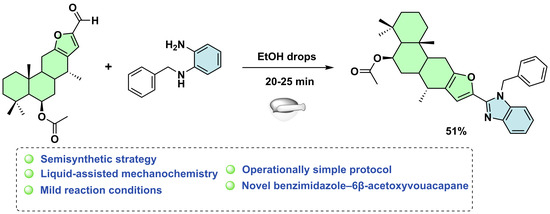
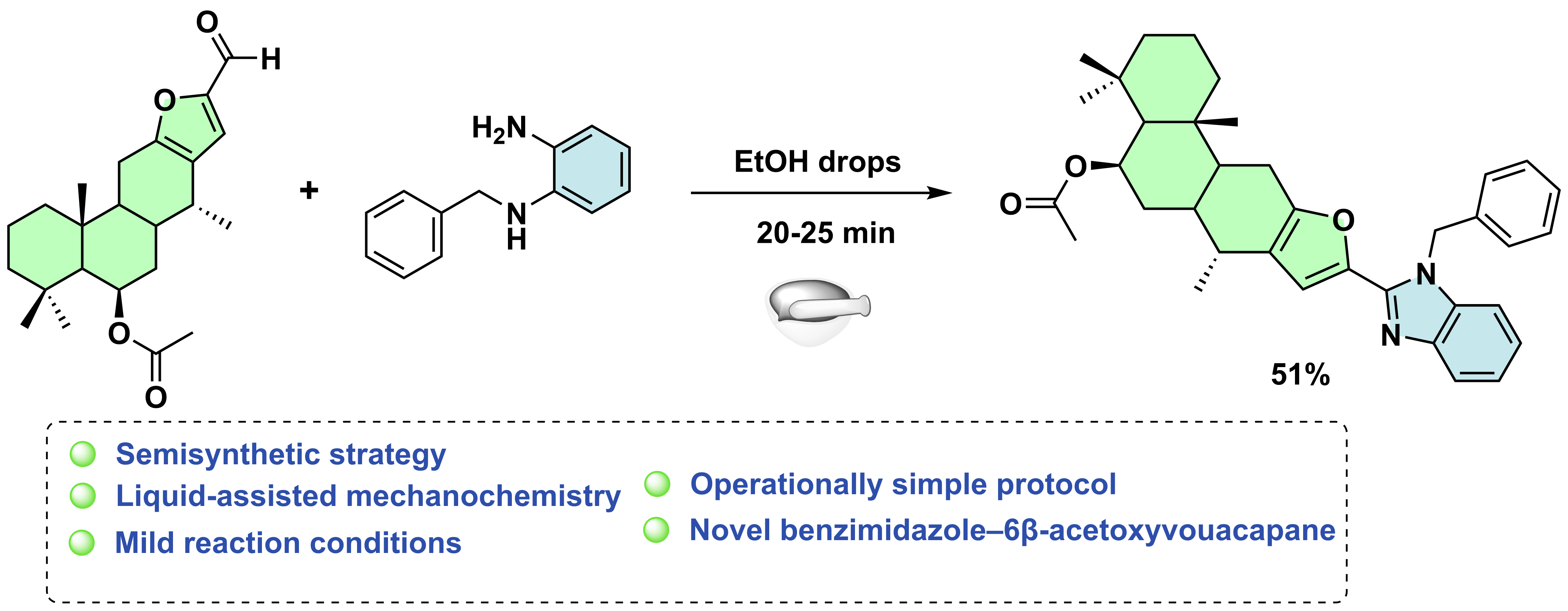
Considering the structural complexity of 6β-acetoxyvouacapane and the well-established pharmacological relevance of benzimidazole-containing molecules, incorporating a benzimidazole unit into the vouacapane framework represents an attractive semisynthetic strategy to expand the chemical diversity accessible from this natural product. As part of our ongoing efforts toward the late-stage functionalization of vouacapane derivatives, our research group has recently described the synthesis of fused vouacapane–imidazo[1,2-a]pyridines through a Groebke–Blackburn–Bienaymé multicomponent reaction [9], as well as the semisynthesis of a bis(indolyl)methane–6β-acetoxyvouacapane derivative through a pseudo-multicomponent reaction [10]. However, to the best of our knowledge, benzimidazole-functionalized vouacapane derivatives have not been previously described. Therefore, herein we report the synthesis and spectroscopic characterization of a novel benzimidazole–6β-acetoxyvouacapane derivative, namely (4aS,5R,6aS,7R,11aS,11bR)-9-(1-benzyl-1H-benzo[d]imidazol-2-yl)-4,4,7,11b-tetramethyl-1,2,3,4,4a,5,6,6a,7,11,11a,11b-dodecahydrophenanthro[3,2-b]furan-5-yl acetate (benzimidazole–6β-acetoxyvouacapane) 3. The target compound was synthesized through a condensation reaction between aldehyde 6β-acetoxyvouacapane 1 and N-benzyl-o-phenylenediamine 2 under liquid-assisted grinding conditions.

2. Results and Discussion

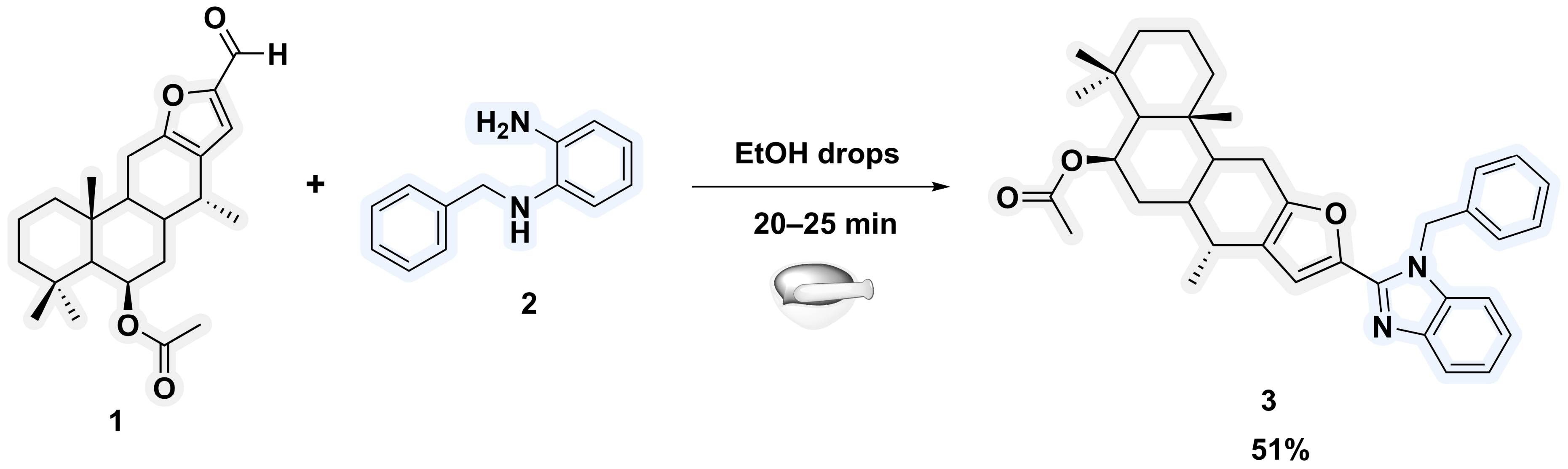
The synthesis of the target benzimidazole–6β-acetoxyvouacapane derivative 3 is outlined in Scheme 1. The natural product 6β-acetoxyvouacapane was isolated from Coulteria platyloba and subsequently converted to aldehyde 6β-acetoxyvouacapane 1 by C-2 furan-ring formylation, following our previously reported procedure [9]. Since the isolation of 6β-acetoxyvouacapane and the synthesis and complete spectroscopic characterization of aldehyde 1 have already been reported by our research group, these aspects will not be discussed herein.
With the key intermediate 1 in hand, the target compound 3 was synthesized through a condensation reaction between aldehyde 6β-acetoxyvouacapane 1 and N-benzyl-o-phenylenediamine 2 under liquid-assisted grinding (LAG) conditions (Scheme 1). The reaction was performed in an agate mortar using manual grinding with a few drops of ethanol, following a mechanochemical strategy adapted from the protocol reported by Banerjee et al. for the synthesis of benzimidazole derivatives [11]. After only 15–20 min of grinding, complete consumption of aldehyde 1 was observed by TLC. The resulting crude reaction mixture was then allowed to stand in methanol at room temperature for 24 h, promoting cyclization and subsequent aromatization to afford the desired benzimidazole derivative 3. Purification by column chromatography furnished compound 3 as a green solid with a 51% isolated yield. Interestingly, no external oxidizing agent was required for benzimidazole formation. Based on the mechanistic proposal reported by Banerjee et al., the reaction most likely proceeds through initial Schiff base formation followed by intramolecular cyclization and spontaneous oxidative aromatization under ambient conditions. The successful application of this mechanochemical protocol to a structurally complex natural product-derived aldehyde further demonstrates the versatility of liquid-assisted grinding as a simple and sustainable approach for the semisynthetic functionalization of vouacapane derivatives.
In the 1H NMR spectrum, the main signals were identified, including a doublet of triplets at δ 7.79 ppm (J = 8.0, 0.9 Hz, 1H), which was assigned to H-4 of the benzimidazole ring. The multiplet observed between δ 7.31 and 7.15 ppm corresponded to the remaining aromatic protons of the benzimidazole and N-benzyl rings. A characteristic singlet at δ 6.85 ppm was attributed to the proton at C-3 of the furan ring. The benzylic methylene attached to the benzimidazole nitrogen appeared as a singlet at δ 5.66 ppm, integrating for two protons. In addition, a doublet at δ 5.52 ppm was assigned to the proton attached to the carbon bearing the acetate group in the 6β-acetoxyvouacapane scaffold. The remaining aliphatic resonances were consistent with those previously reported by our research group for related vouacapane derivatives. In the 13C NMR spectrum, the signal at δ 170.6 ppm was assigned to the ester carbonyl carbon of the 6β-acetoxy group. The resonance at δ 145.1 ppm was attributed to C-2 of the benzimidazole ring, directly connected to the furan moiety of the vouacapane scaffold. The carbon bearing the acetate group in the 6β-acetoxyvouacapane unit appeared at δ 69.5 ppm, while the benzylic methylene carbon of the N-benzyl substituent was observed at δ 48.3 ppm. The remaining carbon resonances were in agreement with the expected vouacapane framework and with related derivatives previously reported by our research group [9,10]. Analysis of the HSQC and HMBC spectra further supported the structural assignment of the target compound. High-resolution mass spectrometry (HRMS, ESI+) further confirmed the molecular formula: m/z calcd. for C36H43N2O3 [M + H]+: 551.3268; found: 551.3264. The corresponding NMR, FT-IR, and HRMS spectra are available in the Supplementary Materials.

3. Materials and Methods

3.1. General Information

All reagents, reactants, and solvents were purchased from Merck (Darmstadt, Germany), and were used as received. The reaction progress was monitored by thin layer chromatography (TLC) using silica gel 60 F254 from Merck and the spots were visualized under UV light at 254 or 365 nm. IR spectra were recorded using a Thermo Scientific NICOLET Is10 spectrometer (Thermo Fisher Scientific, Waltham, MA, USA) via the ATR method with neat compounds. Wavelengths are reported in reciprocal centimeters (ν/cm−1). High-resolution mass spectra (HRMS) were acquired using a Bruker MicroTOF-II spectrometer (Bruker Daltonics, Bremen, Germany). Column chromatography was performed using silica gel (230–400 mesh). Chemical structures and names were generated using ChemDraw Professional (version 23.1.1.3). NMR spectra were recorded in a Bruker AMX Advance III spectrometer (500 MHz) (Bruker Daltonics, Bremen, Germany). Chemical shifts are reported as δ values (ppm). Coupling constants J are reported in Hertz (Hz). The internal reference for NMR spectra is in respect to TMS at 0.0 ppm. Spectral analysis was performed using MestreNova software (version 14.1.0-24037). The melting point was determined on a Fisher–Johns melting point apparatus (Thermo Scientific, Vernon Hills, IL, USA) and is uncorrected.

3.2. Synthesis of (4aS,5R,6aS,7R,11aS,11bR)-9-Formyl-4,4,7,11b-tetramethyl-1,2,3,4,4a,5,6,6a,7,11,11a,11b-dodecahydrophenanthro[3,2-b]furan-5-yl Acetate

Synthesis of (4aS,5R,6aS,7R,11aS,11bR)-9-formyl-4,4,7,11b-tetramethyl-1,2,3,4,4a,5,6,6a,7,11,11a,11b-dodecahydrophenanthro[3,2-b]furan-5-yl acetate or aldehyde 6β-acetoxyvouacapane 1 was performed according to the methodology reported by the Cortés-García research group [9,10].

3.3. Synthesis of (4aS,5R,6aS,7R,11aS,11bR)-9-(1-Benzyl-1H-benzo[d]imidazol-2-yl)-4,4,7,11b-tetramethyl-1,2,3,4,4a,5,6,6a,7,11,11a,11b-dodecahydrophenanthro[3,2-b]furan-5-yl acetate (benzimidazole–6β-acetoxyvouacapane) 3

Aldehyde 6β-acetoxyvouacapane 1 (40 mg, 0.10 mmol, 1.2 equiv.) and N-benzyl-o-phenylenediamine 2 (17.7 mg, 0.083 mmol, 1.0 equiv.) were placed in an agate mortar and manually ground with an agate pestle for 20–25 min under liquid-assisted grinding (LAG) conditions using 1–2 drops of EtOH. After complete consumption of aldehyde 1, as monitored by TLC, the crude reaction mixture was transferred to a vial containing MeOH (2 mL) and left to stand at room temperature for 24 h until the solvent had completely evaporated, thereby promoting spontaneous cyclization and oxidative aromatization to the corresponding benzimidazole. The residue was purified by flash column chromatography on silica gel using hexane/EtOAc (8:2, v/v) as the eluent to afford compound 3 as a beige solid (30.1 mg, 51%); mp 216–220 °C; Rf = 0.32 (hexane/EtOAc 7:3, v/v). 1H NMR (500 MHz, CDCl3): δ = 7.79 (dt, J = 8.0, 0.9 Hz, 1H), 7.31–7.29 (m, 2H), 7.28–7.23 (m, 3H), 7.21–7.19 (m, 1H); 7.15 (d, J = 6.9 Hz, 2H), 6.85 (s, 1H), 5.66 (s, 2H), 5.52 (q, J = 2.8 Hz, 1H), 2.70–2.63 (m, 2H), 2.56 (dd, J = 17.5, 10.0 Hz, 1H), 2.05–2.01 (m, 4H), 1.85 (dt, J = 14.3, 3.6 Hz, 1H), 1.73–1.70 (m, 1H), 1.67–1.56 (m, 3H), 1.55–1.51 (m, 1H), 1.50–1.47 (m, 1H), 1.41 (dq, J = 13.4, 2.3 Hz, 1H), 1.21 (s, 3H), 1.09 (d, J = 1.8 Hz, 1H), 1.03 (s, 3H), 0.99 (s, 3H), 0.97 (d, J = 7.1 Hz, 3H). 13C NMR (125 MHz, CDCl3): δ = 170.6, 152.5, 145.1, 143.3, 143.0, 136.6, 135.8, 128.9, 127.7, 126.4, 124.9, 122.8, 122.7, 119.7, 112.8, 109.8, 69.5, 55.4, 48.3, 45.5, 43.7, 42.2, 38.0, 36.3, 33.9, 33.7, 31.0, 23.5, 22.0, 21.8, 18.8, 17.6, 17.1. FT-IR (ATR) νmax/cm−1 2930, 2856, 1730, 1572, 1450, 1376, 1262, 1032. HRMS (ESI+): m/z: Calcd. for C36H43N2O3[M + H]+: 551.3268; Found: 551.3264.

4. Conclusions

A new benzimidazole–6β-acetoxyvouacapane 3 derivative was obtained via the semisynthetic functionalization of a natural-product-derived aldehyde under liquid-assisted mechanochemical conditions. The reaction provides access to a previously undescribed benzimidazole-functionalized vouacapane scaffold in moderate yield under operationally simple conditions. The structure of the target compound was unambiguously established by FT-IR, 1D and 2D NMR spectroscopy, and HRMS. This work expands the chemical diversity of the vouacapane scaffold and highlights the potential of mechanochemical semisynthesis as a practical approach to preparing new natural product derivatives. Future studies will focus on the biological evaluation of the synthesized compound, guided by complementary in silico analyses.

Supplementary Materials

The following supporting information can be downloaded online. 1H NMR spectrum, 13C NMR spectrum, COSY spectrum, HSQC spectrum, HMBC spectrum, FT-IR spectrum, HRMS spectrum of the compound 3.

Author Contributions

Conceptualization, C.J.C.-G. and A.T.-A.; methodology, J.A.P.-R.; software, L.C.-G. and A.I.-J.; validation, A.I.-J.; formal analysis, L.C.-G.; investigation, C.J.C.-G.; resources, C.J.C.-G. and A.T.-A.; data curation, J.A.P.-R.; writing—original draft preparation, C.J.C.-G.; writing—review and editing, C.J.C.-G.; visualization, A.I.-J.; supervision, C.J.C.-G.; project administration, C.J.C.-G. and L.C.-G.; funding acquisition, C.J.C.-G. All authors have read and agreed to the published version of the manuscript.

Funding

This work was financially supported by Coordinación de la Investigación Cientifíca CIC-UMSNH (18104).

Data Availability Statement

The data presented in this study are available in this article and supporting Supplementary Materials.

Acknowledgments

The authors gratefully acknowledge Juan Pablo García Merinos for his valuable assistance in the acquisition of the infrared spectra.

Conflicts of Interest

The authors declare no conflicts of interest.

References

  1. Atanasov, A.G.; Zotchev, S.B.; Dirsch, V.M.; Supuran, C.T. Natural products in drug discovery: Advances and opportunities. Nat. Rev. Drug Discov. 2021, 20, 200–216. [Google Scholar] [CrossRef] [PubMed]
  2. Butler, M.S.; La Clair, J.J. The role of natural product chemistry in drug discovery: Two decades of progress and perspectives. J. Nat. Prod. 2026, 89, 3–41. [Google Scholar]
  3. Newman, D.J.; Cragg, G.M. Natural products as sources of new drugs over the nearly four decades from 01/1981 to 09/2019. J. Nat. Prod. 2020, 83, 770–803. [Google Scholar] [CrossRef] [PubMed]
  4. Majhi, S.; Das, D. Chemical derivatization of natural products: Semisynthesis and pharmacological aspects—A decade update. Tetrahedron 2021, 78, 131801. [Google Scholar] [CrossRef]
  5. Jing, W.; Zhang, X.; Zhou, H.; Wang, Y.; Yang, M.; Long, L.; Gao, H. Naturally occurring cassane diterpenoids (CAs) of Caesalpinia: A systematic review of its biosynthesis, chemistry and pharmacology. Fitoterapia 2019, 134, 226–249. [Google Scholar] [CrossRef] [PubMed]
  6. Gómez-Hurtado, M.A.; Álvarez-Esquivel, F.E.; Rodríguez-García, G.; Martínez-Pacheco, M.M.; Espinoza-Madrigal, R.M.; Pamatz-Bolaños, T.; Salvador-Hernández, J.L.; García-Gutiérrez, H.A.; Cerda-García-Rojas, C.M.; Joseph-Nathan, P.; et al. Cassane diterpenes from Caesalpinia platyloba. Phytochemistry 2013, 96, 397–403. [Google Scholar] [CrossRef] [PubMed]
  7. Kumar, R.; Babu, M.A.; Pathak, S. Benzimidazole as a Privileged Scaffold in Drug Design and Discovery. Curr. Top. Med. Chem. 2024, 24, 1504–1528. [Google Scholar] [CrossRef] [PubMed]
  8. Chung, N.T.; Dung, V.C.; Duc, D.X. Recent Achievements in the Synthesis of Benzimidazole Derivatives. RSC Adv. 2023, 13, 32734–32771. [Google Scholar] [CrossRef] [PubMed]
  9. Servín-García, G.; Chacón-García, L.; Islas-Jácome, A.; Gómez-Hurtado, M.A.; Rodríguez-García, G.; del Río, R.E.; Cortés-García, C.J. Late-stage functionalization of Vouacapane derivatives from Caesalpinia platyloba by a Groebke–Blackburn–Bienaymé reaction. J. Heterocycl. Chem. 2023, 60, 1903–1910. [Google Scholar] [CrossRef]
  10. Perez-Rangel, J.A.; Servín-García, G.; Gutiérrez-Carrillo, A.; Islas-Jácome, A.; Chacón-García, L.; del Río, R.E.; Cortés-García, C.J. (5R,7R,11bR)-9-(di(1H-Indol-3-yl)methyl)-4,4,7,11b-tetramethyl-1,2,3,4,4a,5,6,6a,7,11,11a,11b-dodecahydrophenanthro[3,2-b]furan-5-yl acetate. Molbank 2025, 2025, M2034. [Google Scholar] [CrossRef]
  11. Banerjee, M.; Chatterjee, A.; Kumar, V.; Bhutia, Z.T.; Khandare, D.G.; Majik, M.S.; Roy, B.G. A simple and efficient mechanochemical route for the synthesis of 2-aryl benzothiazoles and substituted benzimidazoles. RSC Adv. 2014, 4, 39606–39611. [Google Scholar] [CrossRef]
Scheme 1. Synthesis of benzimidazole–6β-acetoxyvouacapane 3 via a liquid-assisted mechanochemical condensation between aldehyde 6β-acetoxyvouacapane 1 and N-benzyl-o-phenylenediamine 2.
Molbank 2026 m2206 sch001
Disclaimer/Publisher’s Note: The statements, opinions and data contained in all publications are solely those of the individual author(s) and contributor(s) and not of MDPI and/or the editor(s). MDPI and/or the editor(s) disclaim responsibility for any injury to people or property resulting from any ideas, methods, instructions or products referred to in the content.