Short Note

[2-{(5′-Amino-2′-fluoroacetophenone)-5-nitro}]acetophenone

by
Richard M. Beteck
* and
Lesetja J. Legoabe
Centre of Excellence for Pharmaceutical Sciences, North-West University, Potchefstroom 2520, South Africa
*
Author to whom correspondence should be addressed.
Molbank 2026, 2026(2), M2162; https://doi.org/10.3390/M2162
Submission received: 2 February 2026 / Revised: 6 April 2026 / Accepted: 8 April 2026 / Published: 10 April 2026
(This article belongs to the Collection Molecules from Side Reactions)

Abstract

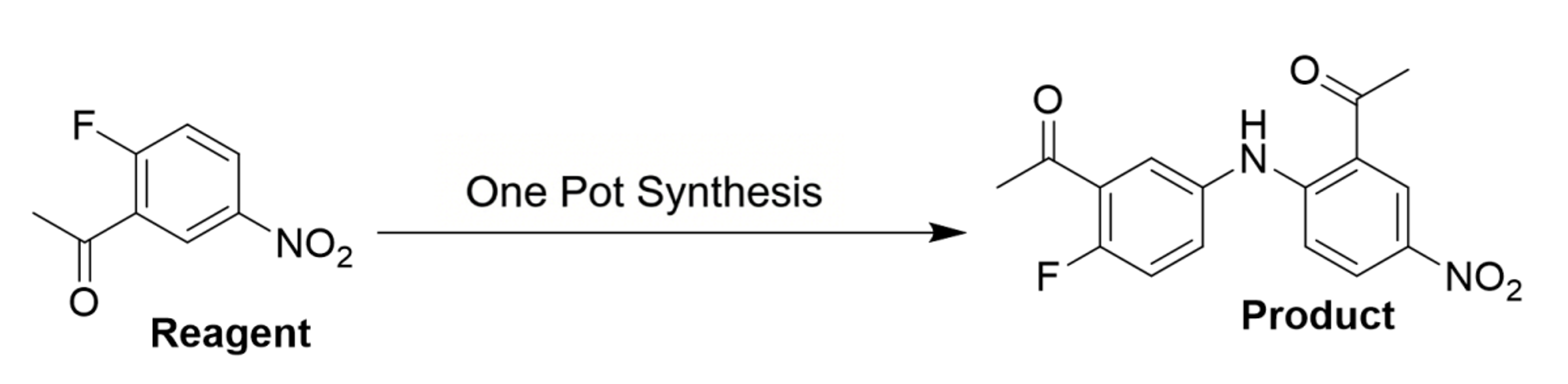
Herein we reported on a one-pot nitro reduction/nucleophilic aromatic substitution on 1-(2-fluoro-5-nitrophenyl)ethan-1-one using a mixture of acetic acid and iron powder in ethanol. The resultant target compound, a nitrated N bis-acetophenone, has many reactive handles; as such, it is a novel intermediate that can be deployed for the syntheses of a vast array of compounds not reported before. This compound is fully characterized using 1H and 13C NMR spectroscopy, and HRMS.

Graphical Abstract

1. Introduction

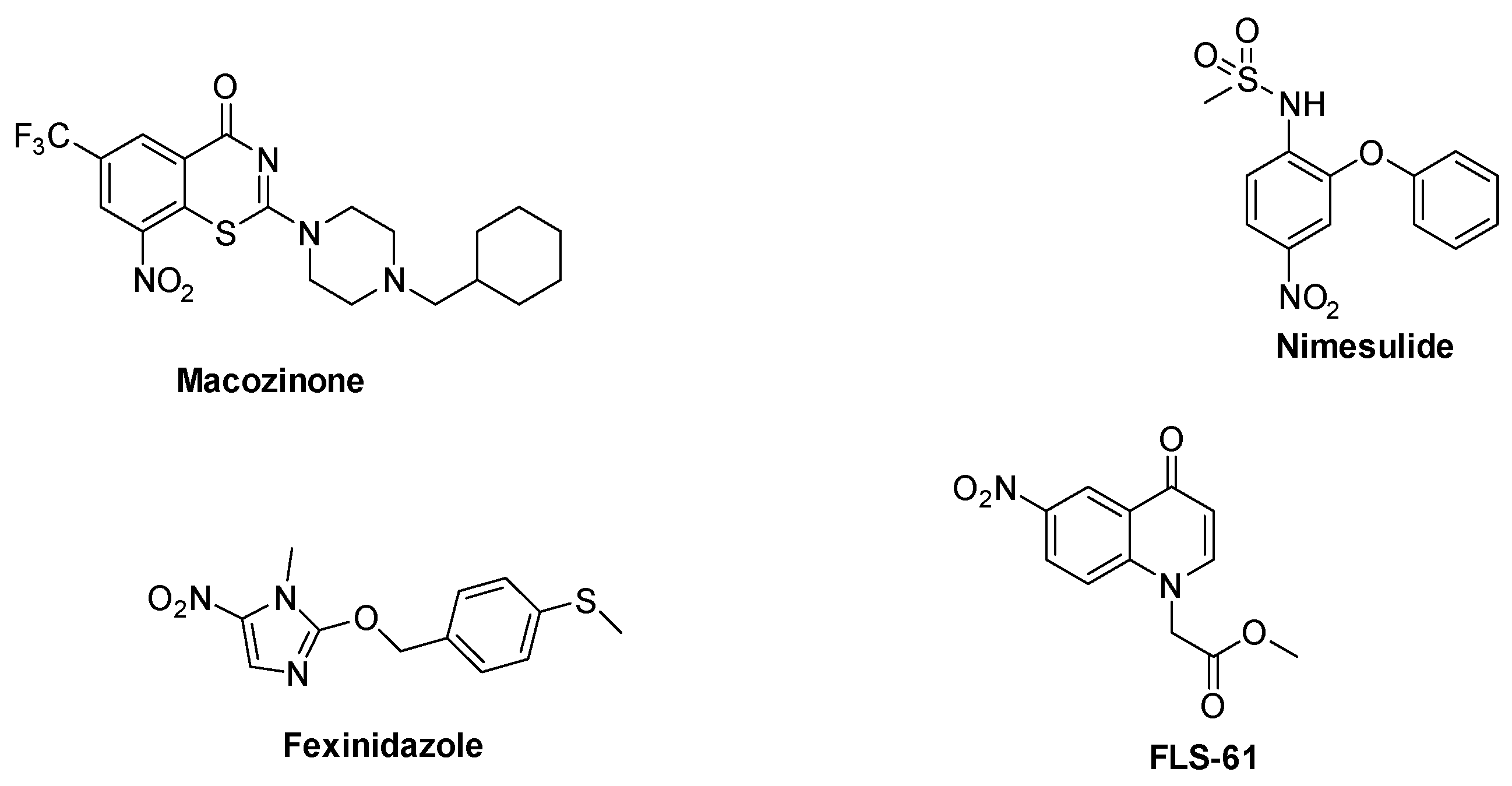
Nitroaromatics are organic molecules, characterized by a nitro (–NO2) moiety directly attached to an aromatic ring [1]. They can be used as building blocks for the generation of compounds such as amines, amides, Schiff-Bases, or applied in agrochemicals and medicine [1]. In medicine, they have diverse applications, including antitubercular (macozinone), antiparasitic (fexinidazole), anti-inflammatory (nimesulide), and radiosensitizers (FLS-61) (Figure 1) [2]. Generally, the pharmacological utility of nitroaromatics is mainly attributed to the nitro group undergoing reduction when these molecules encounter a redox active biological system, leading to the generation of reactive intermediates that ultimately effect the desired pharmacological response [3].
Acetophenones have two chemical moieties: phenyl and acetyl moieties directly linked. They generally act as intermediates for the preparation of a wide range of compounds with versatile pharmacological applications, making them very important building blocks in medicinal chemistry [4]. Compound classes derived from acetophenones include hydrazone, oxime, chalcone, pyrazole, Schiff-base, Mannich-Bases, isoxazole, and thiazole [5]. Pharmacological applications of acetophenone derivatives include antidepressant (bupropion) [6], anticancer (alvocidib) [7], and analgesic (paracetamol) [8].
In this manuscript, we report the synthesis of a novel, nitrated N bis-acetophenone compound. This compound was realized in a one-pot, two-step syntheses, which included reduction and nucleophilic substitution.

2. Results and Discussion

Chemistry

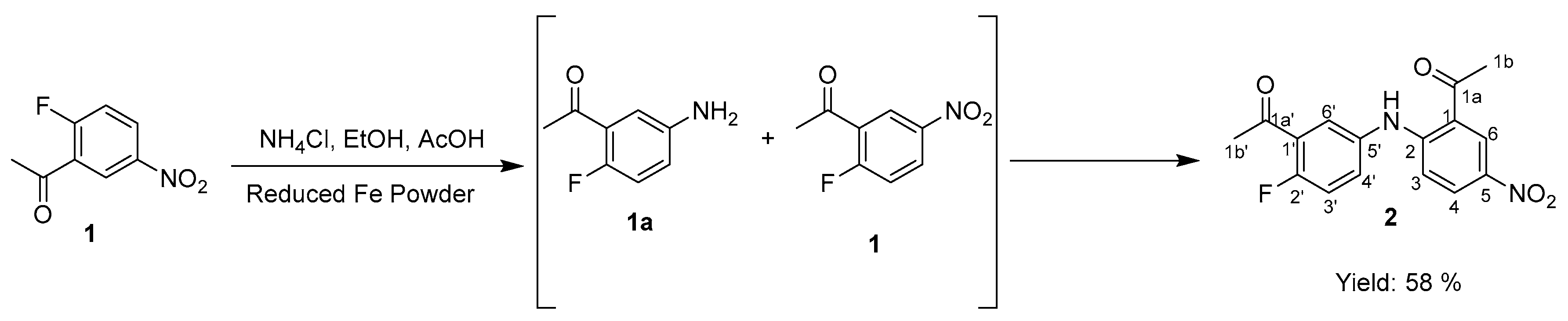
The target compound was obtained in a one-pot, two-step synthetic route as presented in Scheme 1 below. Compound 1 underwent nitro reduction to generate 1a in situs, which caused a fluoride displacement in 1 through an aromatic nucleophilic substitution to afford compound 2 (Scheme 1) [9].
The structure of compound 2 was assigned using nuclear magnetic resonance (NMR) spectroscopy and high-resolution mass spectrometry (HRMS), both of which confirmed the structure of the target compound (see Supplementary Materials Figure S1).
The NMR spectra signals were analysed based on their chemical shifts and/or multiplicities on 1H and 13C. In the 1H NMR spectrum, the singlet appearing at ca 2.7 ppm is indicative of the CH3 of the methyl ketone moiety meta to the nitro group; the 13C peaks at ca 201 and 28 ppm are respectively assignable to the carbonyl and the methyl carbons of the methyl ketone moiety. The doublet at ca 2.6 ppm which integrates to three protons is indicative of the CH3 of the methyl ketone moiety ortho to the fluoro group; these protons are split by the ortho fluorine atom to appear as a doublet with a coupling constant of 3.9 hertz (Hz). DMSO-d6 protons appear at ca 2.5 ppm. The carbonyl and the methyl carbons of this methyl ketone moiety appear at ca 195 (3JCF = 3.2 Hz) and 31 (4JCF = 5.9 Hz) ppm, respectively. Fluorine–carbon coupling with constant magnitude, together with DEPT135, was used to assign aromatic carbons. For example, the carbon directly attached to the fluorine atom has the largest coupling constant of 253.6 Hz, and it appears at 159 ppm; this carbon signal is absent in DEPT135 because it has no proton attached to it. The peak at approximately 118.90 ppm has the second largest coupling constant (2JCF = 25.0 Hz), suggesting it is ortho to a fluorine atom. Moreover, this peak appears on DEPT135, suggesting that it has a hydrogen attached to it. The high-resolution mass spectrometry recorded the exact molecular ion (316 Da) of the compound of interest. DMSO-d6 carbons appear at ca 40 ppm.

3. Materials and Methods

3.1. General Information

Chemicals and solvents used in this study were purchased from Sigma-Aldrich (Pty) Ltd. (Johannesburg, South Africa), Merck (Pty) Ltd. (Johannesburg, South Africa), and Ambeed. Merck (60F254) silica gel plates (Merck, Johannesburg, South Africa) supported on aluminium sheets, which were used to perform thin layer chromatography (TLC) for monitoring reaction progress. Developed TLC plates were visualized under ultraviolet (UV254 and 366 nm) light or stained with iodine vapour. NMR spectra (1H and 13C) were recorded on a Bruker Biospin 600 MHz spectrometer (Rheinstetten/Ettlingen, Germany). Chemical shifts are given in parts per million (ppm) values and are referenced to deuterated dimethylsulfoxide (DMSO-d6). Chemical shifts for deuterated DMSO-d6 appear at 2.5 and 39.5 ppm for 1H and 13C NMR spectra, respectively. Proton coupling patterns are abbreviated as follows: s (singlet), d (doublet), m (multiplet). Coupling constants (J) are reported in Hz. NMR data were analysed using MestReNova Software, version 5.3.2e4936. Melting points (mp) were established with a Büchi melting point B-545 instrument. The high-resolution mass spectra (HRMS) were recorded by means of a Bruker micrOTOF-Q II mass spectrometer (Rheinstetten/Ettlingen, Germany) using atmospheric pressure chemical ionization (APCI) in positive ion mode.

3.2. Generation of [2-{(5′-Amino-2′-fluoroacetophenone)-5-nitro}]acetophenone, 2

Into a round bottom flask containing 1-(2-fluoro-5-nitrophenyl)ethan-1-one (5 g, 27 mmoles), reduced iron powder (5 eq, 7.5 g, 136 mmoles), 10 mL of acetic acid and 15 mL of ethanol were added, and the resultant mixture was stirred under reflux for 24 h, after which it was cooled to room temperature, and 50 mL of dichloromethane (DCM) was added. The mixture was filtered to remove the iron mass (residue), while the filtrate was washed with water, then flushed through a silica gel column using DCM:methanol (10:1) as the mobile phase. Fractions containing the desired compound were combined and concentrated using a rotatory evaporator. The resultant crude was recrystallized from ethanol and dried to afford the target compound in 58% yield (5 g) [9].
[2-{(5′-Amino-2′-fluoroacetophenone)-5-nitro}]acetophenone, 2.
Mustard, plate, mp 136.4–138 °C, yields: 58. 1H NMR (600 MHz, DMSO-d6) δ 10.95 (s, 1H), 8.76 (d, J = 2.7 Hz, 1H), 8.18 (dd, J = 9.5, 2.6 Hz, 1H), 7.72 (dd, J = 6.4, 2.8 Hz, 1H), 7.63 (dt, J = 8.8, 3.5 Hz, 1H), 7.45 (dd, J = 10.7, 8.7 Hz, 1H), 7.02 (d, J = 9.4 Hz, 1H), 2.74 (s, 3H), 2.60 (d, J = 3.9 Hz, 3H). 13C NMR (151 MHz, DMSO) δ 201.40, 195.41 (3JCF = 3.2 Hz), 159.27 (1JCF = 253.6 Hz), 152.32, 137.09, 135.00 (4JCF = 2.8 Hz), 131.90 (3JCF = 9.4 Hz), 130.07, 130.06, 126.79 (2JCF = 13.7 Hz), 126.65 (3JCF = 2.8 Hz), 118.90 (2JCF = 25.0 Hz), 117.71, 114.15, 31.29 (4JCF = 5.9 Hz), 28.58. HRMS-APCI m/z calcd for C16H14FN2O4, 317.0922, found: 317.0932.

4. Conclusions

Nitro-containing compounds have broad applications. In medicine, this compound class has produced several drugs against different clinical indications including tuberculosis, cancer, and sleeping sickness. Acetophenones are versatile chemical intermediates, used for the generation of diverse compounds including hydrazone, chalcones, oxime, and pyrazole, all of which have great pharmacological applications.
In this study, we have executed a one-pot, two-step synthetic procedure to generate a nitrated bisacetophenone. The structural integrity of this compound was confirmed using nuclear magnetic resonance spectroscopy and high-resolution mass spectrometry. The small size of this compound and its poly functionalized nature make it a versatile intermediate that can act as a starting point for the syntheses of novel compounds with diverse applications.

Supplementary Materials

Figure S1: Proton, carbon nuclear magnetic resonance spectra and high resolution mass spectrum.

Author Contributions

R.M.B. coordinated syntheses and characterisation and produced the first draft of the manuscript. L.J.L. reviewed the and curated the final draft. All authors have read and agreed to the published version of the manuscript.

Funding

This research received no external funding.

Data Availability Statement

The data presented in this study are available in this article and Supplementary Materials.

Acknowledgments

We acknowledge Sarah Makgoba, D. Otto and J. Jordaan for sample preparation and for the generation of the NMR and HRMS.

Conflicts of Interest

The authors affirm that they have no known financial or interpersonal conflicts.

References

  1. Ju, K.S.; Parales, R.E. Nitroaromatic compounds, from synthesis to biodegradation. Microbiol. Mol. Biol. Rev. 2010, 74, 250–272. [Google Scholar] [CrossRef] [Scilit] [PubMed]
  2. Nepali, K.; Lee, H.-Y.; Liou, J.-P. Nitro-group-containing drugs. J. Med. Chem. 2019, 62, 2851–2893. [Google Scholar] [CrossRef] [Scilit] [PubMed]
  3. Abreu, S.T.; Gelves, L.V.; Barreiro, E.J.; Lima, L.M. Revisiting nitroaromatic drugs: Mechanisms of bioactivation, metabolism and toxicity and methods to synthesize nitroaromatic fragments. J. Braz. Chem. Soc. 2024, 35, e-20240071. [Google Scholar] [CrossRef] [Scilit]
  4. Zubkov, F.I.; Kouznetsov, V.V. Traveling across life sciences with acetophenone—A simple ketone that has special multipurpose missions. Molecules 2023, 28, 370. [Google Scholar] [CrossRef] [Scilit]
  5. Mohareb, R.M.; Mohamed, A.A.; Ibrahim, R.A. Uses of chalcone acetophenone to synthesis heterocyclic compounds with cytotoxic and c-met kinase activities. Bull. Chem. Soc. Ethiop. 2022, 36, 149–172. [Google Scholar] [CrossRef] [Scilit]
  6. Berigan, T.R. The many uses of bupropion and bupropion sustained release (sr) in adults. Prim. Care Companion J. Clin. Psychiatry 2002, 4, 30–32. [Google Scholar] [CrossRef] [Scilit] [PubMed]
  7. Wiernik, P.H. Alvocidib (flavopiridol) for the treatment of chronic lymphocytic leukemia. Expert Opin. Investig. Drugs 2016, 6, 729–734. [Google Scholar] [CrossRef] [Scilit]
  8. Freo, U. Paracetamol for multimodal analgesia. Pain Manag. 2022, 6, 737–750. [Google Scholar] [CrossRef] [Scilit] [PubMed]
  9. Gamble, A.B.; Garner, J.; Gordon, C.P.; O′Conner, S.M.; Keller, P.A. Aryl Nitro reduction with iron powder or stannous chloride under ultrasonic irradiation. Synth. Commun. 2007, 37, 2777–2786. [Google Scholar] [CrossRef] [Scilit]
Figure 1. Synthetic nitro-based drugs.
Molbank 2026 m2162 g001
Scheme 1. Synthetic route for the obtainment of target compound 2.
Molbank 2026 m2162 sch001
Disclaimer/Publisher’s Note: The statements, opinions and data contained in all publications are solely those of the individual author(s) and contributor(s) and not of MDPI and/or the editor(s). MDPI and/or the editor(s) disclaim responsibility for any injury to people or property resulting from any ideas, methods, instructions or products referred to in the content.