Abstract
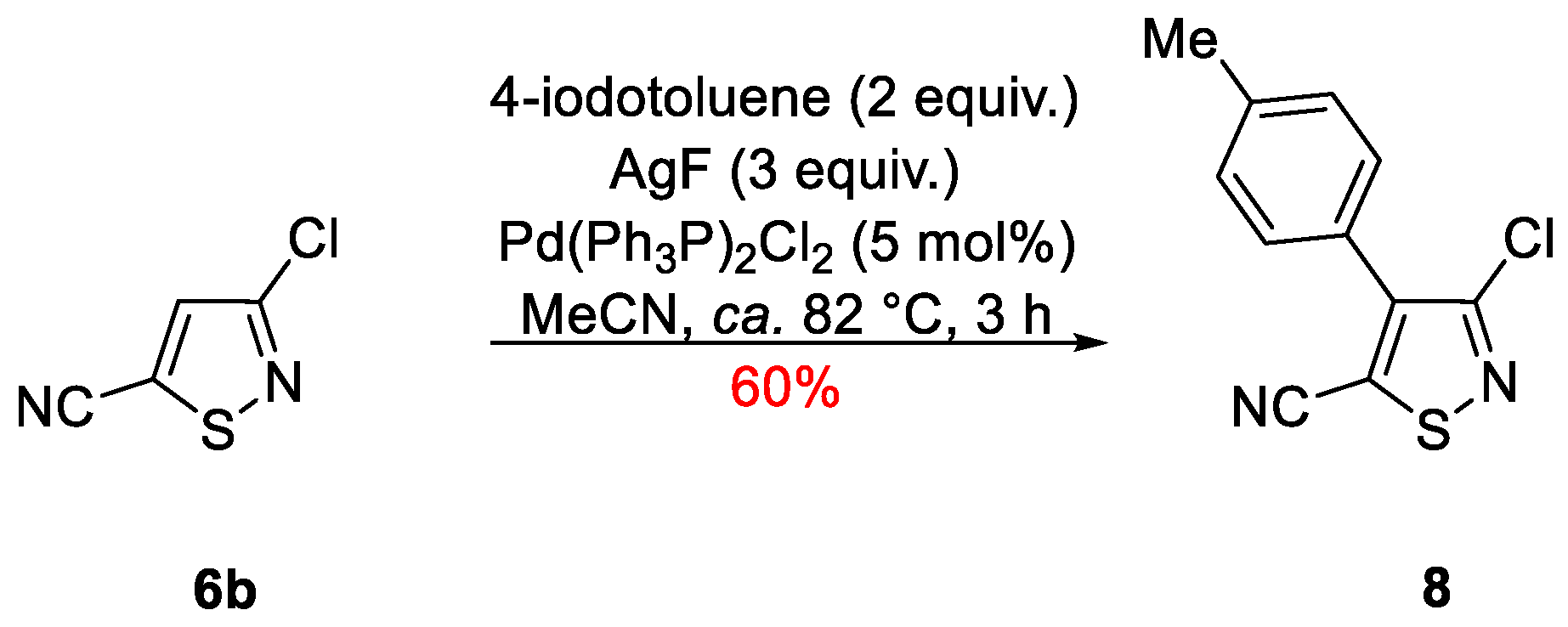
A reaction of 3-chloroisothiazole-5-carbonitrile with 1-iodo-4-methylbenzene (2 equiv.) produced 3-chloro-4-(p-tolyl)isothiazole-5-carbonitrile in a 60% yield. The compound was fully characterized.
1. Introduction
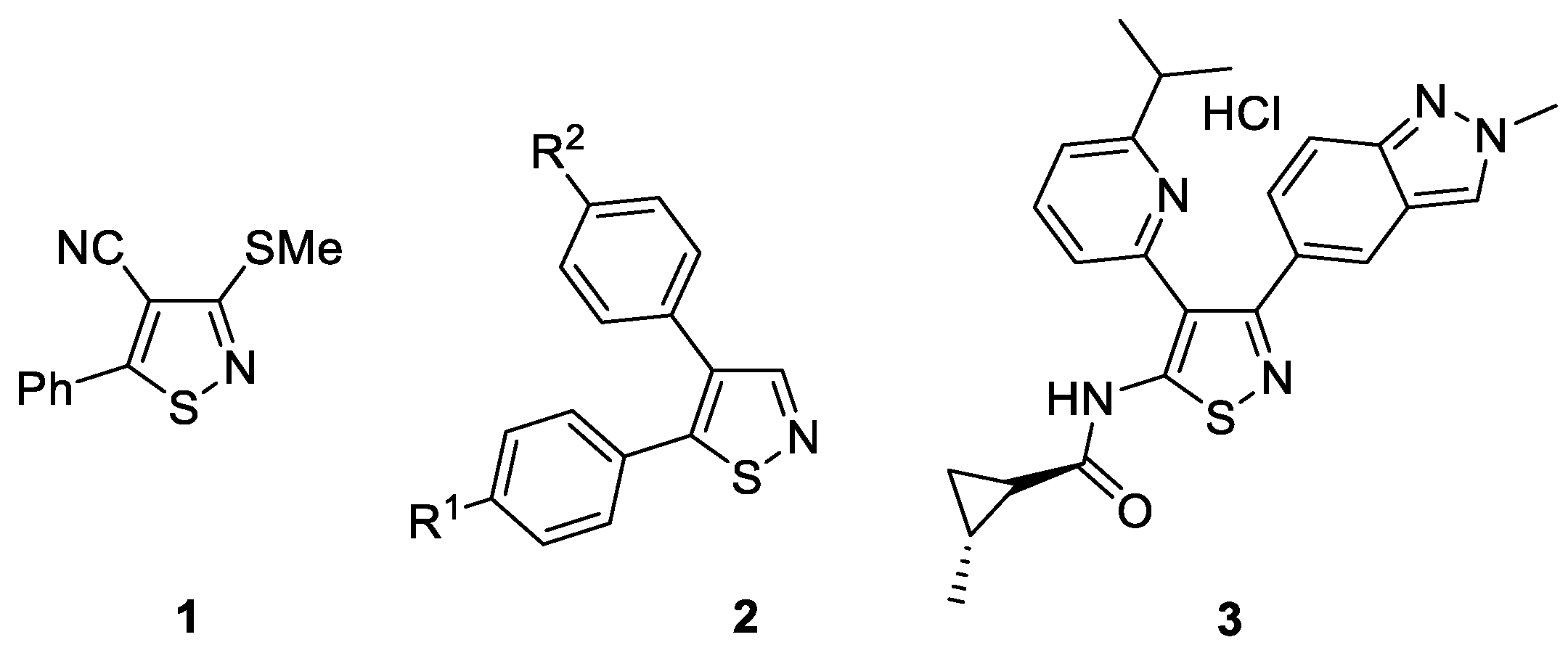
Isothiazoles are useful compounds owing to their wide biological activity, industrial applications, and their use as synthetic intermediates [1]. In particular, aryl- and hetaryl-substituted isothiazoles show rich biological activity, i.e., 5-phenylisothiazole 1 showed antiviral activity against polio [2], 4,5-diarylisothiazoles 2 were active as multiple target non-steroidal anti-inflammatory agents [3] and 4-pyridylisothiazole 3 is a possible HIV inhibitor [4] (Figure 1).
Figure 1.
Biologically active aryl- and hetaryl-substituted isothiazoles.
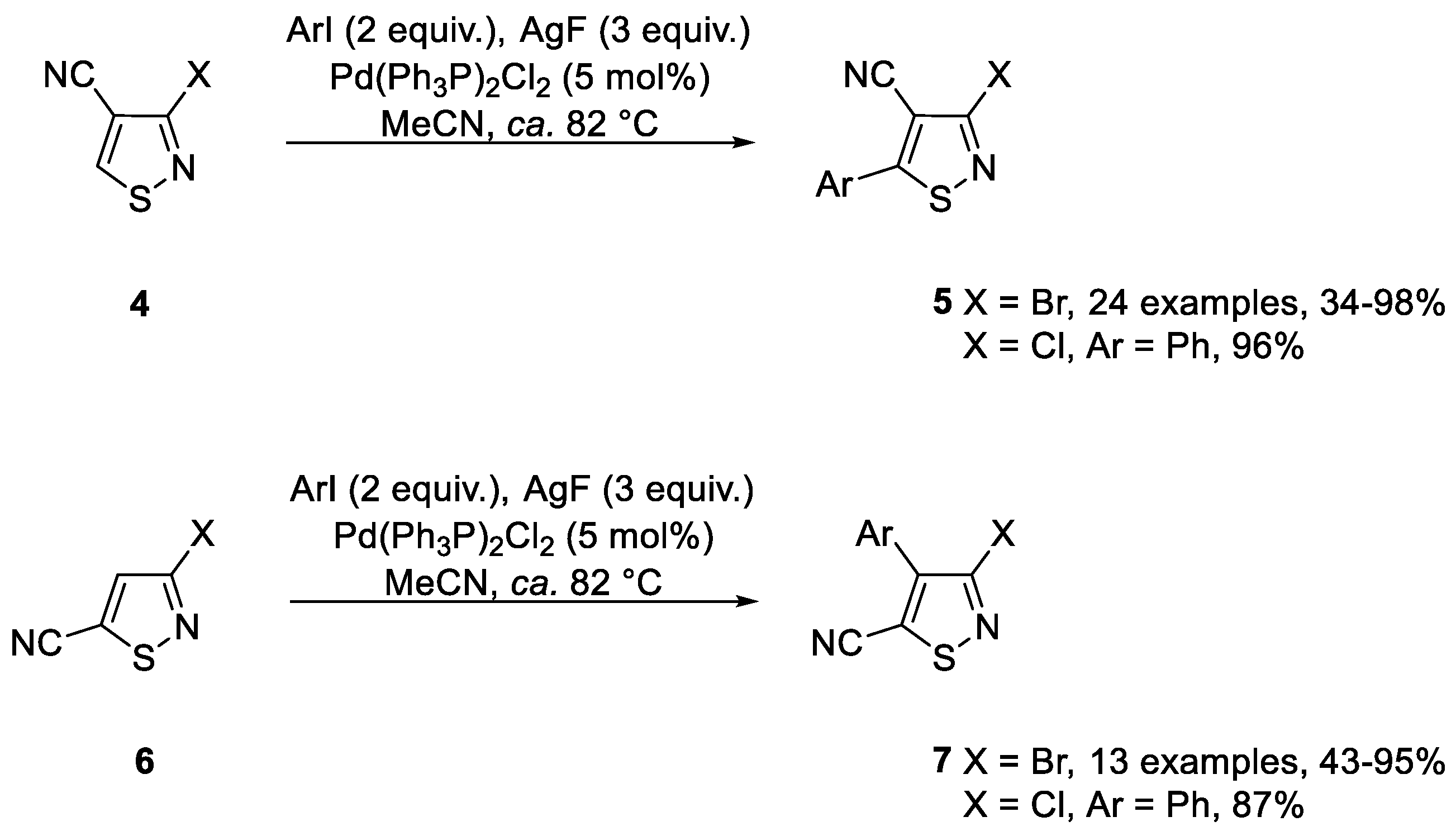
Recently, we investigated the synthesis of aryl-substituted isothiazoles by performing CH arylation of both the 5 [5] and the 4 [6] positions to obtain arylisothiazole products (Scheme 1). Interestingly, while the respective 3-bromoisothiazoles were studied well, only one example of CH arylation of a 3-chloro derivative was reported in each study (Scheme 1).
Scheme 1.
CH arylation of isothiazole-5-carbonitriles 4 and 6.
As a continuation of this study on the CH arylation of isothiazoles, we investigated the reaction of 3-chloroisothiazole-5-carbonitrile (6b) with 1-iodo-4-methylbenzene.
2. Results and Discussion
The reaction of 3-chloroisothiazole-5-carbonitrile (6b) with 1-iodo-4-methylbenzene (2 equiv.), in the presence of AgF (3 equiv.), Pd(Ph3P)2Cl2 (5 mol%) and Ph3P (10 mol%), in MeCN at ca. 82 °C led to a complete consumption of the starting isothiazole and isolation of the desired 3-chloro-4-(p-tolyl)isothiazole-5-carbonitrile (8) in a 60% yield (Scheme 2), while no other products were observed by TLC.
Scheme 2.
Synthesis of 3-chloro-4-(p-tolyl)isothiazole-5-carbonitrile (8).
Product 8 was isolated as colorless plates, mp 108–109 °C (from n-pentane/−20 °C). UV-vis spectroscopy in dichloromethane supported an intact isothiazole ring (λmax 309 nm, log ε 4.02), while FTIR spectroscopy supported the presence of a C≡N resonance at 2228 cm−1. Mass spectrometry revealed a molecular ion (M+) peak of m/z 234 (100%) along with a M++2 isotope peak at 236 (22%) that supported the presence of a chlorine atom. 13C NMR spectroscopy showed the presence of one CH3, two CH resonance and six quaternary carbon resonances, with the resonance at 110.5 ppm corresponding to the nitrile group (see Supplementary Materials for the NMR spectra). Moreover, a correct elemental analysis (CHN) was obtained for the molecular formula C11H7ClN2S. The multifunctional nature of isothiazole 8 makes it a potentially useful scaffold.
3. Materials and Methods
The reaction mixture was monitored by TLC using commercial glass-backed thin layer chromatography (TLC) plates (Merck Kieselgel 60 F254). The plates were observed under UV light at 254 and 365 nm. Acetonitrile (MeCN) was distilled over CaH2 before use. The melting point was determined using a PolyTherm-A, Wagner & Munz, Kofler-Hotstage Microscope apparatus (Wagner & Munz, Munich, Germany). The solvent used for recrystallization is indicated after the melting point. The UV-vis spectrum was obtained using a Perkin-Elmer Lambda-25 UV-vis spectrophotometer (Perkin-Elmer, Waltham, MA, USA) and inflections are identified by the abbreviation “inf”. The IR spectrum was recorded on a Shimadzu FTIR-NIR Prestige-21 spectrometer (Shimadzu, Kyoto, Japan) with a Pike Miracle Ge ATR accessory (Pike Miracle, Madison, WI, USA) and strong, medium and weak peaks are represented by s, m and w, respectively. 1H and 13C NMR spectra were recorded on a Bruker Avance 500 machine (at 500 and 125 MHz, respectively, (Bruker, Billerica, MA, USA)). Deuterated solvents were used for homonuclear lock and the signals reference the deuterated solvent peaks. Attached proton test (APT) NMR studies were used for the assignment of the 13C peaks as CH3, CH2, CH and Cq (quaternary). MALDI-TOF mass spectra were recorded with a Bruker Autoflex III Smartbeam instrument. 3-Chloroisothiazole-5-carbonitrile (6b) [7] was prepared according to the procedure described in the literature.
3-Chloro-4-(p-tolyl)isothiazole-5-carbonitrile (8)

1-Iodo-4-methylbenzene (109 mg, 0.50 mmol), AgF (95 mg, 0.75 mmol), Pd(Ph3P)2Cl2 (8.8 mg, 5 mol%) and Ph3P (6.6 mg, 10 mol%) were added to a stirred suspension of 3-chloroisothiazole-5-carbonitrile (6b) (36 mg, 0.25 mmol) in MeCN (1 mL) and the reaction mixture was stirred at ca. 82 °C until consumption of the starting material (TLC, 3 h). The mixture was then adsorbed onto silica and chromatographed (n-hexane/DCM 80:20) to produce the title compound 8 (36 mg, 60%) as colorless plates, mp 108–109 °C (from n-pentane/−20 °C); Rf 0.23 (n-hexane/DCM 80:20); (found: C, 56.23; H, 2.96; N, 11.81. C11H7ClN2S requires C, 56.29; H, 3.01; N, 11.94%); λmax(DCM)/nm 309 (log ε 4.02); vmax/cm−1 3048w (aryl C–H), 2920w (alkyl C–H), 2228w (C≡N), 1616w, 1533w, 1493w, 1360m, 1346m, 1314m, 1215m, 1196s, 1184m, 1125w, 1107m, 1037w, 1022w, 959w, 930m, 854m, 826s, 816m, 785m; δH(500 MHz; CDCl3) 7.47 (2H, d, J 8.2, Ar H), 7.35 (2H, d, J 8.2, Ar H), 2.45 (3H, s, CH3); δC(125 MHz; CDCl3) 149.9 (Cq), 144.0 (Cq), 140.7 (Cq), 130.9 (Cq), 129.8 (CH), 129.1 (CH), 125.6 (Cq), 110.5 (Cq), 21.5 (CH3); and m/z (MALDI-TOF) 236 (M++2, 22%), 234 (M+, 100), 191 (MH+-SN+2, 31), 189 (M+-SN, 30), 165 (M+, 32), 163 (46).
Supplementary Materials
The following supporting information can be downloaded at, mol file, 1H and 13C NMR and IR spectra.
Author Contributions
A.S.K. and P.A.K. conceived the experiments; A.S.K. designed the experiments; A.S.K. wrote the paper; A.S.K. and P.A.K. edited the manuscript. All authors have read and agreed to the published version of the manuscript.
Funding
This research was funded by the Cyprus Research Promotion Foundation, grant numbers ΣΤΡΑΤΗΙΙ/0308/06, NEKYP/0308/02 ΥΓEIA/0506/19 and ENIΣX/0308/83.
Data Availability Statement
Not applicable.
Acknowledgments
The authors thank the following organizations and companies in Cyprus for generous donations of chemicals and glassware: The State General Laboratory, the Agricultural Research Institute, the Ministry of Agriculture, MedoChemie Ltd., Medisell Ltd. and Biotronics Ltd. Furthermore, we thank the A. G. Leventis Foundation for helping to establish the NMR facility at the University of Cyprus.
Conflicts of Interest
The authors declare no conflict of interest. The funders had no role in the design of the study; in the collection, analyses, or interpretation of data; in the writing of the manuscript, or in the decision to publish the results.
References
- Clerici, F.; Gelmi, M.L.; Pellegrino, S. Comprehensive Heterocyclic Chemistry III; Joule, J., Katritzky, A.R., Ramsden, C.A., Scriven, E.F.V., Taylor, R.J.K., Eds.; Elsevier: Oxford, UK, 2008; Volume 4, pp. 545–633, Chapter 4.05. [Google Scholar]
- Garozzo, A.; Stivala, A.; Tempera, G.; Castro, A. Antipoliovirus activity and mechanism of action of 3-methylthio-5-phenyl-4-isothiazolecarbonitrile. Antiviral Res. 2010, 88, 325–328. [Google Scholar] [CrossRef] [PubMed]
- Scholz, M.; Ulbrich, H.K.; Soehnlein, O.; Lindbom, L.; Mattern, A.; Dannhardt, G. Diaryl-dithiolanes and -isothiazoles: COX-1/COX-2 and 5-LOX-inhibitory, OH scavenging and anti-adhesive activities. Bioorg. Med. Chem. 2009, 17, 558–568. [Google Scholar] [CrossRef] [PubMed]
- Bracey-Walker, M.R.; Britton, T.C.; Catlow, J.T.; Dressman, B.A.; Fivush, A.M.; Hao, J.; Heinz, B.A.; Henry, S.S.; Hollinshead, S.P.; Iyengar, S.; et al. Discovery of (1R,2R)-N-(4-(6-isopropylpyridin-2-yl)-3-(2-methyl-2H-indazol-5-yl)isothiazol-5-yl)-2-methylcyclopropanecarboxamide, a potent and orally efficacious mGlu5 receptor negative allosteric modulator. Bioorg. Med. Chem. Lett. 2013, 23, 1249–1252. [Google Scholar] [CrossRef]
- Ioannidou, H.A.; Koutentis, P.A. Silver-mediated palladium-catalyzed direct C-H arylation of 3-bromoisothiazole-4-carbonitrile. Org. Lett. 2011, 13, 1510–1513. [Google Scholar] [CrossRef] [PubMed]
- Kalogirou, A.S.; Koutentis, P.A. Silver mediated direct CH arylation of 3-bromoisothiazole-5-carbonitrile. Tetrahedron 2014, 70, 6796–6802. [Google Scholar] [CrossRef]
- Kalogirou, A.S.; Christoforou, I.C.; Ioannidou, H.A.; Manos, M.; Koutentis, P.A. Ring transformation of (4-chloro-5H-1,2,3-dithiazol-5-ylidene)acetonitriles to 3-haloisothiazole-5-carbonitriles. RSC Adv. 2013, 4, 7735–7748. [Google Scholar] [CrossRef]
Disclaimer/Publisher’s Note: The statements, opinions and data contained in all publications are solely those of the individual author(s) and contributor(s) and not of MDPI and/or the editor(s). MDPI and/or the editor(s) disclaim responsibility for any injury to people or property resulting from any ideas, methods, instructions or products referred to in the content. |
© 2023 by the authors. Licensee MDPI, Basel, Switzerland. This article is an open access article distributed under the terms and conditions of the Creative Commons Attribution (CC BY) license (https://creativecommons.org/licenses/by/4.0/).