Rethinking Risk Prediction in Preeclampsia: From Biomarkers to Mechanistic Phenotypes and Longitudinal Models

 , , ,
, , ,  , ,
, , 
Abstract
1. Introduction
2. Scope and Approach
3. Preeclampsia as a Heterogeneous Syndrome
4. Limitations of Single-Biomarker and Static Threshold Approaches
5. Multimarker and Longitudinal Risk Trajectories
6. Predictive Models: From Classical Statistics to Machine Learning
7. Translating Prediction into Clinical Decision-Making
8. Future Directions and Research Priorities
9. Conclusions
Author Contributions
Funding
Institutional Review Board Statement
Informed Consent Statement
Data Availability Statement
Conflicts of Interest
References
- Dimitriadis, E.; Rolnik, D.L.; Zhou, W.; Estrada-Gutierrez, G.; Koga, K.; Francisco, R.P.V.; Whitehead, C.; Hyett, J.; da Silva Costa, F.; Nicolaides, K.; et al. Pre-eclampsia. Nat. Rev. Dis. Primers 2023, 9, 8. [Google Scholar] [PubMed]
- Mol, B.W.J.; Roberts, C.T.; Thangaratinam, S.; Magee, L.A.; de Groot, C.J.M.; Hofmeyr, G.J. Pre-eclampsia. Lancet 2016, 387, 999–1011. [Google Scholar] [CrossRef] [PubMed]
- American College of Obstetricians and Gynecologists. Gestational Hypertension and Preeclampsia: ACOG Practice Bulletin, Number 222. Obstet. Gynecol. 2020, 135, e237–e260. [Google Scholar] [CrossRef] [PubMed]
- Torres-Torres, J.; Espino-y-Sosa, S.; Martinez-Portilla, R.; Borboa-Olivares, H.; Estrada-Gutierrez, G.; Acevedo-Gallegos, S.; Ruiz-Ramirez, E.; Velasco-Espin, M.; Cerda-Flores, P.; Ramirez-Gonzalez, A.; et al. A Narrative Review on the Pathophysiology of Preeclampsia. Int. J. Mol. Sci. 2024, 25, 7569. [Google Scholar] [CrossRef]
- Phipps, E.A.; Thadhani, R.; Benzing, T.; Karumanchi, S.A. Pre-eclampsia: Pathogenesis, novel diagnostics and therapies. Nat. Rev. Nephrol. 2019, 15, 275–289, Correction in Nat. Rev. Nephrol. 2019, 15, 386. [Google Scholar] [CrossRef]
- Guizani, M.; Valsamis, J.; Dutemeyer, V.; Kang, X.; Ceccotti, V.; Khalife, J.; Duiella, S.F.; Blavier, F.; Faraca, A.; Cos, T.; et al. First-Trimester Combined Multimarker Prospective Study for the Detection of Pregnancies at a High Risk of Developing Preeclampsia Using the Fetal Medicine Foundation-Algorithm. Fetal Diagn. Ther. 2018, 43, 266–273. [Google Scholar] [CrossRef]
- Malik, V.; Agrawal, N.; Prasad, S.; Talwar, S.; Khatuja, R.; Jain, S.; Sehgal, N.P.; Malik, N.; Khatuja, J.; Madan, N. Prediction of Preeclampsia Using Machine Learning: A Systematic Review. Cureus 2024, 16, e76095. [Google Scholar] [CrossRef]
- Ranjbar, A.; Montazeri, F.; Ghamsari, S.R.; Mehrnoush, V.; Roozbeh, N.; Darsareh, F. Machine learning models for predicting preeclampsia: A systematic review. BMC Pregnancy Childbirth 2024, 24, 6. [Google Scholar] [CrossRef] [PubMed]
- Zeisler, H.; Llurba, E.; Chantraine, F.; Vatish, M.; Staff, A.C.; Sennström, M.; Olovsson, M.; Brennecke, S.P.; Stepan, H.; Allegranza, D.; et al. Predictive Value of the sFlt-1:PlGF Ratio in Women with Suspected Preeclampsia. N. Engl. J. Med. 2016, 374, 13–22. [Google Scholar] [CrossRef]
- Chaiworapongsa, T.; Romero, R.; Gomez-Lopez, N.; Suksai, M.; Gallo, D.M.; Jung, E.; Berry, S.M.; Awonuga, A.; Tarca, A.L.; Bryant, D.R. Preeclampsia at term: Evidence of disease heterogeneity based on the profile of circulating cytokines and angiogenic factors. Am. J. Obstet. Gynecol. 2024, 230, 450.e1–450.e18. [Google Scholar] [CrossRef]
- Masini, G.; Foo, L.F.; Tay, J.; Wilkinson, I.B.; Valensise, H.; Gyselaers, W.; Lees, C.C. Preeclampsia has two phenotypes which require different treatment strategies. Am. J. Obstet. Gynecol. 2022, 226, S1006–S1018. [Google Scholar] [CrossRef]
- Rana, S.; Schnettler, W.T.; Powe, C.; Wenger, J.; Salahuddin, S.; Cerdeira, A.S.; Verlohren, S.; Perschel, F.H.; Arany, Z.; Lim, K.H.; et al. Clinical characterization and outcomes of preeclampsia with normal angiogenic profile. Hypertens. Pregnancy 2013, 32, 189–201. [Google Scholar] [CrossRef]
- Torres-Torres, J.; Espino, Y.S.S.; Martinez-Portilla, R.J.; Moreno-Verduzco, E.R.; Monroy-Muñoz, I.E.; Solis-Paredes, J.M.; Duran, J.P.; Borboa-Olivares, H.; Rojas-Zepeda, L. A first-trimester mechanistic framework integrating three Physiopathologic biomarker domains for pre-eclampsia classification. Int. J. Gynaecol. Obstet. 2026. Epub ahead of print. [Google Scholar] [CrossRef]
- Torres-Torres, J.; Villafan-Bernal, J.R.; Martinez-Portilla, R.J.; Hidalgo-Carrera, J.A.; Estrada-Gutierrez, G.; Adalid-Martinez-Cisneros, R.; Rojas-Zepeda, L.; Acevedo-Gallegos, S.; Camarena-Cabrera, D.M.; Cruz-Martínez, M.Y.; et al. Performance of machine-learning approach for prediction of pre-eclampsia in a middle-income country. Ultrasound Obstet. Gynecol. 2024, 63, 350–357. [Google Scholar] [CrossRef]
- Magee, L.A.; Brown, M.A.; Hall, D.R.; Gupte, S.; Hennessy, A.; Karumanchi, S.A.; Kenny, L.C.; McCarthy, F.; Myers, J.; Poon, L.C.; et al. The 2021 International Society for the Study of Hypertension in Pregnancy classification, diagnosis & management recommendations for international practice. Pregnancy Hypertens. 2022, 27, 148–169. [Google Scholar] [CrossRef]
- Staff, A.C. The two-stage placental model of preeclampsia: An update. J. Reprod. Immunol. 2019, 134–135, 1–10. [Google Scholar] [CrossRef] [PubMed]
- Burton, G.J.; Redman, C.W.; Roberts, J.M.; Moffett, A. Pre-eclampsia: Pathophysiology and clinical implications. BMJ 2019, 366, l2381. [Google Scholar] [CrossRef] [PubMed]
- Kalafat, E.; Thilaganathan, B. Cardiovascular origins of preeclampsia. Curr. Opin. Obstet. Gynecol. 2017, 29, 383–389. [Google Scholar] [CrossRef]
- Thilaganathan, B.; Kalafat, E. Cardiovascular System in Preeclampsia and Beyond. Hypertension 2019, 73, 522–531. [Google Scholar] [CrossRef] [PubMed]
- Laresgoiti-Servitje, E. A leading role for the immune system in the pathophysiology of preeclampsia. J. Leukoc. Biol. 2013, 94, 247–257. [Google Scholar] [CrossRef]
- Poornima, I.G.; Indaram, M.; Ross, J.D.; Agarwala, A.; Wild, R.A. Hyperlipidemia and risk for preclampsia. J. Clin. Lipidol. 2022, 16, 253–260. [Google Scholar] [CrossRef]
- Chaiworapongsa, T.; Romero, R.; Gotsch, F.; Suksai, M.; Gallo, D.M.; Jung, E.; Krieger, A.; Chaemsaithong, P.; Erez, O.; Tarca, A.L. Preeclampsia at term can be classified into 2 clusters with different clinical characteristics and outcomes based on angiogenic biomarkers in maternal blood. Am. J. Obstet. Gynecol. 2023, 228, 569.e1–569.e24. [Google Scholar] [CrossRef]
- Burwick, R.M.; Rodriguez, M.H. Angiogenic Biomarkers in Preeclampsia. Obstet. Gynecol. 2024, 143, 515–523. [Google Scholar] [CrossRef]
- Bisson, C.; Rajan, R.S.; Rana, S. Angiogenic Biomarkers for Preeclampsia in Clinical Setting: A New Era. Hypertension 2023, 80, 2029–2032. [Google Scholar] [CrossRef] [PubMed]
- Steyerberg, E.W.; Vickers, A.J.; Cook, N.R.; Gerds, T.; Gonen, M.; Obuchowski, N.; Pencina, M.J.; Kattan, M.W. Assessing the performance of prediction models: A framework for traditional and novel measures. Epidemiology 2010, 21, 128–138. [Google Scholar] [CrossRef]
- Alba, A.C.; Agoritsas, T.; Walsh, M.; Hanna, S.; Iorio, A.; Devereaux, P.J.; McGinn, T.; Guyatt, G. Discrimination and Calibration of Clinical Prediction Models: Users’ Guides to the Medical Literature. JAMA 2017, 318, 1377–1384. [Google Scholar] [CrossRef]
- O’Gorman, N.; Wright, D.; Poon, L.C.; Rolnik, D.L.; Syngelaki, A.; de Alvarado, M.; Carbone, I.F.; Dutemeyer, V.; Fiolna, M.; Frick, A.; et al. Multicenter screening for pre-eclampsia by maternal factors and biomarkers at 11-13 weeks’ gestation: Comparison with NICE guidelines and ACOG recommendations. Ultrasound Obstet. Gynecol. 2017, 49, 756–760. [Google Scholar] [CrossRef]
- Rolnik, D.L.; Wright, D.; Poon, L.C.; O’Gorman, N.; Syngelaki, A.; de Paco Matallana, C.; Akolekar, R.; Cicero, S.; Janga, D.; Singh, M.; et al. Aspirin versus Placebo in Pregnancies at High Risk for Preterm Preeclampsia. N. Engl. J. Med. 2017, 377, 613–622. [Google Scholar] [CrossRef]
- Wright, D.; Tan, M.Y.; O’Gorman, N.; Poon, L.C.; Syngelaki, A.; Wright, A.; Nicolaides, K.H. Predictive performance of the competing risk model in screening for preeclampsia. Am. J. Obstet. Gynecol. 2019, 220, 199.e1–199.e13, Erratum in Am. J. Obstet. Gynecol. 2019, 221, 504. [Google Scholar] [CrossRef]
- Poon, L.C.; Shennan, A.; Hyett, J.A.; Kapur, A.; Hadar, E.; Divakar, H.; McAuliffe, F.; da Silva Costa, F.; von Dadelszen, P.; McIntyre, H.D.; et al. The International Federation of Gynecology and Obstetrics (FIGO) initiative on pre-eclampsia: A pragmatic guide for first-trimester screening and prevention. Int. J. Gynaecol. Obstet. 2019, 145, 1–33, Erratum in Int. J. Gynaecol. Obstet. 2019, 146, 390–391. [Google Scholar] [CrossRef]
- Tan, M.Y.; Wright, D.; Syngelaki, A.; Akolekar, R.; Cicero, S.; Janga, D.; Singh, M.; Greco, E.; Wright, A.; Maclagan, K.; et al. Comparison of diagnostic accuracy of early screening for pre-eclampsia by NICE guidelines and a method combining maternal factors and biomarkers: Results of SPREE. Ultrasound Obstet. Gynecol. 2018, 51, 743–750. [Google Scholar] [CrossRef]
- Li, H.; Li, Y.; Zang, C.; Pan, W.; Yang, H.S.; Grossman, T.B.; Zhao, Z.; Wang, F. Machine Learning for Dynamic and Short-Term Prediction of Preeclampsia Using Routine Clinical Data. JAMA Netw. Open 2026, 9, e260359. [Google Scholar] [CrossRef]
- Riley, R.D.; Snell, K.I.; Ensor, J.; Burke, D.L.; Harrell, F.E.; Moons, K.G., Jr.; Collins, G.S. Minimum sample size for developing a multivariable prediction model: PART II—Binary and time-to-event outcomes. Stat. Med. 2019, 38, 1276–1296, Correction in Stat. Med. 2019, 38, 5672. [Google Scholar] [CrossRef]
- Beam, A.L.; Kohane, I.S. Big Data and Machine Learning in Health Care. JAMA 2018, 319, 1317–1318. [Google Scholar] [CrossRef]
- Christodoulou, E.; Ma, J.; Collins, G.S.; Steyerberg, E.W.; Verbakel, J.Y.; Van Calster, B. A systematic review shows no performance benefit of machine learning over logistic regression for clinical prediction models. J. Clin. Epidemiol. 2019, 110, 12–22. [Google Scholar] [CrossRef]
- Van Calster, B.; McLernon, D.J.; van Smeden, M.; Wynants, L.; Steyerberg, E.W. Calibration: The Achilles heel of predictive analytics. BMC Med. 2019, 17, 230. [Google Scholar] [CrossRef]
- Vickers, A.J.; Elkin, E.B. Decision curve analysis: A novel method for evaluating prediction models. Med. Decis. Mak. 2006, 26, 565–574. [Google Scholar] [CrossRef]
- Li, S.; Wang, Z.; Vieira, L.A.; Zheutlin, A.B.; Ru, B.; Schadt, E.; Wang, P.; Copperman, A.B.; Stone, J.L.; Gross, S.J.; et al. Improving preeclampsia risk prediction by modeling pregnancy trajectories from routinely collected electronic medical record data. NPJ Digit. Med. 2022, 5, 68. [Google Scholar] [CrossRef] [PubMed]
- Riley, R.D.; Archer, L.; Snell, K.I.E.; Ensor, J.; Dhiman, P.; Martin, G.P.; Bonnett, L.J.; Collins, G.S. Evaluation of clinical prediction models (part 2): How to undertake an external validation study. BMJ 2024, 384, e074820. [Google Scholar] [CrossRef] [PubMed]
- Collins, G.S.; Dhiman, P.; Ma, J.; Schlussel, M.M.; Archer, L.; Van Calster, B.; Harrell, F.E.; Martin, G.P., Jr.; Moons, K.G.M.; van Smeden, M.; et al. Evaluation of clinical prediction models (part 1): From development to external validation. BMJ 2024, 384, e074819. [Google Scholar] [CrossRef]
- Henderson, J.T.; Vesco, K.K.; Senger, C.A.; Thomas, R.G.; Redmond, N. Aspirin Use to Prevent Preeclampsia and Related Morbidity and Mortality: Updated Evidence Report and Systematic Review for the US Preventive Services Task Force. JAMA 2021, 326, 1192–1206. [Google Scholar] [CrossRef]
- Davidson, K.W.; Barry, M.J.; Mangione, C.M.; Cabana, M.; Caughey, A.B.; Davis, E.M.; Donahue, K.E.; Doubeni, C.A.; Kubik, M.; Li, L.; et al. Aspirin Use to Prevent Preeclampsia and Related Morbidity and Mortality: US Preventive Services Task Force Recommendation Statement. JAMA 2021, 326, 1186–1191. [Google Scholar]
- van Montfort, P.; Smits, L.J.M.; van Dooren, I.M.A.; Lemmens, S.M.P.; Zelis, M.; Zwaan, I.M.; Spaanderman, M.E.A.; Scheepers, H.C.J. Implementing a Preeclampsia Prediction Model in Obstetrics: Cutoff Determination and Health Care Professionals’ Adherence. Med. Decis. Mak. 2020, 40, 81–89. [Google Scholar] [CrossRef]
- Vickers, A.; Hollingsworth, A.; Bozzo, A.; Chatterjee, A.; Chatterjee, S. Hypothesis: Net benefit as an objective function during development of machine learning algorithms for medical applications. Int. J. Med. Inf. 2025, 197, 105844. [Google Scholar] [CrossRef]
- Moons, K.G.M.; Damen, J.A.A.; Kaul, T.; Hooft, L.; Andaur Navarro, C.; Dhiman, P.; Beam, A.L.; Van Calster, B.; Celi, L.A.; Denaxas, S.; et al. PROBAST+AI: An updated quality, risk of bias, and applicability assessment tool for prediction models using regression or artificial intelligence methods. BMJ 2025, 388, e082505. [Google Scholar] [CrossRef]
- Efthimiou, O.; Seo, M.; Chalkou, K.; Debray, T.; Egger, M.; Salanti, G. Developing clinical prediction models: A step-by-step guide. BMJ 2024, 386, e078276. [Google Scholar] [CrossRef] [PubMed]
- Collins, G.S.; Moons, K.G.M.; Dhiman, P.; Riley, R.D.; Beam, A.L.; Van Calster, B.; Ghassemi, M.; Liu, X.; Reitsma, J.B.; van Smeden, M.; et al. TRIPOD+AI statement: Updated guidance for reporting clinical prediction models that use regression or machine learning methods. BMJ 2024, 385, e078378, Erratum in BMJ 2024, 385, q902. [Google Scholar] [CrossRef]
- Saelmans, A.; Seinen, T.; Pera, V.; Markus, A.F.; Fridgeirsson, E.; John, L.H.; Schiphof-Godart, L.; Rijnbeek, P.; Reps, J.; Williams, R. Implementation and Updating of Clinical Prediction Models: A Systematic Review. Mayo Clin. Proc. Digit. Health 2025, 3, 100228. [Google Scholar] [CrossRef]
- Tiruneh, S.A.; Vu, T.T.T.; Moran, L.J.; Callander, E.J.; Allotey, J.; Thangaratinam, S.; Rolnik, D.L.; Teede, H.J.; Wang, R.; Enticott, J. Externally validated prediction models for pre-eclampsia: Systematic review and meta-analysis. Ultrasound Obstet. Gynecol. 2024, 63, 592–604. [Google Scholar] [CrossRef]



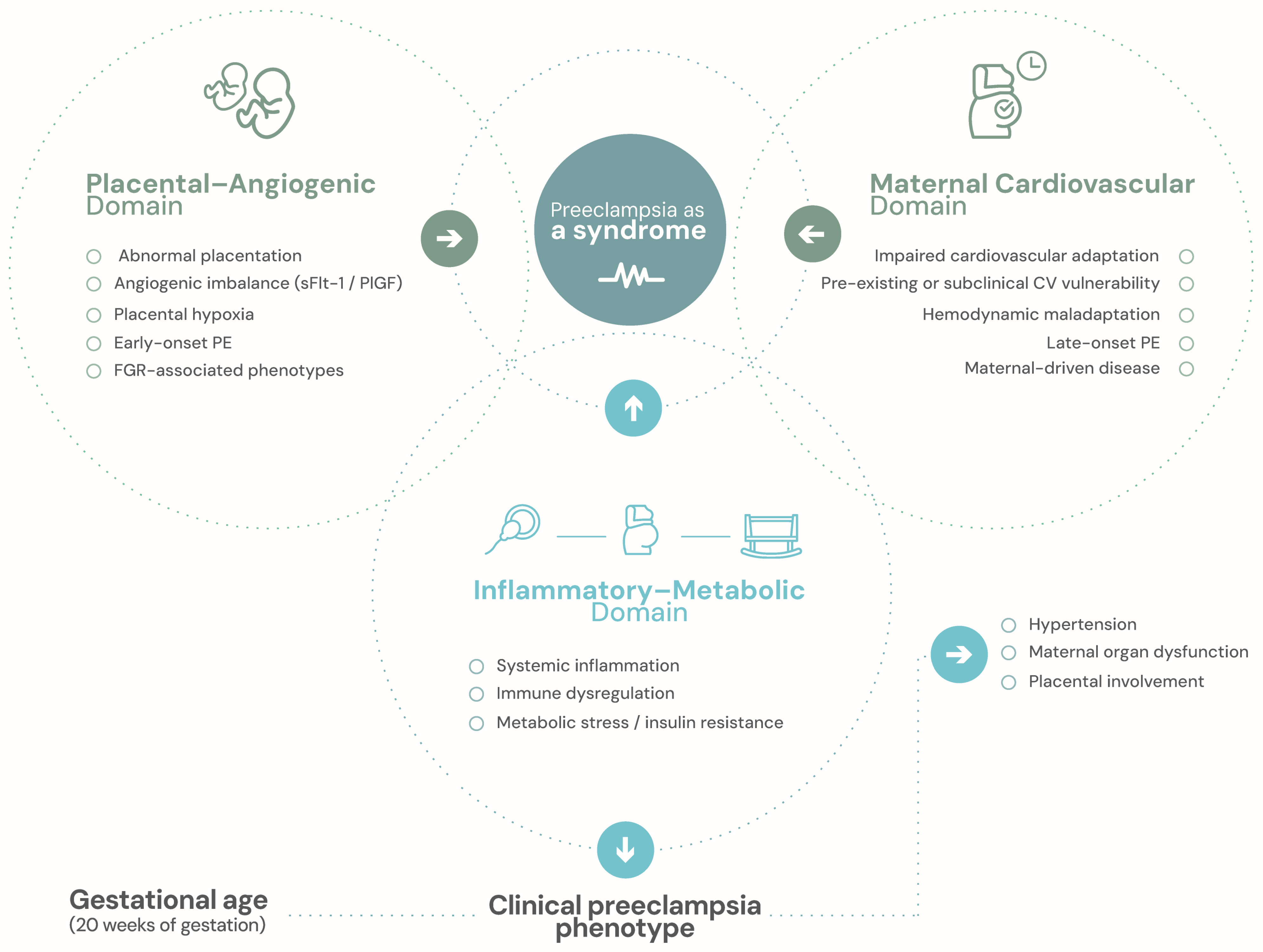
| Phenotype | Dominant Pathway | Typical Timing | FGR | Angiogenic Profile | Clinical Implications |
|---|---|---|---|---|---|
| Placental–angiogenic phenotype | Impaired placentation and angiogenic imbalance | Predominantly early pregnancy | Frequently present | Markedly altered (increased sFlt-1, decreased PlGF) | High risk of early-onset disease, fetal growth restriction, and adverse perinatal outcomes; well suited for angiogenic biomarker-based risk stratification and short-term prediction |
| Maternal cardiovascular phenotype | Inadequate maternal cardiovascular adaptation to pregnancy | Predominantly late pregnancy | Usually absent | Normal or mildly altered | Disease driven primarily by maternal hemodynamic vulnerability; angiogenic markers may be less informative, highlighting the need for cardiovascular-focused and longitudinal prediction strategies |
| Inflammatory–metabolic phenotype | Systemic inflammation, immune dysregulation, and metabolic stress | Across gestation | Variable | Variable or modestly altered | Frequently associated with obesity, diabetes, or metabolic comorbidity; modulates and amplifies other pathways, underscoring the value of integrating metabolic and inflammatory markers |
| Mixed/overlapping phenotypes | Coexistence of multiple mechanistic pathways | Variable | Variable | Heterogeneous | Represents the majority of real-world cases; challenges single-pathway prediction and supports the need for multimarker, phenotype-aware, and longitudinal frameworks |
| Approach | Representative Example(s) | Calibration | Validation | Clinical Usefulness | Main Limitation |
|---|---|---|---|---|---|
| Single-biomarker strategies | sFlt-1/PlGF ratio [9,23,24] | Good for short-term symptomatic prediction; population-dependent for screening | Validated in suspected PE settings | Rule out and short-term triage | Limited for early risk stratification |
| Multimarker first-trimester screening | FMF screening algorithm [6,27,28,30] | Good in screened populations; may require recalibration | Externally validated in multiple cohorts | Supports early risk stratification and aspirin prophylaxis | Static first-trimester snapshot |
| Classical regression-based models | Logistic/competing-risk models [25,26,33] | Can be well calibrated when appropriately specified | Variable across cohorts | Absolute risk estimation and structured screening | Model specification and transportability |
| Machine learning approaches | Multimodal clinical/biochemical models [7,8,14,35] | Often incompletely reported | External validation limited | Potential decision-support role | Limited interpretability and transparency |
| Longitudinal models | Repeated-measures/trajectory-based models [32,38] | Emerging | Limited but growing | Dynamic risk updating across gestation | Data intensity and implementation complexity |
| Phenotype-informed models | Mechanistic-domain models [10,11,16] | Early-stage | Limited validation | Precision-oriented risk stratification | Phenotype definition and validation remain needed |
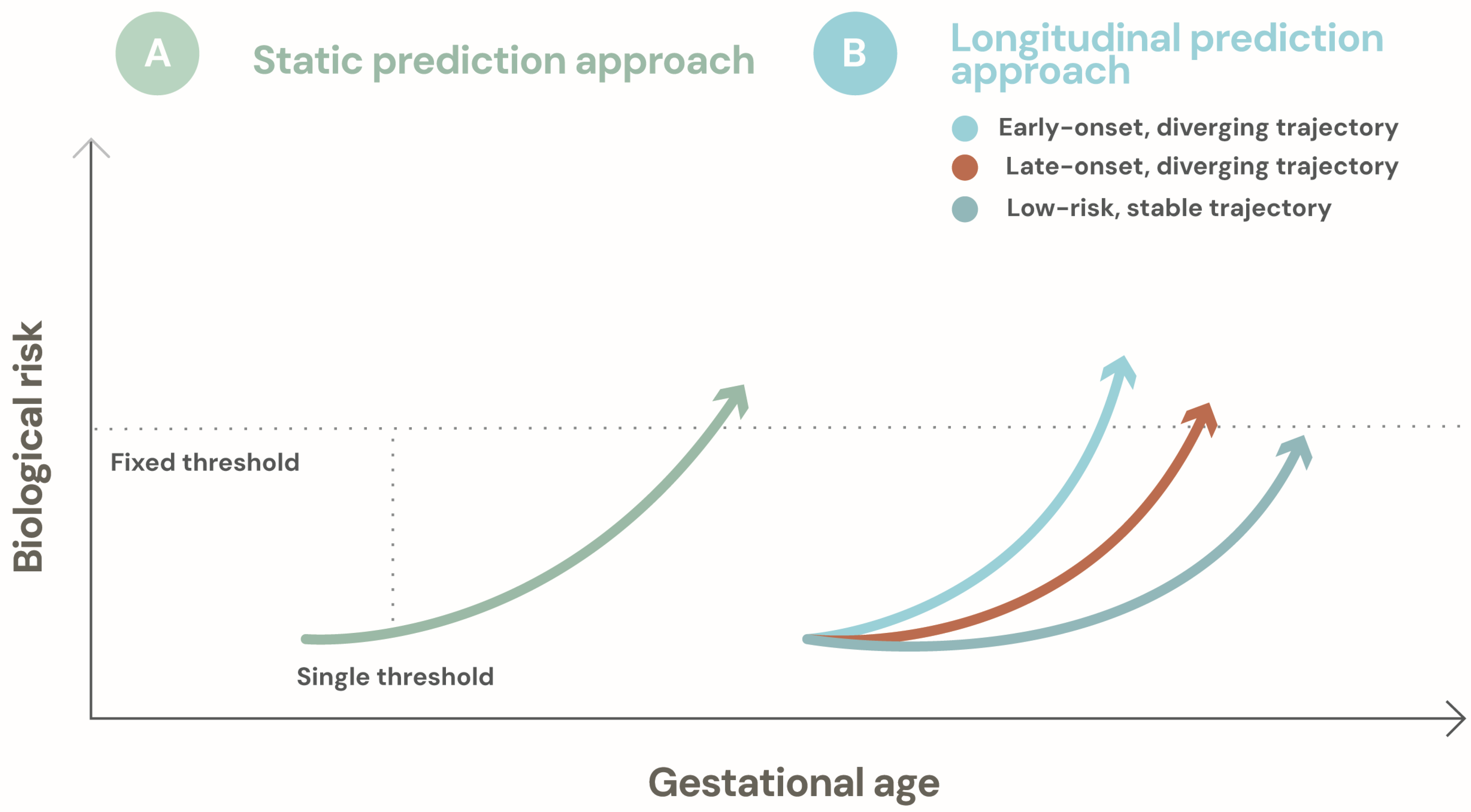
| Approach | Biological Basis | Temporal Representation | Model Perspective | Clinical Implication |
|---|---|---|---|---|
| Single-marker strategies | Single dominant pathway (e.g., angiogenic imbalance) | Static | Threshold-based | Short-term risk assessment; limited early prediction |
| Multimarker strategies | Partial integration of multiple pathways | Static | Additive/combined signals | Improved discrimination; limited adaptability |
| Regression-based models | Selected predictors reflecting clinical and biological factors | Static | Risk estimation | Provides absolute risk; dependent on model specification |
| Machine learning approaches | Complex multi-pathway interactions | Mostly static | Pattern recognition | High discrimination; limited interpretability and transportability |
| Longitudinal models | Evolving biological processes across gestation | Dynamic | Trajectory-based | Enables dynamic risk updating and earlier detection |
| Phenotype-informed models | Mechanistically defined and interacting biological domains | Dynamic | Biology-driven | Aligns prediction with disease mechanisms; supports personalized prevention |
Disclaimer/Publisher’s Note: The statements, opinions and data contained in all publications are solely those of the individual author(s) and contributor(s) and not of MDPI and/or the editor(s). MDPI and/or the editor(s) disclaim responsibility for any injury to people or property resulting from any ideas, methods, instructions or products referred to in the content. |
© 2026 by the authors. Licensee MDPI, Basel, Switzerland. This article is an open access article distributed under the terms and conditions of the Creative Commons Attribution (CC BY) license.
Share and Cite
Espino-y-Sosa, S.; Moreno-Verduzco, E.R.; Monroy-Muñoz, I.E.; Solis-Paredes, J.M.; Pérez Durán, J.; Rojas Zepeda, L.; Torres-Torres, J. Rethinking Risk Prediction in Preeclampsia: From Biomarkers to Mechanistic Phenotypes and Longitudinal Models. Int. J. Mol. Sci. 2026, 27, 3480. https://doi.org/10.3390/ijms27083480
Espino-y-Sosa S, Moreno-Verduzco ER, Monroy-Muñoz IE, Solis-Paredes JM, Pérez Durán J, Rojas Zepeda L, Torres-Torres J. Rethinking Risk Prediction in Preeclampsia: From Biomarkers to Mechanistic Phenotypes and Longitudinal Models. International Journal of Molecular Sciences. 2026; 27(8):3480. https://doi.org/10.3390/ijms27083480
Chicago/Turabian StyleEspino-y-Sosa, Salvador, Elsa Romelia Moreno-Verduzco, Irma Eloisa Monroy-Muñoz, Juan Mario Solis-Paredes, Javier Pérez Durán, Lourdes Rojas Zepeda, and Johnatan Torres-Torres. 2026. "Rethinking Risk Prediction in Preeclampsia: From Biomarkers to Mechanistic Phenotypes and Longitudinal Models" International Journal of Molecular Sciences 27, no. 8: 3480. https://doi.org/10.3390/ijms27083480
APA StyleEspino-y-Sosa, S., Moreno-Verduzco, E. R., Monroy-Muñoz, I. E., Solis-Paredes, J. M., Pérez Durán, J., Rojas Zepeda, L., & Torres-Torres, J. (2026). Rethinking Risk Prediction in Preeclampsia: From Biomarkers to Mechanistic Phenotypes and Longitudinal Models. International Journal of Molecular Sciences, 27(8), 3480. https://doi.org/10.3390/ijms27083480