Article

Impact of Donor Volatile Anesthetic Choice on Recipient Post-Reperfusion Syndrome and Clinical Outcomes in Living Donor Liver Transplantation

Department of Anesthesiology and Pain Medicine, Asan Medical Center, University of Ulsan College of Medicine, 88 Olympic-ro 43-gil, Songpa-gu, Seoul 05505, Republic of Korea
*
Author to whom correspondence should be addressed.
Int. J. Mol. Sci. 2026, 27(8), 3465; https://doi.org/10.3390/ijms27083465
Submission received: 23 February 2026 / Revised: 5 April 2026 / Accepted: 9 April 2026 / Published: 13 April 2026
(This article belongs to the Special Issue Mechanism and Treatment Progress of Liver Disease)

Abstract

Post-reperfusion syndrome (PRS) remains a critical complication in living donor liver transplantation (LDLT). While sevoflurane is recognized for its organ-protective properties, the impact of the donor’s anesthetic choice on recipient outcomes has not been clearly established. This study evaluated whether donor sevoflurane anesthesia reduces the incidence of PRS in recipients compared to desflurane. We retrospectively analyzed 5006 adult LDLT recipients whose donors received either sevoflurane or desflurane. Propensity score matching was employed to minimize selection bias, resulting in 941 matched pairs. The incidence of PRS was significantly lower in the sevoflurane group (64.0%) compared to the desflurane group (71.8%; p < 0.001). Multivariable logistic regression identified donor sevoflurane as an independent protective factor against PRS (odds ratio 0.47; 95% confidence interval 0.41–0.55; p < 0.001). Furthermore, recipients in the sevoflurane group exhibited significantly lower rates of prolonged intensive care unit stay, along with superior recovery of liver enzymes and inflammatory markers. Our findings suggest a potential association between donor sevoflurane anesthesia and more favorable early recipient outcomes, including a reduced incidence of PRS and enhanced recovery.

1. Introduction

Liver transplantation (LT) is the established definitive treatment for patients with end-stage liver disease [1]. Despite advancements in surgical techniques and perioperative management, post-reperfusion syndrome (PRS)—characterized by severe hemodynamic instability immediately following graft reperfusion—remains a critical intraoperative complication [2,3,4]. Clinically, PRS is defined as a decrease in mean arterial pressure (MAP) of more than 30% from the baseline value, lasting at least 1 min within the first 5 min of reperfusion. PRS is associated with significant adverse clinical outcomes, including lower early survival rates, prolonged intensive care unit (ICU) stays, and extended durations of mechanical ventilation [5,6]. Although predicting and preventing PRS remains challenging due to the multifactorial nature of its pathogenesis, various pharmacological interventions have been investigated to improve clinical outcomes [3,7].
Sevoflurane has been suggested to possess organ-protective properties beyond its anesthetic effects [8,9,10]. While its protective effects against hepatic ischemia–reperfusion injury have been demonstrated in various animal studies [11,12,13], robust clinical investigations remain relatively limited. Furthermore, clinical research investigating the protective effects of these agents has primarily focused on the choice of anesthetic for the recipient [8,14]. This focus may not fully address the initial ischemic insult to the liver graft, which begins earlier during donor hepatectomy.
Sevoflurane and desflurane are widely regarded as the volatile agents of choice for living donors due to their favorable pharmacokinetic profiles [15,16]. Previous studies have demonstrated that the choice between these two agents does not affect postoperative hepatic or renal function in living donors [17,18]. In contrast, research involving transplant recipients has shown that the choice of volatile anesthetic administered to the recipient can significantly impact their clinical outcomes [19,20,21]. However, to the best of our knowledge, no study has directly compared the impact of the donor’s volatile anesthetic choice on recipient outcomes. Although deceased donor liver transplantation remains the predominant procedure in Western countries, the annual volume of living donor liver transplantation (LDLT) has steadily increased over the past decade [22]. Despite comprising a minority of all liver transplants, LDLT has demonstrated superior clinical outcomes, highlighting the importance of clinical research on LDLT to optimize perioperative management [23]. Therefore, this study aimed to evaluate the impact of the donor’s volatile anesthetic choice (sevoflurane vs. desflurane) on the incidence of PRS and postoperative outcomes in a large cohort of adult LDLT recipients.

2. Results

2.1. Study Population and Propensity Score Matching Analysis

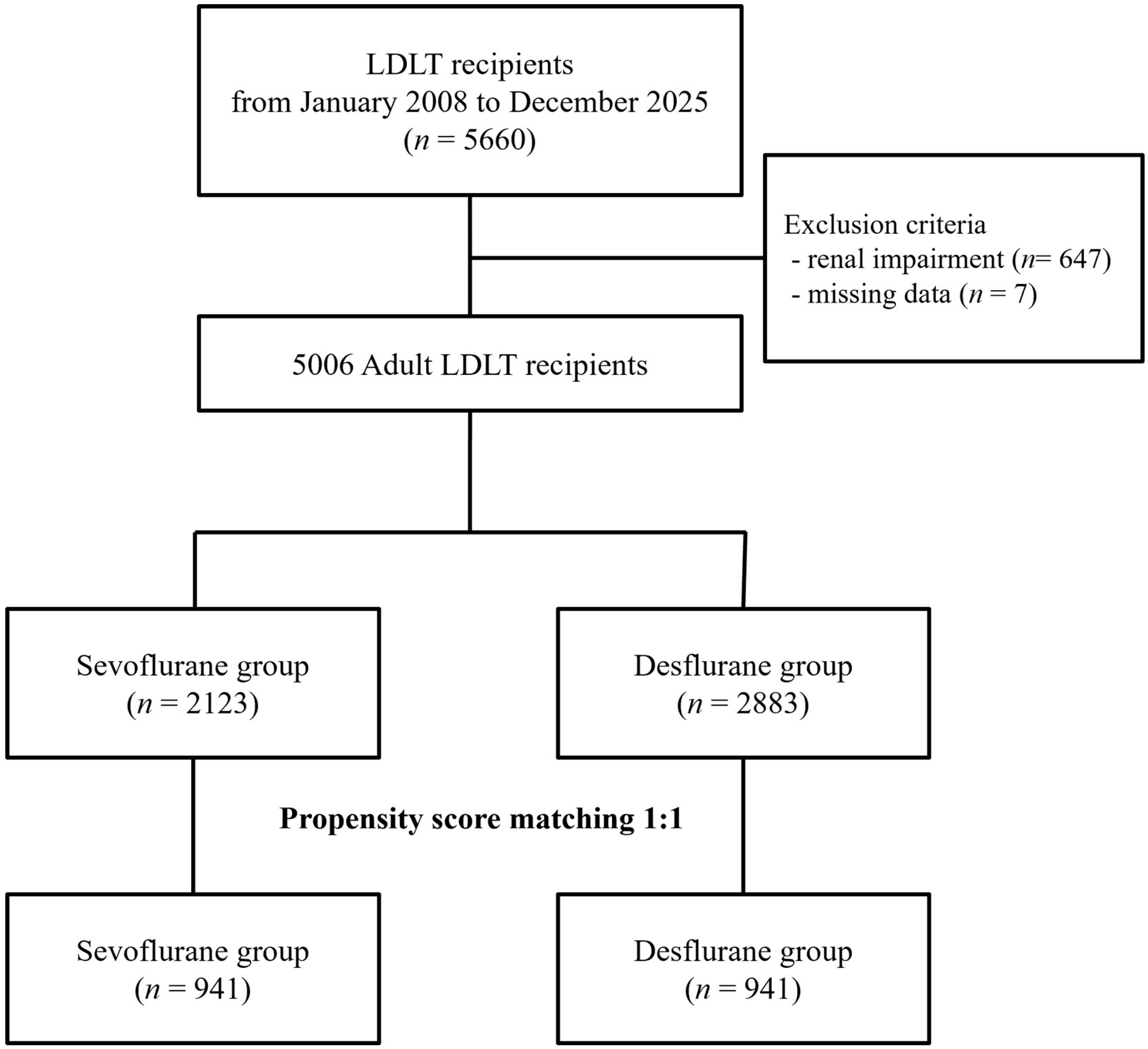
A total of 5006 adult recipients who underwent primary LDLT during the study period were included in the final analysis, consisting of 2123 (42.4%) in the sevoflurane group and 2883 (57.6%) in the desflurane group based on the volatile anesthetic administered to the donor (Figure 1). Before propensity score matching (PSM), differences in baseline characteristics were observed between the two groups (Table 1). After 1:1 PSM, 941 pairs of recipients (total n = 1882) were generated, successfully balancing all baseline covariates. Following matching, all covariates exhibited standardized mean differences of less than 0.1, indicating a well-balanced cohort across demographic, preoperative, and intraoperative variables.

2.2. Primary Outcome

In the unadjusted cohort, the incidence of PRS was significantly lower in the sevoflurane group (51.5% vs. 80.4%; odds ratio [OR] 0.26, 95% confidence interval [CI] 0.23–0.29, p < 0.001). Multivariable analysis confirmed donor sevoflurane as an independent protective factor against PRS (adjusted OR 0.47, 95% CI 0.41–0.55, p < 0.001; Table 2). This result was consistent in the matched cohort (64.0% vs. 71.8%; OR 0.70, 95% CI 0.57–0.85, p < 0.001).

2.3. Secondary Outcomes

Similarly to the primary outcome, postoperative clinical outcomes were evaluated across the three analytical models (Table 3). In the unadjusted cohort, the incidence of prolonged ICU stay (>30 days) was significantly lower in the sevoflurane group compared to the desflurane group (1.4% vs. 3.5%; OR 0.40, 95% CI 0.26–0.59, p < 0.001). Multivariable analysis confirmed this protective effect (adjusted OR 0.49, 95% CI 0.30–0.79, p = 0.004). This result remained consistent within the matched cohort (1.3% vs. 2.8%; OR 0.45, 95% CI 0.22–0.89, p = 0.025), where the median ICU length of stay was also statistically shorter in the sevoflurane group (3.0 vs. 3.0 days, p = 0.039). For prolonged mechanical ventilation (>14 days), the incidence was also significantly lower in the sevoflurane group in both the unadjusted (2.2% vs. 4.6%; OR 0.47, 95% CI 0.33–0.65, p < 0.001) and multivariable-adjusted models (adjusted OR 0.60, 95% CI 0.41–0.88, p = 0.011). However, within the matched cohort, this difference was no longer statistically significant (2.6% vs. 3.9%; OR 0.64, 95% CI 0.37–1.07, p = 0.093), and the median duration of mechanical ventilation was similar between the groups (2.0 vs. 2.0 days, p = 0.880). Regarding other secondary outcomes in the matched cohort, the incidences of early allograft dysfunction (7.1% vs. 8.2%, p = 0.435) and 1-year graft failure (5.1% vs. 4.3%, p = 0.445) did not differ significantly between the two groups.
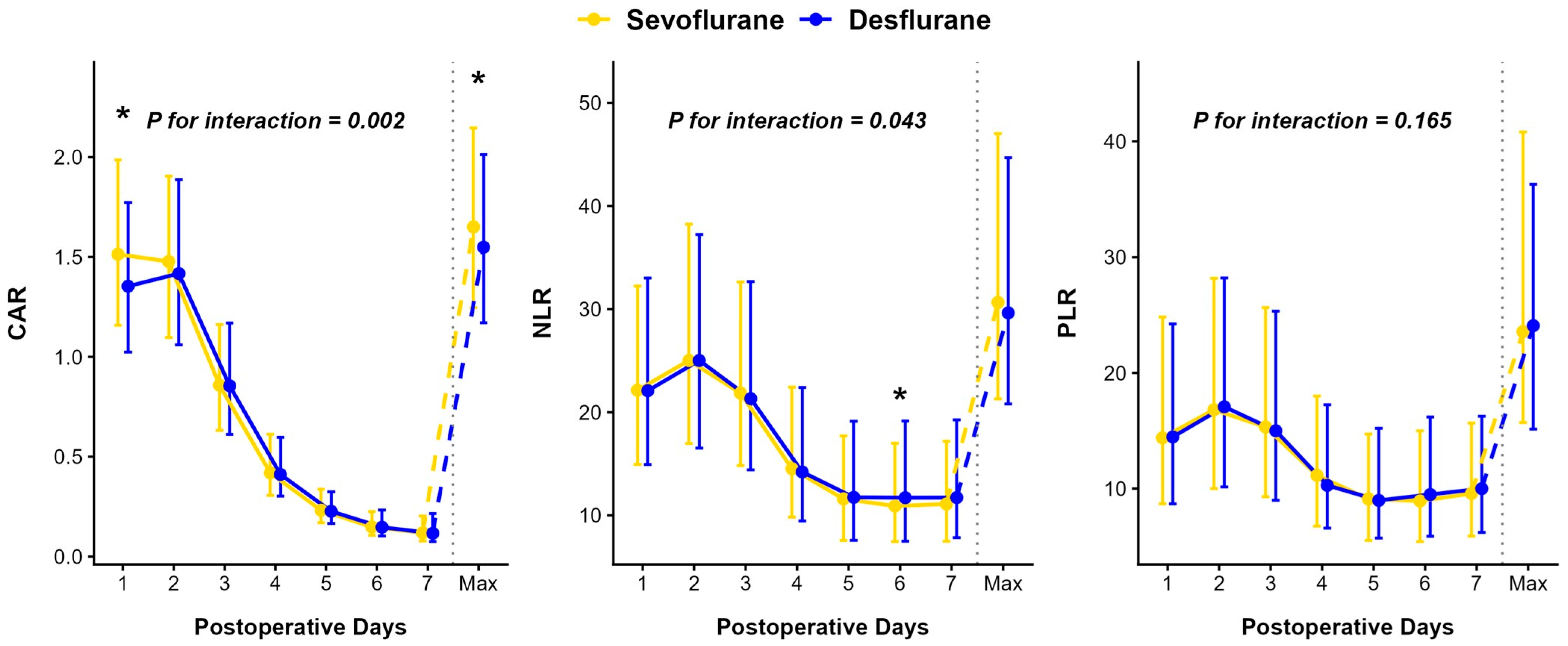
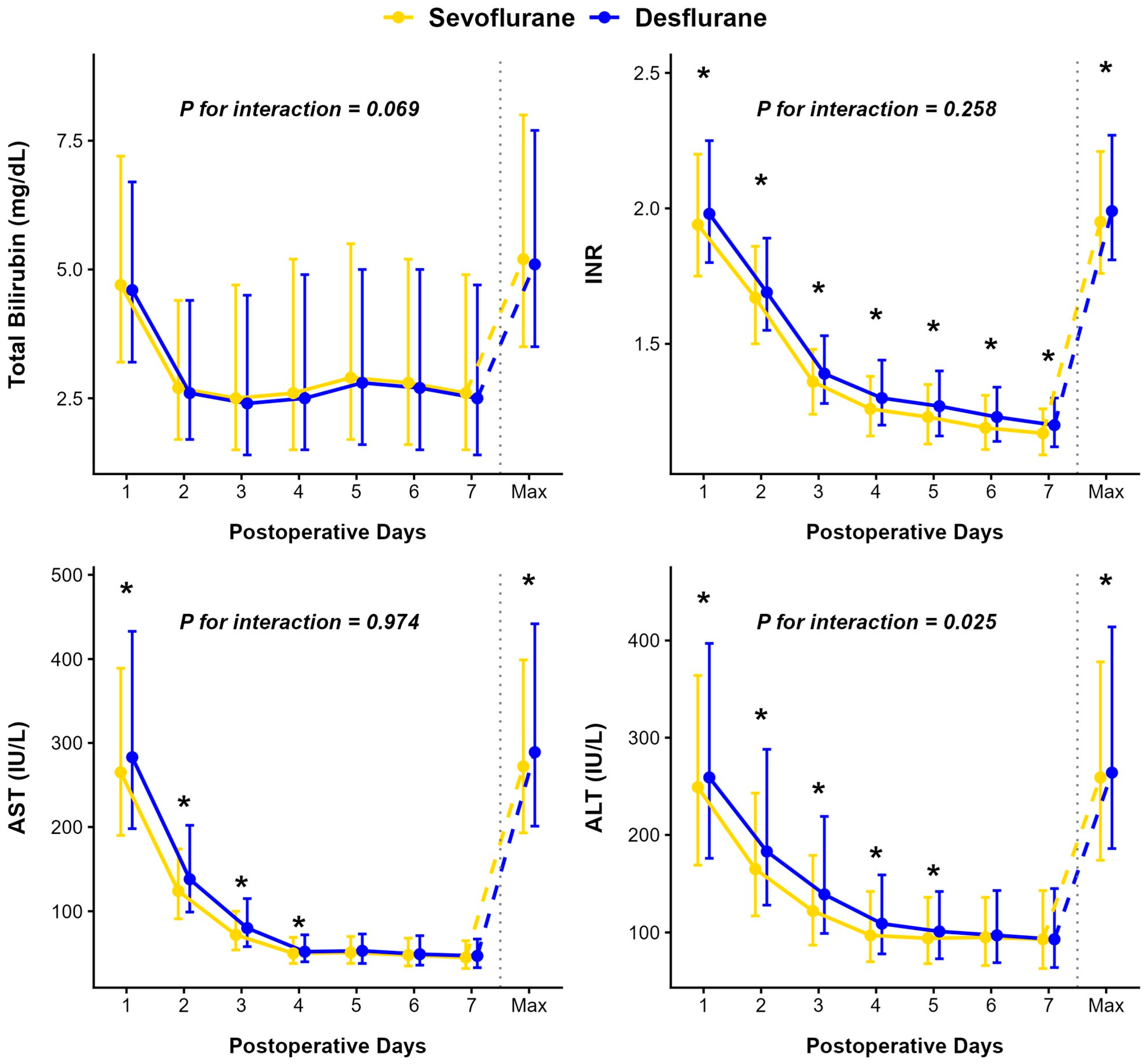
The median peak values of prothrombin time-international normalized ratio (INR), aspartate aminotransferase (AST), and alanine aminotransferase (ALT) were significantly lower in the sevoflurane group compared to the desflurane group, whereas no significant difference was observed for total bilirubin (TB) (Table 4). Although the overall longitudinal trends for AST (p = 0.974), INR (p = 0.258), and total bilirubin (p = 0.069) did not differ significantly between the groups, cross-sectional analyses at specific time points revealed significant daily differences. Specifically, the sevoflurane group exhibited significantly lower AST levels from postoperative days 1 to 4, and consistently lower INR levels throughout the entire 7-day postoperative period compared to the desflurane group (Figure 2). Regarding inflammatory markers, a significant group-by-time interaction was observed for both the C-reactive protein-to-albumin ratio (CAR, p = 0.002) and neutrophil-to-lymphocyte ratio (NLR, p = 0.043), reflecting more favorable recovery trajectories in the sevoflurane group (Figure 3). Conversely, the interaction between time and group for the platelet-to-lymphocyte ratio (PLR) was not statistically significant (p = 0.165).

3. Discussion

Our results demonstrated that the use of sevoflurane in living donors was significantly associated with a reduced incidence of PRS in recipients. Furthermore, recipients in the sevoflurane group exhibited better postoperative clinical outcomes, including lower rates of prolonged ICU stay. The sevoflurane group showed significantly lower peak levels of INR, AST, and ALT, alongside more favorable recovery trends in inflammatory indices (CAR, NLR) during the first postoperative week.
Although the fundamental pathophysiology of PRS is multifactorial and not yet fully understood, ischemia–reperfusion injury (IRI) is widely recognized as playing a pivotal role [4,7]. During the ischemic phase, cellular hypoxia and metabolic distress lead to the accumulation of toxic metabolites, reactive oxygen species (ROS), and proinflammatory cytokines within the liver graft [24]. Upon reperfusion, these accumulated mediators are abruptly released into the systemic circulation, triggering the profound vasodilation and myocardial depression characteristic of PRS [24,25]. Therefore, strategies to mitigate the initial IRI are essential for preventing these adverse hemodynamic events.
The organ-protective potential of volatile anesthetics has been investigated under the concept of anesthetic preconditioning (APC) [8,26]. Experimental studies have demonstrated that sevoflurane preconditioning effectively attenuates hepatic ischemia–reperfusion injury and facilitates hemodynamic recovery by suppressing inflammatory responses and oxidative stress [27,28]. These protective effects have also been observed in clinical settings involving major liver resection. A randomized controlled trial showed that pharmacological preconditioning with sevoflurane significantly reduced postoperative liver injury and decreased the overall rate of complications compared to propofol-based anesthesia [29]. Desflurane has also been reported to modulate the inflammatory response during hepatectomy by regulating the expression of matrix metalloproteinases, which are key markers of tissue remodeling and inflammation [30]. Collectively, these findings support the possibility that volatile agents possess properties that help precondition the liver against ischemic stress.
Clinical studies involving liver transplant recipients have indicated that the choice of volatile anesthetic for the recipient can influence the incidence of PRS and graft outcomes [19,31]. However, in liver transplantation, the ischemic insult to the graft begins much earlier than the reperfusion phase—specifically with the clamping of the hepatic vessels during donor hepatectomy, followed by the period of cold storage. Consequently, effective preconditioning to prime the graft against IRI should ideally be initiated at the donor stage, prior to the onset of ischemia. Nevertheless, clinical evidence linking donor anesthetic management to recipient outcomes remains limited, with only a few studies in pediatric or deceased donor settings suggesting potential benefits of sevoflurane over propofol [9,10]. This scarcity is largely explained by the fact that LDLT has historically represented a minority of all liver transplants; for instance, in the United States, living donation accounted for only 5.7% of the 10,125 adult liver transplants performed in 2023 [23,32]. However, the annual volume of LDLT has increased steadily over the past decade, and recent evidence has established its superior patient survival and outcomes over deceased donor transplantation [33]. As the clinical importance of LDLT grows globally, identifying modifiable factors in donor management to further enhance these superior outcomes becomes increasingly essential.
The reduced incidence of PRS in the sevoflurane group may be attributed to the differing levels of ROS production induced by volatile agents. Previous experimental studies have demonstrated that desflurane induces significantly greater ROS production compared to sevoflurane in cardiomyocytes, which has been interpreted as a sign of potent preconditioning in healthy cells [34]. However, an acute surge of ROS upon reperfusion is a well-known driver of systemic oxidative stress and remote organ injury [24]. Consequently, the relatively higher ROS burden generated by desflurane could potentially exacerbate the profound vasodilation and hemodynamic instability characteristic of PRS. Since direct comparative studies between sevoflurane and desflurane in hepatocytes are currently lacking, further investigations are warranted to confirm these specific cellular mechanisms in the context of liver transplantation.
In our study, the sevoflurane group exhibited a significantly lower risk of prolonged ICU stay and mechanical ventilation. Previous research has shown that the severity of PRS significantly affects short-term outcomes for both patients and liver allografts [6]. Therefore, the reduced incidence of PRS observed in the sevoflurane group likely served as a mediator in preventing these adverse outcomes and facilitating a smoother postoperative course.
The effect of APC on donor sevoflurane is reflected in postoperative graft function markers. Ischemic hepatic injury typically leads to elevated AST and ALT levels due to hepatocellular necrosis and membrane leakage [35]. Furthermore, previous studies have reported higher peak AST levels in patients who developed PRS, suggesting that the hemodynamic instability associated with PRS may contribute to exacerbating hepatic injury [36]. In an experimental model, sevoflurane pretreatment significantly alleviated liver IRI, as evidenced by lower serum AST and ALT levels compared to the control group [37]. These findings are consistent with our results, which show improved laboratory profiles in the sevoflurane group, suggesting that sevoflurane may be more effective in preventing hepatic injury.
Patients with end-stage liver disease typically present with a state of chronic systemic inflammation, often driven by persistent immune activation and disrupted hepatic homeostasis [38,39]. Following liver transplantation, the restoration of graft function plays a pivotal role in resolving this inflammatory state [40]. Persistent postoperative inflammation often indicates delayed graft recovery and is associated with adverse outcomes [41,42]. In our study, the sevoflurane group exhibited significantly faster recovery trends in systemic inflammatory indices, specifically CAR and NLR, compared to the desflurane group. These findings suggest that the preservation of liver function, facilitated by donor sevoflurane preconditioning, may have contributed to the accelerated resolution of systemic inflammation. Consequently, prioritizing sevoflurane for donor anesthesia may serve as a strategic intervention to optimize the recipient’s physiological reserve and enhance early postoperative recovery.
This study has several limitations. First, the retrospective design inherently introduces the potential for selection bias and unmeasured confounding factors. Specifically, the choice of volatile anesthetic agent (sevoflurane versus desflurane) for the living donor was determined at the discretion of the attending anesthesiologist, meaning that selection bias regarding anesthetic administration cannot be entirely excluded. To address these methodological limitations and enhance the validity of our findings, we employed a rigorous propensity score matching analysis. Second, we did not analyze the exact concentration of donor anesthetic exposure, which could influence the magnitude of the preconditioning effect, although the anesthetic dose was titrated to maintain a target anesthetic depth monitored by electroencephalography-based indices. Future studies incorporating detailed pharmacokinetic data are warranted. Finally, although a large cohort was used to ensure statistical power, the population was recruited from a single center, which may limit the generalizability of our findings and necessitate multi-center validation.

4. Materials and Methods

4.1. Patients

This retrospective analysis examined a cohort of patients who underwent LDLT at Asan Medical Center (Seoul, Republic of Korea) from January 2008 to December 2025. The study population comprised adult patients (aged ≥ 18 years) who received LDLT. Patients were excluded based on the following criteria: (1) preoperative renal impairment, defined as a diagnosis of chronic kidney disease, hepatorenal syndrome, or a serum creatinine level > 1.5 mg/dL; and (2) missing data regarding postoperative outcomes. After applying these selection criteria, a total of 5006 adult LDLT recipients were included in the study.

4.2. Anesthetic Management and Surgical Procedures

The choice of volatile anesthetic agent for living donors was determined by the attending anesthesiologist. Donors were induced with propofol and maintained with either sevoflurane or desflurane, along with remifentanil and rocuronium. The concentration of the volatile anesthetic was adjusted to maintain a Bispectral Index (BIS) or SedLine value below 50.
Perioperative anesthetic management for recipients was conducted according to the protocol described in our previous studies [43,44,45]. Anesthesia was induced with propofol, fentanyl, and rocuronium and maintained with volatile anesthetics, along with continuous infusions of fentanyl and rocuronium. Standard monitoring included invasive arterial blood pressure measurement via the radial and femoral arteries, as well as pulmonary artery catheterization for hemodynamic assessment. Vasopressors, including norepinephrine, were administered as needed to maintain a MAP ≥ 65 mmHg.
The native liver was dissected to expose the inferior vena cava. Subsequently, the donor graft was implanted via hepatic vein anastomosis, followed by end-to-end portal vein anastomosis. Graft reperfusion was initiated after completing the portal vein anastomosis. During this reperfusion phase, hemodynamic changes were closely monitored to detect post-reperfusion syndrome, which was managed with bolus doses of vasopressors, calcium gluconate, or sodium bicarbonate to stabilize hemodynamics and correct associated electrolyte or acid-base imbalances. This was followed by sequential anastomosis of the hepatic artery and bile duct. Detailed surgical procedures for LDLT have been described in previous studies [43,44].

4.3. Clinical Data and Outcomes

Comprehensive clinical data of donors and recipients were extracted from the electronic medical record system of Asan Medical Center. Recipient demographic variables included age, sex, body mass index, and comorbidities such as diabetes mellitus, hypertension, and cardiovascular disease history (including coronary artery disease, congestive heart failure, or cerebrovascular accident). Preoperative clinical data encompassed the etiology of cirrhosis, the presence of hepatocellular carcinoma, transplant era (2008–2012, 2013–2017, 2018–2022, and after 2023), and severity scores, including the Model for End-Stage Liver Disease-Sodium (MELD-Na) and Child-Turcotte-Pugh scores. Donor and graft-related variables, such as donor age, donor sex, graft fatty change, and graft-to-recipient weight ratio, were also recorded. Intraoperative details included the incidence of PRS, anesthesia time, ischemic time, incidence of massive transfusion (defined as ≥10 units of packed red blood cells within 24 h or ≥4 units within 1 h), and intraoperative norepinephrine use [46]. Additionally, data on early allograft dysfunction (EAD) were collected, defined by the presence of one or more of the following criteria: TB ≥ 10 mg/dL, INR ≥ 1.6 on postoperative day 7, and peak AST or ALT levels ≥ 2000 U/L within the first 7 postoperative days [47]. Data regarding the median length of ICU stay and mechanical ventilation, as well as prolonged ICU stay (>30 days), prolonged mechanical ventilation (>14 days), and 1-year graft failure rates were also recorded. Furthermore, postoperative laboratory values—including TB, INR, AST, and ALT—along with inflammatory markers such as the CAR, NLR and PLR, were also collected.
The primary outcome of this study was to evaluate the impact of donor sevoflurane versus desflurane anesthesia on the incidence of PRS in recipients. Secondary outcomes included the incidence of EAD, median duration of ICU stay and mechanical ventilation, prolonged ICU stay (>30 days), prolonged mechanical ventilation (>14 days), 1-year graft failure, postoperative laboratory values, and postoperative inflammatory markers.

4.4. Statistical Analysis

Categorical variables are presented as frequencies and percentages, while continuous variables are expressed as means ± standard deviations (SD) or medians with interquartile ranges. Group comparisons were conducted using Student’s t-test or Mann–Whitney U test for continuous variables, and the Chi-square test or Fisher’s exact test for categorical variables, as appropriate.
To balance baseline characteristics between the two groups (Sevoflurane vs. Desflurane), PSM was performed. PSM was conducted using a 1:1 nearest-neighbor algorithm and was calculated using a logistic regression model incorporating relevant demographic, preoperative, intraoperative variables, and transplant era. The balance of covariates was assessed using the standardized mean difference (SMD), with an SMD < 0.1 considered indicative of a negligible imbalance.
The associations between donor anesthetic type and binary clinical outcomes were evaluated across three models: a crude unadjusted analysis, a multivariable-adjusted logistic regression using backward stepwise elimination, and an analysis within the propensity score-matched cohort. Results are reported as OR with 95% CI. To evaluate postoperative trends of continuous laboratory variables and inflammatory markers over time (postoperative days 1–7), linear quantile mixed models were applied. A group-by-time interaction was assessed to determine whether the longitudinal trends of these variables differed significantly between groups. All statistical analyses were conducted using R software (version 4.5.1; R Foundation for Statistical Computing, Vienna, Austria).

4.5. Ethical Statements

Approval of this study was obtained from the Institutional Review Board of our center (protocol number: 2026-0247). Due to the retrospective design, the board waived the requirement to obtain informed consent from the participants.

5. Conclusions

Donor sevoflurane anesthesia was associated with a significantly lower risk of PRS and improved early postoperative recovery in LDLT recipients compared to desflurane. These findings suggest that the choice of volatile anesthetics for living donors is a potentially modifiable factor that can optimize recipient outcomes. Given the comparable safety profile for donors, sevoflurane may be considered the preferred agent for donor anesthesia in LDLT to provide better intraoperative hemodynamic stability and enhance the quality of recovery in recipients.

Author Contributions

Conceptualization, J.-G.S. and G.-S.H.; methodology, H.-J.B. and J.-G.S.; validation, K.-S.K., H.-M.K. and I.-G.J.; formal analysis, H.-J.B., H.-M.K. and I.-G.J.; investigation, H.-J.B., K.-S.K. and J.-G.S.; data curation, S.L. and H.-M.K.; writing—original draft preparation, H.-J.B.; writing—review and editing, H.-J.B. and J.-G.S.; supervision, G.-S.H. All authors have read and agreed to the published version of the manuscript.

Funding

This research received no external funding.

Institutional Review Board Statement

The study was conducted in accordance with the Declaration of Helsinki and was approved by the Institutional Review Board of Asan Medical Center (protocol number: 2026-0247, Approval date: 20 February 2026).

Informed Consent Statement

Patient consent was waived due to the retrospective nature of the study.

Data Availability Statement

The datasets used and/or analyzed during the current study are available from the corresponding author upon reasonable request.

Conflicts of Interest

The authors declare no conflicts of interest.

Abbreviations

The following abbreviations are used in this manuscript:
ALTAlanine Aminotransferase
APCAnesthetic Preconditioning
ASTAspartate Aminotransferase
CARC-reactive Protein-to-Albumin Ratio
CIConfidence Interval
CTPChild-Turcotte-Pugh
EADEarly Allograft Dysfunction
GRWRGraft-to-Recipient Weight Ratio
ICUIntensive Care Unit
INRInternational Normalized Ratio
LDLTLiving Donor Liver Transplantation
LTLiver Transplantation
MAPMean Arterial Pressure
MELD-NaModel for End-Stage Liver Disease-Sodium
MVMechanical Ventilation
NLRNeutrophil-to-Lymphocyte Ratio
OROdds Ratio
PLRPlatelet-to-Lymphocyte Ratio
PRSPost-Reperfusion Syndrome
PSMPropensity Score Matching
ROSReactive Oxygen Species
SDStandard Deviation
SMDStandardized Mean Difference
TBTotal Bilirubin

References

  1. European Association for the Study of the Liver. EASL Clinical Practice Guidelines: Liver transplantation. J. Hepatol. 2016, 64, 433–485. [Google Scholar] [CrossRef]
  2. Jeong, S.M. Postreperfusion syndrome during liver transplantation. Korean J. Anesthesiol. 2015, 68, 527–539. [Google Scholar] [CrossRef]
  3. Siniscalchi, A.; Gamberini, L.; Laici, C.; Bardi, T.; Ercolani, G.; Lorenzini, L.; Faenza, S. Post reperfusion syndrome during liver transplantation: From pathophysiology to therapy and preventive strategies. World J. Gastroenterol. 2016, 22, 1551–1569. [Google Scholar] [CrossRef] [PubMed]
  4. Manning, M.W.; Kumar, P.A.; Maheshwari, K.; Arora, H. Post-Reperfusion Syndrome in Liver Transplantation-An Overview. J. Cardiothorac. Vasc. Anesth. 2020, 34, 501–511. [Google Scholar] [CrossRef] [PubMed]
  5. Paugam-Burtz, C.; Kavafyan, J.; Merckx, P.; Dahmani, S.; Sommacale, D.; Ramsay, M.; Belghiti, J.; Mantz, J. Postreperfusion syndrome during liver transplantation for cirrhosis: Outcome and predictors. Liver Transpl. 2009, 15, 522–529. [Google Scholar] [CrossRef] [PubMed]
  6. Hilmi, I.; Horton, C.N.; Planinsic, R.M.; Sakai, T.; Nicolau-Raducu, R.; Damian, D.; Gligor, S.; Marcos, A. The impact of postreperfusion syndrome on short-term patient and liver allograft outcome in patients undergoing orthotopic liver transplantation. Liver Transpl. 2008, 14, 504–508. [Google Scholar] [CrossRef]
  7. Puchany, A.J.; Hilmi, I. Post-reperfusion syndrome in liver transplant recipients: What is new in prevention and management? World J. Crit. Care Med. 2025, 14, 101777. [Google Scholar] [CrossRef]
  8. Benoit, L.; Dieu, A.; Foguenne, M.; Bonaccorsi-Riani, E. Experimental and Clinical Aspects of Sevoflurane Preconditioning and Postconditioning to Alleviate Hepatic Ischemia-Reperfusion Injury: A Scoping Review. Int. J. Mol. Sci. 2023, 24, 2340. [Google Scholar] [CrossRef]
  9. Dieu, A.; Benoit, L.; Dupont, C.; de Magnee, C.; Reding, R.; Pirotte, T.; Steyaert, A. Sevoflurane preconditioning in living liver donation is associated with better initial graft function after pediatric transplantation: A retrospective study. Perioper. Med. 2024, 13, 11. [Google Scholar] [CrossRef]
  10. Minou, A.F.; Dzyadzko, A.M.; Shcherba, A.E.; Rummo, O.O. The influence of pharmacological preconditioning with sevoflurane on incidence of early allograft dysfunction in liver transplant recipients. Anesthesiol. Res. Pract. 2012, 2012, 930487. [Google Scholar] [CrossRef]
  11. Figueira, E.R.R.; Rocha-Filho, J.A.; Lanchotte, C.; Coelho, A.M.M.; Nakatani, M.; Tatebe, E.R.; Lima, J.A.V.; Mendes, C.O.; de Araujo, B.; Abdo, E.E.; et al. Sevoflurane Preconditioning plus Postconditioning Decreases Inflammatory Response with Hemodynamic Recovery in Experimental Liver Ischemia Reperfusion. Gastroenterol. Res. Pract. 2019, 2019, 5758984. [Google Scholar] [CrossRef]
  12. Ji, H.; Li, H.; Zhang, H.; Cheng, Z. Role of microRNA-218-5p in sevoflurane-induced protective effects in hepatic ischemia/reperfusion injury mice by regulating GAB2/PI3K/AKT pathway. Mol. Med. Rep. 2022, 25, 1. [Google Scholar] [CrossRef] [PubMed]
  13. Jeong, J.S.; Kim, D.; Kim, K.Y.; Ryu, S.; Han, S.; Shin, B.S.; Kim, G.S.; Gwak, M.S.; Ko, J.S. Ischemic Preconditioning Produces Comparable Protection Against Hepatic Ischemia/Reperfusion Injury Under Isoflurane and Sevoflurane Anesthesia in Rats. Transplant. Proc. 2017, 49, 2188–2193. [Google Scholar] [CrossRef] [PubMed]
  14. Beck-Schimmer, B.; Bonvini, J.M.; Schadde, E.; Dutkowski, P.; Oberkofler, C.E.; Lesurtel, M.; DeOliveira, M.L.; Figueira, E.R.; Rocha Filho, J.A.; Auler, J.O., Jr.; et al. Conditioning With Sevoflurane in Liver Transplantation: Results of a Multicenter Randomized Controlled Trial. Transplantation 2015, 99, 1606–1612. [Google Scholar] [CrossRef] [PubMed]
  15. Sakai, T.; Ko, J.S.; Crouch, C.E.; Kumar, S.; Choi, G.S.; Hackl, F.; Han, D.H.; Kaufman, M.; Kim, S.H.; Luzzi, C.; et al. Perioperative management of living donor liver transplantation: Part 2—Donors. Clin. Transplant. 2022, 36, e14690. [Google Scholar] [CrossRef]
  16. Wissing, H.; Kuhn, I.; Rietbrock, S.; Fuhr, U. Pharmacokinetics of inhaled anaesthetics in a clinical setting: Comparison of desflurane, isoflurane and sevoflurane. Br. J. Anaesth. 2000, 84, 443–449. [Google Scholar] [CrossRef]
  17. Soliman, R.; Yacoub, A.; Abdellatif, M. Comparative effect of desflurane and sevoflurane on liver function tests of patients with impaired hepatic function undergoing cholecystectomy: A randomized clinical study. Indian J. Anaesth. 2020, 64, 383–390. [Google Scholar] [CrossRef]
  18. Ko, J.S.; Gwak, M.S.; Choi, S.J.; Yang, M.; Kim, M.J.; Lee, J.Y.; Kim, G.S.; Kwon, C.H.; Joh, J.W. The effects of desflurane and sevoflurane on hepatic and renal functions after right hepatectomy in living donors*. Transpl. Int. 2010, 23, 736–744. [Google Scholar] [CrossRef]
  19. Lee, J.; Yoo, Y.J.; Lee, J.M.; Park, Y.J.; Ryu, H.G. Sevoflurane Versus Desflurane on the Incidence of Postreperfusion Syndrome During Living Donor Liver Transplantation: A Randomized Controlled Trial. Transplantation 2016, 100, 600–606. [Google Scholar] [CrossRef]
  20. Cho, H.Y.; Lee, H.J.; Kim, W.H.; Lee, H.C.; Jung, C.W.; Hong, S.K.; Yang, S.M. Influence of anesthesia type on post-reperfusion syndrome during liver transplantation: A single-center retrospective study. Anesth. Pain. Med. 2022, 17, 304–311. [Google Scholar] [CrossRef]
  21. Mangus, R.S.; Kinsella, S.B.; Farar, D.T.; Fridell, J.A.; Woolf, L.T.; Kubal, C.A. Impact of Volatile Anesthetic Agents on Early Clinical Outcomes in Liver Transplantation. Transplant. Proc. 2018, 50, 1372–1377. [Google Scholar] [CrossRef] [PubMed]
  22. Cotter, T.G.; Minhem, M.; Wang, J.; Peeraphatdit, T.; Ayoub, F.; Pillai, A.; Hernandez-Alejandro, R.; di Sabato, D.; Charlton, M. Living Donor Liver Transplantation in the United States: Evolution of Frequency, Outcomes, Center Volumes, and Factors Associated With Outcomes. Liver Transpl. 2021, 27, 1019–1031. [Google Scholar] [CrossRef]
  23. Humar, A.; Ganesh, S.; Jorgensen, D.; Tevar, A.; Ganoza, A.; Molinari, M.; Hughes, C. Adult Living Donor Versus Deceased Donor Liver Transplant (LDLT Versus DDLT) at a Single Center: Time to Change Our Paradigm for Liver Transplant. Ann. Surg. 2019, 270, 444–451. [Google Scholar] [CrossRef] [PubMed]
  24. Nastos, C.; Kalimeris, K.; Papoutsidakis, N.; Tasoulis, M.K.; Lykoudis, P.M.; Theodoraki, K.; Nastou, D.; Smyrniotis, V.; Arkadopoulos, N. Global consequences of liver ischemia/reperfusion injury. Oxid. Med. Cell Longev. 2014, 2014, 906965. [Google Scholar] [CrossRef]
  25. Mendes-Braz, M.; Elias-Miro, M.; Jimenez-Castro, M.B.; Casillas-Ramirez, A.; Ramalho, F.S.; Peralta, C. The current state of knowledge of hepatic ischemia-reperfusion injury based on its study in experimental models. J. Biomed. Biotechnol. 2012, 2012, 298657. [Google Scholar] [CrossRef]
  26. Swyers, T.; Redford, D.; Larson, D.F. Volatile anesthetic-induced preconditioning. Perfusion 2014, 29, 10–15. [Google Scholar] [CrossRef] [PubMed]
  27. Yang, P.; Du, Y.; Zeng, H.; Xing, H.; Tian, C.; Zou, X. Comparison of Inflammatory Markers Between the Sevoflurane and Isoflurane Anesthesia in a Rat Model of Liver Ischemia/Reperfusion Injury. Transplant. Proc. 2019, 51, 2071–2075. [Google Scholar] [CrossRef]
  28. Cavalcante, F.P.; Coelho, A.M.; Machado, M.C.; Sampietre, S.N.; Patzina, R.A.; Diniz, M.A.; Chaib, E.; D’Albuquerque, L.A. Mechanisms of the beneficial effect of sevoflurane in liver ischemia/reperfusion injury. Acta Cir. Bras. 2015, 30, 749–755. [Google Scholar] [CrossRef]
  29. Beck-Schimmer, B.; Breitenstein, S.; Urech, S.; De Conno, E.; Wittlinger, M.; Puhan, M.; Jochum, W.; Spahn, D.R.; Graf, R.; Clavien, P.A. A randomized controlled trial on pharmacological preconditioning in liver surgery using a volatile anesthetic. Ann. Surg. 2008, 248, 909–918. [Google Scholar] [CrossRef]
  30. Koraki, E.; Mantzoros, I.; Chatzakis, C.; Gkiouliava, A.; Cheva, A.; Lavrentieva, A.; Sifaki, F.; Argiriadou, H.; Kesisoglou, I.; Galanos-Demiris, K.; et al. Metalloproteinase expression after desflurane preconditioning in hepatectomies: A randomized clinical trial. World J. Hepatol. 2020, 12, 1098–1114. [Google Scholar] [CrossRef]
  31. Park, I.; Min, E.K.; Koo, B.N.; Park, J.H.; Kim, D.G.; Joo, D.J.; Lee, J.G. Effects of Desflurane versus sevoflurane on graft outcome of patients with cirrhosis receiving steatotic liver graft in deceased donor liver transplantation. J. Clin. Anesth. 2024, 99, 111674. [Google Scholar] [CrossRef] [PubMed]
  32. Kwong, A.J.; Kim, W.R.; Lake, J.R.; Schladt, D.P.; Handarova, D.; Howell, J.; Schumacher, B.; Weiss, S.; Snyder, J.J.; Israni, A.K. OPTN/SRTR 2023 Annual Data Report: Liver. Am. J. Transplant. 2025, 25, S193–S287. [Google Scholar] [CrossRef] [PubMed]
  33. Barbetta, A.; Aljehani, M.; Kim, M.; Tien, C.; Ahearn, A.; Schilperoort, H.; Sher, L.; Emamaullee, J. Meta-analysis and meta-regression of outcomes for adult living donor liver transplantation versus deceased donor liver transplantation. Am. J. Transplant. 2021, 21, 2399–2412. [Google Scholar] [CrossRef] [PubMed]
  34. Sedlic, F.; Pravdic, D.; Ljubkovic, M.; Marinovic, J.; Stadnicka, A.; Bosnjak, Z.J. Differences in production of reactive oxygen species and mitochondrial uncoupling as events in the preconditioning signaling cascade between desflurane and sevoflurane. Anesth. Analg. 2009, 109, 405–411. [Google Scholar] [CrossRef]
  35. George, J.; Lu, Y.; Tsuchishima, M.; Tsutsumi, M. Cellular and molecular mechanisms of hepatic ischemia-reperfusion injury: The role of oxidative stress and therapeutic approaches. Redox Biol. 2024, 75, 103258. [Google Scholar] [CrossRef]
  36. Kork, F.; Rimek, A.; Andert, A.; Becker, N.J.; Heidenhain, C.; Neumann, U.P.; Kroy, D.; Roehl, A.B.; Rossaint, R.; Hein, M. Visual quality assessment of the liver graft by the transplanting surgeon predicts postreperfusion syndrome after liver transplantation: A retrospective cohort study. BMC Anesthesiol. 2018, 18, 29. [Google Scholar] [CrossRef]
  37. Xu, G.; Wang, X.; Xiong, Y.; Ma, X.; Qu, L. Effect of sevoflurane pretreatment in relieving liver ischemia/reperfusion-induced pulmonary and hepatic injury. Acta Cir. Bras. 2019, 34, e201900805. [Google Scholar] [CrossRef]
  38. Engelmann, C.; Claria, J.; Szabo, G.; Bosch, J.; Bernardi, M. Pathophysiology of decompensated cirrhosis: Portal hypertension, circulatory dysfunction, inflammation, metabolism and mitochondrial dysfunction. J. Hepatol. 2021, 75, S49–S66. [Google Scholar] [CrossRef]
  39. Martinez-Esparza, M.; Tristan-Manzano, M.; Ruiz-Alcaraz, A.J.; Garcia-Penarrubia, P. Inflammatory status in human hepatic cirrhosis. World J. Gastroenterol. 2015, 21, 11522–11541. [Google Scholar] [CrossRef]
  40. Robinson, M.W.; Harmon, C.; O’Farrelly, C. Liver immunology and its role in inflammation and homeostasis. Cell. Mol. Immunol. 2016, 13, 267–276. [Google Scholar] [CrossRef]
  41. Pravisani, R.; Mocchegiani, F.; Isola, M.; Lorenzin, D.; Adani, G.L.; Cherchi, V.; De Martino, M.; Risaliti, A.; Lai, Q.; Vivarelli, M.; et al. Postoperative Trends and Prognostic Values of Inflammatory and Nutritional Biomarkers after Liver Transplantation for Hepatocellular Carcinoma. Cancers 2021, 13, 513. [Google Scholar] [CrossRef] [PubMed]
  42. Haruki, K.; Taniai, T.; Yanagaki, M.; Furukawa, K.; Tsunematsu, M.; Onda, S.; Shirai, Y.; Matsumoto, M.; Okui, N.; Ikegami, T. Sustained Systemic Inflammatory Response Predicts Survival in Patients with Hepatocellular Carcinoma After Hepatic Resection. Ann. Surg. Oncol. 2023, 30, 604–613. [Google Scholar] [CrossRef] [PubMed]
  43. Hwang, S.; Ahn, C.S.; Kim, K.H.; Moon, D.B.; Ha, T.Y.; Song, G.W.; Jung, D.H.; Park, G.C.; Lee, S.G. A cross-sectional analysis of long-term immunosuppressive regimens after liver transplantation at Asan Medical Center: Increased preference for mycophenolate mofetil. Ann. Hepatobiliary Pancreat. Surg. 2018, 22, 19–26. [Google Scholar] [CrossRef] [PubMed]
  44. Lee, S.G. A complete treatment of adult living donor liver transplantation: A review of surgical technique and current challenges to expand indication of patients. Am. J. Transplant. 2015, 15, 17–38. [Google Scholar] [CrossRef]
  45. Jeong, H.W.; Jung, K.W.; Kim, S.O.; Kwon, H.M.; Moon, Y.J.; Jun, I.G.; Song, J.G.; Hwang, G.S. Early postoperative weight gain is associated with increased risk of graft failure in living donor liver transplant recipients. Sci. Rep. 2019, 9, 20096. [Google Scholar] [CrossRef]
  46. Pham, H.P.; Shaz, B.H. Update on massive transfusion. Br. J. Anaesth. 2013, 111, I71–I82. [Google Scholar] [CrossRef]
  47. Lee, D.D.; Croome, K.P.; Shalev, J.A.; Musto, K.R.; Sharma, M.; Keaveny, A.P.; Taner, C.B. Early allograft dysfunction after liver transplantation: An intermediate outcome measure for targeted improvements. Ann. Hepatol. 2016, 15, 53–60. [Google Scholar] [CrossRef]
Figure 1. Flowchart of the study population. Abbreviations: LDLT, living donor liver transplantation.
Ijms 27 03465 g001
Figure 2. Comparison of postoperative trends between the Sevoflurane (yellow) and Desflurane (blue) groups. The data are presented as medians with error bars representing the interquartile range. The solid lines indicate the trend from postoperative day 1 to 7 and maximum values are shown to the right of the dashed line. Asterisks (*) indicate a statistically significant difference (p < 0.05) between the two groups at each time point. P for interaction values are derived from the Linear Quantile Mixed Model to evaluate the differences in changes over time between the groups. Abbreviations: INR, international normalized ratio; AST, aspartate aminotransferase; ALT, alanine aminotransferase.
Ijms 27 03465 g002
Figure 3. Comparison of postoperative trends between the Sevoflurane (yellow) and Desflurane (blue) groups. The data are presented as medians with error bars representing the interquartile range. The solid lines indicate the trend from postoperative day 1 to 7 and maximum values are shown to the right of the dashed line. Asterisks (*) indicate a statistically significant difference (p < 0.05) between the two groups at each time point. p-Values are derived from the Linear Quantile Mixed Model to evaluate the differences in changes over time between the groups. Abbreviations: CAR, C-reactive protein-to-albumin ratio; NLR, neutrophil-to-lymphocyte ratio; PLR, platelet-to-lymphocyte ratio.
Ijms 27 03465 g003
Table 1. Baseline characteristics of the study population.
Before PSM (n = 5006)After PSM (n = 1882)
Sevoflurane
(n = 2123)
Desflurane
(n = 2883)
SMDpSevoflurane
(n = 941)
Desflurane
(n = 941)
SMDp
Demographic variables
Age (years)52.7 ± 8.655.4 ± 9.40.310<0.00153.9 ± 8.554.4 ± 8.90.0620.178
Sex, male1582 (74.5)2008 (69.6)0.109<0.001700 (74.4)678 (72.1)0.0530.274
Body mass index (kg/m2)24.3 ± 3.424.2 ± 3.70.0200.47724.3 ± 3.524.4 ± 3.70.0340.460
Diabetes mellitus484 (22.8)796 (27.6)0.111<0.001240 (25.5)244 (25.9)0.0100.874
Hypertension316 (14.9)633 (22.0)0.183<0.001163 (17.3)181 (19.2)0.0500.311
Cardiovascular disease333 (15.7)373 (12.9)0.0790.007149 (15.8)166 (17.6)0.0480.323
Transplant Era (%) 1.690<0.001 <0.0011.000
   2008–20121109 (52.2)134 (4.6) 133 (14.1)133 (14.1)
   2013–2017749 (35.3)711 (24.7) 545 (57.9)545 (57.9)
   2018–2022224 (10.6)1347 (46.7) 223 (23.7)223 (23.7)
   After 202341 (1.9)691 (24.0) 40 (4.3)40 (4.3)
Etiology and lab results
Hepatocellular carcinoma1095 (51.6)1490 (51.7)0.0020.965485 (51.5)484 (51.4)0.0021.000
Viral hepatitis1532 (72.2)1671 (58.0)0.301<0.001625 (66.4)593 (63.0)0.0710.135
Alcoholic liver disease361 (17.0)762 (26.4)0.230<0.001216 (23.0)197 (20.9)0.0490.316
Creatinine (mg/dL)0.8 ± 0.20.8 ± 0.20.0860.0030.8 ± 0.20.8 ± 0.20.0890.054
MELD-Na score15.0 ± 7.713.6 ± 6.70.200<0.00114.3 ± 7.314.1 ± 7.10.0200.672
MELD-Na score ≥ 20526 (24.8)530 (18.4)0.156<0.001212 (22.5)189 (20.1)0.0600.216
CTP score8.0 ± 2.37.7 ± 2.20.101<0.0017.9 ± 2.27.8 ± 2.20.0540.243
Donor and graft variables
Donor age (years)28.2 ± 8.531.0 ± 9.10.322<0.00128.7 ± 8.729.4 ± 8.70.0900.050
Donor sex, male1476 (69.5)1809 (62.7)0.144<0.001632 (67.2)624 (66.3)0.0180.732
Total fatty change (%)3.9 ± 6.14.1 ± 6.40.0380.1824.2 ± 6.44.2 ± 7.2<0.0010.992
Low GRWR (<0.8)110 (5.2)247 (8.6)0.134<0.00167 (7.1)67 (7.1)<0.0011.000
Intraoperative variables
Anesthesia time (h)14.4 ± 2.513.2 ± 2.30.521<0.00113.8 ± 2.313.7 ± 2.50.0550.232
Massive transfusion773 (36.4)955 (33.1)0.0690.017317 (33.7)310 (32.9)0.0160.769
Cold ischemic time (min)84.5 ± 30.783.0 ± 26.20.0530.06283.4 ± 23.283.0 ± 27.20.0190.683
Warm ischemic time (min)43.2 ± 15.538.8 ± 15.00.293<0.00141.7 ± 14.841.6 ± 15.60.0060.905
Total ischemic time (min)127.7 ± 35.6121.8 ± 32.30.175<0.001125.1 ± 28.5124.6 ± 33.90.0180.698
Norepinephrine use1133 (53.4)2721 (94.4)1.056<0.001791 (84.1)799 (84.9)0.0230.656
Outcomes
PRS1093 (51.5)2319 (80.4) <0.001602 (64.0)676 (71.8) <0.001
EAD205 (9.7)220 (7.6) 0.01367 (7.1)77 (8.2) 0.435
ICU stay (day)3.0 [2.0–5.0]3.0 [2.0–8.0] 0.6303.0 [2.0–5.0]3.0 [2.0–5.0] 0.039
MV (day)2.0 [2.0–3.0]2.0 [2.0–3.0] 0.0842.0 [2.0–3.0]2.0 [2.0–3.0] 0.880
Prolonged ICU stay30 (1.4)100 (3.5) <0.00112 (1.3%)26 (2.8%) 0.032
Prolonged MV47 (2.2)133 (4.6) <0.00124 (2.6%)37 (3.9%) 0.120
1-year graft failure131 (6.2)120 (4.2) 0.00248 (5.1%)40 (4.3%) 0.445
Values are expressed as mean ± standard deviation, median [interquartile range], or number of patients (%) as appropriate. Abbreviations: PSM, propensity score matching; CTP score, Child-Turcotte-Pugh score; MELD-Na score, Model for End-Stage Liver Disease sodium score; GRWR, graft-to-recipient weight ratio; INR, international normalized ratio; PRS, post-reperfusion syndrome; EAD, early allograft dysfunction; ICU, intensive care unit; MV, mechanical ventilation; SMD, standardized mean difference.
Table 2. Multivariate logistic regression analysis for post-reperfusion syndrome.
Univariate AnalysisMultivariate Analysis
OR95% CIpOR95% CIp
Anesthetic type (Sevoflurane)0.260.23–0.29<0.0010.470.41–0.55<0.001
Age (years)1.041.03–1.04<0.0011.031.02–1.03<0.001
Sex, male0.890.78–1.010.081
Diabetes mellitus1.441.25–1.66<0.0011.211.04–1.420.016
Hypertension1.321.13–1.55<0.001
Cardiovascular disease0.960.81–1.140.6510.860.71–1.040.128
Hepatocellular carcinoma0.860.76–0.970.013
Viral hepatitis0.560.49–0.64<0.001
Alcoholic liver disease1.981.70–2.32<0.0011.351.13–1.61<0.001
MELD-Na score ≥ 201.040.90–1.200.642
CTP score1.051.02–1.08<0.0011.061.02–1.09<0.001
Donor age (years)1.021.01–1.03<0.001
Donor sex, male0.970.85–1.100.609
Total fatty change (%)1.021.01–1.03<0.0011.011.00–1.020.119
Low GRWR (<0.8)0.830.67–1.050.1170.640.50–0.82<0.001
Anesthesia time (h)0.870.85–0.90<0.0010.930.90–0.97<0.001
Massive transfusion1.120.99–1.270.0821.251.06–1.480.008
Total ischemic time (min)1.00.99–1.00<0.0011.001.00–1.000.006
Norepinephrine use5.624.89–6.48<0.0013.402.89–4.00<0.001
Abbreviations: OR, odds ratio; CI, confidence interval; MELD-Na, Model for End-Stage Liver Disease sodium score; CTP score, Child-Turcotte-Pugh score; GRWR, graft-to-recipient weight ratio.
Table 3. Impact of Donor Anesthetic Type on Post-Reperfusion Syndrome and Early Recovery.
CrudeMultivariable
Adjusted *
Propensity Score-Matched
Event/nOR
(95% CI)
p-ValueOR
(95% CI)
p-ValueEvent/nOR
(95% CI)
p-Value
Post-reperfusion syndromeSevoflurane1093/21230.26
(0.23–0.29)
<0.0010.47
(0.41–0.55)
<0.001602/9410.70
(0.57–0.85)
<0.001
Desflurane2319/28831 1 676/9411
Prolonged ICU staySevoflurane30/21230.40
(0.26–0.59)
<0.0010.49
(0.30–0.79)
0.00412/9410.45
(0.22–0.89)
0.025
Desflurane100/28831 1 26/9411
Prolonged MVSevoflurane47/21230.47
(0.33–0.65)
<0.0010.60
(0.41–0.88)
0.01124/9410.64
(0.37–1.07)
0.093
Desflurane133/28831 1 37/9411
Data are presented as incidence (event/n) and odds ratios. * Adjusted for the identical set of covariates included in the multivariable analysis presented in Table 2. Abbreviations: OR, odds ratio; CI, confidence interval; ICU, intensive care unit; MV, mechanical ventilation.
Table 4. Comparison of maximum postoperative laboratory values and inflammatory markers between groups.
SevofluraneDesfluranep
Total bilirubin (mg/dL)5.2 [3.5–8.0]5.1 [3.5–7.7]0.240
INR1.95 [1.76–2.21]1.99 [1.81–2.27]0.001
AST (IU/L)272 [193–399]289 [201–442]0.018
ALT (IU/L)259 [174–378]264 [186–414]0.035
Data are expressed as median [interquartile range]. Abbreviations: INR, international normalized ratio; AST, aspartate aminotransferase; ALT, alanine aminotransferase.
Disclaimer/Publisher’s Note: The statements, opinions and data contained in all publications are solely those of the individual author(s) and contributor(s) and not of MDPI and/or the editor(s). MDPI and/or the editor(s) disclaim responsibility for any injury to people or property resulting from any ideas, methods, instructions or products referred to in the content.