Increased Agmatine Degradation in Children with Specific Learning Disorder


Abstract
1. Introduction
2. Results
3. Discussion
4. Materials and Methods
4.1. Patients and Control Group
4.2. Collecting Blood Samples
4.3. Analysis of Enzyme Levels in the Polyamine Synthesis Pathway
4.4. Statistical Analysis
5. Conclusions
Author Contributions
Funding
Institutional Review Board Statement
Informed Consent Statement
Data Availability Statement
Conflicts of Interest
References
- Giofrè, D.; Cornoldi, C. The structure of intelligence in children with specific learning disabilities is different as compared to typically development children. Intelligence 2015, 52, 36–43. [Google Scholar] [CrossRef]
- Peterson, R.L.; Anderson, N.J. Neurodevelopmental Disorders: Learning Disorders. In Tasman’s Psychiatry; Springer International Publishing: Berlin/Heidelberg, Germany, 2023; pp. 1–30. [Google Scholar]
- American Psychiatric Association. Diagnostic and Statistical Manual of Mental Disorders, 5th ed.; American Psychiatric Association: Arlington, VA, USA, 2013. [Google Scholar]
- Georgitsi, M.; Dermitzakis, I.; Soumelidou, E.; Bonti, E. The polygenic nature and complex genetic architecture of specific learning disorder. Brain Sci. 2021, 11, 631. [Google Scholar] [CrossRef]
- Bayyurt, B.; Şahin, N.Ö.; Işık, C.M. Investigation of association between expression of DYX1C1, KIAA0319, and ROBO1 genes and specific learning disorder in children and adolescents. J. Mol. Neurosci. 2024, 74, 109. [Google Scholar] [CrossRef]
- Isik, C.M.; Bayyurt, E.B.T.; Sahin, N.O. The MNK-SYNGAP1 axis in specific learning disorder: Gene expression pattern and new perspectives. Eur. J. Pediatr. 2025, 184, 260, Erratum in Eur. J. Pediatr. 2025, 184, 810. https://doi.org/10.1007/s00431-025-06623-6. [Google Scholar] [CrossRef] [PubMed] [PubMed Central]
- Tanır, Y.; Gülle, Z.N.; Uncu, G.S.; Baki, A.M.; Vural, P.; Soylu, N.; Örengül, A.C. Elevated Serum Galectin-1 and Galectin-3 Levels in Children with Specific Learning Disorder: A Case Control Study. Psychiatry Investig. 2023, 20, 609. [Google Scholar] [CrossRef] [PubMed]
- Uncu, G.S.; Karayağmurlu, A.; Kaynar, T.B.; Baki, A.M.; Vural, P.; Soylu, N. Serum levels of brain-derived neurotrophic factor, nerve growth factor, neurotrophin-3, and glial-derived neurotrophic factor in children with specific learning disorder. Arch. Neuropsychiatry 2022, 59, 260. [Google Scholar] [CrossRef]
- Isik, C.M.; Cicek, A.U.; Ulger, D.; Bakir, S. SIRT1, MMP-9 and TIMP-1 levels in children with specific learning disorder. J. Psychiatr. Res. 2022, 152, 352–359. [Google Scholar] [CrossRef]
- Abdelraouf, E.R.; Kilany, A.; Hashish, A.F.; Gebril, O.H.; Helal, S.I.; Hasan, H.M.; Nashaat, N.H. Investigating the influence of ubiquinone blood level on the abilities of children with specific learning disorder. Egypt. J. Neurol. Psychiatr. Neurosurg. 2018, 54, 39. [Google Scholar] [CrossRef]
- Pegg, A.E.; McCann, P.P. Polyamine metabolism and function. Am. J. Physiol. Cell Physiol. 1982, 243, C212–C221. [Google Scholar] [CrossRef] [PubMed]
- Heby, O. Role of polyamines in the control of cell proliferation and differentiation. Differentiation 1981, 19, 1–20. [Google Scholar] [CrossRef] [PubMed]
- Reis, D.J.; Regunathan, S. Is agmatine a novel neurotransmitter in brain? Trends Pharmacol. Sci. 2000, 21, 187–193. [Google Scholar] [CrossRef]
- Uzbay, T.I. The pharmacological importance of agmatine in the brain. Neurosci. Biobehav. Rev. 2012, 36, 502–519. [Google Scholar] [CrossRef]
- Zomkowski, A.D.; Hammes, L.; Lin, J.; Calixto, J.B.; Santos, A.R.S.; Rodrigues, A.L.S. Agmatine produces antidepressant-like effects in two models of depression in mice. Neuroreport 2002, 13, 387–391. [Google Scholar] [CrossRef]
- Xu, W.; Gao, L.; Li, T.; Shao, A.; Zhang, J. Neuroprotective role of agmatine in neurological diseases. Curr. Neuropharmacol. 2018, 16, 1296–1305. [Google Scholar] [CrossRef]
- Morris, R.G. NMDA receptors and memory encoding. Neuropharmacology 2013, 74, 32–40. [Google Scholar] [CrossRef] [PubMed]
- Yang, X.C.; Reis, D.J. Agmatine selectively blocks the N-methyl-D-aspartate subclass of glutamate receptor channels in rat hippocampal neurons. J. Pharmacol. Exp. Ther. 1999, 288, 544–549. [Google Scholar] [CrossRef] [PubMed]
- Leitch, B.; Shevtsova, O.; Reusch, K.; Bergin, D.H.; Liu, P. Spatial learning-induced increase in agmatine levels at hippocampal CA1 synapses. Synapse 2011, 65, 146–153. [Google Scholar] [CrossRef] [PubMed]
- Esnafoglu, E.; İrende, İ. Decreased plasma agmatine levels in autistic subjects. J. Neural Transm. 2018, 125, 735–740. [Google Scholar] [CrossRef]
- Sari, S.A.; Ulger, D.; Ersan, S.; Bakir, D.; Uzun Cicek, A.; Ismailoglu, F. Effects of agmatine, glutamate, arginine, and nitric oxide on executive functions in children with attention deficit hyperactivity disorder. J. Neural Transm. 2020, 127, 1675–1684. [Google Scholar] [CrossRef]
- Borikar, S.P.; Dongare, S.I.; Danao, K.R. Reversal of lipopolysaccharide-induced learning and memory deficits by agmatine in mice. Int. J. Neurosci. 2022, 132, 621–632. [Google Scholar] [CrossRef]
- Sirvanci-Yalabik, M.; Sehirli, A.O.; Utkan, T.; Aricioglu, F. Agmatine, a metabolite of arginine, improves learning and memory in streptozotocin-induced Alzheimer’s disease model in rats. Klin. Psikofarmakol. Bülteni-Bull. Clin. Psychopharmacol. 2016, 26, 342–354. [Google Scholar] [CrossRef]
- Dixit, M.P.; Rahmatkar, S.N.; Raut, P.; Umekar, M.J.; Taksande, B.G.; Kotagale, N.R. Evidences for agmatine alterations in Aβ1-42induced memory impairment in mice. Neurosci. Lett. 2021, 740, 135447. [Google Scholar] [CrossRef] [PubMed]
- Kotagale, N.; Dixit, M.; Garmelwar, H.; Bhondekar, S.; Umekar, M.; Taksande, B. Agmatine reverses memory deficits induced by Aβ1–42 peptide in mice: A key role of imidazoline receptors. Pharmacol. Biochem. Behav. 2020, 196, 172976. [Google Scholar] [CrossRef] [PubMed]
- Human Arginine Decarboxylase (ADC) ELISA Kit. Available online: https://www.ylbiont.com/data/upload/20241215/675ed98a7057c.pdf (accessed on 17 March 2026).
- Human Agmatine Ureohydrolase (AGMAT) ELISA Kit. Available online: https://www.ylbiont.com/data/upload/20241215/675ed93712867.pdf (accessed on 17 March 2026).



| SLD | Control | Test | Statistic | df | p | |
|---|---|---|---|---|---|---|
| Age, years (M ± SD) | 11.60 ± 1.10 | 11.70 ± 1.08 | Mann–Whitney U | 443.5 | -- | 0.961 |
| Sex, n (%) | Male 14 (46.7), Female 16 (53.3) | Male 16 (53.3), Female 14 (46.7) | χ2 | 0.303 | 1 | 0.606 |
| Family income level, n (%) † | Minimum/less: 10 (33.3), Above: 20 (66.7) | Minimum/less: 5 (16.7), Above: 25 (83.3) | χ2 | 2.266 | 1 | 0.136 |
| Family type, n (%) | Nuclear 27 (90.0), Extended 3 (10.0) | Nuclear 29 (96.7), Extended 1 (3.3) | χ2 | 1.066 | 1 | 0.301 |
| Place of residence, n (%) | Urban 11 (36.7), Rural 19 (63.3) | Urban 7 (23.3), Rural 23 (76.7) | χ2 | 1.276 | 1 | 0.260 |
| Mother age, years (M ± SD) | 39.17 ± 3.86 | 38.40 ± 5.08 | Mann–Whitney U | 434.0 | -- | 0.114 |
| Mother’s education, n (%) | Primary/secondary: 9 (30.0), High school: 16 (53.3), University: 5 (16.7) | Primary/secondary: 16 (53.3), High school: 11 (36.7), University: 3 (10.0) | χ2 | 4.581 | 2 | 0.184 |
| Father age, years (M ± SD) | 42.37 ± 3.85 | 42.20 ± 3.76 | Mann–Whitney U | 441.5 | -- | 0.978 |
| Father’s education, n (%) | Primary/secondary: 13 (43.3), High school: 11 (36.7), University: 6 (20.0) | Primary/secondary: 12 (40.0), High school: 15 (50.0), University: 3 (10.0) | χ2 | 0.561 | 2 | 0.437 |
| Control (M ± SD) | SLD (M ± SD) | Test | t | df | p | |
|---|---|---|---|---|---|---|
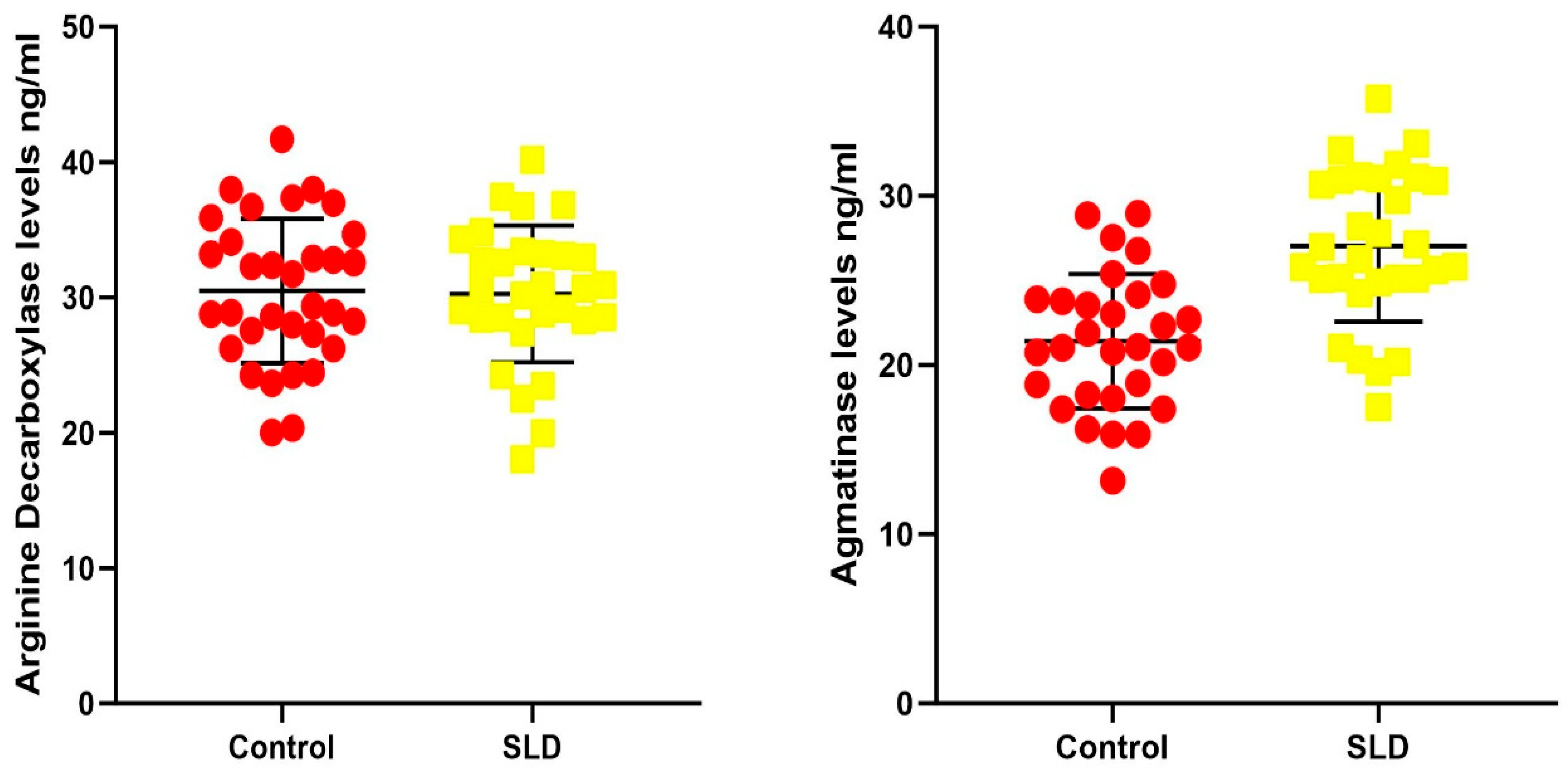
| ADC (ng/mL) | 29.82 ± 4.95 | 30.26 ± 5.06 | Independent t-test | 0.34 | 58 | 0.737 |
| AGMAT (ng/mL) | 21.42 ± 3.98 | 27.02 ± 4.46 | Independent t-test | 5.14 | 58 | 0.001 |
Disclaimer/Publisher’s Note: The statements, opinions and data contained in all publications are solely those of the individual author(s) and contributor(s) and not of MDPI and/or the editor(s). MDPI and/or the editor(s) disclaim responsibility for any injury to people or property resulting from any ideas, methods, instructions or products referred to in the content. |
© 2026 by the authors. Licensee MDPI, Basel, Switzerland. This article is an open access article distributed under the terms and conditions of the Creative Commons Attribution (CC BY) license.
Share and Cite
Kapancık, S.; Abanoz, E.; Çetinkaya, S.; Kaleci, A.O. Increased Agmatine Degradation in Children with Specific Learning Disorder. Int. J. Mol. Sci. 2026, 27, 3084. https://doi.org/10.3390/ijms27073084
Kapancık S, Abanoz E, Çetinkaya S, Kaleci AO. Increased Agmatine Degradation in Children with Specific Learning Disorder. International Journal of Molecular Sciences. 2026; 27(7):3084. https://doi.org/10.3390/ijms27073084
Chicago/Turabian StyleKapancık, Serkan, Elif Abanoz, Serap Çetinkaya, and Ahmet Ozan Kaleci. 2026. "Increased Agmatine Degradation in Children with Specific Learning Disorder" International Journal of Molecular Sciences 27, no. 7: 3084. https://doi.org/10.3390/ijms27073084
APA StyleKapancık, S., Abanoz, E., Çetinkaya, S., & Kaleci, A. O. (2026). Increased Agmatine Degradation in Children with Specific Learning Disorder. International Journal of Molecular Sciences, 27(7), 3084. https://doi.org/10.3390/ijms27073084