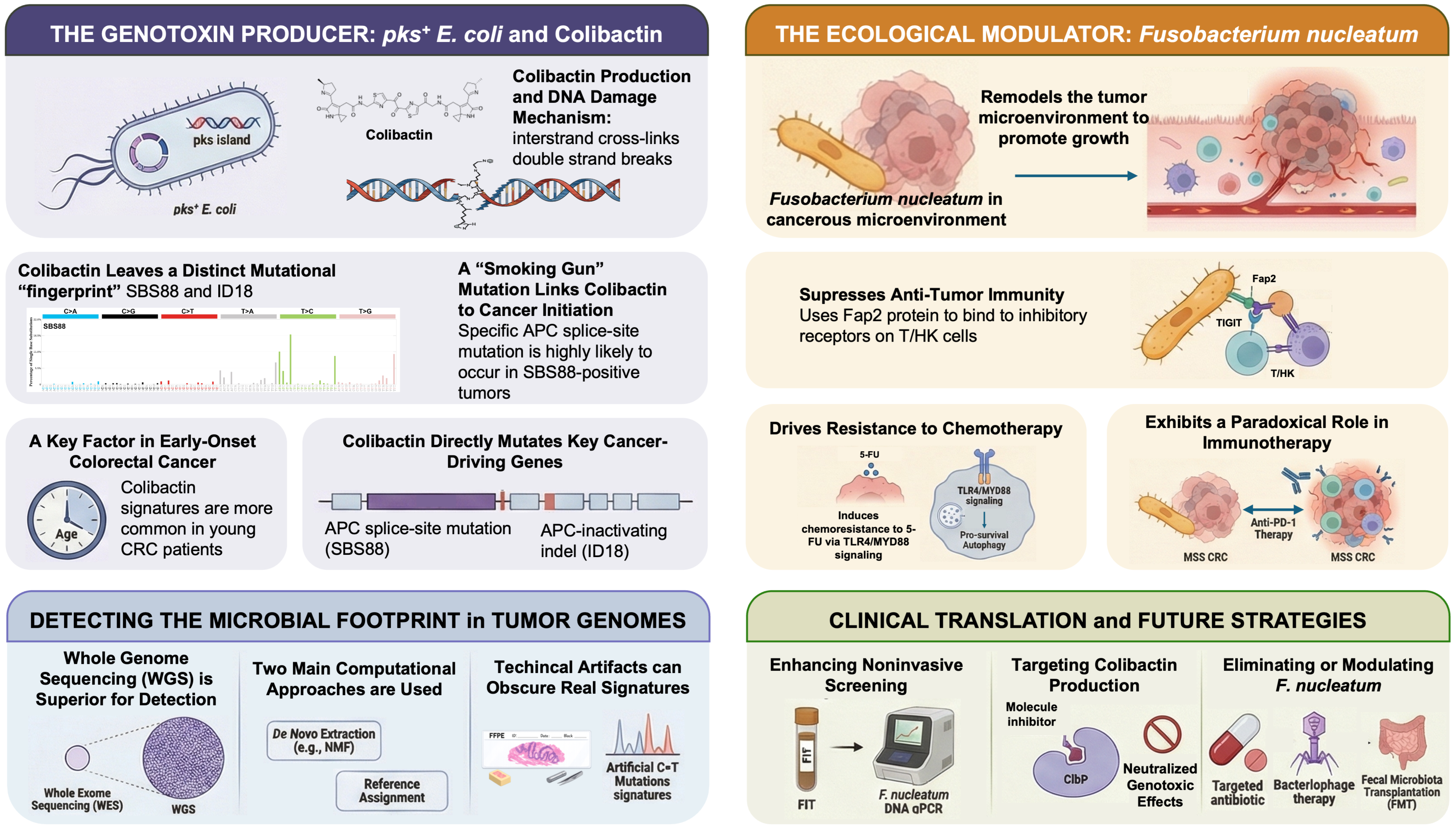
Microbiome–Genome Crosstalk in Colorectal Cancer: Colibactin Signatures and Fusobacterium nucleatum in Epidemiology, Driver Selection, and Translation


Abstract
1. Introduction
2. Colibactin-Induced Mutational Signatures in CRC
2.1. Colibactin Production by pks+ E. coli—Mechanism of Genotoxicity
2.2. Colibactin-Associated Mutational Signatures—Identification and Features
2.3. Epidemiological Patterns of Colibactin Signatures: Geographic Variation
2.4. Influence on CRC Driver Mutations
3. Fusobacterium nucleatum in Tumor Ecology and Therapy Response
3.1. Fusobacterium nucleatum and the Tumor Microenvironment
3.2. Fusobacterium nucleatum and Therapy Response
4. Methodological Approaches for Mutational Signature Detection
4.1. Computational Approaches for Signature Detection
4.2. Whole-Genome vs. Whole-Exome Sequencing Data
4.3. Detection Sensitivity and Thresholds
4.4. Sample Quality and Technical Artifacts
4.5. Translational and Clinical Considerations
5. Clinical Translation and Applications
5.1. Diagnostic Applications
5.2. Therapeutic Applications
6. Remaining Challenges and Future Directions
6.1. Scientific and Technical Challenges
6.2. Clinical and Translational Barriers
7. Conclusions
Funding
Institutional Review Board Statement
Informed Consent Statement
Data Availability Statement
Conflicts of Interest
Abbreviations
| 5-FU | 5-fluorouracil |
| CRC | Colorectal cancer |
| ctDNA | Circulating tumor DNA |
| DSB | Double-strand break |
| FFPE | Formalin-fixed paraffin-embedded |
| FMT | Fecal microbiota transplantation |
| Fn | Fusobacterium nucleatum |
| ICL | Interstrand cross-link |
| MSI | Microsatellite instability |
| MSS | Microsatellite stable |
| NMF | Non-negative matrix factorization |
| OR | Odds ratio |
| PCAWG | Pan-Cancer Analysis of Whole Genome |
| SNV | Single-nucleotide variant |
| UDG | Uracil-DNA glycosylase |
| VAF | Variant allele fraction |
| WES | Whole-exome sequencing |
| WGS | Whole-genome sequencing |
References
- Roshandel, G.; Ghasemi-Kebria, F.; Malekzadeh, R. Colorectal Cancer: Epidemiology, Risk Factors, and Prevention. Cancers 2024, 16, 1530. [Google Scholar] [CrossRef]
- Sung, H.; Siegel, R.L.; Laversanne, M.; Jiang, C.; Morgan, E.; Zahwe, M.; Cao, Y.; Bray, F.; Jemal, A. Colorectal cancer incidence trends in younger versus older adults: An analysis of population-based cancer registry data. Lancet Oncol. 2025, 26, 51–63. [Google Scholar] [CrossRef] [PubMed]
- Avril, M.; DePaolo, R.W. “Driver-passenger” bacteria and their metabolites in the pathogenesis of colorectal cancer. Gut Microbes 2021, 13, 1941710. [Google Scholar] [CrossRef] [PubMed]
- Diaz-Gay, M.; Dos Santos, W.; Moody, S.; Kazachkova, M.; Abbasi, A.; Steele, C.D.; Vangara, R.; Senkin, S.; Wang, J.; Fitzgerald, S.; et al. Geographic and age variations in mutational processes in colorectal cancer. Nature 2025, 643, 230–240. [Google Scholar] [CrossRef]
- Dziubanska-Kusibab, P.J.; Berger, H.; Battistini, F.; Bouwman, B.A.M.; Iftekhar, A.; Katainen, R.; Cajuso, T.; Crosetto, N.; Orozco, M.; Aaltonen, L.A.; et al. Colibactin DNA-damage signature indicates mutational impact in colorectal cancer. Nat. Med. 2020, 26, 1063–1069. [Google Scholar] [CrossRef]
- Kostic, A.D.; Chun, E.; Robertson, L.; Glickman, J.N.; Gallini, C.A.; Michaud, M.; Clancy, T.E.; Chung, D.C.; Lochhead, P.; Hold, G.L.; et al. Fusobacterium nucleatum potentiates intestinal tumorigenesis and modulates the tumor-immune microenvironment. Cell Host Microbe 2013, 14, 207–215. [Google Scholar] [CrossRef]
- Yu, T.; Guo, F.; Yu, Y.; Sun, T.; Ma, D.; Han, J.; Qian, Y.; Kryczek, I.; Sun, D.; Nagarsheth, N.; et al. Fusobacterium nucleatum Promotes Chemoresistance to Colorectal Cancer by Modulating Autophagy. Cell 2017, 170, 548–563.e16. [Google Scholar] [CrossRef]
- Gao, Y.; Bi, D.; Xie, R.; Li, M.; Guo, J.; Liu, H.; Guo, X.; Fang, J.; Ding, T.; Zhu, H.; et al. Fusobacterium nucleatum enhances the efficacy of PD-L1 blockade in colorectal cancer. Signal Transduct. Target. Ther. 2021, 6, 398, Erratum in Signal Transduct. Target. Ther. 2021, 6, 434. [Google Scholar] [CrossRef]
- Brotherton, C.A.; Balskus, E.P. A prodrug resistance mechanism is involved in colibactin biosynthesis and cytotoxicity. J. Am. Chem. Soc. 2013, 135, 3359–3362. [Google Scholar] [CrossRef]
- Nougayrede, J.P.; Homburg, S.; Taieb, F.; Boury, M.; Brzuszkiewicz, E.; Gottschalk, G.; Buchrieser, C.; Hacker, J.; Dobrindt, U.; Oswald, E. Escherichia coli induces DNA double-strand breaks in eukaryotic cells. Science 2006, 313, 848–851. [Google Scholar] [CrossRef] [PubMed]
- Arthur, J.C.; Perez-Chanona, E.; Muhlbauer, M.; Tomkovich, S.; Uronis, J.M.; Fan, T.J.; Campbell, B.J.; Abujamel, T.; Dogan, B.; Rogers, A.B.; et al. Intestinal inflammation targets cancer-inducing activity of the microbiota. Science 2012, 338, 120–123. [Google Scholar] [CrossRef]
- Buc, E.; Dubois, D.; Sauvanet, P.; Raisch, J.; Delmas, J.; Darfeuille-Michaud, A.; Pezet, D.; Bonnet, R. High prevalence of mucosa-associated E. coli producing cyclomodulin and genotoxin in colon cancer. PLoS ONE 2013, 8, e56964. [Google Scholar] [CrossRef]
- Xue, M.; Kim, C.S.; Healy, A.R.; Wernke, K.M.; Wang, Z.; Frischling, M.C.; Shine, E.E.; Wang, W.; Herzon, S.B.; Crawford, J.M. Structure elucidation of colibactin and its DNA cross-links. Science 2019, 365, 6457. [Google Scholar] [CrossRef] [PubMed]
- Mousa, W.K. The microbiome-product colibactin hits unique cellular targets mediating host-microbe interaction. Front. Pharmacol. 2022, 13, 958012. [Google Scholar] [CrossRef]
- Tripathi, P.; Shine, E.E.; Healy, A.R.; Kim, C.S.; Herzon, S.B.; Bruner, S.D.; Crawford, J.M. ClbS Is a Cyclopropane Hydrolase That Confers Colibactin Resistance. J. Am. Chem. Soc. 2017, 139, 17719–17722. [Google Scholar] [CrossRef] [PubMed]
- Pleguezuelos-Manzano, C.; Puschhof, J.; Rosendahl Huber, A.; van Hoeck, A.; Wood, H.M.; Nomburg, J.; Gurjao, C.; Manders, F.; Dalmasso, G.; Stege, P.B.; et al. Mutational signature in colorectal cancer caused by genotoxic pks(+) E. coli. Nature 2020, 580, 269–273. [Google Scholar] [CrossRef] [PubMed]
- Georgeson, P.; Steinfelder, R.S.; Harrison, T.A.; Pope, B.J.; Zaidi, S.H.; Qu, C.; Lin, Y.; Joo, J.E.; Mahmood, K.; Clendenning, M.; et al. Genotoxic colibactin mutational signature in colorectal cancer is associated with clinicopathological features, specific genomic alterations and better survival. medRxiv 2024. [Google Scholar] [CrossRef]
- Lee-Six, H.; Olafsson, S.; Ellis, P.; Osborne, R.J.; Sanders, M.A.; Moore, L.; Georgakopoulos, N.; Torrente, F.; Noorani, A.; Goddard, M.; et al. The landscape of somatic mutation in normal colorectal epithelial cells. Nature 2019, 574, 532–537. [Google Scholar] [CrossRef]
- Chen, B.; Ramazzotti, D.; Heide, T.; Spiteri, I.; Fernandez-Mateos, J.; James, C.; Magnani, L.; Graham, T.A.; Sottoriva, A. Contribution of pks(+) E. coli mutations to colorectal carcinogenesis. Nat. Commun. 2023, 14, 7827. [Google Scholar] [CrossRef]
- Terlouw, D.; Suerink, M.; Boot, A.; van Wezel, T.; Nielsen, M.; Morreau, H. Recurrent APC Splice Variant c.835-8A>G in Patients with Unexplained Colorectal Polyposis Fulfilling the Colibactin Mutational Signature. Gastroenterology 2020, 159, 1612–1614e.15. [Google Scholar] [CrossRef]
- Alexandrov, L.B.; Nik-Zainal, S.; Wedge, D.C.; Aparicio, S.A.; Behjati, S.; Biankin, A.V.; Bignell, G.R.; Bolli, N.; Borg, A.; Borresen-Dale, A.L.; et al. Signatures of mutational processes in human cancer. Nature 2013, 500, 415–421, Erratum in Nature 2013, 502, 258. [Google Scholar] [CrossRef] [PubMed]
- Mima, K.; Sukawa, Y.; Nishihara, R.; Qian, Z.R.; Yamauchi, M.; Inamura, K.; Kim, S.A.; Masuda, A.; Nowak, J.A.; Nosho, K.; et al. Fusobacterium nucleatum and T Cells in Colorectal Carcinoma. JAMA Oncol. 2015, 1, 653–661. [Google Scholar] [CrossRef]
- Kim, H.S.; Kim, C.G.; Kim, W.K.; Kim, K.A.; Yoo, J.; Min, B.S.; Paik, S.; Shin, S.J.; Lee, H.; Lee, K.; et al. Fusobacterium nucleatum induces a tumor microenvironment with diminished adaptive immunity against colorectal cancers. Front. Cell. Infect. Microbiol. 2023, 13, 1101291. [Google Scholar] [CrossRef]
- Yang, Y.; Weng, W.; Peng, J.; Hong, L.; Yang, L.; Toiyama, Y.; Gao, R.; Liu, M.; Yin, M.; Pan, C.; et al. Fusobacterium nucleatum Increases Proliferation of Colorectal Cancer Cells and Tumor Development in Mice by Activating Toll-Like Receptor 4 Signaling to Nuclear Factor-kappaB, and Up-regulating Expression of MicroRNA-21. Gastroenterology 2017, 152, 851–866 e824. [Google Scholar] [CrossRef]
- Rubinstein, M.R.; Wang, X.; Liu, W.; Hao, Y.; Cai, G.; Han, Y.W. Fusobacterium nucleatum promotes colorectal carcinogenesis by modulating E-cadherin/beta-catenin signaling via its FadA adhesin. Cell Host Microbe 2013, 14, 195–206. [Google Scholar] [CrossRef]
- Gur, C.; Ibrahim, Y.; Isaacson, B.; Yamin, R.; Abed, J.; Gamliel, M.; Enk, J.; Bar-On, Y.; Stanietsky-Kaynan, N.; Coppenhagen-Glazer, S.; et al. Binding of the Fap2 protein of Fusobacterium nucleatum to human inhibitory receptor TIGIT protects tumors from immune cell attack. Immunity 2015, 42, 344–355. [Google Scholar] [CrossRef]
- Galaski, J.; Rishiq, A.; Liu, M.; Bsoul, R.; Bergson, A.; Lux, R.; Bachrach, G.; Mandelboim, O. Fusobacterium nucleatum subsp. nucleatum RadD binds Siglec-7 and inhibits NK cell-mediated cancer cell killing. iScience 2024, 27, 110157. [Google Scholar] [CrossRef] [PubMed]
- Abed, J.; Emgard, J.E.; Zamir, G.; Faroja, M.; Almogy, G.; Grenov, A.; Sol, A.; Naor, R.; Pikarsky, E.; Atlan, K.A.; et al. Fap2 Mediates Fusobacterium nucleatum Colorectal Adenocarcinoma Enrichment by Binding to Tumor-Expressed Gal-GalNAc. Cell Host Microbe 2016, 20, 215–225. [Google Scholar] [CrossRef]
- Zhang, S.; Yang, Y.; Weng, W.; Guo, B.; Cai, G.; Ma, Y.; Cai, S. Fusobacterium nucleatum promotes chemoresistance to 5-fluorouracil by upregulation of BIRC3 expression in colorectal cancer. J. Exp. Clin. Cancer Res. 2019, 38, 14. [Google Scholar] [CrossRef]
- Wang, N.; Zhang, L.; Leng, X.X.; Xie, Y.L.; Kang, Z.R.; Zhao, L.C.; Song, L.H.; Zhou, C.B.; Fang, J.Y. Fusobacterium nucleatum induces chemoresistance in colorectal cancer by inhibiting pyroptosis via the Hippo pathway. Gut Microbes 2024, 16, 2333790. [Google Scholar] [CrossRef]
- Li, B.; Wei, Z.; Wang, Z.; Xu, F.; Yang, J.; Lin, B.; Chen, Y.; Wenren, H.; Wu, L.; Guo, X.; et al. Fusobacterium nucleatum induces oxaliplatin resistance by inhibiting ferroptosis through E-cadherin/beta-catenin/GPX4 axis in colorectal cancer. Free. Radic. Biol. Med. 2024, 220, 125–138. [Google Scholar] [CrossRef] [PubMed]
- Bullman, S.; Pedamallu, C.S.; Sicinska, E.; Clancy, T.E.; Zhang, X.; Cai, D.; Neuberg, D.; Huang, K.; Guevara, F.; Nelson, T.; et al. Analysis of Fusobacterium persistence and antibiotic response in colorectal cancer. Science 2017, 358, 1443–1448. [Google Scholar] [CrossRef]
- Zheng, D.W.; Dong, X.; Pan, P.; Chen, K.W.; Fan, J.X.; Cheng, S.X.; Zhang, X.Z. Phage-guided modulation of the gut microbiota of mouse models of colorectal cancer augments their responses to chemotherapy. Nat. Biomed. Eng. 2019, 3, 717–728. [Google Scholar] [CrossRef]
- Guo, S.H.; Wang, H.F.; Nian, Z.G.; Wang, Y.D.; Zeng, Q.Y.; Zhang, G. Immunization with alkyl hydroperoxide reductase subunit C reduces Fusobacterium nucleatum load in the intestinal tract. Sci. Rep. 2017, 7, 10566. [Google Scholar] [CrossRef]
- Jiang, S.S.; Xie, Y.L.; Xiao, X.Y.; Kang, Z.R.; Lin, X.L.; Zhang, L.; Li, C.S.; Qian, Y.; Xu, P.P.; Leng, X.X.; et al. Fusobacterium nucleatum-derived succinic acid induces tumor resistance to immunotherapy in colorectal cancer. Cell Host Microbe 2023, 31, 781–797e.9. [Google Scholar] [CrossRef]
- Ternes, D.; Tsenkova, M.; Pozdeev, V.I.; Meyers, M.; Koncina, E.; Atatri, S.; Schmitz, M.; Karta, J.; Schmoetten, M.; Heinken, A.; et al. The gut microbial metabolite formate exacerbates colorectal cancer progression. Nat. Metab. 2022, 4, 458–475, Erratum in Nat. Metab. 2023, 5, 1638. [Google Scholar] [CrossRef] [PubMed]
- Alexandrov, L.B.; Kim, J.; Haradhvala, N.J.; Huang, M.N.; Tian Ng, A.W.; Wu, Y.; Boot, A.; Covington, K.R.; Gordenin, D.A.; Bergstrom, E.N.; et al. The repertoire of mutational signatures in human cancer. Nature 2020, 578, 94–101, Erratum in Nature 2023, 614, E41. [Google Scholar] [CrossRef]
- Rosenthal, R.; McGranahan, N.; Herrero, J.; Taylor, B.S.; Swanton, C. DeconstructSigs: Delineating mutational processes in single tumors distinguishes DNA repair deficiencies and patterns of carcinoma evolution. Genome Biol. 2016, 17, 31. [Google Scholar] [CrossRef]
- Blokzijl, F.; Janssen, R.; van Boxtel, R.; Cuppen, E. MutationalPatterns: Comprehensive genome-wide analysis of mutational processes. Genome Med. 2018, 10, 33. [Google Scholar] [CrossRef]
- Diaz-Gay, M.; Vangara, R.; Barnes, M.; Wang, X.; Islam, S.M.A.; Vermes, I.; Duke, S.; Narasimman, N.B.; Yang, T.; Jiang, Z.; et al. Assigning mutational signatures to individual samples and individual somatic mutations with SigProfilerAssignment. Bioinformatics 2023, 39, btad756. [Google Scholar] [CrossRef] [PubMed]
- Bailey, M.H.; Meyerson, W.U.; Dursi, L.J.; Wang, L.B.; Dong, G.; Liang, W.W.; Weerasinghe, A.; Li, S.; Li, Y.; Kelso, S.; et al. Retrospective evaluation of whole exome and genome mutation calls in 746 cancer samples. Nat. Commun. 2020, 11, 4748, Erratum in Nat. Commun. 2020, 11, 6232. [Google Scholar] [CrossRef] [PubMed]
- Diaz-Gay, M.; Alexandrov, L.B. Unraveling the genomic landscape of colorectal cancer through mutational signatures. Adv. Cancer Res. 2021, 151, 385–424. [Google Scholar] [CrossRef]
- Bhagwate, A.V.; Liu, Y.; Winham, S.J.; McDonough, S.J.; Stallings-Mann, M.L.; Heinzen, E.P.; Davila, J.I.; Vierkant, R.A.; Hoskin, T.L.; Frost, M.; et al. Bioinformatics and DNA-extraction strategies to reliably detect genetic variants from FFPE breast tissue samples. BMC Genom. 2019, 20, 689. [Google Scholar] [CrossRef]
- Guo, Q.; Lakatos, E.; Bakir, I.A.; Curtius, K.; Graham, T.A.; Mustonen, V. The mutational signatures of formalin fixation on the human genome. Nat. Commun. 2022, 13, 4487. [Google Scholar] [CrossRef]
- Do, H.; Dobrovic, A. Dramatic reduction of sequence artefacts from DNA isolated from formalin-fixed cancer biopsies by treatment with uracil- DNA glycosylase. Oncotarget 2012, 3, 546–558. [Google Scholar] [CrossRef]
- Heo, D.H.; Kim, I.; Seo, H.; Kim, S.G.; Kim, M.; Park, J.; Park, H.; Kang, S.; Kim, J.; Paik, S.; et al. DEEPOMICS FFPE, a deep neural network model, identifies DNA sequencing artifacts from formalin fixed paraffin embedded tissue with high accuracy. Sci. Rep. 2024, 14, 2559. [Google Scholar] [CrossRef]
- Arima, K.; Zhong, R.; Ugai, T.; Zhao, M.; Haruki, K.; Akimoto, N.; Lau, M.C.; Okadome, K.; Mehta, R.S.; Vayrynen, J.P.; et al. Western-Style Diet, pks Island-Carrying Escherichia coli, and Colorectal Cancer: Analyses From Two Large Prospective Cohort Studies. Gastroenterology 2022, 163, 862–874. [Google Scholar] [CrossRef]
- Davies, H.; Glodzik, D.; Morganella, S.; Yates, L.R.; Staaf, J.; Zou, X.; Ramakrishna, M.; Martin, S.; Boyault, S.; Sieuwerts, A.M.; et al. HRDetect is a predictor of BRCA1 and BRCA2 deficiency based on mutational signatures. Nat. Med. 2017, 23, 517–525. [Google Scholar] [CrossRef]
- Wong, S.H.; Kwong, T.N.Y.; Chow, T.C.; Luk, A.K.C.; Dai, R.Z.W.; Nakatsu, G.; Lam, T.Y.T.; Zhang, L.; Wu, J.C.Y.; Chan, F.K.L.; et al. Quantitation of faecal Fusobacterium improves faecal immunochemical test in detecting advanced colorectal neoplasia. Gut 2017, 66, 1441–1448. [Google Scholar] [CrossRef]
- Eklof, V.; Lofgren-Burstrom, A.; Zingmark, C.; Edin, S.; Larsson, P.; Karling, P.; Alexeyev, O.; Rutegard, J.; Wikberg, M.L.; Palmqvist, R. Cancer-associated fecal microbial markers in colorectal cancer detection. Int. J. Cancer 2017, 141, 2528–2536. [Google Scholar] [CrossRef] [PubMed]
- Thomas, A.M.; Manghi, P.; Asnicar, F.; Pasolli, E.; Armanini, F.; Zolfo, M.; Beghini, F.; Manara, S.; Karcher, N.; Pozzi, C.; et al. Metagenomic analysis of colorectal cancer datasets identifies cross-cohort microbial diagnostic signatures and a link with choline degradation. Nat. Med. 2019, 25, 667–678, Erratum in Nat. Med. 2019, 25, 1948. [Google Scholar] [CrossRef]
- Wirbel, J.; Pyl, P.T.; Kartal, E.; Zych, K.; Kashani, A.; Milanese, A.; Fleck, J.S.; Voigt, A.Y.; Palleja, A.; Ponnudurai, R.; et al. Meta-analysis of fecal metagenomes reveals global microbial signatures that are specific for colorectal cancer. Nat. Med. 2019, 25, 679–689. [Google Scholar] [CrossRef]
- Xiao, Q.; Lu, W.; Kong, X.; Shao, Y.W.; Hu, Y.; Wang, A.; Bao, H.; Cao, R.; Liu, K.; Wang, X.; et al. Alterations of circulating bacterial DNA in colorectal cancer and adenoma: A proof-of-concept study. Cancer Lett. 2021, 499, 201–208. [Google Scholar] [CrossRef]
- Zhao, W.; Lei, J.; Ke, S.; Chen, Y.; Xiao, J.; Tang, Z.; Wang, L.; Ren, Y.; Alnaggar, M.; Qiu, H.; et al. Fecal microbiota transplantation plus tislelizumab and fruquintinib in refractory microsatellite stable metastatic colorectal cancer: An open-label, single-arm, phase II trial (RENMIN-215). eClinicalMedicine 2023, 66, 102315. [Google Scholar] [CrossRef]
- Osterlund, P.; Ruotsalainen, T.; Korpela, R.; Saxelin, M.; Ollus, A.; Valta, P.; Kouri, M.; Elomaa, I.; Joensuu, H. Lactobacillus supplementation for diarrhoea related to chemotherapy of colorectal cancer: A randomised study. Br. J. Cancer 2007, 97, 1028–1034. [Google Scholar] [CrossRef] [PubMed]
- Gurbatri, C.R.; Lia, I.; Vincent, R.; Coker, C.; Castro, S.; Treuting, P.M.; Hinchliffe, T.E.; Arpaia, N.; Danino, T. Engineered probiotics for local tumor delivery of checkpoint blockade nanobodies. Sci. Transl. Med. 2020, 12, 530. [Google Scholar] [CrossRef]
- Cougnoux, A.; Delmas, J.; Gibold, L.; Fais, T.; Romagnoli, C.; Robin, F.; Cuevas-Ramos, G.; Oswald, E.; Darfeuille-Michaud, A.; Prati, F.; et al. Small-molecule inhibitors prevent the genotoxic and protumoural effects induced by colibactin-producing bacteria. Gut 2016, 65, 278–285. [Google Scholar] [CrossRef] [PubMed]
- Bharti, R.; Grimm, D.G. Current challenges and best-practice protocols for microbiome analysis. Brief. Bioinform. 2021, 22, 178–193. [Google Scholar] [CrossRef] [PubMed]
- Mirzayi, C.; Renson, A.; Genomic Standards, C.; Massive, A.; Quality Control, S.; Zohra, F.; Elsafoury, S.; Geistlinger, L.; Kasselman, L.J.; Eckenrode, K.; et al. Reporting guidelines for human microbiome research: The STORMS checklist. Nat. Med. 2021, 27, 1885–1892. [Google Scholar] [CrossRef]
- Pant, A.; Das, B. Microbiome-based therapeutics: Opportunity and challenges. Prog. Mol. Biol. Transl. Sci. 2022, 191, 229–262. [Google Scholar] [CrossRef]
- Merrick, B.; Allen, L.; Masirah, M.Z.N.; Forbes, B.; Shawcross, D.L.; Goldenberg, S.D. Regulation, risk and safety of Faecal Microbiota Transplant. Infect. Prev. Pract. 2020, 2, 100069. [Google Scholar] [CrossRef] [PubMed]
- Porcari, S.; Ng, S.C.; Zitvogel, L.; Sokol, H.; Weersma, R.K.; Elinav, E.; Gasbarrini, A.; Cammarota, G.; Tilg, H.; Ianiro, G. The microbiome for clinicians. Cell 2025, 188, 2836–2844. [Google Scholar] [CrossRef]
- Lam, H.Y.P.; Lai, M.-J.; Wang, P.-C.; Wu, W.-J.; Chen, L.-K.; Fan, H.-W.; Tseng, C.-C.; Peng, S.-Y.; Chang, K.-C. A Novel Bacteriophage with the Potential to Inhibit Fusobacterium nucleatum-Induced Proliferation of Colorectal Cancer Cells. Antibiotics 2025, 14, 45. [Google Scholar] [CrossRef] [PubMed]
- Volpe, M.R.; Velilla, J.A.; Daniel-Ivad, M.; Yao, J.J.; Stornetta, A.; Villalta, P.W.; Huang, H.C.; Bachovchin, D.A.; Balbo, S.; Gaudet, R.; et al. A small molecule inhibitor prevents gut bacterial genotoxin production. Nat. Chem. Biol. 2023, 19, 159–167. [Google Scholar] [CrossRef] [PubMed]


| Study | Model/Cohort | Sequencing Platform | Key Findings | Significance for CRC |
|---|---|---|---|---|
| Nougayrede et al., 2006 [10] | Human cell lines infected with pks+ E. coli | Targeted assays, cytogenetics | pks+ E. coli induces DNA double-strand breaks and cell-cycle arrest | First demonstration of direct genotoxicity by colibactin |
| Arthur et al., 2012 [11] | Mouse models (Il10−/−, inflammation-associated CRC) | Targeted sequencing, pathology | pks+ E. coli promotes invasive CRC in vivo | Establishes tumor-promoting role of colibactin in vivo |
| Pleguezuelos-Manzano et al., 2020 [16] | Human colonic organoids exposed to pks+ E. coli | WGS | Identification of colibactin-associated mutational signatures (later SBS88/ID18) | Causal link between colibactin exposure and specific mutational signatures |
| Dziubanska-Kusibab et al., 2020 [5] | Human CRC tumors | WGS | Detection of SBS88/ID18 in human CRC genomes | First confirmation of colibactin signatures in patients |
| Lee-Six et al., 2019 [18] | Normal human colonic crypts | WGS | Early-life mutational imprints in normal epithelium | Supports early timing of colibactin exposure |
| Diaz-Gay et al., 2025 [4] | 981 CRCs from 11 countries | WGS | SBS88/ID18 enriched in early-onset CRC and high-incidence regions | Links microbiome mutagenesis to molecular epidemiology |
| Chen et al., 2023 [19] | Human CRC and normal tissue | WGS, phylogenetic modeling | Truncal colibactin mutations in tumors and adjacent crypts | Demonstrates early, clonal imprinting |
| Terlouw et al., 2020 [20] | CRC patients with unexplained polyposis | WES + targeted validation | Recurrent APC splice-site mutation (c.835-8A>G) linked to SBS88 | Connects colibactin signature to a specific driver mutation |
| Georgeson et al., 2024 [17] | Large CRC cohort (clinical sequencing) | Targeted panels/WES | Colibactin signatures associated with APC, SMAD4, TP53 alterations and survival | Shows clinical relevance beyond WGS-only studies |
| Analytical Step | Recommended Practice | Minimum Criteria | Common Pitfalls | Notes/Examples |
|---|---|---|---|---|
| Sample type | Prefer fresh-frozen tissue; FFPE acceptable with artifact correction | Matched normal recommended | FFPE-induced C > T artifacts inflate background | FFPE samples require dedicated filtering (see below) |
| Sequencing platform | WGS preferred | ≥60–100 total SNVs | WES or panels often underpowered | ID18 indel detection usually requires WGS |
| Mutation calling | High-specificity somatic variant callers with matched normal | VAF-aware filtering | Low-VAF artifacts misclassified as real mutations | Avoid aggressive VAF cutoffs that remove true subclonal events |
| Signature strategy | Reference-based fitting with restricted signature set | SBS88 ≥ 5–10% of SBS mutations | Overfitting with large signature catalogs | Limit reference signatures to CRC-relevant processes |
| De novo extraction | Use only in large, heterogeneous cohorts | ≥100 tumors | Composite or unstable signatures in small datasets | Best for discovery, not single sample calling |
| SBS88 detection | Require characteristic A/T-rich sequence context | ≥10–20 SBS88-consistent mutations | Chance occurrence of T > N mutations | Context validation improves specificity |
| ID18 detection | Assess indel spectrum separately | ≥5–10 indels total | Insufficient indel counts in WES/panels | ID18 often missed without WGS |
| FFPE artifact control (lab) | UDG treatment | Pre-library enzymatic repair | Residual oxidative damage | UDG mainly reduces C > T deamination artifacts |
| FFPE artifact control (bioinformatics) | Explicit artifact removal or modeling | Artifact signature subtraction | Masking of true biological signatures | FFPEsig or ML-based classifiers recommended |
| Thresholding | Apply minimum contribution cutoffs | Typically, ≥5–10% exposure | False negatives for weak signatures | Conservative thresholds favored in clinical contexts |
| Proxy markers | Use hallmark driver mutations when data sparse | APC:c.835-8A>G present | Incomplete capture of signature burden | Useful for panel-based studies |
| Reporting standards | Report mutation counts, thresholds, and QC | Transparent methods section | Irreproducible results | Align with COSMIC/STORMS-stype reporting |
Disclaimer/Publisher’s Note: The statements, opinions and data contained in all publications are solely those of the individual author(s) and contributor(s) and not of MDPI and/or the editor(s). MDPI and/or the editor(s) disclaim responsibility for any injury to people or property resulting from any ideas, methods, instructions or products referred to in the content. |
© 2026 by the author. Licensee MDPI, Basel, Switzerland. This article is an open access article distributed under the terms and conditions of the Creative Commons Attribution (CC BY) license.
Share and Cite
Jung, S. Microbiome–Genome Crosstalk in Colorectal Cancer: Colibactin Signatures and Fusobacterium nucleatum in Epidemiology, Driver Selection, and Translation. Int. J. Mol. Sci. 2026, 27, 2068. https://doi.org/10.3390/ijms27042068
Jung S. Microbiome–Genome Crosstalk in Colorectal Cancer: Colibactin Signatures and Fusobacterium nucleatum in Epidemiology, Driver Selection, and Translation. International Journal of Molecular Sciences. 2026; 27(4):2068. https://doi.org/10.3390/ijms27042068
Chicago/Turabian StyleJung, Sungwon. 2026. "Microbiome–Genome Crosstalk in Colorectal Cancer: Colibactin Signatures and Fusobacterium nucleatum in Epidemiology, Driver Selection, and Translation" International Journal of Molecular Sciences 27, no. 4: 2068. https://doi.org/10.3390/ijms27042068
APA StyleJung, S. (2026). Microbiome–Genome Crosstalk in Colorectal Cancer: Colibactin Signatures and Fusobacterium nucleatum in Epidemiology, Driver Selection, and Translation. International Journal of Molecular Sciences, 27(4), 2068. https://doi.org/10.3390/ijms27042068