Review

Membrane-Anchored Serine Protease Inhibitors: Physiological Functions, Mechanisms, and Roles in Cancer


1
School of Medicine, College of Medicine, National Cheng Kung University, Tainan 701401, Taiwan
2
Graduate Institute of Medical Genomics and Proteomics, College of Medicine, National Taiwan University, Taipei 100233, Taiwan
*
Author to whom correspondence should be addressed.
Int. J. Mol. Sci. 2026, 27(4), 2000; https://doi.org/10.3390/ijms27042000
Submission received: 21 December 2025 / Revised: 13 February 2026 / Accepted: 16 February 2026 / Published: 19 February 2026
(This article belongs to the Special Issue Proteases and Their Inhibitors)

Abstract

Pericellular proteolysis is essential for maintaining tissue homeostasis. Central to this process are hepatocyte growth factor activator inhibitor-1 (HAI-1) and HAI-2, membrane-bound inhibitors that regulate type II transmembrane serine proteases, including matriptase and prostasin, through high-affinity Kunitz domains. This review summarizes current understanding of their molecular structures, physiological roles, and cancer-related clinical relevance. Genetic models reveal HAI-1 is critical for placental and skin development, while HAI-2 is crucial for neural tube closure and intestinal integrity. In cancer, HAIs generally act as tumor suppressors. Their downregulation, often via promoter hypermethylation, leads to excessive activation of hepatocyte growth factor/c-MET or protease-activated receptor-2/NF-κB signaling, promoting epithelial–mesenchymal transition and cancer progression. Clinically, reduced HAI levels in tumors correlate with metastasis and poor prognosis in several carcinomas. Paradoxically, elevated HAI expression in certain cancers suggests context-dependent pro-tumor functions. Emerging evidence links HAI loss to immune suppression, notably via M2 macrophage polarization in lung cancer. Finally, we highlight future directions for identifying tissue-specific serine proteases, downstream signaling, and therapeutic strategies, including recombinant mimetics and epigenetic reactivation, in precision oncology. In conclusion, HAI-1 and HAI-2 are key regulators of tissue homeostasis and cancer, with overlapping yet distinct functions, which present promising opportunities for therapeutic targeting.

1. Introduction

Serine proteases are a versatile group of enzymes characterized by a serine residue in their active site, which is essential for their proteolytic activity. These enzymes participate in fundamental physiological processes such as digestion, blood coagulation, immune defense, and cell signaling [1]. Type II transmembrane serine proteases (TTSPs) are a subfamily of serine proteases widely distributed across vertebrates and some invertebrates. They are characterized by a cytoplasmic domain that potentially mediates intracellular signal transduction and an extracellular domain that catalyzes substrate cleavage [2]. TTSPs are involved in various biological processes including tissue development, epithelial integrity, host defense, and cellular signaling [3]. Several TTSP members, including matriptase, transmembrane protease, serine 2 (TMPRSS2), and hepsin, are also implicated in pathological states, such as cancer progression, making them important targets for therapeutic intervention [3].
To counterbalance the potent activity of cell-surface serine proteases, many tissues express membrane-anchored serine protease inhibitors. The two best-studied inhibitors of TTSPs are hepatocyte growth factor activator inhibitor-1 (HAI-1), encoded by the serine peptidase inhibitor, Kunitz Type 1 gene (SPINT1), and hepatocyte growth factor activator inhibitor-2 (HAI-2), encoded by SPINT2 [4]. The significance of these inhibitors became evident with the discovery of HAI-1, a novel Kunitz-type inhibitor identified during purification of hepatocyte growth factor (HGF) activator (HGFA), a protease responsible for converting pro-HGF into its active form [5]. Shortly thereafter, HAI-2 was purified [6]. Subsequent studies revealed that HAI-2 shares a structural organization similar to HAI-1, featuring two extracellular Kunitz-type domains. Notably, the three-dimensional structures of the main extracellular regions of both HAI-1 [7,8] and HAI-2 [9] have been characterized by X-ray crystallography.
Beyond their biochemical identification, HAI-1 and HAI-2 have been shown to play indispensable roles in diverse physiological contexts. For example, HAI-1 has critical roles in skin barrier formation and epidermal differentiation [10]. In the gastrointestinal tract, HAI-1 is required for maintenance of intestinal epithelial integrity [11]. In reproduction and development, HAI-1 is indispensable for placental labyrinth morphogenesis [12]. Similarly, HAI-2 is required for embryonic development, including placentation and neural tube closure [13]. In the airway, HAI-1 expression is upregulated after tissue injury, supporting its role in epithelial repair [14], while HAI-2 inhibits TMPRSS2- and matriptase-dependent activation of influenza and metapneumoviruses, highlighting its contribution to airway defense [15]. Collectively, these findings establish HAI-1 and HAI-2 as versatile regulators of protease activity in both epithelial and non-epithelial contexts.
This review provides a broad overview of the physiological roles of HAI-1 and HAI-2 in normal development and highlights how their dysregulation in cancer reflects a pathological mirror of these processes. By linking basic biology with tumorigenesis, we underscore their relevance as key regulators in both health and cancer. Despite growing interest, an integrated view of HAI-1 and HAI-2 in both development and cancer remains lacking, making this synthesis both timely and necessary. We first summarize their molecular architectures, regulatory mechanisms, and subcellular localizations, followed by a discussion of their diverse physiological and developmental roles across multiple organ systems. We then highlight the clinical consequences of genetic mutations in SPINT1 and SPINT2. The review further explores the dysregulation of HAI-1 and HAI-2 in cancer, where they influence epithelial–mesenchymal transition, tumor immune evasion, and key oncogenic pathways such as HGF/mesenchymal–epithelial transition factor (MET) and Wnt/β-catenin. Finally, we discuss therapeutic opportunities ranging from biomarker applications to epigenetic reactivation strategies.

2. Research Design and Characteristics

2.1. Databases and Search Strategies

We performed a comprehensive literature search of PubMed from their inception to 25 August 2025. Two investigators independently screened full-text articles for eligibility. The search strategy incorporated the following terms: (HAI-1) OR (Spint1) OR (Hepatocyte growth factor activator inhibitor-1) OR (Serine peptidase inhibitor, Kunitz type 1) OR (HAI-2) OR (Spint2) OR (Hepatocyte growth factor activator inhibitor-2) OR (Serine peptidase inhibitor, Kunitz type 2).
We also manually reviewed the reference lists of eligible studies to include or exclude any additional relevant publications.

2.2. Study Eligibility Criteria

  • Inclusion Criteria
  • Original research articles or review articles focusing on HAI-1 or HAI-2.
  • Studies addressing cancer biology–related topics.
B.
Exclusion Criteria
  • Articles without full-text availability or not written in English.
  • Studies in which HAI-1 or HAI-2 were addressed only minimally (e.g., 1–2 sentences in the Discussion section).
  • Non-cancer studies limited to clinical correlations of HAI-1 or HAI-2, without accompanying functional or mechanistic analyses, as such studies primarily address disease-associated contexts rather than clearly defining physiological roles.
A total of 171 studies were included, most of which investigating the molecular mechanisms, biological functions, regulatory pathways, or pathophysiological roles of HAI-1 and HAI-2, as well as their roles in different cancers.

3. Molecular Structure and Regulation

3.1. Domain Architecture

HAI-1 is a 529-amino-acid, 66 kDa multidomain protein [5,7], comprising an extracellular region (or a secreted 58 kDa variant) that includes, from the N terminus, a motif at N terminus with eight cysteines (MANEC) domain, an internal polycystic kidney disease (PKD)-like domain, Kunitz domain 1 (KD1), a low-density lipoprotein receptor class A (LDLRA) domain, and Kunitz domain 2 (KD2), followed by a single-span transmembrane region, and a short C-terminal cytoplasmic tail (Figure 1). HAI-1 contains three predicted N-glycosylation sites located at Asn-66, Asn-235, and Asn-523 [8]. Disulfide bonds are crucial for the structural integrity, stability, and inhibitory function of HAI-1 and HAI-2 proteins. HAI-1 has multiple cysteine-rich domains, including MANEC (with 8 cysteines forming 4 disulfides), two Kunitz domains (each with 6 cysteines forming 3 conserved disulfides), and LDLRA domain (6 cysteines possibly forming 3 canonical disulfide bonds [16]). The MANEC domain’s distinctive disulfide bonds enhance domain compaction and intramolecular interactions by anchoring the N terminus to α helix 2 and bridging strands 2 and 4 to project a loop outward, thereby defining a novel Plasminogen Apple Nematode subclass [17].
Early studies demonstrated that KD1 was the major inhibitory unit against hepatocyte growth factor activator (HGFA), while the KD2 showed negligible activity toward HGFA but retained inhibitory potency against trypsin [18]. Interestingly, the coexistence of both domains reduced the inhibitory efficacy of Kunitz I toward HGFA, suggesting steric interference between these two domains [18]. The importance of KD1 was further highlighted in glioblastoma models, where disruption of KD1 abolished anti-invasive effects, while KD2 contributed only marginally [19]. Alternative splicing was also shown to generate an isoform such as HAI-1B, which differs from canonical HAI-1 by an additional 16 amino acids located downstream of the KD1 domain (Figure 1), yet both variants rely on KD1 as their principal inhibitory unit [19,20].
Further dissection of domain interactions revealed that KD1 remained the principal inhibitory unit of HAI-1 against matriptase, but its potency was modulated by surrounding structural elements [21]. The N-terminal domain and KD2 were shown to attenuate KD1 activity by reducing the association rate, while the internal PKD-like domain enhanced both association rate and stability of the KD1–protease complex. The LDLRA domain also influenced binding kinetics by maintaining correct domain orientation [21]. These findings established HAI-1 as a flexible multidomain inhibitor, with auxiliary domains fine-tuning KD1 function. Nuclear magnetic resonance analysis of the MANEC domain further revealed it to be a novel subclass of the plasminogen–apple–nematode domain family, characterized by additional disulfide bonds, extended loops, and α-helical elements. This suggested that the MANEC domain was not merely a stabilizing motif but may actively mediate protein–protein interactions [17]. Crystallographic studies then demonstrated that the internal PKD-like domain folds and forms a compact V-shaped architecture with KD1 [7].
Integrative crystallographic and small-angle X-ray scattering analyses revealed that soluble HAI-1 adopts a compact conformation in which KD1′s reactive loop is occluded by neighboring domains and the 365-linker (residues 354–374), establishing an auto-inhibited state [8]. N-glycosylation at the MANEC domain further contributes to this masking. Small-angle X-ray scattering analysis of extracellular HAI-1 in complex with matriptase serine protease domain showed that only upon matriptase binding does HAI-1 shift into an extended conformation, exposing KD1 for inhibition. These findings established a novel auto-inhibitory mechanism governed by interdomain contacts and linker elements [8]. Regarding to the KD2 domain, KD2 of HAI-1 is functionally significant primarily for trypsin inhibition, but is largely inactive against HGFA and matriptase [18,21]. However, KD2 may play a modulatory role by influencing the overall conformation and regulatory properties of HAI-1 [21].
HAI-2 is a 252-amino-acid, ~26 kDa (unglycosylated) multidomain protein, comprising an extracellular region (or a 14 kDa secreted form) with KD1 and KD2, a transmembrane domain, and C-terminal cytoplasmic tail, but lacking MANEC or LDLRA domain (Figure 1) [6]. HAI-2 contains a KD1 domain similar to HAI-1, whereas their KD2 domains are more divergent. Among the two putative N-glycosylation sites, Asn-57 of HAI-2 is required for correct protein folding and protease inhibitory function [22]. Structural information on HAI-2 is limited; however, X-ray crystallography of the mesotrypsin–HAI-2 KD1 complex revealed a compact KD1 structure stabilized by three conserved disulfide bonds [9]. Although mouse HAI-2 encodes two Kunitz domains, the predominant isoform lacks KD1 (Figure 1); notably, its remaining KD2 domain efficiently inhibits HGFA, making it a potent in vivo inhibitor and highlighting species-specific regulation compared to human HAI-2 [23,24]. In addition, clinical genetic studies have identified missense mutations in KD2 of HAI-2 in patients with syndromic congenital sodium diarrhea (SCSD). These variants selectively impair inhibition of prostasin while preserving inhibition of matriptase, demonstrating that KD2 contributes to substrate selectivity rather than serving as a primary inhibitory unit [25].

3.2. Factors Affecting Binding and Inhibitory Activity

The binding and inhibitory properties of HAI-1 and HAI-2 toward their protease partners have been quantitatively characterized. For HAI-1, KD1 binds matriptase with high affinity (Kd = 13 ± 2 pM) [26], whereas KD2 shows no detectable binding. Functionally, extracellular HAI-1 and KD1 inhibit matriptase with Ki values of 9.1 ± 1.0 nM and 0.3 ± 0.02 nM, respectively [26]. KD1 also preferentially inhibits matriptase relative to hepsin (~1 nM), HGFA (3.9 nM), and plasma kallikrein (105 nM) [7]. In contrast, HAI-2 KD1 and KD2 exhibit comparable affinities for the matriptase protease domain, with Kd values of 35–45 nM [27]. Sequence features of the binding loop strongly influence protease recognition and inhibitory specificity. Selective inhibition of matriptase by HAI-1 is mediated by KD1 rather than KD2, and crystallographic analyses indicated that residues at the P1, P3, and P1′ positions are critical for discriminating between the two domains [28]. Additional specificity determinants include a phenylalanine at the P3′ position of HAI-1, which enhances the size of hydrophobic interactions, and a P3 arginine that engages the S3 pocket of matriptase rather than the S4 pocket, as observed in other serine protease-inhibitor cases [28]. Disulfide bonds stabilize reactive-loop conformations required for effective binding [28] and contribute to the unique structural features of the MANEC domain [8], which attenuates HAI-1′s inhibitory activity [21]. Beyond loop sequence, HAI-1 displays a unique KD1–KD2 arrangement in which both reactive sites are partially occluded by neighboring structural elements, providing an additional regulatory layer [8]. Finally, intramolecular electrostatic and hydrophobic interactions further modulate inhibitory-loop accessibility [8].

3.3. Subcellular Localization Differences Between HAI-1 and HAI-2

Despite their close structures, HAI-1 and HAI-2 exhibit strikingly different subcellular localization patterns that profoundly influence their inhibitory functions. HAI-1 is predominantly expressed on the cell surface, particularly the basolateral membrane of polarized epithelial cells. Detailed trafficking studies demonstrated that HAI-1 is first exocytosed to the basolateral membrane, underwent rapid endocytosis, and then recycled between endosomes and the plasma membrane before being partially transcytosed to the apical domain. This dynamic itinerary ensures that HAI-1 remains in close proximity to matriptase at sites of zymogen activation, allowing efficient and timely inhibition [29,30].
In contrast, HAI-2 is largely retained within intracellular compartments, including vesicle- or granule-like structures, due to incomplete plasma membrane export motifs and the presence of multiple Arg/Lys-rich endoplasmic reticulum (ER) retention-like sequences. As a result, HAI-2 often fails to access cell-surface matriptase or prostasin, rendering it less effective in controlling extracellular proteolysis [22,31]. For example, in mammary epithelial cells, HAI-2 remains intracellular during matriptase activation, and matriptase inhibition is exclusively mediated by HAI-1. However, in breast cancer cells, misrouting of HAI-2 to the plasma membrane allows it to interact with matriptase, forming stable inhibitory complexes and contributing to regulation of pericellular proteolysis [32]. Post-translational modifications also contribute to these localization differences. In Caco-2 cells (human colorectal adenocarcinoma-derived epithelial cell line), HAI-2 is synthesized in two glycoforms: an oligomannose-type species are retained in the ER/Golgi and a complex-type glycosylated form is targeted to apical vesicular structures [22]. Only the complex-type glycoform gains access to cell-surface proteases such as matriptase and prostasin. Mutation of the critical glycosylation site Asn57 disrupts N-glycosylation of both HAI-2 isoforms and causes improper folding and targeting, leading to mislocalization and loss of inhibitory activity [22].

3.4. Multi-Layered Regulation of HAI-1 and HAI-2

3.4.1. Epigenetic Regulation

Both HAI-1 and HAI-2 genes are subjective to epigenetic control, with most evidence derived from cancer-related studies. Aberrant up-regulation of HAI-1, due to promoter hypomethylation, has been observed in hepatocellular carcinoma (HCC) and is associated with poorer tumor differentiation. Treatment with 5-aza can further increase HAI-1 expression [33].
The epigenetic regulation of HAI-2 was discovered even much earlier than that of HAI-1, most notably through CpG-island DNA methylation within its promoter region. In HCC tissues, SPINT2/placental bikunin showed dense promoter hypermethylation linked to transcriptional repression [34]. Future research showed that promoter hypermethylation of SPINT2 was an important epigenetic event linking chronic hepatitis C virus infection to hepatocarcinogenesis, highlighting its potential as a biomarker for risk assessment and early detection of HCC [34,35]. Promoter hypermethylation also contributes to SPINT2 silencing in gliomas, linking its loss to enhanced invasiveness and malignant transformation [36]. In high-grade gliomas, SPINT2 promoter hypermethylation is frequent (33.3% of grade II, 71.4% of grades III, and 74.3% of grade IV), associated with reduced SPINT2 messenger ribonucleic acid (mRNA) and accompanied by intact expression of target proteases such as HGF activator.
Forced expression of SPINT2 reduces MET phosphorylation and suppresses glioblastoma growth in vitro and in intracranial xenografts in nude mice [37]. An integrated methylome–transcriptome analysis further showed that SPINT2 is hypermethylated in both IDH1-mutant and wild-type glioblastomas. Moreover, demethylating agents or knockdown of DNA methyltransferase 1 (DNMT1) restore SPINT2 expression, down-shift MET activation, and blunt malignant phenotypes of glioblastoma [38]. SPINT2 also acts as a tumor suppressor gene in medulloblastoma. Its frequent epigenetic silencing, coupled with occasional genetic deletions, removes inhibition of the HGF/MET signaling pathway, thereby contributing to medulloblastoma pathogenesis [39]. Additionally, a functional epigenomics approach in renal cell carcinoma identified SPINT2 as a methylation-inactivated tumor suppressor candidate that could be re-expressed by demethylating treatment [40]. In primary gastric cancers, hypermethylation is detected in 75% (30/40) of tumor tissues but is absent in adjacent normal mucosa. SPINT2 mRNA expression is markedly reduced in gastric cancer cell lines; however, treatment with the 5-aza-2′-deoxycytidine (decitabine) restored its expression. Functionally, restoring SPINT2 expression in gastric cancer cells inhibits proliferation, induces apoptosis, reduces anchorage-independent growth, and suppresses tumor formation in nude mice xenografts [41]. Consistent observations have been reported in esophageal squamous cell carcinoma, where SPINT2 promoter methylation correlates with transcriptional down-regulation and loss of tumor-suppressive effect, which can be restored upon SPINT2 re-expression [42]. Another cervical carcinoma study using methylation-specific polymerase chain reaction (PCR) and bisulfite sequencing confirmed promoter methylation of SPINT2 in tumors and demonstrated its re-expression after 5-azacytidine treatment in cell models [43]. SPINT2 downregulation in the bone marrow microenvironment, mediated by promoter methylation, facilitates aberrant cytokine secretion (e.g., HGF and CXCL12), extracellular matrix remodeling, and abnormal adhesion of leukemic stem cells, thereby supporting leukemia progression [44]. Restoration of SPINT2 expression by demethylating therapy (e.g., azacytidine) highlights its potential role as a prognostic biomarker and therapeutic target in myelodysplastic syndromes and acute myeloid leukemia [44].
While HAI-2 protein levels are decreased in prostate cancer (PCa), its mRNA levels do not show a consistent corresponding change, neither is the SPINT2 promoter hypermethylated. Therefore, its deregulation mechanism in PCa differs from that in other malignancies, probably involving post-translational regulation [45].
Regarding epigenetic regulation in non-cancer contexts, a recent study showed that DNMT1-mediated methylation normally represses SPINT2 expression in fibroblasts. Loss of DNMT1 results in hypomethylation and upregulation of SPINT2 gene, which in turn inhibits c-Met signaling and triggers senescence in human fibroblasts [46]. Additionally, increased SPINT1 promoter methylation has been reported in amnestic mild cognitive impairment and Alzheimer’s disease compared with controls [47]; however, its relationship with dementia severity appears complex and non-monotonic. Histone modifications and chromatin remodeling are other critical epigenetic mechanisms regulating SPINT2 expression, particularly during immune cell activation. In human macrophages, SPINT2 functions as a target gene of Interleukin-4 (IL-4) and the transcription factor signal transducer and activator of transcription 6. Upon IL-4 stimulation, the SPINT2 gene locus undergoes distinct chromatin changes, characterized by the removal of the repressive histone mark histone H3 lysine 27 trimethylation and a significant reduction in nucleosome density [48].

3.4.2. Transcriptional Regulation

Both mouse Spint1 and Spint2 are TATA-less/CAAT-less genes. However, no apparent homologous portion was observed between Spint1 and Spint2 promoter regions. Only the Spint1 promoter harbors a complex of Egr-1-3 and Sp1 that are functionally required for robust promoter activity and is proposed to mediate early-response upregulation during tissue injury and regeneration. This implies that Spint1 and Spint2 are different in their upstream transcriptional regulation mechanisms [49]. Direct regulation of Spint1 by the epithelial factor Grainyhead-like-2 (GRHL2) has been demonstrated in a developmental model of mouse submandibular salivary gland (SMG). SiRNA-mediated knockdown of Grhl2 in ex vivo SMG organ culture reduced Spint1 mRNA and protein, impaired branching morphogenesis, and disrupted basal lamina organization [50]. Additionally, CDX2 has been reported to serve as a key transcriptional regulator that either positively or negatively regulates the gene expression of ST14 and SPINT1 in human intestinal epithelial cells, thereby fine-tuning the expression balance between them, influencing epithelial barrier integrity, and potentially impacting colorectal carcinogenesis [51].

3.4.3. Posttranslational Regulation

Membrane-type 1- matrix metalloproteinase (MT1-MMP) cleaves HAI-1 at the flanking region between the KD-1 and LDLR-like domains, reducing its inhibitory effect. This allows matriptase activation, which in turn converts pro-urokinase-type plasminogen activator (pro-uPA) into active uPA, thereby linking MMP and serine protease systems to promote aggressive carcinoma invasion [52]. Cell-bound MMP-7 cleaves HAI-1 predominantly at Gly451 and Leu452 and releases the extracellular region of HAI-1 as soluble HAI-1 (sHAI-1). sHAI-1 promotes homotypic aggregation of colon carcinoma cells and facilitates invasive growth. Interestingly, cholesterol sulfate is required for MMP-7–mediated cleavage of HAI-1 to generate soluble HAI-1 (sHAI-1), whereas the subsequent sHAI-1–induced cell aggregation relies on cell-surface proteolytic activity of MMP-7 that is independent of cholesterol sulfate [53].

3.4.4. Regulation by Hypoxia

In epithelial models, hypoxia (1% O2 or CoCl2) and H2O2 exposure upregulate SPINT1 mRNA and cell-surface protein within hours in human lung (HLC-1) and colon (WiDr) carcinoma cells. Promoter mapping localizes the hypoxia/oxidant responsiveness to a short GC-rich segment (−79/−30) carrying an overlapping Egr-1/Sp1 site, and mutation of this element blunts induction. Tumor areas positive for hypoxia-inducible factor-1α (HIF-1α) or lipid peroxidation (measured by 4-hydroxy-2-nonenal levels) tend to co-express HAI-1, linking tissue hypoxia/oxidation to HAI-1 regulation [54]. Macrophage HIF-2α sustains HAI-1 under hypoxia; its deletion reduces Spint1 expression and HAI-1 secretion and accelerates tumor growth in a breast cancer allograft model. Functionally, hypoxic HIF-2α-deficient macrophage supernatants (lacking HAI-1) permits pro-HGF to stimulate tumor-cell proliferation, whereas hypoxic wild-type supernatants (rich in HAI-1) does not [55]. Similarly, in breast cancer, hypoxia upregulated SPINT2 mRNA and protein only in HER2 (c-erbB2)–amplified lines (SKBR3, BT474), and HIF-1α knockdown suppressed this effect. Clinically, elevated tumor HAI-2 protein levels correlated with higher T stage, nodal involvement, and increased expression of hypoxia markers (CAIX, HIF-1α). Notably, elevated HAI-2 levels predicts a poorer clinical complete response to neoadjuvant epirubicin, although it does not correlate with overall findings [56].

3.5. Interaction with Various Serine Proteases

3.5.1. Matriptase Regulation and Structural Interactions

Studies investigating how HAI-1 physically interacts with its targets may provide insights into the structural requirements for effective inhibition. The tight relationship between matriptase and HAI-1 extends beyond simple inhibition, involving HAI-1′s unconventional function in regulating matriptase trafficking and activation. HAI-1′s LDL receptor class A domain has been shown to be required for matriptase activation, suggesting that HAI-1 may facilitate transactivation before acting as a competitive inhibitor [57]. Matriptase contains both catalytic and non-catalytic domains in its extra-cellular region, the latter referred to as the stem region. When the inhibitory activity of membrane-anchored recombinant HAI-1 (maHAI-1) was tested against two matriptase variants, one containing the full extracellular domain (HL-matriptase) and the other containing only the catalytic domain (L-matriptase), distinct differences were observed. Inhibition of both enzymes by purified maHAI-1 was similar with substrates corresponding to pro-HGF– and latent matriptase–like cleavage sequences, but HL-matriptase was more strongly inhibited than L-matriptase by a substrate mimicking the prostasin cleavage sequence. This result indicates that the stem domain of matriptase appears to enhance HAI-1 inhibition under certain substrate contexts [58]. However, matriptase proteolysis was unexpectedly suppressed in HAI-1-deficient cells, demonstrated by reduced zymogen activation, less shedding of active matriptase, and diminished matriptase-dependent prostasin zymogen activation. This suppression is attributed to both the decreased ability of HAI-1-deficient cells to activate matriptase and the rapid inhibition of nascent active matriptase by HAI-2 or other unknown protease inhibitors [59].
HAI-2 has also been proposed as a physiological regulator of matriptase activity, possibly acting in a redundant or partially redundant manner with HAI-1. HAI-2 displayed potent inhibitory activity toward matriptase, forming sodium dodecyl sulfate-stable complexes with the protease and blocking matriptase-dependent activation of candidate physiological substrates, such as pro-prostasin and cell-surface-bound uPA [60]. This role was supported by the striking co-localization of HAI-2 with matriptase and HAI-1 across epithelial cells in all major organ systems, as revealed by a global, high-resolution mapping of adult tissues. However, HAI-2 expression was also uniquely detected in non-epithelial cells of the brain and lymph nodes, where matriptase is not typically expressed, suggesting its involvement in inhibiting other serine proteases beyond matriptase [60].

3.5.2. Matriptase Zymogen Inhibition and Chaperone Function of HAIs

A further study expanded the focus on matriptase activity to include its zymogen form. Matriptase belongs to a rare subset of serine proteases that displays significant intrinsic activity even in its zymogen form. Both HAI-1 and HAI-2 were found capable of inhibiting the catalytic activity of matriptase zymogen toward peptide substrates, pro-HGF, and zymogen prostasin in a manner similar to their inhibition of activated matriptase. HAI-1 inhibition depends exclusively on KD1, while HAI-2 utilizes both KD1 and KD2. This ability of HAI-1 and HAI-2 to inhibit the intrinsic activity of the matriptase zymogen suggests they function as regulators of matriptase trans-activation and auto-activation [61].
HAI-1 and HAI-2 also retain a chaperone function, promoting matriptase expression and cell-surface translocation. Notably, even very low levels of the inhibitor proteins appear sufficient to support this trafficking function in certain cellular contexts [31]. This chaperone activity is mediated primarily by the intracellular inhibition of undesirable matriptase catalytic activity by KD1. Additionally, the adjacent PKD domain-like internal domain was found essential for HAI-1′s chaperone function, as it is required for the proper folding and membrane trafficking of the inhibitory HAI-1 [62].

3.5.3. Matriptase Activity Control Under Inhibitor Deficiency

In cells lacking sufficient HAI-1, where the HAI-1-to-matriptase ratio is only 1, such as in ovarian cancer or multiple myeloma, matriptase activity may be controlled through alternative mechanisms. When matriptase activation was induced in these low HAI-1 cells, activated matriptase rapidly formed a 140 kDa matriptase homodimer and a 100 kDa complex, in addition to the canonical 120 kDa matriptase-HAI-1 complex. The 140 kDa homodimer is an enzymatically inactive intermediate formed during the autoactivation process, serving as a mechanism to control matriptase activity when the inhibitor is limiting. The 100 kDa complex contains HAI-2-like peptides and other peptides, suggesting it may contain HAI-2 or an unidentified serine protease inhibitor(s) [63].

3.5.4. Prostasin Regulation

Investigating the consequence of HAI-1 deficiency in HaCaT human keratinocytes revealed distinct and opposing impacts on its two main targets, matriptase and prostasin. Matriptase activation was markedly reduced under HAI-1–deficient conditions, as described above (II-3-1). In contrast, HAI-1 deficiency led to an increase in prostasin proteolysis, primarily through enhanced protein expression and zymogen activation. However, this increase in activated prostasin was detected predominantly in complexes with HAI-2, suggesting that the net prostasin enzymatic activity remains under tight control even without HAI-1 [59].

3.5.5. Comparison of HAI-1 and HAI-2 of the Prostasin–Matriptase Cascade

The functional relationship between HAI-1 and HAI-2, particularly in epithelial homeostasis, has been further delineated in using mouse intestinal models. While HAI-1 ablation did not affect the expression or subcellular localization of matriptase in the intestine, loss of HAI-2 resulted in a dramatic reduction in matriptase protein. This loss was linked to accelerated activation and shedding of matriptase caused by uncontrolled prostasin activity. The activation and shedding of matriptase by HAI-2 depletion could be rescued by simultaneous depletion of prostasin levels in Caco-2 cells, confirming the prostasin-dependent nature of this regulation. This finding indicated that HAI-2 plays an essential role in regulating prostasin-dependent matriptase zymogen activation, while HAI-1 primarily regulates the activity of already-activated matriptase [64]. Further context for this proteolytic cascade was found in human milk, where activated matriptase and prostasin were present in complexes with both HAI-1 and HAI-2. In addition to the well-known matriptase-HAI-1 complex, complexes of prostasin-HAI-1 and prostasin-HAI-2 were purified and identified, suggesting that the proteolytic activity of matriptase and prostasin is significant during lactation and tightly controlled by the HAIs. However, in cultured human mammary epithelial cells, HAI-1 appeared to be the predominant inhibitor, with HAI-2 being mainly intracellular [65], suggesting mammary epithelial cells may not be the in vivo source of the prostasin-HAI complexes in milk, or may have lost this capability upon immortalization.
The SPINT2 mutations primarily cause intestinal defects, manifesting as syndromic congenital sodium diarrhea, reflecting their organ-selective effects despite HAI-2′s broad expression in many tissues. Further research has supported this observation. In Caco-2 cells, HAI-2 deletion results in significantly enhanced and prolonged prostasin proteolytic activity and consumption and depletion of HAI-1 monomer. This depletion of HAI-1 was found to be prostasin-dependent, not matriptase-dependent. While HAI-2 loss increases matriptase and prostasin zymogen activation in both Caco-2 cells and HaCaT keratinocytes, the HAI-1 monomer level remains high in HaCaT cells, suggesting that the intestine’s inherently high prostasin zymogen activation and its strong reliance on HAI-2 for prostasin regulation make Caco-2 cells and the GI epithelium in vivo particularly vulnerable to HAI-2 loss [66].

3.5.6. Subcellular Localization and Inhibitory Function of HAI-1 and HAI-2

The differential control mechanisms exerted by HAI-1 and HAI-2 are largely explained by their distinct subcellular localization patterns. Although both are widely co-expressed, HAI-1 acts as the default inhibitor and is distributed both intracellularly and on the cell surface [67]. In neoplastic B-cells, increasing HAI-1 suppresses extracellular active matriptase proportionally [31]. A further study revealed the HAI-1 likely inhibits active matriptase zymogen in the ER and secretory pathway before it reaches the plasma membrane [61].
HAI-2 acts as a cell-type-selective inhibitor, which is predominately confined to intracellular granules [67]. Increasing HAI-2 fails to achieve the same suppression in neoplastic B-cells, largely because HAI-2 is mainly intracellular [31]. Furthermore, the critical role of subcellular localization demonstrates that HAI-2 acts as a matriptase inhibitor in breast cancer cells but not in immortalized mammary epithelial cells. Although HAI-2 was a more potent matriptase inhibitor than HAI-1 in solution, HAI-2 remained sequestered in intracellular granular/vesicle structures in mammary epithelial cells, thus lacking access to activated matriptase found at cell–cell junctions. In contrast, misrouting of HAI-2 to the cell surface in breast cancer cells allowed it to co-operate with HAI-1 in matriptase inhibition, forming multiple matriptase-HAI-2 complexes [31]. The inhibition of active matriptase zymogen by HAI-2 also occurs in the ER and secretory pathway prior to its arrival at the plasma membrane [61].

3.5.7. Regulation of TMPRSS13 and HAT

The protease activity of TMPRSS13, a member of the TTSP family, was shown to be inhibited by HAI-1. Consistent with the structural findings for matriptase inhibition, a truncated HAI-1 fragment containing KD1 (NK1) demonstrated stronger inhibitory activity against TMPRSS13 than the soluble form containing both Kunitz domains. HAI-2 was also found to inhibit TMPRSS13, with potency comparable to that of NK1 fragment [68].
A further regulatory role of HAI-1 was identified in human airway trypsin-like protease (HAT), a transmembrane serine protease primarily expressed in bronchial epithelial cells. A soluble form of HAI-1 was found to inhibit the protease activity of HAT in vitro. HAT undergoes proteolytic activation in cultured mammalian cells, a process that relies on its own serine protease activity. Notably, co-expression of the full-length transmembrane HAI-1 inhibits the proteolytic activation of HAT, and full-length HAI-1 was observed to associate with the full-length HAT in cells co-expressing them. Functionally, HAT, like other target proteases of HAI-1, can convert pro-HGF to the active form in vitro. These findings suggest that HAI-1 functions as a physiological regulator of HAT by suppressing both its proteolytic activation and its resulting protease activity within the airway epithelium [69].

4. Physiological and Developmental Roles

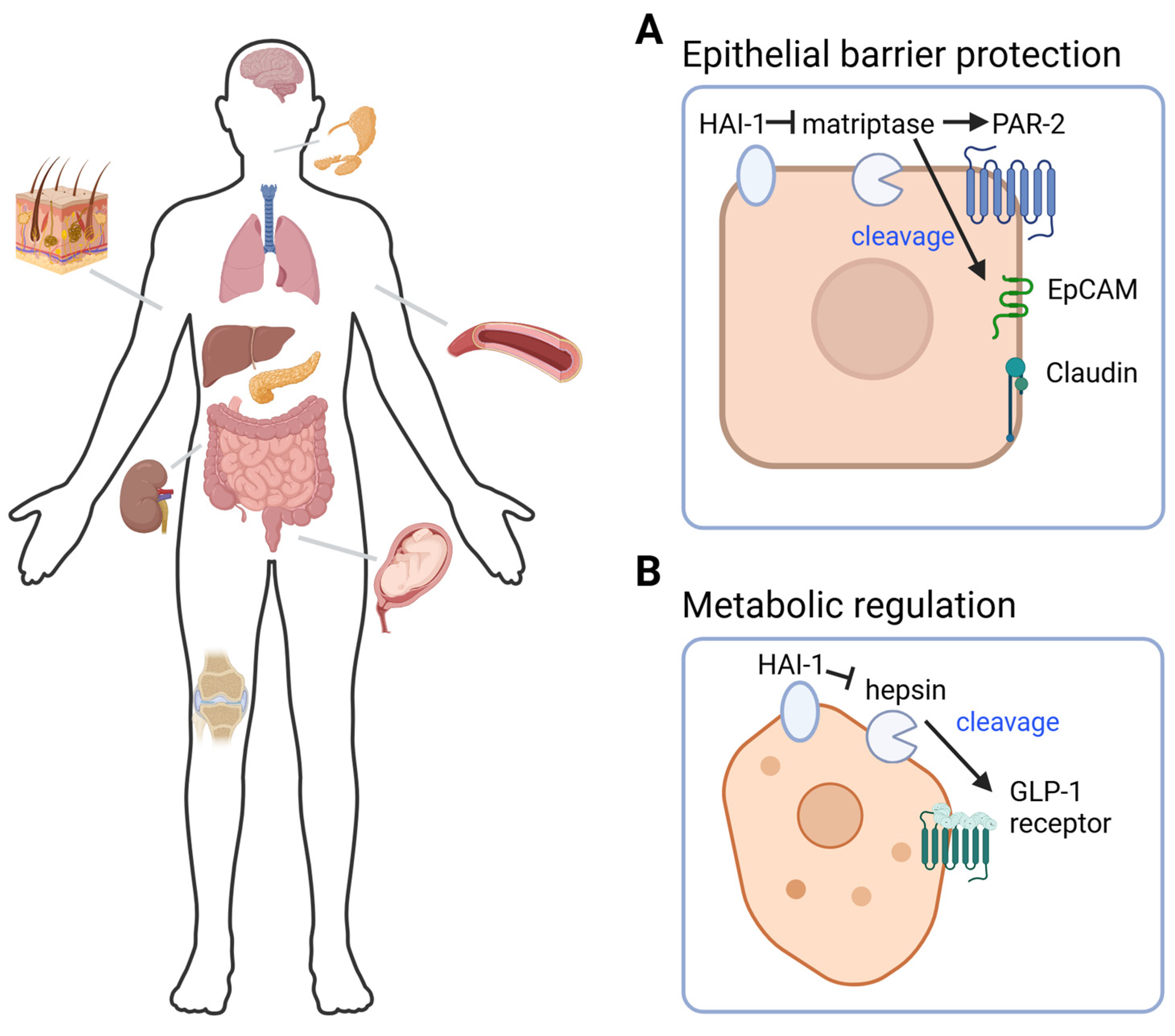
Examples of HAI-1′s physiological roles are depicted in Figure 2.

4.1. Skin Barrier Formation and Epidermal Differentiation

4.1.1. Molecular Pathogenesis and Physiological Consequences

A study in mice revealed the profound importance of HAI-1 in maintaining epithelial homeostasis. Mice with a global deficiency in Spint1, rescued from embryonic lethality caused by placental defects by injecting Spint1-deficient embryonic stem cells into wild-type blastocysts to generate chimeras with functional placentas, developed severe postnatal skin abnormalities, including scaly skin reminiscent of ichthyosis, epidermal acanthosis, abnormal hair development, and reduced epidermal barrier function, resulting in a significantly higher rate of fluid loss. The epidermal defects, which included impaired generation of filaggrin monomers and accumulation of filaggrin dimers, suggested deregulation of the matriptase-prostasin proteolytic cascade [10]. Crucially, it was demonstrated that loss of the matriptase-inhibiting function of HAI-1 is the primary cause of these detrimental postnatal effects. HAI-1 and its target protease, matriptase, co-localized in affected keratinized tissues like the epidermis and hair follicle. Furthermore, Spint1-deficient mice that possessed low levels of matriptase, due to a hypomorphic mutation in the St14 gene, survived the neonatal period, were healthy, and displayed normal tissue homeostasis, confirming that matriptase suppression is an essential function of HAI-1 in maintenance of postnatal epidermal tissues [70]. The skin condition resulting from HAI-1 deficiency, which showed enhanced phosphorylation of Akt in keratinocytes, was similar to phenotypes observed when matriptase activity was abnormally reduced, highlighting the critical need for a tight balance in protease activity [10]. When HAI-1 function is insufficient, the integrity of keratinocytes is compromised. Mouse Spint1-deleted epidermis showed reduced assembly of keratin intermediate filaments into desmosomes, accompanied by a decrease in desmosome number. This structural deficiency was associated with p38 mitogen-activated protein kinase signaling downstream of protease-activated receptor-2 (PAR-2), which was activated by unregulated matriptase activity resulting from insufficient HAI-1. The addition of a p38 inhibitor or PAR-2 antagonist was shown to restore the normal keratinocyte morphology, suggesting that HAI-1 maintains epidermal integrity by suppressing PAR-2 activation via regulating matriptase activity [71].
The critical balance between protease activity and inhibition observed in murine skin is also essential to human epidermal differentiation, where the matriptase-prostasin cascade is constitutively active and requires tight coupling with HAI-1. Further studies showed more details on the dysregulation of protease cascades and protease-mediated signal transduction caused by deficiency of HAI-1. In human epidermal differentiation, the proteolytic cascade involving matriptase and prostasin is constitutively activated from an early stage. Prostasin activation is dependent on the proteolytic action of matriptase in human keratinocytes. This tight coupling requires that both active matriptase and active prostasin are readily inhibited by HAI-1 binding, ensuring only a very brief window of opportunity for proteolytic activity to act on downstream substrates [72].
Recent findings have identified new substrates for matriptase, epithelial cell adhesion molecule (EpCAM) and trophoblast cell surface antigen 2 (TROP2), both of which are co-expressed in human keratinocytes. Matriptase cleavage of EpCAM and TROP2 triggers the destabilization and lysosomal degradation of these proteins and the associated tight junction proteins claudin-1 and claudin-7 [73]. Similar to the broader protease inhibition context, HAI-1 plays a more important role than HAI-2 in inhibiting the matriptase-mediated cleavage of EpCAM and TROP2 in keratinocytes. The loss of HAI-1 inhibition-induced cleavage and subsequent downregulation of claudin-1 and claudin-7 was eliminated when matriptase was also depleted, proving matriptase’s involvement. Simultaneous knockdown of both HAI-1 and HAI-2 resulted in marked increases in cleavage and claudin loss, suggesting that the inhibitors are partially redundant and cooperate to regulate matriptase in keratinocytes. The effect of HAI-1 deficiency on claudin-1 stability is proposed to be a cause of HAI-1 deficiency-induced ichthyosis [73]. In a genome-wide association study conducted in the Japanese population, the single-nucleotide polymorphism (SNP) rs2278431 was associated with increased corneocyte area, which is an indicator of decreased epidermal turnover, and subsequent analysis suggested this SNP is related to SPINT2 expression. SPINT2 knockdown in epidermal keratinocytes decreased proliferative capacity and enlarged corneocyte area in a 3D-reconstructed epidermis model, suggesting that SPINT2 positively regulates keratinocyte proliferation and epidermal turnover [74].

4.1.2. Context-Dependent Regulation and Spatiotemporal Distribution

The role of these inhibitors is context-dependent and based on the specific location within the skin. In the human pilosebaceous unit, including hair follicles and sebaceous glands, matriptase is highly expressed in proliferative cells, such as basal cells of the epidermis and the matrix cells of hair follicles. Its activation is similarly restricted to these basal and proliferative areas. Conversely, matriptase expression is low or absent in terminally differentiated cells (e.g., inner root sheath, granular layer). The expression of matriptase follows a cycle-dependent pattern, with high levels observed during the anagen and catagen phases of the hair cycle, followed by reduced expression of HAI-1 in the catagen phase [75,76].
In human skin, prostasin exhibits high-level constitutive activation primarily in the granular layer, which is associated with late-stage epidermal differentiation, in contrast to the low-level activation of matriptase in basal cells. This inverse pattern suggests that the functional link between matriptase and prostasin is not as strong in human skin as observed in cultured cell models [77,78]. Furthermore, in human skin, HAI-1 is the major functional inhibitor of matriptase and prostasin. This is because HAI-1 is widely distributed on the cell surface of all three viable epidermal layers, granting it direct access to active proteases. In contrast, HAI-2 is expressed predominantly in the basal and spinous layers but maintains a largely intracellular localization, preventing it from effectively inhibiting cell-surface matriptase or prostasin in the skin [77,78].
This regulatory hierarchy is mirrored in the zebrafish epidermis, where HAI-1a, which is encoded by Spint1a, is required for epidermal integrity, but HAI-2 is dispensable for epidermal development. Spint1a interacts genetically with EpCAM, a relationship not observed for Spint2 [79]. Zebrafish mutants carrying an insertion in the spint1 gene exhibit a phenotype resembling chronic inflammation and human psoriasis, characterized by neutrophil and macrophage infiltration into the fin, coupled with underlying epidermal hyperproliferation [80]. The disruption and hyperproliferation precedes the inflammatory response. This chronic inflammatory phenotype is caused by the reduced expression of spint1, which leads to unregulated activity of matriptase 1. Importantly, transient knock-down of matriptase 1 rescued the spint1 mutant phenotypes, confirming matriptase 1 as a key effector downstream of spint1 in regulating epidermal proliferation and inflammation [80]. Live imaging of this chronic inflammatory state revealed that neutrophils displayed a biased random walk migration with frequent pauses, in sharp contrast to the directed chemotaxis observed during acute injury [80]. The mechanism underlying this neutrophil abnormality remains unclear, but is thought to result from dysregulation of the complex interplay of extracellular matrix and inflammatory mediators caused by spint1 deficiency.

4.2. Gastrointestinal Tract: Intestinal Barrier and Mucosal Repair

HAI-1 and HAI-2 are expressed abundantly throughout the human and mouse gastrointestinal (GI) tract [81,82]. Early research, particularly focusing on mucosal regeneration, established that HGF/scatter factor (SF) plays an important role in repairing injured GI mucosa by promoting the proliferation and migration of epithelial cells, a process dependent on HGFA [81,82]. Furthermore, a study focusing on intestine-specific deletion of Spint1 in mice demonstrated that HAI-1 is essential for maintaining intestinal epithelial integrity. Loss of intestinal HAI-1 led to histologic abnormalities, particularly in the proximal aspect of the colon, including increased epithelial cell apoptosis and turnover, as well as increased intestinal permeability, as evidenced by elevated plasma levels of orally administered fluorescein isothiocyanate dextran-dextran. Mechanistically, Spint1 deficiency resulted in a dysregulated subcellular localization pattern of its cognate protease, matriptase, shifting its distribution towards a diffuse cytoplasmic staining pattern in disorganized crypt epithelial cells. Consequently, mice lacking intestinal HAI-1 exhibited enhanced susceptibility to dextran sodium sulfate-induced experimental colitis, a model of inflammatory bowel disease, suggesting a crucial role for HAI-1 in maintaining colon epithelial integrity and susceptibility to injury [11].
A study using cell-based models hypothesized that the loss of HAI-2 leads to unrestrained activity of the protease matriptase, which subsequently cleaves EpCAM after Arg80. Since EpCAM stabilizes the tight junction protein claudin-7, its cleavage causes both EpCAM and claudin-7 to be targeted for internalization and lysosomal degradation, thereby compromising the epithelial barrier. This proposed pathway was supported by findings that congenital tufting enteropathy-associated HAI-2 mutant proteins, such as Y163C or G168S, showed a reduced ability to inhibit matriptase and stabilize claudin-7 [83]. However, a conflicting report emerged regarding the primary target of HAI-2 in human enterocytes. Biochemical analysis demonstrated that HAI-2 selectively inhibits prostasin in Caco-2 cells and human intestinal tissue, forming complexes predominantly with activated prostasin, not matriptase. Prostasin and HAI-2 immunoreactivity localizes intensely near the brush borders of villus epithelial cells, whereas matriptase and HAI-1 localize mainly to the lateral plasma membrane. Therefore, the loss of HAI-2 is expected to result in aberrant regulation of prostasin, leading to sodium loss [84].
Additionally, in intestinal cell lines, CDX2 has been reported to negatively regulate SPINT1 and either positively or negatively regulate ST14 (encoding matriptase) in a context-dependent manner through binding to their enhancer regions [51].

4.3. Reproduction and Development: Placental Function and Embryogenesis

4.3.1. The Critical Role of HAI-1 in Placental Labyrinth Development and Basement Membrane Integrity

The physiological function of HAI- is critical in reproduction and embryonic development, particularly in the formation and maintenance of the placenta. An early clinical investigation in women revealed that SPINT1 gene expression showed a gradual increase in villous tissue from 6 to 9 weeks of pregnancy, supporting its importance in early embryo development [85]. In human placenta, HAI-1 was localized specifically to Langhans cells of villous cytotrophoblasts in the chorionic villi tissue, which are considered proliferating trophoblastic stem cells, while syncytiotrophoblasts were generally negative, and extravillous trophoblasts showed markedly decreased HAI-1 immunoreactivity. The presence of HAI-1 in this specific location suggested a potential role in trophoblast proliferation and placenta development [86].
The essential developmental role of HAI-1 was firmly established through mouse knockout studies. Homozygous Spint1-deficient mice experienced embryonic lethality around embryonic day (E) 10.5 to E11.5 due to failed placental development and function [12]. This lethality was attributed primarily to the severely impaired formation of the labyrinth layer, a key site for nutrient transport, while other placental layers, including spongiotrophoblast and giant cell layers, were formed normally. The defects in the labyrinth include a complete failure of vascularization and attenuated trophoblast branching morphogenesis [12,87].
Further mechanistic studies showed that the root cause of the placental failure in Spint-1-deficient mice was the disruption of basement membranes within the placental labyrinth. Immunofluorescent staining revealed that in Spint1 deficient placentas, the basement membrane components collagen IV and laminin, which normally exhibits a regular linear distribution separating the chorionic trophoblasts from the allantoic mesoderm, were severely disrupted. Their deposition appeared patchy and discontinuous, with laminin immunoreactivity specifically displaying an irregular, intense punctate pattern rather than a continuous sheet [87,88,89]. This finding correlated directly with the defects in vascularization [87]. The expression of Spint-1 co-localized with its protease targets, matriptase and prostasin, in the labyrinthine trophoblast cells near the basement membranes [87]. In fact, the placental labyrinth was found to be the only location where matriptase, prostasin, and HAI-1 are all co-expressed in wild-type embryos and yolk sacs [87]. The absence of HAI-1 resulted in hypothesized uncontrolled proteolytic activities of matriptase and prostasin, which likely caused the degradation and disruption of the basement membrane components [87]. A subsequent genetic ablation study confirmed that matriptase inhibition by HAI-1 is the crucial, non-redundant function for placental development. Loss of HAI-1 resulted in the disruption of the epithelial integrity of matriptase-expressing chorionic trophoblasts, which was characterized by disorganized laminin deposition and altered expression of epithelial markers like E-cadherin and β-catenin. Critically, the placental and embryonic defects in Spint1-deficient mice were completely rescued by the simultaneous genetic ablation of matriptase [90].
When Spint1 knockdown (KD) was performed in BeWo cells, which is a human choriocarcinoma trophoblast cell line, the amount of cellular laminin protein increased, while the activity associated with laminin degradation in the culture supernatant decreased. A key finding regarding protease localization was that cell-associated matriptase was significantly decreased in the KD cells, despite the mRNA level for matriptase remaining unaltered. This outcome suggests that HAI-1 is critically required for the cell surface localization of matriptase in trophoblasts, and its absence leads to an enhanced release or dislocation of matriptase [89]. Taken together, the BeWo knockdown and the in vivo placental data may represent different readouts of the same underlying defect. Loss of HAI-1 destabilizes and mislocalizes matriptase at the trophoblast surface, impairing the polarized basolateral secretion and pericellular processing of laminin. As a result, laminin accumulates within cells and is inefficiently incorporated into the basement membrane, leading in vivo to the irregular, punctate, and discontinuous laminin staining pattern characteristic of Spint1-deficient placentas.
The transcription factor Grhl2 was identified as upstream regulator of Spint1 expression in placental cells. In Grhl2-deficient mouse embryos, defects in basal chorionic trophoblast (BCT) cell polarity and basement membrane integrity resulted in severe disruption of labyrinth branching morphogenesis, leading to embryonic lethality similar to that observed in Spint1 knockout mice. Grhl2 directly regulated a network of genes, including Spint1, suggesting that the Grhl2-dependent Spint1 expression, and the ensuing integrity of the BCT layer mediated by HAI-1, is central to proper labyrinth morphogenesis [88]. In addition, a study in pigs suggested that HAI-1 regulates placental folds development by controlling trophoblast cell proliferation and invasion. Spint1 expression was strong in high columnar trophoblast cells which have low proliferative and invasive capacities, but low in cuboidal trophoblast cells which have high proliferative and invasive capacities [91].

4.3.2. HAI-2 Specific Functions and the Complex Interplay of the Protease Network

Similar to Spint1, Spint2 deficiency in mice also resulted in embryonic lethality, but with additional severe developmental defects including defects in neural tube closure. Spint2 deficiency also caused placental labyrinth abnormalities associated with a pronounced defect in the polarization of the chorionic epithelium and delocalized laminin deposition [92]. The embryonic demise and placental defects in Spint2-deficient mice were primarily caused by unregulated matriptase activity, as the simultaneous inactivation of matriptase restored placental development and embryonic survival. However, the elimination of matriptase only partially reduced the frequency of neural tube defects in Spint2-deficient mice, indicating that HAI-2 likely regulates additional proteases essential for neural development [92]. Further complexity was revealed in the interplay between these two inhibitors and their targets. A combined analysis showed that matriptase, HAI-1, and HAI-2 form a complex network, and the balance of their inhibitory activity is delicate. Specifically, combined heterozygosity for Spint1 and Spint2 was incompatible with term development, but triple heterozygosity, including St14 (matriptase) heterozygosity, restored normal development. This suggested a partial redundancy between HAI-1 and HAI-2 in regulating matriptase [92].
The mechanism by which matriptase and prostasin interact was further clarified by testing the role of prostasin proteolytic activity. Prostasin catalytic activity was found to be required for matriptase zymogen activation during placental differentiation, evidenced by the absence of the active two-chain matriptase in placentas expressing catalytically inactive prostasin. However, a striking contrast was observed regarding overall survival: while prostasin null (KO) mice exhibited partial embryonic and complete perinatal lethality, mice expressing catalytically inactive prostasin (S238A) were fully viable with normal prenatal and postnatal survival. This unexpected finding demonstrated that the overall prostasin-dependent functions in embryonic survival were independent of its proteolytic activity [93]. Moreover, the loss of prostasin proteolytic activity was not sufficient to rescue the embryonic lethality in Spint1 or Spint2-deficient mice. This suggested that the embryonic lethality associated with Spint1 or Spint2-deficient is mediated by non-proteolytic functions of prostasin [93]. Crucially, the absence of HAI-1 completely compensated for the loss of all prostasin functions, including both proteolytic and non-proteolytic, allowing Spint1/prostasin double-deficient mice to achieve normal prenatal and postnatal survival, reinforcing the concept that HAI-1 primarily acts by controlling matriptase [93].
Regarding the expression of HAI-2 in reproductive tissues, HAI-2 was found strongly expressed in the human testis, predominantly localized in primary spermatocytes [94]. Interestingly, the size of SPINT2 mRNA in the testis (1.2 kb) was found to be shorter than in other tissues, such as the placenta (1.5 kb), suggesting distinct transcriptional or splicing regulation for SPINT2 during spermatogenesis [94].

4.4. Liver: HGFA Regulation and Iron Homeostasis

HAI-1 is a regulator of HGFA, which is produced by hepatocytes in an inactive form and is activated primarily by thrombin or factor Xa in response to tissue injury [95]. Furthermore, it has been demonstrated that hepsin, a membrane-associated serine protease, also efficiently activates pro-HGF at the expected Arg494–Val495 peptide bond. This activity was comparable to that of HGFA [96]. Critically, HAI-1B, which is a splice variant of HAI-1, and HAI-2 were identified as potent inhibitors of hepsin activity. Specifically, the inhibition mediated by HAI-1B is attributed entirely to KD1, whereas KD2 was non-functional in this context [96].
Concerning iron homeostasis, Matriptase-2 (MT2), which is expressed predominantly in the liver, plays a key role in suppressing the iron-regulatory hormone, hepcidin. HAI-2 was identified as a cell surface inhibitor with high inhibitory potential against MT2 [97]. HAI-2 modulates hepcidin expression by abrogating the MT2-mediated suppression of the hepcidin-encoding gene. This mechanism was initially suggested to involve HAI-2 suppression of MT2-mediated cleavage of membrane-bound hemojuvelin, a BMP co-receptor, thereby inhibiting BMP–SMAD signaling, which is the central pathway driving hepcidin transcription. [97]. However, later research indicated a more complex regulation of MT2-hepcidin axis and a more nuanced role for HAI-2 within it. While Spint2 was expressed in mouse hepatocytes alongside Mt2, hepatocyte-specific ablation of HAI-2 in mice resulted in only a marginal impact on systemic iron homeostasis and failed to significantly affect the iron-mediated regulation of hepcidin expression. This finding suggested that MT2 regulates basal hepcidin levels primarily through a nonproteolytic mechanism, implying that the proteolytic inhibition function of HAI-2 in this context is limited [98]. Alternatively, it may reflect the presence of compensatory mechanisms in the hepcidin regulatory network.

4.5. Renal Function

In normal kidney tissue, both HAI-1 and HAI-2 mRNA are abundantly expressed, predominantly by the epithelial cells of the uriniferous tubules, followed by the collecting duct and glomerulus. Specifically, SPINT1 mRNA levels appeared higher in proximal tubules compared to distal tubules, while SPINT2 expression was comparable in both proximal and distal tubules [99]. Conversely, HGFA mRNA was scarcely detectable in the normal kidney [99]. In addition, the essential roles of these inhibitors in development are underscored by the fact that targeted disruption of the Spint2 gene in mice resulted in embryonic lethality [99].
More recently, research focused on chronic kidney disease identified matriptase as being induced predominantly in podocytes in mouse models of adriamycin nephropathy. This induction was associated with an imbalance favoring matriptase over its cognate inhibitor, HAI-1. Mechanistically, matriptase mediates pathogenic damage by proteolytically cleaving podocin at Arg50. Consistent with its protective role, the conditional depletion of HAI-1 in podocytes exacerbated the injury in the mouse model. Thus, HAI-1 is considered essential for protecting podocytes by blocking this matriptase-mediated cleavage [100].

4.6. Epithelial Function in Lungs

In normal human pulmonary tissue, SPINT1 is expressed in the bronchial respiratory epithelium, predominantly in basal cells, and weakly in ciliated columnar epithelial cells and alveolar epithelial cells [14]. However, in response to tissue injury and severe inflammation, HAI-1 expression is significantly upregulated. Interestingly, in ciliated epithelial cells of the bronchioles near areas of severe damage (e.g., adjacent to invading carcinoma or inflammation), HAI-1 exhibited a distinct apical translocation from its usual basolateral surface localization. This apical localization might result from transcytosis, suggesting that HAI-1 interacted with ciliated epithelium-specific cognate proteinases, such as prostasin, HAT, or TMPRSS11D, which are localized to the apical surface and regulate epithelial sodium channel (ENaC) activity [14].
HAI-1 and HAI-2 are key regulatory factors for epithelial sodium channel (ENaC) activity. ENaC is stimulated constitutively by trypsin-family serine peptidases, known as channel-activating peptidases (CAPs), including prostasin, TMPRSS4, and matriptase, a process revealed by the inhibitory effect of broad-spectrum inhibitors of peptidases, such as aprotinin and HAI-2 [101]. Prostasin is considered the major basal regulator of ENaC activity in airway cells. HAI-2 was a potential endogenous modulator that inhibits CAP activity and ENaC-mediated sodium hyperabsorption in cultured airway cells [101]. Additionally, HAI-1B, can also inhibit prostasin. Targeting prostasin-like peptidases with HAIs is suggested to hold therapeutic potential for reversing sodium hyperabsorption relevant to lung pathology in cystic fibrosis [101].

4.7. Cartilage and Joints

While a preliminary microarray screen identified SPINT1 as a gene downregulated by SRY-box transcription factor 9 (SOX9) in a human chondrocytic cell line, this regulation was not confirmed upon validation. Subsequent analysis in primary human articular chondrocytes subjected to dedifferentiation in monolayer culture, where endogenous SOX9 levels progressively decreased, the expression of SPINT1 also decreased, showing a correlation with SOX9 levels [102]. Critically, analysis of osteoarthritic (OA) cartilage, a condition characterized by reduced SOX9 expression compared to healthy tissue, demonstrated that the expression of SPINT1 was significantly lower in OA cartilage, supporting the functional link between SOX9 and SPINT1 levels in joint health [102].

4.8. Pancreatic Islets: Glucose Homeostasis

The most recent finding highlighted a specific developmental and physiological role for Spint1 in pancreatic function. Spint1 expression was observed in the embryonic pancreatic epithelium as early as E12.5 in mice [103]. This study revealed that pancreas-specific Spint1 deficiency in mice led to glucose intolerance, diminished pancreatic islet size and mass, and impaired insulin production [103]. Spint1 functions as a crucial cognate inhibitor of hepsin in pancreatic beta cells. Mechanistically, the depletion Spint1 results in hepsin overactivity, which causes the proteolytic cleavage of the Glucagon-like peptide 1 receptor (GLP1R) [103]. This cleavage suppresses GLP1R signaling, thereby reducing the production of cyclic AMP and consequently downregulating the transcription factor MAFA and insulin expression. Thus, Spint1 is proposed to maintain MAFA-dependent insulin production by preventing hepsin-mediated GLP1R cleavage, suggesting that SPINT1 and hepsin may represent promising therapeutic targets for diabetes [103].

4.9. Nervous System and Brain Development

Spint1 and Spint2 are expressed in neural progenitor cells (NPCs), particularly in nestin-positive cells derived from the striatal anlage of the developing rat brain [104]. Mechanistically, HAI-1 and HAI-2 were found to regulate NPC proliferation and fate; overexpression of either HAI-1 or HAI-2 decreased cell proliferation in cultured NPCs. Correspondingly, silencing or antibody blockade of HAI-1 or HAI-2 increased proliferation [104]. HAI-1 also specifically influenced differentiation, increasing the number of glial fibrillary acidic protein-expressing cells, such as astrocytes in culture. Spint1 overexpression in vivo reduced cell proliferation in the neuroepithelium of E15-old mice and promoted astroglia formation in neonatal mice [104]. The regulation of Spint1 and Spint2 mRNA levels in NPCs was linked to BMP signaling, as bone morphogenetic protein-2 (BMP-2) and BMP-4 increased their expression. The BMP-mediated decrease in NPC cell division was partially blocked by the downregulation of Spint1 and Spint2 mRNA [104]. Furthermore, overexpression of human SPINT1 was found to regulate rat glial cell differentiation, mediating some of the BMP effects on cell fate. Interestingly, canonical HGF signaling appeared irrelevant in this context, as the HGF receptor c-Met was hardly detectable, and exogenous HGF did not influence proliferation [104].
Most recently, the expression of Spint1/SPINT1 was confirmed in the epithelial cells of the choroid plexus (CP) in mouse and human brains. The corresponding mRNA was also detected in mouse CP tissues derived from the lateral and fourth ventricles. In human CP epithelial cells (CPE), HAI-1 immunoreactivity was noted primarily in the cytoplasm and typically localized in cells expressing E-cadherin and Smad-interacting protein 1 (SIP1), a transcriptional repressor for the E-cadherin-encoding gene [105]. The study suggested that HAI-1 may be vital for the survival of enlarged CPEs, which may be damaged by aging and neurodegenerative diseases [105].
An early study demonstrated the presence of HAI-1 in the central nervous system, localizing it to white matter astrocytes in neurologically normal persons and patients with Alzheimer’s disease (AD) and cerebral infarction [106]. Astrocytes are known to produce HGF and HGFA, and HAI-1 appears to regulate the HGF pathway in the pericellular microenvironment of these cells [106]. While HAI-1 immunoreactivity in AD tissues was weaker compared to controls, suggesting increased consumption or turnover in AD, the expression intensity of HAI-1 mRNA remained similar across groups [106]. Conversely, intense HAI-1 immunolabeling was observed in infarct areas, potentially reflecting HGF’s neurotrophic function in response to cerebral injury, together with a compensatory feedback increase in HAI-1 aimed at restraining excessive pericellular protease activity during acute injury [106].

4.10. Vascular System: Angiogenesis and Protection

HAI-1 has been analyzed in human endothelial cells, revealing differential localization across the vascular tree. HAI-1 was observed in the endothelial cells of capillaries, venules, and lymph vessels, but it was poorly stained or hardly detectable in arterial endothelial cells (e.g., those derived from the aorta) [107]. These HAI-1-positive endothelial cells also expressed the HGF/SF receptor, MET, suggesting HAI-1 plays a regulatory role in the HGF/SF-MET signaling axis relevant to angiogenesis. Endothelial HAI-1 may function as both an inhibitor of HGFA and, paradoxically, as a reservoir for activated HGFA on the cell surface, which may be crucial for the subsequent angiogenesis phase initiated by tissue injury and inflammation [107].
The role of HAI-2 has been investigated in the pathogenesis of thoracic aortic dissection (TAD). Bioinformatics analysis revealed that SPINT2 expression is prominently decreased in ascending aorta tissues from TAD patients, where it is mainly localized in aortic smooth muscle cells (SMCs) [108]. This downregulation of SPINT2 was recapitulated in vitro by treating SMCs with platelet-derived growth factor BB (PDGF-BB). SPINT2 acts protectively against TAD progression by suppressing proliferation, migration, and phenotypic switching of SMCs [108]. Overexpression of SPINT2 reduced the proliferation in Ki-67-positive SMCs and inhibited their migration in wound healing assay [108]. Furthermore, SPINT2 inhibited the PDGF-BB-induced increase in active MMPs, specifically MMP-2 and MMP-9. Critically, SPINT2 overexpression mitigated the PDGF-BB-induced phenotypic switching of SMCs from a contractile state to a synthetic type [108]. This beneficial effect of SPINT2 on SMC phenotype and migration was mediated through inhibition of the extracellular signal-regulated kinase signaling pathway [108].

4.11. Salivary Gland: Branching Morphogenesis

HAI-1 has also been investigated in the context of salivary gland development. In the developing mouse submandibular salivary gland (SMG), Grhl2 regulates Spint1 expression. Knockdown of Grhl2 in cultured SMG severely retarded epithelial growth and branching morphogenesis, a defect concomitant with suppressed Spint1 mRNA and protein expression. Chromatin immunoprecipitation followed by qPCR confirmed that Grhl2 protein directly binds to the Spint1 gene [50]. Crucially, the addition of recombinant HAI-1 to the culture medium largely overcame the suppressive effects of Grhl2 knockdown on SMG epithelial development and restored the continuous deposition of laminin, a key component of the basal lamina. This suggested that Grhl2-regulated Spint1 expression is critical for organizing the basal lamina and controlling branching morphogenesis in the developing SMG [50].

5. Roles and Mechanisms in Cancer Progression

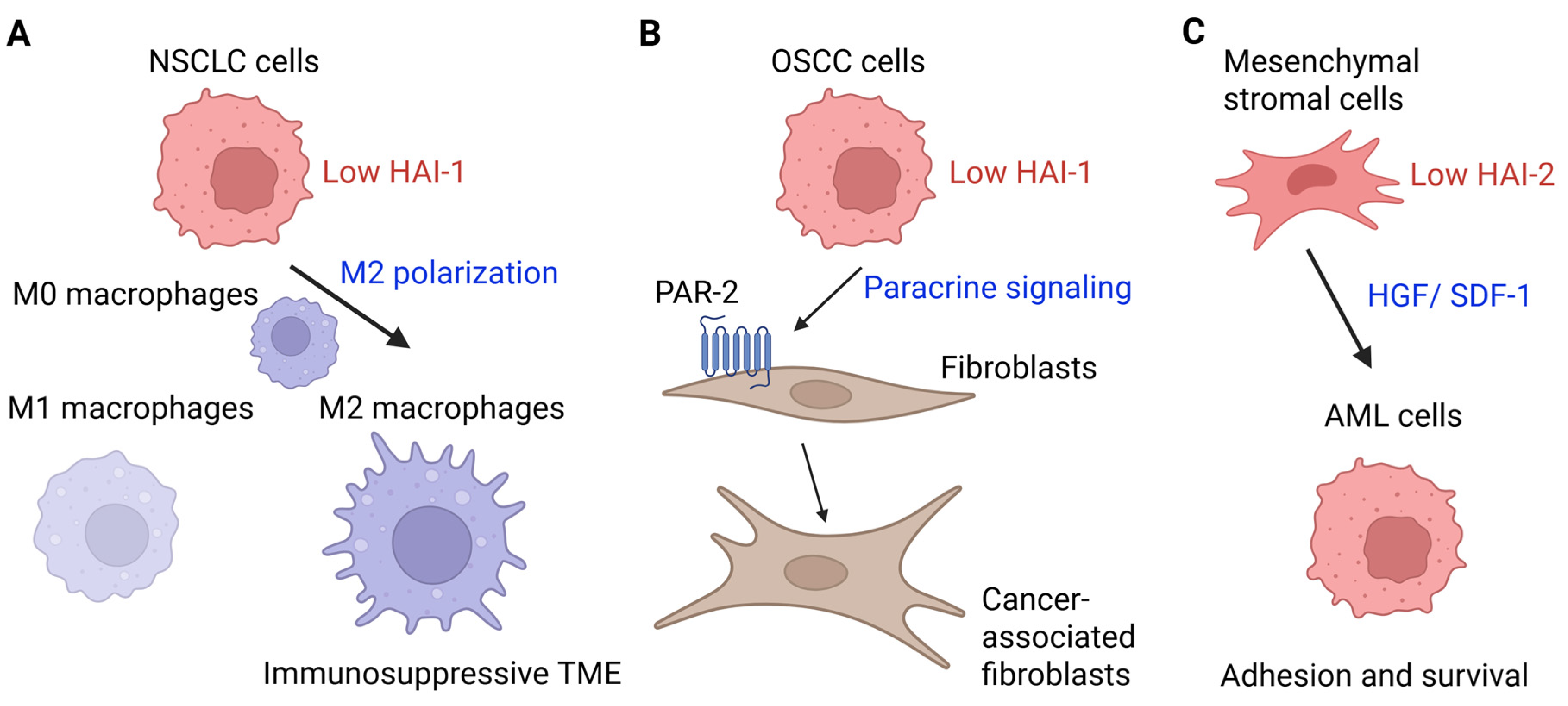
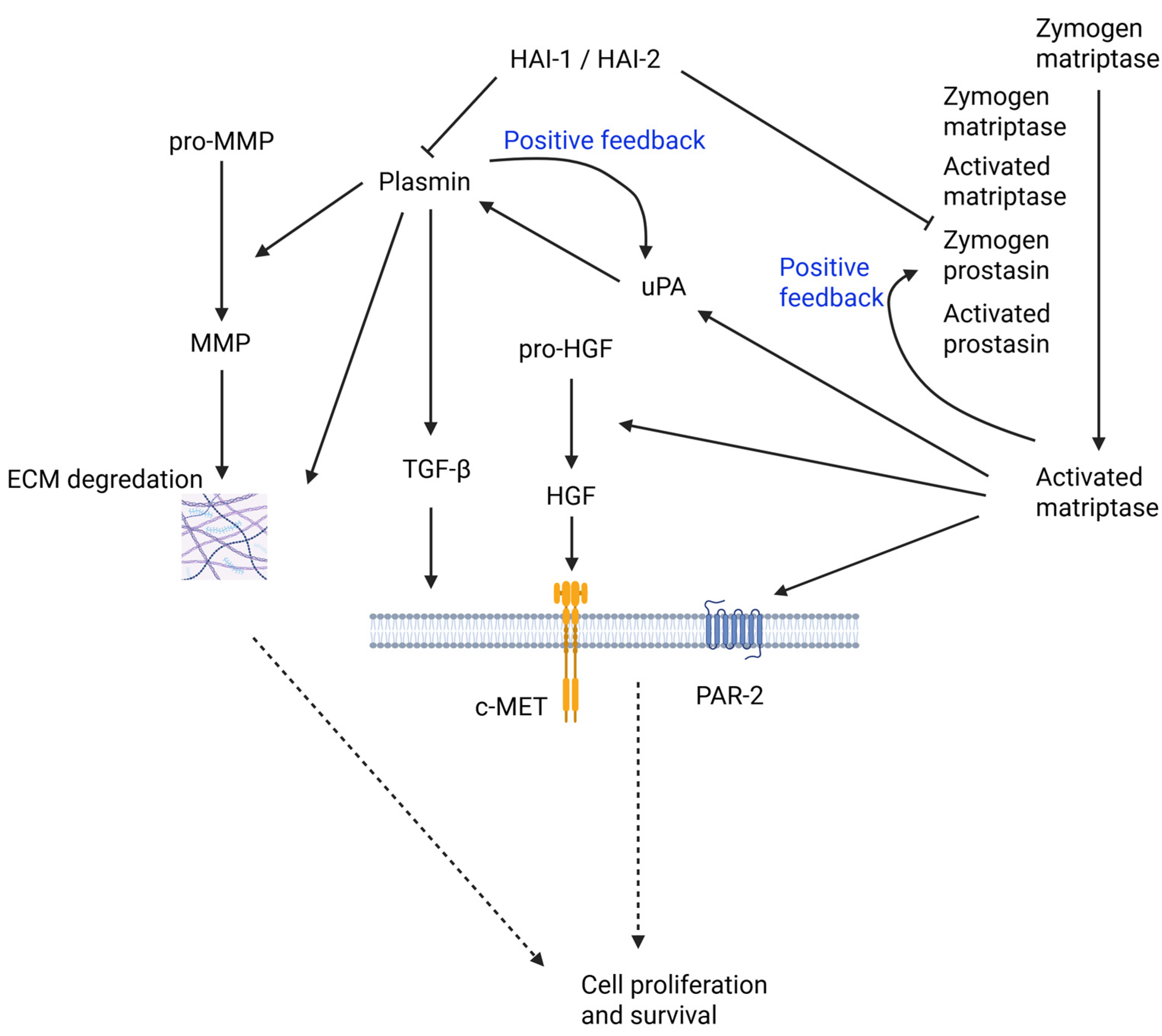
HAI-1 and HAI-2 are critically involved in carcinogenesis, especially in cancer progression. Their roles in various cancers and the related molecular mechanisms are summarized in Table 1 and Table 2. Shown in Figure 3 are several crucial and representative examples of their roles in the tumor microenvironment (TME). Figure 4 illustrates the roles of HAI-1 and HAI-2 in regulating oncogenic signaling pathways.
The key facts of their involvement in cancer are highlighted below. Both HAI-1 and HAI-2 can suppress the activity of TTSPs such as matriptase, prostasin, and hepsin, which are known to play tumor-promoting roles in multiple cancers, making their dysregulation implicated in tumor initiation and progression. HAI-1 is generally downregulated in various cancers, including breast [32,109,110,111,112,113,114], prostate [45,115,116,117,118,119,120], gastric [41,121,122], and pancreatic [123,124] cancers. Its loss correlates with enhanced epithelial–mesenchymal transition (EMT), increased invasive potential, and poor prognosis [123,124]. The silencing of HAI-1 often occurs through promoter hypermethylation, leading to unregulated activation of downstream pathways such as HGF/c-MET [122] and PAR-2/NF-κB [125,126]. These pathways contribute to tumor growth, metastasis, and inflammatory responses. Notably, loss of HAI-1 has also been associated with immune evasion, including M2 macrophage polarization, in NSCLC [127].
In contrast, HAI-2 exhibits a more context-dependent role. While it also generally functions as a tumor suppressor by regulating TTSPs and preserving epithelial integrity, in some cancers, such as breast cancer [32,56,96,110,111,112,114] and oral squamous cell carcinoma [128], HAI-2 is paradoxically upregulated and may contribute to tumor progression. This dual potential may stem from tissue-specific upstream regulation, unique subcellular localization, and distinct target protease signatures.
Collectively, dysregulation of HAIs, frequently due to epigenetic process, promoting oncogenesis mainly through protease-dependent mechanisms. Therapeutically, their restoration, either through epigenetic reactivation or recombinant inhibitor mimetics, could offer promising strategies in cancer treatment. Additionally, the ratio of protease to HAI levels has been proposed as a dynamic biomarker in precision oncology [37,120,121].
Table 1. The roles of HAI-1 in cancers.
Cancer TypeExpression PatternKey Molecular MechanismClinical and Prognostic OutcomesReferences
Oral squamous cell carcinoma (OSCC)downregulated/reduced at invasion fronts
  • Induction of EMT following loss of expression
  • Promotion of cancer-associated fibroblast (CAF)
  • migration via paracrine PAR-2 activation
Reduction significantly correlating with an increased risk of lymph node metastasis; PAR-2 positive CAFs predicting a shorter disease-free survival.[89,125,129]
Tongue squamous cell carcinoma decreased at infiltrative fronts
  • Orchestration of growth factor activation involved in lymph angiogenesis and invasion by deficiency
  • Enhanced activation of fibroblast-derived pro-HGF
  • Increase in plasminogen-dependent plasmin generation
Decrease significantly correlating with the presence of lymphatic invasion.[130]
Prostate carcinoma (PCa)downregulated (progressive Loss)
  • Development of a more aggressive tumor phenotype following loss
  • Mediation through matriptase-regulated uPA signaling
  • Involvement of PAR-2 signaling pathways.
Progressive loss observed with increasing tumor grade; low HAI-1 expression as a significant predictor for poor prognosis; HAI-1–to–matriptase ratio serving as a biomarker for PCa progression.[45,115,116,117,118,119,120]
Gastric cancerdownregulated (significantly lower overall);
paradoxically enhanced at the invasion front
  • MACC1 promoting pro-HGF proteolysis and c-MET phosphorylation by transcriptionally inhibition
  • Negative correlation with invasion and lymph node metastasis by inhibiting HGF
Decreased HAI-1 and a lower HAI-1:SNC19/matriptase ratio correlated with more advanced stages and lymph node-positive gastric cancer.[41,121,122]
Colorectal cancer downregulated (decreases significantly);
paradoxically enhanced at the invasion front
  • Enhancement of NF-κB activation via PAR-2 signaling following loss
  • Association of downregulation with DNA hypermethylation
  • Mediation of cetuximab resistance through an autocrine HAI-1/protease/HGF/MET axis.
Inverse correlation with the progression of the adenoma-carcinoma sequence; hypermethylation of SPINT1 correlating with poor prognosis and a decrease in disease-free survival.[126,131,132,133,134,135]
Non-small-cell lung carcinoma (NSCLC)loss/downregulated.
  • Induction of an immunosuppressive tumor microenvironment upon loss of expression
  • Skewing of macrophage polarization toward an M2-dominant phenotype, with impairment of M1 macrophage polarization
  • Inverse association with HGF mRNA expression
  • Sensitization to c-MET inhibitor–mediated growth inhibition upon γ-catenin–induced expression
Loss serving as an independent predictor of poor prognosis, exhibiting a worse median survival; loss frequently detected in patient specimens (60%).[127,136]
Renal Cell Carcinoma (RCC)downregulated
  • Functioning as a marker of epithelial differentiation
  • Correlation of downregulation with tumor de-differentiation
  • Concurrent decrease in expression with enhanced HGFA levels and proteinase activities
Consistently and significantly decreased mRNA levels in RCC tissues; particularly noticeable downregulation in RCC presenting sarcomatoid change.[99,127],
Ovarian cancerdownregulated
  • Inhibitory regulation of matriptase expression
  • and hepsin expression
  • Induction of apoptosis
Lower level as a significant predictor for poor prognosis concerning both disease-free survival and overall survival.[96,137]
Uterine leiomyosarcoma (LMS)downregulated
  • Anti-tumor effects mediated by reduced HGFA expression
  • Downregulation of matriptase and hepsin expression
  • Induction of apoptosis and necrosis
Low levels significantly predicting poor prognosis.[138]
Endometrial cancerdownregulated
  • Inhibition of cell proliferation upon overexpression
  • Reversal of EMT
  • Upregulation of E-cadherin and Slug expression
  • Downregulation of vimentin, SIP1, Snail, and Twist expression
  • Modulation of estrogen receptor and progesterone receptor signaling
Negative association of levels with lymph node metastasis and lymphovascular space involvement; low HAI-1 predicting a poor prognosis in terms of both disease-free and overall survival.[139]
Non-Hodgkin B-cell lymphomaabsent/low
  • Facilitation of free active matriptase generation in lymphoma cells upon deficiency
  • Promotion of active matriptase shedding
  • Activation of pro-HGF and the uPA system
Exogenous expression of SPINT1 significantly suppressing the proliferation of neoplastic B Cells.[140]
Hepatocellular carcinoma (HCC)upregulated
  • Elevation of expression driven by promoter hypomethylation
  • Correlation of hypomethylation status with poor differentiation
Upregulation associated with poor outcomes, including multiplicity, microscopic vascular invasion, and advanced tumor stage; its positivity functioning as an independent prognostic factor for reduced overall survival and disease-free survival rates.[33,141]
Breast cancerupregulated
  • Association of high expression levels with promoter hypomethylation
  • Downmodulation by hepsin overexpression
  • Augmentation of HGF/MET signaling
  • Requirement of high expression for survival in specific cell lines
High levels associated with poor long-term patient outcome, such as decreased OS, RFS, and DMFS; co-expression of HAI-1 and matriptase predicting a worse outcome.[32,109,110,111,112,113,114]
Thyroid cancer (TC) upregulated
  • Elevation of expression in BRAFV600E-like papillary thyroid carcinoma compared with RAS-like tumors
Enhanced expression positively correlating with aggressive features, including extrathyroidal invasion, lymphovascular invasion, lymph node metastasis, advanced TNM stage, and a higher risk of recurrence.[142]
Bladder cancer downregulated; elevated SPINT1 expression in HIF-2-altered tumors
  • Essential regulation of MET phosphorylation
  • Contribution of elevated expression in HIF-2–altered tumors to a highly immunosuppressive microenvironment
Low SPINT1 expression combined with high matriptase expression displaying a significantly poorer prognosis; elevated expression linked to an increased expression in genes promoting immune evasion.[143]
Pancreatic carcinomadownregulated or loss
  • Promotion of EMT following knockdown
  • Induction of invasiveness via activation of the matriptase/PAR-2 axis
  • Localization of anti-metastatic effects to the functional KD1 domain
Its loss promoting metastatic pulmonary colonization in an experimental nude mouse assay.[123,124]
Glioblastoma (GBM)complex: pro-malignant or tumor suppressive dependent on the membrane structure
  • Dependence of pro-malignant activity on membrane structure
  • Modest reduction in invasiveness upon overexpression in U251 cells
Overexpression of SPINT1 resulting in significantly enhanced tumorigenicity in vivo.[133]
Skin cutaneous melanoma (SKCM)deficiency/genetic alterations/high expression
  • Facilitation of oncogenic transformation upon deficiency
  • Regulation of tumor immune microenvironment crosstalk
  • Correlation of high expression with tumor-associated macrophage infiltration
Genetic alterations in SPINT1 correlating with poor patient prognosis; deficiency accelerating the onset of SKCM.[136,144]
OS: overall survival, RFS: recurrence-free survival, DMFS: distant metastasis-free survival.
Table 2. The roles of HAI-2 in cancers.
Cancer TypeExpression PatternKey Molecular MechanismClinical and Prognostic OutcomesReferences
Prostate carcinoma (PCa)downregulated/progressive loss
  • Primary regulator of matriptase activity
  • Inhibition of TMPRSS2-mediated pro-HGF activation
  • Suppression of ECM degradation and cell invasion
  • Association of downregulation with SPINT2 promoter hypermethylation
  • Association of downregulation with post-translational degradation
Its loss pronounced in the most poorly differentiated tumors (Gleason score 8–10). TMPRSS2/HAI-2 ratio increasing in PCa with advanced stages; circulating HAI-2 levels inversely associated with PCa risk.[27,45,96,118,119,120,145]
Gastric cancerdownregulated/undetectable
  • Epigenetic inactivation via promoter hypermethylation
  • Functioning as a tumor suppressor gene
  • Inhibition of cell proliferation and induction of apoptosis upon ectopic expression
Hypermethylation correlating with poor differentiation and metastasis in primary tumors.[41]
Glioblastoma (GBM)/High-grade glioma (HGG)undetectable/reduced
  • Association of downregulation with promotor hypermethylation
  • Inhibition of serine proteinase activity
  • Reduction in MET phosphorylation via inhibition of HGFA (↓ pro-HGF activation)
  • Functioning as tumor suppressor gene
  • Tumor-suppressive effects mediated by regulation of MMP2 expression and activity
Aberrant methylation detected in 71.4% of grade III and 74.3% of grade IV tumors. Its loss being a common event (absent in 100% of pediatric and 85.3% of adult HGG samples); increased HGFAC/SPINT2 expression ratio found in HGG; restoration suppressing cell proliferation and tumor formation in vivo.[36,37,38,146,147]
Acute myeloid leukemia (AML)/Myelodysplastic syndrome (MDS)downregulated
  • Downregulation in mesenchymal stromal cells MSCs) increasing HGF and SDF-1 secretion
  • Enhance adhesion of malignant cells to MSCs
  • Augmentation of HGF/c-MET signaling via increased HGFA and decreased HAI-2
Lower mRNA levels in the AML untreated group, especially in patients presenting with high white blood cell counts.[44,148,149]
Non-small-cell lung carcinoma (NSCLC)/Lung adenocarcinoma downregulated
  • Non-covalent inhibitor of plasmin
  • Loss enhancing cell-surface plasmin activity
  • Induction of EMT and metastasis by derepressing plasmin-mediated activation of pro-HGF and pro-TGF-β
  • Association of downregulation with STYK1 overexpression
Downregulation predicting poor prognosis and correlating with advanced cancer stages and high tumor invasion; low expression correlating with worse OS. High expression in EGFR mutant tumors associated with shorter OS.[150,151,152]
Renal Cell Carcinoma (RCC)downregulated (especially in advanced stage)
  • Downregulation increasing hepsin/matriptase activity and enhancing ligand-dependent MET activation
  • Loss of tumor suppressor function
  • Restoration suppressing colony formation and cell motility
Low mRNA levels in advanced stages; downregulation in RCC presenting sarcomatoid change; low mRNA levels correlating with high hepsin mRNA level; downregulation facilitating RCC bone metastasis.[99,153,154,155]
Ovarian cancerdownregulated;
upregulated in extracellular vesicles (EVs)
  • Inhibition of matriptase and hepsin expression
  • Induction of apoptosis
Low HAI-2 significantly predicting poor prognosis in terms of both DFS and OS; low expression associated with advanced stage and larger residual tumors; increased expression in ascites EVs (potential diagnostic biomarker).[96,156,157]
Uterine leiomyosarcoma (LMS)decreased
  • Anti-tumor effect mediated by downregulation of HGFA, matriptase, and hepsin
  • Induction of apoptosis and necrosis.
Low HAI-2 levels significantly predicting poor prognosis in LMS patients.[138]
Endometrial cancerdecreased
  • Overexpression suppressing proliferation, migration, and invasion
  • Mediated by downregulation of matriptase and hepsin expression
  • Regulation of EMT by promoting epithelial phenotype
  • Upregulation of E-cadherin and Slug expression.
Levels negatively associated with clinicopathological parameters like lymph node metastasis and lymph vascular space involvement; low HAI-2 predicting a poor prognosis in terms of DFS and OS.[139]
Oral squamous cell carcinoma (OSCC)upregulated
  • Knockout suppressing cell proliferation and invasion
  • Pro-invasive effects mediated by the suppression of prostasin
  • Loss of HAI-2 resulting in prostasin upregulation
Intense immunoreactivity observed in invasive OSCC cells; high expression showing a non-significant trend toward shorter OS.[128]
Breast cancerupregulated
  • Association of high expression with promoter hypomethylation
  • Inhibition of pro-HGF conversion mediated by HGFA, matriptase, and hepsin
  • Cell surface translocation to inhibit active matriptase.
Correlated with tumor aggressiveness (T status, N status, and c-ErbB2 expression); high level serving as an independent negative predictive factor for poor clinical complete response to preoperative anthracycline therapy; high expression correlating significantly with shorter OS, RFS, and DMFS.[32,56,96,110,111,112,114]
Malignant melanoma lower in metastatic tissues
  • Epigenetic silencing via DNA hypermethylation
  • Loss activating oncogenic HGF-MET signaling
  • Ectopic expression inhibiting HGF-MET-AKT signaling
Reduction corresponding with increased DNA methylation levels; loss promoting metastatic phenotypes (cell motility and invasive growth).[158]
Pediatric medulloblastoma (MB)silenced/low
  • Epigenetic silencing via promoter CpG island hypermethylation
  • Functioning as a candidate tumor suppressor gene
Methylation detected in 34.3% of primary MB tumors; stable re-expression in MB cells more than doubling overall survival in mouse xenograft models.[39]
Esophageal squamous cell carcinomasilenced/downregulated
  • Epigenetic inactivation via promoter hypermethylation
  • Functioning as a tumor suppressor gene
Promoter hypermethylation detected in 52.08% of carcinoma tissues and associated with poor overall survival.[42]
Cervical carcinomadownregulated
  • Association of promotor methylation with HPV16-positive specimen
  • Reversal of expression loss by a demethylating agent
Methylation rate (54%) higher than in normal samples; methylation status differing between grade 2 and grade 3 tumors.[43]
OS: overall survival, RFS: recurrence-free survival, DMFS: distant metastasis-free survival.

6. Future Directions

6.1. Basic Research in Physiological Functions

Although the target serine proteases of HAI-1 and HAI-2 have been identified in several organs, many other tissues and specialized cells still express HAI-1 and HAI-2 without known corresponding target proteases or downstream substrates. Elucidating these unknown targets and substrates will reveal novel and important physiological functions of HAI-1 and HAI-2 in these sites. A notable example is the recent discovery of HAI-1′s role in regulating insulin synthesis in pancreatic β-cells [103]. The next critical questions to address are whether HAI-1 and HAI-2 exhibit distinct, non-overlapping functions in these tissues or specialized cell types, what regulatory cascades are associated with their respective target substrates, and how these cascades ultimately integrate external stimuli to orchestrate multilayered responses in pericellular proteolysis. High-throughput degradomics may be useful to map these inhibitor-protease networks across different tissues and cell types. In addition, future investigations into HAI-1 and HAI-2 should extend beyond their established roles as mere proteolytic inhibitors to elucidate their complex non-canonical functions. For example, the unique MANEC domain of HAI-1 likely mediates specific protein–protein interactions [159], while HAI-2 has been shown to possess critical intracellular chaperone capabilities distinct from its inhibitory role [31,62]. Uncovering these non-canonical or proteolysis-independent functions would significantly expand our understanding of the physiological roles of HAI-1 and HAI-2.

6.2. Basic Research in Cancer Biology

A critical research priority is deciphering the double-edged sword paradox in oncology: although HAI-1 and HAI-2 function as tumor suppressors in most cancers, they are paradoxically upregulated in breast and hepatocellular carcinomas to promote cancer cell survival [110,141]. Future research should aim to define the specific microenvironmental cues, such as hypoxia, HER2 amplification, or serine proteases or modifiers that are tissue- or tumor-type-specific, which convert these inhibitors from suppressors into facilitators for cancer cell survival [56].

6.3. Therapeutic Opportunities and Targeting Strategies for Cancer Treatment

Dysregulation of the inhibitory axes formed by HAI proteins and their target TTSPs is increasingly recognized as a driver of tumor invasion and metastasis, thereby presenting multiple therapeutic opportunities.
One of the most direct strategies is functional restoration of HAI-1 or HAI-2 activity. Experimental re-expression or overexpression of HAI-1 or HAI-2 using viral or vector-based overexpression methods has been shown to suppress proliferation, invasion, and metastasis in multiple epithelial cancer models, including bladder [160], liver [161], and lung cancers [150]. Gene therapy-like approaches remain technically challenging and require more effective, controllable, and safer delivery methods. In addition, recombinant proteins or mRNA therapies with lipid nanoparticles may serve as alternative approaches, offering the advantage of avoiding insertional mutagenesis. Recombinant HAI-2 proteins containing the extracellular region of HAI-2 have been shown to inhibit cell migration and invasion in models of breast [112], prostate [27], and lung cancers [150]. Moreover, it has been shown that the KD1 domain, but not the KD2 domain, exerts anti-tumor activity. Indeed, recombinant KD1 has been shown to suppress invasion and metastasis of PCa [162], as well as metastasis of pancreatic cancer in animal models [159]. Developing engineered HAI-1 and HAI-2 mimetics based on the KD1 domain and applying them in cancers where low HAI expression predicts poor survival could represent a novel antitumor strategy. Future efforts should focus on improving the stability and tumor penetration of recombinant KD1 or KD1 mimetics, while also addressing challenges such as immunogenicity and off-target inhibition of multiple serine proteases, which may lead to toxicity or side effects.
Another feasible strategy is the epigenetic reactivation of silenced SPINT1 or SPINT2 genes, as they are frequently downregulated in several cancers through promoter hypermethylation or other epigenetic mechanisms. Reactivation using demethylating agents such as 5-aza-2′-deoxycytidine has been shown to restore SPINT2 expression, thereby inhibiting migration and invasion of liver cancer cells in vitro and suppressing tumorigenicity in vivo [161]. This highlights the therapeutic potential of the approach that targets an upstream regulatory defect rather than individual downstream signaling events. In this regard, other epigenetic-modifying agents or methods may be explored, such as additional demethylating agents like guadecitabine [163], histone deacetylase inhibitors [164], and CRISPR activation systems [165], all of which have been shown to successfully reactivate certain tumor suppressor genes. Furthermore, given that HAI dysregulation mediates resistance to EGFR and c-MET inhibitors in colorectal and lung cancers, future preclinical trials may leverage HAI re-expression to guide combinatorial therapies aimed at overcoming drug resistance [135,136].
Alternative strategies include direct inhibition of target proteases such as matriptase and HGFA, using synthetic small molecules [166,167,168], engineered peptides [169], or antibodies [170]. Targeting downstream pathways such as the HGF/MET axis and PAR-2 signaling offers another approach, with combination therapies showing strong promise. A third strategy involves intracellular targeting, as engineered HAI variants capable of modulating non–surface-localized protease activity could change the stability of TTSPs [62] and expand the therapeutic scope beyond extracellular proteolysis.
Given the link between HAI-1 and M2 macrophage polarization in NSCLC [127,136], future work should explore combining HAI-targeted therapies with anti-PD-1/PD-L1 immunotherapies. Restoring HAI-1 function might re-prime the TME to be more receptive to immune checkpoint inhibitors by shifting the macrophage balance toward an anti-tumor M1 phenotype. On the other hand, it has been shown that targeting serine protease activity in the tumor microenvironment using a synthetic small-molecule inhibitor can overcame fibroblast-mediated resistance to MET inhibition in NSCLC cells by preventing fibroblast-mediated reactivation of AKT and ERK signaling [171]. There still is a vast, relatively less explored territory regarding how these inhibitors modulate the tumor TME and immune evasion in human tumors other than NSCLC, where HAI-1 and HAI-2 have been shown involved. For example, future research may investigate whether the loss of HAI-1/2 affects the recruitment of myeloid-derived suppressor cells or the exhaustion of T cells in common human cancers mentioned in Table 1 and Table 2.

6.4. Other Diseases and Clinical Translation

Beyond oncology, the roles of HAIs in development suggest that modulating the HAI-protease axis offers novel interventions for genetic and metabolic diseases. Since the lethal phenotypes of Spint1 or 2 deficiency can be rescued by ablating their target proteases, synthetic small-molecule inhibitors of matriptase or prostasin could functionally compensate for HAI insufficiency in disorders like SCSD or congenital ichthyosis [64]. This approach could also be extended to other common applications in regenerative medicine, such as promoting epithelial repair following injury or chronic inflammation. In the context of metabolic health, the recent identification of the Spint1-hepsin-GLP1R axis highlights new therapeutic targets for diabetes. Specific hepsin inhibitors could mimic the protective effect of HAI-1 on insulin receptors to improve glucose tolerance [103]. Additionally, given HAI-2′s ability to inhibit the activation of influenza and metapneumoviruses [15], developing HAI-based antiviral coatings or inhalants could represent a promising future approach for preventing viral entry in the airway.

7. Conclusions

This review underscores the critical structural features and regulatory functions of HAI-1 and HAI-2 related to TTSPs, highlights their essential roles in maintaining tissue homeostasis, and discusses how their downregulation or hijacking by tumors contributes to cancer progression. Despite structural similarities and certain overlapped functions, HAI-1 and HAI-2 exhibit divergent subcellular localizations: HAI-1 is primarily located on the cell surface, where it inhibits active proteases, whereas HAI-2 is predominantly cytoplasmic with some apical membrane presence and contributes to the maturation and trafficking of TTSPs. They also exhibit distinct, non-redundant physiological roles: HAI-1 functions as a primary epithelial barrier guardian, essential for placental labyrinth formation and the prevention of skin ichthyosis, while HAI-2 is involved in neural tube closure, regulation of iron homeostasis, and protection against thoracic aortic dissection. In cancers, HAI-1 and HAI-2 predominantly act as tumor suppressors by inhibiting HGF/MET and matriptase signaling, and their genes are therefore frequently silenced through hypermethylation. However, in certain cancers, they are paradoxically upregulated. These context-dependent and opposing roles may reflect the influence of distinct tissue- or tumor-specific protease signatures. Future research should further define the unknown target proteases and non-canonical functions of HAI-1 and HAI-2, especially in tissues where their physiological roles remain unclear. Understanding how these proteins shift from tumor suppressors to promoters of cancer progression in a context-dependent manner may uncover therapeutic opportunities, including epigenetic reactivation, mimetic design, and immunotherapy combinations. Specifically, frequent SPINT1/2 silencing via promoter hypermethylation offers a target for epigenetic therapy. DNMT1 inhibitors restore SPINT2 expression and suppress HGF/MET signaling in preclinical models, highlighting epigenetic therapy as one of the most promising therapeutic strategies in cancer. Finally, a number of TTSPs and related soluble serine proteases still lack well-defined functions, particularly in tissues or cell types where they are enriched but remain poorly characterized. Therefore, although much has been learned about the functions of HAI-1 and HAI-2, this field will undoubtedly continue to expand. Moreover, the development and clinical translation of HAI-based therapeutic strategies represent an exciting and evolving frontier.

Author Contributions

Conceptualization, C.-Y.C. and H.-P.H.; writing—original draft preparation, C.-Y.C.; data curation and validation, T.-N.L.; writing—review and editing, T.-N.L. and H.-P.H. All authors have read and agreed to the published version of the manuscript.

Funding

The authors acknowledge the grants from the National Science and Technology Council, Executive Yuan, Taiwan (NSTC 114-2314-B-002 -148 -MY3).

Institutional Review Board Statement

Not applicable.

Informed Consent Statement

Not applicable.

Data Availability Statement

No new data were created or analyzed in this study. Data sharing is not applicable to this article.

Acknowledgments

We would like to acknowledge Ming-Shyue Lee for his valuable suggestions.

Conflicts of Interest

The authors declare no conflicts of interest.

Abbreviations

The following abbreviations are used in this manuscript (in order of first mention):
TTSPs Type II transmembrane serine proteases
TMPRSS2 Transmembrane protease, serine 2
HAI-1 Hepatocyte growth factor activator inhibitor-1
SPINT1Serine peptidase inhibitor, Kunitz Type 1
HAI-2 Hepatocyte growth factor activator inhibitor-2
SPINT2 Serine peptidase inhibitor, Kunitz Type 2
HGFHepatocyte growth factor
HGFA Hepatocyte growth factor activator
MET Mesenchymal–epithelial transition factor
KD1 Kunitz domain 1
KD2 Kunitz domain 2
MANEC Motif at the N-terminus with eight cysteines
PKD Polycystic kidney disease
SCSD Syndromic congenital sodium diarrhea
ER Endoplasmic reticulum
HCC Hepatocellular carcinoma
mRNA Messenger ribonucleic acid
DNMT1 DNA methyltransferase 1
PCaProstate cancer
GRHL2 Grainyhead-like-2
SMG Submandibular salivary gland
MMP Matrix metalloproteinase
uPA Urokinase-type plasminogen activator
sHAI-1 Soluble HAI-1
HIFHypoxia-inducible factor (included HIF-1α/2α)
maHAI-1 Membrane-anchored recombinant HAI-1
HAT Human airway trypsin-like protease
EpCAM Epithelial cell adhesion molecule
PAR-2Protease-activated receptor-2
TROP2 Trophoblast cell surface antigen 2
SNPSingle-nucleotide polymorphism
GI Gastrointestinal
SF Scatter factor
EEmbryonic day
KDKnockdown
BCT Basal chorionic trophoblast
MT2 Matriptase-2
ENaC Epithelial sodium channel
SOX9 SRY-box transcription factor 9
OA Osteoarthritic
GLP1R Glucagon-like peptide 1 receptor
NPCs Neural progenitor cells
BMP Bone morphogenetic protein
CP Choroid plexus
CPE Choroid plexus epithelial
SIP1 Smad-interacting protein 1
AD Alzheimer’s disease
TAD Thoracic aortic dissection
SMCsSmooth muscle cells
PDGF-BB Platelet-derived growth factor BB
TMETumor microenvironment
OSCC Oral squamous cell carcinoma
CAFCancer-associated fibroblast
AML Acute myeloid leukemia
MSCsMesenchymal stromal cells
SDF-1Stromal cell-derived factor-1
EMTEpithelial–mesenchymal transition
NSCLC Non-small-cell lung carcinoma
RCC Renal cell carcinoma
LMS Leiomyosarcoma
OS Overall survival
RFS Recurrence-free survival
DMFS Distant metastasis-free survival
HGG High-grade glioma
MB Medulloblastoma

References

  1. Patel, S. A critical review on serine protease: Key immune manipulator and pathology mediator. Allergol. Immunopathol. 2017, 45, 579–591. [Google Scholar] [CrossRef]
  2. Szabo, R.; Bugge, T.H. Type II transmembrane serine proteases in development and disease. Int. J. Biochem. Cell Biol. 2008, 40, 1297–1316. [Google Scholar] [CrossRef]
  3. Bugge, T.H.; Antalis, T.M.; Wu, Q. Type II transmembrane serine proteases. J. Biol. Chem. 2009, 284, 23177–23181. [Google Scholar] [CrossRef]
  4. Antalis, T.M.; Bugge, T.H.; Wu, Q. Membrane-anchored serine proteases in health and disease. Prog. Mol. Biol. Transl. Sci. 2011, 99, 1–50. [Google Scholar] [CrossRef]
  5. Shimomura, T.; Denda, K.; Kitamura, A.; Kawaguchi, T.; Kito, M.; Kondo, J.; Kagaya, S.; Qin, L.; Takata, H.; Miyazawa, K.; et al. Hepatocyte growth factor activator inhibitor, a novel Kunitz-type serine protease inhibitor. J. Biol. Chem. 1997, 272, 6370–6376. [Google Scholar] [CrossRef]
  6. Kawaguchi, T.; Qin, L.; Shimomura, T.; Kondo, J.; Matsumoto, K.; Denda, K.; Kitamura, N. Purification and cloning of hepatocyte growth factor activator inhibitor type 2, a Kunitz-type serine protease inhibitor. J. Biol. Chem. 1997, 272, 27558–27564. [Google Scholar] [CrossRef]
  7. Hong, Z.; De Meulemeester, L.; Jacobi, A.; Pedersen, J.S.; Morth, J.P.; Andreasen, P.A.; Jensen, J.K. Crystal structure of a two-domain fragment of hepatocyte growth factor activator inhibitor-1: Functional interactions between the kunitz-type inhibitor domain-1 and the neighboring polycystic kidney disease-like domain. J. Biol. Chem. 2016, 291, 14340–14355. [Google Scholar] [CrossRef] [PubMed][Green Version]
  8. Liu, M.; Yuan, C.; Jensen, J.K.; Zhao, B.; Jiang, Y.; Jiang, L.; Huang, M. The crystal structure of a multidomain protease inhibitor (HAI-1) reveals the mechanism of its auto-inhibition. J. Biol. Chem. 2017, 292, 8412–8423, Erratum in J. Biol. Chem. 2017, 292, 10744.. [Google Scholar] [CrossRef] [PubMed]
  9. Pendlebury, D.; Wang, R.Y.; Henin, R.D.; Hockla, A.; Soares, A.S.; Madden, B.J.; Kazanov, M.D.; Radisky, E.S. Sequence and conformational specificity in substrate recognition: Several human Kunitz protease inhibitor domains are specific substrates of mesotrypsin. J. Biol. Chem. 2014, 289, 32783–32797. [Google Scholar] [CrossRef] [PubMed]
  10. Nagaike, K.; Kawaguchi, M.; Takeda, N.; Fukushima, T.; Sawaguchi, A.; Kohama, K.; Setoyama, M.; Kataoka, H. Defect of hepatocyte growth factor activator inhibitor type 1/serine protease inhibitor, Kunitz type 1 (Hai-1/Spint1) leads to ichthyosis-like condition and abnormal hair development in mice. Am. J. Pathol. 2008, 173, 1464–1475. [Google Scholar] [CrossRef]
  11. Kawaguchi, M.; Takeda, N.; Hoshiko, S.; Yorita, K.; Baba, T.; Sawaguchi, A.; Nezu, Y.; Yoshikawa, T.; Fukushima, T.; Kataoka, H. Membrane-bound serine protease inhibitor HAI-1 is required for maintenance of intestinal epithelial integrity. Am. J. Pathol. 2011, 179, 1815–1826. [Google Scholar] [CrossRef]
  12. Tanaka, H.; Nagaike, K.; Takeda, N.; Itoh, H.; Kohama, K.; Fukushima, T.; Miyata, S.; Uchiyama, S.; Uchinokura, S.; Shimomura, T.; et al. Hepatocyte growth factor activator inhibitor type 1 (HAI-1) is required for branching morphogenesis in the chorioallantoic placenta. Mol. Cell Biol. 2005, 25, 5687–5698. [Google Scholar] [CrossRef] [PubMed]
  13. Szabo, R.; Uzzun Sales, K.; Kosa, P.; Shylo, N.A.; Godiksen, S.; Hansen, K.K.; Friis, S.; Gutkind, J.S.; Vogel, L.K.; Hummler, E.; et al. Reduced prostasin (CAP1/PRSS8) activity eliminates HAI-1 and HAI-2 deficiency-associated developmental defects by preventing matriptase activation. PLoS Genet. 2012, 8, e1002937. [Google Scholar] [CrossRef] [PubMed]
  14. Tanaka, H.; Fukushima, T.; Yorita, K.; Kawaguchi, M.; Kataoka, H. Tissue injury alters the site of expression of hepatocyte growth factor activator inhibitor type 1 in bronchial epithelial cells. Hum. Cell 2009, 22, 11–17. [Google Scholar] [CrossRef]
  15. Straus, M.R.; Kinder, J.T.; Segall, M.; Dutch, R.E.; Whittaker, G.R. SPINT2 inhibits proteases involved in activation of both influenza viruses and metapneumoviruses. Virology 2020, 543, 43–53. [Google Scholar] [CrossRef]
  16. Bieri, S.; Atkins, A.R.; Lee, H.T.; Winzor, D.J.; Smith, R.; Kroon, P.A. Folding, calcium binding, and structural characterization of a concatemer of the first and second ligand-binding modules of the low-density lipoprotein receptor. Biochemistry 1998, 37, 10994–11002. [Google Scholar] [CrossRef]
  17. Hong, Z.B.; Nowakowski, M.; Spronk, C.; Petersen, S.V.; Andreasen, P.A.; Kozminski, W.; Mulder, F.A.A.; Jensen, J.K. The solution structure of the MANEC-type domain from hepatocyte growth factor activator inhibitor-1 reveals an unexpected PAN/apple domain-type fold. Biochem. J. 2015, 466, 299–309. [Google Scholar] [CrossRef]
  18. Denda, K.; Shimomura, T.; Kawaguchi, T.; Miyazawa, K.; Kitamura, N. Functional characterization of Kunitz domains in hepatocyte growth factor activator inhibitor type 1. J. Biol. Chem. 2002, 277, 14053–14059. [Google Scholar] [CrossRef]
  19. Miyata, S.; Fukushima, T.; Kohama, K.; Tanaka, H.; Takeshima, H.; Kataoka, H. Roles of Kunitz domains in the anti-invasive effect of hepatocyte growth factor activator inhibitor type 1 in human glioblastoma cells. Hum. Cell 2007, 20, 100–106. [Google Scholar] [CrossRef]
  20. Fan, B.; Wu, T.D.; Li, W.; Kirchhofer, D. Identification of hepatocyte growth factor activator inhibitor-1B as a potential physiological inhibitor of prostasin. J. Biol. Chem. 2005, 280, 34513–34520. [Google Scholar] [CrossRef] [PubMed]
  21. Kojima, K.; Tsuzuki, S.; Fushiki, T.; Inouye, K. Roles of functional and structural domains of hepatocyte growth factor activator inhibitor type 1 in the inhibition of matriptase. J. Biol. Chem. 2008, 283, 2478–2487. [Google Scholar] [CrossRef] [PubMed]
  22. Huang, N.; Wang, Q.; Chen, C.Y.; Hu, J.M.; Wang, J.K.; Chang, P.Y.; Johnson, M.D.; Lin, C.Y. N-glycosylation on Asn-57 is required for the correct HAI-2 protein folding and protease inhibitory activity. Glycobiology 2023, 33, 203–214. [Google Scholar] [CrossRef]
  23. Itoh, H.; Kataoka, H.; Hamasuna, R.; Kitamura, N.; Koono, M. Hepatocyte growth factor activator inhibitor type 2 lacking the first Kunitz-type serine proteinase inhibitor domain is a predominant product in mouse but not in human. Biochem. Biophys. Res. Commun. 1999, 255, 740–748. [Google Scholar] [CrossRef] [PubMed]
  24. Kataoka, H.; Itoh, H.; Nuki, Y.; Hamasuna, R.; Naganuma, S.; Kitamura, N.; Shimomura, T. Mouse hepatocyte growth factor (HGF) activator inhibitor type 2 lacking the first Kunitz domain potently inhibits the HGF activator. Biochem. Biophys. Res. Commun. 2002, 290, 1096–1100. [Google Scholar] [CrossRef]
  25. Holt-Danborg, L.; Vodopiutz, J.; Nonboe, A.W.; De Laffolie, J.; Skovbjerg, S.; Wolters, V.M.; Müller, T.; Hetzer, B.; Querfurt, A.; Zimmer, K.P.; et al. SPINT2 (HAI-2) missense variants identified in congenital sodium diarrhea/tufting enteropathy affect the ability of HAI-2 to inhibit prostasin but not matriptase. Hum. Mol. Genet. 2019, 28, 828–841. [Google Scholar] [CrossRef]
  26. Mitchell, A.C.; Kannan, D.; Hunter, S.A.; Sperberg, R.A.P.; Chang, C.H.; Cochran, J.R. Engineering a potent inhibitor of matriptase from the natural hepatocyte growth factor activator inhibitor type-1 (HAI-1) protein. J. Biol. Chem. 2018, 293, 4969–4980. [Google Scholar] [CrossRef]
  27. Wu, S.R.; Teng, C.H.; Tu, Y.T.; Ko, C.J.; Cheng, T.S.; Lan, S.W.; Lin, H.Y.; Lin, H.H.; Tu, H.F.; Hsiao, P.W.; et al. The Kunitz Domain I of Hepatocyte Growth Factor Activator Inhibitor-2 Inhibits Matriptase Activity and Invasive Ability of Human Prostate Cancer Cells. Sci. Rep. 2017, 7, 15101, Erratum in Sci. Rep. 2020, 10, 2874.. [Google Scholar] [CrossRef]
  28. Zhao, B.Y.; Yuan, C.; Li, R.; Qu, D.; Huang, M.D.; Ngo, J.C.K. Crystal Structures of Matriptase in Complex with Its Inhibitor Hepatocyte Growth Factor Activator Inhibitor-1. J. Biol. Chem. 2013, 288, 11155–11164. [Google Scholar] [CrossRef] [PubMed]
  29. Kataoka, H.; Suganuma, T.; Shimomura, T.; Itoh, H.; Kitamura, N.; Nabeshima, K.; Koono, M. Distribution of hepatocyte growth factor activator inhibitor type 1 (HAI-1) in human tissues. Cellular surface localization of HAI-1 in simple columnar epithelium and its modulated expression in injured and regenerative tissues. J. Histochem. Cytochem. 1999, 47, 673–682. [Google Scholar] [CrossRef]
  30. Godiksen, S.; Selzer-Plon, J.; Pedersen, E.D.; Abell, K.; Rasmussen, H.B.; Szabo, R.; Bugge, T.H.; Vogel, L.K. Hepatocyte growth factor activator inhibitor-1 has a complex subcellular itinerary. Biochem. J. 2008, 413, 251–259. [Google Scholar] [CrossRef]
  31. Chiu, Y.L.; Wu, Y.Y.; Barndt, R.B.; Lin, Y.W.; Sytwo, H.P.; Cheng, A.; Yang, K.; Chan, K.S.; Wang, J.K.; Johnson, M.D.; et al. Differential subcellular distribution renders HAI-2 a less effective protease inhibitor than HAI-1 in the control of extracellular matriptase proteolytic activity. Genes Dis. 2022, 9, 1049–1061. [Google Scholar] [CrossRef]
  32. Chang, H.H.; Xu, Y.; Lai, H.; Yang, X.; Tseng, C.C.; Lai, Y.J.; Pan, Y.; Zhou, E.; Johnson, M.D.; Wang, J.K.; et al. Differential subcellular localization renders HAI-2 a matriptase inhibitor in breast cancer cells but not in mammary epithelial cells. PLoS ONE 2015, 10, e0120489. [Google Scholar] [CrossRef] [PubMed]
  33. Du, X.; Wu, L.; Ur Rahman, M.S.; Teng, X.; Teng, L.; Ye, J.; Cao, J. Promoter Hypomethylation Is Responsible for Upregulated Expression of HAI-1 in Hepatocellular Carcinoma. Dis. Markers 2019, 2019, 9175215. [Google Scholar] [CrossRef]
  34. Fukai, K.; Yokosuka, O.; Chiba, T.; Hirasawa, Y.; Tada, M.; Imazeki, F.; Kataoka, H.; Saisho, H. Hepatocyte growth factor activator inhibitor 2/placental bikunin (HAI-2/PB) gene is frequently hypermethylated in human hepatocellular carcinoma. Cancer Res. 2003, 63, 8674–8679. [Google Scholar] [CrossRef]
  35. Ramadan, R.A.; Zaki, M.A.; Awad, A.M.; El-Ghalid, L.A. Aberrant methylation of promoter region of SPINT2/HAI-2 gene: An epigenetic mechanism in hepatitis C virus-induced hepatocarcinogenesis. Genet. Test. Mol. Biomarkers 2015, 19, 399–404. [Google Scholar] [CrossRef]
  36. Schuster, J.M.; Longo, M.; Nelson, P.S. Differential expression of bikunin (HAI-2/PB), a proposed mediator of glioma invasion, by demethylation treatment. J. Neurooncol 2003, 64, 219–225. [Google Scholar] [CrossRef]
  37. Fukushima, T.; Kawaguchi, M.; Yamamoto, K.; Yamashita, F.; Izumi, A.; Kaieda, T.; Takezaki, Y.; Itoh, H.; Takeshima, H.; Kataoka, H. Aberrant methylation and silencing of the SPINT2 gene in high-grade gliomas. Cancer Sci. 2018, 109, 2970–2979. [Google Scholar] [CrossRef] [PubMed]
  38. Liu, F.; Cox, C.D.; Chowdhury, R.; Dovek, L.; Nguyen, H.; Li, T.; Li, S.; Ozer, B.; Chou, A.; Nguyen, N.; et al. SPINT2 is hypermethylated in both IDH1 mutated and wild-type glioblastomas, and exerts tumor suppression via reduction of c-Met activation. J. Neurooncol. 2019, 142, 423–434. [Google Scholar] [CrossRef] [PubMed]
  39. Kongkham, P.N.; Northcott, P.A.; Ra, Y.S.; Nakahara, Y.; Mainprize, T.G.; Croul, S.E.; Smith, C.A.; Taylor, M.D.; Rutka, J.T. An epigenetic genome-wide screen identifies SPINT2 as a novel tumor suppressor gene in pediatric medulloblastoma. Cancer Res. 2008, 68, 9945–9953. [Google Scholar] [CrossRef]
  40. Morris, M.R.; Gentle, D.; Abdulrahman, M.; Clarke, N.; Brown, M.; Kishida, T.; Yao, M.; Teh, B.T.; Latif, F.; Maher, E.R. Functional epigenomics approach to identify methylated candidate tumour suppressor genes in renal cell carcinoma. Br. J. Cancer 2008, 98, 496–501. [Google Scholar] [CrossRef][Green Version]
  41. Dong, W.; Chen, X.; Xie, J.; Sun, P.; Wu, Y. Epigenetic inactivation and tumor suppressor activity of HAI-2/SPINT2 in gastric cancer. Int. J. Cancer 2010, 127, 1526–1534. [Google Scholar] [CrossRef]
  42. Yue, D.; Fan, Q.; Chen, X.; Li, F.; Wang, L.; Huang, L.; Dong, W.; Chen, X.; Zhang, Z.; Liu, J.; et al. Epigenetic inactivation of SPINT2 is associated with tumor suppressive function in esophageal squamous cell carcinoma. Exp. Cell Res. 2014, 322, 149–158. [Google Scholar] [CrossRef]
  43. Wang, N.; Che, Y.; Yin, F.; Yu, F.; Bi, X.; Wang, Y. Study on the methylation status of SPINT2 gene and its expression in cervical carcinoma. Cancer Biomark. 2018, 22, 435–442. [Google Scholar] [CrossRef] [PubMed]
  44. Roversi, F.M.; Cury, N.M.; Lopes, M.R.; Ferro, K.P.; Machado-Neto, J.A.; Alvarez, M.C.; Dos Santos, G.P.; Giardini Rosa, R.; Longhini, A.L.; Duarte, A.; et al. Up-regulation of SPINT2/HAI-2 by Azacytidine in bone marrow mesenchymal stromal cells affects leukemic stem cell survival and adhesion. J. Cell Mol. Med. 2019, 23, 1562–1571. [Google Scholar] [CrossRef] [PubMed]
  45. Pereira, M.S.; de Almeida, G.C.; Pinto, F.; Viana-Pereira, M.; Reis, R.M. SPINT2 Deregulation in Prostate Carcinoma. J. Histochem. Cytochem. 2016, 64, 32–41. [Google Scholar] [CrossRef] [PubMed]
  46. Sim, M.S.; Byun, H.O.; Min, S.; Hong, J.; Lim, S.B.; Choi, K.S.; Yoon, G. DNMT1-mediated SPINT2 expression drives early senescence by suppressing c-Met signaling in human fibroblasts. Aging 2025, 17, 2113–2125. [Google Scholar] [CrossRef]
  47. Kobayashi, N.; Shinagawa, S.; Nagata, T.; Shimada, K.; Shibata, N.; Ohnuma, T.; Kasanuki, K.; Arai, H.; Yamada, H.; Nakayama, K.; et al. Usefulness of DNA Methylation Levels in COASY and SPINT1 Gene Promoter Regions as Biomarkers in Diagnosis of Alzheimer’s Disease and Amnestic Mild Cognitive Impairment. PLoS ONE 2016, 11, e0168816. [Google Scholar] [CrossRef]
  48. Dehne, N.; Brüne, B. Hypoxic inhibition of JMJD3 reduces H3K27me3 demethylation and induction of the STAT6 target gene CCL18. Biochim. Biophys. Acta 2016, 1859, 1490–1501. [Google Scholar] [CrossRef]
  49. Itoh, H.; Kataoka, H.; Meng, J.Y.; Hamasuna, R.; Kitamura, N.; Koono, M. Mouse hepatocyte growth factor activator inhibitor type 1 (HAI-1) and type 2 (HAI-2)/placental bikunin genes and their promoters. Biochim. Biophys. Acta 2001, 1519, 92–95. [Google Scholar] [CrossRef]
  50. Matsushita, T.; Sakai, M.; Yoshida, H.; Morita, S.; Hieda, Y.; Sakai, T. Grhl2 regulation of SPINT1 expression controls salivary gland development. Biochem. Biophys. Res. Commun. 2018, 504, 263–269. [Google Scholar] [CrossRef]
  51. Danielsen, E.T.; Olsen, A.K.; Coskun, M.; Nonboe, A.W.; Larsen, S.; Dahlgaard, K.; Bennett, E.P.; Mitchelmore, C.; Vogel, L.K.; Troelsen, J.T. Intestinal regulation of suppression of tumorigenicity 14 (ST14) and serine peptidase inhibitor, Kunitz type -1 (SPINT1) by transcription factor CDX2. Sci. Rep. 2018, 8, 11813. [Google Scholar] [CrossRef] [PubMed]
  52. Domoto, T.; Takino, T.; Guo, L.; Sato, H. Cleavage of hepatocyte growth factor activator inhibitor-1 by membrane-type MMP-1 activates matriptase. Cancer Sci. 2012, 103, 448–454. [Google Scholar] [CrossRef]
  53. Ishikawa, T.; Kimura, Y.; Hirano, H.; Higashi, S. Matrix metalloproteinase-7 induces homotypic tumor cell aggregation via proteolytic cleavage of the membrane-bound Kunitz-type inhibitor HAI-1. J. Biol. Chem. 2017, 292, 20769–20784. [Google Scholar] [CrossRef]
  54. Komaki, W.; Fukushima, T.; Tanaka, H.; Itoh, H.; Chosa, E.; Kataoka, H. Expression of hepatocyte growth factor activator inhibitor type 1 on the epithelial cell surface is regulated by hypoxic and oxidative stresses. Virchows Arch. 2008, 453, 347–357. [Google Scholar] [CrossRef]
  55. Susen, R.M.; Bauer, R.; Olesch, C.; Fuhrmann, D.C.; Fink, A.F.; Dehne, N.; Jain, A.; Ebersberger, I.; Schmid, T.; Brüne, B. Macrophage HIF-2α regulates tumor-suppressive Spint1 in the tumor microenvironment. Mol. Carcinog. 2019, 58, 2127–2138. [Google Scholar] [CrossRef]
  56. Generali, D.; Fox, S.B.; Berruti, A.; Moore, J.W.; Brizzi, M.P.; Patel, N.; Allevi, G.; Bonardi, S.; Aguggini, S.; Bersiga, A.; et al. Regulation of hepatocyte growth factor activator inhibitor 2 by hypoxia in breast cancer. Clin. Cancer Res. 2007, 13, 550–558. [Google Scholar] [CrossRef] [PubMed]
  57. Oberst, M.D.; Williams, C.A.; Dickson, R.B.; Johnson, M.D.; Lin, C.Y. The activation of matriptase requires its noncatalytic domains, serine protease domain, and its cognate inhibitor. J. Biol. Chem. 2003, 278, 26773–26779. [Google Scholar] [CrossRef]
  58. Kojima, K.; Tsuzuki, S.; Fushiki, T.; Inouye, K. Role of the stem domain of matriptase in the interaction with its physiological inhibitor, hepatocyte growth factor activator inhibitor type I. J. Biochem. 2009, 145, 783–790. [Google Scholar] [CrossRef] [PubMed]
  59. Lu, D.D.; Gu, Y.; Li, S.A.; Barndt, R.J.; Huang, S.M.; Wang, J.K.; Su, H.C.; Johnson, M.D.; Lin, C.Y. Targeted deletion of HAI-1 increases prostasin proteolysis but decreases matriptase proteolysis in human keratinocytes. Hum. Cell 2021, 34, 771–784. [Google Scholar] [CrossRef]
  60. Szabo, R.; Hobson, J.P.; List, K.; Molinolo, A.; Lin, C.Y.; Bugge, T.H. Potent inhibition and global co-localization implicate the transmembrane Kunitz-type serine protease inhibitor hepatocyte growth factor activator inhibitor-2 in the regulation of epithelial matriptase activity. J. Biol. Chem. 2008, 283, 29495–29504. [Google Scholar] [CrossRef]
  61. Skovbjerg, S.; Holt-Danborg, L.; Nonboe, A.W.; Hong, Z.; Frost, Á.K.; Schar, C.R.; Thomas, C.C.; Vitved, L.; Jensen, J.K.; Vogel, L.K. Inhibition of an active zymogen protease: The zymogen form of matriptase is regulated by HAI-1 and HAI-2. Biochem. J. 2020, 477, 1779–1794. [Google Scholar] [CrossRef]
  62. Yamashita, F.; Kaieda, T.; Shimomura, T.; Kawaguchi, M.; Lin, C.Y.; Johnson, M.D.; Tanaka, H.; Kiwaki, T.; Fukushima, T.; Kataoka, H. Role of the polycystic kidney disease domain in matriptase chaperone activity and localization of hepatocyte growth factor activator inhibitor-1. FEBS J. 2022, 289, 3422–3439. [Google Scholar] [CrossRef]
  63. Xu, H.; Xu, Z.; Tseng, I.C.; Chou, F.P.; Chen, Y.W.; Wang, J.K.; Johnson, M.D.; Kataoka, H.; Lin, C.Y. Mechanisms for the control of matriptase activity in the absence of sufficient HAI-1. Am. J. Physiol. Cell Physiol. 2012, 302, C453–C462. [Google Scholar] [CrossRef] [PubMed]
  64. Friis, S.; Sales, K.U.; Schafer, J.M.; Vogel, L.K.; Kataoka, H.; Bugge, T.H. The protease inhibitor HAI-2, but not HAI-1, regulates matriptase activation and shedding through prostasin. J. Biol. Chem. 2014, 289, 22319–22332. [Google Scholar] [CrossRef]
  65. Lai, C.H.; Lai, Y.J.; Chou, F.P.; Chang, H.H.; Tseng, C.C.; Johnson, M.D.; Wang, J.K.; Lin, C.Y. Matriptase Complexes and Prostasin Complexes with HAI-1 and HAI-2 in Human Milk: Significant Proteolysis in Lactation. PLoS ONE 2016, 11, e0152904. [Google Scholar] [CrossRef] [PubMed]
  66. Barndt, R.B.; Lee, M.J.; Huang, N.; Lu, D.D.; Lee, S.C.; Du, P.W.; Chang, C.C.; Tsai, P.B.; Huang, Y.K.; Chang, H.M.; et al. Targeted HAI-2 deletion causes excessive proteolysis with prolonged active prostasin and depletion of HAI-1 monomer in intestinal but not epidermal epithelial cells. Hum. Mol. Genet. 2021, 30, 1833–1850. [Google Scholar] [CrossRef]
  67. Huang, N.; Barndt, R.B.; Lu, D.D.; Wang, Q.; Huang, S.M.; Wang, J.K.; Chang, P.Y.; Chen, C.Y.; Hu, J.M.; Su, H.C.; et al. The difference in the intracellular Arg/Lys-rich and EHLVY motifs contributes to distinct subcellular distribution of HAI-1 versus HAI-2. Hum. Cell 2022, 35, 163–178. [Google Scholar] [CrossRef] [PubMed]
  68. Hashimoto, T.; Kato, M.; Shimomura, T.; Kitamura, N. TMPRSS13, a type II transmembrane serine protease, is inhibited by hepatocyte growth factor activator inhibitor type 1 and activates pro-hepatocyte growth factor. FEBS J. 2010, 277, 4888–4900. [Google Scholar] [CrossRef]
  69. Kato, M.; Hashimoto, T.; Shimomura, T.; Kataoka, H.; Ohi, H.; Kitamura, N. Hepatocyte growth factor activator inhibitor type 1 inhibits protease activity and proteolytic activation of human airway trypsin-like protease. J. Biochem. 2012, 151, 179–187. [Google Scholar] [CrossRef]
  70. Szabo, R.; Kosa, P.; List, K.; Bugge, T.H. Loss of matriptase suppression underlies spint1 mutation-associated ichthyosis and postnatal lethality. Am. J. Pathol. 2009, 174, 2015–2022. [Google Scholar] [CrossRef]
  71. Kawaguchi, M.; Kanemaru, A.; Sawaguchi, A.; Yamamoto, K.; Baba, T.; Lin, C.Y.; Johnson, M.D.; Fukushima, T.; Kataoka, H. Hepatocyte growth factor activator inhibitor type 1 maintains the assembly of keratin into desmosomes in keratinocytes by regulating protease-activated receptor 2-dependent p38 signaling. Am. J. Pathol. 2015, 185, 1610–1623. [Google Scholar] [CrossRef]
  72. Chen, Y.W.; Wang, J.K.; Chou, F.P.; Chen, C.Y.; Rorke, E.A.; Chen, L.M.; Chai, K.X.; Eckert, R.L.; Johnson, M.D.; Lin, C.Y. Regulation of the matriptase-prostasin cell surface proteolytic cascade by hepatocyte growth factor activator inhibitor-1 during epidermal differentiation. J. Biol. Chem. 2010, 285, 31755–31762. [Google Scholar] [CrossRef] [PubMed]
  73. Wu, C.J.; Lu, M.; Feng, X.; Nakato, G.; Udey, M.C. Matriptase Cleaves EpCAM and TROP2 in Keratinocytes, Destabilizing Both Proteins and Associated Claudins. Cells 2020, 9, 1027. [Google Scholar] [CrossRef] [PubMed]
  74. Okuno, R.; Inoue, Y.; Hasebe, Y.; Igarashi, T.; Kawagishi-Hotta, M.; Yamada, T.; Hasegawa, S. Genome-wide association studies in the Japanese population identified genetic loci and target gene associated with epidermal turnover. Exp. Dermatol. 2023, 32, 1856–1863. [Google Scholar] [CrossRef]
  75. Wu, B.Y.; Lee, S.P.; Hsiao, H.C.; Chiu, H.; Chen, C.Y.; Yeo, Y.H.; Lee, H.S.; Chen, Y.W.; Kaul, M.; Kataoka, H.; et al. Matriptase expression and zymogen activation in human pilosebaceous unit. J. Histochem. Cytochem. 2014, 62, 50–59. [Google Scholar] [CrossRef] [PubMed]
  76. Lin, C.Y.; Wang, J.K.; Johnson, M.D. The spatiotemporal control of human matriptase action on its physiological substrates: A case against a direct role for matriptase proteolytic activity in profilaggrin processing and desquamation. Hum. Cell 2020, 33, 459–469. [Google Scholar] [CrossRef]
  77. Lee, S.P.; Kao, C.Y.; Chang, S.C.; Chiu, Y.L.; Chen, Y.J.; Chen, M.G.; Chang, C.C.; Lin, Y.W.; Chiang, C.P.; Wang, J.K.; et al. Tissue distribution and subcellular localizations determine in vivo functional relationship among prostasin, matriptase, HAI-1, and HAI-2 in human skin. PLoS ONE 2018, 13, e0192632, Erratum in PLoS ONE 2018, 13, e0198569.. [Google Scholar] [CrossRef]
  78. Lee, S.P.; Kao, C.Y.; Chang, S.C.; Chiu, Y.L.; Chen, Y.J.; Chen, M.G.; Chang, C.C.; Lin, Y.W.; Chiang, C.P.; Wang, J.K.; et al. Correction: Tissue distribution and subcellular localizations determine in vivo functional relationship among prostasin, matriptase, HAI-1, and HAI-2 in human skin. PLoS ONE 2018, 13, e0198569. [Google Scholar] [CrossRef]
  79. Hatzold, J.; Wessendorf, H.; Pogoda, H.M.; Bloch, W.; Hammerschmidt, M. The Kunitz-type serine protease inhibitor Spint2 is required for cellular cohesion, coordinated cell migration and cell survival during zebrafish hatching gland development. Dev. Biol. 2021, 476, 148–170. [Google Scholar] [CrossRef]
  80. Mathias, J.R.; Dodd, M.E.; Walters, K.B.; Rhodes, J.; Kanki, J.P.; Look, A.T.; Huttenlocher, A. Live imaging of chronic inflammation caused by mutation of zebrafish Hai1. J. Cell Sci. 2007, 120, 3372–3383. [Google Scholar] [CrossRef]
  81. Itoh, H.; Kataoka, H.; Tomita, M.; Hamasuna, R.; Nawa, Y.; Kitamura, N.; Koono, M. Upregulation of HGF activator inhibitor type 1 but not type 2 along with regeneration of intestinal mucosa. Am. J. Physiol. Gastrointest. Liver Physiol. 2000, 278, G635–G643. [Google Scholar] [CrossRef]
  82. Itoh, H.; Kataoka, H. Roles of hepatocyte growth factor activator (HGFA) and its inhibitor HAI-1 in the regeneration of injured gastrointestinal mucosa. J. Gastroenterol. 2002, 37 (Suppl. 14), 15–21. [Google Scholar] [CrossRef] [PubMed]
  83. Wu, C.J.; Feng, X.; Lu, M.; Morimura, S.; Udey, M.C. Matriptase-mediated cleavage of EpCAM destabilizes claudins and dysregulates intestinal epithelial homeostasis. J. Clin. Investig. 2017, 127, 623–634. [Google Scholar] [CrossRef] [PubMed]
  84. Shiao, F.; Liu, L.O.; Huang, N.; Lai, Y.J.; Barndt, R.J.; Tseng, C.C.; Wang, J.K.; Jia, B.; Johnson, M.D.; Lin, C.Y. Selective Inhibition of Prostasin in Human Enterocytes by the Integral Membrane Kunitz-Type Serine Protease Inhibitor HAI-2. PLoS ONE 2017, 12, e0170944. [Google Scholar] [CrossRef]
  85. Fan, C.B.; He, J.L.; Wang, Y.X.; Liu, X.Q.; Chen, X.M.; Li, H.M.; Ding, Y.B. HAI-1 expression in villous tissue of early gestational period in women. Sichuan Da Xue Xue Bao Yi Xue Ban 2006, 37, 602–605. [Google Scholar]
  86. Kataoka, H.; Meng, J.Y.; Itoh, H.; Hamasuna, R.; Shimomura, T.; Suganuma, T.; Koono, M. Localization of hepatocyte growth factor activator inhibitor type 1 in Langhans’ cells of human placenta. Histochem. Cell Biol. 2000, 114, 469–475. [Google Scholar] [CrossRef]
  87. Fan, B.; Brennan, J.; Grant, D.; Peale, F.; Rangell, L.; Kirchhofer, D. Hepatocyte growth factor activator inhibitor-1 (HAI-1) is essential for the integrity of basement membranes in the developing placental labyrinth. Dev. Biol. 2007, 303, 222–230. [Google Scholar] [CrossRef]
  88. Walentin, K.; Hinze, C.; Werth, M.; Haase, N.; Varma, S.; Morell, R.; Aue, A.; Pötschke, E.; Warburton, D.; Qiu, A.; et al. A Grhl2-dependent gene network controls trophoblast branching morphogenesis. Development 2015, 142, 1125–1136. [Google Scholar] [CrossRef]
  89. Kohama, K.; Kawaguchi, M.; Fukushima, T.; Lin, C.Y.; Kataoka, H. Regulation of pericellular proteolysis by hepatocyte growth factor activator inhibitor type 1 (HAI-1) in trophoblast cells. Hum. Cell 2012, 25, 100–110. [Google Scholar] [CrossRef]
  90. Szabo, R.; Molinolo, A.; List, K.; Bugge, T.H. Matriptase inhibition by hepatocyte growth factor activator inhibitor-1 is essential for placental development. Oncogene 2007, 26, 1546–1556. [Google Scholar] [CrossRef] [PubMed]
  91. Hong, L.; He, Y.; Tan, C.; Wu, Z.; Yu, M. HAI-1 regulates placental folds development by influencing trophoblast cell proliferation and invasion in pigs. Gene 2020, 749, 144721. [Google Scholar] [CrossRef]
  92. Szabo, R.; Hobson, J.P.; Christoph, K.; Kosa, P.; List, K.; Bugge, T.H. Regulation of cell surface protease matriptase by HAI2 is essential for placental development, neural tube closure and embryonic survival in mice. Development 2009, 136, 2653–2663. [Google Scholar] [CrossRef] [PubMed]
  93. Szabo, R.; Lantsman, T.; Peters, D.E.; Bugge, T.H. Delineation of proteolytic and non-proteolytic functions of the membrane-anchored serine protease prostasin. Development 2016, 143, 2818–2828. [Google Scholar] [CrossRef]
  94. Yamauchi, M.; Itoh, H.; Naganuma, S.; Koono, M.; Hasui, Y.; Osada, Y.; Kataoka, H. Expression of hepatocyte growth factor activator inhibitor type 2 (HAI-2) in human testis: Identification of a distinct transcription start site for the HAI-2 gene in testis. Biol. Chem. 2002, 383, 1953–1957. [Google Scholar] [CrossRef]
  95. Nagata, K.; Hirono, S.; Ido, A.; Kataoka, H.; Moriuchi, A.; Shimomura, T.; Hori, T.; Hayashi, K.; Koono, M.; Kitamura, N.; et al. Expression of hepatocyte growth factor activator and hepatocyte growth factor activator inhibitor type 1 in human hepatocellular carcinoma. Biochem. Biophys. Res. Commun. 2001, 289, 205–211. [Google Scholar] [CrossRef]
  96. Kirchhofer, D.; Peek, M.; Lipari, M.T.; Billeci, K.; Fan, B.; Moran, P. Hepsin activates pro-hepatocyte growth factor and is inhibited by hepatocyte growth factor activator inhibitor-1B (HAI-1B) and HAI-2. FEBS Lett. 2005, 579, 1945–1950. [Google Scholar] [CrossRef]
  97. Maurer, E.; Gütschow, M.; Stirnberg, M. Hepatocyte growth factor activator inhibitor type 2 (HAI-2) modulates hepcidin expression by inhibiting the cell surface protease matriptase-2. Biochem. J. 2013, 450, 583–593. [Google Scholar] [CrossRef]
  98. Enns, C.A.; Weiskopf, T.; Zhang, R.H.; Wu, J.; Jue, S.; Kawaguchi, M.; Kataoka, H.; Zhang, A.S. Matriptase-2 regulates iron homeostasis primarily by setting the basal levels of hepatic hepcidin expression through a nonproteolytic mechanism. J. Biol. Chem. 2023, 299, 105238. [Google Scholar] [CrossRef] [PubMed]
  99. Yamauchi, M.; Kataoka, H.; Itoh, H.; Seguchi, T.; Hasui, Y.; Osada, Y. Hepatocyte growth factor activator inhibitor types 1 and 2 are expressed by tubular epithelium in kidney and down-regulated in renal cell carcinoma. J. Urol. 2004, 171, 890–896. [Google Scholar] [CrossRef]
  100. Ozawa, S.; Matsubayashi, M.; Nanaura, H.; Yanagita, M.; Mori, K.; Asanuma, K.; Kajiwara, N.; Hayashi, K.; Ohashi, H.; Kasahara, M.; et al. Proteolytic cleavage of Podocin by Matriptase exacerbates podocyte injury. J. Biol. Chem. 2020, 295, 16002–16012. [Google Scholar] [CrossRef] [PubMed]
  101. Planès, C.; Caughey, G.H. Regulation of the epithelial Na+ channel by peptidases. Curr. Top. Dev. Biol. 2007, 78, 23–46. [Google Scholar] [CrossRef]
  102. Tew, S.R.; Clegg, P.D.; Brew, C.J.; Redmond, C.M.; Hardingham, T.E. SOX9 transduction of a human chondrocytic cell line identifies novel genes regulated in primary human chondrocytes and in osteoarthritis. Arthritis Res. Ther. 2007, 9, R107. [Google Scholar] [CrossRef]
  103. Lin, H.H.; Yu, I.S.; Cheng, M.S.; Chang, T.J.; Lin, H.Y.; Chang, Y.C.; Ko, C.J.; Chen, P.H.; Lin, S.W.; Huang, T.C.; et al. Spint1 disruption in mouse pancreas leads to glucose intolerance and impaired insulin production involving HEPSIN/MAFA. Nat. Commun. 2024, 15, 10537. [Google Scholar] [CrossRef]
  104. Koivuniemi, R.; Mäkelä, J.; Hokkanen, M.E.; Bruelle, C.; Ho, T.H.; Ola, R.; Korhonen, L.; Schröder, J.; Kataoka, H.; Lindholm, D. Hepatocyte growth factor activator inhibitor-1 is induced by bone morphogenetic proteins and regulates proliferation and cell fate of neural progenitor cells. PLoS ONE 2013, 8, e56117. [Google Scholar] [CrossRef] [PubMed]
  105. Murakami, R.; Chiba, Y.; Takebayashi, G.; Wakamatsu, K.; Miyai, Y.; Matsumoto, K.; Uemura, N.; Yanase, K.; Ogino, Y.; Ueno, M. SPINT1 Expressed in Epithelial Cells of Choroid Plexus in Human and Mouse Brains. Int. J. Mol. Sci. 2025, 26, 5130. [Google Scholar] [CrossRef] [PubMed]
  106. Yamada, T.; Tsujioka, Y.; Taguchi, J.; Takahashi, M.; Tsuboi, Y.; Shimomura, T. White matter astrocytes produce hepatocyte growth factor activator inhibitor in human brain tissues. Exp. Neurol. 1998, 153, 60–64. [Google Scholar] [CrossRef]
  107. Akiyama, Y.; Nagai, M.; Komaki, W.; Marutsuka, K.; Asada, Y.; Kataoka, H. Expression of hepatocyte growth factor activator inhibitor type 1 in endothelial cells. Hum. Cell 2006, 19, 91–97. [Google Scholar] [CrossRef] [PubMed]
  108. Li, J.; Yu, C.; Yu, K.; Chen, Z.; Xing, D.; Zha, B.; Xie, W.; Ouyang, H. SPINT2 is involved in the proliferation, migration and phenotypic switching of aortic smooth muscle cells: Implications for the pathogenesis of thoracic aortic dissection. Exp. Ther. Med. 2023, 26, 546. [Google Scholar] [CrossRef]
  109. Kang, J.Y.; Dolled-Filhart, M.; Ocal, I.T.; Singh, B.; Lin, C.Y.; Dickson, R.B.; Rimm, D.L.; Camp, R.L. Tissue microarray analysis of hepatocyte growth factor/Met pathway components reveals a role for Met, matriptase, and hepatocyte growth factor activator inhibitor 1 in the progression of node-negative breast cancer. Cancer Res. 2003, 63, 1101–1105. [Google Scholar]
  110. Wu, Q.; Yin, G.; Luo, J.; Zhang, Y.; Ai, T.; Tian, J.; Jin, Y.; Lei, J.; Liu, S. Comprehensive Analysis of the Expression and Prognostic Value of SPINT1/2 in Breast Carcinoma. Front. Endocrinol. 2021, 12, 665666. [Google Scholar] [CrossRef]
  111. Uchida, S.; Sugino, T. In Silico Identification of Genes Associated with Breast Cancer Progression and Prognosis and Novel Therapeutic Targets. Biomedicines 2022, 10, 2995. [Google Scholar] [CrossRef] [PubMed]
  112. Parr, C.; Jiang, W.G. Hepatocyte growth factor activation inhibitors (HAI-1 and HAI-2) regulate HGF-induced invasion of human breast cancer cells. Int. J. Cancer 2006, 119, 1176–1183. [Google Scholar] [CrossRef]
  113. Tervonen, T.A.; Belitškin, D.; Pant, S.M.; Englund, J.I.; Marques, E.; Ala-Hongisto, H.; Nevalaita, L.; Sihto, H.; Heikkilä, P.; Leidenius, M.; et al. Deregulated hepsin protease activity confers oncogenicity by concomitantly augmenting HGF/MET signalling and disrupting epithelial cohesion. Oncogene 2016, 35, 1832–1846. [Google Scholar] [CrossRef]
  114. Bendinelli, P.; Maroni, P.; Dall’Olio, V.; Matteucci, E.; Desiderio, M.A. Bone Metastasis Phenotype and Growth Undergo Regulation by Micro-Environment Stimuli: Efficacy of Early Therapy with HGF or TGFβ1-Type I Receptor Blockade. Int. J. Mol. Sci. 2019, 20, 2520. [Google Scholar] [CrossRef] [PubMed]
  115. Saleem, M.; Adhami, V.M.; Zhong, W.; Longley, B.J.; Lin, C.Y.; Dickson, R.B.; Reagan-Shaw, S.; Jarrard, D.F.; Mukhtar, H. A novel biomarker for staging human prostate adenocarcinoma: Overexpression of matriptase with concomitant loss of its inhibitor, hepatocyte growth factor activator inhibitor-1. Cancer Epidemiol. Biomarkers Prev. 2006, 15, 217–227. [Google Scholar] [CrossRef]
  116. Sanders, A.J.; Parr, C.; Mason, M.D.; Jiang, W.G. Suppression of hepatocyte growth factor activator inhibitor-1 leads to a more aggressive phenotype of prostate cancer cells in vitro. Int. J. Mol. Med. 2007, 20, 613–619. [Google Scholar] [CrossRef]
  117. Hu, C.; Jiang, N.; Wang, G.; Zheng, J.; Yang, W.; Yang, J. Expression of hepatocyte growth factor activator inhibitor-1 (HAI-1) gene in prostate cancer: Clinical and biological significance. J. Buon 2014, 19, 215–220. [Google Scholar]
  118. Bergum, C.; List, K. Loss of the matriptase inhibitor HAI-2 during prostate cancer progression. Prostate 2010, 70, 1422–1428. [Google Scholar] [CrossRef]
  119. Tsai, C.H.; Teng, C.H.; Tu, Y.T.; Cheng, T.S.; Wu, S.R.; Ko, C.J.; Shyu, H.Y.; Lan, S.W.; Huang, H.P.; Tzeng, S.F.; et al. HAI-2 suppresses the invasive growth and metastasis of prostate cancer through regulation of matriptase. Oncogene 2014, 33, 4643–4652. [Google Scholar] [CrossRef]
  120. Ko, C.J.; Hsu, T.W.; Wu, S.R.; Lan, S.W.; Hsiao, T.F.; Lin, H.Y.; Lin, H.H.; Tu, H.F.; Lee, C.F.; Huang, C.C.; et al. Inhibition of TMPRSS2 by HAI-2 reduces prostate cancer cell invasion and metastasis. Oncogene 2020, 39, 5950–5963. [Google Scholar] [CrossRef] [PubMed]
  121. Zeng, L.; Cao, J.; Zhang, X. Expression of serine protease SNC19/matriptase and its inhibitor hepatocyte growth factor activator inhibitor type 1 in normal and malignant tissues of gastrointestinal tract. World J. Gastroenterol. 2005, 11, 6202–6207. [Google Scholar] [CrossRef] [PubMed]
  122. Xiang, Y.; Liang, B.; Jiang, Y.; Sun, F.; Zhao, Y.; Wu, Q.; Hu, X.; Liu, Y.; Huang, Q.; Liao, W.; et al. MET transcriptional regulator/serine peptidase inhibitor kunitz type 1 panel operating through HGF/c-MET axis as a prognostic signature in pan-cancer. Cancer Med. 2021, 10, 2442–2460. [Google Scholar] [CrossRef] [PubMed]
  123. Cheng, H.; Fukushima, T.; Takahashi, N.; Tanaka, H.; Kataoka, H. Hepatocyte growth factor activator inhibitor type 1 regulates epithelial to mesenchymal transition through membrane-bound serine proteinases. Cancer Res. 2009, 69, 1828–1835. [Google Scholar] [CrossRef] [PubMed]
  124. Ye, J.; Kawaguchi, M.; Haruyama, Y.; Kanemaru, A.; Fukushima, T.; Yamamoto, K.; Lin, C.Y.; Kataoka, H. Loss of hepatocyte growth factor activator inhibitor type 1 participates in metastatic spreading of human pancreatic cancer cells in a mouse orthotopic transplantation model. Cancer Sci. 2014, 105, 44–51. [Google Scholar] [CrossRef]
  125. Kanemaru, A.; Yamamoto, K.; Kawaguchi, M.; Fukushima, T.; Lin, C.Y.; Johnson, M.D.; Camerer, E.; Kataoka, H. Deregulated matriptase activity in oral squamous cell carcinoma promotes the infiltration of cancer-associated fibroblasts by paracrine activation of protease-activated receptor 2. Int. J. Cancer 2017, 140, 130–141. [Google Scholar] [CrossRef]
  126. Kawaguchi, M.; Yamamoto, K.; Kataoka, H.; Izumi, A.; Yamashita, F.; Kiwaki, T.; Nishida, T.; Camerer, E.; Fukushima, T. Protease-activated receptor-2 accelerates intestinal tumor formation through activation of nuclear factor-kappaB signaling and tumor angiogenesis in Apc(Min/+) mice. Cancer Sci. 2020, 111, 1193–1202. [Google Scholar] [CrossRef]
  127. Borowicz, S.; Principe, D.R.; Dorman, M.J.; McHenry, A.J.; Sondarva, G.; Kumar, S.; Ananthanarayanan, V.; Simms, P.E.; Hess, A.; Rana, A. HAI-1 is an independent predictor of lung cancer mortality and is required for M1 macrophage polarization. PLoS ONE 2021, 16, e0252197. [Google Scholar] [CrossRef]
  128. Yamamoto, K.; Kawaguchi, M.; Shimomura, T.; Izumi, A.; Konari, K.; Honda, A.; Lin, C.Y.; Johnson, M.D.; Yamashita, Y.; Fukushima, T.; et al. Hepatocyte growth factor activator inhibitor type-2 (HAI-2)/SPINT2 contributes to invasive growth of oral squamous cell carcinoma cells. Oncotarget 2018, 9, 11691–11706. [Google Scholar] [CrossRef]
  129. Kataoka, H.; Kawaguchi, M.; Fukushima, T.; Shimomura, T. Hepatocyte growth factor activator inhibitors (HAI-1 and HAI-2): Emerging key players in epithelial integrity and cancer. Pathol. Int. 2018, 68, 145–158. [Google Scholar] [CrossRef]
  130. Izumi, A.; Yamamoto, K.; Kawaguchi, M.; Yamashita, F.; Fukushima, T.; Kiwaki, T.; Tanaka, H.; Yamashita, Y.; Kataoka, H. Insufficiency of hepatocyte growth factor activator inhibitor-1 confers lymphatic invasion of tongue carcinoma cells. Cancer Sci. 2022, 113, 2179–2193. [Google Scholar] [CrossRef]
  131. Ye, J.; Cheng, H.; Wang, Y.; Cao, J. Down-regulation of HAI-1 is associated with poor-differentiation status of colorectal cancer. Hum. Cell 2013, 26, 162–169. [Google Scholar] [CrossRef] [PubMed]
  132. Kataoka, H.; Hamasuna, R.; Itoh, H.; Kitamura, N.; Koono, M. Activation of hepatocyte growth factor/scatter factor in colorectal carcinoma. Cancer Res. 2000, 60, 6148–6159. [Google Scholar]
  133. Miyata, S.; Uchinokura, S.; Fukushima, T.; Hamasuna, R.; Itoh, H.; Akiyama, Y.; Nakano, S.; Wakisaka, S.; Kataoka, H. Diverse roles of hepatocyte growth factor activator inhibitor type 1 (HAI-1) in the growth of glioblastoma cells in vivo. Cancer Lett. 2005, 227, 83–93. [Google Scholar] [CrossRef] [PubMed]
  134. Kataoka, H.; Itoh, H.; Hamasuna, R.; Meng, J.Y.; Koono, M. Pericellular activation of hepatocyte growth factor/scatter factor (HGF/SF) in colorectal carcinomas: Roles of HGF activator (HGFA) and HGFA inhibitor type 1 (HAI-1). Hum. Cell 2001, 14, 83–93. [Google Scholar] [PubMed]
  135. Jones, V.T.; Graves-Deal, R.; Cao, Z.; Bogatcheva, G.; Ramirez, M.A.; Harmych, S.J.; Higginbotham, J.N.; Sharma, V.; Damalanka, V.C.; Wahoski, C.C.; et al. Inhibition of autocrine HGF maturation overcomes cetuximab resistance in colorectal cancer. Cell Mol. Life Sci. 2024, 81, 28. [Google Scholar] [CrossRef]
  136. Sechler, M.; Borowicz, S.; Van Scoyk, M.; Avasarala, S.; Zerayesus, S.; Edwards, M.G.; Kumar Karuppusamy Rathinam, M.; Zhao, X.; Wu, P.Y.; Tang, K.; et al. Novel Role for γ-Catenin in the Regulation of Cancer Cell Migration via the Induction of Hepatocyte Growth Factor Activator Inhibitor Type 1 (HAI-1). J. Biol. Chem. 2015, 290, 15610–15620. [Google Scholar] [CrossRef]
  137. Selzer-Plon, J.; Bornholdt, J.; Friis, S.; Bisgaard, H.C.; Lothe, I.M.; Tveit, K.M.; Kure, E.H.; Vogel, U.; Vogel, L.K. Expression of prostasin and its inhibitors during colorectal cancer carcinogenesis. BMC Cancer 2009, 9, 201. [Google Scholar] [CrossRef]
  138. Nakamura, K.; Abarzua, F.; Hongo, A.; Kodama, J.; Nasu, Y.; Kumon, H.; Hiramatsu, Y. Hepatocyte growth factor activator inhibitors (HAI-1 and HAI-2) are potential targets in uterine leiomyosarcoma. Int. J. Oncol. 2010, 37, 605–614. [Google Scholar] [CrossRef]
  139. Nakamura, K.; Hongo, A.; Kodama, J.; Hiramatsu, Y. The role of hepatocyte growth factor activator inhibitor (HAI)-1 and HAI-2 in endometrial cancer. Int. J. Cancer 2011, 128, 2613–2624. [Google Scholar] [CrossRef]
  140. Chou, F.P.; Chen, Y.W.; Zhao, X.F.; Xu-Monette, Z.Y.; Young, K.H.; Gartenhaus, R.B.; Wang, J.K.; Kataoka, H.; Zuo, A.H.; Barndt, R.J.; et al. Imbalanced matriptase pericellular proteolysis contributes to the pathogenesis of malignant B-cell lymphomas. Am. J. Pathol. 2013, 183, 1306–1317. [Google Scholar] [CrossRef]
  141. Funagayama, M.; Kondo, K.; Chijiiwa, K.; Kataoka, H. Expression of hepatocyte growth factor activator inhibitor type 1 in human hepatocellular carcinoma and postoperative outcomes. World J. Surg. 2010, 34, 1563–1571. [Google Scholar] [CrossRef]
  142. Liu, C.L.; Yang, P.S.; Chien, M.N.; Chang, Y.C.; Lin, C.H.; Cheng, S.P. Expression of serine peptidase inhibitor Kunitz type 1 in differentiated thyroid cancer. Histochem. Cell Biol. 2018, 149, 635–644. [Google Scholar] [CrossRef]
  143. Yamasaki, K.; Mukai, S.; Nagai, T.; Nakahara, K.; Fujii, M.; Terada, N.; Ohno, A.; Sato, Y.; Toda, Y.; Kataoka, H.; et al. Matriptase-Induced Phosphorylation of MET is Significantly Associated with Poor Prognosis in Invasive Bladder Cancer; an Immunohistochemical Analysis. Int. J. Mol. Sci. 2018, 19, 3708. [Google Scholar] [CrossRef]
  144. Gómez-Abenza, E.; Ibáñez-Molero, S.; García-Moreno, D.; Fuentes, I.; Zon, L.I.; Mione, M.C.; Cayuela, M.L.; Gabellini, C.; Mulero, V. Zebrafish modeling reveals that SPINT1 regulates the aggressiveness of skin cutaneous melanoma and its crosstalk with tumor immune microenvironment. J. Exp. Clin. Cancer Res. 2019, 38, 405. [Google Scholar] [CrossRef]
  145. Liu, T.; Joshu, C.E.; Lu, J.; Prizment, A.; Chatterjee, N.; Wu, L.; Platz, E.A. Validation of candidate protein biomarkers previously identified by genetic instruments for prostate cancer risk: A prospective cohort analysis of directly measured protein levels in the ARIC study. Prostate 2024, 84, 1355–1365. [Google Scholar] [CrossRef]
  146. Hamasuna, R.; Kataoka, H.; Meng, J.Y.; Itoh, H.; Moriyama, T.; Wakisaka, S.; Koono, M. Reduced expression of hepatocyte growth factor activator inhibitor type-2/placental bikunin (HAI-2/PB) in human glioblastomas: Implication for anti-invasive role of HAI-2/PB in glioblastoma cells. Int. J. Cancer 2001, 93, 339–345. [Google Scholar] [CrossRef]
  147. Pereira, M.S.; Celeiro, S.P.; Costa, Â.M.; Pinto, F.; Popov, S.; de Almeida, G.C.; Amorim, J.; Pires, M.M.; Pinheiro, C.; Lopes, J.M.; et al. Loss of SPINT2 expression frequently occurs in glioma, leading to increased growth and invasion via MMP2. Cell Oncol. 2020, 43, 107–121. [Google Scholar] [CrossRef] [PubMed]
  148. Roversi, F.M.; Lopes, M.R.; Machado-Neto, J.A.; Longhini, A.L.; Duarte Ada, S.; Baratti, M.O.; Palodetto, B.; Corrocher, F.A.; Pericole, F.V.; Campos Pde, M.; et al. Serine protease inhibitor kunitz-type 2 is downregulated in myelodysplastic syndromes and modulates cell-cell adhesion. Stem Cells Dev. 2014, 23, 1109–1120. [Google Scholar] [CrossRef] [PubMed]
  149. Guo, J.R.; Li, W.; Wu, Y.; Lia, X.L.; Zhang, S.X.; Chen, Y.Z. [Expression and Clinical Significances of HGFA, Matriptase, HAI-1 and HAI-2 in Acute Myeloid Leukemia]. Zhongguo Shi Yan Xue Ye Xue Za Zhi 2018, 26, 984–992. [Google Scholar] [PubMed]
  150. Wu, S.R.; Lin, C.H.; Shih, H.P.; Ko, C.J.; Lin, H.Y.; Lan, S.W.; Lin, H.H.; Tu, H.F.; Ho, C.C.; Huang, H.P.; et al. HAI-2 as a novel inhibitor of plasmin represses lung cancer cell invasion and metastasis. Br. J. Cancer 2019, 120, 499–511. [Google Scholar] [CrossRef]
  151. Ma, Z.; Liu, D.; Li, W.; Di, S.; Zhang, Z.; Zhang, J.; Xu, L.; Guo, K.; Zhu, Y.; Han, J.; et al. STYK1 promotes tumor growth and metastasis by reducing SPINT2/HAI-2 expression in non-small cell lung cancer. Cell Death Dis. 2019, 10, 435. [Google Scholar] [CrossRef]
  152. Luu, J.K.; Johnson, F.D.; Jajarmi, J.; Sihota, T.; Shi, R.; Lu, D.; Farnsworth, D.; Spencer, S.E.; Negri, G.L.; Morin, G.B.; et al. Characterizing the secretome of EGFR mutant lung adenocarcinoma. Front. Oncol. 2023, 13, 1286821. [Google Scholar] [CrossRef]
  153. Betsunoh, H.; Mukai, S.; Akiyama, Y.; Fukushima, T.; Minamiguchi, N.; Hasui, Y.; Osada, Y.; Kataoka, H. Clinical relevance of hepsin and hepatocyte growth factor activator inhibitor type 2 expression in renal cell carcinoma. Cancer Sci. 2007, 98, 491–498. [Google Scholar] [CrossRef]
  154. Morris, M.R.; Gentle, D.; Abdulrahman, M.; Maina, E.N.; Gupta, K.; Banks, R.E.; Wiesener, M.S.; Kishida, T.; Yao, M.; Teh, B.; et al. Tumor suppressor activity and epigenetic inactivation of hepatocyte growth factor activator inhibitor type 2/SPINT2 in papillary and clear cell renal cell carcinoma. Cancer Res. 2005, 65, 4598–4606. [Google Scholar] [CrossRef] [PubMed]
  155. Yamasaki, K.; Mukai, S.; Sugie, S.; Nagai, T.; Nakahara, K.; Kamibeppu, T.; Sakamoto, H.; Shibasaki, N.; Terada, N.; Toda, Y.; et al. Dysregulated HAI-2 Plays an Important Role in Renal Cell Carcinoma Bone Metastasis through Ligand-Dependent MET Phosphorylation. Cancers 2018, 10, 190. [Google Scholar] [CrossRef]
  156. Nakamura, K.; Abarzua, F.; Kodama, J.; Hongo, A.; Nasu, Y.; Kumon, H.; Hiramatsu, Y. Expression of hepatocyte growth factor activator inhibitors (HAI-1 and HAI-2) in ovarian cancer. Int. J. Oncol. 2009, 34, 345–353. [Google Scholar] [CrossRef]
  157. Yamamoto, C.M.; Oakes, M.L.; Murakami, T.; Muto, M.G.; Berkowitz, R.S.; Ng, S.W. Comparison of benign peritoneal fluid- and ovarian cancer ascites-derived extracellular vesicle RNA biomarkers. J. Ovarian Res. 2018, 11, 20. [Google Scholar] [CrossRef]
  158. Hwang, S.; Kim, H.E.; Min, M.; Raghunathan, R.; Panova, I.P.; Munshi, R.; Ryu, B. Epigenetic Silencing of SPINT2 Promotes Cancer Cell Motility via HGF-MET Pathway Activation in Melanoma. J. Investig. Dermatol. 2015, 135, 2283–2291. [Google Scholar] [CrossRef] [PubMed]
  159. Fukushima, T.; Kawaguchi, M.; Yamasaki, M.; Tanaka, H.; Yorita, K.; Kataoka, H. Hepatocyte growth factor activator inhibitor type 1 suppresses metastatic pulmonary colonization of pancreatic carcinoma cells. Cancer Sci. 2011, 102, 407–413. [Google Scholar] [CrossRef] [PubMed]
  160. Katayama, Y.; Akioka, T.; Kimura, S.; Fujii, M.; Nagai, T.; Kiwaki, T.; Kawaguchi, M.; Fukushima, T.; Sato, Y.; Mukai, S.; et al. Engineered Expression of Hepatocyte Growth Factor Activator Inhibitor-1 (HAI-1) Reduces the Growth of Bladder Cancer Cells. Biomedicines 2025, 13, 871. [Google Scholar] [CrossRef]
  161. Tung, E.K.K.; Wong, C.M.; Yau, T.O.; Lee, J.M.F.; Ching, Y.P.; Ng, I.O.L. HAI-2 is epigenetically downregulated in human hepatocellular carcinoma, and its Kunitz domain type 1 is critical for anti-invasive functions. Int. J. Cancer 2009, 124, 1811–1819. [Google Scholar] [CrossRef]
  162. Li, W.; Wang, B.E.; Moran, P.; Lipari, T.; Ganesan, R.; Corpuz, R.; Ludlam, M.J.C.; Gogineni, A.; Koeppen, H.; Bunting, S.; et al. Pegylated Kunitz Domain Inhibitor Suppresses Hepsin-Mediated Invasive Tumor Growth and Metastasis. Cancer Res. 2009, 69, 8395–8402. [Google Scholar] [CrossRef]
  163. Daher-Reyes, G.S.; Merchan, B.M.; Yee, K.W.L. Guadecitabine (SGI-110): An investigational drug for the treatment of myelodysplastic syndrome and acute myeloid leukemia. Expert. Opin. Inv. Drug 2019, 28, 835–849. [Google Scholar] [CrossRef]
  164. Xiao, W.J.; Zhou, Q.D.; Wen, X.D.; Wang, R.; Liu, R.J.; Wang, T.T.; Shi, J.Y.; Hu, Y.H.; Hou, J. Small-Molecule Inhibitors Overcome Epigenetic Reprogramming for Cancer Therapy. Front. Pharmacol. 2021, 12, 702360. [Google Scholar] [CrossRef] [PubMed]
  165. Sgro, A.; Cursons, J.; Waryah, C.; Woodward, E.A.; Foroutan, M.; Lyu, R.; Yeoh, G.C.T.; Leedman, P.J.; Blancafort, P. Epigenetic reactivation of tumor suppressor genes with CRISPRa technologies as precision therapy for hepatocellular carcinoma. Clin. Epigenetics 2023, 15, 1–24. [Google Scholar] [CrossRef]
  166. Franco, F.M.; Jones, D.E.; Harris, P.K.W.; Han, Z.F.; Wildman, S.A.; Jarvis, C.M.; Janetka, J.W. Structure-based discovery of small molecule hepsin and HGFA protease inhibitors: Evaluation of potency and selectivity derived from distinct binding pockets. Bioorgan Med. Chem. 2015, 23, 2328–2343. [Google Scholar] [CrossRef] [PubMed]
  167. Murray, A.S.; Varela, F.A.; List, K. Type II transmembrane serine proteases as potential targets for cancer therapy. Biol. Chem. 2016, 397, 815–826. [Google Scholar] [CrossRef] [PubMed]
  168. Rodenas, M.C.; Peñas-Martínez, J.; Pardo-Sánchez, I.; Zaragoza-Huesca, D.; Ortega-Sabater, C.; Peña-García, J.; Espín, S.; Ricote, G.; Montenegro, S.; Ayala-De La Peña, F.; et al. Venetoclax is a potent hepsin inhibitor that reduces the metastatic and prothrombotic phenotypes of hepsin-expressing colorectal cancer cells. Front. Mol. Biosci. 2023, 10, 1182925. [Google Scholar] [CrossRef]
  169. Gitlin-Domagalska, A.; Hassanzadeh, M.; Helbik-Maciejewska, A.; Lepage, M.; Joushomme, A.; Désilets, A.; Debowski, D.; Boudreault, P.L.; Leduc, R.; Rolka, K. Structural insights into frog skin-derived cyclic peptides as selective matriptase inhibitors. Eur. J. Med. Chem. 2026, 302, 118331. [Google Scholar] [CrossRef]
  170. Tamberg, T.; Hong, Z.; De Schepper, D.; Skovbjerg, S.; Dupont, D.M.; Vitved, L.; Schar, C.R.; Skjoedt, K.; Vogel, L.K.; Jensen, J.K. Blocking the proteolytic activity of zymogen matriptase with antibody-based inhibitors. J. Biol. Chem. 2019, 294, 314–326. [Google Scholar] [CrossRef]
  171. Owusu, B.Y.; Thomas, S.; Venukadasula, P.; Han, Z.F.; Janetka, J.W.; Galemmo, R.A.; Klampfer, L. Targeting the tumor-promoting microenvironment in MET-amplified NSCLC cells with a novel inhibitor of pro-HGF activation. Oncotarget 2017, 8, 63014–63025. [Google Scholar] [CrossRef] [PubMed]
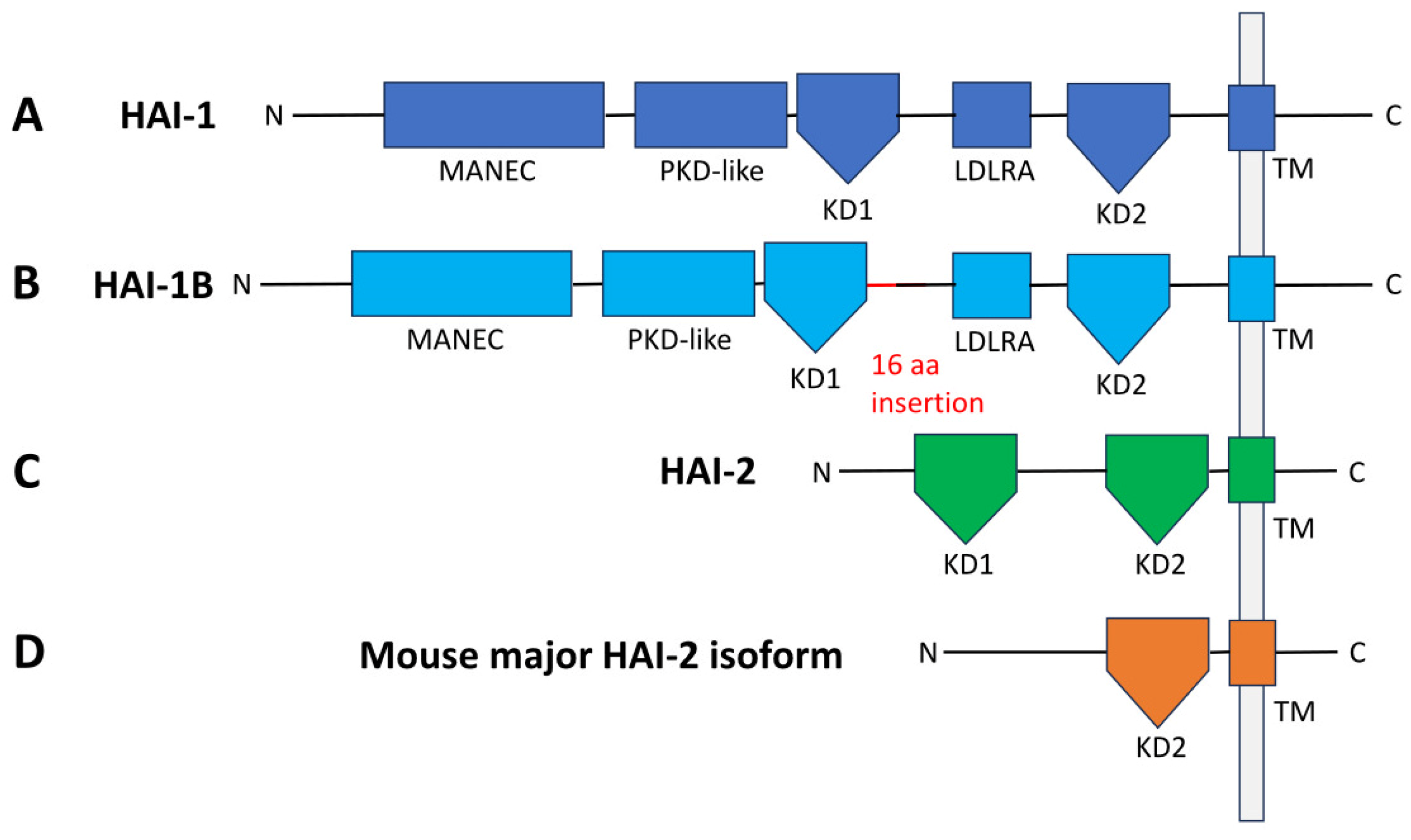
Figure 1. Domain architectures of HAI-1 and HAI-2 isoforms. (A) Human HAI-1: The HAI-1 protein comprises an N-terminal MANEC domain, an internal PKD-like domain, KD1, an LDLRA domain, and KD2, followed by a TM region and a cytoplasmic tail. (B) Human HAI-1B: Human HAI-1B is an alternative splice variant of HAI-1. The structure is identical to HAI-1 but contains an additional 16-amino-acid insertion immediately downstream of the KD1 domain. (C) Human HAI-2: HAI-2 is a shorter transmembrane protein lacking the MANEC and LDLRA domains found in HAI-1. (D) Mouse major HAI-2 isoform: Unlike human HAI-2, the predominant isoform in mice lacks the KD1 domain. This isoform contains only the KD2 domain in its extracellular region. Human and murine HAI-1 exhibit highly similar overall domain architectures. N: N-terminus, C: C-terminus, TM: transmembrane.
Ijms 27 02000 g001
Figure 2. Examples of the developmental and physiological roles of HAI-1 in organ systems. (A) Skin: HAI-1 preserves the epidermal barrier by inhibiting matriptase. Loss of HAI-1 causes unchecked proteolysis, which degrades epithelial cell adhesion molecule (EpCAM), downregulates tight junction protein claudin-7, and activates protease-activated receptor-2 (PAR-2)-mediated inflammatory signaling, resulting in ichthyosis. (B) Pancreas: HAI-1 regulates glucose metabolism by inhibiting hepsin. Loss of HAI-1 allows hepsin to cleave the GLP-1 receptor on β-cells, impairing insulin synthesis and secretion and causing glucose intolerance. Created in BioRender. Chen, B. (2026) https://biorender.com/qwjmtwi (accessed on 25 January 2026).
Ijms 27 02000 g002
Figure 3. HAI-1 and HAI-2 orchestrate TME crosstalk and immune modulation. (A) NSCLC: The loss of HAI-1 leads to an immunosuppressive TME characterized by M2-dominant macrophage infiltration and impaired M1 polarization. (B) OSCC: Downregulation of HAI-1 at invasion fronts triggers the paracrine activation of PAR-2 on CAFs, enhancing their migration and tumor-promoting activity. (C) AML: HAI-2 downregulation in MSCs increases the secretion of HGF and SDF-1, thereby promoting malignant cell adhesion and survival. Created in BioRender. Chen, B. (2026) https://BioRender.com/rrf2jc9 (accessed on 25 January 2026).
Ijms 27 02000 g003
Figure 4. The oncogenic signaling pathways regulated by HAI-1 and HAI-2. Deficiency of HAI-1 and HAI-2 releases inhibitory constraints on the activities of membrane-anchored serine proteases, leading to the activation of matriptase, prostasin, and plasmin. Activated matriptase, which undergoes autoactivation and can also be activated by prostasin, converts pro-HGF into its active form, thereby stimulating c-MET–mediated cell growth and survival. Concurrently, matriptase cleaves PAR-2, triggering downstream signaling pathways that further promote cell growth and survival. In addition, matriptase activates the uPA system, which activates plasmin and is further amplified through a plasmin-dependent positive feedback loop. Plasmin not only converts a pro-MMP to an MMP, leading to ECM degradation, but also directly degrades ECM components. Moreover, plasmin activates latent TGF-β. Both ECM degradation and active TGF-β ultimately converge to promote cell proliferation and survival. Solid arrows indicate direct activation or enhancement; dashed arrows indicate indirect enhancement involving multiple steps. Created in BioRender. Chen, B. (2026) https://BioRender.com/m2mg30s (accessed on 27 January 2026).
Ijms 27 02000 g004
Disclaimer/Publisher’s Note: The statements, opinions and data contained in all publications are solely those of the individual author(s) and contributor(s) and not of MDPI and/or the editor(s). MDPI and/or the editor(s) disclaim responsibility for any injury to people or property resulting from any ideas, methods, instructions or products referred to in the content.