Epigenetic Clocks, Resilience, and Multi-Omics Ageing: A Review and the EpiAge-R Conceptual Framework

Abstract
1. Introduction
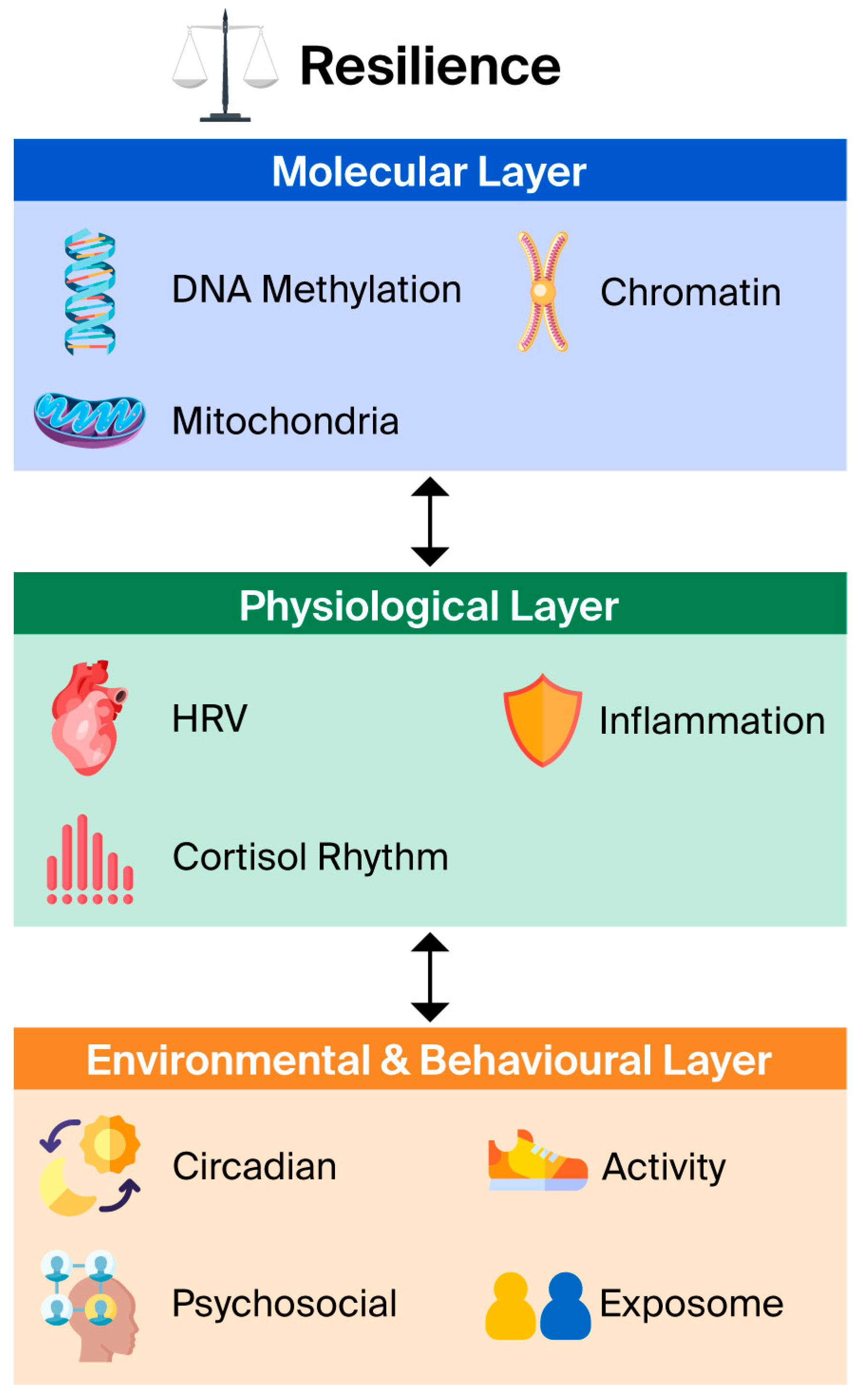
2. Conceptual Framework from Damage to Resilience
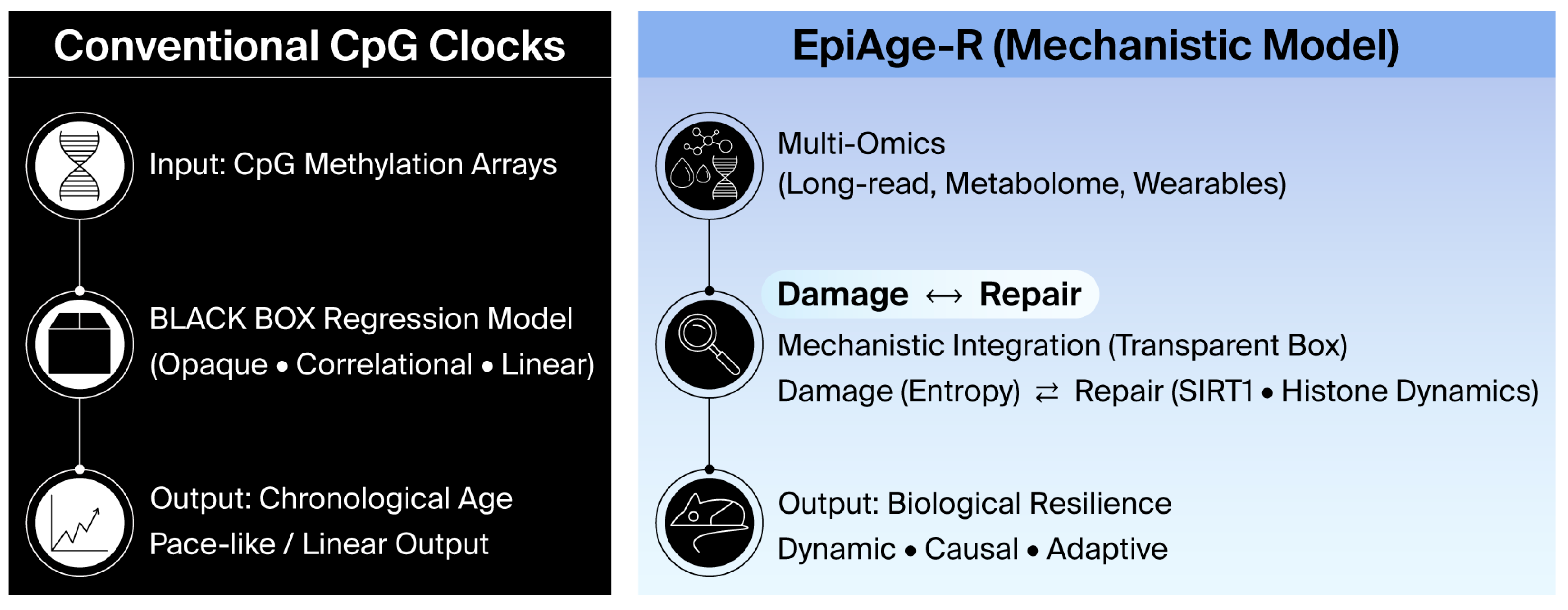
2.1. Limitations of Correlational CpG-Based Clocks
2.2. The EpiAge-R Approach
2.3. Comparative Analysis: Pace, State, and Resilience
3. The Molecular Layer: Epigenetic and Chromatin Resilience
3.1. Nanopore Sequencing and Chromatin Context
3.2. Histone-Modification Balance
3.3. Nuclear Mechanobiology and 3D Genome Architecture
3.4. Telomere Integrity and Mitochondrial Epigenetics
4. The Physiological Layer: Systemic Adaptability
4.1. Autonomic and Neuro-Endocrine Resilience
4.2. Systemic Integrity and Inflammation
5. The Environmental Layer: Adaptive Context
5.1. Behavioural Modulation and Social Genomics
5.2. Exogenous Stressors
6. Integrative Scoring: The EpiAge-R Index
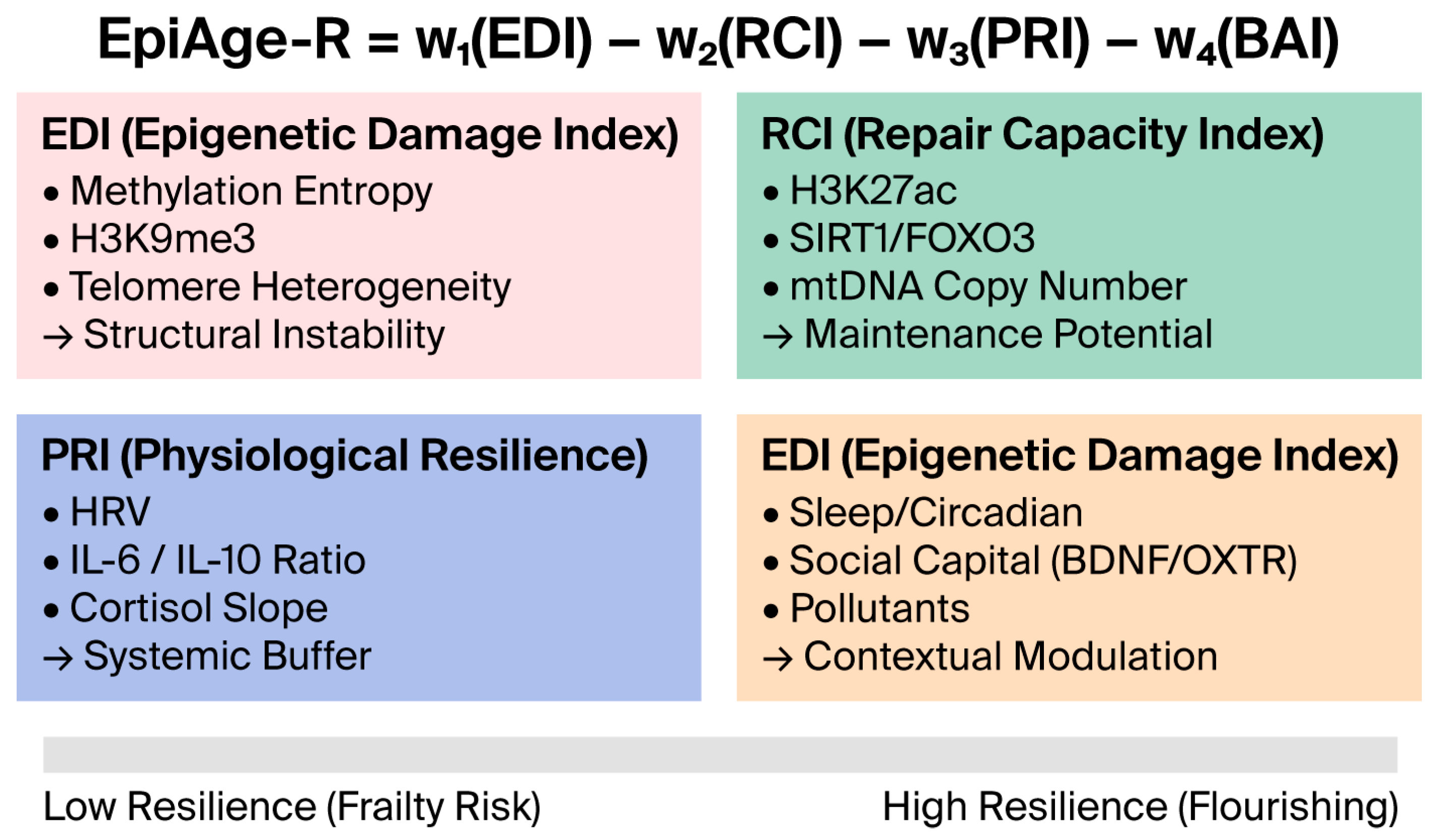
6.1. The Resilience Index Formula
- EDI (Epigenetic Damage Index): Quantifies structural instability (e.g., methylation entropy).
- RCI (Repair Capacity Index): Reflects maintenance potential (e.g., SIRT1 activity).
- PRI (Physiological Resilience Index): Captures systemic buffering (e.g., HRV).
- BAI (Behavioral/Environmental Index): Represents contextual adaptation.
6.2. The Flourishing Extension
6.3. Operationalization: A Minimum Viable Protocol
6.3.1. Feature Selection
6.3.2. Normalization and Integration
7. Discussion and Clinical Implications
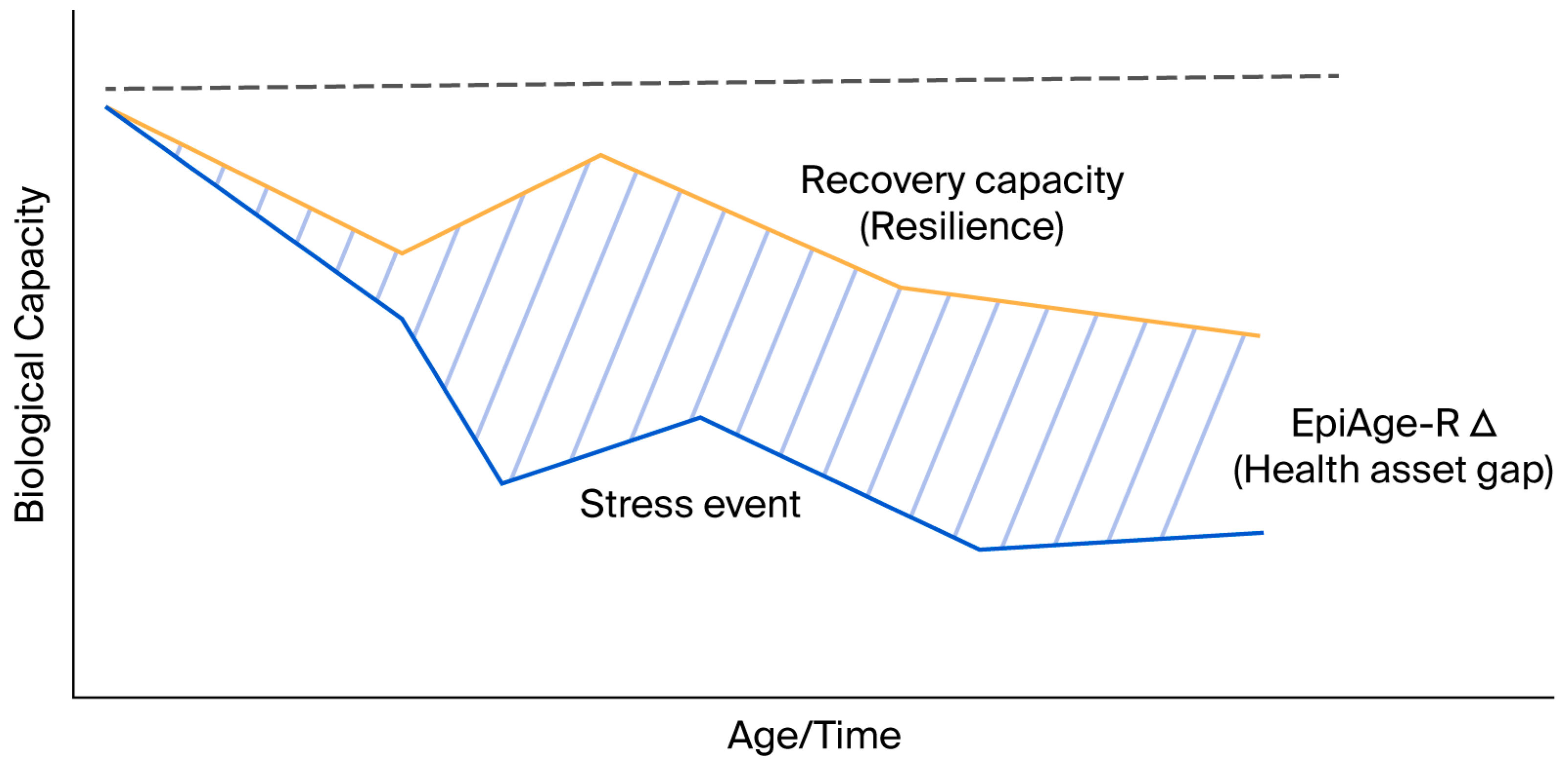
7.1. From Damage to Resilience
7.2. Addressing the Challenge of Biological Validation and Normativity Bias
7.3. Generative AI and Multi-Omics Integration
7.4. Navigating Genomic Privacy via Epigenetic Inference
7.5. Biological Integration of Psychosocial Assets
7.6. Clinical Translation and Therapeutic Interventions
Validation Roadmap: Stress-Recovery Study Design
- Design: A cohort of older adults undergoing scheduled moderate stress (e.g., elective hip replacement surgery).
- Timeline: Measurements taken at Baseline (T0), Acute Stress (T1: 24h post-op), and Recovery (T2: 30 days post-op).
- Hypothesis: Individuals with a higher pre-operative EpiAge-R score (indicating high resilience) will show a faster return to baseline inflammatory and functional markers at T2, independent of their GrimAge or chronological age. This would demonstrate that EpiAge-R captures the dynamic capacity for recovery missed by static clocks.
8. Conclusions
Funding
Institutional Review Board Statement
Informed Consent Statement
Data Availability Statement
Acknowledgments
Conflicts of Interest
Abbreviations
| Abbreviation | Definition |
| EpiAge-R | Epigenetic Age with Resilience |
| EDI | Epigenetic Damage Index |
| RCI | Repair Capacity Index |
| PRI | Physiological Resilience Index |
| BAI | Behavioural/Environmental Adaptation Index |
| CpG | Cytosine-phosphate-Guanine |
| HRV | Heart-Rate Variability |
| SASP | Senescence-Associated Secretory Phenotype |
| LADs | Lamina-Associated Domains |
| TADs | Topologically Associating Domains |
| LINC | Linker of Nucleoskeleton and Cytoskeleton |
| mtDNA | Mitochondrial DNA |
| SIRT1 | Sirtuin 1 |
| BDNF | Brain-Derived Neurotrophic Factor |
| OXTR | Oxytocin Receptor |
| HPA | Hypothalamic-Pituitary-Adrenal |
| HATs | Histone Acetyltransferases |
| HDACs | Histone Deacetylases |
| SNPs | Single Nucleotide Polymorphisms |
| mQTLs | Methylation Quantitative Trait Loci |
References
- Horvath, S. DNA methylation age of human tissues and cell types. Genome Biol. 2013, 14, R115, Erratum in Genome Biol. 2015, 16, 96. [Google Scholar] [CrossRef]
- Hannum, G.; Guinney, J.; Zhao, L.; Zhang, L.; Hughes, G.; Sadda, S.; Klotzle, B.; Bibikova, M.; Fan, J.-B.; Gao, Y.; et al. Genome-wide methylation profiles reveal quantitative views of human aging rates. Mol. Cell 2013, 49, 359–367. [Google Scholar] [CrossRef]
- Lu, A.T.; Quach, A.; Wilson, J.G.; Reiner, A.P.; Aviv, A.; Raj, K.; Hou, L.; Baccarelli, A.A.; Li, Y.; Stewart, J.D.; et al. DNA methylation GrimAge strongly predicts lifespan and healthspan. Aging 2019, 11, 303–327. [Google Scholar] [CrossRef]
- Levine, M.E.; Lu, A.T.; Quach, A.; Chen, B.H.; Assimes, T.L.; Bandinelli, S.; Hou, L.; Baccarelli, A.A.; Stewart, J.D.; Li, Y.; et al. An epigenetic biomarker of aging for lifespan and healthspan. Aging 2018, 10, 573–591. [Google Scholar] [CrossRef] [PubMed]
- López-Otín, C.; Blasco, M.A.; Partridge, L.; Serrano, M.; Kroemer, G. Hallmarks of aging: An expanding universe. Cell 2023, 186, 243–278. [Google Scholar] [CrossRef]
- Kirkwood, T.B.L. A systematic look at an old problem. Nature 2008, 451, 644–647. [Google Scholar] [CrossRef]
- Gladyshev, V.N. The origin of aging: Imperfectness-driven non-random damage defines the aging process. Curr. Opin. Genet. Dev. 2013, 23, 525–532. [Google Scholar] [CrossRef]
- Berger, S.L.; Sassone-Corsi, P. Metabolic signaling to chromatin. Cold Spring Harb. Perspect. Biol. 2016, 8, a019463. [Google Scholar] [CrossRef]
- Bell, C.G.; Lowe, R.; Adams, P.D.; Baccarelli, A.A.; Beck, S.; Bell, J.T.; Christensen, B.C.; Gladyshev, V.N.; Heijmans, B.T.; Horvath, S.; et al. DNA methylation aging clocks: Challenges and recommendations. Genome Biol. 2019, 20, 249. [Google Scholar] [CrossRef] [PubMed]
- Ruden, D.M. The emerging role of multiomics in aging research. Epigenomics 2025, 17, 897–904. [Google Scholar] [CrossRef] [PubMed]
- Tong, H.; Guo, X.; Jacques, M.; Luo, Q.; Eynon, N.; Teschendorff, A.E. Cell-type specific epigenetic clocks to quantify biological age at cell-type resolution. Aging 2024, 16, 13452–13504. [Google Scholar] [CrossRef]
- Shen, X.; Wang, C.; Zhou, X.; Zhou, W.; Hornburg, D.; Wu, S.; Snyder, M.P. Nonlinear dynamics of multi-omics profiles during human aging. Nat. Aging 2024, 4, 1619–1634. [Google Scholar] [CrossRef]
- Campagna, M.P.; Xavier, A.; Lechner-Scott, J.; Maltby, V.; Scott, R.J.; Butzkueven, H.; Jokubaitis, V.G.; Lea, R.A. Epigenome-wide association studies: Current knowledge, strategies and recommendations. Clin. Epigenet. 2021, 13, 214. [Google Scholar] [CrossRef]
- Dixon, J.R.; Selvaraj, S.; Yue, F.; Kim, A.; Li, Y.; Shen, Y.; Hu, M.; Liu, J.S.; Ren, B. Topological domains in mammalian genomes identified by analysis of chromatin interactions. Nature 2012, 485, 376–380. [Google Scholar] [CrossRef]
- Liang, R.; Tang, Q.; Chen, J.; Zhu, L. Epigenetic clocks: Beyond biological age, using the past to predict the future. Aging Dis. 2024, 16, 3520–3545. [Google Scholar] [CrossRef]
- Schaum, N.; Lehallier, B.; Hahn, O.; Pálovics, R.; Hosseinzadeh, S.; Lee, S.E.; Sit, R.; Lee, D.P.; Losada, P.M.; Zardeneta, M.E.; et al. Ageing hallmarks exhibit organ-specific temporal signatures. Nature 2020, 583, 596–602. [Google Scholar] [CrossRef]
- Nativio, R.; Lan, Y.; Donahue, G.; Sidoli, S.; Berson, A.; Srinivasan, A.R.; Shcherbakova, O.; Amlie-Wolf, A.; Nie, J.; Cui, X.; et al. An integrated multi-omics approach identifies epigenetic alterations associated with Alzheimer’s disease. Nat. Genet. 2020, 52, 1024–1035, Erratum in Nat. Genet. 2020, 52, 1266. [Google Scholar] [CrossRef] [PubMed]
- Ahadi, S.; Zhou, W.; Rose, S.M.S.-F.; Sailani, M.R.; Contrepois, K.; Avina, M.; Ashland, M.; Brunet, A.; Snyder, M. Personal aging markers and mechanotypes revealed by deep longitudinal profiling. Nat. Med. 2020, 26, 83–90. [Google Scholar] [CrossRef] [PubMed]
- Jain, M.; Koren, S.; Miga, K.H.; Quick, J.; Rand, A.C.; Sasani, T.A.; Tyson, J.R.; Beggs, A.D.; Dilthey, A.T.; Fiddes, I.T.; et al. Nanopore sequencing and assembly of a human genome with ultra-long reads. Nat. Biotechnol. 2018, 36, 338–345. [Google Scholar] [CrossRef] [PubMed]
- Rand, A.C.; Jain, M.; Eizenga, J.M.; Musselman-Brown, A.; E Olsen, H.; Akeson, M.; Paten, B. Mapping DNA methylation with high-throughput nanopore sequencing. Nat. Methods 2017, 14, 411–413. [Google Scholar] [CrossRef]
- Ewing, A.D.; Smits, N.; Sanchez-Luque, F.J.; Faivre, J.; Brennan, P.M.; Cheetham, S.W.; Faulkner, G.J. Nanopore sequencing enables comprehensive transposable element epigenomic profiling. Mol. Cell 2020, 80, 915–928. [Google Scholar] [CrossRef] [PubMed]
- Liao, Y.; Smyth, G.K.; Shi, W. The Subread aligner: Fast, accurate and scalable read mapping by seed-and-vote. Nucleic Acids Res. 2013, 41, e108. [Google Scholar] [CrossRef]
- Sen, P.; Shah, P.P.; Nativio, R.; Berger, S.L. Epigenetic mechanisms of longevity and aging. Cell 2016, 166, 822–839. [Google Scholar] [CrossRef] [PubMed]
- Mohanta, T.K.; Mishra, A.K.; Al-Harrasi, A. The 3D genome: From structure to function. Int. J. Mol. Sci. 2021, 22, 11585. [Google Scholar] [CrossRef] [PubMed]
- Misteli, T. The self-organizing genome: Principles of genome architecture and function. Cell 2020, 183, 28–45. [Google Scholar] [CrossRef]
- De Cecco, M.; Ito, T.; Petrashen, A.P.; Elias, A.E.; Skvir, N.J.; Criscione, S.W.; Caligiana, A.; Brocculi, G.; Adney, E.M.; Boeke, J.D.; et al. L1 drives IFN in senescent cells and promotes age-associated inflammation. Nature 2019, 566, 73–78. [Google Scholar] [CrossRef]
- Cawthon, R.M. Telomere measurement by quantitative PCR. Nucleic Acids Res. 2002, 30, e47. [Google Scholar] [CrossRef]
- Shay, J.W.; Wright, W.E. Telomeres and telomerase: Three decades of progress. Nat. Rev. Genet. 2019, 20, 299–309. [Google Scholar] [CrossRef]
- Epel, E.S.; Prather, A.A. Stress, telomeres, and psychopathology. Annu. Rev. Clin. Psychol. 2018, 14, 371–397. [Google Scholar] [CrossRef]
- Lopes, A.F.C. Mitochondrial metabolism and DNA methylation: A review of the interaction between tow genomes. Clin. Epigenet. 2020, 12, 182. [Google Scholar] [CrossRef]
- Barja, G. The mitochondrial free radical theory of aging. Prog. Mol. Biol. Transl. Sci. 2014, 127, 1–27. [Google Scholar]
- Thayer, J.F.; Lane, R.D. Claude Bernard and the heart-brain connection. Neurosci. Biobehav. Rev. 2009, 33, 81–88. [Google Scholar] [CrossRef] [PubMed]
- Sehgal, R.; Markov, Y.; Qin, C.; Meer, M.; Hadley, C.; Shadyab, A.H.; Casanova, R.; Manson, J.E.; Bhatti, P.; Moore, A.Z.; et al. Systems Age: A single blood methylation test to quantify aging heterogeneity. Nat. Aging 2025, 5, 1880–1896. [Google Scholar] [CrossRef]
- The MULTI Consortium; Cao, H.; Song, Z.; Duggan, M.R.; Erus, G.; Srinivasan, D.; Tian, Y.E.; Bai, W.; Rafii, M.S.; Aisen, P.; et al. MRI-based multi-organ clocks for healthy aging and disease assessment. Nat. Med. 2025, 31, 1234–1245. [Google Scholar]
- Fuentealba, M.; Rouch, L.; Guyonnet, S.; Lemaitre, J.-M.; Barreto, P.d.S.; Vellas, B.; Andrieu, S.; Furman, D. A blood-based epigenetic clock for intrinsic capacity. Nat. Aging 2025, 5, 1207–1216. [Google Scholar] [CrossRef]
- Jia, X.; Fan, J.; Wu, X.; Cao, X.; Ma, L.; Abdelrahman, Z.; Zhao, F.; Zhu, H.; Bizzarri, D.; Akker, E.B.V.D.; et al. A Novel Metabolomic Aging Clock Predicting Health Outcomes and Its Genetic and Modifiable Factors. NPJ Metab. Health Dis. 2025, 3, 35. [Google Scholar] [CrossRef] [PubMed]
- Miller, A.C.; Futoma, J.; Abbaspourazad, S.; Heinze-Deml, C.; Emrani, S.; Shapiro, I.; Sapiro, G. A wearable-based aging clock associates with disease and behavior. Nat. Commun. 2025, 16, 5678. [Google Scholar] [CrossRef]
- Harvanek, Z.M.; Fogelman, N.; Xu, K.; Sinha, R. Psychological and biological resilience modulates the effects of stress on epigenetic aging. Transl. Psychiatry 2021, 11, 601. [Google Scholar] [CrossRef] [PubMed]
- Pan, Y.; Huang, Z.; Sun, X.; De Anda-Duran, I.; Zhang, R.; Chen, W.; Li, C.; Capuano, A.W.; Yaffe, K.; Zhao, J.; et al. Epigenetic age acceleration and midlife cognition. NPJ Aging 2025, 11, 75. [Google Scholar] [CrossRef]
- Slavich, G.M.; Irwin, M.R. From stress to inflammation and major depressive disorder. Psychol. Bull. 2014, 140, 774–815. [Google Scholar] [CrossRef]
- Tomusiak, A.; Floro, A.; Tiwari, R.; Riley, R.; Matsui, H.; Andrews, N.; Kasler, H.G.; Verdin, E. Development of an epigenetic clock resistant to changes in immune cell composition. Commun. Biol. 2024, 7, 934. [Google Scholar] [CrossRef]
- Cardillo, M.; Katam, K.; Suravajhala, P. Advancements in multi-omics research to address challenges in Alzheimer’s disease. Front. Aging Neurosci. 2025, 17, 1591796. [Google Scholar] [CrossRef] [PubMed]
- Voicu, V.; Toader, C.; Șerban, M.; Covache-Busuioc, R.-A.; Ciurea, A.V. Systemic neurodegeneration and brain aging. Biomedicines 2025, 13, 2025. [Google Scholar] [CrossRef]
- Rappaport, S.M. Genetic factors are not the major causes of chronic diseases. PLoS ONE 2016, 11, e0154387. [Google Scholar] [CrossRef] [PubMed]
- Wild, C.P. Complementing the genome with an “exposome”. Cancer Epidemiol. Biomarkers Prev. 2005, 14, 1847–1850. [Google Scholar] [CrossRef]
- Fries, J.F. The theory and practice of active aging. Curr. Gerontol. Geriatr. Res. 2012, 2012, 420637. [Google Scholar] [CrossRef]
- Ryff, C.D. Psychological Well-Being Revisited. Psychother. Psychosom. 2013, 83, 10–28. [Google Scholar] [CrossRef]
- Ong, A.D.; Mann, F.D.; Kubzansky, L.D. Cumulative social advantage is associated with slower epigenetic aging. Brain Behav. Immun. Health 2025, 48, 101096. [Google Scholar] [CrossRef] [PubMed]
- Bourassa, K.J.; Sbarra, D.A. Trauma, adversity, and biological aging. Transl. Psychiatry 2024, 14, 285. [Google Scholar] [CrossRef]
- Tuminello, S.; Ashebir, Y.A.; Schroff, C.; Ramaswami, S.; Durmus, N.; Chen, Y.; Snuderl, M.; Shao, Y.; Reibman, J.; Arslan, A.A. Epigenetic aging acceleration among World Trade Center-exposed community members. Sci. Rep. 2025, 15, 33942. [Google Scholar] [CrossRef]
- Vrijheid, M.; Fossati, S.; Maitre, L.; Márquez, S.; Roumeliotaki, T.; Agier, L.; Andrusaityte, S.; Cadiou, S.; Casas, M.; De Castro, M.; et al. Early-life environmental exposures and childhood obesity: An exposome-wide approach. Environ. Health Perspect. 2020, 128, 67009. [Google Scholar] [CrossRef]
- Horvath, S.; Raj, K. DNA methylation-based biomarkers and the epigenetic clock theory of aging. Nat. Rev. Genet. 2018, 19, 371–384. [Google Scholar] [CrossRef]
- Fuentealba, M.; Kiprov, D.; Schneider, K.; Mu, W.; Kumaar, P.A.; Kasler, H.; Burton, J.B.; Watson, M.; Halaweh, H.; King, C.D.; et al. Multi-omics analysis reveals biomarkers that contribute to biological age rejuvenation in Response to Single-Blinded Randomized Placebo-Controlled Therapeutic Plasma Exchange. Aging Cell 2025, 24, e70103. [Google Scholar] [CrossRef]
- Lei, J.; Xin, Z.; Liu, N.; Ning, T.; Jing, Y.; Qiao, Y.; He, Z.; Jiang, M.; Yang, Y.; Zhang, Z.; et al. Senescence-resistant human mesenchymal progenitor cells counter aging in primates. Cell 2025, 188, 5039–5061. [Google Scholar] [CrossRef]
- Zou, H.; Hastie, T. Regularization and variable selection via the elastic net. J. R. Stat. Soc. Series B 2005, 67, 301–320. [Google Scholar] [CrossRef]
- Breiman, L. Random forests. Mach. Learn. 2001, 45, 5–32. [Google Scholar] [CrossRef]
- Chen, D.; Liu, S.; Kingsbury, P.; Sohn, S.; Storlie, C.B.; Habermann, E.B.; Naessens, J.M.; Larson, D.W.; Liu, H. Deep learning and alternative learning strategies for retrospective real-world clinical data. NPJ Digit. Med. 2019, 2, 43. [Google Scholar] [CrossRef]
- Levy, J.J.; Diallo, A.B.; Montivero, M.K.S.; Gabbita, S.; Salas, L.A.; Christensen, B.C. Insights to aging prediction with AI based epigenetic clocks. Epigenomics 2025, 17, 49–57. [Google Scholar] [CrossRef] [PubMed]
- Diener, E.; Oishi, S.; Tay, L. Advances in subjective well-being research. Nat. Hum. Behav. 2018, 2, 253–260. [Google Scholar] [CrossRef] [PubMed]
- Santos-Pujol, E.; Noguera-Castells, A.; Casado-Pelaez, M.; García-Prieto, C.A.; Vasallo, C.; Campillo-Marcos, I.; Quero-Dotor, C.; Crespo-García, E.; Bueno-Costa, A.; Setién, F.; et al. The multiomics blueprint of extreme human lifespan. Cell Rep. Med. 2025, 6, 102368. [Google Scholar] [CrossRef] [PubMed]
- Ocampo, A.; Reddy, P.; Martinez-Redondo, P.; Platero-Luengo, A.; Hatanaka, F.; Hishida, T.; Li, M.; Lam, D.; Kurita, M.; Beyret, E.; et al. In Vivo Amelioration of Age-Associated Hallmarks by Partial Reprogramming. Cell 2016, 167, 1719–1733. [Google Scholar] [CrossRef]
- Yang, J.-H.; Petty, C.A.; Dixon-McDougall, T.; Lopez, M.V.; Tyshkovskiy, A.; Maybury-Lewis, S.; Tian, X.; Ibrahim, N.; Chen, Z.; Griffin, P.T.; et al. Chemically induced reprogramming to reverse cellular aging. Aging 2023, 15, 5966–5989. [Google Scholar] [CrossRef] [PubMed]
- Moqri, M.; Herzog, C.; Poganik, J.R.; Justice, J.; Belsky, D.W.; Higgins-Chen, A.; Moskalev, A.; Fuellen, G.; Cohen, A.A.; Bautmans, I.; et al. Biomarkers of aging for the identification and evaluation of longevity interventions. Cell 2023, 186, 3758–3775. [Google Scholar] [CrossRef]
- Moqri, M.; Poganik, J.R.; Horvath, S.; Gladyshev, V.N. What makes biological age epigenetic clocks tick. Nat. Aging 2025, 5, 335–336. [Google Scholar] [CrossRef]
- Pun, F.W.; Leung, G.H.D.; Leung, H.W.; Liu, B.H.M.; Long, X.; Ozerov, I.V.; Wang, J.; Ren, F.; Aliper, A.; Izumchenko, E.; et al. Hallmarks of aging-based dual-purpose disease and aging targets identified by PandaOmics AI. Aging 2022, 14, 2463–2481. [Google Scholar] [CrossRef]
- Waterland, R.A.; Jirtle, R.L. Transposable elements: Targets for early nutritional effects on epigenetic gene regulation. Mol. Cell. Biol. 2003, 23, 5293–5300. [Google Scholar] [CrossRef]
- Erlich, Y.; Narayanan, A. Routes for breaching and protecting genetic privacy. Nat. Rev. Genet. 2014, 15, 409–421, Erratum in Nat. Rev. Genet. 2014, 15, 570. [Google Scholar] [CrossRef]
- Gaunt, T.R.; Shihab, H.A.; Hemani, G.; Min, J.L.; Woodward, G.; Lyttleton, O.; Zheng, J.; Duggirala, A.; McArdle, W.L.; Ho, K.; et al. Systematic identification of genomic influences on DNA methylation. Genome Biol. 2016, 17, 72. [Google Scholar] [CrossRef]
- Fredrickson, B.L.; Grewen, K.M.; Coffey, K.A.; Algoe, S.B.; Firestine, A.M.; Arevalo, J.M.G.; Ma, J.; Cole, S.W. A functional genomic perspective on human well-being. Proc. Natl. Acad. Sci. USA 2013, 110, 13684–13689. [Google Scholar] [CrossRef] [PubMed]
- Fong, S.; Denisov, K.A.; Nefedova, A.A.; Kennedy, B.K.; Gruber, J. LinAge2: Providing actionable insights and benchmarking with epigenetic clocks. NPJ Aging 2025, 11, 29. [Google Scholar] [CrossRef] [PubMed]


Disclaimer/Publisher’s Note: The statements, opinions and data contained in all publications are solely those of the individual author(s) and contributor(s) and not of MDPI and/or the editor(s). MDPI and/or the editor(s) disclaim responsibility for any injury to people or property resulting from any ideas, methods, instructions or products referred to in the content. |
© 2026 by the author. Licensee MDPI, Basel, Switzerland. This article is an open access article distributed under the terms and conditions of the Creative Commons Attribution (CC BY) license.
Share and Cite
Yamada, H. Epigenetic Clocks, Resilience, and Multi-Omics Ageing: A Review and the EpiAge-R Conceptual Framework. Int. J. Mol. Sci. 2026, 27, 1908. https://doi.org/10.3390/ijms27041908
Yamada H. Epigenetic Clocks, Resilience, and Multi-Omics Ageing: A Review and the EpiAge-R Conceptual Framework. International Journal of Molecular Sciences. 2026; 27(4):1908. https://doi.org/10.3390/ijms27041908
Chicago/Turabian StyleYamada, Hidekazu. 2026. "Epigenetic Clocks, Resilience, and Multi-Omics Ageing: A Review and the EpiAge-R Conceptual Framework" International Journal of Molecular Sciences 27, no. 4: 1908. https://doi.org/10.3390/ijms27041908
APA StyleYamada, H. (2026). Epigenetic Clocks, Resilience, and Multi-Omics Ageing: A Review and the EpiAge-R Conceptual Framework. International Journal of Molecular Sciences, 27(4), 1908. https://doi.org/10.3390/ijms27041908