Oxygen Variations, 2nd Edition: Integrative Insights from Cellular Models to Clinical Physiology




Introduction
- 1.
- Experimental and Cellular Models of Oxidative Stress
- 2.
- Mitochondrial Dysfunction and Redox-driven Pathology
- 3.
- Brain, Vascular Tone, and Neuroenergetics
- 4.
- Hyperoxia, (Relative) Hypoxia, and Systemic Adaptation
- 5.
- Integrative Perspective and Conclusions
- 6.
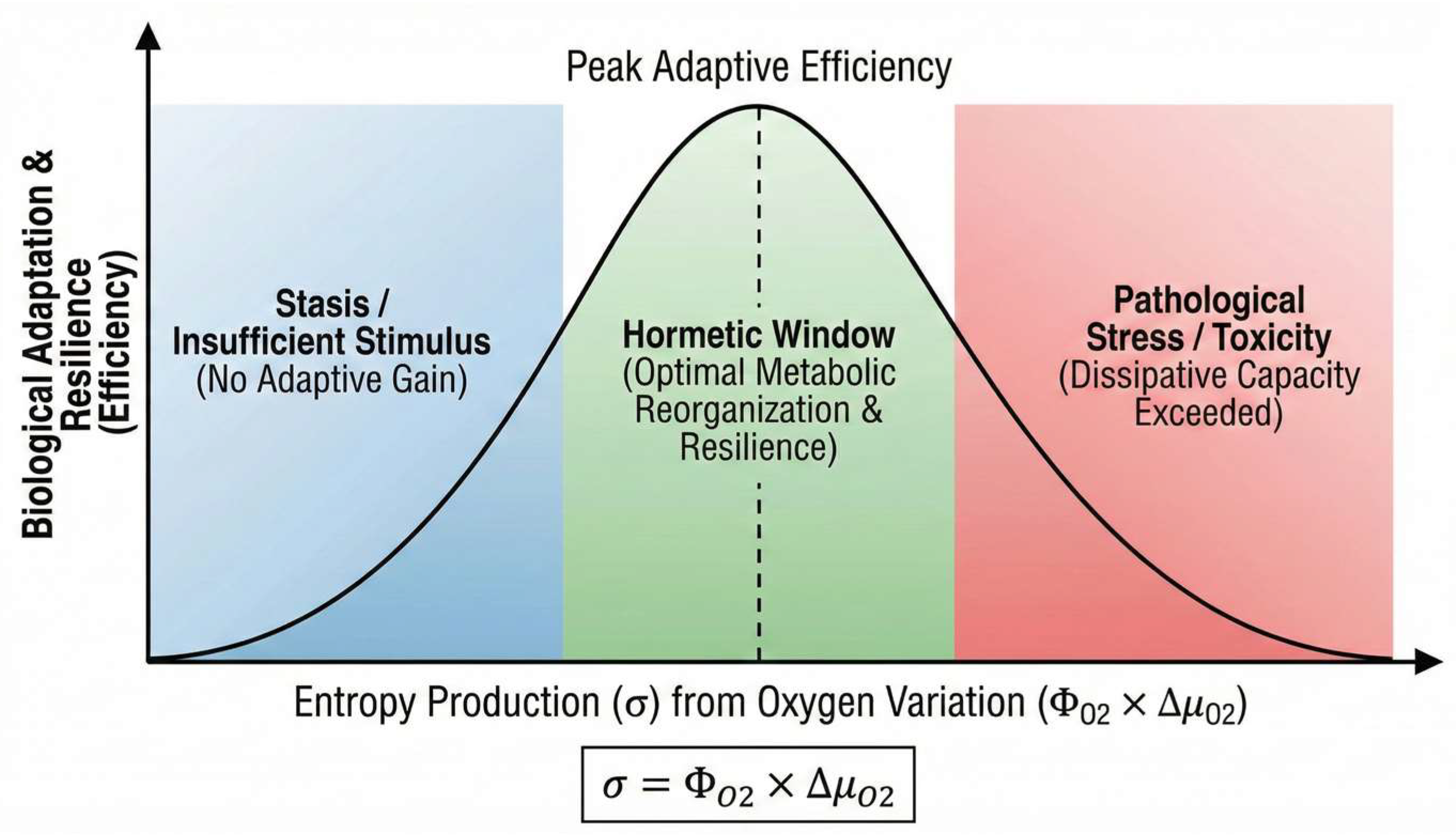
- Conceptual Thermodynamic Framework of Oxygen-Driven Adaptation
Author Contributions
Conflicts of Interest
References
- Hancock, J.T. A Brief History of Oxygen: 250 Years on. Oxygen 2022, 2, 31–39. [Google Scholar] [CrossRef]
- Gorriñobeaskoa, U. On the Historiography of Epistemic Objects: An Evolutionary Approach. Ber. Wiss 2025, 48, 180–198. [Google Scholar] [CrossRef]
- Lanahan, J.K.; Alston, T.A. Oxygen Was Almost Named Nitrogen. J. Anesth. Hist. 2020, 6, 96–97. [Google Scholar] [CrossRef]
- Severinghaus, J.W. The Most Important Discovery of Science. Adv. Exp. Med. Biol. 2016, 876, 1–16. [Google Scholar] [CrossRef]
- Severinghaus, J.W. Eight sages over five centuries share oxygen’s discovery. Adv. Physiol. Educ. 2016, 40, 370–376. [Google Scholar] [CrossRef] [PubMed]
- Balestra, C.; Mrakic-Sposta, S.; Virgili, F. Oxygen Variations—Insights into Hypoxia, Hyperoxia and Hyperbaric Hyperoxia—Is the Dose the Clue? Int. J. Mol. Sci. 2023, 24, 13472. [Google Scholar] [CrossRef] [PubMed]
- Anbalagan, S. Oxygen is an essential gasotransmitter directly sensed via protein gasoreceptors. Anim. Model. Exp. Med. 2024, 7, 189–193. [Google Scholar] [CrossRef]
- Jiang, Q.; Lin, X.; Zhai, M.; Gong, Y.; Li, Y.; Liu, S. The Role of ROS and Its Sources in Tumorigenesis: Friend or Foe? Adv. Biol. 2025, 9, e2400549. [Google Scholar] [CrossRef]
- Glorieux, C.; Enríquez, C.; González, C.; Aguirre-Martínez, G.; Buc Calderon, P. The Multifaceted Roles of NRF2 in Cancer: Friend or Foe? Antioxidants 2024, 13, 70. [Google Scholar] [CrossRef] [PubMed]
- Wang, R.; Liang, L.; Matsumoto, M.; Iwata, K.; Umemura, A.; He, F. Reactive Oxygen Species and NRF2 Signaling, Friends or Foes in Cancer? Biomolecules 2023, 13, 353. [Google Scholar] [CrossRef]
- Cardoso, M.A.; Gonçalves, H.M.R.; Davis, F. Reactive oxygen species in biological media are they friend or foe? Major In vivo and In vitro sensing challenges. Talanta 2023, 260, 124648. [Google Scholar] [CrossRef]
- Szarka, A.; Lőrincz, T.; Hajdinák, P. Friend or Foe: The Relativity of (Anti)oxidative Agents and Pathways. Int. J. Mol. Sci. 2022, 23, 5188. [Google Scholar] [CrossRef] [PubMed]
- Shilovsky, G.A.; Ashapkin, V.V. Transcription Factor Nrf2 and Mitochondria—Friends or Foes in the Regulation of Aging Rate. Biochemistry 2022, 87, 1477–1486. [Google Scholar] [CrossRef]
- Lesmana, R.; Parameswari, C.; Mandagi, G.F.; Wahyudi, J.F.; Permana, N.J.; Radhiyanti, P.T.; Gunadi, J.W. The Role of Exercise-Induced Reactive Oxygen Species (ROS) Hormesis in Aging: Friend or Foe. Cell Physiol. Biochem. 2022, 56, 692–706. [Google Scholar] [CrossRef]
- Powers, S.K.; Deminice, R.; Ozdemir, M.; Yoshihara, T.; Bomkamp, M.P.; Hyatt, H. Exercise-induced oxidative stress: Friend or foe? J. Sport. Health Sci. 2020, 9, 415–425. [Google Scholar] [CrossRef]
- Hafner, S.; Beloncle, F.; Koch, A.; Radermacher, P.; Asfar, P. Hyperoxia in intensive care, emergency, and peri-operative medicine: Dr. Jekyll or Mr. Hyde? A 2015 update. Ann. Intensive Care 2015, 5, 42. [Google Scholar] [CrossRef]
- Asfar, P.; Calzia, E.; Huber-Lang, M.; Ignatius, A.; Radermacher, P. Hyperoxia during septic shock—Dr. Jekyll or Mr. Hyde? Shock 2012, 37, 122–123. [Google Scholar] [CrossRef]
- Cano-Martínez, A.; Rubio-Ruiz, M.E.; Guarner-Lans, V. Homeostasis and evolution in relation to regeneration and repair. J. Physiol. 2024, 602, 2627–2648. [Google Scholar] [CrossRef]
- Sidorova, Y.; Petrov, N.; Biryulina, N.; Sokolov, I.; Balakina, A.; Trusov, N.; Kochetkova, A. The Study of Approaches to Modeling Oxidative Stress in Male Wistar Rats: The Comparative Analysis of Diet-Induced, Chemically Induced, and Physiologically Induced Models. Int. J. Mol. Sci. 2025, 26, 6872. [Google Scholar] [CrossRef] [PubMed]
- Suzuki, J. Exercise performance in well-trained male mice is promoted by intermittent hyperoxia via improving metabolic properties and capillary profiles. Physiol. Rep. 2025, 13, e70341. [Google Scholar] [CrossRef] [PubMed]
- Suzuki, J. Effects of exercise training with intermittent hyperoxic intervention on endurance performance and muscle metabolic properties in male mice. Physiol. Rep. 2024, 12, e16117. [Google Scholar] [CrossRef]
- Brugniaux, J.V.; Coombs, G.B.; Barak, O.F.; Dujic, Z.; Sekhon, M.S.; Ainslie, P.N. Highs and lows of hyperoxia: Physiological, performance, and clinical aspects. Am. J. Physiol. Regul. Integr. Comp. Physiol. 2018, 315, R1–R27. [Google Scholar] [CrossRef]
- Orzoł, D.; Kępska, M.; Zyzak, M. Orientin Reverses Premature Senescence in Equine Adipose Stromal Cells Affected by Equine Metabolic Syndrome Through Oxidative Stress Modulation. Int. J. Mol. Sci. 2025, 26, 6867. [Google Scholar] [CrossRef]
- Zheng, Y.; Chen, L.; Li, H.; Lin, J.; Ma, J. Orientin alleviates severe inflammation via regulating macrophage glycolysis and immune function in sepsis. Free Radic. Biol. Med. 2026, 246, 196–208. [Google Scholar] [CrossRef]
- Pierro, F.; Fazio, M.; Murdaca, G.; Stagno, F.; Gangemi, S.; Allegra, A. Oxidative Stress and Mitochondrial Dysfunction in Myelodysplastic Syndrome: Roles in Development, Diagnosis, Prognosis, and Treatment. Int. J. Mol. Sci. 2025, 26, 6415. [Google Scholar] [CrossRef] [PubMed]
- Salvagno, M.; Sterchele, E.D.; Zaccarelli, M.; Mrakic-Sposta, S.; Welsby, I.J.; Balestra, C.; Taccone, F.S. Oxidative Stress and Cerebral Vascular Tone: The Role of Reactive Oxygen and Nitrogen Species. Int. J. Mol. Sci. 2024, 25, 3007. [Google Scholar] [CrossRef] [PubMed]
- Münz, F.; Datzmann, T.; Hoffmann, A.; Gröger, M.; Mathieu, R.; Mayer, S.; Zink, F.; Gässler, H.; Wolfschmitt, E.-M.; Hogg, M.; et al. The Effect of Targeted Hyperoxemia on Brain Immunohistochemistry after Long-Term, Resuscitated Porcine Acute Subdural Hematoma and Hemorrhagic Shock. Int. J. Mol. Sci. 2024, 25, 6574. [Google Scholar] [CrossRef] [PubMed]
- Damato, E.G.; Piktel, J.S.; Margevicius, S.P.; Fillioe, S.J.; Norton, L.K.; Abdollahifar, A.; Strohl, K.P.; Burch, D.S.; Decker, M.J. Exposure to Non-Steady-State Oxygen Is Reflected in Changes to Arterial Blood Gas Values, Prefrontal Cortical Activity, and Systemic Cytokine Levels. Int. J. Mol. Sci. 2024, 25, 3279. [Google Scholar] [CrossRef] [PubMed]
- Valacchi, G.; Virgili, F.; Cervellati, C.; Pecorelli, A. OxInflammation: From Subclinical Condition to Pathological Biomarker. Front. Physiol. 2018, 9, 858. [Google Scholar] [CrossRef]
- Vezzoli, A.; Mrakic-Sposta, S.; Brizzolari, A.; Balestra, C.; Camporesi, E.M.; Bosco, G. Oxy-Inflammation in Humans during Underwater Activities. Int. J. Mol. Sci. 2024, 25, 3060. [Google Scholar] [CrossRef]
- Rixen, M.; Weickmann, J.; Gebauer, R.A.; Weidenbach, M.; Markel, F.; Michaelis, A.; Dähnert, I.; Wüstenfeld, J.; Münch, D.; Poschart, M.; et al. First Real-Life Data on the Diving Response in Healthy Children. Pediatr. Cardiol. 2024, 45, 314–322. [Google Scholar] [CrossRef]
- Mulder, E.; Sieber, A.; Schagatay, E. Using underwater pulse oximetry in freediving to extreme depths to study risk of hypoxic blackout and diving response phases. Front. Physiol. 2021, 12, 651128. [Google Scholar] [CrossRef]
- Lundell, R.V.; Tuominen, L.; Ojanen, T.; Parkkola, K.; Raisanen-Sokolowski, A. Diving Responses in Experienced Rebreather Divers: Short-Term Heart Rate Variability in Cold Water Diving. Front. Physiol. 2021, 12, 649319. [Google Scholar] [CrossRef]
- Panneton, W.M. The mammalian diving response: An enigmatic reflex to preserve life? Physiology 2013, 28, 284–297. [Google Scholar] [CrossRef] [PubMed]
- Cannellotto, M.; Yasells García, A.; Landa, M.S. Hyperoxia: Effective Mechanism of Hyperbaric Treatment at Mild-Pressure. Int. J. Mol. Sci. 2024, 25, 777. [Google Scholar] [CrossRef] [PubMed]
- Salvagno, M.; Coppalini, G.; Taccone, F.S.; Strapazzon, G.; Mrakic-Sposta, S.; Rocco, M.; Khalife, M.; Balestra, C. The Normobaric Oxygen Paradox-Hyperoxic Hypoxic Paradox: A Novel Expedient Strategy in Hematopoiesis Clinical Issues. Int. J. Mol. Sci. 2022, 24, 82. [Google Scholar] [CrossRef] [PubMed]
- Nesovic Ostojic, J.; Kovacevic, S.; Ivanov, M.; Brkic, P.; Zivotic, M.; Mihailovic-Stanojevic, N.; Karanovic, D.; Vajic, U.J.; Jeremic, R.; Jovovic, D.; et al. Hyperbaric Oxygen Reduces Oxidative Stress Impairment and DNA Damage and Simultaneously Increases HIF-1α in Ischemia–Reperfusion Acute Kidney Injury. Int. J. Mol. Sci. 2024, 25, 3870. [Google Scholar] [CrossRef]
- Balestra, C.; Baldelli, S.; Virgili, F.; Salvagno, M.; Mrakic-Sposta, S.; Fratantonio, D. Pulsed Hyperoxia Acts on Plasmatic Advanced Glycation End Products and Advanced Oxidation Protein Products and Modulates Mitochondrial Biogenesis in Human Peripheral Blood Mononuclear Cells: A Pilot Study on the « Normobaric Oxygen Paradox ». Int. J. Mol. Sci. 2024, 25, 2394. [Google Scholar] [CrossRef]
- Fratantonio, D.; Virgili, F.; Zucchi, A.; Lambrechts, K.; Latronico, T.; Lafere, P.; Germonpre, P.; Balestra, C. Increasing Oxygen Partial Pressures Induce a Distinct Transcriptional Response in Human PBMC: A Pilot Study on the “Normobaric Oxygen Paradox”. Int. J. Mol. Sci. 2021, 22, 458. [Google Scholar] [CrossRef]
- Marín-López, A.G.; Macias-Velez, R.J.; Jarero-Basulto, J.J.; Rivera-Cervantes, M.C. Evidence of a hormetic-like cytoprotective effect by erythropoietin in the SH-SY5Y cell model of oxygen-glucose deprivation. Neuroscience 2025, 577, 114–122. [Google Scholar] [CrossRef]
- Chang, X.; Tamauchi, S.; Nakagawa, A.; Xinyuan, W.; Yoshida, K.; Yokoi, A.; Yoshikawa, N.; Kajiyama, H. Chemotherapeutic hormesis induced by the tumor microenvironment in refractory ovarian cancer. Sci. Rep. 2025, 15, 596. [Google Scholar] [CrossRef] [PubMed]
- Bresilla, D.; Tawfik, I.; Hirtl, M.; Gabrijelčič, S.; Ostaku, J.; Mossegger, F.; Wurzer, L.; Lederer, S.; Kalinova, K.; Malle, E.; et al. Enhancing Late-Life Survival and Mobility via Mitohormesis by Reducing Mitochondrial Calcium Levels. Aging Cell 2025, 24, e70247. [Google Scholar] [CrossRef]
- Burtscher, J.; Samaja, M. Healthy Aging at Moderate Altitudes: Hypoxia and Hormesis. Gerontology 2024, 70, 1152–1160. [Google Scholar] [CrossRef]
- MacLaughlin, K.J.; Barton, G.P.; MacLaughlin, J.E.; Lamers, J.J.; Marcou, M.D.; O’Brien, M.J.; Braun, R.K.; Eldridge, M.W. 100% oxygen mobilizes stem cells and up-regulates MIF and APRIL in humans: A new point on the hormetic dose curve. Front. Cell Dev. Biol. 2025, 12, 1377203. [Google Scholar] [CrossRef]
- MacLaughlin, K.J.; Barton, G.P.; Braun, R.K.; MacLaughlin, J.E.; Lamers, J.J.; Marcou, M.D.; Eldridge, M.W. Hyperbaric air mobilizes stem cells in humans; a new perspective on the hormetic dose curve. Front. Neurol. 2023, 14, 1192793. [Google Scholar] [CrossRef] [PubMed]
- MacLaughlin, K.J.; Barton, G.P.; Braun, R.K.; Eldridge, M.W. Effect of intermittent hyperoxia on stem cell mobilization and cytokine expression. Med. Gas. Res. 2019, 9, 139–144. [Google Scholar] [CrossRef] [PubMed]
- Prigogine, I.; George, C. The second law as a selection principle: The microscopic theory of dissipative processes in quantum systems. Proc. Natl. Acad. Sci. USA 1983, 80, 4590–4594. [Google Scholar] [CrossRef]
- Prigogine, I.; Henin, F.; George, C. Dissipative processes, quantum States, and entropy. Proc. Natl. Acad. Sci. USA 1968, 59, 7–14. [Google Scholar] [CrossRef]
- Leveque, C.; Mrakic Sposta, S.; Theunissen, S.; Germonpré, P.; Lambrechts, K.; Vezzoli, A.; Bosco, G.; Lévénez, M.; Lafère, P.; Guerrero, F.; et al. Oxidative Stress Response Kinetics after 60 Minutes at Different (1.4 ATA and 2.5 ATA) Hyperbaric Hyperoxia Exposures. Int. J. Mol. Sci. 2023, 24, 12361. [Google Scholar] [CrossRef]
- Leveque, C.; Mrakic-Sposta, S.; Lafere, P.; Vezzoli, A.; Germonpre, P.; Beer, A.; Mievis, S.; Virgili, F.; Lambrechts, K.; Theunissen, S.; et al. Oxidative Stress Response’s Kinetics after 60 Minutes at Different (30% or 100%) Normobaric Hyperoxia Exposures. Int. J. Mol. Sci. 2022, 24, 664. [Google Scholar] [CrossRef]

Disclaimer/Publisher’s Note: The statements, opinions and data contained in all publications are solely those of the individual author(s) and contributor(s) and not of MDPI and/or the editor(s). MDPI and/or the editor(s) disclaim responsibility for any injury to people or property resulting from any ideas, methods, instructions or products referred to in the content. |
© 2026 by the authors. Licensee MDPI, Basel, Switzerland. This article is an open access article distributed under the terms and conditions of the Creative Commons Attribution (CC BY) license.
Share and Cite
Balestra, C.; Bosco, G.; Mrakic-Sposta, S. Oxygen Variations, 2nd Edition: Integrative Insights from Cellular Models to Clinical Physiology. Int. J. Mol. Sci. 2026, 27, 1863. https://doi.org/10.3390/ijms27041863
Balestra C, Bosco G, Mrakic-Sposta S. Oxygen Variations, 2nd Edition: Integrative Insights from Cellular Models to Clinical Physiology. International Journal of Molecular Sciences. 2026; 27(4):1863. https://doi.org/10.3390/ijms27041863
Chicago/Turabian StyleBalestra, Costantino, Gerardo Bosco, and Simona Mrakic-Sposta. 2026. "Oxygen Variations, 2nd Edition: Integrative Insights from Cellular Models to Clinical Physiology" International Journal of Molecular Sciences 27, no. 4: 1863. https://doi.org/10.3390/ijms27041863
APA StyleBalestra, C., Bosco, G., & Mrakic-Sposta, S. (2026). Oxygen Variations, 2nd Edition: Integrative Insights from Cellular Models to Clinical Physiology. International Journal of Molecular Sciences, 27(4), 1863. https://doi.org/10.3390/ijms27041863