Application of Prenatal Whole Exome Sequencing for Congenital Heart Anomalies

 , , , , , and
Abstract
1. Introduction
2. Identification of the Targeted Articles
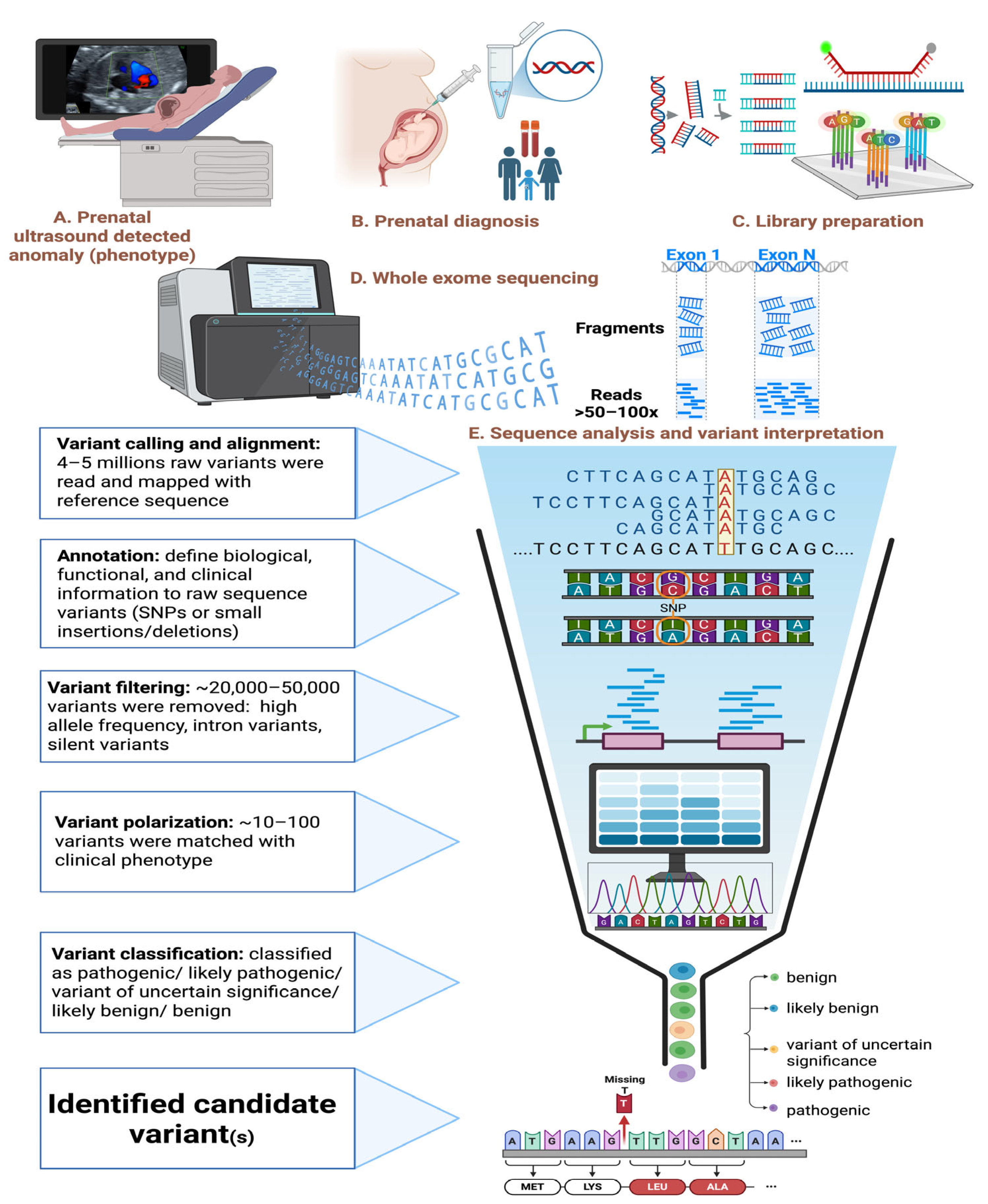
3. The Process of Prenatal WES: From Prenatal Ultrasound to Causative Genetic Variant
4. Genetic Regulation of Heart Development and Associated CHD
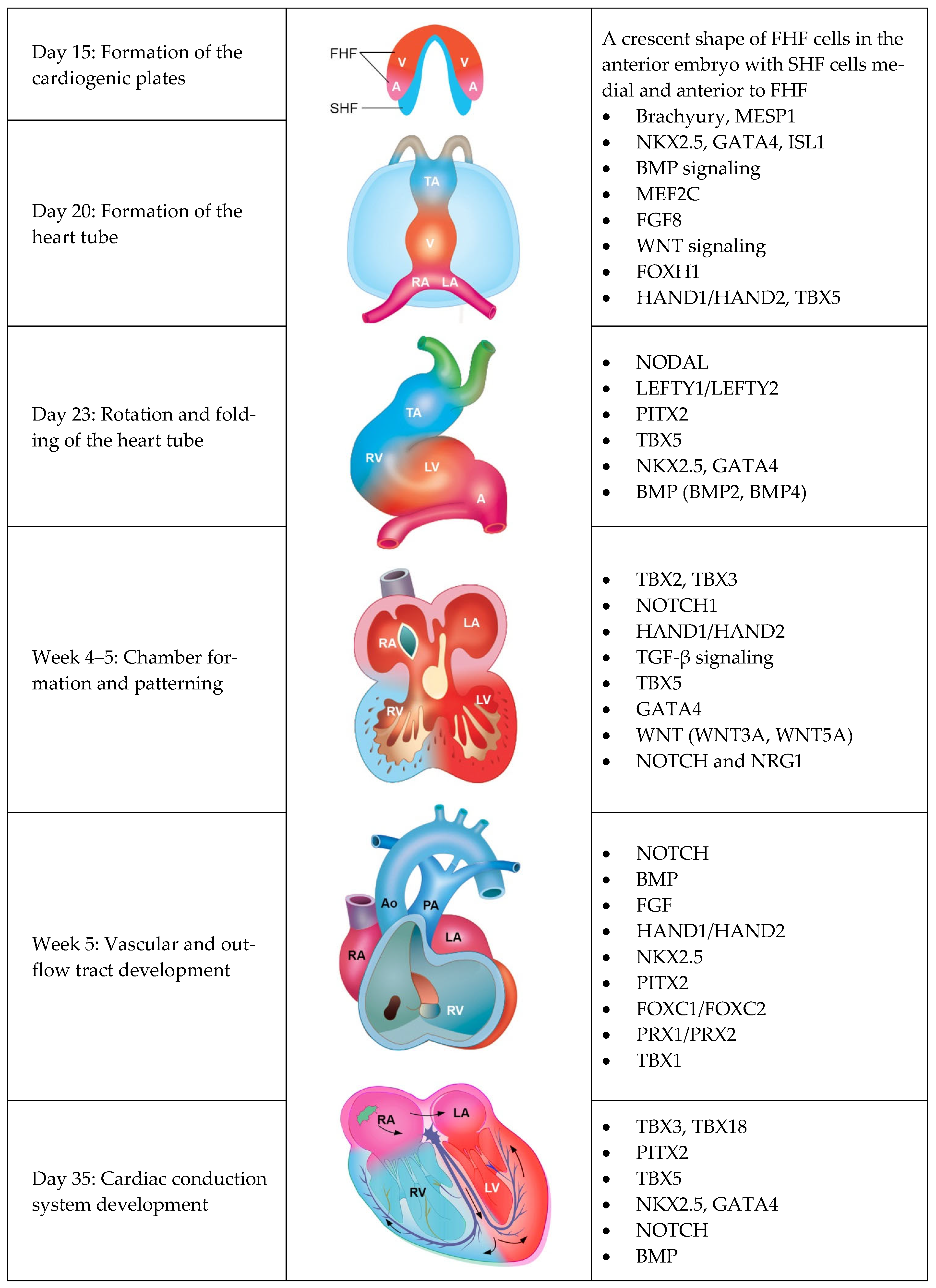
4.1. Formation of the Cardiogenic Plates and Heart Tube
4.2. Rotation and Folding of the Heart Tube
- Truncus arteriosus: arising from the bulbus cordis and later developing into the ascending aorta and pulmonary trunk.
- Bulbus cordis: consisting of the conus cordis and the lower part of the ventricle, which will eventually form the smooth portions of the right and left ventricles.
- Primitive ventricle: connected to the primitive atrium via the narrow atrioventricular canal. The region connecting to the bulbus cordis, known as the bulbo-ventricular sulcus, later forms the interventricular groove. The primitive ventricle develops into the trabeculated portions of the ventricles.
- Primitive atrium: giving rise to the trabeculated parts of the atria.
- Sinus venosus: a thin-walled, sac-like structure formed by the confluence of the left and right sinus horns. It later contributes to the smooth part of the right atrium, the coronary sinus, and the vein of the left atrium.
4.3. Chamber Formation and Patterning

| Process | Key Genes | Regulation Pathways | Associated CHDs |
|---|---|---|---|
|
|
|
|
|
|
|
|
|
|
| |
|
|
| |
|
|
|
4.4. Vascular and Outflow Tract Development
4.5. Development of Cardiac Conduction System
5. The Additional Diagnostic Yield of Prenatal WES in CHD
- Normal QF-PCR, followed by normal karyotyping and CMA, then WES
- Normal QF-PCR and CMA, followed by WES
- Normal karyotyping, followed by CMA and then WES
- Normal results from either QF-PCR, karyotyping, or CMA, followed by WES
- Normal CMA, followed by WES
- Normal CNV sequencing, followed by WES
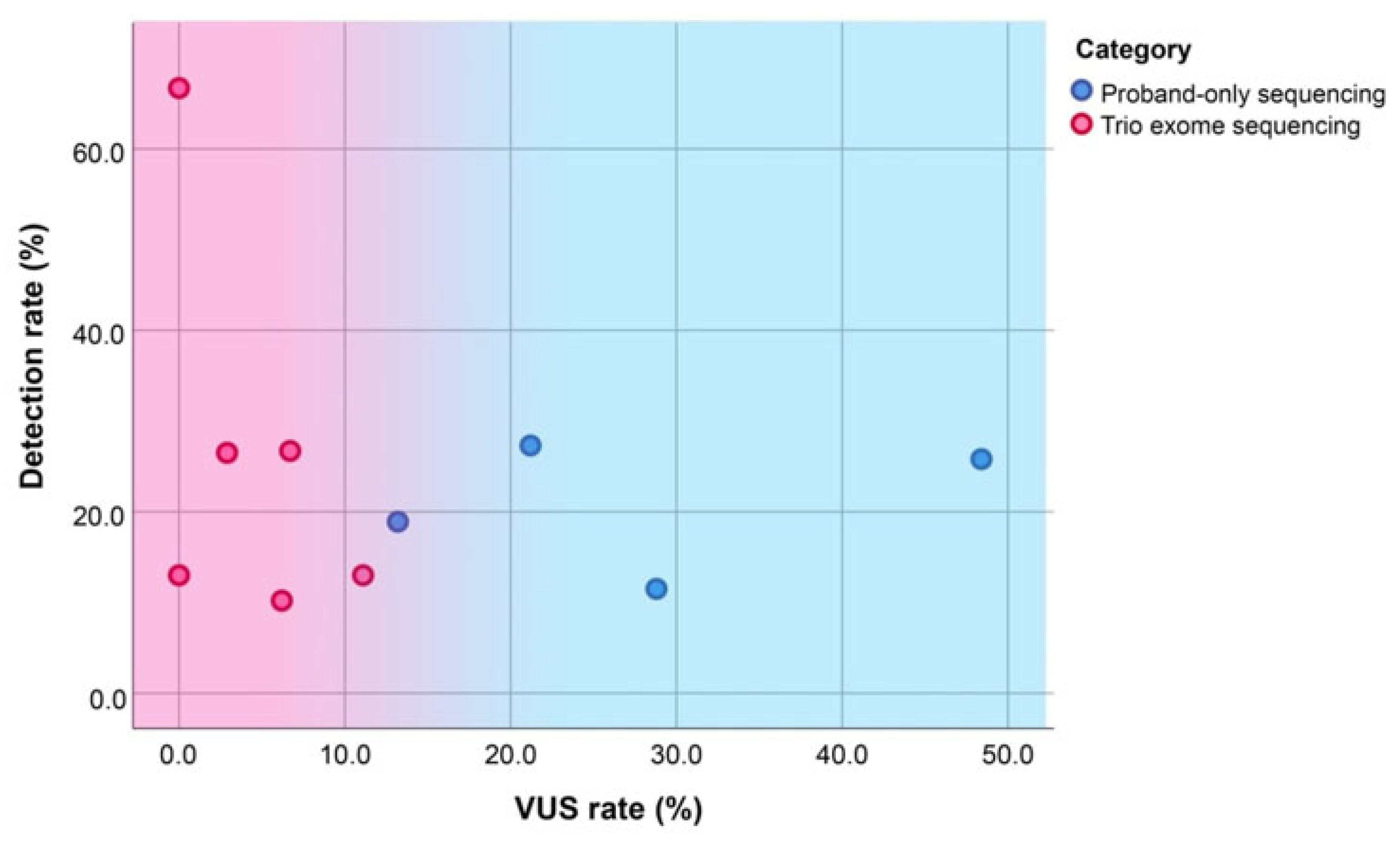
6. The Utility of Trio-Based Exome over Proband-Only Sequencing in Improving Diagnostic Accuracy
7. Prognosis and Outcomes of CHD Cases Associated with Pathogenic/Likely Pathogenic Variants
8. Conclusions
9. Future Research Perspectives
Author Contributions
Funding
Institutional Review Board Statement
Informed Consent Statement
Data Availability Statement
Acknowledgments
Conflicts of Interest
References
- Liu, Y.; Chen, S.; Zühlke, L.; Black, G.C.; Choy, M.K.; Li, N.; Keavney, B.D. Global birth prevalence of congenital heart defects 1970–2017: Updated systematic review and meta-analysis of 260 studies. Int. J. Epidemiol. 2019, 48, 455–463. [Google Scholar] [CrossRef]
- Zimmerman, M.S.; Smith, A.G.C.; A Sable, C.; Echko, M.M.; Wilner, L.B.; Olsen, H.E.; Atalay, H.T.; Awasthi, A.; A Bhutta, Z.; Boucher, J.L.; et al. Global, regional, and national burden of congenital heart disease, 1990–2017: A systematic analysis for the Global Burden of Disease Study 2017. Lancet Child. Adolesc. Health 2020, 4, 185–200. [Google Scholar] [CrossRef]
- Hoffman, J.I.; Kaplan, S. The incidence of congenital heart disease. J. Am. Coll. Cardiol. 2002, 39, 1890–1900. [Google Scholar] [CrossRef]
- Alvarado, J.L.; Bermon, A.; Florez, C.; Castro, J.; Cruz, M.; Franco, H.; Martinez, C.; Villegas, K.; Shabbir, N.; Weisman, A.G.; et al. Outcomes and Associated Extracardiac Malformations in Neonates from Colombia with Severe Congenital Heart Disease. Pediatr. Cardiol. 2024, 45, 55–62. [Google Scholar] [CrossRef] [PubMed]
- Jacobsen, R.M. Outcomes in Adult Congenital Heart Disease: Neurocognitive Issues and Transition of Care. Pediatr. Clin. N. Am. 2020, 67, 963–971. [Google Scholar] [CrossRef] [PubMed]
- Vassar, R.; Peyvandi, S.; Gano, D.; Cox, S.; Zetino, Y.; Miller, S.; McQuillen, P. Critical congenital heart disease beyond HLHS and TGA: Neonatal brain injury and early neurodevelopment. Pediatr. Res. 2023, 94, 691–698. [Google Scholar] [CrossRef] [PubMed]
- Bakker, M.K.; Bergman, J.E.H.; Krikov, S.; Amar, E.; Cocchi, G.; Cragan, J.; de Walle, H.E.K.; Gatt, M.; Groisman, B.; Liu, S.; et al. Prenatal diagnosis and prevalence of critical congenital heart defects: An international retrospective cohort study. BMJ Open 2019, 9, e028139. [Google Scholar] [CrossRef]
- Tegnander, E.; Williams, W.; Johansen, O.J.; Blaas, H.G.; Eik-Nes, S.H. Prenatal detection of heart defects in a non-selected population of 30,149 fetuses--detection rates and outcome. Ultrasound Obstet. Gynecol. 2006, 27, 252–265. [Google Scholar] [CrossRef]
- American Institute of Ultrasound in Medicine. AIUM Practice Parameter for the Performance of Fetal Echocardiography. J. Ultrasound Med. 2020, 39, e5–e16. [Google Scholar] [CrossRef]
- Donofrio, M.T.; Moon-Grady, A.J.; Hornberger, L.K.; Copel, J.A.; Sklansky, M.S.; Abuhamad, A.; Cuneo, B.F.; Huhta, J.C.; Jonas, R.A.; Krishnan, A.; et al. Diagnosis and treatment of fetal cardiac disease: A scientific statement from the American Heart Association. Circulation 2014, 129, 2183–2242. [Google Scholar] [CrossRef]
- Jenkins, K.J.; Correa, A.; Feinstein, J.A.; Botto, L.; Britt, A.E.; Daniels, S.R.; Elixson, M.; Warnes, C.A.; Webb, C.L. Noninherited risk factors and congenital cardiovascular defects: Current knowledge: A scientific statement from the American Heart Association Council on Cardiovascular Disease in the Young: Endorsed by the American Academy of Pediatrics. Circulation 2007, 115, 2995–3014. [Google Scholar] [CrossRef]
- Gianforcaro, K.; Pilchman, L.; Conway, L.; Moldenhauer, J.S.; Rychik, J.; Soni, S. Is there an increased risk of genetic abnormalities in fetuses with congenital heart disease in the setting of growth restriction? Prenat. Diagn. 2024, 44, 879–887. [Google Scholar] [CrossRef] [PubMed]
- Yasuhara, J.; Garg, V. Genetics of congenital heart disease: A narrative review of recent advances and clinical implications. Transl. Pediatr. 2021, 10, 2366–2386. [Google Scholar] [CrossRef] [PubMed]
- Trevisan, P.; Rosa, R.F.; Koshiyama, D.B.; Zen, T.D.; Paskulin, G.A.; Zen, P.R. Congenital heart disease and chromossomopathies detected by the karyotype. Rev. Paul. Pediatr. 2014, 32, 262–271. [Google Scholar] [CrossRef] [PubMed]
- Wang, H.; Lin, X.; Lyu, G.; He, S.; Dong, B.; Yang, Y. Chromosomal abnormalities in fetuses with congenital heart disease: A meta-analysis. Arch. Gynecol. Obstet. 2023, 308, 797–811. [Google Scholar] [CrossRef]
- Ehrlich, L.; Prakash, S.K. Copy-number variation in congenital heart disease. Curr. Opin. Genet. Dev. 2022, 77, 101986. [Google Scholar] [CrossRef]
- Hay, S.B.; Sahoo, T.; Travis, M.K.; Hovanes, K.; Dzidic, N.; Doherty, C.; Strecker, M.N. ACOG and SMFM guidelines for prenatal diagnosis: Is karyotyping really sufficient? Prenat. Diagn. 2018, 38, 184–189. [Google Scholar] [CrossRef]
- Mone, F.; Eberhardt, R.Y.; Morris, R.K.; Hurles, M.E.; McMullan, D.J.; Maher, E.R.; Lord, J.; Chitty, L.S.; Giordano, J.L.; Wapner, R.J.; et al. COngenital heart disease and the Diagnostic yield with Exome sequencing (CODE) study: Prospective cohort study and systematic review. Ultrasound Obstet. Gynecol. 2021, 57, 43–51. [Google Scholar] [CrossRef]
- Reilly, K.; Sonner, S.; McCay, N.; Rolnik, D.L.; Casey, F.; Seale, A.N.; Watson, C.J.; Kan, A.; Lai, T.H.T.; Chung, B.H.Y.; et al. The incremental yield of prenatal exome sequencing over chromosome microarray for congenital heart abnormalities: A systematic review and meta-analysis. Prenat. Diagn. 2024, 44, 821–831. [Google Scholar] [CrossRef]
- Committee Opinion No.682: Microarrays and Next-Generation Sequencing Technology: The Use of Advanced Genetic Diagnostic Tools in Obstetrics and Gynecology. Obstet. Gynecol. 2016, 128, e262–e268. [CrossRef]
- Marangoni, M.; Smits, G.; Ceysens, G.; Costa, E.; Coulon, R.; Daelemans, C.; De Coninck, C.; Derisbourg, S.; Gajewska, K.; Garofalo, G.; et al. Implementation of fetal clinical exome sequencing: Comparing prospective and retrospective cohorts. Genet. Med. 2022, 24, 344–363. [Google Scholar] [CrossRef] [PubMed]
- Xue, H.; Yu, A.; Chen, L.; Guo, Q.; Zhang, L.; Lin, N.; Chen, X.; Xu, L.; Huang, H. Prenatal genetic diagnosis of fetuses with dextrocardia using whole exome sequencing in a tertiary center. Sci. Rep. 2024, 14, 16266. [Google Scholar] [CrossRef] [PubMed]
- Miller, D.T.; Lee, K.; Abul-Husn, N.S.; Amendola, L.M.; Brothers, K.; Chung, W.K.; Gollob, M.H.; Gordon, A.S.; Harrison, S.M.; Hershberger, R.E.; et al. ACMG SF v3.2 list for reporting of secondary findings in clinical exome and genome sequencing: A policy statement of the American College of Medical Genetics and Genomics (ACMG). Genet. Med. 2023, 25, 100866. [Google Scholar] [CrossRef] [PubMed]
- Richards, S.; Aziz, N.; Bale, S.; Bick, D.; Das, S.; Gastier-Foster, J.; Grody, W.W.; Hegde, M.; Lyon, E.; Spector, E.; et al. Standards and guidelines for the interpretation of sequence variants: A joint consensus recommendation of the American College of Medical Genetics and Genomics and the Association for Molecular Pathology. Genet. Med. 2015, 17, 405–424. [Google Scholar] [CrossRef]
- De Koning, M.A.; Haak, M.C.; Adama van Scheltema, P.N.; Peeters-Scholte, C.; Koopmann, T.T.; Nibbeling, E.A.R.; Aten, E.; den Hollander, N.S.; Ruivenkamp, C.A.L.; Hoffer, M.J.V.; et al. From diagnostic yield to clinical impact: A pilot study on the implementation of prenatal exome sequencing in routine care. Genet. Med. 2019, 21, 2303–2310. [Google Scholar] [CrossRef]
- Epstein, J.A. Franklin H. Epstein Lecture. Cardiac development and implications for heart disease. N. Engl. J. Med. 2010, 363, 1638–1647. [Google Scholar] [CrossRef]
- Miquerol, L.; Kelly, R.G. Organogenesis of the vertebrate heart. Wiley Interdiscip. Rev. Dev. Biol. 2013, 2, 17–29. [Google Scholar] [CrossRef]
- Srivastava, D. Making or breaking the heart: From lineage determination to morphogenesis. Cell 2006, 126, 1037–1048. [Google Scholar] [CrossRef]
- Maleki, S.; Poujade, F.A.; Bergman, O.; Gådin, J.R.; Simon, N.; Lång, K.; Franco-Cereceda, A.; Body, S.C.; Björck, H.M.; Eriksson, P. Endothelial/Epithelial Mesenchymal Transition in Ascending Aortas of Patients With Bicuspid Aortic Valve. Front. Cardiovasc. Med. 2019, 6, 182. [Google Scholar] [CrossRef]
- Saxena, S.; Mathur, P.; Shukla, V.; Rani, V. Differential expression of novel MicroRNAs from developing fetal heart of Gallus gallus domesticus implies a role in cardiac development. Mol. Cell Biochem. 2019, 462, 157–165. [Google Scholar] [CrossRef]
- Garg, V.; Yamagishi, C.; Hu, T.; Kathiriya, I.S.; Yamagishi, H.; Srivastava, D. Tbx1, a DiGeorge syndrome candidate gene, is regulated by sonic hedgehog during pharyngeal arch development. Dev. Biol. 2001, 235, 62–73. [Google Scholar] [CrossRef] [PubMed]
- Zhao, Y.; Wang, Y.; Shi, L.; McDonald-McGinn, D.M.; Crowley, T.B.; McGinn, D.E.; Tran, O.T.; Miller, D.; Lin, J.R.; Zackai, E.; et al. Chromatin regulators in the TBX1 network confer risk for conotruncal heart defects in 22q11.2DS. NPJ Genom. Med. 2023, 8, 17. [Google Scholar] [CrossRef] [PubMed]
- Bamford, R.N.; Roessler, E.; Burdine, R.D.; Saplakoğlu, U.; dela Cruz, J.; Splitt, M.; Goodship, J.A.; Towbin, J.; Bowers, P.; Ferrero, G.B.; et al. Loss-of-function mutations in the EGF-CFC gene CFC1 are associated with human left-right laterality defects. Nat. Genet. 2000, 26, 365–369. [Google Scholar] [CrossRef] [PubMed]
- Bamforth, S.D.; Bragança, J.; Farthing, C.R.; Schneider, J.E.; Broadbent, C.; Michell, A.C.; Clarke, K.; Neubauer, S.; Norris, D.; Brown, N.A.; et al. Cited2 controls left-right patterning and heart development through a Nodal-Pitx2c pathway. Nat. Genet. 2004, 36, 1189–1196. [Google Scholar] [CrossRef]
- Branford, W.W.; Essner, J.J.; Yost, H.J. Regulation of gut and heart left-right asymmetry by context-dependent interactions between xenopus lefty and BMP4 signaling. Dev. Biol. 2000, 223, 291–306. [Google Scholar] [CrossRef]
- Inman, K.E.; Downs, K.M. Localization of Brachyury (T) in embryonic and extraembryonic tissues during mouse gastrulation. Gene Expr. Patterns 2006, 6, 783–793. [Google Scholar] [CrossRef]
- Bondue, A.; Blanpain, C. Mesp1: A key regulator of cardiovascular lineage commitment. Circ. Res. 2010, 107, 1414–1427. [Google Scholar] [CrossRef]
- Chan, S.S.; Shi, X.; Toyama, A.; Arpke, R.W.; Dandapat, A.; Iacovino, M.; Kang, J.; Le, G.; Hagen, H.R.; Garry, D.J.; et al. Mesp1 patterns mesoderm into cardiac, hematopoietic, or skeletal myogenic progenitors in a context-dependent manner. Cell Stem Cell 2013, 12, 587–601. [Google Scholar] [CrossRef]
- Lescroart, F.; Chabab, S.; Lin, X.; Rulands, S.; Paulissen, C.; Rodolosse, A.; Auer, H.; Achouri, Y.; Dubois, C.; Bondue, A.; et al. Early lineage restriction in temporally distinct populations of Mesp1 progenitors during mammalian heart development. Nat. Cell Biol. 2014, 16, 829–840. [Google Scholar] [CrossRef]
- Chiapparo, G.; Lin, X.; Lescroart, F.; Chabab, S.; Paulissen, C.; Pitisci, L.; Bondue, A.; Blanpain, C. Mesp1 controls the speed, polarity, and directionality of cardiovascular progenitor migration. J. Cell Biol. 2016, 213, 463–477. [Google Scholar] [CrossRef]
- Zhang, L.; Nomura-Kitabayashi, A.; Sultana, N.; Cai, W.; Cai, X.; Moon, A.M.; Cai, C.L. Mesodermal Nkx2.5 is necessary and sufficient for early second heart field development. Dev. Biol. 2014, 390, 68–79. [Google Scholar] [CrossRef] [PubMed]
- Durocher, D.; Charron, F.; Warren, R.; Schwartz, R.J.; Nemer, M. The cardiac transcription factors Nkx2-5 and GATA-4 are mutual cofactors. EMBO J. 1997, 16, 5687–5696. [Google Scholar] [CrossRef] [PubMed]
- Jamali, M.; Rogerson, P.J.; Wilton, S.; Skerjanc, I.S. Nkx2-5 activity is essential for cardiomyogenesis. J. Biol. Chem. 2001, 276, 42252–42258. [Google Scholar] [CrossRef] [PubMed]
- Tanaka, M.; Chen, Z.; Bartunkova, S.; Yamasaki, N.; Izumo, S. The cardiac homeobox gene Csx/Nkx2.5 lies genetically upstream of multiple genes essential for heart development. Development 1999, 126, 1269–1280. [Google Scholar] [CrossRef]
- Cai, C.L.; Liang, X.; Shi, Y.; Chu, P.H.; Pfaff, S.L.; Chen, J.; Evans, S. Isl1 identifies a cardiac progenitor population that proliferates prior to differentiation and contributes a majority of cells to the heart. Dev. Cell 2003, 5, 877–889. [Google Scholar] [CrossRef]
- Christiaen, L.; Stolfi, A.; Levine, M. BMP signaling coordinates gene expression and cell migration during precardiac mesoderm development. Dev. Biol. 2010, 340, 179–187. [Google Scholar] [CrossRef]
- Schlange, T.; Andrée, B.; Arnold, H.H.; Brand, T. BMP2 is required for early heart development during a distinct time period. Mech. Dev. 2000, 91, 259–270. [Google Scholar] [CrossRef]
- Materna, S.C.; Sinha, T.; Barnes, R.M.; Lammerts van Bueren, K.; Black, B.L. Cardiovascular development and survival require Mef2c function in the myocardial but not the endothelial lineage. Dev. Biol. 2019, 445, 170–177. [Google Scholar] [CrossRef]
- Karamboulas, C.; Dakubo, G.D.; Liu, J.; De Repentigny, Y.; Yutzey, K.; Wallace, V.A.; Kothary, R.; Skerjanc, I.S. Disruption of MEF2 activity in cardiomyoblasts inhibits cardiomyogenesis. J. Cell Sci. 2006, 119, 4315–4321. [Google Scholar] [CrossRef]
- Hinits, Y.; Pan, L.; Walker, C.; Dowd, J.; Moens, C.B.; Hughes, S.M. Zebrafish Mef2ca and Mef2cb are essential for both first and second heart field cardiomyocyte differentiation. Dev. Biol. 2012, 369, 199–210. [Google Scholar] [CrossRef]
- Vincentz, J.W.; Barnes, R.M.; Firulli, B.A.; Conway, S.J.; Firulli, A.B. Cooperative interaction of Nkx2.5 and Mef2c transcription factors during heart development. Dev. Dyn. 2008, 237, 3809–3819. [Google Scholar] [CrossRef]
- Ilagan, R.; Abu-Issa, R.; Brown, D.; Yang, Y.P.; Jiao, K.; Schwartz, R.J.; Klingensmith, J.; Meyers, E.N. Fgf8 is required for anterior heart field development. Development 2006, 133, 2435–2445. [Google Scholar] [CrossRef]
- Alsan, B.H.; Schultheiss, T.M. Regulation of avian cardiogenesis by Fgf8 signaling. Development 2002, 129, 1935–1943. [Google Scholar] [CrossRef]
- Reifers, F.; Walsh, E.C.; Léger, S.; Stainier, D.Y.; Brand, M. Induction and differentiation of the zebrafish heart requires fibroblast growth factor 8 (fgf8/acerebellar). Development 2000, 127, 225–235. [Google Scholar] [CrossRef] [PubMed]
- Liu, Z.; Li, T.; Liu, Y.; Jia, Z.; Li, Y.; Zhang, C.; Chen, P.; Ma, K.; Affara, N.; Zhou, C. WNT signaling promotes Nkx2.5 expression and early cardiomyogenesis via downregulation of Hdac1. Biochim. Biophys. Acta 2009, 1793, 300–311. [Google Scholar] [CrossRef] [PubMed]
- Jain, R.; Li, D.; Gupta, M.; Manderfield, L.J.; Ifkovits, J.L.; Wang, Q.; Liu, F.; Liu, Y.; Poleshko, A.; Padmanabhan, A.; et al. HEART DEVELOPMENT. Integration of Bmp and Wnt signaling by Hopx specifies commitment of cardiomyoblasts. Science 2015, 348, aaa6071. [Google Scholar] [CrossRef] [PubMed]
- Nakamura, T.; Sano, M.; Songyang, Z.; Schneider, M.D. A Wnt- and beta -catenin-dependent pathway for mammalian cardiac myogenesis. Proc. Natl. Acad. Sci. USA 2003, 100, 5834–5839. [Google Scholar] [CrossRef]
- Klaus, A.; Saga, Y.; Taketo, M.M.; Tzahor, E.; Birchmeier, W. Distinct roles of Wnt/beta-catenin and Bmp signaling during early cardiogenesis. Proc. Natl. Acad. Sci. USA 2007, 104, 18531–18536. [Google Scholar] [CrossRef]
- Marvin, M.J.; Di Rocco, G.; Gardiner, A.; Bush, S.M.; Lassar, A.B. Inhibition of Wnt activity induces heart formation from posterior mesoderm. Genes. Dev. 2001, 15, 316–327. [Google Scholar] [CrossRef]
- Von Both, I.; Silvestri, C.; Erdemir, T.; Lickert, H.; Walls, J.R.; Henkelman, R.M.; Rossant, J.; Harvey, R.P.; Attisano, L.; Wrana, J.L. Foxh1 is essential for development of the anterior heart field. Dev. Cell 2004, 7, 331–345. [Google Scholar] [CrossRef]
- Shiratori, H.; Yashiro, K.; Shen, M.M.; Hamada, H. Conserved regulation and role of Pitx2 in situs-specific morphogenesis of visceral organs. Development 2006, 133, 3015–3025. [Google Scholar] [CrossRef]
- Meno, C.; Shimono, A.; Saijoh, Y.; Yashiro, K.; Mochida, K.; Ohishi, S.; Noji, S.; Kondoh, H.; Hamada, H. lefty-1 is required for left-right determination as a regulator of lefty-2 and nodal. Cell 1998, 94, 287–297. [Google Scholar] [CrossRef] [PubMed]
- Tadjuidje, E.; Kofron, M.; Mir, A.; Wylie, C.; Heasman, J.; Cha, S.W. Nodal signalling in Xenopus: The role of Xnr5 in left/right asymmetry and heart development. Open Biol. 2016, 6, 150187. [Google Scholar] [CrossRef] [PubMed]
- Campione, M.; Steinbeisser, H.; Schweickert, A.; Deissler, K.; van Bebber, F.; Lowe, L.A.; Nowotschin, S.; Viebahn, C.; Haffter, P.; Kuehn, M.R.; et al. The homeobox gene Pitx2: Mediator of asymmetric left-right signaling in vertebrate heart and gut looping. Development 1999, 126, 1225–1234. [Google Scholar] [CrossRef] [PubMed]
- Logan, M.; Pagán-Westphal, S.M.; Smith, D.M.; Paganessi, L.; Tabin, C.J. The transcription factor Pitx2 mediates situs-specific morphogenesis in response to left-right asymmetric signals. Cell 1998, 94, 307–317. [Google Scholar] [CrossRef]
- Dagle, J.M.; Sabel, J.L.; Littig, J.L.; Sutherland, L.B.; Kolker, S.J.; Weeks, D.L. Pitx2c attenuation results in cardiac defects and abnormalities of intestinal orientation in developing Xenopus laevis. Dev. Biol. 2003, 262, 268–281. [Google Scholar] [CrossRef]
- Yu, X.; St Amand, T.R.; Wang, S.; Li, G.; Zhang, Y.; Hu, Y.P.; Nguyen, L.; Qiu, M.S.; Chen, Y.P. Differential expression and functional analysis of Pitx2 isoforms in regulation of heart looping in the chick. Development 2001, 128, 1005–1013. [Google Scholar] [CrossRef]
- Ai, D.; Liu, W.; Ma, L.; Dong, F.; Lu, M.F.; Wang, D.; Verzi, M.P.; Cai, C.; Gage, P.J.; Evans, S.; et al. Pitx2 regulates cardiac left-right asymmetry by patterning second cardiac lineage-derived myocardium. Dev. Biol. 2006, 296, 437–449. [Google Scholar] [CrossRef]
- Misra, C.; Chang, S.W.; Basu, M.; Huang, N.; Garg, V. Disruption of myocardial Gata4 and Tbx5 results in defects in cardiomyocyte proliferation and atrioventricular septation. Hum. Mol. Genet. 2014, 23, 5025–5035. [Google Scholar] [CrossRef]
- Xie, L.; Hoffmann, A.D.; Burnicka-Turek, O.; Friedland-Little, J.M.; Zhang, K.; Moskowitz, I.P. Tbx5-hedgehog molecular networks are essential in the second heart field for atrial septation. Dev. Cell 2012, 23, 280–291. [Google Scholar] [CrossRef]
- Nadeau, M.; Georges, R.O.; Laforest, B.; Yamak, A.; Lefebvre, C.; Beauregard, J.; Paradis, P.; Bruneau, B.G.; Andelfinger, G.; Nemer, M. An endocardial pathway involving Tbx5, Gata4, and Nos3 required for atrial septum formation. Proc. Natl. Acad. Sci. USA 2010, 107, 19356–19361. [Google Scholar] [CrossRef] [PubMed]
- Zhang, K.K.; Xiang, M.; Zhou, L.; Liu, J.; Curry, N.; Heine Suñer, D.; Garcia-Pavia, P.; Zhang, X.; Wang, Q.; Xie, L. Gene network and familial analyses uncover a gene network involving Tbx5/Osr1/Pcsk6 interaction in the second heart field for atrial septation. Hum. Mol. Genet. 2016, 25, 1140–1151. [Google Scholar] [CrossRef] [PubMed]
- Shiojima, I.; Komuro, I.; Oka, T.; Hiroi, Y.; Mizuno, T.; Takimoto, E.; Monzen, K.; Aikawa, R.; Akazawa, H.; Yamazaki, T.; et al. Context-dependent transcriptional cooperation mediated by cardiac transcription factors Csx/Nkx-2.5 and GATA-4. J. Biol. Chem. 1999, 274, 8231–8239. [Google Scholar] [CrossRef] [PubMed]
- Singh, R.; Hoogaars, W.M.; Barnett, P.; Grieskamp, T.; Rana, M.S.; Buermans, H.; Farin, H.F.; Petry, M.; Heallen, T.; Martin, J.F.; et al. Tbx2 and Tbx3 induce atrioventricular myocardial development and endocardial cushion formation. Cell Mol. Life Sci. 2012, 69, 1377–1389. [Google Scholar] [CrossRef]
- Singh, R.; Horsthuis, T.; Farin, H.F.; Grieskamp, T.; Norden, J.; Petry, M.; Wakker, V.; Moorman, A.F.; Christoffels, V.M.; Kispert, A. Tbx20 interacts with smads to confine tbx2 expression to the atrioventricular canal. Circ. Res. 2009, 105, 442–452. [Google Scholar] [CrossRef]
- Del Monte-Nieto, G.; Ramialison, M.; Adam, A.A.S.; Wu, B.; Aharonov, A.; D’Uva, G.; Bourke, L.M.; Pitulescu, M.E.; Chen, H.; de la Pompa, J.L.; et al. Control of cardiac jelly dynamics by NOTCH1 and NRG1 defines the building plan for trabeculation. Nature 2018, 557, 439–445. [Google Scholar] [CrossRef]
- Togi, K.; Kawamoto, T.; Yamauchi, R.; Yoshida, Y.; Kita, T.; Tanaka, M. Role of Hand1/eHAND in the dorso-ventral patterning and interventricular septum formation in the embryonic heart. Mol. Cell Biol. 2004, 24, 4627–4635. [Google Scholar] [CrossRef]
- Srivastava, D.; Thomas, T.; Lin, Q.; Kirby, M.L.; Brown, D.; Olson, E.N. Regulation of cardiac mesodermal and neural crest development by the bHLH transcription factor, dHAND. Nat. Genet. 1997, 16, 154–160. [Google Scholar] [CrossRef]
- Shirai, M.; Imanaka-Yoshida, K.; Schneider, M.D.; Schwartz, R.J.; Morisaki, T. T-box 2, a mediator of Bmp-Smad signaling, induced hyaluronan synthase 2 and Tgfbeta2 expression and endocardial cushion formation. Proc. Natl. Acad. Sci. USA 2009, 106, 18604–18609. [Google Scholar] [CrossRef]
- Rivera-Feliciano, J.; Lee, K.H.; Kong, S.W.; Rajagopal, S.; Ma, Q.; Springer, Z.; Izumo, S.; Tabin, C.J.; Pu, W.T. Development of heart valves requires Gata4 expression in endothelial-derived cells. Development 2006, 133, 3607–3618. [Google Scholar] [CrossRef]
- Eisenberg, L.M.; Eisenberg, C.A. Evaluating the role of Wnt signal transduction in promoting the development of the heart. Sci. World J. 2007, 7, 161–176. [Google Scholar] [CrossRef] [PubMed]
- Grego-Bessa, J.; Luna-Zurita, L.; del Monte, G.; Bolós, V.; Melgar, P.; Arandilla, A.; Garratt, A.N.; Zang, H.; Mukouyama, Y.S.; Chen, H.; et al. Notch signaling is essential for ventricular chamber development. Dev. Cell 2007, 12, 415–429. [Google Scholar] [CrossRef] [PubMed]
- Samsa, L.A.; Givens, C.; Tzima, E.; Stainier, D.Y.; Qian, L.; Liu, J. Cardiac contraction activates endocardial Notch signaling to modulate chamber maturation in zebrafish. Development 2015, 142, 4080–4091. [Google Scholar] [CrossRef] [PubMed]
- Yang, Y.; Li, B.; Zhang, X.; Zhao, Q.; Lou, X. The zinc finger protein Zfpm1 modulates ventricular trabeculation through Neuregulin-ErbB signalling. Dev. Biol. 2019, 446, 142–150. [Google Scholar] [CrossRef]
- Kozyrev, I.; Dokshin, P.; Kostina, A.; Kiselev, A.; Ignatieva, E.; Golovkin, A.; Pervunina, T.; Grekhov, E.; Gordeev, M.; Kostareva, A.; et al. Dysregulation of Notch signaling in cardiac mesenchymal cells of patients with tetralogy of Fallot. Pediatr. Res. 2020, 88, 38–47. [Google Scholar] [CrossRef]
- Zhang, J.; Lin, Y.; Zhang, Y.; Lan, Y.; Lin, C.; Moon, A.M.; Schwartz, R.J.; Martin, J.F.; Wang, F. Frs2alpha-deficiency in cardiac progenitors disrupts a subset of FGF signals required for outflow tract morphogenesis. Development 2008, 135, 3611–3622. [Google Scholar] [CrossRef]
- Horton, A.J.; Brooker, J.; Streitfeld, W.S.; Flessa, M.E.; Pillai, B.; Simpson, R.; Clark, C.D.; Gooz, M.B.; Sutton, K.K.; Foley, A.C.; et al. Nkx2-5 Second Heart Field Target Gene Ccdc117 Regulates DNA Metabolism and Proliferation. Sci. Rep. 2019, 9, 1738. [Google Scholar] [CrossRef]
- Bergwerff, M.; Gittenberger-de Groot, A.C.; Wisse, L.J.; DeRuiter, M.C.; Wessels, A.; Martin, J.F.; Olson, E.N.; Kern, M.J. Loss of function of the Prx1 and Prx2 homeobox genes alters architecture of the great elastic arteries and ductus arteriosus. Virchows Arch. 2000, 436, 12–19. [Google Scholar] [CrossRef]
- Zhao, C.M.; Peng, L.Y.; Li, L.; Liu, X.Y.; Wang, J.; Zhang, X.L.; Yuan, F.; Li, R.G.; Qiu, X.B.; Yang, Y.Q. PITX2 Loss-of-Function Mutation Contributes to Congenital Endocardial Cushion Defect and Axenfeld-Rieger Syndrome. PLoS ONE 2015, 10, e0124409. [Google Scholar] [CrossRef]
- Kume, T.; Jiang, H.; Topczewska, J.M.; Hogan, B.L. The murine winged helix transcription factors, Foxc1 and Foxc2, are both required for cardiovascular development and somitogenesis. Genes. Dev. 2001, 15, 2470–2482. [Google Scholar] [CrossRef]
- Lindsay, E.A.; Vitelli, F.; Su, H.; Morishima, M.; Huynh, T.; Pramparo, T.; Jurecic, V.; Ogunrinu, G.; Sutherland, H.F.; Scambler, P.J.; et al. Tbx1 haploinsufficieny in the DiGeorge syndrome region causes aortic arch defects in mice. Nature 2001, 410, 97–101. [Google Scholar] [CrossRef] [PubMed]
- Hoogaars, W.M.; Tessari, A.; Moorman, A.F.; de Boer, P.A.; Hagoort, J.; Soufan, A.T.; Campione, M.; Christoffels, V.M. The transcriptional repressor Tbx3 delineates the developing central conduction system of the heart. Cardiovasc. Res. 2004, 62, 489–499. [Google Scholar] [CrossRef] [PubMed]
- Mohan, R.A.; Mommersteeg, M.T.M.; Domínguez, J.N.; Choquet, C.; Wakker, V.; de Gier-de Vries, C.; Boink, G.J.J.; Boukens, B.J.; Miquerol, L.; Verkerk, A.O.; et al. Embryonic Tbx3(+) cardiomyocytes form the mature cardiac conduction system by progressive fate restriction. Development 2018, 145, dev167361. [Google Scholar] [CrossRef] [PubMed]
- Mohan, R.A.; Bosada, F.M.; van Weerd, J.H.; van Duijvenboden, K.; Wang, J.; Mommersteeg, M.T.M.; Hooijkaas, I.B.; Wakker, V.; de Gier-de Vries, C.; Coronel, R.; et al. T-box transcription factor 3 governs a transcriptional program for the function of the mouse atrioventricular conduction system. Proc. Natl. Acad. Sci. USA 2020, 117, 18617–18626. [Google Scholar] [CrossRef]
- Zhang, W.; Zhao, H.; Quan, D.; Tang, Y.; Wang, X.; Huang, C. Tbx18 promoted the conversion of human-induced pluripotent stem cell-derived cardiomyocytes into sinoatrial node-like pacemaker cells. Cell Biol. Int. 2022, 46, 403–414. [Google Scholar] [CrossRef]
- Wang, J.; Bai, Y.; Li, N.; Ye, W.; Zhang, M.; Greene, S.B.; Tao, Y.; Chen, Y.; Wehrens, X.H.; Martin, J.F. Pitx2-microRNA pathway that delimits sinoatrial node development and inhibits predisposition to atrial fibrillation. Proc. Natl. Acad. Sci. USA 2014, 111, 9181–9186. [Google Scholar] [CrossRef]
- Moskowitz, I.P.; Pizard, A.; Patel, V.V.; Bruneau, B.G.; Kim, J.B.; Kupershmidt, S.; Roden, D.; Berul, C.I.; Seidman, C.E.; Seidman, J.G. The T-Box transcription factor Tbx5 is required for the patterning and maturation of the murine cardiac conduction system. Development 2004, 131, 4107–4116. [Google Scholar] [CrossRef]
- Harris, B.S.; Spruill, L.; Edmonson, A.M.; Rackley, M.S.; Benson, D.W.; O’Brien, T.X.; Gourdie, R.G. Differentiation of cardiac Purkinje fibers requires precise spatiotemporal regulation of Nkx2-5 expression. Dev. Dyn. 2006, 235, 38–49. [Google Scholar] [CrossRef]
- Meysen, S.; Marger, L.; Hewett, K.W.; Jarry-Guichard, T.; Agarkova, I.; Chauvin, J.P.; Perriard, J.C.; Izumo, S.; Gourdie, R.G.; Mangoni, M.E.; et al. Nkx2.5 cell-autonomous gene function is required for the postnatal formation of the peripheral ventricular conduction system. Dev. Biol. 2007, 303, 740–753. [Google Scholar] [CrossRef]
- Harris, J.P.; Bhakta, M.; Bezprozvannaya, S.; Wang, L.; Lubczyk, C.; Olson, E.N.; Munshi, N.V. MyoR modulates cardiac conduction by repressing Gata4. Mol. Cell Biol. 2015, 35, 649–661. [Google Scholar] [CrossRef]
- Rentschler, S.; Harris, B.S.; Kuznekoff, L.; Jain, R.; Manderfield, L.; Lu, M.M.; Morley, G.E.; Patel, V.V.; Epstein, J.A. Notch signaling regulates murine atrioventricular conduction and the formation of accessory pathways. J. Clin. Investig. 2011, 121, 525–533. [Google Scholar] [CrossRef] [PubMed]
- Liu, F.; Fang, Y.; Hou, X.; Yan, Y.; Xiao, H.; Zuo, D.; Wen, J.; Wang, L.; Zhou, Z.; Dang, X.; et al. Enrichment differentiation of human induced pluripotent stem cells into sinoatrial node-like cells by combined modulation of BMP, FGF, and RA signaling pathways. Stem Cell Res. Ther. 2020, 11, 284. [Google Scholar] [CrossRef] [PubMed]
- Vincentz, J.W.; Barnes, R.M.; Firulli, A.B. Hand factors as regulators of cardiac morphogenesis and implications for congenital heart defects. Birth Defects Res. A Clin. Mol. Teratol. 2011, 91, 485–494. [Google Scholar] [CrossRef] [PubMed]
- Bai, Y.; Wang, J.; Morikawa, Y.; Bonilla-Claudio, M.; Klysik, E.; Martin, J.F. Bmp signaling represses Vegfa to promote outflow tract cushion development. Development 2013, 140, 3395–3402. [Google Scholar] [CrossRef]
- Lord, J.; McMullan, D.J.; Eberhardt, R.Y.; Rinck, G.; Hamilton, S.J.; Quinlan-Jones, E.; Prigmore, E.; Keelagher, R.; Best, S.K.; Carey, G.K.; et al. Prenatal exome sequencing analysis in fetal structural anomalies detected by ultrasonography (PAGE): A cohort study. Lancet 2019, 393, 747–757. [Google Scholar] [CrossRef]
- Pashmforoush, M.; Lu, J.T.; Chen, H.; Amand, T.S.; Kondo, R.; Pradervand, S.; Evans, S.M.; Clark, B.; Feramisco, J.R.; Giles, W.; et al. Nkx2-5 pathways and congenital heart disease; loss of ventricular myocyte lineage specification leads to progressive cardiomyopathy and complete heart block. Cell 2004, 117, 373–386. [Google Scholar] [CrossRef]
- Damani, S.B.; Topol, E.J. Molecular genetics of atrial fibrillation. Genome Med. 2009, 1, 54. [Google Scholar] [CrossRef]
- Gudbjartsson, D.F.; Arnar, D.O.; Helgadottir, A.; Gretarsdottir, S.; Holm, H.; Sigurdsson, A.; Jonasdottir, A.; Baker, A.; Thorleifsson, G.; Kristjansson, K.; et al. Variants conferring risk of atrial fibrillation on chromosome 4q25. Nature 2007, 448, 353–357. [Google Scholar] [CrossRef]
- Mommersteeg, M.T.; Brown, N.A.; Prall, O.W.; de Gier-de Vries, C.; Harvey, R.P.; Moorman, A.F.; Christoffels, V.M. Pitx2c and Nkx2-5 are required for the formation and identity of the pulmonary myocardium. Circ. Res. 2007, 101, 902–909. [Google Scholar] [CrossRef]
- Normand, E.A.; Braxton, A.; Nassef, S.; Ward, P.A.; Vetrini, F.; He, W.; Patel, V.; Qu, C.; Westerfield, L.E.; Stover, S.; et al. Clinical exome sequencing for fetuses with ultrasound abnormalities and a suspected Mendelian disorder. Genome Med. 2018, 10, 74. [Google Scholar] [CrossRef]
- Yi, T.; Sun, H.; Fu, Y.; Hao, X.; Sun, L.; Zhang, Y.; Han, J.; Gu, X.; Liu, X.; Guo, Y.; et al. Genetic and Clinical Features of Heterotaxy in a Prenatal Cohort. Front. Genet. 2022, 13, 818241. [Google Scholar] [CrossRef] [PubMed]
- Li, M.; Ye, B.; Chen, Y.; Gao, L.; Wu, Y.; Cheng, W. Analysis of genetic testing in fetuses with congenital heart disease of single atria and/or single ventricle in a Chinese prenatal cohort. BMC Pediatr. 2023, 23, 577. [Google Scholar] [CrossRef] [PubMed]
- Lu, F.; Xue, P.; Zhang, B.; Wang, J.; Yu, B.; Liu, J. Estimating the frequency of causal genetic variants in foetuses with congenital heart defects: A Chinese cohort study. Orphanet J. Rare Dis. 2022, 17, 2. [Google Scholar] [CrossRef] [PubMed]
- Hu, P.; Qiao, F.; Wang, Y.; Meng, L.; Ji, X.; Luo, C.; Xu, T.; Zhou, R.; Zhang, J.; Yu, B.; et al. Clinical application of targeted next-generation sequencing in fetuses with congenital heart defect. Ultrasound Obstet. Gynecol. 2018, 52, 205–211. [Google Scholar] [CrossRef]
- Tan, M.; Wang, X.; Liu, H.; Peng, X.; Yang, Y.; Yu, H.; Xu, L.; Li, J.; Cao, H. Genetic Diagnostic Yield and Novel Causal Genes of Congenital Heart Disease. Front. Genet. 2022, 13, 941364. [Google Scholar] [CrossRef]
- Qiao, F.; Wang, Y.; Zhang, C.; Zhou, R.; Wu, Y.; Wang, C.; Meng, L.; Mao, P.; Cheng, Q.; Luo, C.; et al. Comprehensive evaluation of genetic variants using chromosomal microarray analysis and exome sequencing in fetuses with congenital heart defect. Ultrasound Obstet. Gynecol. 2021, 58, 377–387. [Google Scholar] [CrossRef]
- Sun, H.; Yi, T.; Hao, X.; Yan, H.; Wang, J.; Li, Q.; Gu, X.; Zhou, X.; Wang, S.; Wang, X.; et al. Contribution of single-gene defects to congenital cardiac left-sided lesions in the prenatal setting. Ultrasound Obstet. Gynecol. 2020, 56, 225–232. [Google Scholar] [CrossRef]
- Fu, F.; Li, R.; Li, Y.; Nie, Z.Q.; Lei, T.; Wang, D.; Yang, X.; Han, J.; Pan, M.; Zhen, L.; et al. Whole exome sequencing as a diagnostic adjunct to clinical testing in fetuses with structural abnormalities. Ultrasound Obstet. Gynecol. 2018, 51, 493–502. [Google Scholar] [CrossRef]
- Dempsey, E.; Haworth, A.; Ive, L.; Dubis, R.; Savage, H.; Serra, E.; Kenny, J.; Elmslie, F.; Greco, E.; Thilaganathan, B.; et al. A report on the impact of rapid prenatal exome sequencing on the clinical management of 52 ongoing pregnancies: A retrospective review. Bjog 2021, 128, 1012–1019. [Google Scholar] [CrossRef]
- Kucińska-Chahwan, A.; Geremek, M.; Roszkowski, T.; Bijok, J.; Massalska, D.; Ciebiera, M.; Correia, H.; Pereira-Caetano, I.; Barreta, A.; Obersztyn, E.; et al. Implementation of Exome Sequencing in Prenatal Diagnosis and Impact on Genetic Counseling: The Polish Experience. Genes 2022, 13, 724. [Google Scholar] [CrossRef]
- Westphal, D.S.; Leszinski, G.S.; Rieger-Fackeldey, E.; Graf, E.; Weirich, G.; Meitinger, T.; Ostermayer, E.; Oberhoffer, R.; Wagner, M. Lessons from exome sequencing in prenatally diagnosed heart defects: A basis for prenatal testing. Clin. Genet. 2019, 95, 582–589. [Google Scholar] [CrossRef]
- Li, R.; Fu, F.; Yu, Q.; Wang, D.; Jing, X.; Zhang, Y.; Li, F.; Li, F.; Han, J.; Pan, M.; et al. Prenatal exome sequencing in fetuses with congenital heart defects. Clin. Genet. 2020, 98, 215–230. [Google Scholar] [CrossRef]
- Mone, F.; McMullan, D.J.; Williams, D.; Chitty, L.S.; Maher, E.R.; Kilby, M.D. Evidence to Support the Clinical Utility of Prenatal Exome Sequencing in Evaluation of the Fetus with Congenital Anomalies: Scientific Impact Paper No. 64 [February] 2021. Bjog 2021, 128, e39–e50. [Google Scholar] [CrossRef] [PubMed]
- Yi, T.; Hao, X.; Sun, H.; Zhang, Y.; Han, J.; Gu, X.; Sun, L.; Liu, X.; Zhao, Y.; Guo, Y.; et al. Genetic aetiology distribution of 398 foetuses with congenital heart disease in the prenatal setting. ESC Heart Fail. 2023, 10, 917–930. [Google Scholar] [CrossRef] [PubMed]
- Lin, S.; Shi, S.; Lu, J.; He, Z.; Li, D.; Huang, L.; Huang, X.; Zhou, Y.; Luo, Y. Contribution of genetic variants to congenital heart defects in both singleton and twin fetuses: A Chinese cohort study. Mol. Cytogenet. 2024, 17, 2. [Google Scholar] [CrossRef] [PubMed]
- Van Nisselrooij, A.E.L.; Lugthart, M.A.; Clur, S.A.; Linskens, I.H.; Pajkrt, E.; Rammeloo, L.A.; Rozendaal, L.; Blom, N.A.; van Lith, J.M.M.; Knegt, A.C.; et al. The prevalence of genetic diagnoses in fetuses with severe congenital heart defects. Genet. Med. 2020, 22, 1206–1214. [Google Scholar] [CrossRef]
- Xing, Y.; Zhang, Y.; Chen, J.; Wu, F.; Yuan, M.; Zou, G.; Yang, Y.; Zhou, F.; Zhou, J.; Sun, L. Prenatal diagnosis for fetuses with isolated and non-isolated congenital heart defects using chromosomal microarray and exome sequencing. Prenat. Diagn. 2022, 42, 873–880. [Google Scholar] [CrossRef]
- Yates, C.L.; Monaghan, K.G.; Copenheaver, D.; Retterer, K.; Scuffins, J.; Kucera, C.R.; Friedman, B.; Richard, G.; Juusola, J. Whole-exome sequencing on deceased fetuses with ultrasound anomalies: Expanding our knowledge of genetic disease during fetal development. Genet. Med. 2017, 19, 1171–1178. [Google Scholar] [CrossRef]
- Diderich, K.E.M.; Romijn, K.; Joosten, M.; Govaerts, L.C.P.; Polak, M.; Bruggenwirth, H.T.; Wilke, M.; van Slegtenhorst, M.A.; van Bever, Y.; Brooks, A.S.; et al. The potential diagnostic yield of whole exome sequencing in pregnancies complicated by fetal ultrasound anomalies. Acta Obstet. Gynecol. Scand. 2021, 100, 1106–1115. [Google Scholar] [CrossRef]
- Lai, T.H.T.; Au, L.K.S.; Lau, Y.T.E.; Lo, H.M.; Chan, K.Y.K.; Cheung, K.W.; Ma, T.W.L.; Leung, W.C.; Kong, C.W.; Shu, W.; et al. Application of Prenatal Whole Exome Sequencing for Structural Congenital Anomalies-Experience from a Local Prenatal Diagnostic Laboratory. Healthcare 2022, 10, 2521. [Google Scholar] [CrossRef]
- Leung, G.K.C.; Mak, C.C.Y.; Fung, J.L.F.; Wong, W.H.S.; Tsang, M.H.Y.; Yu, M.H.C.; Pei, S.L.C.; Yeung, K.S.; Mok, G.T.K.; Lee, C.P.; et al. Identifying the genetic causes for prenatally diagnosed structural congenital anomalies (SCAs) by whole-exome sequencing (WES). BMC Med. Genom. 2018, 11, 93. [Google Scholar] [CrossRef]
- Sun, H.; Hao, X.; Wang, X.; Zhou, X.; Zhang, Y.; Liu, X.; Han, J.; Gu, X.; Sun, L.; Zhao, Y.; et al. Genetics and Clinical Features of Noncompaction Cardiomyopathy in the Fetal Population. Front. Cardiovasc. Med. 2020, 7, 617561. [Google Scholar] [CrossRef]
- Sacco, A.; Talker, R.; Sarkies, L.; Ashraf, T.; Chandler, N.J.; Pandya, P.; Jowett, V.; Hillman, S. The evolving genetic etiology of conotruncal anomalies. Prenat. Diagn. 2024, 44, 815–820. [Google Scholar] [CrossRef]
- Monaghan, K.G.; Leach, N.T.; Pekarek, D.; Prasad, P.; Rose, N.C. The use of fetal exome sequencing in prenatal diagnosis: A points to consider document of the American College of Medical Genetics and Genomics (ACMG). Genet. Med. 2020, 22, 675–680. [Google Scholar] [CrossRef]
- Mone, F.; Abu Subieh, H.; Doyle, S.; Hamilton, S.; McMullan, D.J.; Allen, S.; Marton, T.; Williams, D.; Kilby, M.D. Evolving fetal phenotypes and clinical impact of progressive prenatal exome sequencing pathways: Cohort study. Ultrasound Obstet. Gynecol. 2022, 59, 723–730. [Google Scholar] [CrossRef]
- Vora, N.L.; Norton, M.E. Prenatal exome and genome sequencing for fetal structural abnormalities. Am. J. Obstet. Gynecol. 2023, 228, 140–149, Erratum in Am. J. Obstet. Gynecol. 2023, 229, 709. https://doi.org/10.1016/j.ajog.2023.09.017. [Google Scholar] [CrossRef] [PubMed]


| Study | Prenatal Study Cohort | Number of Cases | Genetic Approach | WES Approach | CHD with Prenatal WES | P/LP Variant Cases | Detection Rate (%) |
|---|---|---|---|---|---|---|---|
| Total Cases (Isolated/Non-Isolated) | Total Cases (Isolated/Non-Isolated) | Total (Isolated/Non-Isolated) | |||||
| Lu, 2022 [113] | Cardiac anomalies | 200 | Normal CMA ⟶ WES | Proband | 52 (44/8) | 6 (5/1) | 11.5 (11.4/12.5) |
| Hu, 2018 [114] | Cardiac anomalies | 1126 | Normal karyotyping ⟶ Normal CMA ⟶ WES | Proband | 44 (33/11) | 7 (3/4) | 15.9 (9.1/36.4) |
| Tan, 2022 [115] | Cardiac anomalies | 121 | Combined low-coverage WGS and WES | Proband | 53 (23/30) | 10 (4/6) | 18.9 (17.4/20.0) |
| Qiao, 2021 [116] | Cardiac anomalies | 360 | Normal karyotyping/CMA ⟶ WES | Combined | 300 (243/57) | 24 (18/6) | 8.0 (7.4/10.5) |
| Sun, 2020 [117] | Left-sided heart defect | 80 | Normal CNV sequencing ⟶ WES | Combined | 66 (53/13) | 13 (8/5) | 19.7 (15.1/38.5) |
| Fu, 2018 [118] | Congenital anomalies | 3988 | Normal QF-PCR ⟶ Normal karyotyping ⟶ Normal CMA ⟶ WES | Combined | 34 (28/6) | 7 (2/5) | 20.6 (7.1/83.3) |
| Dempsey, 2021 [119] | Congenital anomalies | 52 | Normal CMA ⟶ WES | Combined | 32 (NA/NA) | 7 (NA/NA) | 21.9 (NA/NA) |
| Chahwan, 2022 [120] | Congenital anomalies | 122 | Normal karyotyping/CMA ⟶ WES | Combined | 31 (12/19) | 8 (1/7) | 25.8 (8.3/36.8) |
| Marangoni, 2022 [21] | Congenital anomalies | 303 | Normal QF-PCR ⟶ Normal CMA ⟶ WES | Combined | 34 (NA/NA) | 9 (NA/NA) | 26.5 (NA/NA) |
| Westphal, 2019 [121] | Cardiac anomalies | 30 | Normal karyotyping/CMA/SGS ⟶ WES | Combined | 30 (15/15) | 8 (3/5) | 26.7 (20.0/33.3) |
| Normand, 2018 [110] | Congenital anomalies | 146 | Normal karyotyping/CMA ⟶ WES | Combined | 37 (NA/NA) | 11 (NA/NA) | 29.8 (NA/NA) |
| Li, 2020 [122] | Cardiac anomalies | 260 | Normal karyotyping/CMA ⟶ WES | Trio | 260 (190/70) | 26 (16/10) | 10.0 (8.4/14.3) |
| Mone, 2021 [123] | Cardiac anomalies | 147 | Normal QF-PCR ⟶ Normal karyotyping/CMA ⟶ WES | Trio | 107 (85/22) | 11 (8/3) | 10.3 (9.4/13.6) |
| Yi, 2023 [124] | Cardiac anomalies | 736 | Normal CNV sequencing ⟶ WES | Trio | 301 (206/95) | 32 (18/14) | 10.6 (0/14.7) |
| Lord, 2019 [105] | Congenital anomalies | 744 | Normal QF-PCR ⟶ Normal CMA ⟶ WES | Trio | 193 (122/71) | 24 (14/10) | 12.4 (11.5/14.1) |
| Lin, 2024 [125] | Cardiac anomalies | 1118 | Normal CMA ⟶ WES | Trio | 62 (41/21) | 8 (5/3) | 12.9 (12.2/14.3) |
| van Nisselrooij, 2020 [126] | Cardiac anomalies | 727 | Normal CMA ⟶ WES | Trio | 108 (NA/NA) | 14 (NA/NA) | 13.0 (NA/NA) |
| Xing, 2022 [127] | Cardiac anomalies | 586 | Normal QF-PCR/Karyotyping/CMA ⟶ WES | Trio | 47 (19/28) | 7 (2/5) | 14.9 (10.5/17.9) |
| Yates, 2017 [128] | Terminated anomalous | 84 | Normal karyotyping/CMA ⟶ WES | Trio | 26 (NA/NA) | 6 (0/6) | 23.1 (NA/NA) |
| Diderich, 2021 [129] | Cardiac anomalies | 391 | Normal CMA ⟶ WES | Trio | 44 (32/12) | 14 (2/12) | 31.8 (6.3/100) |
| Lai, 2022 [130] | Congenital anomalies | 93 | Normal QF-PCR/Karyotyping/CMA ⟶ WES | Trio | 38 (NA/NA) | 13 (NA/NA) | 34.2 (NA/NA) |
| Leung, 2018 [131] | Congenital anomalies | 33 | Normal QF-PCR/Karyotyping/CMA ⟶ WES | Trio | 7 (NA/NA) | 3 (1/2) | 42.9 (NA/NA) |
| Koning, 2019 [25] | Congenital anomalies | 22 | Normal karyotyping/CMA ⟶ WES | Trio | 6 (2/4) | 4 (0/4) | 66.7 (0/80.0) |
| Yi, 2022 [111] | Heterotaxy | 135 | Normal CNV sequencing ⟶ WES | Trio | 69 (0/69) | 9 (0/9) | 13.0 (0/13.0) |
| Xue, 2024 [22] | Dextrocardia | 29 | Normal karyotyping/CMA ⟶ WES | Trio | 15 (11/4) | 3 (1/2) | 20.0 (9.1/50.0) |
| Sun, 2020 [132] | NCCM | 37 | Normal CNV sequencing ⟶ WES | Trio | 20 (18/2) | 5 (5/0) | 25.0 (27.8/0) |
| Li, 2023 [112] | Single atrium/ventricle | 44 | Normal karyotyping/CMA ⟶ WES | Trio | 7 (4/3) | 2 (1/1) | 28.6 (25.0/33.3) |
| Sacco, 2024 [133] | Conotruncal anomalies | 302 | Normal QF-PCR/CMA ⟶ WES | Trio | 16 (5/11) | 6 (1/5) | 37.5 (20.0/45.5) |
| Study | WES Approach | Prenatal Specimen | Number of Cases | Number of P/LP Variants | Number of VUS | Detection Rate (%) | VUS (%) | Turnaround Time |
|---|---|---|---|---|---|---|---|---|
| Hu, 2018 [114] | Proband | CVS, AF, cord blood | 34 | 7 | 4 | 20.6 | 11.8 | 3 wk |
| Tan, 2022 [115] | Proband | AF, cord blood, heart tissue | 53 | 10 | 7 | 18.9 | 13.2 | NA |
| Lu, 2022 [113] | Proband | AF | 52 | 6 | 15 | 11.5 | 28.8 | NA |
| Fu, 2018 [118] | 75.0% Proband 25.0% Trio | CVS, AF, cord blood | 34 | 7 | 4 (Proband-only) | 20.6 | 11.8 | 3 wk |
| Chahwan, 2022 [120] | 91.0% Proband 9.0% Trio | CVS, AF, cord blood | 31 | 8 | 15 | 25.8 | 48.4 | 12 wk |
| Normand, 2018 [110] | Trio and Proband | CVS, AF, cord blood | 37 | 11 | NA | 29.7 | NA | Proband: 12.6 wk Trio: 2 wk |
| Dempsey, 2021 [119] | 74.4% Trio | CVS, AF | 32 | 7 | 0 | 21.9 | 0 | 14–17 d |
| Sun, 2020 [117] | 78.8% Trio | Cord blood | 66 | 13 | 5 | 19.7 | 7.6 | NA |
| Westphal, 2019 [121] | 83.3% Trio | CVS, AF, cord blood, skin or umbilical tissue | 30 | 8 | 2 | 26.7 | 6.7 | 3–12 wk |
| Marangoni, 2022 [21] | 96.3% Trio | CVS, AF, cord blood | 34 | 9 | 1 | 26.5 | 2.9 | 17–43 d |
| Koning, 2019 [25] | Trio | CVS, AF | 6 | 4 | 0 | 66.7 | 0 | <17 d |
| Li, 2020 [122] | Trio | CVS, AF | 260 | 26 | 16 | 10.0 | 6.2 | 3–8 wk |
| Mone, 2021 [123] | Trio | CVS, AF | 107 | 11 | 5 | 10.3 | 4.7 | NA |
| Yi, 2022 [111] | Trio | Cord blood | 69 | 9 | 0 | 13.0 | 0 | NA |
| van Nisselrooij, 2020 [126] | Trio | Prenatal diagnosis procedures | 108 | 14 | 12 | 13.0 | 11.1 | NA |
| Study | GA at CHD Diagnosed | Turnaround Time | Prenatal WES Cases | P/LP Cases | Pregnancy Outcome of P/LP Variants (Cases) | Neonatal Outcome |
|---|---|---|---|---|---|---|
| Normand, 2018 [110] | NA | 2 wk | 37 | 11 | TOP (all) | - |
| Sun, 2020 [132] | 20–33 wk | NA | 20 | 5 | TOP (all) | - |
| Li, 2023 [112] | 17–22 wk | NA | 7 | 2 | TOP (all) | - |
| Xue, 2024 [22] | 13–27 wk | NA | 15 | 3 | TOP (all) | - |
| Lin, 2024 [125] | 20–28 wk | NA | 62 | 8 | TOP (all) | - |
| Hu, 2018 [114] | 24–27 wk | 3 wk | 44 | 7 | TOP (4), continued pregnancy (3) | NA |
| Mone, 2021 [123] | 17–26 wk | NA | 107 | 11 | TOP (6), stillbirth (1), livebirth (4) | NA |
| Westphal, 2019 [121] | 12–36 wk | 3–8 wk | 30 | 8 | TOP (6), livebirth (2) | NA |
| Dempsey, 2021 [119] | NA | NA | 32 | 7 | TOP (4), livebirth (3) | 1 case: livebirth and received palliative care after birth 2 cases: livebirth and remain under pediatric follow-up |
| Marangoni, 2022 [21] | NA | 2–6 wk | 34 | 9 | TOP (6), stillbirth (2), livebirth (1) | 1 case: neonatal death at day 2 |
| Lai, 2022 [130] | NA | 4 wk | 38 | 13 | TOP (10), stillbirth (2), preterm birth (1) | 1 case: preterm birth with neonatal death at day 0 |
| Koning, 2019 [25] | Before 22 wk | 7–19 d | 7 | 4 | TOP (2), livebirth (2) | 1 case: neonatal death from airway obstruction in the NICU 1 case: preterm birth with neonatal death at day 18 post-surgery |
| Li, 2020 [122] | 11–35 wk | 3–8 wk | 260 | 26 | TOP (18), neonatal death (2), livebirth (4), loss to follow-up (2) | 2 cases: neonatal death 2 cases: loss to follow-up |
| Diderich, 2021 [129] | Before 24 wk | NA | 44 | 14 | TOP (7), livebirth (6), loss to follow-up (1) | All cases: livebirth and had extra-cardiac anomalies, e.g., corpus callosum agenesis, craniofacial or limb abnormalities |
| Xing, 2022 [127] | Before 28 wk | NA | 47 | 6 | TOP (5), livebirth (1) | 1 case: livebirth and underwent postnatal cardiac surgery with no extra-cardiac anomalies identified |
Disclaimer/Publisher’s Note: The statements, opinions and data contained in all publications are solely those of the individual author(s) and contributor(s) and not of MDPI and/or the editor(s). MDPI and/or the editor(s) disclaim responsibility for any injury to people or property resulting from any ideas, methods, instructions or products referred to in the content. |
© 2026 by the authors. Licensee MDPI, Basel, Switzerland. This article is an open access article distributed under the terms and conditions of the Creative Commons Attribution (CC BY) license.
Share and Cite
Kamlungkuea, T.; Tongprasert, F.; Wattanasirichaigoon, D.; Kumfu, S.; Chattipakorn, S.C.; Chattipakorn, N.; Tongsong, T. Application of Prenatal Whole Exome Sequencing for Congenital Heart Anomalies. Int. J. Mol. Sci. 2026, 27, 1720. https://doi.org/10.3390/ijms27041720
Kamlungkuea T, Tongprasert F, Wattanasirichaigoon D, Kumfu S, Chattipakorn SC, Chattipakorn N, Tongsong T. Application of Prenatal Whole Exome Sequencing for Congenital Heart Anomalies. International Journal of Molecular Sciences. 2026; 27(4):1720. https://doi.org/10.3390/ijms27041720
Chicago/Turabian StyleKamlungkuea, Threebhorn, Fuanglada Tongprasert, Duangrurdee Wattanasirichaigoon, Sirinart Kumfu, Siriporn C. Chattipakorn, Nipon Chattipakorn, and Theera Tongsong. 2026. "Application of Prenatal Whole Exome Sequencing for Congenital Heart Anomalies" International Journal of Molecular Sciences 27, no. 4: 1720. https://doi.org/10.3390/ijms27041720
APA StyleKamlungkuea, T., Tongprasert, F., Wattanasirichaigoon, D., Kumfu, S., Chattipakorn, S. C., Chattipakorn, N., & Tongsong, T. (2026). Application of Prenatal Whole Exome Sequencing for Congenital Heart Anomalies. International Journal of Molecular Sciences, 27(4), 1720. https://doi.org/10.3390/ijms27041720