Article

High Proportions of GAP43 Positivity in the Cerebrospinal Fluids of Patients with Sporadic and Certain Types of Genetic Creutzfeldt-Jakob Diseases by Western Blot Analysis


National Key Laboratory of Intelligent Tracking and Forecasting for Infectious Disease, NHC Key Laboratory of Medical Virology and Viral Diseases, National Institute for Viral Disease Control and Prevention, Chinese Center for Disease Control and Prevention, Beijing 102206, China
*
Authors to whom correspondence should be addressed.
Int. J. Mol. Sci. 2026, 27(4), 1678; https://doi.org/10.3390/ijms27041678
Submission received: 30 December 2025 / Revised: 29 January 2026 / Accepted: 5 February 2026 / Published: 9 February 2026
(This article belongs to the Section Molecular Neurobiology)

Abstract

Growth-associated protein-43 (GAP43) is a neuronal protein essential for synaptic function and plasticity, and its reduction has been observed in brains of prion diseases (PrDs) and rodent models. However, its status in the cerebrospinal fluid (CSF) of patients with PrDs remains unclear. CSF samples from 140 PrD cases, including 48 sCJD, 35 T188K-gCJD, 22 E200K-gCJD, 35 D178N-FFI, and 36 non-PrD controls, were analyzed for GAP43 by Western blot. The results were compared with 14-3-3 and calmodulin (CaM) detected by WB, and associated with clinical features. GAP43 positivity was significantly higher in sCJD (70.83%), T188K-gCJD (65.71%), and E200K-gCJD (72.73%) than in non-PrD controls (27.78%). The sensitivity and specificity of GAP43 (around 70–75%) were comparable to 14-3-3 and CaM, though inferior to RT-QuIC and total tau reported elsewhere. CSF GAP43 positivity correlated with sCJD-associated MRI changes, periodic sharp-wave complexes (PSWC) on EEG, and with 14-3-3 and CaM positivity. Our data here indicate the feasibility of usage of GAP43 by Western blot analysis as a diagnostic, at least as a screening, biomarker for sCJD and certain types of gPrDs.

1. Introduction

Human prion diseases (PrDs) are a group of fatal and transmissible neurodegenerative diseases, with sporadic Creutzfeldt-Jakob Disease (sCJD) accounting for about 85% of cases [1,2]. Approximately 5–15% of human PrDs are attributed to genetic mutations in PRNP, manifesting as genetic CJD (gCJD), fatal familial insomnia (FFI), and Gerstmann-Sträussler-Scheinker (GSS) syndrome. Definite acquired forms of PrDs are rare, such as iatrogenic CJD (iCJD), variant CJD (vCJD), and Kuru [3,4,5,6,7]. Although a definite diagnosis depends on neuropathological or PrPSc assays of postmortem or biopsy of brains, the real-time quaking-induced conversion (RT-QuIC) assay has revolutionized clinical diagnosis due to its high sensitivity and specificity using cerebrospinal fluid (CSF) or skin samples. Nevertheless, RT-QuIC is technically demanding and requires specialized equipment, limiting its availability in some clinical settings [8,9]. In parallel, exploration of the biomarkers in body fluid, particularly in CSF, has never ceased. A group of CSF proteins has shown diagnostic values, such as 14-3-3, tau, calmodulin (CaM), S100, Neurofilament light, β-synuclein, etc. [10,11,12,13]. Among them, CSF 14-3-3 by Western blot and total tau by ELISA are included in the diagnostic criteria for PrD in many countries.
Growth-associated protein-43 (GAP43) is a neuron-specific protein crucial for synaptic plasticity. Our earlier global brain transcriptomic assays of sCJD, FFI, and Alzheimer’s disease (AD) have identified a significant reduction in brain GAP43 levels. The proteomic study of the postmortem brains from sCJD, D178N-FFI, and G114V-gCJD patients also identified the downregulation of GAP43 [14,15,16]. More recently, using multiple methodologies such as Western blot, IFA, and IHC, we have observed that the brain levels of GAP43 are significantly decreased, whilst the phosphorylated form of GAP43 is elevated, in several scrapie-infected rodent models at the terminal stage, which shows close associations with neuron loss and PrPSc deposition during prion pathogenicity. However, little is known about CSF GAP43 alterations in PrD and its potential as a disease biomarker.
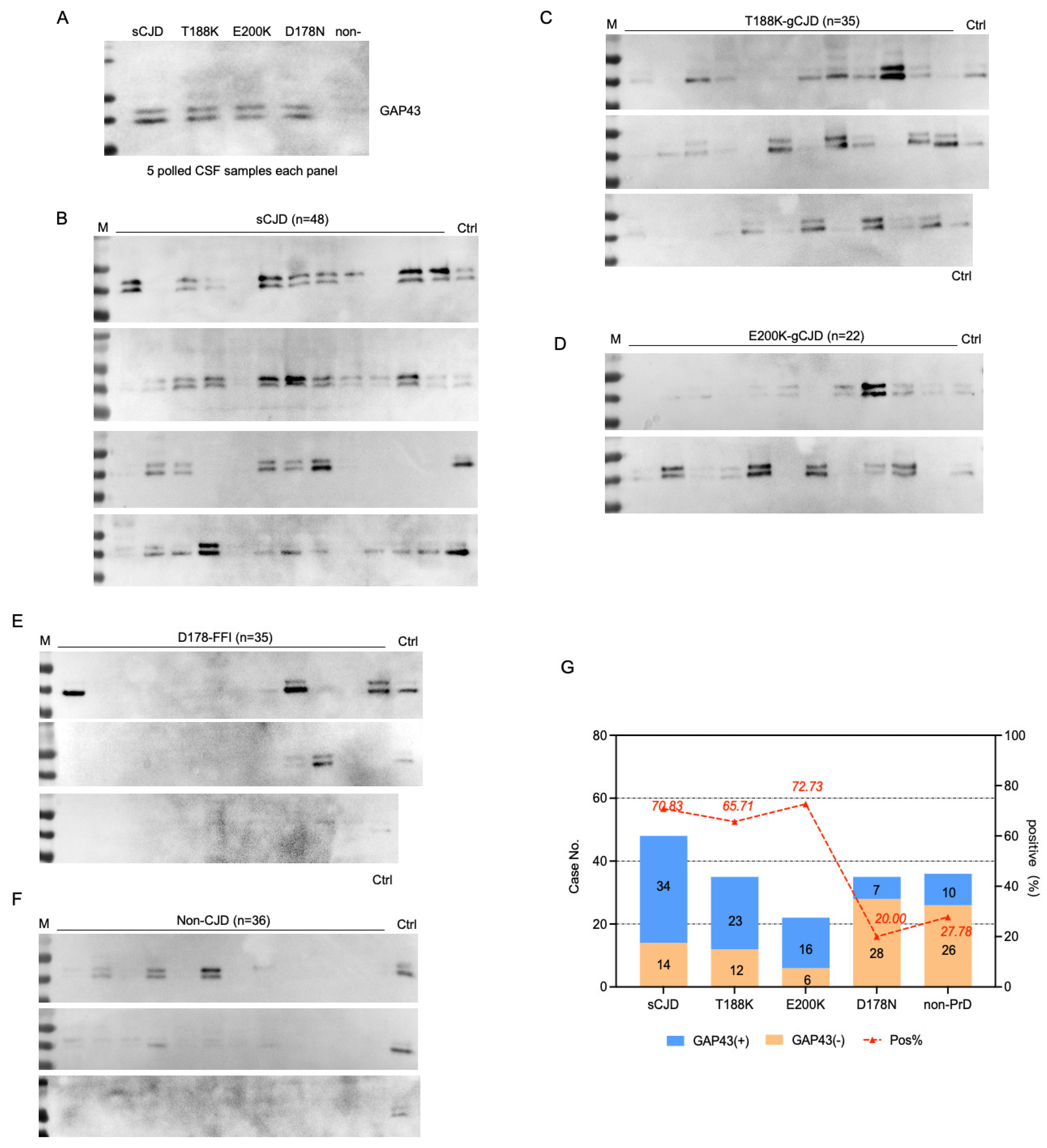
To address the possible changes of CSF GAP43 levels in PrD patients, the CSF samples from 140 different types of PrD cases and 36 non-PrD cases were selected in this study and subjected into GAP43 specific Western blot individually. Compared to the data of non-PrD (27.78%), the positive ratios of the cohorts of sCJD (70.83%), T188K- (65.71%), and E200K-gCJD (72.73%) were significantly higher, while that of D178N-FFI (20.00%) was remarkably low. CSF GAP43 positivity correlated well with the positivity of CSF 14-3-3 and CSF CaM in Western blots.

2. Results

2.1. Demographical and Clinical Characteristics

The main demographic and clinical features of all 176 cases were summarized in Appendix A. The median onset ages of sCJD, T188K-gCJD, E200K-gCJD, D178N-FFI, and non-CJD cases were 65, 62, 57, 53, and 58 years, respectively. Genotypic analysis revealed a predominance of Met/Met homozygote at codon 129 and Glu/Glu homozygote at codon 219 across all cohorts. Compared with the group of non-PrD, sCJD, and E200K-gCJD cases showed significantly higher raties of PSWC on EEG, MRI abnormalities, and CSF 14-3-3 positivity, while T188K-gCJD cases also exhibited higher rates of MRI abnormalities and CSF 14-3-3 positivity. No significant differences were observed for D178N-FFI versus non-PrD. Besides dementia, the frequency of other main sCJD-associated clinical symptoms was higher in all four PrD types than in controls.

2.2. GAP43 Positivity in CSF Across Various PrD Types

To address the CSF GAP43 status, Western blot analysis was performed on pooled and individual CSF samples. Each gel included a pooled sCJD-positive CSF sample as an internal normalization control. Two positive bands migrating at the position of 40 kDa were clearly detected in the CSF panels from sCJD and three other types of gPrDs, but were barely detectable in non-CJD samples (Figure 1A). Subsequently, equal amounts of CSF samples from 176 cases across different PrDs and non-CJD were individually blotted with anti-GAP43 antibody. Two specific bands with varying intensities were identified among different numbers of CSF specimens within each group (Figure 1B–F). The positive rates for CSF GAP43 were 70.83% (34/48) in sCJD, 65.71% (23/35) in T188K-gCJD, 72.73% (16/22) in E200K-gCJD, 20.02% (7/35) in D178N-FFI, 27.78% (10/36) in non-CJD, respectively (Figure 1G). Statistical analysis demonstrated significant differences among these groups (p < 0.001), with elevated GAP43 positivity in sCJD, T188K-gCJD, and E200K-gCJD compared to D178N-FFI and non-PrD (Table 1).

2.3. Correlation of CSF GAP43 Positivity with Clinical Features

The potential correlation of CSF GAP43 positivity was analyzed with key demographic, neurological, and clinical examination factors. The cases were categorized and counted based on CSF GAP43 positivity and negative status for different variables, and the statistical differences between positive and negative groups in various cohorts were calculated (Table 2). In the cohort of all PrDs, patients with GAP43 positivity displayed earlier onset ages than those with GAP43 negativity (p = 0.007). Patients who exhibited MRI abnormalities (p = 0.001), PSWC on EEG (p = 0.001), or mutism (p = 0.028) during their clinical courses had a higher proportion of positive CSF GAP43 results. Similarly, higher rates of CSF GAP43 positivity were observed in cases with recorded MRI abnormalities (p = 0.008) or PSWC on EEG (p = 0.011) within the cohort of all gPrDs. The remaining elements in these two cohorts did not reveal a statistical difference between GAP43-positive and negative groups. Moreover, no significant association was identified between CSF GAP43 positivity and selected clinical items within special PrD types (sCJD, T188K-gCJD, E200K-gCJD, D178N-FFI) as well as non-PrD.

2.4. Associations of CSF GAP43 with CSF 14-3-3 or CSF CaM

All 176 tested cases were addressed for Western blot data of CSF 14-3-3. To investigate the potential association of CSF GAP43 with 14-3-3, patients were categorized into GAP43-positive or negative groups according to their CSF 14-3-3 results. Statistical assays found that patients with CSF 14-3-3 positivity showed higher ratios of CSF GAP43 positivity in the cohorts of all PrDs (p = 0.008) and all gPrD (p = 0.018), whilst a lower ratio was observed in the cohort of non-PrD (p = 0.006) (Table 3). However, no statistically significant differences were identified among special PrD groups.
Out of the total 176 cases, Western blot results for CSF CaM were available for 152 cases. Analyses of the CSF GAP43 statuses in the groups of PrD showing CSF CaM positive and negative revealed higher GAP43 positivity ratios in CaM positive cases within the cohorts of all PrDs (p < 0.001), all gPrDs (p < 0.001) and T188K-gCJD (p < 0.001), but no statistical difference was observed in the other groups (Table 3).

2.5. Evaluation of the Diagnostic Performance of CSF GAP43

The diagnostic sensitivity and specificity of CSF GAP43 by Western blot for sCJD or gCJD (T188K and E200K) were comparatively evaluated alongside CSF 14-3-3 or CSF CaM. Based on the data from 48 sCJD and 36 non-PrD cases with both CSF GAP43 and CSF 14-3-3, the sensitivities of those two biomarkers were found to be 70.8% and 72.9%, while their specificities were determined as 72.2% and 75.0%, respectively. Similarly, using data from a cohort of 24 sCJD and 36 non-PrD patients with available information on both CSF GAP43 and CSF CaM, the sensitivities were calculated as 79.2% and 66.7%, whereas the specificities were estimated at approximately equal values of around 72.2% to 75.0%. In addition, among the group consisting of T188K- and E200K-gPrD cases (n = 57), Western blot analysis revealed that the sensitivities of GAP43, 14-3-3, and CaM were measured as 68.4%, 75.4%, and 80.7%, respectively, while their respective specificities were between 72.2% and 75.0% (Table 4).
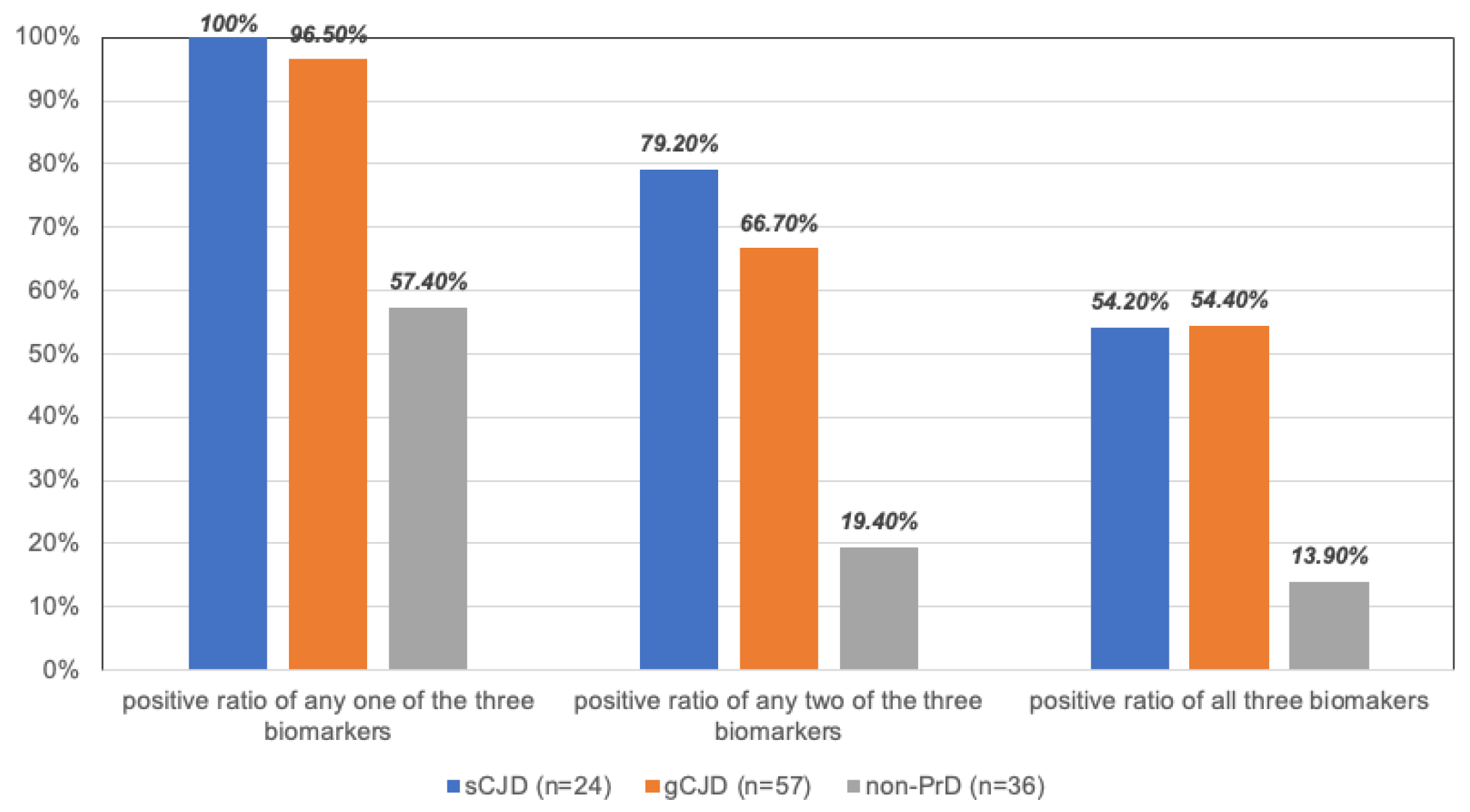
Further, the positive ratios of any one, two, and all three biomarkers in each group (sCJD, gCJD (T188K + E200K), and non-PrD) were separately calculated. As indicated in Figure 2, the positive rate of any one of the three CSF proteins by Western blot was 100% (24/24) in sCJD, 96.5% (55/57) in gCJD, and 57.4% (21/36) in non-PrD, estimating the specificity of 42.6%. The positive rates of any two of the three CSF markers in the cohorts of sCJD, gCJD, and non-PrD were 79.2% (19/24), 66.7% (38/24), and 19.40% (7/36), with a specificity estimate of 80.6%. Finally, in the same cohorts, a simultaneous positivity for all three CSF markers was observed in 52.2% (13/24) of sCJD, 52.4 (38/57) of gCJD, and 13.9% (5/36) of non-PrD, respectively, estimating the specificity of 86.1%.

3. Discussion

Over the past decade, RT-QuIC assays utilizing CSF and skin specimens have become the gold standard for the diagnosis of sCJD and some gPrDs, owing to their high sensitivity and specificity [17,18]. RT-QuIC has also shown reliable diagnostic value for certain types of gPrDs, such as E200K- and T188K-gCJD, but exhibits lower sensitivity for others like D178N-FFI [19]. However, the relatively complex procedures, specialized equipment, and technical requirements hinder the extensive utilization of RT-QuIC as a routine diagnostic tool in many clinical settings. In parallel, several CSF biomarkers, including 14-3-3, t-tau, and p-tau/tau, have been incorporated into diagnostic criteria for sCJD, while additional markers such as calmodulin and synaptic-related proteins (e.g., α-synuclein and β-synuclein) have been explored for their diagnostic potential [13,20,21,22]. Recently, aberrant changes in GAP43 have been reported to be associated with certain neurodegenerative diseases, prompting interest in its feasibility as a fluid biomarker for synaptic dysfunction and loss [23].
In this study, we evaluated CSF GAP43 as a diagnostic biomarker for PrDs using Western blot. GAP43 positivity was defined by rigorous densitometric quantification, with a strict cut-off value (mean + 2SD of non-PrD controls) and normalization to pooled positive controls. All blots were processed in parallel under standardized conditions to minimize technical variability and improve reproducibility. Around 70% of patients with sCJD, T188K-gCJD, and E200K-gCJD tested positive for CSF GAP43 signals, whereas positivity was observed in less than 30% of patients with D178N-FFI and non-PrD controls. These findings suggest that CSF GAP43 has potential utility as a screening biomarker, particularly for sCJD and certain types of gCJD subtypes.
Among gPrDs, T188K-gCJD, E200K-gCJD, and D178N-FFI represent the most prevalent subtypes in the Chinese population [19,24,25]. Coincidental with patterns reported for other CSF biomarkers (e.g., 14-3-3, total tau, CaM) as well as CSF RT-QuIC reactivity [12,26], CSF GAP43 positivity in T188K- and E200K-gCJD was comparable to that observed in sCJD. These similarities likely reflect shared neurodegenerative processes despite different etiological prion mutations. Furthermore, apart from abnormalities detected in CSF samples, T188K/E200K-gCJD exhibit similar neuropathological features as well as clinical manifestations and examination results (EEG and MRI) when compared to sCJD [24,25]. Conversely, D178N-FFI typically displays distinct neuropathological, clinical, EEG, and MRI characteristics compared with sCJD and T188K/E200K-gCJD, and correspondingly lower positivity rates for several CSF biomarkers, such as 14-3-3, total tau, CaM, and RT-QuIC [12,19,27]. Accordingly, CSF GAP43 detected by Western blot appears to be informative not only for sCJD but also for specific gPrDs that share pathogenetic features with sCJD.
GAP43 exhibits a high density at presynaptic termini and plays a key role in neuronal growth, actin modulation, synaptic plasticity, and vesicle transport, depending on its phosphorylation status [28]. Accumulating evidence suggests that synaptic dysfunction and loss represent early events in many neurological diseases, possibly occurring even before neuronal loss [29,30]. Our recent study has also identified down-regulated levels of brain GAP43 in several scrapie-infected experimental rodent models at the terminal stage, closely associated with neuronal loss and prion pathology [31]. In the present cohort, CSF GAP43 positivity correlated significantly with sCJD-associated MRI abnormalities, PSWC on EEG, and akinetic mutism, all of which are indicative of extensive brain injury and neuronal degeneration [32].
Consistent associations were also observed between CSF GAP43 and established CSF biomarkers detected by Western blot. Higher ratios of GAP43 positivity were identified in the groups positive for both 14-3-3 and CaM across all PrDs and within individual subtypes. Notably, patients of CaM positive reveal closer associations (higher OR values) with GAP43 positivity than those positive for 14-3-3 alone. While CSF 14-3-3 is an established biomarker included in the diagnostic criteria for sCJD [20], transient positivity has been reported in certain acute neurological diseases, e.g., encephalitis, ischemic stroke, paraneoplastic neuropathy, etc., likely reflecting rapid neuronal damage. Frequently, observations of CSF CaM positivity have been reported in patients with sCJD and certain types of gPrDs, including T188K- and E200K-gCJD [11,12]. Given that the interaction between CaM and GAP43 is involved in the regulation of intracellular calcium flux [33], further exploration into the mechanisms underlying the release of these neuroproteins into CSF may provide additional insights into prion disease pathogenesis.
The diagnostic sensitivity and specificity of CSF GAP43, 14-3-3, and CaM detected by Western blots were evaluated for sCJD and gCJD (both T188K and E200K) in this cohort. All three biomarkers demonstrated comparable diagnostic performance, with specificity and sensitivity generally ranging from 70% to 80%. Although slight differences in sensitivity were observed, these results support the potential role of GAP43 as a screening biomarker rather than a standalone diagnostic tool. Importantly, CSF GAP43 was positive in a subset of PrD patients who were negative for 14-3-3 or CaM, suggesting that its inclusion may improve overall diagnostic coverage within a multimarker strategy. Given that lumber puncture is typically performed only once during the clinical courses of suspected PrD, parallel assessment of GAP43, 14-3-3, and CaM by Western blot may help prioritize samples for further confirmatory testing, e.g., RT-QuIC. Combined positivity of two or three biomarkers significantly enhanced diagnostic specificity, achieving over 80.60% when two biomarkers were positive and exceeding 86.10% when all three biomarkers were positive concurrently.
Although CSF GAP43 shows lower diagnostic sensitivity than RT-QuIC or total tau, it provides complementary biological information by reflecting synaptic dysfunction, a core pathological process in prion diseases. GAP43 demonstrates consistently high positivity in sCJD and major gCJD subtypes and correlates with MRI, EEG abnormalities, and established CSF biomarkers. Therefore, GAP43 is best positioned as a supportive or screening biomarker rather than a replacement for existing gold-standard assays.
Western blotting was chosen because it remains widely accessible in prion surveillance laboratories and allows direct visualization of protein size and specificity, thereby reducing the risk of non-specific signal interference in CSF analyses. In addition, validated commercial ELISA kits for CSF GAP43 with standardized cut-off values are currently limited. Importantly, Western blotting has a higher detection limit than an optimized ELISA and may fail to detect low-abundance GAP43 in some CSF samples. Therefore, the Western blot–based positivity rates in this study should be interpreted as a conservative estimate, and a negative Western blot result should not be considered sufficient to exclude prion disease. We anticipate that a validated quantitative ELISA with standardized cut-offs could improve analytical sensitivity and potentially increase detection rates near the Western blot threshold.
This study has several limitations that should be acknowledged. First, GAP43 detection relied on Western blotting, which is inherently semi-quantitative and less sensitive than RT-QuIC or ELISA-based assays; This limitation may increase false-negative classifications and thereby constrain the negative predictive value of GAP43 when assessed by Western blotting alone. Second, although normalization procedures and blinded evaluation were implemented, the absence of a universal loading control for CSF remains a technical challenge and may affect inter-laboratory comparability. Third, this study did not directly compare GAP43 with RT-QuIC in individual cases, nor did it evaluate GAP43 in serum or plasma, which could provide more accessible and less invasive options for screening, especially among genetic mutation carriers. These limitations highlight the need for future research utilizing more sensitive and quantitative techniques, larger and independent cohorts, direct comparison with established diagnostic standards, and exploration of blood-based detection and longitudinal changes.
In conclusion, our results demonstrate that CSF GAP43 detected by Western blot may serve as a supportive biomarker for sCJD and certain gCJD subtypes. Further validation and methodological improvements are necessary before clinical implementation.

4. Materials and Methods

4.1. Patients

A total of 140 PrD (48 sCJD, 35 T188K-gCJD, 22 E200K-gCJD, 35 D178N-FFI) and 36 non-PrD cases, neurological controls were enrolled. The non-PrD control group included patients with Alzheimer’s disease (n = 1), autoimmune encephalitis (n = 4), epilepsy (n = 1), hepatic encephalopathy (n = 2), dementia with Lewy bodies (n = 1), limbic encephalitis (n = 1), multiple system atrophy (n = 1), along with other undiagnosed neurological conditions. These conditions were selected to represent disorders that may clinically or diagnostically mimic prion diseases, thereby allowing assessment of the specificity of CSF GAP43 in differential diagnosis. All sporadic Creutzfeldt–Jakob disease (sCJD) cases were confirmed to be homozygous for methionine (MM) at codon 129 of the PRNP gene. Molecular subtyping based on protease-resistant PrPSc isoforms (Type 1 or Type 2) was not uniformly available and therefore was not applied in this study. All diagnoses and differential classifications were performed by the National Surveillance for Creutzfeldt–Jakob Disease (CNS-CJD) at the China CDC, according to the Chinese national health industry standard: Diagnosis for Creutzfeldt–Jakob Disease (WS/T 562—2017) [34]. This diagnostic guideline, issued by the National Health Commission of China, was developed with reference to internationally recognized surveillance criteria, including the WHO manual for surveillance of human transmissible spongiform encephalopathies, the UK National CJD surveillance criteria, and the U.S. CDC diagnostic framework, ensuring international comparability of case classification. Under the national surveillance framework, each suspected case is submitted with standardized clinical information and ancillary investigations (e.g., MRI and EEG findings, CSF routine biochemistry, and prion-related laboratory tests when available) and is centrally reviewed by the National Prion Disease Surveillance Committee within the CNS-CJD program (China CDC). According to the national criteria, “Definite” cases require neuropathological and/or biochemical confirmation of PrPSc; however, no autopsy/biopsy-confirmed cases were available in the present cohort. Therefore, all included cases were categorized as “Probable” under the national diagnostic criteria and surveillance protocol.

4.2. CSF Samples

The staff in local hospitals with routine lumbar punctures obtained the CSF samples of these patients. All CSF specimens were devoid of any blood contamination. After being transferred to the central laboratory in China CDC, the CSF specimens were centrifuged at 2000 rpm for 1 min, aliquoted, and stored at −80 °C. The results of the routine CSF biochemistry of the enrolled patients were collected via the CNS-CJD information system from the local hospitals, which were in the normal ranges of cell count, glucose level, and total protein level.

4.3. Western Blot (WB)

CSF (20 μL per sample) was separated by 12% sodium dodecyl sulfate-polyacrylamide gel electrophoresis (SDS-PAGE) and electronically transferred to nitrocellulose membranes (Whatman, Buckinghamshire, PA, USA), using a semi-dry blotting system (Bio-Rad, Hercules, CA, USA). After blocking, membranes were separately incubated with anti-GAP43 monoclonal antibody (mAb) (1:1000; Immunoway, San Jose, CA, USA), anti-14-3-3 polyclonal antibody (1:1000; Santa Cruz Biological, Santa Cruz, CA, USA), or anti-CaM mAb (1:1000; Millipore, Burlington, MA, USA) at 4 °C overnight. Membranes were further incubated with horseradish peroxidase-conjugated goat-derived anti-mouse antibody (Jackson ImmunoResearch Labs, West Grove, PA, USA; 115–035–003; 1:2000) at RT for 2 h, and the blots were developed by an enhanced chemiluminescence system (ECL; PerkinElmer, Waltham, MA, USA; NEL103E001EA). The images were captured by the ChemiDoc™ XRS + System with Image Lab software 5.2.1 (Bio-Rad) and quantified using Image J software 1.52 (National Institutes of Health).

4.4. Quantification and Definition of Positivity

For all targets, a pooled sCJD-positive CSF was included on every blot for normalization, and results were quantified by densitometry. All membranes were processed in parallel using standardized procedures to ensure reproducibility. For each sample, a visible band at approximately 40 kDa was considered positive if its intensity exceeded twice the mean value observed in non-PrD controls (cut-off: mean + 2SD of controls). All results were independently reviewed by two investigators blinded to clinical data to minimize bias. This definition was applied to all subsequent analyses. Blots that did not meet image quality standards were repeated.

4.5. Statistical Analysis

Data were processed using GraphPad Prism 10.1.1 (270) and SPSS 26.0 statistics software. The descriptive data were expressed as median (range) for continuous variables and percent for categorical variables. Categorical variables were compared using the chi-squared test, and continuous variables were analyzed using the Mann–Whitney U-test, adjusted by the Shapiro–Wilk test for normality.

Author Contributions

X.-X.J. and C.C. contributed to the study design, performed assays and data analysis, and prepared the manuscript. C.H., J.-F.Z., J.-Z.L. and B.X. assisted with WB analysis assays. R.-H.A., D.-L.L., R.-D.C., W.Z. and L.-P.G. assisted with statistical analysis. Q.S., C.C. and X.-P.D. contributed to the design, study concept, and manuscript preparation. All authors have read and agreed to the published version of the manuscript.

Funding

This work was supported by SKLID Development Grants (2021SKLID504, 2019SKLID401, 2019SKLID603, and 2021SKLID503) from the National Key-Laboratory of Intelligent Tracking and Forecasting for Infectious Disease, China CDC.

Institutional Review Board Statement

All human CSF samples in this study were stored in the specimen bank in the center laboratory of CNS-CJD. The use of these storage samples was approved by the Ethics Committee of the National Institute for Viral Disease Control and Prevention, China CDC (No.20220221017, Approval Date: 1 June 2022).

Informed Consent Statement

The samples used were from deceased patients in public institutions, and the approval of the public institutions was obtained. Therefore, the patient’s informed consent form was waived.

Data Availability Statement

The datasets generated for this study are available on request to the corresponding author.

Acknowledgments

We would like to express our sincere gratitude to the following institutions for their support and contributions to this work: Beijing Friendship Hospital, Capital Medical University, Beijing, China; Xuanwu Hospital, Capital Medical University, Beijing, China; Shanghai Institute of Infectious Disease and Biosafety, Shanghai, China.

Conflicts of Interest

The authors declare no conflicts of interest.

Appendix A

Table A1. The demography and clinical characteristics of the patients with PrDs and non-PrDs.
Clinical FeaturesTotal PrDs (n = 140)sCJD (n = 48)Total gPrD (n = 92)T188K-gCJD (n = 35)E200K-gCJD (n = 22)D178N-FFI (n = 35)non-PrD (n = 36)
p-Value vs. non-PrD p-Value vs. non-PrD p-Value vs. non-PrD p-Value vs. non-PrD p-Value vs. non-PrD p-Value vs. non-PrD
Gender (M/F)69/710.333 b24/240.449 b45/470.338 b21/140.886 b8/140.104 b16/190.287 b21/15
Median age at onset (range) (y)57 (22–73)0.560 a64 (37–87)0.018 a57 (24–85)0.583 a62 (40–85)0.201 a57 (42–70)0.665 a53 (24–70)0.031 a58 (22–73)
Age at onset < 50 years no. (%)26/140 (18.6)0.222 b4/48 (8.3)0.018 b22/92 (23.9)0.650 b3/35 (12)0.036 b5/22 (22.7)0.670 b14/35 (40)0.276 b10/36 (27.8)
Age at onset 50–70 years no. (%)93/140 (66.4)0.225 b29/48 (60.4)0.655 b64/92 (69.6)0.134 b26/35 (74.3)0.099 b17/22 (77.3)0.095 b21/35 (60)0.705 b20/36 (55.6)
Age at onset > 70 years no. (%)21/140 (15.0)0.805 b15/48 (31.3)0.127 b6/92 (6.5)0.077 b6/35 (17.1)0.957 b0/22 (0)0.115 c0/35 (0)0.015 c6/36 (16.7)
Codon 129 genotype Met-Met/Total (%)140/140 (100.0)N/A c48/48 (100.0)N/A92/92 (100.0)N/A35/35 (100.0)N/A22/22 (100.0)N/A35/35 (100.0)N/A36/36 (100.0)
Codon 219 genotype Glu-Glu/Total (%)114/115 (99.1)1.000 d48/48 (100)N/A66/67 (85.7)1.000 d24/25 (96.0)0.417 d19/19 (100.0)N/A23/23 (100.0)N/A35/35 (100.0)
PSWC in EEG (%)54/124 (43.5)0.001 b36/48 (70.5)0.001 b18/76 (22.4)0.019 b7/33 (21.2)0.116 c11/16 (68.8)0.001 c0/25 (0)0.580 d2/36 (5.5)
MRI abnormal change/Total no. (%)98/139 (70.5)0.001 b45/48 (93.8)0.001 b53/91 (58.2)0.001 b28/35 (80.0)0.001 b19/22 (86.4)0.001 b6/35 (17.1)0.417 b 9/36 (25.0)
CSF 14-3-3 Positive/Total no. (%)92/139 (66.2)0.001 b35/48 (72.9)0.001 b57/92 (62.0)0.001 b26/35 (74.3)0.001 b17/22 (77.3)0.001 b14/35 (40.0)0.177 b9/36 (25.0)
Progressive dementia/Total no. (%)127/140 (90.7)0.065 c46/48 (95.8)0.029 c81/92 (88.0)0.142 b31/35 (88.6)0.225 b21/22 (95.5)0.135 c29/35 (82.9) 0.591 b 28/36 (77.8)
Myoclonus no. (%)98/140 (70.0)0.001 b39/48 (81.3)0.001 b59/92 (64.1)0.001 b23/35 (65.7)0.001 b16/22 (72.7)0.001 b20/35 (57.1)0.012 b10/36 (27.8)
Visual or cerebellar disturbance no. (%)83/140 (59.3)0.001 b25/48 (52.1)0.002b58/92 (63.0)0.001 b26/35 (74.3)0.001 b16/22 (72.7)0.001 b16/35 (45.7)0.018 b7/36 (18.4)
Pyramidal or extrapyramidal dysfunction no. (%)108/140 (77.1)0.001 b37/48 (77.1)0.005 b71/92 (77.2)0.001 b29/35 (82.9)0.002 b19/22 (86.4)0.003 b23/35 (65.7)0.116 b17/36 (47.2)
Akinetic Mutism no. (%)71/140 (50.7)0.001 b31/48 (64.4)0.001 b40/92(43.5)0.001 b19/35 (54.3)0.284 c14/22 (63.7)0.001 b7/35 (20.0)0.284 c3/36 (8.3)
a Mann-Whitney U test; b Pearson chi-square test; c continuity-adjusted chi-square test; d Fisher exact test; N/A: Not applicable.

References

  1. Ladogana, A.; Puopolo, M.; Croes, E.A.; Budka, H.; Jarius, C.; Collins, S.; Klug, G.M.; Sutcliffe, T.; Giulivi, A.; Alperovitch, A.; et al. Mortality from Creutzfeldt-Jakob disease and related disorders in Europe, Australia, and Canada. Neurology 2005, 64, 1586–1591. [Google Scholar] [CrossRef]
  2. D’Aignaux, J.H.; Cousens, S.N.; Delasnerie-Laupretre, N.; Brandel, J.P.; Salomon, D.; Laplanche, J.L.; Hauw, J.J.; Alperovitch, A. Analysis of the geographical distribution of sporadic Creutzfeldt-Jakob disease in France between 1992 and 1998. Int. J. Epidemiol. 2002, 31, 490–495. [Google Scholar] [CrossRef] [PubMed]
  3. Minikel, E.V.; Vallabh, S.M.; Lek, M.; Estrada, K.; Samocha, K.E.; Sathirapongsasuti, J.F.; McLean, C.Y.; Tung, J.Y.; Yu, L.P.; Gambetti, P.; et al. Quantifying prion disease penetrance using large population control cohorts. Sci. Transl. Med. 2016, 8, 322ra9. [Google Scholar] [CrossRef] [PubMed]
  4. Jeong, B.H.; Kim, Y.S. Genetic studies in human prion diseases. J. Korean Med. Sci. 2014, 29, 623–632. [Google Scholar] [CrossRef] [PubMed]
  5. Brown, P.; Brandel, J.P.; Sato, T.; Nakamura, Y.; MacKenzie, J.; Will, R.G.; Ladogana, A.; Pocchiari, M.; Leschek, E.W.; Schonberger, L.B. Iatrogenic Creutzfeldt-Jakob disease, final assessment. Emerg. Infect. Dis. 2012, 18, 901–907. [Google Scholar] [CrossRef]
  6. Will, R.G.; Ironside, J.W.; Zeidler, M.; Cousens, S.N.; Estibeiro, K.; Alperovitch, A.; Poser, S.; Pocchiari, M.; Hofman, A.; Smith, P.G. A new variant of Creutzfeldt-Jakob disease in the UK. Lancet 1996, 347, 921–925. [Google Scholar] [CrossRef]
  7. Collinge, J.; Whitfield, J.; McKintosh, E.; Beck, J.; Mead, S.; Thomas, D.J.; Alpers, M.P. Kuru in the 21st century—An acquired human prion disease with very long incubation periods. Lancet 2006, 367, 2068–2074. [Google Scholar] [CrossRef]
  8. CDC’s Diagnostic Criteria for Creutzfeldt-Jakob Disease (CJD). Centers for Disease Control and Prevention, Atlanta, GA. 2018. Available online: https://www.cdc.gov/creutzfeldt-jakob/hcp/clinical-overview/?CDC_AAref_Val= (accessed on 4 February 2025).
  9. Hermann, P.; Laux, M.; Glatzel, M.; Matschke, J.; Knipper, T.; Goebel, S.; Treig, J.; Schulz-Schaeffer, W.; Cramm, M.; Schmitz, M.; et al. Validation and utilization of amended diagnostic criteria in Creutzfeldt-Jakob disease surveillance. Neurology 2018, 91, e331–e338. [Google Scholar] [CrossRef]
  10. Hermann, P.; Appleby, B.; Brandel, J.P.; Caughey, B.; Collins, S.; Geschwind, M.D.; Green, A.; Haik, S.; Kovacs, G.G.; Ladogana, A.; et al. Biomarkers and diagnostic guidelines for sporadic Creutzfeldt-Jakob disease. Lancet Neurol. 2021, 20, 235–246, Erratum in: Lancet Neurol. 2021, 20, e3. https://doi.org/10.1016/S1474-4422(21)00069-7. [Google Scholar] [CrossRef]
  11. Chen, C.; Hu, C.; Zhou, W.; Chen, J.; Shi, Q.; Xiao, K.; Wang, Y.; Dong, X.P. Calmodulin level is significantly increased in the cerebrospinal fluid of patients with sporadic Creutzfeldt-Jakob disease. Eur. J. Neurol. 2021, 28, 1134–1141. [Google Scholar] [CrossRef]
  12. Jia, X.X.; Hu, C.; Chen, C.; Gao, L.P.; Liang, D.L.; Zhou, W.; Cao, R.D.; Xiao, K.; Shi, Q.; Dong, X.P. Different reactive profiles of calmodulin in the CSF samples of Chinese patients of four types of genetic prion diseases. Front. Mol. Neurosci. 2024, 17, 1341886. [Google Scholar] [CrossRef] [PubMed]
  13. Halbgebauer, S.; Abu-Rumeileh, S.; Oeckl, P.; Steinacker, P.; Roselli, F.; Wiesner, D.; Mammana, A.; Beekes, M.; Kortazar-Zubizarreta, I.; Perez de Nanclares, G.; et al. Blood beta-Synuclein and Neurofilament Light Chain During the Course of Prion Disease. Neurology 2022, 98, e1434–e1445. [Google Scholar] [CrossRef] [PubMed]
  14. Tian, C.; Liu, D.; Xiang, W.; Kretzschmar, H.A.; Sun, Q.L.; Gao, C.; Xu, Y.; Wang, H.; Fan, X.Y.; Meng, G.; et al. Analyses of the similarity and difference of global gene expression profiles in cortex regions of three neurodegenerative diseases: Sporadic Creutzfeldt-Jakob disease (sCJD), fatal familial insomnia (FFI), and Alzheimer’s disease (AD). Mol. Neurobiol. 2014, 50, 473–481. [Google Scholar] [CrossRef] [PubMed]
  15. Tian, C.; Liu, D.; Chen, C.; Xu, Y.; Gong, H.S.; Chen, C.; Shi, Q.; Zhang, B.Y.; Han, J.; Dong, X.P. Global transcriptional profiling of the postmortem brain of a patient with G114V genetic Creutzfeldt-Jakob disease. Int. J. Mol. Med. 2013, 31, 676–688. [Google Scholar] [CrossRef]
  16. Rekart, J.L.; Quinn, B.; Mesulam, M.M.; Routtenberg, A. Subfield-specific increase in brain growth protein in postmortem hippocampus of Alzheimer’s patients. Neuroscience 2004, 126, 579–584. [Google Scholar] [CrossRef]
  17. Xiao, K.; Yang, X.; Zhou, W.; Chen, C.; Shi, Q.; Dong, X. Validation and Application of Skin RT-QuIC to Patients in China with Probable CJD. Pathogens 2021, 10, 1642. [Google Scholar] [CrossRef]
  18. Mastrangelo, A.; Mammana, A.; Baiardi, S.; Tiple, D.; Colaizzo, E.; Rossi, M.; Vaianella, L.; Polischi, B.; Equestre, M.; Poleggi, A.; et al. Evaluation of the impact of CSF prion RT-QuIC and amended criteria on the clinical diagnosis of Creutzfeldt-Jakob disease: A 10-year study in Italy. J. Neurol. Neurosurg. Psychiatry 2023, 94, 121–129. [Google Scholar] [CrossRef]
  19. Shi, Q.; Chen, C.; Xiao, K.; Zhou, W.; Gao, L.P.; Chen, D.D.; Wu, Y.Z.; Wang, Y.; Hu, C.; Gao, C.; et al. Genetic Prion Disease: Insight from the Features and Experience of China National Surveillance for Creutzfeldt-Jakob Disease. Neurosci. Bull. 2021, 37, 1570–1582. [Google Scholar] [CrossRef]
  20. Llorens, F.; Schmitz, M.; Zerr, I. Progress in CSF biomarker discovery in sCJD. Oncotarget 2017, 8, 5666–5667. [Google Scholar] [CrossRef]
  21. Soomro, S.; Mohan, C. Biomarkers for sporadic Creutzfeldt-Jakob disease. Ann. Clin. Transl. Neurol. 2016, 3, 465–472. [Google Scholar] [CrossRef]
  22. Oeckl, P.; Metzger, F.; Nagl, M.; von Arnim, C.A.; Halbgebauer, S.; Steinacker, P.; Ludolph, A.C.; Otto, M. Alpha-, Beta-, and Gamma-synuclein Quantification in Cerebrospinal Fluid by Multiple Reaction Monitoring Reveals Increased Concentrations in Alzheimer’s and Creutzfeldt-Jakob Disease but No Alteration in Synucleinopathies. Mol. Cell Proteomics 2016, 15, 3126–3138. [Google Scholar] [CrossRef]
  23. Camporesi, E.; Nilsson, J.; Brinkmalm, A.; Becker, B.; Ashton, N.J.; Blennow, K.; Zetterberg, H. Fluid Biomarkers for Synaptic Dysfunction and Loss. Biomark. Insights 2020, 15, 1177271920950319. [Google Scholar] [CrossRef] [PubMed]
  24. Chen, C.; Shi, Q.; Zhou, W.; Zhang, X.C.; Dong, J.H.; Hu, X.Q.; Song, X.N.; Liu, A.F.; Tian, C.; Wang, J.C.; et al. Clinical and familial characteristics of eight Chinese patients with T188K genetic Creutzfeldt-Jakob disease. Infect. Genet. Evol. 2013, 14, 120–124. [Google Scholar] [CrossRef] [PubMed]
  25. Gao, L.P.; Shi, Q.; Xiao, K.; Wang, J.; Zhou, W.; Chen, C.; Dong, X.P. The genetic Creutzfeldt-Jakob disease with E200K mutation: Analysis of clinical, genetic and laboratory features of 30 Chinese patients. Sci. Rep. 2019, 9, 1836. [Google Scholar] [CrossRef] [PubMed]
  26. Chen, C.; Hu, C.; Shi, Q.; Zhou, W.; Xiao, K.; Wang, Y.; Liu, L.; Chen, J.; Xia, Y.; Dong, X.P. Profiles of 14-3-3 and Total Tau in CSF Samples of Chinese Patients of Different Genetic Prion Diseases. Front. Neurosci. 2019, 13, 934. [Google Scholar] [CrossRef]
  27. He, R.; Hu, Y.; Yao, L.; Tian, Y.; Zhou, Y.; Yi, F.; Zhou, L.; Xu, H.; Sun, Q. Clinical features and genetic characteristics of two Chinese pedigrees with fatal family insomnia. Prion 2019, 13, 116–123. [Google Scholar] [CrossRef]
  28. Holahan, M.R. A Shift from a Pivotal to Supporting Role for the Growth-Associated Protein (GAP-43) in the Coordination of Axonal Structural and Functional Plasticity. Front. Cell Neurosci. 2017, 11, 266. [Google Scholar] [CrossRef]
  29. Masliah, E.; Mallory, M.; Alford, M.; DeTeresa, R.; Hansen, L.A.; McKeel, D.W., Jr.; Morris, J.C. Altered expression of synaptic proteins occurs early during progression of Alzheimer’s disease. Neurology 2001, 56, 127–129. [Google Scholar] [CrossRef]
  30. Janezic, S.; Threlfell, S.; Dodson, P.D.; Dowie, M.J.; Taylor, T.N.; Potgieter, D.; Parkkinen, L.; Senior, S.L.; Anwar, S.; Ryan, B.; et al. Deficits in dopaminergic transmission precede neuron loss and dysfunction in a new Parkinson model. Proc. Natl. Acad. Sci. USA 2013, 110, E4016–E4025. [Google Scholar] [CrossRef]
  31. Jia, X.X.; Chen, C.; Hu, C.; Wu, Y.Z.; Chao, Z.Y.; Zeng, J.F.; A., R.H.; Zhou, D.H.; Wang, Y.; Zhang, W.W.; et al. Aberrance of GAP43/p-GAP43 Closely Associates with the Pathology of Neuron Loss in Prion-Infected Rodent Models. Mol. Neurobiol. 2024, 62, 4435–4451. [Google Scholar] [CrossRef]
  32. Iwasaki, Y. Creutzfeldt-Jakob disease. Neuropathology 2017, 37, 174–188. [Google Scholar] [CrossRef]
  33. Gerendasy, D. Homeostatic tuning of Ca2+ signal transduction by members of the calpacitin protein family. J. Neurosci. Res. 1999, 58, 107–119. [Google Scholar] [CrossRef]
  34. WS/T 562-2017; Creutzfeldt-Jakob Disease Diagnosis. Ministry of Health P.R. China: Beijing, China, 2017.
Figure 1. Determination of GAP43 in CSF specimens from the patients of sCJD, gPrD, and non-PrD using Western blots. (A) Blots of pooled CSF samples of various diseases, including sCJD, T188K–gCJD, and E200K–gCJD. D178N–FFI and non-PrD. Each pooled sample consists of an equal amount of CSF from five individual patients. (B) Blots of 48 CSF samples of sCJD cases. (C) Blots of 35 CSF samples of T188K–gCJD cases. (D) Blots of 22 CSF samples of E200K–gCJD cases. (E) Blots of 35 CSF samples of D178N–FFI cases. (F) Blots of 36 CSF samples of non-PrD cases. (G) The positivity of CSF GAP43 in the groups of sCJD, T188K–gCJD, E200K–gCJD, D178N–FFI and non–PrD. The case numbers of GAP43–positive and negative each group are shown in the column on right Y-axis and the positive percentage of GAP43 in each group is indicated at the top on the left Y-axis.
Ijms 27 01678 g001
Figure 2. Positive percentages of CSF GAP43, 14-3-3, and CaM in the cohorts of sCJD, gCJD (T188K and E200K), and non-PrD. The positive ratios of any one of the three biomarkers (right), any two of the three biomarkers (middle), and all three biomarkers (left) are illustrated separately.
Ijms 27 01678 g002
Table 1. CSF GAP43 positivity in the different types of PrDs and non-PrDs.
CategoryDiseaseMutationNo.Positive (%)χ2p-Value
sCJDsCJD/ 14834 (70.83)
gPrDsgCJDT188K 13523 (65.71)37.975<0.001 *
E200K 12216 (72.73)
FFID178N 2357 (20.00)
non−PrDsnon-PrDsNone 23610 (27.78)
Abbreviations: CSF, cerebrospinal fluid; gPrDs, genetic prion diseases; Significant difference between the groups marked with the different number (1 vs. 2) but no significant difference between the groups marked with the same number (1 vs. 1, 2 vs. 1) * Pearson chi-square test.
Table 2. Relationship of clinical features and CFS GAP43 positivity in total and different types of PrDs and non-PrDs.
ClinicalAll PrDssCJDAll gPrDsT188K-gCJDE200K-gCJDD178N-FFInon-PrDs
GAP43+ (n = 80)GAP43− (n = 60)p-ValueGAP43+ (n = 34)GAP43− (n = 14)p-ValueGAP43+ (n = 46)GAP43− (n = 46)p-ValueGAP43+ (n = 23)GAP43− (n = 12)p-ValueGAP43+ (n = 16)GAP43− (n = 6)p-ValueGAP43+ (n = 7)GAP43− (n = 28)p-ValueGAP43+ (n = 10)GAP43− (n = 26)p-Value
Gender (M/F)42/3827/330.380 a18/166/80.525 a24/2221/250.532 a14/97/51.000 b7/91/50.351 b3/413/151.000 b5/516/100.709 b
Median onset age (y) (range)60 (34–87)56 (24–78)0.007 c66 (48–87)61 (37–78)0.188 c59 (34–85)54 (24–76)0.077 c62 (40–85)60 (50–76)0.986 c58 (44–70)52 (42–68)0.356 c53 (34–62)53 (24–70)0.951 c53(42–73)61 (22–73)0.214 c
MRI abnormality no. (%)65 (81.3)33/59 (55.9)0.001 a32 (94.1)13 (92.9)1.000 b33 (71.8)20 (44.4)0.008 b19 (82.6)9 (75.0)0.670 b14 (87.5)5 (83.3)1.000 b0 (0.0)6/27 (22.2)N/A5 (50.0)4 (15.4)0.079 b
PSWC in EEG no. (%)41/72 (56.9)13/52 (25.0)0.001 a28 (82.4)8 (57.1)0.142 d13/38 (34.2)4/37 (13.2)0.011 a5 (21.7)2 (16.7)1.000 b8/11 (72.7)3/5
(60.0)
1.000 b0/21
(0.0)
0/4
(0.0)
N/A1 (10.0)1 (3.8)0.484 b
Progressive dementia no. (%)74 (92.5)53 (88.3)0.401 a32 (94.1)14 (100.0)N/A42 (91.3)39 (87.8)0.335 a21 (91.3)10 (83.3)0.594 b15 (93.8)6 (100.0)N/A6 (85.7)23 (82.1)1.000 b8 (80.0)20 (76.9)1.000 b
Myoclonus no. (%)59 (73.8)39 (65.0)0.264 a30 (88.2)9 (64.3)0.127 d29 (63.0)30 (65.2)0.828 a14 (60.9)9 (75.0)0.476 b12 (75.0)4 (66.7)1.000 b3 (42.9)17 (60.7)0.430 b3 (30.0)7 (26.9)1.000 b
Visual or cerebellar disturbance no. (%)49 (61.3)34 (56.7)0.585 a19 (55.9)6 (42.9)0.412 a30 (65.2)28 (60.9)0.666 a17 (73.9)9 (75.0)1.000 b12 (75.0)4 (66.7)1.000 b1(14.3)15 (53.6)0.096 b1 (10.0)6 (23.1)0.645 b
Pyramidal or extrapyramidal dysfunction no. (%)62 (77.5)46 (76.7)0.907 a26 (76.5)11 (78.6)1.000 d36 (78.3)35 (76.1)0.804 a18 (78.3)11 (91.7)0.640 b14 (87.5)5 (83.3)1.000 b4 (57.1)19 (67.9)0.670 b5 (50.0)12 (46.2)1.000 b
Akinetic Mutism no. (%)47 (58.8)24 (40.0)0.028 a23 (67.7)8 (57.1)0.719 d24 (52.2)16 (34.8)0.092 a13 (56.6)6 (50.0)0.736 b10 (62.5)4 (66.7)1.000 b1 (14.3)6 (21.4)1.000 b1 (10.0)2 (7.7)1.000 b
a Pearson chi−square test; b Fisher’s exact test. c Mann−Whitney U-test. d continuity-adjusted chi-square test. N/A: Not Applicable
Table 3. Relationship of CSF GAP43 and CSF 14-3-3/CaM by Western blot and in PrDs and non-PrDs.
DiseaseMutation CSFGAP43+ (%)GAP43− (%)p-ValueOR (95%CI)
All PrDs/14-3-3+60 (65.2)32 (34.8)0.008 a1.565 (1.085–2.258)
20 (41.7)28 (58.3)
CaM+55 (74.3)19 (25.7)<0.001 a9.263 (3.838–22.356)
10 (23.8)32 (76.2)
sCJD/14-3-3+26 (74.3)9 (25.7)0.613 b1.207 (0.753–1.935)
8 (61.5)5 (35.5)
CaM+13 (81.3)3 (18.7)1.000 b1.444 (0.189–11.042)
6 (75.0)2 (25.0)
All gPrDs/14-3-3+34 (59.6)23 (40.4)0.018 a1.740 (1.049–2.885)
12 (34.3)23 (68.8)
CaM+42 (72.4)16 (27.6)<0.001 a19.688 (5.980–64.820)
4 (11.8)30(88.2)
gCJDT188K14-3-3+18 (69.2)8 (30.8)0.736 b1.246 (0.658–2.359)
5 (55.6)4 (44.4)
CaM+23 (85.2)4 (14.8)<0.001 a3.000 (1.348–6.678)
0 (0.0)8 (100.0)
E200K14-3-3+14 (82.4)3 (17.6)0.100 b2.059 (0.688–6.159)
2 (40.0)3 (60.0)
CaM+15 (78.9)4 (21.1)0.169 b7.500 (0.534–105.279)
1 (33.3)2(66.7)
FFID178N14-3-3+2 (14.3)12 (85.7)0.676 b0.600 (0.135–2.673)
5 (23.8)16 (76.2)
CaM+4 (33.3)8 (66.7)0.200 b3.333 (0.605–18.371)
3 (13.0)20 (87.0)
non-PrDs/14-3-3+6 (66.7)3 (33.3)0.006 b4.500 (1.630–12.425)
4 (14.8)23 (85.2)
CaM+5 (55.6)4 (44.4)0.079 b5.500 (1.073–28.198)
5 (18.5)22 (81.5)
a Pearson chi-square test; b Fisher’s exact test; /: Not within the study’s focus.
Table 4. Evaluation of the diagnostic performance of 14-3-3 and GAP43 for sCJD and non-PrDs.
sCJD (n = 48)non-PrDs (n = 36) Sensitivity(%) Specificity(%) gCJD (n = 57) non-PrDs (n = 36) Sensitivity(%) Specificity(%)
14-3-3 +35972.975.043975.475.0
13271427
GAP43+341070.872.2391068.472.2
14261826
sCJD (n = 24)non-PrDs (n = 36) Sensitivity(%) Specificity(%) gCJD non-PrDs (n = 36) Sensitivity(%) Specificity(%)
CaM+16966.775.046980.775.0
8271127
GAP43+191079.272.2391068.472.2
5261826
Disclaimer/Publisher’s Note: The statements, opinions and data contained in all publications are solely those of the individual author(s) and contributor(s) and not of MDPI and/or the editor(s). MDPI and/or the editor(s) disclaim responsibility for any injury to people or property resulting from any ideas, methods, instructions or products referred to in the content.