Photophysical Processes of Porphyrin and Corrin Complexes with Nickel and Palladium



Abstract
1. Introduction
2. Results
2.1. Nickel Complexes
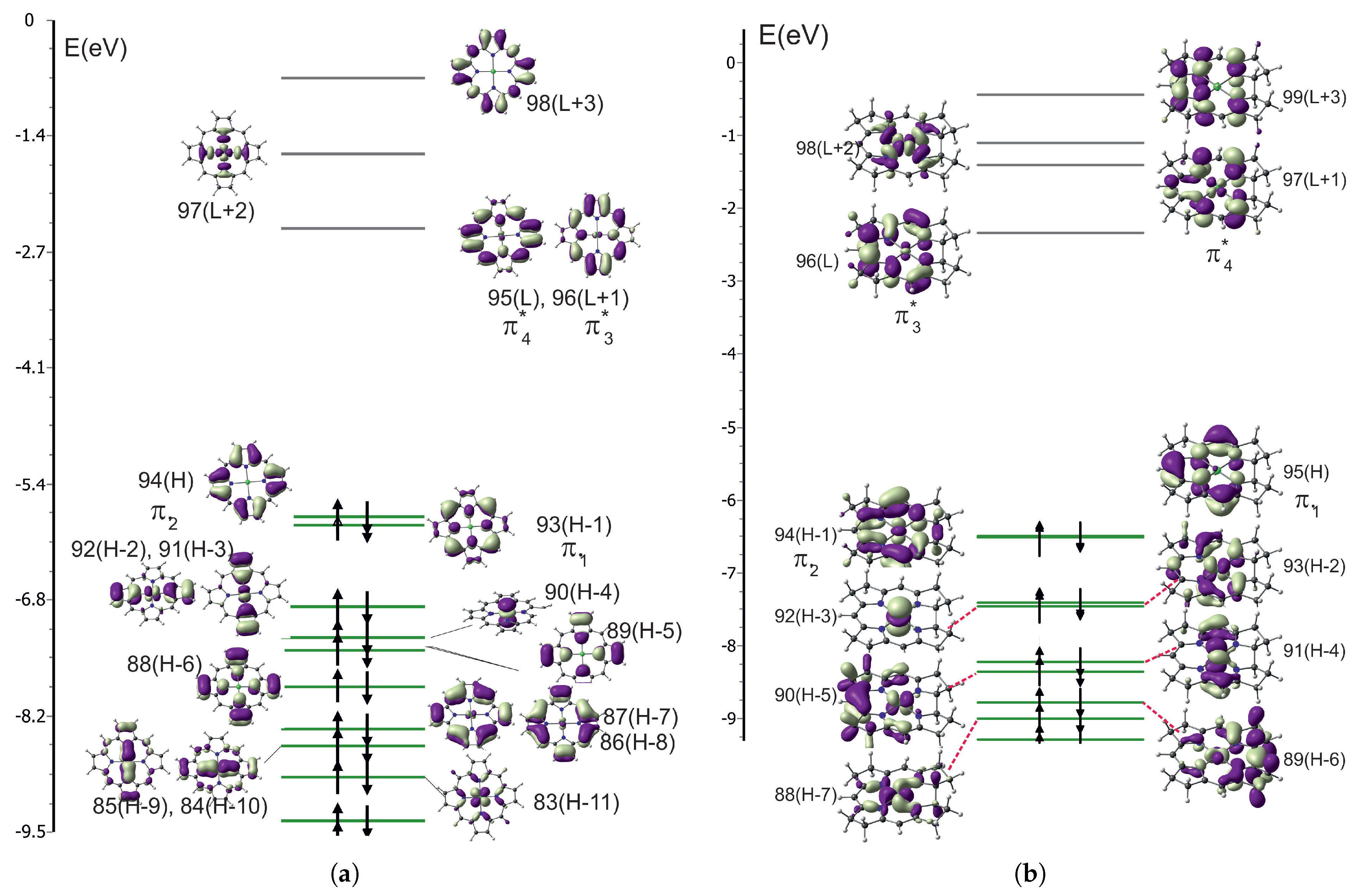
2.1.1. Geometry and Electronic Structure of Nickel Porphyrin and Nickel Corrin


| Parameter | NiCorr | NiPor | ||
|---|---|---|---|---|
| Calc. | Expt. a | Calc. | Expt. b | |
| Ni-N1 | 1.848 | 1.851 | 1.958 | 1.930 |
| Ni-N2 | 1.895 | 1.913 | 1.958 | 1.930 |
| Ni-N3 | 1.895 | 1.884 | 1.958 | 1.930 |
| Ni-N4 | 1.848 | 1.847 | 1.958 | 1.930 |
| N1-Ni-N2 | 91.4 | 91.2 | 90.0 | 90.0 |
| N2-Ni-N3 | 95.1 | 95.5 | 90.0 | 90.0 |
| N3-Ni-N4 | 91.4 | 91.4 | 90.0 | 90.0 |
| N4-Ni-N1 | 82.6 | 83.0 | 90.0 | 90.0 |
| N1-Ni-N3 | 171.6 | 170.4 | 180.0 | 179.7 |
| N2-Ni-N4 | 171.6 | 169.5 | 180.0 | 179.7 |
| N1-N2-N3-N4 | −7.2 | −10.2 | 0.0 | 0.5 |
| N1-N2-N3-Ni | −3.6 | −4.7 | 0.0 | 0.2 |
2.1.2. Electronic Spectra of NiPor and NiCorr
- A. NiPor
- B. NiCorr
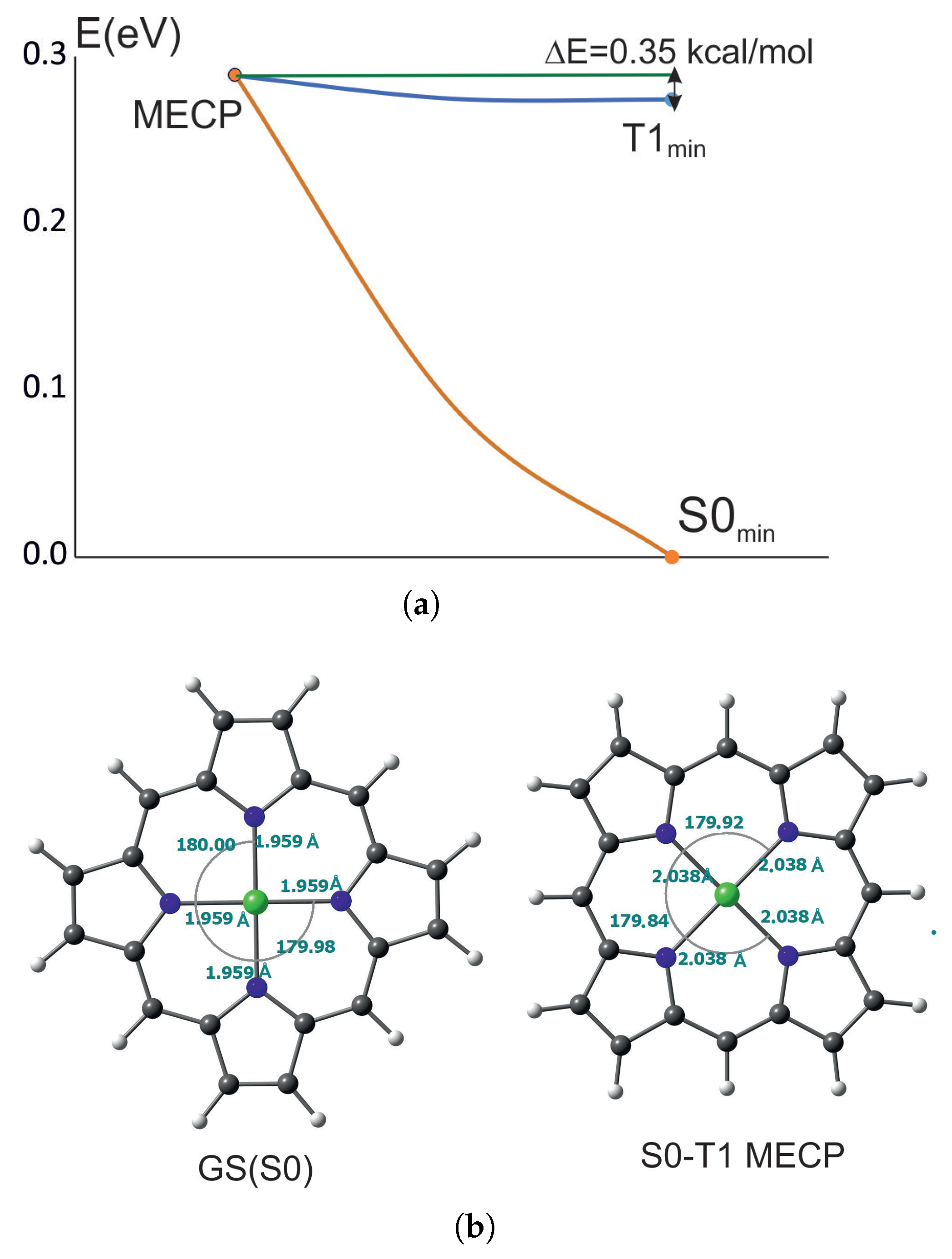
2.1.3. Minimum Energy Crossing Point of T1 and S0
2.2. Palladium Complexes
2.2.1. Geometry and Electronic Structure of Palladium Porphyrin and Palladium Corrin
2.2.2. Electronic Spectra for Palladium Porphyrin and Palladium Corrin
- A. PdPor
- B. PdCorr
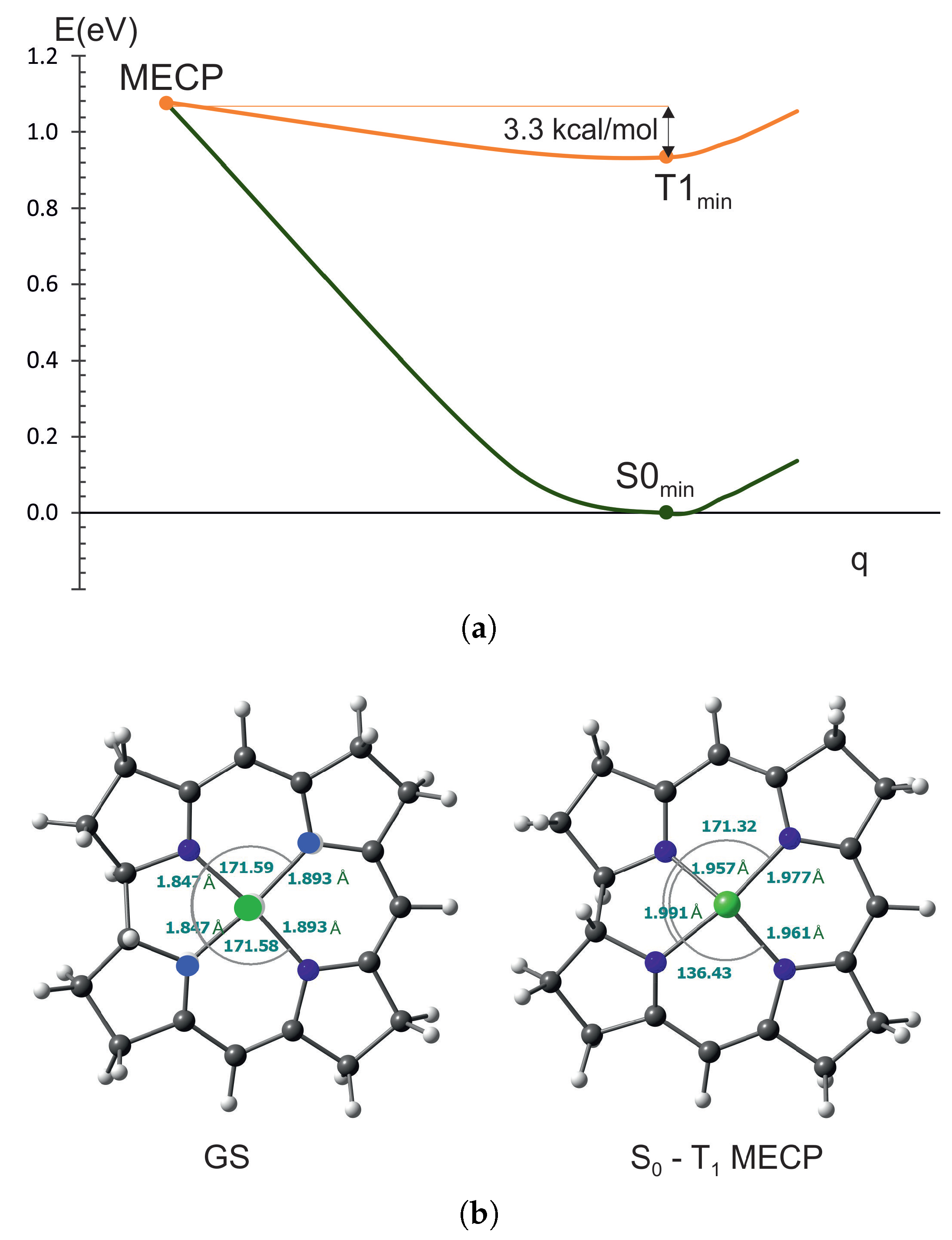
2.2.3. MECP for Palladium Complexes
2.3. Emission of Nickel and Palladium Complexes
2.4. Spin–Orbit Interaction in Nickel and Palladium Porphyrin and Corrin
2.5. NEVPT2 Calculations
3. Discussion
3.1. Photophysics of Nickel and Palladium Porphyrin and Corrin
3.1.1. NiPor and PdPor
3.1.2. NiCorr and PdCorr
3.1.3. PdPor and PdCorr
3.2. Comparison of TDDFT and CASSCF/NEVPT2 Results
3.2.1. NiPor
3.2.2. NiCorr
3.2.3. PdPor
3.2.4. PdCorr
3.3. Comparison of Nickel and Palladium Complexes
4. Materials and Methods
4.1. Density Functional
4.2. Solvent Model
4.3. Spin–Orbit Interaction
4.4. CASSCF/NEVPT2 Calculations
4.5. Model Geometries
5. Conclusions
Supplementary Materials
Author Contributions
Funding
Institutional Review Board Statement
Informed Consent Statement
Data Availability Statement
Acknowledgments
Conflicts of Interest
Abbreviations
| DFT | Density Functional Theory |
| TDDFT | Time Dependent Density Functional Theory |
| NEVPT2 | N-Electron Valence State Perturbation Theory |
| NiPor | Nickel(II) Porphyrrin |
| NiCorr | Nickel(II) Corrin |
| PdPor | Palladium(II) Porphyrin |
| PdCorr | Palladium(II) Corrin) |
| SOC | Spin–Orbit Coupling |
| SOCC | Spin–Orbit Coupling Coefficient |
| IC | Internal Conversion |
| ISC | Intersystem Crossing |
| Q Band | |
| Soret Band | |
| MECP | Minimum Energy Crossing Point |
References
- Marques, H.M. Corrins and porphyrins: Two of nature’s pigments of life. J. Coord. Chem. 2024, 77, 1161–1210. [Google Scholar] [CrossRef]
- Poulos, T.L. Heme Enzyme Structure and Function. Chem. Rev. 2014, 114, 3919–3962. [Google Scholar] [CrossRef]
- Gruber, K.; Puffer, B.; Kräutler, B. Vitamin B12-derivatives—Enzyme cofactors and ligands of proteins and nucleic acids. Chem. Soc. Rev. 2011, 40, 4346–4363. [Google Scholar] [CrossRef]
- Banerjee, R.; Ragsdale, S.W. The Many Faces of Vitamin B12: Catalysis by Cobalamin-Dependent Enzymes1. Annu. Rev. Biochem. 2003, 72, 209–247. [Google Scholar] [CrossRef]
- Kieninger, C.; Wurst, K.; Podewitz, M.; Stanley, M.; Deery, E.; Lawrence, A.D.; Liedl, K.R.; Warren, M.J.; Kräutler, B. Replacement of the Cobalt Center of Vitamin B12 by Nickel: Nibalamin and Nibyric Acid Prepared from Metal-Free B12 Ligands Hydrogenobalamin and Hydrogenobyric Acid. Angew. Chem. Int. Ed. 2020, 59, 20129–20136. [Google Scholar] [CrossRef]
- Kräutler, B. Antivitamins B12—Some Inaugural Milestones. Chem.—Eur. J. 2020, 26, 15438–15445. [Google Scholar] [CrossRef] [PubMed]
- Johnson, A.W. Transition Metal Complexes of Porphins, Corrins and Related Compounds. In Organometallic Chemistry; Stone, F., Bruce, M., Eds.; Butterworth-Heinemann: Oxford, UK, 1970; pp. 375–389. [Google Scholar] [CrossRef]
- Charisiadis, A.; Nikolaou, V.; Nikoloudakis, E.; Ladomenou, K.; Charalambidis, G.; Coutsolelos, A.G. Metalloporphyrins in bio-inspired photocatalytic conversions. Chem. Commun. 2025, 61, 4630–4646. [Google Scholar] [CrossRef]
- Spellane, P.J.; Gouterman, M.; Antipas, A.; Kim, S.; Liu, Y.C. Porphyrins. 40. Electronic spectra and four-orbital energies of free-base, zinc, copper, and palladium tetrakis(perfluorophenyl)porphyrins. Inorg. Chem. 1980, 19, 386–391. [Google Scholar] [CrossRef]
- Allison, J.B.; Becker, R.S. Effect of Metal Atom Perturbations on the Luminescent Spectra of Porphyrins. J. Chem. Phys. 1960, 32, 1410–1417. [Google Scholar] [CrossRef]
- Nyarko, E.; Hanada, N.; Habib, A.; Tabata, M. Fluorescence and phosphorescence spectra of Au(III), Pt(II) and Pd(II) porphyrins with DNA at room temperature. Inorganica Chim. Acta 2004, 357, 739–745. [Google Scholar] [CrossRef]
- Yamada, Y.; Wehrli, P.; Miljkovic, D.; Wild, H.J.; Bühler, N.; Götschi, E.; Golding, B.; Löliger, P.; Gleason, J.; Pace, B.; et al. Corrin Syntheses. Part VI. Helv. Chim. Acta 2015, 98, 1921–2054. [Google Scholar] [CrossRef]
- Blaser, H.U.; Winnacker, E.L.; Fischli, A.; Hardegger, B.; Bormann, D.; Hashimoto, N.; Schossig, J.; Keese, R.; Eschenmoser, A. ChemInform Abstract: Corrin Syntheses. Part 5. Preparation of Metal-Free Corrin Derivatives via (A→B) Ring Closure. Complexation of the Corrin Chromophore with Metal Ions, and Some Properties of the Ligands in Corrin Complexes. ChemInform 2016, 47. [Google Scholar] [CrossRef]
- Grigg, R.; Johnson, A.W.; van den Broek, P. A three-stage synthesis of a nickel corrin perchlorate from pyrrolic intermediates. Chem. Commun. 1967, 502–503. [Google Scholar] [CrossRef]
- Gardiner, M.; Thomson, A.J. Luminescence properties of some synthetic metallocorrins. J. Chem. Soc. Dalton Trans. 1974, 820–828. [Google Scholar] [CrossRef]
- Dicker, I.D.; Grigg, R.; Johnson, A.W.; Pinnock, H.; Richardson, K.; van den Broek, P. Formation of nickel tetradehydrocorrin derivatives and the reduction of nickel 1,19-dimethyltetrahydrocorrin salts. J. Chem. Soc. C 1971, 536–547. [Google Scholar] [CrossRef]
- Szczepańska, M.; Lodowski, P.; Jaworska, M. Electronic excited states and luminescence properties of palladium(II)corrin complex. J. Photochem. Photobiol. A Chem. 2020, 389, 112226. [Google Scholar] [CrossRef]
- Dunitz, J.D.; Meyer, E.F. Structure analysis of nickel(II)-1,8,8,13,13-pentamethyl- 5-cyano-trans-corrin chloride. Proc. R. Soc. Lond. Ser. A Math. Phys. Sci. 1965, 288, 324–330. [Google Scholar] [CrossRef]
- Johnson, A.W.; Overend, W.R. Synthesis of corrins. Part I. Nickel and cobalt 1,19-dimethylcorrin and 1,19-dimethyl-4,5-dihydrocorrin perchlorates. J. Chem. Soc. Perkin Trans. 1 1972, 2681–2691. [Google Scholar] [CrossRef]
- Rodriguez, J.; Holten, D. Ultrafast photodissociation of a metalloporphyrin in the condensed phase. J. Chem. Phys. 1990, 92, 5944–5950. [Google Scholar] [CrossRef]
- Rodriguez, J.; Kirmaier, C.; Holten, D. Time-resolved and static optical properties of vibrationally excited porphyrins. J. Chem. Phys. 1991, 94, 6020–6029. [Google Scholar] [CrossRef]
- Mizutani, Y.; Uesugi, Y.; Kitagawa, T. Intramolecular vibrational energy redistribution and intermolecular energy transfer in the (d,d) excited state of nickel octaethylporphyrin. J. Chem. Phys. 1999, 111, 8950–8962. [Google Scholar] [CrossRef]
- Renner, M.W.; Barkigia, K.M.; Melamed, D.; Gisselbrecht, J.P.; Nelson, N.Y.; Smith, K.M.; Fajer, J. Conformational control of oxidation sites, spin states and orbital occupancy in nickel porphyrins. Res. Chem. Intermed. 2002, 28, 741–759. [Google Scholar] [CrossRef]
- Gilch, P.; Musewald, C.; Michel-Beyerle, M. Magnetic field dependent picosecond intersystem crossing. The role of molecular symmetry. Chem. Phys. Lett. 2000, 325, 39–45. [Google Scholar] [CrossRef]
- Kruglik, S.G.; Ermolenkov, V.V.; Orlovich, V.A.; Turpin, P.Y. Axial ligand binding and release processes in nickel(II)-tetraphenylporphyrin revisited: A resonance Raman study. Chem. Phys. 2003, 286, 97–108. [Google Scholar] [CrossRef]
- Achey, D.; Meyer, G.J. Ligand Coordination and Spin Crossover in a Nickel Porphyrin Anchored to Mesoporous TiO2 Thin Films. Inorg. Chem. 2013, 52, 9574–9582. [Google Scholar] [CrossRef] [PubMed]
- Gutzeit, F.; Dommaschk, M.; Levin, N.; Buchholz, A.; Schaub, E.; Plass, W.; Näther, C.; Herges, R. Structure and Properties of a Five-Coordinate Nickel(II) Porphyrin. Inorg. Chem. 2019, 58, 12542–12546. [Google Scholar] [CrossRef]
- Duval, H.; Bulach, V.; Fischer, J.; Weiss, R. Four-Coordinate, Low-Spin (S = 0) and Six-Coordinate, High-Spin (S = 1) Nickel(II) Complexes of Tetraphenylporphyrins with β-Pyrrole Electron-Withdrawing Substituents: Porphyrin-Core Expansion and Conformation. Inorg. Chem. 1999, 38, 5495–5501. [Google Scholar] [CrossRef]
- Chen, L.X.; Zhang, X.; Wasinger, E.C.; Lockard, J.V.; Stickrath, A.B.; Mara, M.W.; Attenkofer, K.; Jennings, G.; Smolentsev, G.; Soldatov, A. X-ray snapshots for metalloporphyrin axial ligation. Chem. Sci. 2010, 1, 642–650. [Google Scholar] [CrossRef]
- Nandi, G.; Chilukuri, B.; Hipps, K.W.; Mazur, U. Surface directed reversible imidazole ligation to nickel(ii) octaethylporphyrin at the solution/solid interface: A single molecule level study. Phys. Chem. Chem. Phys. 2016, 18, 20819–20829. [Google Scholar] [CrossRef]
- Phelan, B.T.; Mara, M.W.; Chen, L.X. Excited-state structural dynamics of nickel complexes probed by optical and X-ray transient absorption spectroscopies: Insights and implications. Chem. Commun. 2021, 57, 11904–11921. [Google Scholar] [CrossRef]
- Garcia-Orrit, S.; Vega-Mayoral, V.; Chen, Q.; Serra, G.; Guizzardi, M.; Romano, V.; Dal Conte, S.; Cerullo, G.; Di Mario, L.; Kot, M.; et al. Visualizing Thermally Activated Conical Intersections Governing Non-Radiative Triplet Decay in a Ni(II) Porphyrin-Nanographene Conjugate with Variable Temperature Transient Absorption Spectroscopy. J. Phys. Chem. Lett. 2024, 15, 10366–10374. [Google Scholar] [CrossRef] [PubMed]
- Zhang, X.; Wasinger, E.C.; Muresan, A.Z.; Attenkofer, K.; Jennings, G.; Lindsey, J.S.; Chen, L.X. Ultrafast Stimulated Emission and Structural Dynamics in Nickel Porphyrins. J. Phys. Chem. A 2007, 111, 11736–11742. [Google Scholar] [CrossRef]
- Ryland, E.S.; Zhang, K.; Vura-Weis, J. Sub-100 fs Intersystem Crossing to a Metal-Centered Triplet in Ni(II)OEP Observed with M-Edge XANES. J. Phys. Chem. A 2019, 123, 5214–5222. [Google Scholar] [CrossRef]
- Stoyanov, S.R.; Yin, C.X.; Gray, M.R.; Stryker, J.M.; Gusarov, S.; Kovalenko, A. Computational and Experimental Study of the Structure, Binding Preferences, and Spectroscopy of Nickel(II) and Vanadyl Porphyrins in Petroleum. J. Phys. Chem. B 2010, 114, 2180–2188. [Google Scholar] [CrossRef]
- Naumova, M.A.; Paveliuc, G.; Biednov, M.; Kubicek, K.; Kalinko, A.; Meng, J.; Liang, M.; Rahaman, A.; Abdellah, M.; Checchia, S.; et al. Nonadiabatic Charge Transfer within Photoexcited Nickel Porphyrins. J. Phys. Chem. Lett. 2024, 15, 3627–3638. [Google Scholar] [CrossRef]
- Ake, R.L.; Gouterman, M. Porphyrins. Theor. Chim. Acta 1970, 17, 408–416. [Google Scholar] [CrossRef]
- Drain, C.M.; Kirmaier, C.; Medforth, C.J.; Nurco, D.J.; Smith, K.M.; Holten, D. Dynamic Photophysical Properties of Conformationally Distorted Nickel Porphyrins. 1. Nickel(II) Dodecaphenylporphyrin. J. Phys. Chem. 1996, 100, 11984–11993. [Google Scholar] [CrossRef]
- Zheng, W.; Shan, N.; Yu, L.; Wang, X. UV–visible, fluorescence and EPR properties of porphyrins and metalloporphyrins. Dyes Pigment. 2008, 77, 153–157. [Google Scholar] [CrossRef]
- Singh, A.; Johnson, L.W. Phosphorescence spectra and triplet state lifetimes of palladium octaethylporphyrin, palladium octaethylchlorin and palladium 2,3-dimethyloctaethylisobacteriochlorin at 77 K. Spectrochim. Acta Part A Mol. Biomol. Spectrosc. 2003, 59, 905–908. [Google Scholar] [CrossRef] [PubMed]
- Zang, L.; Zhao, H.; Hua, J.; Cao, W.; Qin, F.; Yao, J.; Tian, Y.; Zheng, Y.; Zhang, Z. Comparison study on the influence of the central metal ions in palladium(ii)- and gadolinium(iii)-porphyrins for phosphorescence-based oxygen sensing. J. Mater. Chem. C 2016, 4, 9581–9587. [Google Scholar] [CrossRef]
- Piqueras, M.C.; McMichael Rohlfing, C. An ab initio analysis of the electronic structure and harmonic frequencies of nickel porphyrin. Theor. Chem. Accounts 1997, 97, 81–87. [Google Scholar] [CrossRef]
- Xu-dong, W.; Hai-xu, C.; Yun, Z.; Xi, C.; Xiao-ru, W.; Xi, C. Optical oxygen sensors move towards colorimetric determination. TrAC Trends Anal. Chem. 2010, 29, 319–338. [Google Scholar] [CrossRef]
- Deng, J.; Li, H.; Yang, M.; Wu, F. Palladium porphyrin complexes for photodynamic cancer therapy: Effect of porphyrin units and metal. Photochem. Photobiol. Sci. 2020, 19, 905–912. [Google Scholar] [CrossRef]
- Borisov, S.M.; Lehner, P.; Klimant, I. Novel optical trace oxygen sensors based on platinum(II) and palladium(II) complexes with 5,10,15,20-meso-tetrakis-(2,3,4,5,6-pentafluorphenyl)-porphyrin covalently immobilized on silica-gel particles. Anal. Chim. Acta 2011, 690, 108–115. [Google Scholar] [CrossRef]
- Shelby, M.L.; Mara, M.W.; Chen, L.X. New insight into metalloporphyrin excited state structures and axial ligand binding from X-ray transient absorption spectroscopic studies. Coord. Chem. Rev. 2014, 277–278, 291–299. [Google Scholar] [CrossRef]
- Dąbrowski, J.M.; Pucelik, B.; Regiel-Futyra, A.; Brindell, M.; Mazuryk, O.; Kyzioł, A.; Stochel, G.; Macyk, W.; Arnaut, L.G. Engineering of relevant photodynamic processes through structural modifications of metallotetrapyrrolic photosensitizers. Coord. Chem. Rev. 2016, 325, 67–101. [Google Scholar] [CrossRef]
- Lee, G.; Choi, H.E.; Hong, S.H.; Choi, M.; Han, D.W.; Lee, J.; Kim, K.S.; Hahn, S.K. Upconversion nanomaterials and delivery systems for smart photonic medicines and healthcare devices. Adv. Drug Deliv. Rev. 2022, 188, 114419. [Google Scholar] [CrossRef] [PubMed]
- DiMarco, G.; Lanza, M. Optical solid-state oxygen sensors using metalloporphyrin complexes immobilized in suitable polymeric matrices. Sens. Actuators B Chem. 2000, 63, 42–48. [Google Scholar] [CrossRef]
- Kee, H.L.; Bhaumik, J.; Diers, J.R.; Mroz, P.; Hamblin, M.R.; Bocian, D.F.; Lindsey, J.S.; Holten, D. Photophysical characterization of imidazolium-substituted Pd(II), In(III), and Zn(II) porphyrins as photosensitizers for photodynamic therapy. J. Photochem. Photobiol. A Chem. 2008, 200, 346–355. [Google Scholar] [CrossRef]
- Yoshihara, T.; Hirakawa, Y.; Hosaka, M.; Nangaku, M.; Tobita, S. Oxygen imaging of living cells and tissues using luminescent molecular probes. J. Photochem. Photobiol. C Photochem. Rev. 2017, 30, 71–95. [Google Scholar] [CrossRef]
- Borisov, S.M.; Nuss, G.; Klimant, I. Red Light-Excitable Oxygen Sensing Materials Based on Platinum(II) and Palladium(II) Benzoporphyrins. Anal. Chem. 2008, 80, 9435–9442. [Google Scholar] [CrossRef] [PubMed]
- Patchkovskii, S.; Kozlowski, P.M.; Zgierski, M.Z. Theoretical analysis of singlet and triplet excited states of nickel porphyrins. J. Chem. Phys. 2004, 121, 1317–1324. [Google Scholar] [CrossRef] [PubMed]
- Liao, M.S.; Scheiner, S. Electronic structure and bonding in metal porphyrins, metal=Fe, Co, Ni, Cu, Zn. J. Chem. Phys. 2002, 117, 205–219. [Google Scholar] [CrossRef]
- Ganguly, G.; Havlas, Z.; Michl, J. Ab Initio Calculation of UV–vis Absorption of Parent Mg, Fe, Co, Ni, Cu, and Zn Metalloporphyrins. Inorg. Chem. 2024, 63, 10127–10142. [Google Scholar] [CrossRef]
- Kumar, M.; Pati, Y.A.; Ramasesha, S. A density matrix renormalization group method study of optical properties of porphines and metalloporphines. J. Chem. Phys. 2012, 136, 014112. [Google Scholar] [CrossRef]
- Simone, B.C.D.; Mazzone, G.; Russo, N.; Sicilia, E.; Toscano, M. Metal Atom Effect on the Photophysical Properties of Mg(II), Zn(II), Cd(II), and Pd(II) Tetraphenylporphyrin Complexes Proposed as Possible Drugs in Photodynamic Therapy. Molecules 2017, 22, 1093. [Google Scholar] [CrossRef]
- Baerends, E.; Ricciardi, G.; Rosa, A.; van Gisbergen, S. A DFT/TDDFT interpretation of the ground and excited states of porphyrin and porphyrazine complexes. Coord. Chem. Rev. 2002, 230, 5–27. [Google Scholar] [CrossRef]
- Antipas, A.; Gouterman, M. Porphyrins. 44. Electronic states of cobalt, nickel, rhodium, and palladium complexes. J. Am. Chem. Soc. 1983, 105, 4896–4901. [Google Scholar] [CrossRef]
- Meyer Jnr, E.F. The crystal and molecular structure of nickel(II)octaethylporphyrin. Acta Crystallogr. Sect. B 1972, 28, 2162–2167. [Google Scholar] [CrossRef]
- Rosa, A.; Ricciardi, G.; Baerends, E.J.; Zimin, M.; Rodgers, M.A.J.; Matsumoto, S.; Ono, N. Structural, Optical, and Photophysical Properties of Nickel(II) Alkylthioporphyrins: Insights from Experimental and DFT/TDDFT Studies. Inorg. Chem. 2005, 44, 6609–6622. [Google Scholar] [CrossRef]
- Currie, M.; Dunitz, J.D. Crystallographic Studies of Synthetic Corrinoids. III. Structural similarities and differences between A/D-seco-corrinoid complexes of divalent nickel, palladium and platinum. Helv. Chim. Acta 1971, 54, 98–112. [Google Scholar] [CrossRef]
- Stolzenberg, A.M.; Schussel, L.J.; Summers, J.S.; Foxman, B.M.; Petersen, J.L. Structures of the homologous series of square-planar metallotetrapyrroles palladium(II) octaethylporphyrin, palladium(II) trans-octaethylchlorin, and palladium(II) tct-octaethylisobacteriochlorin. Inorg. Chem. 1992, 31, 1678–1686. [Google Scholar] [CrossRef]
- Knyukshto, V.N.; Shulga, A.M.; Sagun, E.I.; Zen’kevich, E.I. Formation of intersystem crossing transitions in Pd(II) and Pt(II) porphyrins: Nonplanar distortions of the macrocycle and charge transfer states. Opt. Spectrosc. 2006, 100, 590–601. [Google Scholar] [CrossRef]
- Amati, M.; Baerends, E.J.; Ricciardi, G.; Rosa, A. Origin of the Enhanced Binding Capability toward Axial Nitrogen Bases of Ni(II) Porphyrins Bearing Electron-Withdrawing Substituents: An Electronic Structure and Bond Energy Analysis. Inorg. Chem. 2020, 59, 11528–11541. [Google Scholar] [CrossRef]
- Ishizuka, T.; Grover, N.; Kingsbury, C.J.; Kotani, H.; Senge, M.O.; Kojima, T. Nonplanar porphyrins: Synthesis, properties, and unique functionalities. Chem. Soc. Rev. 2022, 51, 7560–7630. [Google Scholar] [CrossRef] [PubMed]
- Housecroft, H.E.; Sharpe, A.G. Inorganic Chemistry; Prentice Hall: New York, NY, USA, 2001. [Google Scholar]
- Schmidtke, H.H. The Variation of Slater-Condon Parameters Fk and Racah Parameters B and C with Chemical Bonding in Transition Group Complexes. In Optical Spectra and Chemical Bonding in Inorganic Compounds: Special Volume Dedicated to Professor Jørgensen I; Mingos, D.M.P., Schönherr, T., Eds.; Springer: Berlin/Heidelberg, Germany, 2004; pp. 19–35. [Google Scholar] [CrossRef]
- Neese, F. Software update: The ORCA program system, version 6.0. WIRES Comput. Molec. Sci. 2025, 15, e70019. [Google Scholar] [CrossRef]
- Neese, F. The ORCA program system. WIRES Comput. Molec. Sci. 2012, 2, 73–78. [Google Scholar] [CrossRef]
- Hohenberg, P.; Kohn, W. Inhomogeneous Electron Gas. Phys. Rev. 1964, 136, B864–B871. [Google Scholar] [CrossRef]
- Kohn, W.; Sham, L.J. Self-Consistent Equations Including Exchange and Correlation Effects. Phys. Rev. 1965, 140, A1133–A1138. [Google Scholar] [CrossRef]
- Runge, E.; Gross, E.K.U. Density-Functional Theory for Time-Dependent Systems. Phys. Rev. Lett. 1984, 52, 997–1000. [Google Scholar] [CrossRef]
- Adamo, C.; Barone, V. Toward reliable density functional methods without adjustable parameters: The PBE0 model. J. Chem. Phys. 1999, 110, 6158–6170. [Google Scholar] [CrossRef]
- Perdew, J.P.; Burke, K.; Ernzerhof, M. Generalized Gradient Approximation Made Simple. Phys. Rev. Lett. 1996, 77, 3865–3868. [Google Scholar] [CrossRef]
- Weigend, F.; Ahlrichs, R. Balanced basis sets of split valence, triple zeta valence and quadruple zeta valence quality for H to Rn: Design and assessment of accuracy. Phys. Chem. Chem. Phys. 2005, 7, 3297–3305. [Google Scholar] [CrossRef]
- Neese, F. An improvement of the resolution of the identity approximation for the formation of the Coulomb matrix. J. Comput. Chem. 2003, 24, 1740–1747. [Google Scholar] [CrossRef]
- Grimme, S.; Antony, J.; Ehrlich, S.; Krieg, H. A consistent and accurate ab initio parametrization of density functional dispersion correction (DFT-D) for the 94 elements H-Pu. J. Chem. Phys. 2010, 132, 154104. [Google Scholar] [CrossRef]
- Rangel, T.; Hamed, S.M.; Bruneval, F.; Neaton, J.B. An assessment of low-lying excitation energies and triplet instabilities of organic molecules with an ab initio Bethe-Salpeter equation approach and the Tamm-Dancoff approximation. J. Chem. Phys. 2017, 146, 194108. [Google Scholar] [CrossRef]
- Chachiyo, T.; Rodriguez, J.H. A direct method for locating minimum-energy crossing points (MECPs) in spin-forbidden transitions and nonadiabatic reactions. J. Chem. Phys. 2005, 123, 094711. [Google Scholar] [CrossRef] [PubMed]
- Lang, L.; Atanasov, M.; Neese, F. Improvement of Ab Initio Ligand Field Theory by Means of Multistate Perturbation Theory. J. Phys. Chem. A 2020, 124, 1025–1037. [Google Scholar] [CrossRef] [PubMed]
- Steinmetz, M.; Grimme, S. Benchmark Study of the Performance of Density Functional Theory for Bond Activations with (Ni,Pd)-Based Transition-Metal Catalysts. ChemistryOpen 2013, 2, 115–124. [Google Scholar] [CrossRef] [PubMed]
- Maity, B.; Scott, T.R.; Stroscio, G.D.; Gagliardi, L.; Cavallo, L. The Role of Excited States of LNiII/III(Aryl)(Halide) Complexes in Ni–Halide Bond Homolysis in the Arylation of Csp3–H Bonds. ACS Catal. 2022, 12, 13215–13224. [Google Scholar] [CrossRef]
- Marenich, A.V.; Cramer, C.J.; Truhlar, D.G. Universal Solvation Model Based on Solute Electron Density and on a Continuum Model of the Solvent Defined by the Bulk Dielectric Constant and Atomic Surface Tensions. J. Phys. Chem. B 2009, 113, 6378–6396. [Google Scholar] [CrossRef] [PubMed]
- Roemelt, M.; Maganas, D.; DeBeer, S.; Neese, F. A combined DFT and restricted open-shell configuration interaction method including spin–orbit coupling: Application to transition metal L-edge X-ray absorption spectroscopy. J. Chem. Phys. 2013, 138, 204101. [Google Scholar] [CrossRef]
- de Souza, B.; Farias, G.; Neese, F.; Izsák, R. Predicting Phosphorescence Rates of Light Organic Molecules Using Time-Dependent Density Functional Theory and the Path Integral Approach to Dynamics. J. Chem. Theory Comput. 2019, 15, 1896–1904. [Google Scholar] [CrossRef]
- Rolfes, J.D.; Neese, F.; Pantazis, D.A. All-electron scalar relativistic basis sets for the elements Rb–Xe. J. Comput. Chem. 2020, 41, 1842–1849. [Google Scholar] [CrossRef]
- Brédas, J.L.; Beljonne, D.; Coropceanu, V.; Cornil, J. Charge-Transfer and Energy-Transfer Processes in π-Conjugated Oligomers and Polymers: A Molecular Picture. Chem. Rev. 2004, 104, 4971–5004. [Google Scholar] [CrossRef]
- Talbot, J.J.; Cheshire, T.P.; Cotton, S.J.; Houle, F.A.; Head-Gordon, M. The Role of Spin–Orbit Coupling in the Linear Absorption Spectrum and Intersystem Crossing Rate Coefficients of Ruthenium Polypyridyl Dyes. J. Phys. Chem. A 2024, 128, 7830–7842. [Google Scholar] [CrossRef]
- Bhandari, S.; Sarkar, S.; Schubert, A.; Yamada, A.; Payne, J.; Ptaszek, M.; Geva, E.; Dunietz, B.D. Intersystem Crossing in Tetrapyrrolic Macrocycles. A First-Principles Analysis. J. Phys. Chem. C 2021, 125, 13493–13500. [Google Scholar] [CrossRef]
- Roos, B.O. The Complete Active Space Self-Consistent Field Method and its Applications in Electronic Structure Calculations. In Advances in Chemical Physics; John Wiley and Sons, Ltd.: Hoboken, NJ, USA, 1987; pp. 399–445. [Google Scholar] [CrossRef]
- Angeli, C.; Cimiraglia, R.; Evangelisti, S.; Leininger, T.; Malrieu, J.P. Introduction of n-electron valence states for multireference perturbation theory. J. Chem. Phys. 2001, 114, 10252–10264. [Google Scholar] [CrossRef]
- Schapiro, I.; Sivalingam, K.; Neese, F. Assessment of n-Electron Valence State Perturbation Theory for Vertical Excitation Energies. J. Theory Comp. Chem. 2013, 9, 3567–3580. [Google Scholar] [CrossRef] [PubMed]
- Singh, S.K.; Atanasov, M.; Neese, F. Challenges in Multireference Perturbation Theory for the Calculations of the g-Tensor of First-Row Transition-Metal Complexes. J. Chem. Theory Comput. 2018, 14, 4662–4677. [Google Scholar] [CrossRef] [PubMed]


| No | E(eV) | (nm) | f | Orbitals | Weight | |
|---|---|---|---|---|---|---|
| Singlet transitions | ||||||
| 1 | 1.95 | 633.6 | 0.0000 | 0.976 | ||
| 2 | 2.04 | 606.3 | 0.0000 | 0.651 | ||
| 3 | 2.04 | 606.3 | 0.0000 | 0.320 | ||
| 0.651 | ||||||
| 4 | 2.49 | 496.3 | 0.0000 | 0.951 | ||
| 5 | 2.61 | 474.1 | 0.0119 | 0.447 | 525 a, 530 b, 522 c | |
| 0.540 | 516 d, 543 e, 527 f, 517 g | |||||
| 6 | 2.61 | 474.1 | 0.0119 | 0.447 | ||
| 0.540 | ||||||
| 7 | 3.14 | 393.8 | 0.0000 | 0.985 | ||
| 8 | 3.16 | 391.5 | 0.0000 | 0.999 | ||
| 9 | 3.42 | 362.1 | 0.0000 | 0.489 | ||
| 0.491 | ||||||
| 10 | 3.48 | 356.2 | 0.0000 | 0.492 | ||
| 0.491 | ||||||
| 11 | 3.57 | 347.0 | 0.0000 | 0.478 | ||
| 0.479 | ||||||
| 12 | 3.65 | 339.4 | 0.0000 | 0.995 | ||
| 13 | 3.65 | 339.4 | 0.0000 | 0.995 | ||
| 14 | 3.81 | 325.1 | 1.7872 | 0.464 | 415 a, 415 b, 414 c, 393 d | |
| 0.396 | 393 e, 415 f, 415 g, 392 h | |||||
| 15 | 3.81 | 325.1 | 1.7879 | 0.464 | ||
| 0.396 | ||||||
| 16 | 3.81 | 325.0 | 0.0005 | 0.477 | ||
| 0.477 | ||||||
| Triplet transitions | ||||||
| 1 | 0.353 | 3505.5 | 0.983 | |||
| 2 | 0.609 | 2034.1 | 0.297 | |||
| 0.428 | ||||||
| 3 | 0.609 | 2034.1 | 0.297 | |||
| 0.428 | ||||||
| 4 | 1.553 | 797.9 | 0.943 | |||
| 5 | 2.076 | 597.1 | 0.440 | |||
| 0.527 | ||||||
| 6 | 2.076 | 597.1 | 0.440 | |||
| 0.527 | ||||||
| 7 | 2.213 | 560.0 | 0.534 | |||
| 0.458 | ||||||
| 8 | 3.066 | 404.4 | 0.975 | |||
| 9 | 3.097 | 400.2 | 0.465 | |||
| 0.466 | ||||||
| 10 | 3.146 | 394.0 | 0.466 | |||
| 0.466 | ||||||
| 11 | 3.149 | 393.7 | 0.999 | |||
| 12 | 3.192 | 388.3 | 0.478 | |||
| 0.481 | ||||||
| 13 | 3.246 | 381.9 | 0.477 | |||
| 0.474 | ||||||
| 14 | 3.583 | 346.0 | 0.757 | |||
| 15 | 3.583 | 346.0 | 0.757 | |||
| No | E(eV) | (nm) | f | Orbitals | Weight | |
|---|---|---|---|---|---|---|
| Singlet transitions | ||||||
| 1 | 2.664 | 465.4 | 0.0000 | 0.319 | ||
| 0.400 | ||||||
| 2 | 2.693 | 460.4 | 0.0010 | 0.746 | ||
| 3 | 2.863 | 433.1 | 0.0001 | 0.528 | ||
| 4 | 3.195 | 388.0 | 0.0030 | 0.567 | ||
| 5 | 3.402 | 364.4 | 0.2503 | 0.876 | 460 e, 450 b, 454 c | |
| 6 | 3.588 | 345.5 | 0.1723 | 0.870 | 416 c, 427 b, 428 d, 435 a | |
| 7 | 3.781 | 327.9 | 0.0013 | 0.989 | ||
| 8 | 3.977 | 311.8 | 0.0058 | 0.790 | ||
| 9 | 4.004 | 309.6 | 0.0347 | 0.270 | ||
| 0.687 | ||||||
| 10 | 4.365 | 284.1 | 0.2440 | 0.591 | 317 d, 319 a, 320 e, 340 e | |
| 11 | 4.575 | 271.0 | 0.4652 | 0.543 | 294 c, 304 d, 306 d 312 c | |
| 0.262 | ||||||
| 12 | 4.638 | 267.3 | 0.0024 | 0.638 | ||
| 13 | 4.729 | 262.2 | 0.0011 | 0.264 | ||
| 0.342 | ||||||
| 14 | 4.833 | 256.5 | 0.2251 | 0.755 | 244 d, 245 a, 277 d, 266 d | |
| 15 | 5.122 | 242.1 | 0.0244 | 0.670 | ||
| 16 | 5.154 | 240.6 | 0.0180 | 0.721 | ||
| Triplet transitions | ||||||
| 1 | 1.182 | 1049.2 | 0.0000 | 0.786 | ||
| 2 | 1.385 | 895.4 | 0.0000 | 0.439 | ||
| 0.308 | ||||||
| 3 | 1.525 | 812.9 | 0.0000 | 0.494 | ||
| 4 | 2.306 | 537.6 | 0.0000 | 0.597 | ||
| 5 | 2.579 | 480.7 | 0.0000 | 0.903 | ||
| 6 | 2.617 | 473.8 | 0.0000 | 0.912 | ||
| 7 | 3.266 | 379.6 | 0.0000 | 0.430 | ||
| 0.341 | ||||||
| 8 | 3.577 | 346.6 | 0.0000 | 0.775 | ||
| 9 | 3.728 | 332.6 | 0.0000 | 0.985 | ||
| 10 | 3.923 | 316.1 | 0.0000 | 0.888 | ||
| 11 | 3.939 | 314.8 | 0.0000 | 0.540 | ||
| 0.320 | ||||||
| 12 | 4.227 | 293.3 | 0.0000 | 0.457 | ||
| 0.203 | ||||||
| 13 | 4.337 | 285.9 | 0.0000 | 0.483 | ||
| Parameter | PdCorr | PdPor | ||
|---|---|---|---|---|
| Calc. | Expt. a | Calc. | Expt. b | |
| Pd-N1 | 1.931 | 2.025 | 2.017 | 2.017 |
| Pd-N2 | 1.971 | 2.009 | 2.017 | 2.011 |
| Pd-N3 | 1.971 | 2.018 | 2.017 | 2.017 |
| Pd-N4 | 1.931 | 2.005 | 2.017 | 2.011 |
| N1-Pd-N2 | 92.2 | 89.9 | 90.0 | 90.1 |
| N2-Pd-N3 | 94.4 | 92.0 | 90.0 | 89.9 |
| N3-Pd-N4 | 92.2 | 89.0 | 90.0 | 90.1 |
| N4-Pd-N1 | 81.4 | 92.2 | 90.0 | 89.9 |
| N1-Pd-N3 | 172.7 | 167.4 | 180.0 | 180.0 |
| N2-Pd-N4 | 172.7 | 166.3 | 180.0 | 180.0 |
| N1-N2-N3-N4 | −4.3 | −18.5 | 0.0 | 0.0 |
| N1-N2-N3-Pd | −2.2 | −8.1 | 0.0 | 0.0 |
| No | E(eV) | (nm) | f | Orbitals | Weight | |
|---|---|---|---|---|---|---|
| Singlet transitions | ||||||
| 1 | 2.64 | 468.6 | 0.0104740 | 0.401 | 512 a,514 c, 514 e, 519 d | |
| 0.471 | 523 e, 524 f, 527 d | |||||
| 2 | 2.64 | 468.6 | 0.0104772 | 0.401 | ||
| 0.471 | ||||||
| 3 | 3.29 | 375.9 | 0.0000000 | 0.491 | ||
| 0.491 | ||||||
| 4 | 3.35 | 369.5 | 0.0000000 | 0.492 | ||
| 0.492 | ||||||
| 5 | 3.41 | 362.8 | 0.0000000 | 0.458 | ||
| 0.458 | ||||||
| 6 | 3.72 | 333.0 | 0.0000000 | 0.484 | ||
| 0.483 | ||||||
| 7 | 3.76 | 329.2 | 0.0018097 | 0.986 | ||
| 8 | 3.76 | 329.2 | 0.0018113 | 0.986 | ||
| 9 | 3.79 | 326.4 | 1.7061422 | 0.450 | 394 a, 394 e, 406 d, 415 d | |
| 0.399 | 416 c, 417 e,417 f, 418 b | |||||
| 10 | 3.79 | 326.4 | 1.7062120 | 0.450 | ||
| 0.399 | ||||||
| 11 | 3.84 | 322.5 | 0.0000003 | 0.987 | ||
| 12 | 3.87 | 320.2 | 0.0000000 | 0.998 | ||
| 13 | 3.94 | 314.1 | 0.0000063 | 0.863 | ||
| 14 | 3.94 | 314.1 | 0.0000068 | 0.863 | ||
| 15 | 4.07 | 304.3 | 0.0000000 | 0.916 | ||
| Triplet transitions | ||||||
| 1 | 2.09 | 591.4 | 0.00000 | 0.474 | ||
| 0.250 | ||||||
| 2 | 2.09 | 591.4 | 0.00000 | 0.474 | ||
| 0.250 | ||||||
| 3 | 2.24 | 553.4 | 0.00000 | 0.345 | ||
| 0.648 | ||||||
| 4 | 2.24 | 553.4 | 0.00000 | 0.345 | ||
| 0.648 | ||||||
| 5 | 2.94 | 420.5 | 0.00000 | 0.464 | ||
| 0.464 | ||||||
| 6 | 2.99 | 413.6 | 0.00000 | 0.464 | ||
| 0.467 | ||||||
| 7 | 3.06 | 404.2 | 0.00000 | 0.479 | ||
| 0.481 | ||||||
| 8 | 3.11 | 398.4 | 0.00000 | 0.545 | ||
| 0.213 | ||||||
| 0.213 | ||||||
| 9 | 3.11 | 397.4 | 0.00000 | 0.439 | ||
| 0.263 | ||||||
| 0.263 | ||||||
| 10 | 3.18 | 388.9 | 0.00000 | 0.751 | ||
| 11 | 3.18 | 388.9 | 0.00000 | 0.751 | ||
| 12 | 3.59 | 345.1 | 0.00000 | 0.662 | ||
| No | E(eV) | (nm) | f | Orbitals | Weight | |
|---|---|---|---|---|---|---|
| Singlet transitions | ||||||
| 1 | 3.376 | 367.2 | 0.2597 | 0.906 | 460 a, 461 b | |
| 2 | 3.616 | 342.9 | 0.2067 | 0.890 | 430 a, 441 b | |
| 3 | 3.980 | 311.5 | 0.0000 | 0.994 | ||
| 4 | 4.093 | 302.9 | 0.0057 | 0.711 | ||
| 0.235 | ||||||
| 5 | 4.338 | 285.8 | 0.1706 | 0.370 | ||
| 0.291 | ||||||
| 6 | 4.509 | 275.0 | 0.1052 | 0.578 | ||
| 7 | 4.533 | 273.5 | 0.4470 | 0.689 | ||
| 8 | 4.768 | 260.0 | 0.0054 | 0.313 | ||
| 0.441 | ||||||
| 9 | 4.776 | 259.6 | 0.1415 | 0.782 | ||
| 10 | 4.978 | 249.0 | 0.0119 | 0.615 | ||
| 11 | 4.996 | 248.2 | 0.0005 | 0.653 | ||
| 0.234 | ||||||
| 12 | 5.074 | 244.3 | 0.0800 | 0.316 | ||
| 0.514 | ||||||
| 13 | 5.153 | 240.6 | 0.0772 | 0.845 | ||
| 14 | 5.251 | 236.1 | 0.0034 | 0.593 | ||
| Triplet transitions | ||||||
| 1 | 2.553 | 485.6 | 0.0000 | 0.9088 | ||
| 2 | 2.582 | 480.1 | 0.0000 | 0.9163 | ||
| 3 | 3.291 | 376.7 | 0.0000 | 0.4526 | ||
| 0.3795 | ||||||
| 4 | 3.621 | 342.4 | 0.0000 | 0.7816 | ||
| 5 | 3.855 | 321.6 | 0.0000 | 0.5608 | ||
| 6 | 3.926 | 315.8 | 0.0000 | 0.9176 | ||
| 7 | 3.930 | 315.5 | 0.0000 | 0.7699 | ||
| 8 | 4.071 | 304.5 | 0.0000 | 0.4324 | ||
| 0.3198 | ||||||
| 9 | 4.198 | 295.3 | 0.0000 | 0.2940 | ||
| 0.3055 | ||||||
| 10 | 4.334 | 282.9 | 0.0000 | 0.3433 | ||
| 0.2488 | ||||||
| 11 | 4.382 | 270.8 | 0.0000 | 0.3007 | ||
| 0.4203 | ||||||
| 12 | 4.578 | 264.3 | 0.0000 | 0.7792 | ||
| 13 | 4.691 | 260.7 | 0.0000 | 0.6647 | ||
| 14 | 4.756 | 254.7 | 0.0000 | 0.5090 | ||
| 0.3927 | ||||||
| 15 | 4.868 | 253.5 | 0.0000 | 0.8951 | ||
| 16 | 4.890 | 252.5 | 0.0000 | 0.6370 | ||
| Molecule | Emission | ||
|---|---|---|---|
| NiPor | Fluorescence | 708 | 620–670 a |
| NiCorr | Fluorescence | 597 | NA |
| PdPor | Fluorescence | 475 | 550 b, 564 c, 560 e |
| PdPor | Phosphorescence | 703 | 640 b, 663 c, 658 d, 664 e, 657 g |
| PdCorr | Fluorescence | 412 | 515, 468 f |
| PdCorr | Phosphorescence | 657 | 702, 653 f |
| NiPor | NiCorr | PdPor | PdCorr | ||||||||
|---|---|---|---|---|---|---|---|---|---|---|---|
| T1 | S2 | 504 | T1 | S1 | 477 | T5 | S11 | 893 | T2 | S3 | 338 |
| S3 | 504 | S3 | 492 | S12 | 893 | S5 | 142 | ||||
| T2 | S1 | 515 | T2 | S2 | 512 | S13 | 148 | T3 | S2 | 103 | |
| S2 | 147 | S3 | 293 | S14 | 148 | S3 | 268 | ||||
| S3 | 260 | S4 | 280 | T6 | S5 | 218 | S7 | 146 | |||
| S4 | 312 | T3 | S1 | 292 | S13 | 382 | T4 | S3 | 197 | ||
| T3 | S1 | 515 | S2 | 489 | S14 | 382 | T5 | S3 | 190 | ||
| S2 | 260 | S4 | 314 | T7 | S10 | 186 | S4 | 517 | |||
| S3 | 147 | T4 | S1 | 280 | S11 | 166 | S5 | 380 | |||
| S4 | 312 | S3 | 312 | S12 | 166 | S9 | 105 | ||||
| T4 | S2 | 309 | T5 | S7 | 202 | S13 | 341 | T6 | S5 | 105 | |
| S3 | 309 | T7 | S7 | 171 | S14 | 341 | S7 | 717 | |||
| T10 | S11 | 134 | T8 | S7 | 134 | S5 | 452 | S9 | 314 | ||
| S12 | 208 | S6 | 251 | S12 | 485 | T7 | S2 | 400 | |||
| S13 | 208 | S14 | 137 | S4 | 272 | ||||||
| T12 | S12 | 203 | S15 | 874 | S5 | 577 | |||||
| S13 | 203 | T9 | S5 | 452 | S7 | 168 | |||||
| T12 | S12 | 203 | S11 | 485 | S8 | 148 | |||||
| S13 | 203 | S13 | 137 | S9 | 242 | ||||||
| T13 | S9 | 127 | S15 | 874 | T8 | S4 | 271 | ||||
| S12 | 225 | T10 | S3 | 212 | S5 | 428 | |||||
| S13 | 225 | S11 | 169 | S7 | 663 | ||||||
| T14 | S10 | 141 | S12 | 169 | S9 | 459 | |||||
| S12 | 225 | S13 | 382 | T9 | S2 | 111 | |||||
| S13 | 225 | S14 | 382 | S3 | 468 | ||||||
| T11 | S4 | 248 | T10 | S1 | 138 | ||||||
| S11 | 205 | S5 | 106 | ||||||||
| S12 | 205 | S7 | 200 | ||||||||
| S13 | 373 | S8 | 114 | ||||||||
| S14 | 373 | S9 | 158 | ||||||||
| T11 | S5 | 108 | |||||||||
| S7 | 196 | ||||||||||
| S9 | 103 | ||||||||||
| T12 | S2 | 103 | |||||||||
| S3 | 330 | ||||||||||
| No | E(eV) | (nm) | f | Orbitals | Weight |
|---|---|---|---|---|---|
| Singlet transitions | |||||
| 1 | 1.86 | 663.3 | 0.000000 | 0.68 | |
| 2 | 1.87 | 662.9 | 0.000000 | 0.68 | |
| 3 | 2.0 | 619.6 | 0.000000 | 0.44 | |
| 0.2 | |||||
| 4 | 2.02 | 611.6 | 0.000000 | 0.87 | |
| 5 | 2.02 | 611.6 | 0.000000 | 0.1 | |
| 6 | 2.02 | 611.4 | 0.000000 | 0.87 | |
| 7 | 2.02 | 611.3 | 0.000000 | 0.40 | |
| 0.24 | |||||
| 8 | 2.05 | 604.2 | 0.000000 | 0.88 | |
| 9 | 2.07 | 597.8 | 0.000000 | 0.43 | |
| 0.19 | |||||
| 10 | 2.12 | 583.2 | 0.000000 | 0.38 | |
| 0.23 | |||||
| 11 | 2.39 | 517.1 | 0.047674 | 0.30 | |
| 0.26 | |||||
| 0.19 | |||||
| 0.16 | |||||
| 12 | 2.39 | 517.1 | 0.047583 | 0.30 | |
| 0.26 | |||||
| 0.19 | |||||
| 0.16 | |||||
| 13 | 2.48 | 498.6 | 0.000000 | 0.9 | |
| 14 | 3.07 | 403.4 | 0.000065 | 0.58 | |
| 15 | 3.07 | 403.2 | 0.000071 | 0.58 | |
| 16 | 3.2 | 387.4 | 1.594977 | 0.52 | |
| 0.31 | |||||
| 17 | 3.2 | 387.2 | 1.597797 | 0.52 | |
| 0.31 | |||||
| Triplet transitions | |||||
| 1 | 0.231 | 5367.0 | 0.0000 | 0.9 | |
| 2 | 0.295 | 4202.7 | 0.0000 | 0.86 | |
| 3 | 0.296 | 4188.5 | 0.0000 | 0.86 | |
| 4 | 1.176 | 1054.2 | 0.0000 | 0.83 | |
| 5 | 2.058 | 602.42 | 0.0000 | 0.86 | |
| 6 | 2.059 | 602.13 | 0.0000 | 0.86 | |
| 7 | 2.315 | 535.55 | 0.0000 | 0.86 | |
| 8 | 2.317 | 535.08 | 0.0000 | 0.86 | |
| 9 | 2.614 | 474.29 | 0.0000 | 0.43 | |
| 10 | 2.687 | 461.40 | 0.0000 | 0.44 | |
| No | E(eV) | (nm) | f | Orbitals | Weight |
|---|---|---|---|---|---|
| Singlet transitions | |||||
| 1 | 2.16 | 572.2 | 0.00013 | 0.67 | |
| 0.23 | |||||
| 2 | 2.19 | 565.9 | 0.00001 | 0.56 | |
| 0.25 | |||||
| 3 | 2.26 | 548.3 | 0.01332 | 0.43 | |
| 0.23 | |||||
| 4 | 2.28 | 541.9 | 0.00001 | 0.83 | |
| 5 | 2.44 | 507.9 | 0.00337 | 0.62 | |
| 6 | 2.51 | 492.4 | 0.04073 | 0.43 | |
| 0.25 | |||||
| 7 | 2.68 | 462.3 | 0.31598 | 0.75 | |
| 8 | 3.51 | 352.5 | 0.02077 | 0.33 | |
| 0.17 | |||||
| 9 | 3.61 | 342.9 | 0.29217 | 0.38 | |
| 0.19 | |||||
| 10 | 3.62 | 342.4 | 0.02888 | 0.25 | |
| 0.14 | |||||
| 11 | 3.76 | 329.5 | 0.04108 | 0.49 | |
| 12 | 4.06 | 305.4 | 0.04424 | 0.14 | |
| 13 | 4.06 | 305.1 | 0.41735 | 0.26 | |
| 0.17 | |||||
| Triplet transitions | |||||
| 1 | 0.41 | 3023.9 | 0.000 | 0.93 | |
| 2 | 0.52 | 2366.0 | 0.000 | 0.72 | |
| 3 | 0.58 | 2122.9 | 0.000 | 0.82 | |
| 4 | 2.47 | 501.94 | 0.000 | 0.43 | |
| 5 | 2.49 | 497.71 | 0.000 | 0.54 | |
| 0.18 | |||||
| 6 | 2.55 | 484.67 | 0.000 | 0.78 | |
| 7 | 2.84 | 435.17 | 0.000 | 0.34 | |
| 8 | 2.90 | 426.63 | 0.000 | 0.25 | |
| 9 | 2.99 | 414.09 | 0.000 | 0.23 | |
| 10 | 3.05 | 406.35 | 0.000 | 0.34 | |
| 0.14 | |||||
| 11 | 3.30 | 375.01 | 0.000 | 0.46 | |
| 12 | 3.47 | 356.98 | 0.000 | 0.46 | |
| 13 | 3.59 | 345.34 | 0.000 | 0.49 | |
| 14 | 3.62 | 342.48 | 0.000 | 0.22 | |
| No | E(eV) | (nm) | f | Orbitals | Weight |
|---|---|---|---|---|---|
| Singlet transitions | |||||
| 1 | 2.45 | 507 | 0.0445 | 0.4200 | |
| 0.2720 | |||||
| 0.1533 | |||||
| 2 | 2.45 | 507 | 0.0445 | 0.4200 | |
| 0.2720 | |||||
| 0.1533 | |||||
| 3 | 3.11 | 399 | 0.0000 | 0.8643 | |
| 4 | 3.11 | 399 | 0.0000 | 0.8643 | |
| 5 | 3.22 | 385 | 0.0000 | 0.3596 | |
| 0.3580 | |||||
| 6 | 3.22 | 385 | 0.0000 | 0.4107 | |
| 0.4091 | |||||
| 7 | 3.26 | 380 | 1.6557 | 0.3295 | |
| 0.2089 | |||||
| 0.2022 | |||||
| 0.1282 | |||||
| 8 | 3.26 | 380 | 1.6559 | 0.3295 | |
| 0.2089 | |||||
| 0.2022 | |||||
| 0.1282 | |||||
| 9 | 3.27 | 380 | 0.0000 | 0.3555 | |
| 0.3553 | |||||
| 10 | 3.50 | 354 | 0.0000 | 0.3935 | |
| 0.3934 | |||||
| 11 | 4.10 | 303 | 0.0000 | 0.9043 | |
| 12 | 4.11 | 302 | 0.0000 | 0.4127 | |
| 13 | 4.18 | 296 | 0.0000 | 0.3843 | |
| 14 | 4.24 | 292 | 0.0000 | 0.8247 | |
| 15 | 4.24 | 292 | 0.0000 | 0.8247 | |
| 16 | 4.25 | 292 | 0.0000 | 0.8972 | |
| Triplet transitions | |||||
| 1 | 2.14 | 579.3 | 0.0000 | 0.685 | |
| 0.203 | |||||
| 2 | 2.14 | 579.3 | 0.0000 | 0.685 | |
| 0.203 | |||||
| 3 | 2.34 | 529.1 | 0.0000 | 0.882 | |
| 4 | 2.34 | 529.1 | 0.0000 | 0.882 | |
| 5 | 3.07 | 403.8 | 0.0000 | 0.866 | |
| 6 | 3.07 | 403.8 | 0.0000 | 0.866 | |
| 7 | 3.14 | 394.7 | 0.0000 | 0.426 | |
| 0.424 | |||||
| 8 | 3.15 | 393.2 | 0.0000 | 0.399 | |
| 0.396 | |||||
| 9 | 3.16 | 392.8 | 0.0000 | 0.913 | |
| 10 | 3.17 | 391.1 | 0.0000 | 0.398 | |
| 0.397 | |||||
| 11 | 3.17 | 390.7 | 0.0000 | 0.420 | |
| 0.418 | |||||
| 13 | 3.31 | 374.6 | 0.0000 | 0.869 | |
| 14 | 3.31 | 374.6 | 0.0000 | 0.869 | |
| 15 | 4.01 | 309.3 | 0.0000 | 0.898 | |
| 16 | 4.09 | 302.8 | 0.0000 | 0.415 | |
| No | E(eV) | (nm) | f | Orbitals | Weight |
|---|---|---|---|---|---|
| Singlet transitions | |||||
| 1 | 3.244 | 382.1 | 0.1779 | 0.78 | |
| 2 | 3.369 | 368.0 | 0.1155 | 0.58 | |
| 0.20 | |||||
| 0.11 | |||||
| 3 | 3.474 | 356.8 | 0.0024 | 0.89 | |
| 4 | 3.843 | 322.6 | 0.0788 | 0.87 | |
| 5 | 4.145 | 299.1 | 0.1609 | 0.54 | |
| 0.18 | |||||
| 6 | 4.446 | 278.8 | 0.0574 | 0.71 | |
| 0.14 | |||||
| 7 | 4.512 | 274.7 | 0.1042 | 0.70 | |
| 0.21 | |||||
| 8 | 4.533 | 273.5 | 0.6477 | 0.54 | |
| 0.29 | |||||
| 9 | 4.769 | 259.9 | 0.0042 | 0.56 | |
| 0.32 | |||||
| 10 | 4.807 | 257.9 | 0.0531 | 0.56 | |
| 11 | 5.470 | 226.6 | 0.0394 | 0.71 | |
| Triplet transitions | |||||
| 1 | 2.822 | 439.3 | 0.0000 | 0.67 | |
| 0.24 | |||||
| 2 | 2.868 | 432.2 | 0.0000 | 0.70 | |
| 0.20 | |||||
| 3 | 3.470 | 357.2 | 0.0000 | 0.90 | |
| 4 | 3.579 | 346.4 | 0.0000 | 0.37 | |
| 0.25 | |||||
| 0.22 | |||||
| 5 | 3.645 | 340.1 | 0.0000 | 0.73 | |
| 0.11 | |||||
| 6 | 3.919 | 316.3 | 0.0000 | 0.45 | |
| 0.20 | |||||
| 0.12 | |||||
| 7 | 4.098 | 302.5 | 0.0000 | 0.93 | |
| 8 | 4.124 | 300.6 | 0.0000 | 0.47 | |
| 0.44 | |||||
| 9 | 4.389 | 282.4 | 0.0000 | 0.92 | |
| 10 | 4.415 | 280.8 | 0.0000 | 0.54 | |
| 0.20 | |||||
| 11 | 4.469 | 277.4 | 0.0000 | 0.89 | |
| 12 | 4.666 | 265.7 | 0.0000 | 0.80 | |
| 13 | 4.742 | 261.4 | 0.0000 | 0.56 | |
| 14 | 5.588 | 221.8 | 0.0000 | 0.42 | |
| 15 | 5.957 | 208.1 | 0.0000 | 0.25 | |
| 0.16 | |||||
| 16 | 6.014 | 206.1 | 0.0000 | 0.19 | |
| Molecule | ΔE(H-L) (eV) | (eV) |
|---|---|---|
| NiPor | 3.38 | 5.82 |
| NiCorr | 4.16 | 6.34 |
| PdPor | 3.43 | 6.77 |
| PdCorr | 4.11 | 7.11 |
| Molecule | B (eV) | C (eV) | 4B+C (eV) |
|---|---|---|---|
| Ni(II) | 0.165 | 0.603 | 1.263 |
| Pd(II) | 0.119 | 0.462 | 0.938 |
Disclaimer/Publisher’s Note: The statements, opinions and data contained in all publications are solely those of the individual author(s) and contributor(s) and not of MDPI and/or the editor(s). MDPI and/or the editor(s) disclaim responsibility for any injury to people or property resulting from any ideas, methods, instructions or products referred to in the content. |
© 2026 by the authors. Licensee MDPI, Basel, Switzerland. This article is an open access article distributed under the terms and conditions of the Creative Commons Attribution (CC BY) license.
Share and Cite
Jaworska, M.; Lodowski, P. Photophysical Processes of Porphyrin and Corrin Complexes with Nickel and Palladium. Int. J. Mol. Sci. 2026, 27, 1577. https://doi.org/10.3390/ijms27031577
Jaworska M, Lodowski P. Photophysical Processes of Porphyrin and Corrin Complexes with Nickel and Palladium. International Journal of Molecular Sciences. 2026; 27(3):1577. https://doi.org/10.3390/ijms27031577
Chicago/Turabian StyleJaworska, Maria, and Piotr Lodowski. 2026. "Photophysical Processes of Porphyrin and Corrin Complexes with Nickel and Palladium" International Journal of Molecular Sciences 27, no. 3: 1577. https://doi.org/10.3390/ijms27031577
APA StyleJaworska, M., & Lodowski, P. (2026). Photophysical Processes of Porphyrin and Corrin Complexes with Nickel and Palladium. International Journal of Molecular Sciences, 27(3), 1577. https://doi.org/10.3390/ijms27031577