
This is an early access version, the complete PDF, HTML, and XML versions will be available soon.
Article

Melatonin Biosynthesis, Receptors, and the Microbiota–Tryptophan–Melatonin Axis: A Shared Dysbiosis Signature Across Cardiac Arrhythmias, Epilepsy, Malignant Proliferation, and Cognitive Trajectories


by
Alexandre Tavartkiladze
1,2,3,*,
Russel J. Reiter
4,
Ruite Lou
3,
Dinara Kasradze
2,
Nana Okrostsvaridze
2,
Pati Revazishvili
1,2,
Maia Maisuradze
2,
George Dundua
2,
Irine Andronikashvili
1,2,
Pirdara Nozadze
1,2,
David Jinchveladze
2,
Levan Tavartkiladze
2,
Rusudan Khutsishvili
2 and
Tatia Potskhoraia
2
1
Department of Internal Medicine, Faculty of Medicine, Tbilisi State Medical University, 0186 Tbilisi, Georgia
2
Institute for Personalized Medicine, 0186 Tbilisi, Georgia
3
Foconsci Chemical Industry, Department of Biotechnology, Shaoxing 312000, China
4
Department of Cellular & Structural Biology, University of Texas Health Science Center, San Antonio, TX 78229, USA
*
Author to whom correspondence should be addressed.
Int. J. Mol. Sci. 2026, 27(3), 1361; https://doi.org/10.3390/ijms27031361
Submission received: 25 November 2025 / Revised: 8 January 2026 / Accepted: 21 January 2026 / Published: 29 January 2026

Abstract

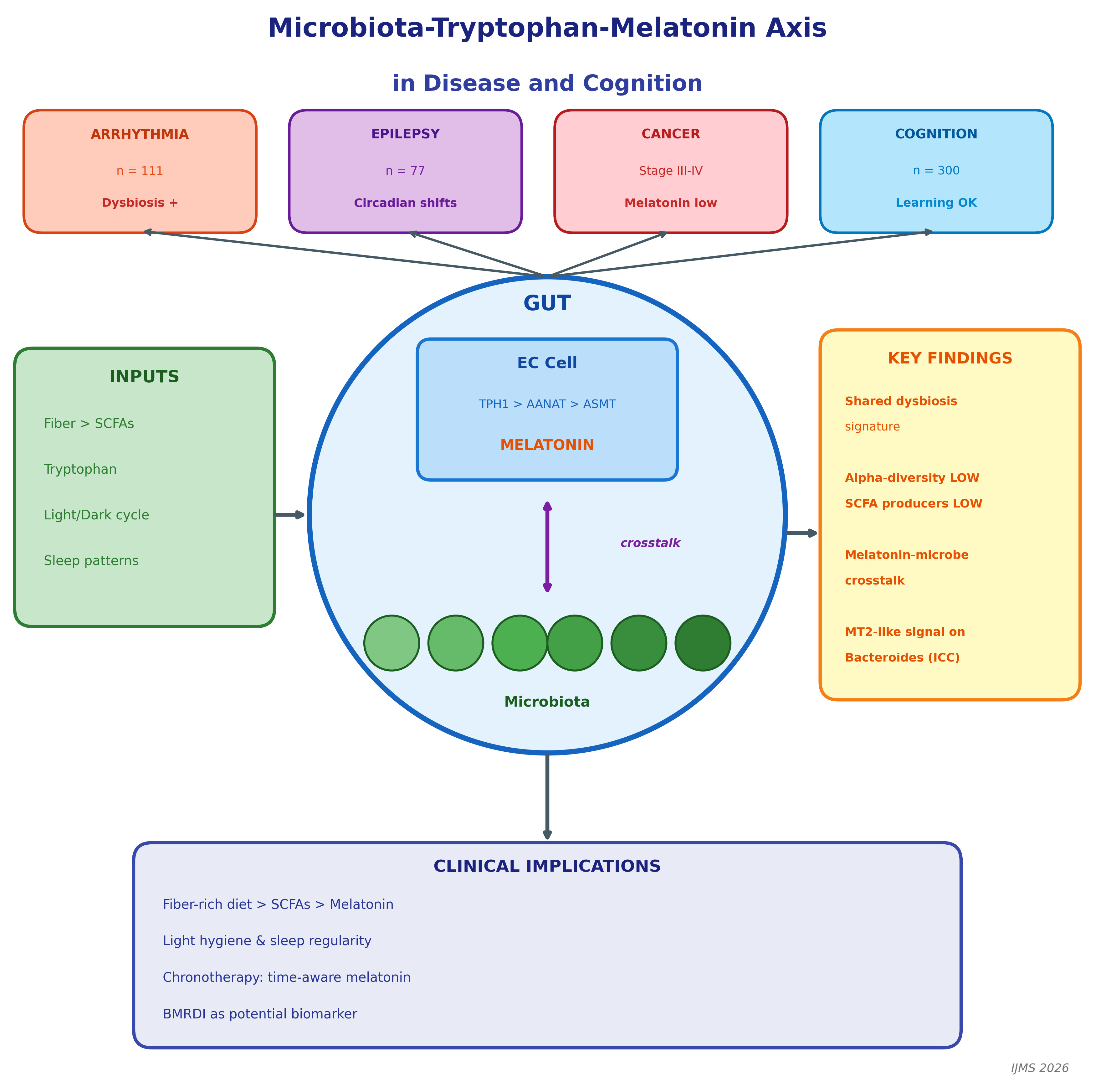
Melatonin, an indolic neuromodulator with putative oncostatic and proposed anti-inflammatory properties, primarily demonstrated in preclinical models, is produced at extrapineal sites—most notably in the gut. Its canonical actions are mediated by high-affinity GPCRs (MT1/MT2) and by NQO2, a cytosolic enzyme with a melatonin-binding site (historically termed “MT3”). A growing body of work highlights a bidirectional interaction between the gut microbiota and host melatonin. We integrated two lines of work: (i) three clinical cohorts—cardiac arrhythmias (n = 111; 46–75 y), epilepsy (n = 77; 20–59 y), and stage III–IV solid cancers (25–79 y)—profiled with stool 16S rRNA sequencing, SCFA measurements, and circulating melatonin/urinary 6-sulfatoxymelatonin and (ii) an age-spanning cognitive cohort with melatonin phenotyping, microbiome analyses, and exploratory immune/metabolite readouts, including a novel observation of melatonin binding on bacterial membranes. Across all three disease cohorts, we observed moderate-to-severe dysbiosis, with reduced alpha-diversity and shifted beta-structure. The core dysbiosis implicated tryptophan-active taxa (Bacteroides/Clostridiales proteolysis and indolic conversions) and depletion of SCFA-forward commensals (e.g., Faecalibacterium, Blautia, Akkermansia, and several Lactobacillus/Bifidobacterium spp.). Synthesised literature indicates that typical human gut commensals rarely secrete measurable melatonin in vitro; rather, their metabolites (SCFAs, lactate, and tryptophan derivatives) regulate host enterochromaffin serotonin/melatonin production. In arrhythmia models, dysbiosis, bile-acid remodelling, and autonomic/inflammatory tone align with melatonin-sensitive antiarrhythmic effects. Epilepsy exhibits circadian seizure patterns and tryptophan–metabolite signatures, with modest and heterogeneous responses to add-on melatonin. Cancer cohorts show broader dysbiosis consistent with melatonin’s oncostatic actions. In the cognitive cohort, the absence of dysbiosis tracked with preserved learning across ages, and exploratory immunohistochemistry suggested melatonin-binding sites on bacterial membranes in ~15–17% of samples. A unifying microbiota–tryptophan–melatonin axis plausibly integrates circadian, electrophysiologic, and immune–oncologic phenotypes. Practical levers include fiber-rich diets (to drive SCFAs), light hygiene, and time-aware therapy, with indication-specific use of melatonin. Our conclusions regarding microbiota–melatonin crosstalk rely primarily on local paracrine effects within the gut mucosa (where melatonin concentrations are 10–400× plasma levels), whereas systemic chronotherapy conclusions depend on circulating melatonin amplitude and phase. This original research article presents primary data from four prospectively enrolled clinical cohorts (total n = 577).
Keywords: melatonin; AANAT; ASMT; MT1/MT2; NQO2 (“MT3”); microbiota; tryptophan; SCFA; arrhythmia; epilepsy; cancer; dysbiosis melatonin; AANAT; ASMT; MT1/MT2; NQO2 (“MT3”); microbiota; tryptophan; SCFA; arrhythmia; epilepsy; cancer; dysbiosis
Graphical Abstract