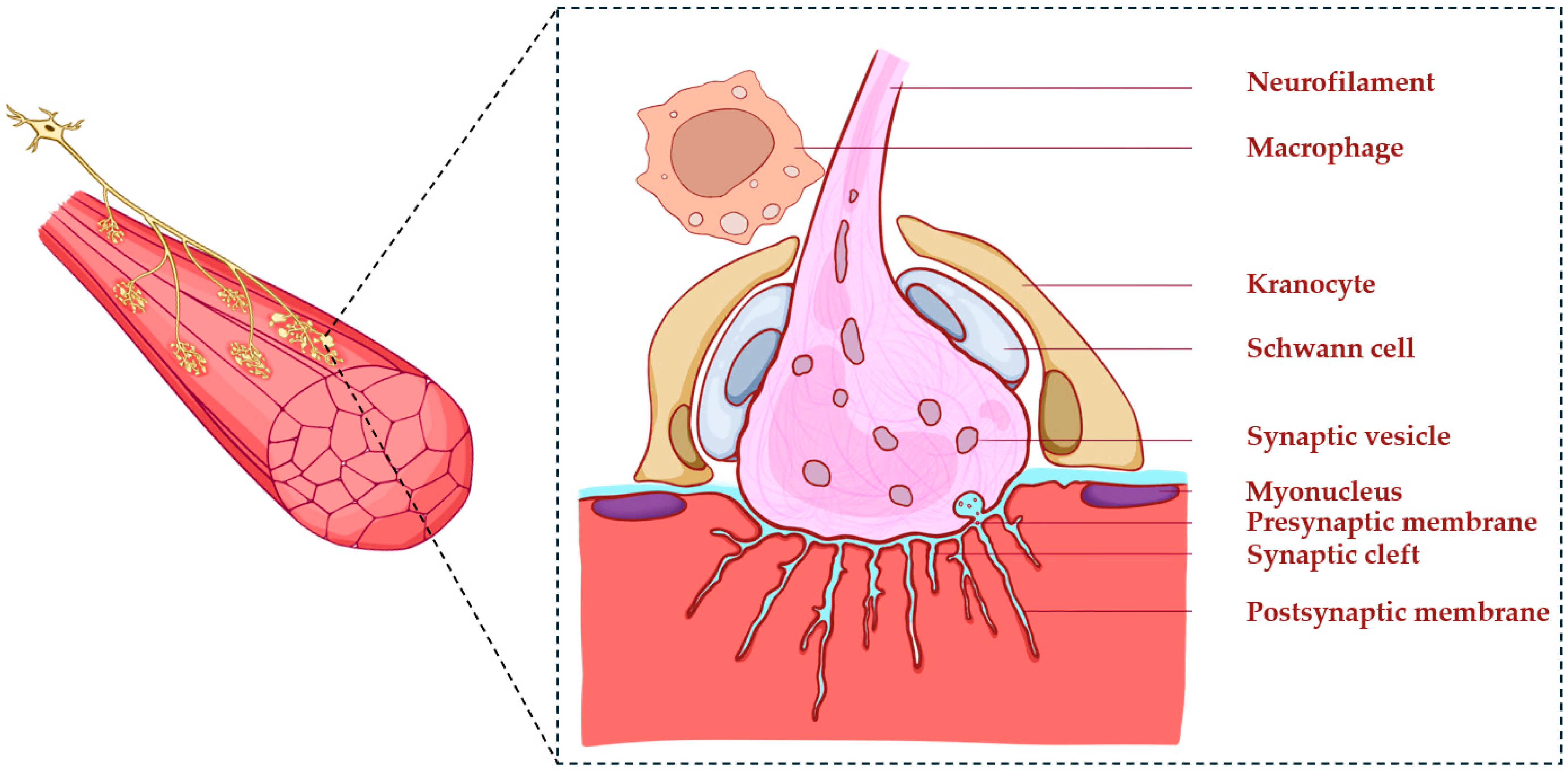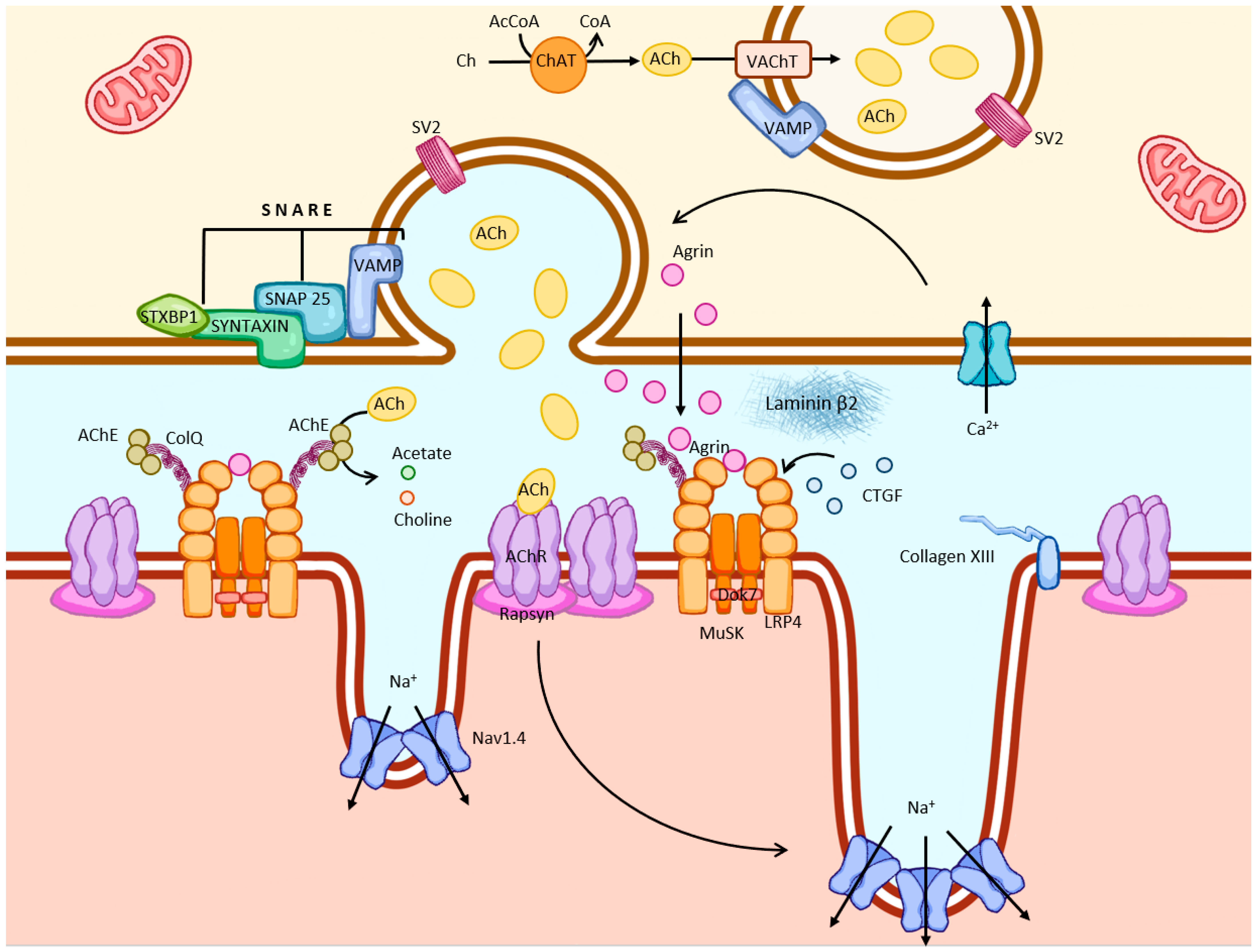
_Kim.png)

New Insights into Neuromuscular Junction Biology: Evidence from Human and Animal Research




Abstract
1. Introduction
2. NMJ Structure and Regulatory Components
2.1. Presynaptic Terminals
2.2. Synaptic Cleft and Basal Lamina Structures
2.3. Postsynaptic Structural–Functional Domain
2.4. Terminal Schwann Cells: Key Regulators of NMJ Homeostasis and Repair
2.5. Kranocytes: Structural Positioning and Functional Hypothesis
2.6. NMJ-Associated Myonuclei
2.7. NMJ-Associated Immune Cells
2.8. Interspecies Differences
3. NMJ Remodeling and Regeneration
3.1. NMJ Structural Remodeling and Adaptation
- Multiscale regulatory networks
- Metabolic signaling
- Mechanotransduction
- Neurotrophic cascades
- ECM-dependent control
- Muscle membrane mechanosensation
3.2. NMJ Repair and Reinnervation
4. NMJ Degeneration Related to Age and Disease
4.1. Evidence from Human Research
- Functional impairment precedes clinical sarcopenia
- Synaptic matrix remodeling
- Compensatory remodeling
- Concurrent neural stress
4.2. Dysregulation of Inflammation and Oxidative Stress
4.3. Impaired Immune Stem Cell Crosstalk
4.4. Autoimmune NMJ Disorders
4.5. Genetic Mutations of NMJ Components
4.6. Biomarkers and Functional Correlations
5. Conclusions and Future Perspectives
Author Contributions
Funding
Institutional Review Board Statement
Informed Consent Statement
Data Availability Statement
Conflicts of Interest
Abbreviations
| ACh | Acetylcholine |
| AChE | Acetylcholinesterase |
| AChR | Acetylcholine Receptor |
| Akt | Protein Kinase B (AKT) |
| ALS | Amyotrophic Lateral Sclerosis |
| AMPK | AMP-Activated Protein Kinase |
| ATP | Adenosine Triphosphate |
| AZ | Active Zone |
| CAF | C-terminal Agrin Fragment |
| Cav3 | Caveolin-3 |
| CCN2/CTGF | Cellular Communication Network Factor 2/Connective Tissue Growth Factor |
| ChAT | Choline Acetyltransferase |
| CMAP | Compound Muscle Action Potential |
| COLQ | Collagen Q (AChE-anchoring collagen) |
| cryo-EM | Cryo-Electron Microscopy |
| Dok-7 | Downstream of Tyrosine Kinase 7 |
| ECM | Extracellular Matrix |
| EPP | Endplate Potential |
| EMG | Electromyography |
| FAK | Focal Adhesion Kinase |
| iMUNE | Motor Unit Number Estimation (incremental MUNE) |
| IL-6 | Interleukin-6 |
| iPSC | Induced Pluripotent Stem Cell |
| LRP4 | Low-Density Lipoprotein Receptor-Related Protein 4 |
| MAPK | Mitogen-Activated Protein Kinase |
| MuSK | Muscle-Specific Kinase |
| Munc13/Munc18 | Mammalian Unc-13/Unc-18 homologs |
| nAChR | Nicotinic Acetylcholine Receptor |
| Nav1.4 | Skeletal-Muscle Voltage-Gated Sodium Channel α-subunit |
| NCAM | Neural Cell Adhesion Molecule |
| NfL | Neurofilament Light Chain |
| NMJ | Neuromuscular Junction |
| PI3K | Phosphoinositide 3-Kinase |
| PSC | Perisynaptic Schwann Cell |
| PGC-1α | Peroxisome Proliferator-Activated Receptor Gamma Coactivator-1α |
| RIM | Rab3-Interacting Molecule |
| ROS | Reactive Oxygen Species |
| SC | Satellite Cell |
| SNARE | Soluble NSF Attachment Protein Receptor |
| SV2 | Synaptic Vesicle Glycoprotein 2 |
| TAZ | Transcriptional Co-Activator with PDZ-binding motif |
| TNF-α | Tumor Necrosis Factor-α |
| tSC | Terminal Schwann Cell |
| VGCC | Voltage-Gated Calcium Channel |
| YAP | Yes-Associated Protein |
| MG | Myasthenia gravis |
| SMA | Spinal muscular atrophy |
References
- Desaki, J.; Uehara, Y. The overall morphology of neuromuscular junctions as revealed by scanning electron microscopy. J. Neurocytol. 1981, 10, 101–110. [Google Scholar] [CrossRef]
- Katz, B.; Kuffler, S.W. Excitation of the nerve-muscle system in Crustacea. Proc. R. Soc. Lond B Biol. Sci. 1946, 133, 374–389. [Google Scholar] [CrossRef] [PubMed]
- Fertuck, H.C.; Salpeter, M.M. Localization of acetylcholine receptor by 125I-labeled alpha-bungarotoxin binding at mouse motor endplates. Proc. Natl. Acad. Sci. USA 1974, 71, 1376–1378. [Google Scholar] [CrossRef] [PubMed]
- Tisdale, S.; Van Alstyne, M.; Simon, C.M.; Mentis, G.Z.; Pellizzoni, L. SMN controls neuromuscular junction integrity through U7 snRNP. Cell Rep. 2022, 40, 111393. [Google Scholar] [CrossRef]
- Reuveni, D.; Aricha, R.; Souroujon, M.C.; Fuchs, S. MuSK EAMG: Immunological Characterization and Suppression by Induction of Oral Tolerance. Front. Immunol. 2020, 11, 403. [Google Scholar] [CrossRef]
- Barik, A.; Li, L.; Sathyamurthy, A.; Xiong, W.C.; Mei, L. Schwann Cells in Neuromuscular Junction Formation and Maintenance. J. Neurosci. 2016, 36, 9770–9781. [Google Scholar] [CrossRef]
- Lu, C.Y.; Santosa, K.B.; Jablonka-Shariff, A.; Vannucci, B.; Fuchs, A.; Turnbull, I.; Pan, D.; Wood, M.D.; Snyder-Warwick, A.K. Macrophage-Derived Vascular Endothelial Growth Factor-A Is Integral to Neuromuscular Junction Reinnervation after Nerve Injury. J. Neurosci. 2020, 40, 9602–9616. [Google Scholar] [CrossRef]
- Cunningham, M.E.; Meehan, G.R.; Robinson, S.; Yao, D.; McGonigal, R.; Willison, H.J. Perisynaptic Schwann cells phagocytose nerve terminal debris in a mouse model of Guillain-Barre syndrome. J. Peripher. Nerv. Syst. 2020, 25, 143–151. [Google Scholar] [CrossRef]
- Gessler, L.; Huraskin, D.; Jian, Y.; Eiber, N.; Hu, Z.; Proszynski, T.J.; Hashemolhosseini, S. The YAP1/TAZ-TEAD transcriptional network regulates gene expression at neuromuscular junctions in skeletal muscle fibers. Nuclei. Acids Res. 2024, 52, 600–624. [Google Scholar] [CrossRef]
- Hirano, K.; Tsuchiya, M.; Shiomi, A.; Takabayashi, S.; Suzuki, M.; Ishikawa, Y.; Kawano, Y.; Takabayashi, Y.; Nishikawa, K.; Nagao, K.; et al. The mechanosensitive ion channel PIEZO1 promotes satellite cell function in muscle regeneration. Life Sci. Alliance 2023, 6, e202201783. [Google Scholar] [CrossRef] [PubMed]
- Li, H.; Pham, M.C.; Teng, J.; O’Connor, K.C.; Noviello, C.M.; Hibbs, R.E. Autoimmune mechanisms elucidated through muscle acetylcholine receptor structures. Cell 2025, 188, 2390–2406.e20. [Google Scholar] [CrossRef]
- Grimaldi, L.; Garcia-Uzquiano, R.; de la Banda, M.G.; Oulhissane-Omar, A.; Tard, C.; Saugier-Veber, P.; Laugel, V.; Desguerre, I.; Cintas, P.; Vuillerot, C.; et al. REGISTRE SMA FRANCE: A nationwide observational registry of patients with spinal muscular atrophy in France. J. Neuromuscul. Dis. 2025, 12, 793–803. [Google Scholar] [CrossRef] [PubMed]
- Gendron, T.F.; Petrucelli, L. Immunological drivers of amyotrophic lateral sclerosis. Sci. Transl. Med. 2023, 15, eadj9332. [Google Scholar] [CrossRef]
- Murata, F.; Ogata, T. The ultrastructure of neuromuscular junctions of human red, white and intermediate striated muscle fibers. Tohoku J. Exp. Med. 1969, 99, 289–301. [Google Scholar] [CrossRef] [PubMed]
- Court, F.A.; Gillingwater, T.H.; Melrose, S.; Sherman, D.L.; Greenshields, K.N.; Morton, A.J.; Harris, J.B.; Willison, H.J.; Ribchester, R.R. Identity, developmental restriction and reactivity of extralaminar cells capping mammalian neuromuscular junctions. J. Cell Sci. 2008, 121, 3901–3911. [Google Scholar] [CrossRef] [PubMed]
- Trias, E.; Ibarburu, S.; Barreto-Nunez, R.; Varela, V.; Moura, I.C.; Dubreuil, P.; Hermine, O.; Beckman, J.S.; Barbeito, L. Evidence for mast cells contributing to neuromuscular pathology in an inherited model of ALS. JCI Insight 2017, 2, e95934. [Google Scholar] [CrossRef]
- Kedlian, V.R.; Wang, Y.; Liu, T.; Chen, X.; Bolt, L.; Tudor, C.; Shen, Z.; Fasouli, E.S.; Prigmore, E.; Kleshchevnikov, V.; et al. Human skeletal muscle aging atlas. Nat. Aging 2024, 4, 727–744. [Google Scholar] [CrossRef]
- Jones, R.A.; Harrison, C.; Eaton, S.L.; Llavero Hurtado, M.; Graham, L.C.; Alkhammash, L.; Oladiran, O.A.; Gale, A.; Lamont, D.J.; Simpson, H.; et al. Cellular and Molecular Anatomy of the Human Neuromuscular Junction. Cell Rep. 2017, 21, 2348–2356. [Google Scholar] [CrossRef]
- Boehm, I.; Alhindi, A.; Leite, A.S.; Logie, C.; Gibbs, A.; Murray, O.; Farrukh, R.; Pirie, R.; Proudfoot, C.; Clutton, R.; et al. Comparative anatomy of the mammalian neuromuscular junction. J. Anat. 2020, 237, 827–836. [Google Scholar] [CrossRef]
- Ohkawara, B.; Kobayakawa, A.; Kanbara, S.; Hattori, T.; Kubota, S.; Ito, M.; Masuda, A.; Takigawa, M.; Lyons, K.M.; Ishiguro, N.; et al. CTGF/CCN2 facilitates LRP4-mediated formation of the embryonic neuromuscular junction. EMBO. Rep. 2020, 21, e48462. [Google Scholar] [CrossRef]
- Lai, Y.; Choi, U.B.; Leitz, J.; Rhee, H.J.; Lee, C.; Altas, B.; Zhao, M.L.; Pfuetzner, R.A.; Wang, A.L.; Brose, N.; et al. Molecular Mechanisms of Synaptic Vesicle Priming by Munc13 and Munc18. Neuron 2017, 95, 591–607.e10. [Google Scholar] [CrossRef]
- Wu, S.S.; Fan, J.L.; Tang, F.J.; Chen, L.; Zhang, X.Y.; Xiao, D.Q.; Li, X.H. The role of RIM in neurotransmitter release: Promotion of synaptic vesicle docking, priming, and fusion. Front. Neurosci. 2023, 17, 1123561. [Google Scholar] [CrossRef] [PubMed]
- Sakamoto, H.; Ariyoshi, T.; Kimpara, N.; Sugao, K.; Taiko, I.; Takikawa, K.; Asanuma, D.; Namiki, S.; Hirose, K. Synaptic weight set by Munc13-1 supramolecular assemblies. Nat. Neurosci. 2018, 21, 41–49. [Google Scholar] [CrossRef] [PubMed]
- Kawabe, H.; Mitkovski, M.; Kaeser, P.S.; Hirrlinger, J.; Opazo, F.; Nestvogel, D.; Kalla, S.; Fejtova, A.; Verrier, S.E.; Bungers, S.R.; et al. ELKS1 localizes the synaptic vesicle priming protein bMunc 13-2 to a specific subset of active zones. J. Cell Biol. 2017, 216, 1143–1161, Correction in J. Cell Biol. 2017, 216, 1205. https://doi.org/10.1083/jcb.20160608603092017c. [Google Scholar] [CrossRef] [PubMed]
- Ramachandran, S.; Rodgriguez, S.; Potcoava, M.; Alford, S. Single Calcium Channel Nanodomains Drive Presynaptic Calcium Entry at Lamprey Reticulospinal Presynaptic Terminals. J. Neurosci. 2022, 42, 2385–2403. [Google Scholar] [CrossRef]
- Blotnick-Rubin, E.; Anglister, L. Fine Localization of Acetylcholinesterase in the Synaptic Cleft of the Vertebrate Neuromuscular Junction. Front. Mol. Neurosci. 2018, 11, 123. [Google Scholar] [CrossRef]
- Pezinski, M.; Daszczuk, P.; Pradhan, B.S.; Lochmuller, H.; Proszynski, T.J. An improved method for culturing myotubes on laminins for the robust clustering of postsynaptic machinery. Sci. Rep. 2020, 10, 4524. [Google Scholar] [CrossRef] [PubMed]
- Barik, A.; Lu, Y.; Sathyamurthy, A.; Bowman, A.; Shen, C.; Li, L.; Xiong, W.C.; Mei, L. LRP4 is critical for neuromuscular junction maintenance. J. Neurosci. 2014, 34, 13892–13905. [Google Scholar] [CrossRef]
- Gemza, A.; Barresi, C.; Proemer, J.; Hatami, J.; Lazaridis, M.; Herbst, R. Internalization of Muscle-Specific Kinase Is Increased by Agrin and Independent of Kinase-Activity, Lrp4 and Dynamin. Front. Mol. Neurosci. 2022, 15, 780659. [Google Scholar] [CrossRef] [PubMed]
- Zainul, Z.; Heikkinen, A.; Koivisto, H.; Rautalahti, I.; Kallio, M.; Lin, S.; Härönen, H.; Norman, O.; Rüegg, M.A.; Tanila, H.; et al. Collagen XIII Is Required for Neuromuscular Synapse Regeneration and Functional Recovery after Peripheral Nerve Injury. J. Neurosci. 2018, 38, 4243–4258. [Google Scholar] [CrossRef]
- Logan, C.V.; Cossins, J.; Rodriguez Cruz, P.M.; Parry, D.A.; Maxwell, S.; Martinez-Martinez, P.; Riepsaame, J.; Abdelhamed, Z.A.; Lake, A.V.; Moran, M.; et al. Congenital Myasthenic Syndrome Type 19 Is Caused by Mutations in COL13A1, Encoding the Atypical Non-fibrillar Collagen Type XIII alpha1 Chain. Am. J. Hum. Genet. 2015, 97, 878–885. [Google Scholar] [CrossRef]
- Nakata, T.; Ito, M.; Azuma, Y.; Otsuka, K.; Noguchi, Y.; Komaki, H.; Okumura, A.; Shiraishi, K.; Masuda, A.; Natsume, J.; et al. Mutations in the C-Terminal Domain of ColQ in Endplate Acetylcholinesterase Deficiency Compromise ColQ-MuSK Interaction. Hum. Mutat. 2013, 34, 997–1004. [Google Scholar] [CrossRef]
- Wargon, I.; Richard, P.; Kuntzer, T.; Sternberg, D.; Nafissi, S.; Gaudon, K.; Lebail, A.; Bauche, S.; Hantaï, D.; Fournier, E.; et al. Long-term follow-up of patients with congenital myasthenic syndrome caused by mutations. Neuromuscul. Disord. 2012, 22, 318–324. [Google Scholar] [CrossRef] [PubMed]
- Barbeau, S.; Semprez, F.; Dobbertin, A.; Merriadec, L.; Roussange, F.; Eymard, B.; Sternberg, D.; Fournier, E.; Karasoy, H.; Martinat, C.; et al. Molecular Analysis of a Congenital Myasthenic Syndrome Due to a Pathogenic Variant Affecting the C-Terminus of ColQ. Int. J. Mol. Sci. 2023, 24, 16217. [Google Scholar] [CrossRef]
- Ohkawara, B.; Shen, X.; Selcen, D.; Nazim, M.; Bril, V.; Tarnopolsky, M.A.; Brady, L.; Fukami, S.; Amato, A.A.; Yis, U.; et al. Congenital myasthenic syndrome-associated agrin variants affect clustering of acetylcholine receptors in a domain-specific manner. JCI Insight 2020, 5, e132023. [Google Scholar] [CrossRef] [PubMed]
- Pan, N.C.; Zhang, T.; Hu, S.; Liu, C.; Wang, Y. Fast desensitization of acetylcholine receptors induced by a spider toxin. Channels 2021, 15, 507–515. [Google Scholar] [CrossRef] [PubMed]
- Cisterna, B.A.; Vargas, A.A.; Puebla, C.; Fernandez, P.; Escamilla, R.; Lagos, C.F.; Matus, M.F.; Vilos, C.; Cea, L.A.; Barnafi, E.; et al. Active acetylcholine receptors prevent the atrophy of skeletal muscles and favor reinnervation. Nat. Commun. 2020, 11, 1073. [Google Scholar] [CrossRef]
- Li, A.; Pike, A.C.W.; Webster, R.; Maxwell, S.; Liu, W.W.; Chi, G.; Palace, J.; Beeson, D.; Sauer, D.B.; Dong, Y.Y. Structures of the human adult muscle-type nicotinic receptor in resting and desensitized states. Cell Rep. 2025, 44, 115581. [Google Scholar] [CrossRef]
- Noviello, C.M.; Gharpure, A.; Mukhtasimova, N.; Cabuco, R.; Baxter, L.; Borek, D.; Sine, S.M.; Hibbs, R.E. Structure and gating mechanism of the alpha7 nicotinic acetylcholine receptor. Cell 2021, 184, 2121–2134.e13. [Google Scholar] [CrossRef]
- Ramadan, A.; Sheard, T.M.D.; Alhindi, A.; Rust, P.A.; Jones, R.A.; Jayasinghe, I.; Gillingwater, T.H. Expansion microscopy reveals nano-scale insights into the human neuromuscular junction. Cell Rep. Methods 2025, 5, 101082. [Google Scholar] [CrossRef]
- York, A.L.; Zheng, J.Q. Super-Resolution Microscopy Reveals a Nanoscale Organization of Acetylcholine Receptors for Trans-Synaptic Alignment at Neuromuscular Synapses. eNeuro 2017, 4, 78–88. [Google Scholar] [CrossRef]
- Zhang, C.; Joshi, A.; Liu, Y.; Sert, O.; Haddix, S.G.; Teliska, L.H.; Rasband, A.; Rodney, G.G.; Rasband, M.N. Ankyrin-dependent Na(+) channel clustering prevents neuromuscular synapse fatigue. Curr. Biol. 2021, 31, 3810–3819.e3814. [Google Scholar] [CrossRef] [PubMed]
- Kwan, H.R.; Chan, Z.C.; Bi, X.; Kutkowska, J.; Proszynski, T.J.; Chan, C.B.; Lee, C.W. Nerve-independent formation of membrane infoldings at topologically complex postsynaptic apparatus by caveolin-3. Sci. Adv. 2023, 9, eadg0183. [Google Scholar] [CrossRef] [PubMed]
- Sarto, F.; Stashuk, D.W.; Franchi, M.V.; Monti, E.; Zampieri, S.; Valli, G.; Sirago, G.; Candia, J.; Hartnell, L.M.; Paganini, M.; et al. Effects of short-term unloading and active recovery on human motor unit properties, neuromuscular junction transmission and transcriptomic profile. J. Physiol. 2022, 600, 4731–4751. [Google Scholar] [CrossRef]
- Duregotti, E.; Negro, S.; Scorzeto, M.; Zornetta, I.; Dickinson, B.C.; Chang, C.J.; Montecucco, C.; Rigoni, M. Mitochondrial alarmins released by degenerating motor axon terminals activate perisynaptic Schwann cells. Proc. Natl. Acad. Sci. USA 2015, 112, E497–E505. [Google Scholar] [CrossRef]
- Heredia, D.J.; Feng, C.Y.; Hennig, G.W.; Renden, R.B.; Gould, T.W. Activity-induced Ca(2+) signaling in perisynaptic Schwann cells of the early postnatal mouse is mediated by P2Y(1) receptors and regulates muscle fatigue. Elife 2018, 7, e30839. [Google Scholar] [CrossRef] [PubMed]
- Negro, S.; Bergamin, E.; Rodella, U.; Duregotti, E.; Scorzeto, M.; Jalink, K.; Montecucco, C.; Rigoni, M. ATP Released by Injured Neurons Activates Schwann Cells. Front. Cell Neurosci. 2016, 10, 134. [Google Scholar] [CrossRef]
- Bruneteau, G.; Bauche, S.; Gonzalez de Aguilar, J.L.; Brochier, G.; Mandjee, N.; Tanguy, M.L.; Hussain, G.; Behin, A.; Khiami, F.; Sariali, E.; et al. Endplate denervation correlates with Nogo-A muscle expression in amyotrophic lateral sclerosis patients. Ann. Clin. Transl. Neurol. 2015, 2, 362–372. [Google Scholar] [CrossRef]
- Nicole, S.; Chaouch, A.; Torbergsen, T.; Bauche, S.; de Bruyckere, E.; Fontenille, M.J.; Horn, M.A.; van Ghelue, M.; Loseth, S.; Issop, Y.; et al. Agrin mutations lead to a congenital myasthenic syndrome with distal muscle weakness and atrophy. Brain 2014, 137, 2429–2443. [Google Scholar] [CrossRef]
- Hastings, R.L.; Massopust, R.T.; Haddix, S.G.; Lee, Y.I.; Thompson, W.J. Exclusive vital labeling of myonuclei for studying myonuclear arrangement in mouse skeletal muscle tissue. Skelet. Muscle 2020, 10, 15. [Google Scholar] [CrossRef]
- Ham, A.S.; Lin, S.; Tse, A.; Thurkauf, M.; McGowan, T.J.; Jorin, L.; Oliveri, F.; Ruegg, M.A. Single-nuclei sequencing of skeletal muscle reveals subsynaptic-specific transcripts involved in neuromuscular junction maintenance. Nat. Commun. 2025, 16, 2220. [Google Scholar] [CrossRef]
- Motanova, E.; Sarto, F.; Negro, S.; Pirazzini, M.; Rossetto, O.; Rigoni, M.; Stashuk, D.W.; Gasparini, M.; Simunic, B.; Pisot, R.; et al. Neuromuscular junction instability with inactivity: Morphological and functional changes after 10 days of bed rest in older adults. J. Physiol. 2025, 604, 868–885. [Google Scholar] [CrossRef]
- Ying, Z.; Pan, C.; Shao, T.; Liu, L.; Li, L.; Guo, D.; Zhang, S.; Yuan, T.; Cao, R.; Jiang, Z.; et al. Mixed Lineage Kinase Domain-like Protein MLKL Breaks Down Myelin following Nerve Injury. Mol. Cell 2018, 72, 457–468.e455. [Google Scholar] [CrossRef]
- Fabbrizio, P.; Apolloni, S.; Bianchi, A.; Salvatori, I.; Valle, C.; Lanzuolo, C.; Bendotti, C.; Nardo, G.; Volonte, C. P2 × 7 activation enhances skeletal muscle metabolism and regeneration in SOD1G93A mouse model of amyotrophic lateral sclerosis. Brain Pathol. 2020, 30, 272–282. [Google Scholar] [CrossRef] [PubMed]
- Chen, X.; Hao, D.; Becker, N.; Muller, A.; Pishnamaz, M.; Bollheimer, L.C.; Hildebrand, F.; Nourbakhsh, M. Unsaturated Long-Chain Fatty Acids Activate Resident Macrophages and Stem Cells in a Human Skeletal Muscle Tissue Model. Biology 2023, 12, 1111. [Google Scholar] [CrossRef] [PubMed]
- Chen, X.; Muller, A.; Pishnamaz, M.; Hildebrand, F.; Bollheimer, L.C.; Nourbakhsh, M. Differential Fatty Acid Response of Resident Macrophages in Human Skeletal Muscle Fiber and Intermuscular Adipose Tissue. Int. J. Mol. Sci. 2024, 25, 722. [Google Scholar] [CrossRef] [PubMed]
- Chen, X.; Schubert, S.L.; Muller, A.; Pishnamaz, M.; Hildebrand, F.; Nourbakhsh, M. Metabolic Activity in Human Intermuscular Adipose Tissue Directs the Response of Resident PPARgamma(+) Macrophages to Fatty Acids. Biomedicines 2024, 13, 10. [Google Scholar] [CrossRef]
- Finlayson, S.; Palace, J.; Belaya, K.; Walls, T.J.; Norwood, F.; Burke, G.; Holton, J.L.; Pascual-Pascual, S.I.; Cossins, J.; Beeson, D. Clinical features of congenital myasthenic syndrome due to mutations in DPAGT1. J. Neurol. Neurosurg. Psychiatry 2013, 84, 1119–1125. [Google Scholar] [CrossRef]
- Monti, E.; Tagliaferri, S.; Zampieri, S.; Sarto, F.; Sirago, G.; Franchi, M.V.; Ticinesi, A.; Longobucco, Y.; Adorni, E.; Lauretani, F.; et al. Effects of a 2-year exercise training on neuromuscular system health in older individuals with low muscle function. J. Cachexia Sarcopenia Muscle 2023, 14, 794–804. [Google Scholar] [CrossRef]
- Piasecki, J.; Inns, T.B.; Bass, J.J.; Scott, R.; Stashuk, D.W.; Phillips, B.E.; Atherton, P.J.; Piasecki, M. Influence of sex on the age-related adaptations of neuromuscular function and motor unit properties in elite masters athletes. J. Physiol. 2021, 599, 193–205. [Google Scholar] [CrossRef]
- Sarto, F.; Franchi, M.V.; McPhee, J.S.; Stashuk, D.W.; Paganini, M.; Monti, E.; Rossi, M.; Sirago, G.; Zampieri, S.; Motanova, E.S.; et al. Neuromuscular impairment at different stages of human sarcopenia. J. Cachexia Sarcopenia Muscle 2024, 15, 1797–1810. [Google Scholar] [CrossRef]
- Xie, T.; Xu, G.; Liu, Y.; Quade, B.; Lin, W.; Bai, X.C. Structural insights into the assembly of the agrin/LRP4/MuSK signaling complex. Proc. Natl. Acad. Sci. USA 2023, 120, e2300453120. [Google Scholar] [CrossRef]
- Alhindi, A.; Boehm, I.; Forsythe, R.O.; Miller, J.; Skipworth, R.J.E.; Simpson, H.; Jones, R.A.; Gillingwater, T.H. Terminal Schwann cells at the human neuromuscular junction. Brain Commun. 2021, 3, fcab081. [Google Scholar] [CrossRef]
- Bakooshli, M.A.; Wang, Y.X.; Monti, E.; Su, S.; Kraft, P.; Nalbandian, M.; Alexandrova, L.; Wheeler, J.R.; Vogel, H.; Blau, H.M. Regeneration of neuromuscular synapses after acute and chronic denervation by inhibiting the gerozyme 15-prostaglandin dehydrogenase. Sci. Transl. Med. 2023, 15, eadg1485. [Google Scholar] [CrossRef]
- Ng, S.Y.; Mikhail, A.I.; Mattina, S.R.; Mohammed, S.A.; Khan, S.K.; Desjardins, E.M.; Lim, C.; Phillips, S.M.; Steinberg, G.R.; Ljubicic, V. AMPK regulates the maintenance and remodelling of the neuromuscular junction. Mol. Metab. 2025, 91, 102066. [Google Scholar] [CrossRef]
- Sakuma, M.; Gorski, G.; Sheu, S.H.; Lee, S.; Barrett, L.B.; Singh, B.; Omura, T.; Latremoliere, A.; Woolf, C.J. Lack of motor recovery after prolonged denervation of the neuromuscular junction is not due to regenerative failure. Eur. J. Neurosci. 2016, 43, 451–462. [Google Scholar] [CrossRef] [PubMed]
- Sugimoto, T.; Sakamaki, C.; Kimura, T.; Eguchi, T.; Miura, S.; Kamei, Y. Peroxisome proliferator-activated receptor gamma coactivator 1alpha regulates downstream of tyrosine kinase-7 (Dok-7) expression important for neuromuscular junction formation. Sci. Rep. 2024, 14, 1780. [Google Scholar] [CrossRef] [PubMed]
- Deschenes, M.R.; Rackley, M.; Fernandez, S.; Heidebrecht, M.; Hamilton, K.; Paez, H.G.; Paez, C.R.; Alway, S.E. Efficacy of Mitochondrial Transfer in Healing Toxin-Induced Damage to Neuromuscular Junction, an Empirical Study. Synapse 2025, 79, e70022. [Google Scholar] [CrossRef]
- Zhao, Y.; Yan, H.; Liu, K.; Ma, J.; Sun, W.; Lai, H.; Li, H.; Gu, J.; Huang, H. Acetylcholine receptor-beta inhibition by interleukin-6 in skeletal muscles contributes to modulating neuromuscular junction during aging. Mol. Med. 2024, 30, 171. [Google Scholar] [CrossRef] [PubMed]
- Jones, R.A.; Reich, C.D.; Dissanayake, K.N.; Kristmundsdottir, F.; Findlater, G.S.; Ribchester, R.R.; Simmen, M.W.; Gillingwater, T.H. NMJ-morph reveals principal components of synaptic morphology influencing structure-function relationships at the neuromuscular junction. Open Biol. 2016, 6, 160240. [Google Scholar] [CrossRef]
- Sun, S.; Shen, Y.; Zhang, X.; Ding, N.; Xu, Z.; Zhang, Q.; Li, L. The MuSK agonist antibody protects the neuromuscular junction and extends the lifespan in C9orf72-ALS mice. Mol. Ther. 2024, 32, 2176–2189. [Google Scholar] [CrossRef]
- Haddix, S.G.; Lee, Y.I.; Kornegay, J.N.; Thompson, W.J. Cycles of myofiber degeneration and regeneration lead to remodeling of the neuromuscular junction in two mammalian models of Duchenne muscular dystrophy. PLoS ONE 2018, 13, e0205926. [Google Scholar] [CrossRef]
- Tsuchiya, M.; Hara, Y.; Okuda, M.; Itoh, K.; Nishioka, R.; Shiomi, A.; Nagao, K.; Mori, M.; Mori, Y.; Ikenouchi, J.; et al. Cell surface flip-flop of phosphatidylserine is critical for PIEZO1-mediated myotube formation. Nat. Commun. 2018, 9, 2049. [Google Scholar] [CrossRef]
- Bermedo-García, F.; Zelada, D.; Martínez, E.; Tabares, L.; Henríquez, J.P. Functional regeneration of the murine neuromuscular synapse relies on long-lasting morphological adaptations. Bmc Biol. 2022, 20, 158. [Google Scholar] [CrossRef] [PubMed]
- Hastings, R.L.; Mikesh, M.; Lee, Y.I.; Thompson, W.J. Morphological remodeling during recovery of the neuromuscular junction from terminal Schwann cell ablation in adult mice. Sci. Rep. 2020, 10, 11132. [Google Scholar] [CrossRef] [PubMed]
- Lu, J.C.Y.; Huang, Y.H.; Chen, A.C.Y.; Chuang, D.C.C. Using the Neuromuscular Junction Cellular Response to Predict Functional Recovery after Nerve Grafting in a Mouse Experimental Model. Plast. Reconstr. Surg. 2024, 154, 551–561. [Google Scholar] [CrossRef]
- Gupta, R.; Johnston, T.R.; Chen, V.Y.; Gonzales, L.P.; Steward, O. Human Motor Endplate Survival after Chronic Peripheral Nerve Injury. medRxiv 2023. [Google Scholar] [CrossRef]
- Wokke, J.H.J.; Jennekens, F.G.I.; Vandenoord, C.J.M.; Veldman, H.; Smit, L.M.E.; Leppink, G.J. Morphological-Changes in the Human End Plate with Age. J. Neurol. Sci. 1990, 95, 291–310. [Google Scholar] [CrossRef] [PubMed]
- Lexell, J.; Taylor, C.C.; Sjostrom, M. What is the cause of the ageing atrophy? Total number, size and proportion of different fiber types studied in whole vastus lateralis muscle from 15- to 83-year-old men. J. Neurol. Sci. 1988, 84, 275–294. [Google Scholar] [CrossRef]
- Chang, M.Y.; Liu, R.Q.; Chen, B.Q.; Xu, J.; Wang, W.; Ji, Y.N.; Gao, Z.H.; Liu, B.Y.; Yao, X.L.; Sun, H.L.; et al. hBMSC-EVs alleviate weightlessness-induced skeletal muscle atrophy by suppressing oxidative stress and inflammation. Stem Cell Res. Ther. 2025, 16, 46. [Google Scholar] [CrossRef]
- Southerland, K.W.; Xu, Y.; Peters, D.T.; Wei, X.; Lin, X.; Xiang, Y.; Fei, K.; Olivere, L.A.; Morowitz, J.M.; Otto, J.; et al. Pro-inflammatory macrophages impair skeletal muscle regeneration in ischemic-damaged limbs by inducing precocious differentiation of satellite cells. bioRxiv 2023. [Google Scholar] [CrossRef]
- Wang, S.; Wang, S.; Cai, W.; Wang, J.; Huang, J.; Yang, Q.; Bai, H.; Jiang, B.; Ben, J.; Zhang, H.; et al. Macrophage scavenger receptor A1 promotes skeletal muscle regeneration after hindlimb ischemia. J. Biomed. Res. 2024, 39, 23–35. [Google Scholar] [CrossRef]
- Qin, H.; Luo, Z.; Sun, Y.; He, Z.; Qi, B.; Chen, Y.; Wang, J.; Li, C.; Lin, W.; Han, Z.; et al. Low-intensity pulsed ultrasound promotes skeletal muscle regeneration via modulating the inflammatory immune microenvironment. Int. J. Biol. Sci. 2023, 19, 1123–1145. [Google Scholar] [CrossRef]
- Mane-Damas, M.; Schottler, A.K.; Marcuse, F.; Molenaar, P.C.; Mohile, T.; Hoeijmakers, J.G.J.; Hochstenbag, M.; Damoiseaux, J.; Maessen, J.G.; Abdul-Hamid, M.; et al. Myasthenia gravis with antibodies against the AChR, current knowledge on pathophysiology and an update on treatment strategies with special focus on targeting plasma cells. Autoimmun. Rev. 2025, 24, 103875. [Google Scholar] [CrossRef]
- Wang, B.; Liu, D.; Yang, Y.; Zhu, R. Beyond the Surface: Investigating the Potential Mechanisms of Non-Motor Symptoms in Myasthenia Gravis. Eur. J. Neurol. 2025, 32, e70309. [Google Scholar] [CrossRef]
- Cruz-Jentoft, A.J.; Baeyens, J.P.; Bauer, J.M.; Boirie, Y.; Cederholm, T.; Landi, F.; Martin, F.C.; Michel, J.P.; Rolland, Y.; Schneider, S.M.; et al. Sarcopenia: European consensus on definition and diagnosis: Report of the European Working Group on Sarcopenia in Older People. Age Ageing 2010, 39, 412–423. [Google Scholar] [CrossRef] [PubMed]
- Lee, L.L.; Galo, E.; Lyeth, B.G.; Muizelaar, J.P.; Berman, R.F. Neuroprotection in the rat lateral fluid percussion model of traumatic brain injury by SNX-185, an N-type voltage-gated calcium channel blocker. Exp. Neurol. 2004, 190, 70–78. [Google Scholar] [CrossRef] [PubMed]
- Rygiel, K.A.; Picard, M.; Turnbull, D.M. The ageing neuromuscular system and sarcopenia: A mitochondrial perspective. J. Physiol. 2016, 594, 4499–4512. [Google Scholar] [CrossRef] [PubMed]
- Ohno, K.; Ohkawara, B.; Shen, X.M.; Selcen, D.; Engel, A.G. Clinical and Pathologic Features of Congenital Myasthenic Syndromes Caused by 35 Genes—A Comprehensive Review. Int. J. Mol. Sci. 2023, 24, 3730. [Google Scholar] [CrossRef]



| Species | Model | Target/Marker | Targeting Mechanism | Clinical Relevance/ Translation | Reference |
|---|---|---|---|---|---|
| human | clinical + ex vivo | DPAGT1 mutations | Impaired AChR glycosylation | Treatable CMS subtype | [58] |
| human | in vivo | CAF; NMJ genes; NF jitter | Mechanical unloading then resistance retraining | Disuse, rehab, denervation risk | [44] |
| human | cell lines (in vitro) | AChR α1β1δε | Cryo-EM with ACh/aBuTx; Fab35 | Explains CMS variants’ gain/loss function | [38] |
| human | clinical + in vivo | CAF; MUP; NFM jiggle; segment jitter | Exercise preserves NMJ stability markers | Sarcopenia prevention strategy; aging MU remodeling; NMJ instability | [59] |
| human | clinical + in vivo | CAF; NfL; muscle architecture | Intramuscular EMG at 25% MVC | Sarcopenia prevention strategy | [60] |
| human | in vivo + ex vivo | CAF; NfL; iMUNE; NF jitter | Multimodal NMJ/MU assessment; no intervention | Early biomarkers for sarcopenia prevention | [61] |
| human | in vivo + ex vivo | Nogo-A; AChR; neurofilament | Correlative expression–denervation analysis | Nogo-A therapeutic target ALS | [48] |
| human | clinical + in vivo + ex vivo | CAF; AChR; SV2; NfL | Disuse-induced NMJ remodeling | Inactivity-related sarcopenia risk | [52] |
| human | ex vivo | Agrin LRP4 MuSK | Cryo-EM ternary complex assembly | Congenital myasthenia therapeutics | [62] |
| human, mouse | in vivo | AChR clusters; synaptic podosomes | Laminin-driven ECM signaling induces AChR clustering | Screening targets for neuromuscular disorders | [27] |
| human, mouse | ex vivo + cell-lines (in vitro) | (tSCs); S100, NG2; AChRs; SV2/2H3; | siRNA KD; EFNA5 overexpression | Aging NMJ loss; re-innervation support | [17] |
| human, mouse | ex vivo + cell-lines (in vitro) | CHRNE; EFNA5/SORBS2; GRIA2 | Confocal morphometry comparison | Translational species differences; | [63] |
| human, mouse | ex vivo | AChR; SV2; NaV1.4 | α-BTX; anti-SV2/NaV1.4 | Human NMJ nanoscale organization | [40] |
| human, mouse | ex vivo | AChR; SV2/2H3; SNAP25; | Super-resolution imaging; proteomics | Species-specific NMJ translation | [18] |
| human, mouse | ex vivo | 15-PGDH; PGE2; | Small-molecule PGDHi | Trauma; ALS; SMA; aging | [64] |
| human, mouse | in vivo + ex vivo | AMPK; PGC-1a; Dok7 | Direct AMPK activation; muscle knockout | Aging; neuromuscular disorders | [65] |
| mouse, cat, dog, sheep, pig, human | ex vivo | SV2/2H3; α-BTX AChRs | NMJ-morph morphometry across species | Sheep best match the human NMJ | [19] |
| mouse, rat | in vivo | Kranocyte: cytoskeletal antibody (2166); CD34; CTB | Denervation-induced reactive expansion | ALS; Huntington’s muscle atrophy | [15] |
| mouse, rat | in vivo + ex vivo | Mitochondrial alarmins; PSC ERK | Axonal mitochondrial danger signaling | ALS-like dying-back mechanisms | [45] |
| mouse, rat | in vivo + ex vivo | NF200; α-bungarotoxin; CMAP | Delayed reinnervation after denervation | Nerve repair critical period | [66] |
| human; mouse; monkey | clinical + ex vivo | ColQ D-CTD; LRP4; AChR | Variant lowers ColQ–LRP4 binding | Explains COLQ CMS; informs therapy | [34] |
| mouse | in vivo + ex vivo | LRP4 | Agrin-LRP4 signaling loss | CMS/MG mechanism | [28] |
| mouse | in vivo + ex vivo | Terminal Schwann cells; S100 + 7 | SC ablation → postsynaptic defects first | NMJ degeneration; myasthenic relevance | [6] |
| mouse | in vivo + ex vivo | AChR; rapsyn; piccolo | AChRs edge-localized → AZ alignment | Efficient transmission; myasthenia context | [41] |
| mouse | in vivo + ex vivo | PGC1α; ERRα; Dok-7 | Transcriptional promoter activation | Exercise-mediated NMJ restoration | [67] |
| mouse | in vivo + ex vivo | AChR BTX; synaptophysin | Mitochondrial transfer after toxin | NMJ repair after muscle injury | [68] |
| mouse | in vivo + ex vivo | P2X7; SV2/2H3; α-BTX | P2X7 agonist BzATP intraperitoneal dosing | Site-specific P2X7 modulation in ALS | [54] |
| mouse | in vivo + ex vivo | MLKL; MBP; PLP | S441 phosphorylation enables myelin breakdown | Nerve regeneration after injury | [53] |
| mouse | in vivo + ex vivo | Etv4; Pdzrn4; MuSK | AAV overexpression; muscle CRISPR | NMJ maintenance pathways | [51] |
| mouse | in vivo + ex vivo | mCherry-H2B myonuclei; BTX-labeled AChRs | HSA-Cre activates mCherry-H2B reporter | In vivo NMJ subsynaptic nuclei tracking | [50] |
| mouse | in vivo + ex vivo | Nav1.4; AnkR/B/G; α-BTX NMJ | Ankyrin loss blocks NMJ Nav1.4 clustering | NMJ excitability; prevents use-dependent failure | [42] |
| mouse | in vivo + ex vivo | IL-6/IL-6R; AChR-β; PGC1α; MEF2C | IL-6R signaling modulates AChR-β expression | Pre-sarcopenia NMJ target: IL-6 | [69] |
| mouse | in vivo + ex vivo | SMN; U7 snRNP; Agrin; NMJ | AAV9 Lsm10/11 boosts U7 assembly | SMA NMJ rescue; adjunct therapy | [4] |
| mouse | in vivo + ex vivo | PIEZO1; Pax7 MuSCs | MuSC Piezo1 deletion; Rho rescue | Muscle repair; sarcopenia relevance | [10] |
| mouse | in vivo + ex vivo | YAP1, TAZ, TEAD1/4; synaptic genes | Muscle Cre knockout; CRISPR; AGRN media | Mechanisms for NMJ weakness disorders | [9] |
| mouse | ex vivo | SV2 2H3; α-BTX AChR | NMJ-morph quantification workflow | Benchmark for NMJ studies | [70] |
| mouse | ex vivo | P2Y1; TPSCs; GCaMP3 | Purinergic Ca2+ signaling blockade | Muscle fatigue modulation | [46] |
| mouse | ex vivo | Muscle nAChR; GsMTx-4 | Lipid-partitioning toxin; fast desensitization | Channel desensitization; therapeutic insight | [36] |
| mouse | ex vivo | MuSK; Lrp4; AChRα/β | Agrin increases MuSK endocytosis | MuSK trafficking; NMJ maintenance | [29] |
| mouse | ex vivo | CTGF/CCN2, LRP4, MuSK | CTGF enhances LRP4–MuSK signaling | Congenital myasthenic mechanisms | [20] |
| mouse | in vivo | Collagen XIII; AChRs | Col13a1 loss → presynaptic regeneration failure | CMS19; nerve injury recovery | [30] |
| mouse | in vivo | MuSK, anti-MuSK IgG, Treg | Oral MuSK → Treg-mediated immune suppression | MuSK-MG antigen-specific therapy | [5] |
| mouse | in vivo | nAChR; Cx43/45 hemichannels | ACh agonists; pyridostigmine; Cx43/45 KO | Targets for atrophy; reinnervation therapies | [37] |
| mouse | in vivo | Vegf-A; CD68 macrophages; tSC S100 | LysMCre Vegf-A cKO; CBZ VegfR2 | Targets to improve motor reinnervation | [7] |
| mouse | in vivo | GD1b; complement MAC; pSC S100B | Anti-GD1b antibody plus human complement | GBS distal axon debris clearance | [8] |
| mouse | in vivo | MuSK agonist antibody X-17 | MuSK activation independent of Agrin | ALS NMJ protection; lifespan extension | [71] |
| lamprey | ex vivo | CaV2.1/2.2/2.3; presynaptic AZ | Cell-attached patch; LLSM Ca2+ imaging | Synaptic dysfunction mechanism insight | [25] |
| xenopus, mouse | in vivo + ex vivo | Caveolin-3; lipid rafts; AChR | Cav3 MO/shRNA; MβCD cholesterol depletion | Junctional folds in muscular dystrophy | [43] |
| mouse, dog | in vivo | Muscle fibers; AChRs; SCs | Fiber degeneration/regeneration → NMJ remodeling | DMD progression; therapeutic timing | [72] |
| mouse, frog | in vivo | AChE; basal lamina | BL-anchored AChE → efficient ACh hydrolysis | Myasthenia; synaptic transmission fidelity | [26] |
| rat | in vivo | Mast cells; tryptase+; c-Kit+ | Mast degranulation → NMJ denervation | ALS progression; anti-inflammatory target | [16] |
Disclaimer/Publisher’s Note: The statements, opinions and data contained in all publications are solely those of the individual author(s) and contributor(s) and not of MDPI and/or the editor(s). MDPI and/or the editor(s) disclaim responsibility for any injury to people or property resulting from any ideas, methods, instructions or products referred to in the content. |
© 2026 by the authors. Licensee MDPI, Basel, Switzerland. This article is an open access article distributed under the terms and conditions of the Creative Commons Attribution (CC BY) license.
Share and Cite
Liang, Z.; Chen, X.; Nourbakhsh, M. New Insights into Neuromuscular Junction Biology: Evidence from Human and Animal Research. Int. J. Mol. Sci. 2026, 27, 1253. https://doi.org/10.3390/ijms27031253
Liang Z, Chen X, Nourbakhsh M. New Insights into Neuromuscular Junction Biology: Evidence from Human and Animal Research. International Journal of Molecular Sciences. 2026; 27(3):1253. https://doi.org/10.3390/ijms27031253
Chicago/Turabian StyleLiang, Zhanyang, Xiaoying Chen, and Mahtab Nourbakhsh. 2026. "New Insights into Neuromuscular Junction Biology: Evidence from Human and Animal Research" International Journal of Molecular Sciences 27, no. 3: 1253. https://doi.org/10.3390/ijms27031253
APA StyleLiang, Z., Chen, X., & Nourbakhsh, M. (2026). New Insights into Neuromuscular Junction Biology: Evidence from Human and Animal Research. International Journal of Molecular Sciences, 27(3), 1253. https://doi.org/10.3390/ijms27031253