Review

Aquaporin-4 Dysfunction in Depression: From Pathogenic Mechanisms to Novel Therapeutic Targeting

College of Basic Medical Sciences, Naval Medical University, Shanghai 200433, China
*
Author to whom correspondence should be addressed.
These authors contributed equally to this work.
Int. J. Mol. Sci. 2026, 27(3), 1233; https://doi.org/10.3390/ijms27031233
Submission received: 12 December 2025 / Revised: 8 January 2026 / Accepted: 22 January 2026 / Published: 26 January 2026
(This article belongs to the Section Molecular Neurobiology)

Abstract

Depression represents a leading cause of global disability, yet its pathogenesis remains incompletely understood. This review synthesizes emerging evidence highlighting the multifaceted role of Aquaporin-4 (AQP4), the central nervous system’s predominant water channel, in the pathophysiology of depression. Preclinical studies frequently report AQP4 dysregulation in depression models, characterized by reduced perivascular expression and impaired polarization in mood-relevant brain circuits. We delineate how AQP4 impairment is implicated in depression through several interconnected mechanistic pathways: (1) exacerbating glutamate excitotoxicity by disrupting astrocytic glutamate clearance; (2) impairing monoaminergic neurotransmission and synaptic plasticity; (3) potentiating neuroinflammatory cascades; (4) inducing mitochondrial functional impairment and oxidative stress; and (5) participating in hypothalamic–pituitary–adrenal (HPA) axis dysregulation by disrupting perineuronal osmotic and ionic homeostasis in response to arginine vasopressin (AVP) signaling. Furthermore, we explore the therapeutic relevance of AQP4, noting that diverse antidepressant treatments appear to partly exert their effects by modulating AQP4 expression and function. Collectively, the evidence positions AQP4 not as a solitary causative factor, but as a critical contributing component within the broader astrocyte–neuron–immune network. We therefore propose AQP4 as a promising node for therapeutic intervention, whose modulation may help counteract core pathophysiological processes in depression, offering a potential avenue for novel treatment development.

1. Introduction

Depressive disorder represents a pervasive psychiatric condition affecting over 300 million people worldwide, characterized by pervasive anhedonia, cognitive impairment, and somatic comorbidities that frequently confer treatment resistance [1,2]. Critically, depression constitutes the foremost modifiable risk factor for suicide, accounting for approximately 28% of global suicide-attributable disability-adjusted life years according to World Health Organization meta-analyses [3,4]. The disease burden is projected to escalate dramatically, with major depressive disorder (MDD) anticipated to become the leading cause of global disease burden by 2030—surpassing. cardiovascular conditions and malignancies [3]. This trajectory underscores an urgent need to move beyond traditional concepts of depression and elucidate novel pathophysiological mechanisms. While monoaminergic neurotransmission deficits have dominated therapeutic development for decades, their explanatory limitations are increasingly apparent [5,6]. A fundamental challenge remains the incomplete understanding of the disease’s pathogenesis.
Aquaporin-4 (AQP4), the predominant water channel in the central nervous system (CNS), exhibits polarized localization at perivascular astrocyte end-feet where it orchestrates glymphatic clearance, ion homeostasis, and astrocytic physiology [7,8,9]. Beyond these canonical roles, accumulating evidence demonstrates AQP4’s critical involvement in regulating neuroinflammatory responses [10], glutamate recycling [11], synaptic plasticity [12], etc. Notably, AQP4 dysregulation contributes to the pathogenesis of diverse neurological disorders including Alzheimer’s disease (AD) [13], stroke [14], and cerebral edema [15]. More recently, growing recognition implicates AQP4 dysregulation in the pathophysiology of depression [16]. This review systematically synthesizes current evidence linking AQP4 impairment to depression pathogenesis through multiple mechanistic pathways and evaluates its therapeutic relevance. We aim to consolidate existing research findings and provide an integrated framework for understanding AQP4’s multifaceted contributions to depressive disorders, thereby identifying promising therapeutic targets.

2. Molecular Structure and Localization of AQP4

In the brain, the only aquaporins with well-established physiological and pathological roles are AQP1, AQP4, and AQP9 [17]. First identified by Peter Agre in 1994, AQP4 is the most extensively characterized astrocyte-associated water channel [18]. Structurally, the AQP4 monomer (approximately 30 kDa) consists of six transmembrane α-helices (S1, S2, S4, S5, S6, S8) and two shorter, partially membrane-embedded helices (S3, S7), with each monomer forming an independent water-selective channel [19,20]. High-resolution X-ray crystallographic analyses reveal the presence of a narrow selectivity filter (diameter ~1.5 Å) within the channel [21]. This filter incorporates the conserved NPA (Asn-Pro-Ala) motifs and key residues such as Arg216 and His201 [21]. Through a combination of steric hindrance and electrostatic repulsion mechanisms, this structure ensures high selectivity for water molecules while effectively preventing the permeation of protons, ions, and other solutes [21]. Functionally active AQP4 assembles in the plasma membrane as homotetramers or heterotetramers [22]. Notably, a central pore is formed at the core of each tetramer, which has been proposed to potentially facilitate the transport of gases (such as CO2 and NH3) or ions [23]. However, the physiological relevance of transport through this central pore remains a subject of ongoing debate. These tetramers can further self-assemble into lattice-like supramolecular structures known as orthogonal arrays of particles (OAPs), a process primarily regulated by two major transcript isoforms, M1 and M23 [24,25]. The full-length M1 isoform possesses an extended N-terminus that inhibits large OAP assembly, while the shorter M23 isoform drives OAP formation through hydrophobic interactions [25,26]. Their co-expression and formation of heterotetramers in vivo determine the ultimate size and stability of OAPs [27].
AQP4 exhibits a highly polarized distribution pattern in astrocytes, with particular enrichment at critical brain-fluid interfaces: including the perivascular endfoot membranes of the blood–brain barrier, the pial/subpial endfeet at the cerebrospinal fluid (CSF)-parenchyma interface, and the ependymal/subependymal processes surrounding the ventricular system [28,29]. This specific localization is mediated by an anchoring system, primarily via the dystrophin-associated protein complex and its component α-syntrophin, which bridges AQP4 to the extracellular matrix at the basal lamina [30,31,32,33]. Genetic deletion of key components like dystrophin or α-syntrophin leads to a dramatic loss of perivascular AQP4 polarization [32,34]. Regional specificity analysis reveals that AQP4 density is highest in perivascular, subarachnoid, and periventricular astrocytes, and is also markedly elevated in osmosensitive regions (such as the supraoptic nucleus and subfornical organ), consistent with its core function in maintaining water and ion homeostasis [29,35,36]. Recent studies further suggest that sparse but functional pools of AQP4 are also present on the perisynaptic membranes of astrocytes at tripartite synapses, facing neurons [37]. This indicates that AQP4 may extend beyond its traditional role in fluid balance, possessing potential for direct synaptic modulation and the regulation of neural plasticity.

3. Foundational Physiological Roles of AQP4 in the CNS

AQP4 is the most abundant and distinctive water channel in the CNS [38]. Its functions extend well beyond passive water transport, positioning it as a core executor of astrocyte activity and a critical regulator of brain homeostasis [39,40]. By modulating the dynamic equilibrium of water, ions, and cellular volume, AQP4 establishes a molecular foundation for the stability of the neuronal microenvironment, thereby influencing neural signaling and plasticity [31]. A comprehensive understanding of these fundamental roles provides the necessary framework for deciphering its involvement in pathological conditions such as cerebral edema, epilepsy, and neurodegenerative diseases.

3.1. Molecular and Cellular Basis: Facilitated Water Transport and Osmotic Balance

The primary function of AQP4 is to serve as a bidirectional, water-selective pore [38]. It assembles as a tetramer, with each monomer forming an independent water channel, a structure essential for maintaining baseline brain water homeostasis [41]. Under physiological conditions, AQP4 mediates continuous, subtle water exchange between CSF, the interstitial space, and across vascular interfaces [42]. For example, in response to osmotic changes, astrocytes rapidly adjust their volume via AQP4, buffering acute shifts in extracellular osmolality and protecting neurons from osmotic stress [43]. Foundational studies show that AQP4-knockout (AQP4/) mice exhibit a slight but significant increase in baseline brain and spinal cord water content compared to wild-type littermates, directly underscoring its role in the fine-tuning of physiological water balance [44].

3.2. Potassium Spatial Buffering and Ionic Homeostasis

A key physiological function of AQP4 is its cooperation with the astrocytic inward rectifier potassium channel Kir4.1 to regulate extracellular potassium (K+) spatial buffering [45]. Neuronal activity releases K+ into the restricted extracellular space, elevating local concentration ([K+]0) and potentially disrupting neuronal excitability [46]. Astrocytes uptake excess K+ mainly via Kir4.1 [47]. The accompanying K+ influx creates a local osmotic gradient that drives water entry into astrocytes through AQP4. This coupled transport is crucial for maintaining extracellular volume and ionic stability. In AQP4/ mice, the clearance rate of extracellular K+ following stimulation is significantly slowed, impairing K+ buffering and affecting neuronal excitability, which illustrates how AQP4 influences basic neuroelectrical activity [48].

3.3. Modulation of the Perisynaptic Microenvironment

Within the tripartite synapse—comprising pre- and postsynaptic neurons along with perisynaptic astrocyte processes—AQP4 contributes to microenvironmental regulation [37,49]. Neurotransmitter release and reuptake involve rapid local osmotic and ionic shifts [50]. Perisynaptic AQP4 is believed to regulate water flux in this microdomain, influencing extracellular geometry and diffusion properties, thereby indirectly shaping the spatiotemporal dynamics of neurotransmitters. AQP4 deficiency is associated with reduced astrocytic glutamate uptake, possibly due to altered transporter function or microenvironmental changes [51]. Moreover, AQP4-dependent volume adjustments can modulate synaptic cleft concentrations of neurotransmitters and neuromodulators, supporting synaptic plasticity mechanisms such as long-term potentiation (LTP) and depression [52]. Behaviorally, AQP4/ mice show impairments in spatial learning and memory consolidation, linking AQP4 to higher cognitive functions [12,53].

3.4. Polarized Localization at Fluid Interfaces: Blood-Brain and CSF Barriers

The highly polarized enrichment of AQP4 on astrocyte endfeet membranes underpins its systemic functions [54]. Via interaction with anchoring proteins such as α-syntrophin within the dystrophin-associated complex, AQP4 is specifically targeted to endfoot domains facing capillary basal laminae and pial/ependymal surfaces [30]. This strategic placement positions AQP4 at critical brain-blood and brain-CSF interfaces [55,56], where it not only mediates trans-barrier water movement but may also participate in neurovascular coupling. Evidence suggests that osmotic stimuli or activity-induced astrocytic Ca2+ signals may, through AQP4 or associated channels like TRPV4, modulate vascular tone and local cerebral blood flow [43,57].

3.5. The Glymphatic System and Metabolic Clearance

The glymphatic system hypothesis expands the role of AQP4 to a whole-brain clearance mechanism [58]. It proposes that, particularly during states such as sleep, CSF enters the brain along para-arterial spaces [59]. Water from this influx moves into the extracellular space via AQP4 on astrocyte endfeet, driving convective interstitial fluid flow that promotes the clearance of metabolic wastes along para-venous pathways [59]. Although hydrodynamic details remain debated, AQP4 is central to this proposed clearance model [60]. AQP4/ mice exhibit significantly reduced interstitial solute clearance and increased amyloid-β deposition [59,61], providing physiological evidence for AQP4’s role in maintaining brain metabolic homeostasis.

4. AQP4 and Depression

Converging evidence from clinical and preclinical animal studies substantiates AQP4 dysregulation as being implicated in the pathophysiology of MDD. The following table summarizes recent studies on the association between AQP4 and depression, most of which demonstrate a significant association between AQP4 and depression or depression-related diseases, but there are also studies with opposing opinions, proving that the relationship between AQP4 and depression remains to be investigated (Table 1 and Table 2). Histopathological analyses reveal significantly reduced perivascular AQP4 immunoreactivity (indicating impaired astrocyte end-foot coverage) in corticolimbic vasculature of MDD patients [62,63]. Complementary transcriptomic investigations demonstrate downregulation of AQP4-associated mRNA transcripts in depressive cohorts, suggesting compromised channel expression at the transcriptional level [64]. Postmortem validations further identify region-specific AQP4 deficiency, with marked reductions in both mRNA and protein expression particularly affecting mood-regulating gray matter structures—including the hippocampus (dentate gyrus and cornu ammonis), locus coeruleus, and prefrontal cortex-while sparing white matter tracts [16]. This anatomically selective AQP4 deficiency underlies a disruption in brain fluid homeostasis, including glymphatic function, which in turn may contribute to disease progression by causing impaired metabolic waste clearance, aberrant distribution of neurotransmitters, and altered neuroimmune communication.
Complementary preclinical evidence also establishes AQP4 dysregulation as causally contributing to depression pathogenesis. Chronic unpredictable mild stress (CUMS) models demonstrate impaired AQP4 polarization and reduced transcript levels of AQP4 and dystrophin-associated complex components (agrin, laminin, dystroglycan) in anterior cortex, concomitant with glymphatic dysfunction [65]. These pathological alterations are reversibly rescued by antidepressant therapies or glucocorticoid receptor antagonism [65]. Parallel CUMS exposure significantly decreases AQP4 protein expression in hippocampal dentate gyrus and choroid plexus—effects prevented by mood stabilizers [66]. Additional stress paradigms (anxiety-provoking stimuli, gestational stress) consistently replicate cortical AQP4 downregulation [66,67]. Crucially, genetic ablation studies confirm causal involvement: AQP4 knockout (AQP4-KO) mice exhibit exacerbated hippocampal neurogenesis impairment and astrocytic vulnerability during chronic corticosterone exposure, with significant aggravation of depression-like behaviors [68]. Lipopolysaccharide (LPS)-induce animal model of depression further demonstrated that perivascular AQP4 redistribution, establishing consistent AQP4 dysregulation across etiologically diverse depression models [69].
Table 1. Association of AQP4 with depression-related disorders in animal studies.
Material TypeExperimental ParadigmsExperimental ModelsKey OutcomesReferences
  • Male and female C57BL/6 J mice (6–8 weeks of age).
  • Adeno-associated virus 5 (AAV5) or a scrambled control (AAV5-scrambled-shRNA).
  • Prefrontal cortex tissue
Stress-based models of depressionChronic Unpredictable Stress (CUS) Model
  • CUS induced pronounced astrocyte dystrophy, loss of vascular AQP4 coverage, and working memory deficits in male mice
[70]
  • Adult male C57BL/6 mice (10–12 weeks old)
  • Melatonin, TGN020, artificial CSF tracers and antibodies for immunohistochemistry
  • Primary astrocyte cultures
  • ELISA kits, qPCR reagents
Stress-based models of depressionCUMS mouse model
  • CUMS disrupted AQP4 polarization (reduced M23/M1 ratio) at astrocytic endfeet
[71]
  • Adult male C57BL/6 mice (9–11 weeks) and CD1 mice (9–13 months)
  • Primary hippocampal neurons isolated from embryonic day 18–19 C57BL/6 mice
  • NMDA (100 μmol/L), KN-93 (CaMKII inhibitor, 1 μM); TBB (CK2 inhibitor, 50 μM); Rapamycin (autophagy activator, 100 nM); Fluoxetine (10 mg/kg).
Stress-based models of depressionchronic social defeat stress Mouse Model
  • AQP4 Upregulation in Depression
  • AQP4 Knockdown Ameliorates Depression
[72]
  • Adult male C57BL/6 mice (10–12 weeks old)
  • Polyunsaturated fatty acid (PUFA) supplement, escitalopram (Es, 10 mg/kg, intraperitoneal); tracers (FITC-dextran 3 kDa, Texas Red-dextran 40 kDa)
Stress-based models of depressionCUMS mouse model
  • CUMS caused AQP4 depolarization in astrocytic endfeet;
  • PUFA restored perivascular AQP4 localization, supporting glymphatic flow.
  • Es partially increased AQP4 expression but did not correct polarization.
[73]
  • Thirty-eight specific pathogen-free C57BL/6 mice (male, age unspecified) Chemical Reagents
  • Gadolinium-diethylenetriamine pentaacetate (Gd-DTPA) as paramagnetic contrast agent; Texas Red-dextran-3 (3 kDa); immunofluorescence antibodies
Stress-based models of depressionCUMS mouse model
  • Immunofluorescence confirmed the down-regulation of AQP4 expression in CUMS mice
[74]
  • Male Wistar rats (6 weeks old, ~200 g; n = 80)
  • Lithium chloride (2.5 mEq/kg, i.p.); Gd-DTPA (0.5 mmol/kg)
  • anti-AQP4, anti-GFAP, anti-claudin-5, anti-BDNF, anti-IL-6
Stress-based models of depressionChronic mild stress (CMS) rats model
  • Lithium attenuated CMS-induced reduction in hippocampal AQP4/GFAP ratio
[75]
  • Adult male AQP4-KO (AQP4−/−) and wild-type (AQP4+/+) mice (2 months old, CD1 background).
  • Fluoxetine hydrochloride (10 mg/kg, i.p.), bromodeoxyuridine
  • Antibodies for immunohistochemistry
Stress-based models of depressionCUMS mouse model
  • Ketamine increased the AQP4 expression in the hippocampus of the CUMS mice
[76]
  • Wistar rats (male and female) at postnatal days 15 (juvenile) and 70 (adult)
  • Sodium fluorescein (NaF, 376 Da)
  • RT-qPCR
  • ELISA kits
Stress-based modelsEarly-life stress (ELS) Model: Maternal separation (MS) protocol
  • MS upregulated AQP4 expression exclusively in the dSTR of juvenile males
[77]
  • Male C57BL/6 mice (8 weeks old)
  • Antibodies for immunofluorescence
  • ELISA kits
Depression-like behavior based on neuroinflammationHigh-fat diet (HFD)-induced obesity in mice
  • HFD-induced obese mice have reduced AQP4 expression in the caudo-putamen nucleus and anterior cingulate cortex
[78]
  • Male and female C57BL/6 mice (8–10 weeks old; n = 6–12/group)
  • Antibodies for immunofluorescence
  • ELISA kits
  • qPCR reagents
Depression-like behavior based on neuroinflammationTraumatic brain injury (TBI) Model: Lateral fluid percussion injury in mice to induce moderate TBI
  • TBI reduced AQP4 polarization at 3 DPI, indicating glymphatic impairment.
[79]
Table 2. Association of AQP4 with depression-related disorders in human studies.
Material TypeDisease AreaExperimental ModelsKey OutcomesReferences
  • DNA isolated from peripheral blood samples of 342 patients with confirmed coronary artery disease (CAD).
  • Genome-wide genotyping data
  • Demographic and psychiatric assessment data
  • Vascular depression, a subtype of late-onset depression
  • Patients with atherosclerotic CAD
  • Genome-wide association study
  • The genome-wide significant variant rs528732638 is associated with a 3.6-fold increase in the odds of lifetime depression
  • The genomic region harboring rs528732638 acts as an expression quantitative trait loci (eQTL), regulating the expression of the AQP4 gene
[80]
  • 50 patients with a major depressive episode (MDE) (25 with MDD, 25 with bipolar disorder [BD]) and 30 matched healthy controls (HCs)
  • MDE in unipolar MDD and BD
  • Anxiety disorders,
  • Personality disorders
  • Treatment-resistant depression
  • Human Clinical Cohort
  • No serum AQP4 autoantibodies detected in any MDE patients (MDD or BD) or HCs at baseline or follow-up
[81]
  • 57 patients with optic neuritis
  • Demographic information (age, sex), clinical metrics (visual acuity in better- and worse-seeing eyes, number of recurrence events), and patient-reported outcome measures
  • Serum AQP4-IgG antibody status
  • AQP4 antibody-seropositive optic neuritis (AQP4-ON)
  • Visual impairment
  • Depression risk
  • Human clinical cohort model
  • AQP4-ON was significantly associated with a lower the 25-item National Eye Institute Visual Function Questionnaire (VFQ-25) composite score compared to idiopathic ON (ION)
  • AQP4-ON was significantly associated with a higher the Beck Depression Inventory-II (BDI-II) score compared to ION
[82]
  • 31 patients with stress-induced exhaustion disorder (SED), 31 with MDD, and 61 HCs
  • Anti-AQP4 DyLight 488, anti-glial fibrillary acidic protein (GFAP) DyLight 755, anti-CD41-FITC (platelet marker), and anti-CD154-PE (CD40 Ligand); Isotype-matched immunoglobulins
  • SED
  • MDD
  • A cross-sectional study
  • SED patients showed significantly higher concentrations of AQP4+ EVs
  • MDD patients had higher AQP4/GFAP+ EVs than HCs, but lower than SED
[83]
  • Brain samples from subjects with MDD and matched non-psychiatric controls
  • Antibodies for immunohistochemistry
  • molecular biology tools for qPCR
  • ELISA kits
  • Rodents (rats and mice)
  • MDD
  • Human Postmortem Studies
  • The coverage of blood vessels by AQP4-positive astrocytes in MDD is reduced.
  • Downregulation of AQP4 in MDD
[84]
As above mentioned, investigations into AQP4 expression in depression models report seemingly paradoxical findings, including regional downregulation, upregulation, or altered polarization. These discrepancies are not necessarily inconsistent; rather, they underscore the context-dependent nature of AQP4 dysregulation, influenced by factors such as brain region, disease subtype, stress paradigm, and the specific molecular parameter altered.
The brain region under investigation is a primary determinant of AQP4 expression changes. Consistent downregulation of AQP4 has been observed in emotion-processing gray matter structures, such as the hippocampus and prefrontal cortex, both in post-mortem studies of MDD patients and in chronic stress models like CUMS [63,65]. This regional vulnerability may be linked to high metabolic demand and susceptibility to excitotoxic and inflammatory insult. Conversely, distinct pathological contexts, such as the neuroinflammatory response following TBI, may be associated with disrupted polarization of AQP4 at astrocytic endfeet without an overall change in total protein levels [79]. This suggests that the loss of polarized localization—critical for glymphatic function—can occur independently of changes in total AQP4 expression, a nuance that may explain conflicting reports from studies employing different methodologies.
The nature of the depressive insult also critically influences AQP4 dynamics. CMS or CUMS protocols typically lead to reduced hippocampal AQP4 expression and polarization, supported by DCE-MRI evidence of glymphatic dysfunction [74]. However, acute or severe stressors may trigger different adaptive or maladaptive responses [85]. Furthermore, comorbidity plays a significant role. Diet-induced obesity, a common comorbidity of depression, can induce frontal-striatal gliosis and is associated with reduced AQP4 levels, suggesting that metabolic stress engages pathways converging on AQP4 downregulation [78].
The total abundance of AQP4 protein and its polarized localization to perivascular astrocytic endfeet can be differentially regulated with distinct functional consequences. A reduction in total AQP4 expression, as observed in the hippocampus following chronic stress, directly impairs the channel’s water transport capacity [65]. Conversely, mislocalization or depolarization of AQP4 can disrupt glymphatic flow without necessarily altering total protein levels, as illustrated by studies on sleep disruption and TBI [79]. Depolarization of AQP4 distribution has also been observed in many models of depression [73,86]. Therefore, studies reporting no change in total AQP4 levels cannot rule out significant functional impairment at the glymphatic interface due to loss of polarization.
Consequently, seemingly contradictory findings across studies reflect the complex, multifaceted regulation of AQP4. This is not a simple model of loss- or gain-of-function, but rather positions AQP4 dysfunction as a final common pathway reachable via various etiologies, each leaving a distinct molecular signature on AQP4 expression and localization. Future research must explicitly account for these variables by systematically analyzing both polarization status and total expression across different brain regions and disease models to comprehensively elucidate the role of AQP4 in the pathophysiology of depression. This refined understanding positions AQP4 not merely as a biomarker of dysfunction but as a central, dynamically regulated node interfacing neurovascular, glymphatic, and inflammatory processes—a promising target for mechanistically informed therapeutic strategies.

5. Potential Mechanisms Underlying the Contribution of AQP4 to Depression

5.1. Glutamate Excitotoxicity

Glutamate excitotoxicity has emerged as a critical pathogenic mechanism underlying depression [87]. It has been demonstrated that sustained elevation of extracellular glutamate concentrations and aberrant N-methyl-D-aspartate receptor (NMDAR) activation occur in corticolimbic circuits of depressed patients and chronic stress models [88,89]. Critically, impaired astrocytic glutamate clearance initiates excitotoxic cascades, which may underlie core depressive symptomatology [90].
Emerging evidence indicates that AQP4 expression can modulate cerebral glutamate homeostasis, with deficiency being linked to excitotoxic risk in various neurological conditions [91]. In AQP4-KO mice, across different models have demonstrated significantly elevated extracellular glutamate concentrations and NMDAR-mediated excitatory postsynaptic currents are significantly elevated in the nucleus accumbens and hippocampus [92]. Research suggests that these perturbations correlate with behavioral despair phenotypes relevant to depression.
Mechanistically, experimental evidence from cell and animal models indicates that AQP4 deficiency can impairs astrocytic glutamate clearance, evidenced by reduced [3H]D,L-glutamate uptake in cortical astrocytes and decreased glutamate transporter activity in primary cultures, which paradoxically attenuates glutamate-induced cytotoxicity due to compensatory upregulation of antioxidant pathways (e.g., Nrf2/ARE) [93]. Critically, AQP4 co-localizes with the astrocytic glutamate transporter-1 (known as EAAT2 in humans and GLT-1 in rodents) at perivascular endfeet domains, suggesting the formation of a functional complex that could synchronize water efflux with glutamate translocation via osmotic gradients [11,94,95,96]. Consistent with this spatial organization, AQP4 loss has been shown to downregulate GLT-1 expression in a region-specific manner and suppresse glutamate uptake in primary astrocytes by disrupting transporter membrane trafficking [91,97]. This regional heterogeneity may contribute to the differential vulnerability of brain circuits to excitotoxic injury observed in various disorders, including depression. In addition, heterologous AQP4 expression in HEK-293 cells was found to upregulate transgenic EAAT2 protein, an effect abrogated by blockade of calcium-dependent PKC signaling, implying a potential mechanism through which AQP4 might regulate transporters via kinase-mediated phosphorylation [98]. Collectively, data from preclinical models suggest that AQP4 deficiency could promote elevated extracellular glutamate via impaired transporter function and expression, potentially inducing NMDAR hyperactivation that is associated with dendritic spine loss in prefrontal pyramidal neurons—a structural hallmark also observed in chronic stress models. This body of work establishes excitotoxicity as a potential pathophysiological mechanism that may link astrocyte dysfunction to depressive pathogenesis.

5.2. Impaired Neurotransmission

Impaired neurotransmission constitutes a pathophysiological cornerstone of depression, characterized by dysregulated monoaminergic and glutamatergic signaling across corticolimbic-hypothalamic circuits [99]. These deficits manifest as synaptic failure—evidenced by dendritic atrophy, spine loss, and disrupted plasticity—compromising neural connectivity essential for emotion regulation [100,101]. Thus, synaptic dysfunction serves as a convergent mechanism linking distributed network disruption to core depressive symptomatology.
AQP4 has been implicated in modulating monoaminergic neurotransmission and synaptic plasticity, suggesting a potential role in depression-related neural circuitry [102,103,104,105]. Prior studies, primarily in addiction or other neurological models, demonstrate that AQP4 deletion attenuates dopamine dynamics in reward pathways: it blunts morphine-induced dopamine elevation in the nucleus accumbens and reduces cocaine-evoked extracellular dopamine release compared to wild-type controls [105,106]. Furthermore, research in neurodegeneration models indicates that AQP4 deficiency exacerbates dopaminergic neurodegeneration in the substantia nigra following α-synuclein fibril inoculation, potentially through impaired clearance of neurotoxic glutamate and α-synuclein aggregates via glymphatic dysfunction [107]. Mechanistically, studies suggest that AQP4 may mediate estrogenic regulation of serotonergic function, as evidenced by abolished hippocampal 5-HT increases in AQP4-KO mice upon estrogen administration, proposing that AQP4-dependent water flux facilitates 5-HT1A receptor signaling through modulation of perisynaptic space geometry [108].
Critically, AQP4 is thought to influence synaptic plasticity, which is essential for cognitive-emotional processing. Observations from neuroimmune disorders, such as the impaired neuroplasticity in patients with AQP4 antibody-positive neuromyelitis optica spectrum disorder, indicate a potential link [109]. While its precise mechanisms remain incompletely characterized, AQP4-KO mice exhibit impaired LTP in key depression-relevant circuits [12,49]. Preclinical evidence also suggests that AQP4 loss can reduce lactate shuttling via monocarboxylate transporters, which may deprive neurons of energy substrates for plasticity maintenance [110]. Furthermore, chronic stress downregulates hippocampal AQP4 expression by 40–60% in rodent models [111], a change that coincides with LTP impairment and dendritic simplification—phenotypes that have been rescued by AQP4 overexpression in some models [52]. Collectively, these findings from various experimental systems position AQP4 dysfunction as a potential contributing event in depression pathophysiology. It may contribute to the disorder by affecting critical processes including monoaminergic and glutamatergic neurotransmission, as well as synaptic plasticity, which could ultimately converge on the synaptic deficits that underlie core depressive symptomatology.

5.3. Neuroinflammation

Major advances in depression pathophysiology research have established neuroinflammation as a fundamental pathogenic driver [112]. Convergent clinical and preclinical evidence now implicates maladaptive neuroinflammatory activation in the etiology and progression of both human depressive disorders and experimental models of depression [113,114]. Key pathological features include microglial priming [115], elevated pro-inflammatory cytokines [116], and inflammasome activation within corticolimbic circuits [117], which may induce depressive symptomatology.
To date, only a limited number of studies have investigated the relationship between AQP4, neuroinflammation, and depression. The existing evidence, primarily from animal models of depression, has converged to indicate several key disturbances: a depolarized expression of AQP4, significant glymphatic dysfunction, and a concomitant upregulation of neuroinflammatory markers [73]. Notably, increasing studies utilizing AQP4-KO mice demonstrate a critical role for AQP4 in modulating neuroinflammatory responses across diverse brain pathologies. For instance, studies in models of Parkinson’s disease have shown thatAQP4 deficiency disrupts the balance of inflammatory cytokines in the midbrain, evidenced by exacerbated reactive gliosis (increased astrocytosis and microgliosis), activation of the nuclear factor κB (NF-κB) pathway, and elevated production of interleukin-1β (IL-1β) and tumor necrosis factor-α (TNF-α), both under basal conditions and following 1-methyl-4-phenyl-1,2,3,6-tetrahydropyridine intoxication [10]. Similarly, research in ischemic stroke models, such as Shi et al. reported that AQP4-KO mice exhibit heightened cellular inflammation after middle cerebral artery occlusion, characterized by neutrophil infiltration within the ischemic core, microglial activation in the peri-infarct boundary zone, and upregulation of the proinflammatory receptors cysteinyl leukotriene receptors (CysLT1 and CysLT2) in injured neurons [118]. These findings collectively hint at a potential inhibitory function for AQP4 in post-ischemic inflammation regulatory role of AQP4 in inflammatory responses after brain injury. Furthermore, in APP/PS1 transgenic mouse models of AD, AQP4 deletion exacerbates Aβ accumulation, a key driver of neuroinflammation via microglial immune activation and induction of neurotoxic astrocyte phenotypes [119,120].
Accumulating evidence from models of sleep disturbance also indicates that AQP4 deficiency may aggravate the activation of the NF-c pathway and NLRP3 inflammasomes, as reflected by elevated levels of NLRP3 and ASC in the hippocampus following chronic sleep disruption [121]. This impairment may potentially stem from disrupted glymphatic function due to AQP4 dysregulation, which could contribute to the accumulation of inflammatory cytokines and metabolic waste, thereby possibly perpetuating a vicious cycle of neuroinflammation. Despite the current absence of direct evidence connecting AQP4 to depression through neuroinflammation, deciphering their intricate interplay is nevertheless key to unraveling the disease mechanisms and paving the way for novel therapies.

5.4. Mitochondrial Dysfunction

Mitochondrial dysfunction constitutes a pathogenic nexus in depression, driving bioenergetic collapse and oxidative stress within corticolimbic circuits [122]. Key manifestations, including impaired electron transport chain activity (ATP deficit), accumulated mtDNA deletions, and aberrant fission-fusion dynamics, converge to disrupt synaptic resilience and stress adaptation, which are core features of depressive pathophysiology [122,123]. Critically, mitochondrial-targeted agents reverse depressive phenotypes in preclinical models, confirming causal involvement in disease etiology [124].
AQP4 dysfunction may disrupt mitochondrial homeostasis through multi-mechanistic pathways relevant to depression pathogenesis. Research in Alzheimer’s disease (APP/PS1) models has shown that AQP4 deficiency exacerbates hypothalamic mitochondrial respiratory chain impairment, correlating with aberrant AQP4 polarization and reduced Complex I activity—a critical defect in NADH oxidation [125]. Intriguingly, studies in AQP4-KO astrocytes exhibit fragmented mitochondrial networks and impaired Ca2+ buffering capacity, which in co-culture systems directly compromises neuronal bioenergetics [126,127]. Evidence from models like OVX/D-galactose treatment suggests that AQP4-KO induces oxidative stress cascades, as evidenced by reductions in T-SOD/T-AOC and elevated MDA, with prefrontal cortex mitochondria showing greater ROS susceptibility than hippocampal counterparts, a pattern which aligns with regional vulnerability in depression [127]. Simultaneously, retinal bioenergetic suppression (decreased Pgc1α, CoxIV, CytC) and fission-fusion imbalance (decreased Fis1/Mfn1/Mfn2) have been found to coincide with disrupted glycolytic-astrocyte lactate shuttle, potentially depriving neurons of plasticity substrates [128]. Notably, experiments indicate that mitochondrial fission inhibitor mdivi-1 attenuates hypoxia-induced AQP4 upregulation via NF-κB-dependent crosstalk, while AQP4 overexpression rescues stress-induced mitochondrial elongation in medial prefrontal cortex astrocytes, normalizing ATP production by 80% [129]. Collectively, findings from diverse experimental systems suggest that AQP4 serves as an astrocytic gatekeeper of mitochondrial integrity, whose impairment may drive depressive pathophysiology through amplified oxidative stress and bioenergetics collapse.

5.5. HPA Axis Dysregulation

The pathogenesis of depression is intricately linked to dysregulation of the hypothalamic–pituitary–adrenal (HPA) axis, in which the key neural circuit formed by the prefrontal cortex (PFC) and the basolateral amygdala (BLA) plays a central role [130,131]. Chronic stress disrupts the balance of this circuitry, leading to dendritic hypertrophy and functional hyperactivity in the BLA, concurrently inducing structural atrophy and functional suppression in the superficial layers of the PFC [132]. Hyperexcitability of the BLA, mediated via its projections to the PFC, may impair the top-down inhibitory regulation of the HPA axis by the PFC, ultimately resulting in disrupted HPA axis negative feedback and sustained elevation of glucocorticoid levels [132]. In a depression model induced by neonatal clomipramine administration, these pathological changes are manifested simultaneously as BLA volumetric enlargement, elevated plasma corticosterone levels, and associated anxiety-like behaviors [133]. Notably, these abnormalities can be reversed by stimulation targeting the reward circuitry [133]. Collectively, these findings underscore that correcting the hyperactive state of the BLA–PFC–HPA axis circuit represents a crucial pathway for restoring emotional homeostasis.
However, a comprehensive understanding of HPA axis regulation necessitates moving beyond the macroscopic neural circuit level to the cellular and microenvironmental homeostatic levels. The role of arginine vasopressin (AVP) and its potential regulation of aquaporins offer a novel perspective. AVP is a critical regulator of the HPA axis [134]. Its action via the V1b receptor in the anterior pituitary potently activates the HPA axis, a process highly correlated with specific depressive phenotypes, such as depression comorbid with anxiety and psychomotor retardation [135]. Beyond this classical endocrine pathway, the role of AVP in regulating water and ion homeostasis within the central nervous system is garnering increasing attention [136]. AVP is synthesized and released by the suprachiasmatic nucleus (SCN), the master circadian pacemaker [137,138]. AVP neurons within the SCN have been identified as key integrators of time- and osmoregulation-based cues [139]. Research indicates that SCN AVP neurons can be activated via a unique GABA-dependent excitatory mechanism in response to osmotic changes, triggering adaptive responses specific to circadian timing [140]. Given that HPA axis activity exhibits a robust circadian rhythm, and its dysregulation is a core feature of depression, the rhythmic output from the SCN is essential for modulating upstream HPA axis regions, including the paraventricular nucleus (PVN).
Herein, we posit a testable scientific hypothesis: AVP derived from the SCN may influence neuronal excitability and rhythmic synchronization within HPA axis-related brain regions (including the SCN itself and the PVN) by modulating local water and ion homeostasis, thereby participating in the overall regulation of HPA axis activity. In this hypothetical framework, aquaporin-4 (AQP4) may play a pivotal effector role, given its crucial physiological functions in the central nervous system. Theoretically, osmotic changes triggered by SCN neuronal activity or local AVP release could alter extracellular space volume and ion concentration by affecting AQP4-dependent transcellular water transport [141]. Such hydrodynamic alterations may further impair astrocytic glutamate reuptake efficiency, leading to an imbalance in glutamatergic tone within the PVN and other related regions [91]. This could result in aberrant activation of CRH/AVP neurons and subsequent HPA axis hyperactivity [142]. Therefore, AVP may directly regulate the excitability threshold of HPA axis-related neurons at the cellular microenvironment level by modulating AQP4 function, thereby enabling multi-level regulation of HPA axis activity in concert with macroscopic neural circuits such as the BLA–PFC pathway.
Although existing literature has not directly confirmed AVP-mediated HPA axis regulation via AQP4, this hypothesis integrates the well-established functions of AVP in osmoregulation and circadian rhythm with the fundamental role of AQP4 in maintaining neural microenvironmental homeostasis. It provides a novel and potential cellular mechanistic framework for understanding HPA axis dysfunction under chronic stress. Future research should test this hypothesis in animal models, investigating whether alterations in hypothalamic AVP signaling correlate with changes in AQP4 expression or function in depression models, and whether modulating AQP4 can regulate HPA axis activity and depression-like behaviors. This line of inquiry may reveal a novel pathway connecting neuroendocrine signaling, fluid homeostasis, and neuronal excitability, potentially offering new targets for mechanistic research and therapeutic development in depression.

6. AQP4 and Antidepressive Treatment

6.1. Drug Treatment

Major antidepressants, including tricyclic antidepressants, selective serotonin reuptake inhibitors (SSRIs), and serotonin-noradrenaline reuptake inhibitors, exert pharmacotherapeutic effects are often accompanied by changes in AQP4 expression or localization (Table 3). Chronic stress downregulates hippocampal and prefrontal AQP4 expression, a pathology reversed by fluoxetine and escitalopram via Src kinase-dependent phosphorylation of AQP4 at Ser111, enhancing its membrane trafficking and orthogonal array assembly [73,143,144]. Structurally, fluoxetine binding to the σ1 receptor-astrocyte microdomain triggers Ca2+-dependent calmodulin activation, promoting AQP4 oligomerization and perivascular endfoot anchoring—processes abolished in AQP4-KO models [145]. Critically, AQP4 is indispensable for SSRI efficacy: fluoxetine fails to rescue hippocampal neurogenesis or volumetric deficits in AQP4-KO mice, as evidenced by persistent dendritic spine loss and impaired brain-derived neurotrophic factor (BDNF)-mechanistic target of rapamycin (mTOR) signaling in dentate gyrus granule neurons [146]. Novel glutamatergic agents similarly show effects that correlate with the normalization of AQP4 dynamics. For example, ketamine rapidly normalizes CUMS-suppressed AQP4 through HIF-1α-mediated transcriptional upregulation, facilitating astrocyte process elongation prior to synaptic protein recovery [76,147]. In addition, memantine profoundly reduces AQP4 and astrocyte loss, and attenuated demyelination and axonal loss in the spinal cord of mice which had received AQP4-IgG [148].
Table 3. Antidepressants associated with AQP4/astrocytes.
Drug NameDrug ClassResearch PhaseEffect on AQP4/AstrocytesReferences
KetamineNMDAR antagonistMarketed
  • Increased the number of GFAP-positive cells and upregulated AQP4 expression in the hippocampus of CUMS mice.
[76]
KetamineNMDAR antagonistMarketed
  • AQP4-KO enhances hypnotic sensitivity to ketamine, shortens latency and prolongs duration of loss of righting reflex.
[149]
S-ketamineNMDAR antagonistMarketed
  • Significantly mitigated reactive astrocytosis in the hippocampal CA1 region, as indicated by reduced GFAP intensity and a decreased total number of intersections in Sholl analysis.
  • Reduced the proportion of neurotoxic A1-type astrocytes (GFAP/C3-positive) and increased the proportion of neuroprotective A2-type astrocytes (GFAP/S100A10-positive).
[150]
MemantineNMDAR antagonistMarketed
  • Attenuates AQP4-IgG-induced loss of AQP4 and GFAP (astrocyte marker) in spinal cord white matter;
  • Reduces astrocytic apoptosis.
[148]
SertralineSSRIMarketed
  • Induces intracellular Ca2+ overload, mitochondrial membrane hyperpolarization followed by collapse, ROS generation, and caspase-3/PARP activation, leading to apoptosis in astrocytes.
[151]
ParoxetineSSRIMarketed
  • Induces intracellular Ca2+ overload, mitochondrial membrane hyperpolarization followed by collapse, ROS generation, and caspase-3/PARP activation, leading to apoptosis in astrocytes.
[151]
FluoxetineSSRIMarketed
  • Reversed CMS-induced upregulation of hippocampal AQP4 expression;
  • Enhanced proliferation of AQP4-positive adult neural stem cells in vitro.
[143]
MirtazapineNoradrenergic and specific serotonergic antidepressant (NaSSA)Marketed
  • Promotes astrocyte proliferation and upregulates the antioxidant protein metallothionein (MT-1/2) expression in striatal astrocytes via astrocytic 5-HT1A receptors.
[152]
VortioxetineSerotonin partial agonist reuptake inhibitor (SPARI) Marketed
  • Subchronic administration suppresses basal and hemichannel-activated astroglial L-glutamate release.
[153]
VortioxetineSerotonin Modulators and Stimulants (SMS)Marketed
  • Significantly increased the number of ALDH1L1-positive astrocytes in the CA2/3 and CA1 hippocampal subregions.
[154]
LithiumMood stabilizerMarketed
  • Attenuates stress-induced reduction in hippocampal AQP4 density in astrocytes (AQP4/GFAP ratio), particularly in the dentate gyrus;
  • prevents decrease in AQP4 immunoreactive astrocyte coverage under stress conditions.
[75]
Omega-3 PUFANeuroprotective agentClinical Research
  • Suppresses TBI-induced upregulation of AQP4 expression (both protein and mRNA) and partially prevents loss of AQP4 polarity in astrocytes;
  • Preserves AQP4-dependent glymphatic clearance function.
[155]
AgomelatineMelatonergic agonist (MT1/MT2 receptor agonist) and 5-HT2c receptor antagonistMarketed
  • Promotes AQP4 polarization at astrocytic endfeet, enhancing perivascular localization;
  • Increases expression of AQP4 at perivascular endfeet in MPTP-induced PD mice;
  • Enhances glymphatic influx and efflux, indicating improved AQP4-dependent fluid clearance.
[156]
Some mood stabilizers, such as Lithium, PUFA, and valproic acid (VPA) also share a common downstream effect of influencing AQP4 function to alleviate depressive symptoms. Lithium reverses stress-induced AQP4 reduction in the dentate gyrus, thereby attenuating hippocampal blood–brain barrier/neurovascular unit disruption, which may in turn restore neurogenesis and alleviate anhedonia [75]. Complementarily, PUFA restores the underlying glymphatic system disruption and protecting cerebral vascular function by enhances AQP4 membrane trafficking in prefrontal astrocytes, which is involved in its antidepressive effects [73]. Notably, according to Davoudi S et al., VPA counteracts AQP4 depolarization through its suppression of MMP-9, which cleaves β-dystroglycan and causes the depolarization [66]. These findings establish AQP4 as a common downstream effector or modulator influenced by diverse antidepressant agents, rather than a direct molecular target of these drugs. However, while these studies imply that AQP4 could serve as a potential direct target for novel antidepressant therapies, significant challenges must be acknowledged. Direct pharmacological targeting of AQP4 would need to address issues such as achieving cellular specificity for astrocytes, mitigating the risk of disrupting water homeostasis and inducing cerebral edema, and accounting for the regional heterogeneity of AQP4 expression and function across different brain areas.

6.2. Non-Drug Treatment

As a non-drug way, physical exercise confers antidepressant efficacy which involves AQP4-dependent neuromodulation, with high-intensity interval training (HIIT) restoring perivascular AQP4 polarization to enhance glymphatic clearance—evidenced by increased CSF tracer influx and orthogonal array density in hippocampal astrocytes [157]. Treadmill preconditioning attenuates cerebral edema via transcriptional AQP4 downregulation, while HIIT accelerates amyloid-β clearance through meningeal-lymphatic coupling [157,158]. Critically, exercise upregulates BDNF-TrkB-AQP4 signaling cascades, triggering P2Y1R-mediated ERK1/2 phosphorylation that reorganizes orthogonal arrays within astrocytic endfeet-a structural prerequisite for glymphatic competency [159]. AQP4 deficiency ablates exercise benefits: AQP4-KO mice exhibit abolished cognitive improvement, impaired glymphatic flux, and blunted astrocytic lactate shuttle that deprives neurons of plasticity substrates [160]. These findings converge on AQP4 as an exercise-sensitive effector regulating protein homeostasis and metabolic resilience, with optimized exercise regimens demonstrating superior AQP4 activation versus moderate continuous training in treatment-resistant cohorts.
Beyond exercise, diverse non-pharmacological interventions ameliorate depressive pathology through mechanisms that ultimately involve AQP4-mediated neuromodulation. Electroacupuncture, an effective intervention for depression, has been shown to attenuate astrocyte damage by downregulating AQP4 expression, a process mediated through the reduction in METTL3-dependent m6A methylation on lncRNA MALAT1 [161]. Phototherapy enhances perivascular AQP4 polarization in the suprachiasmatic nucleus, synchronizing circadian glymphatic clearance of neuroinflammatory cytokines via melanopsin-astrocyte signaling [162]. Slow-wave sleep enhancement triples glymphatic influx by augmenting astrocytic Ca2+ waves and AQP4-dependent paravascular flow, correlating with reductions in hippocampal TNF-α and restored HPA axis rhythmicity [163]. These findings position AQP4 as a key downstream mediator or convergent node through which a spectrum of non-pharmacological mechanisms alleviate depressive pathology, highlighting its role in the final common pathway of these interventions rather than as a primary target. This further underscores that while AQP4 modulation is a crucial component of the therapeutic response, the development of strategies aimed directly at AQP4 would require careful consideration of its complex physiological roles, including the precise spatiotemporal control needed to avoid adverse effects such as edema and to respect the functional heterogeneity of AQP4 across neurocircuits implicated in depression.

7. Conclusions and Future Perspectives

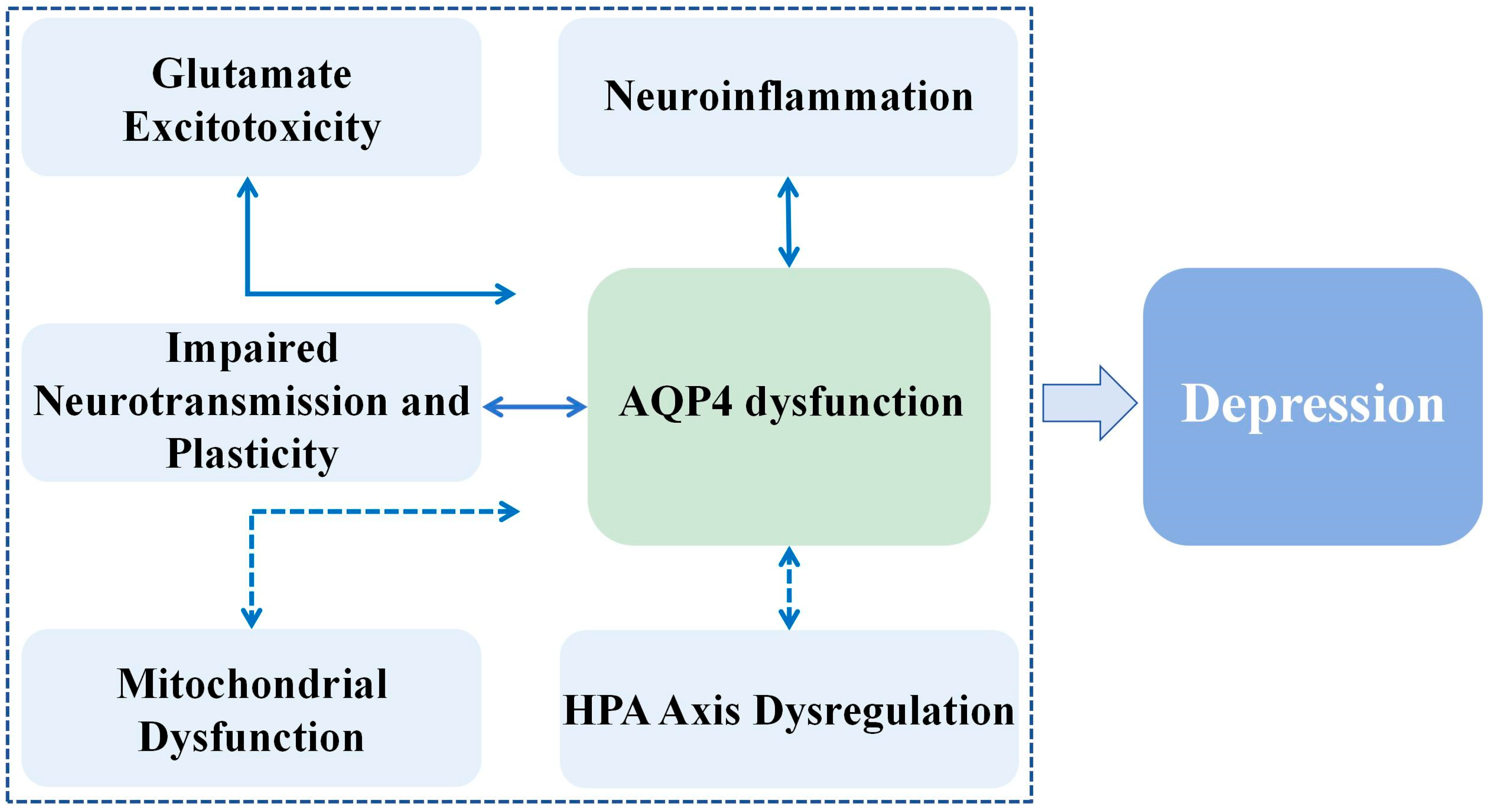
This review establishes AQP4 as a pathophysiological node in depression, implicated in a spectrum of core pathological cascades: glutamate excitotoxicity, impaired neurotransmission, neuroinflammatory, mitochondrial dysfunction, and HPA axis dysregulation (Figure 1). Furthermore, AQP4 appears to mediate, at least in part, the therapeutic effects of certain pharmacological and non-pharmacological interventions, highlighting its functional relevance in treatment responses. While the majority of supporting data are currently associative or derived from global knockout and chronic stress models, the collective evidence positions AQP4 not as a sole causative factor but as a critical contributing and permissive element within the broader astrocyte–neuron–immune network. Its dysfunction likely facilitates disease progression by disrupting water homeostasis, neurovascular coupling, and glymphatic clearance, thereby creating a permissive environment for the convergence of multiple depressive pathomechanisms.
Despite extensive research efforts carried out to date, the mechanisms linking AQP4 to depression remain largely unclear. Four transformative directions will advance AQP4-targeted precision psychiatry: ① Nanoscale Dynamics: Resolve AQP4 OAP reorganization in live astrocytes using cryo-electron tomography to define drug-binding pockets for orthogonal array stabilizers [164]. ② Circadian Biology: Track diurnal AQP4 redistribution via intravital two-photon imaging [165] to determine its role in diurnal mood variation. ③ Circuit-Specific Delivery: Develop astrocyte-targeted adeno-associated virus vectors for region-restricted AQP4 overexpression in treatment-resistant models [166]. ④ Multi-Omic Integration: Decode comorbid mechanisms through spatial transcriptomics of perivascular niches in depression with neurodegeneration/vascular disease [125,167].

Author Contributions

Conceptualization, Investigation, Writing—Original Draft, X.X. and H.L.; Writing—Original Draft, Data Curation, Formal analysis, Y.C. and M.J.; Writing—Original Draft, Visualization, M.W. and J.H.; Review and Editing, Supervision, Funding Acquisition, H.S. All authors have read and agreed to the published version of the manuscript.

Funding

This research was funded by the Natural Science Foundation of China, grant number 81671176.

Institutional Review Board Statement

Not applicable.

Informed Consent Statement

Not applicable.

Data Availability Statement

No new data were created or analyzed in this study. Data sharing is not applicable to this article.

Acknowledgments

We are deeply thankful to the information specialists and librarians at the university library for their invaluable assistance in designing and executing comprehensive literature searches across multiple databases, which formed the foundational step of this work. We sincerely thank the editors and anonymous reviewers for their constructive comments and thoughtful suggestions, which have significantly enhanced the quality and clarity of this manuscript.

Conflicts of Interest

The authors declare no conflicts of interest.

Abbreviations

The following abbreviations are used in this manuscript:
AQP4Aquaporin-4
CNSCentral nervous system
MDDMajor depressive disorder
ADAlzheimer’s disease
OAPsOrthogonal arrays of particles
CSFCerebrospinal fluid
CUMSChronic unpredictable mild stress
AQP4-KOAQP4 knockout
LPSLipopolysaccharide
AAV5Adeno-associated virus 5
CUSChronic unpredictable stress
AQP4-ONAquaporin-4 antibody-seropositive optic neuritis
IONIdiopathic ON
CADCoronary artery disease
PUFAPolyunsaturated fatty acids
MDEMajor depressive episode
BDBipolar disorder
Gd-DTPAGadolinium-diethylenetriamine pentaacetate
SEDStress-induced exhaustion disorder
HCsHealthy controls
GFAPGlial fibrillary acidic protein
CMSChronic mild stress
ELSEarly-life stress
MSMaternal separation
HFDHigh-fat diet
TBITraumatic brain injury
NMDARN-methyl-D-aspartate receptor
LTPLong-term potentiation
NF-κBNuclear factor κB
IL-1βInterleukin-1β
TNF-αTumor necrosis factor-α
HPAHypothalamic–pituitary–adrenal
BLABasolateral amygdala
AVPArginine vasopressin
SCNSuprachiasmatic nucleus
PVNParaventricular nucleus
SSRIsSelective serotonin reuptake inhibitors
BDNFBrain-derived neurotrophic factor
mTORmechanistic target of rapamycin
VPAValproic acid
HIITHigh-intensity interval training

References

  1. Battle, D.E. Diagnostic and Statistical Manual of Mental Disorders (DSM). Codas 2013, 25, 191–192. [Google Scholar] [CrossRef] [PubMed]
  2. Ménard, C.; Hodes, G.E.; Russo, S.J. Pathogenesis of depression: Insights from human and rodent studies. Neuroscience 2016, 321, 138–162. [Google Scholar] [CrossRef]
  3. Miret, M.; Ayuso-Mateos, J.L.; Sanchez-Moreno, J.; Vieta, E. Depressive disorders and suicide: Epidemiology, risk factors, and burden. Neurosci. Biobehav. Rev. 2013, 37, 2372–2374. [Google Scholar] [CrossRef]
  4. Tian, J.S.; Shi, B.Y.; Xiang, H.; Gao, S.; Qin, X.M.; Du, G.H. 1H-NMR-based metabonomic studies on the anti-depressant effect of genipin in the chronic unpredictable mild stress rat model. PLoS ONE 2013, 8, e75721. [Google Scholar] [CrossRef] [PubMed]
  5. Perez-Caballero, L.; Torres-Sanchez, S.; Romero-López-Alberca, C.; González-Saiz, F.; Mico, J.A.; Berrocoso, E. Monoaminergic system and depression. Cell Tissue Res. 2019, 377, 107–113. [Google Scholar] [CrossRef] [PubMed]
  6. Malhi, G.S.; Mann, J.J. Depression. Lancet 2018, 392, 2299–2312. [Google Scholar] [CrossRef]
  7. Barres, B.A. The mystery and magic of glia: A perspective on their roles in health and disease. Neuron 2008, 60, 430–440. [Google Scholar] [CrossRef]
  8. Deffner, F.; Gleiser, C.; Mattheus, U.; Wagner, A.; Neckel, P.H.; Fallier-Becker, P.; Hirt, B.; Mack, A.F. Aquaporin-4 expression in the human choroid plexus. Cell. Mol. Life Sci. 2022, 79, 90. [Google Scholar] [CrossRef]
  9. Oklinski, M.K.; Skowronski, M.T.; Skowronska, A.; Rützler, M.; Nørgaard, K.; Nieland, J.D.; Kwon, T.H.; Nielsen, S. Aquaporins in the Spinal Cord. Int. J. Mol. Sci. 2016, 17, 2050. [Google Scholar] [CrossRef] [PubMed]
  10. Sun, H.; Liang, R.; Yang, B.; Zhou, Y.; Liu, M.; Fang, F.; Ding, J.; Fan, Y.; Hu, G. Aquaporin-4 mediates communication between astrocyte and microglia: Implications of neuroinflammation in experimental Parkinson’s disease. Neuroscience 2016, 317, 65–75. [Google Scholar] [CrossRef] [PubMed]
  11. Hubbard, J.A.; Binder, D.K. Unaltered Glutamate Transporter-1 Protein Levels in Aquaporin-4 Knockout Mice. ASN Neuro 2017, 9, 1759091416687846. [Google Scholar] [CrossRef]
  12. Fan, Y.; Liu, M.; Wu, X.; Wang, F.; Ding, J.; Chen, J.; Hu, G. Aquaporin-4 promotes memory consolidation in Morris water maze. Brain Struct. Funct. 2013, 218, 39–50. [Google Scholar] [CrossRef]
  13. Nedergaard, M.; Goldman, S.A. Glymphatic failure as a final common pathway to dementia. Science 2020, 370, 50–56. [Google Scholar] [CrossRef]
  14. Xin, W.; Pan, Y.; Wei, W.; Tatenhorst, L.; Graf, I.; Popa-Wagner, A.; Gerner, S.T.; Huber, S.; Kilic, E.; Hermann, D.M.; et al. Preconditioned extracellular vesicles from hypoxic microglia reduce poststroke AQP4 depolarization, disturbed cerebrospinal fluid flow, astrogliosis, and neuroinflammation. Theranostics 2023, 13, 4197–4216. [Google Scholar] [CrossRef]
  15. Tang, G.; Yang, G.Y. Aquaporin-4: A Potential Therapeutic Target for Cerebral Edema. Int. J. Mol. Sci. 2016, 17, 1413. [Google Scholar] [CrossRef] [PubMed]
  16. Genel, O.; Pariante, C.M.; Borsini, A. The role of AQP4 in the pathogenesis of depression, and possible related mechanisms. Brain Behav. Immun. 2021, 98, 366–377. [Google Scholar] [CrossRef]
  17. Benga, O.; Huber, V.J. Brain water channel proteins in health and disease. Mol. Aspects Med. 2012, 33, 562–578. [Google Scholar] [CrossRef] [PubMed]
  18. Jung, J.S.; Bhat, R.V.; Preston, G.M.; Guggino, W.B.; Baraban, J.M.; Agre, P. Molecular characterization of an aquaporin cDNA from brain: Candidate osmoreceptor and regulator of water balance. Proc. Natl. Acad. Sci. USA 1994, 91, 13052–13056. [Google Scholar] [CrossRef] [PubMed]
  19. Verkman, A.S.; Mitra, A.K. Structure and function of aquaporin water channels. Am. J. Physiol. Renal Physiol. 2000, 278, F13–F28. [Google Scholar] [CrossRef]
  20. Yang, B.; Brown, D.; Verkman, A.S. The mercurial insensitive water channel (AQP-4) forms orthogonal arrays in stably transfected Chinese hamster ovary cells. J. Biol. Chem. 1996, 271, 4577–4580. [Google Scholar] [CrossRef]
  21. Ho, J.D.; Yeh, R.; Sandstrom, A.; Chorny, I.; Harries, W.E.; Robbins, R.A.; Miercke, L.J.; Stroud, R.M. Crystal structure of human aquaporin 4 at 1.8 A and its mechanism of conductance. Proc. Natl. Acad. Sci. USA 2009, 106, 7437–7442. [Google Scholar] [CrossRef]
  22. Jin, B.J.; Rossi, A.; Verkman, A.S. Model of aquaporin-4 supramolecular assembly in orthogonal arrays based on heterotetrameric association of M1-M23 isoforms. Biophys. J. 2011, 100, 2936–2945. [Google Scholar] [CrossRef]
  23. Musa-Aziz, R.; Chen, L.M.; Pelletier, M.F.; Boron, W.F. Relative CO2/NH3 selectivities of AQP1, AQP4, AQP5, AmtB, and RhAG. Proc. Natl. Acad. Sci. USA 2009, 106, 5406–5411. [Google Scholar] [CrossRef] [PubMed]
  24. Wolburg, H.; Wolburg-Buchholz, K.; Fallier-Becker, P.; Noell, S.; Mack, A.F. Structure and functions of aquaporin-4-based orthogonal arrays of particles. Int. Rev. Cell Mol. Biol. 2011, 287, 1–41. [Google Scholar] [CrossRef] [PubMed]
  25. Crane, J.M.; Verkman, A.S. Determinants of aquaporin-4 assembly in orthogonal arrays revealed by live-cell single-molecule fluorescence imaging. J. Cell Sci. 2009, 122, 813–821. [Google Scholar] [CrossRef]
  26. Lu, M.; Lee, M.D.; Smith, B.L.; Jung, J.S.; Agre, P.; Verdijk, M.A.; Merkx, G.; Rijss, J.P.; Deen, P.M. The human AQP4 gene: Definition of the locus encoding two water channel polypeptides in brain. Proc. Natl. Acad. Sci. USA 1996, 93, 10908–10912. [Google Scholar] [CrossRef]
  27. Crane, J.M.; Bennett, J.L.; Verkman, A.S. Live cell analysis of aquaporin-4 m1/m23 interactions and regulated orthogonal array assembly in glial cells. J. Biol. Chem. 2009, 284, 35850–35860. [Google Scholar] [CrossRef]
  28. Rash, J.E.; Yasumura, T.; Hudson, C.S.; Agre, P.; Nielsen, S. Direct immunogold labeling of aquaporin-4 in square arrays of astrocyte and ependymocyte plasma membranes in rat brain and spinal cord. Proc. Natl. Acad. Sci. USA 1998, 95, 11981–11986. [Google Scholar] [CrossRef]
  29. Nielsen, S.; Nagelhus, E.A.; Amiry-Moghaddam, M.; Bourque, C.; Agre, P.; Ottersen, O.P. Specialized membrane domains for water transport in glial cells: High-resolution immunogold cytochemistry of aquaporin-4 in rat brain. J. Neurosci. 1997, 17, 171–180. [Google Scholar] [CrossRef]
  30. Adams, M.E.; Mueller, H.A.; Froehner, S.C. In vivo requirement of the alpha-syntrophin PDZ domain for the sarcolemmal localization of nNOS and aquaporin-4. J. Cell Biol. 2001, 155, 113–122. [Google Scholar] [CrossRef] [PubMed]
  31. Nagelhus, E.A.; Ottersen, O.P. Physiological roles of aquaporin-4 in brain. Physiol. Rev. 2013, 93, 1543–1562. [Google Scholar] [CrossRef]
  32. Neely, J.D.; Amiry-Moghaddam, M.; Ottersen, O.P.; Froehner, S.C.; Agre, P.; Adams, M.E. Syntrophin-dependent expression and localization of Aquaporin-4 water channel protein. Proc. Natl. Acad. Sci. USA 2001, 98, 14108–14113. [Google Scholar] [CrossRef]
  33. Amiry-Moghaddam, M.; Otsuka, T.; Hurn, P.D.; Traystman, R.J.; Haug, F.M.; Froehner, S.C.; Adams, M.E.; Neely, J.D.; Agre, P.; Ottersen, O.P.; et al. An alpha-syntrophin-dependent pool of AQP4 in astroglial end-feet confers bidirectional water flow between blood and brain. Proc. Natl. Acad. Sci. USA 2003, 100, 2106–2111. [Google Scholar] [CrossRef] [PubMed]
  34. Wolburg, H.; Noell, S.; Fallier-Becker, P.; Mack, A.F.; Wolburg-Buchholz, K. The disturbed blood-brain barrier in human glioblastoma. Mol. Aspects Med. 2012, 33, 579–589. [Google Scholar] [CrossRef]
  35. Badaut, J.; Fukuda, A.M.; Jullienne, A.; Petry, K.G. Aquaporin and brain diseases. Biochim. Biophys. Acta 2014, 1840, 1554–1565. [Google Scholar] [CrossRef]
  36. Szczygielski, J.; Kopańska, M.; Wysocka, A.; Oertel, J. Cerebral Microcirculation, Perivascular Unit, and Glymphatic System: Role of Aquaporin-4 as the Gatekeeper for Water Homeostasis. Front. Neurol. 2021, 12, 767470. [Google Scholar] [CrossRef]
  37. Wu, J.; Carlock, C.; Shim, J.; Moreno-Gonzalez, I.; Glass, W., 2nd; Ross, A.; Barichello, T.; Quevedo, J.; Lou, Y. Requirement of brain interleukin33 for aquaporin4 expression in astrocytes and glymphatic drainage of abnormal tau. Mol. Psychiatry 2021, 26, 5912–5924. [Google Scholar] [CrossRef] [PubMed]
  38. Papadopoulos, M.C.; Verkman, A.S. Aquaporin water channels in the nervous system. Nat. Rev. Neurosci. 2013, 14, 265–277. [Google Scholar] [CrossRef]
  39. Ferrer, I. Diversity of astroglial responses across human neurodegenerative disorders and brain aging. Brain Pathol. 2017, 27, 645–674. [Google Scholar] [CrossRef] [PubMed]
  40. Xiao, M.; Hu, G. Involvement of aquaporin 4 in astrocyte function and neuropsychiatric disorders. CNS Neurosci. Ther. 2014, 20, 385–390. [Google Scholar] [CrossRef]
  41. Hiroaki, Y.; Tani, K.; Kamegawa, A.; Gyobu, N.; Nishikawa, K.; Suzuki, H.; Walz, T.; Sasaki, S.; Mitsuoka, K.; Kimura, K.; et al. Implications of the aquaporin-4 structure on array formation and cell adhesion. J. Mol. Biol. 2006, 355, 628–639. [Google Scholar] [CrossRef]
  42. Badaut, J.; Ashwal, S.; Obenaus, A. Aquaporins in cerebrovascular disease: A target for treatment of brain edema? Cerebrovasc. Dis. 2011, 31, 521–531. [Google Scholar] [CrossRef] [PubMed]
  43. Thrane, A.S.; Rappold, P.M.; Fujita, T.; Torres, A.; Bekar, L.K.; Takano, T.; Peng, W.; Wang, F.; Rangroo Thrane, V.; Enger, R.; et al. Critical role of aquaporin-4 (AQP4) in astrocytic Ca2+ signaling events elicited by cerebral edema. Proc. Natl. Acad. Sci. USA 2011, 108, 846–851. [Google Scholar] [CrossRef] [PubMed]
  44. Bloch, O.; Auguste, K.I.; Manley, G.T.; Verkman, A.S. Accelerated progression of kaolin-induced hydrocephalus in aquaporin-4-deficient mice. J. Cereb. Blood Flow Metab. 2006, 26, 1527–1537. [Google Scholar] [CrossRef]
  45. Strohschein, S.; Hüttmann, K.; Gabriel, S.; Binder, D.K.; Heinemann, U.; Steinhäuser, C. Impact of aquaporin-4 channels on K+ buffering and gap junction coupling in the hippocampus. Glia 2011, 59, 973–980. [Google Scholar] [CrossRef] [PubMed]
  46. Olsen, M.L.; Sontheimer, H. Functional implications for Kir4.1 channels in glial biology: From K+ buffering to cell differentiation. J. Neurochem. 2008, 107, 589–601. [Google Scholar] [CrossRef]
  47. Butt, A.M.; Kalsi, A. Inwardly rectifying potassium channels (Kir) in central nervous system glia: A special role for Kir4.1 in glial functions. J. Cell. Mol. Med. 2006, 10, 33–44. [Google Scholar] [CrossRef]
  48. Binder, D.K.; Yao, X.; Zador, Z.; Sick, T.J.; Verkman, A.S.; Manley, G.T. Increased seizure duration and slowed potassium kinetics in mice lacking aquaporin-4 water channels. Glia 2006, 53, 631–636. [Google Scholar] [CrossRef]
  49. Li, Y.K.; Wang, F.; Wang, W.; Luo, Y.; Wu, P.F.; Xiao, J.L.; Hu, Z.L.; Jin, Y.; Hu, G.; Chen, J.G. Aquaporin-4 deficiency impairs synaptic plasticity and associative fear memory in the lateral amygdala: Involvement of downregulation of glutamate transporter-1 expression. Neuropsychopharmacology 2012, 37, 1867–1878. [Google Scholar] [CrossRef]
  50. Gunnarson, E.; Zelenina, M.; Axehult, G.; Song, Y.; Bondar, A.; Krieger, P.; Brismar, H.; Zelenin, S.; Aperia, A. Identification of a molecular target for glutamate regulation of astrocyte water permeability. Glia 2008, 56, 587–596. [Google Scholar] [CrossRef]
  51. Zeng, X.N.; Sun, X.L.; Gao, L.; Fan, Y.; Ding, J.H.; Hu, G. Aquaporin-4 deficiency down-regulates glutamate uptake and GLT-1 expression in astrocytes. Mol. Cell. Neurosci. 2007, 34, 34–39. [Google Scholar] [CrossRef] [PubMed]
  52. Szu, J.I.; Binder, D.K. The Role of Astrocytic Aquaporin-4 in Synaptic Plasticity and Learning and Memory. Front. Integr. Neurosci. 2016, 10, 8. [Google Scholar] [CrossRef]
  53. Skucas, V.A.; Mathews, I.B.; Yang, J.; Cheng, Q.; Treister, A.; Duffy, A.M.; Verkman, A.S.; Hempstead, B.L.; Wood, M.A.; Binder, D.K.; et al. Impairment of select forms of spatial memory and neurotrophin-dependent synaptic plasticity by deletion of glial aquaporin-4. J. Neurosci. 2011, 31, 6392–6397. [Google Scholar] [CrossRef]
  54. Verkman, A.S.; Binder, D.K.; Bloch, O.; Auguste, K.; Papadopoulos, M.C. Three distinct roles of aquaporin-4 in brain function revealed by knockout mice. Biochim. Biophys. Acta 2006, 1758, 1085–1093. [Google Scholar] [CrossRef]
  55. Haj-Yasein, N.N.; Vindedal, G.F.; Eilert-Olsen, M.; Gundersen, G.A.; Skare, Ø.; Laake, P.; Klungland, A.; Thorén, A.E.; Burkhardt, J.M.; Ottersen, O.P.; et al. Glial-conditional deletion of aquaporin-4 (Aqp4) reduces blood-brain water uptake and confers barrier function on perivascular astrocyte endfeet. Proc. Natl. Acad. Sci. USA 2011, 108, 17815–17820. [Google Scholar] [CrossRef]
  56. Moftakhar, P.; Lynch, M.D.; Pomakian, J.L.; Vinters, H.V. Aquaporin expression in the brains of patients with or without cerebral amyloid angiopathy. J. Neuropathol. Exp. Neurol. 2010, 69, 1201–1209. [Google Scholar] [CrossRef] [PubMed]
  57. Benfenati, V.; Caprini, M.; Dovizio, M.; Mylonakou, M.N.; Ferroni, S.; Ottersen, O.P.; Amiry-Moghaddam, M. An aquaporin-4/transient receptor potential vanilloid 4 (AQP4/TRPV4) complex is essential for cell-volume control in astrocytes. Proc. Natl. Acad. Sci. USA 2011, 108, 2563–2568. [Google Scholar] [CrossRef] [PubMed]
  58. Peng, S.; Liu, J.; Liang, C.; Yang, L.; Wang, G. Aquaporin-4 in glymphatic system, and its implication for central nervous system disorders. Neurobiol. Dis. 2023, 179, 106035. [Google Scholar] [CrossRef]
  59. Iliff, J.J.; Wang, M.; Liao, Y.; Plogg, B.A.; Peng, W.; Gundersen, G.A.; Benveniste, H.; Vates, G.E.; Deane, R.; Goldman, S.A.; et al. A paravascular pathway facilitates CSF flow through the brain parenchyma and the clearance of interstitial solutes, including amyloid β. Sci. Transl. Med. 2012, 4, 147ra111. [Google Scholar] [CrossRef]
  60. Gomolka, R.S.; Hablitz, L.M.; Mestre, H.; Giannetto, M.; Du, T.; Hauglund, N.L.; Xie, L.; Peng, W.; Martinez, P.M.; Nedergaard, M.; et al. Loss of aquaporin-4 results in glymphatic system dysfunction via brain-wide interstitial fluid stagnation. Elife 2023, 12, e82232. [Google Scholar] [CrossRef]
  61. Mestre, H.; Hablitz, L.M.; Xavier, A.L.; Feng, W.; Zou, W.; Pu, T.; Monai, H.; Murlidharan, G.; Castellanos Rivera, R.M.; Simon, M.J.; et al. Aquaporin-4-dependent glymphatic solute transport in the rodent brain. Elife 2018, 7, e40070. [Google Scholar] [CrossRef]
  62. Menard, C.; Pfau, M.L.; Hodes, G.E.; Kana, V.; Wang, V.X.; Bouchard, S.; Takahashi, A.; Flanigan, M.E.; Aleyasin, H.; LeClair, K.B.; et al. Social stress induces neurovascular pathology promoting depression. Nat. Neurosci. 2017, 20, 1752–1760. [Google Scholar] [CrossRef] [PubMed]
  63. Rajkowska, G.; Hughes, J.; Stockmeier, C.A.; Javier Miguel-Hidalgo, J.; Maciag, D. Coverage of blood vessels by astrocytic endfeet is reduced in major depressive disorder. Biol. Psychiatry 2013, 73, 613–621. [Google Scholar] [CrossRef]
  64. Medina, A.; Watson, S.J.; Bunney, W., Jr.; Myers, R.M.; Schatzberg, A.; Barchas, J.; Akil, H.; Thompson, R.C. Evidence for alterations of the glial syncytial function in major depressive disorder. J. Psychiatr. Res. 2016, 72, 15–21. [Google Scholar] [CrossRef]
  65. Wei, F.; Song, J.; Zhang, C.; Lin, J.; Xue, R.; Shan, L.D.; Gong, S.; Zhang, G.X.; Qin, Z.H.; Xu, G.Y.; et al. Chronic stress impairs the aquaporin-4-mediated glymphatic transport through glucocorticoid signaling. Psychopharmacology 2019, 236, 1367–1384. [Google Scholar] [CrossRef]
  66. Davoudi, S.; Rahdar, M.; Hosseinmardi, N.; Behzadi, G.; Janahmadi, M. Chronic inhibition of astrocytic aquaporin-4 induces autistic-like behavior in control rat offspring similar to maternal exposure to valproic acid. Physiol. Behav. 2023, 269, 114286. [Google Scholar] [CrossRef]
  67. Ding, C.; Lu, M.; Huang, J. Changes of the ocular surface and aquaporins in the lacrimal glands of rabbits during pregnancy. Mol. Vis. 2011, 17, 2847–2855. [Google Scholar]
  68. Kong, H.; Zeng, X.N.; Fan, Y.; Yuan, S.T.; Ge, S.; Xie, W.P.; Wang, H.; Hu, G. Aquaporin-4 knockout exacerbates corticosterone-induced depression by inhibiting astrocyte function and hippocampal neurogenesis. CNS Neurosci. Ther. 2014, 20, 391–402. [Google Scholar] [CrossRef]
  69. Xingi, E.; Koutsoudaki, P.N.; Thanou, I.; Phan, M.S.; Margariti, M.; Scheller, A.; Tinevez, J.Y.; Kirchhoff, F.; Thomaidou, D. LPS-Induced Systemic Inflammation Affects the Dynamic Interactions of Astrocytes and Microglia with the Vasculature of the Mouse Brain Cortex. Cells 2023, 12, 1418. [Google Scholar] [CrossRef] [PubMed]
  70. Bollinger, J.L.; Johnsamuel, S.; Vollmer, L.L.; Kuhn, A.M.; Wohleb, E.S. Stress-induced dysfunction of neurovascular astrocytes in the prefrontal cortex contributes to sex-dependent deficits in cognition and behavior. Mol. Psychiatry 2025, 30, 4128–4141. [Google Scholar] [CrossRef] [PubMed]
  71. Yao, D.; Li, R.; Hao, J.; Huang, H.; Wang, X.; Ran, L.; Fang, Y.; He, Y.; Wang, W.; Liu, X.; et al. Melatonin alleviates depression-like behaviors and cognitive dysfunction in mice by regulating the circadian rhythm of AQP4 polarization. Transl. Psychiatry 2023, 13, 310. [Google Scholar] [CrossRef]
  72. Liu, X.; Gu, X.H.; Zheng, L.L.; Xu, L.J.; Yang, Y.J.; Yang, G.; Wu, H.J.; Chen, Z.Z.; Wang, W. Autophagy promotes membrane trafficking of NR2B to alleviate depression by inhibiting AQP4 expression in mice. Exp. Cell Res. 2022, 419, 113298. [Google Scholar] [CrossRef]
  73. Liu, X.; Hao, J.; Yao, E.; Cao, J.; Zheng, X.; Yao, D.; Zhang, C.; Li, J.; Pan, D.; Luo, X.; et al. Polyunsaturated fatty acid supplement alleviates depression-incident cognitive dysfunction by protecting the cerebrovascular and glymphatic systems. Brain Behav. Immun. 2020, 89, 357–370. [Google Scholar] [CrossRef]
  74. Lyu, C.; Xia, Y.; Li, Y.; Que, J.; Han, F.; Guan, Q.; Wang, Y.; Gao, B. Dynamic contrast-enhanced MRI reveals glymphatic dysfunction in mice with depressive-like behavior. Neurobiol. Dis. 2025, 217, 107169. [Google Scholar] [CrossRef]
  75. Taler, M.; Aronovich, R.; Henry Hornfeld, S.; Dar, S.; Sasson, E.; Weizman, A.; Hochman, E. Regulatory effect of lithium on hippocampal blood-brain barrier integrity in a rat model of depressive-like behavior. Bipolar. Disord. 2021, 23, 55–65. [Google Scholar] [CrossRef]
  76. Wen, G.; Zhan, X.; Xu, X.; Xia, X.; Jiang, S.; Ren, X.; Ren, W.; Lou, H.; Lu, L.; Hermenean, A.; et al. Ketamine Improves the Glymphatic Pathway by Reducing the Pyroptosis of Hippocampal Astrocytes in the Chronic Unpredictable Mild Stress Model. Mol. Neurobiol. 2024, 61, 2049–2062, Erratum in Mol. Neurobiol. 2024, 61, 2063. [Google Scholar] [CrossRef] [PubMed]
  77. Solarz, A.; Majcher-Maślanka, I.; Chocyk, A. Effects of early-life stress and sex on blood-brain barrier permeability and integrity in juvenile and adult rats. Dev. Neurobiol. 2021, 81, 861–876. [Google Scholar] [CrossRef] [PubMed]
  78. Fu, J.T.; Huang, H.T.; Chen, P.C.; Kuo, Y.M.; Chen, P.S.; Tzeng, S.F. Exploring the reduction in aquaporin-4 and increased expression of ciliary neurotrophic factor with the frontal-striatal gliosis induced by chronic high-fat dietary stress. J. Neurochem. 2025, 169, e16236. [Google Scholar] [CrossRef]
  79. Tapp, Z.M.; Kumar, J.E.; Witcher, K.G.; Atluri, R.R.; Velasquez, J.A.; O’Neil, S.M.; Dziabis, J.E.; Bray, C.E.; Sheridan, J.F.; Godbout, J.P.; et al. Sleep Disruption Exacerbates and Prolongs the Inflammatory Response to Traumatic Brain Injury. J. Neurotrauma 2020, 37, 1829–1843. [Google Scholar] [CrossRef] [PubMed]
  80. Westermair, A.L.; Munz, M.; Schaich, A.; Nitsche, S.; Willenborg, B.; Muñoz Venegas, L.M.; Willenborg, C.; Schunkert, H.; Schweiger, U.; Erdmann, J. Association of Genetic Variation at AQP4 Locus with Vascular Depression. Biomolecules 2018, 8, 164. [Google Scholar] [CrossRef]
  81. Gur, S.; Taler, M.; Bormant, G.; Blattberg, D.; Nitzan, U.; Vaknin-Dembinsky, A.; Brill, L.; Krivoy, A.; Weizman, A.; Hochman, E. Lack of association between unipolar or bipolar depression and serum aquaporin-4 autoantibodies. Brain Behav. Immun. 2020, 88, 930–934. [Google Scholar] [CrossRef]
  82. Song, R.; Huang, W.; Yang, J.; Tang, X.; Huang, Y.; Chen, Y.; Zhao, M.; Hu, Q.; Du, Y. Association of aquaporin-4 antibody-seropositive optic neuritis with vision-related quality of life and depression. Front. Neurol. 2023, 14, 1265170. [Google Scholar] [CrossRef] [PubMed]
  83. Wallensten, J.; Nager, A.; Åsberg, M.; Borg, K.; Beser, A.; Wilczek, A.; Mobarrez, F. Leakage of astrocyte-derived extracellular vesicles in stress-induced exhaustion disorder: A cross-sectional study. Sci. Rep. 2021, 11, 2009, Correction in Sci. Rep. 2023, 13, 10211. [Google Scholar] [CrossRef] [PubMed]
  84. Rajkowska, G.; Stockmeier, C.A. Astrocyte pathology in major depressive disorder: Insights from human postmortem brain tissue. Curr. Drug Targets 2013, 14, 1225–1236. [Google Scholar] [CrossRef] [PubMed]
  85. McEwen, B.S. Central effects of stress hormones in health and disease: Understanding the protective and damaging effects of stress and stress mediators. Eur. J. Pharmacol. 2008, 583, 174–185. [Google Scholar] [CrossRef]
  86. Xia, M.; Yang, L.; Sun, G.; Qi, S.; Li, B. Mechanism of depression as a risk factor in the development of Alzheimer’s disease: The function of AQP4 and the glymphatic system. Psychopharmacology 2017, 234, 365–379. [Google Scholar] [CrossRef]
  87. Mamelak, M. Depression and the Glutamate/GABA-Glutamine Cycle. Curr. Neuropharmacol. 2024, 23, 75–84. [Google Scholar] [CrossRef]
  88. Elhussiny, M.E.A.; Carini, G.; Mingardi, J.; Tornese, P.; Sala, N.; Bono, F.; Fiorentini, C.; La Via, L.; Popoli, M.; Musazzi, L.; et al. Modulation by chronic stress and ketamine of ionotropic AMPA/NMDA and metabotropic glutamate receptors in the rat hippocampus. Prog. Neuropsychopharmacol. Biol. Psychiatry 2021, 104, 110033. [Google Scholar] [CrossRef]
  89. Lener, M.S.; Niciu, M.J.; Ballard, E.D.; Park, M.; Park, L.T.; Nugent, A.C.; Zarate, C.A., Jr. Glutamate and Gamma-Aminobutyric Acid Systems in the Pathophysiology of Major Depression and Antidepressant Response to Ketamine. Biol. Psychiatry 2017, 81, 886–897. [Google Scholar] [CrossRef]
  90. Armada-Moreira, A.; Gomes, J.I.; Pina, C.C.; Savchak, O.K.; Gonçalves-Ribeiro, J.; Rei, N.; Pinto, S.; Morais, T.P.; Martins, R.S.; Ribeiro, F.F.; et al. Going the Extra (Synaptic) Mile: Excitotoxicity as the Road Toward Neurodegenerative Diseases. Front. Cell. Neurosci. 2020, 14, 90. [Google Scholar] [CrossRef]
  91. Yan, H.T.; Wu, N.; Lu, X.Q.; Su, R.B.; Zheng, J.Q.; Li, J. Aquaporin-4 deficiency attenuates opioid dependence through suppressing glutamate transporter-1 down-regulation and maintaining glutamate homeostasis. CNS Neurosci. Ther. 2013, 19, 12–19. [Google Scholar] [CrossRef] [PubMed]
  92. Yang, J.; Li, M.X.; Luo, Y.; Chen, T.; Liu, J.; Fang, P.; Jiang, B.; Hu, Z.L.; Jin, Y.; Chen, J.G.; et al. Chronic ceftriaxone treatment rescues hippocampal memory deficit in AQP4 knockout mice via activation of GLT-1. Neuropharmacology 2013, 75, 213–222. [Google Scholar] [CrossRef]
  93. Enger, R.; Dukefoss, D.B.; Tang, W.; Pettersen, K.H.; Bjørnstad, D.M.; Helm, P.J.; Jensen, V.; Sprengel, R.; Vervaeke, K.; Ottersen, O.P.; et al. Deletion of Aquaporin-4 Curtails Extracellular Glutamate Elevation in Cortical Spreading Depression in Awake Mice. Cereb. Cortex 2017, 27, 24–33. [Google Scholar] [CrossRef]
  94. Benarroch, E.E. Aquaporin-4, homeostasis, and neurologic disease. Neurology 2007, 69, 2266–2268. [Google Scholar] [CrossRef] [PubMed]
  95. Hinson, S.R.; Clift, I.C.; Luo, N.; Kryzer, T.J.; Lennon, V.A. Autoantibody-induced internalization of CNS AQP4 water channel and EAAT2 glutamate transporter requires astrocytic Fc receptor. Proc. Natl. Acad. Sci. USA 2017, 114, 5491–5496. [Google Scholar] [CrossRef]
  96. Wang, H.; Wang, S.; Zhang, K.; Wang, H.; Lan, L.; Ma, X.; Liu, X.; Zhang, S.; Zheng, J.; Wei, X.; et al. Aquaporin 4 Forms a Macromolecular Complex with Glutamate Transporter 1 and Mu Opioid Receptor in Astrocytes and Participates in Morphine Dependence. J. Mol. Neurosci. 2017, 62, 17–27. [Google Scholar] [CrossRef] [PubMed]
  97. Chen, M.L.; Bao, F.; Zhang, Y.Q.; Zhao, Z.Q. Effects of aquaporin 4 deficiency on morphine analgesia and chronic tolerance: A study at spinal level. J. Mol. Neurosci. 2010, 42, 140–144. [Google Scholar] [CrossRef]
  98. Hinson, S.R.; Roemer, S.F.; Lucchinetti, C.F.; Fryer, J.P.; Kryzer, T.J.; Chamberlain, J.L.; Howe, C.L.; Pittock, S.J.; Lennon, V.A. Aquaporin-4-binding autoantibodies in patients with neuromyelitis optica impair glutamate transport by down-regulating EAAT2. J. Exp. Med. 2008, 205, 2473–2481. [Google Scholar] [CrossRef]
  99. Price, R.B.; Duman, R. Neuroplasticity in cognitive and psychological mechanisms of depression: An integrative model. Mol. Psychiatry 2020, 25, 530–543. [Google Scholar] [CrossRef]
  100. Jiang, Y.; Zou, M.; Wang, Y.; Wang, Y. Nucleus accumbens in the pathogenesis of major depressive disorder: A brief review. Brain Res. Bull. 2023, 196, 68–75. [Google Scholar] [CrossRef]
  101. Li, Y.; Zhang, B.; Pan, X.; Wang, Y.; Xu, X.; Wang, R.; Liu, Z. Dopamine-Mediated Major Depressive Disorder in the Neural Circuit of Ventral Tegmental Area-Nucleus Accumbens-Medial Prefrontal Cortex: From Biological Evidence to Computational Models. Front. Cell. Neurosci. 2022, 16, 923039. [Google Scholar] [CrossRef]
  102. Ding, J.H.; Sha, L.L.; Chang, J.; Zhou, X.Q.; Fan, Y.; Hu, G. Alterations of striatal neurotransmitter release in aquaporin-4 deficient mice: An in vivo microdialysis study. Neurosci. Lett. 2007, 422, 175–180. [Google Scholar] [CrossRef]
  103. Fan, Y.; Zhang, J.; Sun, X.L.; Gao, L.; Zeng, X.N.; Ding, J.H.; Cao, C.; Niu, L.; Hu, G. Sex- and region-specific alterations of basal amino acid and monoamine metabolism in the brain of aquaporin-4 knockout mice. J. Neurosci. Res. 2005, 82, 458–464. [Google Scholar] [CrossRef] [PubMed]
  104. Hubbard, J.A.; Szu, J.I.; Binder, D.K. The role of aquaporin-4 in synaptic plasticity, memory and disease. Brain Res. Bull. 2018, 136, 118–129. [Google Scholar] [CrossRef]
  105. Lv, Y.; Jing, M.Y.; Li, P.Y.; Zhao, T.Y.; Pang, C.; Lu, G.Y.; Wang, Z.Y.; Wu, N.; Hu, G.; Song, R.; et al. Aquaporin-4 deletion attenuates opioid-induced addictive behaviours associated with dopamine levels in nucleus accumbens. Neuropharmacology 2022, 208, 108986. [Google Scholar] [CrossRef] [PubMed]
  106. Li, Z.; Gao, L.; Liu, Q.; Cao, C.; Sun, X.L.; Ding, J.H.; Hu, G. Aquaporin-4 knockout regulated cocaine-induced behavior and neurochemical changes in mice. Neurosci. Lett. 2006, 403, 294–298. [Google Scholar] [CrossRef]
  107. Cui, H.; Wang, W.; Zheng, X.; Xia, D.; Liu, H.; Qin, C.; Tian, H.; Teng, J. Decreased AQP4 Expression Aggravates α-Synuclein Pathology in Parkinson’s Disease Mice, Possibly via Impaired Glymphatic Clearance. J. Mol. Neurosci. 2021, 71, 2500–2513. [Google Scholar] [CrossRef] [PubMed]
  108. Sun, X.L.; Ding, J.H.; Fan, Y.; Zhang, J.; Gao, L.; Hu, G. Aquaporin 4 regulates the effects of ovarian hormones on monoamine neurotransmission. Biochem. Biophys. Res. Commun. 2007, 353, 457–462. [Google Scholar] [CrossRef]
  109. Cruciani, A.; Capone, F.; Haggiag, S.; Prosperini, L.; Santoro, F.; Ruggieri, S.; Motolese, F.; Pilato, F.; Musumeci, G.; Pozzilli, V.; et al. Cortical plasticity in AQP4-positive NMOSD: A transcranial magnetic stimulation study. Cereb. Cortex 2024, 34, bhae345. [Google Scholar] [CrossRef] [PubMed]
  110. Cha, H.; Choi, J.H.; Jeon, H.; Kim, J.H.; Kim, M.; Kim, S.J.; Park, W.; Lim, J.S.; Lee, E.; Ahn, J.S.; et al. Aquaporin-4 Deficiency is Associated with Cognitive Impairment and Alterations in astrocyte-neuron Lactate Shuttle. Mol. Neurobiol. 2023, 60, 6212–6226. [Google Scholar] [CrossRef]
  111. Zhang, D.; Li, X.; Li, B. Glymphatic System Dysfunction in Central Nervous System Diseases and Mood Disorders. Front. Aging Neurosci. 2022, 14, 873697. [Google Scholar] [CrossRef]
  112. Yang, X.Y.; Wang, H.Q.; Wang, Z.Z.; Chen, N.H. Linking depression and neuroinflammation: Crosstalk between glial cells. Eur. J. Pharmacol. 2025, 995, 177408. [Google Scholar] [CrossRef]
  113. Guo, B.; Zhang, M.; Hao, W.; Wang, Y.; Zhang, T.; Liu, C. Neuroinflammation mechanisms of neuromodulation therapies for anxiety and depression. Transl. Psychiatry 2023, 13, 5. [Google Scholar] [CrossRef]
  114. Wu, A.; Zhang, J. Neuroinflammation, memory, and depression: New approaches to hippocampal neurogenesis. J. Neuroinflamm. 2023, 20, 283. [Google Scholar] [CrossRef]
  115. Wang, H.; He, Y.; Sun, Z.; Ren, S.; Liu, M.; Wang, G.; Yang, J. Microglia in depression: An overview of microglia in the pathogenesis and treatment of depression. J. Neuroinflamm. 2022, 19, 132. [Google Scholar] [CrossRef] [PubMed]
  116. Kim, Y.K.; Na, K.S.; Myint, A.M.; Leonard, B.E. The role of pro-inflammatory cytokines in neuroinflammation, neurogenesis and the neuroendocrine system in major depression. Prog. Neuropsychopharmacol. Biol. Psychiatry 2016, 64, 277–284. [Google Scholar] [CrossRef]
  117. Xia, C.Y.; Guo, Y.X.; Lian, W.W.; Yan, Y.; Ma, B.Z.; Cheng, Y.C.; Xu, J.K.; He, J.; Zhang, W.K. The NLRP3 inflammasome in depression: Potential mechanisms and therapies. Pharmacol. Res. 2023, 187, 106625. [Google Scholar] [CrossRef]
  118. Shi, W.Z.; Zhao, C.Z.; Zhao, B.; Shi, Q.J.; Zhang, L.H.; Wang, Y.F.; Fang, S.H.; Lu, Y.B.; Zhang, W.P.; Wei, E.Q. Aggravated inflammation and increased expression of cysteinyl leukotriene receptors in the brain after focal cerebral ischemia in AQP4-deficient mice. Neurosci. Bull. 2012, 28, 680–692. [Google Scholar] [CrossRef]
  119. Feng, W.; Zhang, Y.; Wang, Z.; Xu, H.; Wu, T.; Marshall, C.; Gao, J.; Xiao, M. Microglia prevent beta-amyloid plaque formation in the early stage of an Alzheimer’s disease mouse model with suppression of glymphatic clearance. Alzheimers Res. Ther. 2020, 12, 125. [Google Scholar] [CrossRef] [PubMed]
  120. Xu, Z.; Xiao, N.; Chen, Y.; Huang, H.; Marshall, C.; Gao, J.; Cai, Z.; Wu, T.; Hu, G.; Xiao, M. Deletion of aquaporin-4 in APP/PS1 mice exacerbates brain Aβ accumulation and memory deficits. Mol. Neurodegener. 2015, 10, 58. [Google Scholar] [CrossRef] [PubMed]
  121. Zhang, R.; Liu, Y.; Chen, Y.; Li, Q.; Marshall, C.; Wu, T.; Hu, G.; Xiao, M. Aquaporin 4 deletion exacerbates brain impairments in a mouse model of chronic sleep disruption. CNS Neurosci. Ther. 2020, 26, 228–239. [Google Scholar] [CrossRef]
  122. Khan, M.; Baussan, Y.; Hebert-Chatelain, E. Connecting Dots between Mitochondrial Dysfunction and Depression. Biomolecules 2023, 13, 695. [Google Scholar] [CrossRef]
  123. Song, Y.; Cao, H.; Zuo, C.; Gu, Z.; Huang, Y.; Miao, J.; Fu, Y.; Guo, Y.; Jiang, Y.; Wang, F. Mitochondrial dysfunction: A fatal blow in depression. Biomed. Pharmacother. 2023, 167, 115652. [Google Scholar] [CrossRef] [PubMed]
  124. Głombik, K.; Budziszewska, B.; Basta-Kaim, A. Mitochondria-targeting therapeutic strategies in the treatment of depression. Mitochondrion 2021, 58, 169–178. [Google Scholar] [CrossRef]
  125. Liu, S.; Li, H.; Shen, Y.; Zhu, W.; Wang, Y.; Wang, J.; Zhang, N.; Li, C.; Xie, L.; Wu, Q. Moxibustion improves hypothalamus Aqp4 polarization in APP/PS1 mice: Evidence from spatial transcriptomics. Front. Aging Neurosci. 2023, 15, 1069155. [Google Scholar] [CrossRef] [PubMed]
  126. Mola, M.G.; Sparaneo, A.; Gargano, C.D.; Spray, D.C.; Svelto, M.; Frigeri, A.; Scemes, E.; Nicchia, G.P. The speed of swelling kinetics modulates cell volume regulation and calcium signaling in astrocytes: A different point of view on the role of aquaporins. Glia 2016, 64, 139–154. [Google Scholar] [CrossRef] [PubMed]
  127. Liu, L.; Lu, Y.; Kong, H.; Li, L.; Marshall, C.; Xiao, M.; Ding, J.; Gao, J.; Hu, G. Aquaporin-4 deficiency exacerbates brain oxidative damage and memory deficits induced by long-term ovarian hormone deprivation and D-galactose injection. Int. J. Neuropsychopharmacol. 2012, 15, 55–68. [Google Scholar] [CrossRef]
  128. Ozawa, Y.; Toda, E.; Kawashima, H.; Homma, K.; Osada, H.; Nagai, N.; Abe, Y.; Yasui, M.; Tsubota, K. Aquaporin 4 Suppresses Neural Hyperactivity and Synaptic Fatigue and Fine-Tunes Neurotransmission to Regulate Visual Function in the Mouse Retina. Mol. Neurobiol. 2019, 56, 8124–8135. [Google Scholar] [CrossRef]
  129. Lu, Y.; Chang, P.; Ding, W.; Bian, J.; Wang, D.; Wang, X.; Luo, Q.; Wu, X.; Zhu, L. Pharmacological inhibition of mitochondrial division attenuates simulated high-altitude exposure-induced cerebral edema in mice: Involvement of inhibition of the NF-κB signaling pathway in glial cells. Eur. J. Pharmacol. 2022, 929, 175137. [Google Scholar] [CrossRef]
  130. Menke, A. The HPA Axis as Target for Depression. Curr. Neuropharmacol. 2024, 22, 904–915. [Google Scholar] [CrossRef]
  131. Zhou, L.; Wang, T.; Yu, Y.; Li, M.; Sun, X.; Song, W.; Wang, Y.; Zhang, C.; Fu, F. The etiology of poststroke-depression: A hypothesis involving HPA axis. Biomed. Pharmacother. 2022, 151, 113146. [Google Scholar] [CrossRef]
  132. Tripathi, S.J.; Chakraborty, S.; Srikumar, B.N.; Raju, T.R.; Shankaranarayana Rao, B.S. Basolateral amygdalar inactivation blocks chronic stress-induced lamina-specific reduction in prefrontal cortex volume and associated anxiety-like behavior. Prog. Neuropsychopharmacol. Biol. Psychiatry 2019, 88, 194–207. [Google Scholar] [CrossRef]
  133. Chakraborty, S.; Tripathi, S.J.; Raju, T.R.; Shankaranarayana Rao, B.S. Brain stimulation rewarding experience attenuates neonatal clomipramine-induced adulthood anxiety by reversal of pathological changes in the amygdala. Prog. Neuropsychopharmacol. Biol. Psychiatry 2020, 103, 110000. [Google Scholar] [CrossRef]
  134. Tanoue, A.; Ito, S.; Honda, K.; Oshikawa, S.; Kitagawa, Y.; Koshimizu, T.A.; Mori, T.; Tsujimoto, G. The vasopressin V1b receptor critically regulates hypothalamic-pituitary-adrenal axis activity under both stress and resting conditions. J. Clin. Investig. 2004, 113, 302–309. [Google Scholar] [CrossRef][Green Version]
  135. Jasnic, N.; Djordjevic, J.; Vujovic, P.; Lakic, I.; Djurasevic, S.; Cvijic, G. The effect of vasopressin 1b receptor (V1bR) blockade on HPA axis activity in rats exposed to acute heat stress. J. Exp. Biol. 2013, 216, 2302–2307. [Google Scholar] [CrossRef] [PubMed]
  136. Hu, H.; Zarate, C.A., Jr.; Verbalis, J. Arginine vasopressin in mood disorders: A potential biomarker of disease pathology and a target for pharmacologic intervention. Psychiatry Clin. Neurosci. 2024, 78, 495–506. [Google Scholar] [CrossRef]
  137. Evans, J.A. Collective timekeeping among cells of the master circadian clock. J. Endocrinol. 2016, 230, R27–R49. [Google Scholar] [CrossRef]
  138. Schwartz, W.J.; Reppert, S.M. Neural regulation of the circadian vasopressin rhythm in cerebrospinal fluid: A pre-eminent role for the suprachiasmatic nuclei. J. Neurosci. 1985, 5, 2771–2778. [Google Scholar] [CrossRef] [PubMed]
  139. Hut, R.A.; Van der Zee, E.A. The cholinergic system, circadian rhythmicity, and time memory. Behav. Brain Res. 2011, 221, 466–480. [Google Scholar] [CrossRef] [PubMed]
  140. Sanchez, R.E.A.; Kalume, F.; de la Iglesia, H.O. Sleep timing and the circadian clock in mammals: Past, present and the road ahead. Semin. Cell Dev. Biol. 2022, 126, 3–14. [Google Scholar] [CrossRef]
  141. Niermann, H.; Amiry-Moghaddam, M.; Holthoff, K.; Witte, O.W.; Ottersen, O.P. A novel role of vasopressin in the brain: Modulation of activity-dependent water flux in the neocortex. J. Neurosci. 2001, 21, 3045–3051. [Google Scholar] [CrossRef] [PubMed]
  142. Myers, B.; Mark Dolgas, C.; Kasckow, J.; Cullinan, W.E.; Herman, J.P. Central stress-integrative circuits: Forebrain glutamatergic and GABAergic projections to the dorsomedial hypothalamus, medial preoptic area, and bed nucleus of the stria terminalis. Brain Struct. Funct. 2014, 219, 1287–1303. [Google Scholar] [CrossRef] [PubMed]
  143. Kong, H.; Sha, L.L.; Fan, Y.; Xiao, M.; Ding, J.H.; Wu, J.; Hu, G. Requirement of AQP4 for antidepressive efficiency of fluoxetine: Implication in adult hippocampal neurogenesis. Neuropsychopharmacology 2009, 34, 1263–1276, Erratum in Neuropsychopharmacology 2009, 34, 2055. [Google Scholar] [CrossRef]
  144. Yukutake, Y.; Yasui, M. Regulation of water permeability through aquaporin-4. Neuroscience 2010, 168, 885–891. [Google Scholar] [CrossRef]
  145. Chevallier, N.; Keller, E.; Maurice, T. Behavioural phenotyping of knockout mice for the sigma-1 (σ1) chaperone protein revealed gender-related anxiety, depressive-like and memory alterations. J. Psychopharmacol. 2011, 25, 960–975. [Google Scholar] [CrossRef]
  146. Di Benedetto, B.; Malik, V.A.; Begum, S.; Jablonowski, L.; Gómez-González, G.B.; Neumann, I.D.; Rupprecht, R. Fluoxetine Requires the Endfeet Protein Aquaporin-4 to Enhance Plasticity of Astrocyte Processes. Front. Cell. Neurosci. 2016, 10, 8. [Google Scholar] [CrossRef] [PubMed]
  147. Zhang, Y.; Pan, Y.D.; Zheng, W.Y.; Li, H.Y.; Zhu, M.Z.; Ou Yang, W.J.; Qian, Y.; Turecki, G.; Mechawar, N.; Zhu, X.H. Enhancing HIF-1α-P2X2 signaling in dorsal raphe serotonergic neurons promotes psychological resilience. Redox Biol. 2024, 69, 103005. [Google Scholar] [CrossRef]
  148. Yick, L.W.; Tang, C.H.; Ma, O.K.; Kwan, J.S.; Chan, K.H. Memantine ameliorates motor impairments and pathologies in a mouse model of neuromyelitis optica spectrum disorders. J. Neuroinflamm. 2020, 17, 236. [Google Scholar] [CrossRef]
  149. Lv, Y.; Dai, W.; Ge, A.; Fan, Y.; Hu, G.; Zeng, Y. Aquaporin-4 knockout mice exhibit increased hypnotic susceptibility to ketamine. Brain Behav. 2018, 8, e00990. [Google Scholar] [CrossRef]
  150. Zhang, L.M.; Wu, Z.Y.; Liu, J.Z.; Li, Y.; Lv, J.M.; Wang, L.Y.; Shan, Y.D.; Song, R.X.; Miao, H.T.; Zhang, W.; et al. Subanesthetic dose of S-ketamine improved cognitive dysfunction via the inhibition of hippocampal astrocytosis in a mouse model of post-stroke chronic stress. J. Psychiatr. Res. 2023, 158, 1–14. [Google Scholar] [CrossRef]
  151. Then, C.K.; Liu, K.H.; Liao, M.H.; Chung, K.H.; Wang, J.Y.; Shen, S.C. Antidepressants, sertraline and paroxetine, increase calcium influx and induce mitochondrial damage-mediated apoptosis of astrocytes. Oncotarget 2017, 8, 115490–115502. [Google Scholar] [CrossRef]
  152. Kikuoka, R.; Miyazaki, I.; Kubota, N.; Maeda, M.; Kagawa, D.; Moriyama, M.; Sato, A.; Murakami, S.; Kitamura, Y.; Sendo, T.; et al. Mirtazapine exerts astrocyte-mediated dopaminergic neuroprotection. Sci. Rep. 2020, 10, 20698. [Google Scholar] [CrossRef]
  153. Shiroyama, T.; Fukuyama, K.; Okada, M. Distinct Effects of Escitalopram and Vortioxetine on Astroglial L-Glutamate Release Associated with Connexin43. Int. J. Mol. Sci. 2021, 22, 10013. [Google Scholar] [CrossRef]
  154. Chen, F.; Danladi, J.; Ardalan, M.; Nyengaard, J.R.; Sanchez, C.; Wegener, G. The rat hippocampal gliovascular system following one week vortioxetine and fluoxetine. Eur. Neuropsychopharmacol. 2021, 42, 45–56. [Google Scholar] [CrossRef] [PubMed]
  155. Zhang, E.; Wan, X.; Yang, L.; Wang, D.; Chen, Z.; Chen, Y.; Liu, M.; Zhang, G.; Wu, J.; Han, H.; et al. Omega-3 Polyunsaturated Fatty Acids Alleviate Traumatic Brain Injury by Regulating the Glymphatic Pathway in Mice. Front. Neurol. 2020, 11, 707. [Google Scholar] [CrossRef] [PubMed]
  156. Wang, S.; Wu, D.; Chen, G.; Yuan, J.; Zheng, L.; Huang, X.; Liu, X.; Kang, Z.; Feng, Y.; Zhang, J.; et al. Agomelatine Targets Aquaporin-4 Polarization to Rescue Glymphatic Dysfunction in Parkinson’s Disease. Neurosci. Bull. 2025. [Google Scholar] [CrossRef] [PubMed]
  157. Feng, S.; Wu, C.; Zou, P.; Deng, Q.; Chen, Z.; Li, M.; Zhu, L.; Li, F.; Liu, T.C.; Duan, R.; et al. High-intensity interval training ameliorates Alzheimer’s disease-like pathology by regulating astrocyte phenotype-associated AQP4 polarization. Theranostics 2023, 13, 3434–3450. [Google Scholar] [CrossRef]
  158. He, Z.; Wang, X.; Wu, Y.; Jia, J.; Hu, Y.; Yang, X.; Li, J.; Fan, M.; Zhang, L.; Guo, J.; et al. Treadmill pre-training ameliorates brain edema in ischemic stroke via down-regulation of aquaporin-4: An MRI study in rats. PLoS ONE 2014, 9, e84602. [Google Scholar] [CrossRef]
  159. Fahimi, A.; Baktir, M.A.; Moghadam, S.; Mojabi, F.S.; Sumanth, K.; McNerney, M.W.; Ponnusamy, R.; Salehi, A. Physical exercise induces structural alterations in the hippocampal astrocytes: Exploring the role of BDNF-TrkB signaling. Brain Struct. Funct. 2017, 222, 1797–1808. [Google Scholar] [CrossRef]
  160. Liu, Y.; Hu, P.P.; Zhai, S.; Feng, W.X.; Zhang, R.; Li, Q.; Marshall, C.; Xiao, M.; Wu, T. Aquaporin 4 deficiency eliminates the beneficial effects of voluntary exercise in a mouse model of Alzheimer’s disease. Neural. Regen. Res. 2022, 17, 2079–2088, Correction in Neural. Regen. Res. 2024, 19, 1255. [Google Scholar] [CrossRef]
  161. Zhang, H.; Xu, X.; Li, X.; Zeng, C.; Peng, Y. Electroacupuncture Serum Alleviates Ogd/R-Induced Astrocyte Damage by Regulating the AQP4 Via m6A Methylation of lncRNA MALAT1. Neurochem. Res. 2025, 50, 139. [Google Scholar] [CrossRef]
  162. Wu, W.; Zhao, Y.; Cheng, X.; Xie, X.; Zeng, Y.; Tao, Q.; Yang, Y.; Xiao, C.; Zhang, Z.; Pang, J.; et al. Modulation of glymphatic system by visual circuit activation alleviates memory impairment and apathy in a mouse model of Alzheimer’s disease. Nat. Commun. 2025, 16, 63. [Google Scholar] [CrossRef]
  163. Wafford, K.A. Aberrant waste disposal in neurodegeneration: Why improved sleep could be the solution. Cereb. Circ. Cogn. Behav. 2021, 2, 100025, Erratum in Cereb. Circ. Cogn. Behav. 2022, 3, 100038. [Google Scholar] [CrossRef] [PubMed]
  164. Rash, J.E.; Davidson, K.G.; Yasumura, T.; Furman, C.S. Freeze-fracture and immunogold analysis of aquaporin-4 (AQP4) square arrays, with models of AQP4 lattice assembly. Neuroscience 2004, 129, 915–934. [Google Scholar] [CrossRef] [PubMed]
  165. Zhao, Z.; Zhou, Y.; Liu, B.; He, J.; Zhao, J.; Cai, Y.; Fan, J.; Li, X.; Wang, Z.; Lu, Z.; et al. Two-photon synthetic aperture microscopy for minimally invasive fast 3D imaging of native subcellular behaviors in deep tissue. Cell 2023, 186, 2475–2491.e2422. [Google Scholar] [CrossRef] [PubMed]
  166. Herstine, J.A.; Chang, P.K.; Chornyy, S.; Stevenson, T.J.; Sunshine, A.C.; Nokhrina, K.; Rediger, J.; Wentz, J.; Vetter, T.A.; Scholl, E.; et al. Evaluation of safety and early efficacy of AAV gene therapy in mouse models of vanishing white matter disease. Mol. Ther. 2024, 32, 1701–1720. [Google Scholar] [CrossRef]
  167. Wang, T.; Song, Z.; Zhao, X.; Wu, Y.; Wu, L.; Haghparast, A.; Wu, H. Spatial transcriptomic analysis of the mouse brain following chronic social defeat stress. Exploration 2023, 3, 20220133. [Google Scholar] [CrossRef]
Figure 1. This figure illustrates how AQP4 dysfunction contributes to the pathophysiology of dysregulated astrocytic-neuron-immune network through multiple pathways, including the development of depression: (1) glutamate excitotoxicity: AQP4 dysfunction is directly associated with impaired glutamate clearance from astrocytes, resulting in elevated synaptic glutamate and neuronal toxicity in preclinical studies; (2) Neuroinflammation: AQP4 deficiency or mislocalization has been shown to exacerbate glial cell activation and proinflammatory cytokine release in animal models of depression; (3) impaired neurotransmission and plasticity: AQP4-mediated changes in extracellular homeostasis and neuroinflammation may secondary to impaired synaptic plasticity and monoaminergic transmission; (4) Mitochondrial dysfunction: The role of AQP4 in ion-water homeostasis may indirectly affect astrocyte bioenergetics and oxidative stress, and this pathway is under active investigation; (5) HPA axis dysfunction: AQP4 dysfunction induced by chronic stress may impair the clearance of neuroactive hormones and cytokines, which may lead to glucocorticoid resistance and persistent HPA axis hyperactivity. Arrow notations: Solid arrows indicate established evidence based on experimental data; dashed arrows represent hypothetical or proposed pathways requiring further validation.
Ijms 27 01233 g001
Disclaimer/Publisher’s Note: The statements, opinions and data contained in all publications are solely those of the individual author(s) and contributor(s) and not of MDPI and/or the editor(s). MDPI and/or the editor(s) disclaim responsibility for any injury to people or property resulting from any ideas, methods, instructions or products referred to in the content.