
Article

Evolutionary History, Transcriptome Expression Profiles, and Abiotic Stress Responses of the SBP Family Genes in the Three Endangered Medicinal Notopterygium Species

1
Key Laboratory of Resource Biology and Biotechnology in Western China, Ministry of Education, College of Life Sciences, Northwest University, Xi’an 710069, China
2
College of Advanced Agricultural Sciences, Yulin University, Yulin 719000, China
*
Authors to whom correspondence should be addressed.
These authors contributed equally to this work.
Int. J. Mol. Sci. 2026, 27(2), 979; https://doi.org/10.3390/ijms27020979
Submission received: 8 December 2025 / Revised: 26 December 2025 / Accepted: 13 January 2026 / Published: 19 January 2026

Abstract

Squamosa promoter binding protein (SBP) plays a vital role in plant growth, development, and responses to abiotic stresses. The genus Notopterygium is an endangered perennial herbaceous plant mainly distributed in the high-altitude Qinghai–Tibet Plateau and adjacent areas, which possibly occurred the adaptive evolution to the extreme environmental conditions. In this study, we firstly determined the genome-wide structural characteristics, evolutionary history, and expression profiles of the SBP family genes in Notopterygium species by using genome, transcriptome, and DNA resequencing data. We have also investigated the response patterns of SBPs of N. franchetii to the drought and high-temperature stresses. The 21, 18, and 18 SBP family genes of three Notopterygium species, N. incisum, N. franchetii, and N. forrestii, were, respectively, identified and classified into eight subfamilies, with four subfamily members regulated by miR156. The structure analysis showed that the members of the same SBP subfamily had similar structures and conserved motif composition. Cis-element analysis suggested that those SBP genes may have been essential to the growth and environmental adaptation of Notopterygium. The expansion of the SBP gene family was mainly caused by the whole genome duplication/segmental duplication and transposable element duplication. Evolutionary analysis showed the SBP gene family experienced severe contraction events and most of the gene copies underwent purification selection. Population genetics analysis based on SBPs variations suggested that the genus Notopterygium species have obvious genetic structure and interspecific differentiation. RNA-seq and qRT-PCR experiments demonstrated that the expressions of SBPs genes in Notopterygium were not species-specific, but tissue-specific. NinSBP08 and NinSBP10/12 may have played the key roles in heat tolerance and drought resistance, respectively. These results provided novel insights into the evolutionary history of the SBP gene family in the endangered herb Notopterygium species in the high-altitude Qinghai–Tibet Plateau and adjacent areas.

1. Introduction

Squamosa promoter binding protein (SBP/SPL) is a unique transcription factor in plants. The SBP gene family has a conserved domain composed of 74–79 highly conserved amino acid residues, including two zinc finger structures and a nuclear localization signal. The first zinc finger has the following two types: Cys-Cys-Cys-His (C3H) and Cys-Cys-Cys-Cys (C4). The second zinc finger is usually Cys-Cys-His-Cys (C2HC). There is a partial overlap between the C-terminal nuclear localization signal and the second zinc finger structure, which guides SBP transcription factors into the nucleus and then regulates the expression of downstream genes [1]. The SBP gene was first isolated from Antirrhinum majus L. in 1996 [2]. Due to its ability to recognize the binding site of the flower development gene SQUAMOSA promoter and regulate gene expression, it was named the SBP transcription factor [2]. Subsequently, the SBP gene was identified in many angiosperm plants, such as Chlamydomonas reinhardtii Karl Friedrich Reinhardt (7), Physcomitrella patens (Hedw.) Bruch & Schimp. (13), Populus trichocarpa Torr. & Gray (28), Arabidopsis thaliana (L.) Heynh. (16), Mangifera indica L. (26), Vitis vinifera L. (18), and Dactylis glomerata L. (17) [3,4,5,6,7,8,9]. As the number of SBP genes isolated from different green plants increased, researchers conducted the evolutionary analysis of this gene family. It has been shown that the SBP gene family originated from the differentiation of green algae and terrestrial plant ancestors, followed by further duplication and differentiation in each lineage, including the process of exon–intron loss [4]. Some studies showed that the SBP gene had undergone both ancient and recent duplication events, leading to the formation of SBP homologous genes in most of plants [10,11,12,13]. The SPL gene family of Arabidopsis thaliana (AtSPLs) were classified into eight subgroups based on the phylogenetic analysis, where each group shared similar motifs structures and conserved motif composition [14]. Some studies found that the replicated SBP gene was maintained in the genome by positive selection after subfunctionality and new functionality [15].
Most SBP genes play important roles in plant growth and development through targeted regulation of miR156, such as growth plasticity [15], root development and nodulation [16], leaf formation [17], flowering regulation [18,19], fruit development, and seed growth [20,21]. Furthermore, more and more SBP genes have been reported in responses to various biotic and abiotic stresses. SPL transcription factors were potential targets for epigenetic regulation by chickpea (Cicer arietinum L.) under drought stress [22]. OsSPL10 (Oryza sativa SPL10) knockout mutants enhanced drought tolerance by inducing rapid stomatal closure and preventing water loss [23]. The OfSPL11 (Osmanthus fragrans SPL11) transgenic line had a faster germination rate, longer roots, and less leaf wilt than the wild type under salt stress [24]. SPLs could regulate cold tolerance in plants by mediating the CBF-mediated cold signaling pathway [25,26]. In alfalfa, the resistance to heat stress (40 °C) was increased in SPL13 knockout plants [27]. In addition, SBP transcription factors may be involved in glutathione-mediated pesticide degradation in tomato (Solanum lycopersicum L.) [28]. SPL10 could enhance both the activity of salicylic acid pathway by directly activating PAD4 and the age-related resistance of Arabidopsis [29].
The genus Notopterygium H. Boissieu species are endangered perennial herbaceous plants endemic to China, belonging to the Apiaceae family. Notopterygium plants are mainly distributed in the Qinghai–Tibet Plateau (QTP) and adjacent areas [30,31]. Influenced by the recent uplift on the eastern margin of the QTP, Notopterygium species diverged approximately 1.74–7.82 million years ago [32]. Some studies suggested that the genus Notopterygium should have been clustered into four species clades, N. incisum C. C. Ting ex H. T. Chang, N. franchetii H. de Boissieu, N. forrestii H. Wolff, and N. oviforme R. H. Shan [33]. Among them, N. incisum and N. forrestii formed separate branches, and N. franchetii and N. oviforme clustered into sister branches [34,35]. Moreover, the genetic differentiation coefficient between N. incisum and the other three species was the largest, followed by N. forrestii and N. franchetii; N. franchetii and N. oviforme were the smallest [32]. Furthermore, both N. forrestii and N. oviforme were formed by species hybridization. The hybridization of N. incisum and N. franchetii formed N. forrestii, and N. forrestii backcrossed with N. franchetii produced N. oviforme [30]. N. incisum and N. franchetii are the source plants of Notopterygii Rhizoma et Radix (NRR) included in the Chinese Pharmacopeia, which are used as medicine with their dry roots and rhizomes [36].
In this study, we identified SBP family genes from the whole genomes of N. incisum, N. franchetii, and N. forrestii. The gene characteristics, structural composition, subcellular localization, and promoter cis-regulatory element were systematically analyzed. Meanwhile, the SBP transcription factor families of Daucus carota L., Coriandrum sativum L., Apium graveolens L., Angelica sinensis (Oliv.) Diels, and other representative species in Apiaceae were analyzed jointly, and their phylogenetic relationships and evolution were calculated. Then, the genetic variation and population structure of SBP gene in Notopterygium species were detected based on the population genome resequencing data. Finally, the expression patterns of SBP gene in Notopterygium species under different tissue stages and environmental stresses were investigated by using RNA-seq data and real-time quantitative PCR. This study will provide a theoretical basis for the development of specific gene functions of Notopterygium and the breeding of new resistant varieties.

2. Results

2.1. Identification and Characterization of SBP Family Genes

A total of 21, 18, and 18 SBP family genes were identified from the whole genomes of N. incisum, N. franchetii, and N. forrestii, respectively. They were renamed NinSBP01-NinSBP21, NfrSBP01-NfrSBP18, and NfoSBP01-NfoSBP18 according to their position on the chromosome, respectively. The SBP genes were unevenly distributed on the chromosomes, with none of the genes localized on chr3 and chr7 in any of the three Notopterygium species. In addition, NfrSBP16, NfrSBP17, and NfrSBP18 did not map to any of the chromosomes (Figure S3). Meanwhile, 19, 23, 15, 20, 20, and 18 members of the SBP gene family were identified from the genomes of carrot, coriander, celery, A. sinensis, A. elata, and grape (Figure S4). They were renamed DcSBP01-DcSBP19, CsSBP01-CsSBP23, AgSBP01-AgSBP15, AsSBP01-AsSBP20, AeSBP01-AeSBP20, and VvSBP01-VvSBP18 in the same method (Figure S5).
The sequence length of SBP protein of the three Notopterygium species was from 136 to 1095 amino acids, with corresponding molecular weights of 15.87–120.37 kDa, isoelectric points of 5.74–9.7, and basic proteins accounting for 84%. The results of subcellular localization showed that NinSBP04, NfrSBP06, NfoSBP05, and NfoSBP11 were localized to plasma membrane and nucleus, and the rest were localized to nucleus (Table 1). In order to verify the accuracy of subcellular localization, the DeepTMHMM tool was used for transmembrane domain detection. NinSBP04, NfrSBP06, NfoSBP05, and NfoSBP11 proteins all had transmembrane domains, consistent with the results of subcellular localization (Figure S6).

2.2. Phylogenetic Analysis

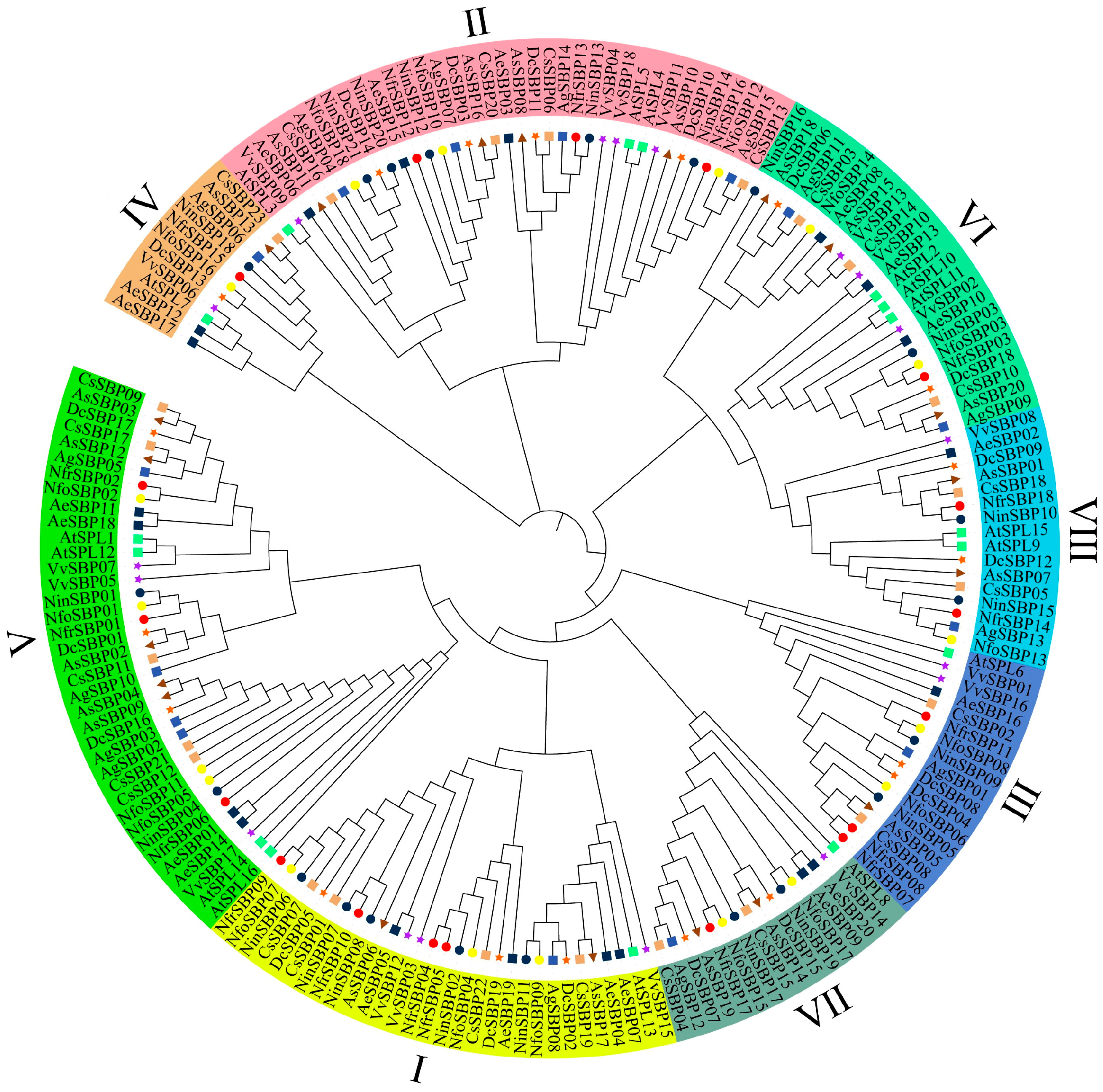
To explore the phylogenetic relationships of SBP family genes in Notopterygium species, we constructed ML phylogenetic trees with 188 SBP proteins from ten species (Figure 1). According to the classification of AtSPL genes, the SBP family genes of all species were classified into eight subfamilies, which indicated that the evolution of SBP genes was relatively conservative. Multiple sequence alignment results showed that the first zinc finger structure of all members in subfamily IV was C4 type, while the other subfamilies were C3H type (Figures S2 and S4). For Notopterygium species, subfamilyIhad the most members, with a total of twelve genes. Meanwhile, the subfamily IV had the fewest, with only three members (Figure 1).

2.3. SBP Protein Tertiary Structure

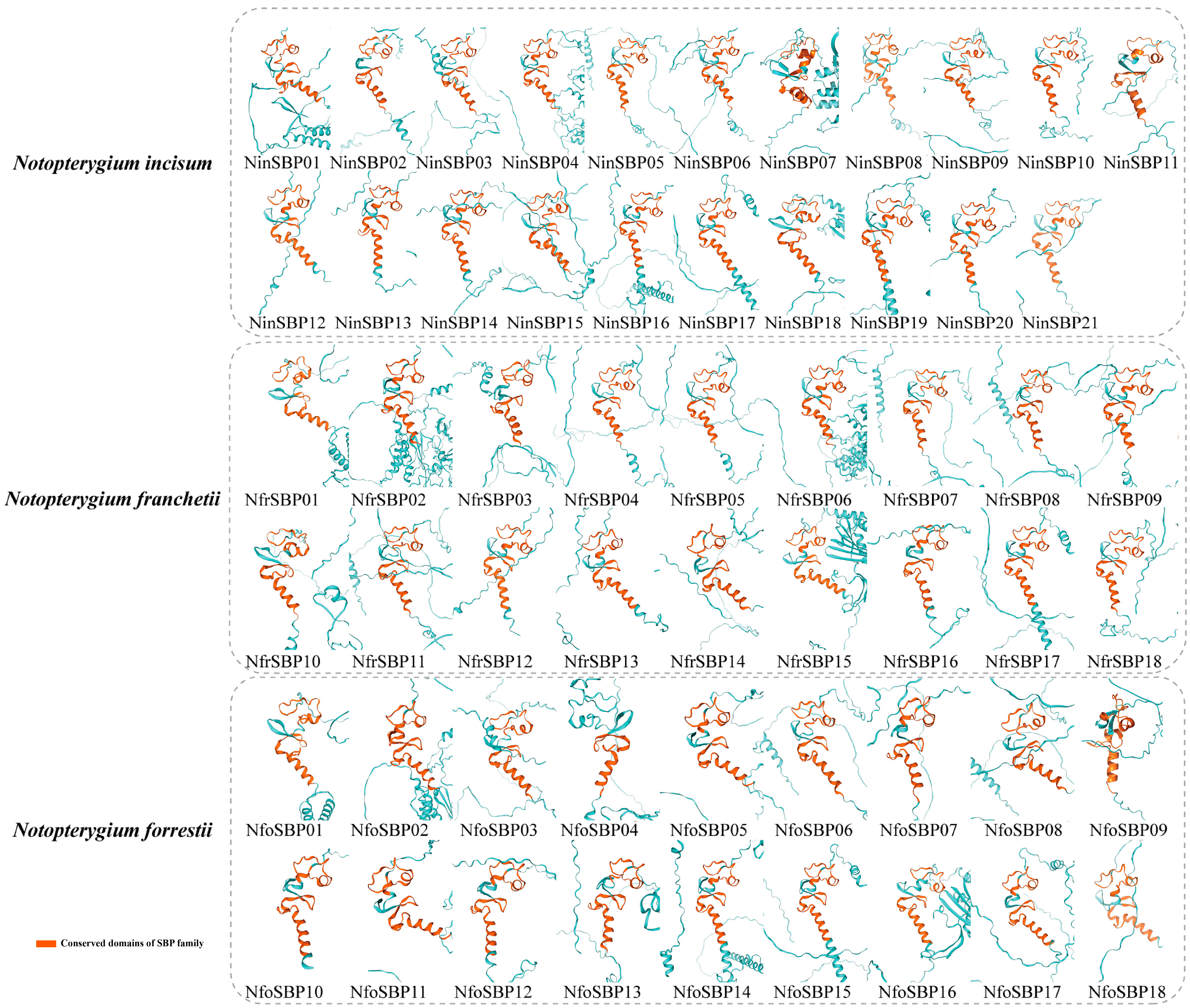
Protein structure often correlates its function. The results of homology modeling using the SWISS-MODEL are shown in Figure 2. SBP proteins of the same subfamily had similar three-dimensional structures. For example, all members of subfamily V had more complex tertiary structures, while all members of subfamily IV had a similar structure that differ from members of other subfamilies. Therefore, it was inferred that members of the same subfamily have similar functions.

2.4. Characterization of Gene Structure and Conserved Motifs

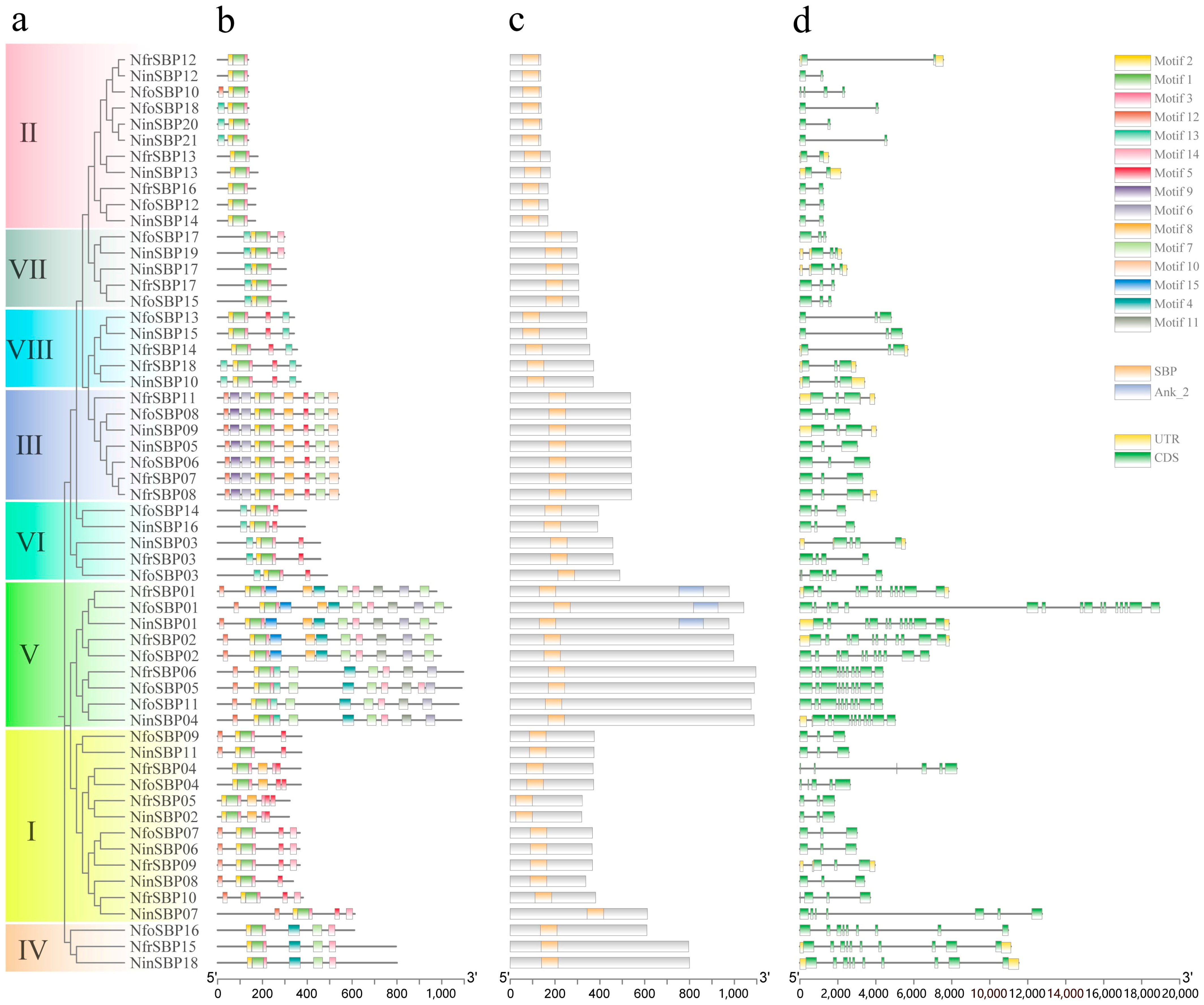
The gene structures, conserved domains, and conserved motif composition of NinSBPs, NfrSBPs, and NfoSBPs are shown in Figure 3. All identified protein sequences contained intact SBP-conserved domains, namely two zinc fingers and one nuclear localization signal. Phylogenetic analysis of NinSBPs-, NfrSBPs-, and NfoSBPs-conserved domain sequences was performed (Figure 3a); its topology was consistent with the phylogenetic tree constructed in ten species (Figure 1). As shown in Figure 3c, in addition to the SBP-conserved structural domain, NinSBP01, NfrSBP01, and NfoSBP01 also contained the Ank_2 conserved domain at the C-terminus.
The MEME results showed that, corresponding to the conserved domain, all members contain motifs 1, 2, and 3 (Figure 3b and Figure S7). In terms of the number of motifs, subfamily V contained the highest number of motifs (11–12), followed by subfamily III, with all members comprising 10 motifs. The subfamily II included the lowest number of motifs (3–4), while other subfamilies had 4–6 motifs. From the analysis of motif composition, some motifs were unique to a certain family, such as motif 9/10 which were only distributed in subfamily III, and motif 11/15 were only distributed in subfamily V. Some motifs were shared by different subfamilies, such as motif 5 in subfamilies I, III, V, VI, and VIII, and motif 7 only in subfamilies III, IV, and V. Therefore, different subfamilies may be functionally similar, but not identical.
The exon/intron distribution of NinSBPs, NfrSBPs, and NfoSBPs was analyzed by the GSDS2.0 program (Figure 3d). The distribution patterns of the same subfamily in terms of exon length and intron number were roughly similar. Corresponding to the conserved motifs, subfamily V had the highest number of exons/introns with 10–16/9–15 (Table 1, Figure 3d), followed by subfamily IV with 9–10/8–9, whereas subfamily II had the lowest exon/intron members (2/1). This was probably due to the deletion of introns at the late stage of differentiation. The difference in exon/intron numbers in different subfamilies indicated that different selection pressures may have been experienced during evolution, leading to functional differentiation.

2.5. Cis-Element Analysis

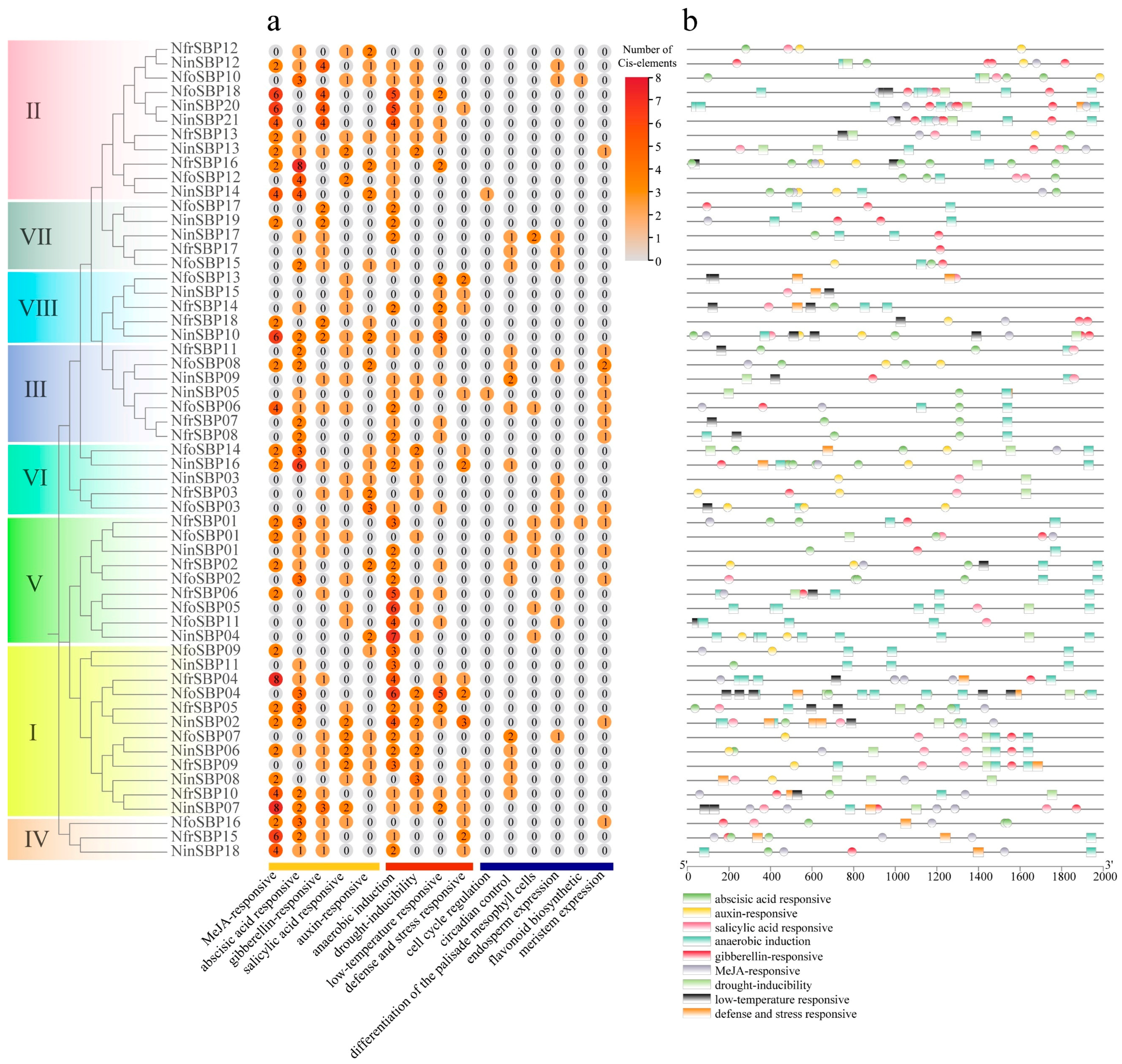
A total of twenty-three regulatory elements related to environmental stress, hormone response, and growth and development were detected in SBP gene promoters of the three Notopterygium species, corresponding to fifteen functions (Figure 4a). Among them, all genes contained the most hormone-responsive elements (288), followed by environmental stress-responsive elements (200), and the least growth-related elements (60). To further analyze the response of SBP family genes to environment and hormones, we constructed an environmental- and hormone-response element map (Figure 4b). The number and distribution of the same stress-response elements varied greatly among subfamilies. For example, most of the members contained anaerobic induction elements, but only nineteen members included stress and defense response elements. The differences in the number and function of these elements suggest that SBP genes in Notopterygium plants may be involved in various biotic/abiotic stresses and the regulation of environmental adaptation.

2.6. miRNA156-Targeting SBPs and Protein Interaction Network

In order to further explore the regulatory mode of SBP gene in Notopterygium plants, miR156 regulatory site detection was performed on SBP family genes of three Notopterygium species, and the results are shown in Table 2. miR156 regulatory sites were detected in 29 out of 57 SBP gene family members from the three Notopterygium species. Among them, miR156 regulatory sites were detected in 11 genes from N. incisum, 10 and 8 in N. franchetii and N. forrestii, respectively. These SBP genes belong to subfamily I, III, VI, and VIII, respectively (Table 2).
Except for NinSBP03/07, most SBP proteins were involved in different regulatory networks (Figure S8). It can be observed that SBP proteins interact with a large number of flowering-related proteins, e.g., AP2, TOE, AGL, LFY, SOC1, SMZ, and RGA. In addition, part of NinSBPs were associated with abiotic stress-related proteins such as MYB, TCP, NBR1, and RAP2-7. These results suggest that SBP proteins in Notopterygium species interact with flowering and abiotic stress-related proteins and thus participate in plant growth and development.

2.7. Collinearity and Gene Replication Types

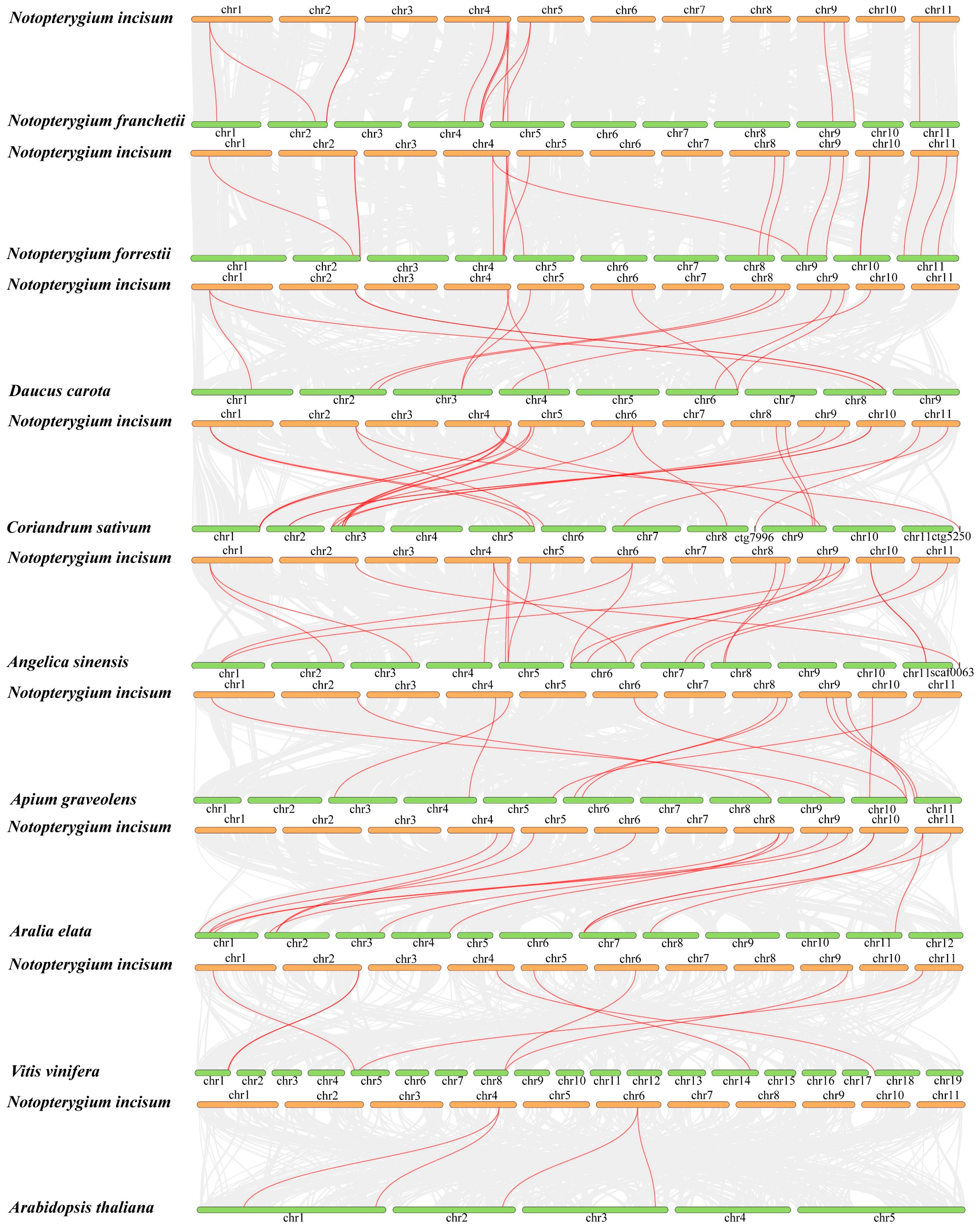
There were collinear gene pairs between NinSBPs and SBP genes of other species, 18 (NfoSBPs), 15 (NfrSBPs), 13 (DcSBPs), 22 (CsSBPs), 20 (AsSBPs), 12 (AgSBPs), 14 (AeSBPs), 8 (VvSBPs), and 4 (AtSBPs) collinear gene pairs, respectively (Figure 5). We found that, except for NinSBP20, other NinSBPs genes covary with at least one other species, such as NinSBP04 which covaries with AtSPL14, VvSBP17, AeSBP01, AsSBP04, etc. This indicated that these NinSBPs genes were relatively conserved before differentiation. In addition, there was a collinear relationship between NinSBPs and 2–3 SBP genes from another species, such as NinSBP05 and NfoSBP06/08, NinSBP01 and DcSBP01/17, suggesting that these genes play important roles in species evolution and the execution of biological functions.
Gene replication-type analysis was performed using the duplicate_gene_classifier program of MCScanX software (version 11.0.13) (Figure S9a). Except for three NinSBPs genes that belong to proximal duplication, all other genes were WGD/segmental duplication and transposable element duplication types, without tandem duplication. Two, four, and four paralogous gene pairs of N. incisum, N. franchetii, and N. forrestii were all the results of segmental duplication. Among them, eight paralogs of the three species belong to subfamilies I, III and V, respectively (Figure S9b–d).

2.8. Ka/Ks and Gene Duplication/Losses

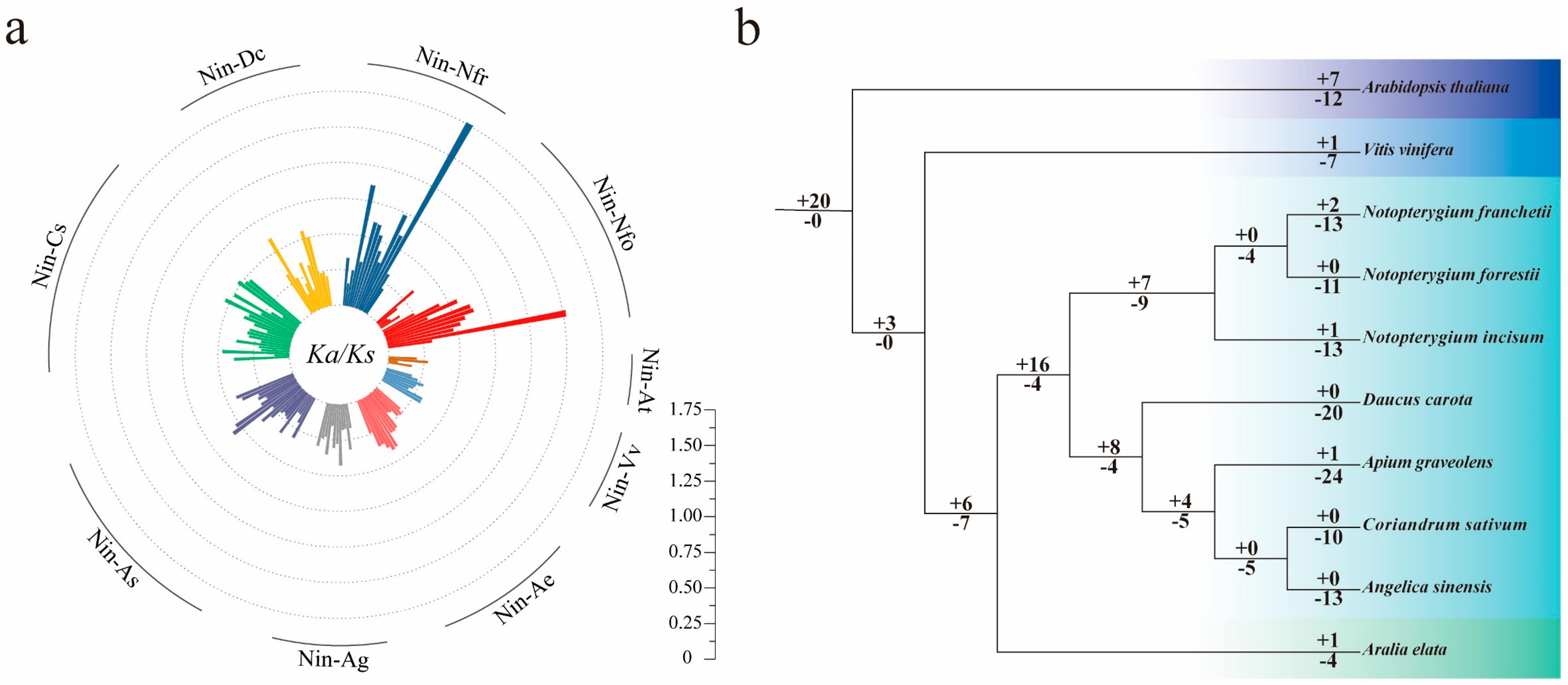
To determine the nature and extent of selection pressure on repetitive gene pairs, Ka, Ks, and Ka/Ks values were calculated for 125 homologous gene pairs in ten species. The results showed (Figure 6a) that the Ka/Ks values of NinSBP02/NfrSBP04 and NinSBP02/NfoSBP04 were 1.51 and 1.27, respectively. It suggested that non-synonymous substitutions of some genes during the differentiation process were beneficial to the species and were preserved by positive environmental selection. However, the Ka/Ks values of the other homologous gene pairs were all less than 1, and 105 of them were less than 0.50. Therefore, they all underwent purification selection during evolution. In addition, the Ka/Ks values of the paralogue gene pairs in the three Notopterygium species were also less than one (Table S1).
The SBP genes of ten species had a total of 77 gene duplicates and 165 gene losses during evolution, with the number of gene losses far greater than duplicates (Figure 6b). Moreover, the common ancestor of all species had twenty gene duplicates without loss, and the number of gene duplications in the common ancestor lineage of six Apiaceae species was four times the number of gene losses. It indicated that SBP gene family experienced large-scale expansion in the early stage of species differentiation. Compared with other genera in Apiaceae family, the number of SBP gene losses in the common ancestor lineage of Notopterygium plants was greater than the number of duplicates, and the overall number of SBP genes was significantly reduced. Furthermore, all species had a large number of gene loss; presumably, SBP gene family has experienced a serious contraction in recent evolutionary processes.

2.9. Genetic Diversity and Population Genetic Structure

A total of 20,727 SNPs were detected, and 525 high-quality SNPs were obtained after filtering. Annotation results for SNPs showed that the majority of SNPs were located in exonic regions (40.32%), followed by gene downstream regions (28.09%) and intronic regions (26.21%). The splice site region and 5′ untranslated region were the fewest (less than 1%) (Table 3). Then, 156 SNPs were annotated as synonymous mutations, 145 as missense mutations and one stop codon mutation. In addition, SNPs were unevenly distributed on the chromosome, with 54.86% of SNPs positioned on chr4 (Table S2).
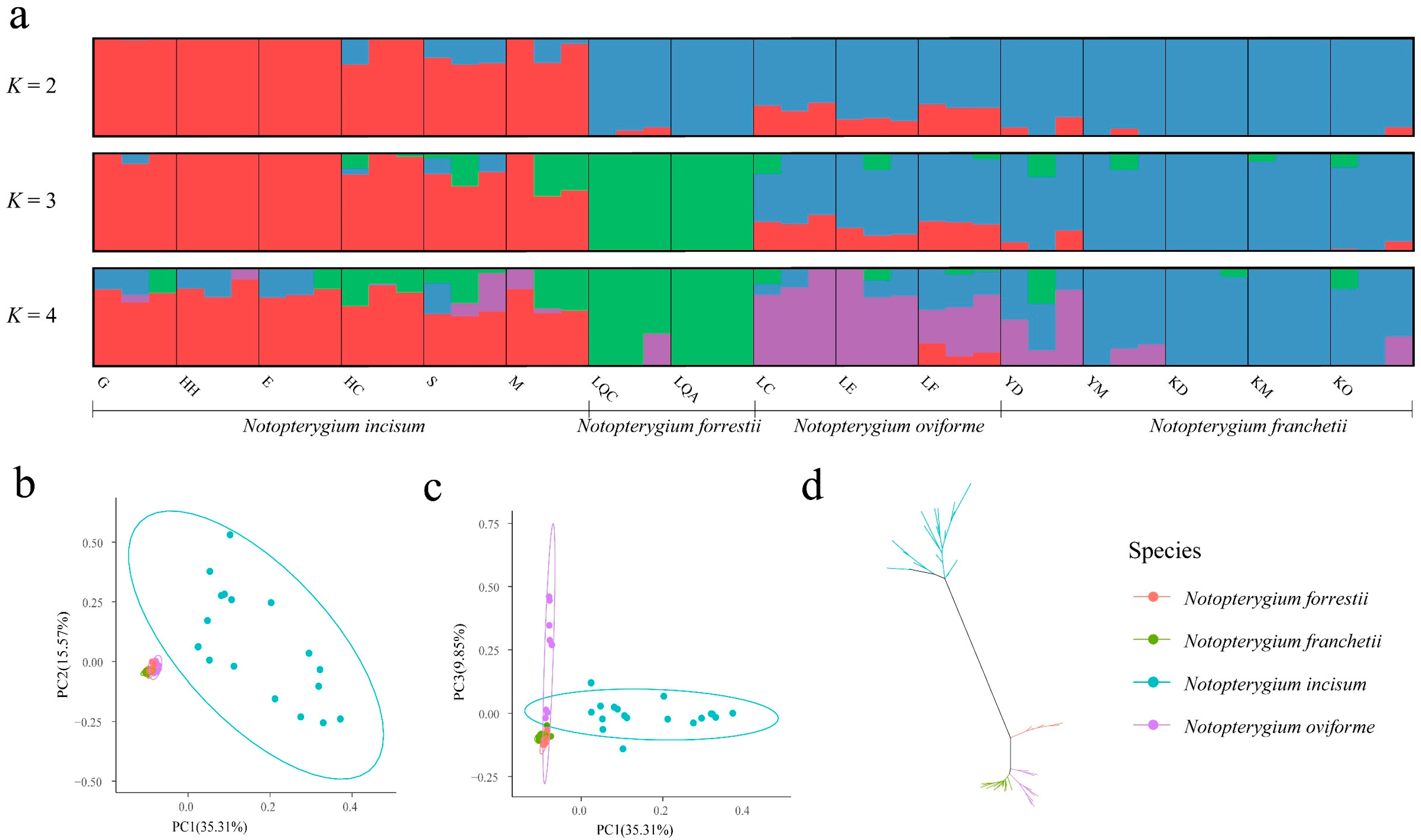
The population genetic structure calculated based on ADMIXTURE software (version 1.3.0) showed that the optimal cluster of SBP gene family in Notopterygium species was three. When K = 2, the genetic component of SBP genes in N. incisum was the first to be isolated from the Notopterygium population; when K = 3, the genetic component of SBP genes in N. forrestii was subsequently isolated; and when K = 4, there was a clear distinction between the N. franchetii and N. oviforme populations, but some populations had more gene introgression (Figure 7a). Both PC1-PC2 and PC1-PC3 showed significant genetic differentiation between the SBP gene family of N. incisum and the other three species, consistent with the results of ADMIXTURE (Figure 7b,c). An ML tree was constructed using SNPs (Figure 7d). The SBP genes of N. incisum and N. forrestii were clustered into a separate genetic branch, respectively. The SBP genes of 9 individuals in N. oviforme were classified into two genetic branches, and 6 of them and 15 individuals of N. franchetii were grouped into a large branch. This indicated that the genetic differentiation of the SBP genes in N. incisum and N. forrestii was relatively large, while that in N. franchetii and N. oviforme was relatively small.
The genetic differentiation index (Fst) of SBP gene family between Notopterygium species is shown in Figure S10. The Fst was the largest between the SBP genes of N. incisum and N. franchetii, followed by those between N. incisum and N. oviforme, N. incisum and N. forrestii, N. forrestii and N. franchetii, N. forrestii and N. oviforme, and the smallest between N. franchetii and N. oviforme, with values of 0.30, 0.22, 0.20, 0.10, 0.08, and 0.07, respectively. Within-species nucleotide diversity indicated that the SBP family genes of N. oviforme had the highest nucleotide diversity level (θπ = 7.84 × 10⁻⁴), followed by N. forrestii (θπ = 7.56 × 10⁻⁴) and N. franchetii (θπ = 7.05 × 10⁻⁴), and the N. incisum had the lowest (θπ = 6.37 × 10⁻⁴).

2.10. Expression Profiles of SBP Gene Family

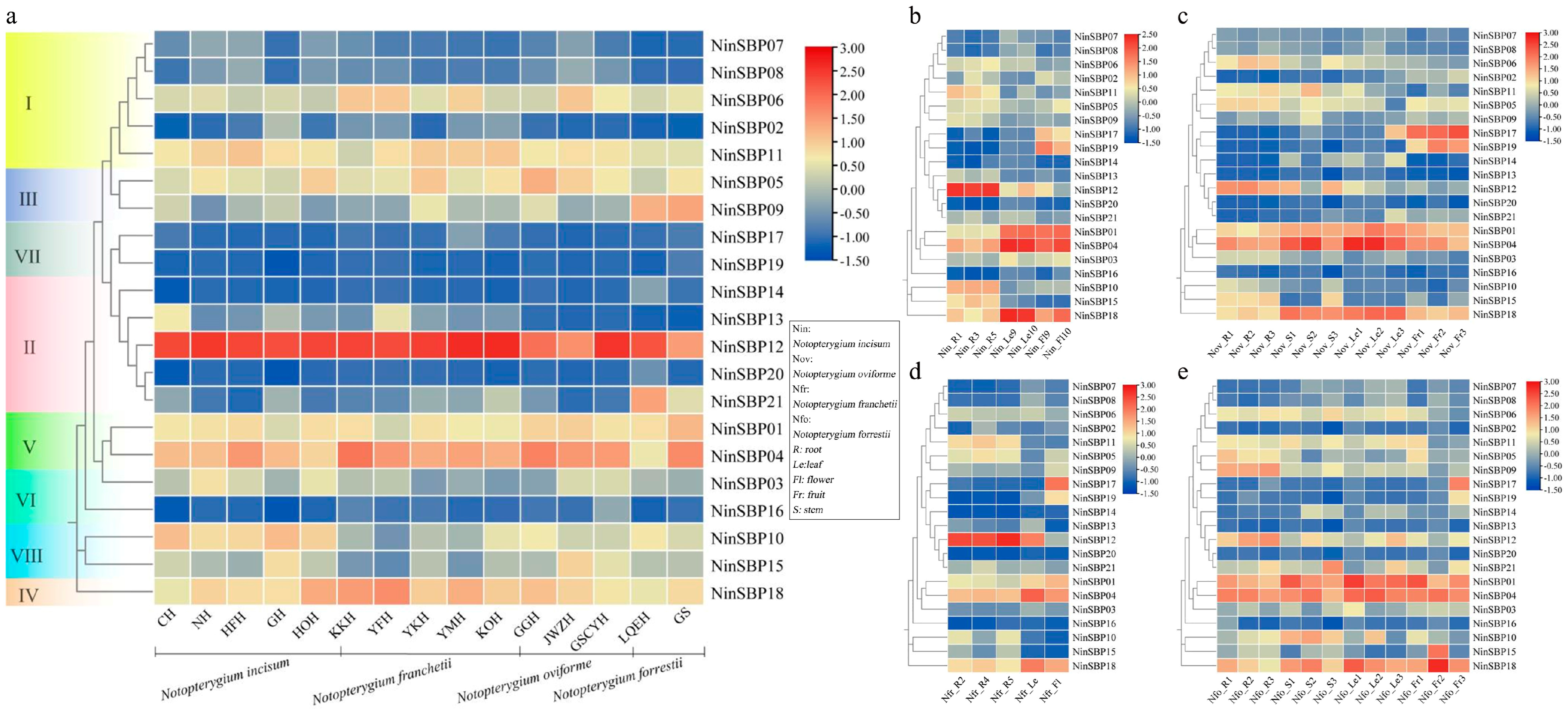
In order to investigate the expression patterns of SBP genes in Notopterygium species, we constructed expression heatmaps of different tissues (Figure 8). Most genes had similar expression levels in roots of different species, for example, NinSBP12 was most highly expressed in all populations of the four species, while NinSBP17 and NinSBP19 were not expressed in all populations. Only a few genes were expressed differently among species, such as NinSBP09, which was more expressed in N. incisum than in the other three species (Figure 8a). These results indicated that the expression level of NinSBPs varied among species depending on the gene members. In addition, the expression levels of genes in the same subfamily were not completely similar, such as the significant difference in NinSBP12 and NinSBP20, which were all located in the second subfamily. Therefore, there was no correlation between gene expression levels and subfamily.

2.11. qRT-PCR

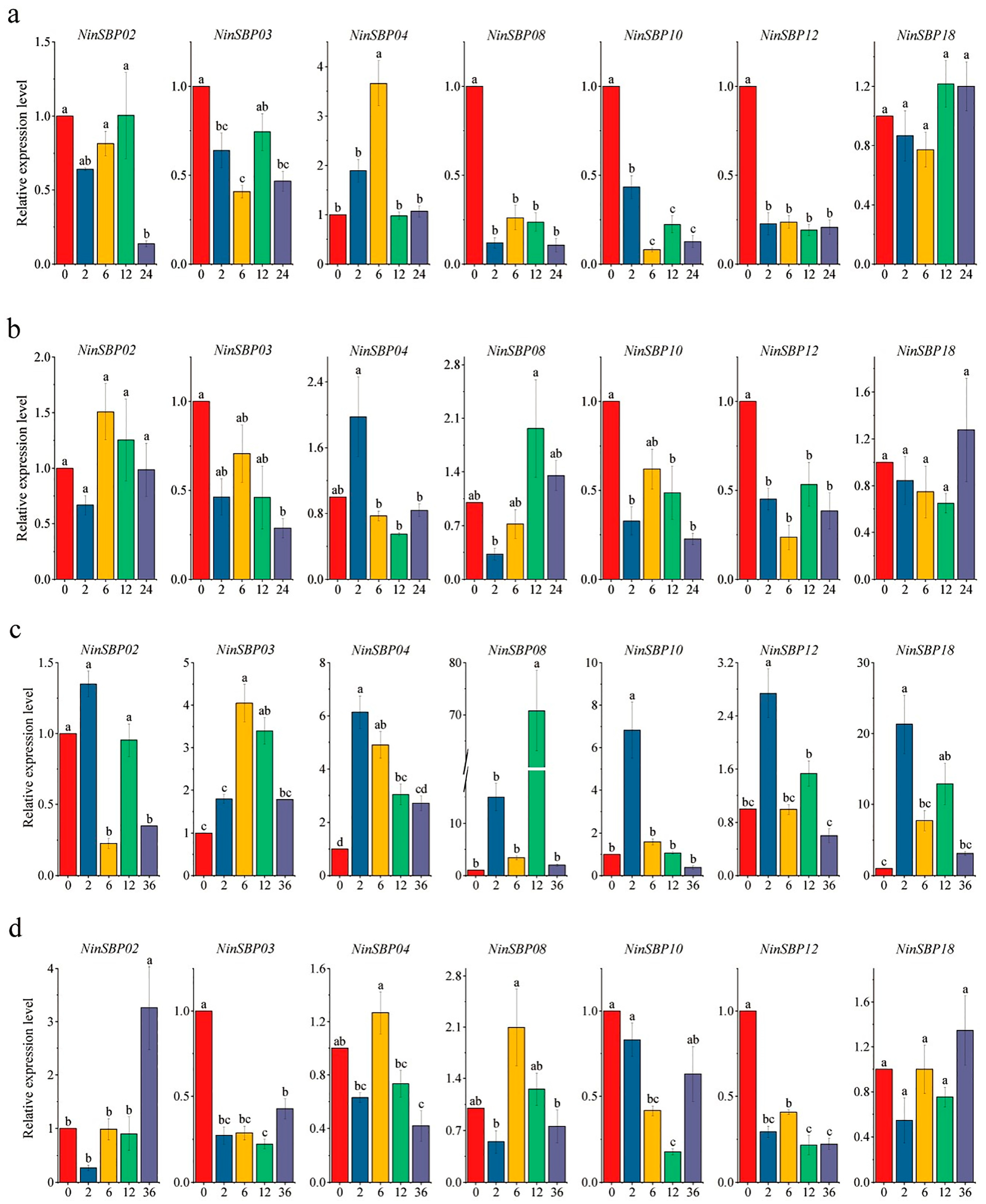
To investigate the response of SBP genes in Notopterygium plants to drought and high temperature stresses, qRT-PCR experiment was carried out. Different NinSBPs genes exhibited different response patterns under the same abiotic stress (Figure 9).
Under drought stress, expression of several NinSBP genes in leaves showed dynamic changes. NinSBP02/18 exhibited a transient induction, peaking at 12 h. In contrast, NinSBP03/08/12 showed highest expression at 0 h. NinSBP04 displayed a distinctive bimodal response (increase–decrease–increase), peaking at 6 h, while NinSBP12 expression decreased initially and then stabilized at 2 h (Figure 9a).
In roots, the expression trends of NinSBP02/03/04/08 were consistent with those in leaves, albeit with shifted peak times (6, 0, 2, and 24 h, respectively). NinSBP10/12 in roots showed a similar response pattern to that in leaves, peaking at 0 h. Conversely, NinSBP18 in roots displayed a relatively simple increase in stress responsiveness, reaching its maximum at 24 h (Figure 9b).
Under high temperature stress, there were two trends of NinSBPs expression in leaves of N. franchetii (Figure 9c,d). One group (NinSBP02/08/12/18) showed complex fluctuations, with most (NinSBP02/12/18) peaking early at 2 h, while NinSBP08 peaked later at 12 h. The other group (NinSBP03/04/10) consistently showed a rapid induction followed by a gradual decline, peaking at 6 h (NinSBP03) and 2 h (NinSBP04/10) (Figure 9c). Root responses were more varied: NinSBP02/03/12/18 fluctuated with peaks at 36 h (NinSBP02/18) and 0 h (NinSBP03/12). NinSBP04/08 exhibited a decrease–increase–decrease pattern, peaking at 6 h. Only NinSBP10 showed a simple decrease–then–increase trend, with a maximum at 0 h (Figure 9d). Furthermore, Figure S11 illustrated the antioxidant enzyme activities in the roots and leaves of N. franchetii at various time points under the aforementioned different stress treatments.

3. Discussion

3.1. Identification and Structure Analysis of SBP Gene Family

Notopterygium is an endangered and medicinal herb genus endemic to China, and the N. incisum and N. franchetii of this genus have high medicinal and economic values. The whole genome sequencing of Notopterygium species provided an opportunity for the evolutionary study of SBP gene family. Then, 21, 18 and 18 members of SBP gene families were identified from N. incisum, N. franchetii, and N. forrestii, respectively. Furthermore, we identified 19, 23, 15, 18, 20, and 20 SBP genes in the genomes of carrot, coriander, celery, grape, A. sinensis, and A. elata, respectively, for a comparative analysis with Notopterygium species. The number of SBP genes in different species may be related to the amount of loss and retention after multiple whole genome duplication events [37]. Consistent with findings from other species, the distribution of SBP genes in Notopterygium species was uneven on chromosomes [38,39]. NfrSBP16/17/18 was not localized to any chromosome, but NfrSBP16/17/18 shares similar gene structures and conserved motif compositions with other members of its subfamily, and these genes all have orthologous genes in the SBP gene of N. incisum. It is therefore likely that NfrSBP16/17/18 was indeed part of the genome, although the exact chromosomal location in the current assembly has not yet been determined. In addition, subcellular localization results revealed that NinSBP04, NfrSBP06, NfoSBP05, and NfoSBP11 were localized to the plasma membrane and possessed transmembrane domains, in contrast to the predicted nuclear localization of most SBP proteins. This finding was consistent with observations in Zanthoxylum bungeanumn [40]. Such atypical characteristics suggest functional diversity within the SBP gene family. For instance, the Arabidopsis SPL7 protein contains a functional transmembrane domain and exhibits dual localization in the nucleus and the membrane system, which is associated with its role in responding to copper deficiency [41]. We speculate that these membrane-associated SBP proteins in Notopterygium species may act as sensors or regulatory nodes for environmental signals, participating in membrane-related stress-response pathways.
The results of gene structure prediction of SBP family genes in the three Notopterygium plants showed that members of the same subfamily have similar tertiary protein structures, conserved motifs, and exon/intron composition patterns. It is therefore presumed that they share a common evolutionary origin and similar molecular functions. The tertiary structure of the fifth subfamily was more complex and diverse, with the highest number of introns (9–15). Introns increase the length and frequency of gene recombination and alter their regulatory role [42]. Therefore, we speculate that this subfamily has significant functional differentiation and may perform particular biological functions under certain specific conditions. It is generally accepted that a large number of introns were present in ancient biological ancestors but were lost as organisms evolved [42,43]. It is inferred that the SBP gene of subfamily V was relatively old, while the subfamily II was relatively late. In addition, the protein tertiary structure of subfamily IV differs greatly from that of other subfamily members, possibly because the first zinc finger structure was type C4. According to the evolutionary model of the SBP gene family proposed by Guo et al. (2008), this subfamily originated from group I [4].
Promoter cis-acting elements can provide insights into the function of genes [44]. This study suggests that the SBP genes promoter of Notopterygium species contained several cis-acting regulatory elements, which may regulate a variety of developmental and stress-related processes. However, different SBP genes included different regulatory elements, which may be closely related to the functional diversity of SBP genes. In addition, a large number of anaerobic response elements suggest that SBP gene may play an important role in plant adaptation to high-altitude oxygen-poor environment.

3.2. Evolutionary History of SBP Gene Family in Notopterygium

The SBP gene originated from the differentiation between green algae and terrestrial plants and subsequently underwent further duplication and differentiation in each lineage [4]. In this study, ML phylogenetic tree was constructed using conserved domain sequences of SBP proteins from ten species. SBP genes of all species were classified into eight subfamilies. The gene structure and conserved motifs of NinSBPs, NfoSBPs, and NfrSBPs also supported this taxonomic pattern, suggesting that the SBP gene family was highly conserved during evolution and had similar biological functions in different species. The results of collinearity analysis showed that the SBP gene of N. incisum had more collinearity gene pairs with the species of Apiaceae and Araliaceae, but less with Vitaceae and Brassicaceae, which also confirmed the relationship between the species. NinSBP20 had no collinearity with any SBP gene. NinSBP21 only had collinearity with NfoSBP18, while its Ks value was zero. The phylogenetic tree showed that these three genes were located in the same branch of subfamilies II; it is inferred that these three genes are highly homologous and have been differentiated recently. Furthermore, NinSBP10 has a collinearity with SBP genes of all species except Notopterygium plants; it is hypothesized that NinSBP10 was relatively old and underwent great variation after Notopterygium differentiation.
Repeated genes are generally considered to be an essential material source for the origin of new species [45]. In this study, only WGD/segmental duplication, dispersed duplication, and proximal duplication were detected in NinSBPs, NfrSBPs, and NfoSBPs, and no tandem duplication events were present. This phenomenon has also been found in beet (Beta vulgaris L.) [46]. These results suggest that some SBP genes may be generated during WGD/segmental duplication, especially members of subfamilies III and V, leading to genomic complexity [47]. Additionally, these replication events may be driving factors for the new functions of SBP genes, helping plants adapt to harsh environments [11,45]. In addition, 50% of the SBP paralogous genes within Notopterygium species were located on chr4 and chr5, respectively, and 54.86% of SNPs were distributed on chr4 (Table 4). It is inferred that there may be a chromosomal rearrangement between chr4 and chr5 and that this region was selected conservatively during evolution.
Genome-wide duplication contributes greatly to the evolution of eukaryotic genomes; meanwhile, WGD events accelerate gene loss [48,49]. Similarly to other species in the Apiaceae family, the SBP gene in Notopterygium plants has undergone a large amount of gene loss, presumably caused by two consecutive WGD events unique to Apiaceae [50,51,52]. Ka/Ks calculations showed that the vast majority of SBP genes in Notopterygium plants have undergone purification selection. Meanwhile, only two (1.6%) duplicate gene pairs were detected by positive selection, indicating that they may have undergone relatively rapid evolution. Therefore, the SBP gene in Notopterygium may have limited functional differentiation after WGD [53].

3.3. Genetic Diversity and Population Structure of SBPs

Based on comparative reference genomes and whole-genome resequencing data, a large number of genetic features such as single nucleotide polymorphism variations, insertion and deletion variations, structural variations, and copy number variations can be obtained to explain genetic variation patterns at the genome level [54]. In this study, SNPs data of forty-eight individuals from fifteen populations of four species in Notopterygium were used to analyze the genetic diversity and genetic structure of SBP genes. The annotation results of the SNPs revealed that 40.32% of the variant sites were located in exonic regions. Those SNPs lead to the changes in the codon and amino acid sequence, resulting in changes in the structure and function of the proteins, ultimately bringing about functional diversity of the SBP gene in Notopterygium species.
The findings of population genetic structure, principal component analysis, and phylogenetic relationships supported each other. That is, the SBP genes of N. incisum and N. forrestii can be clearly distinguished in four species as a large monophyletic branch, respectively. However, the SBP genes of N. oviforme and N. franchetii clustered together. The results support Yang et al. (2019)’s differentiation study of Notopterygium species based on multiple genomic fragments and morphological evidence [33]. According to the division of genetic differentiation level among populations, the results of Fst in this study were consistent with the above results. Therefore, the differentiation of SBP gene in Notopterygium plants was in accordance with the differentiation level of Notopterygium species. The degree of species nucleotide diversity can be influenced by its origin [55]. In our study, the SBP gene of N. oviforme had the highest nucleotide diversity level, followed by N. forrestii, N. franchetii, and N. incisum, which had the lowest. This study supports the hybridization origin of N. oviforme and N. forrestii [30].

3.4. Expression Pattern and Function Prediction of SBPs

As rooted and fixed organisms, land plants are unable to move and constantly face various unfavorable challenges [56]. In order to adapt to various stimuli, plants have evolved complex signal transduction pathways to sense various stress signals and coordinate their growth [57]. miR156 or miR156-SPL modules play an important role in plant growth and development, as well as in biotic and abiotic stresses [58,59,60]. Genetic analysis of the SBP gene family in Notopterygium species indicated that all members of the subfamilies I, III, VI, and VIII were regulated by miR156, which induced the expression of downstream genes. Additionally, each member of gene family plays a role in different regulatory pathways; the interaction of multiple members of gene family also performs an indispensable function in some aspects [61]. The results of protein interaction network showed that SBP transcription factors of Notopterygium plants mainly interact with AP2-like, AGL, and MYB proteins, which play an important role in regulating flowering and responding to biotic and abiotic stresses [62,63,64].
Based on the RNA-seq data, the expression patterns of SBP genes were consistent among the four Notopterygium plants; namely, most SBP genes were not species-specific. However, these genes had obvious tissue specificity, which suggests that they have different functions or regulatory mechanisms in different tissues or organs. In addition, the expression patterns of the same subfamily genes varied considerably across tissues, suggesting that genes of the same subfamily were more functionally differentiated in different tissues. This result has also been confirmed in other species. For example, regarding AtSPL10 and AtSPL11 located in the sixth subfamily, it can be said that AtSPL10 is essential in fruit pod development; however, AtSPL11 mainly acts on the flowering signaling pathway in Arabidopsis thaliana [65,66].
We detected the expression of seven NinSBPs in the living leaves and root tissues of N. franchetii under drought and high temperature stress through qRT-PCR. The results showed that under the same stress, the response patterns of the same gene in different tissues were different; in the same tissues, the responses of the same gene under different stress were also different. Therefore, the response patterns of these SBP genes are stress-specific and tissue-specific. This result was also confirmed in the enzyme activity and content. In addition, the relative expression levels of some genes significantly increased or decreased after two hours, such as NinSBP08/10/12, indicating that these genes may have rapid response ability to help plants resist adverse conditions in the short term. Similar phenomena have also been observed in other species [56,67].
Gene silencing of TaSPL6 enhanced drought tolerance in wheat and exhibited better growth status [68], a result also validated in tea plants [69]. The expression level of NinSBP10/12 was significantly inhibited in both leaves and roots under drought stress. Additionally, drought-responsive elements were detected in the promoter regions of these two genes. It is speculated that NinSBP10/12 can enhance the drought resistance of Notopterygium plants. Overexpression of AtSPL1 or AtSPL12 enhanced heat tolerance in Arabidopsis and tobacco [70]. NinSBP08 was located in the same branch as AtSPL1/12, and the expression level of NinSBP08 increased about seventy-fold after 12 h of heat stress, while NinSBP08 was hardly expressed without additional stress. The results demonstrated that high temperature stress could activate the expression of NinSBP08 in leaves of Notopterygium plants and make them survive the adverse environment.

4. Materials and Methods

4.1. Genome Data Collection and SBP Family Genes Identification

The whole genome sequencing data of the three species of Notopterygium were obtained from the research group. Genome assemblies for N. incisum (1.48 Gb; N50: 16.57 Mb), N. francheti (2.04 Gb; N50: 2.81 Mb), and N. forrestii (1.36 Gb; N50: 47.22 Mb) showed high BUSCO completeness of 97.03%, 93.38%, and 98.88%, respectively. The other seven species were downloaded from NCBI (D. carota, V. vinifera, and A. thaliana), CGDB (C. sativum and A. graveolens), cyVerse platform (A. sinensis), and Dryad Digital Repository (Aralia elata (Miq.) Seem.), respectively. The Pfam database and Blastp software (version 2.14.0) were used to identify SBP family genes (PF03110) with an e-value < 1 × 10⁻⁵, respectively [71,72]. The above two results were combined and redundant sequences were removed. Then, the NCBI-CDD database was utilized to confirm the conserved domains [73], with only the complete SBP-conserved domain preserved. The SBP family genes were renamed according to their distribution on the chromosome, and the chromosome mapping was made by TBtools (version 2.376) [74].

4.2. Physicochemical Properties, Subcellular Localization, and Protein Structure

All SBP protein sequences were submitted to ExPASy platform for physicochemical property analysis (https://web.expasy.org/protparam/, accessed on 11 April 2025) [75], Wolf PSORT (https://wolfpsort.hgc.jp/, accessed on 24 April 2025) for subcellular localization, and TMHMM (https://services.healthtech.dtu.dk/services/TMHMM-2.0/, accessed on 6 May 2025) for transmembrane domain prediction [76,77]. The tertiary structure was obtained by homology modeling with SWISS-MODEL (https://swissmodel.expasy.org/, accessed on 27 May 2025) [78].

4.3. Multiple Sequence Alignments and Phylogenetic Analysis

Amino acid sequences of the SBP family genes from 10 species were used to construct a phylogenetic tree using MEGA X software (version 2.056) [79]. First, multiple alignment was conducted using muscle; then, the phylogenetic tree was constructed using the maximum-likelihood (ML) method with the best amino acid substitution model JTT + G and 1000 bootstrap replicates. Furthermore, the ML tree was submitted to iTol website for phylogenetic tree beautification [80].

4.4. Gene Structure and Conserved Motif Analysis

The conserved motifs of SBP proteins were identified by the program MEME with a maximum of 15 motifs and other default settings [81]. The gene structure display server (GSDS) was utilized to investigate the SBP gene structures [82]. TBtools software (version 2.376) was used to visualize gene structure and conserved motif composition.

4.5. Cis-Element Analysis and miRNA156-Targeting SBPs Prediction

The 2000 bp upstream of the SBP family genes was extracted as the promoter sequence and submitted to PlantCARE database for cis-element analysis [83]. Although three genes (NinSBP11, NinSBP20, and NfrSBP06) showed partial overlaps with adjacent genes, we maintained the uniform 2000 bp promoter length for all genes to ensure consistency with previous studies and facilitate comparative analyses. The potential targets of miR156 were predicted by psRNATarget server [84].

4.6. Protein Interaction Network

In order to explore the interaction of SBP proteins in Notopterygium species, NinSBPs were used as representatives to construct a protein interaction network of this genus using the STRING (https://cn.string-db.org/ (accessed on 29 June 2025) [85].

4.7. Collinearity and Duplication Type of SBP Genes

The interspecies and intraspecific SBP protein sequences of Notopterygium species were compared using Diamond software (version 0.8.22.84) [86]. Then, the MCScanX software (version 2.056) was used to search the collinearity blocks. The duplication types of the SBP genes were classified using the duplicate_gene_classifier program, which was incorporated in the MCScanX software (version 2.056) [87]. Finally, SBP family genes located in the collinear blocks were extracted using TBtools software (version 2.376).

4.8. Gene Duplication/Loss Analysis and Ka/Ks Calculation

First, the OrthoFinder software (version 2.5.4) was adopted to construct a species tree of the 10 species, with default parameters [88]. The species tree was then compared with the gene tree for lineage comparison with Notung software (version 2.1.9.5) for gene replication and loss estimation [89]. To analyze the selection pressure during gene evolution of NinSBPs, the synonymous mutation frequency (Ks), nonsynonymous mutation frequency (Ka), and Ka/Ks of collinear gene pairs were calculated employing the Simple Ka/Ks Calculator (NG) program in TBtool software (version 2.376)

4.9. Genetic Structure and Genetic Diversity of SBP Gene Family

Forty-eight individuals of 16 populations from four Notopterygium species were collected and the whole genome was resequenced on BGISEQ-500 platform (Figure S1). The N. incisum genome was used as the reference genome for sequence alignment and single-nucleotide polymorphism (SNP) detection, followed by the SNP data of the SBP gene family, which was extracted according to the position information of SBP family genes on chromosome. SNPs filtering was performed using Vcftools software (version 0.1.17) [90]. Additionally, variant annotation was carried out using snpEff v4.3 software [91].
Based on the SNPs data filtered by linkage disequilibrium (LD: R2 < 0.2) with PLINK v1.9 software [92], the genetic structure of the SBP gene family was estimated using ADMIXTURE v1.3.0 software and mapping by Pong software (version 1.5) [93,94]. Principal component analysis was performed using PLINK (version 1.90) as well as phylogenetic trees, which were calculated using IQ-TREE software (version 2.1.3) [95]. Nucleotide diversity (θπ) and genetic differentiation coefficients (Fst) were obtained using the --windows-pi and --fst windows parameters in Vcftools (version 0.1.17), with the sliding window set to 10 K and the step size set to 5 K.

4.10. Expression Pattern Analysis

The expression pattern of NinSBPs in root tissues of 45 individuals from 15 populations of four Notopterygium species, as well as in different tissues of each species, was studied by RNA-seq (Table S3). These plant materials were collected from Gansu, Qinghai, Sichuan, and Shaanxi provinces. Fresh materials were rapidly frozen with liquid nitrogen and transcriptome sequencing was performed on an Illumina HiSeq X Reagent platform (Majorbio, Shanghai, China). Fastp software (version 23.4) was used for filtering and quality control of the original sequencing data [96]. The gene expression abundance was performed using the comparison software HISAT2 (version 2.10) and the assembly and quantification software StringTie (version 1.3.5 ) [97,98], taking the N. incisum genome sequence as reference. The TPM values (transcripts per million reads) were then calculated utilizing the RPKM/FPKM or TPM Calculator plugin in TBtools (version 2.376), and a heat map was drawn by logarithm.

4.11. Plant Materials and Seedling Treatments of Abiotic Stress Experiments

The plant material used in this study was 3-year-old cultivated N. franchetii seedlings. The roots of the seedlings were cultivated into pots and the stems and leaves were cut to allow re-germination. Six weeks after germination, they were subjected to drought and high-temperature stress treatments. Under drought stress, leaves and roots were collected at 0, 2, 6, 12, and 24 h, after the washed roots were placed in 40% Polyethylene glycol (PEG) 6000 solution. For the heat treatment, the plants were placed in a 40 °C incubator and the leaves and roots were obtained at 0, 2, 6, 12, and 36 h. All samples were collected separately, quickly placed in liquid nitrogen, and stored at −80 °C. Three biological replicates were set for each qRT-PCR experiment.

4.12. RNA Extraction and qRT-PCR

Total plant RNA was extracted using the SteadyPure Plant RNA Extraction Kit (Accurate Biotechnology Changsha, China) according to the manufacturer’s instructions. Hifair® III 1st Strand cDNA Synthesis SuperMix for qPCR (gDNA digester plus) was utilized to synthesize the first strand cDNA (Yeasen Biotechnology, Shanghai, China). qRT-PCR experiments were performed with Hieff® qPCR SYBR Green Master Mix (No Rox) Fluorescence Quantification Kit (Yeasen Biotechnology, Shanghai, China). Actin8 was employed as an internal reference gene for normalization and all primer sequences were designed through Primer Premier v6.0 software (Table S4). The relative expression of each gene was calculated according to the 2−ΔΔCT method and significance analysis was performed using Tukey test in Origin software (version10.1.0.78) [99].

4.13. Physiological Indexes Determination

The superoxide dismutase (SOD) and peroxidase (POD) activity and malondialdehyde (MDA) content of leaves and roots treated for different times were determined by the SOD, POD, and MDA assay kits (A001-3, A084-3-1 and A003-1) (Nanjing Institute of Biological Engineering, Nanjing, China).

5. Conclusions

In this study, 21, 18, and 18 SBP family genes were identified in the whole genome of N. incisum, N. francheti, and N. forrestii, respectively, and classified into eight subfamilies. Members of the same subfamily had similar structures and conserved motif compositions, suggesting that they may have similar biological functions. Promoter cis-regulatory element analysis showed that the SBP gene may play an important role in the growth and environmental adaptation of Notopterygium species. Evolutionary analysis revealed that there was a collinear relationship between the SBP gene of N. incisum and other closely related Apiaceae species. The expansion of the SBP gene family in Notopterygium plants was mainly caused by WGD/segmental duplication and transposable element duplication. The SBP gene family has experienced severe contraction events, and most of the gene copies have undergone purification selection during evolution. A few genes have recently differentiated, which may lead to the differentiation of new functions and promote the adaptation of Notopterygium species to the changing environment. Moreover, there was a clear interspecific genetic differentiation pattern in the SBP gene of Notopterygium plants, which was consistent with the genetic structure at the species level. Genetic regulation analysis indicated that a total of twenty-nine SBP genes were regulated by miR156. The expression patterns of SBP genes in Notopterygium species were not species-specific, but they were obviously tissue-specific. The results of qRT-PCR experiments illustrated that most of the validated SBP genes were responsive to drought and high temperature stresses, but the response patterns were inconsistent. Furthermore, NinSBP08 and NinSBP10/12 may have important effects on heat tolerance and drought tolerance, respectively.

Supplementary Materials

The following supporting information can be downloaded at https://www.mdpi.com/article/10.3390/ijms27020979/s1.

Author Contributions

Writing—review, editing, supervision, and funding acquisition, M.-L.L. and Z.-H.L.; methodology, D.-T.Z., Y.-J.C., and R.Y.; software, D.-T.Z., Y.-J.C., and H.-L.W.; validation, X.-J.H. and C.-Y.L.; formal analysis, D.-T.Z. and Y.-J.C.; investigation, R.Y. and H.-L.W.; data curation, C.-Y.L. and X.-J.H.; writing—original draft preparation, D.-T.Z. and Y.-J.C. All authors have read and agreed to the published version of the manuscript.

Funding

This research was funded by the National Natural Science Foundation of China (32470392, 32300324 and 32560102).

Institutional Review Board Statement

Not applicable.

Informed Consent Statement

Not applicable.

Data Availability Statement

The original contributions presented in this study are included in the article/Supplementary Material. Further inquiries can be directed to the corresponding authors.

Conflicts of Interest

The authors declare no conflicts of interest.

References

  1. Yamasaki, K.; Kigawa, T.; Inoue, M.; Tateno, M.; Yamasaki, T.; Yabuki, T.; Masaaki, A.; Eiko, S.; Takayoshi, M.; Emi, N.; et al. A novel zinc-binding motif revealed by solution structures of DNA-binding domains of Arabidopsis SBP-family transcription factors. J. Mol. Biol. 2004, 337, 49–63. [Google Scholar] [CrossRef]
  2. Klein, J.; Saedler, H.; Huijser, P. A new family of DNA binding proteins includes putative transcriptional regulators of the Antirrhinum majus floral meristem identity gene SQUAMOSA. Mol. Gen. Genet. 1996, 250, 7–16. [Google Scholar] [CrossRef]
  3. Feng, G.; Han, J.; Yang, Z.; Liu, Q.; Shuai, Y.; Xu, X.; Nie, G.; Huang, L.; Liu, W.; Zhang, X. Genome-wide identification, phylogenetic analysis, and expression analysis of the SPL gene family in orchardgrass (Dactylis glomerata L.). Genomics 2021, 113, 2413–2425. [Google Scholar] [CrossRef] [PubMed]
  4. Guo, A.-Y.; Zhu, Q.-H.; Gu, X.; Ge, S.; Yang, J.; Luo, J. Genome-wide identification and evolutionary analysis of the plant specific SBP-box transcription factor family. Gene 2008, 418, 1–8. [Google Scholar] [CrossRef]
  5. Hou, H.; Li, J.; Gao, M.; Singer, S.D.; Wang, H.; Mao, L.; Fei, Z.; Wang, X. Genomic organization, phylogenetic comparison and differential expression of the SBP-box family genes in grape. PLoS ONE 2013, 8, e59358. [Google Scholar] [CrossRef] [PubMed]
  6. Kropat, J.; Tottey, S.; Birkenbihl, R.P.; Depege, N.; Huijser, P.; Merchant, S. A regulator of nutritional copper signaling in Chlamydomonas is an SBP-domain protein that recognizes the GTAC core of copper response element. Proc. Natl. Acad. Sci. USA 2005, 102, 18730–18735. [Google Scholar] [CrossRef] [PubMed]
  7. Li, C.; Lu, S. Molecular characterization of the SPL gene family in Populus trichocarpa. BMC Plant Biol. 2014, 14, 131. [Google Scholar] [CrossRef]
  8. Riese, M.; Höhmann, S.; Saedler, H.; Münster, T.; Huijser, P. Comparative analysis of the SBP-box gene families in P. patens and seed plants. Gene 2007, 401, 28–37. [Google Scholar] [CrossRef]
  9. Zhu, J.; He, X.; Li, Y.; Zhang, Y.; Yu, H.; Xia, L.; Mo, X.; Zeng, X.; Yang, J.; Luo, C. Genome-wide analysis of the mango SPL family and overexpression of MiSPL13 confers early flowering and stress tolerance in transgenic Arabidopsis. Sci. Hortic. 2022, 305, 111363. [Google Scholar] [CrossRef]
  10. Li, Y.; Wang, S.; Adhikari, P.B.; Liu, B.; Liu, S.; Huang, Y.; Hu, G.; Notaguchi, M.; Xu, Q. Evolutionary assessment of SQUAMOSA PROMOTER BINDING PROTEIN-LIKE genes in citrus relatives with a specific focus on flowering. Mol. Hortic. 2023, 3, 13. [Google Scholar] [CrossRef]
  11. Zhang, S.-D.; Ling, L.-Z.; Yi, T.-S. Evolution and divergence of SBP-box genes in land plants. BMC Genom. 2015, 16, 787. [Google Scholar] [CrossRef]
  12. Zhou, Q.; Zhang, S.; Chen, F.; Liu, B.; Wu, L.; Li, F.; Zhang, J.; Bao, M.; Liu, G. Genome-wide identification and characterization of the SBP-box gene family in Petunia. BMC Genom. 2018, 19, 193. [Google Scholar] [CrossRef] [PubMed]
  13. Yang, Z.; Wang, X.; Gu, S.; Hu, Z.; Xu, H.; Xu, C. Comparative study of SBP-box gene family in Arabidopsis and rice. Gene 2008, 407, 1–11. [Google Scholar] [CrossRef] [PubMed]
  14. Preston, J.C.; Hileman, L.C. Functional evolution in the plant SQUAMOSA-PROMOTER BINDING PROTEIN-LIKE (SPL) gene family. Front. Plant Sci. 2013, 4, 80. [Google Scholar] [CrossRef] [PubMed]
  15. Sang, Q.; Fan, L.; Liu, T.; Qiu, Y.; Du, J.; Mo, B.; Chen, M.; Chen, X. MicroRNA156 conditions auxin sensitivity to enable growth plasticity in response to environmental changes in Arabidopsis. Nat. Commun. 2023, 14, 1449. [Google Scholar] [CrossRef]
  16. Nasrollahi, V.; Yuan, Z.C.; Lu, Q.S.M.; McDowell, T.; Kohalmi, S.E.; Hannoufa, A. Deciphering the role of SPL12 and AGL6 from a genetic module that functions in nodulation and root regeneration in Medicago sativa. Plant Mol. Biol. 2022, 110, 511–529. [Google Scholar] [CrossRef]
  17. Tang, H.B.; Wang, J.; Wang, L.; Shang, G.D.; Xu, Z.G.; Mai, Y.X.; Liu, Y.-T.; Zhang, T.Q.; Wang, J.W. Anisotropic cell growth at the leaf base promotes age-related changes in leaf shape in Arabidopsis thaliana. Plant Cell 2023, 35, 1386–1407. [Google Scholar] [CrossRef]
  18. Paola, D.C.; Garcia-Carpintero, V.; Vazquez-Vilar, M.; Kaminski, K.; Fernandez-del-Carmen, A.; Sierro, N.; Ivanov, N.V.; Giuliano, G.; Waterhouse, P.; Orzaez, D. Comparative analysis of the Squamosa Promoter Binding-Like (SPL) gene family in Nicotiana benthamiana and Nicotiana tabacum. Plant Sci. 2023, 335, 111797. [Google Scholar] [CrossRef]
  19. Zhu, J.; Li, Y.; Zhang, Y.; Xia, L.; Hu, W.; Huang, X.; Li, K.; He, M.; Luo, C. Overexpression of MiSPL3a and MiSPL3b confers early flowering and stress tolerance in Arabidopsis thaliana. Int. J. Biol. Macromol. 2024, 262, 129913. [Google Scholar] [CrossRef]
  20. Ferigolo, L.F.; Vicente, M.H.; Correa, J.P.; Barrera-Rojas, C.H.; Silva, E.M.; Silva, G.F.; Carvalho, A., Jr.; Peres, L.E.P.; Ambrosano, G.B.; Margarido, G.R.A.; et al. Gibberellin and miRNA156-targeted SlSBP genes synergistically regulate tomato floral meristem determinacy and ovary patterning. Development 2023, 150, dev201961. [Google Scholar] [CrossRef]
  21. Yang, X.; Liu, C.; Tang, Q.; Zhang, T.; Wang, L.; Han, L.; Zhang, J.; Pei, X. Identification of lncRNAs and functional analysis of ceRNA related to fatty acid synthesis during flax seed development. Genes 2023, 14, 967. [Google Scholar] [CrossRef] [PubMed]
  22. Yadav, S.; Yadava, Y.K.; Meena, S.; Singh, L.; Kansal, R.; Grover, M.; Nimmy, M.S.; Bharadwaj, C.; Paul, V.G.K.; Jain, P.K. The SPL transcription factor genes are potential targets for epigenetic regulation in response to drought stress in chickpea (C. arietinum L.). Mol. Biol. Rep. 2023, 50, 5509–5517. [Google Scholar] [CrossRef]
  23. Lan, T.; Zheng, Y.; Su, Z.; Yu, S.; Song, H.; Zheng, X.; Wu, W. OsSPL10, a SBP-Box gene, plays a dual role in salt tolerance and trichome formation in rice (Oryza sativa L.). G3 Genes Genom. Genet. 2019, 9, 4107–4114. [Google Scholar] [CrossRef]
  24. Zhu, S.; Fang, Q.; Wang, Y.; Zhong, S.; Dong, B.; Zhao, H. OfSPL11 Gene from Osmanthus fragrans promotes plant growth and oxidative damage reduction to enhance salt tolerance in Arabidopsis. Horticulturae 2022, 8, 412. [Google Scholar] [CrossRef]
  25. Sun, M.; Shen, Y.; Yang, J.; Cai, X.; Li, H.; Zhu, Y.; Jia, B.; Sun, X. miR535 negatively regulates cold tolerance in rice. Mol. Breed. 2020, 40, 14. [Google Scholar] [CrossRef]
  26. Zhao, J.; Shi, M.; Yu, J.; Guo, C. SPL9 mediates freezing tolerance by directly regulating the expression of CBF2 in Arabidopsis thaliana. BMC Plant Biol. 2022, 22, 59. [Google Scholar] [CrossRef] [PubMed]
  27. Matthews, C.; Arshad, M.; Hannoufa, A. Alfalfa response to heat stress is modulated by microRNA156. Physiol. Plant. 2019, 165, 830–842. [Google Scholar] [CrossRef]
  28. Yu, G.B.; Tian, J.; Chen, R.N.; Liu, H.L.; Wen, B.-W.; Wei, J.P.; Chen, Q.S.; Chen, F.Q.; Sheng, Y.Y.; Yang, F.-J.; et al. Glutathione-dependent redox homeostasis is critical for chlorothalonil detoxification in tomato leaves. Ecotoxicol. Environ. Saf. 2023, 268, 115732. [Google Scholar] [CrossRef]
  29. Hu, L.; Qi, P.; Peper, A.; Kong, F.; Yao, Y.; Yang, L. Distinct function of SPL genes in age-related resistance in Arabidopsis. PLoS Pathog. 2023, 19, e1011218. [Google Scholar] [CrossRef] [PubMed]
  30. Jia, Y.; Liu, M.L.; López-Pujol, J.; Jia, R.W.; Kou, Y.X.; Yue, M.; Guan, T.X.; Li, Z.-H. The hybridization origin of the Chinese endemic herb genus Notopterygium (Apiaceae): Evidence from population genomics and ecological niche analysis. Mol. Phylogenetics Evol. 2023, 182, 107736. [Google Scholar] [CrossRef]
  31. Liu, M.L.; Shang, Q.-H.; Cheng, Y.J.; Wang, N.; Sa, W.; Li, B.-G.; Li, Z.-H. Drivers of intraspecific differentiation of an alpine cold-tolerant herb, Notopterygium oviforme: Roles of isolation by distance and ecological factors. J. Syst. Evol. 2023, 61, 383–398. [Google Scholar] [CrossRef]
  32. Liu, M.L.; He, Y.L.; López-Pujol, J.; Jia, Y.; Li, Z.-H. Complex population evolutionary history of four cold-tolerant Notopterygium herb species in the Qinghai-Tibetan Plateau and adjacent areas. Heredity 2019, 123, 242–263. [Google Scholar] [CrossRef]
  33. Yang, J.; Feng, L.; Yue, M.; He, Y.-L.; Zhao, G.-F.; Li, Z.-H. Species delimitation and interspecific relationships of the endangered herb genus Notopterygium inferred from multilocus variations. Mol. Phylogenet Evol. 2019, 133, 142–151. [Google Scholar] [CrossRef]
  34. Shahzad, K.; Jia, Y.; Chen, F.L.; Zeb, U.; Li, Z.-H. Effects of mountain uplift and climatic oscillations on phylogeography and species divergence in four endangered Notopterygium herbs. Front. Plant Sci. 2017, 8, 1929. [Google Scholar] [CrossRef] [PubMed]
  35. Yang, J.; Yue, M.; Niu, C.; Ma, X.F.; Li, Z.-H. Comparative analysis of the complete chloroplast genome of four endangered herbals of Notopterygium. Genes 2017, 8, 124. [Google Scholar] [CrossRef] [PubMed]
  36. Wu, Z.Y.; Deyuan, P.; Deyuan, H. Flora of China Volume 14, Apiaceae through Ericaceae. Syst. Bot. 2006, 31, 629–630. [Google Scholar] [CrossRef]
  37. Zhang, X.; Zhao, Y.; Kou, Y.; Chen, X.; Yang, J.; Zhang, H.; Zhao, Z.; Zhao, Y.; Zhao, G.; Li, Z. Diploid chromosome-level reference genome and population genomic analyses provide insights into Gypenoside biosynthesis and demographic evolution of Gynostemma pentaphyllum (Cucurbitaceae). Hortic. Res. 2023, 10, uhac231. [Google Scholar] [CrossRef]
  38. Zhao, H.; Cao, H.; Zhang, M.; Deng, S.; Li, T.; Xing, S. Genome-wide identification and characterization of SPL family genes in Chenopodium quinoa. Genes 2022, 13, 1455. [Google Scholar] [CrossRef]
  39. Zhang, Y.; Hu, Q.; Zhai, X.; Tu, Z.; Wang, J.; Wang, M.; Li, H. Genome-wide investigation of SQUAMOSA PROMOTER BINDING PROTEIN-LIKE genes in Liriodendron and functional characterization of LcSPL2. AoB Plants 2024, 16, plae008. [Google Scholar] [CrossRef]
  40. Wang, S.S.; Hu, W.M.; Zhang, X.L.; Liu, Y.L.; Liu, F. Identification and characterization of SQUAMOSA promoter binding protein-like transcription factor family members in Zanthoxylum bungeanum and their expression profiles in response to abiotic stresses. Plants 2025, 14, 520. [Google Scholar] [CrossRef] [PubMed]
  41. Garcia-Molina, A.; Xing, S.P.; Huijser, P. Functional characterisation of Arabidopsis SPL7 conserved protein domains suggests novel regulatory mechanisms in the Cu deficiency response. BMC Plant Biol. 2014, 14, 231. [Google Scholar] [CrossRef] [PubMed]
  42. Shabalina, S.A.; Ogurtsov, A.Y.; Spiridonov, A.N.; Novichkov, P.S.; Spiridonov, N.A.; Koonin, E.V. Distinct patterns of expression and evolution of intronless and intron-containing mammalian genes. Mol. Biol. Evol. 2010, 27, 1745–1749. [Google Scholar] [CrossRef]
  43. William-Roy, S.; Gilbert, W. The evolution of spliceosomal introns: Patterns, puzzles and progress. Nat. Rev. Genet. 2006, 7, 211–221. [Google Scholar] [CrossRef]
  44. Fuqua, C.; Winans, S.C. Conserved cis-acting promoter elements are required for density-dependent transcription of Agrobacterium tumefaciens conjugal transfer genes. J. Bacteriol. 1996, 178, 435–440. [Google Scholar] [CrossRef]
  45. Lynch, M.; Conery, J.S. The Evolutionary Fate and Consequences of duplicate genes. Science 2000, 290, 1151–1155. [Google Scholar] [CrossRef]
  46. Xue, G.; Wu, W.; Fan, Y.; Ma, C.; Xiong, R.; Bai, Q.; Yao, X.; Weng, W.; Cheng, J.; Ruan, J. Genome-wide identification, evolution, and role of SPL gene family in beet (Beta vulgaris L.) under cold stress. BMC Genom. 2024, 25, 101. [Google Scholar] [CrossRef]
  47. Cannon, S.B.; Mitra, A.; Baumgarten, A.; Young, N.D.; May, G. The roles of segmental and tandem gene duplication in the evolution of large gene families in Arabidopsis thaliana. BMC Plant Biol. 2004, 4, 10. [Google Scholar] [CrossRef] [PubMed]
  48. Hao, Y.; Fleming, J.; Petterson, J.; Lyons, E.; Edger, P.; Pires, J.C.; Thorne, J.L.; Conant, G.C. Convergent evolution of polyploid genomes from across the eukaryotic tree of life. G3 Genes Genom. Genet. 2022, 12, jkac094. [Google Scholar] [CrossRef] [PubMed]
  49. Wang, H.; Yu, L.; Lai, F.; Liu, L.; Wang, J. Molecular evidence for asymmetric evolution of sister duplicated blocks after cereal polyploidy. Plant Mol. Biol. 2005, 59, 63–74. [Google Scholar] [CrossRef]
  50. Iorizzo, M.; Ellison, S.; Senalik, D.; Zeng, P.; Satapoomin, P.; Huang, J.; Bowman, M.; Iovene, M.; Sanseverino, W.; Cavagnaro, P.; et al. A high-quality carrot genome assembly provides new insights into carotenoid accumulation and asterid genome evolution. Nat. Genet. 2016, 48, 657–666. [Google Scholar] [CrossRef]
  51. Song, X.; Wang, J.; Li, N.; Yu, J.; Meng, F.; Wei, C.; Liu, C.; Chen, W.; Nie, F.; Zhang, Z.; et al. Deciphering the high-quality genome sequence of coriander that causes controversial feelings. Plant Biotechnol. J. 2020, 18, 1444–1456. [Google Scholar] [CrossRef]
  52. Song, X.; Sun, P.; Yuan, J.; Gong, K.; Li, N.; Meng, F.; Zhang, Z.; Li, X.; Hu, J.; Wang, J.; et al. The celery genome sequence reveals sequential paleo-polyploidizations, karyotype evolution and resistance gene reduction in apiales. Plant Biotechnol. J. 2021, 19, 731–744. [Google Scholar] [CrossRef] [PubMed]
  53. Hurst, L.D. The Ka/Ks ratio, diagnosing the form of sequence evolution. Trends Genet. 2002, 18, 486–487. [Google Scholar] [CrossRef] [PubMed]
  54. Bourgeois, Y.X.C.; Warren, B.H. An overview of current population genomics methods for the analysis of whole-genome resequencing data in eukaryotes. Mol. Ecol. 2021, 30, 6036–6071. [Google Scholar] [CrossRef]
  55. Glémin, S.; François, C.M.; Galtier, N. Genome evolution in outcrossing vs. selfing vs. asexual species. Evol. Genom. Stat. Comput. Methods 2019, 1910, 331–369. [Google Scholar] [CrossRef]
  56. Zhu, J.K. Abiotic stress signaling and responses in plants. Cell 2016, 167, 313–324. [Google Scholar] [CrossRef]
  57. Verma, V.; Ravindran, P.; Kumar, P.P. Plant hormone-mediated regulation of stress responses. BMC Plant Biol. 2016, 16, 86. [Google Scholar] [CrossRef]
  58. Gandikota, M.; Birkenbihl, R.P.; Höhmann, S.; Cardon, G.H.; Saedler, H.; Huijser, P. The miRNA156/157 recognition element in the 3′ UTR of the Arabidopsis SBP-box gene SPL3 prevents early flowering by translational inhibition in seedlings. Plant J. 2007, 49, 683–693. [Google Scholar] [CrossRef] [PubMed]
  59. Lal, S.; Pacis, L.B.; Smith, H.M.S. Regulation of the SQUAMOSA PROMOTER-BINDING PROTEIN-LIKE genes/microRNA156 module by the homeodomain proteins PENNYWISE and POUND-FOOLISH in Arabidopsis. Mol. Plant 2011, 4, 1123–1132. [Google Scholar] [CrossRef]
  60. Yuan, J.; Wang, X.; Qu, S.; Shen, T.; Li, M.; Zhu, L. The roles of miR156 in abiotic and biotic stresses in plants. Plant Physiol. Biochem. 2023, 204, 108150. [Google Scholar] [CrossRef]
  61. Huang, X.; Xiao, N.; Zou, Y.; Xie, Y.; Tang, L.; Zhang, Y.; Yu, Y.; Li, Y.; Xu, C. Heterotypic transcriptional condensates formed by prion-like paralogous proteins canalize flowering transition in tomato. Genome Biol. 2022, 23, 78. [Google Scholar] [CrossRef] [PubMed]
  62. Fouracre, J.P.; Poethig, R.S. The role of small RNAs in vegetative shoot development. Curr. Opin. Plant Biol. 2016, 29, 64–72. [Google Scholar] [CrossRef]
  63. Poulios, S.; Dadarou, D.; Gavriilidis, M.; Mougiou, N.; Kargios, N.; Maliori, V.; Hark, A.T.; Doonan, J.H.; Vlachonasios, K.E. The transcriptional adaptor protein ADA3a modulates flowering of Arabidopsis thaliana. Cells 2021, 10, 904. [Google Scholar] [CrossRef] [PubMed]
  64. Vadde, B.V.L.; Challa, K.R.; Sunkara, P.; Hegde, A.S.; Nath, U. The TCP4 transcription factor directly activates TRICHOMELESS1 and 2 and suppresses trichome initiation. Plant Physiol. 2019, 181, 1587–1599. [Google Scholar] [CrossRef] [PubMed]
  65. Liu, J.; Li, W.; Ning, Y.; Shirsekar, G.T.; Cai, Y.; Wang, X.; Dai, L.; Wang, Z.; Liu, W.; Wang, G.-L. The U-Box E3 ligase SPL11/PUB13 is a convergence point of defense and flowering signaling in plants. Plant Physiol. 2012, 160, 28–37. [Google Scholar] [CrossRef]
  66. Shikata, M.; Kyama, T.; Mitsuda, N.; Ohme-Takagi, M. Arabidopsis SBP-box genes SPL10, SPL11 and SPL2 control morphological change in association with shoot maturation in the reproductive phase. Plant Cell Physiol. 2009, 50, 2133–2145. [Google Scholar] [CrossRef] [PubMed]
  67. Fan, Y.; Lai, D.; Yang, H.; Xue, G.; He, A.; Chen, L.; Feng, L.; Ruan, J.; Xiang, D.; Yan, J.; et al. Genome-wide identification and expression analysis of the bHLH transcription factor family and its response to abiotic stress in foxtail millet (Setaria italica L.). BMC Genom. 2021, 22, 778. [Google Scholar] [CrossRef]
  68. Zhao, Y.; He, J.; Liu, M.; Miao, J.; Ma, C.; Feng, Y.; Qian, J.; Li, H.; Bi, H.; Liu, W. The SPL transcription factor TaSPL6 negatively regulates drought stress response in wheat. Plant Physiol. Biochem. 2024, 206, 108264. [Google Scholar] [CrossRef]
  69. Wen, S.; Zhou, C.; Tian, C.; Yang, N.; Zhang, C.; Zheng, A.; Chen, Y.; Lai, Z.; Guo, Y. Identification and validation of the miR156 family involved in drought responses and tolerance in tea plants (Camellia sinensis (L.) O. Kuntze). Plants 2024, 13, 201. [Google Scholar] [CrossRef]
  70. Chao, L.M.; Liu, Y.Q.; Chen, D.Y.; Xue, X.Y.; Mao, Y.B.; Chen, X.Y. Arabidopsis transcription factors SPL1 and SPL12 confer plant thermotolerance at reproductive stage. Mol. Plant 2017, 10, 735–748. [Google Scholar] [CrossRef]
  71. Bateman, A.; Coin, L.; Durbin, R.; Finn, R.D.; Hollich, V.; Griffiths-Jones, S.; Khanna, A.; Marshall, M.; Moxon, S.; Sonnhammer, E.L.L.; et al. The Pfam protein families database. Nucleic Acids Res. 2004, 32, 138–141. [Google Scholar] [CrossRef]
  72. Jacob, A.; Lancaster, J.; Buhler, J.; Harris, B.; Chamberlain, R.D. Mercury BLASTP, Accelerating protein sequence alignment. ACM Trans. Reconfigurable Technol. Syst. 2008, 1, 9. [Google Scholar] [CrossRef]
  73. Lu, S.; Wang, J.; Chitsaz, F.; Derbyshire, M.K.; Geer, R.C.; Gonzales, N.R.; Gwadz, M.; Hurwitz, D.I.; Marchler, G.H.; Song, J.S.; et al. CDD/SPARCLE, the conserved domain database in 2020. Nucleic Acids Res. 2020, 48, 265–268. [Google Scholar] [CrossRef]
  74. Chen, C.; Chen, H.; Zhang, Y.; Thomas, H.R.; Frank, M.H.; He, Y.; Xia, R. TBtools, an integrative toolkit developed for interactive analyses of big biological data. Mol. Plant 2020, 13, 1194–1202. [Google Scholar] [CrossRef]
  75. Wilkins, M.R.; Gasteiger, E.; Bairoch, A.; Sanchez, J.C.; Williams, K.L.; Appel, R.D.; Hochstrasser, D.F. Protein identification and analysis tools in the ExPASy server. Methods Mol. Biol. 1999, 112, 531–552. [Google Scholar] [CrossRef]
  76. Horton, P.; Park, K.J.; Obayashi, T.; Fujita, N.; Harada, H.; Adams-Collier, C.J.; Nakai, K. WoLF PSORT, protein localization predictor. Nucleic Acids Res. 2007, 35, 585–587. [Google Scholar] [CrossRef]
  77. Krogh, A.; Larsson, B.; Von-Heijne, G.; Sonnhammer, E.L. Sonnhammer, Predicting transmembrane protein topology with a hidden markov model, application to complete genomes. J. Mol. Biol. 2001, 305, 567–580. [Google Scholar] [CrossRef]
  78. Waterhouse, A.; Bertoni, M.; Bienert, S.; Studer, G.; Tauriello, G.; Gumienny, R.; Heer, F.T.; Beer, T.A.P.D.; Rempfer, C.; Bordoli, L.; et al. SWISS-MODEL, homology modelling of protein structures and complexes. Nucleic Acids Res. 2018, 46, 296–303. [Google Scholar] [CrossRef]
  79. Kumar, S.; Stecher, G.; Li, M.; Knyaz, C.; Tamura, K. MEGA X, molecular evolutionary genetics analysis across computing platforms. Mol. Biol. Evol. 2018, 35, 1547. [Google Scholar] [CrossRef] [PubMed]
  80. Letunic, I.; Bork, P. Bork-bioinformatics, interactive tree of life (iTOL), an online tool for phylogenetic tree display and annotation. Bioinformatics 2007, 23, 127–128. [Google Scholar] [CrossRef] [PubMed]
  81. Bailey, T.L.; Boden, M.; Buske, F.A.; Frith, M.; Grant, C.E.; Clementi, L.; Ren, J.Y.; Li, W.W.; Noble, W.S. MEME SUITE: Tools for motif discovery and searching. Nucleic Acids Res. 2009, 37, 202–208. [Google Scholar] [CrossRef] [PubMed]
  82. Hu, B.; Jin, J.; Guo, A.-Y.; Zhang, H.; Luo, J.; Gao, G. GSDS 2.0: An upgraded gene feature visualization server. Bioinformatics 2015, 31, 1296–1297. [Google Scholar] [CrossRef]
  83. Rombauts, S.; Déhais, P.; Van-Montagu, M.; Rouzé, P. PlantCARE, a plant cis-acting regulatory element database. Nucleic Acids Res. 1999, 27, 295–296. [Google Scholar] [CrossRef]
  84. Dai, X.; Zhao, P.X. psRNATarget: A plant small RNA target analysis server. Nucleic Acids Res. 2011, 39, 155–159. [Google Scholar] [CrossRef]
  85. Szklarczyk, D.; Gable, A.L.; Lyon, D.; Junge, A.; Wyder, S.; Huerta-Cepas, J.; Simonovic, M.; Doncheva, N.T.; Morris, J.H.; Bork, P.; et al. STRING v11, protein-protein association networks with increased coverage, supporting functional discovery in genome-wide experimental datasets. Nucleic Acids Res. 2019, 47, 607–613. [Google Scholar] [CrossRef]
  86. Buchfink, B.; Xie, C.; Huson, D.H. Fast and sensitive protein alignment using DIAMOND. Nat. Methods 2015, 12, 59–60. [Google Scholar] [CrossRef]
  87. Wang, Y.; Tang, H.; DeBarry, J.D.; Tan, X.; Li, J.; Wang, X.; Lee, T.; Jin, H.; Marler, B.; Guo, H.; et al. MCScanX, a toolkit for detection and evolutionary analysis of gene synteny and collinearity. Nucleic Acids Res. 2012, 40, e49. [Google Scholar] [CrossRef]
  88. Emms, D.M.; Kelly, S. OrthoFinder: Phylogenetic orthology inference for comparative genomics. Genome Biol. 2019, 20, 1–14. [Google Scholar] [CrossRef]
  89. Chen, K.; Durand, D.; Farach-Colton, M. NOTUNG: A program for dating gene duplications and optimizing gene family trees. J. Comput. Biol. 2000, 7, 429–447. [Google Scholar] [CrossRef] [PubMed]
  90. Danecek, P.; Auton, A.; Abecasis, G.; Albers, C.A.; Banks, E.; DePristo, M.A.; Handsaker, R.E.; Lunter, G.; Marth, G.T.; Sherry, S.T.; et al. The variant call format and VCFtools. Bioinformatics 2011, 27, 2156–2158. [Google Scholar] [CrossRef] [PubMed]
  91. Cingolani, P.; Platts, A.; Wang, L.L.; Coon, M.; Nguyen, T.; Wang, L.; Land, S.J.; Lu, X.Y.; Ruden, D.M. A program for annotating and predicting the effects of single nucleotide polymorphisms, SnpEff, SNPs in the genome of Drosophila melanogaster strain w1118; iso-2; iso-3. Fly 2012, 6, 80–92. [Google Scholar] [CrossRef] [PubMed]
  92. Purcell, S.; Neale, B.; Todd-Brown, K.; Thomas, L.; Ferreira, M.A.; Bender, D.; Maller, J.; Sklar, P.; Bakker, P.I.W.D.; Daly, M.J.; et al. PLINK, a tool set for whole-genome association and population-based linkage analyses. Am. J. Hum. Genet. 2007, 81, 559–575. [Google Scholar] [CrossRef]
  93. Alexander, D.H.; Novembre, J.; Lange, K. Fast model-based estimation of ancestry in unrelated individuals. Genome Res. 2009, 19, 1655–1664. [Google Scholar] [CrossRef] [PubMed]
  94. Behr, A.A.; Liu, K.Z.; Liu-Fang, G.; Nakka, P.; Ramachandran, S. Pong, fast analysis and visualization of latent clusters in population genetic data. Bioinformatics 2016, 32, 2817–2823. [Google Scholar] [CrossRef]
  95. Nguyen, L.T.; Schmidt, H.A.; Von-Haeseler, A.; Minh, B.-Q. IQ-TREE, a fast and effective stochastic algorithm for estimating maximum-likelihood phylogenies. Mol. Biol. Evol. 2015, 32, 268–274. [Google Scholar] [CrossRef] [PubMed]
  96. Chen, S.; Zhou, Y.; Chen, Y.; Gu, J. fastp: An ultra-fast all-in-one FASTQ preprocessor. Bioinformatics 2018, 34, 884–890. [Google Scholar] [CrossRef]
  97. Kim, D.; Paggi, J.M.; Park, C.; Bennett, C.; Salzberg, S.L. Graph-based genome alignment and genotyping with HISAT2 and HISAT-genotype. Nat. Biotechnol. 2019, 37, 907–915. [Google Scholar] [CrossRef]
  98. Pertea, M.; Pertea, G.M.; Antonescu, C.M.; Chang, T.C.; Mendell, J.T.; Salzber, S.L. StringTie enables improved reconstruction of a transcriptome from RNA-seq reads. Nat. Biotechnol. 2015, 33, 290–295. [Google Scholar] [CrossRef]
  99. Seifert, E. OriginPro 9.1, scientific data analysis and graphing software-softwqare review. J. Chem. Inf. Model. 2014, 54, 1552. [Google Scholar] [CrossRef]
Figure 1. The ML phylogenetic tree constructed from conserved domain sequences of SBP family genes in the three Notopterygium species (N. incisum, N. franchetii, and N. forrestii), and carrot, coriander, celery, grape, A. sinensis, A. elata, and A. thaliana, and all members of the SBP family genes were classified into 8 subfamilies. The differently shaped symbols preceding the gene IDs represent different species, with circles denoting the three species of Notopterygium. Orange pentagrams represent carrots, and purple pentagrams represent grapes. Dark blue, green, light brown, and black squares represent Apium graveolens, Arabidopsis thaliana, Coriandrum sativum, and Aralia elata, respectively; brown triangles represent Angelica. sinensis.
Ijms 27 00979 g001
Figure 2. Three-dimensional structures of SBP protein in the three Notopterygium species.
Ijms 27 00979 g002
Figure 3. The phylogenetic tree, gene structure, conserved domains, and conserved motifs of SBP family genes in the three Notopterygium species. (a) The ML tree was constructed based on the sequences of conserved domains of SBP proteins using MEGA software (version 11.0.13); (b) the conserved motifs of SBP family genes; (c) the conserved domains of SBP proteins; (d) and the structure of SBP family genes.
Ijms 27 00979 g003
Figure 4. Cis-elements of SBP genes promoter in the three Notopterygium species. (a) The number of cis-acting elements in each SBP gene promoter region; (b) the distribution of cis-acting elements related to hormone and environmental response.
Ijms 27 00979 g004
Figure 5. The synteny analysis of NinSBPs with NfrSBPs, NfoSBPs, DcSBPs, CsSBPs, AsSBPs, AgSBPs, VvSBPs, and AtSBPs, respectively. The gray lines represent collinearity blocks between genomes, while the red lines represent SBP collinearity genes.
Ijms 27 00979 g005
Figure 6. Ka/Ks value and the duplication and loss analyses. (a) The Ka/Ks calculations of the orthologous SBP gene pairs between N. incisum and the other 9 species; (b) the duplication and loss analyses of the SBP family genes in the 10 species, where “+” and “–” indicate duplication and loss, respectively, and the number after “+” and “–” represents the gene number.
Ijms 27 00979 g006
Figure 7. The population structure of SBP gene family in Notopterygium species. (a) Genetic structure analysis; (b,c) principal component analysis, and the confidence interval is 95%; and (d) ML tree.
Ijms 27 00979 g007
Figure 8. Expression patterns of the NinSBPs gene. (a) Expression patterns of the NinSBPs gene in the root tissues of the four Notopterygium species; the abbreviations on the horizontal axis of the heatmap correspond to 15 populations; (be) expression patterns of the NinSBPs gene in different tissues of N. incisum (b), N. oviforme (c), N. franchetii (d), and N. forrestii (e).
Ijms 27 00979 g008
Figure 9. Relative expression levels of NinSBPs in leaves and roots of N. franchetii under drought and high temperature stresses. (a) Leaves under drought stress; (b) roots under drought stress; (c) leaves under high temperature stress; and (d) roots under high temperature stress. Note: Bars sharing the same letter are not significantly different; different letters denote significant differences (p < 0.05).
Ijms 27 00979 g009
Table 1. Characteristics of SBP family genes in the three Notopterygium species.
NameGene IDCDS (bp)ExonProteinSubcellular Localization
AaMw (kDa)Ip
NinSBP01evm.model.Chr01.784293111976108,949.937.71Nucleus
NinSBP02evm.model.Chr02.2860960331935,805.748.46Nucleus
NinSBP03evm.model.Chr02.28701377445850,302.857.79Nucleus
NinSBP04evm.model.Chr04.29783267101088119,719.877.75Nucleus/plasma membrane
NinSBP05evm.model.Chr04.42911620353959,630.866.45Nucleus
NinSBP06evm.model.Chr04.44461101336640,9478.88Nucleus
NinSBP07evm.model.Chr05.12471839761269,337.789.18Nucleus
NinSBP08evm.model.Chr05.12491014333738,098.899.25Nucleus
NinSBP09evm.model.Chr05.14911611353659,371.727.64Nucleus
NinSBP10evm.model.Chr06.29571116337140,026.029.01Nucleus
NinSBP11evm.model.Chr08.31001125337441,660.237.66Nucleus
NinSBP12evm.model.Chr08.3801411213615,871.688.77Nucleus
NinSBP13evm.model.Chr09.2640540217920,327.999.65Nucleus
NinSBP14evm.model.Chr09.3014507216818,581.519.27Nucleus
NinSBP15evm.model.Chr09.38391026334136,294.78.52Nucleus
NinSBP16evm.model.Chr10.4731173339043,878.528.03Nucleus
NinSBP17evm.model.Chr10.476918330534,890.288.68Nucleus
NinSBP18evm.model.Chr11.93524031080089,469.546Nucleus
NinSBP19evm.model.Chr11.3220897329834,161.538.87Nucleus
NinSBP20evm.model.Chr11.3843426214116,213.39.01Nucleus
NinSBP21evm.model.Chr11.4037414213716,025.048.86Nucleus
NfrSBP01evm.model.Chr04.2435293111976108,740.627.05Nucleus
NfrSBP02evm.model.Chr09.3138299111996110,688.176.58Nucleus
NfrSBP03evm.model.Chr09.43231377445850,304.827.79Nucleus
NfrSBP04evm.model.Chr09.43371110636941,115.958.42Nucleus
NfrSBP05evm.model.Chr09.4286966332135,882.828.74Nucleus
NfrSBP06evm.model.Chr02.53113288101095120,367.737.73Nucleus/plasma membrane
NfrSBP07evm.model.Chr02.37831623354059,818.257.01Nucleus
NfrSBP08evm.model.Chr02.37601623354059,887.276.83Nucleus
NfrSBP09evm.model.Chr02.35881101336640,916.898.79Nucleus
NfrSBP10evm.model.Chr08.1121143438042,584.048.83Nucleus
NfrSBP11evm.model.Chr08.5331611353659,414.77.01Nucleus
NfrSBP12evm.model.Chr03.4221411213615,885.78.77Nucleus
NfrSBP13evm.model.Chr01.7697537217820,356.049.7Nucleus
NfrSBP14evm.model.Chr01.103771065335437,817.488.52Nucleus
NfrSBP15evm.model.Chr01.253123881079588,797.735.74Nucleus
NfrSBP16evm.model.Contig1761.2507216818,567.489.27Nucleus
NfrSBP17evm.model.Contig2298.2918330534,772.068.69Nucleus
NfrSBP18evm.model.Contig711.21116337140,197.368.82Nucleus
NfoSBP01evm.model.tig75.1873126161041115,888.986.78Nucleus
NfoSBP02evm.model.tig30.821299111996110,808.216.48Nucleus
NfoSBP03evm.model.tig30.14371467648853,896.917.05Nucleus
NfoSBP04evm.model.tig30.14541116537141,606.758.77Nucleus
NfoSBP05evm.model.tig13.5923267101088119,930.047.74Nucleus/plasma membrane
NfoSBP06evm.model.tig13.15541623354059,935.296.53Nucleus
NfoSBP07evm.model.tig13.16681101336640,974.978.69Nucleus
NfoSBP08evm.model.tig50.9331611353659,326.77.62Nucleus
NfoSBP09evm.model.tig10.11331125337441,658.267.66Nucleus
NfoSBP10evm.model.tig10.1754417413815,896.97.06Nucleus
NfoSBP11evm.model.tig14.5643225101074119,249.918.35Nucleus/plasma membrane
NfoSBP12evm.model.tig14.437507216818,581.519.27Nucleus
NfoSBP13evm.model.tig24.401026334136,266.618.34Nucleus
NfoSBP14evm.model.tig33.1251185339444,194.878.03Nucleus
NfoSBP15evm.model.tig33.124918330534,811.188.69Nucleus
NfoSBP16evm.model.tig25.3311830960967,913.965.9Nucleus
NfoSBP17evm.model.tig25.1991897329834,201.558.51Nucleus
NfoSBP18evm.model.tig40.43414213716,016.028.86Nucleus
Table 2. Prediction of miR156 regulatory loci of SBP family genes in three Notopterygium species.
NinSBPsNfrSBPsNfoSBPs
INinSBP02, NinSBP06, NinSBP07, NinSBP08, NinSBP11NfrSBP04, NfrSBP05, NfrSBP09, NfrSBP10NfoSBP04, NfoSBP07, NfoSBP09
IIINinSBP05, NinSBP09NfrSBP07, NfrSBP08, NfrSBP11NfoSBP06, NfoSBP08
VINinSBP03, NinSBP16NfrSBP03NfoSBP03, NfoSBP14
VIIINinSBP10, NinSBP15NfrSBP14, NfrSBP18NfoSBP13
Table 3. The distribution of SNPs within different regions.
Number of Effects by RegionCountPercent
DOWNSTREAM20928.09%
EXON30040.32%
INTRON19526.21%
SPLICE_SITE_REGION70.94%
UPSTREAM101.34%
UTR_3_PRIME162.15%
UTR_5_PRIME70.94%
Table 4. Chromosome distribution of SNPs.
ChromosomeLengthVariants
1157,866,84727
2153,106,86421
4129,796,441288
5129,440,67536
6125,876,6022
8116,547,4185
9101,813,30327
1094,455,82122
1193,597,19797
Total1,102,501,168525
Disclaimer/Publisher’s Note: The statements, opinions and data contained in all publications are solely those of the individual author(s) and contributor(s) and not of MDPI and/or the editor(s). MDPI and/or the editor(s) disclaim responsibility for any injury to people or property resulting from any ideas, methods, instructions or products referred to in the content.