MGF-DTA: A Multi-Granularity Fusion Model for Drug–Target Binding Affinity Prediction

Abstract
1. Introduction
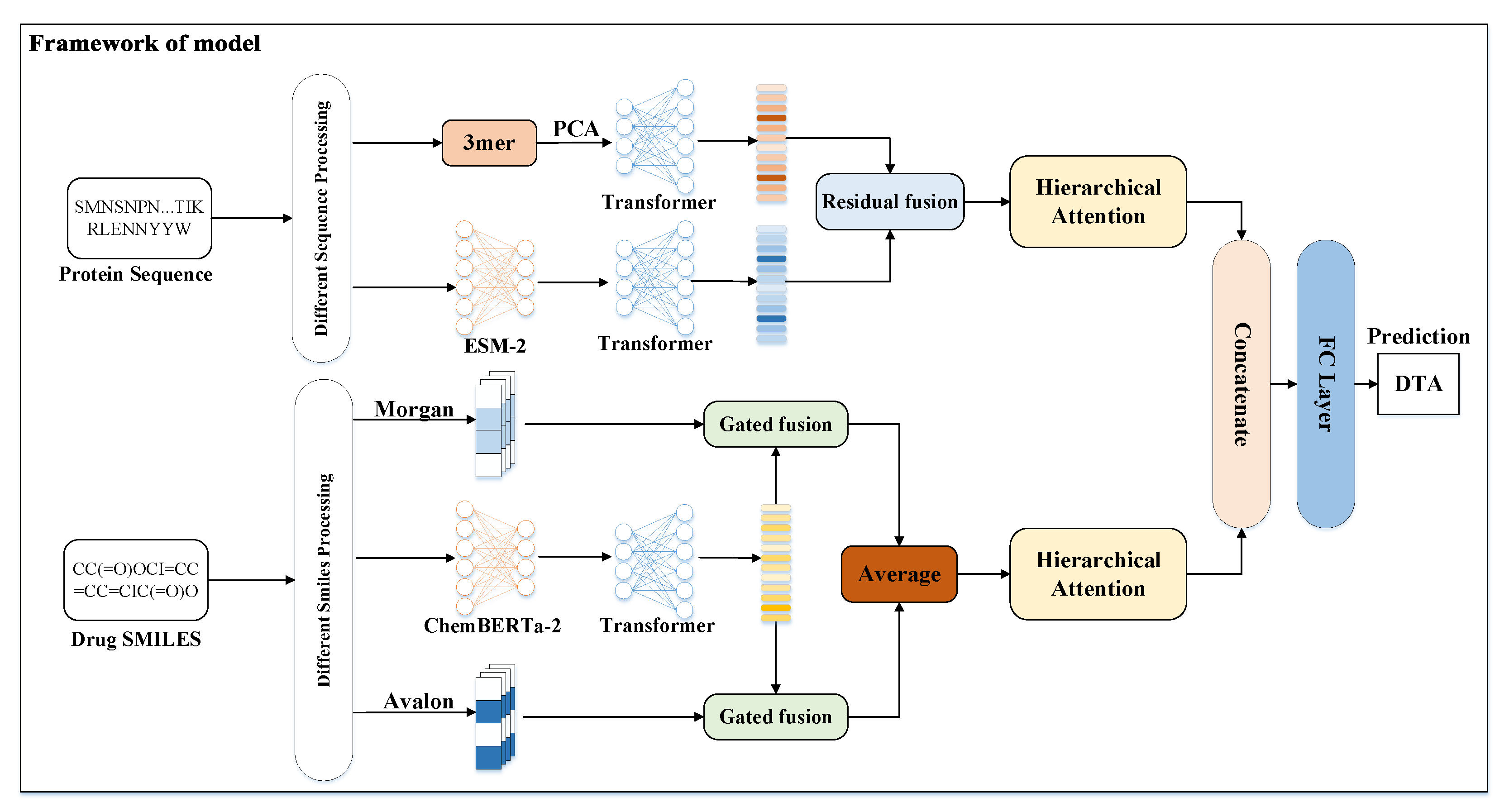
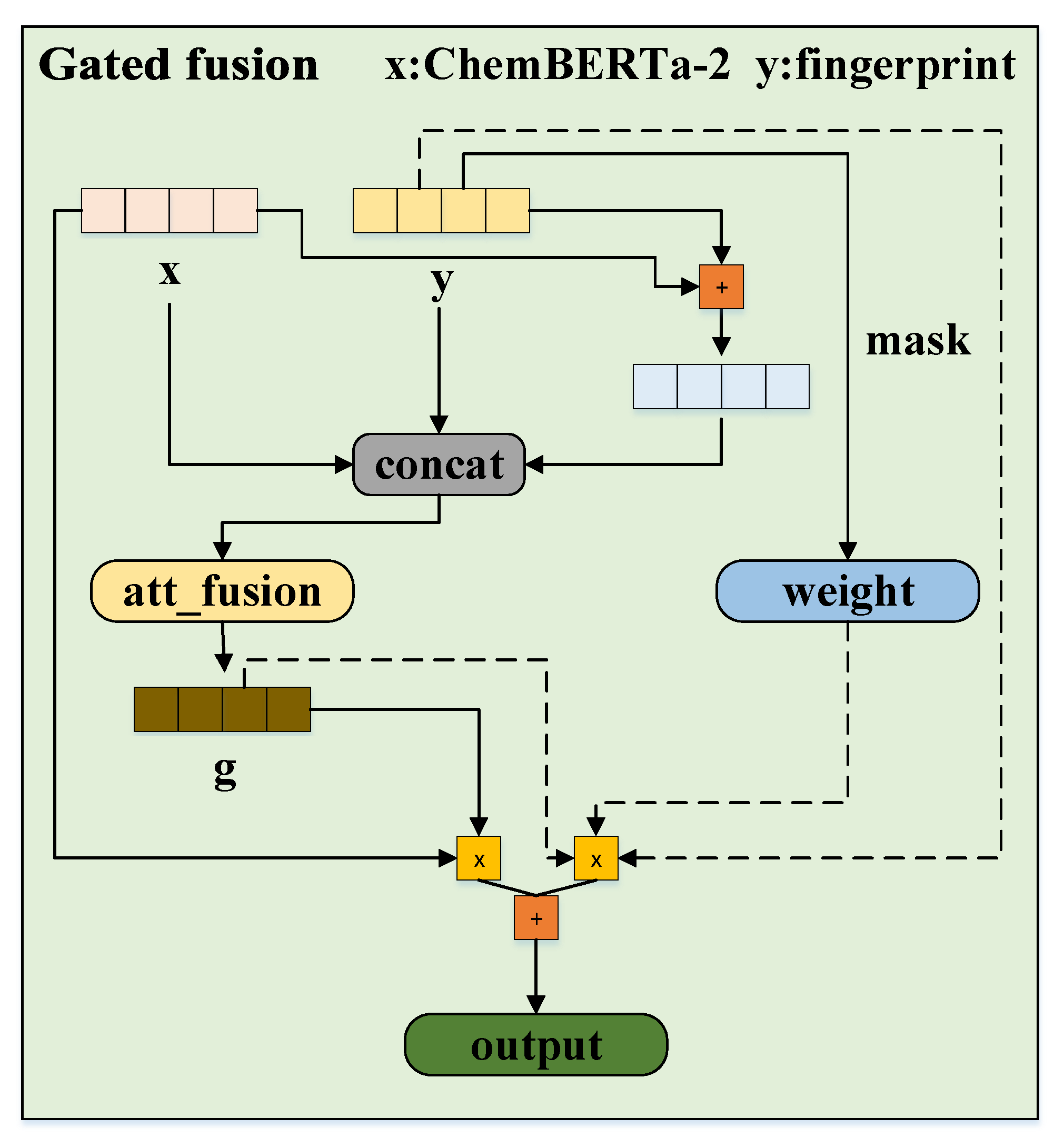
- We employ the ChemBERTa-2 model to extract deep semantic features from SMILES strings and perform gated fusion with traditional Morgan and Avalon fingerprints, thereby capturing overlooked chemical semantic information and constructing informative drug representations.
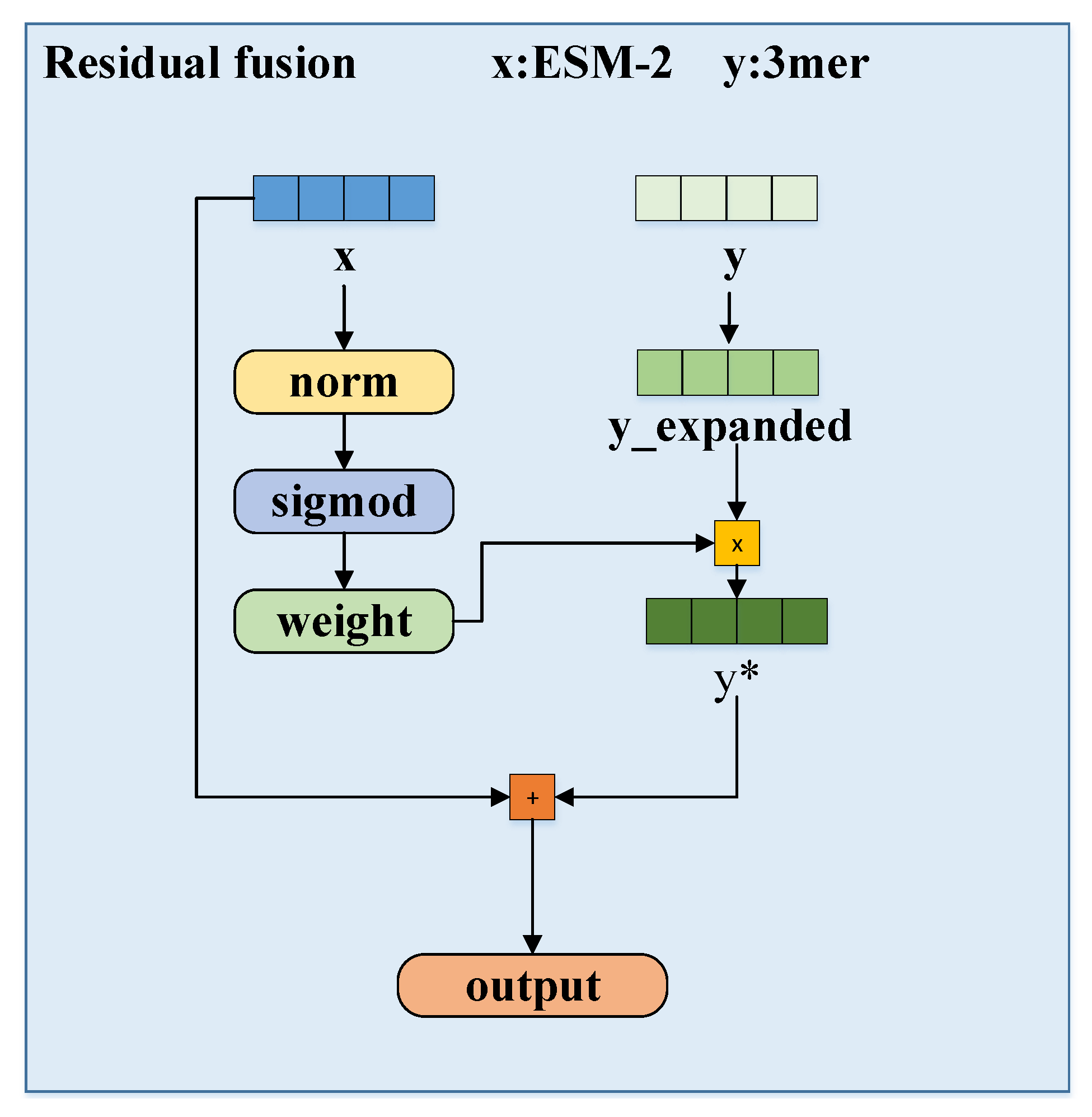
- To compensate for potential information loss caused by the sequence length limitations of the ESM-2 model, we employ a residual fusion mechanism to innovatively integrate features extracted through k-mer+PCA with ESM-2 features, thereby realizing complementarity between partial and global features.
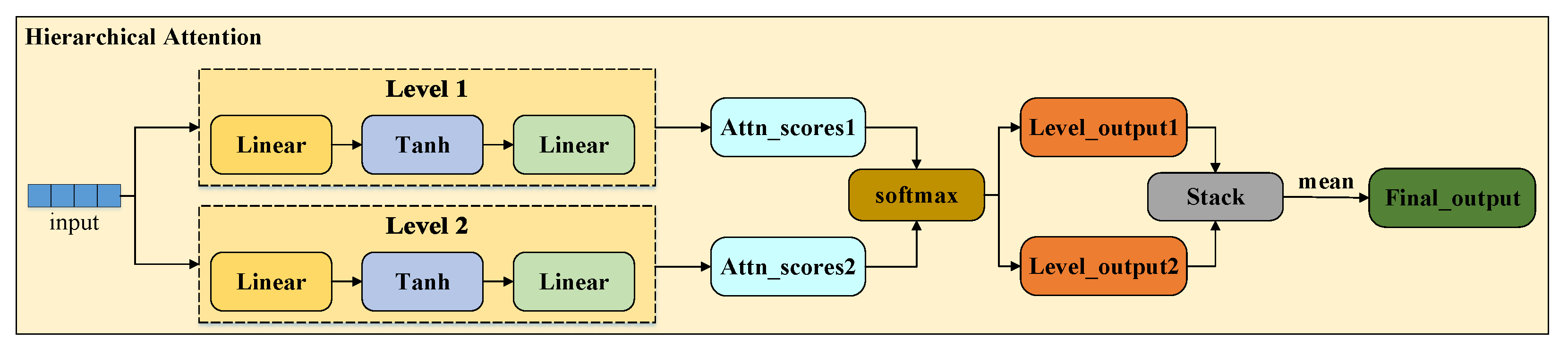
- We design a hierarchical attention mechanism that computes independent attention distributions in parallel across multiple levels, achieving multi-granularity feature extraction from both drug SMILES strings and protein sequences.
2. Results and Discussion
2.1. Multi-Modal Feature Enhancement for Drug Representation
2.2. Global–Local Feature Complementarity for Protein Representation
2.3. Hierarchical Attention Fusion for DTA Prediction
2.4. Performance Comparison Between MGF-DTA and Other Mainstream Methods
2.5. Cross-Domain Generalization Testing
2.6. Ablation Experiment
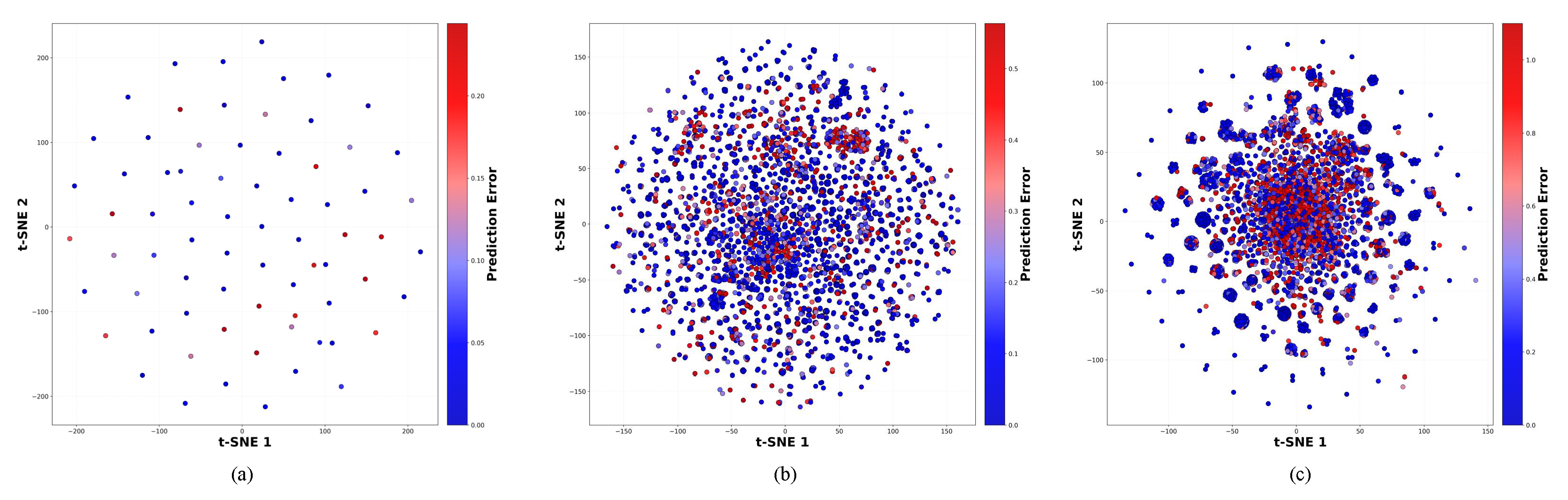
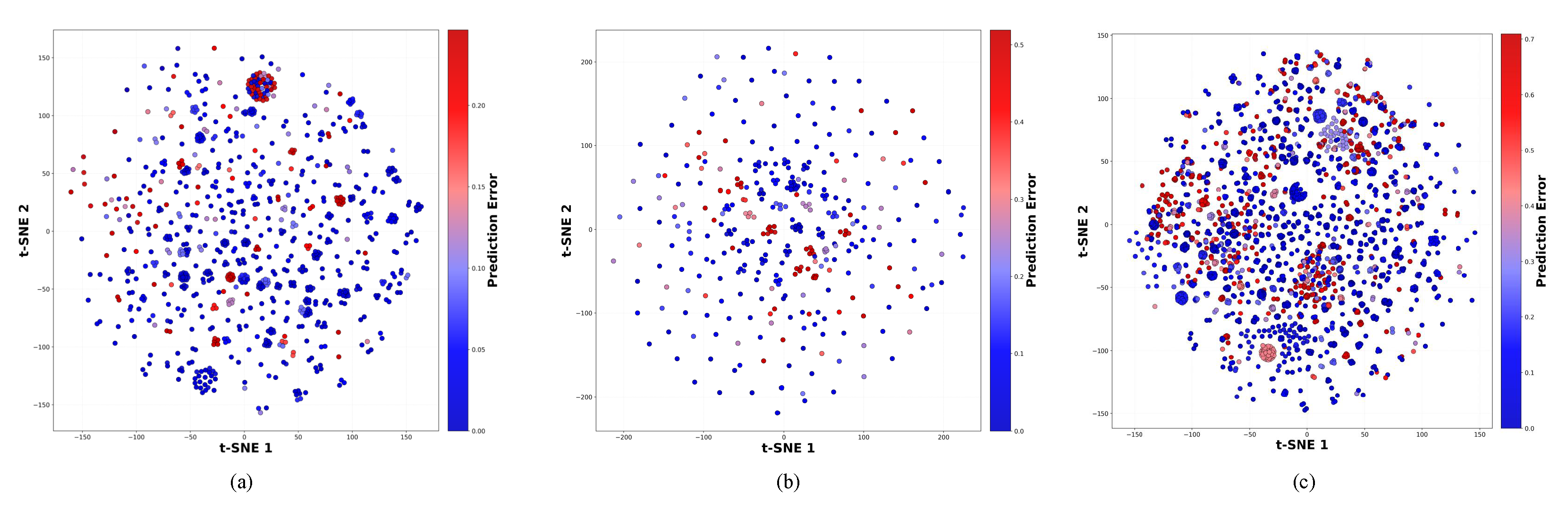
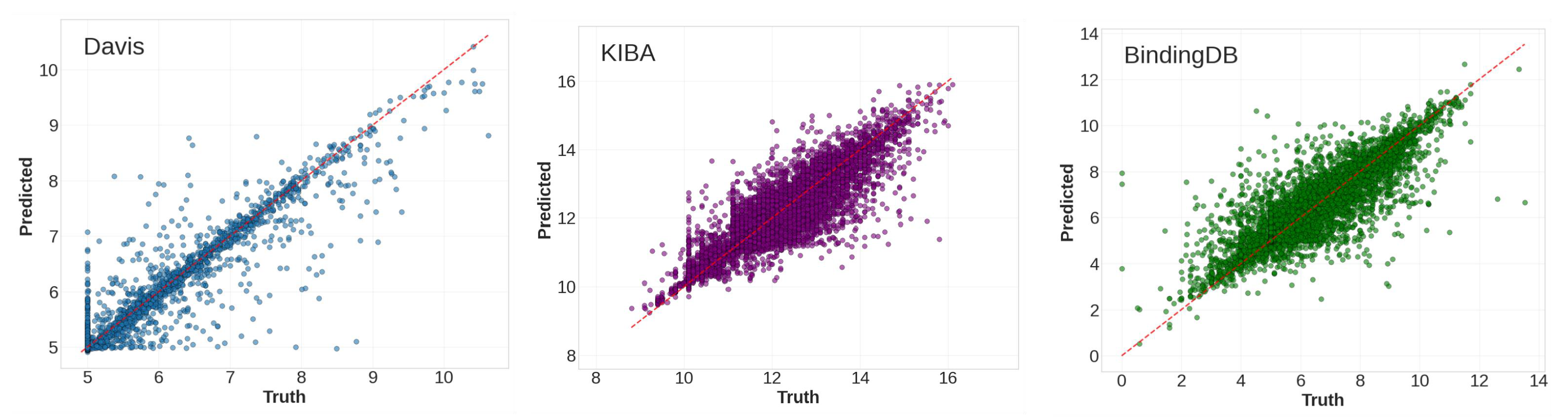
2.7. Interpretability Analysis
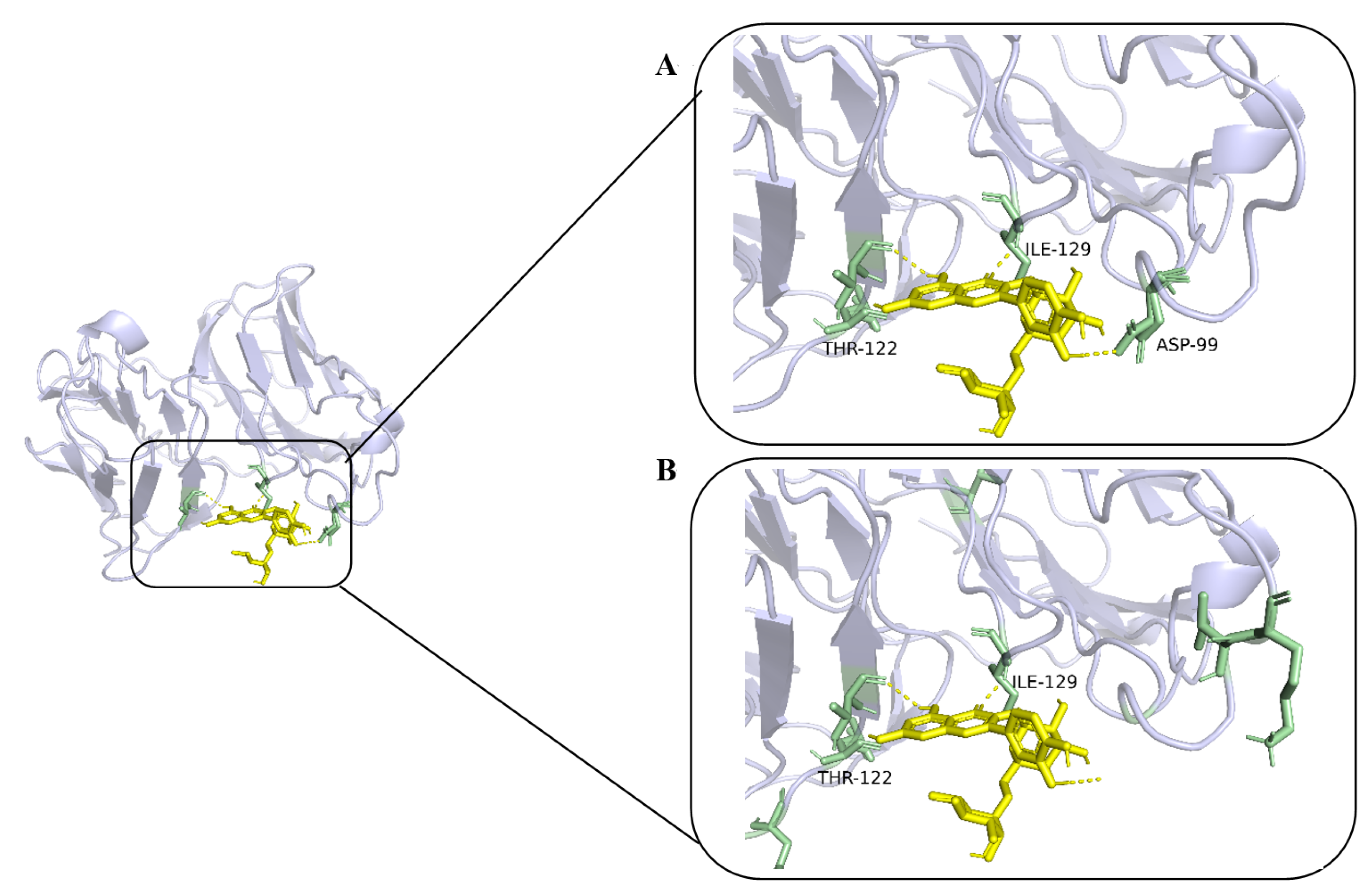
2.8. Case Study
2.9. Discussion
3. Materials and Methods
3.1. Model Architecture
3.1.1. Drug Encoding
3.1.2. Drug Feature Fusion
3.1.3. Protein Encoding
3.1.4. Protein Feature Fusion
3.1.5. Hierarchical Attention Fusion and DTA Prediction
3.2. Experiment Setting
3.3. Evaluation Metrics
4. Conclusions
Author Contributions
Funding
Institutional Review Board Statement
Informed Consent Statement
Data Availability Statement
Acknowledgments
Conflicts of Interest
References
- Chen, X.; Yan, C.C.; Zhang, X.; Zhang, X.; Dai, F.; Yin, J.; Zhang, Y. Drug–target interaction prediction: Databases, web servers and computational models. Brief. Bioinform. 2016, 17, 696–712. [Google Scholar] [CrossRef] [Scilit]
- Hopkins, A.L. Predicting promiscuity. Nature 2009, 462, 167–168. [Google Scholar] [CrossRef] [Scilit] [PubMed]
- Mohs, R.C.; Greig, N.H. Drug discovery and development: Role of basic biological research. Alzheimer’s Dementia Transl. Res. Clin. Interv. 2017, 3, 651–657. [Google Scholar] [CrossRef] [Scilit] [PubMed]
- Zeng, X.; Li, S.J.; Lv, S.Q.; Wen, M.L.; Li, Y. A comprehensive review of the recent advances on predicting drug-target affinity based on deep learning. Front. Pharmacol. 2024, 15, 1375522. [Google Scholar] [CrossRef] [Scilit] [PubMed]
- Berdigaliyev, N.; Aljofan, M. An overview of drug discovery and development. Future Med. Chem. 2020, 12, 939–947. [Google Scholar] [CrossRef] [Scilit]
- Meier-Kolthoff, J.P.; Auch, A.F.; Klenk, H.P.; Göker, M. Genome sequence-based species delimitation with confidence intervals and improved distance functions. BMC Bioinform. 2013, 14, 60. [Google Scholar] [CrossRef] [Scilit]
- Piazza, I.; Beaton, N.; Bruderer, R.; Knobloch, T.; Barbisan, C.; Chandat, L.; Sudau, A.; Siepe, I.; Rinner, O.; de Souza, N.; et al. A machine learning-based chemoproteomic approach to identify drug targets and binding sites in complex proteomes. Nat. Commun. 2020, 11, 4200. [Google Scholar] [CrossRef] [Scilit]
- Qiu, Z.; Wang, X. Improved prediction of protein ligand-binding sites using random forests. Protein Pept. Lett. 2011, 18, 1212–1218. [Google Scholar] [CrossRef] [Scilit]
- Wong, G.Y.; Leung, F.H.; Ling, S.H. Predicting protein-ligand binding site using support vector machine with protein properties. IEEE/ACM Trans. Comput. Biol. Bioinform. 2013, 10, 1517–1529. [Google Scholar] [CrossRef] [Scilit]
- Wang, W.; Li, K.; Lv, H.; Zhang, H.; Wang, S.; Huang, J. SmoPSI: Analysis and prediction of small molecule binding sites based on protein sequence information. Comput. Math. Methods Med. 2019, 2019, 1926156. [Google Scholar] [CrossRef] [Scilit]
- Zhao, Z.; Xu, Y.; Zhao, Y. Sxgbsite: Prediction of protein–ligand binding sites using sequence information and extreme gradient boosting. Genes 2019, 10, 965. [Google Scholar] [CrossRef] [Scilit]
- Wen, M.; Zhang, Z.; Niu, S.; Sha, H.; Yang, R.; Yun, Y.; Lu, H. Deep-learning-based drug–target interaction prediction. J. Proteome Res. 2017, 16, 1401–1409. [Google Scholar] [CrossRef] [Scilit]
- Öztürk, H.; Özgür, A.; Ozkirimli, E. DeepDTA: Deep drug–target binding affinity prediction. Bioinformatics 2018, 34, i821–i829. [Google Scholar] [CrossRef] [Scilit]
- Öztürk, H.; Ozkirimli, E.; Özgür, A. WideDTA: Prediction of drug-target binding affinity. arXiv 2019, arXiv:1902.04166. [Google Scholar] [CrossRef] [Scilit]
- Zhao, Q.; Duan, G.; Yang, M.; Cheng, Z.; Li, Y.; Wang, J. AttentionDTA: Drug–target binding affinity prediction by sequence-based deep learning with attention mechanism. IEEE/ACM Trans. Comput. Biol. Bioinform. 2022, 20, 852–863. [Google Scholar] [CrossRef] [Scilit] [PubMed]
- Li, W.; Zhou, Y.; Tang, X. Tf-dta: A deep learning approach using transformer encoder to predict drug-target binding affinity. In Proceedings of the 2023 IEEE International Conference on Bioinformatics and Biomedicine (BIBM), Istanbul, Turkiye, 5 December 2023; pp. 418–421. [Google Scholar] [CrossRef] [Scilit]
- Kalemati, M.; Zamani Emani, M.; Koohi, S. DCGAN-DTA: Predicting drug-target binding affinity with deep convolutional generative adversarial networks. BMC Genom. 2024, 25, 411. [Google Scholar] [CrossRef] [Scilit]
- Ouyang, X.; Feng, Y.; Cui, C.; Li, Y.; Zhang, L.; Wang, H. Improving generalizability of drug–target binding prediction by pre-trained multi-view molecular representations. Bioinformatics 2025, 41, btaf002. [Google Scholar] [CrossRef] [Scilit] [PubMed]
- Nguyen, T.; Le, H.; Quinn, T.P.; Nguyen, T.; Le, T.D.; Venkatesh, S. GraphDTA: Predicting drug–target binding affinity with graph neural networks. Bioinformatics 2021, 37, 1140–1147. [Google Scholar] [CrossRef] [Scilit]
- Yang, Z.; Zhong, W.; Zhao, L.; Chen, C.Y. MGraphDTA: Deep multiscale graph neural network for explainable drug–target binding affinity prediction. Chem. Sci. 2022, 13, 816–833. [Google Scholar] [CrossRef] [Scilit]
- Tang, W.; Zhao, Q.; Wang, J. Llmdta: Improving cold-start prediction in drug-target affinity with biological LLM. IEEE Trans. Comput. Biol. Bioinform. 2025, 22, 2398–2409. [Google Scholar] [CrossRef] [Scilit]
- Wang, X.; Xia, Z.; Feng, R.; Han, T.; Wang, H.; Yu, W.; Wang, X. SMFF-DTA: Using a sequential multi-feature fusion method with multiple attention mechanisms to predict drug-target binding affinity. BMC Biol. 2025, 23, 120. [Google Scholar] [CrossRef] [Scilit]
- Ahmad, W.; Simon, E.; Chithrananda, S.; Grand, G.; Ramsundar, B. Chemberta-2: Towards chemical foundation models. arXiv 2022, arXiv:2209.01712. [Google Scholar] [CrossRef] [Scilit]
- Lin, Z.; Akin, H.; Rao, R.; Hie, B.; Zhu, Z.; Lu, W.; Smetanin, N.; Verkuil, R.; Kabeli, O.; Shmueli, Y.; et al. Evolutionary-scale prediction of atomic-level protein structure with a language model. Science 2023, 379, 1123–1130. [Google Scholar] [CrossRef] [Scilit] [PubMed]
- Lee, C.H.; Lin, C.R.; Chen, M.S. Sliding-window filtering: An efficient algorithm for incremental mining. In Proceedings of the tenth International Conference on Information and Knowledge Management, Atlanta, GA, USA, 5 October 2001; pp. 263–270. [Google Scholar] [CrossRef] [Scilit]
- Abdi, H.; Williams, L.J. Principal component analysis. Wiley Interdiscip. Rev. Comput. Stat. 2010, 2, 433–459. [Google Scholar] [CrossRef] [Scilit]
- Curtis, A.E.; Smith, T.A.; Ziganshin, B.A.; Elefteriades, J.A. The mystery of the Z-score. Aorta 2016, 4, 124–130. [Google Scholar] [CrossRef] [Scilit]
- Davis, M.I.; Hunt, J.P.; Herrgard, S.; Ciceri, P.; Wodicka, L.M.; Pallares, G.; Hocker, M.; Treiber, D.K.; Zarrinkar, P.P. Comprehensive analysis of kinase inhibitor selectivity. Nat. Biotechnol. 2011, 29, 1046–1051. [Google Scholar] [CrossRef] [Scilit]
- Tang, J.; Szwajda, A.; Shakyawar, S.; Xu, T.; Hintsanen, P.; Wennerberg, K.; Aittokallio, T. Making sense of large-scale kinase inhibitor bioactivity data sets: A comparative and integrative analysis. J. Chem. Inf. Model. 2014, 54, 735–743. [Google Scholar] [CrossRef] [Scilit]
- Liu, T.; Lin, Y.; Wen, X.; Jorissen, R.N.; Gilson, M.K. BindingDB: A web-accessible database of experimentally determined protein–ligand binding affinities. Nucleic Acids Res. 2007, 35, D198–D201. [Google Scholar] [CrossRef] [Scilit]
- Gönen, M.; Heller, G. Concordance probability and discriminatory power in proportional hazards regression. Biometrika 2005, 92, 965–970. [Google Scholar] [CrossRef] [Scilit]



| Dataset | Feature Composition | Fusion Method | MAE ↓ | MSE ↓ | Pearson ↑ | Spearman ↑ | CI ↑ |
|---|---|---|---|---|---|---|---|
| Davis | ChemBERTa-2 | - | 0.214 | 0.192 | 0.878 | 0.699 | 0.904 |
| ChemBERTa-2 +Fingerprints | Gated fusion | 0.211 * | 0.186 * | 0.883 * | 0.706 * | 0.909 * | |
| KIBA | ChemBERTa-2 | - | 0.213 | 0.152 | 0.886 | 0.881 | 0.887 |
| ChemBERTa-2 +Fingerprints | Gated fusion | 0.199 * | 0.139 * | 0.892 * | 0.886 * | 0.894 * | |
| BindingDB | ChemBERTa-2 | - | 0.430 | 0.555 | 0.879 | 0.836 | 0.872 |
| ChemBERTa-2 +Fingerprints | Gated fusion | 0.404 * | 0.547 * | 0.880 | 0.839 * | 0.874 * |
| Dataset | Methods | MAE ↓ | MSE ↓ | Pearson ↑ | Spearman ↑ | CI ↑ |
|---|---|---|---|---|---|---|
| Davis | Concat | 0.250 a | 0.203 a | 0.870 a | 0.690 a | 0.897 a |
| Weighted Fusion | 0.211 b | 0.187 b | 0.882 b | 0.696 b | 0.903 b | |
| Cross-Attention | 0.215 c | 0.188 b | 0.880 b | 0.693 c | 0.900 c | |
| Gated Fusion (ours) | 0.211 b | 0.186 b | 0.883 b | 0.706 d | 0.909 d | |
| KIBA | Concat | 0.208 a | 0.143 a | 0.888 a | 0.883 a | 0.892 a |
| Weighted Fusion | 0.206 b | 0.143 a | 0.889 a | 0.883 a | 0.891 a | |
| Cross-Attention | 0.226 c | 0.171 b | 0.866 b | 0.863 b | 0.879 b | |
| Gated Fusion (ours) | 0.199 d | 0.139 c | 0.892 c | 0.886 c | 0.894 c | |
| BindingDB | Concat | 0.421 a | 0.552 a | 0.880 a | 0.836 a | 0.873 a |
| Weighted Fusion | 0.413 b | 0.549 b | 0.880 a | 0.837 a | 0.873 a | |
| Cross-Attention | 0.415 b | 0.551 a | 0.878 b | 0.832 b | 0.870 b | |
| Gated Fusion (ours) | 0.404 c | 0.547 c | 0.881 a | 0.839 c | 0.874 a |
| Dataset | Feature Composition | Fusion Method | MAE ↓ | MSE ↓ | Pearson ↑ | Spearman ↑ | CI ↑ |
|---|---|---|---|---|---|---|---|
| Davis | ESM-2 | - | 0.211 | 0.186 | 0.883 | 0.706 | 0.909 |
| ESM-2+k-mer | Residual fusion | 0.209 * | 0.185 | 0.883 | 0.710 * | 0.911 * | |
| KIBA | ESM-2 | - | 0.199 | 0.139 | 0.892 | 0.886 | 0.894 |
| ESM-2+k-mer | Residual fusion | 0.199 | 0.137 * | 0.893 | 0.888 * | 0.895 | |
| BindingDB | ESM-2 | - | 0.404 | 0.547 | 0.880 | 0.839 | 0.874 |
| ESM-2+k-mer | Residual fusion | 0.403 | 0.542 * | 0.883 * | 0.840 | 0.875 |
| Dataset | Methods | MAE ↓ | MSE ↓ | Pearson ↑ | Spearman ↑ | CI ↑ |
|---|---|---|---|---|---|---|
| Davis | Concat | 0.212 a | 0.184 a | 0.884 a | 0.705 a | 0.908 a |
| Bilinear Fusion | 0.239 b | 0.199 b | 0.875 b | 0.702 b | 0.906 b | |
| Weighted Fusion | 0.213 a | 0.190 c | 0.880 c | 0.688 c | 0.897 c | |
| Cross-Attention | 0.212 a | 0.206 d | 0.868 d | 0.685 d | 0.895 d | |
| Linear Attention | 0.209 c | 0.185 a | 0.883 a | 0.710 e | 0.911 e | |
| Hierarchical Attention (ours) | 0.208 c | 0.183 a | 0.884 a | 0.714 f | 0.913 f | |
| KIBA | Concat | 0.204 a | 0.138 a | 0.893 a | 0.884 a | 0.890 a |
| Bilinear Fusion | 0.311 b | 0.251 b | 0.796 b | 0.783 b | 0.825 b | |
| Weighted Fusion | 0.211 c | 0.145 c | 0.888 c | 0.882 a | 0.889 a | |
| Cross-Attention | 0.259 d | 0.178 d | 0.862 d | 0.854 c | 0.869 c | |
| Linear Attention | 0.199 e | 0.137 a | 0.893 a | 0.888 d | 0.895 d | |
| Hierarchical Attention (ours) | 0.198 e | 0.132 e | 0.898 e | 0.891 e | 0.897 e | |
| BindingDB | Concat | 0.451 a | 0.620 a | 0.867 a | 0.823 a | 0.864 a |
| Bilinear Fusion | 0.494 b | 0.730 b | 0.837 b | 0.796 b | 0.848 b | |
| Weighted Fusion | 0.450 a | 0.626 c | 0.860 c | 0.811 c | 0.857 c | |
| Cross-Attention | 0.445 c | 0.610 d | 0.868 a | 0.829 d | 0.858 c | |
| Linear Attention | 0.403 d | 0.542 e | 0.883 d | 0.840 e | 0.874 d | |
| Hierarchical Attention (ours) | 0.400 e | 0.540 f | 0.883 d | 0.841 e | 0.876 e |
| Method | Davis | KIBA | ||||
|---|---|---|---|---|---|---|
| MSE ↓ | CI ↑ | ↑ | MSE ↓ | CI ↑ | ↑ | |
| DeepDTA | 0.261 | 0.878 | 0.630 | 0.194 | 0.863 | 0.673 |
| GraphDTA | 0.241 | 0.869 | 0.632 | 0.177 | 0.868 | 0.733 |
| MGraphDTA | 0.217 | 0.879 | 0.673 | 0.148 a | 0.894 a | 0.775 a |
| AttentionDTA | 0.215 | 0.879 | 0.663 | 0.167 | 0.880 | 0.732 |
| TF-DTA | 0.231 | 0.886 | 0.670 | 0.177 | 0.877 | 0.734 |
| LLMDTA | 0.226 | 0.884 | 0.717 | 0.162 | 0.872 | 0.768 |
| SMFF-DTA | 0.206 | 0.897 | 0.733 | 0.151 | 0.894 | 0.780 |
| PMMR | 0.194 a | 0.910 a | 0.751 a | 0.163 | 0.880 | 0.764 |
| MGF-DTA (Ours) | 0.183 b | 0.913 b | 0.779 b | 0.132 b | 0.897 b | 0.784 b |
| Method | MSE ↓ | CI ↑ | ↑ |
|---|---|---|---|
| PMMR | 0.555 | 0.872 | 0.760 |
| MGF-DTA (Ours) | 0.540 * | 0.876 * | 0.765 * |
| Method | Pearson ↑ |
|---|---|
| MGF-DTA (Ours) | 0.591 a |
| OTTER-KNOWLEDGE | 0.588 b |
| ProBertMorgan | 0.538 |
| MMD | 0.433 |
| CORAL | 0.432 |
| ERM | 0.427 |
| MTL | 0.425 |
| GroupDRO | 0.384 |
| Model | A | B | C | MSE ↓ | CI ↑ | Spearman ↑ |
|---|---|---|---|---|---|---|
| Model-1 | – | – | – | 0.192 a | 0.904 a | 0.699 a |
| Model-2 | √ | – | – | 0.186 b | 0.909 b | 0.706 b |
| Model-3 | √ | √ | – | 0.185 b | 0.911 c | 0.710 c |
| Model-4 (MGF-DTA) | √ | √ | √ | 0.183 c | 0.913 d | 0.714 d |
| Metz ID | Metz Value | Predicted Value (KIBA Score) |
|---|---|---|
| PRKG1 | 8.1 | 14.28 |
| PRKAA1 | 8.0 | 13.64 |
| MINK | 7.2 | 12.77 |
| CDK2 | 7.0 | 12.57 |
| DYRK4 | 6.6 | 12.10 |
| PIM2 | 6.4 | 12.79 |
| STK6 | 6.0 | 11.66 |
| SRC | 5.8 | 11.50 |
| NTRK2 | 5.6 | 11.41 |
| CAMK2D | 5.3 | 11.28 |
| SGK | 5.1 | 11.19 |
| KIAA1811 | 5.0 | 11.17 |
| GSK3B | 4.7 | 11.25 |
| ACK1 | 4.6 | 10.53 |
| ABL1 | 4.3 | 10.51 |
Disclaimer/Publisher’s Note: The statements, opinions and data contained in all publications are solely those of the individual author(s) and contributor(s) and not of MDPI and/or the editor(s). MDPI and/or the editor(s) disclaim responsibility for any injury to people or property resulting from any ideas, methods, instructions or products referred to in the content. |
© 2026 by the authors. Licensee MDPI, Basel, Switzerland. This article is an open access article distributed under the terms and conditions of the Creative Commons Attribution (CC BY) license.
Share and Cite
Ni, Z.; Wei, B.; Zeng, Y. MGF-DTA: A Multi-Granularity Fusion Model for Drug–Target Binding Affinity Prediction. Int. J. Mol. Sci. 2026, 27, 947. https://doi.org/10.3390/ijms27020947
Ni Z, Wei B, Zeng Y. MGF-DTA: A Multi-Granularity Fusion Model for Drug–Target Binding Affinity Prediction. International Journal of Molecular Sciences. 2026; 27(2):947. https://doi.org/10.3390/ijms27020947
Chicago/Turabian StyleNi, Zheng, Bo Wei, and Yuni Zeng. 2026. "MGF-DTA: A Multi-Granularity Fusion Model for Drug–Target Binding Affinity Prediction" International Journal of Molecular Sciences 27, no. 2: 947. https://doi.org/10.3390/ijms27020947
APA StyleNi, Z., Wei, B., & Zeng, Y. (2026). MGF-DTA: A Multi-Granularity Fusion Model for Drug–Target Binding Affinity Prediction. International Journal of Molecular Sciences, 27(2), 947. https://doi.org/10.3390/ijms27020947