Review

Silver Nanoparticles in Antibacterial Research: Mechanisms, Applications, and Emerging Perspectives

1
Department of Molecular Biology and Genetics, Çanakkale Onsekiz Mart University, Çanakkale 17100, Türkiye
2
European Institute for Membranes (IEM)—UMR 5635, University of Montpellier, École Nationale Supérieure de Chimie de Montpellier (ENSCM), Centre National de la Recherche Scientifique (CNRS), 34090 Montpellier, France
*
Authors to whom correspondence should be addressed.
Int. J. Mol. Sci. 2026, 27(2), 927; https://doi.org/10.3390/ijms27020927
Submission received: 18 December 2025 / Revised: 12 January 2026 / Accepted: 14 January 2026 / Published: 16 January 2026
(This article belongs to the Special Issue Innovative Nanomaterials from Functional Molecules)

Abstract

Silver nanoparticles (AgNPs) possess distinct physicochemical characteristics and demonstrate high antibacterial potential that highlights them as promising alternatives against a wide range of pathogens. The immense antibacterial potential of AgNPs is primarily attributed to the release of silver ions that lead to the disruption of bacterial cell membrane, generation of reactive oxygen species (ROS), inhibition of protein synthesis and interference with DNA replication. Variations in AgNPs’ shape, size, and surface characteristics are also considered key factors determining their effectivity as well as specificity. AgNPs are considered potent antibacterial agents, including against antibiotic- and drug-resistant strains. However, inappropriate dosages or unoptimized application of may result in potential toxicity, consisting one of the main drawbacks of the AgNPs’ safer administration. This article reviews the recent literature on the antibacterial potential of AgNPs, focusing on their broad mechanisms of action, applicability, especially in agriculture, biomedical and environmental fields, toxicity and future perspectives.

1. Introduction

Nanoparticles (NPs) are one of the most studied nanomaterials in the field of nanotechnology, typically within the size range from 1 to 100 nm with a size scale comparable to other nanoscale materials such as nanoclusters. At this scale, NPs exhibit unique chemical, physical, and biological properties that distinguish them from bulk materials. AgNPs can be classified into different categories depending on their physicochemical characteristics, such as size, shape, and surface charge. These properties are highly dependent on the bulk material which they have synthesized, including silver, gold or carbon-based materials. Lately, NPs are extensively investigated due to these diverse features. Among them, AgNPs particularly stand out with their broad range of distinctive properties [1].
One of the significant threats to public health today is the rise in pathogens that are resistant to multiple drugs. These drug-resistant pathogens are often at the forefront of infections [2]. Currently, researchers are actively seeking for new approaches to overcome the strong resistance of these pathogens. One of these approaches include the utilization of NPs, especially the AgNPs. Numerous studies [3,4,5] have shown that AgNPs are highly effective in inhibiting multidrug-resistant bacterial pathogens. In addition, although AgNPs exhibit strong antibacterial activity on their own, they are also frequently used in combination with conventional antibiotics to restore or enhance antibiotic efficacy. Such synergistic interaction can significantly amplify the antibacterial effects of various antibiotics, resulting in improved therapeutic outcomes [6].
AgNPs can inhibit diverse pathogens with multiple mechanisms of actions, promoting their applicability in antibacterial research. Some of these mechanisms can act simultaneously, which increases the effectiveness of the antibacterial activity. AgNPs’ interaction with the bacterial cell wall consists of one of the main mechanisms of their antibacterial activity. Such interactions lead to notable structural changes on the cell wall, causing significant membrane damage [7]. Similarly, AgNPs induce high levels of ROS synthesis that is related to most of the antibacterial mechanisms. The excessive intracellular ROS levels cause high oxidative stress, damaging essential biomolecules and disrupting the composition of the bacteria [8]. Additionally, Ag+ ions released from AgNPs can penetrate the cell membrane and interact with intracellular targets, further hindering the bacteria to function [9,10]. Furthermore, interaction between AgNPs and DNA and ribosomes can damage the genetic material, preventing replication and protein synthesis which is essential to the bacteria [11]. Despite these multifunctional mechanisms, the specific mechanism behind the antibacterial activity is not precisely explained [12].
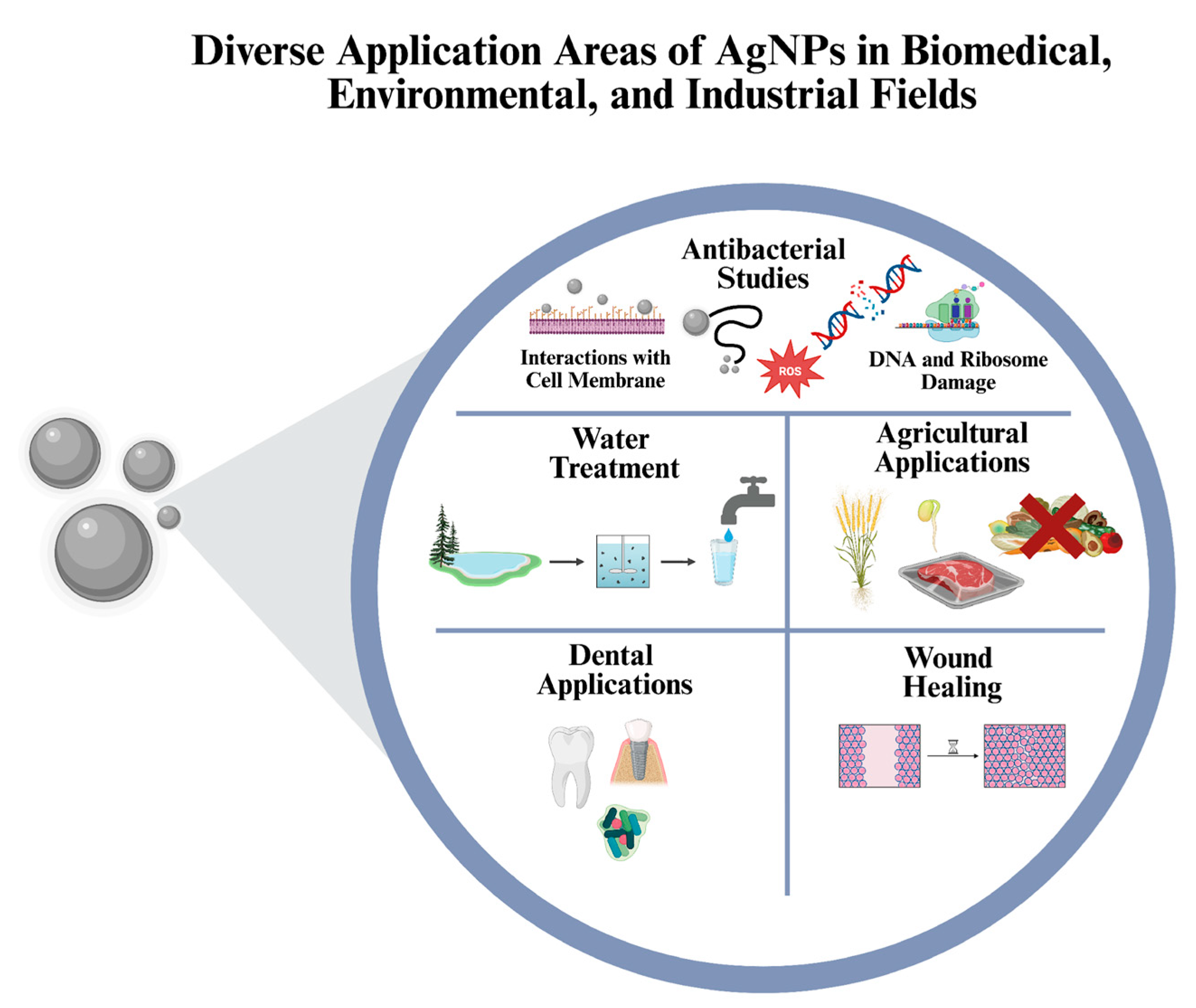
Thanks to their strong antibacterial activity, AgNPs are widely utilized in various fields [13]. Their antibacterial applications are extensive (Figure 1), and numerous studies have investigated their effects on different pathogenic microorganisms. In most of these studies [14,15,16] the synthesized AgNPs demonstrated strong antibacterial activity. For example, in agriculture, AgNPs have been shown to be effective when applied under suitable doses and conditions, promoting plant growth [17] and preventing food spoilage, decay, and discoloration when used as food coatings [18]. In the field of wound healing, various AgNP-based formulations are employed depending on wound type. Their employment has essentially increased due to their strong antibacterial effectiveness against wound-infecting bacteria. In particular, studies have reported AgNPs’ successful application in different wound types, such as burn [19] and scratch models [20] in both in vivo and in vitro settings. AgNPs have also been applied in oral health, where they help reduce bacterial populations responsible for infections, thereby supporting oral and dental hygiene [21]. The application area of AgNPs further extends to industrial aspects, in particular is water treatment, where AgNPs are used for dye degradation, pathogen removal, and overall water quality improvement [22]. To summarize, AgNPs continue to attract significant attention due to their broad-spectrum antibacterial potential and diverse applicability across both scientific and industrial areas.
Toxicity of AgNPs is considered a major drawback although they have many desirable characteristics. Synthesis method and the physicochemical properties are the main contributors of AgNPs toxicity potential. Physical, chemical, and green synthesis are the three main and most studied synthesis methods to produce AgNPs. Physical synthesis relies on top–down processes to produce NPs without the use of chemical reducing agents. Chemical synthesis utilizes chemical reducing and stabilizing agents that may lead to adverse toxic effects. Green synthesis being an environmentally friendly and sustainable approach, utilizes bioactive compounds from plants, bacteria and fungi to mediate reduction and stabilization of resulting NPs [24,25].
In this review, antibacterial applications of AgNPs, their mechanisms of action, synthesis approaches, application area from agriculture to industrial, and current toxicity concerns are evaluated. We also highlight their expanding applications in fields ranging from agriculture and food systems to biomedical and industrial sectors. Finally, we address current toxicity concerns and emerging challenges that must be resolved for safe and sustainable use of AgNP-based technologies.

2. Antibacterial Activity of Silver Nanoparticles

The antibacterial potential of silver ions has been discussed in the literature with a long history [26]. Most recently, silver ions became one of the main research topics in antibacterial research, leading to their inclusion in many studies [6]. Considering the growing potential of drug-resistant bacteria as a global health threat, the requirement for alternative resistance breaker agents becomes extremely important [27]. In this context, AgNPs are recently highlighted with their strong antibacterial activity, biofilm inhibition and effectively acting as antibiotic adjuvants [28,29]. This is why AgNPs have been featured as a promising alternative to conventional antibiotics, considering the growing threat of antibiotic resistance [30,31].

2.1. Antibacterial Mechanisms of Silver Nanoparticles

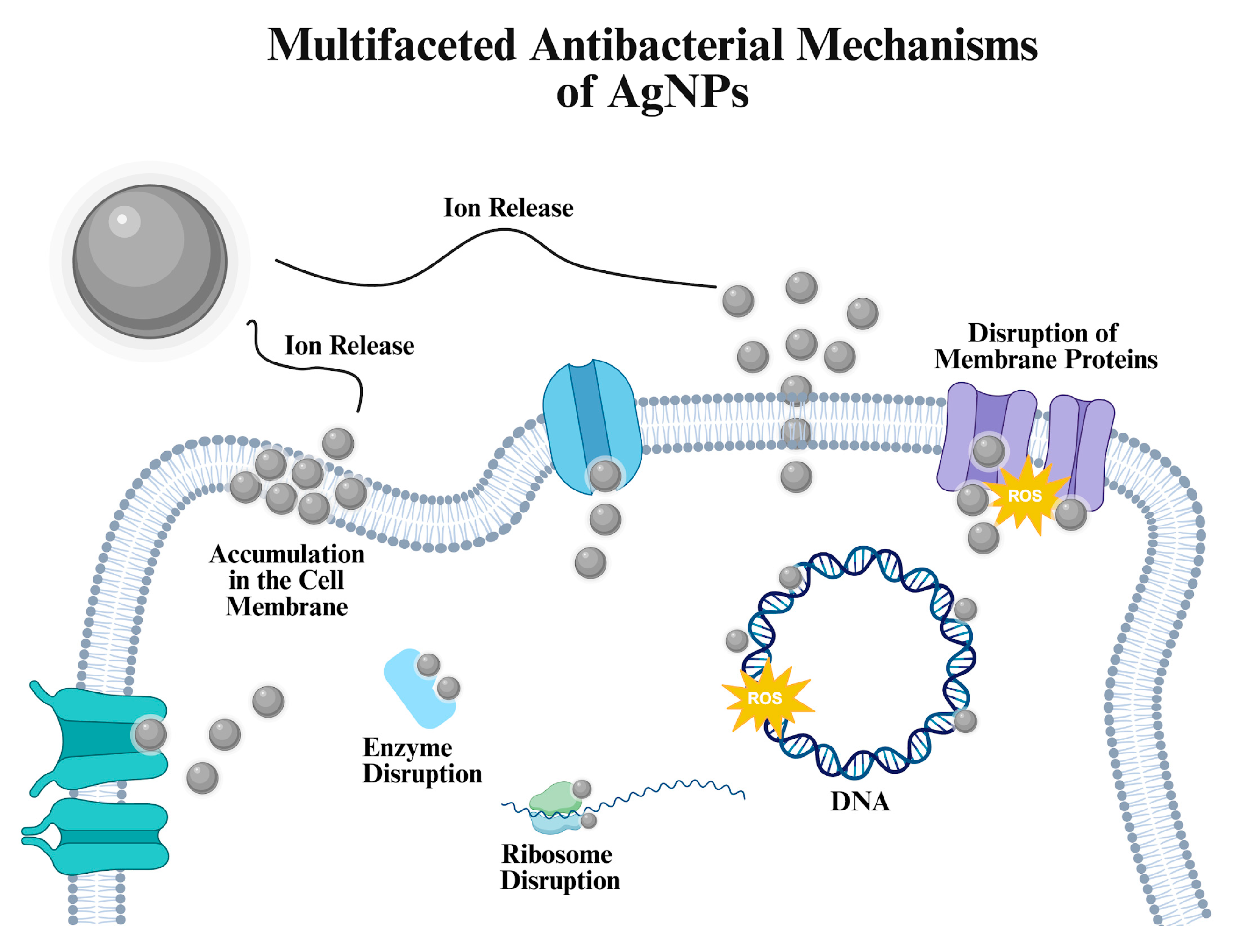
AgNPs exhibit antibacterial effects through several mechanisms that disrupt key cellular processes (Figure 2). These mechanisms may act alone or together, and are outlined in the following subsections.

2.1.1. Mechanisms of Antibacterial Action

Although AgNPs are often discussed as a single antibacterial entity, their biological activity originates from two closely related but mechanistically distinct contributors: (i) the AgNP-mediated effects and (ii) silver ions released from the AgNP surface. AgNP-specific antibacterial effects are primarily associated with direct physical interactions with the bacterial cell envelope, including membrane adsorption, surface-mediated disruption, and NP internalization. In contrast, Ag+ ions predominantly demonstrate their antibacterial activity through intracellular interactions with essential biomolecules such as proteins, DNA, and enzymatic systems, leading to impaired metabolic function and cellular homeostasis. The relative contribution of these two components depends on physicochemical properties of the AgNPs, including size, surface charge, coating, and environmental conditions.
  • Disruption of the bacterial cell membrane
The tunable surface charge of AgNPs, which plays a central role in NP-mediated membrane interactions, enables their interaction with negatively charged bacterial membranes, facilitating their antibacterial activity. As the interaction is established, AgNPs are incorporated into the membrane, increasing the permeability. Structural and morphological disruption of the membrane causing loss of functional integrity, resulting in cell death.
Structural differences between Gram-positive and Gram-negative bacteria, including a thinner peptidoglycan layer and the presence of outer membrane porins in Gram-negative strains, can influence their susceptibility to NPs. For instance, mutations affecting the major outer membrane porins in Gram-negative bacterial strains have been shown to increase resistance to AgNPs and silver ions by several-fold, suggesting that porins play an important role in NP uptake [33]. In this context, Radzig et al. reported that Escherichia coli strains lacking OmpF or OmpC porins were 4 to 8 times more resistant to AgNPs of 8.3 nm compared to wild-type cells, further supporting the role of porins in NP penetration [34].
Wang et al. [35] investigated the effect of DAMP-coupled AgNPs’ membrane distribution activity against Salmonella enterica ATCC 13311. The small-sized spherical AgNPs, produced with thiolate ligands, effectively exhibited antibacterial activity as novel bacteriostatic compounds. The AgNPs were particularly effective against planktonic S. enterica through disrupting membrane integrity, increasing membrane permeability and causing irreversible membrane damage [35].
Researchers investigated molecular interaction between the bacterial cell membrane and AgNPs. It was found that administration of AgNPs influenced the permeability of the S. enterica inner cell membrane in a dose-dependent manner, as determined by assays detecting ion leakage and cytoplasmic component release. At lower concentrations of 3.2 and 6.4 μg/mL, AgNPs caused minimal changes, while higher concentrations of 12.8 and 25.6 μg/mL resulting in significantly increased inner membrane permeability and leading to membrane depolarization, intracellular Ca2+ accumulation, and eventually bacterial cell death. In contrast, the outer membrane permeability remained largely unchanged, as confirmed by experimental measurements showing no notable change in outer membrane ion uptake [36].
  • Release of silver ions (Ag+)
Ag+ ions released from AgNPs represent an ion-driven antibacterial pathway distinct from NP-mediated mechanisms. AgNPs can interact with essential molecules such as DNA, lipids, and proteins inside the cell, which affect the systems that are crucial for cell survival. For example, AgNP-induced alterations to ribosomal components can disrupt protein synthesis and lead to irreversible cellular damage. Ag+ ions can also damage the structural integrity of cellular proteins by disrupting the disulfide bonds, leading to complete loss of their function. As proteins become misfolded or inactive key processes such as metabolism, signaling, and cellular repair are severely impaired, which reduces the cell survival rate [9].
Sorinolu et al. investigated how silver ions released from light-activated AgNPs inhibited the proliferation of antibiotic-resistant bacteria. In the study, they showed that the interaction between AgNPs and photosensitizer protoporphyrin IX (PpIX) may increase the rate of Ag+ ion release, which in turn enhances the antibacterial activity. In addition, they investigated the effect of polyethyleneimine (PEI) coating on the bactericidal activity to investigate the effect of positive charge on the AgNP surface. Three different AgNP types, PpIX-AgNPs, AgNPs, and PEI-PpIX-AgNPs were tested against methicillin-resistant Staphylococcus aureus (MRSA) and wild-type multidrug-resistant (MDR) E. coli. PpIX-AgNPs showed the highest antibacterial activity, achieving more than 7 log reductions in both MDR E. coli and MRSA counts. The significance of AgNPs in terms of bacterial log inactivations were PpIX-AgNPs > PEI-PpIX-AgNPs > AgNPs. This ranking was consistent with the measured concentrations of released Ag+ ions, confirming the importance of ion release for antibacterial efficiency [27].
  • Induction of oxidative stress
AgNPs trigger oxidative stress through combined effects of NP contact with cellular structures and the release of Ag+ ions, both of which contribute to ROS generation. Upon interacting with the bacterial membrane or penetrating into the cell, AgNPs facilitate redox reactions that produce superoxide anions and hydroxyl radicals [37,38]. Nonetheless, excessive ROS generation is a major factor contributing to the toxic effects of AgNPs. While ROS are normally maintained at controlled levels, their overproduction damages DNA, proteins and lipids, which directly contribute to bactericidal potential of AgNPs [39].
Das et al. [40] investigated the contribution of ROS to the antibacterial mechanism of AgNPs. Using Staphylococcus aureus and E. coli, they investigated how ROS generated by AgNPs influenced antibacterial activity. They have emphasized that high ROS levels from AgNP caused significant membrane damage and disruption of the electron transport chain [40]. Ali et al. [41] examined the antibacterial activity of AgNPs synthesized using aqueous extracts of Origanum vulgare (O-AgNPs), Salvia moorcroftiana (S-AgNPs), ceftriaxone (Cfx-AgNPs) to investigate ROS-based effects. The synthesized AgNPs were tested against Klebsiella pneumoniae and Pseudomonas aeruginosa, where the K. pneumoniae was found to be the most susceptible strain during the treatment. For the Cfx-AgNPs, P. aeruginosa exhibited the highest response, with a Channel S1 (ChS1) count of 56.865. These results demonstrated that Cfx-AgNPs induced the highest levels of ROS, leading to notable DNA, protein degradation and cellular damage [41].
  • Interaction with DNA and ribosomes
AgNP-mediated interference with DNA and ribosomal function occurs through a combination of direct NP-cell interactions and the activity of Ag+ ions released from their surface. Together, these contributions enable AgNPs and Ag+ ions to bind intracellular biomolecules, disrupt structural integrity, and impair normal cellular processes. AgNPs strongly interact with both DNA and proteins, binding to nucleobases such as cytosine as well as to N-terminal amines and other metal-affinity sites within the cell. In parallel, AgNPs and released Ag+ ions form strong coordination bonds with sulfur-containing residues, most notably cysteine and methionine, in proteins, which destabilizes protein structure and function and can amplify downstream cellular damage. These alterations negatively affect cellular mechanisms such as respiration and cell division that can lead to cell death. As a result, the cell suffers genotoxicity, mutation, DNA strand breaks and oxidative DNA base damage. AgNPs disrupt cellular homeostasis of E. coli through DNA damage and induced mutations in genes that are responsible for DNA repair. AgNP–protein interactions also disrupt functional capability of proteins and inactivating enzyme activity. The disruption of the 3D structure of proteins inactivates the binding sites of proteins. As a result, AgNPs can effectively restrict cellular activity by binding to and deactivating proteins [42].
A comprehensive study investigated the interaction between DNA and green-synthesized AgNPs using Helianthemum lippii extracts [43]. The results showed that negative free binding energy was associated with the increased DNA binding, causing spontaneous interactions. The electrostatic interaction with the ligands is an important factor that contributes to the DNA degradation. These mechanisms highlight the therapeutic potential of AgNPs against infectious diseases and conditions involving uncontrolled cell growth, including cancer.

2.1.2. Synergistic Antibacterial Activity with Antibiotics

AgNPs stand out with their ability to inhibit proliferation of multidrug-resistant (MDR) strains [44]. Apart from their sole administration, AgNPs can be combined with antibiotics to obtain enhanced bactericidal effects, where they can improve the efficiency of antibiotics [45]. The potential of antibiotics is affected by proper dosing. Their insufficient or excessive administration contributes to MDR. In this manner, AgNP enhances antibiotic effectiveness by allowing utilization of lower and safer therapeutic doses against MDR bacteria [46].
A recent study highlighted the synergistic antibacterial effect of AgNPs with antibiotics. The study was conducted using several different bacterial species. When AgNPs (100 μg per disc) were applied in combination with colistin (10 μg per disc), the inhibition zones were measured as 20.27 ± 0.58 mm for Acinetobacter baumannii, 34.94 ± 0.39 mm for E. coli, 27.18 ± 0.42 mm for K. pneumoniae and 19.16 ± 0.53 mm for P. aeruginosa. However, treatment with colistin alone produced inhibition zones of 13.89 ± 0.52 mm, 25.18 ± 0.26 mm, 20.52 ± 0.48 mm, and 16.43 ± 0.18 mm for A. baumannii, E. coli, K. pneumoniae and P. aeruginosa, respectively. When working together, colistin reduces the permeability of the cell membrane. AgNPs then easily pass through the cell membrane and cause the cell membrane to break down. AgNPs that reach the inside of the cell cause ROS production by damaging the cell’s DNA, facilitated by colistin. This ultimately leads to cell death. These findings demonstrate the enhanced antibacterial activity of combined colistin and AgNPs [47]. Shahverdi et al. [48] tested 14 different antibiotics to assess their effectiveness against E. coli and S. aureus in combination with polydisperse AgNPs. The antibacterial tests revealed that most notable increases in antibacterial activity were observed for vancomycin, amoxicillin, and penicillin G. It was found that penicillin G alone had no inhibitory effect against S. aureus, whereas its combination with AgNPs produced a 12 mm zone of inhibition. Similarly, vancomycin alone had no inhibitory effect against S. aureus, but when combined with AgNPs, the zone of inhibition was 13 mm. The most significant increase was observed for amoxicillin, where the inhibition zone expanded from 7.5 mm when used alone to 14.0 mm when combined with AgNPs. This article does not explain exactly how the antibacterial mechanism works. It also adds that this is worth researching [48]. Together, these results show that the synergistic activity of AgNPs with antibiotics is not limited to a single drug or organism. While the first study demonstrated improved inhibition across multiple Gram-negative pathogens using colistin, the second showed that AgNPs can enhance the effectiveness of several different antibiotics, even restoring activity to drugs that are normally ineffective against resistant strains
Similarly, Lee and colleagues investigated the combined antibacterial effects of various antibiotics (aminoglycoside, streptomycin, gentamicin, tobramycin, kanamycin) combined with AgNPs, demonstrating their combined efficacy against pathogenic E. coli. Comparison of minimum inhibitory concentration (MIC) and minimum bactericidal concentration (MBC) values revealed that AgNP-antibiotic combinations increased antibacterial effects. Furthermore, the AgNP–tobramycin combination achieved the highest biofilm inhibition rate of 19.87% among the antibiotics tested. In this study, antibiotics with synergistic effects with AgNPs cause the death of microorganisms by weakening the cell membrane, disrupting DNA and protein synthesis, and silencing resistance-related genes. The study concluded that the combination of aminoglycosides and AgNPs increases antibacterial potential [49]. Smekalova et al. investigated the synergistic effect of AgNPs and antibiotics, penicillin G, colistin, amoxycillin and gentamicin, against several animal pathogens including S. enterica, E. coli, S. aureus, Streptococcus uberis, Pasteurella multocida, and Actinobacillus pleuropneumoniae [50]. Researchers identified 7 synergistic, 17 additive and 16 indifferent effects in the tested AgNP–antibiotic combinations, with no antagonistic effects observed. Among these combinations, AgNP–gentamicin had the majority of synergistic effects, while the strongest synergistic effect observed against A. pleuropneumoniae by 6.3 µg/mL AgNP−8 nm and 2 µg/mL penicillin G combination, with a fractional inhibitory concentration (FIC) index of 0.3. Additionally, the combined AgNP treatments restored susceptibility in A. pleuropneumoniae and P. multocida, which were originally resistant to gentamicin, amoxycillin, and colistin. From another perspective, Adil et al. [51] synthesized antibiotic-supplemented AgNPs in a 1:1 molar ratio, utilizing cephalosporin class antibiotics including cefepime, ceftazidime, ceftriaxone and cefotaxime. Results highlighted enhanced antibacterial activity against K. pneumoniae, P. aeruginosa, S. aureus, and Enterococcus faecalis by AgNP–antibiotic conjugates, in comparison to antibiotics or AgNPs alone, with the exception of the cefepime–AgNPs. The authors attributed these enhanced antibacterial effects to the antibiotic coating that surrounds AgNPs, which increases local antibiotic concentration at the target side [51]. Collectively, these studies further expand evidence for AgNP–antibiotic synergy across a wide range of drug classes and bacterial targets. While aminoglycoside combinations were shown to enhance antibacterial and antibiofilm activity primarily against E. coli, broader studies demonstrated synergistic or additive effects across multiple clinically relevant pathogens, including S. enterica, S. aureus, and P. multocida. Notably, no antagonism was reported, and in several cases susceptibility was restored in strains previously resistant to conventional antibiotics. In addition, approaches using direct antibiotics–AgNP conjugates have shown that surface-bound antibiotics can improve local drug delivery and enhance bacterial killing compared with either agent alone. Together, these findings support AgNP–antibiotic combinations as a promising strategy for improving antimicrobial efficacy and overcoming resistance.

2.2. Effect of Physicochemical Properties of AgNPs in Antibacterial Activity

AgNPs exhibit outstanding physicochemical properties, such as size, high surface area-to-volume ratio and notable electrical, thermal, and optical conductivity. They also display considerable diversity depending on their synthesis methods, experimental conditions and structural characteristics [23]. Particle size influences the physicochemical characteristics of AgNPs and their biological interaction capability. Furthermore, it can play an important role in their toxicity potential, since larger particles are known with lowered cytotoxicity potential as a result of their smaller relative surface area. Even though small-sized AgNPs exhibit higher toxicity potential with potent reactivity, they also show the most efficient antibacterial activity and biofilm inhibition, as they can efficiently penetrate cells. The bactericidal activity of AgNPs is highly affected by their morphology, including their interaction with cellular structures. Depending on the particle’s surface charge, the antibacterial efficiency is also influenced since their interaction with bacterial cell membranes is mediated by electrostatic interactions. Moreover, tunable surface chemistry of AgNPs can be manipulated to enhance the antibacterial activity, improving stability and antibacterial potency [6].
  • Effect of Size on Antibacterial Activity
The relationship between the particle size and the antibacterial potential of AgNPs are thoroughly discussed [52]. Depending on the size, AgNPs can penetrate the bacterial cells efficiently, thus facilitating their intracellular antibacterial mechanisms.
Wu et al. [53] synthesized AgNPs with different sizes (2, 12 and 32 nm), testing against E. coli and S. aureus. Results highlighted that small-sized AgNPs demonstrated higher antibacterial activity with lower MIC values and larger inhibition zones [53]. Similarly, Ershov et al. [54] demonstrated the enhanced biocidal activity of small-sized AgNPs. The MIC and IC50 values were approximately 1.3 × 10⁻⁴ M and 6.5 × 10⁻⁶ M for 22.7 nm particles, and 0.6 × 10⁻⁴ M and 3.0 × 10⁻⁶ M for 10.8 nm particles, respectively. Half-maximal inhibitory concentration (IC50) values were similar and related to the particle size. Results suggested that smaller particles equipped with a greater reactive surface area, enhancing antibacterial activity [54].
  • Effect of Shape on Antibacterial Activity
In addition to size, the morphology of AgNPs also has a significant impact on their antibacterial potential [6]. NPs can adopt various shapes, including spherical, rod, triangular, cubic and star-like forms, depending on the synthesis method [55]. The interaction between the bacterial cell membrane and the NP is influenced by the shape, which can enhance or reduce overall antibacterial effectiveness [6]. Shape also affects the release of ions from NPs, further contributing to antibacterial activity [56]. Among these shapes, spherical NPs are particularly advantageous due to their higher surface area-to-volume ratio compared to other types of NPs [55]. Overall, the morphology of AgNPs determines their mode of action on bacterial cells and positions them as versatile and widely used antibacterial agents [6].
In a study on this subject, antibacterial activity of AgNPs of different shapes, spherical (AgNSs), triangular plate (AgNTs) and disc (AgNDs) were investigated against E. coli, S. aureus, and P. aeruginosa. The AgNPs showing the largest zone of inhibition against E. coli was AgNSs with 4.8 mm, while AgNDs and AgNTs showed weaker effects. Based on their antibacterial effects, the ranking was as follows: AgNSs demonstrated the highest activity, AgNDs showed moderate activity and AgNTs had the weakest effect. [57]. Similarly, Helmlinger et al. [58] investigated the effect of NP shape on antibacterial activity. They synthesized AgNPs with uniform shape and size, including nanospheres (40–70 nm and 120–180 nm in diameter), nanoplatelets (20–60 nm), nanocubes (140–180 nm) and nanorods (80–120 nm in diameter). The antibacterial activity was further evaluated against S. aureus via MBC measurements. Among various morphologies, nanoplatelets demonstrated the strongest antibacterial activity. These results indicate that the antibacterial potential of AgNPs is greatly affected by their morphology, including their dissolution rate and surface Ag+ ions [58]. From another perspective, Parit et al. [59] tested the antibacterial potential of green-synthesized AgNPs with various morphologies, including spherical, hexagonal and triangular. These AgNPs, which come in a wide variety of shapes, have shown strong antibacterial effects against the bacterial strains used in the study [59]. Hong et al. [60] examined how the shapes of AgNPs affect antibacterial activity. They used specifically nanocubes, nanospheres, and nanowires AgNPs. According to this study, the first factor to consider is the effective surface area. Accordingly, nanowires establish the weakest contact with cells due to their one-dimensional nature and low specific surface area. This results in low antibacterial activity. In contrast, nanocubes showed higher efficiency. Experiments revealed that at a concentration of 12.5 µg/mL, nanocubes delayed bacterial growth for up to 7 h, while no such effect was observed with nanowires or nanospheres. This study demonstrates that the shapes of AgNPs play a significant role in their antibacterial effect [60]. Acharya et al. [61] examined the antibacterial effects of spherical, rod-shaped, triangular, and hexagonal AgNPs. The most fundamental result of this study shows that spherical AgNPs have the highest antibacterial activity and the fastest killing rate compared to other shapes. In the experiments, spherical AgNPs were tested on K. pneumoniae bacteria. According to the results obtained, a mortality rate of 76% or higher was observed within 240 min. This rate remained at 23% for rod-shaped AgNPs, 15% for hexagonal AgNPs, and 15% for triangular AgNPs. The article also states that this high effect stems from the release rate of Ag ions in spherical AgNPs. The highest release rate is 34 µg/mL in spherical shapes. This also shows us the importance of Ag ion release along with shape [61]. These studies highlight that AgNP antibacterial activity varies widely with particle morphology. Spherical, disc-shaped, nanocube, and platelet-like AgNPs consistently demonstrate stronger inhibition than rods, wires, or triangular structures, likely due to greater surface contact and higher Ag+ ion release. Green-synthesized AgNPs with varied geometries also exhibit notable activity, reinforcing that surface area and exposed crystal facets strongly influence bacterial killing. Overall, morphology serves as a key determinant in optimizing AgNP antibacterial performance.
  • Effect of Zeta Potential and Colloidal Stability on Antibacterial Activity
The colloidal stability and antibacterial activity of AgNPs are related to the surface charge and zeta potential of the particles. Research indicates that a zeta potential value greater than +30 mV or less than −30 mV increases particle stability. This stability prevents agglomeration. Accordingly, AgNPs with zeta potentials within this range exhibit higher antibacterial effects. The effect of zeta potential on antibacterial activity has been investigated in the literature [62].
A study by Salazar-Bryam et al. [63] describes the effect of pH changes during synthesis on AgNPs. According to this study, the stability of AgNPs was analyzed using zeta potential. An increase in pH from 5 to 9 during synthesis resulted in an increase in zeta potential (from −29.86 mV to −40.33 mV). Furthermore, more stable AgNPs were obtained at higher pH values. As a result of this stability, the more stable AgNPs exhibit a strong synergistic antibacterial effect with rhamnolipids [63]. Rónavári et al. [64] examined the behavior of AgNPs coated with polyvinylpyrrolidone (PVP) under various conditions in their studies. One of the important findings of this article is that the PVP coating provided steric stabilization to the AgNPs. As a result of this stabilization, they were found to be more resistant to biological agglomeration compared to electrostatic stabilization. In addition, the chemical stability of the particles was also examined. The formation of silver chloride (AgCl) precipitates in the presence of chloride ions (Cl) was investigated. Although colloidal protection is provided, complete chemical protection has not been achieved [64]. In another study conducted by MacCuspie et al., they investigated how the physicochemical properties of AgNPs affect colloidal stability under relevant conditions [65]. They examined the stabilization provided to AgNPs by coating materials such as citrate, bovine serum albumin, and starch, which are surface coating agents for AgNPs. Although citrate coatings provide electrostatic stabilization, they become ineffective in the face of high ionic strength. The particles lose their effect by being grounded. Steric stabilization is provided in bovine serum albumin coating. With this coating, particles can remain individual and active for up to 64 h in various environments. In addition, the increased surface area compared to bulk silver, combined with natural solubility, has affected antimicrobial activity. This increase in surface area leads to greater ROS production and DNA damage in bacteria. These coatings give AgNPs powerful antibacterial properties.
  • Effect of Surface Chemistry and Capping Agents on Antibacterial Activity
Silveria et al. [66] synthesized AgNPs from the Ilex paraguariensis plant. By examining the physicochemical properties of these synthesized AgNPs, they focused on their antibacterial effect [66]. One of the results obtained in this study was obtained through FT-IR analysis. According to these results, functional groups such as polyphenols in the plant extract reduced the Ag+. This reduction resulted in the formation of a protective coating around these particles. Thanks to this coating, the particles became more stable. The antibacterial activity of these stable AgNPs was tested on E. coli and S. aureus bacterial strains. The results showed that inhibition was achieved even at high concentrations. Sinclair et al. focused on the antibacterial effect of the surface chemistry of AgNPs in their study [67]. Various coating materials were used in this study. The first of these materials is positively charged branched polyethyleneimine (BPEI). AgNPs coated with BPEI showed the highest effect on MS2 bacteriophages. This is due to the electrostatic attraction caused by the negative surface of these bacteriophages and the positive charge on the surface of AgNPs. AgNPs were also coated with substances that can create a strong negative surface, such as citrate and mercaptoacetic acid (MAA). As a result, there was more interaction with positively charged microorganisms. Since these coatings will come into direct contact with the target organism, there is an increase in antibacterial and biological activity.
  • Effect of Surface Charge and Functionalization on Antibacterial Activity
Surface charge is essential for NPs to attach to and interact with bacterial cell membranes. It plays a critical role in determining how NPs engage with bacterial membranes and proteins. Surface charge is typically measured using zeta potential, and whether the charge is positive or negative significantly influences AgNPs’ interactions [68].
Gulami et al. [69] were able to synthesize a positively charged silver nanocomplex for chlorhexidine (CHX) using ionic liquids in their study. The nanocomplex produced in this study can deliver the antibacterial agent in a synergistic manner. This synthesized positively charged silver nanocomplex (AgNPs+) and CHX-loaded positively charged AgNPs (CHX@AgNPs) were synthesized and characterized by various means. They found the zeta potentials of AgNPs+ and CHXAgNPs+ to be +18 mV and +56 mV, respectively. To summarize, they observed that the MBC and MIC values were lower than those of AgNPs+ and CHX alone. With this result, they concluded that it could be a potential root canal disinfectant. However, they stated that more ex vivo studies are needed to fully incorporate this antibacterial agent into our lives [69]. In another study, five types of AgNP colloids with identical sizes and shapes but different surface ligands were synthesized, resulting in zeta potentials ranging from −47.6 mV to +68.5 mV. Later, AgNPs were tested against various Gram-positive and Gram-negative bacterial species, including S. aureus, E. faecalis, E. coli, P. aeruginosa, A. baumannii, and K. pneumoniae. Results revealed that AgNPs with intermediate charges (−21.5 mV and +14.9 mV) exhibited stronger antibacterial activity than those with extreme positive or negative charges. Additionally, Gram-positive bacteria were more sensitive to higher positively charged AgNPs, whereas Gram-negative bacteria were more sensitive to higher negatively charged AgNPs [70].
Surface functionalization involves attaching organic or inorganic biomolecules to AgNP surfaces through covalent or non-covalent interactions. Such functionalized NPs, characterized by improved stability and performance, have been widely employed in antibacterial applications [71].
Owing to their high surface area, AgNPs provide a major advantage for tunable surface functionalization and can interact with diverse organic molecules and biomolecules. As an example, AgNPs can form strong Ag-S linkages with amino acids, peptides, and proteins, while also engaging with functional groups containing nitrogen and oxygen. Moreover, AgNPs can bind into the organic compounds containing functional groups such as phenol, carbonyl and hydroxyl, increasing their antibacterial potential [72].
As an example, Khan et al. [73] compared the antibacterial efficiency of AgNPs with and without functionalization using polyethylene glycol (PEG). Three different PEG molecular weights (750, 2000, and 5000) were used for surface coating, referred to as P750-, P2000-, and P5000-AgNP, respectively. These NPs were tested for bactericidal activity against S. aureus. Findings revealed PEG-functionalized AgNPs’ stronger antibacterial activity compared to non-functionalized AgNPs. P5000-AgNPs achieved an inhibition zone of 29 mm, compared to 22 mm for bare NPs. It was also reported that smaller-sized AgNPs combined with higher molecular weight PEGs were more effective in inhibiting the proliferation of S. aureus [73]. In another study, Veena et al. [74] functionalized AgNPs with 4-amino-3,5-dimercapto-1,2,4-triazole (DMT) to enhance intracellular uptake and biocompatibility. The functionalized AgNPs showed strong antibacterial activity against both Gram positive and Gram-negative bacteria strains. In addition, researchers also investigated the anticancer potential of DMT-AgNPs, revealing the cell cycle arrest and apoptosis in MCF-7 cancer cells in a dose-dependent manner (IC50 value of 18.46% v/v). Overall, DMT functionalization enhanced the antibacterial potential of AgNPs, along with their anticancer activity [74]. Shumi et al. [75] synthesized AgNPs functionalized with the amino acid histidine (AgNP-His) and phenylalanine (AgNP-Phen) using Lippia abyssinica leaf extracts through a green synthesis approach. Both types of AgNPs exhibited antibacterial activity against E. coli and S. aureus, with inhibition zones of 8.67 ± 1.25 mm and 11.00 ± 0.82 mm for AgNP-His, and 8.33 ± 0.47 mm and 8.33 ± 1.25 mm for AgNP-Phen at a concentration of 62.5 μg/mL, respectively. Overall, the study indicated that amino acid functionalization may represent a promising strategy for developing novel antibacterial agents [75].

2.3. Fundamental In Vitro Studies

Numerous studies in the literature have investigated the in vitro antibacterial effects of AgNPs. These studies generally evaluate the effects of AgNPs on bacterial species using various experimental parameters. Examples of these parameters include MIC and MBC values. These values provide clear evidence of whether AgNPs act as strong antibacterial agents.
Yusuf-Salihu et al. [76] conducted a comprehensive study investigating the antibacterial activity of AgNPs synthesized from empty fruit bunches (EFB) waste. The researchers applied a green synthesis approach, converting EFB waste into high-value AgNPs, combining waste valorization with NP production Their antibacterial, antioxidant, antidiabetic, anticoagulant, and thrombolytic activities were investigated, marking the first reported successful biosynthesis of AgNPs from EFB. The NP formed ranged in diameter from 12.78 to 19.10 nm. These NPs exhibited notable dose-dependent activity against several bacteria species: E. coli, Klebsiella oxytoca, S. aureus, Proteus mirabilis, and P. aeruginosa, with inhibition rates between 40% and 80%. They also achieved 100% inhibition against Aspergillus niger, Aspergillus fumigatus, and Aspergillus flavus. The study also showed that the NPs induced oxidative stress through ROS generation. In later stages of the study, antioxidant capacity of AgNPs was also examined. Overall, high-value EFB-based AgNPs were successfully synthesized, offering both waste valorization and effective antibacterial activity [76]. Koçer et al. [77] synthesized AgNPs using macroalgae and evaluated their antifungal and antibacterial activities. The synthesis was carried out using green methods with extracts from Ulva lactuca and Halopteris scoparia. In terms of antibacterial activity, inhibition zones of 10–15 mm in diameter were observed. The antifungal activity of these macroalgae-derived AgNPs was also examined and found to be comparable to their antibacterial activity. With this study, it has been seen that macroalgae-based green synthesized. The findings demonstrate that macroalgae-based green-synthesized AgNPs exhibit strong antibacterial activity and offer an environmentally friendly alternative to chemically and physically produced NPs [77].
Kavin et al. [78] synthesized AgNPs using Coffea arabica husks and investigated their enhanced antibacterial and anticancer activities. The synthesized NPs exhibited spherical morphology with an average size of 147 nm were obtained. When tested against P. aeruginosa, Bacillus subtilis, E. coli, and S. aureus, the inhibition zones measured 8.2, 5.3, 4.0, and 3.8 mm, respectively. For Gram-positive S. aureus and B. subtilis, the MBC and MIC values were 1.5 and 0.75 mg/mL, respectively. For Gram-negative P. aeruginosa, the MBC was 0.75 mg/mL and the MIC was 0.37 mg/mL. Based on this result, AgNPs synthesized from the Coffea arabica plant were considered important agents for antibacterial activity. The study also demonstrated that these AgNPs exhibited cytotoxic effects against MCF-7 cancer cells [78]. Similarly, Yazdi et al. [79] conducted a comprehensive study using AgNPs synthesized from Lentinus tigrinus mushrooms and examined the synergistic antibacterial effects in combination with the acetone extract of L. tigrinus. AgNPs were 5 to 25 nm in size and had spherical morphology. Bare NPs were only able to inhibit proliferation of P. aeruginosa below concentration of 1 mg/mL. When combined with acetone extracts, AgNP–extract combination at a concentration of 0.5 mg/mL had increased inhibition of 380% against S. aureus, 306% against E. coli and 900% against Bacillus cereus in compared to bare AgNPs [79]. Das et al. [80] investigated the bactericidal potential of AgNPs green-synthesized from Trema orientalis extracts. NPs had a size range between 14.04 and 34.38 nm and were spherical in shape. AgNPs had a MIC value of 55.31 µg/mL against S. aureus, along with Inhibition zones of 9, 10, 13 and 14 mm at 25, 50, 75, and 100 µg/mL [80].
Overall, these in vitro studies provide the necessary scientific understanding of how AgNPs act against bacteria under controlled laboratory conditions. Through determination of MIC and MBC values and showing how different bacteria respond in AgNP treatment, these results contribute to the explanation of how in what degree AgNPs can be effective as antibacterial agents. Based on this foundation, the next section focuses on how AgNPs are applied in wide-ranging antibacterial fields.

3. Antibacterial Applications of Silver Nanoparticles

AgNPs have been primarily applied in antibacterial treatments, agriculture, wound healing, dentistry, and wastewater treatment, arising from their strong antibacterial action. Continued research on AgNPs is essential to advance these fields, with a strong emphasis on developing NPs that can be efficiently integrated into commercial and practical applications (Table 1).

3.1. Agricultural Applications of AgNPs

AgNPs are recognized as sustainable alternatives to conventional pesticides due to their strong antimicrobial activity, surface reactivity and multiple modes of action. Yet, conventional chemical synthesis relies on chemicals with dangerous potential to the environment, making AgNPs less suitable for agricultural applications. Green synthesis routes reveal high potential to reduce the environmental impact of chemically synthesized AgNPs. This enables suitable implementation of AgNPs that target plant pathogens. Food packaging is another application where AgNPs’ immense antibacterial characteristics can be exploited through their integration into agriculture and food systems. In this way, AgNPs ability to support more resilient and sustainable production and reduce pesticide dependence presents a promising strategy [105].
AgNP and sweet potato anthocyanin (PSPA) loaded Chitosan/polyvinyl alcohol films were developed by Wu et al. [106] to investigate their ability on strawberry preservation. Incorporation of AgNPs with PSPA improved the functional, barrier and physical properties of the film. Strawberries coated with PVA/CS-AgNPs-PSPA10 film remained visibly intact for up to 13 days of storage, which is attributed to AgNPs’ antibacterial activity where they effectively inhibited bacterial growth. In contrast, uncoated strawberries showed visible spoilage after 2 days, whereas those coated with only PVA/CS or wrapped in regular stretch film exhibited spoilage after 5 days. As a result, the composite film effectively preserved fruit freshness, reduced bacterial growth and delayed spoilage [106]. Rutkowski et al. [107] investigated the antibacterial activity of AgNPs with sodium alginate hydrogels on red cabbage seedlings, revealing their effect on plant performance. Hydrogels containing AgNPs were tested against several bacterial strains and their effect on seedling growth were determined. AgNP concentrations of 20 and 60 mg/L showed no phytotoxic effects or negative impact on seedling development, while exhibiting potent antibacterial activity. Moreover, while carotenoid levels in the control group increased by 0.107 ± 0.009 mg/g FW, the AgNP-treated group showed a significantly higher increase of 0.134 ± 0.004 mg/g FW. As a result, AgNP–alginate composites exhibited strong antibacterial activity without reducing the plant quality [107]. Together, these findings show that AgNP-based materials can protect crops and fresh produce by inhibiting microbial spoilage, extending shelf life, and improving plant performance without causing harmful effects
Exposure to AgNPs may lead to triggering of physiological responses linked with improved tolerance to drought and enhanced photosynthesis. In this manner Ding et al. [108] utilized AgNPs to increase drought resistance in wheat plants. Results showed ROS generated by AgNPs induced mild stress in the plant, enabling the preparation of its defense system to effectively respond following stress conditions. Low concentration of AgNPs (1 mg/L) had no adverse effects while phytotoxic responses were observed at higher levels of administration (5 and 10 mg/L). Treatment also led to a measurable increase in yield-related traits such as grain weight and number by 12%. The study also showed that AgNPs did not accumulate in plant tissues, further supporting their potential safe use [108]. AgNP–spirulina extract formulations were developed by Elbanna et al. [109] as an eco-friendly nanofertilizer. Formulations containing different concentrations of AgNPs, 50, 100 and 150 mg/L positively affected height, growth and number of leaves of French basil. However, the highest concentration of AgNPs led to accumulation of malondialdehyde, an indicator of oxidative stress. The synergistic application reduced the ROS-related damage by activating the plant’s antioxidant defense system, thus antioxidant enzyme activation suppressed the excessive ROS levels. The highest yield and positive effect were observed at the concentration where spirulina extract and AgNPs were synergistically present, specifically at 100 mg/L AgNP + 1.5 g/L spirulina extract. These findings suggest that synergistic application of AgNPs were more effective than sole application, enhancing basil quality and yield. The mitigated oxidative damage and maintained antibacterial activity highlight the potential of the combination as a nanofertilizer [109]. Aguirre-Noyola et al. [110] cultivated strawberries in vitro to evaluate the effects of green-synthesized AgNPs on plant development. Green synthesized AgNPs were applied in vitro to assess their impact on photosynthetic pigment production and growth parameters, along with the shoot height, leaf number, and total chlorophyll content. The average number of shoots in the control group was determined as 1.50 ± 0.23, while there was a notable change with AgNP treatment in a dose-dependent manner. AgNP treatment with 100 mg/L concentration nearly doubled the number of shoots to 3.08 ± 0.64. However, increased concentrations to 300 mg/L inversely affected the number of shoots, showing a dramatic reduction to an average of 2.00 ± 0.24. Total chlorophyll levels were also evaluated, reaching the highest value at approximately 0.3 mg/g FW at 300 mg/L AgNPs [110]. These findings indicate that AgNPs can promote crop vigor by enhancing stress responses, shoot formation, and pigment production, but that their benefits depend on careful dose control to avoid oxidative damage and growth inhibition.

3.2. Biomedical and Healthcare Applications of AgNPs

3.2.1. Wound Healing Applications of AgNPs

One of the key objectives in wound management is to ensure rapid and efficient healing while minimizing bacterial contamination. In parallel, use of AgNPs as alternatives to traditional treatments has notably increased due to their promising antibacterial potential. With their strong antibacterial activity and ability to support tissue regeneration, AgNP-based dressings have become widely utilized in current wound care strategies [111,112]. However, potential cytotoxic effects of AgNPs must be considered, as they have limited their therapeutic applications in some cases [30].
Aldakheel et al. [113] developed an AgNP-based hydrogel, aimed to prevent the spread of infection, and accelerate healing by preventing traditional wound dressings, such as poor barrier function and adherence to the wound. AgNPs were synthesized using matcha green tea extract (Camellia sinensis) as a green catalyst, further incorporated into chitosan and alginate matrices to produce hydrogels with strong antibacterial properties. Their antimicrobial activity was evaluated through inhibition zone assays against three bacterial and two fungal strains. The AgNP-containing hydrogels exhibited superior water retention, maintained wound moisture and effectively absorbed wound exudate, in comparison to their counterparts containing only chitosan or alginate [113]. Moayedi et al. [114] developed nanofibrous burn dressings composed of polylactic acid (PLA), curcumin (Cur), and AgNPs with different formulations (PLA, PLA + Cur, PLA + Cur + 1% AgNP, PLA + Cur + 2% AgNP, and PLA + Cur + 3% AgNP) and evaluated their wound healing efficacy. PLA + Cur + 3% AgNP showed highest curcumin release while PLA+Cur+2% AgNP formulation had the least. The PLA + Cur dressing led to 84.06% destruction of bacteria, while PLA + Cur + 3% AgNP formulation achieved 99.12%. These confirmed the strong antibacterial potential of AgNPs [114]. Sharma et al. [115] demonstrated the wound healing potential of green synthesized AgNPs incorporated to 0.5% Carbopol hydrogel. The AgNP–hydrogel was tested in excision wound models, demonstrating efficient wound closure rates. In vivo assays on Wistar rats further revealed that hair follicle regrowth and enhanced skin regeneration were greatly increased by the AgNP hydrogel compared to the control group [115]. These findings confirm that AgNP-loaded dressings offer both antibacterial action and accelerated wound closure, supporting their promise for clinical wound management
Bacterial biofilm formation is another major factor that hinders the healing rate of wounds. Gangwar et al. [116] conducted a comprehensive study, evaluating the antibacterial and wound healing effects of green synthesized AgNPs. Antibacterial activity was investigated using zone inhibition and MTT assays against E. coli and S. aureus. Green-synthesized AgNPs were prepared by reacting an optimized and constant concentration of AgNO3 (0.2 M) with Aloe vera extracts at varying concentrations (125, 250, 375, and 500 mg/mL), where A. vera acted as the reducing and stabilizing agent. Zone inhibition results confirmed that the AgNPs were effective against both strains, with highest antibacterial activity in the group containing 0.2 M AgNO3 + 500 mg/mL A. vera. Wound-healing effects were further evaluated using a scratch assay on mouse fibroblast cells. As a result, AgNP treatment significantly enhanced fibroblast migration and scratch closure, leading to improved wound repair [116]. In vitro and In vivo wound healing efficiency of AgNPs investigated by Baveloni et al. [117] MIC values of 6.74 μg/mL against S. aureus and P. aeruginosa and 58.5 μg/mL against E. coli were indicated through in vitro assays. Further in vivo studies revealed AgNPs’ efficiency in controlling the microbial growth in wounds infected with S. aureus on Wistar rats. These highlighted the potential utilization of AgNPs in treating infections and wound healing studies due to their strong antibacterial potential [117]. Results from in vitro scratch assays and in vivo infection models suggest that AgNPs can accelerate tissue regeneration while suppressing pathogenic bacteria, positioning them as promising candidates for wound-care therapies.

3.2.2. Dental and Oral Healthcare Applications of AgNPs

AgNPs are highly promising for inhibiting microbial colonization, reducing implant-related infections and limiting multidrug-resistant bacterial growth [118]. Still, dose of administration is essential for safety and efficacy, since excessive amounts can cause cytotoxicity and limit clinical applicability [119].
Téllez Girón et al. [120] investigated the anti-caries and anti-adhesive properties of green synthesized AgNPs. The antibacterial activity was evaluated through measurement of acid production and bacterial adhesion of S. mutans and Lactobacillus acidophilus. The MIC and MBC values for S. mutans were 6.68 and 13.17 μg/mL, while the values were 3.34 and 3.34 μg/mL for L. acidophilus, respectively. In adhesion tests, fluoride varnish applied with AgNPs and exhibited potent inhibition of bacterial adhesion. The combination also reduced bacterial adhesion and acid production associated with the tooth decay. These results highlight that AgNPs effectively demonstrate synergistic antibacterial activity against key cariogenic bacteria as an alternative to conventional dental caries prevention strategies [120]. Kamel et al. [121] conducted an in vivo study evaluating the antibacterial and regenerative effects of AgNPs on dental pulp. Three experimental groups were designed for the research: group 1 was treated with a resin composite containing 1% (w/w) AgNPs, group 2 received mineral trioxide aggregate (MTA) and control group was treated with conventional resin. Histomorphometric analysis showed an inflammatory cell area of 43.93 ± 1.87% in the control group, which decreased to 20.12 ± 1.20% in Group 2 and 14.7 ± 1.07% in the AgNP group. AgNP treatment did not induce any necrosis and managed reparative dentin formation in continuous [121]. Synergistic employment of AgNPs with polymethyl methacrylate (PMMA) for dental applications were investigated by Ayuso et al. [122] PMMA nanocomposites were incorporated with green-synthesized AgNPs to improve bactericidal potential. PMMA formulation containing 10 mg/mL AgNPs achieved decreased biofilm adhesion of 18.2 ± 2.8% compared to sole PMMA formulation having 91.6 ± 4.7%. For Opti-Cryl PMMA, biofilm adhesion decreased from 49.5 ± 3.3% to 16.7 ± 2.4% following incorporation of AgNPs at a concentration of 5 mg/mL.The toxicity potential of the nanocomposite was also investigated. Nearly 80% cell viability was maintained in PMMA containing AgNPs at 10 mg/mL, indicating biocompatibility and low toxicity of the nanocomposite [122]. The evidence demonstrates that AgNP incorporation into dental formulations can inhibit cariogenic pathogens, improve biofilm resistance, and support tissue repair, highlighting their potential use across preventive, restorative, and regenerative dentistry
Beyond conventional dental materials and restorative approaches, AgNPs have also been investigated in broader oral healthcare settings. Recent studies have explored alternative delivery methods and biological strategies for preventing oral infections and controlling pathogenic biofilms. Praharsha et al. [123] developed an approach by coating bacteriophages with AgNPs. Antibacterial activity was evaluated using two oral pathogens, S. mutans and Porphyromonas gingivalis. The inhibition zone was measured as 14.50 mm for S. mutans and 16.83 mm for P. gingivalis. The positively charged AgNPs exhibited strong electrostatic adhesion to the negatively charged phages. Cytotoxicity testing on human gingival fibroblasts revealed 91% cell viability at 0.05% AgNPs after 24, 48, and 72 h, showing low cytotoxicity [123]. In another study, Tomiyama et al. assessed the effects of an AgNP-containing mouthrinse (NS-mouthrinse) on polymicrobial oral biofilms [124]. NS-mouthrinse significantly reduced bacterial cell viability and inhibited bacterial regrowth, as shown by a marked decrease in colony-forming units (CFU/mL) both immediately after treatment and following 48 h of regrowth. These findings indicated antimicrobial efficacy comparable to or greater than that of chlorhexidine gluconate, which is a commonly used oral antiseptic. In addition, the NS-mouthrinse reduced lactic acid production within the biofilm, reflecting reduced bacterial metabolic activity.

3.2.3. Medical Device and Implant Coating Applications of AgNPs

AgNPs are used as coatings on the surfaces of medical devices and implants. This coating enhances the usability of the device and implant. In addition, it strengthens these devices from an antibacterial perspective [125].
Kim et al. tested the antibacterial effect of AgNPs in implantable medical devices. They synthesized AgNPs on polydimethylsiloxane, which is used in implantable medical devices [126]. The Ag+ obtained from AgNPs through oxidation had a destructive effect on bacteria. They damaged metabolic activities by producing ROS in bacterial cells. In addition, these ions threaten the life of the cell by binding to proteins in the cell. According to the results obtained in this effective study, the coating was found to be highly effective against both E. coli and S. aureus strains. Also, Ag+ obtained from AgNPs show high antibacterial activity, especially in implants that can be placed inside the body. De Giglio et al. are investigating the effect of AgNPs on titanium implant coatings [127]. AgNPs have multiple important effects on implants. AgNPs significantly reduce bacterial growth and biofilm formation on device surfaces. In addition, they increase the effect by reducing toxicity in this area during drug administration. In antibacterial effect tests, AgNPs have largely stopped the growth of multiple bacterial species. It is important that AgNPs, along with these implants, are compatible with the body. In this case, the effect of AgNPs within the body was also examined. As a result, thanks to the carefully adjusted amount of Ag+, it has become a center of benefit rather than harm. In the tests conducted, although AgNPs exerted some pressure on human osteoblast-like (bone) cells (MG63) in the first 24–48 h, it was observed that the cells regained their viability and exceeded 60% after 7 days. In short, this coating acts as a strong antibacterial barrier. Zhang et al. investigated the effect of AgNPs/Polytetrafluoroethylene (PTFE) hybrid coating on the surface of metallic implants [128]. The coating was formed layer by layer by depositing a polydopamine (PDA) substrate layer onto stainless steel, followed by a sol–gel matrix containing PTFE, and finally AgNPs. The importance of AgNPs in this coating is that they cause bacterial cell death by releasing Ag+. The biofilm-inhibiting effect of AgNPs has also been proven by reducing the adhesion of E. coli bacteria to the implant surface by 50–80%. In addition, this hybrid coating has reduced the corrosion current density by approximately tenfold. Therefore, the implant has become more resistant inside the body. Furthermore, its cytotoxicity was found to be high based on experiments conducted on mice. The study results have once again proven that AgNPs can have a strong coating structure and an effective antibacterial mechanism.
Overall, the evidence indicates that AgNP-based surface coatings provide dual benefits for medical implants: strong antibacterial activity through Ag ion release and ROS generation, and improved material durability and corrosion resistance. Importantly, these effects can be achieved with minimal long-term cytotoxicity when Ag levels are properly controlled.

3.2.4. Systemic and Topical Anti-Infective Therapies

AgNPs can be used as a powerful and versatile tool against infectious diseases. They are effective against bacteria, fungi, and viruses. They have multiple modes of attack. They disrupt the bacterial cell wall and membrane integrity and destroy essential enzymes. In addition, they cause DNA and protein damage by generating ROS. They can also inhibit biofilm formation [129]. There are studies in the literature on the use of AgNPs as anti-infective tools. The study by Chhibber et al. [130] describes the topical application of AgNPs to burn wounds using a special carrier system called an emulgel. According to this study, they tested the use of histidine-coated AgNPs (H-AgNPs) to treat burn wound infections caused by K. pneumoniae bacteria. The efficacy of AgNPs as a topical anti-infective has been demonstrated in vivo and in vitro. This H-AgNPs emulgel application completely cleared the infection within 14 days. AgNPs also significantly reduced inflammatory markers in the body. Furthermore, no irritation was observed after 7 days of use on the skin. At the same time, antibacterial tests showed that the bacterial load in mice treated with H-AgNPs decreased by approximately 1000 times compared to those not treated with H-AgNPs. This study shows us that AgNPs can be highly active antibacterial agents in topical applications [130]. Shao et al. [131] examine the topical antibacterial efficacy and effects on wound healing of adding AgNPs to chitosan-based membranes. The study emphasizes that AgNPs play a critical role in preventing microbial infection in medical devices such as wound dressings and reducing dressing change frequency by slowly releasing Ag+ ions. Both in vitro and in vivo experiments have demonstrated that AgNPs provide strong antibacterial protection. However, due to the barrier formed by proteins in biological fluids, high AgNP loading is required to achieve real success in tissues. Consequently, this system can topically control infection without harming the wound healing process and tissue response [131]. In another study, Du et al. [132] tested the effect of AgNPs on sepsis, a systemic infection caused by the E. coli CQ10 strain, using mouse models. The AgNPs used in the study were coated with mice serum protein (MS-AgNPs). These applied mice serum made the AgNPs more resistant than AgNPs coated with PVP. Significant success was also observed in the treatment of sepsis. These MS-AgNPs reduced the mortality rate in mice infected with multidrug-resistant bacteria from 70% to 25%. This success was not observed with PVP-coated AgNPs. MS-AgNPs reduced the bacterial load in the blood and liver by approximately 100-fold within the first 8 h after infection. Based on this result, we can say that the spread of infection was prevented. These in vivo tests also showed no signs of serious toxicity in the liver and kidney functions of the mice. Ultimately, with the right coating, AgNPs can be both powerful antibacterial agents and effective against systemic infections such as sepsis [132].

3.2.5. Diagnostic and Therapeutic Synergies

AgNPs offer diagnostic signal generation and traceability capabilities in addition to their potent antibacterial therapeutic effects, based on their optical and surface properties. The combination of these features creates a functional synergy between diagnostic and therapeutic processes, enabling real-time monitoring of treatment efficacy in infected areas [133].
Kim et al. [134] describe a hybrid NP system created by coating the surface of gold nanorods (AuNR) with a thin silver layer as a theranostic platform that combines the diagnostic and antibacterial functions of AgNPs. The silver coating initially suppresses the photoacoustic (PA) signal by masking the plasmonic properties of the gold core, but this coating eventually disappears as the silver layer oxidatively dissolves and releases Ag+ ions, allowing the PA signal of the gold core to appear again. The intensity of the recovered PA signal through this coating-dissolution process was found to be directly related to the amount of Ag+ ions released (R2 = 0.93–0.96), enabling real-time, non-invasive monitoring of the antibacterial dose at the infection site. As a result of the triggered Ag+ release, more than 99.99% of MRSA and E. coli bacteria were eliminated, and in the in vivo MRSA infection model, the bacterial load decreased by 1000-fold, accompanied by a 730% increase in the PA signal. These findings reveal that the silver coating is not only an antibacterial ion source but also a critical structural component that enables the controlled activation of the diagnostic signal [134]. Jain et al. [135] investigated the therapeutic antibacterial activity of AgNPs. The main objective of this study was to develop an S-gel formulation, a topical gel, for use in conditions such as burn and wound treatment. In the antibacterial studies conducted, AgNPs were effective against many bacterial strains tested. In addition, the success of the S-gel formulation, which is a hydrophilic gel, is highlighted. This gel was compared to a commercially available 1% silver sulfadiazine (SSD) cream. As a result of this comparison, it showed similar antibacterial effects despite containing 30 times less silver than SSD. They exhibited strong inhibition even after short-term interaction with bacteria. Accordingly, 10.5 h of inhibition was observed for P. aeruginosa. Testing a gel to be used therapeutically in vivo is also of vital importance. Accordingly, the safety of S-gel was tested by performing acute dermal toxicity tests on rats. According to the results, no adverse skin reactions were observed. Thus, AgNPs are potent agents that can be used therapeutically and as antibacterial agents [135].
AgNPs are effective in drug delivery systems. There are several studies in the literature.
A study conducted by Masri et al. [136] examined the importance of AgNPs in drug delivery and their effect on antibacterial activity. According to this study, Cephradine, an antibiotic, and Vildagliptin, an antidiabetic drug, were conjugated with AgNPs. The conjugation rate was determined to be 52% for Ceph-AgNPs and 62% for Vgt-AgNPs. Antibacterial tests also demonstrated that these conjugated drugs exhibited higher antibacterial activity than the drugs alone. For example, in E. coli K1 bacteria, the use of Vgt-AgNPs reduced the bacterial count from 7.3 × 10⁷ to 5.4 × 10⁵ CFU. The antibacterial transport mechanism of these drugs is thought to be due to AgNPs attaching to the bacterial wall and penetrating the cell, thereby directly transporting the loaded drugs to the target bacteria. This comprehensive study demonstrates the effectiveness of AgNPs in drug transport and their antibacterial power [136]. Another study by Steckiewicz et al. [137] examined the role of AgNPs in the delivery of certain drugs effective in oral health and their antibacterial effect. According to this study, drugs such as CHX and metronidazole (MET) were delivered to the target area thanks to AgNPs. Two different delivery methods were used in this study. CHX was bound directly to the surface of AgNPs and transported. However, MET molecules were attached to the surface of AgNPs via linkers. Subsequently, the antibacterial efficacy of these conjugates against pathogens in the mouth was examined. Antibacterial tests showed that the combination of these drugs and AgNPs had a stronger antibacterial effect on some bacteria associated with periodontitis. MET alone required a concentration of more than 32 µg/mL to be effective against most bacteria. However, when bound to AgNPs, this concentration dropped to 2–16 µg/mL. This suggests that the delivery of drugs using AgNPs may enhance both the antibacterial activity and the activity of the drugs themselves [137]. In another study, Reddy et al. [138] evaluated the drug delivery properties and antibacterial efficacy of poly(acrylamide/sodium alginate)-based hydrogel composites (PASA/C30B/Ag) containing AgNPs and Cloisite−30B (C30B) clay were evaluated together. The addition of AgNP and clay altered the network structure of the hydrogel, reducing drug loading efficiency but still providing rapid delivery. Antibacterial tests showed that the AgNP-containing composites were significantly effective against both Streptococcus faecalis and E. coli. Specifically, the sample containing pure silver exhibited the strongest antibacterial effect with low MIC values. MIC values are 1.62 µg/mL for S. faecalis and 1.14 µg/mL for E. coli. Although a slight decrease in antibacterial activity was observed with increasing clay content due to partial coverage of the silver surface, all AgNP-containing systems are still much more effective than pure hydrogels. Overall, these results demonstrate that AgNPs impart a strong antibacterial character to the hydrogel system and that PASA/C30B/Ag composites are promising smart systems for drug delivery applications with high infection risk [138].

3.3. Wastewater Treatment Applications of AgNPs

AgNPs ability to inhibit proliferation of waterborne bacterial pathogens enable their use for the treatment of wastewater [139]. Yet, for AgNPs’ broad-term applicability in this field, their adverse impact on the environment must be addressed. Most of these adverse effects can be managed using green synthesis as it introduces a nature friendly and sustainable approach [139,140].
Polyethersulfone (PES) membranes containing green-synthesized AgNPs were investigated for their efficiency to purify wastewater in terms of salt rejection, water permeability, dye removal efficiency and antifouling potential. Synergistic activity between AgNPs and PES was shown by observable increase in the performance of the membrane. NaCl, CaCl2 and MgSO4 rejection increased to 57%, 41% and 67% from 32%, 27% and 26%, respectively, when AgNPs of 0.75% were loaded into the membrane. AgNP-PES membrane also effectively removed organic dyes including Congo Red and Methylene Blue (MB) and reduced the total fouling from 67% to 56% [141]. AgNP–coffee grounds waste (CWAg) nanocomposite was developed by Ghamdi et al. [142] to investigate their antibacterial activity and biosorption potential on the removal of MB and Cr (VI) from wastewater. CWAg effectively inhibited proliferation of S. mutans, MRSA and Serratia marcescens with inhibition zones of 26 mm, 18.66 mm and 21, while sole coffee grounds waste showed slight activity only against P. aeruginosa. CWAg nanocomposite effectively removed both MB and Cr (VI) with equilibration times of 120 and 90 min and half absorption times of 13.9 and 9.2 min, respectively [142]. AgNP-incorporated membranes were investigated for their ability to treat microorganism-rich seawater. Membranes led to complete bacterial inhibition (100%) approximately after 3 h for E. coli and Vibrio coralliilyticus, and 48 h for S. aureus and 72 h for Exiguobacterium aestuarii, where the longer inhibition times attributed to structural difference in Gram-positive bacteria. In tests with natural seawater from Sentosa Island, the reduction curve was slower due to microbial diversity. It was concluded that AgNP-enriched membranes can be utilized in seawater environments as effective bacterial barriers [143].
Overall, the discussed studies highlight that AgNP-enabled systems can simultaneously inhibit bacterial contamination and increase purification efficiency, whether through nanocomposite adsorption, improved membrane rejection, or seawater filtration.

4. Toxicity and Potential of AgNPs

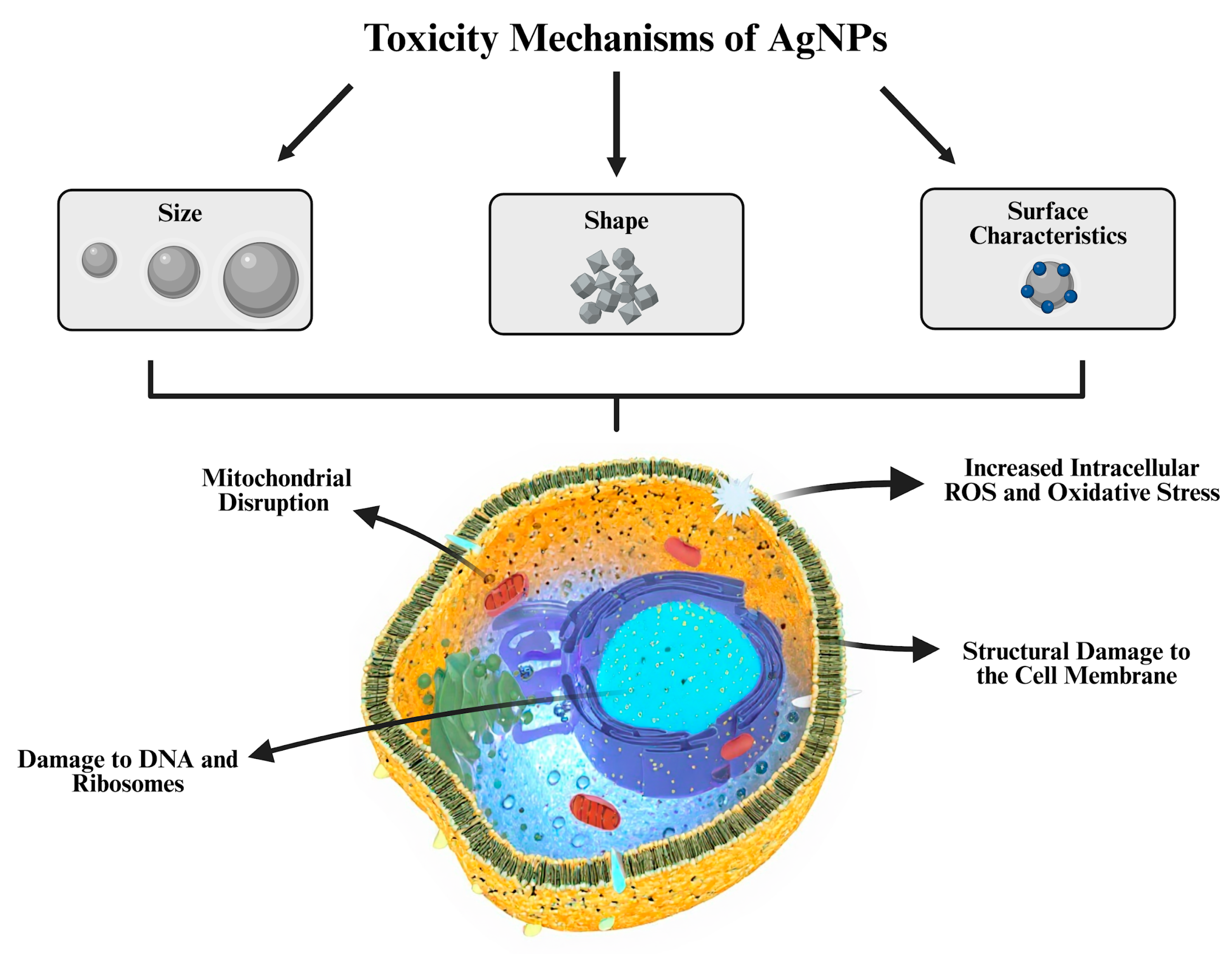
AgNPs have emerged as widely utilized nanomaterials, whether utilized alone or alongside functional molecules. Their applications extend across agriculture, antibacterial coatings, wound healing, dentistry, and water treatment, highlighting their wide-ranging potential [144]. However, their possible harmful effects need to be examined carefully, as wider use has raised concerns about their toxicity to people and the environment [145]. The toxicity of AgNPs is influenced by several factors, including stability, dose of administration and surface chemistry, which influence the aggregation of the particles in the organism. The toxicity potential is also affected by the physicochemical properties of AgNPs (Figure 3). Furthermore, AgNP-induced toxicity can be observed through various mechanisms, which differ based on the biological system. Key mechanisms include cell membrane disruption and excessive ROS generation, impairing organelle functions [146]. The toxicological profile of AgNPs has been investigated in both in vivo and in vitro studies [147].
Dinç et al. [148] investigated the toxicity potential of AgNPs in biological systems in a dose-dependent manner. The effects of AgNPs at concentrations of 10, 30, and 50 µg/mL were investigated on Caenorhabditis elegans, human vascular endothelial cells (HUVECs) and bacteria E. coli and B. subtilis. The initial evaluation in C. elegans revealed that AgNPs markedly affected both reproductive function and locomotion. At 10 µg/mL, the reproductive rate decreased by 25%. Following 6 days of exposure, body-bending frequency dropped from 42 to 19 beats. The results highlight the possible neurotoxic effect of AgNPs against C. elegans, with increased bioaccumulation. At 50 µg/mL, >90% of HUVECs lost viability, while lowered concentrations (10 µg/mL) resulted in a 25% reduction in viability within 48 h. The dose-dependent inhibition of bacterial growth was determined with 52% inhibition at 50 µg/mL and 23% at 10 µg/mL concentration [148]. Okuthe et al. [149] examined the acute dermotoxicity of green synthesized AgNPs in the epidermis of Danio rerio. Zebrafish were exposed to 0.031, 0.250, and 5000 µg/L of AgNPs for 96 h. No mortality was recorded, but clear signs of toxicity were observed. TEarly responses included rapid mucus production within the first 2 h, indicating acute stress. In controls, the cup cell count was 11.17 ± 3.148, and the average size was 12.71 ± 2.084 µm after 24 h. At 0.031 µg/L, cup cell count increased to 20.00 ± 2.275 after 24 h. Cell size decreased to 7.07 ± 1.22 µm at 24 h, increased to 15.85 ± 2.369 µm at 48 h, and dropped to 10.83 ± 1.339 µm after 96 h. At 0.250 µg/L, cell size reached 16.15 ± 2.298 µm at 48 h, with cup cell counts increasing to 18.94 ± 2.287 at 24 h and 18.89 ± 2.298 at 48 h. At 5000 µg/L, size decreased to 8.256 ± 1.382 µm and further to 6.403 ± 1.583 µm after 96 h, while cup cell count dropped significantly to 9.556 ± 1.423 at 48 h. These data indicate the onset of severe cellular damage and loss of epidermal regenerative capacity. Pathological epidermal lesions were observed in all treated groups, with the most severe effects at 5000 µg/L after 96 h. These findings show that green synthesis does not eliminate the toxic potential of AgNPs [149]. Matras et al. [150] investigated the phytotoxic effects of AgNPs with different surface properties and charges on monocotyledonous and dicotyledonous model plants. Three types of AgNPs were synthesized using trisodium citrate (TCSB-AgNPs), tannic acid (TA-AgNPs), and cysteamine hydrochloride (CHSB-AgNPs). CHSB-AgNPs exhibited a positive surface charge, whereas TCSB-AgNPs and TA-AgNPs carried negative charges. The strongest phytotoxic effect was observed in positively charged CHSB-AgNPs [150]. Cunningham et al. [151] investigated the size-dependent toxicity of AgNPs. The AgNPs were coated with a hybrid lipid membrane to prevent surface oxidation and Ag+ release. In general, the study was based on the application of AgNPs ranging in size from 20 to 100 nm at concentrations of 0.25 to 12 mg/L to zebrafish for 5 days. The first observed toxicity effect was mortality. In general, an increase in mortality was observed with an increase in AgNP concentration and a decrease in AgNP size. Specifically, 100% mortality was observed in AgNPs with a size of 20 nm and a concentration of 12 mg/L. In those between 20 and 40 nm, more than 75% of mortality occurred at 24 h post-fertilization. In addition, no significant mortality occurred in NP particles ranging from 80 to 100 nm. Another toxic effect is malformations in fish. The findings showed that AgNPs with average size of 100 nm exhibited reduced internalization, highlighting the inverse relationship between the toxicity and particle size [151]. Such studies have highlighted the potential toxic effects of AgNPs across biological systems, with dose, size, and surface characteristics emerging as critical determinants. Dinç et al. [148] reported significant reproductive, locomotor, and viability reductions in C. elegans and HUVECs, demonstrating dose-dependent toxicity, while Okuthe et al. [149] found clear dermal stress responses and epidermal damage in Danio rerio, even at low concentrations. Toxicity was also evident in plants, where Matras et al. [150] showed that positively charged AgNPs caused stronger phytotoxic effects than negatively charged particles. Complementing these results, Cunningham et al. [151] found that smaller AgNPs caused higher mortality and anatomical malformations in zebrafish embryos, reinforcing that higher doses and smaller particle sizes increase toxicity risk. Together, these studies demonstrate that AgNPs can have harmful effects depending on concentration, exposure duration, particle size, and surface chemistry.
In another study, Ayubee et al. [152] highlighted the toxicity of AgNPs and AgNP–ampicillin conjugates on the Vero cell line. The cells were treated with 25 µL of AgNP combinations at a concentration of 100 µg/mL for 24 h. Results revealed cytotoxic effects of AgNPs, resulting in approximately 80-90% of cell viability. However, AgNP-ampicilin conjugates notably decreased these effects, achieving a cellular viability of greater than 95%. Researchers attributed this lower toxicity to the shielding effect of the ampicillin, which may prevent direct interaction of AgNPs with mammalian cell membranes. Additionally, they stated that the presence of silica coating and amine functionalization during synthesis can further help to improve the biocompatibility of the conjugates [152]. Das et al. [153] evaluated the toxicity potential of chemically synthesized and AgNPs synthesized using Phe-Gly peptide-gallol conjugate on mouse embryonic fibroblast cell lines. It was shown that peptide–gallol capped AgNPs had reduced toxic effects, achieving almost a two-fold reduction compared to chemically synthesized AgNPs. The IC50 values were reported as 250 μg/mL for peptide–gallol capped AgNPs, while chemically synthesized counterparts had an IC50 of 100 μg/mL. The observed reduction in toxic effects was associated with free phenolic -OH groups in the peptide-gallol moiety, which may scavenge ROS and thereby mitigate oxidative damage in cells [153]. Mortazavi Moghadam et al. [154] investigated the toxicity potential of AgNPs in food coatings when ingested through packaging materials. Rainbow trout (Oncorhynchus mykiss) fillets were used during the experimentation considering their proneness to spoilage. To reduce AgNP migration, a composite matrix consisting of cellulose and low-density polyethylene (LDPE) was developed. Fish fillets contained 1.85 μg/mL AgNPs, and in vivo studies in Wistar rats were conducted to assess its potential impact. There was no observable AgNP accumulation detected in the liver, kidneys, small intestine, or blood. The study further examined how migrated AgNPs affect the oral microbiota, focusing on Streptococcus mutans despite the oral cavity’s diverse microbial community. According to MIC results, 0.5 mg/mL nanosilver was sufficient to inhibit S. mutans. In comparison, ICP-MS measurements revealed that the packaging released a maximum of 1.85 μg/mL AgNPs. This amount was insufficient to affect S. mutans or alter oral microbiota. The in vivo results indicate that AgNP migration from the cellulose/LDPE nanocomposite is minimal and insufficient to cause detectable biological effects [154].
In contrast, several investigations have shown that AgNP–related toxicity can be mitigated through controlled formulations or surface modifications. Ayubee et al. [152] demonstrated that coupling AgNPs with ampicillin reduced cytotoxic effects in mammalian cells, likely due to decreased direct contact with cell membranes, while Das et al. [153] showed that peptide-gallol capped AgNPs caused roughly half the toxicity of chemically synthesized NPs, attributed to ROS-scavenging phenolic groups. Real-world exposure experiments also suggest limited risk, as Mortazavi Moghadam et al. [154] found minimal AgNP migration from cellulose/LDPE food packaging and no detectable accumulation in rat organs. Collectively, these studies highlight that although AgNPs possess inherent toxic potential, safer design strategies, such as conjugation, surface coating, and dose control, can substantially reduce biological impact and support safer implementation.
AgNP toxicity is extensively examined in the literature and is influenced by various factors, including the synthesis method. Among available approaches, green synthesis is now widely preferred, as it offers reduced environmental impact relative to chemical and physical synthesis methods [155]. Additionally, green-synthesized AgNPs are valued for their sustainability and biocompatibility. Unlike chemical methods, green synthesis uses biological entities such as plants as both reducing and stabilizing agents. In this context, Farhadi et al. [156] conducted a comparative analysis of the toxicity potential of AgNPs synthesized using three different routes, including chemically-synthesized (c-AgNPs), green-synthesized from Spirulina extracts (g-AgNPs) and green-synthesized and capped with chitosan (CH-gAgNPs). Cell viability assays performed on the H9c2 cell line demonstrated the promotion of the healthy cells on samples treated with g-AgNPs compared with c-AgNPs. CH-gAgNPs further reduced the cytotoxicity against healthy cells, exhibiting no detectable toxicity among all tested concentrations ranging from 10 to 100 µg/mL. In addition, the authors emphasized the immense antibacterial potential of CH-gAgNPs against both Gram-positive and Gram-negative bacterial strains, suggesting their potential as a safe and biocompatible alternative to address the toxicity issues associated with conventional AgNPs [156].
Other factors, including concentration, pH, and synthesis conditions, also influence physicochemical properties and stability. AgNPs obtained from plants can be derived from leaf extracts, seed extracts, aerial parts, and whole plant extracts. Furthermore, phytochemicals such as terpenoids, alkaloids, and polyphenols play an important role in plant-based syntheses. For example, terpenoids interact with Ag+ due to the functional groups in their structures and stabilize the NPs. Furthermore, alkaloids provide electrons to reduce Ag+ ions. In synthesis using algae, proteins and polysaccharides found in algae are used as reducing agents. Additionally, various bioactive organic compounds in their structures and functional groups, such as hydroxyl and carboxyl groups, help reduce Ag+ ions. In synthesis using fungi, silver ions are reduced and stabilized simultaneously by utilizing extracellular proteins and enzymes. In bacteria-based synthesis, the size advantage is exploited. Bacteria are preferred due to their small size and their use of the two most basic reducing enzymes, reductases and dehydrogenases, found in their structures. Their use in controlled synthesis is quite high [155,157].
Synthesis using traditional methods has various advantages, such as precise structural control and obtaining high particle yields [158]. However, usage of reducing and stabilizing chemicals during AgNP production introduces significant environmental and health risks, along with high costs and energy-intensive processes [159]. On the other hand, green synthesis offers sustainable, biocompatible, and environmentally friendly alternatives such as plants, algae, fungi and bacteria [158]. It reduces environmental impact through the use of non-toxic reducing and stabilizing agents while providing cost-effective and manageable processing steps [160]. Still, green synthesis faces challenges such as variability, slower reaction rates and scalability. Further research into optimizing green synthesis methods is crucial for reducing environmental impact and ensuring scalability [158].

5. Future & Conclusions

AgNPs demonstrate high antibacterial efficiency and possess synergistic effects when applied in combination with antibiotics. AgNPs produced via different synthesis methods have been widely tested against different bacterial strains and showed efficiency even towards the drug-resistant ones. Based on the current literature, it is reported that AgNPs exert their bactericidal effects using different mechanisms. Among these, bacterial membrane disruption and ROS generation are the widely recognized ones where both contribute to inhibition of the bacterial proliferation. In addition, AgNPs can interfere with cellular components like ribosomes and DNA and enhance their antibacterial effects
AgNPs physicochemical properties including size, shape and surface charge also influence their antibacterial activity. For example, smaller sized AgNPs show increased bactericidal effects as they can penetrate more easily to bacterial membranes compared to their larger counterparts. AgNP morphology is another factor affecting the antibacterial activity as indicated in the literature by spherical AgNPs achieving more potent effects than triangular and disc-shaped ones. Surface charge of AgNPs also contributes to their antibacterial potential by influencing the electrostatic interactions between NP and the bacterial membrane. Surface functionalization has also gained importance as it is employed to improve biocompatibility, stability and targeted activity of AgNPs.
Remarkable antibacterial potential of AgNPs extend their application across numerous fields. Agriculture is one of these fields where AgNPs are highly utilized as nanopesticides, nanofertilizers and growth-promoting agents based upon their positive impact on germination, plant growth and yield. Food packaging and preservation also represent important agricultural applications where researchers develop AgNP-incorporated packaging films or solutions to extend shelf life while preventing spoilage of the products. In addition, AgNP coatings are widely applied as they are able to indicate food spoilage through temperature- and pH-sensitive changes to provide real-time information about food quality to consumers. Additionally, utilization of AgNPs in the field of agriculture extends to the development of functional textiles with increased antibacterial potential.
Beyond agriculture, the biomedical field is another major area where AgNPs are broadly used. For instance, extensive in vitro and in vivo research has shown the potential of AgNPs for developing wound healing materials. Currently, AgNP-incorporated hydrogels are produced to lower infection through their antibacterial potential and consequently providing an accelerated healing process. AgNPs are also applied as coatings for biomedical devices to reduce the likelihood of infection. However, their application in dentistry remains limited and requires further research.
The toxicity potential of AgNPs remains a major issue even though they are increasingly utilized in a range of applications. Chemically synthesized AgNPs may pose risks to human health and the environment. Although many studies have been conducted, safe usage practices remain insufficient. Accordingly, recent studies have emphasized the development of rational design and application strategies to mitigate these toxicity concerns and support the safe clinical translation of AgNP-based antibacterial systems. In this context, surface functionalization and coating approaches have gained increasing attention, as they have been shown to improve AgNP stability and biocompatibility while limiting uncontrolled silver ion release and direct NP-cell interactions. Notably, conjugation of AgNPs with conventional antibiotics, bioactive polymers, or peptide-based ligands has emerged as a promising strategy, as these systems can preserve antibacterial efficacy while reducing AgNP-associated cytotoxicity through effective dose minimization and shielding effects. Collectively, these formulation-based strategies highlight feasible pathways for improving the safety profile of AgNP-based antibacterial platforms and facilitating their translational advancement.
Beyond post-synthesis formulation approaches designed to mitigate AgNP-associated toxicity, the future of AgNP applications is expected to rely on comprehensive toxicity assessments and the development of clear safety guidelines. In this context, green synthesis offers an alternative approach to reducing the toxicity associated with chemically synthesized AgNPs. It is particularly attractive due to its low cost, improved biocompatibility, and sustainability Ultimately, green-synthesized AgNPs can reduce the reliance on hazardous chemicals associated with toxicity.
In conclusion, AgNPs demonstrate high potential with their significant antibacterial potential and wide range of applicability. Nevertheless, achieving safer applications will depend on improved synthesis strategies and a more comprehensive understanding of their underlying toxicity mechanisms. Emphasizing green synthesis and safety evaluations for AgNPs will facilitate their effective and sustainable application across diverse applications, mainly in antibacterial research.

Author Contributions

Conceptualization, S.K.; writing—original draft preparation, H.K., F.E. and E.A.; writing—review and editing, S.K. and M.B.; visualization, H.K. All authors have read and agreed to the published version of the manuscript.

Funding

This research received no external funding.

Institutional Review Board Statement

Not applicable.

Informed Consent Statement

Not applicable.

Data Availability Statement

No new data were created or analyzed in this study. Data sharing is not applicable to this article.

Acknowledgments

All figures were created using BioRender.com (accessed on 7 December 2025).

Conflicts of Interest

The authors declare no conflicts of interest.

Abbreviations

The following abbreviations are used in this manuscript:
AgNPsSilver nanoparticles
NPsNanoparticles
MICMinimum inhibitory concentration
MBCMinimum bactericidal concentration
ROSReactive oxygen species
DNADeoxyribonucleic acid
MDRMultidrug-resistant
MRSAMethicillin-resistant Staphylococcus aureus
IC50IC50 is defined as the concentration of a drug required for 50% inhibition of biological or biochemical function
CFUColony-forming units
PEIPolyethyleneimine
PpIXProtoporphyrin IX
Cfx-AgNPsCeftriaxone-conjugated silver nanoparticles
DMT4-amino−3,5-dimercapto−1,2,4-triazole
SPRSurface plasmon resonance
PMMAPolymethyl methacrylate
PVPPolyvinylpyrrolidone
CHXChlorhexidine
EFBEmpty fruit bunches
H-AgNPsHistidine-coated silver nanoparticles
HUVECHuman vascular endothelial cells

References

  1. Hosny, S.; Gaber, G.A.; Ragab, M.S.; Ragheb, M.A.; Anter, M.; Mohamed, L.Z. A Comprehensive Review of Silver Nanoparticles (AgNPs): Synthesis Strategies, Toxicity Concerns, Biomedical Applications, AI-Driven Advancements, Challenges, and Future Perspectives. Arab. J. Sci. Eng. 2025, 1–48. [Google Scholar] [CrossRef]
  2. Pal, N.; Sharma, P.; Kumawat, M.; Singh, S.; Verma, V.; Tiwari, R.R.; Sarma, D.K.; Nagpal, R.; Kumar, M. Phage Therapy: An Alternative Treatment Modality for MDR Bacterial Infections. Infect. Dis. 2024, 56, 785–817. [Google Scholar] [CrossRef]
  3. Xie, N. Synthesis and Antibacterial Effects of Silver Nanoparticles (AgNPs) against Multi-Drug Resistant Bacteria. Bio-Med. Mater. Eng. 2024, 35, 451–463. [Google Scholar] [CrossRef]
  4. Fagbemi, K.O.; Thonda, O.A.; Daramola, O.O.; Oyewole, T.; Adeduro, O.O.; Samuel, A.; Popoola, D.; Aina, D.A. Antibacterial Activity of Silver Nanoparticles Synthesized Using Vitex grandifolia Against Multidrug-Resistant (MDR) Pathogens. Trop. J. Nat. Prod. Res. 2024, 8, 8068–8074. [Google Scholar] [CrossRef]
  5. Swain, S.; Bej, S.; Bishoyi, A.K.; Jali, B.R.; Padhy, R.N. Biosynthesis and Characterisations of Silver Nanoparticles with Filamentous Cyanobacterium Lyngbya Sp. with In Vitro Antibacterial Properties against MDR Pathogenic Bacteria. Naunyn-Schmiedebergs Arch. Pharmacol. 2024, 397, 9123–9133. [Google Scholar] [CrossRef]
  6. Rodrigues, A.S.; Batista, J.G.S.; Rodrigues, M.Á.V.; Thipe, V.C.; Minarini, L.A.R.; Lopes, P.S.; Lugão, A.B. Advances in Silver Nanoparticles: A Comprehensive Review on Their Potential as Antimicrobial Agents and Their Mechanisms of Action Elucidated by Proteomics. Front. Microbiol. 2024, 15, 1440065. [Google Scholar] [CrossRef]
  7. Shayo, G.M.; Elimbinzi, E.; Shao, G.N. Preparation Methods, Applications, Toxicity and Mechanisms of Silver Nanoparticles as Bactericidal Agent and Superiority of Green Synthesis Method. Heliyon 2024, 10, e36539. [Google Scholar] [CrossRef] [PubMed]
  8. Palanisamy, J.; Palanichamy, V.S.; Vellaichamy, G.; Perumal, P.; Vinayagam, J.; Gunalan, S.; Prabhakaran, S.G.; Thiraviam, P.P.; Musthafa, F.; Balaraman, A.K.; et al. A Comprehensive Review on the Green Synthesis of Silver Nanoparticles from Marine Sources. Naunyn-Schmiedebergs Arch. Pharmacol. 2025, 398, 3409–3432. [Google Scholar] [CrossRef]
  9. Dakal, T.C.; Kumar, A.; Majumdar, R.S.; Yadav, V. Mechanistic Basis of Antimicrobial Actions of Silver Nanoparticles. Front. Microbiol. 2016, 7, 1831. [Google Scholar] [CrossRef]
  10. Kyziol-Komosinska, J.; Dzieniszewska, A.; Czupioł, J. Behavior of Silver Species in Soil: Ag Nanoparticles vs. Ionic Ag. Molecules 2024, 29, 5531. [Google Scholar] [CrossRef]
  11. Abbas, W.S.; Atwan, Z.W.; Abdulhussein, Z.R.; Mahdi, M.A. Preparation of Silver Nanoparticles as Antibacterial Agents through DNA Damage. Mater. Technol. 2019, 34, 867–879. [Google Scholar] [CrossRef]
  12. Meng, Z.; Fan, B.; Yan, P.; Liu, C. Research on the Antibacterial Mechanism of Medical Nanosilver Latex Composite Materials. Front. Mater. 2024, 11, 1349870. [Google Scholar] [CrossRef]
  13. Meher, A.; Tandi, A.; Moharana, S.; Chakroborty, S.; Mohapatra, S.S.; Mondal, A.; Dey, S.; Chandra, P. Silver Nanoparticle for Biomedical Applications: A Review. Hybrid Adv. 2024, 6, 100184. [Google Scholar] [CrossRef]
  14. Wang, G.; Yang, X.; Chen, X.; Huang, J.; He, R.; Zhang, R.; Zhang, Y. Construction and Antibacterial Activities of Walnut Green Husk Polysaccharide Based Silver Nanoparticles (AgNPs). Int. J. Biol. Macromol. 2024, 276, 133798. [Google Scholar] [CrossRef]
  15. Abdussalam-Mohammed, W.; Edbey, K.; Farhat, H.E.; Shah, P.; Shamsi, S.S.; Bhattarai, A. Facile Green Synthesis of Novel AgNPs Using Hyoscyamus Leaf Extract as Capping Agent: Characterization and Their Potential Antibacterial Activities. Inorg. Chem. Commun. 2025, 173, 113893. [Google Scholar] [CrossRef]
  16. Kim, D.-Y.; Kim, M.; Sung, J.-S.; Koduru, J.R.; Nile, S.H.; Syed, A.; Bahkali, A.H.; Seth, C.S.; Ghodake, G.S. Extracellular Synthesis of Silver Nanoparticle Using Yeast Extracts: Antibacterial and Seed Priming Applications. Appl. Microbiol. Biotechnol. 2024, 108, 150. [Google Scholar] [CrossRef]
  17. Patel, D.; Patel, B.; Patani, A.; Yadav, V.K.; Alharbi, S.A.; Alarfaj, A.A.; Choudhary, N.; Patel, A. Biogenic Silver Nanoparticles Derived from the Marine Brown Algae Iyengaria Stellata for Plant Growth Promotion under Saline Conditions. Physiol. Plant. 2024, 176, e14638. [Google Scholar] [CrossRef]
  18. Yang, X.; Niu, Y.; Fan, Y.; Zheng, T.; Fan, J. Green Synthesis of Poria cocos Polysaccharides-Silver Nanoparticles and Their Applications in Food Packaging. Int. J. Biol. Macromol. 2024, 269, 131928. [Google Scholar] [CrossRef]
  19. Chen, J.; Zhao, X.; Qiao, L.; Huang, Y.; Yang, Y.; Chu, D.; Guo, B. Multifunctional On-Demand Removability Hydrogel Dressing Based on in Situ Formed AgNPs, Silk Microfibers and Hydrazide Hyaluronic Acid for Burn Wound Healing. Adv. Healthc. Mater. 2024, 13, 2303157. [Google Scholar] [CrossRef]
  20. Abdel-Kareem, M.M.; Ali, M.M.A.; Hesham, A.E.-L.; Abdel-Raheam, H.E.F.; Obiedallah, M. Mycosynthesis of Silver Nanoparticles by Aspergillus Templicola OR480102: A Multifaceted Approach for Antibacterial, Anticancer, and Scratch Assay Applications. BMC Biotechnol. 2025, 25, 46. [Google Scholar] [CrossRef]
  21. Yin, I.X.; Xu, V.W.; Xu, G.Y.; Yu, O.Y.; Niu, J.Y.; Chu, C.H. Synthesis and Application of Silver Nanoparticles for Caries Management: A Review. Pharmaceuticals 2024, 17, 1264. [Google Scholar] [CrossRef] [PubMed]
  22. Tessema, B.; Gonfa, G.; Hailegiorgis, S.M. Preparation of Modified Silica Gel Supported Silver Nanoparticles and Its Evaluation Using Zone of Inhibition for Water Disinfection. Arab. J. Chem. 2024, 17, 106036. [Google Scholar] [CrossRef]
  23. Abbas, R.; Luo, J.; Qi, X.; Naz, A.; Khan, I.A.; Liu, H.; Yu, S.; Wei, J. Silver Nanoparticles: Synthesis, Structure, Properties and Applications. Nanomaterials 2024, 14, 1425. [Google Scholar] [CrossRef] [PubMed]
  24. Choudhary, A.; Singh, S.; Ravichandiran, V. Toxicity, Preparation Methods and Applications of Silver Nanoparticles: An Update. Toxicol. Mech. Methods 2022, 32, 650–661. [Google Scholar] [CrossRef]
  25. Sati, A.; Ranade, T.N.; Mali, S.N.; Ahmad Yasin, H.K.; Pratap, A. Silver Nanoparticles (AgNPs): Comprehensive Insights into Bio/Synthesis, Key Influencing Factors, Multifaceted Applications, and Toxicity—A 2024 Update. ACS Omega 2025, 10, 7549–7582. [Google Scholar] [CrossRef]
  26. Khina, A.G.; Krutyakov, Y.A. Similarities and Differences in the Mechanism of Antibacterial Action of Silver Ions and Nanoparticles. Appl. Biochem. Microbiol. 2021, 57, 683–693. [Google Scholar] [CrossRef]
  27. Sorinolu, A.J.; Godakhindi, V.; Siano, P.; Vivero-Escoto, J.L.; Munir, M. Influence of Silver Ion Release on the Inactivation of Antibiotic Resistant Bacteria Using Light-Activated Silver Nanoparticles. Mater. Adv. 2022, 3, 9090–9102. [Google Scholar] [CrossRef]
  28. AboElmaaty, S.A.; Shati, A.A.; Alfaifi, M.Y.; Elbehairi, S.E.I.; Sheraba, N.S.; Hassan, M.G.; Badawy, M.S.E.M.; Ghareeb, A.; Hamed, A.A.; Gabr, E.Z. Biofilm Inhibitory Activity of Actinomycete-Synthesized AgNPs with Low Cytotoxic Effect: Experimental and In Silico Study. Microorganisms 2022, 11, 102. [Google Scholar] [CrossRef]
  29. Hamid, M.T.; Hussein, N.N.; Sulaiman, G.M.; Mohammed, H.A. Antibacterial and Antibiofilm Properties of Silver Nanoparticles Synthesized Using Carthamus Tinctorius Extract Against Various Multidrug-Resistant Bacterial Strains. Discov. Appl. Sci. 2025, 7, 548. [Google Scholar] [CrossRef]
  30. Ren, Y.; Zhang, Y.; Li, X. Application of AgNPs in Biomedicine: An Overview and Current Trends. Nanotechnol. Rev. 2024, 13, 20240030. [Google Scholar] [CrossRef]
  31. Mikhailova, E.O. Green Silver Nanoparticles: An Antibacterial Mechanism. Antibiotics 2024, 14, 5, Erratum in Antibiotics 2025, 14, 1092. [Google Scholar] [CrossRef]
  32. Sani Aliero, A.; Hasmoni, S.H.; Haruna, A.; Isah, M.; Malek, N.A.N.N.; Ahmad Zawawi, N. Bibliometric Exploration of Green Synthesized Silver Nanoparticles for Antibacterial Activity. Emerg. Contam. 2025, 11, 100411. [Google Scholar] [CrossRef]
  33. Balaure, P.C.; Niculescu, A.-G.; Anghel, D.; Grumezescu, A.M.; Alberts, A. Role of Silver Nanoparticles in Wound Healing: Mechanisms, Efficacy, and Clinical Applications. Inorganics 2025, 13, 401. [Google Scholar] [CrossRef]
  34. Radzig, M.A.; Nadtochenko, V.A.; Koksharova, O.A.; Kiwi, J.; Lipasova, V.A.; Khmel, I.A. Antibacterial Effects of Silver Nanoparticles on Gram-Negative Bacteria: Influence on the Growth and Biofilms Formation, Mechanisms of Action. Colloids Surf. B Biointerfaces 2013, 102, 300–306. [Google Scholar] [CrossRef] [PubMed]
  35. Wang, L.; Liu, L.; Zhou, X. Novel Mercaptide-Coupled Silver Nanoparticles AgDAMP Against Salmonella Through Membrane Disruption, Biofilm Obstruction, and Protein Expression Alteration. Food Bioprocess. Technol. 2024, 17, 2304–2325. [Google Scholar] [CrossRef]
  36. Seong, M.; Lee, D.G. Silver Nanoparticles Against Salmonella Enterica Serotype Typhimurium: Role of Inner Membrane Dysfunction. Curr. Microbiol. 2017, 74, 661–670. [Google Scholar] [CrossRef]
  37. Azócar, M.I.; Alarcón, R.; Castillo, A.; Blamey, J.M.; Walter, M.; Paez, M. Capping of Silver Nanoparticles by Anti-Inflammatory Ligands: Antibacterial Activity and Superoxide Anion Generation. J. Photochem. Photobiol. B Biol. 2019, 193, 100–108. [Google Scholar] [CrossRef]
  38. Nakamura, S.; Ando, N.; Sato, M.; Ishihara, M. Ultraviolet Irradiation Enhances the Microbicidal Activity of Silver Nanoparticles by Hydroxyl Radicals. Int. J. Mol. Sci. 2020, 21, 3204. [Google Scholar] [CrossRef] [PubMed]
  39. Akhtar, M.F.; Irshad, M.; Ali, S.; Summer, M.; Noor-ul-ain-Zulfiqar; Akhter, M.F.; Akhtar, G. Understanding the Silver Nanotoxicity: Mechanisms, Risks, and Mitigation Strategies. J. Nanopart. Res. 2025, 27, 89. [Google Scholar] [CrossRef]
  40. Das, B.; Dash, S.K.; Mandal, D.; Ghosh, T.; Chattopadhyay, S.; Tripathy, S.; Das, S.; Dey, S.K.; Das, D.; Roy, S. Green Synthesized Silver Nanoparticles Destroy Multidrug Resistant Bacteria via Reactive Oxygen Species Mediated Membrane Damage. Arab. J. Chem. 2015, 10, 862–876. [Google Scholar] [CrossRef]
  41. Ali, H.M.; Karam, K.; Khan, T.; Wahab, S.; Ullah, S.; Sadiq, M. Reactive Oxygen Species Induced Oxidative Damage to DNA, Lipids, and Proteins of Antibiotic-Resistant Bacteria by Plant-Based Silver Nanoparticles. 3 Biotech 2023, 13, 414. [Google Scholar] [CrossRef] [PubMed]
  42. Girma, A.; Abera, B.; Mekuye, B.; Mebratie, G. Antibacterial Activity and Mechanisms of Action of Inorganic Nanoparticles Against Foodborne Bacterial Pathogens: A Systematic Review. IET Nanobiotechnol. 2024, 2024, 5417924. [Google Scholar] [CrossRef]
  43. Laib, I.; Djahra Ali, B.; Boudebia, O. Green Synthesis of Silver Nanoparticles Using Helianthemum lippii Extracts (Hl-NPs): Characterization, Antioxidant and Antibacterial Activities, and Study of Interaction with DNA. J. Organomet. Chem. 2023, 986, 122619. [Google Scholar] [CrossRef]
  44. Casals, E.; Gusta, M.F.; Bastus, N.; Rello, J.; Puntes, V. Silver Nanoparticles and Antibiotics: A Promising Synergistic Approach to Multidrug-Resistant Infections. Microorganisms 2025, 13, 952. [Google Scholar] [CrossRef]
  45. Kamer, A.M.A.; El Maghraby, G.M.; Shafik, M.M.; Al-Madboly, L.A. Silver Nanoparticle with Potential Antimicrobial and Antibiofilm Efficiency Against Multiple Drug Resistant, Extensive Drug Resistant Pseudomonas Aeruginosa Clinical Isolates. BMC Microbiol. 2024, 24, 277. [Google Scholar] [CrossRef]
  46. Chegini, Z.; Shariati, A.; Alikhani, M.Y.; Safaiee, M.; Rajaeih, S.; Arabestani, M.; Azizi, M. Antibacterial and Antibiofilm Activity of Silver Nanoparticles Stabilized with C-Phycocyanin Against Drug-Resistant Pseudomonas Aeruginosa and Staphylococcus Aureus. Front. Bioeng. Biotechnol. 2024, 12, 1455385, Erratum in Front. Bioeng. Biotechnol. 2025, 13, 1714279. [Google Scholar] [CrossRef] [PubMed]
  47. Muenraya, P.; Sawatdee, S.; Srichana, T.; Atipairin, A. Silver Nanoparticles Conjugated with Colistin Enhanced the Antimicrobial Activity Against Gram-Negative Bacteria. Molecules 2022, 27, 5780. [Google Scholar] [CrossRef] [PubMed]
  48. Shahverdi, A.R.; Fakhimi, A.; Shahverdi, H.R.; Minaian, S. Synthesis and Effect of Silver Nanoparticles on the Antibacterial Activity of Different Antibiotics Against Staphylococcus aureus and Escherichia coli. Nanomed. Nanotechnol. Biol. Med. 2007, 3, 168–171. [Google Scholar] [CrossRef]
  49. Lee, E.-B.; Lee, K. Silver Nanoparticle-Aminogylcosides Conjugation for Enhanced Control of Pathogenic E. coli O157:H7. J. Inorg. Organomet. Polym. 2024, 34, 2800–2811. [Google Scholar] [CrossRef]
  50. Smekalova, M.; Aragon, V.; Panacek, A.; Prucek, R.; Zboril, R.; Kvitek, L. Enhanced Antibacterial Effect of Antibiotics in Combination with Silver Nanoparticles Against Animal Pathogens. Vet. J. 2016, 209, 174–179. [Google Scholar] [CrossRef] [PubMed]
  51. Adil, M.; Alam, S.; Amin, U.; Ullah, I.; Muhammad, M.; Ullah, M.; Rehman, A.; Khan, T. Efficient Green Silver Nanoparticles-Antibiotic Combinations Against Antibiotic-Resistant Bacteria. AMB Expr. 2023, 13, 115. [Google Scholar] [CrossRef]
  52. Crisan, C.M.; Mocan, T.; Manolea, M.; Lasca, L.I.; Tăbăran, F.-A.; Mocan, L. Review on Silver Nanoparticles as a Novel Class of Antibacterial Solutions. Appl. Sci. 2021, 11, 1120. [Google Scholar] [CrossRef]
  53. Wu, Y.; Yang, Y.; Zhang, Z.; Wang, Z.; Zhao, Y.; Sun, L. A Facile Method to Prepare Size-Tunable Silver Nanoparticles and Its Antibacterial Mechanism. Advanced Powder Technology 2018, 29, 407–415. [Google Scholar] [CrossRef]
  54. Ershov, V.A.; Ershov, B.G. Effect of Silver Nanoparticle Size on Antibacterial Activity. Toxics 2024, 12, 801. [Google Scholar] [CrossRef]
  55. Carreño, G.; Piñero, S.; Delgado, M.; Quintero, L.; Gutierrez, J.; Blanco, S. Systematic Control of Silver Nanoparticle Size and Shape for Enhanced Biocompatibility and Antibacterial Activity Against Staphylococcus aureus and Escherichia coli. Oxf. Open Mater. Sci. 2025, 5, itaf016. [Google Scholar] [CrossRef]
  56. Talib, H.; Mehmood, A.; Amjad, M.S.; Mustafa, A.; Khan, M.A.R.; Raffi, M.; Khan, R.T.; Ahmad, K.S.; Qureshi, H. Antibacterial, Antioxidant, and Anticancer Potential of Green Fabricated Silver Nanoparticles Made from Viburnum Grandiflorum Leaf Extract. Bot. Stud. 2024, 65, 4. [Google Scholar] [CrossRef]
  57. Cheon, J.Y.; Kim, S.J.; Rhee, Y.H.; Kwon, O.H.; Park, W.H. Shape-Dependent Antimicrobial Activities of Silver Nanoparticles. Int. J. Nanomed. 2019, 14, 2773–2780. [Google Scholar] [CrossRef]
  58. Helmlinger, J.; Sengstock, C.; Groß-Heitfeld, C.; Mayer, C.; Schildhauer, T.A.; Köller, M.; Epple, M. Silver Nanoparticles with Different Size and Shape: Equal Cytotoxicity, but Different Antibacterial Effects. RSC Adv. 2016, 6, 18490–18501. [Google Scholar] [CrossRef]
  59. Parit, S.B.; Karade, V.C.; Patil, R.B.; Pawar, N.V.; Dhavale, R.P.; Tawre, M.; Pardesi, K.; Jadhav, U.U.; Dawkar, V.V.; Tanpure, R.S.; et al. Bioinspired Synthesis of Multifunctional Silver Nanoparticles for Enhanced Antimicrobial and Catalytic Applications with Tailored SPR Properties. Mater. Today Chem. 2020, 17, 100285. [Google Scholar] [CrossRef]
  60. Hong, X.; Wen, J.; Xiong, X.; Hu, Y. Shape Effect on the Antibacterial Activity of Silver Nanoparticles Synthesized via a Microwave-Assisted Method. Environ. Sci. Pollut. Res. 2016, 23, 4489–4497. [Google Scholar] [CrossRef]
  61. Acharya, D.; Pandey, P.; Mohanta, B. A Comparative Study on the Antibacterial Activity of Different Shaped Silver Nanoparticles. Chem. Pap. 2021, 75, 4907–4915. [Google Scholar] [CrossRef]
  62. Bruna, T.; Maldonado-Bravo, F.; Jara, P.; Caro, N. Silver Nanoparticles and Their Antibacterial Applications. Int. J. Mol. Sci. 2021, 22, 7202. [Google Scholar] [CrossRef]
  63. Salazar-Bryam, A.M.; Yoshimura, I.; Santos, L.P.; Moura, C.C.; Santos, C.C.; Silva, V.L.; Lovaglio, R.B.; Costa Marques, R.F.; Jafelicci Junior, M.; Contiero, J. Silver Nanoparticles Stabilized by Ramnolipids: Effect of pH. Colloids Surf. B Biointerfaces 2021, 205, 111883. [Google Scholar] [CrossRef] [PubMed]
  64. Rónavári, A.; Bélteky, P.; Boka, E.; Zakupszky, D.; Igaz, N.; Szerencsés, B.; Pfeiffer, I.; Kónya, Z.; Kiricsi, M. Polyvinyl-Pyrrolidone-Coated Silver Nanoparticles—The Colloidal, Chemical, and Biological Consequences of Steric Stabilization Under Biorelevant Conditions. Int. J. Mol. Sci. 2021, 22, 8673. [Google Scholar] [CrossRef]
  65. MacCuspie, R.I. Colloidal Stability of Silver Nanoparticles in Biologically Relevant Conditions. J. Nanopart. Res. 2011, 13, 2893–2908. [Google Scholar] [CrossRef]
  66. Silveira, A.P.; Bonatto, C.C.; Lopes, C.A.P.; Rivera, L.M.R.; Silva, L.P. Physicochemical Characteristics and Antibacterial Effects of Silver Nanoparticles Produced Using the Aqueous Extract of Ilex Paraguariensis. Mater. Chem. Phys. 2018, 216, 476–484. [Google Scholar] [CrossRef]
  67. Sinclair, T.R.; Van Den Hengel, S.K.; Raza, B.G.; Rutjes, S.A.; De Roda Husman, A.M.; Peijnenburg, W.J.G.M.; Roesink, H.D.W.; De Vos, W.M. Surface Chemistry-Dependent Antiviral Activity of Silver Nanoparticles. Nanotechnology 2021, 32, 365101. [Google Scholar] [CrossRef] [PubMed]
  68. Lasmi, F.; Hamitouche, H.; Laribi-Habchi, H.; Benguerba, Y.; Chafai, N. Silver Nanoparticles (AgNPs), Methods of Synthesis, Characterization, and Their Application: A Review. Plasmonics 2025, 20, 9455–9488. [Google Scholar] [CrossRef]
  69. Gholami, A.; Ghezelbash, K.; Asheghi, B.; Abbaszadegan, A.; Amini, A. An In Vitro Study on the Antibacterial Effects of Chlorhexidine-Loaded Positively Charged Silver Nanoparticles on Enterococcus Faecalis. J. Nanomater. 2022, 2022, 6405772. [Google Scholar] [CrossRef]
  70. Krychowiak-Maśnicka, M.; Wojciechowska, W.P.; Bogaj, K.; Bielicka-Giełdoń, A.; Czechowska, E.; Ziąbka, M.; Narajczyk, M.; Kawiak, A.; Mazur, T.; Szafranek, B.; et al. The Substantial Role of Cell and Nanoparticle Surface Properties in the Antibacterial Potential of Spherical Silver Nanoparticles. Nanotechnol. Sci. Appl. 2024, 17, 227–246. [Google Scholar] [CrossRef]
  71. Ahmad, F.; Salem-Bekhit, M.M.; Khan, F.; Alshehri, S.; Khan, A.; Ghoneim, M.M.; Wu, H.-F.; Taha, E.I.; Elbagory, I. Unique Properties of Surface-Functionalized Nanoparticles for Bio-Application: Functionalization Mechanisms and Importance in Application. Nanomaterials 2022, 12, 1333. [Google Scholar] [CrossRef]
  72. Kovács, D.; Igaz, N.; Gopisetty, M.K.; Kiricsi, M. Cancer Therapy by Silver Nanoparticles: Fiction or Reality? Int. J. Mol. Sci. 2022, 23, 839. [Google Scholar] [CrossRef]
  73. Khan, B.; Nawaz, M.; Hussain, R.; Price, G.J.; Warsi, M.F.; Waseem, M. Enhanced Antibacterial Activity of Size-Controlled Silver and Polyethylene Glycol Functionalized Silver Nanoparticles. Chem. Pap. 2021, 75, 743–752. [Google Scholar] [CrossRef]
  74. Veena, V.; Shivaprasad, K.H.; Lokesh, K.S.; Sharanagouda, H. Surface Functionalization of Silver Nanoparticles by 4-Amino, 3, 5-Dimercapto, 1, 2, 4 Triazole for Improved Intracellular Uptake and Biocompatibility. BioNanoScience 2024, 14, 287–298. [Google Scholar] [CrossRef]
  75. Shumi, G.; Demissie, T.B.; Eswaramoorthy, R.; Bogale, R.F.; Kenasa, G.; Desalegn, T. Biosynthesis of Silver Nanoparticles Functionalized with Histidine and Phenylalanine Amino Acids for Potential Antioxidant and Antibacterial Activities. ACS Omega 2023, 8, 24371–24386. [Google Scholar] [CrossRef]
  76. Yusuf-Salihu, B.O.; Abdulmumini, S.A.; Bajepade, T.T.; Durosinmi, H.A.; Kazeem, M.O.; Ajayi, V.A.; Lateef, A. Novel Green Synthesis of Silver Nanoparticles from Empty Fruit Bunch Waste: Biomedical Applications and Mechanistic Insights. Next Nanotechnol. 2025, 7, 100136. [Google Scholar] [CrossRef]
  77. Koçer, A.T.; Özçimen, D. Eco-Friendly Synthesis of Silver Nanoparticles from Macroalgae: Optimization, Characterization and Antimicrobial Activity. Biomass Conv. Bioref. 2025, 15, 1995–2006. [Google Scholar] [CrossRef]
  78. Kavin, T.; Murugaiyah, V.; Tan, J.K.; Kassim, M.N.I.; Ramakrishna, S.; Vigneswari, S. Eco-Friendly Synthesis of Silver Nanoparticles Using Coffea arabica Husk for Enhanced Antibacterial and Anti-Cancer Applications. Biomass Bioenergy 2025, 194, 107625. [Google Scholar] [CrossRef]
  79. Yazdi, Y.; Rezaei, M.R.; Pourianfar, H.R. Strong Synergistic Antibacterial Effects of Biosynthesized Silver Nanoparticles and Extracts of the Mushroom Lentinus Tigrinus. Indian J. Microbiol. 2025, 1–10. [Google Scholar] [CrossRef]
  80. Das, R.; Kumar, P.; Singh, A.K.; Agrawal, S.; Albukhaty, S.; Bhattacharya, I.; Tiwari, K.N.; Mishra, S.K.; Tripathi, A.K.; AlMalki, F.A.; et al. Green Synthesis of Silver Nanoparticles Using Trema orientalis (L.) Extract and Evaluation of Their Antibacterial Activity. Green Chem. Lett. Rev. 2025, 18, 2444679. [Google Scholar] [CrossRef]
  81. Aswini, A.; Jenifer, S.; Ashina, J.N.B.; Jeba Raj, Y.; Subashkumar, R. Fabrication of Biogenic Silver Nanoparticles Using Bacillus vietnamensis JA01: Characterization and Antibacterial Activity. Biomass Conv. Bioref. 2025, 15, 7119–7126. [Google Scholar] [CrossRef]
  82. Lavecchia, R.; García-Martínez, J.B.; Contreras-Ropero, J.E.; Barajas-Solano, A.F.; Zuorro, A. Antibacterial and Photocatalytic Applications of Silver Nanoparticles Synthesized from Lacticaseibacillus Rhamnosus. Int. J. Mol. Sci. 2024, 25, 11809. [Google Scholar] [CrossRef] [PubMed]
  83. George, N.; Devi, D.G. Phytonano Silver for Cosmetic Formulation-Synthesis, Characterization, and Assessment of Antimicrobial and Antityrosinase Potential. Discov. Nano 2024, 19, 65. [Google Scholar] [CrossRef]
  84. Lovanh, N.; Agga, G.; Ruiz-Aguilar, G.; Loughrin, J.; Sistani, K. Synthesis of Silver Nanoparticles from Bitter Melon (Momordica charantia) Extracts and Their Antibacterial Effect. Microorganisms 2025, 13, 1809. [Google Scholar] [CrossRef] [PubMed]
  85. Zhang, C.; Li, Y.; Huo, Y.; Wang, H.; Wang, D. Dianthus superbus L. (QM) Extract-Assisted Silver Nanoparticle Gelatin Films with Antioxidant and Antimicrobial Properties for Fresh Fruit Preservation. Foods 2025, 14, 2327. [Google Scholar] [CrossRef]
  86. Kayani, S.; Sert, T.D.; Abidullah, S.; Shinwari, K.I.; Kiliç, S.; Kousar, S.; Chowan, A.A. Green Synthesis of AgNPs Using Medicinal Himalaya Fern (Thelypteris erubescens): Structural Characterization, Effect on Maize Seed Germination and Antimicrobial Function. Trans. Biomed. Eng. Appl. Healthc. 2025, 6, 14–23. [Google Scholar] [CrossRef]
  87. Mohamad Hanafiah, R.; Abd Ghafar, S.A.; Lim, V.; Musa, S.N.A.; Yakop, F.; Hairil Anuar, A.H. Green Synthesis, Characterisation and Antibacterial Activities of Strobilanthes crispus-Mediated Silver Nanoparticles (SC-AGNPS) Against Selected Bacteria. Artif. Cells Nanomed. Biotechnol. 2023, 51, 549–559. [Google Scholar] [CrossRef]
  88. Bektas, I. Biosynthesis of Silver Nanoparticles by Using Phoma Herbarum and Control Efficacy against Onion Basal Root Rot Disease. Res. Sq. 2025. [Google Scholar] [CrossRef]
  89. Kinoan, C.M.; Katas, H. Sustainable Production and Antibacterial Efficacy of Silver Nanoparticles on Cellulose Nanofibers from Mushroom Waste. RSC Adv. 2025, 15, 19726–19740. [Google Scholar] [CrossRef]
  90. Qubtia, M.; Ghumman, S.A.; Noreen, S.; Hameed, H.; Noureen, S.; Kausar, R.; Irfan, A.; Akhtar Shah, P.; Afzal, H.; Hameed, M.; et al. Evaluation of Plant-Based Silver Nanoparticles for Antioxidant Activity and Promising Wound-Healing Applications. ACS Omega 2024, 9, 12146–12157. [Google Scholar] [CrossRef]
  91. Vijayakumar, G.; Kim, H.J.; Jo, J.W.; Rangarajulu, S.K. Macrofungal Mediated Biosynthesis of Silver Nanoparticles and Evaluation of Its Antibacterial and Wound-Healing Efficacy. Int. J. Mol. Sci. 2024, 25, 861. [Google Scholar] [CrossRef]
  92. Gupta, I.; Kumar, A.; Bhatt, A.N.; Sapra, S.; Gandhi, S. Green Synthesis-Mediated Silver Nanoparticles Based Biocomposite Films for Wound Healing Application. J. Inorg. Organomet. Polym. 2022, 32, 2994–3011. [Google Scholar] [CrossRef]
  93. Aldujaily, A.H.; Hassoon, K.F.; Hatem, A.A.; Abbas, M. The Effect of Biosynthesized Silver Nanoparticles on Pseudomonas Aeruginosa-Infected Dogs Wounds. PLoS ONE 2025, 20, e0313166. [Google Scholar] [CrossRef] [PubMed]
  94. Dong, Q.; Zu, D.; Kong, L.; Chen, S.; Yao, J.; Lin, J.; Lu, L.; Wu, B.; Fang, B. Construction of Antibacterial Nano-Silver Embedded Bioactive Hydrogel to Repair Infectious Skin Defects. Biomater. Res. 2022, 26, 36. [Google Scholar] [CrossRef] [PubMed]
  95. Ortiz-Magdaleno, M.; Sánchez-Vargas, L.; Gardea-Contreras, D.; Campos-Ibarra, V.; Pozos-Guillén, A.; Márquez-Preciado, R. Antibiofilm Properties of Silver Nanoparticles Incorporated into Polymethyl Methacrylate Used for Dental Applications. Bio-Med. Mater. Eng. 2023, 34, 357–373. [Google Scholar] [CrossRef] [PubMed]
  96. Espinosa Cristobal, L.F. Antimicrobial Activity of Silver Nanoparticles Against Clinical Biofilms from Patients with and Without Dental Caries. Available online: https://cathi.uacj.mx/handle/20.500.11961/18553 (accessed on 22 August 2025).
  97. Holguín-Meráz, C.; Martínez-Martínez, R.E.; Zaragoza-Contreras, E.A.; Domínguez-Pérez, R.A.; Reyes-López, S.Y.; Donohue-Cornejo, A.; Cuevas-González, J.C.; Silva-Benítez, E.D.L.; Molina-Frechero, N.; Espinosa-Cristóbal, L.F. Antibacterial Effect of Silver Nanoparticles against Oral Biofilms in Subjects with Motor and Intellectual Disabilities. J. Funct. Biomater. 2024, 15, 191. [Google Scholar] [CrossRef]
  98. Campos-Ibarra, V.; Rodríguez-Moreno, A.; Zavala-Alonso, N.V.; Vargas-Sanchez, L.O.; Loredo-Tobias, M.; García-Arreola, M.E.; Aranda-Herrera, B.; Ruiz-Garcia, J.; Manisekaran, R. Silver Nanoparticles Incorporated Dental Restorative Resin and Its Antibiofilm Effect. R. Soc. Open Sci. 2024, 11, 240915. [Google Scholar] [CrossRef]
  99. Liang, Y.; Wang, B.; Yu, Q.; Wang, W.; Ge, S.; Shao, J. Ebselen Optimized the Therapeutic Effects of Silver Nanoparticles for Periodontal Treatment. Int. J. Nanomed. 2023, 18, 8113–8130. [Google Scholar] [CrossRef]
  100. Zhu, Y.; Zhang, H.; Sun, H.; Zhang, Y.; Yang, L.; Liu, C.; Yang, X.; Liu, Y. Effect of Silver Nanoparticles on Biological Nitrogen Removal in Sequential Batch Wastewater Treatment Process: Microbial Communities, Functional Genes, and Interactions. J. Water Process Eng. 2025, 70, 107114. [Google Scholar] [CrossRef]
  101. Selvaraj, R.; Shetty, S.A.; Murugesan, G.; Varadavenkatesan, T.; Vinayagam, R. Sustainable Synthesis of Silver Nanoparticles Using Cynometra Ramiflora Leaf Extract for Methyl Orange Degradation. Discov. Appl. Sci. 2025, 7, 658. [Google Scholar] [CrossRef]
  102. Hamid, L.L.; Ali, A.Y.; Ohmayed, M.M.; Ramizy, A.; Mutter, T.Y. Antimicrobial Activity of Silver Nanoparticles and Cold Plasma in the Treatment of Hospital Wastewater. Kuwait J. Sci. 2024, 51, 100212. [Google Scholar] [CrossRef]
  103. Wafy, K.R.; El-Aswar, E.I.; Mohamed, W.S.E.; El-Sabbagh, S.M. Water Disinfection Using Durable Ceramic Filter Coated with Silver Nanoparticles Synthesized Using Actinomycetes. Appl. Water Sci. 2023, 13, 140. [Google Scholar] [CrossRef]
  104. Awad, M.A.; Virk, P.; Hendi, A.A.; Ortashi, K.M.; AlMasoud, N.; Alomar, T.S. Role of Biosynthesized Silver Nanoparticles with Trigonella Foenum-Graecum Seeds in Wastewater Treatment. Processes 2023, 11, 2394. [Google Scholar] [CrossRef]
  105. Khan, S.; Zahoor, M.; Sher Khan, R.; Ikram, M.; Islam, N.U. The Impact of Silver Nanoparticles on the Growth of Plants: The Agriculture Applications. Heliyon 2023, 9, e16928. [Google Scholar] [CrossRef]
  106. Wu, J.; Zhang, Y.; Zhang, F.; Mi, S.; Yu, W.; Sang, Y.; Wang, X. Preparation of Chitosan/Polyvinyl Alcohol Antibacterial Indicator Composite Film Loaded with AgNPs and Purple Sweet Potato Anthocyanins and Its Application in Strawberry Preservation. Food Chem. 2025, 463, 141442. [Google Scholar] [CrossRef]
  107. Rutkowski, M.; Makowski, W.; Krzemińska-Fiedorowicz, L.; Khachatryan, K.; Kalisz, A.; Malina, D.; Chwastowski, J.; Wzorek, Z.; Khachatryan, G.; Sękara, A.; et al. Silver Nanoparticles Embedded in Sodium Alginate: Antibacterial Efficacy and Effects on Red Cabbage Seedling Performance. Agronomy 2025, 15, 1640. [Google Scholar] [CrossRef]
  108. Ding, S.; Zheng, L.; Tao, T.; Li, Q.; Cai, J.; Zhou, Q.; Zhong, Y.; Wang, X.; Jiang, D. Silver Nanoparticles Priming for Drought Tolerance in Wheat: Insights from Antioxidant System Activation and Stress Memory. Chem. Biol. Technol. Agric. 2025, 12, 57. [Google Scholar] [CrossRef]
  109. Elbanna, H.M.; Ahmed, O.; Fayed, S.; Hammam, K.; Yousef, R.S. The Biochemical Response of Ocimum Basilicum Cv. Grand Vert Plants to Silver Nanoparticles and Green Algae as Biofertilizer. Egypt. J. Chem. 2025, 68, 97–111. [Google Scholar] [CrossRef]
  110. Aguirre-Noyola, J.L.; Ramírez-Mosqueda, M.A.; Cadena-Zamudio, J.D.; Caamal-Velázquez, J.H.; Cruz-Gutiérrez, E.J.; Armenta-Medina, A. Green-Synthesized Silver Nanoparticles (AgNPs) Enhance In Vitro Multiplication and Rooting of Strawberries (Fragaria × ananassa Duchesne). BioTech 2025, 14, 45. [Google Scholar] [CrossRef] [PubMed]
  111. Jangid, H.; Singh, S.; Kashyap, P.; Singh, A.; Kumar, G. Advancing Biomedical Applications: An in-Depth Analysis of Silver Nanoparticles in Antimicrobial, Anticancer, and Wound Healing Roles. Front. Pharmacol. 2024, 15, 1438227. [Google Scholar] [CrossRef]
  112. Singh, M.; Thakur, V.; Kumar, V.; Raj, M.; Gupta, S.; Devi, N.; Upadhyay, S.K.; Macho, M.; Banerjee, A.; Ewe, D.; et al. Silver Nanoparticles and Its Mechanistic Insight for Chronic Wound Healing: Review on Recent Progress. Molecules 2022, 27, 5587. [Google Scholar] [CrossRef]
  113. Aldakheel, F.M.; Wickramasinghe, R.; Thamaraiselvan, C.; Sayed, M.M.E.; Fagir, M.H.; Dein, D.K.E.; Mohsen, D. Green Silver Nanoparticle-Embedded Chitosan-Alginate Hydrogel: A Novel Antibacterial Approach for Potential Wound Healing. Polym. Polym. Compos. 2025, 33, 09673911251320463. [Google Scholar] [CrossRef]
  114. Moayedi, M.; Ahmadi, T.; Nekouie, V.; Dehaghani, M.T.; Shojaei, S.; Benisi, S.Z.; Bakhsheshi-Rad, H.R. Preparation and Assessment of Polylactic Acid-Curcumin Nanofibrous Wound Dressing Containing Silver Nanoparticles for Burn Wound Treatment. Burns 2025, 51, 107442. [Google Scholar] [CrossRef]
  115. Sharma, S.; Bose, A.; Biswas, S.; Sen, S.; Roy, I. Cyperus Rotundus Mediated Green Synthesis of Silver Nanoparticles for Antibacterial Wound Dressing Applications. Sci. Rep. 2025, 15, 18394. [Google Scholar] [CrossRef] [PubMed]
  116. Gangwar, R.; Rao, K.T.; Khatun, S.; Rengan, A.K.; Subrahmanyam, C.; Vanjari, S.R.K. Aloe Vera-Driven Green Synthesis of Silver Nanoparticles: A Facile Approach for Superior Antibacterial Activity and Enhanced Wound-Healing. Appl. Nanosci. 2025, 15, 18. [Google Scholar] [CrossRef]
  117. Baveloni, F.G.; Meneguin, A.B.; Sábio, R.M.; de Camargo, B.A.F.; Trevisan, D.P.V.; Duarte, J.L.; de Araújo, J.T.C.; Luiz, M.T.; Zanatta, M.B.T.; da Silva, I.C.P.; et al. Antimicrobial Effect of Silver Nanoparticles as a Potential Healing Treatment for Wounds Contaminated with Staphylococcus aureus in Wistar Rats. J. Drug Deliv. Sci. Technol. 2025, 103, 106445. [Google Scholar] [CrossRef]
  118. Joseph, B.; Sultan, N.; Jayash, S.N. Can the Use of Silver Nanoparticles in Dental Implants Increase Its Antimicrobial Potency?—Systematic Review. BMC Oral Health 2025, 25, 1221. [Google Scholar] [CrossRef] [PubMed]
  119. Abar, E.S.; Vandghanooni, S.; Memar, M.Y.; Eskandani, M.; Torab, A. Enhancing Antifungal and Antibacterial Properties of Denture Resins with Nystatin-Coated Silver Nanoparticles. Sci. Rep. 2024, 14, 23770. [Google Scholar] [CrossRef]
  120. Butrón-Téllez Girón, C.; De Alba-Montero, I.; Hernández-Arteaga, L.O.; Garrocho-Rangel, A.; Ruiz, F. Antibacterial Effect, Antiadherence, and Antiacidogenicity Properties of a Dental Varnish Containing Silver Nanoparticles: An In Vitro Study. Eur. Arch. Paediatr. Dent. 2025, 26, 799–809. [Google Scholar] [CrossRef]
  121. Mohamed Kamel, S.; Al Moghazy, H.H.; Mohamed El-Kholy, M. Influence of Biosynthesized Silver Nanoparticles on Vital Pulp Therapy of New-Zealand Rabbits (In Vivo Study). MSA Dent. J. 2025, 4, 17–23. [Google Scholar] [CrossRef]
  122. Lopez-Ayuso, C.A.; Garcia-Contreras, R.; Manisekaran, R.; Figueroa, M.; Rangel-Grimaldo, M.; Jacome, M.; Dominguez-Perez, R.A.; Lopez-Morales, S.; Cristians, S.; Acosta-Torres, L.S. Biological and Mechanical Properties of a Self-Curing Acrylic Resin Enriched with AgNPs as a Proposal for Orthopedic Aparatology. Nanoscale Adv. 2025, 7, 2068–2082. [Google Scholar] [CrossRef]
  123. Praharsha, A.; Gupta, A.; Bhardwaj, K.; Kumar, L.; Khandelwal, P.; Verma, S. Silver Nanoparticle-Coated Bacteriophages: A Novel Therapeutic Approach for Combating Enterococcus faecalis in Endodontic Infections. J. Oral Biol. Craniofac. Res. 2025, 15, 1051–1056. [Google Scholar] [CrossRef]
  124. Tomiyama, K.; Watanabe, K.; Iizuka, J.; Hamada, N.; Mukai, Y. Effects of a Mouthrinse Containing Silver Nanoparticles on Polymicrobial Oral Biofilms. Oral Health Prev. Dent. 2024, 22, 567–572. [Google Scholar] [CrossRef]
  125. Polívková, M.; Hubáček, T.; Staszek, M.; Švorčík, V.; Siegel, J. Antimicrobial Treatment of Polymeric Medical Devices by Silver Nanomaterials and Related Technology. Int. J. Mol. Sci. 2017, 18, 419. [Google Scholar] [CrossRef] [PubMed]
  126. Kim, J.H.; Park, H.; Seo, S.W. In Situ Synthesis of Silver Nanoparticles on the Surface of PDMS with High Antibacterial Activity and Biosafety Toward an Implantable Medical Device. Nano Converg. 2017, 4, 33. [Google Scholar] [CrossRef] [PubMed]
  127. De Giglio, E.; Cafagna, D.; Cometa, S.; Allegretta, A.; Pedico, A.; Giannossa, L.C.; Sabbatini, L.; Mattioli-Belmonte, M.; Iatta, R. An Innovative, Easily Fabricated, Silver Nanoparticle-Based Titanium Implant Coating: Development and Analytical Characterization. Anal. Bioanal. Chem. 2013, 405, 805–816. [Google Scholar] [CrossRef] [PubMed]
  128. Zhang, S.; Liang, X.; Gadd, G.M.; Zhao, Q. A Sol–Gel Based Silver Nanoparticle/Polytetrafluorethylene (AgNP/PTFE) Coating with Enhanced Antibacterial and Anti-Corrosive Properties. Appl. Surf. Sci. 2021, 535, 147675. [Google Scholar] [CrossRef]
  129. González-Fernández, S.; Blanco-Agudín, N.; Rodríguez, D.; Fernández-Vega, I.; Merayo-Lloves, J.; Quirós, L.M. Silver Nanoparticles: A Versatile Tool Against Infectious and Non-Infectious Diseases. Antibiotics 2025, 14, 289. [Google Scholar] [CrossRef]
  130. Chhibber, S.; Gondil, V.S.; Singla, L.; Kumar, M.; Chhibber, T.; Sharma, G.; Sharma, R.K.; Wangoo, N.; Katare, O.P. Effective Topical Delivery of H-AgNPs for Eradication of Klebsiella Pneumoniae–Induced Burn Wound Infection. AAPS PharmSciTech 2019, 20, 169. [Google Scholar] [CrossRef]
  131. Shao, J.; Wang, B.; Li, J.; Jansen, J.A.; Walboomers, X.F.; Yang, F. Antibacterial Effect and Wound Healing Ability of Silver Nanoparticles Incorporation into Chitosan-Based Nanofibrous Membranes. Mater. Sci. Eng. C 2019, 98, 1053–1063. [Google Scholar] [CrossRef]
  132. Du, H.; Wang, X.; Zhang, H.; Chen, H.; Deng, X.; He, Y.; Tang, H.; Deng, F.; Ren, Z. Serum Protein Coating Enhances the Antisepsis Efficacy of Silver Nanoparticles Against Multidrug-Resistant Escherichia coli Infections in Mice. Front. Microbiol. 2023, 14, 1153147. [Google Scholar] [CrossRef] [PubMed]
  133. Jiang, L.; Ding, L.; Liu, G. Nanoparticle Formulations for Therapeutic Delivery, Pathogen Imaging and Theranostic Applications in Bacterial Infections. Theranostics 2023, 13, 1545–1570. [Google Scholar] [CrossRef] [PubMed]
  134. Kim, T.; Zhang, Q.; Li, J.; Zhang, L.; Jokerst, J.V. A Gold/Silver Hybrid Nanoparticle for Treatment and Photoacoustic Imaging of Bacterial Infection. ACS Nano 2018, 12, 5615–5625. [Google Scholar] [CrossRef]
  135. Jain, J.; Arora, S.; Rajwade, J.M.; Omray, P.; Khandelwal, S.; Paknikar, K.M. Silver Nanoparticles in Therapeutics: Development of an Antimicrobial Gel Formulation for Topical Use. Mol. Pharm. 2009, 6, 1388–1401. [Google Scholar] [CrossRef]
  136. Masri, A.; Anwar, A.; Ahmed, D.; Siddiqui, R.B.; Raza Shah, M.; Khan, N.A. Silver Nanoparticle Conjugation-Enhanced Antibacterial Efficacy of Clinically Approved Drugs Cephradine and Vildagliptin. Antibiotics 2018, 7, 100. [Google Scholar] [CrossRef]
  137. Steckiewicz, K.P.; Cieciórski, P.; Barcińska, E.; Jaśkiewicz, M.; Narajczyk, M.; Bauer, M.; Kamysz, W.; Megiel, E.; Inkielewicz-Stepniak, I. Silver Nanoparticles as Chlorhexidine and Metronidazole Drug Delivery Platforms: Their Potential Use in Treating Periodontitis. Int. J. Nanomed. 2022, 17, 495–517. [Google Scholar] [CrossRef]
  138. Nanjunda Reddy, B.H.; Rauta, P.R.; Venkatalakshimi, V.; Sreenivasa, S. Synthesis and Characterization of Cloisite-30B Clay Dispersed Poly (Acryl Amide/Sodium Alginate)/AgNp Hydrogel Composites for the Study of BSA Protein Drug Delivery and Antibacterial Activity. Mater. Res. Express 2018, 5, 025403. [Google Scholar] [CrossRef]
  139. Di Fraia, A.; Dal Poggetto, G.; Salamone, M.; Carraturo, F.; Contursi, P.; Guida, M.; Limauro, D.; Scognamiglio, V.; Rossi, M.; Fiorentino, G. Green Synthesis of Silver Nanoparticles (AgNPs) from G. Stearothermophilus GF16: Stable and Versatile Nanomaterials with Antioxidant, Antimicrobial, and Catalytic Properties. Microb. Cell Fact. 2025, 24, 189. [Google Scholar] [CrossRef]
  140. Kalakonda, P.; Thodeti, M.; Ganneboina, C.; Ankathi, K.; Kathri, S.; Begari, K.; Kante, H.S.; Jupalli, V.; Khaderabad, Y.; Vijaylaxmi, S.; et al. Eco-Friendly Fabrication of Silver Nanoparticles for Sustainable Water Purification and Antibacterial Synergy. Plasmonics 2024, 19, 2857–2869. [Google Scholar] [CrossRef]
  141. Bashir, N.; Afzaal, M.; Khan, A.L.; Nawaz, R.; Irfan, A.; Almaary, K.S.; Dabiellil, F.; Bourhia, M.; Ahmed, Z. Green-Synthesized Silver Nanoparticle-Enhanced Nanofiltration Mixed Matrix Membranes for High-Performance Water Purification. Sci. Rep. 2025, 15, 1001, Erratum in Sci. Rep. 2025, 15, 11419. [Google Scholar] [CrossRef] [PubMed]
  142. Al-Ghamdi, A.A.; Ibrahim, S.M.; Lu, X.; Xin, J.; El-Sayed, I.E.-T.; Galhoum, A.A.; Wageh, S. Biosorbent Silver Nanoparticles Decorated Coffee-Ground Waste Composite for Cleaning Water and Antimicrobial Applications. Environ. Sci. Pollut. Res. 2025, 32, 2280–2297. [Google Scholar] [CrossRef]
  143. Zhu, J.; Lua, A.C. Antibacterial Ultrafiltration Membrane with Silver Nanoparticle Impregnation by Interfacial Polymerization for Ballast Water. J. Polym. Sci. 2021, 59, 2295–2308. [Google Scholar] [CrossRef]
  144. Waktole, G. Toxicity and Molecular Mechanisms of Actions of Silver Nanoparticles. J. Biomater. Nanobiotechnol. 2023, 14, 53–70. [Google Scholar] [CrossRef]
  145. Noga, M.; Milan, J.; Frydrych, A.; Jurowski, K. Toxicological Aspects, Safety Assessment, and Green Toxicology of Silver Nanoparticles (AgNPs)—Critical Review: State of the Art. Int. J. Mol. Sci. 2023, 24, 5133. [Google Scholar] [CrossRef]
  146. Nie, P.; Zhao, Y.; Xu, H. Synthesis, Applications, Toxicity and Toxicity Mechanisms of Silver Nanoparticles: A Review. Ecotoxicol. Environ. Saf. 2023, 253, 114636. [Google Scholar] [CrossRef]
  147. Albadawi, E.A.; Musa, E.N.A.; Ghaban, H.M.; Ebrahim, N.A.; Albadrani, M.S.; El-Tokhy, A.I. Eco-Friendly Green Synthesis of Silver Nanoparticles from Guajava Leaves Extract for Controlling Organophosphorus Pesticides Hazards, Characterization, and in-Vivo Toxicity Assessment. BMC Pharmacol. Toxicol. 2024, 25, 98. [Google Scholar] [CrossRef]
  148. Dinç, B. Comprehensive Toxicity Assessment of Silver Nanoparticles on Bacteria, Human Vein Endothelial Cells, and Caenorhabditis elegans. Results Chem. 2025, 14, 102092. [Google Scholar] [CrossRef]
  149. Okuthe, G.E.; Siguba, B. Acute Dermatotoxicity of Green-Synthesized Silver Nanoparticles (AgNPs) in Zebrafish Epidermis. Toxics 2025, 13, 592. [Google Scholar] [CrossRef]
  150. Matras, E.; Gorczyca, A.; Pociecha, E.; Przemieniecki, S.W.; Oćwieja, M. Phytotoxicity of Silver Nanoparticles with Different Surface Properties on Monocots and Dicots Model Plants. J. Soil Sci. Plant Nutr. 2022, 22, 1647–1664. [Google Scholar] [CrossRef]
  151. Cunningham, B.; Engstrom, A.M.; Harper, B.J.; Harper, S.L.; Mackiewicz, M.R. Silver Nanoparticles Stable to Oxidation and Silver Ion Release Show Size-Dependent Toxicity In Vivo. Nanomaterials 2021, 11, 1516. [Google Scholar] [CrossRef]
  152. Ayubee, M.S.; Akter, F.; Ahmed, N.T.; Kabir, A.K.L.; Hossain, M.M.; Hussain, M.D.; Kazi, M.; Mazid, M.A. Synergistic Antibacterial Action of AgNP-Ampicillin Conjugates: Evading β-Lactamase Degradation in Ampicillin-Resistant Clinical Isolates. PLoS ONE 2025, 20, e0331669. [Google Scholar] [CrossRef]
  153. Das, M.; Senapati, K.; Panda, S.S.; Bhattacharya, P.; Jana, S.; Mandal, S.M.; Basak, A. π-Stacking Assisted Redox Active Peptide–Gallol Conjugate: Synthesis of a New Generation of Low-Toxicity Antimicrobial Silver Nanoparticles. RSC Adv. 2016, 6, 85254–85260. [Google Scholar] [CrossRef]
  154. Mortazavi Moghadam, F.S.; Rasouli, S.; Mortazavi Moghadam, F.A. In Vivo Study and Cytotoxicity of Migrated Silver Nanoparticles (AgNPs) from Cellulose/LDPE/AgNP Nanocomposite in Highly Perishable Food (Fish Fillet) Packaging. ACS Food Sci. Technol. 2025, 5, 1024–1041. [Google Scholar] [CrossRef]
  155. Fahim, M.; Shahzaib, A.; Nishat, N.; Jahan, A.; Bhat, T.A.; Inam, A. Green Synthesis of Silver Nanoparticles: A Comprehensive Review of Methods, Influencing Factors, and Applications. JCIS Open 2024, 16, 100125. [Google Scholar] [CrossRef]
  156. Farhadi, L.; Mohtashami, M.; Saeidi, J.; Azimi-nezhad, M.; Taheri, G.; Khojasteh-Taheri, R.; Rezagholizade-Shirvan, A.; Shamloo, E.; Ghasemi, A. Green Synthesis of Chitosan-Coated Silver Nanoparticle, Characterization, Antimicrobial Activities, and Cytotoxicity Analysis in Cancerous and Normal Cell Lines. J. Inorg. Organomet. Polym. 2022, 32, 1637–1649. [Google Scholar] [CrossRef]
  157. Dheyab, M.A.; Aziz, A.A.; Nowfal, S.H.; Braim, F.S.; Abdullah, W.; Kasasbeh, W.H.; Jameel, M.S.; Alanezi, S.T.; Alrosan, M.; Oladzadabbasabadi, N. Sustainable Green Synthesis of Silver Nanoparticles for Safer Biomedical Application. J. Environ. Chem. Eng. 2025, 13, 115998. [Google Scholar] [CrossRef]
  158. Nguyen, N.P.U.; Dang, N.T.; Doan, L.; Nguyen, T.T.H. Synthesis of Silver Nanoparticles: From Conventional to ‘Modern’ Methods—A Review. Processes 2023, 11, 2617. [Google Scholar] [CrossRef]
  159. Sarhan, A.S.; Abdel-Hamid, M.I.; Hanie, R. Green Synthesis of (CS/OLE) AgNPs and Evaluation of Their Physico-Chemical Characteristic. Appl. Nanosci. 2022, 12, 2765–2776. [Google Scholar] [CrossRef]
  160. Patil, S.; Thimmappa, A.D.; Tomar, A.; Verma, A. Plant-Based Green Synthesis of AgNPs and Their Structural and Antimicrobial Characterization. Nat. Eng. Sci. 2025, 10, 363–373. [Google Scholar] [CrossRef]
Figure 1. Utilization of Silver Nanoparticles in Diverse Fields. AgNPs exhibit antibacterial activity through interactions with microbial cell membranes, DNA, and ribosomes. They are widely applied in water treatment, agriculture, dental materials, and wound healing. The schematic illustrates these major application areas, where arrows indicate process flows or interaction pathways, and red symbols denote antimicrobial inhibition and oxidative stress generation [23].
Ijms 27 00927 g001
Figure 2. Antibacterial Mechanism of AgNPs. AgNPs exert antibacterial effects through ion release, membrane accumulation, and intracellular disruption. The diagram depicts the release of Ag+ ions (small grey spheres) and their subsequent inhibition of membrane proteins and cytosolic enzymes. Yellow starburst icons represent ROS-mediated oxidative stress on DNA and proteins, while directional lines illustrate the Ag+ ion penetration pathways [32].
Ijms 27 00927 g002
Figure 3. Toxicity Mechanisms of AgNPs. The toxicity profile of AgNPs is dependent on size, shape, and surface characteristics, as depicted in the upper boxes. These properties influence the interaction with the cell, leading to structural damage to the cell membrane and organelles. Directional arrows illustrate the downstream toxic effects, specifically highlighting mitochondrial disruption, ROS generation, and damage to DNA and ribosomes [23].
Ijms 27 00927 g003
Table 1. Recent Antibacterial Applications of AgNPs.
Application TypeAgNP TypePhysicochemical PropertyMain ResultsReferences
Antibacterial
(in vitro)
Green synthesized from Hyoscyamus muticus extractGlobular morphology
17.3 ± 4.5 nm size
Zeta potential of −64.42 mV
SPR value 398 nm
Inhibition zone of 22 mm against S. aureus.
Inhibition zone of 19 mm against A. baumannii.
[15]
Antibacterial
(in vitro)
Green synthesized from Bacillus vietnamensis JA01Spherical morphology
Size ranging from 14–21 nm
SPR value of 381.50 nm
Strong antibacterial activity against several pathogenic bacterial strains.
Inhibition zones ranging from 0.3 ± 0.2 nm to 1.8 ± 0.2 nm.
[81]
Antibacterial
(in vitro)
Green synthesized from probiotic bacterial strain Lacticaseibacillus rhamnosusGlobular morphology
Average size of 199.7 nm
SPR value of 443 nm
Zeta potential value of −36.3 mV
Significant antibacterial activity against various bacterial strains.
Inhibition zone of 16 mm against Vibrio parahaemolyticus.
[82]
Antibacterial
(in vitro)
Green synthesized from Cocos nucifera extractGlobular morphology
28 nm size
SPR value 425 nm
Significant inhibitory activity against tyrosinase.
Influence on skin rejuvenation.
Strong antibacterial activity against pathogens related to skin infection.
[83]
Antibacterial
(in vitro)
Green synthesized from Momordica charantia extractsPredominantly spherical morphology
Size ranging from 14.5 ± 8.2 to 70 nm
The SPR value between 420–450 nm
Strong antibacterial activity against E. coli ATCC25922.
AgNPs between 0.625 and 2.50 mg/L achieved 99.99% killing after 24 h of incubation.
[84]
AgriculturalGreen synthesized from Dianthus superbus L. extractGlobular and polydisperse morphology
Size between 11–18 nm
AgNPs prevented discoloration, decay, and spoilage of grapes for 4 days.
Extended shelf life of grapes.
[85]
AgriculturalGreen synthesized from Thelypteris erubescens Globular morphology
Sizes ranging from 30 to 40 nm.
Strong antibacterial activity against several bacterial strains.
Dose-dependent increase in dry weight, germination rate, and crop yield in maize.
[86]
AgriculturalGreen synthesized from Strobilanthes crispusGlobular morphology
Average size of 75.25 nm
Zeta potential of −35.6 mV
Strong antibacterial activity against P. aeruginosa and Streptococcus mutans.
Disruption of gene expression responsible for bacterial adhesion and biofilm formation.
[87]
AgriculturalGreen synthesized from the fungus Phoma herbarumSpherical morphology
Size ranging from 4 to 40 nm
SPR peak around 429 nm
Dose-dependent antifungal activity against onion basal root rot disease causing Fusarium oxysporum f.sp. cepae.
Inhibition rate of 94.42% in vivo.
[88]
AgriculturalGreen synthesized from spent mushroom substrateGlobular morphology
Zeta potential of −48.3 ± 0.58 mV
Dose-dependent antibacterial activity against several bacterial strains through protein and amino acid leakage mechanisms.
Minimal cytotoxicity against human dermal fibroblasts.
[89]
Wound HealingGreen synthesized from taro corms extract Spherical morphology
Size between 244.9 and 272.2 nm
SPR values between 438–445 nm
Zeta potential of −18.8 mV
Complete wound closure in rabbits following 14 days.
Increase in collagen content.
Strong antibacterial activity against several bacterial strains.
[90]
Wound HealingGreen synthesized from macrofungus Phellinus adamantinusGlobular morphology
Size ranging between 40–50 nm
Bactericidal activity against several bacterial species.
20% wound healing efficacy following 24 h of treatment.
[91]
Wound HealingGreen synthesized from Ocimum sanctum Globular morphology
28.95 ± 7.74 nm in size
Zeta potential of −17.8 mV
45% healing of scratch wounds in 12 h in vitro.
Reduced toxicity against L929 mouse fibroblasts.
Strong antibacterial activity against E. coli.
[92]
Wound HealingGreen synthesized from Tribulus terrestrisSpherical morphology
Size of 50.2 nm
SPR peak at 410 nm
Antibacterial and anti-inflammatory effect in wounds infected with P. aeruginosa
Faster and more pronounced histological development through administration of AgNPs
Low toxicity
[93]
Wound HealingAgNPs were commercially purchased Size of 5 nm
SPR peak at 400 nm
Notable antibacterial activity against infected skin defects.
Reduced toxicity.
Promotion of angiogenesis and acceleration of wound closure.
[94]
Dental Synthesized via chemical reductionHemispherical and irregular morphology
Size between 2–17 nm
AgNPs added to the PMMA surface strongly inhibit biofilm formation of S. aureus.[95]
DentalSynthesized via chemical reductionSpherical morphology
Size ranging from 5.2 ± 1.2 nm to 37.4 ± 3.6 nm
Zeta potential ranging from −48.4 ± 6.9 mV to −52.6 ± 8.5 mV
SPR value between 408–410 nm
Significant potential for preventing dental caries.
Strong antimicrobial activity in several sizes.
[96]
DentalSynthesized via chemical reductionGlobular morphology
Size ranging from 10.2 ± 0.7 nm to 29.3 ± 2.3 nm
Zeta potential between −35.0 ± 3.3 mV to −52.6 ± 8.5 mV
Size and oral biofilm dependent antibacterial activity.
High resistance in oral biofilms obtained from disabled patients against AgNP.
[97]
DentalSynthesized using green synthesis and chemical synthesisGlobular morhpology
Size between 2–20 nm
SPR peak at 400 nm
Significant antibiofilm inhibition.
Notable biocompatibility.
Concentration-dependent toxicity.
[98]
Dental Synthesized via chemical reductionSpherical morphology
-Size between 10–100 nm
-Zeta potential value −24.75 mV
Strong antibacterial effect against various bacteria in synergy with Ebselen, a synthetic organoselenium drug molecule.
Excellent cell compatibility.
Strong anti-inflammatory activity.
Reduced alveolar bone resorption in rats with periodontitis.
[99]
Water TreatmentNPs were commercially purchasedSize between 2–5 nmInhibits biological nitrogen removal.
Nitrification is suppressed by up to 90%.
Reduces the potential of bacteria playing a key role in the nitrogen cycle in water.
[100]
Water TreatmentGreen synthesized from Cynometra ramiflora leaf extractSpherical morphology
Average size of 18.84 ± 8.67 nm
Zeta potential of −18.2 mV
SPR value peaks at 431 nm
Strong catalytic effect on methyl orange in water purification.
95% degradation of methyl orange in 15 min.
Rapid and effective degradation of azo dyes in water.
[101]
Water TreatmentGreen synthesized from Melia azedarachGlobular morphology
Average size of 13.6 nm
zeta potential of +50 mV
Microbial contaminants in hospital wastewater were removed using cold plasma and AgNPs.
Complete colony removal was observed.
[102]
Water TreatmentGreen synthesized from cell-free supernatant of ActinomycetesSpherical morphology
Size ranging from 5 nm to 45 nm
Strong antibacterial activity against various pathogens.
100% bacterial elimination.
[103]
Water TreatmentGreen synthesized from Trigonella foenum-graecum aqueous extractSpherical morphology
Size between 20–50 nm
SPR peak at 439.29 nm
Separated 94.5% of crystal violet dye from the medium.
Strong antibacterial activity against various bacterial strains.
[104]
Disclaimer/Publisher’s Note: The statements, opinions and data contained in all publications are solely those of the individual author(s) and contributor(s) and not of MDPI and/or the editor(s). MDPI and/or the editor(s) disclaim responsibility for any injury to people or property resulting from any ideas, methods, instructions or products referred to in the content.