


Abstract
Quantitative real-time PCR (qPCR) remains a cornerstone method for analyzing gene expression due to its high sensitivity, specificity, and reproducibility. However, for reliable results in relative quantification studies, the choice of an appropriate reference gene is critical to ensure accurate normalization. The expression of commonly used reference genes can vary depending on developmental stage and experimental conditions, making their validation essential. To date, no validated reference genes have been reported for Agrostemma githago L. (corn cockle, Caryophyllaceae). To facilitate research on genes involved in natural product biosynthesis and specialized metabolism regulation, we aimed to identify the most stable reference genes across various plant organs and cultivation conditions of this species. Drawing on previous literature, we have selected seven housekeeping genes widely used for evaluation: actin, β-tubulin, elongation factor 1α, glyceraldehyde-3-phosphate dehydrogenase, histone H3, translation elongation factor 1, and eukaryotic translation initiation factor 5A1 (for which two primer sets were tested). The nucleotide sequences of these potential reference genes were identified from the A. githago transcriptome. Using qRT-PCR, transcript levels of seven potential reference genes were estimated in 40 different A. githago samples, including 25 in vitro samples under various treatment conditions and 15 soil-grown samples representing A. githago organs in different developmental stages. Expression stability of candidate reference genes was assessed using the RefFinder platform, which combines four commonly applied statistical algorithms: geNorm, NormFinder, BestKeeper, and the comparative Δ-Ct method. The results revealed that the selection of optimal reference genes varied based on the particular organ, developmental stage and condition being examined. TIF5A1-2 (one of the two primer pairs tested) and GAPHD consistently exhibited the most stable expression under various conditions in vitro. EF1α and H3 exhibited superior performance across different organs of soil-grown plants. Moreover, our integrated analysis enabled the identification of the two most stable, universal reference genes suitable for normalization in A. githago under all tested conditions—H3 and TIF5A1-2. Our work provides a robust foundation for future transcriptomic and functional studies of the specialized metabolism of A. githago and other related species.
1. Introduction
Quantitative real-time PCR (qRT-PCR) remains one of the most widely used and reliable methods for quantifying gene expression, owing to its high sensitivity, specificity, reproducibility, and overall analytical efficiency [1,2]. However, the accuracy of qRT-PCR can be affected by factors such as sample source, RNA integrity, cDNA quality, primer specificity, amplification efficiency, and other experimental variables [3,4]. To minimize these sources of variation and ensure reliable measurements, it is essential to normalize raw expression data according to the Minimum Information for Publication of Quantitative Real-Time PCR Experiments (MIQE) guidelines [5,6] which emphasizes the selection of appropriate reference genes.
Reliable normalization requires reference genes with stable expression across tissues, developmental stages, and experimental conditions [7,8]. Housekeeping genes which maintain basic cellular functions and encode essential proteins are frequently used as reference genes, as their products are necessary for cellular activity and are typically expressed under a wide range of conditions. Traditionally, well-known housekeeping genes, such as elongation factor 1 alpha (EF1α), glyceraldehyde-3-phosphate dehydrogenase (GAPDH), actin (ACT) and ubiquitin (UBQ), were commonly accepted for normalization without prior validation of their stability. However, numerous studies have demonstrated that the transcript levels of many traditional housekeeping genes can vary substantially under different biological or environmental contexts as their expression stability is not universal and often species-, tissue-, or treatment-dependent [9,10]. Consequently, unstable reference genes can introduce substantial bias into qRT-PCR datasets [11,12].
Moreover, insights from RNA-seq data further revealed that individual members of housekeeping gene families often exhibit distinct tissue-specific expression profiles and differential responses to environmental stimuli [13,14,15,16,17]. Since qRT-PCR assays typically target single gene models, it is no longer acceptable to select conventional housekeeping genes arbitrarily, without prior confirming their expression stability across the specific samples and conditions under investigation [18]. Instead, rigorous, experiment-specific validation has become a necessary prerequisite for any reliable qRT-PCR-based gene expression study. Progress in high-throughput transcriptomics has also facilitated the identification of novel candidate reference genes with improved stability, identified through large-scale genome and transcriptome mining [7,14,15,16,19,20,21,22,23,24,25,26]. These studies consistently show that reference gene suitability is highly species- and condition-specific. Consequently, the systematic evaluation of known and novel candidate reference genes prior to experimentation is essential to ensure data accuracy and to avoid biased conclusions. The use of multiple reference genes, providing more robust normalization than any single gene alone, is nowadays recommended to reduce systematic error and enhance data reliability [27,28]. The diverse physiological and ecological adaptations of non-model species, such as many medicinal and poisonous plants, also mean that genes involved in basic cellular functions might be regulated differently under various environmental stresses or developmental stages, further complicating the search for true expression stability [29,30]. Hence, the identification of stable reference genes presents unique challenges compared to well-characterized model organisms. This underscores the need for systematic, empirical validation of reference genes tailored to the specific experimental context of each non-model plant.
The plant used in this study, Agrostemma githago L. (corn cockle), Caryophyllaceae, is an annual herbaceous segetal weed that was once widespread in cereal fields, where its seeds often contaminated harvested grain. However, it has become increasingly rare due to modern agricultural practices. Nowadays, it is considered endangered in many parts of Europe and has emerged as an ornamental plant for use in wildflower meadows, and a few new varieties have been bred. Despite its decline, A. githago remains ecologically and evolutionarily significant, representing a unique lineage adapted to variable environmental conditions under anthropogenic pressure, such as seed persistence. Moreover, the historical and recent reports on its medicinal and toxic properties of this understudied plant call for a comprehensive characterization of its functional genomics.
Previous studies have revealed the presence of a number of triterpene saponins [31], and type I ribosome-inactivating proteins (RIPs) in A. githago [32]. Some of the saponins from this species, such as agrostemmoside E, have the capacity to facilitate the endosomal escape of type I RIPs within the cell, a critical step for RIP-mediated toxicity [33,34]. A comprehensive review of phytochemical and bioactive properties of corncockle has been published recently [35]. Furthermore, while the genome sequence of A. githago has recently become available [36], the molecular regulation of saponin biosynthesis and the expression of type I RIPs have not yet been reported.
Despite its biochemical, pharmacological, ecological, and evolutionary interest, a robust framework for gene expression analysis in A. githago, particularly regarding the identification of reliable reference genes for qRT-PCR, remains lacking, as no validated reference genes have been reported for this species to date. However, within the Caryophyllaceae family, a few studies have investigated the stability of potential reference genes in species such as Silene vulgaris [37], Dianthus caryophyllus [38], and Dianthus broteri [39]. To support investigations of genes involved in specialized metabolism underlying natural product biosynthesis and the regulation of RIP production in A. githago, we sought to identify reference genes exhibiting the highest expression stability across diverse organs and cultivation conditions of this species. Based on previous studies in carnation species, we selected seven candidate reference genes for investigation: actin, β-tubulin, elongation factor 1α, glyceraldehyde-3-phosphate dehydrogenase, histone H3, translation elongation factor 1, and eukaryotic translation initiation factor 5A1. Orthologous nucleotide sequences of these genes were retrieved from the transcriptomic data of A. githago to enable primer design [32]. Using qRT-PCR, transcript levels of these seven potential reference genes were estimated in 40 different A. githago samples, including 25 in vitro samples under various treatment conditions and 15 soil-grown samples representing different organs and developmental stages. Expression stability was evaluated from Ct values using the comparative ΔCt method [40], geNorm [41], NormFinder [42], BestKeeper [43], and the integrative RefFinder algorithm [44,45], and their accuracy was validated by analyzing the expression of the Squalene synthase (SQS) and β-amyrin synthase (BAS) genes.
This study is the first to screen and verify the internal reference genes used for qRT-PCR normalization in A. githago across various plant organs and cultivation conditions. To support downstream gene expression analyses in A. githago, we leveraged existing knowledge from Caryophyllaceae, selected previously validated candidate reference genes, and systematically assessed their stability under our experimental conditions. The main strength of this study lies in the rigorous evaluation of these candidates across 40 independent A. githago cDNA libraries spanning diverse developmental stages and cultivation regimes. This application-oriented work builds on prior research to provide a practical framework for selecting appropriate reference genes for A. githago grown either in soil or in vitro.
By identifying universally stable housekeeping genes, we also provide valuable resources for future quantification of gene expression in A. githago and related species, facilitating studies not only of specific biosynthetic pathways but also of broader physiological and ecological processes.
2. Results
2.1. Primer Specificity and Amplification Efficiency
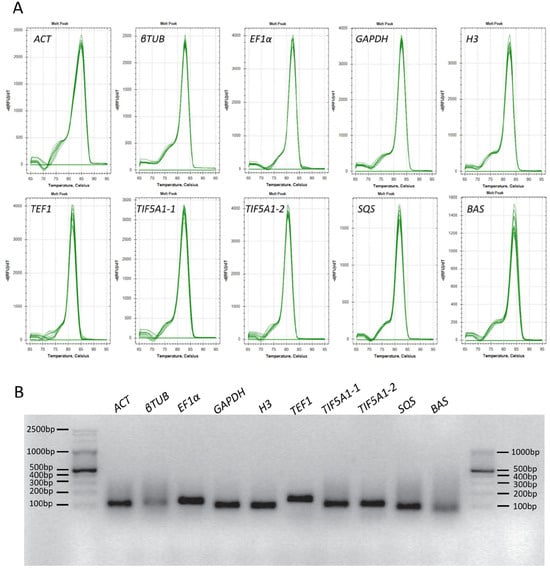
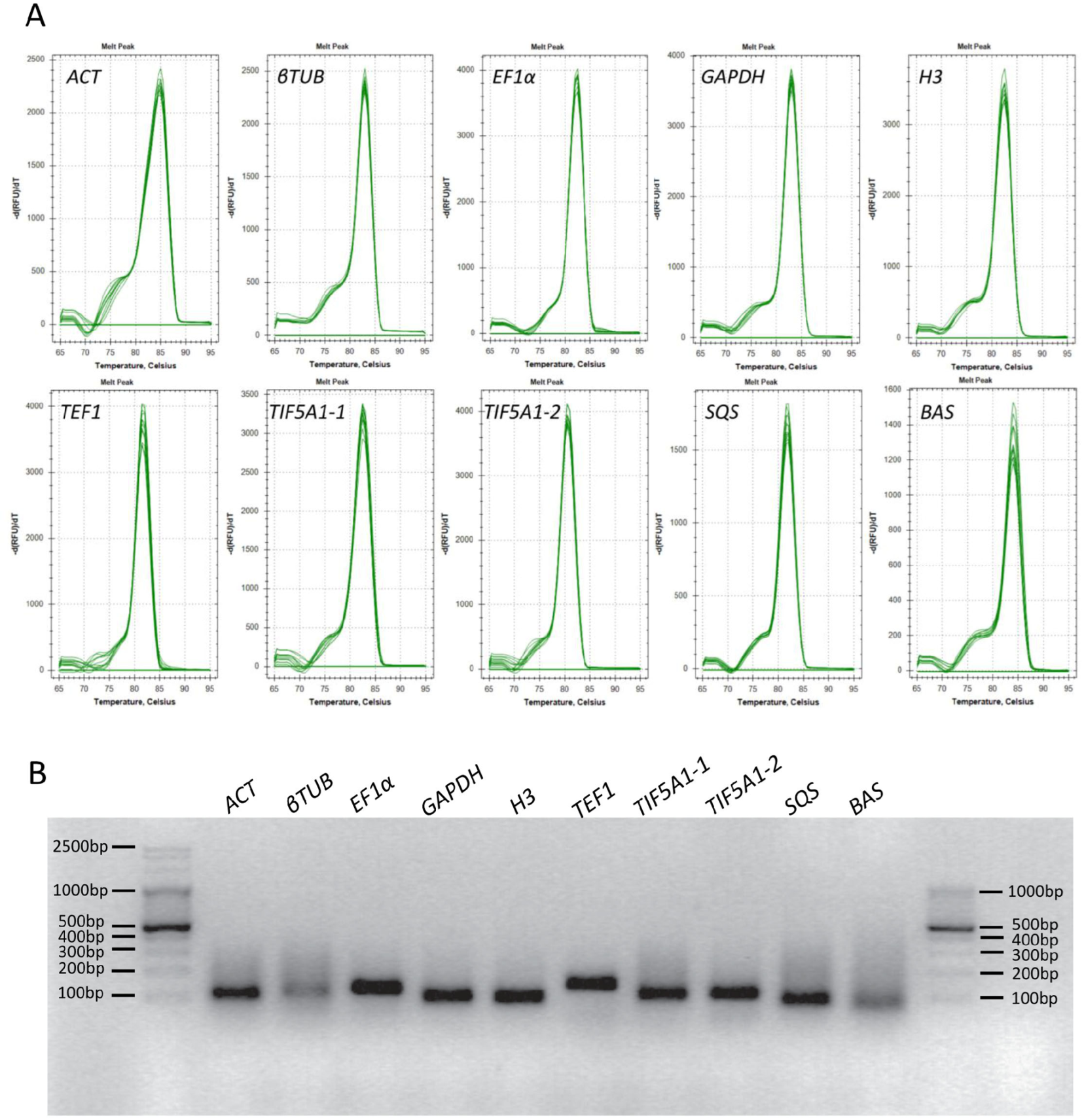
Primer specificity and amplification efficiency (E) were confirmed through melting and standard-curve analysis, respectively. As depicted in Figure 1A, melt-curve analysis revealed a single peak for each candidate reference gene, indicating highly specific amplification. Agarose gel electrophoresis confirmed that each primer pair produced a single amplicon within the expected size range (86–149 bp) (Figure 1B). No non-specific bands or primer dimers were detected.
Figure 1.
Primer specificity of candidate reference genes verified by melting curve analysis shown using Bio-Rad CFX Maestro 1.1 software (version 4.1.2433.1219) (A) and 2% agarose gel electrophoresis (B). Amplicon sizes were estimated against mass markers: PerfectTM 100 bp DNA Ladder (EURx, Gdansk, Poland) (left) and PerfectTM 100–1000 bp DNA Ladder (EURx, Gdansk, Poland) (right).
Amplification efficiencies ranged from 96% (H3) to 117% (TIF5A1-1), while correlation coefficients (R2) values spanned 0.991–0.999. These results demonstrated that all primer sets have suitable specificity and efficiency for subsequent qRT-PCR analyses. Primer sequences, amplicon lengths, empirically established efficiencies, and R2 values are provided in Table 1.
Table 1.
qPCR primers used in this study.
All candidate reference gene primers exhibited high specificity and acceptable amplification performance, confirming their suitability for qRT-PCR analyses.
2.2. Expression Profiles of Candidate Reference Genes
The expression consistency of the seven candidate reference genes across A. githago organs and under diverse growth and stress conditions was evaluated based on cycle threshold (Ct) values obtained via qRT-PCR. As Ct values are inversely related to transcript abundance, lower Ct values correspond to higher gene expression.
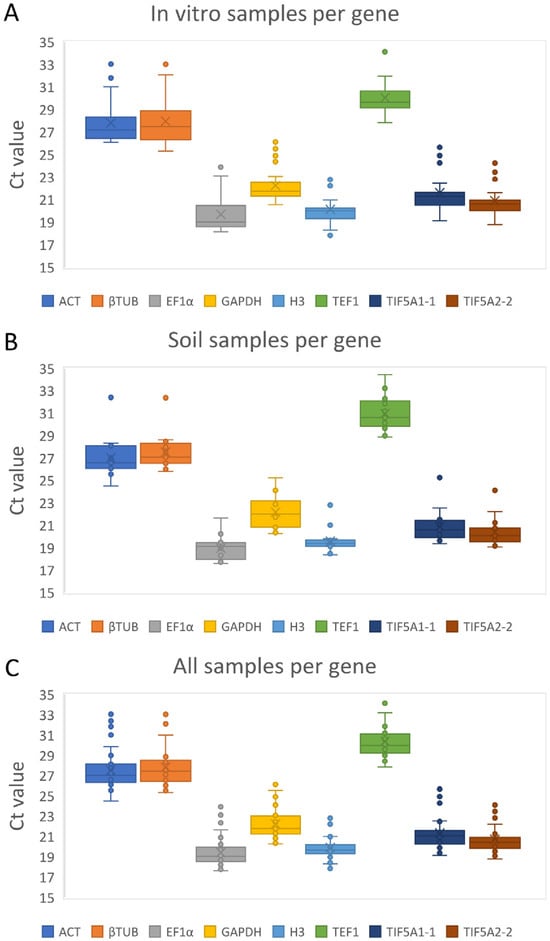
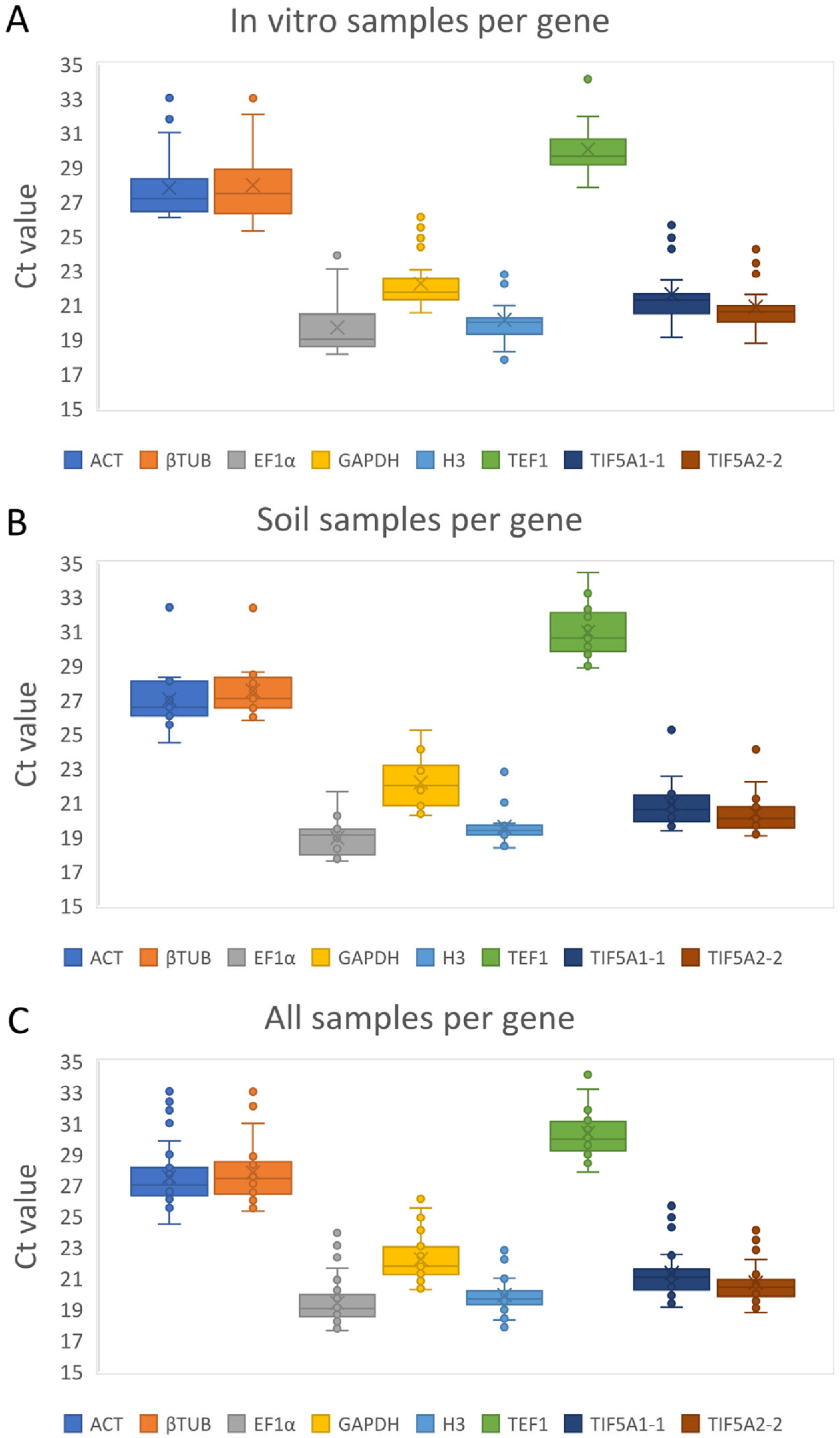
Across all samples, Ct values ranged from 17.61 to 34.48. Mean Ct values spanned from 19.43 for EF1α, indicating its highest transcript abundance, to 30.39 for TEF1, reflecting comparatively low expression. This overall pattern was consistent when in vitro and soil-grown samples were analyzed independently (Supplementary Table S1).
Box-plot visualizations of Ct distributions (Figure 2) illustrate expression variation among samples. Genes exhibiting narrow Ct dispersion were considered more stable. H3 and TIF5A1-2 displayed the lowest variation, indicating highly consistent expression across all tested conditions, whereas βTUB, GAPDH, and TEF1 showed the greatest variability.
Figure 2.
Expression levels of seven candidate reference genes across in vitro and soil cultivated A. githago, presented as cycle threshold (Ct) values. Distribution of mean Ct values of seven genes (represented by eight primer pairs) per in vitro cultured experimental samples (A), in soil-grown samples (B) and in all A. githago samples (C). For each boxplot, the average (diagonal cross), median (horizontal line), interquartile range (boxes: 25th to 75th percentile), and range (whiskers: minimum to maximum) are displayed, illustrating variation in transcript abundance across samples.
Within in vitro cultures, H3, followed by TIF5A1-2 and TIF5A1-1, demonstrated the highest expression stability. In contrast, βTUB and ACT were the least stable and, together with GAPDH, exhibited the highest Ct values. In soil-grown plants, H3 again showed the greatest expression stability, while TEF1 and GAPDH displayed broader Ct dispersion, indicating reduced stability. Notably, TEF1 consistently produced the highest Ct values among all candidate genes, clearly distinguishing it as the least abundantly expressed.
Our results show that genes traditionally regarded as stably expressed exhibit substantial differences in transcript abundance under the conditions of our experiment. Across all organs and experimental conditions, H3 and TIF5A1-2 exhibited the most consistent Ct values and highest expression stability, whereas βTUB, GAPDH, and TEF1 showed substantial variability, with TEF1 consistently displaying the lowest transcript abundance and poorest stability.
2.3. Expression Stability Assessment
Given substantial variation in expression levels among candidate reference genes across samples, statistical analyses were used to assess and rank their expression stability and determine the optimal number of reference genes required for accurate normalization in gene expression studies.
2.3.1. ΔCt Method
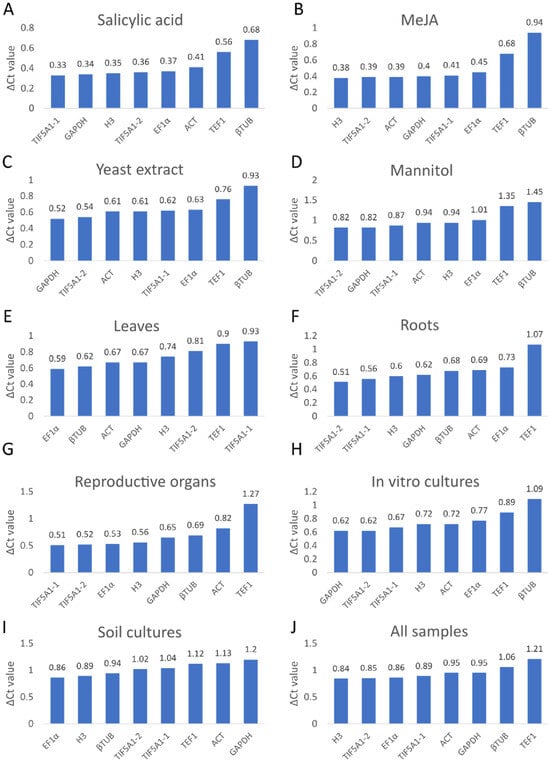
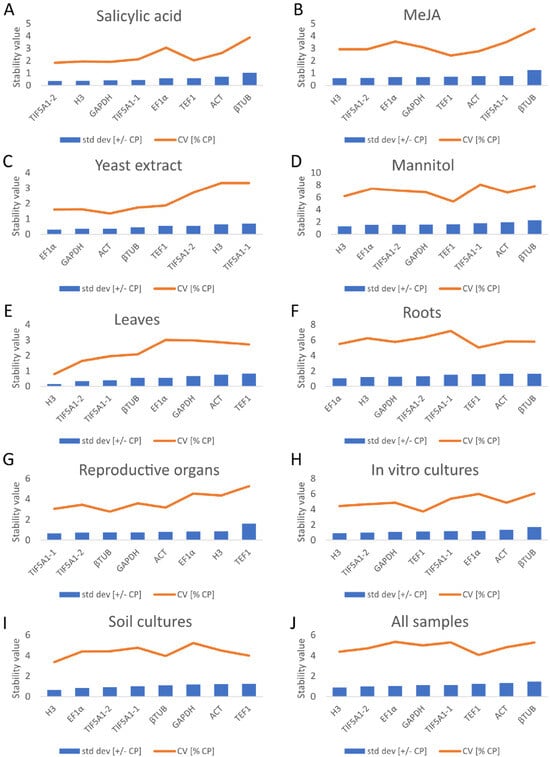
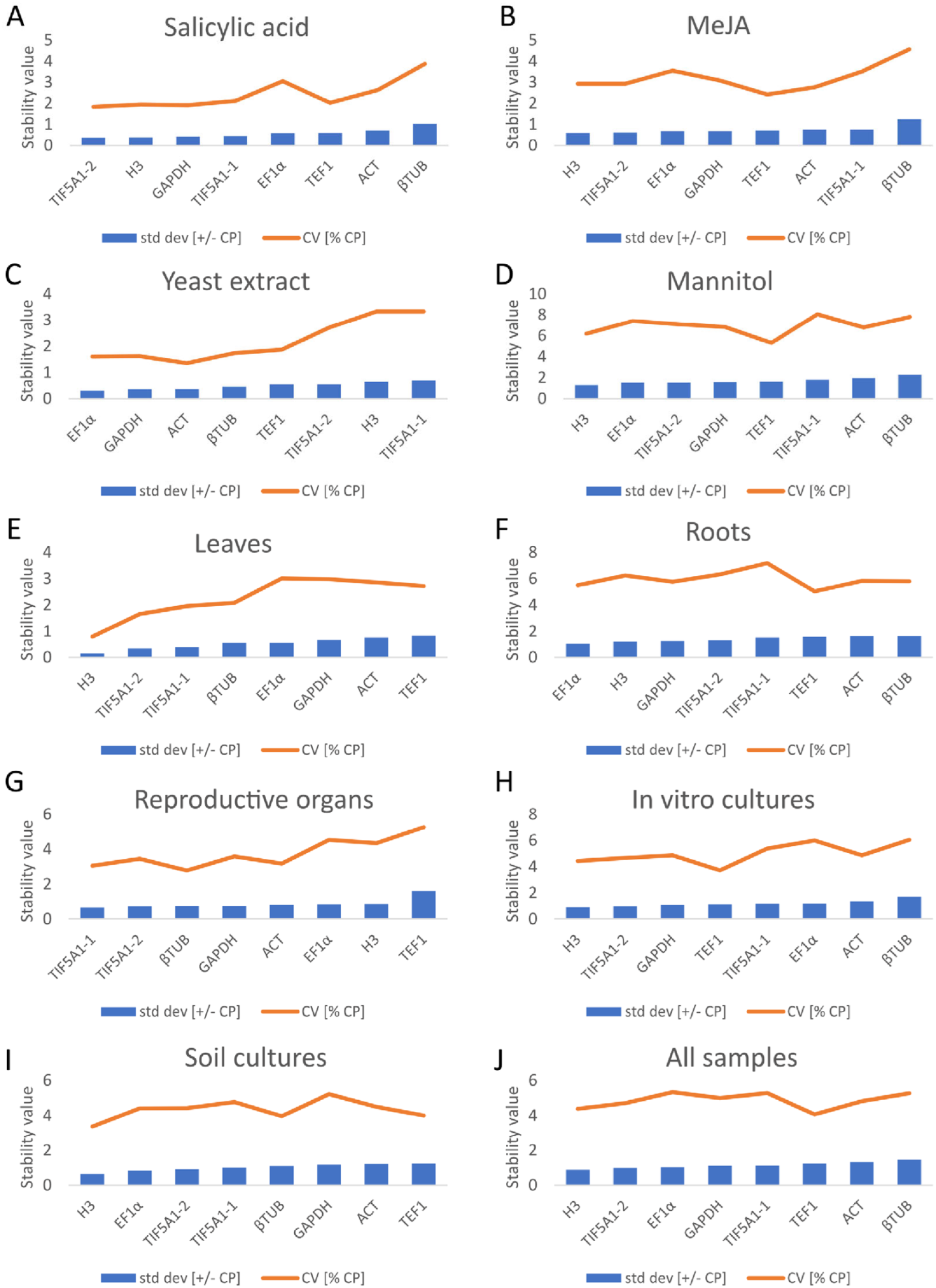
The stability of each candidate reference gene was evaluated using the ΔCt method, in which genes with the lowest average standard deviation across samples are considered the most stable [37]. As shown in Figure 3, differences in stability rankings among successive genes were relatively small, indicating generally high stability across the dataset, although certain genes displayed notably lower variability than others.
Figure 3.
Stability evaluation of seven reference genes analyzed using ∆Ct. In vitro cultured A. githago treated with phytohormones: salicylic acid (A) and methyl jasmonate (B), under a biotic stress with yeast extract (C), under the osmotic stress with mannitol (D), in leaves (E), roots (F) and reproductive organs (G) of soil-grown plants, in all in vitro cultivated samples (H), in all soil-grown samples (I), and in all samples (J). Genes with the lowest average standard deviation across samples are considered the most stable.
Across all A. githago samples, H3 showed the least expression variation and was therefore identified as the most stable reference gene, followed by TIF5A1-2 and EF1α. In soil-grown plants, TIF5A1-1 and TIF5A1-2 were the most stable in roots and reproductive organs, whereas in leaves EF1α and βTUB exhibited the lowest variability. In contrast, within in vitro cultures, GAPDH and TIF5A1-1, followed closely by TIF5A1-2, produced the lowest ΔCt values, indicating the highest stability under these conditions.
Stability patterns also varied across treatment regimes. TIF5A1-1 was the most stable under salicylic acid (SA) treatment, H3 under methyl jasmonate (MeJA) treatment, GAPDH under yeast extract (YE) treatment, and TIF5A1-2 under mannitol (MN) treatment. Notably, mannitol-treated samples, as well as soil-grown samples overall, exhibited greater variability in ΔCt values than other groups.
Using the ΔCt method, H3 emerged as the most stable reference gene across all A. githago samples, with stability rankings varying by organ, growth condition, and treatment—highlighting context-dependent performance of candidate genes despite generally high overall expression stability.
2.3.2. GeNorm Analysis
The stability of the seven candidate reference genes was evaluated using the geNorm algorithm, which calculates an average expression stability value (M) based on pairwise comparisons among all genes. Lower M values correspond to greater expression stability, and values below 1.5 are generally considered acceptable for reference gene selection [38]. In this investigation, all genes demonstrated M values below this threshold across all tested conditions, confirming their suitability as reference genes in A. githago (Figure 4). M values were lowest in in vitro samples; however, even in soil-grown plants, all values remained below 1.5, further supporting the appropriateness of the selected candidates and validating their stability as demonstrated by the geNorm analysis.
Figure 4.
The ranking order of reference genes as expression stability values (M) of candidate reference genes calculated by geNorm. In vitro cultured A. githago treated with phytohormones: salicylic acid (A) and methyl jasmonate (B), under a biotic stress with yeast extract (C), under the osmotic stress with mannitol (D), in leaves (E), roots (F) and reproductive organs (G) of soil-grown plants, in all in vitro cultivated samples (H), in all soil-grown samples (I), and in all samples (J). Lower stability values indicate higher expression stability; values below 1.5 are considered acceptable for reference gene selection.
geNorm analysis showed that all seven candidate reference genes exhibited acceptable expression stability (M < 1.5) across all tested conditions, confirming their suitability for qRT-PCR normalization in A. githago.
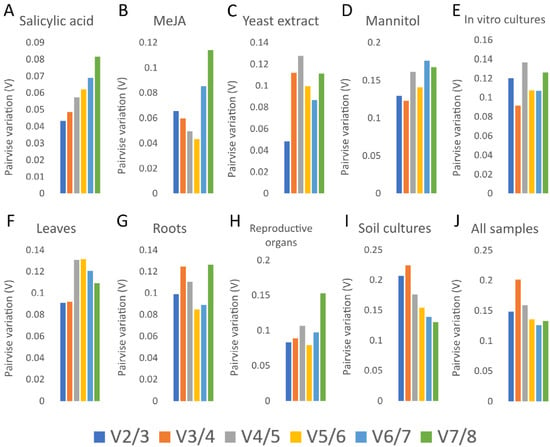
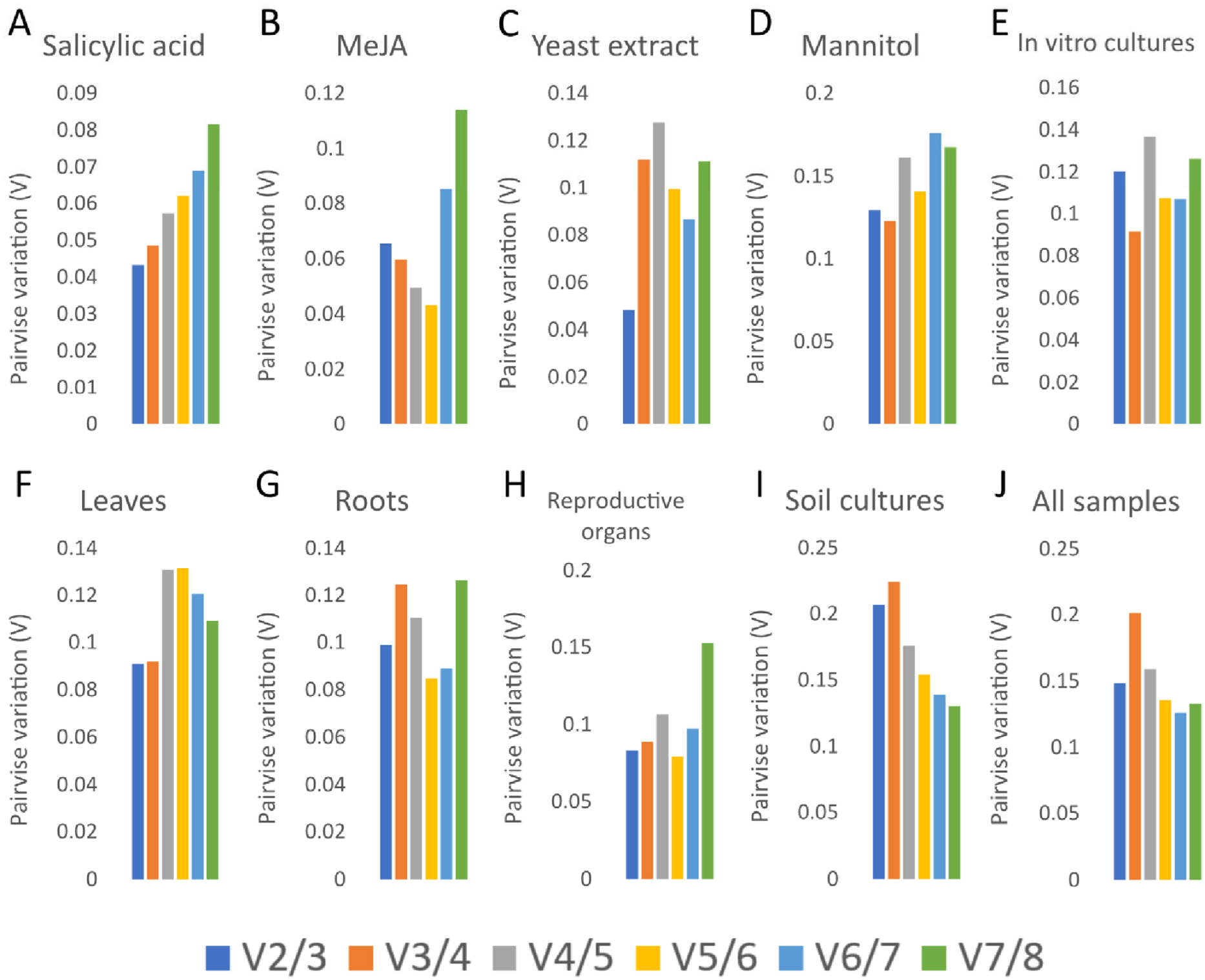
In addition to ranking gene stability, geNorm was also used to determine the optimal number of reference genes required for accurate normalization. This analysis relies on calculating pairwise variation (Vn/Vn+1) between consecutive normalization factors (NF). A commonly accepted threshold of V < 0.15 is used to determine whether including an additional reference gene provides a meaningful improvement in normalization accuracy.
The analysis of all 40 cDNA samples indicated that including a third reference gene would not substantially enhance normalization accuracy, as the pairwise variation value V2/3 was 0.149, which meets the cut-off (<0.15) (Figure 5) (Supplementary Table S2). For the remaining analyses—across individual organs and under various growth and stress conditions—a similar trend was observed, indicating that adding a third reference gene would not meaningfully improve normalization accuracy. An exception occurred in the analysis of all soil-grown plants, where V5/6 = 0.154 and V6/7 = 0.139. These values suggest that six reference genes are adequate, as the inclusion of the seventh gene provides only a marginal improvement in normalization.
Figure 5.
Pairwise variation (V) of seven candidate reference genes calculated by geNorm. Vn/Vn+1 values were used to determine the optimal number of reference genes; a threshold of V < 0.15 is used to assess whether inclusion of an additional reference gene results in a meaningful improvement in normalization accuracy. In vitro cultured A. githago treated with phytohormones: salicylic acid (A) and methyl jasmonate (B), under a biotic stress with yeast extract (C), under the osmotic stress with mannitol (D), in all in vitro cultivated samples (E), in leaves (F), roots (G) and reproductive organs (H) of soil-grown plants, in all soil-grown samples (I), and in all samples (J).
2.3.3. NormFinder Analysis
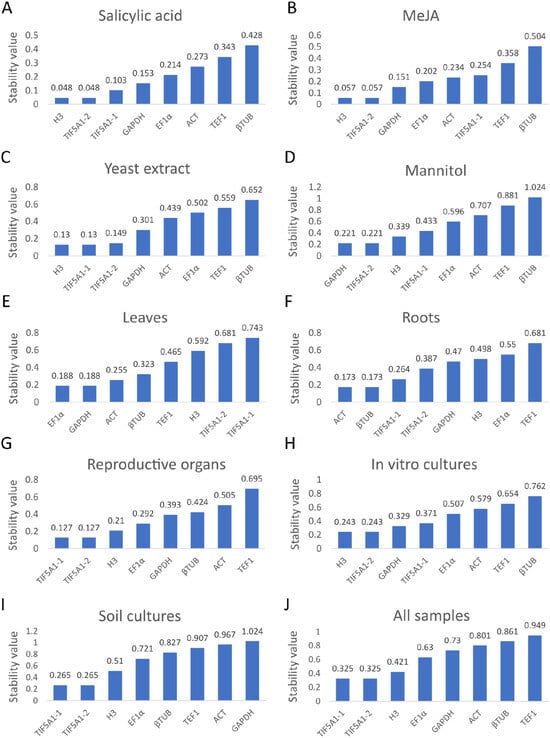
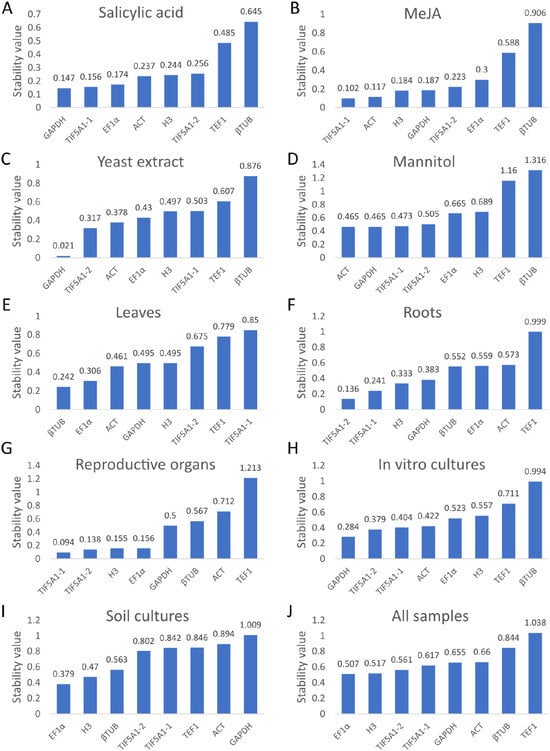
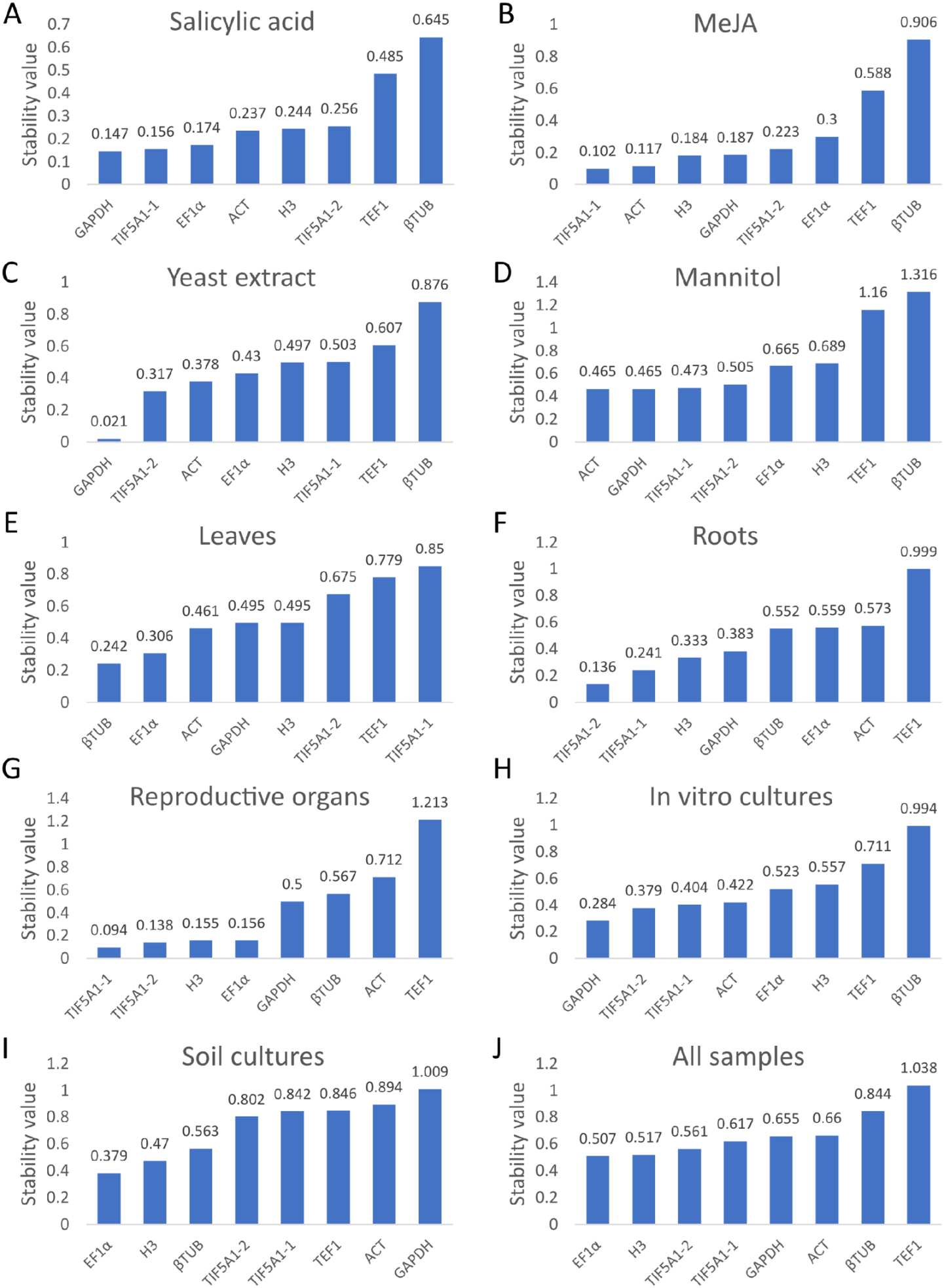
To validate the geNorm results, the stability of the candidate reference genes was re-assessed using NormFinder. This model-based algorithm calculates an expression stability value (S) for each gene by quantifying both intra- and inter-group variation [39]. Prior to analysis, Ct values are transformed into relative expression levels, as required by the method. Lower S values correspond to higher expression stability and thus greater suitability as reference genes. In contrast to geNorm, which is based on pairwise comparisons, NormFinder uses an analysis of variance (ANOVA) framework to estimate variability and directly identify the most stable genes across defined sample groups.
The NormFinder analysis revealed substantial variation in reference gene performance across tissues and experimental conditions. When all samples were evaluated collectively, EF1α (S = 0.507) and H3 (S = 0.517) were identified as the most stable genes, indicating their suitability as broadly applicable reference genes (Figure 6). In leaf tissue, βTUB (S = 0.242) and EF1α (S = 0.306) exhibited the highest stability, whereas in roots, TIF5A1-2 and TIF5A1-1 (S = 0.136 and 0.241, respectively) were the most stable. A similar pattern was observed in reproductive organs, where TIF5A1-2 and TIF5A1-1 again ranked highest (S = 0.138 and 0.094), both showing exceptionally low S values.
Figure 6.
The ranking order of reference genes as expression stability values (M) of candidate reference genes calculated by NormFinder. In vitro cultured A. githago treated with phytohormones: salicylic acid (A) and methyl jasmonate (B), under a biotic stress with yeast extract (C), under the osmotic stress with mannitol (D), in leaves (E), roots (F) and reproductive organs (G) of soil-grown plants, in all in vitro cultivated samples (H), in all soil-grown samples (I), and in all samples (J). Lower stability values indicate higher expression stability.
Across all in vitro samples, GAPDH (S = 0.284) showed the greatest stability, followed closely by TIF5A1-2 (S = 0.379) and TIF5A1-1 (S = 0.404). Under SA treatment, GAPDH (S = 0.147) and TIF5A1-1 (S = 0.156) were the most stable, while TIF5A1-1 (S = 0.102) and ACT (S = 0.117) ranked highest under MeJA treatment. In yeast extract–treated samples, GAPDH (S = 0.021) and TIF5A1-2 (S = 0.317) were the most stable. In contrast, under mannitol stress, both ACT and GAPDH exhibited relatively high S values (S = 0.465), suggesting reduced stability in this condition.
Notably, βTUB consistently demonstrated poor stability across in vitro samples, and TEF1 across different organs in soil-grown plants, indicating that these genes are less suitable as reference genes for normalization in A. githago according to the NormFinder analysis.
NormFinder analysis revealed pronounced tissue- and condition-dependent differences in reference gene stability, identifying EF1α and H3 as the most stable overall, while highlighting TIF5A1-1, TIF5A1-2, and GAPDH as condition-specific top performers and confirming βTUB and TEF1 as the least suitable reference genes in A. githago.
2.3.4. BestKeeper Analysis
BestKeeper evaluates reference gene stability through the calculation of standard deviation (SD) and coefficient of variation (CV) of Ct values, where lower values denote greater stability. In addition, it computes Pearson correlation coefficients (r) between each candidate gene and the BestKeeper index, defined as the geometric mean of all tested reference genes. Genes are ranked by increasing SD, with SD ≤ 1 indicating high expression stability [40]. This descriptive statistical approach provides a complementary perspective to geNorm and NormFinder, offering additional validation for the selection of stable reference genes.
The BestKeeper analysis revealed that H3 (SD = 0.88; CV = 4.39%) and TIF5A1-2 (SD = 0.98; CV = 4.71%) were the most stable genes overall (Figure 7) (Supplementary Table S3). EF1α also showed low variability (SD = 1.03; CV = 5.33%), supporting its suitability for normalization. In contrast, across all samples, βTUB (SD = 1.46; CV = 5.27%) and ACT (SD = 1.33; CV = 4.82%) were identified as the least stable genes.
Figure 7.
Stability evaluation of reference genes calculated by BestKeeper; with SD ≤ 1 indicating high expression stability. In vitro cultured A. githago treated with phytohormones: salicylic acid (A) and methyl jasmonate (B), under a biotic stress with yeast extract (C), under the osmotic stress with mannitol (D), in leaves (E), roots (F) and reproductive organs (G) of soil-grown plants, in all in vitro cultivated samples (H), in all soil-grown samples (I), and in all samples (J).
Gene stability varied considerably across soil-grown tissues. In leaf samples, H3 (SD = 0.15; CV = 0.8%) and TIF5A1-2 (SD = 0.33; CV = 1.66%) exhibited the highest stability, although all genes met the stability criterion (SD ≤ 1). In roots, EF1α (SD = 1.06; CV = 5.51%) was the most stable, yet still borderline, and the remaining genes showed higher variability and may be unsuitable for normalization. In reproductive organs, TIF5A1-1 (SD = 0.66; CV = 3.05%) ranked as the most stable gene, whereas only TEF1 exceeded the SD cut-off.
Stress-specific analyses further highlighted the importance of condition-dependent selection of reference genes. H3 and TIF5A1-2 were the most stable genes under salicylic acid and methyl jasmonate treatments, while βTUB was consistently the least stable (SD > 1). Under yeast extract treatment, all genes displayed strong stability, with the best performance from EF1α (SD = 0.3; CV = 1.6%) and GAPDH (SD = 0.35; CV = 1.62%). In contrast, mannitol-stressed samples showed the highest variability, with H3 exhibiting the lowest stability values (SD = 1.29; CV = 6.19%).
Overall, the BestKeeper results demonstrate that reference gene stability is strongly influenced by tissue type, growth conditions, and stress treatment. TIF5A1-2, GAPDH, H3, and EF1α consistently ranked among the most stable genes across multiple conditions and are therefore recommended for normalization, whereas βTUB and TEF1 showed high variability and should be avoided, according to BestKeeper analysis.
2.3.5. Comprehensive Stability Ranking
Across all samples, H3 was identified as the most stable reference gene (Geomean = 1.57), making it the strongest candidate for general normalization across different A. githago tissues and growth conditions (Table 2; Supplementary Table S4). It was closely followed by TIF5A1-2 (1.86), which also serves as a reliable option for broad-scale expression studies. In contrast, βTUB (7.24) and TEF1 (7.44) showed the lowest stability overall and should be avoided due to their inconsistent expression profiles.
Table 2.
Comprehensive stability rankings of candidate reference genes as determined by RefFinder across individual treatments and growth conditions.
In soil-grown plants, EF1α (1.68) and H3 (1.86) were ranked as the most stable genes, while GAPDH, ACT, and TEF1 (7.44, 7.24, and 6.45, respectively) showed poor stability under these conditions. Organ-specific analyses produced slightly different stability rankings: EF1α (1.78) demonstrated the highest stability in leaves, while TIF5A1-1 (1.0) and TIF5A1-2 (2.0) were the most stable in reproductive organs and roots. However, all tissue-specific analyses consistently identified TEF1 as the least stable gene, confirming its unsuitability for normalization in soil-cultivated plants.
In in vitro cultures and under various stress treatments, TIF5A1-1, TIF5A1-2, H3, and GAPDH were identified as the most reliable reference genes across the analyses. Conversely, βTUB consistently exhibited the lowest stability, thereby reaffirming its exclusion from normalization under these conditions.
Overall stability analyses consistently identified H3 and TIF5A1-2 (together with EF1α in soil-grown plants and TIF5A1-1/GAPDH for in vitro and stress conditions) as the most reliable reference genes for qRT-PCR normalization in A. githago, whereas βTUB and TEF1 showed poor stability across multiple datasets and therefore should be avoided as general normalizers.
2.4. Evaluation of Candidate Reference Genes for Expression Analysis in A. githago
To evaluate the reliability of the selected reference genes, we examined the expression patterns of squalene synthase (SQS) and β-amyrin synthase (BAS) across different experimental stress conditions and various organs of soil-grown plants.
These genes encode essential enzymes involved in triterpene and sterol biosynthesis, facilitating key steps in transforming farnesyl pyrophosphate into complex plant metabolites. SQS catalyzes the initial committed step, condensing two farnesyl pyrophosphate molecules to produce squalene A [41]. β-amyrin synthase then converts squalene-derived intermediates into β-amyrin, a precursor of triterpene saponins [42].
These enzymes can be induced by elicitors like methyl jasmonate, indicating they have adaptive functions in plant metabolism [43].
Based on RefFinder rankings, the two most stable and one most unstable reference genes were used to normalize SQS and BAS expression data. The performance of these reference genes was evaluated to determine their suitability for accurate gene expression analysis in different growth conditions.
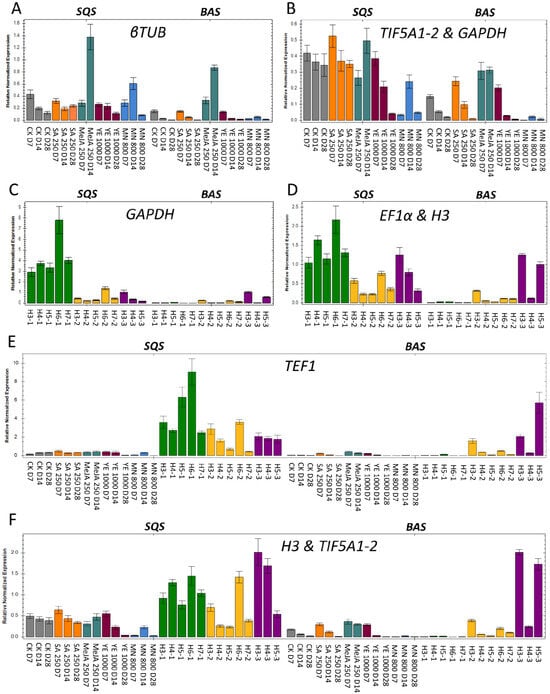
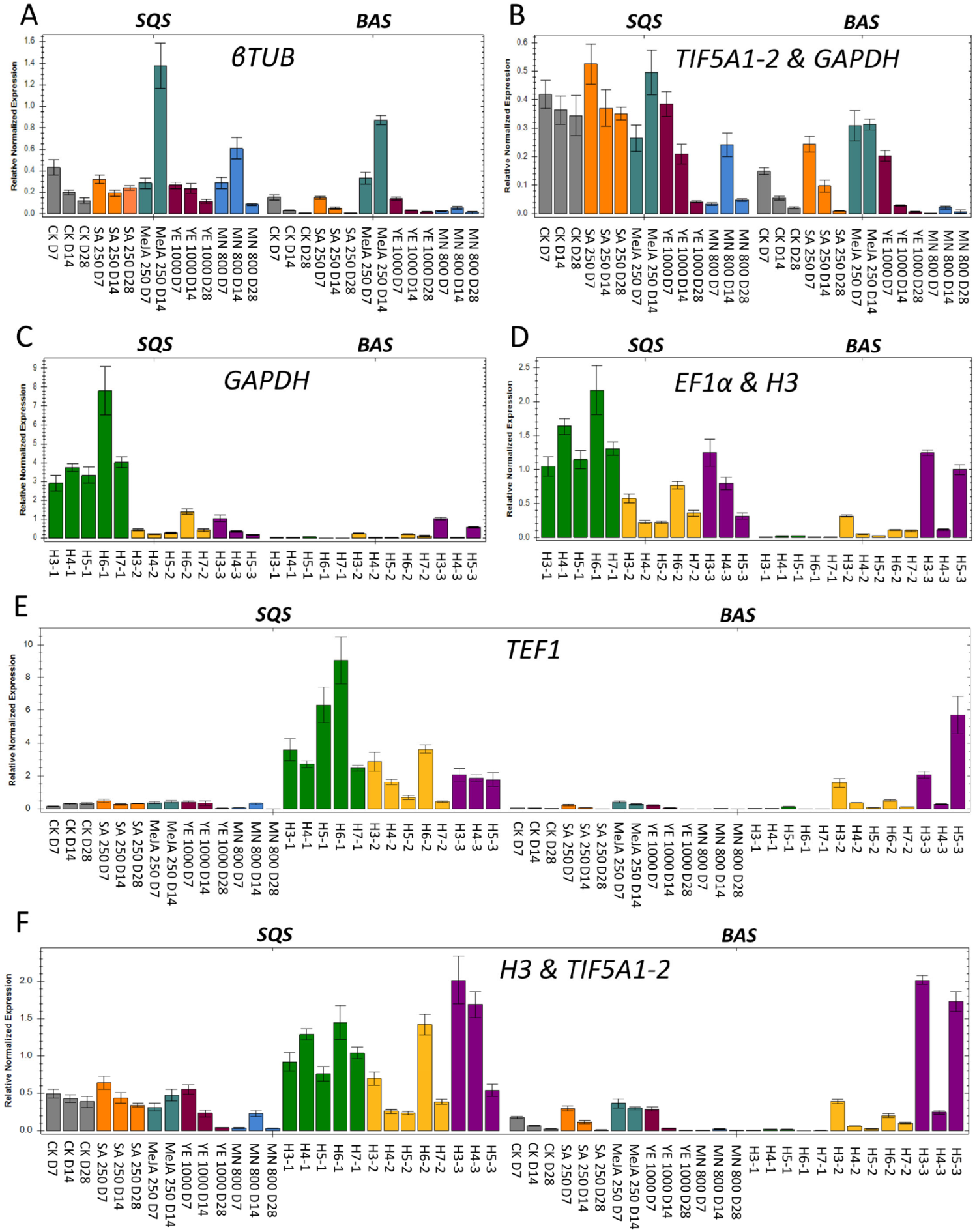
As shown in Figure 8, the expression patterns of SQS and BAS were consistent and biologically reasonable when normalized using the stable reference genes. In contrast, normalization with the unstable reference genes, resulted in markedly altered expression profiles characterized by inflated variability between plant organs and various conditions and inconsistent trends. These discrepancies underscored the importance of reference gene stability in interpreting qPCR data. The results highlighted that the use of unreliable reference genes can distort target gene expression and compromise experimental accuracy, further validating the selection of H3 and TIF5A1-2 as appropriate normalizers in A. githago.
Figure 8.
Relative expression levels of target genes SQS and BAS in A. githago cultivated in vitro (A,B), in soil-grown (C,D) and in all plant samples (E,F). A combination of the most stable reference genes (B,D,F) and the most unstable gene (A,C,E) were selected for normalization. Error bars show the standard error calculated from three biological replicates. CK, control; SA, salicylic acid; MeJA, methyl jasmonate; YE, yeast extract; MN, mannitol; D7, day 7; D14, day 14; D28, day 28; H, harvest. H3-1–H7-1—leaves; H3-2–H7-2—roots; H3-3–H5-3—reproductive organs.
3. Discussion
Housekeeping genes are traditionally defined by evolutionary conservation, stable expression, involvement in essential cellular functions and core maintenance processes, and thus were assumed to be expressed regardless of tissue, developmental stage, or environmental condition [44]. However, many studies have shown that the expression of housekeeping genes varies across tissues, developmental stages, treatments, environmental contexts, and species [45,46,47]. Consequently, rigorous evaluation of reference gene stability is crucial for reliable qPCR normalization [46,48] and the use of multiple validated reference genes is increasingly recommended to enhance the accuracy of gene expression analyses [28,49].
Relying on prior results published for Caryophyllaceae [50,51,52], we have selected seven housekeeping genes to study their expression stability in A. githago. We have omitted genes with insufficiently supported homology among the contig sequences of A. githago transcriptome [32]. We also excluded the gene encoding the 18S rRNA subunit from our analysis, as our goal was to identify universal corn cockle reference genes that are not influenced by variations in the rRNA to mRNA ratio across samples or experimental groups and that remain suitable for normalization regardless of the RNA purification method or cDNA synthesis protocol [10,52].
In this study, we assessed the expression stability of seven putative reference genes across multiple organs and cultivation conditions of A. githago using four widely employed algorithms: ΔCt, geNorm, NormFinder, and BestKeeper. To obtain an integrated ranking, the outputs of these individual methods were consolidated with the RefFinder tool, which computes a weighted geometric mean to generate a consensus assessment. By combining multiple statistical approaches, this strategy minimizes method-specific biases and yields a more reliable evaluation of reference gene performance.
Each algorithm offered distinct perspectives on reference gene performance. The ΔCt approach, which evaluates the uniformity of Ct differences between gene pairs across samples, identified H3 as the most consistently expressed candidate in all datasets, followed closely by TIF5A1-2 and EF1α. This result underscores its strong suitability as a broadly applicable reference gene for A. githago. The geNorm algorithm, which ranks candidates based on pairwise comparisons and calculates M-values, confirmed the suitability of all evaluated genes as appropriate normalizers in all tested organs and conditions. This general good performance of housekeeping genes tested in this work might result from earlier preselection or gene candidates, which has been performed based on published data in Caryophyllaceae [50,51,52]. However, when the geNorm was used to determine the optimal number of reference genes required for an accurate normalization, a minimal number of two genes was indicated, when analyzing all 40 cDNA samples. Except for soil-cultivated plants, it was proved that adding a third reference gene would not meaningfully improve normalization accuracy. Reassessment of the candidate genes stability performed by NormFinder revealed substantial variation in their performance across plant organs and cultivation conditions, however, collective evaluation of all 40 samples identified the EF1α and H3 as the most stable. Complementary analysis done by BestKeeper revealed the highest expression stability of H3 and TIF5A1-2 followed by EF1α, indicating their suitability as broadly applicable reference genes.
A combined ranking from four algorithms presented by RefFinder identified H3 as the most stable reference gene across all analysed A. githago samples. A similarly high level of stability was observed for TIF5A1-2, underscoring its potential as an additional dependable reference gene for comprehensive expression analyses in corn cockle. In contrast, βTUB and TEF1 showed the lowest stability overall and are not recommended as suitable normalizers.
The ranking of genes, however, differed when performed for selected groups of samples. Across in vitro cultures and multiple stress treatments, TIF5A1-1, TIF5A1-2, H3, and GAPDH consistently emerged as the most stable reference genes. In contrast, βTUB showed the poorest stability in all in vitro analyses, confirming that it is unsuitable for normalization under these conditions. In soil-grown plants, EF1α and H3 were ranked as the most stable genes, while GAPDH, ACT, and TEF1 were the least stable and hence unsuitable for normalization in soil-grown plants. Notably, GAPDH expression variability changed drastically depending on the cultivation conditions, resulting in either high or poor suitability of this gene as a reference in in vitro or soil-based experiments, respectively.
Based on the comprehensive ranking, we propose to employ the combination of TIF5A1-2 and GAPDH as reliable reference genes in in vitro experiments and the combination of the EF1α and H3 in the applications were various organs and developmental stages are of interest in the soil-cultivated A. githago. As universal reference genes in corn cockle we propose the combination of H3 and TIF5A1-2 as these two genes presented superior stability in terms of expression level across all analysed A. githago samples, regardless of the plant organ, developmental stage and cultivation conditions. Our analysis confirmed and aligns with previous recommendations that distinct reference genes should be selected for different sample types and experimental conditions [27,28].
To validate the selected reference genes, we analyzed the expression profiles of SQS and BAS, two key enzymes in the triterpenoid saponin pathway. Normalization with the top-ranked reference genes, whether suitable for the specific cultivation conditions or universal, yielded consistent and biologically meaningful expression patterns across plant organs and experimental conditions. In contrast, using unstable reference genes generated irregular profiles and inflated variability. These results again confirm and are in line with previous findings that an inappropriate reference gene choice might lead to a biased understanding of qRT-PCR results [30] and mask the true nature of gene expression [53].
Additionally, the gene identity of the transcriptome-derived contigs [32] has been confirmed and linked with the recently annotated reference genome of A. githago (assembly dcAgrGith1.1) [36]. Several candidate reference genes mapped to multiple highly similar transcripts in the dcAgrGith1.1 genome assembly, frequently exhibiting near-complete sequence identity (Supplementary Table S7). Notably, many of these alignments correspond to alternative transcript isoforms derived from the same genomic locus rather than to distinct gene copies, reflecting alternative splicing events and redundancy in the current transcript model annotation. However, for two candidates, ACT and βTUB, the BLAST-based transcript assignment suggested that mapped transcripts may originate from more than one genomic locus.
In general, genes represented by multiple gene copies are not ideal reference genes for qRT-PCR, as individual gene copies might by differentially regulated resulting in ambiguous transcript quantification. This might correlate with the fact that both ACT and βTUB were often found as moderately or least stable under the conditions of our experiment (Table 2). If this was the case, it constitutes a further rationale for excluding ACT and βTUB from use as reference genes for qRT-PCR analyses.
On the other hand, in plants, many genes with fundamental cellular functions or broad expression patterns are organized into multigene families, and disabled copies of these genes are often preserved as pseudogenes originating from duplicated paralogs [54,55,56,57]. This includes also the nuclear 35S/45S rDNA (encoding 18S-5.8S-26S rRNAs) which occurs as tandemly repeated arrays with hundreds to thousands of copies in plant genomes [58]. Despite that, 18S rRNA sequences are still being proposed as internal controls for molecular analyses in various plants, including species of medicinal importance [59,60,61,62].
In summary, for qRT-PCR normalization, it is generally recommended to prioritize single-copy genes with well-defined gene models and to empirically validate their stability under the specific experimental conditions.
The integrated RefFinder analysis provides practical, context-specific recommendations for reference gene selection. Its user-friendly interface and incorporation of multiple algorithms have contributed to its broad adoption. A key strength of RefFinder is its ability to generate a consensus ranking through a weighted geometric mean, thereby increasing confidence in identifying stable reference genes. However, as with other closed-source algorithms, RefFinder has several notable limitations, which we have described in detail in our previous publication on Reynoutria, the genus belonging to the Caryophyllales order and Polygonaceae family, therefore more distantly related than Caryophyllaceae family species [19]. Its opacity limits user customization, complicates troubleshooting, and may reduce suitability for certain datasets. Despite these caveats, RefFinder remains a valuable and widely used tool for strengthening qPCR normalization through multifactorial evaluation of reference gene stability [17,63,64,65,66,67].
One of the rarely studied factors that might also influence the baseline gene expression are diurnal or circadian fluctuation. In quinoa, a distant relative from the Amaranthaceae, two other genes—Polypyrimidine tract-binding protein (PTB) and Isocitrate dehydrogenase (IDH-A) were designated suitable as reference for diurnally regulated genes during a circadian cycle to avoid misinterpretation [68]. In our study, this issue has not been considered since the targeted genes were related to terpenoid pathway, while other potential targets represent phenylpropanoid pathway and RIP expression all of which that are rather stress and development associated than typical diurnally regulated genes. Nonetheless, to avoid additional variation, the plant material was collected during the morning hours.
In relation to the few previous studies on the other Caryophyllaceae, several genes can be suggested as preferred reference candidates, but the stability was not consistent under different experimental conditions and between the different tissues or genotypes. In Silene vulgaris [52] SvACT (actin) and SvGAPDH (glyceraldehyde-3-phosphate dehydrogenase) exhibited the lowest expression variability of the twenty genes across all tested tissues and organs, including pollen as well as between female and hermaphroditic plants. However, no varied conditions nor treatments were applied in the above study. Similarly, Rodriguez-Parra et al. [51] tested thirteen genes in Dianthus broteri organs and four ploidy levels and suggest that TIP41 and TIF5A should be used when both petal and leaf tissues and various ploidy levels are to be compared. Unlike in S. vulgaris, GAPDH was unsuitable showing differential expression among cytotypes. In Dianthus caryophyllus, twelve candidate genes were tested by Yu et al. [50] in vegetative and generative organs as well as in leaves and roots under a set of stress treatments, such as: osmotic, salt, temperature, Cu2+ and Cr3+ ions, and exogenous plant growth regulators (auxin, cytokinin, ABA and gibberellin). The stability of candidate genes varied across tested tissues and treatments. As a result, several pairs of reference genes were recommended, depending on experimental conditions and organs, including EF1α, UBQ1, CYP, TUB, TIP41, TIF5A, PP2A. Hence, in carnations, each experimental set-up requires careful selection of the most suitable reference genes.
Much more studies have been published on more distant relatives, representing various families of the Caryophyllales order, such as Amaranthaceae, e.g., pseudocereals quinoa [13], amaranth [69] and several halophytes—Halostachys, Salicornia, Salsola, Suaeda [70,71,72,73] with the main aim of validating salt and drought stress response and developmental variation research. Again, these studies align with the main conclusion that there are no universal reference genes that would fit most needs in various experimental designs and different models.
Thus, even the closely related species can vary significantly in stability of candidate reference genes. This underscores the imperative for rigorous validation of candidate reference genes for each unique experimental setup and organism.
In conclusion, our study offers a thorough assessment of candidate reference genes for accurate qPCR normalization in A. githago. Reference gene stability varied markedly across plant organs and cultivation conditions, emphasizing the need for experiment-tailored selection of gene expression normalizers. By integrating multiple analytical approaches, we identified reference genes suitable for broad application as well as for conditions- and organ-specific normalization. These results will provide a basis for reliable gene expression studies in A. githago and support future research on the molecular regulation of secondary metabolism and stress responses in this medicinally important plant species.
4. Materials and Methods
4.1. Plant Material
Seeds of wild-type, open-pollinated A. githago were obtained from the certified collection of the Botanical Garden of Medicinal Plants at the Wroclaw Medical University, Poland (51.11736° N, 17.07486° E) operating under the Ministry of Environment accreditation No. DOPogiz-4210-26-6024-/05/kL).
The plants were grown in 15 diameter pots with soil, in glasshouse conditions. A voucher specimen with assigned number P-146 was deposited in the Botanical Garden herbarium.
In vitro cultures were initiated from surface-sterilized seeds treated with 5% sodium hypochlorite, rinsed three times with distilled water. Seeds were sown on basal Murashige and Skoog (MS) medium [74] supplemented with 3% (w/v) sucrose and solidified with 6 g/L agar (Biocorp, Warsaw, Poland).
Shoot tips of the three-weeks-old aseptic seedlings containing two nodes were excised and transferred to proliferation media supplemented with phytohormones or elicitors of biotic or abiotic stress at varying concentrations. Salicylic acid (SA) or methyl jasmonate (MeJa) were applied at 100 μM and 250 μM; yeast extract (YE) at 250 mg/L and 1000 mg/L; and mannitol at 100 μM and 800 μM. Shoots cultured on basal MS medium without supplementation served as controls.
Cultures were maintained in a growth chamber (POL-EKO, Wodzisław Śląski, Poland) at 25 ± 2 °C under a 16/8 h light/dark photoperiod using white LED lamps (8000–10,000 K) at a photon flux density of 55 μmol/m2s, with 40% relative humidity.
Aerial parts of the plants were harvested after 7, 14, and 28 days of stress treatment, except for MeJa-treated shoots, which did not survive until the final sampling. In total, 25 distinct A. githago samples were collected, representing four stress types, two concentrations each, and three time points, including controls. Each sample comprised six biological replicates. All samples were immediately frozen in liquid nitrogen, homogenized, and subsequently stored at −80 °C for future experiments.
Glasshouse experiment was carried out in Botanical Garden of Medicinal Plants Wroclaw Medical University. Plants were cultivated in pots (15 × 15 cm; 11 L) filled with commercially available soil composed of 85% of organic matter, 2.5 kg/m3 organic fertilizers and 1.25 kg/m3 mineral fertilizers (Canna Terra Professional containing NPK:12/14/24, pH 6.0, EC: 1.1–1.3 mS/cm, product code: 37E5-305D1, CANNA Nederland BV, Breda, The Netherlands) and watered daily. Growing parameters including air and soil temperature, soil pH and air humidity were monitored and recorded daily and are provided in the Supplementary Table S5.
A. githago plants were harvested based on organ type: roots, leaves, flowers and fruits at seven time-points covering the developmental stages throughout the vegetative season. Samples from six individualy grown plants were collected for a study, at each time-point. In total, 15 distinct soil-grown A. githago samples representing different organs and developmental stages were collected. The plant samples were collected during morning hours (between 9 and 11 a.m.). Samples were immediately frozen in liquid nitrogen, homogenized, and subsequently stored at −80 °C for future experiments.
The sample list with detailed description of cultivation type, plant organ and stress conditions as well as a harvest time-point is provided in the Supplementary Table S6.
4.2. RNA Extraction and cDNA Synthesis
Total RNA was extracted using the Plant/Fungi Total RNA Purification Kit (Norgen Biotek Corp., Thorold, ON, Canada) from 50 mg of each sample. RNA purification with DNase treatment (RNase-Free DNase I, Norgen Biotek Corp., Thorold, ON, Canada) was performed using an on-column workflow according to the manufacturer’s protocol. The extracted RNA was assessed for quality and purity by the NanoDrop 2000 spectrophotometer (Thermo Fisher ScientificTM, Waltham, MA, USA). RNA samples with an A260/A280 ratio of 1.9–2.1 and an A260/A230 ratio > 2.0 were used for subsequent cDNA synthesis. RNA was stored at –80 °C to maintain its quality and integrity.
Each cDNA was synthesized from 5 µg of total RNA in a total volume of 40 µL using the iScriptTM Advanced cDNA Synthesis Kit for qRT-PCR (Bio-Rad, Hercules, CA, USA). The initial reaction comprised: 5 µg of total RNA, 8 µL of 5× iScriptTM Advanced Reaction Mix (Bio-Rad, Hercules, CA, USA) (which includes dNTPs, oligo(dT), and random primers), 2 µL of iScriptTM Advanced Reverse Transcriptase (Bio-Rad, Hercules, CA, USA), and nuclease-free water. This mixture was incubated at 46 °C for 20 min, followed by a heating step at 95 °C for 1 min. Subsequently, each cDNA was diluted five times with nuclease-free water to maintain the same range of template concentrations across all samples.
4.3. Selection of Candidate Reference Genes, Genes Related to Saponin Biosynthesis and Primer Design
Seven candidate reference genes—actin, β-tubulin, elongation factor 1α, glyceraldehyde-3-phosphate dehydrogenase, histone H3, translation elongation factor 1, and eukaryotic translation initiation factor 5A1, were selected based on previous studies in carnation species: Dianthus caryophyllus [50] and Dianthus broteri [51].
Nucleotide sequences of these genes were retrieved from the transcriptomic data of A. githago [32]. To confirm gene identity and link transcriptome-derived contigs to the reference genome, we performed BLASTN searches against a custom cDNA database derived from the annotated A. githago reference genome (assembly dcAgrGith1.1) generated within the Darwin Tree of Life project (Ensembl Darwin Tree of Life portal; https://projects.ensembl.org/darwin-tree-of-life/, accessed on 20 December 2025) [36].
All A. githago RNA sequences used in this study were queried with BLASTN (BLAST+ v2.15.0) against the cDNA database, allowing up to 50 target sequences per query (max_target_seqs = 50). For each query, tabular BLAST outputs (outfmt 6: qseqid, sseqid, percentage identity, alignment length, number of mismatches and gaps, query and subject start/end positions, E-value, bitscore and subject annotation) were generated and sorted to select either the single best hit or up to the five highest-scoring hits per sequence. Ranking was based primarily on percentage identity, with bitscore and E-value. In parallel, full BLAST reports (outfmt 0) were produced for the same hit sets to allow inspection of complete pairwise alignments and coverage. BLAST annotation was performed against public NCBI databases without taxonomy restriction (i.e., across all organisms).
The resulting contigs with their BLAST score parameters and nucleotide sequences are provided in the Supplementary Table S7.
Primer pairs were designed using Primer3Plus (https://www.primer3plus.com/, accessed on 21 April 2024) [75]. Primer design parameters were set to a melting temperature of 60 °C, length of 20–22 bp, and ~50% GC content (Table 1). Prior to qRT-PCR assays, each primer pair’s amplification efficiency (E) and specificity were assessed using a ten-fold cDNA dilution series to generate standard curves. Efficiency was calculated as E [%] = (10−1/slope − 1) × 100% [76].
4.4. Quantitative Real-Time PCR
Gene-specific primers (Table 1) were employed to quantify transcript levels from reverse-transcribed cDNA templates. Reactions were carried out in triplicate with a CFX96 Touch Real-Time PCR Detection System (Bio-Rad) using SsoAdvancedTM Universal SYBR Green Supermix® (Bio-Rad, Hercules, CA, USA). The reaction mixture consisted of 5 μL of SsoAdvanced Universal SYBR® Green Supermix (2×), 2 μL of nuclease-free H2O, 1 μL of previously diluted cDNA, and 2 μL of a mix of forward and reverse amplification primers (250 nmol/μL each), resulting in a final volume of 10 μL.
Thermal cycling comprised an initial denaturation at 95 °C for 30 s, followed by 40 cycles of 95 °C for 15 s and 60 °C for 30 s. A subsequent melt-curve analysis was performed from 65 °C to 95 °C at a rate of 0.5 °C per 5 s to verify amplicon specificity.
Primer efficiencies were determined experimentally from a ten-fold cDNA dilution series and incorporated into relative quantification calculations via the Pfaffl method [77]. All stages, from experimental design and RNA isolation through data analysis, complied with the MIQE guidelines for qRT-PCR [5]. Relative expression values are provided in Supplementary Table S1.
4.5. Statistical Data Analysis
Several commonly used algorithms, including ΔCt, BestKeeper, GeNorm, NormFinder, and a web-based tool RefFinder (https://www.ciidirsinaloa.com.mx/RefFinder-master/, 20 October 2025), were applied to assess the stability of candidate reference genes [17,66,78] in various experimental conditions and organs of A. githago. GeNorm and NormFinder use the 2−ΔCT method for calculations, while BestKeeper analyzes the Ct values. GeNorm calculates the stability of a reference gene (M) based on the average pairwise variations (V) among all other reference genes. It also determines the optimal number of reference genes needed by computing the Vn/Vn+1 pairwise variation. The NormFinder algorithm evaluates both intra- and intergroup expression variations, assigning the highest stability to genes with the lowest stability values (SV). The BestKeeper program evaluates the expression stability of genes by assessing coefficients of variation (CV) and standard deviations (SD), with the lowest CV and SD used as criteria for identifying the most stable reference genes. Lastly, the results from the above algorithms are combined by the web-based analysis tool RefFinder. RefFinder is an online tool that brings together the results of major computational programs, including GeNorm (M values), NormFinder (stability values), BestKeeper (CV and SD), and ΔCt values. It calculates the overall expression stability ranking by taking the geometric mean of all rankings and generates a comprehensive reference gene stability ranking, which helps choose the most suitable reference genes. Using a weighted geometric mean–based integration of rankings from ΔCt, geNorm, NormFinder, and BestKeeper reduces bias associated with any single algorithm, provides a consensus ranking that reflects multiple statistical perspectives and improves confidence in selecting the most stable reference genes.
4.6. Validation of Selected Reference Genes
Using the selected reference genes, we further analyzed the expression patterns of squalene synthase (SQS) and β-amyrin synthase (BAS) across selected experimental stress conditions and various organs of soil-grown A. githago to validate the stability of these reference genes. The samples and procedures remained the same as those used in the qPCR analysis of the reference genes. We assessed the relative expression level using the calculated primer efficiency [77].
5. Conclusions
To enable robust analyses of genes involved in natural product biosynthesis and specialized metabolic regulation in A. githago, we determined the most stably expressed reference genes across multiple plant organs and cultivation conditions in this species.
Based on the overall ranking, we recommend TIF5A1-2 and GAPDH as suitable reference genes for in vitro experiments, and EF1α together with H3 for studies involving different organs and developmental stages of soil-grown A. githago. For universal normalization across all tested organs, developmental stages, and cultivation conditions, the combination of H3 and TIF5A1-2 is proposed, as these genes showed the highest expression stability.
Supplementary Materials
The following supporting information can be downloaded at https://www.mdpi.com/article/10.3390/ijms27020889/s1.
Author Contributions
Conceptualization, M.B.; methodology, B.P., M.S., M.D., W.K. and M.B.; software, M.B., M.S., K.N. and Ł.Ł.; validation, M.B.; formal analysis, B.P., M.S. and M.B.; investigation, B.P., M.S., M.D., W.K., K.N. and M.B.; data curation, M.B.; writing—original draft preparation, M.B. and M.S.; writing—review and editing, M.B. and A.M.; visualization, M.B. and A.M.; supervision, M.B. and A.M.; funding acquisition, A.M. All authors have read and agreed to the published version of the manuscript.
Funding
The study was supported by the RIP-SAPO grant from the Polish National Science Center (NCN) No. 2020/39/I/NZ7/01515. The cultivation and plant material preparation in the Botanical Garden of Medicinal Plants is funded by the Ministry of Science and Higher Education grant for special research facility—28/598769/SPUB/SP/2024.
Institutional Review Board Statement
Not applicable.
Informed Consent Statement
Not applicable.
Data Availability Statement
Data generated and analyzed during this study are included in this published article and its Supplementary Information Files.
Conflicts of Interest
The authors declare no conflicts of interest.
Abbreviations
The following abbreviations are used in this manuscript:
| ACT | actin |
| ANOVA | analysis of variance |
| BAS | β-amyrin synthase |
| Ct | cycle threshold |
| CV | coefficient of variation |
| D | day of treatment |
| E | amplification efficiency |
| EF1α | elongation factor 1α |
| GAPDH | glyceraldehyde-3-phosphate dehydrogenase |
| H | harvest |
| H3 | histone H3 |
| MeJA | methyl jasmonate |
| MN | mannitol |
| qRT-PCR | quantitative real-time polymerase chain reaction |
| R2 | correlation coefficient |
| RIP | ribosome-inactivating proteins |
| SA | salicylic acid |
| SD | standard deviation |
| SQS | squalene synthase |
| TEF1 | translation elongation factor 1 |
| TIF5A1 | eukaryotic translation initiation factor 5A1 |
| YE | yeast extract |
| β-TUB | β-tubulin |
References
- Bustin, S.A.; Benes, V.; Nolan, T.; Pfaffl, M.W. Quantitative Real-Time RT-PCR—A Perspective. J. Mol. Endocrinol. 2005, 34, 597–601. [Google Scholar] [CrossRef] [Scilit]
- Klein, D. Quantification Using Real-Time PCR Technology: Applications and Limitations. Trends Mol. Med. 2002, 8, 257–260. [Google Scholar] [CrossRef] [Scilit]
- Pfaffl, M.W. Quantification Strategies in Real-Time PCR. In A–Z of Quantitative PCR; Bustin, S.A., Ed.; International University Line (IUL): La Jolla, CA, USA, 2004; Chapter 3; pp. 87–112. [Google Scholar] [CrossRef] [Scilit]
- Nolan, T.; Hands, R.E.; Bustin, S.A. Quantification of MRNA Using Real-Time RT-PCR. Nat. Protoc. 2006, 1, 1559–1582. [Google Scholar] [CrossRef] [Scilit]
- Bustin, S.A.; Benes, V.; Garson, J.A.; Hellemans, J.; Huggett, J.; Kubista, M.; Mueller, R.; Nolan, T.; Pfaffl, M.W.; Shipley, G.L.; et al. The MIQE Guidelines: Minimum Information for Publication of Quantitative Real-Time PCR Experiments. Clin. Chem. 2009, 55, 611–622. [Google Scholar] [CrossRef] [Scilit]
- Bustin, S.A.; Beaulieu, J.-F.; Huggett, J.; Jaggi, R.; Kibenge, F.S.; Olsvik, P.A.; Penning, L.C.; Toegel, S. MIQE Précis: Practical Implementation of Minimum Standard Guidelines for Fluorescence-Based Quantitative Real-Time PCR Experiments. BMC Mol. Biol. 2010, 11, 74. [Google Scholar] [CrossRef] [Scilit] [PubMed]
- Czechowski, T.; Stitt, M.; Altmann, T.; Udvardi, M.K.; Scheible, W.R. Genome-Wide Identification and Testing of Superior Reference Genes for Transcript Normalization in Arabidopsis. Plant Physiol. 2005, 139, 5–17. [Google Scholar] [CrossRef] [Scilit] [PubMed]
- Wong, M.L.; Medrano, J.F. Real-Time PCR for mRNA Quantitation. Biotechniques 2005, 39, 75–85. [Google Scholar] [CrossRef] [Scilit] [PubMed]
- Radonić, A.; Thulke, S.; Mackay, I.M.; Landt, O.; Siegert, W.; Nitsche, A. Guideline to Reference Gene Selection for Quantitative Real-Time PCR. Biochem. Biophys. Res. Commun. 2004, 313, 856–862. [Google Scholar] [CrossRef] [Scilit]
- Kozera, B.; Rapacz, M. Reference Genes in Real-Time PCR. J. Appl. Genet. 2013, 54, 391–406. [Google Scholar] [CrossRef] [Scilit]
- Remans, T.; Keunen, E.; Bex, G.J.; Smeets, K.; Vangronsveld, J.; Cuypers, A. Reliable Gene Expression Analysis by Reverse Transcription-Quantitative PCR: Reporting and Minimizing the Uncertainty in Data Accuracy. Plant Cell 2014, 26, 3829–3837. [Google Scholar] [CrossRef] [Scilit]
- Ferguson, B.S.; Nam, H.; Hopkins, R.G.; Morrison, R.F. Impact of Reference Gene Selection for Target Gene Normalization on Experimental Outcome Using Real-Time QRT-PCR in Adipocytes. PLoS ONE 2010, 5, e15208. [Google Scholar] [CrossRef] [Scilit] [PubMed]
- Lu, Q.; Wang, X.; Dong, S.; Fu, J.; Lin, Y.; Zhang, Y.; Zhao, B.; Guo, F. Screening of QPCR Reference Genes in Quinoa Under Cold, Heat, and Drought Gradient Stress. Plants 2025, 14, 2434. [Google Scholar] [CrossRef] [Scilit] [PubMed]
- Zhao, Z.; Zhang, Z.; Ding, Z.; Meng, H.; Shen, R.; Tang, H.; Liu, Y.G.; Chen, L. Public-Transcriptome-Database-Assisted Selection and Validation of Reliable Reference Genes for QRT-PCR in Rice. Sci. China Life Sci. 2020, 63, 92–101. [Google Scholar] [CrossRef] [Scilit] [PubMed]
- Zhou, T.; Yang, X.; Fu, F.; Wang, G.; Cao, F. Selection of Suitable Reference Genes Based on Transcriptomic Data in Ginkgo Biloba under Different Experimental Conditions. Forests 2020, 11, 1217. [Google Scholar] [CrossRef] [Scilit]
- Liang, L.; He, Z.; Yu, H.; Wang, E.; Zhang, X.; Zhang, B.; Zhang, C.; Liang, Z. Selection and Validation of Reference Genes for Gene Expression Studies in Codonopsis pilosula Based on Transcriptome Sequence Data. Sci. Rep. 2020, 10, 1362. [Google Scholar] [CrossRef] [Scilit]
- Xing, L.; Zhang, Y.; Xing, Y.; Ge, M.; Miao, H.; Huo, X. Reference Genes Selection and Validation in Yam by Real-Time Quantitative Polymerase Chain Reaction. Sci. Rep. 2025, 15, 92244. [Google Scholar] [CrossRef] [Scilit]
- Hao, X.; Horvath, D.P.; Chao, W.S.; Yang, Y.; Wang, X.; Xiao, B. Identification and Evaluation of Reliable Reference Genes for Quantitative Real-Time PCR Analysis in Tea Plant (Camellia sinensis (L.) O. Kuntze). Int. J. Mol. Sci. 2014, 15, 22155–22172. [Google Scholar] [CrossRef] [Scilit]
- Stafiniak, M.; Makowski, W.; Matkowski, A.; Bielecka, M. Stabilizing the Baseline: Reference Gene Evaluation in Three Invasive Reynoutria Species. Int. J. Mol. Sci. 2025, 26, 178265. [Google Scholar] [CrossRef] [Scilit]
- Liang, W.; Zou, X.; Carballar-Lejarazú, R.; Wu, L.; Sun, W.; Yuan, X.; Wu, S.; Li, P.; Ding, H.; Ni, L.; et al. Selection and Evaluation of Reference Genes for QRT-PCR Analysis in Euscaphis konishii Hayata Based on Transcriptome Data. Plant Methods 2018, 14, 42. [Google Scholar] [CrossRef] [Scilit]
- Wang, X.; Wu, Z.; Bao, W.; Hu, H.; Chen, M.; Chai, T.; Wang, H. Identification and Evaluation of Reference Genes for Quantitative Real-Time PCR Analysis in Polygonum cuspidatum Based on Transcriptome Data. BMC Plant Biol. 2019, 19, 2108. [Google Scholar] [CrossRef] [Scilit]
- Dos Santos, K.C.G.; Desgagné-Penix, I.; Germain, H. Custom Selected Reference Genes Outperform Pre-Defined Reference Genes in Transcriptomic Analysis. BMC Genom. 2020, 21, 35, Erratum in BMC Genom. 2020, 22, 607. https://doi.org/10.1186/s12864-021-07743-7. [Google Scholar] [CrossRef] [Scilit]
- Yang, H.; Liu, J.; Huang, S.; Guo, T.; Deng, L.; Hua, W. Selection and Evaluation of Novel Reference Genes for Quantitative Reverse Transcription PCR (QRT-PCR) Based on Genome and Transcriptome Data in Brassica napus L. Gene 2014, 538, 113–122. [Google Scholar] [CrossRef] [Scilit] [PubMed]
- Giménez, M.J.; Pistón, F.; Atienza, S.G. Identification of Suitable Reference Genes for Normalization of QPCR Data in Comparative Transcriptomics Analyses in the Triticeae. Planta 2011, 233, 163–173. [Google Scholar] [CrossRef] [Scilit]
- Demidenko, N.V.; Logacheva, M.D.; Penin, A.A. Selection and Validation of Reference Genes for Quantitative Real-Time PCR in Buckwheat (Fagopyrum esculentum) Based on Transcriptome Sequence Data. PLoS ONE 2011, 6, e19434. [Google Scholar] [CrossRef] [Scilit] [PubMed]
- Narsai, R.; Ivanova, A.; Ng, S.; Whelan, J. Defining Reference Genes in Oryza sativa Using Organ, Development, Biotic and Abiotic Transcriptome Datasets. BMC Plant Biol. 2010, 10, 56. [Google Scholar] [CrossRef] [Scilit]
- Li, T.; Wang, J.; Lu, M.; Zhang, T.; Qu, X.; Wang, Z. Selection and Validation of Appropriate Reference Genes for QRT-PCR Analysis in Isatis indigotica Fort. Front. Plant Sci. 2017, 8, 1139. [Google Scholar] [CrossRef] [Scilit]
- Jian, B.; Liu, B.; Bi, Y.; Hou, W.; Wu, C.; Han, T. Validation of Internal Control for Gene Expression Study in Soybean by Quantitative Real-Time PCR. BMC Mol. Biol. 2008, 9, 59. [Google Scholar] [CrossRef] [Scilit]
- Gutierrez, L.; Mauriat, M.; Pelloux, J.; Bellini, C.; Van Wuytswinkel, O. Towards a Systematic Validation of References in Real-Time RT-PCR. Plant Cell 2008, 20, 1734–1735. [Google Scholar] [CrossRef] [Scilit] [PubMed]
- Gutierrez, L.; Mauriat, M.; Guénin, S.; Pelloux, J.; Lefebvre, J.-F.; Louvet, R.; Rusterucci, C.; Moritz, T.; Guerineau, F.; Bellini, C.; et al. The Lack of a Systematic Validation of Reference Genes: A Serious Pitfall Undervalued in Reverse Transcription-Polymerase Chain Reaction (RT-PCR) Analysis in Plants. Plant Biotechnol. J. 2008, 6, 609–618. [Google Scholar] [CrossRef] [Scilit]
- Gevrenova, R.; Nawrot-Hadzik, I.; Matkowski, A. Oleanane-Type Bidesmosides from Agrostemma githago L. Roots and Aerial Parts. Biochem. Syst. Ecol. 2025, 123, 105069. [Google Scholar] [CrossRef] [Scilit]
- Weise, C.; Schrot, A.; Wuerger, L.T.D.; Adolf, J.; Gilabert-Oriol, R.; Sama, S.; Melzig, M.F.; Weng, A. An Unusual Type I Ribosome-Inactivating Protein from Agrostemma githago L. Sci. Rep. 2020, 10, 15377. [Google Scholar] [CrossRef] [Scilit]
- Clochard, J.; Jerz, G.; Schmieder, P.; Mitdank, H.; Tröger, M.; Sama, S.; Weng, A. A New Acetylated Triterpene Saponin from Agrostemma githago L. Modulates Gene Delivery Efficiently and Shows a High Cellular Tolerance. Int. J. Pharm. 2020, 589, 119822. [Google Scholar] [CrossRef] [Scilit]
- Weng, A.; Thakur, M.; Von Mallinckrodt, B.; Beceren-Braun, F.; Gilabert-Oriol, R.; Wiesner, B.; Eichhorst, J.; Böttger, S.; Melzig, M.F.; Fuchs, H. Saponins Modulate the Intracellular Trafficking of Protein Toxins. J. Control. Release 2012, 164, 74–86. [Google Scholar] [CrossRef] [Scilit]
- Smakosz, A.; Matkowski, A.; Nawrot-Hadzik, I. Phytochemistry and Biological Activities of Agrostemma Genus—A Review. Plants 2024, 13, 1673. [Google Scholar] [CrossRef] [Scilit]
- Mian, S.; Leitch, I.J. The Genome Sequence of the Corn Cockle, Agrostemma githago L., 1753 (Caryophyllaceae). Wellcome Open Res. 2024, 9, 590. [Google Scholar] [CrossRef] [Scilit]
- Silver, N.; Best, S.; Jiang, J.; Thein, S.L. Selection of Housekeeping Genes for Gene Expression Studies in Human Reticulocytes Using Real-Time PCR. BMC Mol. Biol. 2006, 7, 33. [Google Scholar] [CrossRef] [Scilit]
- Vandesompele, J.; De Preter, K.; Pattyn, F.; Poppe, B.; Van Roy, N.; De Paepe, A.; Speleman, F. Accurate Normalization of Real-Time Quantitative RT-PCR Data by Geometric Averaging of Multiple Internal Control Genes. Genome Biol. 2002, 3, research0034-1. [Google Scholar] [CrossRef] [Scilit] [PubMed]
- Andersen, C.; Jensen, J.; Ørntoft, T.F. Normalization of Real-Time Quantitative Reverse Transcription-PCR Data: A Model-Based Variance Estimation Approach to Identify Genes Suited for Normalization, Applied to bladder and colon cancer data sets. Cancer Res. 2004, 64, 5245–5250. [Google Scholar] [CrossRef] [Scilit] [PubMed]
- Pfaffl, M.W.; Tichopad, A.; Prgomet, C.; Neuvians, T.P. Determination of Stable Housekeeping Genes, Differentially Regulated Target Genes and Sample Integrity: BestKeeper—Excel-Based Tool Using Pair-Wise Correlations. Biotechnol. Lett. 2004, 26, 509–515. [Google Scholar] [CrossRef] [Scilit]
- Hazra, A.; Dutta, M.; Dutta, R.; Bhattacharya, E.; Bose, R.; Biswas, S.M. Squalene Synthase in Plants—Functional Intricacy and Evolutionary Divergence While Retaining a Core Catalytic Structure. Plant Gene 2023, 33, 100403. [Google Scholar] [CrossRef] [Scilit]
- Lee, M.H.; Jeong, J.H.; Seo, J.W.; Shin, C.G.; Kim, Y.S.; In, J.G.; Yang, D.C.; Yi, J.S.; Choi, Y.E. Enhanced Triterpene and Phytosterol Biosynthesis in Panax ginseng Overexpressing Squalene Synthase Gene. Plant Cell Physiol. 2004, 45, 976–984. [Google Scholar] [CrossRef] [Scilit] [PubMed]
- Kim, T.D.; Han, J.Y.; Huh, G.H.; Choi, Y.E. Expression and Functional Characterization of Three Squalene Synthase Genes Associated with Saponin Biosynthesis in Panax ginseng. Plant Cell Physiol. 2011, 52, 125–137. [Google Scholar] [CrossRef] [Scilit]
- Joshi, C.J.; Ke, W.; Drangowska-Way, A.; O’Rourke, E.J.; Lewis, N.E. What Are Housekeeping Genes? PLoS Comput. Biol. 2022, 18, e1010295. [Google Scholar] [CrossRef] [Scilit]
- Brunner, A.M.; Yakovlev, I.A.; Strauss, S.H. Validating Internal Controls for Quantitative Plant Gene Expression Studies. BMC Plant Biol. 2004, 4, 14. [Google Scholar] [CrossRef] [Scilit]
- Huggett, J.; Dheda, K.; Bustin, S.; Zumla, A. Real-Time RT-PCR Normalisation; Strategies and Considerations. Genes. Immun. 2005, 6, 279–284. [Google Scholar] [CrossRef] [Scilit] [PubMed]
- Panina, Y.; Germond, A.; Masui, S.; Watanabe, T.M. Validation of Common Housekeeping Genes as Reference for QPCR Gene Expression Analysis During IPS Reprogramming Process. Sci. Rep. 2018, 8, 8716. [Google Scholar] [CrossRef] [Scilit]
- Arukwe, A. Toxicological Housekeeping Genes: Do They Really Keep the House? Environ. Sci. Technol. 2006, 40, 7944–7949. [Google Scholar] [CrossRef] [Scilit] [PubMed]
- Bonefeld, B.E.; Elfving, B.; Wegener, G. Reference Genes for Normalization: A Study of Rat Brain Tissue. Synapse 2008, 62, 302–309. [Google Scholar] [CrossRef] [Scilit]
- Yu, W.; Tao, Y.; Luo, L.; Hrovat, J.; Xue, A.; Luo, H. Evaluation of Housekeeping Gene Expression Stability in Carnation (Dianthus caryophyllus). N. Z. J. Crop Hortic. Sci. 2021, 49, 347–360. [Google Scholar] [CrossRef] [Scilit]
- Rodríguez-Parra, A.; Picazo-Aragonés, J.; Balao, F. Evaluation of Reference Genes in the Polyploid Complex Dianthus broteri (Caryophyllaceae) Using qPCR. Plants 2022, 11, 518. [Google Scholar] [CrossRef] [Scilit]
- Koloušková, P.; Stone, J.D.; Štorchová, H. Evaluation of Reference Genes for Reverse Transcription Quantitative Real-Time PCR (RT-QPCR) Studies in Silene vulgaris Considering the Method of CDNA Preparation. PLoS ONE 2017, 12, e0183470. [Google Scholar] [CrossRef] [Scilit]
- Bustin, S.A.; Nolan, T. Pitfalls of Quantitative Real-Time Reverse-Transcription Polymerase Chain Reaction. J. Biomol. Tech. 2004, 15, 155–166. [Google Scholar] [PubMed]
- Thellin, O.; Zorzi, W.; Lakaye, B.; De Borman, B.; Coumans, B.; Hennen, G.; Grisar, T.; Igout, A.; Heinen, E. Housekeeping Genes as Internal Standards: Use and Limits. J. Biotechnol. 1999, 75, 291–295. [Google Scholar] [CrossRef] [Scilit] [PubMed]
- Wang, P.; Moore, B.M.; Panchy, N.L.; Meng, F.; Lehti-Shiu, M.D.; Shiu, S.H. Factors Influencing Gene Family Size Variation Among Related Species in a Plant Family, Solanaceae. Genome Biol. Evol. 2018, 10, 2596–2613. [Google Scholar] [CrossRef] [Scilit]
- Xiao, J.; Sekhwal, M.K.; Li, P.; Ragupathy, R.; Cloutier, S.; Wang, X.; You, F.M. Pseudogenes and Their Genome-Wide Prediction in Plants. Int. J. Mol. Sci. 2016, 17, 1991. [Google Scholar] [CrossRef] [Scilit]
- Xie, J.; Chen, S.; Xu, W.; Zhao, Y.; Zhang, D. Origination and Function of Plant Pseudogenes. Plant Signal. Behav. 2019, 14, 1625698. [Google Scholar] [CrossRef] [Scilit]
- Bailey, C.D.; Carr, T.G.; Harris, S.A.; Hughes, C.E. Characterization of Angiosperm NrDNA Polymorphism, Paralogy, and Pseudogenes. Mol. Phylogenet. Evol. 2003, 29, 435–455. [Google Scholar] [CrossRef] [Scilit]
- Sen, M.K.; Hamouzová, K.; Košnarová, P.; Roy, A.; Soukup, J. Identification of the Most Suitable Reference Gene for Gene Expression Studies with Development and Abiotic Stress Response in Bromus sterilis. Sci. Rep. 2021, 11, 1339. [Google Scholar] [CrossRef] [Scilit]
- Zhou, L.; Niuid, J.; Quan, S. Identification of Appropriate Reference Genes for RT-QPCR Analysis in Juglans regia L. PLoS ONE 2018, 13, e0209424. [Google Scholar] [CrossRef] [Scilit] [PubMed]
- Xiao, Z.; Sun, X.; Liu, X.; Li, C.; He, L.; Chen, S.; Su, J. Selection of Reliable Reference Genes for Gene Expression Studies on Rhododendron molle G. Don. Front. Plant Sci. 2016, 7, 209667. [Google Scholar] [CrossRef] [Scilit]
- Singh, V.; Kaul, S.C.; Wadhwa, R.; Kumar Pati, P. Evaluation and Selection of Candidate Reference Genes for Normalization of Quantitative RT-PCR in Withania somnifera (L.) Dunal. PLoS ONE 2015, 10, e0118860. [Google Scholar] [CrossRef] [Scilit]
- Wang, Q.; Guo, C.; Yang, S.; Zhong, Q.; Tian, J. Screening and Verification of Reference Genes for Analysis of Gene Expression in Garlic (Allium sativum L.) under Cold and Drought Stress. Plants 2023, 12, 763. [Google Scholar] [CrossRef] [Scilit] [PubMed]
- Wang, X.; Hu, H.; Wu, Z.; Fan, H.; Wang, G.; Chai, T.; Wang, H. Tissue-Specific Transcriptome Analyses Reveal Candidate Genes for Stilbene, Flavonoid and Anthraquinone Biosynthesis in the Medicinal Plant Polygonum cuspidatum. BMC Genom. 2021, 22, 353. [Google Scholar] [CrossRef] [Scilit]
- Yin, X.; He, T.; Yi, K.; Zhao, Y.; Hu, Y.; Liu, J.; Zhang, X.; Meng, L.; Wang, L.; Liu, H.; et al. Comprehensive Evaluation of Candidate Reference Genes for Quantitative Real-Time PCR-Based Analysis in Caucasian Clover. Sci Rep. 2021, 11, 3269. [Google Scholar] [CrossRef] [Scilit] [PubMed]
- Yuan, Y.; Liu, C.; Bao, J.; Li, F. Selection and Validation of Appropriate Reference Genes for QRT-PCR Analysis of Iris germanica L. Under Various Abiotic Stresses. Food Sci. Nutr. 2024, 13, e4765. [Google Scholar] [CrossRef] [Scilit]
- Zhou, L.; Shi, Q.; Wang, Y.; Li, K.; Zheng, B.; Miao, K. Evaluation of Candidate Reference Genes for Quantitative Gene Expression Studies in Tree Peony. J. Am. Soc. Hortic. Sci. 2016, 141, 99–111. [Google Scholar] [CrossRef] [Scilit]
- Maldonado-Taipe, N.; Patirange, D.S.R.; Schmocke, S.M.; Jung, C.; Emrani, N. Validation of Suitable Genes for Normalization of Diurnal Gene Expression Studies in Chenopodium quinoa. PLoS ONE 2021, 16, e0233821. [Google Scholar] [CrossRef] [Scilit] [PubMed]
- Vera Hernández, F.P.; Martínez Núñez, M.; Ruiz Rivas, M.; Vázquez Portillo, R.E.; Bibbins Martínez, M.D.; Luna Suárez, S.; Rosas Cárdenas, F.D.F. Reference Genes for RT-QPCR Normalisation in Different Tissues, Developmental Stages and Stress Conditions of Amaranth. Plant Biol. 2018, 20, 713–721. [Google Scholar] [CrossRef] [Scilit]
- Zhang, S.; Zeng, Y.; Yi, X.; Zhang, Y. Selection of Suitable Reference Genes for Quantitative RT-PCR Normalization in the Halophyte Halostachys caspica under Salt and Drought Stress. Sci. Rep. 2016, 6, 30363. [Google Scholar] [CrossRef] [Scilit]
- Xiao, X.; Ma, J.; Wang, J.; Wu, X.; Li, P.; Yao, Y. Validation of Suitable Reference Genes for Gene Expression Analysis in the Halophyte Salicornia europaea by Real-Time Quantitative PCR. Front. Plant Sci. 2015, 5, 788. [Google Scholar] [CrossRef] [Scilit]
- Wang, S.; Zhang, S. Selection of the Reference Gene for Expression Normalization in Salsola ferganica under Abiotic Stress. Genes 2022, 13, 571. [Google Scholar] [CrossRef] [Scilit]
- Cao, J.; Wang, L.; Lan, H. Validation of Reference Genes for Quantitative RT-PCR Normalization in Suaeda aralocaspica, an Annual Halophyte with Heteromorphism and C4 Pathway without Kranz Anatomy. PeerJ 2016, 4, e1697. [Google Scholar] [CrossRef] [Scilit] [PubMed]
- Murashige, T.; Skoog, F. A Revised Medium for Rapid Growth and Bio Assays with Tobacco Tissue Cultures. Physiol. Plant 1962, 15, 473. [Google Scholar] [CrossRef] [Scilit]
- Untergasser, A.; Cutcutache, I.; Koressaar, T.; Ye, J.; Faircloth, B.C.; Remm, M.; Rozen, S.G. Primer3-New Capabilities and Interfaces. Nucleic Acids Res. 2012, 40, e115. [Google Scholar] [CrossRef] [Scilit] [PubMed]
- Ruijter, J.M.; Ramakers, C.; Hoogaars, W.M.H.; Karlen, Y.; Bakker, O.; van den Hoff, M.J.B.; Moorman, A.F.M. Amplification Efficiency: Linking Baseline and Bias in the Analysis of Quantitative PCR Data. Nucleic Acids Res. 2009, 37, e45. [Google Scholar] [CrossRef] [Scilit] [PubMed]
- Pfaffl, M.W. A New Mathematical Model for Relative Quantification in Real-Time RT-PCR. Nucleic Acids Res. 2001, 29, e45. [Google Scholar] [CrossRef] [Scilit]
- Li, J.; Han, J.; Hu, Y.; Yang, J. Selection of Reference Genes for Quantitative Real-Time PCR during Flower Development in Tree Peony (Paeonia suffruticosa Andr.). Front. Plant Sci. 2016, 7, 516. [Google Scholar] [CrossRef] [Scilit]

Disclaimer/Publisher’s Note: The statements, opinions and data contained in all publications are solely those of the individual author(s) and contributor(s) and not of MDPI and/or the editor(s). MDPI and/or the editor(s) disclaim responsibility for any injury to people or property resulting from any ideas, methods, instructions or products referred to in the content. |
© 2026 by the authors. Licensee MDPI, Basel, Switzerland. This article is an open access article distributed under the terms and conditions of the Creative Commons Attribution (CC BY) license.