Article

Multi-Marker Evaluation of Creatinine, Cystatin C and β2-Microglobulin for GFR Estimation in Stage 3–4 CKD Using the 2021 CKD-EPI Equations

by
Nurulamin Abu Bakar
1,*,†,
Nurul Izzati Hamzan
2,†,
Siti Nurwani Ahmad Ridzuan
2,
Izatus Shima Taib
1,
Zariyantey Abdul Hamid
1,
Anasufiza Habib
3 and
Noor Hafizah Hassan
2,*
1
Centre of Diagnostics, Therapeutics and Investigative Studies (CODTIS), Faculty of Health Sciences, Universiti Kebangsaan Malaysia, Jalan Raja Muda Abdul Aziz, Kuala Lumpur 50300, Malaysia
2
Special Protein Unit, Specialized Diagnostic Centre, Institute for Medical Research, National Institutes of Health, Jalan Pahang, Kuala Lumpur 50588, Malaysia
3
Specialized Diagnostic Centre, Institute for Medical Research, National Institutes of Health, Jalan Pahang, Kuala Lumpur 50588, Malaysia
*
Authors to whom correspondence should be addressed.
These authors contributed equally to this work.
Int. J. Mol. Sci. 2026, 27(2), 862; https://doi.org/10.3390/ijms27020862
Submission received: 9 December 2025 / Revised: 12 January 2026 / Accepted: 13 January 2026 / Published: 15 January 2026

Abstract

Chronic kidney disease (CKD) is a progressive disease in which accurate estimation of glomerular filtration rate (GFR) is essential for staging and guiding therapy. Serum creatinine is widely used but influenced by non-renal factors, while cystatin C and β2-microglobulin (β2M) may provide complementary information related to filtration and tubular or inflammatory factors. This study compared the discriminatory performance of creatinine, cystatin C and β2M for separating CKD stage 3 from stage 4 within the 2021 CKD-EPI eGFR framework in 45 adults with CKD stages 3–4. CKD stage classification was defined using the 2021 CKD-EPI creatinine and creatinine–cystatin C equations (eGFRcr, eGFRcr–cys) with a threshold of 30 mL/min/1.73 m2. Receiver operating characteristic (ROC) analysis evaluated each marker’s ability to distinguish moderate from severe CKD. Creatinine showed high diagnostic accuracy (AUC up to 0.98). Cystatin C achieved 100% specificity at the optimal cut-off for severe CKD and showed comparable diagnostic accuracy to creatinine under the eGFRcr–cys framework (AUC 0.978 vs. 0.957). β2M demonstrated AUCs up to 0.97, with sensitivity and specificity above 90%. These findings support a multi-marker evaluation within the 2021 CKD-EPI-based staging, rather than validation against measured GFR. Larger studies incorporating measured GFR and relevant clinical confounders are warranted.

1. Introduction

Chronic kidney disease (CKD) is a major global health problem, affecting nearly 10% of the adult population and contributing substantially to cardiovascular morbidity, premature mortality and healthcare costs [1]. The progressive and often irreversible decline in kidney function in CKD is closely linked to structural damage, including glomerulosclerosis, tubulointerstitial fibrosis and microvascular injury. Accurate assessment of glomerular filtration rate (GFR) is therefore essential not only for staging CKD, but also for risk stratification, prognostication and timely initiation of nephroprotective therapies [2].
GFR is widely recognized as the best overall indicator of kidney function. Direct measurement of GFR using exogenous filtration markers such as inulin, iohexol or radioisotopes provides high accuracy, but these methods are complex, time-consuming, expensive and not suitable for routine clinical practice [3,4,5]. As a result, most clinical decisions rely on estimated GFR (eGFR) derived from endogenous serum biomarkers. Over the past decades, several creatinine-based equations have been developed, culminating in the recent 2021 CKD-EPI equations, which removed race coefficients to improve equity and reduce bias in GFR estimation [6].
Serum creatinine remains the most commonly used endogenous filtration marker because it is inexpensive, widely available and well-integrated into clinical guidelines. However, creatinine levels are strongly influenced by non-renal factors such as muscle mass, diet, age and sex, and may be less reliable at extremes of body composition or in certain ethnic groups [6]. These limitations have led to growing interest in alternative or complementary biomarkers that more closely reflect kidney function and underlying pathophysiology.
Cystatin C is a low-molecular-weight protein produced at a relatively constant rate by all nucleated cells. It is freely filtered by the glomeruli and almost completely reabsorbed and catabolized in the proximal tubules, with minimal extrarenal elimination. Because its concentration is less affected by muscle mass and diet, cystatin C has been proposed as a more specific marker of GFR, particularly in populations where creatinine may be misleading [7,8]. Incorporation of cystatin C into eGFR equations, as in the 2021 CKD-EPI creatinine–cystatin C (eGFRcr–cys) equation, has been shown to improve precision and reduce bias in GFR estimation.
Beta-2 microglobulin (β2M) is another low-molecular-weight protein that is filtered by the glomeruli and almost completely reabsorbed in the proximal tubules under normal conditions. Elevated β2M concentrations can reflect both reduced glomerular filtration and tubulointerstitial injury, and have been associated with CKD progression, inflammation and cardiovascular risk [9,10,11]. These characteristics suggest that β2M may provide complementary pathophysiological information to creatinine and cystatin C, particularly in patients with moderate to severe CKD, where structural damage is more advanced. However, β2M has been less extensively studied as a routine marker for GFR estimation, and its role within contemporary eGFR frameworks remains to be clarified.
Taken together, these observations support a multi-marker approach that integrates creatinine, cystatin C and β2M to capture different molecular and physiological aspects of kidney dysfunction. Such an approach may refine GFR estimation, improve discrimination between stages of CKD and better align with our evolving understanding of the molecular mechanisms underlying kidney disease. The aim of this study was to compare the diagnostic performance of serum creatinine, cystatin C and β2M for discriminating CKD stage 3 from stage 4 when classification was defined using the 2021 CKD-EPI creatinine (eGFRcr) and creatinine–cystatin C (eGFRcr–cys) equations in adults with CKD stages 3–4. Specifically, we evaluated their ability to distinguish moderate from severe CKD at a clinically relevant threshold of 30 mL/min/1.73 m2 and examined β2-microglobulin as a complementary biomarker whose interpretation may reflect both filtration impairment and tubular factors.

2. Results

Baseline demographic and laboratory characteristics of the study cohort are provided in Appendix A (Table A1), including age, sex, reciprocal biomarker values (1/cystatin C, 1/creatinine and 1/β2M), and eGFR values calculated using the 2021 CKD-EPI equations (eGFRcr and eGFRcr–cys). Because this study involved secondary analysis of archived, de-identified laboratory data, clinical information such as primary kidney disease etiology and comorbidities (e.g., diabetes mellitus and hypertension) was not consistently available and therefore was not analyzed.

2.1. Relationship Between Serum Cystatin C, Creatinine, and β2M with GFR

To evaluate the relationship between each biomarker and estimated GFR, we calculated Pearson correlation coefficients (r) using the reciprocal values of serum creatinine, cystatin C, and β2M. Estimated GFR based on serum creatinine (eGFRcr) showed a very strong correlation with reciprocal serum creatinine (r = 0.906; n = 45), and strong correlations with reciprocal serum cystatin C (r = 0.775; n = 45) and reciprocal serum β2M (r = 0.836; n = 45). The corresponding coefficients of determination (R2) were 0.821, 0.601, and 0.699, respectively (Table 1A).
Estimated GFR based on the combined serum creatinine–cystatin C equation (eGFRcr–cys) also demonstrated strong linear relationships with all three biomarkers. Reciprocal serum creatinine correlated strongly with eGFRcr–cys (r = 0.806; R2 = 0.651; n = 45), while reciprocal serum cystatin C (r = 0.960; R2 = 0.922) and reciprocal serum β2M (r = 0.944; R2 = 0.892) showed very strong correlations (Table 1B).
Additionally, eGFRcr showed a strong correlation (r = 0.914; n = 45) with eGFRcr–cys, as shown in Figure 1.

2.2. Diagnostic Accuracy Comparison Between Serum Creatinine, Cystatin C and β2M

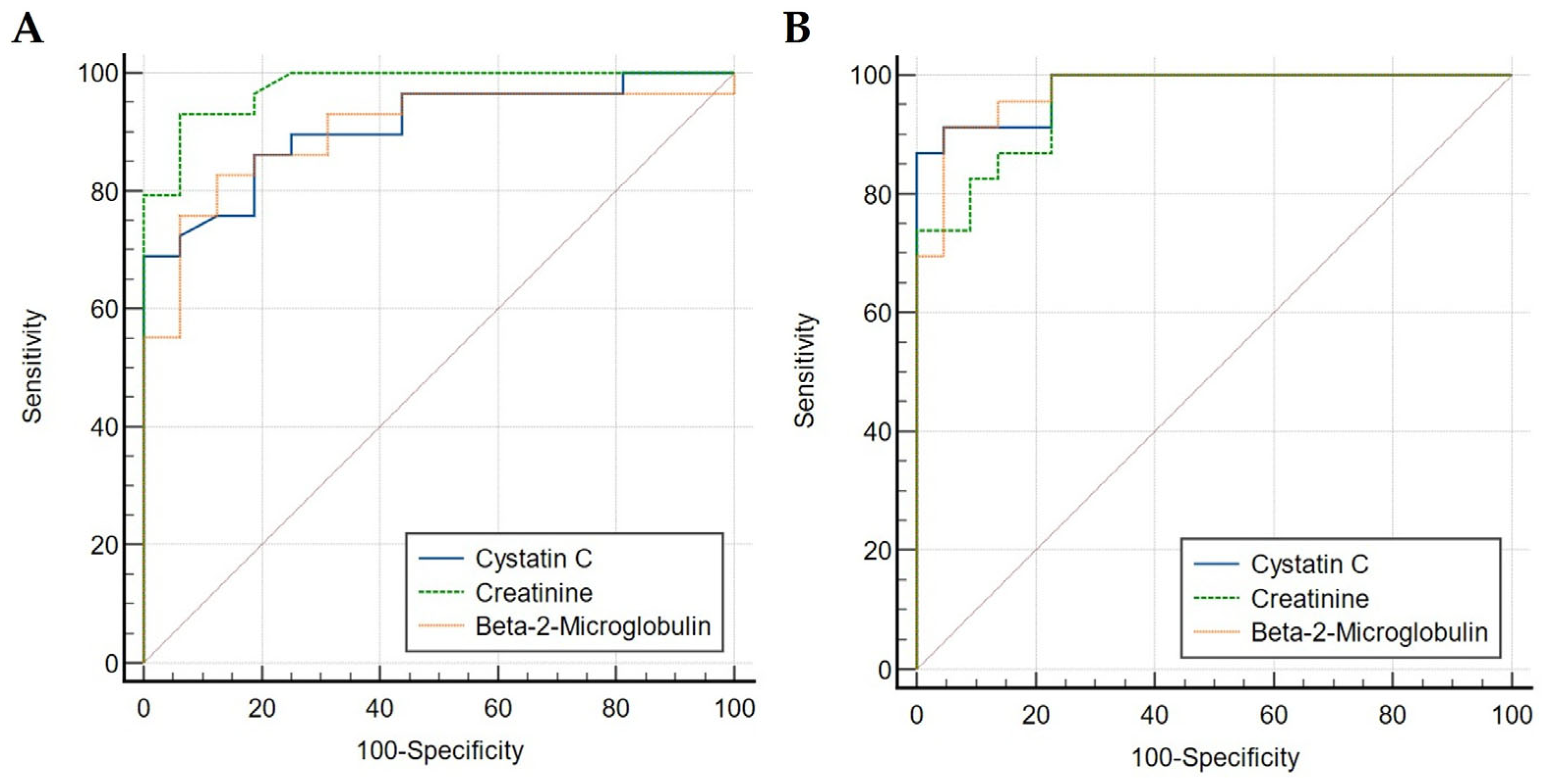
The diagnostic performance of serum creatinine, cystatin C, and β2M was assessed using ROC curve analysis at a predefined eGFR threshold of 30 mL/min per 1.73 m2 to distinguish between moderate (CKD stage 3) and severe (CKD stage 4) kidney dysfunction. Using the 2021 CKD-EPI creatinine equation (eGFRcr), ROC analysis showed that the area under the curve (AUC) for serum creatinine [AUC = 0.977 (95% CI: 0.882–0.999)] was comparable to that of serum cystatin C (p = 0.1035) [AUC = 0.908 (95% CI: 0.784–0.974)] and serum β2M (p = 0.1003) [AUC = 0.901 (95% CI: 0.775–0.970)] (Figure 2A).
When the 2021 CKD-EPI creatinine–cystatin C equation (eGFRcr–cys) was applied, the ROC curves again demonstrated similarly high diagnostic accuracy for all three markers. The AUC for serum creatinine [AUC = 0.957 (95% CI: 0.850–0.995)] was comparable to that of serum cystatin C (p = 0.4295) [AUC = 0.978 (95% CI: 0.883–0.999)] and serum β2M (p = 0.5465) [AUC = 0.974 (95% CI: 0.877–0.999)] (Figure 2B).
At the predefined cut-off of 30 mL/min per 1.73 m2, the sensitivity, specificity, positive predictive value (PPV), negative predictive value (NPV), and Youden Index for each GFR marker were determined.
Using the 2021 CKD-EPI Creatinine Formula (eGFRcr), serum creatinine showed a sensitivity of 93.1%, specificity of 93.75%, PPV of 94.8%, and NPV of 91.3%, with a Youden Index of 0.87. Serum cystatin C demonstrated a sensitivity of 68.97%, specificity of 100%, PPV of 100%, and NPV of 78.6%, with a Youden Index of 0.69. Serum β2M exhibited a sensitivity of 82.76%, specificity of 87.50%, PPV of 85.2%, and NPV of 85.1%, with a Youden Index of 0.70 (Table 2A).
When the 2021 CKD-EPI creatinine–cystatin C equation (eGFRcr–cys) was used, serum creatinine achieved a sensitivity of 100%, specificity of 77.27%, PPV of 80.6%, and NPV of 100%, with a Youden Index of 0.77. Serum cystatin C showed a sensitivity of 86.96%, specificity of 100%, PPV of 100%, and NPV of 84.0%, with a Youden Index of 0.87. Serum β2M demonstrated a sensitivity of 91.30%, specificity of 95.45%, PPV of 95.2%, and NPV of 91.7%, with a Youden Index of 0.87 (Table 2B).

3. Discussion

Chronic kidney disease (CKD) is a major health burden, and accurate estimation of glomerular filtration rate (GFR) remains central to staging and clinical decision-making [1,2,3]. Creatinine-based eGFR is widely used but is influenced by non-GFR determinants, supporting interest in complementary biomarkers such as cystatin C and other low-molecular-weight proteins [5]. In this study, we compared creatinine, cystatin C and β2-microglobulin (β2M) within the 2021 CKD-EPI eGFR framework to inform a pragmatic multi-marker approach for discriminating CKD stage 3 from stage 4.
In this context, our findings reinforce the diagnostic robustness of creatinine when interpreted with the 2021 CKD-EPI creatinine equation (eGFRcr), showing high sensitivity and specificity in differentiating between CKD stages 3 and 4. Previous local work comparing the MDRD and CKD-EPI equations against isotopic GFR methods in Malaysian patients confirmed the superiority of CKD-EPI, further supporting its use in this setting [12]. Taken together, these data indicate that creatinine-based eGFR remains a reliable foundation for CKD staging when used with contemporary equations, although its limitations must still be acknowledged in specific clinical scenarios.
Cystatin C demonstrated superior specificity (100%) and higher predictive accuracy at the critical threshold of 30 mL/min/1.73 m2 in our study. This underscores cystatin C’s clinical utility as a confirmatory marker for advanced kidney dysfunction, particularly in cases where creatinine-based estimates may be misleading. Biologically, cystatin C is a low-molecular-weight cysteine protease inhibitor produced at a relatively constant rate by all nucleated cells and freely filtered by the glomeruli, with almost complete reabsorption and catabolism in the proximal tubules. Its serum concentration is therefore less affected by muscle mass and may provide a reflection less dependent on muscle mass interpreted cautiously as a marker of glomerular filtration than creatinine. Our results align with multicenter studies demonstrating cystatin C’s added value in risk prediction beyond creatinine and with evaluations showing its clinical utility and cost-effectiveness in primary care CKD management [13,14]. Together, these findings suggest that cystatin C could improve diagnostic precision and optimize resource allocation in CKD care, particularly when used in a targeted manner for patients with uncertain or borderline creatinine-based eGFR.
Importantly, this study also highlights the diagnostic value of beta-2 microglobulin (β2M). While not yet widely used in routine nephrology practice, β2M demonstrated balanced sensitivity and specificity, particularly under the creatinine–cystatin C framework (eGFRcr–cys), supporting its potential as a complementary biomarker. β2M is a component of the major histocompatibility complex class I molecule and is a low-molecular-weight protein that is freely filtered by the glomerulus and normally reabsorbed and catabolized by proximal tubular cells. Consequently, circulating β2M may reflect a combination of reduced filtration and altered tubular handling. In CKD, tubulointerstitial injury may reduce proximal tubular uptake and metabolism, potentially amplifying β2M elevations beyond what is expected from GFR decline alone. This dual dependence highlights why β2M should be interpreted cautiously as a filtration marker and supports its potential role as a biomarker capturing both filtration impairment and tubular involvement [15].
From a translational perspective, β2M can also be influenced by non-GFR determinants and extrarenal factors, including systemic inflammation, immune activation, and malignancy, which may affect generalizability and clinical implementation [16]. Nevertheless, its association with the severity of kidney injury, including acute kidney injury, supports its broader relevance as a complementary biomarker in renal disease [10].
Therefore, in current practice, β2M is best positioned as a complementary biomarker and a candidate component for future multi-marker equations rather than a standalone filtration marker. Future studies should incorporate inflammatory indices and relevant comorbidities, evaluate assay standardization and cost, and compare performance against measured GFR and emerging multi-marker equations incorporating β2M and β-trace protein [11].
Several studies in Asia have evaluated the 2021 CKD-EPI equation. For example, Pakistani and Korean cohorts have assessed its performance in creatinine-based GFR estimation and its impact on CKD prevalence and risk prediction [17,18]. In China, the ES-CKD study validated a β2M-based GFR equation and compared it with cystatin C-inclusive equations, demonstrating improved accuracy with multi-marker approaches [19]. A large multi-country analysis further showed variable effects of the 2021 CKD-EPI equation across Asian populations [20]. Our study extends this body of work by evaluating a three-marker panel (creatinine, cystatin C and β2M) within the 2021 CKD-EPI equations in a Malaysian CKD cohort, providing novel regional data and supporting the feasibility of a multi-marker strategy in this population.
The integration of multiple biomarkers, particularly creatinine, cystatin C and β2M, reflects a broader movement toward multi-marker strategies in CKD biology and diagnosis. Such approaches aim to capture different molecular and physiological pathways involved in kidney injury, including altered glomerular filtration, proximal tubular reabsorption and chronic inflammation. In principle, this may improve staging accuracy, inform risk prediction for cardiovascular complications and guide earlier therapeutic interventions. This is particularly relevant given the close interplay between CKD, chronic inflammation and cardiovascular disease, which remains the leading cause of mortality among patients with end-stage kidney disease [3]. By combining filtration-based and inflammation-linked markers, our findings align with the emerging paradigm of molecular diagnostics emphasized in this Special Issue, where biochemical markers serve as accessible surrogates of underlying molecular mechanisms.
A limitation of this study is the relatively small cohort (n = 45), which restricts generalizability and limits the precision of some estimates. Because the study population was limited to CKD stages 3–4, the findings may not extrapolate to earlier CKD (stages 1–2), dialysis-dependent kidney failure, or other Asian populations with different comorbidity patterns and body composition. Validation across a broader CKD spectrum and ethnically diverse cohorts, ideally against measured GFR, will be important to define the clinical contexts in which cystatin C and β2M add the greatest value.
Nevertheless, this represents one of the first Malaysian datasets evaluating the 2021 CKD-EPI equations in combination with cystatin C and β2M, offering preliminary insights into their clinical performance in a real-world population. Another important limitation is that GFR was not directly measured using an exogenous filtration marker. Instead, we used eGFR derived from the 2021 CKD-EPI creatinine and creatinine–cystatin C equations as the reference. As a result, the strong performance of creatinine and cystatin C partly reflects their incorporation into these equations, and our findings should be interpreted as an evaluation of marker performance within the CKD-EPI framework rather than an independent validation against measured GFR. Larger multicenter studies are needed to validate these findings and to assess additional emerging markers such as β-trace protein, which, when combined with β2M, may yield even greater diagnostic accuracy across diverse ethnic groups without reliance on race-based adjustments [11]. Cost-effectiveness studies will also be essential to support broader adoption of cystatin C and β2M in routine practice, particularly in resource-constrained healthcare systems [14].
Our findings highlight that while serum creatinine remains a reliable primary marker for GFR estimation, cystatin C provides superior specificity in identifying severe CKD, and β2M offers balanced diagnostic performance as a complementary marker. From a biological perspective, cystatin C and β2M not only reflect renal filtration but are also associated with systemic processes such as inflammation and cardiovascular risk, underscoring their relevance beyond kidney function alone [10,11]. Diagnostic integration of these markers, particularly within the 2021 CKD-EPI equations, improves accuracy at critical thresholds and may reduce reliance on creatinine alone, which is influenced by extrarenal factors. Clinically, adopting a multi-marker strategy could facilitate earlier identification of patients at higher risk of CKD progression and related complications, enabling timely interventions such as tighter blood pressure and metabolic control, avoidance of nephrotoxic drugs and earlier referral for nephrology care. These therapeutic implications are especially relevant in Malaysia and other regions with rising CKD prevalence, where cost-effectiveness and accessibility remain critical considerations [1,2,3,14]. By linking biochemical markers to underlying pathophysiological processes, this multi-marker approach illustrates how molecularly informed diagnostics can support more precise and personalized care in CKD, in line with the objectives of this Special Issue.

4. Materials and Methods

4.1. Patients’ Samples

This retrospective observational study was based on the analysis of laboratory data from 45 patients (22 males and 23 females; aged 25–75 years) with chronic kidney disease (CKD) stages 3 to 4 who attended the Nephrology Clinic at the Institute of Urology and Nephrology, Kuala Lumpur Hospital (Appendix A). All data were obtained from routine clinical testing. The study was conducted in accordance with the Declaration of Helsinki and was approved by the Institutional Review Board of Ministry of Health’s Medical Research Ethics Committee (MREC) [NMRR ID-25-02170-XEB (IIR)].

4.2. Cystatin C, Beta-2 Microglobulin (β2M) and Creatinine Assays

Serum cystatin C and β2M levels were measured using a particle-enhanced nephelometric assay (PENIA) on a Siemens nephelometer system (Siemens Healthcare Diagnostics, Forchheim, Germany). Serum creatinine was measured using the modified Jaffe method on a Roche chemistry analyzer (Roche Diagnostics, Mannheim, Germany).
These three markers were selected because they represent complementary aspects of CKD pathophysiology, reflecting glomerular filtration (creatinine and cystatin C) and low-molecular-weight protein handling (β2M).

4.3. GFR Estimation

The estimated glomerular filtration rate (eGFR) was calculated using the 2021 CKD-EPI equations for creatinine and creatinine–cystatin C:

4.3.1. 2021 CKD-EPI Creatinine Formula (eGFRcr)

The creatinine-based eGFR (eGFRcr) was calculated using the following formula:
eGFRcr (mL/min/1.73 m2) = 142 × (Scr/A) − B × 0.9938Age × (1.012 if female)
where Scr is serum creatinine (mg/dL); A and B depend on sex and creatinine level:
SexCreatinine LevelAB
Female≤0.7 mg/dL0.7−0.241
Female>0.7 mg/dL0.7−1.200
Male≤0.9 mg/dL0.9−0.302
Male>0.9 mg/dL0.9−1.200

4.3.2. 2021 CKD-EPI Creatinine–Cystatin C Formula (eGFRcr–cys)

The creatinine–cystatin C-based eGFR (eGFRcr–cys) was calculated as:
eGFRcr-cys (mL/min/1.73 m2) = 135 × (Scr/A) − B × (Scys/C) − D × 0.9938Age × (1.012 if female)
where Scr is serum creatinine (mg/dL) and Scys is serum cystatin C (mg/L); A, B, C and D depend on sex and levels of creatinine and cystatin C:
SexCreatinine LevelCystatin C LevelABCD
Female≤0.7 mg/dL≤0.8 mg/L0.7−0.2190.8−0.323
Female≤0.7 mg/dL>0.8 mg/L0.7−0.2190.8−0.778
Female>0.7 mg/dL≤0.8 mg/L0.7−0.5440.8−0.323
Female>0.7 mg/dL>0.8 mg/L0.7−0.5440.8−0.778
Male≤0.9 mg/dL≤0.8 mg/L0.9−0.1440.8−0.323
Male≤0.9 mg/dL>0.8 mg/L0.9−0.1440.8−0.778
Male>0.9 mg/dL≤0.8 mg/L0.9−0.5440.8−0.323
Male>0.9 mg/dL>0.8 mg/L0.9−0.5440.8−0.778

4.4. Statistical Methods

4.4.1. Correlation Analysis

The relationship between serum creatinine, cystatin C, and β2M with estimated GFR was evaluated using correlation analysis of their reciprocal values to linearize the curvilinear relationship with eGFRcr and eGFRcr–cys. Correlation analysis was also performed to assess the association between eGFRcr and eGFRcr–cys. Pearson correlation coefficients (r) and coefficient of determination (R2) were calculated, with statistical significance defined as p < 0.05. All analyses were performed using SPSS for Windows, version 29.0.1.0 (IBM Corp., Armonk, NY, USA).

4.4.2. Receiver Operating Curve (ROC) Analysis

The diagnostic accuracy of reciprocal serum cystatin C, serum creatinine and serum β2M was assessed using ROC curve analysis to discriminate between patients with moderate (CKD stage 3) and severe (CKD stage 4) kidney dysfunction. A predefined eGFR threshold of 30 mL/min/1.73 m2 was applied to classify kidney function.
This study did not validate biomarkers against directly measured GFR. CKD stage classification for CKD stage 3 and CKD stage 4 was based on the 2021 CKD-EPI equations (eGFRcr and eGFRcr–cys) using a predefined threshold of 30 mL/min/1.73 m2. Because creatinine and cystatin C are components of these equations, their apparent discriminatory performance may be inflated relative to an independent reference standard. Therefore, the findings should be interpreted as a comparative assessment within the CKD-EPI framework.
ROC curves were generated by plotting sensitivity against 1—specificity. The area under the curve (AUC) and 95% confidence intervals (CIs) were calculated using the binomial exact method. Sensitivity, specificity, positive predictive value (PPV), and negative predictive value (NPV) were determined, with the optimal cut-off value identified using the Youden Index. Comparisons between AUCs of different GFR markers were performed using the DeLong method. Statistical significance was defined as p < 0.05. All analyses were conducted using MedCalc for Windows, version 23.09 (MedCalc Software Ltd., Ostend, Belgium).

5. Conclusions

In adults with CKD stages 3–4, serum creatinine, cystatin C and β2-microglobulin demonstrated high discriminatory performance for separating stage 3 from stage 4 kidney dysfunction when classification was defined using the 2021 CKD-EPI equations, including eGFRcr and eGFRcr–cys. Cystatin C showed high specificity at the 30 mL/min/1.73 m2 threshold, while β2-microglobulin provided a balanced sensitivity and specificity profile, supporting its potential role as a complementary biomarker. These findings should be interpreted as a comparative assessment within CKD-EPI-based staging rather than a validation against measured GFR. Larger studies incorporating measured GFR, broader CKD spectra and relevant clinical confounders are warranted.

Author Contributions

Conceptualization, N.A.B. and N.H.H.; Data curation, N.A.B. and N.I.H., Formal analysis, N.A.B., N.I.H., S.N.A.R., I.S.T., Z.A.H., A.H. and N.H.H.; Funding acquisition, N.I.H. and N.H.H.; Methodology, N.A.B., N.I.H. and N.H.H.; Project administration, N.A.B. and N.H.H.; Resources, N.A.B., N.I.H. and S.N.A.R.; Software, N.A.B. and N.I.H.; Supervision, N.A.B. and N.H.H.; Visualization, N.A.B. and N.H.H.; writing—original draft preparation, N.A.B.; writing—review and editing, N.A.B., N.I.H., S.N.A.R., I.S.T., Z.A.H., A.H. and N.H.H.; N.A.B. and N.I.H. contributed equally to this work. All authors have read and agreed to the published version of the manuscript.

Funding

This research was registered with Universiti Kebangsaan Malaysia (NN-2026-003) and the National Medical Research Register (NMRR) (RSCH ID-25-03258-ROB). The study received no external research funding. The article processing charge (APC) was funded by the Institute for Medical Research (IMR), National Institutes of Health (NIH), Ministry of Health Malaysia.

Institutional Review Board Statement

The study was conducted in accordance with the Declaration of Helsinki and approved by the Institutional Review Board of MINISTRY OF HEALTH’S MEDICAL RESEARCH ETHICS COMMITTEE (MREC) [Protocol code: NMRR ID-25-02170-XEB (IIR); Date of approval: 21 August 2025].

Informed Consent Statement

Patient consent was waived due to the retrospective nature of the study, the exclusive use of de-identified patient data, and the absence of any foreseeable risk of harm to participants, in accordance with the Malaysian Guidelines for Good Clinical Practice (GCP) and international ethical standards.

Data Availability Statement

The original contributions presented in this study are included in the article and Appendix A. Further inquiries can be directed to the corresponding authors.

Acknowledgments

The authors thank the Director General of Health Malaysia and the Director of the Institute of Medical Research (IMR), Malaysia, for permitting us to publish this article.

Conflicts of Interest

The authors declare no conflicts of interest.

Abbreviations

The following abbreviations are used in this manuscript:
AUCArea under the curve
CIconfidence intervals
CKDChronic kidney disease
CKD-EPIChronic Kidney Disease Epidemiology Collaboration
eGFREstimated glomerular filtration rate
eGFRcrThe 2021 CKD-EPI creatinine equation
eGFRcr–cysThe 2021 CKD-EPI creatinine–cystatin C equation
GFRGlomerular filtration rate
KDIGOThe Kidney Disease: Improving Global Outcomes
KDOQIThe National Kidney Foundation–Kidney Disease Outcomes Quality Initiative
MDRDModification of Diet in Renal Disease
NPVnegative predictive value
pp-value
PENIAparticle-enhanced nephelometric assay
PPVpositive predictive value
rPearson correlation coefficients
R2Coefficient of determination
ROCReceiver operating characteristic
β2MBeta-2 microglobulin

Appendix A

Table A1. Baseline demographic and laboratory characteristics of the study cohort (n = 45).
Patient IDAgeSex1/Cystatin C1/Creatinine1/β2MeGFRcreGFRcr–cys
P175Male0.354610.003690.1358695652019
P251Male0.7575760.00757580.3952569175657
P347Female0.3831420.00277010.1328021251317
P453Male0.9345790.00689660.3968253975063
P556Male0.3891050.00380230.181159422423
P668Male0.448430.00653590.2358490574233
P759Female0.3508770.00278550.109409191215
P840Male0.3322260.00308640.1494768312119
P942Female0.476190.00425530.1912045892225
P1056Male0.3952570.00456620.1824817523026
P1150Female0.4608290.00564970.1992031873030
P1261Male0.4716980.00469480.2409638553029
P1350Male0.4098360.00347220.1293661062223
P1470Female0.3322260.00526320.1041666672419
P1545Male0.9523810.00636940.4694835684763
P1667Male0.4854370.00473930.2739726032929
P1745Male0.5025130.00641030.2444987784839
P1851Female0.6493510.0080.3344481614544
P1960Male0.3558720.00235850.1307189541316
P2027Female0.4219410.00456620.174520072725
P2154Female0.5617980.00735290.2808988764037
P2265Female0.7936510.0099010.413223145354
P2325Female0.3401360.00602410.0826446283825
P2474Female0.4854370.00645160.1838235293028
P2556Female0.5586590.00719420.2754820943836
P2659Male0.602410.00729930.30030035145
P2731Female0.4424780.00408160.1923076922324
P2850Male0.6097560.00689660.4219409285146
P2932Female0.5524860.0094340.3546099296245
P3070Female0.43290.00571430.2079002082725
P3127Male0.7407410.0069930.3816793895959
P3250Male0.7142860.00666670.3389830514951
P3338Female0.8695650.01041670.4878048786767
P3433Female0.2994010.00375940.1497005992017
P3547Male0.5263160.00531910.259740263836
P3650Male0.5714290.00714290.2564102565344
P3746Female0.5649720.00719420.2493765594138
P3865Female0.7462690.00769230.2724795643945
P3957Female0.5813950.0058480.2890173413033
P4066Female0.4081630.00649350.1607717043226
P4166Male0.8474580.00724640.467289724957
P4260Male0.523560.00395260.2369668252429
P4338Female0.4405290.00568180.2150537633228
P4458Male0.6711410.00540540.3184713383642
P4556Female0.3571430.00442480.1540832052119

References

  1. Saminathan, T.A.; Hooi, L.S.; Mohd Yusoff, M.F.; Ong, L.M.; Bavanandan, S.; Rodzlan Hasani, W.S.; Tan, E.Z.Z.; Wong, I.; Rifin, H.M.; Robert, T.G.; et al. Prevalence of Chronic Kidney Disease and Its Associated Factors in Malaysia; Findings from a Nationwide Population-Based Cross-Sectional Study. BMC Nephrol. 2020, 21, 344. [Google Scholar] [CrossRef] [PubMed]
  2. Levin, A.; Tonelli, M.; Bonventre, J.; Coresh, J.; Donner, J.-A.; Fogo, A.B.; Fox, C.S.; Gansevoort, R.T.; Heerspink, H.J.L.; Jardine, M.; et al. Global Kidney Health 2017 and beyond: A Roadmap for Closing Gaps in Care, Research, and Policy. Lancet 2017, 390, 1888–1917. [Google Scholar] [CrossRef] [PubMed]
  3. Stevens, P.E.; Ahmed, S.B.; Carrero, J.J.; Foster, B.; Francis, A.; Hall, R.K.; Herrington, W.G.; Hill, G.; Inker, L.A.; Kazancıoğlu, R.; et al. KDIGO 2024 Clinical Practice Guideline for the Evaluation and Management of Chronic Kidney Disease. Kidney Int. 2024, 105, S117–S314. [Google Scholar] [CrossRef] [PubMed]
  4. Porrini, E.; Ruggenenti, P.; Luis-Lima, S.; Carrara, F.; Jiménez, A.; de Vries, A.P.J.; Torres, A.; Gaspari, F.; Remuzzi, G. Estimated GFR: Time for a Critical Appraisal. Nat. Rev. Nephrol. 2019, 15, 177–190, Correction in Nat. Rev. Nephrol. 2019, 15, 121. https://doi.org/10.1038/s41581-018-0105-4. [Google Scholar] [CrossRef] [PubMed]
  5. Seegmiller, J.C.; Eckfeldt, J.H.; Lieske, J.C. Challenges in Measuring Glomerular Filtration Rate: A Clinical Laboratory Perspective. Adv. Chronic Kidney Dis. 2018, 25, 84–92. [Google Scholar] [CrossRef] [PubMed]
  6. Inker, L.A.; Eneanya, N.D.; Coresh, J.; Tighiouart, H.; Wang, D.; Sang, Y.; Crews, D.C.; Doria, A.; Estrella, M.M.; Froissart, M.; et al. New Creatinine- and Cystatin C–Based Equations to Estimate GFR without Race. N. Engl. J. Med. 2021, 385, 1737–1749. [Google Scholar] [CrossRef] [PubMed]
  7. Hoek, F.J.; Kemperman, F.A.W.; Krediet, R.T. A Comparison between Cystatin C, Plasma Creatinine and the Cockcroft and Gault Formula for the Estimation of Glomerular Filtration Rate. Nephrol. Dial. Transplant. 2003, 18, 2024–2031. [Google Scholar] [CrossRef] [PubMed]
  8. Inker, L.A.; Schmid, C.H.; Tighiouart, H.; Eckfeldt, J.H.; Feldman, H.I.; Greene, T.; Kusek, J.W.; Manzi, J.; Van Lente, F.; Zhang, Y.L.; et al. Estimating Glomerular Filtration Rate from Serum Creatinine and Cystatin C. N. Engl. J. Med. 2012, 367, 20–29, Correction in N. Engl. J. Med. 2012, 367, 681. Correction in N. Engl. J. Med. 2012, 367, 2060. https://doi.org/10.1056/NEJMx120062. [Google Scholar] [CrossRef] [PubMed]
  9. Inker, L.A.; Couture, S.J.; Tighiouart, H.; Abraham, A.G.; Beck, G.J.; Feldman, H.I.; Greene, T.; Gudnason, V.; Karger, A.B.; Eckfeldt, J.H.; et al. A New Panel-Estimated GFR, Including Β2-Microglobulin and β-Trace Protein and Not Including Race, Developed in a Diverse Population. Am. J. Kidney Dis. 2021, 77, 673–683.e1, Correction in Am. J. Kidney Dis. 2024, 83, 840. https://doi.org/10.1053/j.ajkd.2024.04.003. [Google Scholar] [CrossRef] [PubMed]
  10. Barton, K.T.; Kakajiwala, A.; Dietzen, D.J.; Goss, C.W.; Gu, H.; Dharnidharka, V.R. Using the Newer Kidney Disease: Improving Global Outcomes Criteria, Beta-2-Microglobulin Levels Associate with Severity of Acute Kidney Injury. Clin. Kidney J. 2018, 11, 797–802. [Google Scholar] [CrossRef] [PubMed]
  11. Inker, L.A.; Tighiouart, H.; Coresh, J.; Foster, M.C.; Anderson, A.H.; Beck, G.J.; Contreras, G.; Greene, T.; Karger, A.B.; Kusek, J.W.; et al. GFR Estimation Using β-Trace Protein and Β2-Microglobulin in CKD. Am. J. Kidney Dis. 2016, 67, 40–48. [Google Scholar] [CrossRef] [PubMed]
  12. Jalalonmuhali, M.; Lim, S.K.; Md Shah, M.N.; Ng, K.P. MDRD vs. CKD-EPI in Comparison to 51Chromium EDTA: A Cross Sectional Study of Malaysian CKD Cohort. BMC Nephrol. 2017, 18, 363. [Google Scholar] [CrossRef] [PubMed]
  13. Shlipak, M.G.; Matsushita, K.; Ärnlöv, J.; Inker, L.A.; Katz, R.; Polkinghorne, K.R.; Rothenbacher, D.; Sarnak, M.J.; Astor, B.C.; Coresh, J.; et al. Cystatin C versus Creatinine in Determining Risk Based on Kidney Function. N. Engl. J. Med. 2013, 369, 932–943. [Google Scholar] [CrossRef] [PubMed]
  14. Shardlow, A.; McIntyre, N.J.; Fraser, S.D.S.; Roderick, P.; Raftery, J.; Fluck, R.J.; McIntyre, C.W.; Taal, M.W. The Clinical Utility and Cost Impact of Cystatin C Measurement in the Diagnosis and Management of Chronic Kidney Disease: A Primary Care Cohort Study. PLoS Med. 2017, 14, e1002400. [Google Scholar] [CrossRef] [PubMed]
  15. Argyropoulos, C.P.; Chen, S.S.; Ng, Y.-H.; Roumelioti, M.-E.; Shaffi, K.; Singh, P.P.; Tzamaloukas, A.H. Rediscovering Beta-2 Microglobulin as a Biomarker across the Spectrum of Kidney Diseases. Front. Med. 2017, 4, 73. [Google Scholar] [CrossRef] [PubMed]
  16. Liu, X.; Foster, M.C.; Tighiouart, H.; Anderson, A.H.; Beck, G.J.; Contreras, G.; Coresh, J.; Eckfeldt, J.H.; Feldman, H.I.; Greene, T.; et al. Non-GFR Determinants of Low-Molecular-Weight Serum Protein Filtration Markers in CKD. Am. J. Kidney Dis. 2016, 68, 892–900, Correction in Am. J. Kidney Dis. 2024, 83, 840. https://doi.org/10.1053/j.ajkd.2024.04.001. [Google Scholar] [CrossRef] [PubMed]
  17. Safdar, A.; Akram, W.; Khan, M.A.; Tahir, D.; Butt, M.H. Comparison of EKFC, Pakistani CKD-EPI and 2021 Race-Free CKD-EPI Creatinine Equations in South Asian CKD Population: A Study from Pakistani CKD Community Cohort. PLoS ONE 2024, 19, e0300428. [Google Scholar] [CrossRef]
  18. Kim, J.H.; Kang, M.; Kang, E.; Ryu, H.; Jeong, Y.; Kim, J.; Park, S.K.; Jeong, J.C.; Yoo, T.-H.; Kim, Y.; et al. Comparison of Cardiovascular Event Predictability between the 2009 and 2021 Chronic Kidney Disease Epidemiology Collaboration Equations in a Korean Chronic Kidney Disease Cohort: The KoreaN Cohort Study for Outcome in Patients With Chronic Kidney Disease. Kidney Res. Clin. Pract. 2023, 42, 700–711. [Google Scholar] [CrossRef] [PubMed]
  19. Yue, L.; Pan, B.; Shi, X.; Du, X. Comparison between the Beta-2 Microglobulin-Based Equation and the CKD-EPI Equation for Estimating GFR in CKD Patients in China: ES-CKD Study. Kidney Dis. 2020, 6, 204–214. [Google Scholar] [CrossRef] [PubMed]
  20. Betzler, B.K.; Sultana, R.; He, F.; Tham, Y.C.; Lim, C.C.; Wang, Y.X.; Nangia, V.; Tai, E.S.; Rim, T.H.; Bikbov, M.M.; et al. Impact of Chronic Kidney Disease Epidemiology Collaboration (CKD-EPI) GFR Estimating Equations on CKD Prevalence and Classification Among Asians. Front. Med. 2022, 9, 957437. [Google Scholar] [CrossRef]
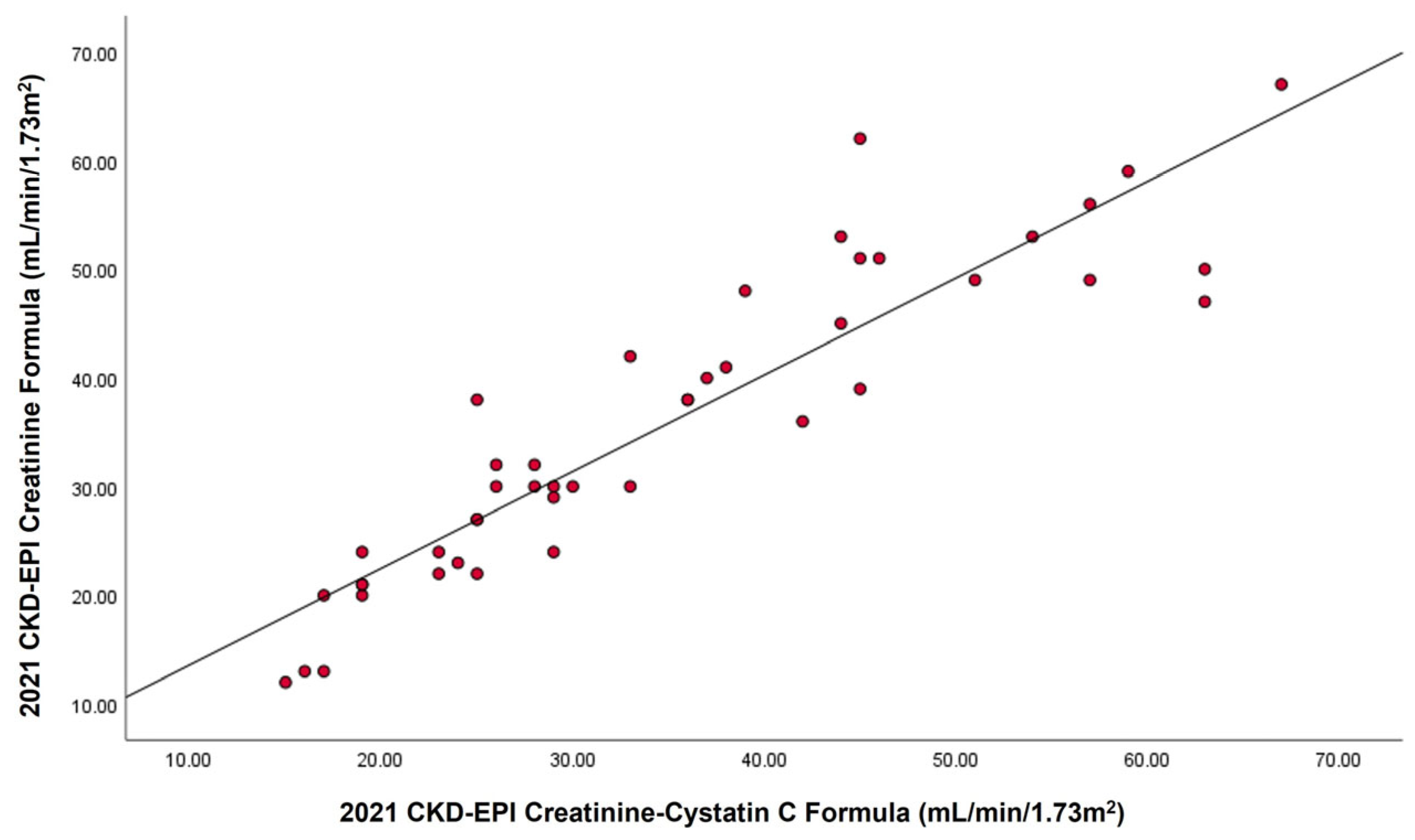
Figure 1. Scatter plot showing the relationship between estimated glomerular filtration rate based on the 2021 CKD-EPI creatinine equation (eGFRcr) and the 2021 CKD-EPI creatinine–cystatin C equation (eGFRcr–cys) in 45 adults with CKD stages 3–4. The solid line represents the line of best fit with the corresponding Pearson correlation coefficient (r).
Ijms 27 00862 g001
Figure 2. Receiver operating characteristic (ROC) curves for serum creatinine, cystatin C and β2-microglobulin (β2M) in discriminating moderate (CKD stage 3) from severe (CKD stage 4) kidney dysfunction at an eGFR threshold of 30 mL/min/1.73 m2. (A) ROC curves based on the 2021 CKD-EPI creatinine equation (eGFRcr). (B) ROC curves based on the 2021 CKD-EPI creatinine–cystatin C equation (eGFRcr–cys). The area under the curve (AUC) and 95% confidence intervals for each biomarker are shown.
Ijms 27 00862 g002
Table 1. (A). Correlation between reciprocal serum creatinine, cystatin C and β2-microglobulin (β2M) and estimated glomerular filtration rate based on the 2021 CKD-EPI creatinine equation (eGFRcr). Pearson correlation coefficients (r) and coefficients of determination (R2) are shown (n = 45). (B). Correlation between reciprocal serum creatinine, cystatin C and β2-microglobulin (β2M) and estimated glomerular filtration rate based on the 2021 CKD-EPI creatinine–cystatin C equation (eGFRcr–cys). Pearson correlation coefficients (r) and coefficients of determination (R2) are shown (n = 45).
(A)
GFR MarkerrR2Linear Equation
Serum creatinine0.9060.821y = (1.48 × 10⁻³) + (1.21 × 10⁻⁴)x
Serum cystatin C0.7750.601y = (0.2 × 10⁻³) + (9.5 × 10⁻³)x
Serum β2M0.8360.699y = 0.02 + (6.38 × 10⁻³)x
(B)
GFR MarkerrR2Linear Equation
Serum creatinine0.8060.651y = (2.15 × 10⁻³) + (1.05 × 10⁻⁴)x
Serum cystatin C0.9600.922y = 0.13 + (0.01)x
Serum β2M0.9440.892y = (7.8 × 10⁻³) + 7.01 × (10−3)x
Table 2. (A). Diagnostic performance of serum creatinine, cystatin C and β2-microglobulin (β2M) for discriminating moderate (CKD stage 3) from severe (CKD stage 4) kidney dysfunction using the 2021 CKD-EPI creatinine equation (eGFRcr) at an eGFR threshold of 30 mL/min/1.73 m2. Sensitivity, specificity, positive predictive value (PPV), negative predictive value (NPV) and Youden Index are presented. (B). Diagnostic performance of serum creatinine, cystatin C and β2-microglobulin (β2M) for discriminating moderate (CKD stage 3) from severe (CKD stage 4) kidney dysfunction using the 2021 CKD-EPI creatinine–cystatin C equation (eGFRcr–cys) at an eGFR threshold of 30 mL/min/1.73 m2. Sensitivity, specificity, positive predictive value (PPV), negative predictive value (NPV) and Youden Index are presented.
(A)
GFR MarkerSensitivity
(%)
Specificity
(%)
PPV
(%)
NPV
(%)
Youden Index
Serum creatinine93.1093.7594.8091.300.87
Serum cystatin C68.97100.00100.0078.600.69
Serum β2M82.7687.5085.2085.100.70
(B)
GFR MarkerSensitivity
(%)
Specificity
(%)
PPV
(%)
NPV
(%)
Youden Index
Serum creatinine100.0077.2780.60100.000.77
Serum cystatin C86.96100.00100.0084.000.87
Serum β2M91.3095.4595.2091.700.87
Disclaimer/Publisher’s Note: The statements, opinions and data contained in all publications are solely those of the individual author(s) and contributor(s) and not of MDPI and/or the editor(s). MDPI and/or the editor(s) disclaim responsibility for any injury to people or property resulting from any ideas, methods, instructions or products referred to in the content.