
Article

ΔFW-NPS6-Dependent Transcriptome Profiling Reveals Putative Pathogenicity Genes in Fusarium oxysporum

1
College of Land and Environment, Shenyang Agricultural University, Dongling Road 120, Shenyang 110866, China
2
National Engineering Research Center for Efficient Utilization of Soil and Fertilizer Resources, Shenyang 110866, China
3
Northeast Key Laboratory of Conservation and Improvement of Cultivated Land (Shenyang), Ministry of Agriculture and Rural Affairs, Shenyang 110866, China
*
Author to whom correspondence should be addressed.
These authors contributed equally to this work.
Int. J. Mol. Sci. 2026, 27(2), 830; https://doi.org/10.3390/ijms27020830
Submission received: 18 December 2025 / Revised: 9 January 2026 / Accepted: 12 January 2026 / Published: 14 January 2026

Abstract

Fusarium oxysporum f. sp. niveum is an increasingly threatening fungal pathogen that systemically colonizes watermelon plants and severely compromises their productivity by causing destructive vascular wilt disease. While its nonribosomal peptide synthetase NPS6 has been identified as a key virulence factor, the regulatory mechanisms through which it controls downstream gene networks to cause disease remain unclear. To elucidate this regulatory pathway, we constructed a ΔFW-NPS6 knockout mutant and conducted a comparative genome-wide analysis using RNA sequencing, with the wild-type strain as a control. The results revealed 66 NPS6-dependent differentially expressed genes, which were primarily associated with secondary-metabolite biosynthesis (e.g., genes encoding nonribosomal peptide synthetases like NPS2) and pathogen–host interactions (e.g., components of the MAPK signaling pathway), and were enriched in key pathogenic pathways. This finding reveals the virulence regulatory network mediated by NPS6, providing a direct theoretical foundation and crucial molecular targets for developing novel control strategies, such as targeted fungicides or genetic interventions, against Fusarium wilt in watermelon by highlighting NPS6 itself as a potential fungicide target and its downstream pathways (e.g., siderophore biosynthesis) as points for intervention.

1. Introduction

Fusarium wilt, a prevalent and devastating plant vascular disease, results from fungal infections that systematically colonize the host plant’s vascular tissues [1]. The primary causative agent of this disease is Fusarium oxysporum, a species characterized by significant pathogenic specialization. It is further classified into multiple formae speciales (abbreviated as f. sp.), each typically comprising one or several physiological races defined by their capacity to infect specific host plants [2]. Among these, Fusarium oxysporum f. sp. niveum (FON) is particularly notable for its specific pathogenicity toward watermelon (Citrullus lanatus) [3]. This pathogen poses a severe threat to watermelon crops across all developmental stages, leading to substantial yield losses and has remained a persistent challenge for fruit growers worldwide [4].
Currently, control strategies for Fusarium wilt in watermelon are primarily developed based on the biological characteristics of different pathogenic races (Races 0, 1, and 2), including practices such as grafting susceptible scions onto resistant rootstocks and employing biological control agents [5,6]. hypothesized, due to the complexity and variability of the mechanisms underlying the pathogen’s ability to cause disease and, more importantly, the limited understanding of its pathogenicity at the molecular level, current control strategies still fail to address the fundamental cause of the disease, making sustainable control elusive, namely, the lack of knowledge about master regulators and their core virulence networks such as those governed by NPS6, making sustainable control elusive. Therefore, elucidating the molecular mechanisms governing fungal virulence, particularly the role of key pathogenicity determinants such as nonribosomal peptide synthetase (NPS), is essential for developing effective and durable control solutions [7]. These constraints underscore the imperative to conduct in-depth molecular-level investigations into the virulence factors of FON to facilitate the development of novel, targeted, and sustainable management strategies.
At the molecular level, numerous pathogenicity-associated factors have been identified in Fusarium oxysporum, revealing a suite of sophisticated cellular responses during infection. These include complex signal transduction pathways [8,9], the secretion of cell wall–degrading enzymes, and diverse mechanisms that counteract or evade plant immune defenses [10]. However, existing knowledge remains largely fragmented, offering a catalog of components without a clear understanding of the regulatory circuitry that coordinates them. The major bottleneck is no longer the shortage of candidate genes but the absence of a systems-level view of how these elements are hierarchically organized and functionally integrated. As a result, the rational design of next-generation control strategies, such as targeted antifungals or host-induced gene silencing, is significantly hindered by the inability to identify master regulators and their core downstream networks, which represent the most effective and durable points of intervention.
Nonribosomal peptide synthetases (NPSs), recognized as key virulence factors in a wide range of fungal pathogens [11,12], can undergo post-assembly modifications such as glycosylation, methylation, and acylation, thereby expanding their functional diversity [13]. In plant-pathogenic fungi, NPS-derived metabolites have been demonstrated to serve multiple biological functions. These include acting as signaling molecules that regulate developmental processes, functioning as phytotoxins that directly damage plant tissues, assisting in the degradation of host components, contributing to resistance against host-derived oxidative stress, serving as siderophores for iron acquisition under iron-limited conditions, and acting as virulence effectors that modulate host immunity to promote infection [14,15,16]. Consequently, NPSs are widely regarded as central elements in the pathogenesis strategies of numerous plant-pathogenic fungi. Among the NPSs, NPS6 has attracted particular interest as a key virulence factor because of its well-established roles in siderophore biosynthesis, oxidative stress tolerance, and the regulation of fungal virulence [17,18,19]. Functionally, NPS6 is responsible for the synthesis of fusarinine-type siderophores, which are secreted to chelate extracellular iron, a critical step for successful host colonization and infection [20,21,22]. Studies in other fungal pathogens, such as Alternaria alternata and several ascomycetes, have demonstrated that NPS6 participates in siderophore-mediated iron acquisition [11,23]. Notably, genetic disruption of NPS6 in these fungi results in significant reductions in virulence and increased sensitivity to reactive oxygen species [11,24], highlighting its conserved role in mitigating host-induced oxidative stress. While our recent study confirmed that NPS6 is essential for full virulence in FON [1], the specific regulatory network it governs remains uncharacterized. However, despite these advances in related fungal systems, the specific functions of NPS6 and its associated virulence-regulatory networks in Fusarium oxysporum remain largely unknown. Based on its conserved role in siderophore biosynthesis and oxidative stress tolerance, we hypothesized that NPS6 is a master virulence regulator in FON. We specifically predicted that the deletion of NPS6 would not only impair iron homeostasis and redox balance but also lead to a broad transcriptional reprogramming. This reprogramming was anticipated to affect key pathogenic processes, including the biosynthesis of secondary metabolites and the modulation of signaling pathways, thereby compromising the ability of the fungus to colonize and infect watermelon plants.
To test this hypothesis and fill this knowledge gap, we employ genetic manipulation and pathogenicity assays to determine whether these candidate genes mediate the virulence function of NPS6, thereby clarifying their roles in the pathogenic mechanisms of this economically important fungus. To achieve this goal, we compare the genomic and transcriptomic profiles of wild-type and NPS6-deficient strains through comprehensive RNA sequencing and bioinformatics analyses to identify potential virulence factors functionally associated with NPS6. Through these analyses, we seek to delineate the NPS6-centered pathogenic regulatory network and provide insights and experimental evidence for understanding the systemic pathogenic mechanisms of Fusarium oxysporum f. sp. niveum.

2. Results

2.1. Distribution of Mapped Reads

To comprehensively characterize the transcriptional profiles of the wild-type (WT) Fusarium oxysporum f. sp. niveum and the ΔFW-NPS6 mutant strain, high-throughput cDNA libraries were constructed and subjected to RNA sequencing. After quality control and filtering, a total of 4,782,664 and 5,047,895 raw sequence reads were generated for the WT and ΔNPS6 libraries, respectively. From these, 2,378,325 and 2,540,752 unique reads were successfully mapped to the reference genome for the WT and mutant strains, indicating robust sequencing depth for subsequent differential expression analysis. A substantial proportion of these sequence reads were successfully annotated, accounting for 59.78% (1,421,151 reads) of the WT and 45.55% (1,246,324 reads) of the ΔFW-NPS6 transcriptomes. Analysis of gene expression levels, quantified using the RPKM (Reads Per Kilobase of transcript per Million mapped reads) metric, revealed that the majority of genes exhibited moderate expression levels. Specifically, 470 genes in the WT and 580 in the mutant were expressed within an RPKM range of 1.0 to 50. In contrast, only a small subset of genes demonstrated very high expression levels, with 7 genes in the WT and 13 in ΔFW-NPS6 having RPKM values exceeding 500.

2.2. Gene Ontology (GO) Classification

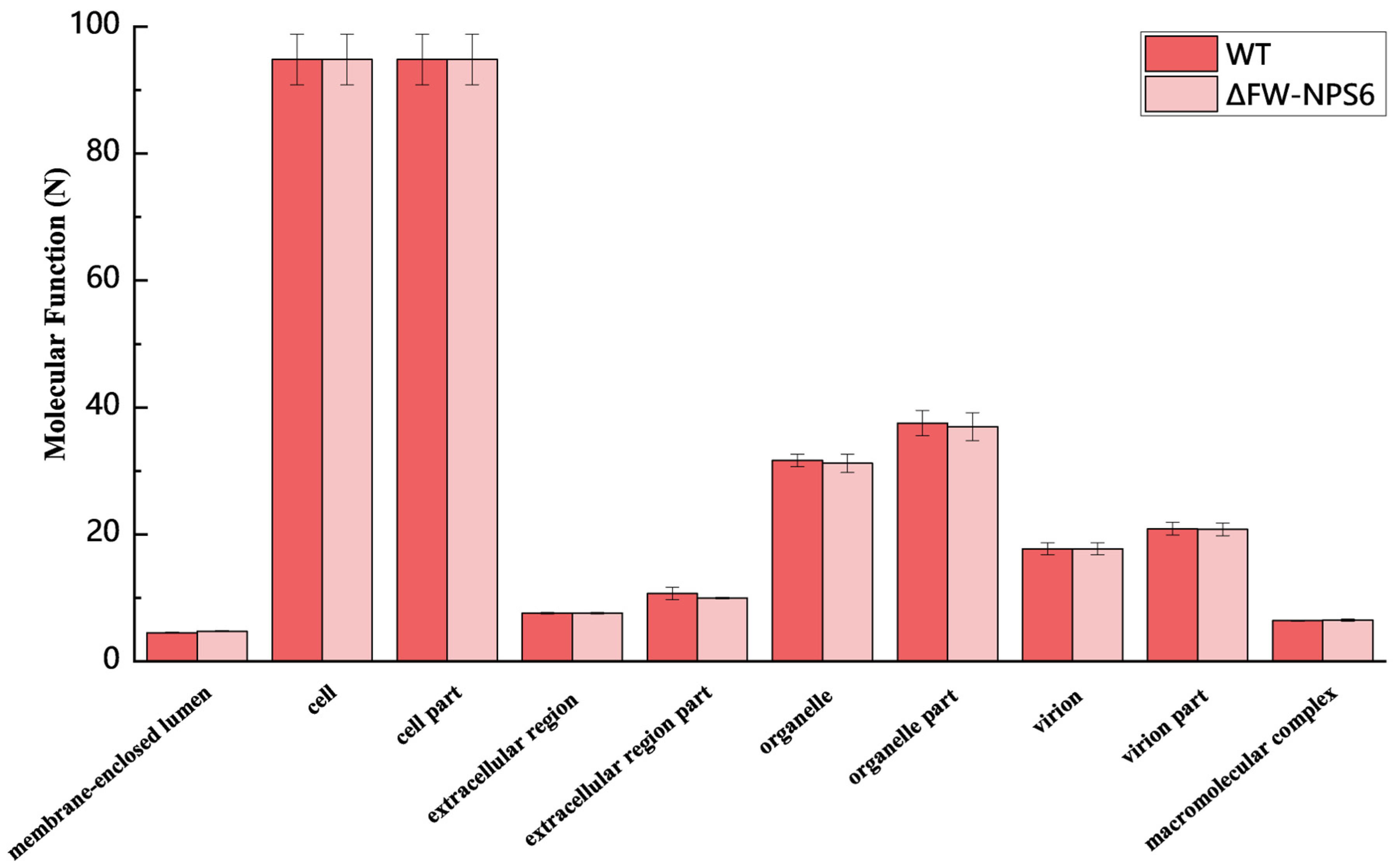
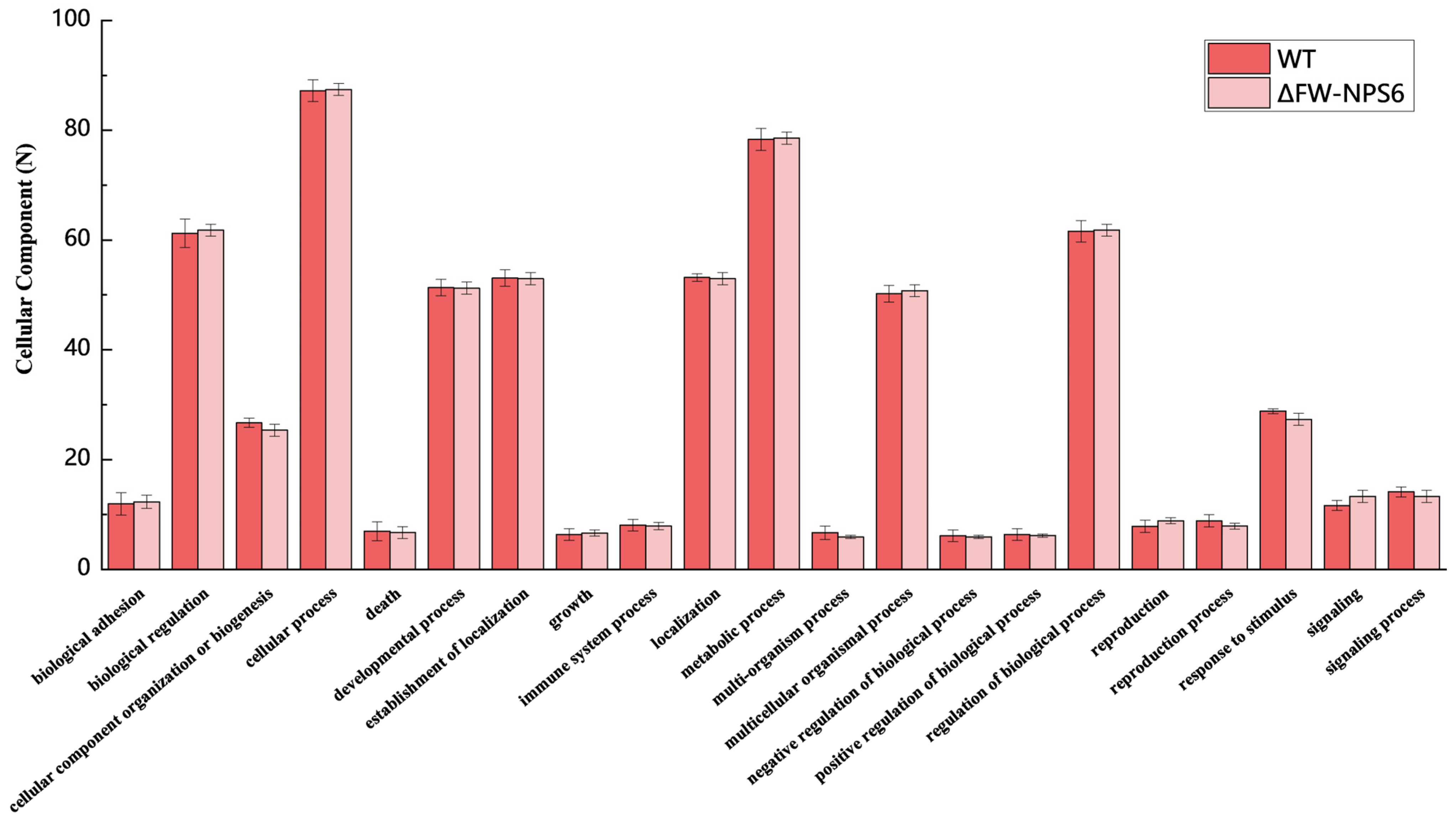
To gain functional insights into the transcriptomes of the wild-type (WT) Fusarium oxysporum f. sp. niveum and the ΔFW-NPS6 mutant, we performed a systematic functional classification of the annotated genes. Gene Ontology (GO) analysis was used to categorize the predicted genes into three major categories: biological process, molecular function, and cellular component. The overall distribution of genes within the principal level-2 GO terms for each of these categories is visually summarized in Figure 1 (biological process), Figure 2 (molecular function), and Figure 3 (cellular component). The absence of major shifts in the global functional profiles (Figure 1, Figure 2 and Figure 3) indicates that the core cellular machinery remains largely intact in the ΔNPS6 mutant under the conditions tested. This conservation of baseline functions underscores the specificity of the transcriptional reprogramming revealed by the subsequent differential expression analysis, highlighting pathways directly influenced by NPS6.
From the total set of expressed genes, 1634 from the WT and 1672 from the ΔFW-NPS6 mutant were subjected to GO analysis. Among these, a high percentage—1297 (78.41%) genes for the WT and 1311 (79.38%) for the mutant—were successfully assigned GO terms. The distribution of these annotated genes across the three principal GO categories was as follows: for the WT, 743 genes were linked to Biological Process, 1130 to Molecular Function, and 550 to Cellular Component. Correspondingly, for the ΔFW-NPS6 mutant, 733, 1021, and 721 genes were annotated in these same categories, respectively. Notably, the overall functional classification profile was highly conserved between the two strains, with no significant differences observed at this level of analysis. A more granular examination at level 2 further subdivided the genes into 53 distinct functional groups for both the WT and mutant. Within the Biological Process domain, the subcategories cellular process and metabolic process constituted the predominant functional classes. For the Cellular Component category, the terms cell part and cell were the most heavily represented. In the Molecular Function category, binding was the most abundant activity, followed by catalytic activity.
Complementing the GO analysis, pathway assignment and functional classification were also carried out using the Kyoto Encyclopedia of Genes and Genomes (KEGG) database. This analysis revealed that 536 genes from the WT and 542 genes from the ΔFW-NPS6 mutant were assigned one or more KEGG annotations and could be mapped to 201 distinct KEGG pathways (Table 1). The proportional distribution of these annotated genes into major KEGG categories was remarkably similar between the two strains. In the WT, the breakdown was 25.40% for Cellular Processes, 19.88% for Environmental Information Processing, 43.78% for Metabolism, and 7.34% for Genetic Information Processing. The ΔFW-NPS6 mutant exhibited a nearly identical profile, with 25.08%, 20.09%, 43.37%, and 7.56% of its genes classified into these same categories, respectively. A closer inspection of the Cellular Processes category indicated that the majority of genes in both strains were involved in functions pertaining to the immune system, cell communication, and the endocrine system. Within the overarching Metabolism category, pathways for carbohydrate metabolism, amino acid metabolism, and lipid metabolism were most prominently represented.
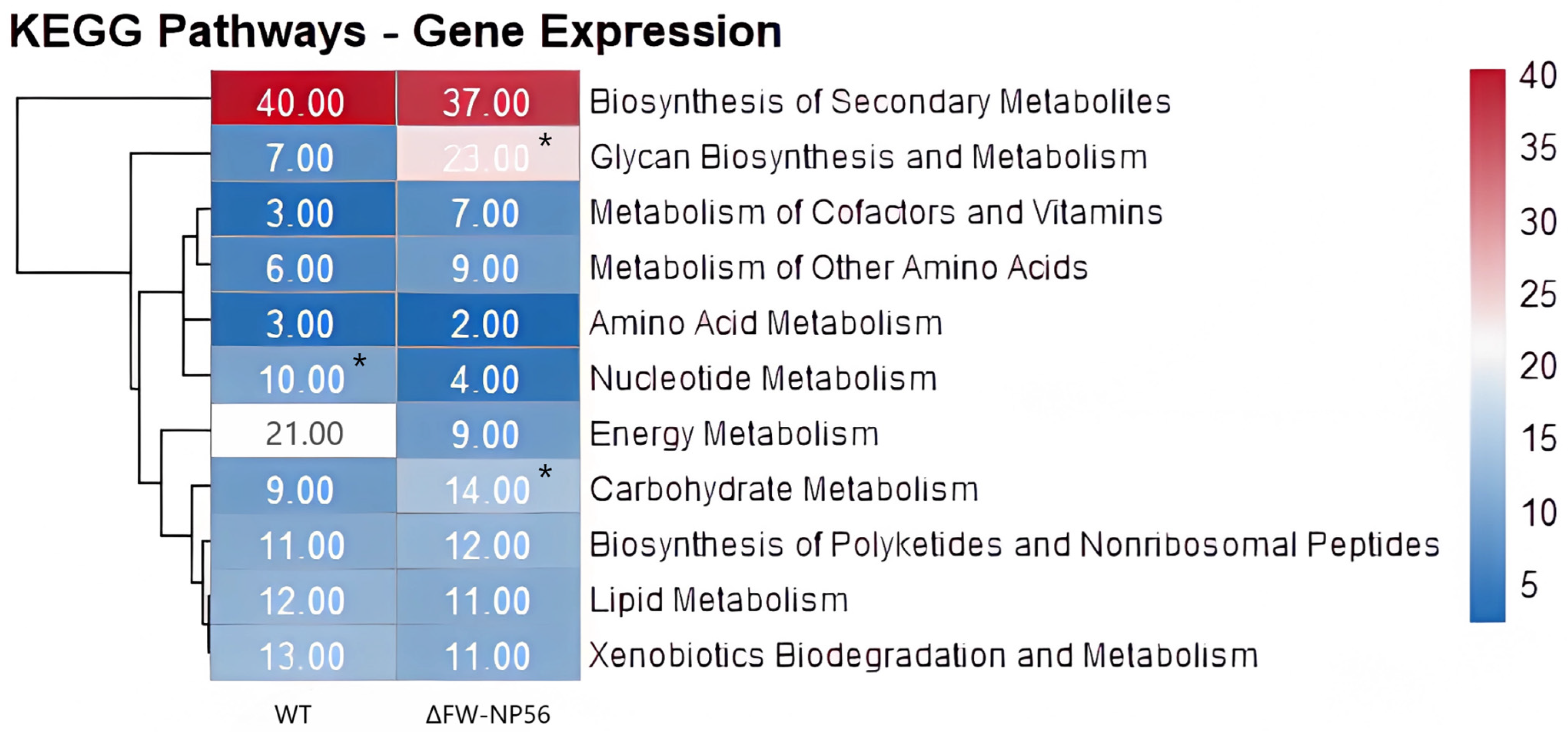
To evaluate the impact of FW-NPS6 deletion at the metabolic pathway level, we conducted a comparative analysis of genes assigned to KEGG metabolic pathways in the wild-type (WT) and ΔFW-NPS6 mutant strains, with the results visualized in a heatmap (Figure 4). Statistical analysis confirmed that the reductions in gene counts associated with “Energy Metabolism” (WT: 21 vs. ΔFW-NPS6: 9) and “Nucleotide Metabolism” (WT: 10 vs. ΔFW-NPS6: 4) were statistically significant (p < 0.05). In contrast, “Carbohydrate Metabolism” showed a significant increase in gene number (WT: 9 vs. ΔFW-NPS6: 14). No significant differences were observed in pathways including “Biosynthesis of Secondary Metabolites” (WT: 40 vs. ΔFW-NPS6: 37), “Biosynthesis of Polyketides and Nonribosomal Peptides” (WT: 11 vs. ΔFW-NPS6: 12), and “Lipid Metabolism” (WT: 13 vs. ΔFW-NPS6: 11). These results demonstrate that FW-NPS6 deletion specifically impairs fundamental energy and nucleotide metabolism while preserving the biosynthetic capacity for secondary metabolites, indicating its crucial role in regulating core energetic processes and cellular building block supply.

2.3. Identification of the Differentially Expressed Genes

To systematically identify genes whose expression was influenced by the deletion of the NPS6 gene, we conducted a comparative transcriptome analysis between the wild-type (WT) Fusarium oxysporum f. sp. niveum and the ΔFW-NPS6 mutant. A stringent screening criterion, requiring a p-value < 0.01 and an absolute fold-change > 2, was applied to ensure the high confidence of the results. This analysis revealed a total of 578 differentially expressed genes (DEGs). Among these, 279 genes were significantly upregulated in the WT strain relative to the mutant, suggesting their expression may be suppressed by or dependent on a functional NPS6. Conversely, 299 genes were downregulated in the WT, indicating their potential induction in the ΔFW-NPS6 genetic background. Following this identification, a crucial step of functional annotation was performed. We successfully annotated 162 of the upregulated genes and 128 of the downregulated genes, providing them with definitive gene names and functional descriptions, which form a critical foundation for subsequent mechanistic interpretations. Notably, the significant downregulation of genes involved in energy and nucleotide metabolism in the ΔNPS6 mutant suggests that NPS6 may play a previously underappreciated role in regulating core metabolic processes, which could be crucial for supplying the energy and building blocks required for host invasion.
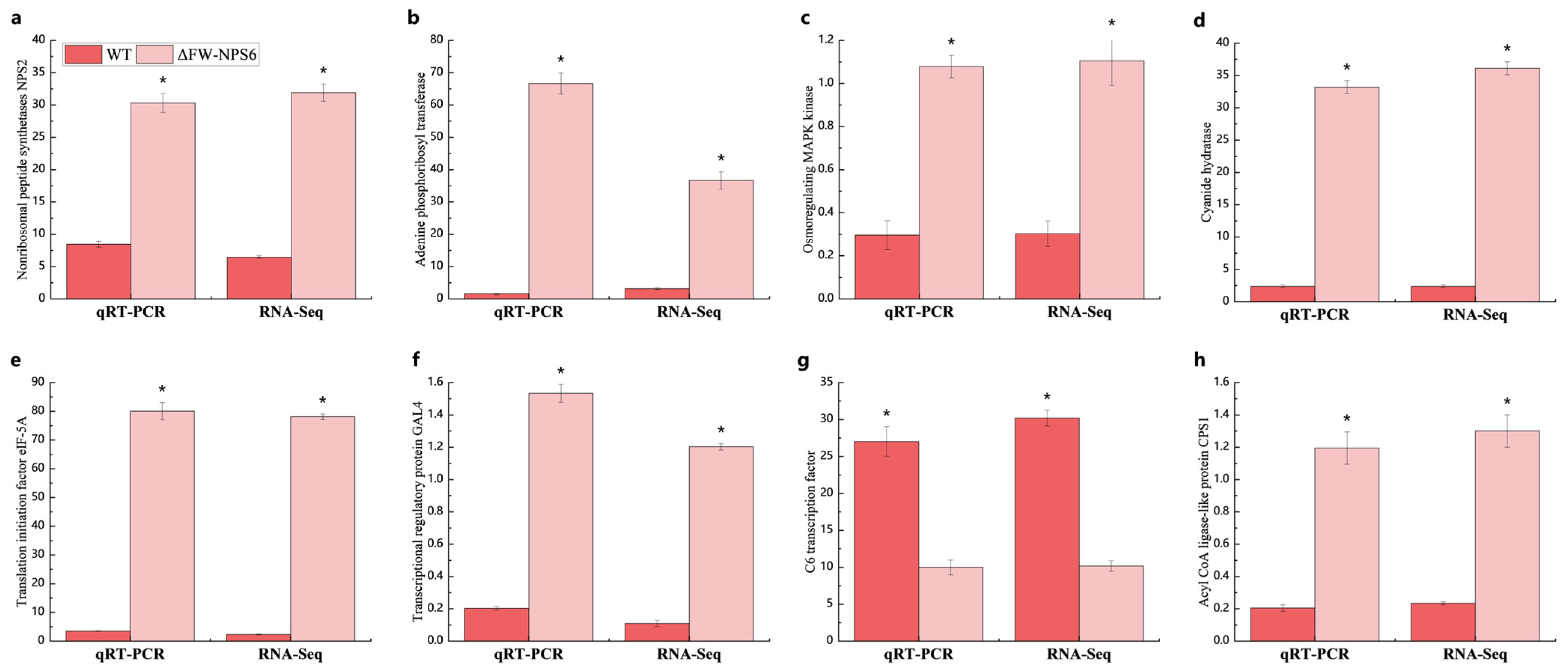
To independently verify the reliability and accuracy of the RNA-Seq data, a subset of ten DEGs was randomly selected for technical validation using quantitative real-time PCR (qRT-PCR). The expression trends and magnitudes of change for these selected genes, as determined by qRT-PCR, showed a strong and statistically significant correlation with the expression profiles generated from the RNA-Seq analysis. This high degree of consistency between the two methodologies, as graphically depicted in Figure 5, confirms the technical robustness of our transcriptome sequencing and the credibility of the identified DEGs for further biological investigation.

2.4. Identification of High-Confidence NPS6-Dependent Genes

These 66 genes constitute a high-confidence subset of the 578 DEGs, identified by applying an additional filter for expression abundance (RPKM > average). To systematically uncover novel genes functionally linked to the nps6-mediated virulence pathway in Fusarium oxysporum f. sp. niveum, we performed a targeted screening of our transcriptome data based on stringent expression criteria. The screening strategy was designed to identify genes not only exhibiting significant differential expression but also maintaining substantial expression levels, thereby increasing the likelihood of their biological relevance. Following the established methodology of Zheng et al. [25], we defined WT-enriched genes as those demonstrating a fold-change greater than 2 and possessing an RPKM value higher than the average RPKM of all genes in the WT background. Conversely, genes with a fold-change of less than −2 and an RPKM value exceeding the genetic background average were classified as ΔFW-NPS6-enriched. This dual-filter approach ensured the selection of high-confidence candidate genes. The resulting sets of enriched genes were subsequently subjected to in-depth functional prediction and pathway analysis using the KEGG Orthology (KO) database.
Application of this screening pipeline yielded 41 robustly WT-enriched genes and 54 ΔFW-NPS6-enriched genes. Within the WT-enriched gene set, 30 genes were successfully annotated with KO terms. Functional classification of these 30 genes revealed that the vast majority (27 genes) encoded various enzymes, while 3 genes were predicted to function as transcription factors, as detailed in Table 2. Parallel analysis of the 54 ΔFW-NPS6-enriched genes identified 36 with KO annotations. This group comprised 32 genes encoding enzymes and 4 genes for transcription factors. Notably, this set also included 4 genes belonging to the nonribosomal peptide synthetase (NRPS) gene family, highlighting a potential compensatory mechanism or an alternative secondary metabolite pathway activated in the absence of a functional NPS6. By integrating the candidate genes from both genotypes, this study successfully predicted a total of 66 putative pathogenic genes whose expression is strongly associated with the regulatory network of the NPS6 gene, providing a valuable resource for future functional characterization (Table 2). Among these, genes associated with secondary metabolite biosynthesis (particularly nonribosomal peptide synthetases like NPS2) and the MAPK signaling pathway emerge as particularly promising candidates for further experimental validation, given their well-established direct links to fungal pathogenesis and virulence regulation.

3. Discussion

Fusarium oxysporum f. sp. niveum (FON) is a devastating soil-borne facultative pathogen with a global distribution in major watermelon cultivation regions [5]. It incites a complex of destructive diseases, including vascular wilt, foot rot, and root and bulb rot, which collectively lead to substantial and often catastrophic reductions in crop yield and fruit quality, posing a persistent threat to global watermelon production. Given the well-established and diverse roles of nonribosomal peptide synthetases (NPSs) as critical virulence determinants-ranging from siderophore production to toxin biosynthesis in numerous plant-pathogenic fungi [11,12,26], they have been strongly proposed as key candidates mediating essential steps in plant pathogenesis. This study, therefore, sought to elucidate the specific molecular functions and regulatory network of a particular NPS gene, NPS6, in the pathogenesis of FON, aiming to uncover novel mechanisms that govern the pathogen‘s ability to cause disease. Unlike specific effector proteins such as FonSIX6 or transcription factors like FonPUF1 that execute discrete pathogenic functions, the NPS6-dependent regulon identified here may represent a broader regulatory layer that orchestrates fundamental metabolic and stress-responsive pathways necessary for successful infection.
To systematically address this objective, we constructed and sequenced comprehensive cDNA libraries from both the wild-type (WT) strain and the isogenic ΔFW-NPS6 mutant. Subsequent high-quality functional annotation, comparative transcriptomics, and rigorous gene set enrichment analysis were employed to identify genes whose expression is associated with NPS6. Applying a stringent statistical threshold (p-value < 0.01, following the methodology of Wang et al., 2009 [25]) for defining DEGs, we identified 30 genes significantly enriched in the WT strain and 36 genes enriched in the ΔFW-NPS6 mutant. Bioinformatics analysis revealed that these candidate genes are implicated in a wide array of fundamental biological processes crucial for the fungal life cycle and host interaction. These processes encompass amino acid transport and metabolism [27,28], regulation of gene expression, secondary metabolite biosynthesis, transport and catabolism, carbohydrate transport and metabolism, cell cycle control, stress response, the MAPK signaling pathway [8,29], fatty acid and lipid metabolism, glycan biosynthesis and metabolism, inorganic ion transport and metabolism, and energy production and conversion (Table 2). The broad involvement across these diverse and critical functional categories strongly suggests their collective importance in the pathogenicity of FON, potentially under the direct or indirect regulatory influence of the NPS6 gene [30,31,32].
Amino acid transport and metabolism represent a key functional category identified in our study, with 6 WT-enriched and 7 ΔFW-NPS6-enriched genes implicated. This process is fundamentally important for fungal virulence, as it participates in critical developmental stages such as spore formation, mycelial and conidial morphogenesis, and the biosynthesis of mycotoxins like deoxynivalenol (DON) in various Fusarium species [5,25,33]. For instance, vacuolar amino acid transporters, exemplified by FoAvt3p in F. oxysporum, play a vital role in spore formation [25]. Similarly, enzymes in the branched-chain amino acid pathway, such as FgIlv5 (acetohydroxy acid reductoisomerase) and FgIlv1 (threonine dehydratase) in Fusarium graminearum, are required for isoleucine and valine biosynthesis and are indispensable for normal morphogenesis, DON production, and full pathogenic capability [5]. The identification of amino acid metabolism genes in our dataset suggests that NPS6-mediated virulence may involve the modulation of nitrogen metabolism and associated developmental pathways in FON, a link that warrants further functional characterization.
Iron homeostasis, mediated by siderophores, is another crucial virulence mechanism. Iron-chelating siderophores produced by fungal NPSs are integral to reproductive development, pathogenic processes, iron acquisition, and resistance to host-induced oxidative stress [30]. In F. graminearum, distinct roles for different NPSs have been elucidated: deletion of NPS2 (intracellular siderophore biosynthesis) abolishes sexual sporulation, while deletion of NPS6 (extracellular siderophore biosynthesis) confers hypersensitivity to iron starvation and oxidative stress, leading to significantly reduced virulence, with evidence suggesting partial functional overlap between the two [34]. In our study, we observed a notable upregulation of NPS2 in the ΔFW-NPS6 mutant strain. Given that both NPS2 and NPS6 are involved in siderophore metabolism but are responsible for distinct intracellular and extracellular pools, respectively [30], the upregulation of NPS2 could represent an adaptive transcriptional response. This observation suggests a potential functional interaction or co-regulation within the NPS family that merits further investigation to determine if it partially offsets the metabolic deficiency caused by NPS6 deletion. Conversely, other NPS genes, including NPS4, NPS7, NPS9, NPS10, and NPS11, were downregulated in the ΔFW-NPS6 strain. This suggests that their expression might be positively regulated, directly or indirectly, by a functional NPS6 in the WT background. While the product of NPS4 has been hypothesized to function as a structural component of the cell wall or a regulator of surface hydrophobicity [10], the biological functions of NPS7, 9, 10, and 11 remain largely unknown [35], presenting intriguing targets for future research into the NPS6 regulon.
Signal transduction pathways, particularly the evolutionarily conserved mitogen-activated protein kinase (MAPK) cascades, serve as key regulators of pathogenesis in Fusarium. These pathways control a range of biological processes, including mating, conidiation, heterokaryon formation, host root penetration, and invasive growth [6,26]. For instance, in F. oxysporum, the MAPK Fmk1 is essential for plant infection and the development of vascular wilt. Mutants lacking fmk1 display pleiotropic defects, such as altered surface hydrophobicity, impaired invasive growth, and markedly reduced expression of pl1, which encodes a critical pectate lyase involved in cell wall degradation [6]. Similarly, orthologous MAPKs—including Mgv1 and Gpmk1 in F. graminearum and Fvmk in F. verticillioides—have been shown to regulate fungal fertility, development, and virulence [4,36]. Our RNA-seq analysis revealed significant downregulation of a gene encoding an osmoregulatory MAPK in the ΔFW-NPS6 strain. This finding leads us to propose that NPS6 may modulate the MAPK signaling pathway. This downregulation may disrupt the signal transduction necessary for successful host colonization, thereby directly contributing to the attenuated virulence observed in the ΔFW-NPS6 mutant. The production of toxic secondary metabolites is a well-established virulence strategy for many fungal pathogens [33,37]. Our transcriptome data revealed that FtmPT1, a dimethylallyl tryptophan synthase that catalyzes the first committed step in ergot alkaloid biosynthesis, was downregulated in the ΔFW-NPS6 strain. This intriguing association raises the possibility of a link between NPS6 and the biosynthesis of secondary metabolites with phytotoxic properties. The precise mechanism by which NPS6 influences FtmPT1 expression and the potential contribution of ergot alkaloid-like compounds to FON pathogenicity are currently unclear and represent a compelling avenue for further investigation. Taken together, the downregulation of key virulence-associated genes provides a direct explanation for the ΔNPS6 mutant’s attenuated pathogenicity: impaired MAPK signaling likely hinders host colonization, while reduced expression of biosynthetic enzymes like FtmPT weakens chemical attack.
Integrating our findings, we propose that NPS6 acts as a central virulence regulator in FON through a hierarchical model: its primary role in maintaining iron and redox homeostasis establishes a cellular foundation that enables the proper functioning of secondary metabolite biosynthesis and stress-responsive signaling pathways (e.g., MAPK), collectively governing pathogenicity. Based on this model, we hypothesize that the iron/redox imbalance in the ΔNPS6 mutant directly or indirectly (e.g., through altered metabolite pools or stress signals) impairs the activation of specific MAPK cascades and represses the expression of secondary metabolite genes like FtmPT1. This hypothesis can be tested by comparing MAPK phosphorylation states and FtmPT1 expression levels in the WT and ΔNPS6 strains under controlled iron availability. This study provides a transcriptomic roadmap that defines the NPS6 regulon in FON, highlighting specific candidates for functional dissection. The most immediate research priorities arising directly from our data include the functional characterization of the differentially expressed nonribosomal peptide synthetases (e.g., NPS7, NPS9, NPS10, and NPS11), validation of the role of the phytotoxin synthase FtmPT1, and elucidation of the mechanistic link between NPS6 and the MAPK signaling pathway. Beyond mechanistic insights, these NPS6-dependent virulence determinants open new avenues for integrated disease management. The core genes and pathways identified here could serve as targets for designing novel mode-of-action fungicides or for developing DNA markers to expedite the breeding of resistant watermelon varieties. Furthermore, understanding how these virulence factors are deployed may inform the selection or engineering of more effective biocontrol agents. Moving from correlative transcriptomic evidence to causal validation of these targets will be essential to translate our findings into sustainable control strategies against Fusarium wilt.

4. Materials and Methods

4.1. Sampling of Mutant Strains

The wild-type (WT) strain of Fusarium oxysporum f. sp. niveum race 1, used in this study, was originally acquired from the Jiangsu Academy of Agricultural Sciences, China. This strain was initially isolated from a diseased watermelon plant exhibiting characteristic symptoms of Fusarium wilt. The ΔFW-NPS6 knockout mutant was generated on this WT genetic background. Specifically, the NPS6 gene was deleted via a homologous recombination strategy, wherein the entire coding region was replaced by a hygromycin resistance cassette to create the ΔFW-NPS6 mutant. The successful and correct construction of the mutant was confirmed by both diagnostic PCR and Southern blot analysis. Hereafter, this mutant is abbreviated as ΔNPS6. Consistent with previous findings in other fungal systems, the ΔFW-NPS6 mutant has been previously demonstrated to exhibit a significant reduction in virulence compared to the wild-type progenitor, underscoring the functional importance of this biosynthetic gene in the pathogenicity of Fusarium oxysporum f. sp. niveum [5].

4.2. RNA Isolation, cDNA Library Preparation and Sequencing

The strain was pre-cultured on PDA plates at 28 °C for 7 days. Conidia were harvested and inoculated into 100 mL of liquid PDB (nutrient-rich condition) or iron-limited Czapek-Dox medium (supplemented with 100 µM BPS) in flasks at a final concentration of 1 × 10⁵ spores/mL. Cultures were incubated at 28 °C with shaking at 180 rpm for 72 h to obtain mycelia in the late-logarithmic growth phase under respective conditions. Mycelia were harvested by rapid vacuum filtration, immediately frozen in liquid nitrogen, and stored at −80 °C until RNA extraction. Three biological replicates were prepared for each condition. Total RNA was extracted from both the wild-type (WT) and the ΔFW-NPS6 mutant strains using the TRIzol reagent method, respectively. (Invitrogen, Carlsbad, CA, USA), following the manufacturer’s instructions. RNA integrity and concentration were assessed. Subsequently, cDNA libraries for RNA sequencing were constructed using the Illumina TruSeq RNA Sample Preparation Kit (Illumina, San Diego, CA, USA), strictly according to the standard protocol provided by the manufacturer.

4.3. Read Mapping and Gene Annotation

The obtained clean reads were mapped to the reference genome of Fusarium oxysporum using the BLAST-based alignment tool (version 2.2.24) provided by the Fusarium Comparative Database at the Broad Institute (https://www.ncbi.nlm.nih.gov/bioproject/18813, accessed on 25 March 2016). Uniquely mapped reads were assigned to genes using feature Counts, and gene expression levels were calculated and normalized as FPKM (Fragments Per Kilobase per Million mapped reads). Functional annotation was performed using the following databases and tools: Gene Ontology (GO) terms were assigned using Blast2GO 6.0; pathway annotation was conducted using the KEGG Automatic Annotation Server (KAAS) https://www.genome.jp/kegg/kaas/, accessed 15 October 2025; and gene enrichment analysis was performed using DAVID https://davidbioinformatics.nih.gov/, accessed 15 October 2025.

4.4. Identification of Differentially Expressed Genes

Differentially expressed genes (DEGs) between the wild-type (WT) and the ΔNPS6 mutant were identified using the DEGseq R package (R version 4.5) [25]. The MARS (MA-plot-based method with Random Sampling) model within DEGseq was applied. Genes with an absolute fold change |FC| > 2 and a p-value < 0.01 were considered statistically significant. The fold change was calculated by the Wilson‘s method [18]. Gene enrichment analysis was performed by DAVID and predicting novel pathogenic genes.

4.5. Quantitative Reverse Transcriptase (qRT-PCR)

T The qRT-PCR reactions were performed on an ABI PRISM 7900HT Fast Real-Time PCR System (Applied Biosystems, Carlsbad, CA, USA) using SYBR Green chemistry. The thermal cycling conditions were as follows: initial denaturation at 95 °C for 30 s; followed by 40 cycles of denaturation at 95 °C for 5 s and combined annealing/extension at 60 °C for 30 s; finally, a melt curve analysis was performed from 65 °C to 95 °C to verify amplification specificity. The 2−ΔΔCt method was used to calculate relative gene expression levels. Primers used in qRT-PCR are shown in Table 3.

4.6. Data Access

The sequencing data have been submitted to the Sequence Read Archive (SRP) database under the accession numbers SRP 066642, SRP 066643.

5. Conclusions

We utilized an RNA-seq approach to dissect the transcriptomic landscape governed by NPS6 in Fusarium oxysporum f. sp. niveum. This strategy successfully identified 30 WT-enriched and 36 mutant-enriched candidate genes that are potentially critical for pathogenicity. These genes span multiple functional categories, including amino acid metabolism, siderophore biosynthesis, MAPK signaling, and secondary metabolism, outlining a complex regulatory network associated with NPS6. Future studies, involving targeted gene knockout and functional complementation assays, will be essential to precisely clarify the mechanistic relationships between NPS6 and these identified genes, and to definitively establish their individual and collective roles in the virulence of this economically important pathogen.
Particularly, genes involved in siderophore biosynthesis and MAPK signaling are prioritized for functional validation. We also note that the mechanistic insights proposed here, derived from transcriptomic correlations, require further experimental confirmation.

Author Contributions

Conceptualization, X.Y. and J.L.; Methodology, X.Y., J.L. and H.Z.; Software, L.Z. and H.L.; Formal analysis, L.Z.; Investigation, X.Y., L.Z., J.Z. and H.L.; Resources, X.Y. and H.L.; Data curation, J.Z. and H.Z.; Writing—original draft, X.Y., L.Z., J.Z. and H.L.; Writing—review & editing, L.Z. and J.L.; Visualization, L.Z.; Supervision, X.Y., J.Z., J.L. and H.Z.; Project administration, X.Y. and J.L.; Funding acquisition, X.Y. and J.L. All authors have read and agreed to the published version of the manuscript.

Funding

This research was supported by National Key R&D Program of China (2023YFD1500900), Key Project of the Ministry of Agriculture and Rural Affairs of China (NK2022180201), Basic Research Project of Liaoning Provincial Department of Education (JYTZD2023126), Liaoning Province Science and Technology Plan Project (2023-BSBA-285) and Shenyang Agricultural University publicly recruits doctoral graduates for research start-up fund project (2022018).

Institutional Review Board Statement

Not applicable.

Informed Consent Statement

Not applicable.

Data Availability Statement

The original contributions presented in this study are included in the article. Further inquiries can be directed to the corresponding author.

Conflicts of Interest

The authors declare no conflicts of interest.

References

  1. Li, J.; Gao, Y.; Li, B.; Zhang, L.; Fang, Y.; Zou, H.; Ye, X. FONPS6, a Nonribosomal Peptide Synthetase, Plays a Crucial Role in Achieving the Full Virulence Potential of the Vascular Wilt Pathogen Fusarium oxysporum f. sp. niveum. Life 2025, 15, 142. [Google Scholar] [CrossRef]
  2. Di Lorenzo, M.; Stork, M.; Naka, H.; Tolmasky, M.E.; Crosa, J.H. Tandem heterocyclization domains in a nonribosomal peptide synthetase essential for siderophore biosynthesis in Vibrio anguillarum. BioMetals 2008, 21, 635–648. [Google Scholar] [CrossRef]
  3. Liu, X.; Wang, J.; Xu, J.; Shi, J. FgIlv5 is required for branched-chain amino acid biosynthesis and full virulence in Fusarium graminearum. Microbiology 2014, 160, 692–702. [Google Scholar] [CrossRef]
  4. Hou, Z.; Xue, C.; Peng, Y.; Katan, T.; Kistler, H.C.; Xu, J.R. A mitogen-activated protein kinase gene (MGV1) in Fusarium graminearum is required for female fertility, heterokaryon formation, and plant infection. Mol. Plant-Microbe Interact. 2002, 15, 1119–1127. [Google Scholar] [CrossRef]
  5. Peng, S.; Wang, Y.M.; Ye, X.H.; Lin, X.G.; Dai, X.; Wang, J.W.; Xie, X.Q. Effects of soil habitat factors on growth of Fusarium oxysporum f. sp. niveum and Fusarium oxysporum f. sp. Cucumerinum. Soil 2014, 46, 845–850. [Google Scholar]
  6. Michielse, C.B.; Van, W.R.; Reijnen, L.; Cornelissen, B.J.; Rep, M. Insight into the molecular requirements for pathogenicity of Fusarium oxysporum f. sp. lycopersici through large-scale insertional mutagenesis. Genome Biol. 2009, 10, R4. [Google Scholar] [CrossRef]
  7. Bao, Y.; Dolfing, J.; Guo, Z.; Liu, J.; Pan, X.; Cui, X.; Wang, Y.; Jin, Y.; Zhang, L.; Chen, R.; et al. Warmer summers have the potential to affect food security by increasing the prevalence and activity of Actinobacteria. Eur. J. Soil Biol. 2025, 124, 103708. [Google Scholar] [CrossRef]
  8. Di, P.A.; Garcia-MacEira, F.I.; Meglecz, E.; Roncero, M.I. A MAP kinase of the vascular wilt fungus Fusarium oxysporum is essential for root penetration and pathogenesis. Mol. Microbiol. 2001, 39, 1140–1152. [Google Scholar] [CrossRef]
  9. Rispail, N.; Di, P.A. Fusarium oxysporum Ste12 controls invasive growth and virulence downstream of the Fmk1 MAPK cascade. Mol. Plant-Microbe Interact. 2009, 22, 830–839. [Google Scholar] [CrossRef]
  10. Shen, Y.; Diener, A.C. Arabidopsis thaliana resistance to Fusarium oxysporum 2 implicates tyrosine-sulfated peptide signaling in susceptibility and resistance to root infection. PLoS Genet. 2013, 9, e1003525. [Google Scholar] [CrossRef]
  11. Oide, S.; Moeder, W.; Krasnoff, S.; Gibson, D.; Haas, H.; Yoshioka, K.; Turgeon, B.G. NPS6, encoding a nonribosomal peptide synthetase involved in siderophore-mediated iron metabolism, is a conserved virulence determinant of plant pathogenic ascomycetes. Plant Cell 2006, 18, 2836–2853. [Google Scholar] [CrossRef]
  12. Lee, B.N.; Kroken, S.; Chou, D.Y.; Robbertse, B.; Yoder, O.C.; Turgeon, B.G. Functional analysis of all nonribosomal peptide synthetases in Cochliobolus heterostrophus reveals a factor, NPS6, involved in virulence and resistance to oxidative stress. Eukaryot. Cell 2005, 4, 545–555. [Google Scholar] [CrossRef] [PubMed]
  13. Hansen, F.T.; Droce, A.; Sorensen, J.L.; Fojan, P.; Giese, H.; Sondergaard, T.E. Overexpression of NPS4 leads to increased surface hydrophobicity in Fusarium graminearum. Fungal Biol. 2012, 116, 855–862. [Google Scholar] [CrossRef]
  14. Halkier, B.A.; Gershenzon, J. Biology and biochemistry of glucosinolates. Annu. Rev. Plant Biol. 2020, 71, 303–333. [Google Scholar] [CrossRef]
  15. Cheng, Y.; Liu, X.; An, S.; Chang, C.; Zou, Y.; Huang, L.; Zhong, J.; Liu, Q.; Jiang, Z.; Zhou, J.; et al. A nonribosomal peptide synthase containing a stand-alone condensation domain is essential for phytotoxin zeamine biosynthesis. Mol. Plant Microbe Interact. 2013, 26, 1294–1301. [Google Scholar] [CrossRef] [PubMed]
  16. Hanschen, F.S.; Winkelmann, T. Sulfur volatiles in plant-plant interactions: Ecological and molecular perspectives. Plant Cell Environ. 2023, 46, 321–335. [Google Scholar] [CrossRef]
  17. Schrettl, M.; Bignell, E.; Kragl, C.; Sabiha, Y.; Loss, O.; Eisendle, M.; Wallner, A.; Arst, H.N., Jr.; Haynes, K.; Haas, H. Distinct roles for intra-and extracellular siderophores during Aspergillus fumigatus infection. PLoS Pathog. 2007, 3, e128. [Google Scholar] [CrossRef]
  18. Wilson, D.J.; Shi, C.; Teitelbaum, A.M.; Gulick, A.M.; Aldrich, C.C. Characterization of AusA: A dimodular nonribosomal peptide synthetase responsible for the production of aureusimine pyrazinones. Biochemistry 2013, 52, 926–937. [Google Scholar] [CrossRef]
  19. Yin, W.B.; Baccile, J.A.; Bok, J.W.; Chen, Y.; Keller, N.P.; Schroeder, F.C. A nonribosomal peptide synthetase-derived iron(III) complex from the pathogenic fungus Aspergillus fumigatus. J. Am. Chem. Soc. 2013, 135, 2064–2067. [Google Scholar] [CrossRef] [PubMed]
  20. Hansen, F.T.; Sorensen, J.L.; Giese, H.; Sondergaard, T.E.; Frandsen, R.J. Quick guide to polyketide synthase and nonribosomal synthetase genes in Fusarium. Int. J. Food Microbiol. 2012, 155, 128–136. [Google Scholar] [CrossRef] [PubMed]
  21. Lunprom, S.; Pongcharoen, P.; Sekito, T.; Kawano-Kawada, M.; Kakinuma, Y.; Akiyama, K. Characterization of vacuolar amino acid transporter from Fusarium oxysporum in Saccharomyces cerevisiae. Biosci. Biotechnol. Biochem. 2015, 79, 1972–1979. [Google Scholar] [CrossRef]
  22. Ramel, C.; Baechler, N.; Hildbrand, M.; Meyer, M.; Schadeli, D.; Dudler, R. Regulation of biosynthesis of syringolin A, a Pseudomonas syringae virulence factor targeting the host proteasome. Mol. Plant Microbe Interact. 2012, 25, 1198–1208. [Google Scholar] [CrossRef]
  23. Chen, L.H.; Lin, C.H.; Chung, K.R. A nonribosomal peptide synthetase mediates siderophore production and virulence in the citrus fungal pathogen Alternaria alternata. Mol. Plant Pathol. 2013, 14, 497–505. [Google Scholar] [CrossRef]
  24. Reeves, E.P.; Reiber, K.; Neville, C.; Scheibner, O.; Kavanagh, K.; Doyle, S. A nonribosomal peptide synthetase (Pes1) confers protection against oxidative stress in Aspergillus fumigatus. FEBS J. 2006, 273, 3038–3053. [Google Scholar] [CrossRef]
  25. Wang, L.; Feng, Z.; Wang, X.; Zhang, X. DEGseq: An R package for identifying differentially expressed genes from RNA-seq data. Bioinformatics 2009, 26, 136–138. [Google Scholar] [CrossRef]
  26. Condon, B.J.; Leng, Y.; Wu, D.; Bushley, K.E.; Ohm, R.A.; Otillar, R.; Martin, J.; Schackwitz, W.; Grimwood, J.; MohdZainudin, N.; et al. Comparative genome structure, secondary metabolite, and effector coding capacity across Cochliobolus pathogens. PLoS Genet. 2013, 9, e1003233. [Google Scholar] [CrossRef] [PubMed]
  27. Fu, J.; Wu, J.; Jiang, J.; Wang, Z.; Ma, Z. Cystathionine gamma-synthase is essential for methionine biosynthesis in Fusarium graminearum. Fungal Biol. 2013, 117, 13–21. [Google Scholar] [CrossRef] [PubMed]
  28. Liu, X.; Xu, J.; Wang, J.; Ji, F.; Yin, X.; Shi, J. Involvement of threonine deaminase FgIlv1 in isoleucine biosynthesis and full virulence in Fusarium graminearum. Curr. Genet. 2015, 61, 55–65. [Google Scholar] [CrossRef]
  29. Zhang, Y.; Choi, Y.E.; Zou, X.; Xu, J.R. The FvMK1 mitogen-activated protein kinase gene regulates conidiation, pathogenesis, and fumonisin production in Fusarium verticillioides. Fungal Genet. Biol. 2011, 48, 71–79. [Google Scholar] [CrossRef]
  30. Oide, S.; Berthiller, F.; Wiesenberger, G.; Adam, G.; Turgeon, B.G. Individual and combined roles of malonichrome, ferricrocin, and TAFC siderophores in Fusarium graminearum pathogenic and sexual development. Front. Microbiol. 2014, 5, 759. [Google Scholar] [CrossRef]
  31. Jenczmionka, N.J.; Maier, F.J.; Losch, A.P.; Schafer, W. Mating, conidiation and pathogenicity of Fusarium graminearum, the main causal agent of the head-blight disease of wheat, are regulated by the MAP kinase gpmk1. Curr. Genet. 2003, 43, 87–95. [Google Scholar] [CrossRef] [PubMed]
  32. Bao, Y.; Sáez-Sandino, T.; Feng, Y.; Yan, X.; He, S.; Feng, S.; Chen, R.; Guo, H.; Delgado-Baquerizo, M. Gemmatirosa adaptations to arid and low soil organic carbon conditions worldwide. Geoderma 2025, 460, 117420. [Google Scholar] [CrossRef]
  33. Zhang, Y.; Stupka, E.; Henkel, C.V. Identification of common carp innate immune genes with whole-genome sequencing and RNA-Seq data. J. Integr. Bioinform. 2011, 8, 169. [Google Scholar] [CrossRef] [PubMed]
  34. Oide, S.; Krasnoff, S.B.; Turgeon, B.G. NPS6-dependent extracellular siderophores mediate iron acquisition and virulence in Fusarium oxysporum. PLoS Pathog. 2020, 16, e1008647. [Google Scholar] [CrossRef]
  35. Jones, J.P.; Woltz, S.S. Effect of ethionine and methionine on the growth, sporulation, and virulence of Fusarium oxysporum f. sp. lycopersici race 2. Phytopathology 1969, 59, 1464–1467. [Google Scholar]
  36. Sheridan, K.J.; Dolan, S.K.; Doyle, S. Endogenous cross-talk of fungal metabolites. Front. Microbiol. 2014, 5, 732. [Google Scholar] [CrossRef]
  37. Jenczmionka, N.J.; Schafer, W. The Gpmk1 MAP kinase of Fusarium graminearum regulates the induction of specific secreted enzymes. Curr. Genet. 2005, 47, 29–36. [Google Scholar] [CrossRef]
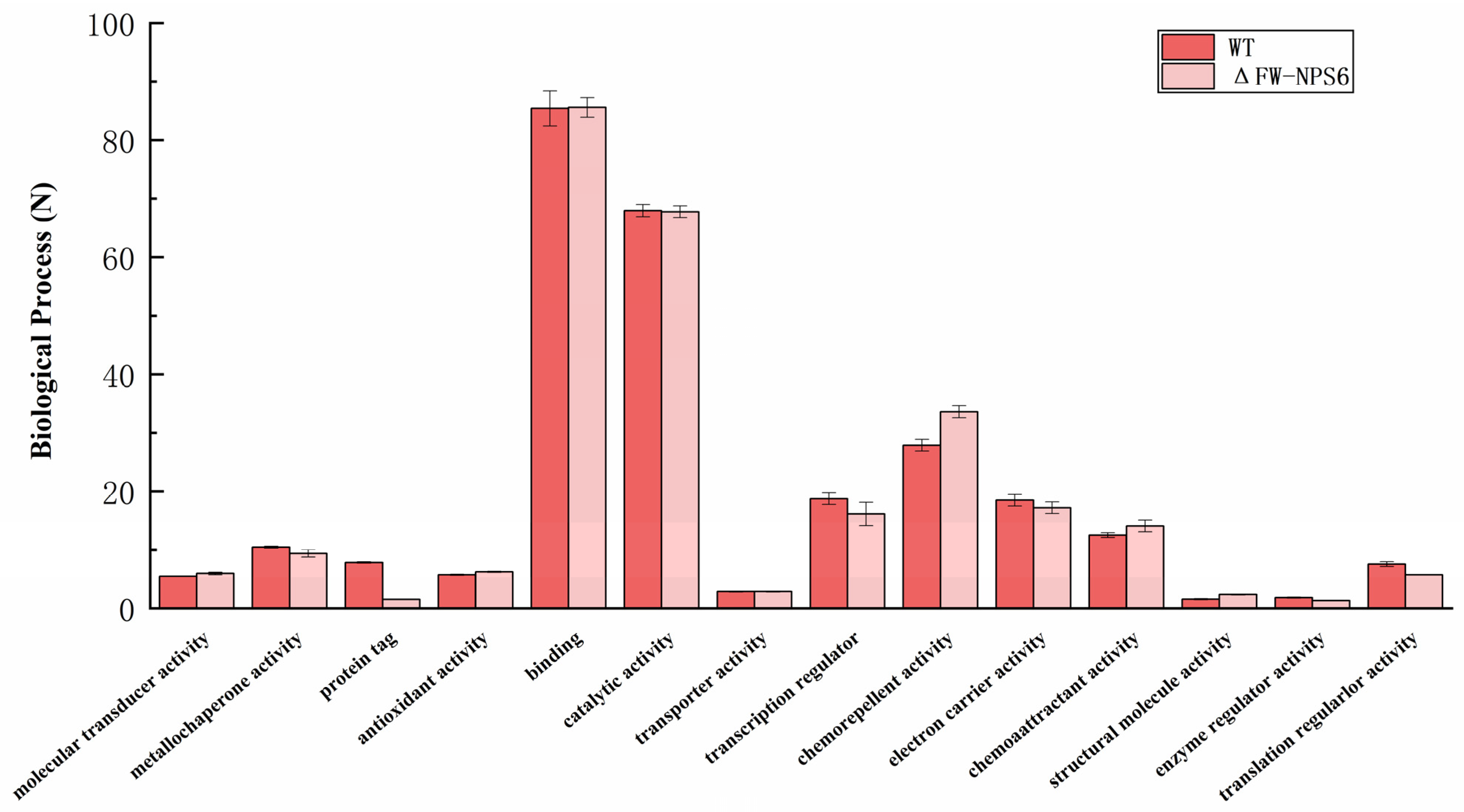
Figure 1. Biological process of Gene Ontology classification of annotated genes in wild-type (WT) and ΔFW-NPS6 mutant strains. The two strains showed no significant differences in their classification hierarchies (p > 0.05).
Ijms 27 00830 g001
Figure 2. Molecular function of Gene Ontology classification of annotated genes in wild-type (WT) and ΔFW-NPS6 mutant strains. The two strains showed no significant differences in their GO classification hierarchies (p > 0.05).
Ijms 27 00830 g002
Figure 3. Cellular component of Gene Ontology classification of annotated genes in wild-type (WT) and ΔFW-NPS6 mutant strains. The two strains showed no significant differences in their classification hierarchies (p > 0.05).
Ijms 27 00830 g003
Figure 4. Heatmap Analysis of KEGG Metabolic Pathway Gene Expression in WT and ΔFW-NP56 Strains. “*” indicates a statistically significant difference (p < 0.05) in gene count between WT and ΔFW-NPS6 strains.
Ijms 27 00830 g004
Figure 5. qRT-PCR validation of 8 genes that were differentially expressed between WT and ΔFW-NPS6. (a) Nonribosomal peptide synthetases NPS2; (b) Adenine phosphoribosyl transferase; (c) Osmoregulating MAPK; (d) Cyanide hydratase; (e) Translation initiation factor eIF-5A; (f) Transcriptional regulatory protein GAL4; (g) C6 transcription factor; (h) Acyl CoA ligase-like protein CPS1. An asterisk (*) indicates a significant difference among treatments at the p < 0.05 level.
Ijms 27 00830 g005
Table 1. The Kyoto encyclopedia of genes and genomes (KEGG) biochemical mappings for genes expressed in WT and ΔFW-NPS6.
KEGG Categories RepresentedNumber of Genes
WTΔFW-NPS6
Metabolism134139
Amino Acid Metabolism32
Biosynthesis of Polyketides and Nonribosomal Peptides1112
Biosynthesis of Secondary Metabolites4037
Carbohydrate Metabolism914
Energy Metabolism219
Glycan Biosynthesis and Metabolism723
Lipid Metabolism1211
Metabolism of Cofactors and Vitamins37
Metabolism of Other Amino Acids69
Nucleotide Metabolism104
Xenobiotics Biodegradation and Metabolism1311
Cellular Processes236235
Behavior12
Cell Communication4045
Cell Growth and Death1114
Cell Motility1517
Circulatory System910
Development608
Endocrine System5153
Immune System1460
Nervous System320
Sensory System117
Transport and Catabolism219
Environmental Information Processing107108
Membrane Transport46
Signal Transduction5162
Signaling Molecules and Interaction5240
Genetic Information Processing3743
Folding, Sorting and Degradation1313
Replication and Repair94
Transcription109
Translation517
Table 2. Genes differentially expressed in ΔFW-NPS6 according to RNA sequencing.
Acc. No. Protein FunctionRPKMFold Change
(ΔFW-NPS6 vs. wt)
Amino acid transport and metabolism
FOXG_000585 choline dehydrogenase82.40.09
FOXG_000341 peptidylprolyl isomerase172.190.13
FOXG_000647 homoserine O-acetyltransferase61.660.15
FOXG_000604 phosphoserine aminotransferase76.750.26
FOXG_000834 maleylacetoacetate isomerase52.190.35
FOXG_000478 homocitrate synthase108.770.43
FOXG_175961 homoisocitrate dehydrogenase55.264.1
FOXG_168639 glutamate carboxypeptidase II30.084.73
FOXG_000016 4-hydroxyphenylpyruvate dioxygenase172.185.55
FOXG_000497 basic amino acid/polyamine antiporter, APA family232.647.35
FOXG_195125 methylenetetrahydrofolate dehydrogenase47.48.36
FOXG_134050 cysteine synthase A31.199.24
FOXG_000472 arginine transporter80.4410.71
Carbohydrate transport and metabolism
FOXG_000713 maltose permease59.210.11
FOXG_000094 D-lactate dehydrogenase272.840.19
FOXG_00921 MFS transporter43.140.4
FOXG_134128 Hexokinase51.012.64
FOXG_137571 NAD(P)H-dependent D-xylose reductase (XR)43.372.85
Cell cycle regulation
FOXG_166060 cell cycle control protein tyrosine phosphatase Mih154.817.47
Stress response
FOXG_000540 zinc-binding oxidoreductase228.443.65
Growth and Survival
FOXG_000472 osmoregulating MAPK112.190.13
FOXG_001738 TNF receptor-associated factor 659.484.37
Fatty acid and lipid transport and metabolism
FOXG_001664 extracellular lipase64.632.17
FOXG_000190 extracellular lipase107.713.81
FOXG_130515 acyl-CoA-ligases CPS157.767.27
Glycan biosynthesis and metabolism
FOXG_000478 beta-1,6-N-acetylglucosaminyl transferase299.588.56
FOXG_132156 UDP-N-acetylglucosamine pyrophosphorylase38.2910.46
Information storage and processing
FOXG_000540 peptide-N4-(N-acetyl-beta-glucosaminyl)asparagine amidase87.30.1
FOXG_000113 isoleucyl-tRNA synthetase208.940.31
FOXG_132712 alanyl-tRNA synthetase35.225.58
Inorganic ion transport and metabolism
FOXG_000973 sulfate permease, SulP family37.470.23
FOXG_001733 phosphate-repressible phosphate permease61.642.09
FOXG_137308 metalloreductase Fre843.798.47
Sulfur metabolism
FOXG_128562 choline sulfatase57.893.95
Nitrogen metabolism
FOXG_00886 cyanide hydratase44.190.47
Metabolism of cofactors
FOXG_000058 enoyl-CoA hydratase290.430.13
FOXG_000764 type II pantothenate kinase55.390.17
FOXG_001590 similar to Trans-2-enoyl-CoA reductase224.924.26
FOXG_257691 carnitine O-acetyltransferase42.216.36
Nucleotide transport and metabolism
FOXG_000135 adenine phosphoribosyltransferase204.820.24
Posttranslational modification, protein turnover, folding and assembly
FOXG_131982 GNAT family acetyltransferase Nat439.263.97
FOXG_168639 glutamate carboxypeptidase II30.084.73
Regulation of gene expression
FOXG_000190 transcriptional adapter 3187.10.11
FOXG_010129 regulatory protein SWI533.110.17
FOXG_001075 translation initiation factor eIF-5A33.720.36
FOXG_000497 translation initiation factor eIF-4107.750.46
FOXG_165825 small subunit ribosomal protein S2e57.393.95
FOXG_001655 small subunit ribosomal protein S15e69.774.49
FOXG_000047 transcriptional regulatory protein GAL4117.14.85
FOXG_001610 C6 transcription factor72.495.52
Secondary metabolites biosynthesis, transport and catabolism
FOXG_000637 nonribosomal peptide synthetases 466.480.11
FOXG_236772 nonribosomal peptide synthetases 746.60.16
FOXG_000786 nonribosomal peptide synthetases 952.560.12
FOXG_000578 nonribosomal peptide synthetases 1082.490.42
FOXG_144903 nonribosomal peptide synthetases 1149.240.22
FOXG_000848 dimethylallyl tryptophan synthase FtmPTI45.860.11
FOXG_001684 nonribosomal peptide synthetases 262.483.32
FOXG 000058 short-chain dehydrogenase109.373.59
Energy production and conversion
FOXG 001941 AMID-like mitochondrial oxidoreductase41.010.19
FOXG_000027 aarF domain-containing kinase117.123.47
Other
FOXG_00944 Carboxymethyl ene butenolidase39.240.34
FOXG_000630 membrane dipeptidase74.690.39
FOXG_168476 Bloom syndrome protein53.118.46
FOXG_000341 5-dehydrogenase188.0910.46
Table 3. PCR primers used for qRT-PCR validation.
No.Gene IDGene NamePrimers Sequences
Sense 5′-3′Anti-Sense 5′-3′
aFOXG_000135adenine phosphoribosyltransferaseGACTTGCGCTCCGTCTCGGCGTTCGACGATCAGCTGCAGCCTTTGC
bFOXG_000472osmoregulating MAPKGCCCGATATCAACATCTCGTGGGCATTCAGCTTCTAGCTTGAAATC
cFOXG_00886cyanide hydrataseCGTGAGAACTCCATGGCTGTCGACGATGACAGCACCGTCAGGACCGA
dFOXG_001075translation initiation factor eIF-5ACCGTTCTCTTCAAAGAACTCGAGGTGTCACCGTCATCGGTCATG
eFOXG_000047transcriptional regulatory protein GAL4GCAAGCATCTCGGCTTGCAAGCTCTTGGAAGACCTGCTCG
fFOXG_001684nonribosomal peptide synthetases 2CTCTGAACATCGACGCACCATGGAATATGTCTGTCGTG
gFOXG_001610C6 transcription factorGGTATGGATCCACAATACCGGCGCATGATGGTTGTTTC
hFOXG_130515acyl-CoA-ligases CPS1CGCCTCTCAACCCGGCTTACAAGTGATAAGACGTACTCATGGTTCG
ReferenceGenBank: U37499.1β-actinIGCGTGACATCAAGGAGAAGCTGGGCAACGGAACCTCT
Disclaimer/Publisher’s Note: The statements, opinions and data contained in all publications are solely those of the individual author(s) and contributor(s) and not of MDPI and/or the editor(s). MDPI and/or the editor(s) disclaim responsibility for any injury to people or property resulting from any ideas, methods, instructions or products referred to in the content.