Review

Safety Assessment of Extracellular Vesicle-Based Therapy in Regenerative Dentistry

1
Department of Craniofacial Diagnostics and Biosciences, Faculty of Dentistry, Universiti Kebangsaan Malaysia, Kuala Lumpur 50300, Malaysia
2
Department of Tissue Engineering and Regenerative Medicine, Faculty of Medicine, Universiti Kebangsaan Malaysia, Kuala Lumpur 56000, Malaysia
3
Jeffrey Cheah School of Medicine & Health Sciences, Monash University Malaysia, Petaling Jaya 47500, Malaysia
4
Department of Restorative Dentistry, Faculty of Dentistry, Universiti Kebangsaan Malaysia, Kuala Lumpur 50300, Malaysia
*
Author to whom correspondence should be addressed.
Int. J. Mol. Sci. 2026, 27(2), 798; https://doi.org/10.3390/ijms27020798
Submission received: 24 November 2025 / Revised: 30 December 2025 / Accepted: 6 January 2026 / Published: 13 January 2026

Abstract

Extracellular vesicle (EV)-based therapies have emerged as promising, cell-free approaches for dental tissue regeneration. This narrative review integrates mechanistic insights, therapeutic efficacy data, and safety and delivery considerations from in vitro and in vivo studies to elucidate the molecular mechanisms by which EVs, particularly those from dental pulp stem cells (DPSCs) and mesenchymal stem cells (MSCs), drive regenerative processes via key signalling axes (PI3K/Akt, MAPK, BMP/Smad, and Hedgehog). Preclinical studies demonstrate that unmodified and engineered EVs enhance odontogenic differentiation, angiogenesis, bone repair, and immunomodulation in models of pulp regeneration, alveolar bone defects, osteonecrosis, and periodontitis. Isolation and purification methodologies were also evaluated, comparing ultracentrifugation, size-exclusion chromatography, and density-cushion approaches, and discussing how protocol variations affect EV purity, dosing metrics, and functional reproducibility. Early-phase clinical evaluations report only low-grade transient adverse events, underscoring a generally favourable safety profile. Despite these encouraging results, significant challenges remain: heterogeneity in EV cargo composition, lack of standardised potency assays, and incomplete long-term safety data. The review highlights the urgent need for rigorous, harmonised regulatory frameworks and robust quality control measures to ensure that EV-based modalities can be translated into safe, effective, and reproducible therapies in regenerative dentistry.

1. Introduction

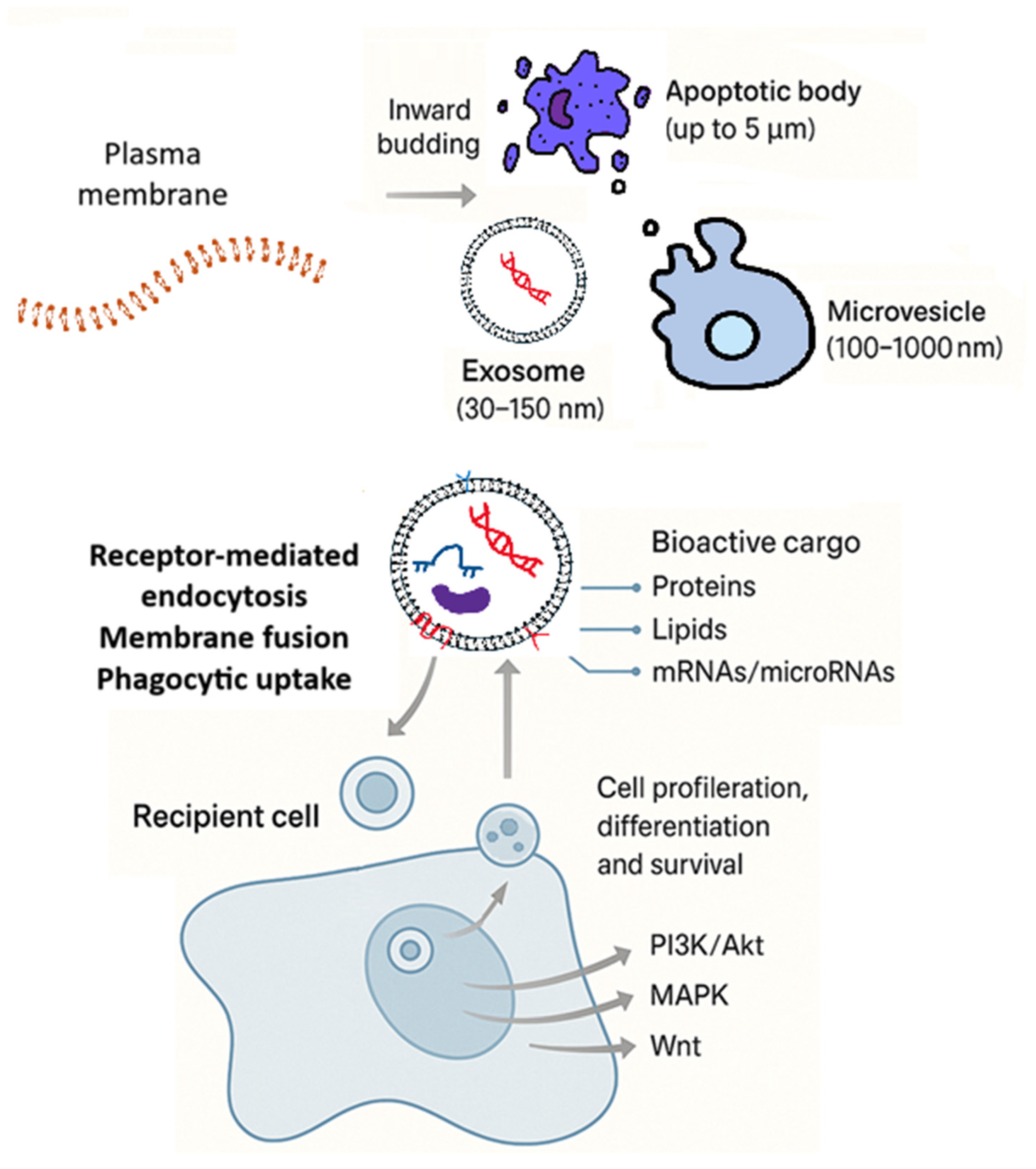
Extracellular vesicles (EVs) are heterogeneous, membrane-enclosed particles released by nearly all cell types and are primarily categorised as exosomes (30–150 nm, derived from the endosomal pathway), microvesicles (100–1000 nm, generated by direct plasma membrane budding), and apoptotic bodies (up to 5 µm, formed during programmed cell death) [1]. Their biogenesis is governed by distinct molecular machinery; exosomes arise via the inward budding of multivesicular bodies and subsequent fusion with the plasma membrane, while microvesicles form through outward membrane blebbing [2]. Apoptotic bodies, on the other hand, are produced during the late stages of apoptosis through cell shrinkage, chromatin condensation, and membrane blebbing, followed by fragmentation of the dying cell into membrane-bound vesicles containing cellular organelles and nuclear material [3] (Figure 1).
The various types of EVs, along with their formation and uptake mechanisms, are depicted in Figure 1. EVs encapsulate a complex cargo of proteins, lipids, and nucleic acids, including messenger RNAs (mRNAs), microRNAs (miRNAs), and long non-coding RNAs (lncRNAs), which modulate recipient cell functions by altering intracellular signalling pathways such as Phosphoinositide 3-Kinase (PI3K/Akt), Mitogen-Activated Protein Kinase (MAPK), and Wnt (Wingless/Integrated Signalling Pathway) [4]. The targeted delivery of this bioactive cargo occurs through receptor-mediated endocytosis, membrane fusion, and phagocytic uptake, enabling EVs to orchestrate specific cellular responses [4]. Research indicates that EVs derived from dental pulp cells, for example, carry specific miRNAs and proteins that activate signalling cascades such as PI3K/Akt and MAPK [5], which are essential for odontogenic differentiation and angiogenesis [6]. Moreover, EVs isolated from MSCs have been shown to regulate the inflammatory microenvironment by inducing M2 macrophage polarisation, thereby reducing inflammatory responses while simultaneously promoting osteogenesis and vascular remodelling critical for periodontal regeneration [7]. Notably, exosomes from stem cells of the apical papilla have demonstrated the ability to stimulate craniofacial bone repair [4] through the activation of Wnt and BMP (bone morphogenetic protein)/Smad (suppressor of mother against decapentaplegic family proteins) pathways, underscoring the multifaceted role of EVs in orchestrating molecular events that drive tissue regeneration [5,8,9]. These bioactive vesicles bypass many of the limitations associated with traditional cell-based therapies, such as donor variability, senescence, and immune rejection, thus presenting a more reliable and targeted approach to tissue regeneration [10,11].
This review aims to critically analyse original research to elucidate the molecular mechanisms underlying EV-based therapies in regenerative dentistry, with a particular emphasis on safety and standardisation. By analysing how EV cargo modulates key signalling pathways such as PI3K/Akt, MAPK, BMP/Smad, and Wnt [12], the review seeks to clarify the direct links between these molecular events and clinical regenerative outcomes. It will also evaluate current methodologies for EV isolation, purification, and characterisation, highlighting how variations in these processes impact both efficacy and safety, specifically addressing concerns such as immunogenicity and unintended cellular responses. Furthermore, the review will critically assess preclinical and clinical evidence on EV-mediated tissue repair, wound healing, and bone regeneration to provide a comprehensive framework for the safe integration of EV-based therapies into clinical practice. Ultimately, this synthesis of research findings aims to inform future translational strategies and standardisation protocols, facilitating the development of reliable, cell-free therapeutic modalities to harness precise molecular pathways for enhanced regenerative outcomes in dentistry.

2. Mechanisms of Action of EVs in Regenerative Dentistry

2.1. EVs as Mediators of Cellular Communication

In periodontal regeneration, EVs derived from periodontal ligament stem cell-derived exosomes (PDLSC-Exo) have been shown to modulate osteogenic differentiation via the miR-34c-5p/special AT-rich sequence-binding protein 2 (SATB2)/extracellular signal-regulated kinase (ERK) axis [13] while concurrently delivering miR-17-5p to activate vascular endothelial growth factor receptor (VEGF/VEGFR)-mediated angiogenesis [14] and PI3K/Akt-dependent suppression of nuclear factor kappa-light-chain-enhancer of activated B cells (NF-κB)-driven inflammation [15]. Mesenchymal stem cell-derived extracellular vesicles (MSC-EVs) likewise attenuate macrophage-mediated inflammation by blocking NF-κB activation through inhibition of inhibitor of nuclear factor kappa B alpha (IκBα) phosphorylation [16], reducing tumour necrosis factor alpha (TNF-α) [16] and interleukin (IL-6) secretion [17,18], a beneficial immunomodulatory effect that nonetheless poses a risk of impaired host defence if dosing is not carefully controlled [19,20,21].
However, these regenerative pathways carry inherent safety considerations. Hyperactivation of Wnt/beta-catenin (β-catenin) signalling has been implicated in tumourigenesis [22,23,24] and ectopic calcification [25,26], underscoring the necessity for precise dose titration and rigorous cargo characterisation to avoid oncogenic risks. Similarly, excessive modulation of NF-κB or ERK pathways can lead to off-target immunosuppression [27] or fibrosis [15,28,29]. Moreover, cargo heterogeneity, variability in miRNA, protein, and lipid composition among EV batches, can result in inconsistent pathway engagement and unpredictable biological responses [30,31].

2.2. Source Cells and Molecular Signalling Mediated by EVs

EVs for dental regeneration have been sourced from multiple stem and progenitor cell populations, each offering distinct cargo profiles and regenerative capacities. DPSC-derived EVs, harvested by differential ultracentrifugation of conditioned medium from extracted third molars [32], are enriched in odontogenic proteins (e.g., DSPP, DMP1) and miRNAs such as miR-196a. In a rat mandibular defect model, these EVs upregulated RUNX2 and alkaline phosphatase in the jawbone and accelerated bone repair [33].
Periodontal ligament stem cell-derived exosomes (PDLSC-Exo), likewise isolated by ultracentrifugation, deliver miR-34c-5p to inhibit SATB2/ERK signalling [34], modulating osteogenic differentiation, and promoting VEGF/VEGFR-mediated angiogenesis through exosome-mediated transfer of VEGFA regulated by miR-17-5p [14] while concurrently attenuating inflammation via NF-κB suppression and reduced TNF-α/IL-6 secretion [35,36,37]. Stem cells from human exfoliated deciduous teeth (SHED) produce EVs that, after purification by size-exclusion chromatography, enhance HUVEC proliferation, migration, and tube formation [38]. These effects are maintained under hyperglycaemic conditions through GATA2 and CD31 upregulation [34]. In mouse periodontitis models, SHED-EVs restore alveolar bone comparably to SHED transplantation without inducing target-cell apoptosis [34].
Gingival MSC (GMSC)-derived EVs cross-regulate NF-κB and Wnt/β-catenin pathways in PDLSCs, inhibiting porphyromonas gingivalis-derived lipopolysaccharide (LPS)-induced NF-κB activation and upregulating Wnt/β-catenin to promote osteogenesis under both homeostatic and inflammatory conditions [39].
Among non-dental sources, umbilical cord MSCs (UC-MSCs) yield approximately fourfold more EVs per cell than bone marrow MSCs under identical culture conditions, highlighting their scalability for clinical-grade EV production [40]. Finally, exosomes from hiPSC-derived endothelial cells, enriched in miR-199b-5p, enhance HUVEC proliferation, migration, and tube formation via Jagged1/VEGFR2 signalling and promote neovascularisation in hind-limb ischaemia models, illustrating the versatility of iPSC-EVs for vascularised tissue repair [41].

Donor Age, Cell State, and Microenvironment

EV cargo reflects the physiological state of the parent cell; hence, donor age, replicative history, and inflammatory or metabolic microenvironments can significantly alter EV composition and downstream regenerative potency. Ageing is associated with shifts in EV abundance and cargo, such as miRNA profiles in circulation and in EVs released by somatic tissues, consistent with the concept that EVs transmit state signals to recipient cells. In a bone-relevant context, muscle-derived miRNA changes have been linked to age-associated depletion of bone stem or progenitor pools [42], supporting a mechanism by which systemic ageing alters osteogenic capacity via EV-mediated signalling. Conversely, EVs from neonatal or younger donors can exhibit pro-rejuvenation activity. Neonatal umbilical cord MSC-derived EVs were shown to restore functional deficits in aged bone marrow MSCs through transfer of proliferative and repair signals, including proliferating cell nuclear antigen (PCNA)-associated mechanisms [43], and to attenuate age-related degeneration in vivo, showing that donor age can qualitatively change EV therapeutic effects. Beyond chronological age, the parent-cell microenvironment is an important aspect of altering EV function, as inflammatory or lineage-specific conditioning can enrich EV cargo linked to immunomodulation or osteogenesis and increase the need for batch-level cargo and potency characterisation, because conditioning can increase the variability between preparations [44].

2.3. EV-Mediated Tissue Regeneration in Dentistry

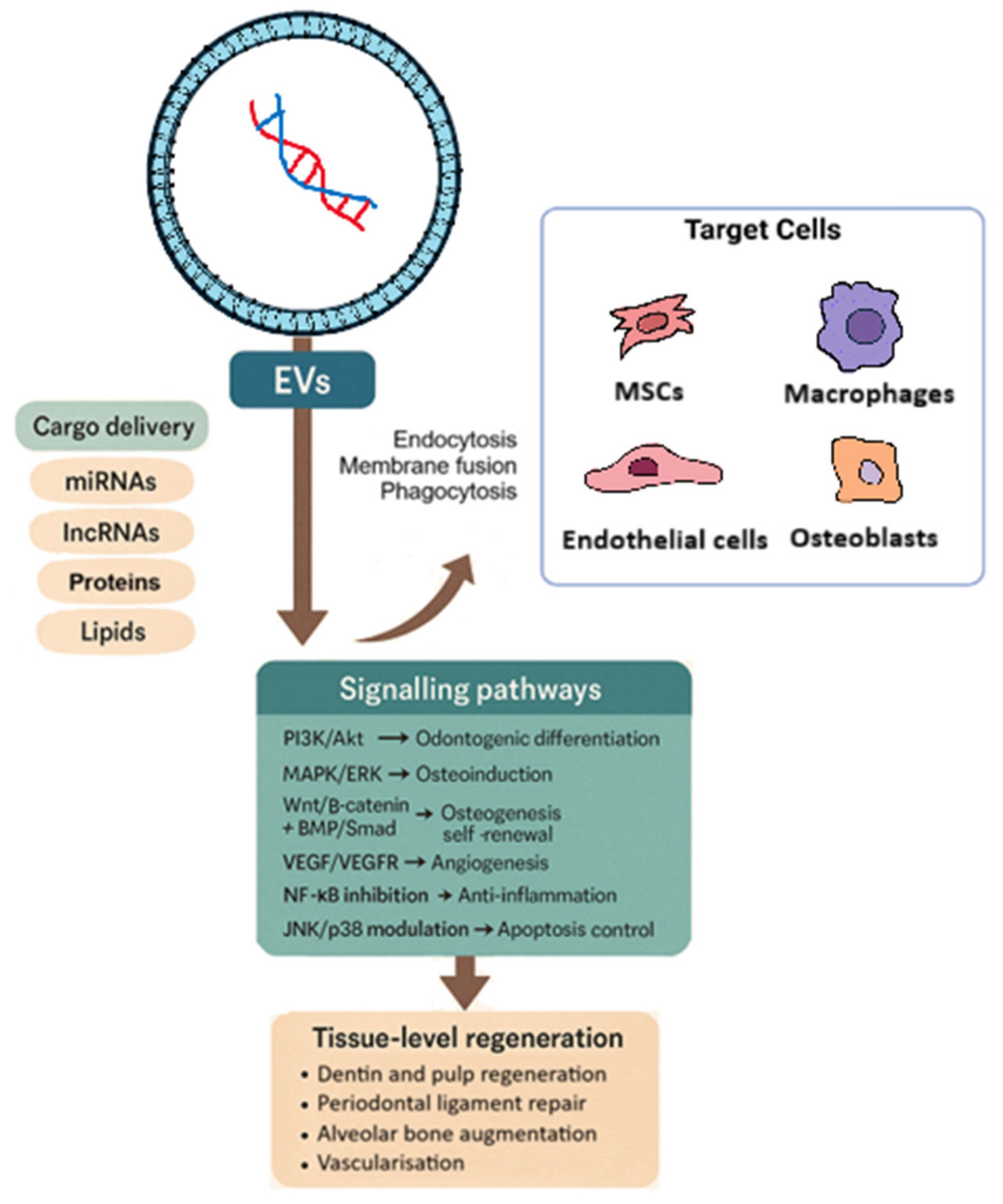
The pathways or mechanisms, based on both preclinical and clinical models, in dental regeneration are depicted in Figure 2. EVs have emerged as potent mediators of tissue regeneration in dental contexts, coordinating cell proliferation, differentiation, migration, and immunomodulation via several conserved signalling cascades. In particular, EVs activate the Wnt/β-catenin [45], Cdc42 [46], ERK/MAPK [47], PI3K/Akt [48], and NF-κB [49] pathways to orchestrate complex repair processes in dental pulp cells, periodontal ligament cells, osteoblasts/pre-osteoblasts, and endothelial cells [45,46,47,48,49].
In osteogenic and dentinogenic models, human embryonic stem cell (ESC)-derived EVs have been shown to transport miR-196a to pre-osteoblasts [50], thereby enhancing differentiation and upregulating key osteogenic markers, including Runx2, alkaline phosphatase, and osteocalcin, in alveolar bone explants [51,52,53]. These findings underscore the ability of ESC-EVs to mimic developmental cues and drive bone-forming programmes ex vivo.
Expanding upon mechanistic pathways, exosomes harvested from stem cells of human exfoliated deciduous teeth (SHED-Exo) co-activate Wnt/β-catenin and BMP signalling in periodontal ligament stem cells, resulting in robust osteogenic commitment in vitro [54]. Exosomes derived from the apical papilla (SCAP-Exo) deliver active Cdc42 protein directly into endothelial cells, triggering cytoskeletal reorganisation, filopodia formation, and angiogenic sprouting, critical steps for generating vascularised craniofacial tissues [46]. Mesenchymal stem cell-derived EVs (MSC-EVs) further contribute to regenerative outcomes by exerting anti-inflammatory effects alongside the promotion of new bone formation in periodontal defect models [55]. Additionally, activation of the canonical Wnt/β-catenin pathway enhances stem cell self-renewal and osteogenic gene transcription [54], while Cdc42 signalling controls cytoskeletal dynamics and endothelial motility [46]. The ERK/MAPK and PI3K/Akt pathways coordinate cell survival and proliferation during repair, and modulation of NF-κB activity shapes the immunomodulatory and matrix-remodelling environment necessary for tissue regeneration [49]. By engaging these pathways in concert, EVs recreate developmental signalling networks to accelerate dental tissue repair.
Translational studies also highlight the utility of these insights in engineered constructs. Zhao et al. (2022) embedded periodontal ligament-derived EVs within a gelatin–alginate hydrogel scaffold and reported a 15 percent increase in alveolar bone volume at four weeks, along with more extensive Masson’s trichrome-stained bone formation compared with hydrogel alone [56]. Lu et al. (2024) extended this approach by incorporating SHED-Exo into a gelatin methacryloyl (GelMA) matrix to enhance odontogenic differentiation of dental pulp stem cells, achieving significantly greater dentin matrix deposition and upregulation of dentin sialophosphoprotein (DSPP) [6].
Finally, combinatorial strategies that integrate pro-angiogenic growth factors, such as VEGF, bFGF, and PDGF, into EV-laden scaffolds have demonstrated synergistic enhancements in neovascularisation and osteogenesis in dental defect models [54,56].

3. Safety Concerns in EV-Based Therapies

3.1. Immunogenicity of EVs

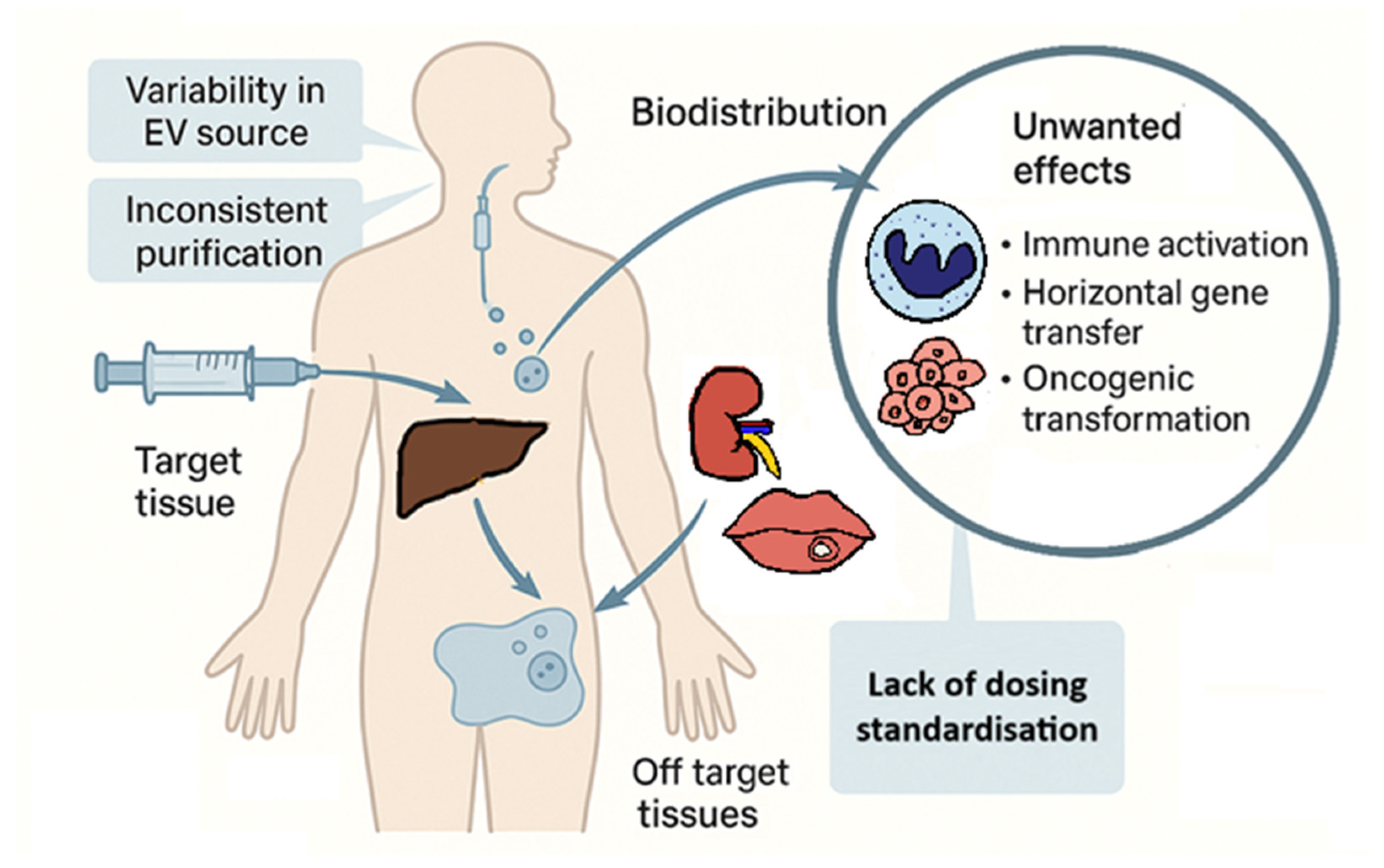
EV-based therapies raise important safety concerns, primarily related to immune activation, biodistribution, and off-target effects. Key immunogenicity outcomes include complement activation, cytokine release, and the generation of anti-EV antibodies upon repeated administration [57,58]. These risks are amplified in vulnerable populations and underscore the need to assess both the magnitude and duration of host immune responses prior to clinical application.
Patient-specific factors, including age, health status, and comorbidities, play a critical role in modulating these safety outcomes. Age-related physiological changes, such as cellular senescence and diminished regenerative potential, can alter EV biodistribution and clearance, increasing the likelihood of suboptimal efficacy or heightened inflammatory responses [58,59,60,61]. Similarly, patients with chronic diseases or immunocompromised conditions may exhibit altered pharmacokinetics or reduced tolerability to allogeneic EVs, raising the risk of exaggerated immune responses [10,57,58,62]. A thorough evaluation of each patient’s immune profile and clinical background is thus essential for tailoring dosing regimens and minimising adverse events [63].
While EVs, particularly those derived from MSCs, are generally regarded as having low immunogenicity [11,64], this profile is not uniform. It varies significantly based on cellular origin, donor compatibility, and purification method [50,60,61,64]. Autologous EVs tend to carry lower immunological risk, whereas allogeneic or xenogeneic EVs may present surface antigens that trigger host immune reactions [57,58]. In addition, the method of EV isolation can co-purify immunostimulatory contaminants such as nucleic acids and lipoproteins, which may contribute to complement activation or Toll-like receptor signalling [11,58,65,66]. These findings support the need for standardised isolation techniques and stringent quality control measures to reduce batch-to-batch variability and ensure clinical safety.
EV surface components and cargo, including membrane proteins, tetraspanins, RNA species, and phosphatidylserine, can interact with pattern recognition receptors (PRRs) on immune cells. These molecular features may facilitate macrophage uptake, promote cytokine secretion, or activate complement cascades, potentially leading to systemic inflammation [58,63]. Rational design strategies such as EV surface engineering, preconditioning of parent cells, or cargo modulation may help reduce these immunogenic epitopes and improve tolerability [67,68].
The route of administration, delivery matrix, and dosing schedule are equally critical in shaping immune responses. For dental applications where local injection to the intragingival, periodontal pocket, or intrabony delivery is feasible, immunotoxicity considerations must account for the specialised immune landscape of the gingival barrier, which is continuously exposed to tooth-associated biofilm and mechanical microtrauma. EVs actively modulate the oral immune microenvironment by regulating macrophage polarisation, Th17/Treg balance, and NF-κB-driven cytokine signalling in gingivitis and periodontitis, underscoring the need to evaluate immunogenicity within oral-specific inflammatory contexts [69]. In a large human cohort, the gingival interface in health was characterised by a predominance of T cells, relatively few B cells, and a substantial presence of granulocytes and neutrophils, and antigen-presenting cell networks. In periodontitis, this immune architecture shifts further with increased neutrophils and heightened IL-17 responses within the CD4+ T-cell compartment [70]. These features are relevant because EV surface molecules and co-isolated contaminants, including nucleic acids, LPS, and lipoproteins, may engage pattern recognition pathways on resident epithelial cells, neutrophils, macrophages, and dendritic cells, potentially amplifying local cytokine release or altering clearance kinetics after injection. In keeping with this context dependence, dental-tissue MSC exosomes have been evaluated directly in inflammatory periodontal settings, as gingival MSC-derived exosomes suppress inflammatory signalling and restore the regenerative potential of PDLSCs in an inflammatory microenvironment [71], and TNF-α primed gingiva-derived MSC exosomes promote anti-inflammatory macrophage polarisation and reduce inflammatory bone loss in an LIP model [7]. Evidence therefore suggests that local delivery in the oral cavity may not be immunologically neutral; therefore, dental EV products should be evaluated in preclinical systems that incorporate oral-relevant immune cues such as biofilm products, IL-17, and neutrophil-rich inflammation, and local APC networks, to better predict tolerability and the therapeutic window.
Repeated systemic injections of unmodified EVs may lead to immune memory and accelerated clearance, while localised delivery systems, such as hydrogels, can enhance tissue retention and reduce systemic exposure [6,72]. As shown by Lu et al. (2024), preconditioning SHEDs in odontogenic medium generated OM-EVs enriched in pro-regenerative factors that activated the AMPK/mTOR pathway [6]. When embedded in GelMA hydrogel, these OM-EVs improved safety by ensuring sustained, site-specific delivery and significantly enhanced dentinogenesis in vitro and in vivo [6].
In periodontitis and other oral conditions, EV-based therapy must also account for craniofacial tissue-specific factors, local immune microenvironments, and angiogenic variability among patients [56,73]. For example, Cai et al. (2023) emphasised the need for immune-modulating EV formulations tailored to individual profiles in periodontal therapy [74], while Fuloria et al. (2021) highlighted the importance of customising MSC-EV therapy for regenerative applications across diverse clinical populations [75].
To advance the safe clinical translation of EV-based therapies, an integrated approach is required. This includes matching EV sources to patient immune status, optimising purification methods, controlling delivery kinetics, and understanding immune engagement pathways [55,65,66,72]. An overview of safety considerations in EV-based therapies is presented in Figure 3.

3.2. Risk of Tumourigenesis

EV-based therapies carry the risk of inadvertently promoting cancer progression rather than initiating de novo tumourigenesis. Through horizontal transfer of oncogenic proteins, RNAs, and other bioactive molecules, EVs can activate key signalling cascades in recipient cells, enhancing proliferation, migration, invasion, stemness, and metastatic potential. Although true tumourigenesis implies the initial transformation of normal cells, the bulk of current evidence implicates EVs in accelerating the growth and spread of pre-existing malignant cells. Consequently, evaluating the pro-tumourigenic capacity of therapeutic EVs, particularly in patients with occult or existing cancers, is essential to safe clinical translation.
Multiple studies have dissected the pathways and EV sources responsible for these effects. Gu et al. (2016) showed that human bone marrow MSC-derived exosomes stimulate AKT signalling in human HGC-27 gastric cancer cells, driving epithelial–mesenchymal transition, increased expression of stemness markers (OCT4, SOX2, and Lin28B), and enhanced ex vivo tumourigenicity [76]. Qi et al. (2017) found that MSC exosomes activate Hedgehog signalling in human MG63 osteosarcoma and human SGC7901 gastric cancer cells, a proliferative effect reversible by Hedgehog pathway inhibitors, underscoring the role of developmental pathways in EV-mediated cancer progression [77].
More recently, Qi et al. (2023) reported that MSC microvesicles conditioned by Helicobacter pylori carry elevated thrombospondin-2, which, upon transfer to MGC-803 gastric cancer cells, promotes in vitro proliferation, invasion, and in vivo tumour growth with peritoneal metastasis in mouse xenografts [78]. Similar mechanisms operate in oral tissues: exosomes from MSCs derived from dysplastic oral leukoplakia and oral carcinoma in in vitro models are enriched in miR-8485, which accelerates proliferation, migration, and invasion and downregulates p53 expression—effects reversed by blocking exosome secretion, suggesting that EVs from premalignant lesions may fuel malignant transformation and recurrence in the oral cavity [79].

3.3. Toxicity of EV Cargo

EV cargo can pose significant acute toxicity risks, particularly haematotoxicity and cytotoxicity, that must be addressed before clinical application. Procoagulant lipids and proteins on EV surfaces catalyse clotting cascades: for instance, MSC-EVs bearing phosphatidylserine accelerate tenase and prothrombinase assembly, shortening plasma clotting times by 25–30% and carrying factor V, prothrombin, von Willebrand factor, CD9, and kallikrein, all of which amplify thrombin generation and could precipitate thrombosis in susceptible patients [80].
Similarly, EVs from umbilical cord MSCs generate activated factor X (0.023 ± 0.017 nM FXa per 106 EVs), an effect tied directly to tissue factor content since a blocking antibody reduced FXa production by over 85% [81]. Moreover, plasma EVs isolated from multiple myeloma patients exhibit a nearly two-fold increase in endogenous thrombin potential and a 60% rise in peak thrombin generation, effects attributable to large EVs enriched in tissue factor and procoagulant phospholipids, underscoring that both EV source and subpopulation critically determine haematologic safety profiles [82]. Beyond coagulation, damage-associated molecular patterns (DAMPs) such as HMGB1 carried by EVs from LPS-activated macrophages can trigger RAGE-mediated NLRP3 inflammasome activation in hepatocytes, inducing caspase-1-dependent pyroptosis and contributing to organ injury in sepsis models [83]. Although some of these pathways lie outside dental applications, they illustrate that EV preparations must be rigorously screened for pro-inflammatory and pro-death signals to avoid acute toxicity.
In addition to these immediate effects, EV-mediated transfer of pathogenic microRNAs can drive tissue-specific injury and chronic dysfunction. For example, EVs from steatotic hepatocytes enriched in miR-1 suppress KLF4 and activate NF-κB in endothelial cells, upregulating ICAM-1 and VCAM-1, promoting leukocyte adhesion, and accelerating atherogenesis in ApoE/ mice [84,85]. Podocyte-derived EVs carrying miR-149 and miR-424 induce apoptosis in proximal tubular cells via BCL2 downregulation and caspase-3 activation, contributing to acute tubular injury in vitro [7]. Additionally, systemic elevation of miR-424 in diabetic nephropathy rat models attenuated renal lesions by targeting Rictor and modulating AKT signalling, highlighting that the same cargo can have context-dependent effects [7].
In the context of regenerative dentistry, procoagulant activity could impair pulp revascularisation, DAMP-driven inflammation might disrupt periodontal healing, and unwanted miRNA transfer could compromise local cell viability. Critically assessing cargo heterogeneity, defining safe concentration thresholds, and developing strategies to deplete or neutralise toxic components will be essential for translating EV therapies into safe, effective dental regenerative treatments.

3.4. Contamination Risks

EV preparations are prone to co-isolating non-EV particles, most notably lipoproteins, abundant serum proteins, and microbial contaminants, which compromise both functional purity and safety [86]. Albumin and ApoB-positive lipoproteins frequently persist in isolates, increasing the risk of unpredictable bioactivity and inflammatory reactions in clinical use [87]. Viral and bacterial components further exacerbate this problem: enveloped viruses such as HIV-1 can co-purify with exosomes in standard density gradients, posing a risk of inadvertent pathogen transfer [88], while bacterial endotoxins, up to 1.2 × 10¹³ LPS units per 1010 EVs in P. gingivalis vesicle preparations, can trigger potent TLR4-mediated inflammation if not removed [89,90]. Mycoplasma [91], a common cell-culture contaminant, releases EV-like particles that infiltrate human cells and modulate host proteomes, underscoring the necessity of routine mycoplasma surveillance and elimination during EV production [92,93].
Common isolation techniques each carry intrinsic limitations that favour specific contaminant classes. Precipitation methods using PEG tend to co-pellet serum protein aggregates and high-density lipoproteins, while size-based methods alone, such as size-exclusion chromatography, fail to fully clear these contaminants without additional density-based steps [94,95]. Differential ultracentrifugation reduces bulk impurities but cannot eliminate smaller lipoprotein particles or tightly bound protein complexes [95]. These technical shortcomings highlight the need for orthogonal purification strategies, combining density cushions, affinity capture, and sequential filtration, to achieve reproducible EV purity [96,97]. Moreover, comprehensive contaminant profiling, including markers such as ApoB, viral capsid proteins, and endotoxin levels, is essential for quality control and to ensure that therapeutic EV products meet stringent safety standards [98,99,100]. In the context of regenerative dentistry, residual lipoproteins or microbial components could provoke pulp inflammation, interfere with scaffold integration, or undermine immunomodulatory benefits, so rigorous multimodal purification and validation remain critical prerequisites for clinical translation.

4. Discussion and Future Challenges

4.1. Advancements in EV-Based Therapies

Recent years have witnessed significant progress in engineering EV-based therapies to enhance dental tissue regeneration. Early-phase clinical investigations have begun to explore the use of EVs in craniofacial bone regeneration.
One promising strategy involves embedding EVs within biocompatible hydrogels to improve their retention and sustained release at defect sites. For example, Zhang et al. (2020) demonstrated that fibrin gels loaded with dental pulp stem cell-derived EVs promoted rapid neovascularisation, collagen I/III deposition, and angiogenic factor release under nutrient-deficient conditions in vitro, suggesting that such constructs can overcome the rapid clearance of EVs and support vascularised pulp regeneration [101]. These studies indicate that scaffold-mediated EV delivery can both protect EV bioactivity and facilitate localised, sustained therapeutic dosing.
Beyond hydrogels, decellularised tissue scaffolds have been explored as EV carriers. Diomede et al. (2022) developed a decellularised dental pulp matrix capable of supporting stem cell repopulation and, when combined with EVs, could potentially provide both structural and biochemical cues for in situ pulp regeneration [101,102]. Such approaches leverage the native ECM to present EVs in a physiologically relevant microenvironment, potentially enhancing cell–matrix and EV–cell interactions.
Innovations in EV functionalisation have also emerged to boost therapeutic efficacy. Surface modification of EVs with targeting ligands, such as RGD peptides, to engage integrin receptors on osteoblasts, has been shown in non-dental models to increase EV homing and uptake by target cells, leading to improved bone regeneration outcomes [103]. Although not yet reported in dental applications, these strategies hold promise for increasing the precision of EV therapies in periodontal and alveolar bone repair.

4.2. Overcoming Safety Challenges and Translating EV-Based Therapies to Clinical Practice

To enhance safety and translational potential, EV-based therapeutics must integrate immunogenicity reduction and off-target toxicity mitigation from production through administration. Advanced purification workflows such as tangential flow filtration (TFF) followed by size-exclusion chromatography (SEC) have been shown to produce high-purity EV preparations devoid of xenogeneic proteins and endotoxin contaminants, essential for clinical-grade GMP compliance [104]. Commercial hollow-fibre bioreactor systems utilising xeno-free media further support reproducible EV isolation, yielding high-purity preparations with acceptable safety margins in controlled conditions [104].
Evidence from early clinical case reports suggests that well-matched autologous or screened allogeneic MSC-EVs elicit minimal immunogenicity in human use, as inferred from analogous MSC therapy trials in graft-versus-host disease, where no infusion-related adverse events or dose-limiting toxicities occurred even with repeated dosing [105]. While these outcomes derive from MSC therapy rather than isolated EVs, they provide a supportive rationale to anticipate comparable tolerability in EV applications.
To translate EV therapies into clinical practice, dosing strategies must be grounded in preclinical pharmacokinetics and biodistribution data that define therapeutic windows and off-target accumulation. Dose escalation studies comparing intravenous administration versus localised delivery via scaffolds or hydrogels are necessary to determine the optimal balance between efficacy and safety [106]. These data should be paired with functional potency assays, robust particle and cargo profiling, and regulatory-aligned potency criteria as per MISEV2023 to ensure reproducibility across batches and sites [107].
Enabling safe clinical deployment of EV-based therapies hinges on GMP-compatible purification methods (e.g., TFF-SEC) [108,109], immunologically inert donor matching, and optimised delivery routes informed by rigorous preclinical safety data [110]. Together, these convergence strategies will reduce immunogenic risk, improve off-target control, and support future clinical translation.

4.3. Translating EV-Based Therapies to Clinical Practice

Efficient translation of EV-based interventions into dental clinics hinges on establishing robust, GMP-compliant production pipelines. Pachler et al. (2017) demonstrated that BM-MSC expansion in fibrinogen-depleted, pooled human platelet lysate media, with downstream tangential flow filtration and preparative SEC, yields EV preparations exhibiting narrow nanoparticle size distributions, consistent expression of CD9, CD81, and TSG101, and sterility profiles satisfying clinical release criteria [35].
While this scalable approach addresses batch-to-batch variability, further work is needed to define potency assays predictive of oral tissue regeneration, since most current release metrics (particle count, marker presence) do not correlate directly with functional outcomes in alveolar bone or pulp repair [36]. Regulatory classification of EVs is also uncertain: some jurisdictions treat them as biological products, others as cell therapies or drug-delivery systems, each demanding distinct investigational new drug (IND) dossier contents, stability protocols, and post-marketing surveillance plans [37].
Early-phase clinical data in non-dental indications suggest a favourable safety profile. Sengupta et al. (2020) reported that a single 15 mL infusion of ExoFlo, an allogeneic BM-MSC-EV formulation, was well tolerated in severe COVID-19 patients, with no infusion-related adverse events at 72 h, and complementary studies in stage III/IV chronic kidney disease likewise observed no acute toxicity over 12 months [111]. However, these findings cannot be extrapolated to periodontal or endodontic applications, where local scaffold embedding or repeat dosing may produce different biodistribution and immune responses.
Critically, no Phase I/II trials have yet targeted periodontal regeneration or pulp repair using EV therapies. Such studies must define dosing regimens that balance therapeutic efficacy against potential off-target effects in the oral mucosa, compare systemic versus local delivery, and establish therapeutic windows compatible with clinical workflows.
Dose selection for EV therapeutics remains challenging because studies variably report dose as particle number, total protein, or parent cell equivalents, limiting cross-study comparability and rational scaling from animals to humans. A pragmatic approach for translational development is to report dosing in at least one normalised metric (e.g., particles/kg or µg protein/kg) alongside functional potency readouts, enabling batch comparability and dose–response modelling. The route of administration strongly impacts effective exposure; after intravenous delivery, biodistribution studies show preferential accumulation in reticuloendothelial organs, such as the liver and spleen, indicating the possibility that higher systemic doses are required to achieve adequate exposure at oral targets while increasing off-target risk [112]. In contrast, local administration can increase concentration at the intended site and reduce systemic biodistribution. In a mouse biodistribution study, IV dosing led to liver and spleen accumulation, whereas localised delivery routes increased signal in the target compartment and were interpreted to limit extra-organ exposure [112]. These considerations are particularly relevant in regenerative dentistry, where local injection and scaffold or hydrogel delivery are clinically feasible and may permit lower total doses by improving tissue retention and residence time [6]. As such, future dental EV studies should directly compare local versus systemic dosing using standardised reporting in normalised dose units, pharmacokinetic and biodistribution endpoints, and oral-site safety readouts such as local cytokine profiles, gingival histopathology, and effects on mucosal immunity, in addition to regeneration outcomes. Without dental-specific clinical evidence, adoption in routine practice remains premature.
Finally, long-term safety evaluations are indispensable. In murine models, repeat dosing of HEK293F-derived EVs over 30 days resulted in rapid clearance and organ biodistribution profiles comparable to PEG-liposomes, with haematology, serum biochemistry, cytokine assays, and histopathology revealing no immunogenicity or tissue lesions [113]. Wiklander et al. (2015) further refined biodistribution analysis, using DiR labelling, sucrose-gradient purification, and IVIS imaging, to confirm that systemically administered HEK293T-EVs localise primarily to the liver, spleen, GI tract, and lungs in a dose- and route-dependent manner, and that fluorescence derives from intact vesicles rather than free dye [114]. Additionally, the oncogenic potential of EV therapies remains insufficiently studied: to date, no dedicated long-term tumourigenesis assessments have been reported in preclinical models, highlighting a critical gap in safety evaluation that must be addressed before large-scale clinical trials can proceed [115,116].

4.4. Ethical and Social Considerations

Clinical investigations of EV therapies in dental and non-dental contexts provide important evidence on tolerability that complements ethical mandates for rigorous oversight. In periodontitis, a proof-of-concept study of non-surgical injections of human platelet-derived EVs in 21 patients (stages I–III) demonstrated significant reductions in probing depth and pro-inflammatory cytokines at six weeks post-treatment, with only transient gingival erythema and no systemic haematological or biochemical abnormalities reported [117]. Alveolar ridge augmentation using the same periosomes formulation restored bone volume successfully and elicited no local or systemic toxicity [118]. In endodontics, a chitosan–hUCMSC exosome hydrogel applied post-pulpectomy facilitated progressive pulp vitality recovery and periapical healing over 24 weeks, with only mild postoperative discomfort noted [119]. These dental findings align with favourable safety profiles in other EV applications; idiopathic facial paralysis treatments reported no functional deterioration or serious adverse effects [120], and combined autologous exosome plus Nd:YAG laser therapy for facial nerve injury achieved marked functional improvements without safety concerns [121].
Ethical frameworks governing EV-based interventions mandate comprehensive informed consent processes, particularly in vulnerable populations, and stringent donor screening and Research Ethics Board approvals to safeguard autonomy and minimise harm [122]. Invasive delivery routes, such as intrathecal or surgical implantation, necessitate transparent patient education on both acute and delayed toxicities [123,124]. Autologous EVs mitigate immunogenic risks but introduce variability and standardisation challenges, whereas allogeneic preparations require protocols akin to cellular therapies to address consent, traceability, and infectious risk [125]. Furthermore, unregulated commercial offerings of human-derived exosome products with misleading safety claims underscore the need for post-market surveillance and enforcement of accurate risk communication [126,127]. Equitable access considerations, from donor compensation frameworks to intellectual property landscapes, must balance fair benefit sharing against undue inducement and monopolistic barriers that could hinder technology transfer and inflate costs in low-resource settings [128,129]. Collectively, integrating clinical safety outcomes with ethical rigour and robust governance will be essential to responsibly advance EV therapeutics in regenerative dentistry and beyond.
The clinical deployment of EV-based therapies must be accompanied by transparent risk communication and robust informed consent processes that fully convey both the known benefits and remaining uncertainties surrounding EV cargo heterogeneity and off-target effects. Lener et al. (2015) emphasise that patient information sheets should include accessible explanations of EV manufacturing (GMP compliance, batch release criteria) and potential immunogenic or biodistribution risks, ensuring that consent is truly informed [130]. Equitable access presents a parallel challenge: high costs associated with GMP-grade EV production and specialised delivery systems risk concentrating advanced therapies in resource-rich centres. An evaluation of cytotherapy economics noted that without novel reimbursement models or tiered pricing strategies, vulnerable populations may be systematically excluded from EV treatments, exacerbating health disparities [131].
Regulatory harmonisation will therefore be crucial not only for safety but also for social legitimacy. The comprehensive review by Japan’s Pharmaceuticals and Medical Devices Agency (PMDA) on EV product quality and safety highlights the need for internationally aligned guidelines on production, characterisation, and post-marketing pharmacovigilance, addressing critical ethical concerns about source material traceability and long-term monitoring of adverse events [132]. Transparent dissemination of clinical trial data and engagement with patient advocacy groups are essential to address misconceptions and inform public understanding [133]. Clear communication of both the therapeutic potential and current limitations of EV-based therapies will be critical for fostering informed acceptance and responsible integration into clinical practice.

5. Preclinical and Clinical Studies on EV-Based Therapy in Dentistry

Preclinical and early clinical investigations have validated the regenerative potential and safety of EV-based interventions in dental applications. In rodent and small animal preclinical studies, EVs derived from stem cells and engineered via preconditioning or scaffold integration have consistently provided valuable insights into the biological properties and regenerative potential by showing accelerated dentinogenesis, alveolar bone repair, and periodontal regeneration, while exhibiting minimal overt toxicity (Table 1). Building on efficacy and safety data, human studies, though limited in cohort size, report favourable tolerability and preliminary evidence of clinical benefit in periodontitis and guided bone regeneration procedures (Table 2). The following sections summarise key findings from preclinical investigations and emerging evidence from clinical studies.

5.1. Preclinical Studies

Preclinical investigations of EVs in dental tissue regeneration have demonstrated both robust efficacy and an absence of overt toxicity in rodent models. In a rat calvarial defect model, MSCs preconditioned with TNF-α produced EVs that, when applied via a collagen membrane, significantly improved bone regeneration at 4 and 8 weeks, promoted M2 macrophage polarisation, and increased oncostatin M expression, all without evidence of ectopic tissue formation or systemic adverse events [134]. Likewise, in a mandibular alveolar defect model, human dental follicle cell-derived collagenase-released matrix vesicles (CRMVs) outperformed media-collected MVs by restoring approximately 75% bone volume fraction versus 60% in controls, enhancing trabecular architecture, and achieving near-complete defect closure through PLC/PKC/MAPK signalling, again with no signs of local or systemic toxicity [135]. In a mouse periodontitis model, EVs from P. gingivalis-LPS-preconditioned dental follicle cells reduced alveolar bone loss, inhibited osteoclast activity, and shifted macrophages toward an anti-inflammatory M2 phenotype, while downregulating apoptotic markers in periodontal ligament cells; animals exhibited no adverse reactions during treatment [136].
Table 1. Findings of preclinical studies.
Author [Year]Source of EVsIsolation Method of EVsRoute of Administration Dose of EVsAnimal ModelMain Findings
Huang et al., 2024 [136]Human dental follicle cells [DFCs] preconditioned with 250 ng/mL P. gingivalis lipopolysaccharide [LPS]Ultracentrifugation from DFC culture supernatant
characterised by TEM, NTA, and Western blot [positive for TSG101 and HSP70]
In vivo systemic injection [exact method not specified]; in vitro treatment of human periodontitis-derived periodontal ligament cells [p-PDLCs]Dose: Not explicitly quantified; in vitro dose optimised for effectEighteen 8-week-old male C57BL/6 mice
Periodontitis induced by 5–0 silk ligature around the maxillary second molar + P. gingivalis inoculation [1 × 10⁷ CFUs per mouse]
In vitro:
EVs reduced apoptosis in periodontal ligament cells from periodontitis-affected teeth (p-PDLCs)

Downregulated pro-apoptotic markers [Caspase-3, BAX], upregulated anti-apoptotic BCL-2

Decreased RANKL/OPG ratio and inhibited phosphorylation of JNK and P38

In vivo:
Reduced alveolar bone loss and osteoclast activity

Promoted M2 polarisation [increased CD206, decreased iNOS]

Lowered inflammation and bone resorption markers
Suggests these EVs modulate inflammation, apoptosis, and osteoclastogenesis via the JNK/P38 MAPK pathway and macrophage polarisation
Kang et al., 2022 [134]MSCs preconditioned with 20 ng/mL TNF-α [TNFα EVs]; compared with naïve MSC-EVsUltracentrifugation; characterised by Western blot [CD63, TSG101, HSP70] and nanoparticle tracking analysis [NTA]Local application at defect site via collagen membrane soaked with EVsNot explicitly quantified [standard EV prep used consistently]Rat calvarial defect model; samples collected at days 1, 3, 7, 28, and 56EV size and uptake ability were unaffected by TNF-α preconditioning

Both EV types enhanced osteogenic markers in MSCs, but TNFα EVs were slightly less effective in vitro

TNFα EVs significantly improved bone regeneration at 4 and 8 weeks

Promoted M2 macrophage polarisation and reduced M1 markers in vitro and in vivo

Increased OSM expression, correlating with bone formation

miRNA sequencing showed upregulation of anti-inflammatory miRNAs and enrichment in immunoregulatory pathways [PI3K-Akt, FoxO]
Yi et al., 2022 [135]Matrix vesicles [MVs] from human dental follicle cells [DFCs]:
-
Media MVs [MMVs]
-
Collagenase-released MVs [CRMVs]
MMVs:
  • 7 d osteogenic induction of DFCs
  • Remove cells/debris: 2000× g 30 min → 15,000× g 1 h
  • 100 kDa ultrafiltration, 0.8 µm filter
  • Ultracentrifuge 150,000× g 1 h

CRMVs:
  • 7 d osteogenic DFCs → collagenase [300 U/mL, 3 h]
  • Same spin/filter/ultracentrifuge as MMVs
MV-loaded collagen sponge implanted into defect site1 × 109 particles per scaffold [~40 µg protein]Rats: 8-wk-old male Sprague–Dawley with 3 mm × 2 mm × 1 mm mandibular alveolar defects [n = 4 per group]Both MMVs and CRMVs internalise into DFCs, enhance proliferation; CRMVs [1 × 10⁹ particles/mL] better promote migration, mineralisation, and upregulate ALP, OCN, OPN, MMP-2; activate PLC-γ1 → PKC → p-ERK/p-p38 cascade.

CRMV-loaded scaffolds restored ~75% bone volume fraction vs. ~60% in MMV or scaffold alone [BV/TV]; increased trabecular number/thickness, reduced separation; histology showed near-complete defect closure, robust cortical and trabecular bone; CRMVs outperformed MMVs and matched DFC-seeded scaffolds.

Mechanistically, CRMVs—but not MMVs—activated the PLC/PKC/MAPK pathway in recipient cells, underpinning their superior osteoinduction
These studies collectively underscore that EV cargo modulation, whether via inflammatory preconditioning or enzymatic release, can enhance regenerative outcomes in craniofacial bone repair while maintaining favourable safety profiles. However, the variability in dosing regimens, EV isolation methods, and defect models complicates direct comparison and translational planning. Notably, none of the studies reported comprehensive immunotoxicity or biodistribution analyses; future work should integrate multi-parametric safety assessments (e.g., haematology, histopathology, cytokine panels) and explore long-term effects in larger animal systems. Mechanistic insights into macrophage polarisation and MAPK pathway activation provide rational targets for EV engineering, but without standardised potency assays and rigorous off-target evaluations, clinical translation will remain tentative. Table 1 provides an overview of the study models, routes of EV administration, dosages used, and the corresponding responses observed in each study. Key preclinical models, EV sources, isolation methods, administration routes, and dosing metrics are summarised in Table 1.

5.2. Clinical Trials and Human Studies

A limited body of clinical research has explored EV-based therapies in dental applications [137]. Notably, a recent proof-of-concept study evaluated non-surgical injections of human platelet-derived EVs in patients (n = 21) with stage I–III periodontitis, reporting significant reductions in probing depth and pro-inflammatory cytokines at 6 weeks post-treatment [117]. Safety monitoring across these studies has consistently shown favourable tolerability. In EV studies, only transient gingival erythema occurred in a minority of subjects, with no systemic haematological or biochemical abnormalities reported [117]. In a separate first-in-human case, periosteomes were also used for alveolar ridge augmentation, resulting in successful bone volume restoration and no local or systemic adverse events, marking a milestone in guided bone regeneration procedures [118]. In endodontic applications, a chitosan–hUCMSC-exosome hydrogel used post-pulpectomy promoted progressive pulp vitality recovery and periapical healing over 24 weeks, with only mild postoperative discomfort noted [119].
These findings align with safety data from non-dental EV trials: a pilot study of EVs in idiopathic facial paralysis (Bell’s palsy) observed no functional deterioration or serious adverse effects across seven treated patients [120], and a case series combining autologous exosomes with Nd:YAG laser therapy for facial nerve injury reported marked functional recovery without safety concerns [121].
Despite these positive outcomes, substantial challenges impede the progression of EV therapies in dentistry: most dental studies involve small, non-controlled cohorts, limiting statistical power and generalizability [138]; heterogeneity in EV isolation methods and dosing metrics (ranging from particle counts to protein concentrations) complicates cross-study comparisons and hinders the development of standardised clinical protocols [139]; the optimal route of administration remains unclear (systemic delivery faces rapid clearance by the mononuclear phagocyte system [140], whereas local injections improve site retention but pose technical challenges in uniform distribution within periodontal or pulp tissues [141]); and long-term data on both sustained efficacy and potential delayed adverse effects are lacking, underscoring the need for multicenter, placebo-controlled trials with extended follow-up to elucidate the risk–benefit profile of EVs in regenerative dentistry. Table 2 details the clinical reactions and outcomes of studies using EVs as interventions. In most of these studies, the dosage of EVs was not specified. Available human studies, administration approaches, and reported clinical outcomes are summarised in Table 2.
Table 2. Findings of clinical trials.
Author [Year]Source of EVsIsolation Method of EVsRoute of Administration Dose of EVsMain Findings
Estrin et al., 2025 [118]Allogeneic EVs [“Periosomes”] combined with bone allograft and platelet-rich fibrin [PRF]Not specifiedLocal surgical application within a guided bone regeneration [GBR] membrane during an augmentation procedureNot specifiedCBCT scans at 1, 2, 3, and 6 months showed progressive and significant bone growth.
Core biopsy at 3 months confirmed histological alveolar bone regeneration.
Implants were successfully placed, demonstrating surgical and histologic success.
Jafari et al., 2025 [119]Exosomes from human umbilical cord mesenchymal stem cells [hUCMSCs]Isolation from conditioned medium; confirmed by SEM and TEM [mean size ~101 nm via NTA]Local application: mixed with chitosan and placed into the root canal following pulpectomyNot quantifiedSingle-case report across Bushehr, Shiraz (Iran), and Aktobe (Kazakhstan) on a 40-year-old male with irreversible pulpitis
No signs of infection or symptoms over 24 weeks
Radiographic imaging indicated periapical healing and periodontal ligament normalisation
Clinical signs suggested successful pulp tissue regeneration and tooth vitality preservation
Puletic et al., 2024 [117]EVs derived from unspecified donor cells [culture source not detailed]—typical of regenerative EV therapiesNot specificLocal injection into periodontal pockets via syringeNot quantifiedPilot study in Santo André, Brazil (n = 14; periodontitis group n = 7 [4 M/3 F], stages I–III; healthy controls n = 7 [4 M/3 F]); power > 98% at α = 0.05.
Pro-inflammatory cytokines, e.g., IL-5 and IL-6, in gingival crevicular fluid were reduced post-treatment to levels comparable to healthy controls.
Treatment was safe, well-tolerated, and showed potential for periodontal regeneration

6. Regulatory and Quality Control Considerations for EV-Based Therapies

6.1. Regulatory Framework

Extracellular vesicle therapies are increasingly viewed by regulators as novel biologics subject to oversight under existing legal frameworks in the United States and European Union. In the U.S., EV-based products are regulated as biological drugs under the Public Health Service Act and the Federal Food, Drug, and Cosmetic Act, which mandate premarket review, compliance with current Good Manufacturing Practices (cGMP), and post-market pharmacovigilance as stipulated by FDA guidance and public safety notifications [142,143]. As of now, no EV therapeutics have achieved FDA approval, prompting enforcement actions and warning letters targeting clinics marketing unapproved exosome treatments without valid biologics licences [144,145]. Similarly, the European Medicines Agency classifies EVs as Advanced Therapy Medicinal Products (ATMPs) under Regulation (EC) No 1394/2007, which requires equivalent manufacturing and clinical standards [144,146,147].
A notable regulatory challenge is the inherent heterogeneity of EV preparations. The variable lipid, protein, and RNA cargo, along with the biogenesis pathways, complicates the establishment of well-defined identity, potency, and comparability assays, as well as detailed pharmacokinetic and biodistribution data [37,148]. Quality control metrics must therefore go beyond particle count and purity to include functional testing and reproducible isolation methods.
Ultimately, translating EV therapies into clinical use depends on integrating robust manufacturing processes, such as scalable isolation, validated cargo profiling, and mechanism-based potency assays, with rigorous regulatory adherence. This holistic quality control approach ensures batch-to-batch consistency, addresses safety concerns inherent in complex biologics, and supports the case for future FDA or EMA approval of EV-based therapies [149].

6.2. Quality Control and Standardisation

Reliable therapeutic application of EVs hinges on robust, reproducible isolation and characterisation protocols. Potency assays are quantitative bioassays designed to measure the biological activity of EV preparations, which are directly linked to their intended mechanism of action and clinical indications, such as immunomodulation, angiogenesis, osteogenic, and odontogenic induction. In contrast to identity and purity measurements that include particle concentration, size distribution, tetraspanin and TSG101 expression, and particle-to-protein ratios, potency assays aim to demonstrate that a given batch produces a reproducible and functional effect in a relevant cellular system and can thus serve as a batch-release and comparability tool. In practice, potency testing for MSC-derived small EVs has been approached using mechanism-aligned functional readouts, such as suppression of activated lymphocyte proliferation in mixed-donor mixed lymphocyte reaction (mdMLR) assays as an immunomodulatory potency readout, and endothelial migration and tube formation assays as a pro-angiogenic potency readout. For example, a qualified mdMLR assay has been developed to assess the immunomodulatory activity of EV preparations such as MSC-EVs by quantifying inhibition of T-cell proliferation across multiple donor combinations, improving robustness and reproducibility for potency testing [150]. Similarly, in vitro angiogenesis assays can provide a potency-linked functional readout when EVs are intended to promote neovascularisation, and tube formation responses (network length or branch points) are commonly used to quantify pro-angiogenic activity and support manufacturing comparability [151]. Potency assays can also be tailored to dental indications by selecting readouts that map to therapeutic goals such as macrophage polarisation with M1 to M2 marker shifts, odontogenic and osteogenic differentiation measured by ALP activity and mineralisation, or suppression of inflammatory cytokine output in periodontal ligament-relevant cell systems. Current guidance on MSC-sEV therapeutics also emphasises that potency assays should be fit-for-purpose, standardised for batch release, and ideally anchored to a mechanism that is plausibly causal for the intended regenerative endpoint [152].
Comparative studies have demonstrated marked variability in EV yield and purity depending on the method employed.
Baranyai et al. (2015) compared a rapid 1 h differential ultracentrifugation (UC) protocol to size-exclusion chromatography (SEC) on Sephacryl S-400 columns, demonstrating that UC pellets CD63- and TSG101-positive exosomes together with high levels of co-pelleted albumin, whereas SEC yields the same exosome markers in early fractions with significantly lower albumin contamination [153]. Zhang et al. (2020) evaluated a cascade of PEG precipitation, SEC, and iohexol density gradients, finding that although PEG precipitation followed by SEC isolates EVs efficiently, notable apoA1 and apoB100 contamination remains, and that only the subsequent density gradient step appreciably decreases, but does not entirely eliminate, these non-vesicular particles [154].
To harmonise reporting and facilitate cross-laboratory comparability, MISEV2023 guidelines recommend standardised metrics such as particle concentration (e.g., via nanoparticle tracking analysis), contaminant ratios (e.g., particle-to-protein), and marker panels (e.g., CD9, CD63, TSG101) to define EV preparations [107]. Adoption of well-characterised reference materials, such as GFP-tagged recombinant vesicles for assay calibration, has been shown to streamline high-throughput yield measurements, facilitate rapid process characterisation, and enhance reproducibility in EV isolation workflows [155]. Single-vesicle analyses (e.g., high-resolution flow cytometry, image-based cytometry) and combined zeta-potential/size distribution profiling can sensitively detect residual lipoproteins or protein aggregates that would otherwise elude functional assays [156,157].
EV translation also depends on validated storage and transport conditions that preserve vesicle integrity and function. EVs are sensitive to temperature shifts, adsorption to tube surfaces, and repeated freeze–thaw cycles, which can promote aggregation, alter apparent size distributions, and reduce functional potency even when particle counts appear similar. While −80 °C storage is widely used, current evidence suggests that ideal conditions vary by EV source, buffer composition, and downstream application, and that standardisation remains incomplete. As potential solutions for point-of-care distribution, lyophilisation or freeze-drying has been investigated [158] to reduce cold-chain dependence; however, drying imposes physical stresses that can reduce recoverable particle numbers, unless protective formulations are used. Freeze-drying EVs with lyoprotectants such as trehalose can mitigate particle loss and preserve biological activity compared with unprotected lyophilisation [159], supporting a formulation-dependent route toward room-temperature-stable EV products. Systemic evaluations also emphasise remaining gaps, including EV type-specific limits on freeze–thaw exposure, optimal cryoprotectant selection and concentration, and long-term functional stability under realistic shipping conditions, including temperature excursions, agitation, and delayed processing [160], which require further studies before temperature or storage standards can be established.
At a clinical scale, EV production must adhere to GMP standards, maintaining both purity and potency. Microfluidic platforms, such as viscoelastic flow separation, enable label-free, continuous-flow enrichment of EVs with >90% purity of exosomes, with >80% recovery, while preserving vesicle integrity [161]. Affinity-based capture using anti-CD61 methacrylate-based monolithic columns delivers highly pure platelet-derived EV preparations, achieving a 100-fold increase in particle-to-protein ratio over flow-through and no detectable lipoprotein contamination by FPLC within a 10 min, reusable-disc workflow, though further cross-validation against SEC or density gradient methods is essential before routine adoption [162].
Scalable and clinical-grade EV purification can be increasingly achieved using closed, filtration-based workflows rather than ultracentrifugation. In particular, TFF enables reproducible concentration and buffer exchange from large volumes of conditioned medium or biofluids with reduced shear and improved scalability compared to ultracentrifugation. In a direct comparison, TFF provided a scalable approach for concentrating EVs from large sample volumes while maintaining vesicle integrity and yield [163]. Polishing steps are typically required to improve purity. By combining TFF followed by SEC, this reduces co-isolated protein contaminants while preserving EV-associated markers and functional activity, and comparative technical analyses show that the use of TFF with SEC can achieve purity [164] and yield profiles suitable for downstream functional assays. For upstream functionality, hollow-fibre bioreactor culture supports high-density MSC expansion and continuous harvesting and enables substantially increased EV production compared with conventional flasks [165], which further facilitates GMP-aligned manufacturing when paired with scalable downstream purification.

6.3. Risk Management in Clinical Settings Framework

Risk management in clinical EV therapy demands a structured strategy that spans pre-treatment screening, dose and route optimisation, systematic adverse event grading, and extended follow-up. In a single-arm Phase I trial of intrathecal allogeneic human umbilical cord MSC-derived exosomes for subacute spinal cord injury, nine patients underwent baseline neurological and laboratory assessments, received a single infusion, and were followed at 1, 3, 6, and 12 months. Assessments included ASIA motor/sensory scores, SCIM III, NBD evaluation, and CTCAE v5.0 grading. No early or delayed adverse events were attributed to the intervention over one year, demonstrating strong tolerability in a small cohort [124]. This clinical experience aligns with broader findings that intrathecal cell or exosome administrations typically show acceptable safety profiles in human neurological trials.
Another study in refractory Crohn’s perianal fistula patients applied a multimodal monitoring approach over six months, encompassing initial in-hospital surveillance for acute cardiac, respiratory, or allergic events; six-hourly labs during early post-administration, and weekly outpatient follow-up, with no serious adverse events observed [130]. These structured designs highlight that effective risk mitigation hinges on integrated clinical, laboratory, and functional monitoring aligned with standardised criteria like CTCAE and regular clinical reviews to detect both overt and subclinical toxicities. However, most published EV trials remain limited by small sample sizes and the absence of independent data and safety monitoring boards, which are standard in oncology and other therapeutic areas, to review unblinded safety data and define dose-limiting toxicity.
To strengthen safety frameworks in future EV trials, adopting guidance elements from clinical research best practices, such as risk-based monitoring outlined in the European Medicines Agency guidelines on human medicines [166], trial master file documentation, and data and safety monitoring oversight, is essential [167]. Implementation of a data and safety monitoring plan proportionate to trial complexity, interim safety reviews, and explicit escalation criteria would preserve patient safety and trial integrity. Post-market pharmacovigilance systems like FDA MedWatch or EMA EudraVigilance are also critical to identify rare or late-onset adverse events as EV therapeutics become more widely used [168]. While existing phase I trials demonstrate potential for EV safety, a robust risk management infrastructure, with independent oversight, rigorous adverse event grading, and long-term follow-up, will be vital for safe scaling of EV-based therapies into broader clinical use.

7. Conclusions

Although this review provides a comprehensive synthesis of the available evidence on the safety of EV-based therapy in regenerative dentistry, several limitations must be acknowledged. Firstly, the search strategy was focused on preclinical and clinical studies within dental applications, which may have excluded relevant data from broader regenerative fields that could provide valuable mechanistic insights. Secondly, the heterogeneity in study design, EV sources, isolation methods, and outcome assessments limits direct comparison across studies and introduces potential selection and reporting bias. Furthermore, the reliance on small animal models, limited long-term follow-up, and underreporting of adverse events in several studies may obscure true safety profiles. Finally, the current lack of standardisation in EV characterisation, as emphasised by adherence variability to MISEV and GMP guidelines, further challenges translational interpretation. Despite these limitations, existing studies collectively suggest that EVs exert regenerative effects primarily through modulation of inflammation, stimulation of angiogenesis, and promotion of progenitor cell recruitment and differentiation. In periodontal models, MSC- and PLT-derived EVs attenuated inflammatory cytokine expression and enhanced tissue regeneration by upregulating osteogenic markers.
EV therapies hold transformative potential for regenerative dentistry, offering a safe and effective cell-free approach to tissue repair. While preclinical evidence is compelling, the field must overcome challenges in standardisation, safety validation, and clinical scalability. With continued interdisciplinary research and regulatory alignment, EV-based strategies are poised to become a cornerstone of future dental regenerative protocols.

Author Contributions

Conceptualisation, B.-H.C.; methodology, B.-H.C., X.-F.L., K.-L.P. and M.R.; software, B.-H.C.; validation, S.-L.N., X.-F.L., K.-L.P., M.R., J.-X.L. and M.R.; formal analysis, B.-H.C., S.-L.N., X.-F.L., M.R. and J.-X.L.; investigation, B.-H.C., K.-L.P. and J.-X.L.; resources, B.-H.C.; data curation, B.-H.C.; writing—original draft preparation, B.-H.C.; writing—review and editing, B.-H.C., S.-L.N., X.-F.L., J.-X.L., K.-L.P. and Y.-R.F.; visualisation, B.-H.C.; supervision, S.-L.N., X.-F.L. and J.-X.L., K.-L.P. and M.R.; All authors have read and agreed to the published version of the manuscript.

Funding

This research was funded by the Ministry of Higher Education (MOHE), Malaysia, under the Fundamental Research Grant Scheme (FRGS) (grant number FRGS/1/2023/SKK11/UKM/03/1). The APC was covered by Universiti Kebangsaan Malaysia.

Data Availability Statement

No new data were created or analysed in this study. Data sharing is not applicable to this article.

Acknowledgments

During the preparation of this manuscript, the authors used ChatGPT-4o [OpenAI, 2025] for the purpose of generating ideas for graphical illustrations used in the figures. The authors have reviewed and edited the output and take full responsibility for the content of this publication.

Conflicts of Interest

The authors declare no conflicts of interest.

Abbreviations

The following abbreviations are used in this manuscript:
ABBMCAnorganic Bovine Bone Mineral with 10% Collagen
AKTProtein Kinase B [AKT]
ALTAlanine Aminotransferase
ApoBApolipoprotein B
ApoE/Apolipoprotein E-Deficient
ASIAAmerican Spinal Injury Association
ASTAspartate Aminotransferase
ATMP[s]Advanced Therapy Medicinal Product[s]
BCL2B-cell Lymphoma 2
bFGFBasic Fibroblast Growth Factor
BMPBone Morphogenetic Protein
BMP-2Bone Morphogenetic Protein 2
BUNBlood Urea Nitrogen
C1q/C1sComplement Component 1q/1s
C3Complement Component 3
C3aComplement Component 3a
CBCComplete Blood Count
CBCT Cone Beam Computed Tomography
CTCAE v5.0Common Terminology Criteria for Adverse Events Version 5.0
DAMP[s]Damage-Associated Molecular Pattern[s]
DEXDendritic Cell-Derived Exosomes
DFSC MVsDental Follicle Stem Cell-Derived Matrix Vesicles
DFSCDental Follicle Stem Cell
DMP1Dentin Matrix Protein 1
DOKDysplastic Oral Keratinocyte Cell Line
DPSC[s]Dental Pulp Stem Cell[s]
DSPPDentin Sialophosphoprotein
ECEuropean Commission
EMAEuropean Medicines Agency
ERKExtracellular Signal-Regulated Kinase
EV[s]Extracellular Vesicle[s]
ExoExosome
FDAU.S. Food and Drug Administration
FPLCFast Protein Liquid Chromatography
FXaActivated Factor X
GATA2GATA Binding Protein 2
GBR Guided Bone Regeneration
GFPGreen Fluorescent Protein
GMPGood Manufacturing Practice
GMSCGingival Mesenchymal Stem Cell
HEK293THuman Embryonic Kidney 293T Cell Line
HGC-27Human Gastric Cancer Cell Line 27
hiPSCHuman Induced Pluripotent Stem Cell
HMGB1High Mobility Group Box 1
H-PRFHorizontal Platelet-Rich Fibrin
HUC MSC/
hUCMSC
Human Umbilical Cord Mesenchymal Stem Cell
HUVECHuman Umbilical Vein Endothelial Cell
ICAM-1Intercellular Adhesion Molecule 1
IgGImmunoglobulin G
IL-1βInterleukin-1 Beta
IL-6Interleukin 6
IP-10Interferon Gamma-Induced Protein 10
iPSCInduced Pluripotent Stem Cell
IκBαInhibitor of Nuclear Factor Kappa B Alpha
KLF4Kruppel-Like Factor 4
LALLimulus Amebocyte Lysate
Lin28BLin-28 Homologue B
lncRNAsLong non-coding RNAs
LPSLipopolysaccharide
MAGEMelanoma-Associated Antigen
MAPKMitogen-Activated Protein Kinase
MDCMacrophage-Derived Chemokine
MG63Human Osteosarcoma Cell Line
MIP-1αMacrophage Inflammatory Protein-1 Alpha
miRmicroRNA
MISEVMinimal Information for Studies of Extracellular Vesicles
MSC[s]Mesenchymal Stem Cell[s]
NBDNeurogenic Bowel Dysfunction
Nd:YAGNeodymium-Doped Yttrium Aluminium Garnet [Laser]
NF-κBNuclear Factor Kappa B
NTANanoparticle Tracking Analysis
OCT4Octamer-Binding Transcription Factor 4
PCNAProliferating cell nuclear antigen
P.g. LPSPorphyromonas gingivalis-Derived Lipopolysaccharide
P.g.Porphyromonas gingivalis
PDGFPlatelet-Derived Growth Factor
PDGF-BBPlatelet-Derived Growth Factor BB
p-PDLCsPeriodontal ligament cells from periodontitis-affected teeth
PDLSC-ExoPeriodontal Ligament Stem Cell-Derived Exosomes
PDLSCPeriodontal Ligament Stem Cell
PEGPolyethylene Glycol
PI3KPhosphoinositide 3-Kinase
PKCProtein Kinase C
PLTPlatelet
PPLProcoagulant Phospholipid
PSPhosphatidylserine
RAGEReceptor for Advanced Glycation End-Products
RictorRapamycin-Insensitive Companion of mTOR
RUNX2Runt-Related Transcription Factor 2
SATB2Special AT-Rich Sequence-Binding Protein 2
SCAP-ExoStem Cells from the Apical Papilla-Derived Exosomes
SCAPStem Cells from the Apical Papilla
SCC15Squamous Cell Carcinoma Cell Line 15
SCIM IIISpinal Cord Independence Measure, Version III
SECSize-Exclusion Chromatography
SEMScanning Electron Microscopy
sEV[s]Small Extracellular Vesicle[s]
SGC7901Gastric Cancer Cell Line
SHED-ExoSHED-Derived Exosomes
SHEDStem Cells from Human Exfoliated Deciduous Teeth
siRNASmall Interfering RNA
SmadSuppressor Of Mother Against Decapentaplegic Family Proteins [TGF-β Signal Transducers]
SOX2SRY-Box Transcription Factor 2
TEMTransmission Electron Microscopy
THBS2Thrombospondin-2
TLR4Toll-Like Receptor 4
TNF-αTumour Necrosis Factor Alpha
TSG101Tumour Susceptibility Gene 101
VCAM-1Vascular Cell Adhesion Molecule 1
VEGFVascular Endothelial Growth Factor
VEGFRVascular Endothelial Growth Factor Receptor
VEGFR2Vascular Endothelial Growth Factor Receptor 2
vWFvon Willebrand Factor
WBCWhite Blood Cell Count
WntWingless/Integrated Signalling Pathway
β-cateninBeta-Catenin

References

  1. Doyle, L.M.; Wang, M.Z. Overview of Extracellular Vesicles, Their Origin, Composition, Purpose, and Methods for Exosome Isolation and Analysis. Cells 2019, 8, 727. [Google Scholar] [CrossRef] [PubMed]
  2. Gurung, S.; Perocheau, D.; Touramanidou, L.; Baruteau, J. The exosome journey: From biogenesis to uptake and intracellular signalling. Cell Commun. Signal. 2021, 19, 47. [Google Scholar] [CrossRef] [PubMed]
  3. Franz, S.; Herrmann, K.; Führnrohr, B.; Sheriff, A.; Frey, B.; Gaipl, U.S.; Voll, R.; Kalden, J.R.; Jäck, H.M.; Herrmann, M.; et al. After shrinkage apoptotic cells expose internal membrane-derived epitopes on their plasma membranes. Cell Death Differ. 2007, 14, 733–742, Erratum in Cell Death Differ. 2008, 15, 805. [Google Scholar] [CrossRef] [PubMed]
  4. Prieto-Vila, M.; Yoshioka, Y.; Ochiya, T. Biological Functions Driven by mRNAs Carried by Extracellular Vesicles in Cancer. Front. Cell Dev. Biol. 2021, 9, 620498. [Google Scholar] [CrossRef]
  5. Troha, K.; Vozel, D.; Arko, M.; Zavec, A.B.; Dolinar, D.; Hočevar, M.; Jan, Z.; Kisovec, M.; Kocjančič, B.; Pađen, L.; et al. Autologous Platelet and Extracellular Vesicle-Rich Plasma as Therapeutic Fluid: A Review. Int. J. Mol. Sci. 2023, 24, 3420. [Google Scholar] [CrossRef]
  6. Lu, H.; Mu, Q.; Ku, W.; Zheng, Y.; Yi, P.; Lin, L.; Li, P.; Wang, B.; Wu, J.; Yu, D.; et al. Functional extracellular vesicles from SHEDs combined with gelatin methacryloyl promote the odontogenic differentiation of DPSCs for pulp regeneration. J. Nanobiotechnol. 2024, 22, 265. [Google Scholar] [CrossRef]
  7. Nakao, Y.; Fukuda, T.; Zhang, Q.; Sanui, T.; Shinjo, T.; Kou, X.; Chen, C.; Liu, D.; Watanabe, Y.; Hayashi, C.; et al. Exosomes from TNF-α-treated human gingiva-derived MSCs enhance M2 macrophage polarization and inhibit periodontal bone loss. Acta Biomater. 2021, 122, 306–324, Erratum in Acta Biomater. 2025, 191, 428–429. [Google Scholar] [CrossRef]
  8. Fu, Z.; Zhuang, Y.; Cui, J.; Sheng, R.; Tomás, H.; Rodrigues, J.; Zhao, B.; Wang, X.; Lin, K. Development and challenges of cells- and materials-based tooth regeneration. Eng. Regen. 2022, 3, 163–181. [Google Scholar] [CrossRef]
  9. Chen, L.; Zhu, S.; Guo, S.; Tian, W. Mechanisms and clinical application potential of mesenchymal stem cells-derived extracellular vesicles in periodontal regeneration. Stem Cell Res. Ther. 2023, 14, 26. [Google Scholar] [CrossRef]
  10. Zheng, C.; Chen, J.; Liu, S.; Jin, Y. Stem cell-based bone and dental regeneration: A view of microenvironmental modulation. Int. J. Oral. Sci. 2019, 11, 23. [Google Scholar] [CrossRef]
  11. Ivanov, A.A.; Kuznetsova, A.V.; Popova, O.P.; Danilova, T.I.; Yanushevich, O.O. Modern Approaches to Acellular Therapy in Bone and Dental Regeneration. Int. J. Mol. Sci. 2021, 22, 13454. [Google Scholar] [CrossRef]
  12. Lin, Z.; Sugai, J.V.; Jin, Q.; Chandler, L.A.; Giannobile, W.V. Platelet-derived growth factor-B gene delivery sustains gingival fibroblast signal transduction. J. Periodontal Res. 2008, 43, 440–449. [Google Scholar] [CrossRef]
  13. Lin, C.; Yang, Y.; Wang, Y.; Jing, H.; Bai, X.; Hong, Z.; Zhang, C.; Gao, H.; Zhang, L. Periodontal ligament fibroblasts-derived exosomes induced by PGE2 inhibit human periodontal ligament stem cells osteogenic differentiation via activating miR-34c-5p/SATB2/ERK. Exp. Cell Res. 2022, 419, 113318. [Google Scholar] [CrossRef]
  14. Zhang, Z.; Shuai, Y.; Zhou, F.; Yin, J.; Hu, J.; Guo, S.; Wang, Y.; Liu, W. PDLSCs Regulate Angiogenesis of Periodontal Ligaments via VEGF Transferred by Exosomes in Periodontitis. Int. J. Med. Sci. 2020, 17, 558–567, Erratum in Int. J. Med. Sci. 2022, 19, 833. [Google Scholar] [CrossRef] [PubMed]
  15. Liu, N.; Xing, R.; Yang, C.; Tian, A.; Lv, Z.; Sun, N.; Gao, X.; Zhang, Y.; Li, Z. HIP-55/DBNL-dependent regulation of adrenergic receptor mediates the ERK1/2 proliferative pathway. Mol. BioSyst 2014, 10, 1932–1939. [Google Scholar] [CrossRef] [PubMed]
  16. Vonk, L.A.; Van Dooremalen, S.F.J.; Liv, N.; Klumperman, J.; Coffer, P.J.; Saris, D.B.F.; Lorenowicz, M.J. Mesenchymal Stromal/stem Cell-derived Extracellular Vesicles Promote Human Cartilage Regeneration In Vitro. Theranostics 2018, 8, 906–920. [Google Scholar] [CrossRef] [PubMed]
  17. Xie, Y.F.; Shu, R.; Jiang, S.Y.; Song, Z.C.; Guo, Q.M.; Dong, J.C.; Lin, Z.K. miRNA-146 negatively regulates the production of pro-inflammatory cytokines via NF-κB signalling in human gingival fibroblasts. J. Inflamm. 2014, 11, 38. [Google Scholar] [CrossRef]
  18. Kishikawa, H.; Miura, S.; Yoshida, H.; Hirokawa, M.; Nakamizo, H.; Higuchi, H.; Adachi, M.; Nakatsumi, R.C.; Suzuki, H.; Saito, H.; et al. Transmural pressure induces IL-6 secretion by intestinal epithelial cells. Clin. Exp. Immunol. 2002, 129, 86–91. [Google Scholar] [CrossRef]
  19. de Castro, L.L.; Lopes-Pacheco, M.; Weiss, D.J.; Cruz, F.F.; Rocco, P.R.M. Current understanding of the immunosuppressive properties of mesenchymal stromal cells. J. Mol. Med. 2019, 97, 605–618. [Google Scholar] [CrossRef]
  20. Couper, K.N.; Blount, D.G.; Riley, E.M. IL-10: The Master Regulator of Immunity to Infection. J. Immunol. 2008, 180, 5771–5777. [Google Scholar] [CrossRef]
  21. Chang, D.; Dela Cruz, C.; Sharma, L. Beneficial and Detrimental Effects of Cytokines during Influenza and COVID-19. Viruses 2024, 16, 308. [Google Scholar] [CrossRef]
  22. Wei, C.-Y.; Zhu, M.-X.; Yang, Y.-W.; Zhang, P.-F.; Yang, X.; Peng, R.; Gao, C.; Lu, J.-C.; Wang, L.; Deng, X.-Y.; et al. Downregulation of RNF128 activates Wnt/β-catenin signaling to induce cellular EMT and stemness via CD44 and CTTN ubiquitination in melanoma. J. Hematol. Oncol. 2019, 12, 21. [Google Scholar] [CrossRef] [PubMed]
  23. Zhou, J.; Toh, S.H.-M.; Chan, Z.-L.; Quah, J.Y.; Chooi, J.-Y.; Tan, T.Z.; Chong, P.S.Y.; Zeng, Q.; Chng, W.-J. A loss-of-function genetic screening reveals synergistic targeting of AKT/mTOR and WTN/β-catenin pathways for treatment of AML with high PRL-3 phosphatase. J. Hematol. Oncol. 2018, 11, 36. [Google Scholar] [CrossRef]
  24. Jung, Y.S.; Jun, S.; Lee, S.H.; Sharma, A.; Park, J.I. Wnt2 complements Wnt/β-catenin signaling in colorectal cancer. Oncotarget 2015, 6, 37257–37268. [Google Scholar] [CrossRef] [PubMed]
  25. Cai, T.; Sun, D.; Duan, Y.; Wen, P.; Dai, C.; Yang, J.; He, W. WNT/β-catenin signaling promotes VSMCs to osteogenic transdifferentiation and calcification through directly modulating Runx2 gene expression. Exp. Cell Res. 2016, 345, 206–217. [Google Scholar] [CrossRef] [PubMed]
  26. Mak, K.K.; Chen, M.H.; Day, T.F.; Chuang, P.T.; Yang, Y. Wnt/β-catenin signaling interacts differentially with Ihh signaling in controlling endochondral bone and synovial joint formation. Development 2006, 133, 3695–3707. [Google Scholar] [CrossRef]
  27. Liu, X.; Tang, R.; Xu, J.; Tan, Z.; Liang, C.; Meng, Q.; Lei, Y.; Hua, J.; Zhang, Y.; Liu, J.; et al. CRIP1 fosters MDSC trafficking and resets tumour microenvironment via facilitating NF-κB/p65 nuclear translocation in pancreatic ductal adenocarcinoma. Gut 2023, 72, 2329–2343. [Google Scholar] [CrossRef]
  28. Chorzalska, A.; Morgan, J.; Ahsan, N.; Treaba, D.O.; Olszewski, A.J.; Petersen, M.; Kingston, N.; Cheng, Y.; Lombardo, K.; Schorl, C.; et al. Bone marrow–specific loss of ABI1 induces myeloproliferative neoplasm with features resembling human myelofibrosis. Blood 2018, 132, 2053–2066. [Google Scholar] [CrossRef]
  29. Zhang, Z.; Yang, Z.; Wang, S.; Wang, X.; Mao, J. Targeting MAPK-ERK/JNK pathway: A potential intervention mechanism of myocardial fibrosis in heart failure. Biomed. Pharmacother. 2024, 173, 116413. [Google Scholar] [CrossRef]
  30. Liu, Y.; Sun, L.; Li, Y.; Holmes, C. Mesenchymal stromal/stem cell tissue source and in vitro expansion impact extracellular vesicle protein and miRNA compositions as well as angiogenic and immunomodulatory capacities. J. Extracell. Vesicles 2024, 13, e12472. [Google Scholar] [CrossRef]
  31. Wang, Z.G.; He, Z.Y.; Liang, S.; Yang, Q.; Cheng, P.; Chen, A.M. Comprehensive proteomic analysis of exosomes derived from human bone marrow, adipose tissue, and umbilical cord mesenchymal stem cells. Stem Cell Res. Ther. 2020, 11, 511. [Google Scholar] [CrossRef]
  32. Imanishi, Y.; Hata, M.; Matsukawa, R.; Aoyagi, A.; Omi, M.; Mizutani, M.; Naruse, K.; Ozawa, S.; Honda, M.; Matsubara, T.; et al. Efficacy of extracellular vesicles from dental pulp stem cells for bone regeneration in rat calvarial bone defects. Inflamm. Regen. 2021, 41, 12. [Google Scholar] [CrossRef]
  33. Lee, A.E.; Choi, J.G.; Shi, S.H.; He, P.; Zhang, Q.Z.; Le, A.D. DPSC-Derived Extracellular Vesicles Promote Rat Jawbone Regeneration. J. Dent. Res. 2023, 102, 313–321. [Google Scholar] [CrossRef] [PubMed]
  34. Sunartvanichkul, T.; Arayapisit, T.; Sangkhamanee, S.S.; Chaweewannakorn, C.; Iwasaki, K.; Klaihmon, P.; Sritanaudomchai, H. Stem cell-derived exosomes from human exfoliated deciduous teeth promote angiogenesis in hyperglycemic-induced human umbilical vein endothelial cells. J. Appl. Oral. Sci. 2023, 31, e20220427. [Google Scholar] [CrossRef] [PubMed]
  35. Pachler, K.; Lener, T.; Streif, D.; Dunai, Z.A.; Desgeorges, A.; Feichtner, M.; Öller, M.; Schallmoser, K.; Rohde, E.; Gimona, M. A Good Manufacturing Practice–grade standard protocol for exclusively human mesenchymal stromal cell–derived extracellular vesicles. Cytotherapy 2017, 19, 458–472. [Google Scholar] [CrossRef] [PubMed]
  36. Nguyen, V.V.T.; Witwer, K.W.; Verhaar, M.C.; Strunk, D.; Van Balkom, B.W.M. Functional assays to assess the therapeutic potential of extracellular vesicles. J. Extracell. Vesicles 2020, 10, e12033. [Google Scholar] [CrossRef]
  37. Wang, C.; Tsai, T.; Lee, C. Regulation of exosomes as biologic medicines: Regulatory challenges faced in exosome development and manufacturing processes. Clin. Transl. Sci. 2024, 17, e13904. [Google Scholar] [CrossRef]
  38. Wu, J.; Chen, L.; Wang, R.; Song, Z.; Shen, Z.; Zhao, Y.; Huang, S.; Lin, Z. Exosomes Secreted by Stem Cells from Human Exfoliated Deciduous Teeth Promote Alveolar Bone Defect Repair through the Regulation of Angiogenesis and Osteogenesis. ACS Biomater. Sci. Eng. 2019, 5, 3561–3571. [Google Scholar] [CrossRef]
  39. Hu, Y.; Wang, Z.; Fan, C.; Gao, P.; Wang, W.; Xie, Y.; Xu, Q. Human gingival mesenchymal stem cell-derived exosomes cross-regulate the Wnt/β-catenin and NF-κB signalling pathways in the periodontal inflammation microenvironment. J. Clin. Periodontol. 2023, 50, 796–806. [Google Scholar] [CrossRef]
  40. Haraszti, R.A.; Miller, R.; Stoppato, M.; Sere, Y.Y.; Coles, A.; Didiot, M.-C.; Wollacott, R.; Sapp, E.; Dubuke, M.L.; Li, X.; et al. Exosomes Produced from 3D Cultures of MSCs by Tangential Flow Filtration Show Higher Yield and Improved Activity. Mol. Ther. 2018, 26, 2838–2847. [Google Scholar] [CrossRef]
  41. Ye, M.; Ni, Q.; Qi, H.; Qian, X.; Chen, J.; Guo, X.; Li, M.; Zhao, Y.; Xue, G.; Deng, H.; et al. Exosomes Derived from Human Induced Pluripotent Stem Cells-Endothelia Cells Promotes Postnatal Angiogenesis in Mice Bearing Ischemic Limbs. Int. J. Biol. Sci. 2019, 15, 158–168. [Google Scholar] [CrossRef] [PubMed]
  42. Fulzele, S.; Mendhe, B.; Khayrullin, A.; Johnson, M.; Kaiser, H.; Liu, Y.; Isales, C.M.; Hamrick, M.W. Muscle-derived miR-34a increases with age in circulating extracellular vesicles and induces senescence of bone marrow stem cells. Aging 2019, 11, 1791–1803. [Google Scholar] [CrossRef] [PubMed]
  43. Lei, Q.; Gao, F.; Liu, T.; Ren, W.; Chen, L.; Cao, Y.; Chen, W.; Guo, S.; Zhang, Q.; Chen, W.; et al. Extracellular vesicles deposit PCNA to rejuvenate aged bone marrow–derived mesenchymal stem cells and slow age-related degeneration. Sci. Transl. Med. 2021, 13, eaaz8697. [Google Scholar] [CrossRef] [PubMed]
  44. Abbasi Sourki, P.; Pourfathollah, A.A.; Kaviani, S.; Soufi Zomorrod, M.; Ajami, M.; Wollenberg, B.; Multhoff, G.; Bashiri Dezfouli, A. The profile of circulating extracellular vesicles depending on the age of the donor potentially drives the rejuvenation or senescence fate of hematopoietic stem cells. Exp. Gerontol. 2023, 175, 112142. [Google Scholar] [CrossRef]
  45. Lan, Q.; Cao, J.; Bi, X.; Xiao, X.; Li, D.; Ai, Y. Curcumin-primed periodontal ligament stem cells-derived extracellular vesicles improve osteogenic ability through the Wnt/β-catenin pathway. Front. Cell Dev. Biol. 2023, 11, 1225449. Available online: https://www.frontiersin.org/journals/cell-and-developmental-biology/articles/10.3389/fcell.2023.1225449/full (accessed on 10 April 2025). [CrossRef]
  46. Liu, Y.; Zhuang, X.; Yu, S.; Yang, N.; Zeng, J.; Liu, X.; Chen, X. Exosomes derived from stem cells from apical papilla promote craniofacial soft tissue regeneration by enhancing Cdc42-mediated vascularization. Stem Cell Res. Ther. 2021, 12, 76. [Google Scholar] [CrossRef]
  47. He, X.; Chu, X.-Y.; Chen, X.; Xiang, Y.-L.; Li, Z.-L.; Gao, C.-Y.; Luan, Y.-Y.; Yang, K.; Zhang, D.-L. Dental pulp stem cell-derived extracellular vesicles loaded with hydrogels promote osteogenesis in rats with alveolar bone defects. Mol. Med. Rep. 2025, 31, 29. [Google Scholar] [CrossRef]
  48. Zhang, J.; Liu, X.; Li, H.; Chen, C.; Hu, B.; Niu, X.; Li, Q.; Zhao, B.; Xie, Z.; Wang, Y. Exosomes/tricalcium phosphate combination scaffolds can enhance bone regeneration by activating the PI3K/Akt signaling pathway. Stem Cell Res. Ther. 2016, 7, 136. [Google Scholar] [CrossRef]
  49. Wang, Y.; Zhang, X.; Wang, J.; Zhang, Y.; Ye, Q.; Wang, Y.; Fei, D.; Wang, Q. Inflammatory Periodontal Ligament Stem Cells Drive M1 Macrophage Polarization via Exosomal miR-143-3p-Mediated Regulation of PI3K/AKT/NF-κB Signaling. Stem Cells 2023, 41, 184–199. [Google Scholar] [CrossRef]
  50. Qin, Y.; Wang, L.; Gao, Z.; Chen, G.; Zhang, C. Bone marrow stromal/stem cell-derived extracellular vesicles regulate osteoblast activity and differentiation in vitro and promote bone regeneration in vivo. Sci. Rep. 2016, 6, 21961. [Google Scholar] [CrossRef]
  51. Gardin, C.; Ferroni, L.; Piattelli, A.; SIvolella, S.; Zavan, B.; Mijiritsky, E. Non-Washed Resorbable Blasting Media (NWRBM) on Titanium Surfaces could Enhance Osteogenic Properties of MSCs through Increase of miRNA-196a And VCAM1. Stem Cell Rev. Rep. 2016, 12, 543–552. [Google Scholar] [CrossRef]
  52. Takeuchi, R.; Katagiri, W.; Endo, S.; Kobayashi, T. Exosomes from conditioned media of bone marrow-derived mesenchymal stem cells promote bone regeneration by enhancing angiogenesis. PLoS ONE 2019, 14, e0225472. [Google Scholar] [CrossRef] [PubMed]
  53. Brunello, G.; Zanotti, F.; Trentini, M.; Zanolla, I.; Pishavar, E.; Favero, V.; Favero, R.; Favero, L.; Bressan, E.; Bonora, M.; et al. Exosomes Derived from Dental Pulp Stem Cells Show Different Angiogenic and Osteogenic Properties in Relation to the Age of the Donor. Pharmaceutics 2022, 14, 908. [Google Scholar] [CrossRef] [PubMed]
  54. Wang, M.; Li, J.; Ye, Y.; He, S.; Song, J. SHED-derived conditioned exosomes enhance the osteogenic differentiation of PDLSCs via Wnt and BMP signaling in vitro. Differ. Res. Biol. Divers. 2020, 111, 1–11. [Google Scholar] [CrossRef] [PubMed]
  55. Nagelkerke, A.; Ojansivu, M.; Van Der Koog, L.; Whittaker, T.E.; Cunnane, E.M.; Silva, A.M.; Dekker, N.; Stevens, M.M. Extracellular vesicles for tissue repair and regeneration: Evidence, challenges and opportunities. Adv. Drug Deliv. Rev. 2021, 175, 113775. [Google Scholar] [CrossRef]
  56. Zhao, Y.; Gong, Y.; Liu, X.; He, J.; Zheng, B.; Liu, Y. The Experimental Study of Periodontal Ligament Stem Cells Derived Exosomes with Hydrogel Accelerating Bone Regeneration on Alveolar Bone Defect. Pharmaceutics 2022, 14, 2189. [Google Scholar] [CrossRef]
  57. Wang, W.; Xu, Z.; Liu, M.; Cai, M.; Liu, X. Prospective applications of extracellular vesicle-based therapies in regenerative medicine: Implications for the use of dental stem cell-derived extracellular vesicles. Front. Bioeng. Biotechnol. 2023, 11, 1278124. Available online: https://www.frontiersin.org/journals/bioengineering-and-biotechnology/articles/10.3389/fbioe.2023.1278124/full (accessed on 24 December 2024). [CrossRef]
  58. Miron, R.J.; Estrin, N.E.; Sculean, A.; Zhang, Y. Understanding exosomes: Part 2—Emerging leaders in regenerative medicine. Periodontol 2000, 2024, 94, 257–414. [Google Scholar] [CrossRef]
  59. Zhang, S.; Yang, Y.; Jia, S.; Chen, H.; Duan, Y.; Li, X.; Wang, S.; Wang, T.; Lyu, Y.; Chen, G.; et al. Exosome-like vesicles derived from Hertwig’s epithelial root sheath cells promote the regeneration of dentin-pulp tissue. Theranostics 2020, 10, 5914–5931. [Google Scholar] [CrossRef]
  60. Xia, E.J.; Zou, S.; Zhao, X.; Liu, W.; Zhang, Y.; Zhao, I.S. Extracellular vesicles as therapeutic tools in regenerative dentistry. Stem Cell Res. Ther. 2024, 15, 365. [Google Scholar] [CrossRef]
  61. Van Delen, M.; Derdelinckx, J.; Wouters, K.; Nelissen, I.; Cools, N. A systematic review and meta-analysis of clinical trials assessing safety and efficacy of human extracellular vesicle-based therapy. J. Extracell. Vesicles 2024, 13, e12458. [Google Scholar] [CrossRef]
  62. Atia, G.A.; Rashed, F.; Taher, E.S.; Cho, S.-G.; Dayem, A.A.; Soliman, M.M.; Shalaby, H.K.; Mohammed, N.A.; Taymour, N.; El-Sherbiny, M.; et al. Challenges of therapeutic applications and regenerative capacities of urine based stem cells in oral, and maxillofacial reconstruction. Biomed. Pharmacother. 2024, 177, 117005. [Google Scholar] [CrossRef] [PubMed]
  63. Brown, S.V.; Dewitt, S.; Clayton, A.; Waddington, R.J. Identifying the Efficacy of Extracellular Vesicles in Osteogenic Differentiation: An EV-Lution in Regenerative Medicine. Front. Dent. Med. 2022, 3, 849724. Available online: https://www.frontiersin.org/journals/dental-medicine/articles/10.3389/fdmed.2022.849724/full (accessed on 24 December 2024). [CrossRef]
  64. Tsiapalis, D.; O’Driscoll, L. Mesenchymal Stem Cell Derived Extracellular Vesicles for Tissue Engineering and Regenerative Medicine Applications. Cells 2020, 9, 991. [Google Scholar] [CrossRef] [PubMed]
  65. Costa, L.A.; Eiro, N.; Vaca, A.; Vizoso, F.J. Towards a New Concept of Regenerative Endodontics Based on Mesenchymal Stem Cell-Derived Secretomes Products. Bioengineering 2023, 10, 4. [Google Scholar] [CrossRef]
  66. Stanko, P.; Altanerova, U.; Jakubechova, J.; Repiska, V.; Altaner, C. Dental Mesenchymal Stem/Stromal Cells and Their Exosomes. Stem Cells Int. 2018, 2018, 8973613. [Google Scholar] [CrossRef]
  67. Cabaña-Muñoz, M.E.; Pelaz Fernández, M.J.; Parmigiani-Cabaña, J.M.; Parmigiani-Izquierdo, J.M.; Merino, J.J. Adult Mesenchymal Stem Cells from Oral Cavity and Surrounding Areas: Types and Biomedical Applications. Pharmaceutics 2023, 15, 2109. [Google Scholar] [CrossRef]
  68. Tatullo, M.; Ellis, I.; Islam, M. Editorial: Tissue regeneration using dental stem cells. Front. Cell Dev. Biol. 2024, 12, 1401476. Available online: https://www.frontiersin.org/journals/cell-and-developmental-biology/articles/10.3389/fcell.2024.1401476/full (accessed on 24 December 2024). [CrossRef]
  69. Farm, Y.R.; Chuah, B.H.; Law, J.X.; Leong, X.F.; Razali, M.; Ng, S.L. Therapeutic Potential of Extracellular Vesicles in Oral Inflammation. Int. J. Mol. Sci. 2025, 26, 3031. [Google Scholar] [CrossRef]
  70. Dutzan, N.; Konkel, J.E.; Greenwell-Wild, T.; Moutsopoulos, N.M. Characterization of the human immune cell network at the gingival barrier. Mucosal Immunol. 2016, 9, 1163–1172. [Google Scholar] [CrossRef]
  71. Sun, J.; Wang, Z.; Liu, P.; Hu, Y.; Li, T.; Yang, J.; Gao, P.; Xu, Q. Exosomes Derived From Human Gingival Mesenchymal Stem Cells Attenuate the Inflammatory Response in Periodontal Ligament Stem Cells. Front. Chem. 2022, 10, 863364. Available online: https://www.frontiersin.org/journals/chemistry/articles/10.3389/fchem.2022.863364/full (accessed on 29 December 2025). [CrossRef]
  72. Ruan, C.; Zhu, Y.; Xiong, J. Stem Cell Therapy in Oral Medicine: Status and Clinical Application Prospects. J. Med. Health Sci. 2023, 1, 49–53. [Google Scholar] [CrossRef]
  73. Cooper, L.F.; Ravindran, S.; Huang, C.-C.; Kang, M. A Role for Exosomes in Craniofacial Tissue Engineering and Regeneration. Front. Physiol. 2020, 10, 1569. Available online: https://www.frontiersin.org/journals/physiology/articles/10.3389/fphys.2019.01569/full (accessed on 24 December 2024). [CrossRef] [PubMed]
  74. Cai, Z.; Feng, J.; Dong, N.; Zhou, P.; Huang, Y.; Zhang, H. Platelet-derived extracellular vesicles play an important role in platelet transfusion therapy. Platelets 2023, 34, 2242708. [Google Scholar] [CrossRef] [PubMed]
  75. Fuloria, S.; Subramaniyan, V.; Dahiya, R.; Dahiya, S.; Sudhakar, K.; Kumari, U.; Sathasivam, K.; Meenakshi, D.U.; Wu, Y.S.; Sekar, M.; et al. Mesenchymal Stem Cell-Derived Extracellular Vesicles: Regenerative Potential and Challenges. Biology 2021, 10, 172. Available online: https://www.ncbi.nlm.nih.gov/pmc/articles/PMC7996168/ (accessed on 15 June 2024). [CrossRef]
  76. Gu, H.; Ji, R.; Zhang, X.; Wang, M.; Zhu, W.; Qian, H.; Chen, Y.; Jiang, P.; Xu, W. Exosomes derived from human mesenchymal stem cells promote gastric cancer cell growth and migration via the activation of the Akt pathway. Mol. Med. Rep. 2016, 14, 3452–3458. [Google Scholar] [CrossRef]
  77. Qi, J.; Zhou, Y.; Jiao, Z.; Wang, X.; Zhao, Y.; Li, Y.; Chen, H.; Yang, L.; Zhu, H.; Li, Y. Exosomes Derived from Human Bone Marrow Mesenchymal Stem Cells Promote Tumor Growth Through Hedgehog Signaling Pathway. Cell. Physiol. Biochem. 2017, 42, 2242–2254. [Google Scholar] [CrossRef]
  78. Qi, C.; Shi, H.; Fan, M.; Chen, W.; Yao, H.; Jiang, C.; Meng, L.; Pang, S.; Lin, R. Microvesicles from bone marrow-derived mesenchymal stem cells promote Helicobacter pylori-associated gastric cancer progression by transferring thrombospondin-2. Cell Commun. Signal. CCS 2023, 21, 274. [Google Scholar] [CrossRef]
  79. Li, W.; Han, Y.; Zhao, Z.; Ji, X.; Wang, X.; Jin, J.; Wang, Q.; Guo, X.; Cheng, Z.; Lu, M.; et al. Oral mucosal mesenchymal stem cell-derived exosomes: A potential therapeutic target in oral premalignant lesions. Int. J. Oncol. 2019, 54, 1567–1578. [Google Scholar] [CrossRef]
  80. Silachev, D.N.; Goryunov, K.V.; Shpilyuk, M.A.; Beznoschenko, O.S.; Morozova, N.Y.; Kraevaya, E.E.; Popkov, V.A.; Pevzner, I.B.; Zorova, L.D.; Evtushenko, E.A.; et al. Effect of MSCs and MSC-Derived Extracellular Vesicles on Human Blood Coagulation. Cells 2019, 8, 258. [Google Scholar] [CrossRef]
  81. Wright, A.; Snyder, O.; He, H.; Christenson, L.K.; Fleming, S.; Weiss, M.L. Procoagulant Activity of Umbilical Cord-Derived Mesenchymal Stromal Cells’ Extracellular Vesicles (MSC-EVs). Int. J. Mol. Sci. 2023, 24, 9216. [Google Scholar] [CrossRef]
  82. Nielsen, T.; Kristensen, S.R.; Gregersen, H.; Teodorescu, E.M.; Christiansen, G.; Pedersen, S. Extracellular vesicle-associated procoagulant phospholipid and tissue factor activity in multiple myeloma. PLoS ONE 2019, 14, e0210835. [Google Scholar] [CrossRef] [PubMed]
  83. Wang, G.; Jin, S.; Huang, W.; Li, Y.; Wang, J.; Ling, X.; Huang, Y.; Hu, Y.; Li, C.; Meng, Y.; et al. LPS-induced macrophage HMGB1-loaded extracellular vesicles trigger hepatocyte pyroptosis by activating the NLRP3 inflammasome. Cell Death Discov. 2021, 7, 337. [Google Scholar] [CrossRef] [PubMed]
  84. Jiang, F.; Chen, Q.; Wang, W.; Ling, Y.; Yan, Y.; Xia, P. Hepatocyte-derived extracellular vesicles promote endothelial inflammation and atherogenesis via microRNA-1. J. Hepatol. 2020, 72, 156–166. [Google Scholar] [CrossRef] [PubMed]
  85. Lo Sasso, G.; Schlage, W.K.; Boué, S.; Veljkovic, E.; Peitsch, M.C.; Hoeng, J. The Apoe−/− mouse model: A suitable model to study cardiovascular and respiratory diseases in the context of cigarette smoke exposure and harm reduction. J. Transl. Med. 2016, 14, 146. [Google Scholar] [CrossRef]
  86. Iwai, K.; Minamisawa, T.; Suga, K.; Yajima, Y.; Shiba, K. Isolation of human salivary extracellular vesicles by iodixanol density gradient ultracentrifugation and their characterizations. J. Extracell. Vesicles 2016, 5, 30829. [Google Scholar] [CrossRef]
  87. Macías, M.; Rebmann, V.; Mateos, B.; Varo, N.; Perez-Gracia, J.L.; Alegre, E.; González, Á. Comparison of six commercial serum exosome isolation methods suitable for clinical laboratories. Clin. Chem. Lab. Med. 2019, 57, 1539–1545. [Google Scholar] [CrossRef]
  88. Cantin, R.; Diou, J.; Bélanger, D.; Tremblay, A.M.; Gilbert, C. Discrimination between exosomes and HIV-1: Purification of both vesicles from cell-free supernatants. J. Immunol. Methods 2008, 338, 21–30. [Google Scholar] [CrossRef]
  89. Kim, H.Y.; Song, M.-K.; Lim, Y.; Jang, J.S.; An, S.-J.; Kim, H.-H.; Choi, B.-K. Effects of extracellular vesicles derived from oral bacteria on osteoclast differentiation and activation. Sci. Rep. 2022, 12, 14239. [Google Scholar] [CrossRef]
  90. Farhana, A.; Khan, Y.S. Biochemistry, Lipopolysaccharide. In StatPearls; StatPearls Publishing: Treasure Island, FL, USA, 2025. Available online: http://www.ncbi.nlm.nih.gov/books/NBK554414/ (accessed on 12 April 2025).
  91. Windsor, H.M.; Windsor, G.D.; Noordergraaf, J.H. The growth and long term survival of Acholeplasma laidlawii in media products used in biopharmaceutical manufacturing. Biologicals 2010, 38, 204–210. [Google Scholar] [CrossRef]
  92. Mouzykantov, A.A.; Rozhina, E.V.; Fakhrullin, R.F.; Gomzikova, M.O.; Zolotykh, M.A.; Chernova, O.A.; Chernov, V.M. Extracellular Vesicles from Mycoplasmas Can Penetrate Eukaryotic Cells In Vitro and Modulate the Cellular Proteome. Acta Naturae 2021, 13, 82–88. [Google Scholar] [CrossRef]
  93. Gaurivaud, P.; Ganter, S.; Villard, A.; Manso-Silvan, L.; Chevret, D.; Boulé, C.; Monnet, V.; Tardy, F. Mycoplasmas are no exception to extracellular vesicles release: Revisiting old concepts. PLoS ONE 2018, 13, e0208160. [Google Scholar] [CrossRef] [PubMed]
  94. Karimi, N.; Cvjetkovic, A.; Jang, S.C.; Crescitelli, R.; Hosseinpour Feizi, M.A.; Nieuwland, R.; Lötvall, J.; Lässer, C. Detailed analysis of the plasma extracellular vesicle proteome after separation from lipoproteins. Cell. Mol. Life Sci. 2018, 75, 2873–2886. [Google Scholar] [CrossRef] [PubMed]
  95. Helwa, I.; Cai, J.; Drewry, M.D.; Zimmerman, A.; Dinkins, M.B.; Khaled, M.L.; Seremwe, M.; Dismuke, W.M.; Bieberich, E.; Stamer, W.D.; et al. A Comparative Study of Serum Exosome Isolation Using Differential Ultracentrifugation and Three Commercial Reagents. PLoS ONE 2017, 12, e0170628. [Google Scholar] [CrossRef]
  96. Duong, P.; Chung, A.; Bouchareychas, L.; Raffai, R.L. Cushioned-Density Gradient Ultracentrifugation (C-DGUC) improves the isolation efficiency of extracellular vesicles. PLoS ONE 2019, 14, e0215324, Erratum in PLoS ONE 2020, 15, e0236914. [Google Scholar] [CrossRef] [PubMed]
  97. Balaj, L.; Atai, N.A.; Chen, W.; Mu, D.; Tannous, B.A.; Breakefield, X.O.; Skog, J.; Maguire, C.A. Heparin affinity purification of extracellular vesicles. Sci. Rep. 2015, 5, 10266. [Google Scholar] [CrossRef]
  98. Muraoka, S.; Hirano, M.; Isoyama, J.; Nagayama, S.; Tomonaga, T.; Adachi, J. Comprehensive proteomic profiling of plasma and serum phosphatidylserine-positive extracellular vesicles reveals tissue-specific proteins. iScience 2022, 25, 104012. [Google Scholar] [CrossRef]
  99. Neun, B.W.; Dobrovolskaia, M.A. Detection and Quantitative Evaluation of Endotoxin Contamination in Nanoparticle Formulations by LAL-Based Assays. In Characterization of Nanoparticles Intended for Drug Delivery; McNeil, S.E., Ed.; Methods in Molecular Biology; Humana Press: Totowa, NJ, USA, 2011; Volume 697, pp. 121–130. Available online: https://link.springer.com/10.1007/978-1-60327-198-1_12 (accessed on 12 April 2025).
  100. Canh, V.D.; Liu, M.; Sangsanont, J.; Katayama, H. Capsid integrity detection of pathogenic viruses in waters: Recent progress and potential future applications. Sci. Total Environ. 2022, 827, 154258. [Google Scholar] [CrossRef]
  101. Zhang, S.; Thiebes, A.L.; Kreimendahl, F.; Ruetten, S.; Buhl, E.M.; Wolf, M.; Jockenhoevel, S.; Apel, C. Extracellular Vesicles-Loaded Fibrin Gel Supports Rapid Neovascularization for Dental Pulp Regeneration. Int. J. Mol. Sci. 2020, 21, 4226. [Google Scholar] [CrossRef]
  102. Diomede, F.; Fonticoli, L.; Marconi, G.D.; Della Rocca, Y.; Rajan, T.S.; Trubiani, O.; Murmura, G.; Pizzicannella, J. Decellularized Dental Pulp, Extracellular Vesicles, and 5-Azacytidine: A New Tool for Endodontic Regeneration. Biomedicines 2022, 10, 403. [Google Scholar] [CrossRef]
  103. Zhao, J.; Santino, F.; Giacomini, D.; Gentilucci, L. Integrin-Targeting Peptides for the Design of Functional Cell-Responsive Biomaterials. Biomedicines 2020, 8, 307. [Google Scholar] [CrossRef] [PubMed]
  104. Watson, D.C.; Yung, B.C.; Bergamaschi, C.; Chowdhury, B.; Bear, J.; Stellas, D.; Morales-Kastresana, A.; Jones, J.C.; Felber, B.K.; Chen, X.; et al. Scalable, cGMP-compatible purification of extracellular vesicles carrying bioactive human heterodimeric IL-15/lactadherin complexes. J. Extracell. Vesicles 2018, 7, 1442088. [Google Scholar] [CrossRef] [PubMed]
  105. Kordelas, L.; Rebmann, V.; Ludwig, A.-K.; Radtke, S.; Ruesing, J.; Doeppner, T.R.; Epple, M.; Horn, P.A.; Beelen, D.W.; Giebel, B. MSC-derived exosomes: A novel tool to treat therapy-refractory graft-versus-host disease. Leukemia 2014, 28, 970–973. [Google Scholar] [CrossRef] [PubMed]
  106. Yang, Y.; Wang, C.; Wang, Y.; Sun, Y.; Huang, X.; Huang, M.; Xu, H.; Fan, H.; Chen, D.; Zhao, F. Dose escalation biodistribution, positron emission tomography/computed tomography imaging and dosimetry of a highly specific radionuclide-labeled non-blocking nanobody. EJNMMI Res. 2021, 11, 113. [Google Scholar] [CrossRef]
  107. Welsh, J.A.; Goberdhan, D.C.I.; O’Driscoll, L.; Buzas, E.I.; Blenkiron, C.; Bussolati, B.; Cai, H.; Di Vizio, D.; Driedonks, T.A.P.; Erdbrügger, U.; et al. Minimal information for studies of extracellular vesicles (MISEV2023): From basic to advanced approaches. J. Extracell. Vesicles 2024, 13, e12404, Erratum in J. Extracell. Vesicles 2024, 13, e12451. https://doi.org/10.1002/jev2.12451. [Google Scholar] [CrossRef]
  108. Goodin, J.L.; Nellis, D.F.; Powell, B.S.; Vyas, V.V.; Enama, J.T.; Wang, L.C.; Clark, P.K.; Giardina, S.L.; Adamovicz, J.J.; Michiel, D.F. Purification and protective efficacy of monomeric and modified Yersinia pestis capsular F1-V antigen fusion proteins for vaccination against plague. Protein Expr. Purif. 2007, 53, 63–79. [Google Scholar] [CrossRef]
  109. Burden, L.; Hume, S.D.; Morton, J.; Pogue, G.; Bratcher, B.; Haydon, H.A.; Simpson, C.A.; Partain, N.; Shepherd, J.W. Virus and Antigen Purification and Conjugation. 2024. Available online: https://patents.google.com/patent/US12097256/en (accessed on 26 May 2025).
  110. Ahn, J.; Park, J.H.; Choi, H.J.; Lee, D.; Hong, H.-E.; Kim, O.-H.; Kim, S.-J. Scaffold implantation vs. intravenous delivery: A comparative preclinical animal study evaluating peroxisome proliferator-activated receptor gamma coactivator 1-alpha adipose-derived stem cells in liver fibrosis treatment. Ann. Surg. Treat. Res. 2025, 108, 186. [Google Scholar] [CrossRef]
  111. Nassar, W.; El-Ansary, M.; Sabry, D.; Mostafa, M.A.; Fayad, T.; Kotb, E.; Temraz, M.; Saad, A.-N.; Essa, W.; Adel, H. Umbilical cord mesenchymal stem cells derived extracellular vesicles can safely ameliorate the progression of chronic kidney diseases. Biomater. Res. 2016, 20, 21, Erratum in Biomater. Res. 2017, 21, 3. https://doi.org/10.1186/s40824-017-0089-3. [Google Scholar] [CrossRef]
  112. Tolomeo, A.M.; Zuccolotto, G.; Malvicini, R.; De Lazzari, G.; Penna, A.; Franco, C.; Caicci, F.; Magarotto, F.; Quarta, S.; Pozzobon, M.; et al. Biodistribution of Intratracheal, Intranasal, and Intravenous Injections of Human Mesenchymal Stromal Cell-Derived Extracellular Vesicles in a Mouse Model for Drug Delivery Studies. Pharmaceutics 2023, 15, 548. [Google Scholar] [CrossRef]
  113. Chen, Z.-Q.; Tang, T.-T.; Tang, R.-N.; Zhang, Y.; Zhang, Y.-L.; Yang, H.-B.; Song, J.; Yang, Q.; Qin, S.-F.; Chen, F.; et al. A comprehensive evaluation of stability and safety for HEK293F-derived extracellular vesicles as promising drug delivery vehicles. J. Control. Release 2025, 382, 113673. [Google Scholar] [CrossRef]
  114. Wiklander, O.P.B.; Nordin, J.Z.; O’Loughlin, A.; Gustafsson, Y.; Corso, G.; Mäger, I.; Vader, P.; Lee, Y.; Sork, H.; Seow, Y.; et al. Extracellular vesicle in vivo biodistribution is determined by cell source, route of administration and targeting. J. Extracell. Vesicles 2015, 4, 26316. [Google Scholar] [CrossRef] [PubMed]
  115. De Vlieghere, E.; Van De Vijver, K.; Blondeel, E.; Carpentier, N.; Ghobeira, R.; Pauwels, J.; Riemann, S.; Minsart, M.; Fieuws, C.; Mestach, J.; et al. A preclinical platform for assessing long-term drug efficacy exploiting mechanically tunable scaffolds colonized by a three-dimensional tumor microenvironment. Biomater. Res. 2023, 27, 104. [Google Scholar] [CrossRef] [PubMed]
  116. Golebiewska, A.; Fields, R.C. Advancing preclinical cancer models to assess clinically relevant outcomes. BMC Cancer 2023, 23, 230. [Google Scholar] [CrossRef] [PubMed]
  117. Puletic, M.; Velikic, G.; Maric, D.M.; Supic, G.; Maric, D.L.; Radovic, N.; Avramov, S.; Vojvodic, D. Clinical Efficacy of Extracellular Vesicle Therapy in Periodontitis: Reduced Inflammation and Enhanced Regeneration. Int. J. Mol. Sci. 2024, 25, 5753. [Google Scholar] [CrossRef]
  118. Estrin, N.; Farshidfar, N.; Ahmad, P.; Froum, S.; Castro Pinto, M.A.; Zhang, Y.; Miron, R.J. Exosome-Mediated Alveolar Ridge Augmentation: A First Human Case Report with Histology. Int. J. Periodontics Restor. Dent. 2025, 1–20. [Google Scholar] [CrossRef]
  119. Jafari, N.; Seyed Habashi, M.; Afshar, A.; Ghasemi, M.; Kurmanalina, M.A.; Mussin, N.M.; Kaliyev, A.A.; Zare, S.; Khodabandeh, Z.; Tanideh, N.; et al. The Effect of Exosomes Derived from Human Umbilical Cord Mesenchymal Stromal/Stem Cells on the Regeneration of Human Pulpectomized Tooth: A Case Report. Iran. J. Med. Sci. 2025, 50, 54–58. [Google Scholar] [CrossRef]
  120. Dreschnack, P.A.; Belshaku, I. Treatment of idiopathic facial paralysis (Bell’s Palsy) and secondary facial paralysis with extracellular vesicles: A pilot safety study. BMC Neurol. 2023, 23, 342. [Google Scholar] [CrossRef]
  121. Kozarev, J. Concomitant use of autologous exosomes and Nd:YAG laser in post-reconstructive treatment of Bell’s palsy: A case report. JPRAS Open 2025, 44, 199–203. [Google Scholar] [CrossRef]
  122. Informed Consent Form. Ethics Committee of Wuhan Union Hospital, Huazhong University of Science and Technology. 2023. Available online: https://cdn.clinicaltrials.gov/large-docs/00/NCT05808400/Prot_SAP_ICF_000.pdf (accessed on 20 April 2025).
  123. Nazari, H.; Alborzi, F.; Heirani-Tabasi, A.; Hadizadeh, A.; Asbagh, R.A.; Behboudi, B.; Fazeli, M.S.; Rahimi, M.; Keramati, M.R.; Keshvari, A.; et al. Evaluating the safety and efficacy of mesenchymal stem cell-derived exosomes for treatment of refractory perianal fistula in IBD patients: Clinical trial phase I. Gastroenterol. Rep. 2022, 10, goac075. [Google Scholar] [CrossRef]
  124. Akhlaghpasand, M.; Tavanaei, R.; Hosseinpoor, M.; Yazdani, K.O.; Soleimani, A.; Zoshk, M.Y.; Soleimani, M.; Chamanara, M.; Ghorbani, M.; Deylami, M.; et al. Safety and potential effects of intrathecal injection of allogeneic human umbilical cord mesenchymal stem cell-derived exosomes in complete subacute spinal cord injury: A first-in-human, single-arm, open-label, phase I clinical trial. Stem Cell Res. Ther. 2024, 15, 264. [Google Scholar] [CrossRef]
  125. Jay, S.; Bauer, S. Engineering Quality Control into Biomanufacturing of Extracellular Vesicle-Based Products. 2023. Available online: https://www.fda.gov/science-research/advancing-regulatory-science/engineering-quality-control-biomanufacturing-extracellular-vesicle-based-products (accessed on 21 April 2025).
  126. Turner, L. Preying on Public Fears and Anxieties in a Pandemic: Businesses Selling Unproven and Unlicensed “Stem Cell Treatments” for COVID-19. Cell Stem Cell 2020, 26, 806–810. [Google Scholar] [CrossRef]
  127. Kamel, S.; Smith, K.R. Stem-Cell Clinics in the UK: A Web-Based Study. Regen. Med. 2021, 16, 1029–1036. [Google Scholar] [CrossRef] [PubMed]
  128. Sachetti, C.G.; Barbosa, A.; de Carvalho, A.C.C.; Araujo, D.V.; Silva, E.N. da Challenges and opportunities for access to Advanced Therapy Medicinal Products in Brazil. Cytotherapy 2024, 26, 939–947. [Google Scholar] [CrossRef] [PubMed]
  129. Doxzen, K.W.; Adair, J.E.; Fonseca Bazzo, Y.M.; Bukini, D.; Cornetta, K.; Dalal, V.; Guerino-Cunha, R.L.; Hongeng, S.; Jotwani, G.; Kityo-Mutuluuza, C.; et al. The translational gap for gene therapies in low- and middle-income countries. Sci. Transl. Med. 2024, 16, eadn1902. [Google Scholar] [CrossRef] [PubMed]
  130. Lener, T.; Gimona, M.; Aigner, L.; Börger, V.; Buzas, E.; Camussi, G.; Chaput, N.; Chatterjee, D.; Court, F.A.; Del Portillo, H.A.; et al. Applying extracellular vesicles based therapeutics in clinical trials–an ISEV position paper. J. Extracell. Vesicles 2015, 4, 30087. [Google Scholar] [CrossRef]
  131. Hwang, W.Y.K.; Muzammil, E.M. The current state of Cytotherapy and the field of cell and gene therapy. Cytotherapy 2025, 27, 678–685. [Google Scholar] [CrossRef]
  132. Takakura, Y.; Hanayama, R.; Akiyoshi, K.; Futaki, S.; Hida, K.; Ichiki, T.; Ishii-Watabe, A.; Kuroda, M.; Maki, K.; Miura, Y.; et al. Quality and Safety Considerations for Therapeutic Products Based on Extracellular Vesicles. Pharm. Res. 2024, 41, 1573–1594. [Google Scholar] [CrossRef]
  133. Ehidiamen, A.J.; Oladapo, O.O. The intersection of clinical trial management and patient advocacy: How research professionals can promote patient rights while upholding clinical excellence. World J. Biol. Pharm. Health Sci. 2024, 20, 296–308. [Google Scholar] [CrossRef]
  134. Kang, M.; Huang, C.-C.; Gajendrareddy, P.; Lu, Y.; Shirazi, S.; Ravindran, S.; Cooper, L.F. Extracellular Vesicles from TNFα Preconditioned MSCs: Effects on Immunomodulation and Bone Regeneration. Front. Immunol. 2022, 13, 878194. Available online: https://www.frontiersin.org/journals/immunology/articles/10.3389/fimmu.2022.878194/full (accessed on 21 April 2025). [CrossRef]
  135. Yi, G.; Zhang, S.; Ma, Y.; Yang, X.; Huo, F.; Chen, Y.; Yang, B.; Tian, W. Matrix vesicles from dental follicle cells improve alveolar bone regeneration via activation of the PLC/PKC/MAPK pathway. Stem Cell Res. Ther. 2022, 13, 41. [Google Scholar] [CrossRef]
  136. Huang, Y.; Li, M.; Liu, Q.; Song, L.; Wang, Q.; Ding, P.; Tian, W.; Guo, S. Small extracellular vesicles derived from lipopolysaccharide-preconditioned dental follicle cells inhibit cell apoptosis and alveolar bone loss in periodontitis. Arch. Oral. Biol. 2024, 162, 105964. [Google Scholar] [CrossRef]
  137. Ivanovski, S.; Han, P.; Peters, O.A.; Sanz, M.; Bartold, P.M. The Therapeutic Use of Dental Mesenchymal Stem Cells in Human Clinical Trials. J. Dent. Res. 2024, 103, 1173–1184. [Google Scholar] [CrossRef] [PubMed]
  138. Fusco, C.; De Rosa, G.; Spatocco, I.; Vitiello, E.; Procaccini, C.; Frigè, C.; Pellegrini, V.; La Grotta, R.; Furlan, R.; Matarese, G.; et al. Extracellular vesicles as human therapeutics: A scoping review of the literature. J. Extracell. Vesicles 2024, 13, e12433. [Google Scholar] [CrossRef] [PubMed]
  139. Tan, F.; Li, X.; Wang, Z.; Li, J.; Shahzad, K.; Zheng, J. Clinical applications of stem cell-derived exosomes. Signal Transduct. Target. Ther. 2024, 9, 17. [Google Scholar] [CrossRef] [PubMed]
  140. Wan, Z.; Zhao, L.; Lu, F.; Gao, X.; Dong, Y.; Zhao, Y.; Wei, M.; Yang, G.; Xing, C.; Liu, L. Mononuclear phagocyte system blockade improves therapeutic exosome delivery to the myocardium. Theranostics 2020, 10, 218–230. [Google Scholar] [CrossRef]
  141. Bei, H.P.; Hung, P.M.; Yeung, H.L.; Wang, S.; Zhao, X. Bone-a-Petite: Engineering Exosomes towards Bone, Osteochondral, and Cartilage Repair. Small 2021, 17, 2101741. [Google Scholar] [CrossRef]
  142. Fujita, M.; Hatta, T.; Ikka, T.; Onishi, T. The urgent need for clear and concise regulations on exosome-based interventions. Stem Cell Rep. 2024, 19, 1517–1519. [Google Scholar] [CrossRef]
  143. Stawarska, A.; Bamburowicz-Klimkowska, M.; Runden-Pran, E.; Dusinska, M.; Cimpan, M.R.; Rios-Mondragon, I.; Grudzinski, I.P. Extracellular Vesicles as Next-Generation Diagnostics and Advanced Therapy Medicinal Products. Int. J. Mol. Sci. 2024, 25, 6533. [Google Scholar] [CrossRef]
  144. Asadpour, A.; Yahaya, B.H.; Bicknell, K.; Cottrell, G.S.; Widera, D. Uncovering the gray zone: Mapping the global landscape of direct-to-consumer businesses offering interventions based on secretomes, extracellular vesicles, and exosomes. Stem Cell Res. Ther. 2023, 14, 111. [Google Scholar] [CrossRef]
  145. FDA Public Safety Notification on Exosome Products. 2019. Available online: https://www.fda.gov/vaccines-blood-biologics/safety-availability-biologics/public-safety-notification-exosome-products (accessed on 12 April 2025).
  146. Priesner, C.; Hildebrandt, M. Advanced Therapy Medicinal Products and the Changing Role of Academia. Transfus. Med. Hemotherapy 2022, 49, 158–162. [Google Scholar] [CrossRef]
  147. Advanced Therapy Medicinal Products: Overview. Available online: https://www.ema.europa.eu/en/human-regulatory-overview/advanced-therapy-medicinal-products-overview (accessed on 12 April 2025).
  148. Skotland, T.; Iversen, T.G.; Sandvig, K. Development of Nanoparticles for Clinical Use. Nanomed 2014, 9, 1295–1299. [Google Scholar] [CrossRef]
  149. Lau, H.-C.; Han, D.W.; Park, J.; Lehner, E.; Kals, C.; Arzt, C.; Bayer, E.; Auer, D.; Schally, T.; Grasmann, E.; et al. GMP-compliant manufacturing of biologically active cell-derived vesicles produced by extrusion technology. J. Extracell. Biol. 2022, 1, e70, Correction in J. Extracell. Biol. 2025, 4, e70070. https://doi.org/10.1002/jex2.70070. [Google Scholar] [CrossRef] [PubMed]
  150. Bremer, M.; Nardi Bauer, F.; Tertel, T.; Dittrich, R.; Horn, P.A.; Börger, V.; Giebel, B. Qualification of a multidonor mixed lymphocyte reaction assay for the functional characterization of immunomodulatory extracellular vesicles. Cytotherapy 2023, 25, 847–857. [Google Scholar] [CrossRef] [PubMed]
  151. Lehman, N.; Cutrone, R.; Raber, A.; Perry, R.; van’t Hof, W.; Deans, R.; Ting, A.E.; Woda, J. Development of a surrogate angiogenic potency assay for clinical-grade stem cell production. Cytotherapy 2012, 14, 994–1004. [Google Scholar] [CrossRef] [PubMed]
  152. Gimona, M.; Brizzi, M.F.; Choo, A.B.H.; Dominici, M.; Davidson, S.M.; Grillari, J.; Hermann, D.M.; Hill, A.F.; de Kleijn, D.; Lai, R.C.; et al. Critical considerations for the development of potency tests for therapeutic applications of mesenchymal stromal cell-derived small extracellular vesicles. Cytotherapy 2021, 23, 373–380. [Google Scholar] [CrossRef]
  153. Baranyai, T.; Herczeg, K.; Onódi, Z.; Voszka, I.; Módos, K.; Marton, N.; Nagy, G.; Mäger, I.; Wood, M.J.; El Andaloussi, S.; et al. Isolation of Exosomes from Blood Plasma: Qualitative and Quantitative Comparison of Ultracentrifugation and Size Exclusion Chromatography Methods. PLoS ONE 2015, 10, e0145686. [Google Scholar] [CrossRef]
  154. Zhang, X.; Borg, E.G.F.; Liaci, A.M.; Vos, H.R.; Stoorvogel, W. A novel three step protocol to isolate extracellular vesicles from plasma or cell culture medium with both high yield and purity. J. Extracell. Vesicles 2020, 9, 1791450. [Google Scholar] [CrossRef]
  155. Carrillo Sanchez, B.; Hinchliffe, M.; Bracewell, D.G. GFP-tagging of extracellular vesicles for rapid process development. Biotechnol. J. 2022, 17, 2100583. [Google Scholar] [CrossRef]
  156. Droste, M.; Tertel, T.; Jeruschke, S.; Dittrich, R.; Kontopoulou, E.; Walkenfort, B.; Börger, V.; Hoyer, P.F.; Büscher, A.K.; Thakur, B.K.; et al. Single Extracellular Vesicle Analysis Performed by Imaging Flow Cytometry and Nanoparticle Tracking Analysis Evaluate the Accuracy of Urinary Extracellular Vesicle Preparation Techniques Differently. Int. J. Mol. Sci. 2021, 22, 12436. [Google Scholar] [CrossRef]
  157. Ali Moussa, H.Y.; Manaph, N.; Ali, G.; Maacha, S.; Shin, K.C.; Ltaief, S.M.; Gupta, V.; Tong, Y.; Ponraj, J.; Salloum-Asfar, S.; et al. Single Extracellular Vesicle Analysis Using Flow Cytometry for Neurological Disorder Biomarkers. Front. Integr. Neurosci. 2022, 16, 879832. [Google Scholar] [CrossRef]
  158. Susa, F.; Limongi, T.; Borgione, F.; Peiretti, S.; Vallino, M.; Cauda, V.; Pisano, R. Comparative Studies of Different Preservation Methods and Relative Freeze-Drying Formulations for Extracellular Vesicle Pharmaceutical Applications. ACS Biomater. Sci. Eng. 2023, 9, 5871–5885. [Google Scholar] [CrossRef] [PubMed]
  159. El Baradie, K.B.Y.; Nouh, M.; O’Brien, F., III; Liu, Y.; Fulzele, S.; Eroglu, A.; Hamrick, M.W. Freeze-Dried Extracellular Vesicles From Adipose-Derived Stem Cells Prevent Hypoxia-Induced Muscle Cell Injury. Front. Cell Dev. Biol. 2020, 8, 181. Available online: https://www.frontiersin.org/journals/cell-and-developmental-biology/articles/10.3389/fcell.2020.00181/full (accessed on 29 December 2025). [CrossRef] [PubMed]
  160. Ahmadian, S.; Jafari, N.; Tamadon, A.; Ghaffarzadeh, A.; Rahbarghazi, R.; Mahdipour, M. Different storage and freezing protocols for extracellular vesicles: A systematic review. Stem Cell Res. Ther. 2024, 15, 453. [Google Scholar] [CrossRef] [PubMed]
  161. Liu, C.; Guo, J.; Tian, F.; Yang, N.; Yan, F.; Ding, Y.; Wei, J.; Hu, G.; Nie, G.; Sun, J. Field-Free Isolation of Exosomes from Extracellular Vesicles by Microfluidic Viscoelastic Flows. ACS Nano 2017, 11, 6968–6976. [Google Scholar] [CrossRef]
  162. Multia, E.; Tear, C.J.Y.; Palviainen, M.; Siljander, P.; Riekkola, M.-L. Fast isolation of highly specific population of platelet-derived extracellular vesicles from blood plasma by affinity monolithic column, immobilized with anti-human CD61 antibody. Anal. Chim. Acta 2019, 1091, 160–168. [Google Scholar] [CrossRef]
  163. Busatto, S.; Vilanilam, G.; Ticer, T.; Lin, W.-L.; Dickson, D.W.; Shapiro, S.; Bergese, P.; Wolfram, J. Tangential Flow Filtration for Highly Efficient Concentration of Extracellular Vesicles from Large Volumes of Fluid. Cells 2018, 7, 273. [Google Scholar] [CrossRef]
  164. Nordin, J.Z.; Bostancioglu, R.B.; Corso, G.; El Andaloussi, S. Tangential Flow Filtration with or Without Subsequent Bind-Elute Size Exclusion Chromatography for Purification of Extracellular Vesicles. In Target Identification and Validation in Drug Discovery; Methods in Molecular Biology; Humana Press: New York, NY, USA, 2019; Volume 1953, pp. 287–299. [Google Scholar] [CrossRef]
  165. Jakl, V.; Ehmele, M.; Winkelmann, M.; Ehrenberg, S.; Eiseler, T.; Friemert, B.; Rojewski, M.T.; Schrezenmeier, H. A novel approach for large-scale manufacturing of small extracellular vesicles from bone marrow-derived mesenchymal stromal cells using a hollow fiber bioreactor. Front. Bioeng. Biotechnol. 2023, 11, 1107055. Available online: https://www.frontiersin.org/journals/bioengineering-and-biotechnology/articles/10.3389/fbioe.2023.1107055/full (accessed on 29 December 2025). [CrossRef]
  166. Van Der Laan, J.W.; Andersson, M.; Beken, S.; Bonelli, M.; Brendler-Schwaab, S.; Kane, R.; Pasanen, M.; Ponzano, S.; Paur, J.; Siezen, C.; et al. EMA commentary on the ICH guideline for testing for carcinogenicity of pharmaceuticals. Br. J. Clin. Pharmacol. 2023, 89, 2341–2348. [Google Scholar] [CrossRef]
  167. Evans, S.R. Independent Oversight of Clinical Trials through Data and Safety Monitoring Boards. NEJM Evid. 2022, 1, EVIDctw2100005, Correction in NEJM Evid. 2022, 1, EVIDx2200028. https://doi.org/10.1056/EVIDx2200028. [Google Scholar] [CrossRef]
  168. Balendran, A.; Benchoufi, M.; Evgeniou, T.; Ravaud, P. Algorithmovigilance, lessons from pharmacovigilance. NPJ Digit. Med. 2024, 7, 270. [Google Scholar] [CrossRef]
Figure 1. Overview of EV types, formation, and uptake. Biogenesis of exosomes [via inward budding], microvesicles [via outward budding], and apoptotic bodies [from dying cells]. The image illustrates EV uptake by recipient cells and downstream signalling pathways [PI3K/Akt, MAPK, Wnt] involved in regulating proliferation, differentiation, and survival. Bioactive cargo is represented by coloured icons for proteins, lipids, and nucleic acids.
Ijms 27 00798 g001
Figure 2. EV-mediated regenerative mechanisms in dentistry. EVs shuttle proteins, lipids and RNAs into target cells (MSCs, macrophages, endothelial cells, and osteoblasts) via endocytosis, membrane fusion, or phagocytosis, activating PI3K/Akt, MAPK/ERK, Wnt/BMP/Smad, VEGF/VEGFR, NF-κB, and JNK/p38 pathways to promote odontogenesis, osteogenesis, angiogenesis, immunomodulation, and ultimately dentin/pulp, periodontal, and alveolar bone regeneration.
Ijms 27 00798 g002
Figure 3. Safety concerns in extracellular vesicle (EV)-based therapies, particularly within the context of regenerative dentistry. Key risks include off-target effects, potential immunogenicity, transmission of undesirable cargo, and tumourigenic potential.
Ijms 27 00798 g003
Disclaimer/Publisher’s Note: The statements, opinions and data contained in all publications are solely those of the individual author(s) and contributor(s) and not of MDPI and/or the editor(s). MDPI and/or the editor(s) disclaim responsibility for any injury to people or property resulting from any ideas, methods, instructions or products referred to in the content.