


Abstract
Autosomal recessive familial partial lipodystrophy type 5 (FPLD5) due to a homozygous NP_001186481.1; p.E186* CIDEC variant has previously been reported in a 19-year-old female with diabetes mellitus, hypertriglyceridemia, and hepatic steatosis. Now, we report an 18-year-old Hispanic female who presented with FPL, along with hirsutism, acanthosis nigricans, and marked insulin resistance, and was found to have an extremely rare homozygous variant in CIDEC (NM_001199623.2:c.224G>T; NP_001186552.1; p.Ser75Ile) by whole exome sequencing. She also harbored a novel homozygous variant in WRN (NM_000553.4:c.1856T>G; NP_000544; p.Leu619Arg). Both serine 75 of the CIDEC protein and leucine 619 of the WRN protein were well conserved across species. She developed an invasive papillary thyroid carcinoma at the age of 17 years. Our report confirms the previously reported association of the biallelic CIDEC variant with the FPL phenotype and also highlights the extremely rare possibility of co-occurrence of FPLD5 with thyroid cancer, a clinical feature of Werner syndrome. Thus, our patient may not only need surveillance for the metabolic complications of FPLD5, such as diabetes, hypertriglyceridemia, and hepatic steatosis, but also for WRN-associated neoplasms and features of premature aging.
1. Introduction
Autosomal recessive familial partial lipodystrophy (FPL) syndromes due to biallelic variants in the CIDEC, LIPE, and PCYT1A genes have only been reported in a small number of patients [1,2,3,4]. For example, only one 19-year-old Ecuadorian female with FPL harboring a biallelic homozygous null variant (NP_001186481.1; p.E186*) in Cell death-inducing DFFA-like effector C (CIDEC) has been reported previously [4]. She had childhood-onset acanthosis nigricans, hepatic steatosis, extreme hypertriglyceridemia, uncontrolled diabetes mellitus, and, on follow-up, developed microalbuminuria and hypertension [4]. However, all these phenotypic features of this patient could not be conclusively attributed to the CIDEC variant [4]. Here, we provide further evidence for CIDEC as the locus of autosomal–recessive FPL by reporting another young female harboring a homozygous CIDEC missense variant, who, interestingly, also had a novel homozygous variant in WRN.
2. Case Report
The study protocol was approved by the National Institute of Diabetes and Digestive and Kidney Diseases, National Institutes of Health, Bethesda, Maryland, USA. The patient and her mother provided written informed consent, including for the use of the patient’s photographs, and the record of informed consent has been retained.
This 18-year-old Hispanic female of Ecuadorian descent had thelarche at the age of 9 years and menarche at 13 years, when a gradual decrease in subcutaneous fat in her extremities was noticed. She also had hirsutism but had mostly regular menstrual cycles. The patient’s serum testosterone was elevated (157 ng/dL, normal range 14 to 53 ng/dL) at age 12 years.
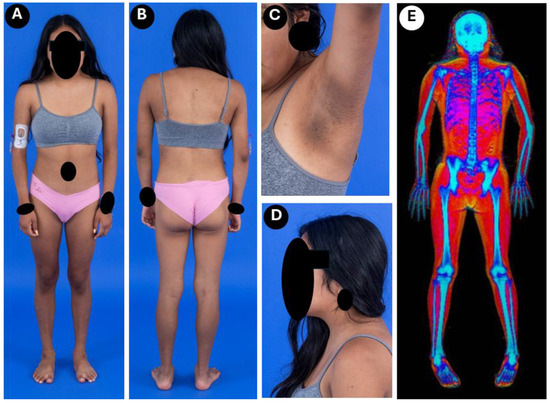
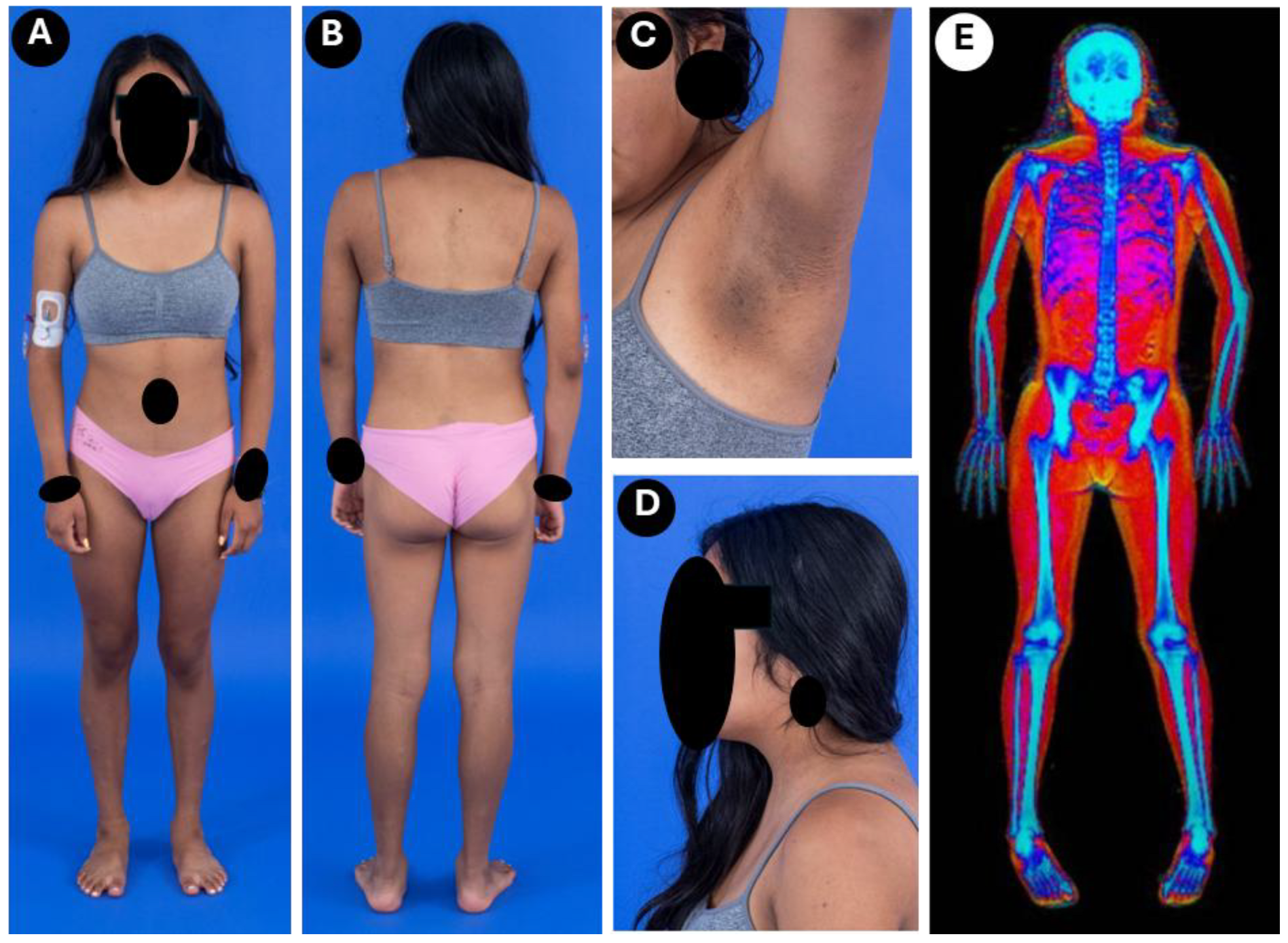
Her height at age 18 years was 1.55 m, and her weight was 50.9 kg with a body mass index of 21.2 kg/m2 (49th percentile). Her father’s height was 1.80 m, and her mother’s was 1.52 m, with a mid-parental height of 1.60 m. Her height was within 2SD of the mid-parental height. She had increased adiposity in the face and a small dorsocervical fat pad (Figure 1). Subcutaneous fat in the forearms and the lower extremities was markedly decreased, and minimal gluteal fat was present. Acanthosis nigricans was present in the neck and axillary regions. She had increased muscularity of the lower extremities and some phlebomegaly. The patient reported normal exercise tolerance.
Figure 1.
Phenotypic features and Dual-energy X-ray absorptiometry (DEXA) scan of the patient at the age of 15 years. (A) Anterior and (B) posterior view of the patient. Note decreased subcutaneous (sc) fat in the forearms, hips, and lower extremities, and preserved sc fat around the shoulders and upper arms. (C) Severe acanthosis nigricans in the axilla. (D) Increased adiposity in the neck and a small dorsocervical fat pad. (E) DEXA scan showing preserved fat around the shoulders and upper arms; however, sc fat in the forearms and lower extremities is markedly reduced. Total body fat by DEXA was 26.8% (−0.8 SD); regional fat in the upper extremities was 28.75% (−0.65 SD), and in the lower extremities was 24.1% (−2.3 SD). Her bone density measurements for the total whole body were 0.990 (z score 0.2), for the Lumbar region (L1 to L4) were 0.914 (z score 0.4), left femoral neck 0.789 (z score −0.1), total left hip 0.825 (z score −0.5), and at the left forearm were 0.64 (z score 0.5).
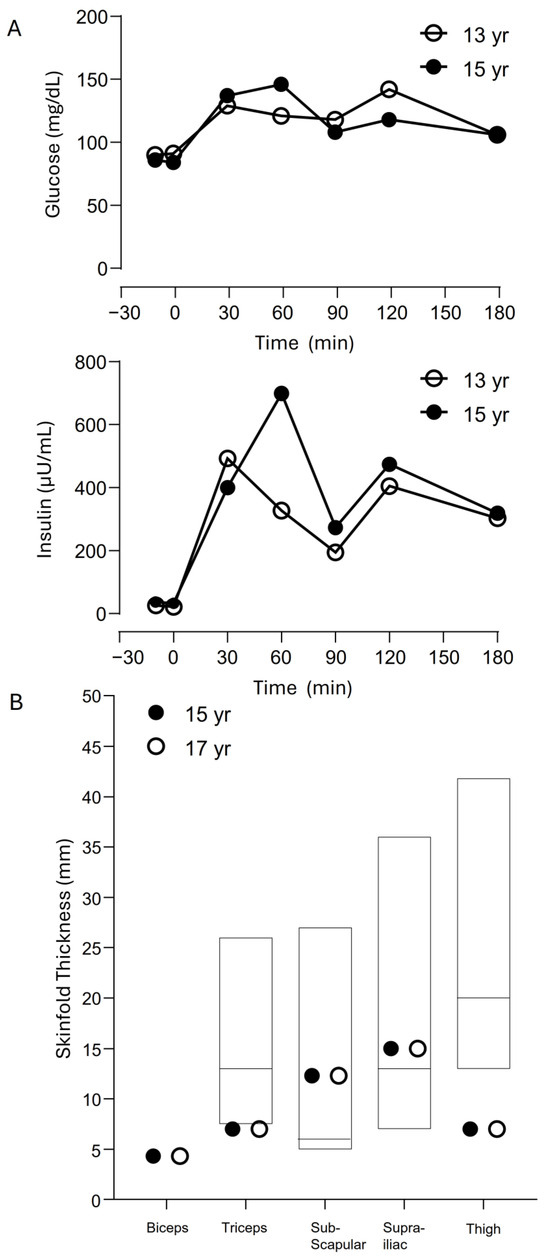
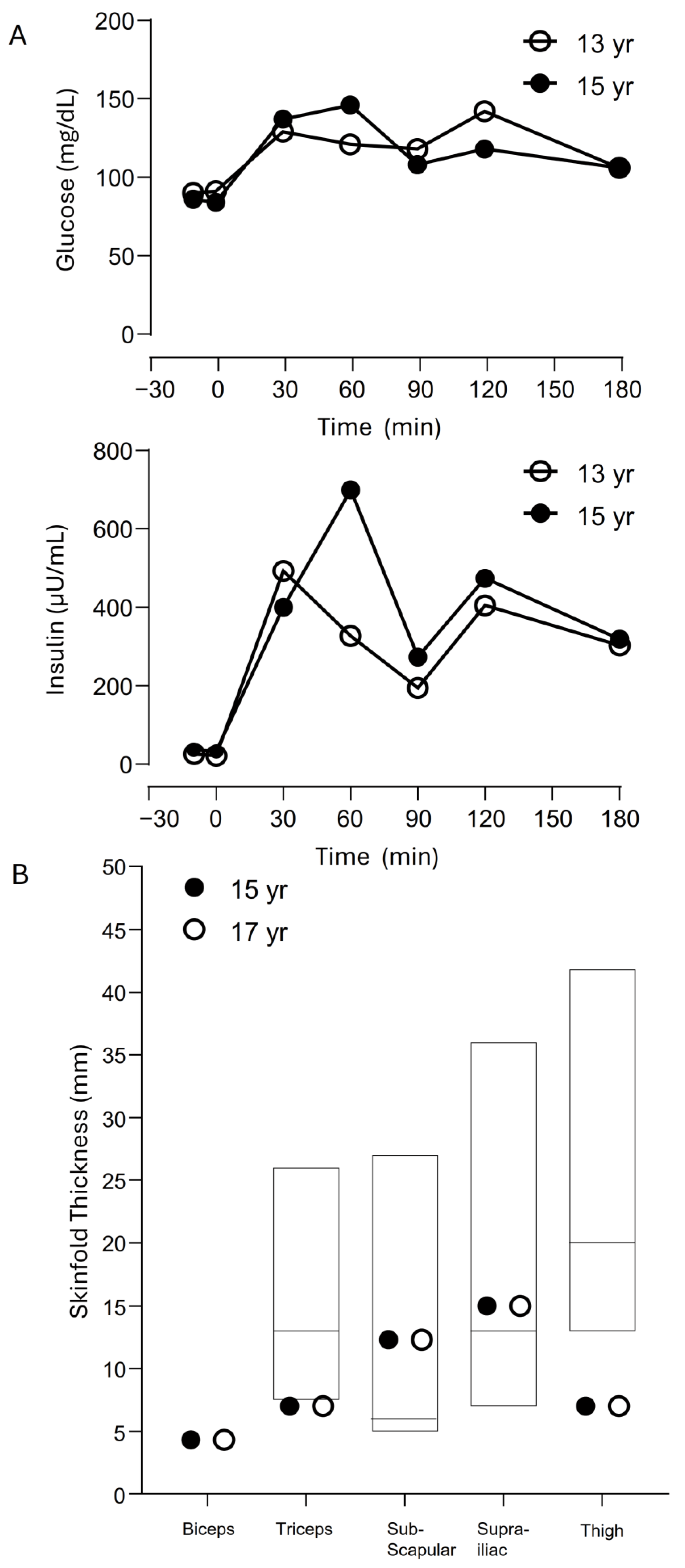
Skinfold thickness measurements at age 15 years revealed markedly reduced values in both the upper and lower extremities, especially at the triceps and thigh, which were below the 10th percentile of normal controls (Figure 2) [5]. Regional fat by dual energy X-ray absorptiometry was normal in the upper extremities (28.75%, −0.65 SD) but was reduced in the lower extremities (24.1%, −2.3 SD) (Figure 1E) [6]. Her bone density measurements were normal (Figure 1E).
Figure 2.
Oral glucose tolerance test and skinfold thickness measurements of the patient. (A) Oral Glucose tolerance test (OGTT) results at ages 13 and 15 years. At age 13 (unfilled circles), the OGTT showed normal fasting glucose (91 mg/dL) with modestly elevated fasting insulin (21.8 µU/mL), a mild glucose rise post-load, and marked hyperinsulinemia peaking at 493.3 µU/mL at 30 min and remaining elevated at 404.9 µU/mL at 120 min. By age 15 (solid circles), fasting glucose levels remained normal (84 mg/dL), but fasting insulin levels were higher (32.7 µU/mL). Additionally, post-load 2 h plasma glucose peak was higher (146 mg/dL vs. 129 mg/dL). Post-glucose insulin response was more exaggerated and prolonged, peaking at 699 µU/mL at 60 min, with persistently elevated levels throughout the test, indicating worsening insulin resistance. Oral glucose was administered at time 0 min. (B) Skinfold thickness at 15 years (solid circles) and 17 years (unfilled circles). The bars show 10th to 90th percentile values of normal age-matched girls [5], with the median value marked by a horizontal line. At age 15, biceps, triceps, subscapular, suprailiac, and thigh skinfold thicknesses were 4.7 mm, 5.0 mm, 12.0 mm, 10.0 mm, and 6.0 mm, respectively. At age 17, the corresponding values were 4.3 mm, 7.0 mm, 12.3 mm, 15.0 mm, and 7.0 mm, respectively. These graphs show markedly reduced values in both the upper and lower extremities, and at the triceps and thigh were below the 10th percentile of normal controls, while the sub-scapular and supra-iliac skinfold thickness were above the 50th percentiles.
Her serum total cholesterol was 141 mg/dL; triglycerides, 60 mg/dL; high-density lipoprotein cholesterol, 41 mg/dL; and blood hemoglobin A1c, 4.8%. Oral glucose tolerance tests at the ages of 13 and 15 years revealed impaired glucose tolerance and marked hyperinsulinemia (Figure 2). At age 13 years, her serum aspartate aminotransferase was 12 U/L (normal 17–33); alanine aminotransferase (ALT), 17 U/L (normal 5–30); uric acid, 3.6 mg/dL (normal 2.2–6.4); and leptin (ELISA, Millipore) was 16.4 ng/mL. Abdominal ultrasound at the age of 15 years revealed normal liver size (13.8 cm), with normal stiffness (elastography 1.53 m/s) [7] and echogenicity, and normal spleen size (181 mL).
Routine screening neck ultrasound at age 13 years showed a 5 mm × 4 mm × 4 mm right thyroid lobe nodule, which by age 17 years had increased in size to 14 mm. The nodule was non-encapsulated with infiltration of the right lower lobe and multiple punctate echogenic foci consistent with microcalcifications. Needle biopsy of the thyroid nodule showed papillary thyroid carcinoma. The patient underwent a total thyroidectomy with right central neck dissection, and oral levothyroxine was initiated. The patient was treated with radioactive iodine ablation after the surgery, and subsequent imaging at age 18 years showed no evidence of residual tumor. She had no cataracts, premature graying, loss of hair, or sclerodermatous skin changes.
Genome Sequencing and Analysis
Genomic DNA was isolated from peripheral blood using the Easy-DNA kit (Invitrogen, Carlsbad, CA, USA). The proband (FPL361.3) and her mother (FPL361.1) underwent whole exome sequencing (WES) using the Integrated DNA Technologies xGen Exome Research Panel V.1.0 on the Illumina platform. The mean coverage of the targeted regions was >50-fold, with >80% of bases covered by >20-fold reads in both samples. Sequences were aligned to the human reference genome b37, and variants were called using the Genome Analysis Toolkit (v3.8) and annotated using SnpEff (v5.1).
The inbreeding coefficients were estimated to be 0.087 and 0.118 for FPL361.1 and FPL361.3, respectively, which suggested consanguinity within the family. Therefore, we first filtered for variants that were homozygous in the proband but heterozygous in her mother under a recessive model. In the meantime, we performed runs of homozygosity (ROH) analysis searching for segments greater than 1 Mb in the proband but not in her mother using BCFtools/ROH [8] and copy number variation (CNV) detection using CNVkit [9] comparing FPL361.3 vs. FPL361.1. In addition, we filtered for variants that were heterozygous in the proband and absent in her mother under a dominant model with special attention to lipodystrophy candidate genes, including AGPAT2, AKT2, BSCL2, CAV1, CIDEC, EPHX1, LIPE, LMNA, MTX2, NOTCH3, PCYT1A, PIK3R1, PLAAT3, PLIN1, POLD1, PPARG, PSMB8, PTRF, TYMP, and ZMPSTE24. We filtered for rare missense, nonsense, splicing, or frameshift variants meeting the following criteria: minor allele frequencies (MAF) less than 0.001 in each of the subpopulations in the genome aggregation database (gnomAD v4.1.0; http://gnomad.broadinstitute.org/, accessed on 26 June 2025), a genomic evolutionary rate profiling++ score [10] greater than 2.0, and a combined annotation-dependent depletion score [11] greater than 15. As the father’s DNA was unavailable, de novo variants were not considered.
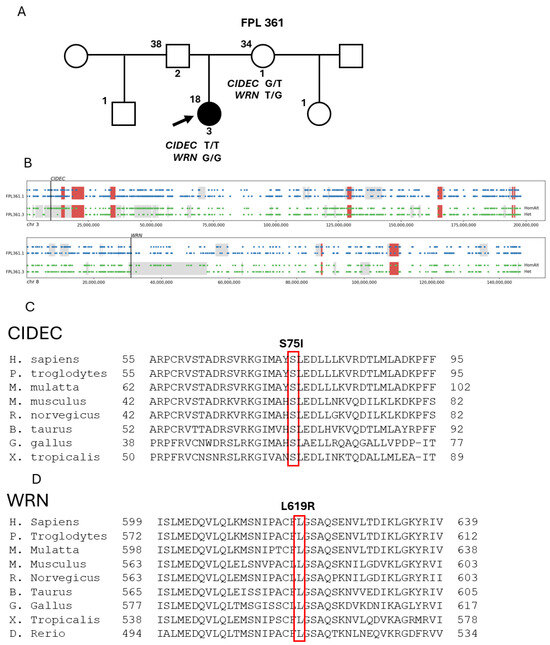
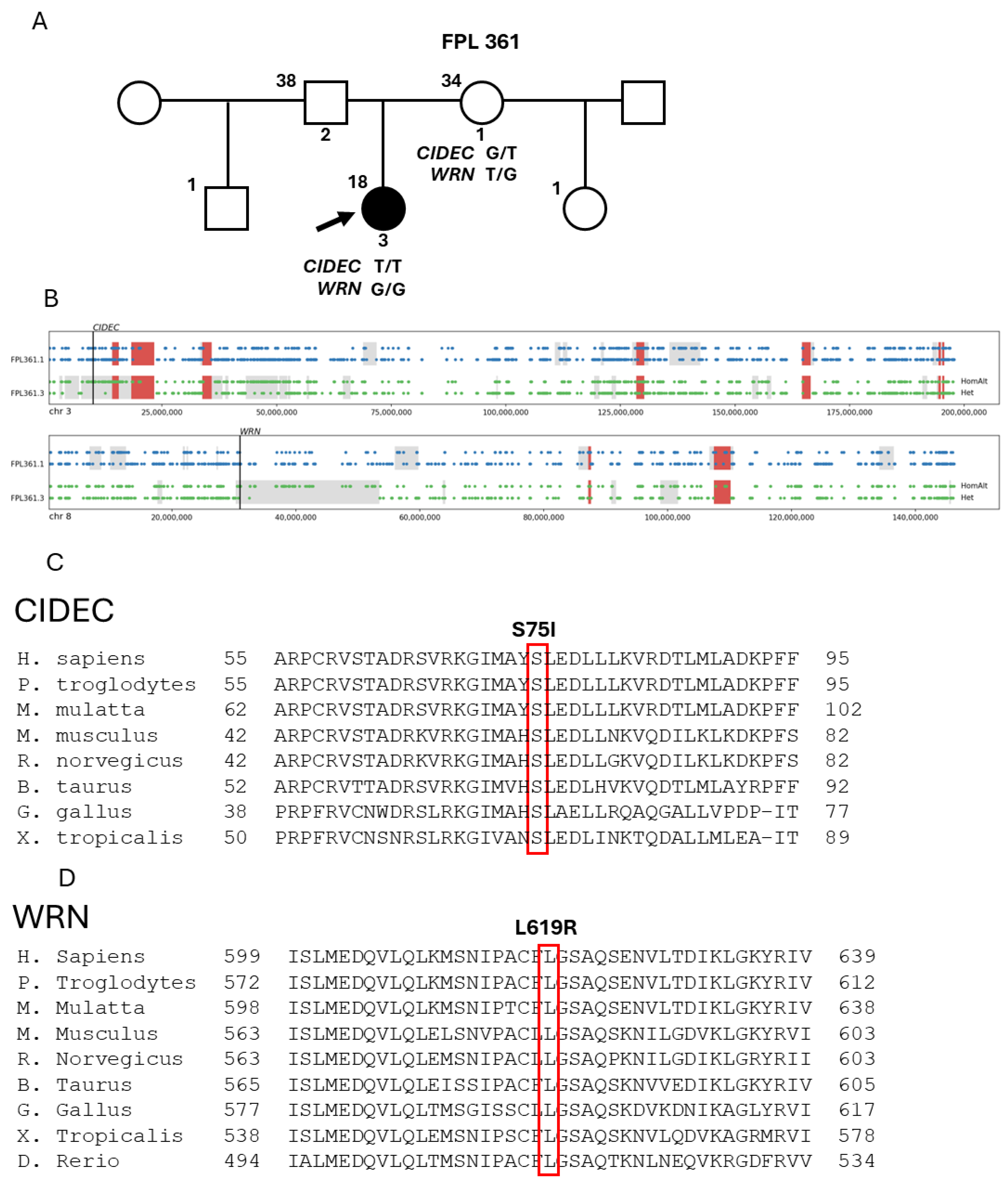
WES analysis revealed that the proband carried one extremely rare homozygous missense variant: chr3, g.9918772C>A (rs766353274; NM_001199623.2: c.224G>T; NP_001186552.1: p.Ser75Ile) in CIDEC, and one novel homozygous missense variant: chr8, g.30949372T>G (NM_000553.4: c.1856T>G; NP_000544: p.Leu619Arg) in WRN (Figure 3A). The proband, but not her mother, had regions of homozygosity (ROH) including 6.7 Mb on chromosome 3 and 23.1 Mb on chromosome 8, where the variants were located (Figure 3B). Both serine 75 of the CIDEC protein and leucine 619 of the WRN protein were well conserved across species (Figure 3C,D). The mother was a heterozygous carrier of both variants. There was no heterozygous pathogenic variant or CNVs identified in lipodystrophy candidate genes in the proband.
Figure 3.
FPL361 Pedigree, regions of homozygosity on chromosomes 3 and 8 encompassing the disease-causing variants in CIDEC and WRN, and conservation of the mutated residues across the species. (A) FPL361 Pedigree. Circles denote females, and squares denote males, and the numbers on the top left of the symbols denote current age in years, and under the symbols denote pedigree number. The slanted arrow indicates the proband, who is shown as a filled black symbol, while the unaffected subjects are shown as unfilled symbols. The patient’s mother, 34 years old (1.52 m, 62.7 kg), and father, 38 years old (1.80 m, 94.1 kg), were both healthy. The genotypes of the proband and her mother are given under the symbols. For CIDEC, T/T indicates homozygous c.224G>T variant and G/T indicates heterozygous variant; and for WRN, G/G indicates homozygous c.1856T>G variant and T/G indicates heterozygous variant. The minor allele frequency (MAF) of c.224G>T variant in CIDEC is 2.0 × 10⁻⁵ in gnomAD, and the WRN variant is absent. Both variants are located at highly conserved sites—GERP++ scores equal to 5.3 and 5.5, respectively, and are predicted to be of high impact—CADD scores equal to 23.2 and 26.9, respectively. (B) Schematic of segments on chromosomes 3 and 8 of the proband (FPL361.3) and her mother (FPL361.1), based on GRCh37/hg19 coordinates. For each individual, the top line displays markers with homozygous genotypes and the bottom line displays markers with heterozygous genotypes. The inferred homozygous regions are highlighted in color blocks: red for regions common to both and gray for regions unique to one individual. The CIDEC and WRN loci are indicated. (C) Multiple species alignment of the region surrounding Ser75 of human CIDEC and (D) multiple species alignment of the region surrounding Leu619 of human WRN performed in the COBALT multiple alignment tool (https://www.ncbi.nlm.nih.gov/tools/cobalt/cobalt.cgi, accessed on 26 June 2025). CIDEC Ser75 and WRN Leu619 are conserved across all the species. The Genbank accession numbers are: Homo sapiens NP_006102.2, Mus musculus NP_803421.1, Rattus Norvegicus NP_569117.2, Danio rerio NP_998217.1, Box taurus NP_001030419.1, Xenopus tropicalis XP_012820301.1, Gallus gallus NP_001006571.2, Macaca mulatta NP_001253662.1, Pan troglodytes NP_001253662.1.
The minor allele frequency of the CIDEC p.Ser75Ile variant is 2.0 × 10⁻⁵ in gnomAD, 1.8 × 10⁻⁵ in All of US, and 1.7 × 10⁻⁵ in UK Biobank, without any homozygous carrier observed; the WRN p.Leu619Arg variant is absent in all these databases. Both variants are located at highly conserved sites—GERP++ scores equal to 5.3 and 5.5, respectively, and are predicted to be of high impact—CADD scores equal to 23.2 and 26.9, respectively. However, both variants would be classified as VUS (variant of unknown significance) by the ACMG criteria [12].
3. Discussion
CIDEC is a crucial lipid droplet protein that promotes lipid droplet formation and fusion in adipocytes [13]. It is predominantly expressed in white adipose tissue and plays a key role in triglyceride storage and negatively regulates lipolysis [14]. Only a single patient with a homozygous null variant in CIDEC has been reported to be associated with FPL type 5 (FPLD5), characterized by peripheral fat loss from the limbs and gluteal region with normal to increased central fat deposition in the face and trunk, and severe insulin resistance [4]. Our report provides further confirmation of the association of FPL phenotype with the CIDEC variants. Similarly to the previously reported patient with FPLD5, our patient also had a loss of fat from the extremities with excess fat in the face and upper back. Interestingly, our patient did not have any hepatic steatosis or hepatomegaly and also had normal serum triglyceride levels, in contrast to the previously reported patient who had marked hepatic steatosis, extreme hypertriglyceridemia, and acute pancreatitis. However, the metabolic deterioration in the previously reported patient might have been due to uncontrolled diabetes mellitus (hemoglobin A1c 11.0% to 16.3%) despite taking 1.6 units of insulin per kg body weight subcutaneously daily. Our patient also had normal serum leptin levels, whereas the previously reported patient had low levels of serum leptin. However, our patient also had severe insulin resistance.
We further expand the scope of phenotypic findings of FPLD5 due to CIDEC variants. For example, our patient had normal bone density and exercise tolerance in contrast to the findings of osteoporosis and myopathy in the Cidec, also called fat-specific protein 27 (Fsp27), knock-out mouse model [14]. Further follow-up of both patients will be needed to see if they develop muscle or bone pathology later in life. While Fsp27-null mice are lean and resistant to diet-induced obesity and insulin resistance [15,16], under energetic stress, they display hepatic steatosis and systemic insulin resistance [17]. Fsp27 knock-out mice exhibit multilocular lipid droplets in white adipocytes [15,16]; similar findings were observed in the previously reported patient with FPLD5, including a mixed population of uni- and multi-locular white adipocytes from axillary subcutaneous adipose tissue biopsy [4].
The CIDEC p.Ser75Ile variant identified in our patient is located in a highly conserved region of the protein. While this specific variant has been reported in the heterozygous state in population databases, no homozygotes have been previously documented. It is possible that our patient with a missense variant, p.Ser75Ile, had less severe lipodystrophy compared to the previously reported patient, who had a null variant, p.Glu186*; however, no skinfold thickness or regional body fat data from DEXA scans were available for the previously reported patient [4]. Published magnetic resonance images of the previously reported patient did show a marked loss of subcutaneous fat from both the upper and lower extremities, with increased fat accumulation in the neck and intra-abdominal region [4]. Interestingly, neither patient had increased subcutaneous fat accumulation in the pubic region and labia majora, which is seen in females with FPL, Dunnigan, due to LMNA variants [18].
Interestingly, our patient also had a missense homozygous variant in WRN. WRN encodes a RecQ DNA helicase involved in DNA replication and repair, and telomere maintenance [19]. Biallelic loss-of-function pathogenic variants in WRN cause Werner syndrome, a rare autosomal recessive disorder characterized by premature aging, with the following four cardinal signs: bilateral cataracts, premature graying or thinning of scalp hair, sclerodermatous skin changes, and short stature. In addition, patients with Werner syndrome also present with thin limbs, pinched facial features, voice change, hypogonadism, type 2 diabetes mellitus, soft tissue calcification, neoplasm(s), ulcers on legs, and atherosclerosis [20,21,22,23,24]. Although our patient did not have cataracts, facial features of premature aging, short stature, sclerodermatous skin, or osteoporosis, she did develop papillary thyroid carcinoma at a very young age, which provides supportive evidence for the pathogenicity of the novel homozygous missense variant, p.Leu619Arg, in WRN. This variant affects the protein’s helicase domain, which is critical for its function [25]. WRN deficiency leads to genomic instability and can increase the risk of neoplasms, particularly sarcomas, meningiomas, thyroid cancer, and melanoma [26,27,28,29].
Most of the pathogenic variants causing Werner syndrome are loss-of-function variants (null, frameshift, or indels), and only six other missense variants have been reported so far [19,30,31,32,33,34]. However, three of them were in trans with another null variant (p.Arg637Trp with p.Val1082fsX [31]; p.Gly574Arg with p.I662fsX [34]; and p.Met1350Arg with p.N1197fsX [32]), and another patient had double missense homozygous variants (p.Lys125Asn with p.Lys135Glu) [19]. Recently, Sezer et al. [33] reported a consanguineous family with a homozygous, novel WRN missense variant p.Trp200Cys in four affected siblings (13–23 year-old males) with interstitial lung disease, spontaneous pneumothorax, and progressive pulmonary failure. However, none of the affected subjects (three of whom died at ages 16–23 years) had any other cardinal signs of Werner syndrome besides growth failure. The lung phenotype is extremely rare in confirmed patients with Werner syndrome [35]. No functional studies were conducted to ascertain the pathogenicity of the WRN variant. Interestingly, all affected siblings also harbored a c.357+1G>T homozygous variant in SFXN5. There are no previous reports of human phenotypes associated with homozygous null variants of SFXN5. Therefore, whether the phenotype was due to atypical Werner syndrome, a new clinical entity associated with the WRN variant, or due to the SFXN5 variant was not clear [33]. Overall, which clinical features of Werner syndrome may be caused by exclusively homozygous missense rare variants can not be ascertained from these reports.
While classical lipodystrophy is not a recognized feature of Werner syndrome, patients often display a characteristic body habitus with thin limbs and relatively preserved truncal fat, resembling a partial lipodystrophy phenotype [36]. Recent studies have suggested that WRN may play a role in adipocyte differentiation and function, potentially linking it to lipodystrophy syndromes [37,38]. Thus, it is possible that the homozygous WRN variant in our patient may have contributed to her lipodystrophic phenotype and insulin resistance.
4. Conclusions
In conclusion, our report confirms the previously reported association of a biallelic CIDEC variant with familial partial lipodystrophy phenotype. Our case also highlights the extremely rare possibility of co-occurrence of FPLD5 with thyroid cancer, a clinical feature of Werner syndrome. Thus, in future, our patient may not only need surveillance for metabolic complications of FPLD5 such as diabetes, hypertriglyceridemia, and hepatic steatosis, but also for WRN-associated neoplasms and features of premature aging.
Author Contributions
Conceptualization, N.P., R.J.B. and A.G.; Methodology, N.P., R.J.B., A.G. and C.X.; Formal Analysis, A.G., C.X. and C.-Y.H.; Investigation, N.P., R.J.B. and A.G.; Resources, R.J.B. and A.G.; Data Curation, N.P., R.J.B. and A.G.; Writing—Original Draft Preparation, N.P.; Writing—Review and Editing, N.P., R.J.B., C.X. and A.G.; Supervision A.G.; Funding Acquisition, R.J.B. and A.G. All authors have read and agreed to the published version of the manuscript.
Funding
This work was supported by grants from the National Institutes of Health, R01-DK105448, and by the intramural research program of the National Institute of Diabetes and Digestive and Kidney Diseases within the National Institutes of Health (NIH). The contributions of the NIH author(s) are considered Works of the United States Government. The findings and conclusions presented in this paper are those of the author(s) and do not necessarily reflect the views of the NIH or the U.S. Department of Health and Human Services. The funding sources were not involved in study design, analysis and interpretation of data, writing of the paper, or in the decision to submit the article for publication. REDCap Version 15.8.3 was used for data storage.
Institutional Review Board Statement
The study was conducted in accordance with the Declaration of Helsinki and approved by the Institutional Review Board of the National Institutes of Health (protocol code 76-DK-0006, initial date of approval 1976, most recent approval date 26 June 2025).
Informed Consent Statement
Informed consent was obtained from all subjects involved in the study.
Data Availability Statement
The individual-level whole-exome sequencing data sets cannot be released because of the Health Insurance Portability and Accountability Act and Genetic Information Nondiscrimination Act regulations to protect patients’ genetic privacy.
Acknowledgments
The authors acknowledge Anil K. Agarwal and Mary Tunison for Multiple species alignment of the region surrounding the mutated residues of CIDEC and WRN, and the Texas Advanced Computing Center (https://www.tacc.utexas.edu) (accessed on 26 June 2025) at The University of Texas at Austin for providing high-performance computing resources that have contributed to the research results reported within this paper.
Conflicts of Interest
N.P. has consulted for Chiesi. A.G. consults for Chiesi, Regeneron, and Zvelt Pharmaceuticals, and has received grant support from Chiesi, Regeneron, Quintiles, Akcea Pharmaceuticals, and Intercept Pharmaceuticals. R.J.B. has received scientific writing support from Aegerion Pharmaceuticals and receives research support from Chiesi, Regeneron, and Marea. The remaining authors have nothing to disclose.
References
- Jeru, I.; Vatier, C.; Araujo-Vilar, D.; Vigouroux, C.; Lascols, O. Clinical Utility Gene Card for: Familial partial lipodystrophy. Eur. J. Hum. Genet. 2017, 25, 271. [Google Scholar] [CrossRef] [Scilit]
- Farhan, S.M.; Robinson, J.F.; McIntyre, A.D.; Marrosu, M.G.; Ticca, A.F.; Loddo, S.; Carboni, N.; Brancati, F.; Hegele, R.A. A novel LIPE nonsense mutation found using exome sequencing in siblings with late-onset familial partial lipodystrophy. Can. J. Cardiol. 2014, 30, 1649–1654. [Google Scholar] [CrossRef] [Scilit] [PubMed]
- Payne, F.; Lim, K.; Girousse, A.; Brown, R.J.; Kory, N.; Robbins, A.; Xue, Y.; Sleigh, A.; Cochran, E.; Adams, C.; et al. Mutations disrupting the Kennedy phosphatidylcholine pathway in humans with congenital lipodystrophy and fatty liver disease. Proc. Natl. Acad. Sci. USA 2014, 111, 8901–8906. [Google Scholar] [CrossRef] [Scilit] [PubMed]
- Rubio-Cabezas, O.; Puri, V.; Murano, I.; Saudek, V.; Semple, R.K.; Dash, S.; Hyden, C.S.; Bottomley, W.; Vigouroux, C.; Magre, J.; et al. Partial lipodystrophy and insulin resistant diabetes in a patient with a homozygous nonsense mutation in CIDEC. EMBO Mol. Med. 2009, 1, 280–287. [Google Scholar] [CrossRef] [Scilit] [PubMed]
- Dezenberg, C.V.; Nagy, T.R.; Gower, B.A.; Johnson, R.; Goran, M.I. Predicting body composition from anthropometry in pre-adolescent children. Int. J. Obes. Relat. Metab. Disord. 1999, 23, 253–259. [Google Scholar] [CrossRef] [Scilit]
- Vasandani, C.; Li, X.; Sekizkardes, H.; Adams-Huet, B.; Brown, R.J.; Garg, A. Diagnostic Value of Anthropometric Measurements for Familial Partial Lipodystrophy, Dunnigan Variety. J. Clin. Endocrinol. Metab. 2020, 105, 2132–2141. [Google Scholar] [CrossRef] [Scilit]
- Marginean, C.O.; Melit, L.E.; Ghiga, D.V.; Sasaran, M.O. Reference values of normal liver stiffness in healthy children by two methods: 2D shear wave and transient elastography. Sci. Rep. 2020, 10, 7213. [Google Scholar] [CrossRef] [Scilit]
- Narasimhan, V.; Danecek, P.; Scally, A.; Xue, Y.; Tyler-Smith, C.; Durbin, R. BCFtools/RoH: A hidden Markov model approach for detecting autozygosity from next-generation sequencing data. Bioinformatics 2016, 32, 1749–1751. [Google Scholar] [CrossRef] [Scilit]
- Talevich, E.; Shain, A.H.; Botton, T.; Bastian, B.C. CNVkit: Genome-Wide Copy Number Detection and Visualization from Targeted DNA Sequencing. PLoS Comput. Biol. 2016, 12, e1004873. [Google Scholar] [CrossRef] [Scilit]
- Davydov, E.V.; Goode, D.L.; Sirota, M.; Cooper, G.M.; Sidow, A.; Batzoglou, S. Identifying a high fraction of the human genome to be under selective constraint using GERP++. PLoS Comput. Biol. 2010, 6, e1001025. [Google Scholar] [CrossRef] [Scilit]
- Kircher, M.; Witten, D.M.; Jain, P.; O’Roak, B.J.; Cooper, G.M.; Shendure, J. A general framework for estimating the relative pathogenicity of human genetic variants. Nat. Genet. 2014, 46, 310–315. [Google Scholar] [CrossRef] [Scilit] [PubMed]
- Richards, S.; Aziz, N.; Bale, S.; Bick, D.; Das, S.; Gastier-Foster, J.; Grody, W.W.; Hegde, M.; Lyon, E.; Spector, E.; et al. Standards and guidelines for the interpretation of sequence variants: A joint consensus recommendation of the American College of Medical Genetics and Genomics and the Association for Molecular Pathology. Genet. Med. 2015, 17, 405–424. [Google Scholar] [CrossRef] [Scilit] [PubMed]
- Gong, J.; Sun, Z.; Li, P. CIDE proteins and metabolic disorders. Curr. Opin. Lipidol. 2009, 20, 121–126. [Google Scholar] [CrossRef] [Scilit] [PubMed]
- Puri, V.; Konda, S.; Ranjit, S.; Aouadi, M.; Chawla, A.; Chouinard, M.; Chakladar, A.; Czech, M.P. Fat-specific protein 27, a novel lipid droplet protein that enhances triglyceride storage. J. Biol. Chem. 2007, 282, 34213–34218. [Google Scholar] [CrossRef] [Scilit]
- Nishino, N.; Tamori, Y.; Tateya, S.; Kawaguchi, T.; Shibakusa, T.; Mizunoya, W.; Inoue, K.; Kitazawa, R.; Kitazawa, S.; Matsuki, Y.; et al. FSP27 contributes to efficient energy storage in murine white adipocytes by promoting the formation of unilocular lipid droplets. J. Clin. Investig. 2008, 118, 2808–2821. [Google Scholar] [CrossRef] [Scilit]
- Toh, S.Y.; Gong, J.; Du, G.; Li, J.Z.; Yang, S.; Ye, J.; Yao, H.; Zhang, Y.; Xue, B.; Li, Q.; et al. Up-regulation of mitochondrial activity and acquirement of brown adipose tissue-like property in the white adipose tissue of fsp27 deficient mice. PLoS ONE 2008, 3, e2890. [Google Scholar] [CrossRef] [Scilit]
- Zhou, L.; Park, S.Y.; Xu, L.; Xia, X.; Ye, J.; Su, L.; Jeong, K.H.; Hur, J.H.; Oh, H.; Tamori, Y.; et al. Insulin resistance and white adipose tissue inflammation are uncoupled in energetically challenged Fsp27-deficient mice. Nat. Commun. 2015, 6, 5949. [Google Scholar] [CrossRef] [Scilit]
- Meral, R.; Ryan, B.J.; Malandrino, N.; Jalal, A.; Neidert, A.H.; Muniyappa, R.; Akinci, B.; Horowitz, J.F.; Brown, R.J.; Oral, E.A. “Fat Shadows” From DXA for the Qualitative Assessment of Lipodystrophy: When a Picture Is Worth a Thousand Numbers. Diabetes Care 2018, 41, 2255–2258. [Google Scholar] [CrossRef] [Scilit]
- Huang, S.; Lee, L.; Hanson, N.B.; Lenaerts, C.; Hoehn, H.; Poot, M.; Rubin, C.D.; Chen, D.F.; Yang, C.C.; Juch, H.; et al. The spectrum of WRN mutations in Werner syndrome patients. Hum. Mutat. 2006, 27, 558–567. [Google Scholar] [CrossRef] [Scilit]
- Oshima, J. The Werner syndrome protein: An update. Bioessays 2000, 22, 894–901. [Google Scholar] [CrossRef]
- Lebel, M.; Monnat, R.J., Jr. Werner syndrome (WRN) gene variants and their association with altered function and age-associated diseases. Ageing Res. Rev. 2018, 41, 82–97. [Google Scholar] [CrossRef] [Scilit] [PubMed]
- Goto, M.; Ishikawa, Y.; Sugimoto, M.; Furuichi, Y. Werner syndrome: A changing pattern of clinical manifestations in Japan (1917~2008). Biosci. Trends 2013, 7, 13–22. [Google Scholar] [CrossRef] [Scilit] [PubMed]
- Yokote, K.; Chanprasert, S.; Lee, L.; Eirich, K.; Takemoto, M.; Watanabe, A.; Koizumi, N.; Lessel, D.; Mori, T.; Hisama, F.M.; et al. WRN Mutation Update: Mutation Spectrum, Patient Registries, and Translational Prospects. Hum. Mutat. 2017, 38, 7–15. [Google Scholar] [CrossRef] [Scilit] [PubMed]
- Hoff, F.W.; Xing, C.; Simha, V.; Agarwal, A.K.; Zhang, X.; Lekkala, L.; Vaishnav, M.S.; Vuitch, F.; Garg, A. Early-onset diabetes mellitus as a presenting feature of Werner’s syndrome in an Indian family. Mol. Genet. Genom. Med. 2024, 12, e2299. [Google Scholar] [CrossRef] [Scilit]
- Chen, L.; Oshima, J. Werner Syndrome. J. Biomed. Biotechnol. 2002, 2, 46–54. [Google Scholar] [CrossRef] [Scilit]
- Lauper, J.M.; Krause, A.; Vaughan, T.L.; Monnat, R.J., Jr. Spectrum and risk of neoplasia in Werner syndrome: A systematic review. PLoS ONE 2013, 8, e59709. [Google Scholar] [CrossRef] [Scilit]
- Goto, M.; Miller, R.W.; Ishikawa, Y.; Sugano, H. Excess of rare cancers in Werner syndrome (adult progeria). Cancer Epidemiol. Biomark. Prev. 1996, 5, 239–246. [Google Scholar]
- Zhang, W.; Li, J.; Suzuki, K.; Qu, J.; Wang, P.; Zhou, J.; Liu, X.; Ren, R.; Xu, X.; Ocampo, A.; et al. Aging stem cells. A Werner syndrome stem cell model unveils heterochromatin alterations as a driver of human aging. Science 2015, 348, 1160–1163, Erratum in Science 2025, 387, eadx3819. [Google Scholar] [CrossRef] [Scilit]
- Ishikawa, Y.; Sugano, H.; Matsumoto, T.; Furuichi, Y.; Miller, R.W.; Goto, M. Unusual features of thyroid carcinomas in Japanese patients with Werner syndrome and possible genotype-phenotype relations to cell type and race. Cancer 1999, 85, 1345–1352. [Google Scholar] [CrossRef]
- Oshima, J.; Sidorova, J.M.; Monnat, R.J., Jr. Werner syndrome: Clinical features, pathogenesis and potential therapeutic interventions. Ageing Res. Rev. 2017, 33, 105–114. [Google Scholar] [CrossRef] [Scilit]
- Uhrhammer, N.A.; Lafarge, L.; Dos Santos, L.; Domaszewska, A.; Lange, M.; Yang, Y.; Aractingi, S.; Bessis, D.; Bignon, Y.J. Werner syndrome and mutations of the WRN and LMNA genes in France. Hum. Mutat. 2006, 27, 718–719. [Google Scholar] [CrossRef] [Scilit]
- Friedrich, K.; Lee, L.; Leistritz, D.F.; Nurnberg, G.; Saha, B.; Hisama, F.M.; Eyman, D.K.; Lessel, D.; Nurnberg, P.; Li, C.; et al. WRN mutations in Werner syndrome patients: Genomic rearrangements, unusual intronic mutations and ethnic-specific alterations. Hum. Genet. 2010, 128, 103–111. [Google Scholar] [CrossRef] [Scilit]
- Sezer, A.; Kayhan, G.; Gursoy, T.R.; Eyuboglu, T.S.; Percin, F.E. A homozygous missense variant in the WRN gene segregating in a family with progressive pulmonary failure with recurrent spontaneous pneumothorax and interstitial lung disease. Am. J. Med. Genet. Part A 2023, 191, 220–227. [Google Scholar] [CrossRef] [Scilit]
- Tadokoro, T.; Rybanska-Spaeder, I.; Kulikowicz, T.; Dawut, L.; Oshima, J.; Croteau, D.L.; Bohr, V.A. Functional deficit associated with a missense Werner syndrome mutation. DNA Repair. 2013, 12, 414–421. [Google Scholar] [CrossRef] [Scilit]
- Goletto, T.; Crockett, F.; Aractingi, S.; Toper, C.; Senet, P.; Cadranel, J.; Naccache, J.M. Interstitial Lung Disease in Werner Syndrome: A Case Report of a 55-Year-Old Male Patient. Case Rep. Pulmonol. 2015, 2015, 361694. [Google Scholar] [CrossRef] [Scilit]
- Donadille, B.; D’Anella, P.; Auclair, M.; Uhrhammer, N.; Sorel, M.; Grigorescu, R.; Ouzounian, S.; Cambonie, G.; Boulot, P.; Laforet, P.; et al. Partial lipodystrophy with severe insulin resistance and adult progeria Werner syndrome. Orphanet J. Rare Dis. 2013, 8, 106. [Google Scholar] [CrossRef] [Scilit] [PubMed]
- Goh, K.J.; Chen, J.H.; Rocha, N.; Semple, R.K. Human pluripotent stem cell-based models suggest preadipocyte senescence as a possible cause of metabolic complications of Werner and Bloom Syndromes. Sci. Rep. 2020, 10, 7490. [Google Scholar] [CrossRef] [Scilit]
- Atallah, I.; McCormick, D.; Good, J.-M.; Barigou, M.; Fraga, M.; Sempoux, C.; Superti-Furga, A.; Semple, R.K.; Tran, C. Partial lipodystrophy, severe dyslipidaemia and insulin resistant diabetes as early signs of Werner syndrome. J. Clin. Lipidol. 2022, 16, 583–590. [Google Scholar] [CrossRef] [Scilit] [PubMed]
Disclaimer/Publisher’s Note: The statements, opinions and data contained in all publications are solely those of the individual author(s) and contributor(s) and not of MDPI and/or the editor(s). MDPI and/or the editor(s) disclaim responsibility for any injury to people or property resulting from any ideas, methods, instructions or products referred to in the content. |
© 2026 by the authors. Licensee MDPI, Basel, Switzerland. This article is an open access article distributed under the terms and conditions of the Creative Commons Attribution (CC BY) license.