Next Article in Journal
The Adipokine Axis in Heart Failure: Linking Obesity, Sarcopenia and Cardiac Dysfunction in HFpEF
Previous Article in Journal
Special Issue “Modern Analytical Strategies for Foodomics: From Nutritional Value to Food Security”
error_outline You can access the new MDPI.com website here. Explore and share your feedback with us.
 
 
Article

Influence of Aza-Substitution on Molecular Structure, Spectral and Electronic Properties of t-Butylphenyl Substituted Vanadyl Complexes


by
Daniil N. Finogenov
*,
Alexander E. Pogonin
,
Yuriy A. Zhabanov
*,
Ksenia V. Ksenofontova
,
Dominika Yu. Parfyonova
,
Alexey V. Eroshin
and
Pavel A. Stuzhin
Research Institute of Chemistry of Macroheterocyclic Compounds, Ivanovo State University of Chemistry and Technology, Sheremetevskiy Av. 7, 153000 Ivanovo, Russia
*
Authors to whom correspondence should be addressed.
Int. J. Mol. Sci. 2026, 27(2), 606; https://doi.org/10.3390/ijms27020606
Submission received: 11 December 2025 / Revised: 25 December 2025 / Accepted: 30 December 2025 / Published: 7 January 2026
(This article belongs to the Section Molecular Biophysics)

Abstract

Vanadyl octa-(4-tert-butylphenyl)phthalocyanine (VOPc(t-BuPh)8) and vanadyl octa-(4-tert-butylphenyl)tetrapyrazinoporphyrazine (VOTPyzPz(t-BuPh)8) complexes were synthesized for the first time and confirmed by IR and UV-Vis spectroscopy and MALDI-TOF spectrometry. The method of synthesis of their precursors, 4,5-bis(4-tert-butylphenyl)phthalonitrile ((t-BuPh)2PN) and 5,6-bis(4-tert-butylphenyl)pyrazine-2,3-dicarbonitrile ((t-BuPh)2PDC), was modified, resulting in higher yields. For the vanadyl complexes, the basic properties were studied, and it was found that the red shift in the Q band in the first protonation step is approximately two times greater than that of previously known complexes. An electrochemical study showed the influence of aza-substitution on the redox properties and on the energies of the frontier orbitals of all the compounds presented. For all four considered compounds, quantum chemical calculations of the molecular structure, IR spectra, and electronic absorption spectra were carried out using density functional theory (DFT) and time-dependent density functional theory (TDDFT and simplified sTDDFT) approaches. According to the DFT calculations, vanadyl macrocyclic complexes have dome-shaped distorted structures. Experimental and theoretical IR and electronic absorption spectra were compared and interpreted.

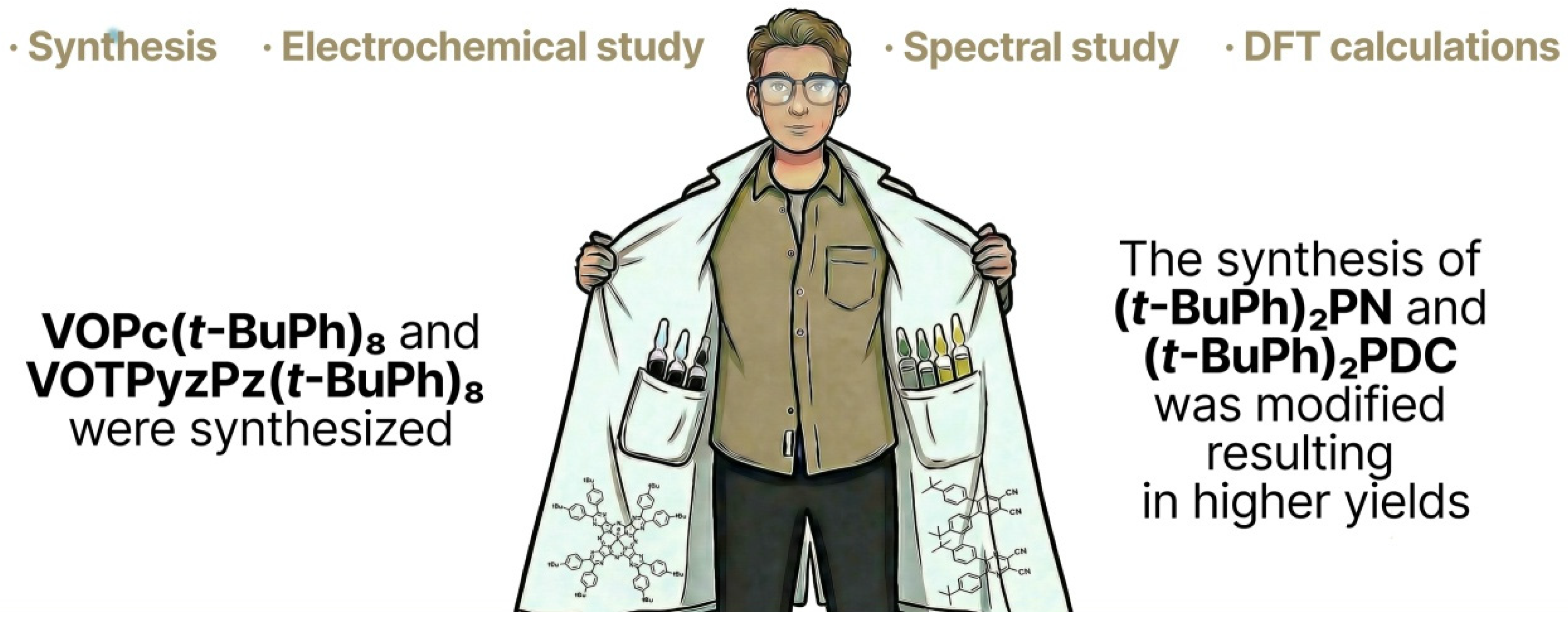
Graphical Abstract

1. Introduction

Phthalocyanines (Pcs) and their aza-analogs, tetrapyrazinoporphyrazines (TPyzPzs), are promising porphyrinoids in various applications such as dyes, catalysts, and materials for optical, electronic, and photoelectronic devices [1,2,3,4,5,6,7,8,9,10,11]. Among such macrocycles, vanadium complexes are of particular interest due to the paramagnetic properties of the central metal atom, as well as to the presence of an axial ligand that promotes packing in crystals. Research by Hadt and colleagues has shown that vanadyl and titanyl phthalocyanines could be promising options for application in quantum computing [12,13]. Nemykin et al. [14] have also noted that tetrapyrazinoporphyrazines could be successfully used in this field. Moreover, vanadyl complexes of phthalocyanines and their analogs have been extensively studied, since they have the potential to form compounds with coupling between spins [14,15,16,17,18,19,20].
The synthesis of alkyl-substituted aza-analogs of phthalocyanines and naphthalocyanines [21,22,23], which can be dissolved in common organic solvents such as chloroform, as well as compounds with isocyanides [17] or axial dialkylsiloxane ligands [18], has already been carried out. At the same time, it is known that the addition of aryl substituents to phthalocyanines, naphthalocyanines, and their aza-analogs significantly increases their solubility in most organic solvents due to disruption of the planar structure of these molecules [24]. The combination of these types of substitution at the periphery of macrocyclic core provides excellent solubility.
Derivatives of phthalonitrile (PN, 1,2-dicyanobenzene, phthalodinitrile, o-phthalonitrile) and pyrazine-2,3-dicarbonitrile (PDC, 2,3-dicyanopyrazine, 2,3-pyrazinedicarbonitrile) are used as precursors for the production of the macroheterocycles mentioned above. Despite the large number of known phthalonitriles, the study of their structures, vibrational spectra, and electronic spectra has received much less attention than the corresponding macrocycles. However, we should not forget that the conformational properties of initial phthalonitriles can influence the structure of macrocycles produced from them [25,26,27].
In this work, we synthesized new vanadyl octa-(4-tert-butylphenyl)phthalocyanine (VOPc(t-BuPh)8) and vanadyl octa-(4-tert-butylphenyl)tetrapyrazinoporphyrazine (VOTPyzPz(t-BuPh)8) complexes and slightly modified the existing method for obtaining precursors—4,5-bis(4-tert-butylphenyl)phthalonitrile ((t-BuPh)2PN) and 5,6-bis(4-tert-butylphenyl)pyrazine-2,3-dicarbonitrile ((t-BuPh)2PDC). The molecular structurse, infrared (IR) and ultraviolet–visible (UV-Vis) spectra of the compounds were also studied.

2. Results and Discussion

2.1. Synthesis

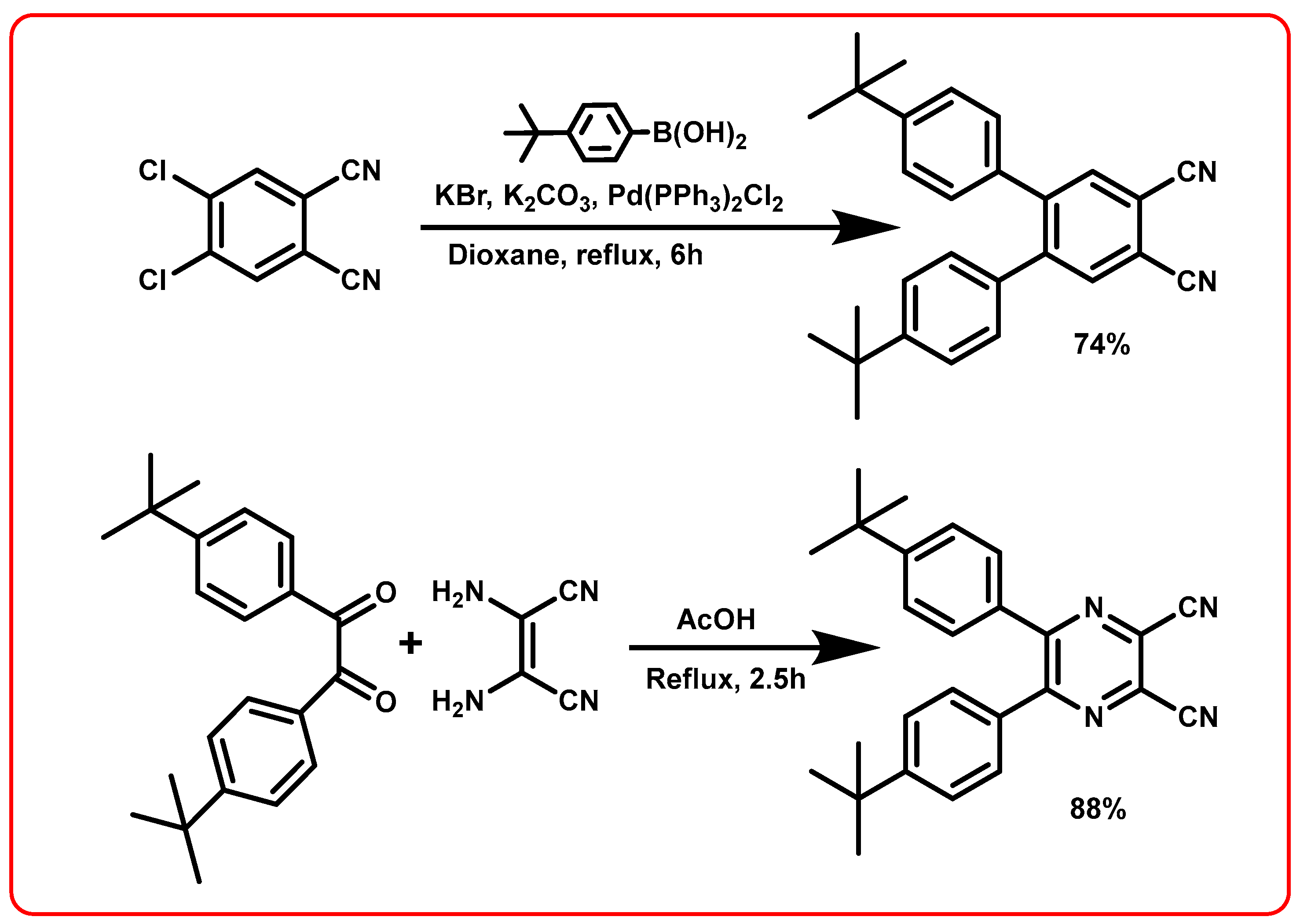
Firstly, we optimized previously reported synthetic methods of (t-BuPh)2PN [28,29] and (t-BuPh)2PDC [30] (Scheme 1). (t-BuPh)2PN was obtained in a higher yield compared to the results reported in previously published synthesis methods [28]. It was facilitated by the use of a procedure known for Ph2PN [31]. After completion of the reaction, purification by precipitation or flash chromatography yielded a greenish-gray product containing trace amounts of phthalocyanine. Obtaining a white powder of (t-BuPh)2PN is possible with additional sublimation at 250 °C using a water pump.
The synthesis of (t-BuPh)2PDC was slightly modified at the purification stage. After boiling in acetic acid, the resulting mixture was dried under vacuum on a rotary evaporator and purified by a silica gel flash column with DCM as the eluent to give a pale yellow powder with an 88% yield. This value is significantly higher than the 34% yield published earlier [30]. The change in purification method was undertaken because the previous separation [30] was not optimized, and boiling with activated charcoal led to significant product losses.
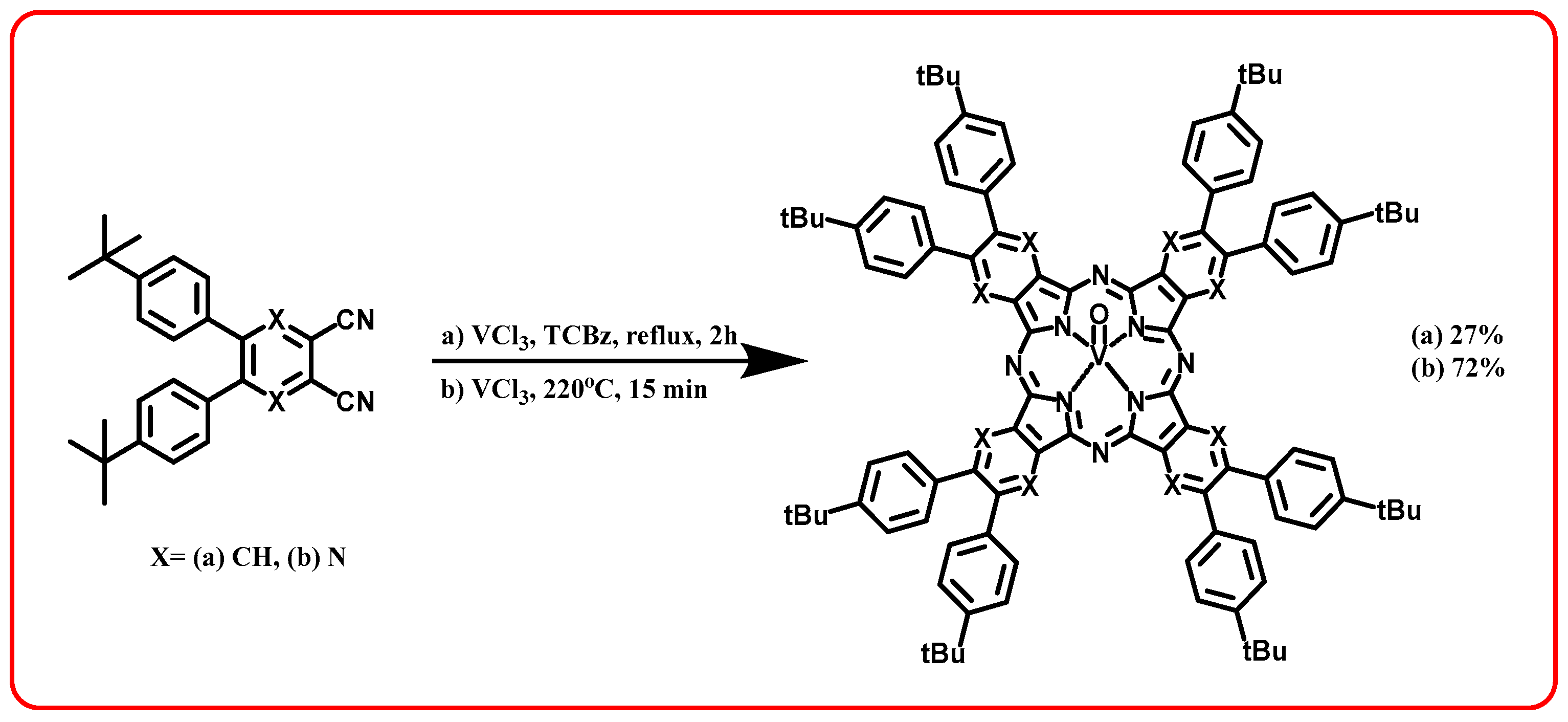
In the case of vanadyl complexes, different synthetic methods (Scheme 2) were applied for (t-BuPh)2PN and (t-BuPh)2PDC. For VOTPyzPz(t-BuPh)8, melting of the corresponding dinitrile with vanadium chloride at 220 °C gave the target complex in good yield. On the other hand, melting of (t-BuPh)2PN with VCl3 under the same conditions did not yield a phthalocyanine, even when the temperature was increased to 265 °C. Tetramerization in a high-boiling solvent led to the formation of VOPc(t-BuPh)8, but the yield was much lower than in the case of VOTPyzPz(t-BuPh)8 (27% vs. 72%, respectively).

2.2. Basic Properties

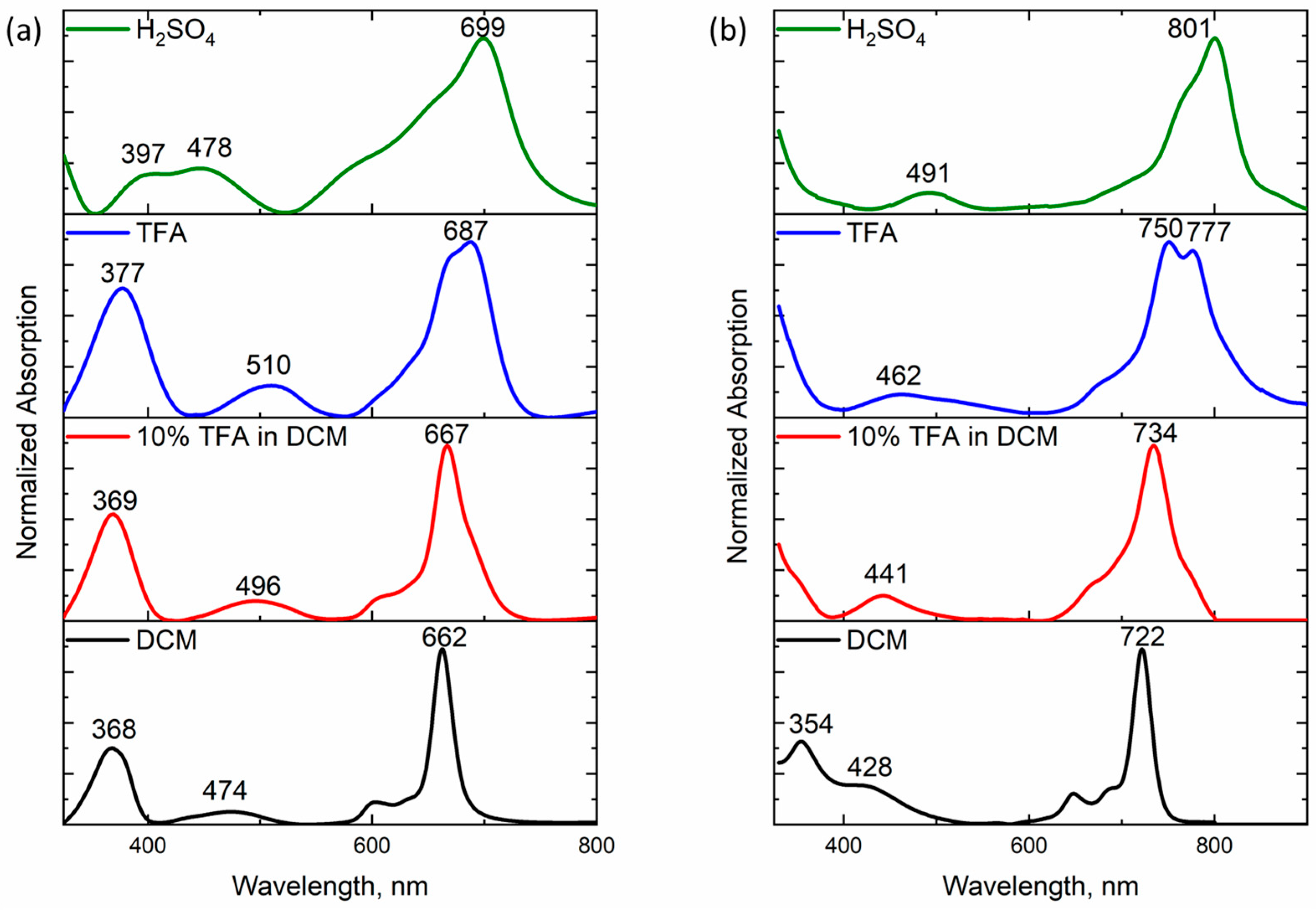
The spectral behavior of the considered vanadyl complexes in various acidic media were studied (Figure 1). The presence of nitrogen atoms at meso-positions in both complexes and in the pyrazine rings in the case of VOTPyzPz(t-BuPh)8 as basic centers provides the possibility to study their protonation, which is typical for metal phthalocyanines and their analogs [32,33,34,35].
With increasing acidity of the medium, sequential protonation of meso-nitrogen occurs, which leads to a characteristic splitting and a bathochromic shift in the Q band maximum. It was shown that the shape of the Q band and the bathochromic shift in its long-wave maximum are unique for each stage of protonation [35]. Previously, our group showed that substituents of an acceptor nature have a slight effect on shifts in absorption spectra in the case of phthalocyanines (see Table 1). Herein, for the molecule with electron-donating substituents VOPc(t-BuPh)8, we can see another influence. For this phthalocyanine, the first protonation step has a 980 cm−1 shift in the Q band from 722 nm to 777 nm (Table 1), which is almost twice as large as that of the corresponding MPcCl8 and MPc(t-Bu)4 derivatives of group 13 complexes [32,33]. This may be due to the presence of more electron-rich fragments at the periphery of the molecule; additionally, protonation of the axial oxygen at the vanadium atom is observed, as seen in Figure 1, with addition of 10% trifluoroacetic acid (TFA), manifested as a slight shift and broadening in the Q band. The second protonation step can only be detected in pure sulfuric acid, and the overall shift in the Q band is approximately 79 nm (1366 cm−1) from 722 nm to 801 nm (Table 1). In addition, protonation also affects the position of the charge-transfer (CT) band, which shifts by 34 nm in the case of the first protonation step and by 63 nm in the case of the second one (see Figure 1). On the other hand, VOTPyzPz(t-BuPh)8 demonstrates behavior similar to MTPyzPzCl8 [34]. The first protonation step is observed at 687 nm of the Q band, with a 25 nm (840 cm−1) shift (see Figure 1). Subsequent acidification of the solution by pure H2SO4 leads to protonation of the pyrazine nitrogen atoms, which can be detected by broadening of the Q band and splitting of the CT band (Figure 1).

2.3. Electrochemistry

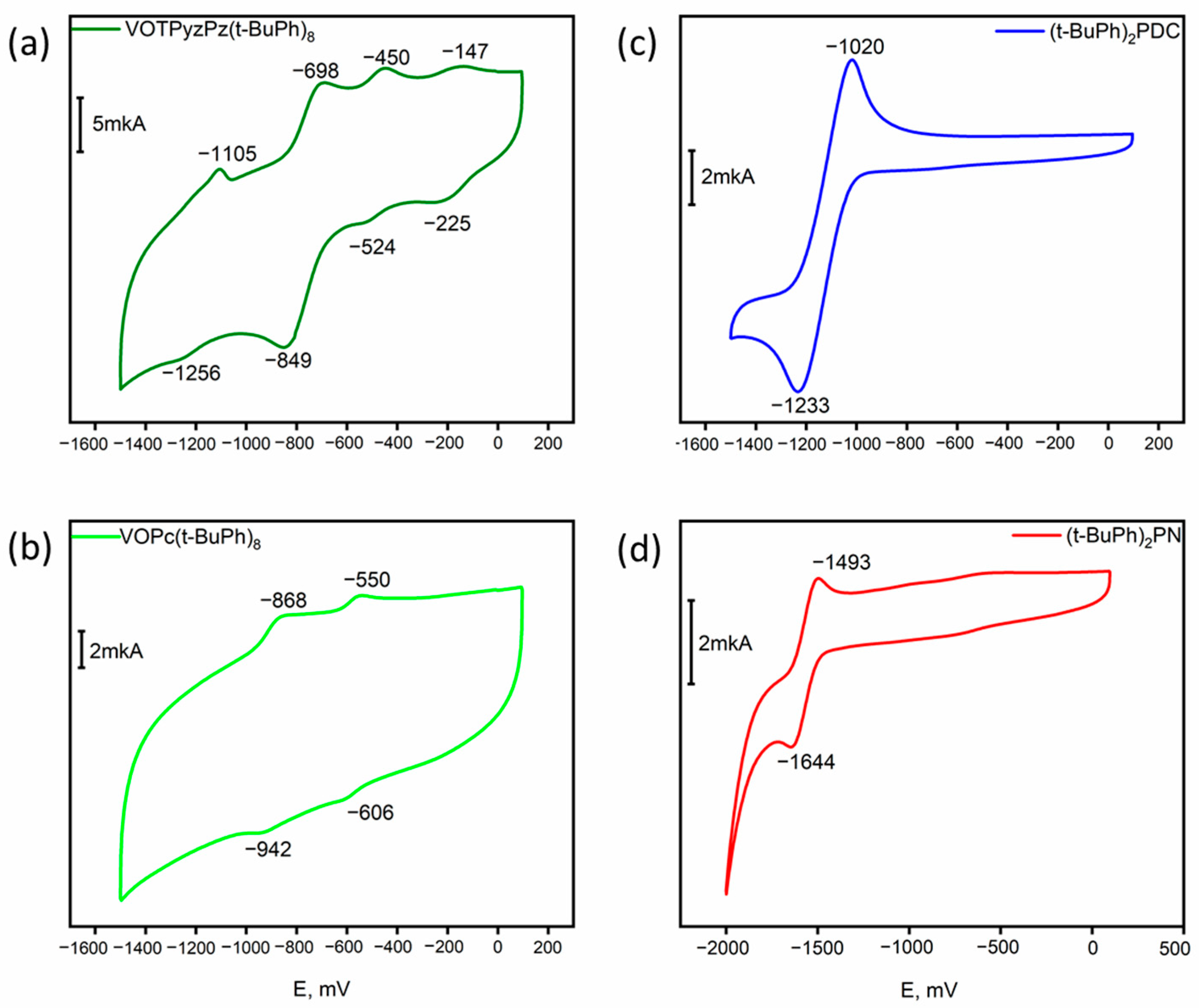
Cyclic voltammograms for studied dinitriles and macroheterocycles are shown in Figure 2, Table 2 contains the determined values of reduction potentials for the studied compounds in comparison with the corresponding values for related vanadyl complexes—VOPc(NaphtO)4, VOPc(t-Bu)2C6H3O)4, VOPc(C8H17O)4, VOTPyzPzCl8, VOTTDPz, VOPc, and VOTBP. For the dinitriles, only one reduction process was observed. In this case, the influence of aza-substitution manifests as a shift in the first reduction potential toward 0 (Figure 2c,d). A similar tendency is observed when comparing the VOTPyzPz(t-BuPh)8 and VOPc(t-BuPh)8 complexes.
A pyrazine-annulated macrocycle can be easily reduced in comparison with its benzo-annulated analogs by ~400 mV. This phenomenon is related to the electron-deficient nature of the pyrazine rings and leads to a decrease in the energy of the lowest unoccupied molecular orbital (LUMO). On the other hand, peripheral substitution in benzene rings appears to have little effect on the values of the reduction potentials in the case of Pcs. Thus, VOTPyzPz(t-BuPh)8 and VOTPyzPzCl8 have similar first reduction potentials.
Phthalocyanine complexes show similar behavior of the first reduction potential, with values ranging from −510 to −640 mV. In this row, VOPc(t-Bu)2C6H3O)4 has the highest value of E1/2, but in this case the impact of substituents is quite low. These complexes also possess a greater acceptor nature than VOTBP (vanadyl tetrabenzoporphyrin). VOPc(t-BuPh)8 has the highest second reduction potential in comparison with other considered complexes, which can provide easy formation of dianions with different reductants for single-molecule magnets [18].
The values of LUMO energies were estimated using the data of electrochemical experiments by the empirical Equation (1) [41].
E L U M O = 1.19 · ( E 1 / 2   r e d 1 E 1 / 2 ( F c / F c + ) ) 4.78
where ELUMO is the energy of the LUMO, E11/2 red is the first reduction potential, E1/2(Fc/Fc+) = 0.507 V is the redox potential of the reference Fc/Fc+ couple, and −1.19 ± 0.08 eV/V and −4.78 ± 0.17 eV are the slope and intercept of the empirical equation [37].
The UV-Vis optical gaps (OEG) were found using the absorption onset edge method by Equation (2) [41,42,43].
O E G = 1240 λ e d g e
where OEG is the UV-Vis optical gap in eV, and λedge is the onset wavelength (nm) derived at a low-energy absorption band using the online version of the program “0nset” [44].
The energies of the highest occupied molecular orbitals (HOMOs) were estimated using the experimental data of UV-Vis spectrometry and CVA by Equation (3).
E H O M O = E L U M O O E G
where ELUMO was calculated by Equation (1), and OEG was calculated by Equation (2).
The experimentally and theoretically estimated values of energy gaps are presented in Table 3. It is also necessary to note the different nature of the energy values determined using different approaches, which is described in detail in [42].

2.4. Molecular Structure

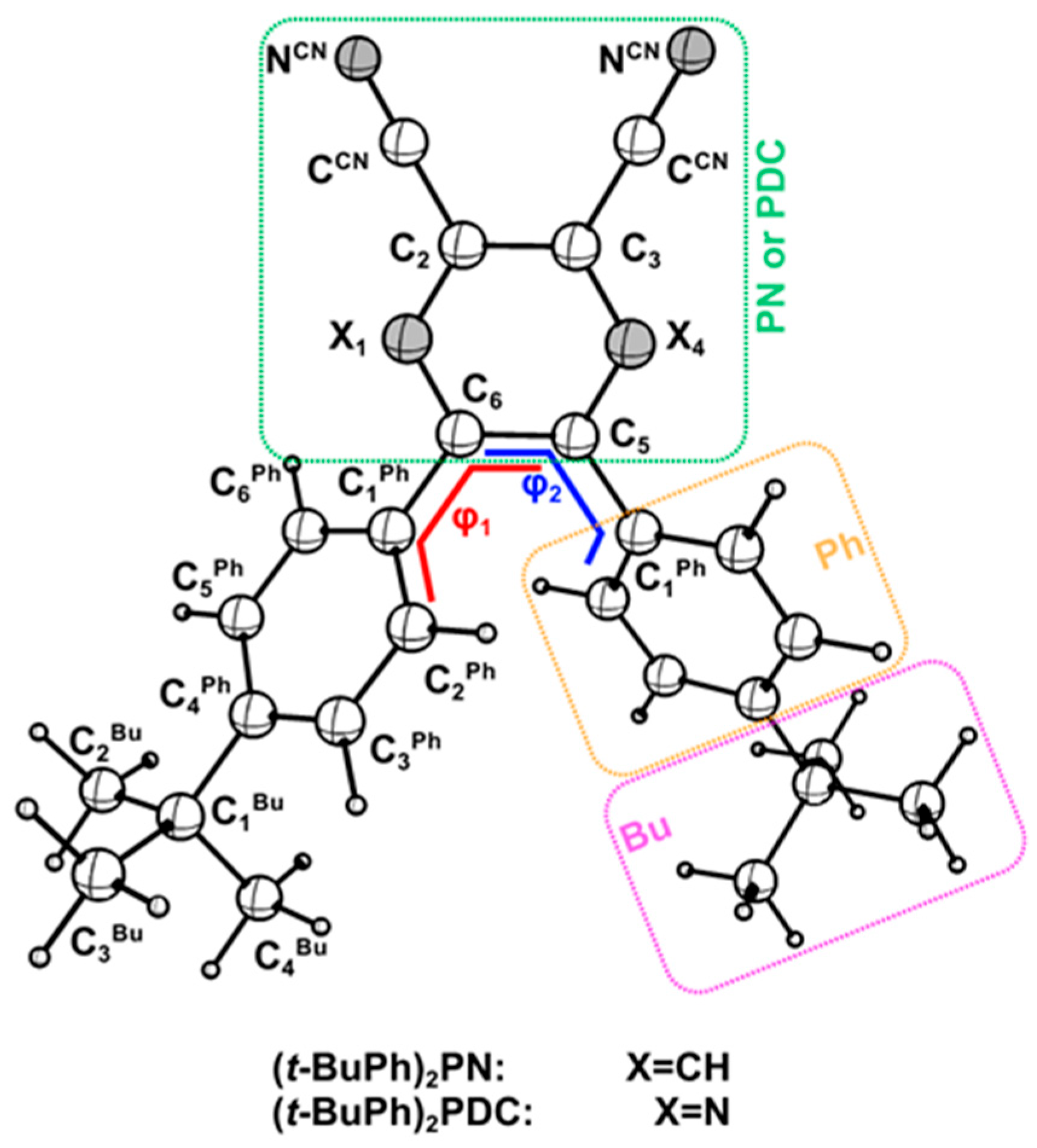
According to PBE0-D3BJ/def2-TZVP calculations, PN and PDC have planar structures with C2v symmetry. Under PN(t-BuPh)2PN and PDC(t-BuPh)2PDC, substitution of hydrogen atoms with bulky t-BuPh groups leads to a significant increase in C5-C6 distance by 0.02 and 0.03 Å, respectively (Table 4, Figure 3). In the cases of (t-BuPh)2PN and (t-BuPh)2PDC, the presence of t-BuPh substituents in adjacent positions is characterized by steric repulsions in the structure; therefore, the phenyl groups are rotated relative to the molecule backbone. Neighboring t-BuPh groups are oriented in a “quasi-parallel manner” as in similar dinitriles [45]. These structures of (t-BuPh)2PN and (t-BuPh)2PDC are characterized by the point symmetry group C2. The rotation angles of the two phenyl rings (φ1 = φ2) are 49.5° and 37.3° for (t-BuPh)2PN and (t-BuPh)2PDC, respectively. The rotation of the phenyl rings in these structures is energetically hindered (Figure S11) due to their close proximity to each other. Cs-conformations of (t-BuPh)2PN and (t-BuPh)2PDC with mirrored orientations of neighboring t-BuPh-groups (φ1 = −φ2) are energetically unfavorable by ~15 and ~28 kJ∙mol−1, respectively.
The noticeable mutual influence of t-BuPh groups on each other in both (t-BuPh)2PN and (t-BuPh)2PDC is also proven by the fact that, in the presence of only one t-BuPh group in the structure, the rotation angles φ decrease by more than 10° (35.5° for t-BuPhPN and 16.7° for t-BuPhPDC). In general, this rotation angle φ may be important, since it affects the degree of π-delocalization, which in turn significantly determines the nature of the electronic transitions and the corresponding absorption spectra (e.g., Figure S12 for t-BuPhPN and t-BuPhPDC). The barriers to rotation of t-BuPh-group in t-BuPhPN and t-BuPhPDC are ~12 and ~23 kJ∙mol−1, respectively (Figure S13).
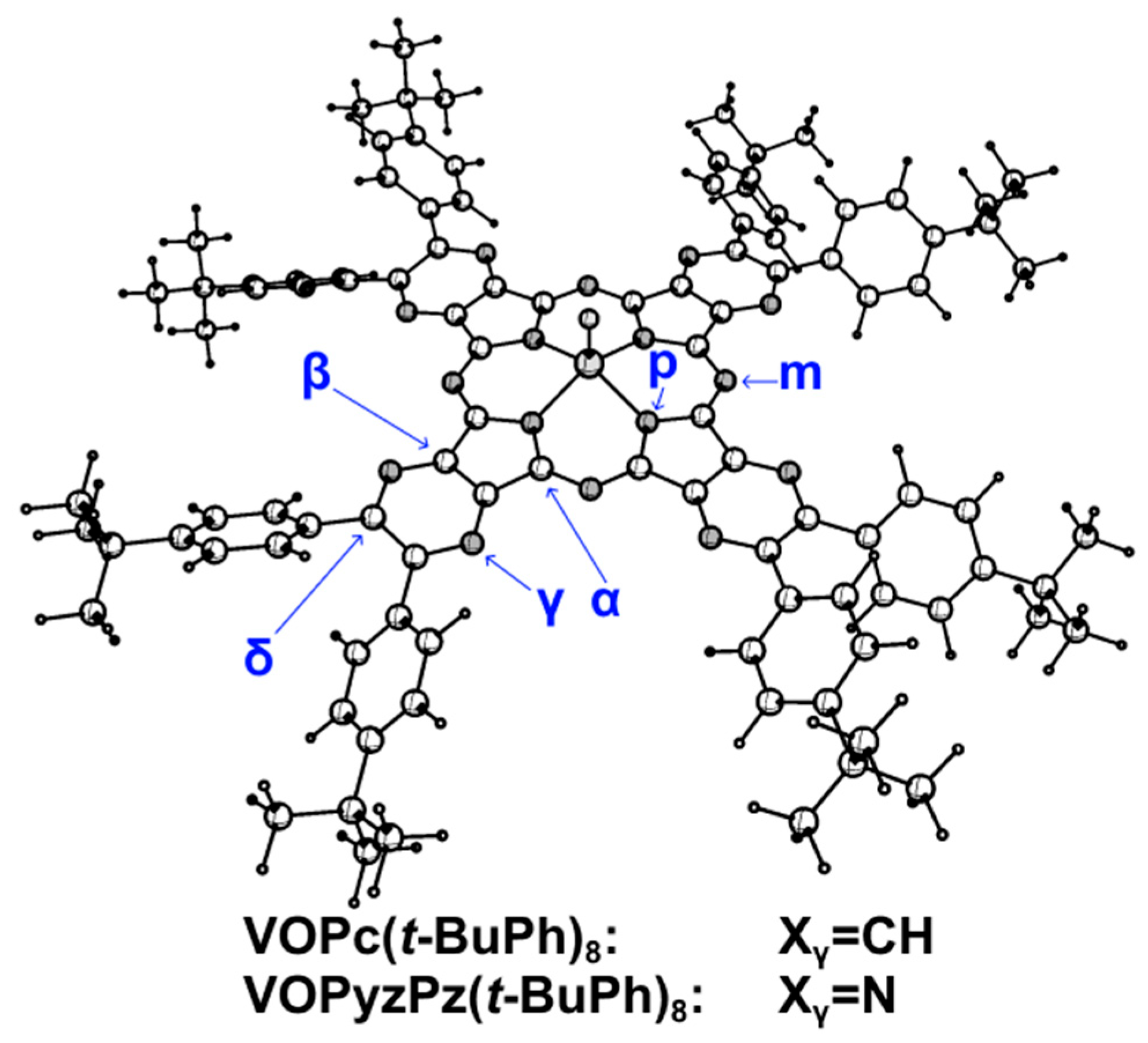
The considered vanadyl complexes are characterized by a dome-shaped distortion of the macroheterocyclic skeleton. According to gas electron diffraction and X-ray diffraction methods, the vanadium atoms in VOPc are out of the coordination plane defined by the four Np atoms by 0.576(14) Å [46] and 0.575(1) Å [46,47], respectively. According to ROP-BE0-GD3BJ/def2-TZVP calculations, the displacements (h) of the vanadium atom from the coordination plane in VOPc(t-BuPh)8 and VOTPyzPz(t-BuPh)8 are 0.587 Å and 0.575 Å, respectively. The slightly larger deviation of the V atom from the coordination plane in the case of VOPc(t-BuPh)8 can be explained by the smaller size of the coordination plane of phthalocyanine compared to tetrapyrazinoporphyrazine (re(Np···Np) in [Pc]2 and [TPyzPz]2− are 3.932 Å and 3.965 Å, respectively). Neighboring t-BuPh groups are oriented in a “quasi-parallel manner” similar to that of the corresponding precursors (φ ≈ 50 and 40°). At the same time, the VOPc(t-BuPh)8 and VOTPyzPz(t-BuPh)8 molecules are characterized by conformational multiformity caused by the possibility of different orientations of the four pairs of phenyl groups. However, the energy differences between these structures are small (e.g., according to UPBE0-GD3BJ/def2-SVP calculations, the C4 and C2v structures (see Figure S14) differ from each other by less than 1.5 kJ·mol−1). Subsequently, we considered theoretical spectra only for structures with the C4 point group. The influence of tert-butylphenyl groups on the structure of the macroheterocyclic skeleton is limited to some changes in the Xγ-Cδ and Cδ-Cδ distances (Table 5).
Table 5. Selected structural parameters a of vanadyl complexes by ROPBE0-D3BJ/def2-TZVP/gas calculations.
VOPcVOPc(t-BuPh)8VOTPyzPzVOTPyzPz(t-BuPh)8
SymmetryC4vC4C4vC4
V-O1.5621.5621.5581.560
h b0.5860.5870.5720.575
V-Np2.0382.0382.0452.044
Np-Cα1.3671.3681.3681.370
Nm-Cα1.3151.3151.3101.311
Cα-Cβ1.4481.4471.4531.452
Cβ-Cβ1.3981.3961.3961.391
Cβ-Xγ1.3871.3841.3271.323
Xγ-Cδ1.3841.3911.3231.328
Cδ-Cδ1.4011.4221.4071.436
Cδ-CPh-1.478-1.474
φ1 ≈ φ2-50.0-39.9
a internuclear distances re—in Å, valence angles—in °; designations of atoms and angles are shown in Figure 4. b h—the distance between a vanadium atom and the center of four Np atoms. Cartesian coordinates of the structures are given in Supplementary Materials.
Figure 4. Molecular structure of VOPc(t-BuPh)8 (Xγ = CH) and VOTPyzPz(t-BuPh)8 (Xγ = N).
Ijms 27 00606 g004

2.5. Electronic Structure

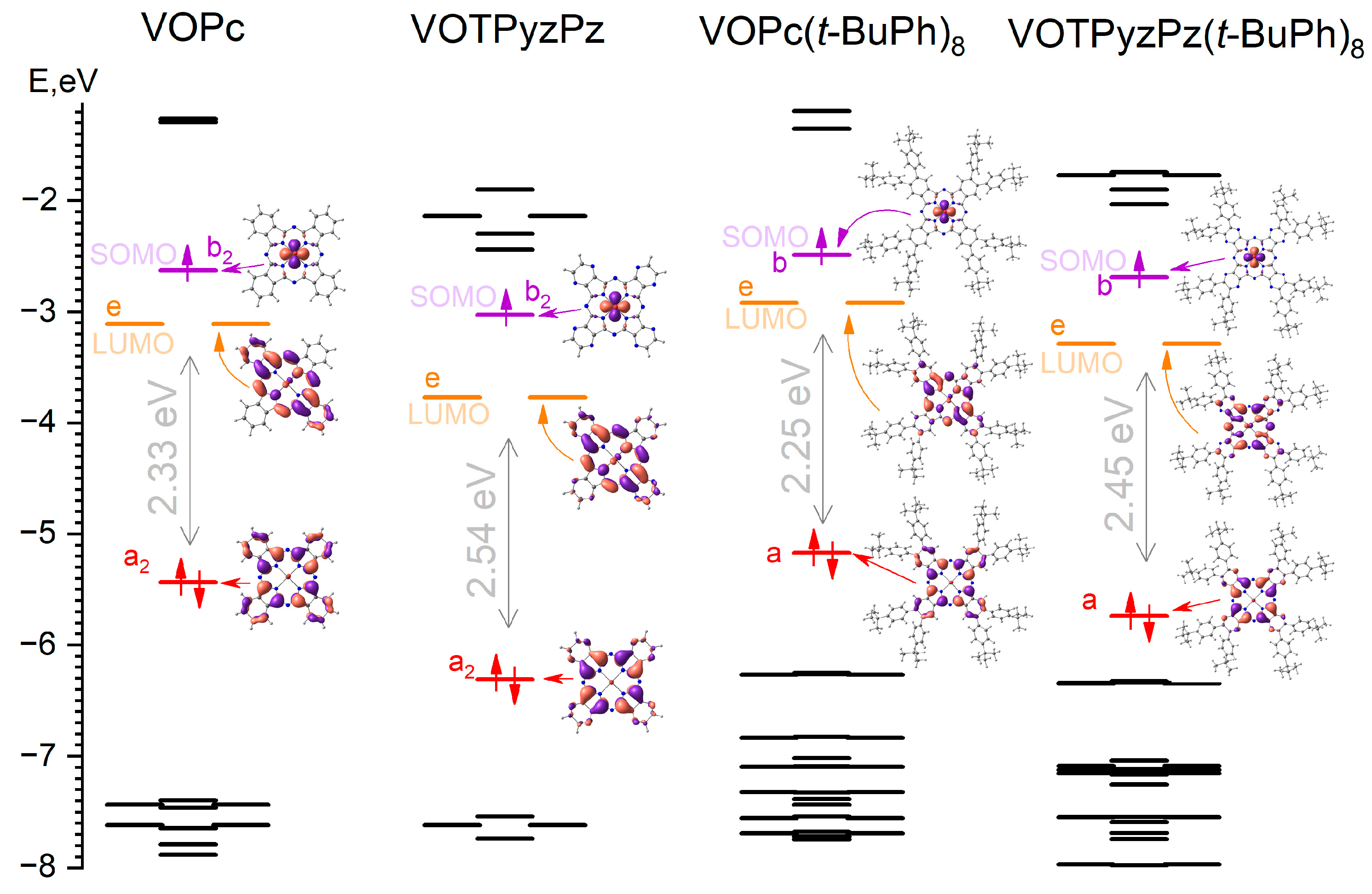
As previously noted [48], the ground electronic state of VOPc is 2B2. As in the case of vanadyl octaethylporphyrin [49], the singly occupied molecular orbital (SOMO) is a dxy orbital of the vanadium atom (Figure 5, as well as [48,50,51]). Unlike porphyrins, occupied Gouterman’s orbitals a1u and a2u (in D4h terms) become more separated in Pcs [52] and TPyzPzs (Figure S15 [53]). The highest doubly occupied molecular orbital for VOPc is a2 (a1u in D4h terms) localized on the isoindole fragment (Figure 5). The lowest unoccupied molecular orbitals in Pcs and TPyzPzs are degenerate π* orbitals (Figure 5 and Figure S15). The addition of t-BuPh substituents to the macrocyclic skeletons, although it leads to a slight increase in the energy of the mentioned frontier orbitals, has little effect on the energy gap between Gouterman’s unoccupied and occupied orbitals e and a (eg and a1u in D4h symmetry terms). The π-π* transition between these macrocyclic orbitals a2 and e determines the intense Q band ~650–730 nm. The energy gap between Gouterman’s unoccupied and occupied orbitals e and a (eg and a1u in D4h symmetry terms) in TPyzPzs significantly decreases by 0.2 eV compared to those of Pcs (Figure 5), which determines the blue shift in the Q band in VOTPyzPz(t-BuPh)8 compared to VOPc(t-BuPh)8 (Figure S9).
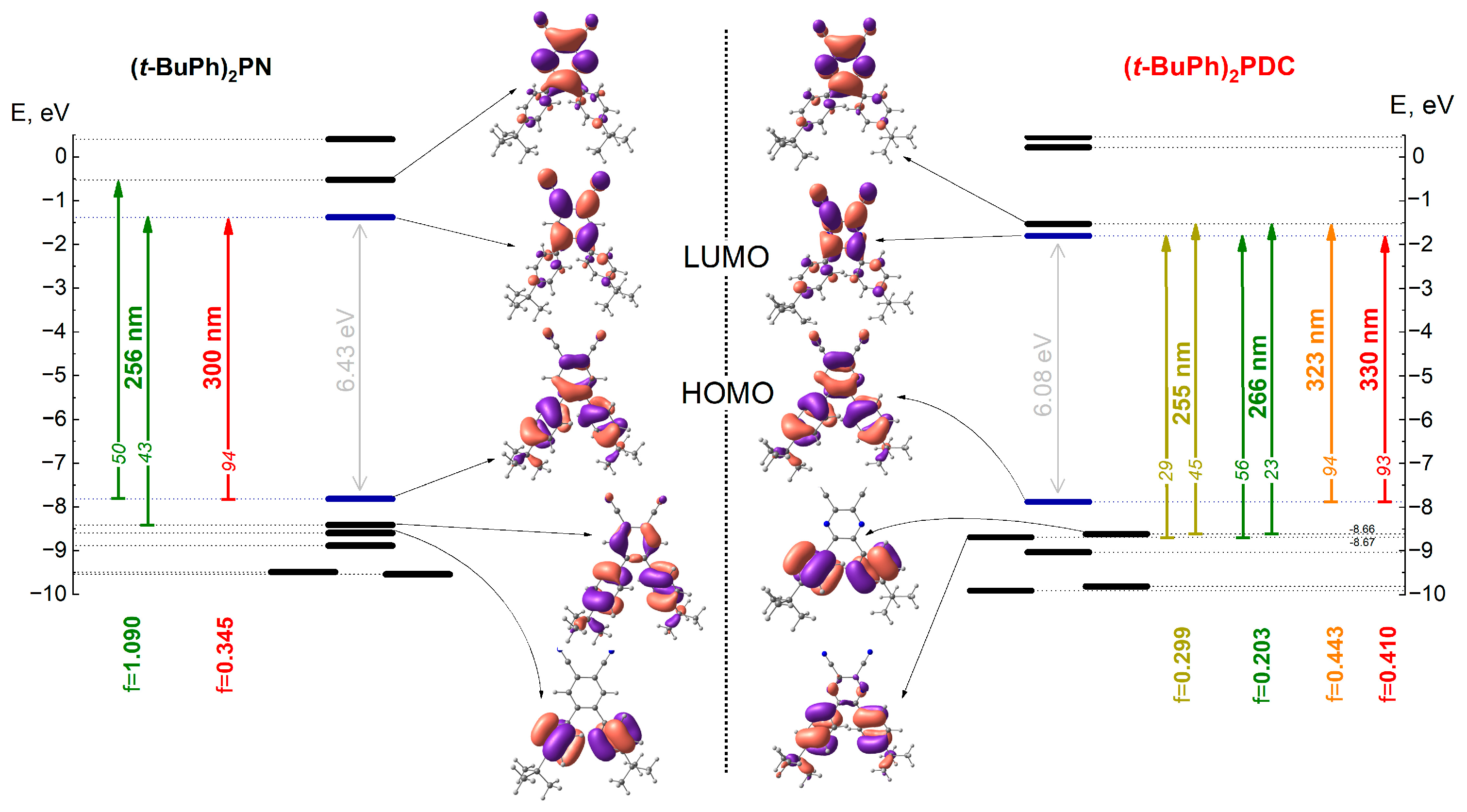
The HOMOs for (t-BuPh)2PN/(t-BuPh)2PDC are distributed throughout the entire π-conjugated molecules (mostly throughout the phenyl rings (~70%) and PN / PDC (~23%) moieties, Figure 6). The LUMOs are localized on the PN/PDC skeleton (~85%). For (t-BuPh)2PDC, the HOMO-LUMO energy gap is slightly narrower, by 0.35 eV than that for (t-BuPh)2PN (Figure 6). This results in a bathochromic shift in the observed band in the spectrum of (t-BuPh)2PDC in comparison with (t-BuPh)2PN (Figure S10). Atoms X1 and X4 make a significant contribution to the LUMO + 1, due to which these orbitals decrease their energy in the case of (t-BuPh)2PDC compared to (t-BuPh)2PN. Figure S10 shows satisfactory agreement between the theoretical and experimentally recorded absorption spectra.

2.6. IR Spectra

The position of bands in the simulated IR spectra of dinitriles are in satisfactory agreement with appropriate values from the experimental spectra measured in the solid phase (Figures S3 and S4) and with the literature [29,30]. The correlation between the bands of the simulated and experimental spectra is close to linear (scaling coefficients are in the range from 0.941 to 0.957, Figures S16 and S17). The IR spectra of the two dinitriles have a large number of bands in the range from 400 to 1650 cm−1, several bands in the range from 2800 to 3100 cm−1 corresponding to C-H vibrations, and one band at ~2230 cm−1 corresponding to C-N vibrations of the cyano-groups (Figures S3, S4, and S18). For (t-BuPh)2PDC, the band at ~2236 cm−1 is very weak in the spectra registered in the attenuated total reflectance mode, but this band is quite well manifested in the case of spectrum measured in KBr pellets (Figure S18). According to calculations, some C-H vibrations of butyl groups have large IR intensities and determine the bands at ~2900 cm−1 and 2980 cm−1 (Figures S3b and S4b). Weak bands with ω > 3020 cm−1 correspond to C-H vibrations in aromatic rings (Figures S3 and S4). Assignment of the other bands in the obtained IR spectra is presented in Tables S1 and S2.
For VOPc(t-BuPh)8 and VOTPyzPz(t-BuPh)8, the band positions in the simulated IR spectra exhibit satisfactory agreement with the corresponding values obtained from the experimental spectra for the solid phase (Figures S6 and S8). In macroheterocyclic metal complexes (e.g., [54]), including the compounds under study, the observed IR bands typically arise from the superposition of some vibrational modes, making definitive assignment exceedingly difficult. In the region above 2800 cm−1, the spectra of vanadyl complexes resembles those of the precursor dinitriles, as the bands in this region correspond to C-H vibrations. The band at νexp = 1094 cm−1 is the most intense band in the spectrum of VOPc(t-BuPh)8. It may correspond to a vibration involving deformation of the isoindole fragments with a large contribution from stretching of the C-N and C-C bonds (ωth = 1105 cm−1, Figure S6b). For VOTPyzPz(t-BuPh)8, the same vibration corresponds to a band ωth = 1128 cm−1 (Figure S8b). Stretching of the V=O bond (ωth= 1094 and 1098 cm−1 in the two cases) has a rather high IR intensity, but its closeness to bands ωth = 1105 and 1128 cm−1, which have even greater intensities, can make it difficult to isolate in the spectra (Figures S6 and S8). According to literature data, the calculated value of V=O vibration in porphyrin complexes is ∼1100 cm−1 [55], while it is manifests in the experimental IR spectra in the region of ∼1000 cm−1 [56,57,58]. For VOPc(t-BuPh)8 and VOTPyzPz(t-BuPh)8, the high-intensity vibrations with ωth = 1329 and 1345 cm−1 are mostly attributed to the N-C and C-C stretching in the isoindole moieties and apparently appear at νexp = 1325 and 1346 cm−1 in the experimental spectra (Figures S6 and S8). The bands at 1608 and 1607 cm−1 in the theoretical spectra correspond to C-C stretching in the phenyl moieties.
The bands at νexp= 833 and 839 cm−1 in the experimental spectra of VOPc(t-BuPh)8 and VOTPyzPz(t-BuPh)8 are assigned to the C-H out-of-plane bending (ωth = 819 and 823 cm−1, Figures S6 and S8). The bands at νexp= 731 and 727 cm−1 are assigned to a degenerate vibrational mode related to the complicated deformation of the entire molecule (ωth = 715 and 714 cm−1, Figures S6 and S8). The bands at νexp= 939 and 949 cm−1 are attributed to another degenerate vibrational mode, also associated with complex deformation of the entire molecule (ωth = 920 and 933 cm−1, Figures S6 and S8).

3. Materials and Methods

3.1. Synthesis

(t-BuPh)2PN (4,5-bis(4-tert-butylphenyl)phthalonitrile). A mixture of 4,5-dichlorophthalonitrile (2.00 g, 0.01 mmol), 4-tert-butylphenylboronic acid (7.12 g, 0.04 mmol), KBr (1.2 g, 0.01 mmol), and a saturated aqueous solution of K2CO3 (5.6 g, 0.04 mmol) was stirred in 70 mL of boiling 1,4-dioxane under argon. After the solvent began to boil, the dichloro-bis(triphenylphosphine) palladium compound (0.12 g, 0.0002 mmol) was added. The reaction was carried out for 6 h. The reaction mixture was cooled to room temperature and water was added. The product was collected by extraction with ethyl acetate. After rotary evaporation, greenish-gray powder was purified by flash chromatography on silica gel (ethyl acetate/n-hexane (1:10)). The obtained product was additionally purified by sublimation at 250 °C to give a white powder (2.9 g, 74%). 1H NMR (500 MHz, CDCl3): δ 7.84 (s, 2H), 7.31 (d, J = 8.53 Hz, 4H), 7.05 (d, J = 8.53 Hz, 4H), 1.32 (s, 18H) (Figure S1). 13C NMR (500 MHz, CDCl3): δ 151.8, 145.8, 135.6, 134.8, 129.3, 125.7, 115.5, 114, 34.6, 31.2 (Figure S2). IR: 573, 594, 833, 928, 1015, 1113, 1269, 1364, 1462, 1483, 1589, 1609, 2237, 2961 cm−1 (Figure S3).
(t-BuPh)2PDC (5,6-bis(4-tert-butylphenyl)pyrazine-2,3-dicarbonitrile; 5,6-bis(4-tert-butylphenyl)-2,3-dicyanopyrazin; 2,3-dicyano-5,6-bis(4-tertbutylphenyl)pyrazine) was obtained by slight modification of a known method [28]. A mixture of 9.6 g (30 mmol) of 4,4′-bis(tert-butylphenyl)-ethane-1,2-dione and 3.24 g (30 mmol) of diaminomaleonitrile was heated in 60 mL of glacial acetic acid for 2.5 h under reflux. After completion of the reaction, acetic acid was evaporated by a rotary evaporator, and the crude product was redissolved in dichloromethane (DCM) and purified by flash chromatography on silica gel using DCM as the eluent. As a result, a pale yellow powder of the desired product was obtained in 88% yield. IR: 577, 600, 845, 939, 1015, 1117, 1198, 1227, 1375, 1466, 1504, 1601, 2236, 2965 cm−1 (Figure S4).
VOPc(t-BuPh)8 (vanadyl octa-(4-tert-butylphenyl)phthalocyanine). A mixture of 39 mg (0.1 mmol) of (t-BuPh)2PN and 4 mg of VCl3 (0.025 mmol) was dissolved in 1 mL of 1,2,4-thrichlorobenzene and refluxed for 2 h. After cooling to room temperature, the reaction mixture was poured into ethanol and centrifuged. The greenish powder was washed three times with ethanol and finally purified by column chromatography on silica gel using DCM as the eluent to give a grass-green powder (11 mg, 27%). UV-Vis (DCM): λmax (A/Amax) = 722 (1), 648 (0.18), 428 (0.07). MALDI-TOF (DHB, positive): 1638.5 [M + H+] (calcd. for C112H112N8OV 1637.1) (Figure S5). IR: 731, 758, 833, 939, 1009, 1094, 1269, 1298, 1325, 1395, 1404, 1443, 1611, 2961 cm−1 (Figure S6).
VOTPyzPz(t-BuPh)8 (vanadyl octa-(4-tert-butylphenyl)tetrapyrazinoporphyrazine). A mixture of 200 mg (0.5 mmol) of (t-BuPh)2PDC and 20mg (0.125 mmol) of VCl3 was melted at 220 °C for 15 min. After cooling, the dark powder was washed with ethanol and finally purified by column chromatography on silica gel using DCM as the eluent to give a dark-green powder (150 mg, 72%). UV-Vis (DCM): λmax (A/Amax) = 659 (1), 599 (0.14), 459 (0.07), 369 (0.44). MALDI-TOF (DHB, positive): 1646.70 [M + H+] (calcd. for C104H104N16OV 1645.03) (Figure S7). IR: 685, 727, 797, 839, 949, 1065, 1099, 1117, 1238, 1248, 1346, 1462, 1531, 1609, 2955 (Figure S8).
All other chemicals for the syntheses were purchased from certified suppliers (i.e., Sigma-Aldrich (St. Louis, MO, USA), TCI (Tokyo, Japan), EKOS-1 (Moscow, Russia)) and used as received.

3.2. Spectral Study

UV-V is spectra were recorded using a Jasco V-770 spectrophotometer (Jasco, Tokyo, Japan) in DCM. The IR spectra were measured on a Shimadzu IRAffinity-1 (Shimadzu, Kyoto, Japan) Fourier transform IR spectrophotometer equipped with a Specac Quest ATR Diamond GS10800-B (Specac, London, UK) accessory in the mid-infrared region (400–4000 cm−1). Mass spectra were recorded on an MALDI TOF Shimadzu Biotech Axima Confidence (Shimadzu, Kyoto, Japan) mass spectrometer using the resources of the Center for Shared Use of Scientific Equipment of the ISUCT (Ivanovo, Russia).

3.3. Electrochemical Study

Cyclic voltammetry (CVA) study was performed in a three-electrode electrochemical cell with a glassy carbon working electrode, a Pt wire counter electrode, and a Ag/AgCl reference electrode on a Smart Stat potentiostat–galvanostat PS-50, in argon-deoxygenated DCM with 0.1 M tetrabutylammonium perchlorate as the supporting electrolyte; the reference ferrocene/ferrocenium (Fc/Fc+) couple was observed at +0.507 V. Ferrocene was used as an internal standard by adding it to the solution containing the compound being studied.

3.4. Computational Details

Quantum chemical calculations for the dinitriles and the corresponding vanadyl complexes were carried out using the Gaussian09 program [59]. The calculations were performed using the PBE0 functional [60,61] and the def2-TZVP [62] basis set, with D3 version of the Grimme’s dispersion with Becke–Johnson damping (D3BJ) [63], “Tight” optimization convergence criteria (maximum force = 1.5∙10−5 H·Bohr–1, root mean square (RMS) force = 1.0∙10−5 H·Bohr–1, maximum displacement = 6.0∙10−5 Å, RMS displacement = 4.0∙10−5 Å), “ultrafine” grid (pruned, 99 radial shells and 590 angular points per shell). Basis sets and ECPs were taken from the Basis Set Exchange library [64]. In order to obtain theoretical IR spectra for VOPc(t-BuPh)8 and VOTPyzPz(t-BuPh)8, PBE0-D3BJ/def2-SVP [62] calculations were used. The results of harmonic frequencies calculations with different basis sets were compared using (t-BuPh)2PN and (t-BuPh)2PDC as examples (Figures S3, S4, S16, and S17). The assignments of vibrational modes of (t-BuPh)2PN and (t-BuPh)2PDC were carried out based on potential energy distribution (PED) analysis of PBE0-GD3BJ/def2-TZVP results among internal coordinates using the VibModule program (version 1.3.2) [65].
Simulations of electronic absorption spectra were performed by time-dependent density functional theory (TDDFT) calculations with CAM-B3LYP [66], D3BJ, and the def2-TZVP basis set for PBE0-D3BJ/def2-TZVP geometries. The simplified TDDFT (sTDDFT) [67] approach, as implemented in the ORCA 5.0.3 software [68], was also used to simulate UV-Vis spectra. Visualization of the molecular structures and orbitals was performed using the ChemCraft program (version 1.8) [69]. The contributions of atomic orbitals of specific atoms to molecular orbitals were calculated based on the results of QC calculations using the GausSum program (version 3.0.2) [70].
The bands in the simulated IR and UV-Vis spectra (Figures S3, S4, S6, S8–S10 and S12) were described by Lorentz curves with a full width at half maximum of 10 cm−1 and 10 nm, respectively.

4. Conclusions

The existing synthesis method of 4,5-bis(4-tert-butylphenyl)phthalonitrile ((t-BuPh)2PN) and 5,6-bis(4-tert-butylphenyl)pyrazine-2,3-dicarbonitrile ((t-BuPh)2PDC) were modified at the purification stage. Two vanadyl complexes, VOPc(t-BuPh)8 and VOTPyzPz(t-BuPh)8, were obtained by tetramerization of these nitriles with VCl3. The basic properties were studied in TFA and sulfuric acid. An absorption spectrum recorded in pure sulfuric acid coincides with that of the diprotonated form of VOPc(t-BuPh)8. In the case of VOTPyzPz(t-BuPh)8, protonation of the pyrazine rings was observed. In the CVAs, the first reduction potential shifted by approximately 0.4 V toward zero when benzene rings were replaced by pyrazine rings in both the dinitrile and vanadyl complexes due to LUMO stabilization. Comparison of our results with data for related structures revealed that the primary role is played not by the peripheral substituents, but by the ring annelated to the porphyrazine hull. The phenyl groups are rotated relative to the molecule backbone and are located in a “quasi-parallel manner”. A bathochromic shift in the longest wavelength band in the electronic absorption spectrum of (t-BuPh)2PDC was observed in comparison with (t-BuPh)2PN due to a narrower HOMO-LUMO gap for the former. It was shown that VOPc(t-BuPh)8 and VOTPyzPz(t-BuPh)8 have dome-shaped distortions and can be characterized by conformational multiformity caused by the possibility of different orientations of the four pairs of phenyl groups, as well as tert-butyl group rotation. It was noted that the addition of t-BuPh substituents to the macrocyclic skeleton of VOPc or VOTPyzPz has little effect on the energy gap between Gouterman’s unoccupied and occupied orbitals and, consequently, on the Q band position. Two complexes, VOPc(t-BuPh)8 and VOTPyzPz(t-BuPh)8, were synthesized for the first time. The syntheses of their precursors, (t-BuPh)2PN and (t-BuPh)2PDC, were modified, resulting in higher yields. The structural, spectral, and electrochemical properties of the four compounds were thoroughly studied using a complex approach that included both theoretical and experimental methods. The results obtained will be useful for the further development of the chemistry of vanadyl macroheterocyclic compounds.

Supplementary Materials

The following supporting information can be downloaded at: https://www.mdpi.com/article/10.3390/ijms27020606/s1.

Author Contributions

Conceptualization, Y.A.Z. and D.N.F.; Methodology, D.N.F., A.E.P., and A.V.E.; Investigation, D.N.F., A.E.P., K.V.K., and D.Y.P.; Resources, P.A.S. and Y.A.Z.; Data Curation, D.N.F., A.E.P., and A.V.E.; Writing—Original Draft Preparation, D.N.F. and A.E.P. All authors have read and agreed to the published version of the manuscript.

Funding

The study was supported by the Russian Science Foundation (grant No. 24-73-10107).

Institutional Review Board Statement

Not applicable.

Informed Consent Statement

Not applicable.

Data Availability Statement

The original contributions presented in this study are included in the article/Supplementary Material. Further inquiries can be directed to the corresponding authors.

Acknowledgments

Equipment from the Centers of Joint Use of Ivanovo State University of Chemistry and Technology (ISUCT) was used.

Conflicts of Interest

The authors declare no conflicts of interest.

References

  1. Ito, O.; D’Souza, F. Recent Advances in Photoinduced Electron Transfer Processes of Fullerene-Based Molecular Assemblies and Nanocomposites. Molecules 2012, 17, 5816–5835. [Google Scholar] [CrossRef] [PubMed]
  2. Wöhrle, D.; Schnurpfeil, G.; Makarov, S.G.; Kazarin, A.; Suvorova, O.N. Practical Applications of Phthalocyanines—from Dyes and Pigments to Materials for Optical, Electronic and Photo-electronic Devices. Macroheterocycles 2012, 5, 191–202. [Google Scholar] [CrossRef]
  3. Walter, M.G.; Rudine, A.B.; Wamser, C.C. Porphyrins and phthalocyanines in solar photovoltaic cells. J. Porphyr. Phthalocyanines 2010, 14, 759–792. [Google Scholar] [CrossRef]
  4. Sorokin, A.B. Phthalocyanine Metal Complexes in Catalysis. Chem. Rev. 2013, 113, 8152–8191. [Google Scholar] [CrossRef]
  5. Kadish, K.M.; Smith, K.M.; Guilard, R. Handbook of Porphyrin Science; World Scientific Publishing Company: Singapore, 2010. [Google Scholar] [CrossRef]
  6. Kaliya, O.L.; Lukyanets, E.A.; Vorozhtsov, G.N. Catalysis and photocatalysis by phthalocyanines for technology, ecology and medicine. J. Porphyr. Phthalocyanines 1999, 3, 592–610. [Google Scholar] [CrossRef]
  7. Novakova, V.; Donzello, M.P.; Ercolani, C.; Zimcik, P.; Stuzhin, P.A. Tetrapyrazinoporphyrazines and their metal derivatives. Part II: Electronic structure, electrochemical, spectral, photophysical and other application related properties. Coord. Chem. Rev. 2018, 361, 1–73. [Google Scholar] [CrossRef]
  8. Martynov, A.G.; Gorbunova, Y.G.; Tsivadze, A.Y. Crown-substituted phthalocyanines—Components of molecular ionoelectronic materials and devices. Russ. J. Inorg. Chem. 2014, 59, 1635–1664. [Google Scholar] [CrossRef]
  9. Bunin, D.A.; Martynov, A.G.; Gvozdev, D.A.; Gorbunova, Y.G. Phthalocyanine aggregates in the photodynamic therapy: Dogmas, controversies, and future prospects. Biophys. Rev. 2023, 15, 983–998. [Google Scholar] [CrossRef]
  10. de la Torre, G.; Vázquez, P.; Agulló-López, F.; Torres, T. Phthalocyanines and related compounds: Organic targets for nonlinear optical applications. J. Mater. Chem. 1998, 8, 1671–1683. [Google Scholar] [CrossRef]
  11. Dini, D.; Hanack, M. Phthalocyanines as materials for advanced technologies: Some examples. J. Porphyr. Phthalocyanines 2004, 8, 915–933. [Google Scholar] [CrossRef]
  12. Follmer, A.H.; Ribson, R.D.; Oyala, P.H.; Chen, G.Y.; Hadt, R.G. Understanding Covalent versus Spin–Orbit Coupling Contributions to Temperature-Dependent Electron Spin Relaxation in Cupric and Vanadyl Phthalocyanines. J. Phys. Chem. A 2020, 124, 9252–9260. [Google Scholar] [CrossRef] [PubMed]
  13. Kazmierczak, N.P.; Mirzoyan, R.; Hadt, R.G. The Impact of Ligand Field Symmetry on Molecular Qubit Coherence. J. Am. Chem. Soc. 2021, 143, 17305–17315. [Google Scholar] [CrossRef] [PubMed]
  14. Marx, B.; Schrage, B.R.; Ziegler, C.J.; Nemykin, V.N. Synthesis, spectroscopic, and electronic properties of new tetrapyrazinoporphyrazines with eight peripheral 2,6-diisopropylphenol groups. J. Porphyr. Phthalocyanines 2022, 27, 363–372. [Google Scholar] [CrossRef]
  15. Konarev, D.V.; Faraonov, M.A.; Kuzmin, A.V.; Khasanov, S.S.; Nakano, Y.; Norko, S.I.; Batov, M.S.; Otsuka, A.; Yamochi, H.; Saito, G.; et al. Crystalline salts of metal phthalocyanine radical anions [M(Pc˙3−)]˙ (M = CuII, PbII, VIVO, SnIVCl2) with cryptand(Na+) cations: Structure, optical and magnetic properties. New J. Chem. 2017, 41, 6866–6874. [Google Scholar] [CrossRef]
  16. Faraonov, M.A.; Konarev, D.V.; Fatalov, A.M.; Khasanov, S.S.; Troyanov, S.I.; Lyubovskaya, R.N. Radical anion and dianion salts of titanyl macrocycles with acceptor substituents or an extended π-system. Dalton Trans. 2017, 46, 3547–3555. [Google Scholar] [CrossRef]
  17. Konarev, D.V.; Kuzmin, A.V.; Nakano, Y.; Faraonov, M.A.; Khasanov, S.S.; Otsuka, A.; Yamochi, H.; Saito, G.; Lyubovskaya, R.N. Coordination Complexes of Transition Metals (M = Mo, Fe, Rh, and Ru) with Tin(II) Phthalocyanine in Neutral, Monoanionic, and Dianionic States. Inorg. Chem. 2016, 55, 1390–1402. [Google Scholar] [CrossRef]
  18. Finogenov, D.N.; Faraonov, M.A.; Kopylova, A.S.; Ivanov, T.E.; Romanenko, N.R.; Yakushev, I.A.; Konarev, D.V.; Stuzhin, P.A. Perchlorinated vanadyl tetrapyrazinoporphyrazine: Spectral, redox and magnetic properties. New J. Chem. 2024, 48, 10067–10073. [Google Scholar] [CrossRef]
  19. Cissell, J.A.; Vaid, T.P.; Rheingold, A.L. Aluminum Tetraphenylporphyrin and Aluminum Phthalocyanine Neutral Radicals. Inorg. Chem. 2006, 45, 2367–2369. [Google Scholar] [CrossRef]
  20. Zhou, W.; Platel, R.H.; Tasso, T.T.; Furuyama, T.; Kobayashi, N.; Leznoff, D.B. Reducing zirconium(iv) phthalocyanines and the structure of a Pc4−Zr complex. Dalton Trans. 2015, 44, 13955–13961. [Google Scholar] [CrossRef]
  21. Gal’pern, M.G.; Luk’yanets, E.A. Tetra-2,3-(5-tert-butylpyrazino) porphyrazines. Chem. Heterocycl. Compd. 1972, 8, 780. [Google Scholar] [CrossRef]
  22. Luk’yanets, E.A. Electronic Spectra of Phthalocyanines and Related Compounds; NIITEKhIM: Cherkassy, Ukraine, 1989. [Google Scholar]
  23. Tokita, S.; Kai, N.; Osa, M.; Ohkoshi, T.; Kojima, M.; Nishi, H. Chemistry of Functional Dyes. In Proceedings of the 1st International Symposium on the Chemistry of Functional Dyes, Osaka, Japan, 5–9 June 1989; p. 46. [Google Scholar]
  24. Gal’pern, M.G.; Kudrevich, S.V.; Novozhilova, I.G. Synthesis and spectroscopic properties of soluble aza analogs of phthalocyanine and naphthalocyanine. Chem. Heterocycl. Compd. 1993, 29, 49–54. [Google Scholar] [CrossRef]
  25. Tverdova, N.V.; Giricheva, N.I.; Maizlish, V.E.; Galanin, N.E.; Girichev, G.V. Molecular Structure, Vibrational Spectrum and Conformational Properties of 4-(4-Tritylphenoxy)phthalonitrile-Precursor for Synthesis of Phthalocyanines with Bulky Substituent. Int. J. Mol. Sci. 2022, 23, 13922. [Google Scholar] [CrossRef] [PubMed]
  26. Tverdova, N.V.; Giricheva, N.I.; Maizlish, V.E.; Galanin, N.E.; Girichev, G.V. From conformational properties of 4-(4-Tritylphenoxy)phthalonitrile precursor to conformational properties of substituted phthalocyanines. Macroheterocycles 2022, 15, 40–43. [Google Scholar] [CrossRef]
  27. Pogonin, A.E.; Kurochkin, I.Y.; Krasnov, A.V.; Malyasova, A.S.; Kuzmin, I.A.; Tikhomirova, T.V.; Girichev, G.V. Gas-Phase Structure of 4-(4-hydroxyphenylazo)phthalonitrile—Precursor for Synthesis of Phthalocyanines with Macrocyclic and Azo Chromophores. Macroheterocycles 2024, 17, 92–101. [Google Scholar] [CrossRef]
  28. Xu, Y.; Ni, Z.; Xiao, Y.; Chen, Z.; Wang, S.; Gai, L.; Zheng, Y.-X.; Shen, Z.; Lu, H.; Guo, Z. Helical β-isoindigo-Based Chromophores with B−O−B Bridge: Facile Synthesis and Tunable Near-Infrared Circularly Polarized Luminescence. Angew. Chem. Int. Ed. 2023, 62, e202218023. [Google Scholar] [CrossRef]
  29. Eu, S.; Katoh, T.; Umeyama, T.; Matano, Y.; Imahori, H. Synthesis of sterically hindered phthalocyanines and their applications to dye-sensitized solar cells. Dalton Trans. 2008, 40, 5476–5483. [Google Scholar] [CrossRef]
  30. Freyer, W. Okta-(4-tert-butylphenyl)-tetrapyrazinoporphyrazin und davon abgeleitete Metallkomplexe. J. Prakt. Chem. 1994, 336, 690–692. [Google Scholar] [CrossRef]
  31. Dubinina, T.V.; Trashin, S.A.; Borisova, N.E.; Boginskaya, I.A.; Tomilova, L.G.; Zefirov, N.S. Phenyl-substituted planar binuclear phthalo- and naphthalocyanines: Synthesis and investigation of physicochemical properties. Dye. Pigment. 2012, 93, 1471–1480. [Google Scholar] [CrossRef]
  32. Borovkov, N.Y.; Akopov, A.S. Acid-base properties of complexes of group III elements with tetra-4-tert-butylphthalocyanine. Coord. Chem. 1987, 13, 1358–1361. [Google Scholar]
  33. Finogenov, D.N.; Lazovskiy, D.A.; Kopylova, A.S.; Zhabanov, Y.A.; Stuzhin, P.A. Spectral-luminescence, redox and photochemical properties of Al III, Ga III and In III complexes formed by peripherally chlorinated phthalocyanines and tetrapyrazinoporphyrazines. J. Porphyr. Phthalocyanines 2023, 27, 1618–1629. [Google Scholar] [CrossRef]
  34. Hamdoush, M.; Ivanova, S.S.; Koifman, O.I.; Kos’kina, M.; Pakhomov, G.L.; Stuzhin, P.A. Synthesis, spectral and electrochemical study of perchlorinated tetrapyrazinoporphyrazine and its AlIII, GaIII and InIII complexes. Inorg. Chim. Acta 2016, 444, 81–86. [Google Scholar] [CrossRef]
  35. Stuzhin, P.A. Azaporphyrins and Phthalocyanines as Multicentre Conjugated Ampholites. J. Porphyr. Phthalocyanines 1999, 3, 500–513. [Google Scholar] [CrossRef]
  36. Özçeşmeci, İ.; Koca, A.; Gül, A. Synthesis and electrochemical and in situ spectroelectrochemical characterization of manganese, vanadyl, and cobalt phthalocyanines with 2-naphthoxy substituents. Electrochim. Acta 2011, 56, 5102–5114. [Google Scholar] [CrossRef]
  37. Jiang, Z.; Ou, Z.; Chen, N.; Wang, J.; Huang, J.; Shao, J.; Kadish, K.M. Synthesis, spectral and electrochemical characterization of non-aggregating α-substituted vanadium(IV)-oxophthalocyanines. J. Porphyr. Phthalocyanines 2005, 9, 352–360. [Google Scholar] [CrossRef]
  38. Lever, A.B.P.; Licoccia, S.; Magnell, K.; Minor, P.C.; Ramaswamy, B.S. Mapping of the Energy Levels of Metallophthalocyanines via Electronic Spectroscopy, Electrochemistry, and Photochemistry. In Electrochemical and Spectrochemical Studies of Biological Redox Components; American Chemical Society: Washington, DC, USA, 1982; pp. 237–251. [Google Scholar] [CrossRef]
  39. Finogenov, D.N.; Koptyaev, A.I.; Eroshin, A.V.; Kopylova, A.S.; Nabasov, A.A.; Galanin, N.E.; Zhabanov, Y.A.; Stuzhin, P.A. Molecular and Electronic Structure, and Electrochemical Study of Oxometal(IV) Tetrabenzoporphyrins, [TBPM] (M = VO, TiO). Macroheterocycles 2024, 17, 22–28. [Google Scholar] [CrossRef]
  40. Miyoshi, Y.; Takahashi, K.; Fujimoto, T.; Yoshikawa, H.; Matsushita, M.M.; Ouchi, Y.; Kepenekian, M.; Robert, V.; Donzello, M.P.; Ercolani, C.; et al. Crystal Structure, Spin Polarization, Solid-State Electrochemistry, and High n-Type Carrier Mobility of a Paramagnetic Semiconductor: Vanadyl Tetrakis(thiadiazole)porphyrazine. Inorg. Chem. 2012, 51, 456–462. [Google Scholar] [CrossRef]
  41. Djurovich, P.I.; Mayo, E.I.; Forrest, S.R.; Thompson, M.E. Measurement of the lowest unoccupied molecular orbital energies of molecular organic semiconductors. Org. Electron. 2009, 10, 515–520. [Google Scholar] [CrossRef]
  42. Aderne, R.E.; Borges, B.G.A.L.; Ávila, H.C.; von Kieseritzky, F.; Hellberg, J.; Koehler, M.; Cremona, M.; Roman, L.S.; Araujo, C.M.; Rocco, M.L.M.; et al. On the energy gap determination of organic optoelectronic materials: The case of porphyrin derivatives. Mater. Adv. 2022, 3, 1791–1803. [Google Scholar] [CrossRef]
  43. Costa, J.C.S.; Taveira, R.J.S.; Lima, C.F.R.A.C.; Mendes, A.; Santos, L.M.N.B.F. Optical band gaps of organic semiconductor materials. Opt. Mater. 2016, 58, 51–60. [Google Scholar] [CrossRef]
  44. Wallace, A.M.; Curiac, C.; Delcamp, J.H.; Fortenberry, R.C. Accurate determination of the onset wavelength (λonset) in optical spectroscopy. J. Quant. Spectrosc. Radiat. Transf. 2021, 265, 107544. [Google Scholar] [CrossRef]
  45. Shagalov, E.V.; Pogonin, A.E.; Kiselev, A.N.; Syrbu, S.A.; Maizlish, V.E. New dinitrile: Synthesis, structure, and spectra. ChemChemTech 2023, 66, 22–32. [Google Scholar] [CrossRef]
  46. Tverdova, N.V.; Girichev, G.V.; Krasnov, A.V.; Pimenov, O.A.; Koifman, O.I. The molecular structure, bonding, and energetics of oxovanadium phthalocyanine: An experimental and computational study. Struct. Chem. 2013, 24, 883–890. [Google Scholar] [CrossRef]
  47. Ziolo, R.F.; Griffiths, C.H.; Troup, J.M. Crystal structure of vanadyl phthalocyanine, phase II. J. Chem. Soc. Dalton Trans. 1980, 11, 2300–2302. [Google Scholar] [CrossRef]
  48. Hoshi, H.; Yamada, T.; Ishikawa, K.; Takezoe, H.; Fukuda, A. Electric quadrupole second-harmonic generation spectra in epitaxial vanadyl and titanyl phthalocyanine films grown by molecular-beam epitaxy. J. Chem. Phys. 1997, 107, 1687–1691. [Google Scholar] [CrossRef]
  49. Wang, X.; Li, S.; Zhao, L.; Xu, C.; Gao, J. A DFT and TD-DFT study on electronic structures and UV-spectra properties of octaethyl-porphyrin with different central metals(Ni, V, Cu, Co). Chin. J. Chem. Eng. 2020, 28, 532–540. [Google Scholar] [CrossRef]
  50. Zhang, Y.; Learmonth, T.; Wang, S.; Matsuura, A.Y.; Downes, J.; Plucinski, L.; Bernardis, S.; O’Donnell, C.; Smith, K.E. Electronic structure of the organic semiconductor vanadyl phthalocyanine (VO-Pc). J. Mater. Chem. 2007, 17, 1276–1283. [Google Scholar] [CrossRef]
  51. Escalante, R.A.; Mathpal, M.C.; Ruiz-Tagle, C.; Alvarado, V.H.; Pinto, F.; Martínez, L.J.; Gence, L.; Garcia, G.; González, I.A.; Maze, J.R. Photophysics of a single quantum emitter based on vanadium phthalocyanine molecules. Opt. Express 2024, 32, 29447–29457. [Google Scholar] [CrossRef]
  52. Mack, J.; Stillman, M.J. Assignment of the optical spectra of metal phthalocyanines through spectral band deconvolution analysis and zindo calculations. Coord. Chem. Rev. 2001, 219–221, 993–1032. [Google Scholar] [CrossRef]
  53. Pogonin, A.E.; Eroshin, A.V.; Knyazeva, A.A.; Petrova, U.A.; Rychikhina, E.D.; Giricheva, N.I.; Zhabanov, Y.A. Molecular and electronic structure of Si (IV), Ge (IV), Sn (IV), Pb (IV) porphyrazines: DFT-study. Comput. Theor. Chem. 2025, 1249, 115264. [Google Scholar] [CrossRef]
  54. Sliznev, V.V.; Pogonin, A.E.; Ischenko, A.A.; Girichev, G.V. Vibrational Spectra of Cobalt (II), Nickel(II), Copper(II), Zinc(II) Etioporphyrins-II, MN4C32H36. Macroheterocycles 2014, 7, 60–72. [Google Scholar] [CrossRef]
  55. Mubarak, M.Q.E.; de Visser, S.P. Reactivity patterns of vanadium (IV/V)-oxo complexes with olefins in the presence of peroxides: A computational study. Dalton Trans. 2019, 48, 16899–16910. [Google Scholar] [CrossRef] [PubMed]
  56. Ghosh, S.K.; Patra, R.; Rath, S.P. Axial ligand coordination in sterically strained vanadyl porphyrins: Synthesis, structure, and properties. Inorg. Chem. 2008, 47, 9848–9856. [Google Scholar] [CrossRef] [PubMed]
  57. Yamashita, K.I.; Tazawa, S.; Sugiura, K.I. Oxo (porphyrinato) vanadium (IV) as a standard for geoporphyrins. Inorganica Chim. Acta 2016, 439, 173–177. [Google Scholar] [CrossRef]
  58. Kumar, R.; Chaudhary, N.; Sankar, M.; Maurya, M.R. Electron deficient nonplanar β-octachlorovanadylporphyrin as a highly efficient and selective epoxidation catalyst for olefins. Dalton Trans. 2015, 44, 17720–17729. [Google Scholar] [CrossRef] [PubMed]
  59. Frisch, M.J.; Trucks, G.W.; Schlegel, H.B.; Scuseria, G.E.; Robb, M.A.; Cheeseman, J.R.; Scalmani, G.; Barone, V.; Mennucci, B.; Petersson, G.A.; et al. Gaussian 09, Revision D.01; Gaussian, Inc.: Wallingford, CT, USA, 2009. [Google Scholar]
  60. Adamo, C.; Barone, V. Toward reliable density functional methods without adjustable parameters: The PBE0 model. J. Chem. Phys. 1999, 110, 6158–6170. [Google Scholar] [CrossRef]
  61. Ernzerhof, M.; Scuseria, G.E. Assessment of the Perdew–Burke–Ernzerhof exchange-correlation functional. J. Chem. Phys. 1999, 110, 5029–5036. [Google Scholar] [CrossRef]
  62. Weigend, F.; Ahlrichs, R. Balanced basis sets of split valence, triple zeta valence and quadruple zeta valence quality for H to Rn: Design and assessment of accuracy. Phys. Chem. Chem. Phys. 2005, 7, 3297–3305. [Google Scholar] [CrossRef]
  63. Grimme, S.; Ehrlich, S.; Goerigk, L. Effect of the damping function in dispersion corrected density functional theory. J. Comput. Chem. 2011, 32, 1456–1465. [Google Scholar] [CrossRef]
  64. Pritchard, B.P.; Altarawy, D.; Didier, B.; Gibson, T.D.; Windus, T.L. New Basis Set Exchange: An Open, Up-to-Date Resource for the Molecular Sciences Community. J. Chem. Inf. Model. 2019, 59, 4814–4820. [Google Scholar] [CrossRef]
  65. Vishnevskiy, Y.V.; Zhabanov, Y.A. New implementation of the first-order perturbation theory for calculation of interatomic vibrational amplitudes and corrections in gas electron diffraction. J. Phys. Conf. Ser. 2015, 633, 012076. [Google Scholar] [CrossRef]
  66. Yanai, T.; Tew, D.P.; Handy, N.C. A new hybrid exchange-correlation functional using the Coulomb-attenuating method (CAM-B3LYP). Chem. Phys. Lett. 2004, 393, 51–57. [Google Scholar] [CrossRef]
  67. Bannwarth, C.; Grimme, S. A simplified time-dependent density functional theory approach for electronic ultraviolet and circular dichroism spectra of very large molecules. Comput. Theor. Chem. 2014, 1040–1041, 45–53. [Google Scholar] [CrossRef]
  68. Neese, F. Software update: The ORCA program system—Version 5.0. WIREs Comput. Mol. Sci. 2022, 12, e1606. [Google Scholar] [CrossRef]
  69. Zhurko, G.A. Chemcraft—Graphical Software for Visualization of Quantum Chemistry Computations. Available online: https://www.chemcraftprog.com (accessed on 24 December 2025).
  70. O’boyle, N.M.; Tenderholt, A.L.; Langner, K.M. cclib: A library for package-independent computational chemistry algorithms. J. Comput. Chem. 2008, 29, 839–845. [Google Scholar] [CrossRef]
Scheme 1. Synthesis of dinitrile precursors (t-BuPh)2PN and (t-BuPh)2PDC.
Ijms 27 00606 sch001
Scheme 2. Synthesis of (a) VOPc(t-BuPh)8 and (b) VOTPyzPz(t-BuPh)8.
Ijms 27 00606 sch002
Figure 1. UV-Vis spectra of (a) VOTPyzPz(t-BuPh)8 and (b) VOPc(t-BuPh)8 in solutions with different acidity.
Ijms 27 00606 g001
Figure 2. Cyclic voltammograms for (a) VOTPyzPz(t-BuPh)8, (b) VOPc(t-BuPh)8, (c) (t-BuPh)2PDC, and (d) (t-BuPh)2PN measured in DCM (100 mV/s scan rate, 0.1 M TBAP).
Ijms 27 00606 g002
Figure 3. Molecular structure of (t-BuPh)2PN (X = CH) and (t-BuPh)2PDC (X = N). Atom numbering was performed by analogy with [45]. Cartesian coordinates of the structures are given in Supplementary Materials.
Ijms 27 00606 g003
Figure 5. MO energy level diagram (ROPBE0-D3BJ/def2-TZVP/gas) and composition of frontier MOs for VOPc, VOTPyzPz, VOPc(t-BuPh)8, and VOTPyzPz(t-BuPh)8. MO level diagram for [Pc]2− and [TPyzPz]2− is shown in Figure S15.
Ijms 27 00606 g005
Figure 6. MO energy level diagram (CAM-B3LYP-D3BJ/def2-TZVP/PCM:DCM//PBE0-D3BJ/def2-TZVP/gas), composition of canonical Mos, and visual representation of several transitions for (t-BuPh)2PN (in left) and (t-BuPh)2PDC (in right). f denotes the oscillator strengths of the corresponding transitions. The composition of the excited states is shown in italics; transitions are listed if their contributions are greater than 10%. To improve the visual presentation of the diagram, the arrangement of accidentally degenerate HOMO-1 and HOMO-2 for (t-BuPh)2PDC has been changed; the correct values (−8.66 and −8.67 eV) of the energies of these orbitals are indicated. Arrows of different colors denote excitations to different excited states. Double gray arrows denote HOMO-LUMO gaps.
Ijms 27 00606 g006
Table 1. Maxima of the Q band for meso-protonated forms and their bathochromic shifts. Q0 is the value of the Q band in a neutral molecule and Qn is the value of the band maximum at the n-th protonation stage.
Compoundλabs (Q0–Qn), nm (cm−1)
n = 0n = 1n = 2n = 3n = 4
[Al(Cl)PcCl8] *681710 (600)734 (1060)774 (1764)810 (2339)
[Ga(OH)PcCl8] *682-728 (926)774 (1740)811 (2330)
[In(OH)PcCl8] *688---818 (2289)
[Al(OH)Pc(t-Bu)4] #691718 (540) 740 (949)805 (2044)825 (2344)
[Ga(OH)Pc(t-Bu)4] #693718 (510)744 (980)802 (1970)835 (2410)
[In(OH)Pc(t-Bu)4] #695727 (650)745 (960)799 (1870)830 (2320)
[VOPc(t-BuPh)8]722777(980)801(1366)--
[VOTPyzPz(t-BuPh)8]662687(550)---
#—data from ref. [32]; *—data from ref. [33].
Table 2. Reduction potentials of studied and related compounds.
CompoundReduction Potentials E1/2, VSolvent|Reference ElectrodeReferences
1st2nd3rd
(t-BuPh)2PN−1.57--DCM|Ag/AgClThis Work
(t-BuPh)2PDC−1.13--DCM|Ag/AgClThis Work
VOPc(t-BuPh)8−0.58−0.90-DCM|Ag/AgClThis Work
VOTPyzPz(t-BuPh)8−0.19−0.49−0.77DCM|Ag/AgClThis Work
VOTPyzPzCl8−0.19−0.52−0.83DMF|Ag/AgCl[18]
VOPc(NaphtO)4−0.64−0.98−1.83DCM|SCE[36]
VOPc(t-Bu)2C6H3O)4−0.51−0.97−1.94DMF|SCE[37]
VOPc(C8H17O)4−0.62−1.12−2.07DMF|SCE[37]
VOPc−0.58−1.08-DMF[38]
VOTBP−1.19−1.42-DMF|Ag/AgCl[39]
VOTTDPz−0.4--Thin film|Ag/AgCl[40]
Table 3. Estimated values of frontier MO levels.
CompoundELUMO a, eVOEG or
Δ(HOMO-LUMO), eV
EHOMO b, eV
CVA cPBE0 dUV-Vis ePBE0 dExp fPBE0 d
(t-BuPh)2PN−2.31−2.363.494.52−5.80−6.88
(t-BuPh)2PDC−2.83−2.763.104.18−5.93−6.94
VOPc(t-BuPh)8−3.49−2.921.662.25−5.15−5.17
VOTPyzPz(t-BuPh)8−3.95−3.291.812.45−5.76−5.74
a the shapes of LUMOs are shown below; b for VOPc(t-BuPh)8 and VOTPyzPz(t-BuPh)8—doubly occupied MO of symmetry a; c calculated by Equation (1) using experimental CVA data; d according to ROPBE0-D3BJ/def2-TZVP/gas calculations; e calculated by Equation (2) using experimental UV-Vis data; f calculated by Equation (3) using experimental UV-Vis and CVA data.
Table 4. Selected structural parameters a of dinitriles by PBE0-D3BJ/def2-TZVP/gas calculations.
Parameters aPNPh2PN(t-BuPh)2PNPDCPh2PDC(t-BuPh)2PDC
SymmetryC2vC2C2C2vC2C2
C5-C61.3881.4071.4081.3931.4231.425
X1-C61.3841.3911.3911.3211.3261.326
X1-C21.3921.3881.3891.3291.3251.326
C2-C31.4041.4021.4021.4031.3981.398
C2-CCN1.4251.4241.4241.4321.4311.431
CCN-NCN1.1511.1511.1511.1501.1501.150
C6-C1Ph-1.4781.476-1.4721.470
C1Ph-C2Ph-1.3941.395-1.3941.395
C3Ph-C4Ph-1.3881.397-1.3881.397
C4Ph-C1Bu--1.522--1.522
φ1 = φ2 b-50.149.5-38.137.3
a internuclear distances re—in Å, valence angles—in °; designations of atoms and angles are shown in Figure 3. b rotation angles of the two phenyl rings (see in Figure 3).
Disclaimer/Publisher’s Note: The statements, opinions and data contained in all publications are solely those of the individual author(s) and contributor(s) and not of MDPI and/or the editor(s). MDPI and/or the editor(s) disclaim responsibility for any injury to people or property resulting from any ideas, methods, instructions or products referred to in the content.