
Article

In Situ Metal Sulfide-Modified N/S-Doped Carbon for High-Performance Oxygen Reduction
1
Materials Tech Laboratory for Hydrogen & Energy Storage, Ningbo Institute of Materials Technology and Engineering, Chinese Academy of Sciences, Ningbo 315201, China
2
State Key Laboratory of Advanced Marine Materials, Ningbo Institute of Materials Technology and Engineering, Chinese Academy of Sciences, Ningbo 315201, China
3
Nano Science and technology Institute, University of Science and Technology of China, Suzhou 215123, China
4
Shanghai Institute of Optics and Fine Mechanics, Chinese Academy of Sciences, Shanghai 201800, China
5
State Key Laboratory of Chemical Engineering, East China University of Science and Technology, Shanghai 200237, China
*
Authors to whom correspondence should be addressed.
Int. J. Mol. Sci. 2026, 27(1), 434; https://doi.org/10.3390/ijms27010434
Submission received: 29 October 2025 / Revised: 18 December 2025 / Accepted: 22 December 2025 / Published: 31 December 2025
(This article belongs to the Special Issue Molecular Insight into Catalysis of Nanomaterials)

Abstract

Developing efficient and durable oxygen reduction reaction (ORR) catalysts is crucial for advancing fuel cell technology and sustainable energy conversion. In this study, a scalable strategy was employed to synthesize ZIF-derived nitrogen-sulfur co-doped carbon nanosheets embedded with in situ generated ZnS and Co9S8 nanoparticles. The synergistic effect of heteroatom doping and metal sulfide modification effectively modulated the electronic structure, optimized charge transfer pathways, and enhanced structural stability. The optimized catalyst exhibited a half-wave potential of 0.83 V vs. RHE, close to that of commercial 20 wt% Pt/C (0.85 V), excellent 4e ORR selectivity, and exceptional stability, with only a ~15 mV degradation after 10,000 cycles. These results demonstrate that the combination of nitrogen sulfur co-doping and in situ metal sulfide addition pro-vides an effective approach for designing highly active and durable non-precious metal catalysts for the ORR. This synthetic concept provides practical guidance for the scalable preparation of multifunctional nanomaterial-based catalysts for electrochemical energy applications.

1. Introduction

The continuous growth of global energy consumption is still primarily supported by fossil fuels, which, while providing reliable energy, also contribute significantly to environmental pollution and greenhouse gas emissions [1,2,3]. To achieve sustainable development, clean and renewable energy technologies have attracted increasing attention [4,5]. Among them, fuel cells stand out for their high efficiency and zero-emission operation [6]. However, the sluggish kinetics of the oxygen reduction reaction (ORR) at the cathode limit overall fuel cell performance, necessitating platinum-based catalysts to enhance reaction rates [7]. Platinum-based catalysts account for 38% to 60% of the total cost of a fuel cell stack [8,9,10,11]. The high cost and limited availability of Pt—responsible for a substantial fraction of stack cost—remain major barriers, while many non-precious metal catalysts (NPMCs) suffer from insufficient mass activity and limited durability for practical use [12,13,14,15].
Zeolitic imidazolate frameworks (ZIF-8, ZIF-67) have attracted significant interest as precursors for M–N–C catalysts due to their high nitrogen content, controllable metal centers, and porous carbon skeletons [16,17]. These ZIF-derived structures enable uniform dispersion of active sites and optimized electronic environments, making them attractive platforms for the design of highly active ORR electrocatalysts for fuel cell cathodes [18]. Heteroatom doping, particularly with nitrogen and sulfur, has proven effective in modifying the electronic structure of carbon matrices, facilitating O2 adsorption and charge transfer through synergistic effects [19,20,21,22,23]. Sulfur incorporation forms C–S–C and SOx–C bonds, tuning the charge density of adjacent carbon atoms and thereby enhancing ORR kinetics. Furthermore, coupling with transition metal sulfides introduces additional active centers and can strengthen the structural robustness of the catalyst [24].
Recent studies have demonstrated the promise of such hybrid systems. Peng et al. [25] reported Co9S8 nanoparticles embedded in N/S co-doped hollow carbon nanosheets, achieving a half-wave potential (E1/2) of 0.82 V and excellent bifunctional ORR/OER performance. Li et al. [26] prepared ZnS@NC catalysts by sulfidation and carbonization of ZIF-8, achieving a high starting potential of 0.94 V and a half-wave potential of 0.84 V comparable to commercial 20% Pt/C. Huang et al. [27] designed ZnS/Co-NSCNTs through the co-sulfidation of ZIF-8 and ZIF-67, where the synergistic effect of ZnS and thiophene-S species facilitated O2 adsorption and improved electron mobility at Co–Nx sites. However, despite these advances, scalable synthesis strategies that integrate multi-metal sulfides with N/S-doped carbon nanosheets while maintaining high activity and durability remain limited.
In this study, a scalable strategy was developed to synthesize ZIF-derived N/S co-doped carbon nanosheets embedded with in situ formed ZnS and Co9S8 nanoparticles. The synergistic coupling of heteroatom doping and metal sulfide modification effectively tailored the electronic structure, optimized charge transfer, and enhanced structural stability. As a result, the Co9S8/Cu-SNC catalyst exhibited an ORR half-wave potential of 0.83 V vs. RHE, comparable to that of commercial Pt/C, and demonstrated superior durability with only about 15 mV loss after 10,000 cycles and excellent methanol tolerance in 0.1 M KOH. These findings provide a practical and cost-effective route for constructing high-performance non-precious metal catalysts for next-generation fuel cells.

2. Results and Discussion

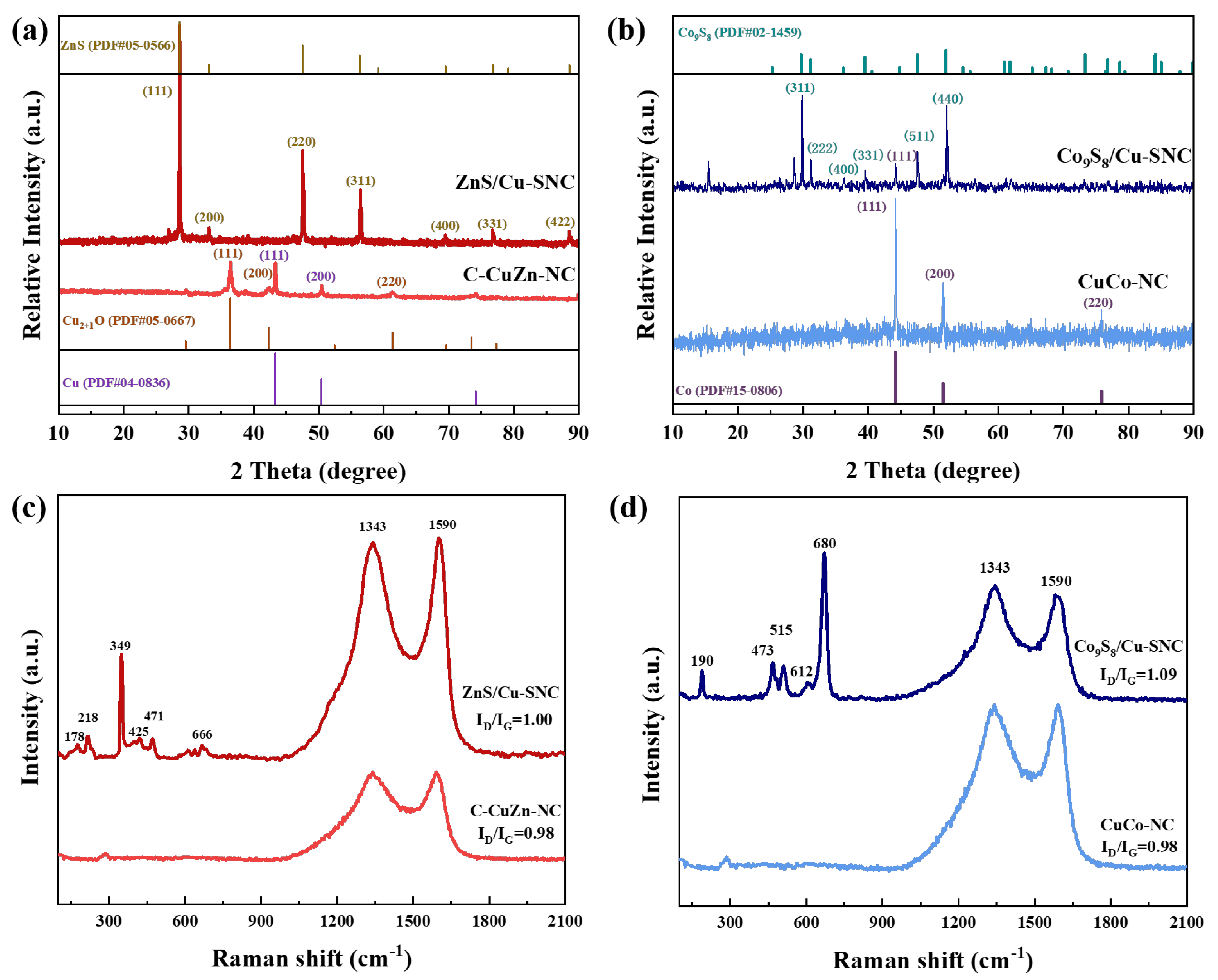
The crystal structures of CuZn-NC, ZnS/Cu-SNC, CuCo-NC, and Co9S8/Cu-SNC were tested and analyzed by XRD, and the results are shown in Figure 1a,b. It can be observed from the XRD pattern of the CuZn-NC catalyst that obvious diffraction peaks appear at 2θ = 43.3°, 50.4°, and 74.1°, which belong to the (111), (200) and (220) crystal planes of metal Cu (PDF#04-0836). In addition, characteristic peaks belonging to the (220) and (111) crystal planes of Cu2+1O were observed at 2θ = 61.3° and 36.4° (PDF#05-0667). The above results show that the CuZn-NC catalyst obtained by high-temperature pyrolysis of Cu@ZIF-8 contains Cu and Cu2+1O crystals. This is because during the high-temperature pyrolysis process, the Cu2+ adsorbed in the ZIF-8 framework that did not participate in the reaction can be reduced to zero-valent Cu by carbon, and part of the Cu will be oxidized by the air to form Cu oxides. The characteristic peaks observed at 2θ = 28.6°, 33.1°, 47.5°, 56.3°, 69.5°, 76.8°, and 88.5°of the ZnS/Cu-SNC catalyst are corresponding to the (111), (200), (220), (311), (400), (331), and (422) crystal planes of ZnS, respectively (PDF#05-0566). This is because during high-temperature pyrolysis, evaporated Zn reacts with S to form ZnS. When ZIF-67 was used as the precursor, the XRD spectrum of the CuCo-NC catalyst only shows characteristic peaks belonging to the metal Co (111), (200), and (220) crystal planes at 2θ = 44.2°, 51.5°, and 75.8° (PDF#15-0806). However, for the XRD spectrum of the Co9S8/Cu-SNC catalyst, it can be seen in Figure 2b that there are obvious characteristic peaks belonging to the Co9S8 (311), (222), (331), (511) and (440) crystal planes at 2θ = 29.8°, 31.2°, 39.5°, 47.6° and 52.1° (PDF#02-1459), and the sharp relative intensity of peaks indicates that the crystallization intensity is very high. During the pyrolysis of Cu@ZIF-67, the sulfurized reaction formed Co9S8 crystals, which are typical spiral crystal structures, are formed by alternating arrangement of Co and S atoms, and contain two different ring structures, Co6S8 and Co3S4. This alternating spiral structure can increase the electron transfer rate during the reaction and accelerate the reaction kinetics.
The Raman spectra of ZnS/Cu-SNC, CuZn-NC, Co9S8/Cu-SNC, and CuCo-NC, as shown in Figure 1c,d, exhibit two characteristic peaks (D and G) located at 1343 and 1590 cm−1, respectively. The D peak originates from structural defects and disordered edges in carbon materials, whereas the G peak arises from the in-plane vibration of sp2-hybridized carbon atoms, reflecting the degree of graphitization. A higher intensity ratio (ID/IG) indicates an increased defect density within the carbon skeleton. CuZn-NC and CuCo-NC, derived from the pyrolysis of ZIF-8 and ZIF-67 with nearly identical frameworks, show comparable carbon structures and defect levels. In contrast, ZnS/Cu-SNC and Co9S8/Cu-SNC exhibit slightly higher ID/IG values after sulfur doping, suggesting that S incorporation enhances defects in carbon materials, and improves charge delocalization within the carbon lattice, consistent with Raman ID/IG increase, which is known to facilitate ORR kinetics. Compared with CuZn-NC, ZnS/Cu-SNC displays additional Raman peaks at 178, 218, 349, 425, 471, and 666 cm−1. The peaks at 178, 349, and 666 cm−1 correspond to the transverse acoustic (TA), first-order longitudinal optical (1LO), and second-order longitudinal optical (2LO) phonon modes of ZnS, respectively. The additional features near 218, 425, and 471 cm−1 arise from surface vibrations of ZnS nanoparticles, attributed to symmetry breaking at the nanoscale that relaxes the q = 0 selection rule. These results confirm the formation of ZnS nanoparticles via vulcanization–sulfidation of the Cu@ZIF-8 precursor during high-temperature pyrolysis with sublimed sulfur [28]. Similarly, the Co9S8/Cu-SNC catalyst exhibits five distinct Raman peaks at 190, 473, 515, 612, and 680 cm−1 (as shown in Figure 2d), corresponding to the F2g, Eg, F2g, F2g, and A1g vibrational modes of Co9S8, respectively. This further verifies the formation of Co9S8 upon sulfur incorporation during pyrolysis. The consistency between Raman and XRD analyses supports that metal sulfides form concurrently with sulfur doping into the carbon matrix during high-temperature treatment.
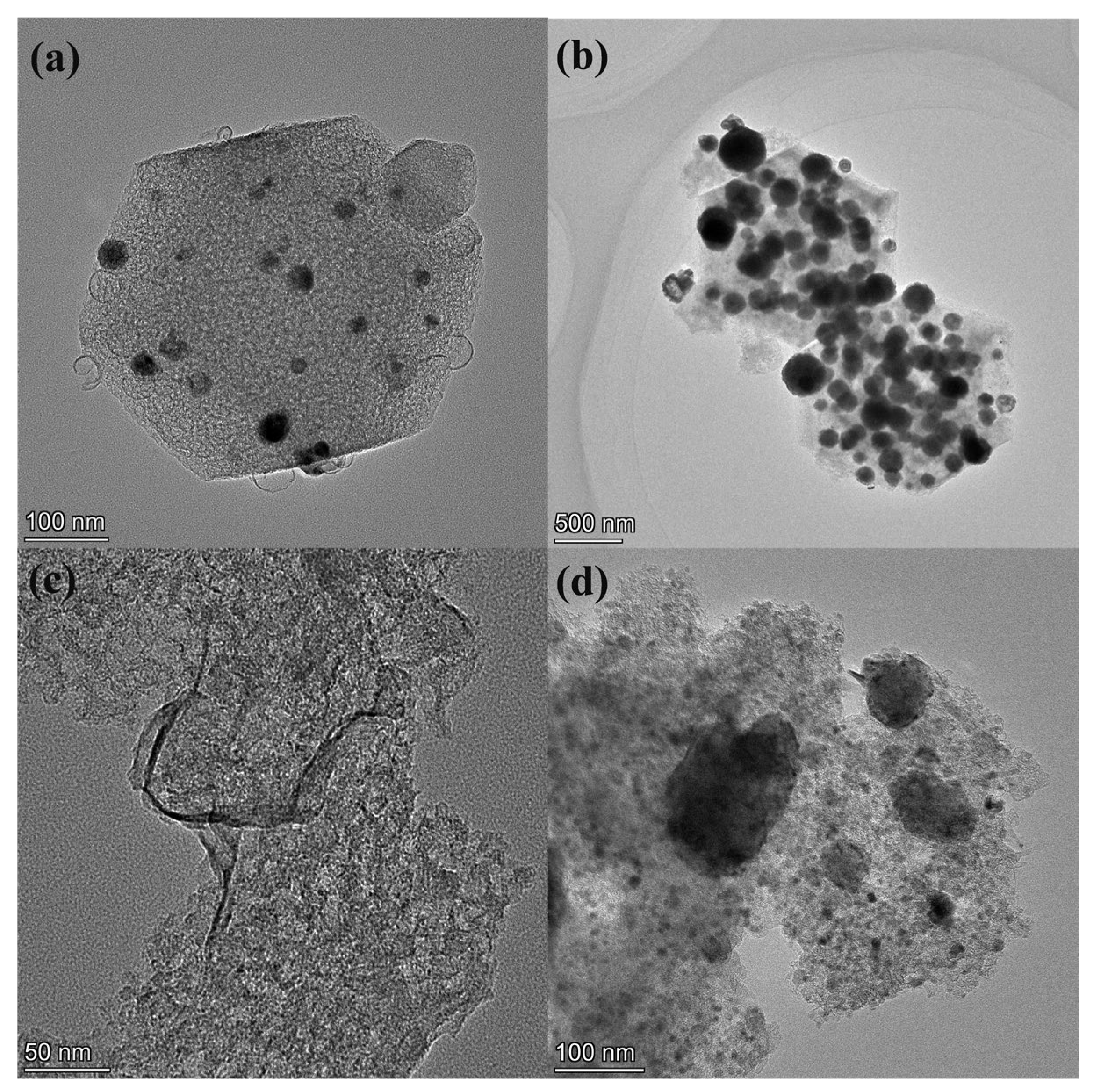
The morphology and elemental distribution of all synthesized samples were analyzed using transmission electron microscopy (TEM), and the results are presented in Figure 2. As shown in Figure 2a,b, the CuZn-NC and CuCo-NC catalysts, derived from the pyrolysis of Cu@ZIF-8 and Cu@ZIF-67 at 900 °C, retain the rhombic dodecahedral structure of the original ZIF framework without any significant structural collapse or agglomeration. Additionally, a high density of nanoparticles is observed on the surface of the rhombic dodecahedron. Following sulfurization with sulfur powder as the sulfur source, the CuZn-NC and CuCo-NC catalysts were transformed into ZnS/Cu-SNC and Co9S8/Cu-SNC, respectively, as evidenced by their TEM images shown in Figure 2c,d. Notably, after sulfurization, the ZnS/Cu-SNC and Co9S8/Cu-SNC catalysts lose their original rhombic dodecahedral morphology and instead adopt a nanosheet-like structure, with a small quantity of nanoparticles dispersed across the surface.
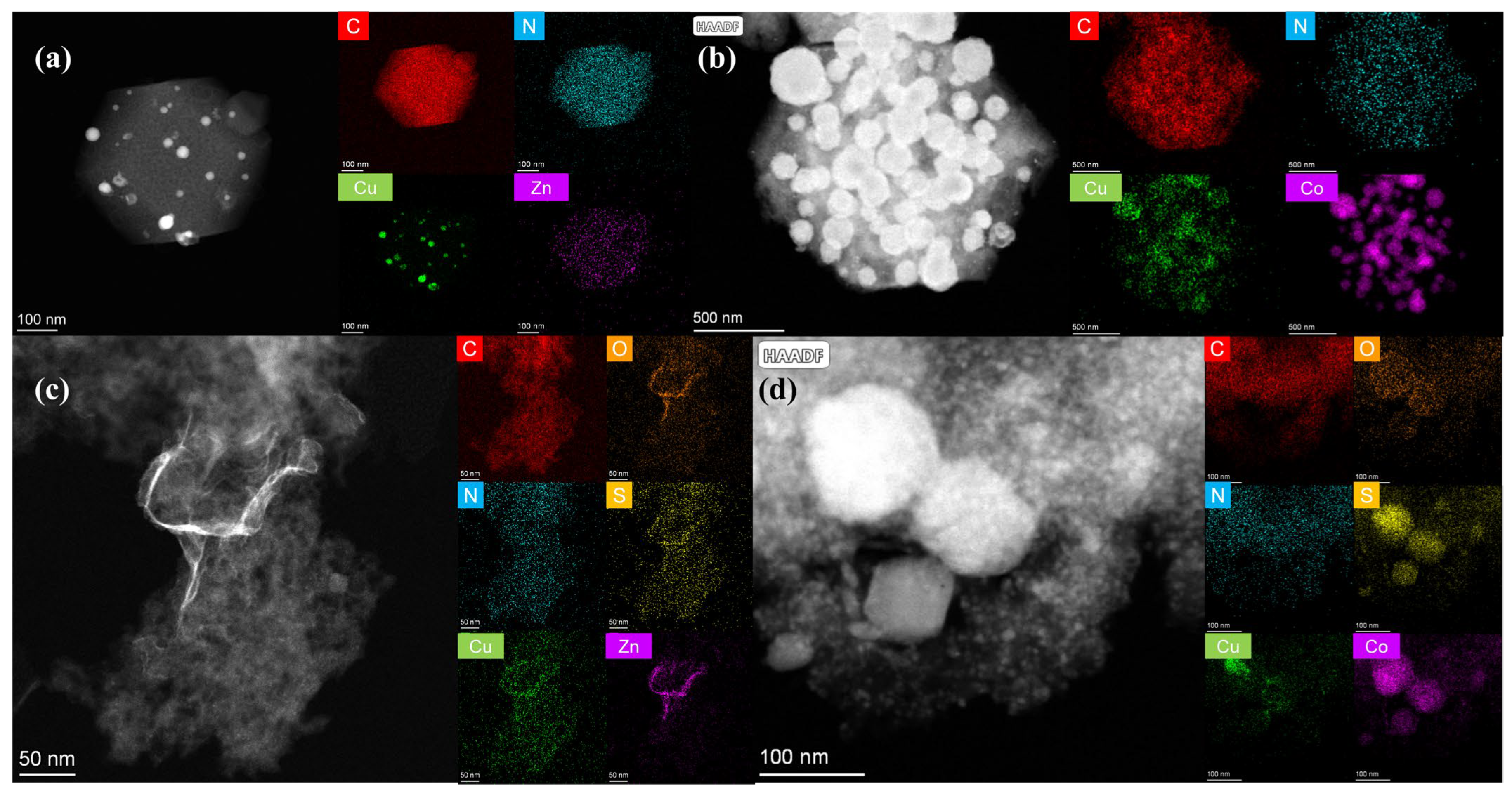
Figure 3 presents the elemental mapping images corresponding to the four catalysts described above. As observed in Figure 3a, C and N elements are uniformly distributed across the rhombic dodecahedron structure, with the nanoparticles in the CuZn-NC catalyst primarily composed of metallic Cu. Additionally, the elemental distribution map reveals that the Zn content in the catalyst is minimal, which can be attributed to the volatilization of Zn during the high-temperature pyrolysis process [29]. As a result, only a small fraction of Zn is anchored by nitrogen in the organic ligand and remains within the catalyst. In Figure 3b, it is evident that the majority of nanoparticles in the CuCo-NC catalyst are composed of metallic Co. The C and N are evenly spread across the entire carbon carrier, while Cu is more uniformly distributed compared to that in the CuZn-NC catalyst. Furthermore, only distinct peaks of metallic Co are observed in the XRD spectrum of CuCo-NC, suggesting the reduction of Co2+ ions to metallic Co during the high-temperature calcination process, likely facilitated by carbon. In Figure 3c, the elemental distribution in the ZnS/Cu-SNC catalyst is homogeneous, with C, N, O, S, and Cu elements evenly dispersed across the nanosheet, while the Zn content is more concentrated within the folds of the nanosheet. Finally, in Figure 3d, for the Co9S8/Cu-SNC catalyst, the C, N, and O elements are uniformly distributed throughout the nanosheet structure, whereas the S and Co elements are predominantly localized in particles with diameters of approximately 100–150 nm.
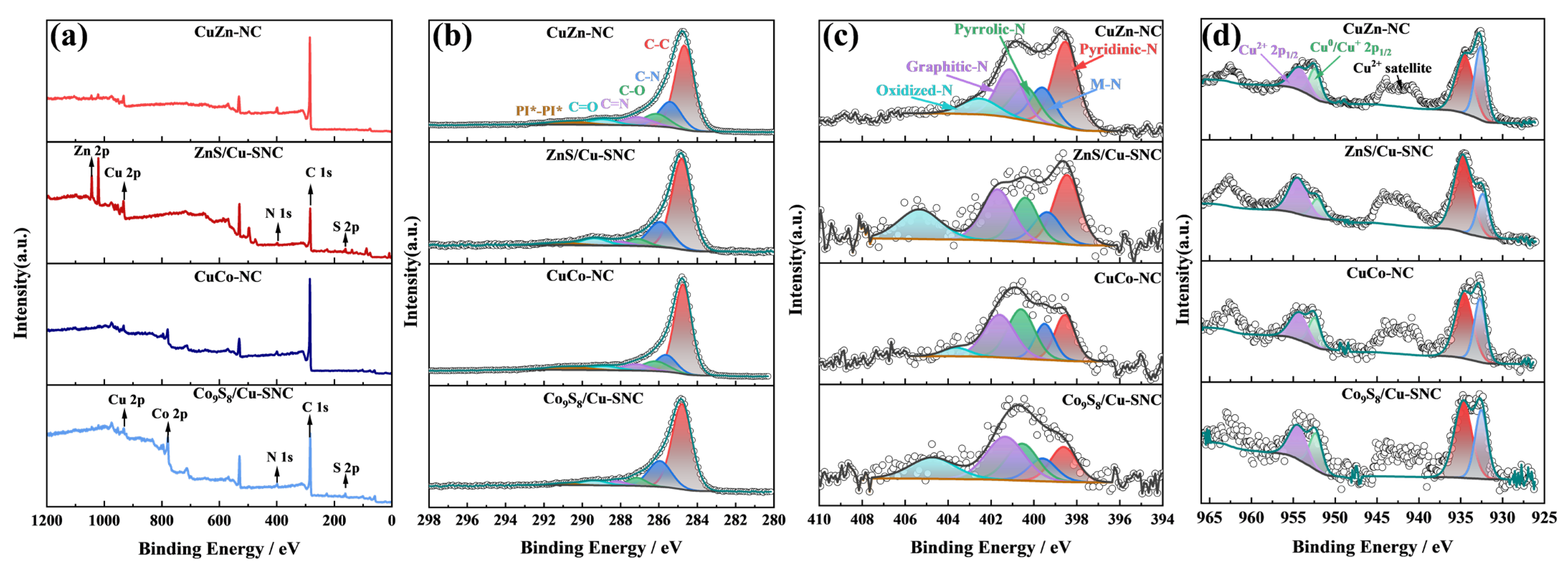
The surface composition and electronic structure of the CuZn-NC, CuCo-NC, ZnS/Cu-SNC, and Co9S8/Cu-SNC catalysts were systematically investigated by X-ray photoelectron spectroscopy (XPS). As shown in Figure 4a, the characteristic signals of C, N, Cu, and Co or Zn were clearly identified in all four catalysts, confirming the presence of carbon, nitrogen, copper, and cobalt or zinc within the structures. Moreover, in the full XPS spectra of ZnS/Cu-SNC and Co9S8/Cu-SNC, an additional S 2p peak was detected, demonstrating that sulfur powder physically mixed prior to calcination was successfully incorporated into the catalysts during the high-temperature pyrolysis process. Deconvolution of the high-resolution C 1s spectrum (Figure 4b) reveals six distinct components: C–C (~284.7 eV), C–N (~285.6 eV), C–O (~286.2 eV), C=N (~287.2 eV), C=O (~288.9 eV), and π*–π* conjugated bonds (~290.8 eV). The presence of the C–N bond provides direct evidence for the successful incorporation of nitrogen atoms into the carbon framework.
The chemical states and electronic configuration of Cu species were further examined through the high-resolution Cu 2p spectra (Figure 4c). All catalysts display characteristic Cu+ 2p3/2 (~932.7 eV), Cu2+ 2p3/2 (~934.8 eV), Cu+ 2p1/2 (~952.4 eV), and Cu2+ 2p1/2 (~954.6 eV), along with satellite peaks of Cu2+ at ~943.0 eV and ~962.5 eV. Importantly, no discernible peak shift in Cu 2p binding energies is observed after sulfur incorporation, consistent with the XRD results. Furthermore, no crystalline phase corresponding to Cu sulfides was detected, indicating that Cu predominantly exists in the +1 and +2 oxidation states, which can be attributed to Cu oxides and Cu species coordinated with nitrogen (Cu–N structure).
The high-resolution N 1s XPS spectrum (Figure 4d) was deconvolved to yield five distinct nitrogen species: pyridinic-N (~398.5 eV), metal-N (~399.6 eV), pyrrolic-N (~400.5 eV), graphitic-N (~401.5 eV), and oxidized-N (~403.0 eV) [30]. The quantitative distribution of these N configurations is summarized in Table 1. Notably, the content of metal-N in ZnS/Cu-SNC and Co9S8/Cu-SNC catalysts decreased by approximately 3% relative to their counterparts, CuZn-NC and CuCo-NC, respectively—consistent with partial consumption of Zn and Co atoms in forming metal sulfide phases. Concurrently, sulfur incorporation significantly altered the nitrogen speciation: both sulfide catalysts exhibited a marked reduction in the relative abundance of pyridinic-N, while graphitic-N increased substantially. This suggests that sulfur doping induces electronic restructuring within the N-doped carbon matrix. Although metal-N bonds are often regarded as key active centers in M–N–C catalysts [31], the introduction of sulfur not only reorganizes the carbon scaffold but also generates metal sulfide domains, complicating activity–structure relationships. Importantly, graphitic-N has been reported to govern limiting current density and enhance electrical conductivity. In line with this, the Co9S8/Cu-SNC catalyst exhibits the highest graphitic-N content (30.91%), which correlates with an anticipated high limiting current density [32].
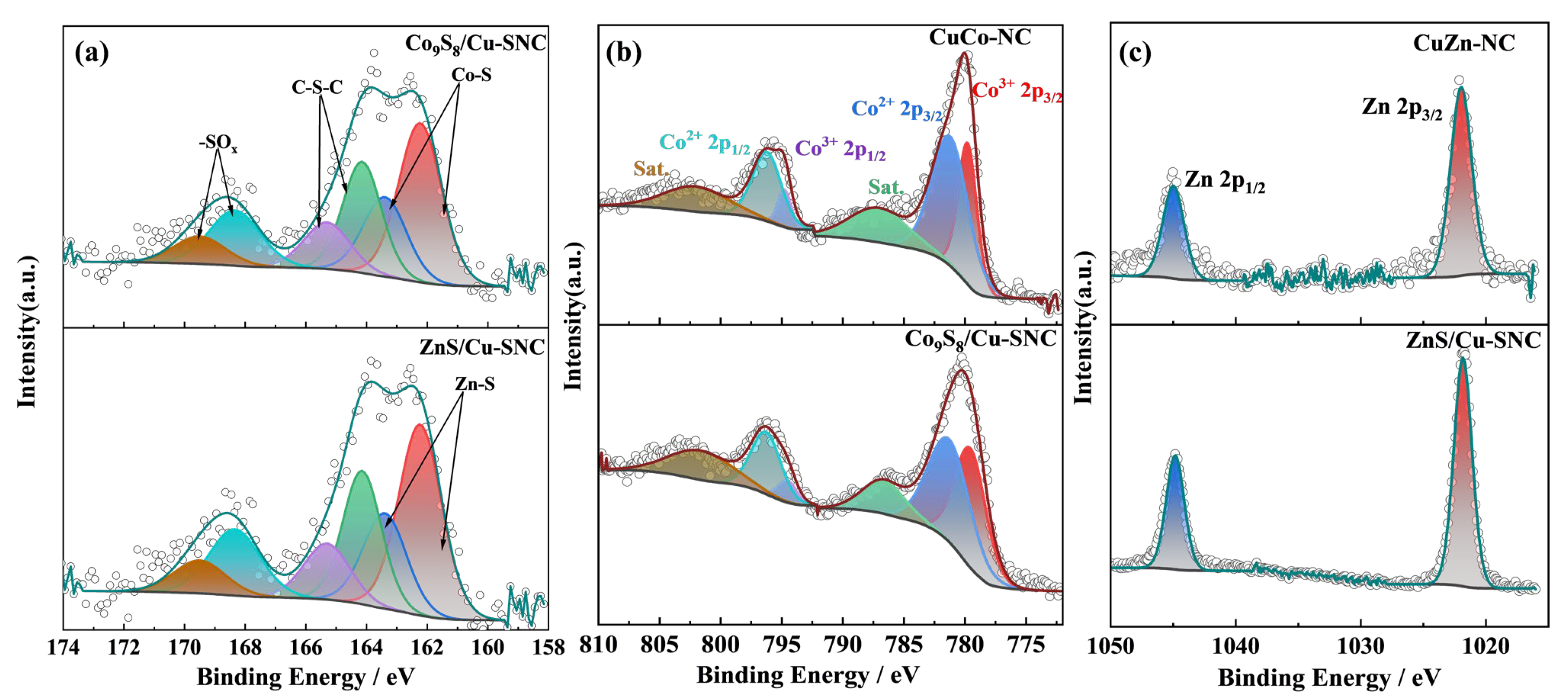
The high-resolution S 2p spectra were employed to elucidate the valence states of sulfur species and their interactions with both the carbon matrix and metal centres. As shown in Figure 5a, the S 2p spectrum can be deconvoluted into three major components: M–S (metal–sulfur), C–S–C (thienyl-S), and –SOx species [33]. Specifically, the Co–S 2p3/2 (~161.8 eV) and 2p1/2 (~162.7 eV) peaks, together with the Zn–S 2p3/2 and 2p1/2 peaks showing negligible binding energy shifts, confirm the formation of Co sulfides in Co9S8/Cu-SNC and Zn sulfides in ZnS/Cu-SNC, respectively. Additional peaks at ~168.2 eV and ~169.9 eV are assigned to sulphate species, while those at ~163.9 eV and ~164.9 eV correspond to the 2p3/2 and 2p1/2 of thienyl-S (C–S–C). The coexistence of C–N and thienyl-S functionalities demonstrate the successful dual doping of N and S atoms into the carbon skeleton. Moreover, thienyl-S is known to modulate the charge density and spin distribution of carbon atoms, as well as interact synergistically with pyridinic-N, thereby enhancing oxygen reduction reaction (ORR) activity [34]. Quantitatively, the Co9S8/Cu-SNC catalyst exhibits a higher thienyl-S content (47.82%) compared to ZnS/Cu-SNC (41.16%), which rationalizes its superior ORR performance.
Figure 5b presents the high-resolution Co 2p spectra of CuCo-NC and Co9S8/Cu-SNC. The binding energies at ~779.6 eV (Co3+ 2p3/2) and ~794.5 eV (Co3+ 2p1/2), along with ~781.3 eV (Co2+ 2p3/2) and ~796.3 eV (Co2+ 2p1/2), indicate the coexistence of Co in both +2 and +3 oxidation states. Furthermore, the shake-up satellite features at ~786.7 eV and ~801.7 eV corroborate the presence of Co2+ species. Similarly, the high-resolution Zn 2p spectra of CuZn-NC and ZnS/Cu-SNC (Figure 5c) display characteristic Zn2+ doublet peaks at ~1021.9 eV (2p3/2) and ~1044.9 eV (2p1/2), confirming the oxidation state of Zn in the sulfide catalyst.
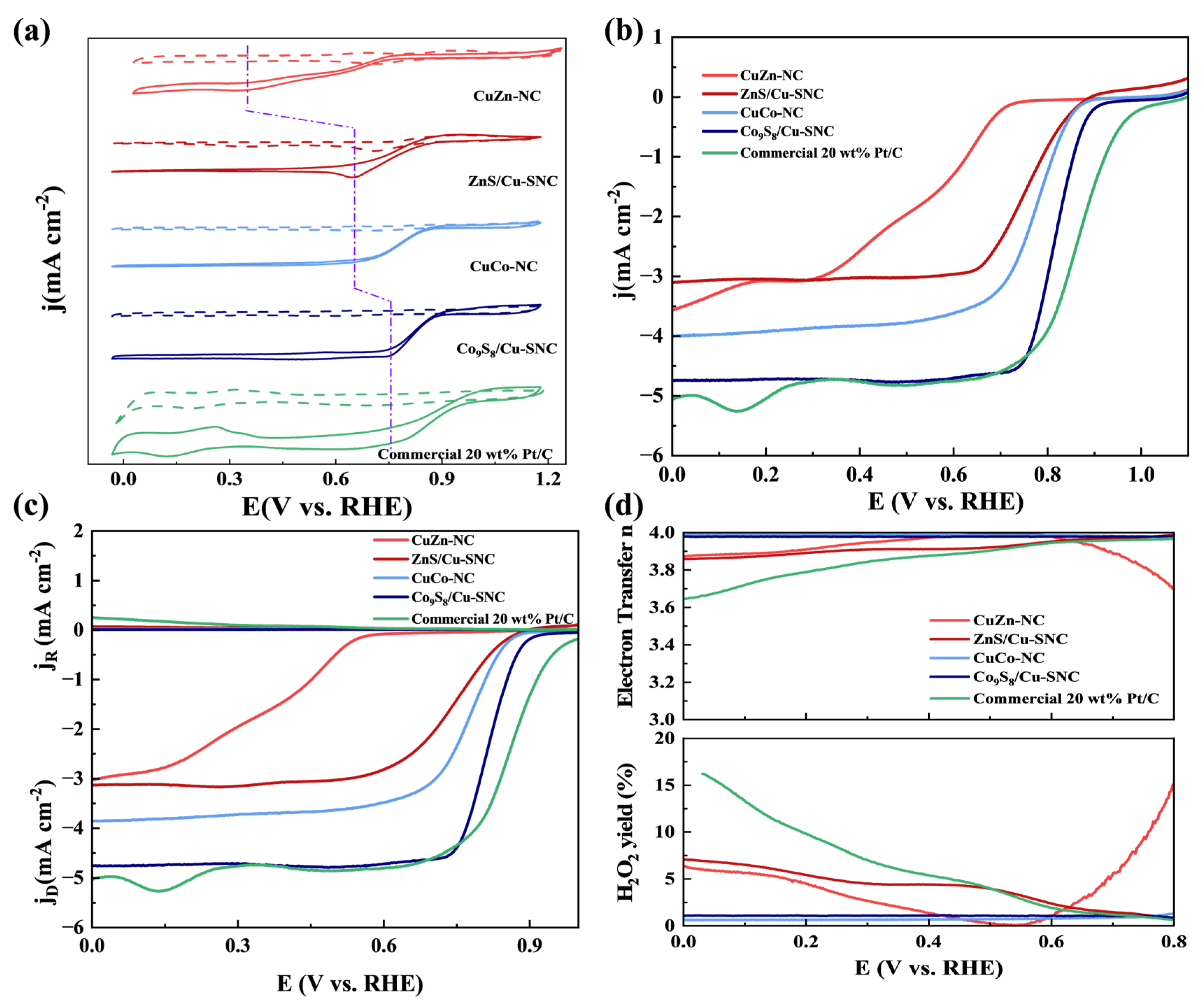
The ORR activity of CuZn-NC, CuCo-NC, ZnS/Cu-SNC, and Co9S8/Cu-SNC was evaluated using a three-electrode system with a rotating disk electrode, with a commercial 20 wt.% Pt/C as reference. As shown in Figure 6a, cyclic voltammetry (CV) curves in 0.1 M KOH saturated with N2 and O2. Compared with the test results under N2 atmosphere, the CV curves of the four catalysts prepared experimentally and the Pt/C catalyst in the O2-saturated electrolyte all revealed obvious oxygen reduction peaks, indicating that the prepared catalysts have ORR catalytic activity. Linear sweep voltammetry (LSV) was used to determine the onset potential (Eonset) and half-wave potential (E1/2) of each catalyst. ZnS/Cu-SNC (Eonset = 0.87 V, E1/2 = 0.75 V) and Co9S8/Cu-SNC (Eonset = 0.92 V, E1/2 = 0.83 V) exhibit significantly higher Eonset and E1/2 than CuZn-NC (Eonset = 0.73 V, E1/2 = 0.57 V) and CuCo-NC (Eonset = 0.88 V, E1/2 = 0.77 V), approaching the performance of commercial Pt/C (Eonset = 1.04 V, E1/2 = 0.85 V). The high activity of Co9S8/Cu-SNC is the result of the highly dispersed Co-N active sites, the optimized electronic structure of S/N co-doping, the synergistic effect of Co9S8 nanoparticles, and the defect-rich carbon skeleton. These factors work together to make its half-wave potential close to that of commercial 20 wt.% Pt/C.
Rotating ring-disk electrode (RRDE) measurements assessed H2O2 selectivity and electron transfer pathway. As shown in Figure 6c, ring current densities follow the order Pt/C > CuZn-NC > CuCo-NC ≈ ZnS/Cu-SNC > Co9S8/Cu-SNC, indicating that the prepared catalysts predominantly follow a four-electron pathway. Figure 6d shows calculated H2O2 yields and average electron transfer numbers (n): CuZn-NC (3.7%, n = 3.93), CuCo-NC (3.9%, n = 3.92), ZnS/Cu-SNC (1.1%, n = 3.97), Co9S8/Cu-SNC (0.7%, n = 3.99), and Pt/C (5.9%, n = 3.87). These results demonstrate that the four experimental catalysts exhibit superior 4e selectivity compared with Pt/C, with Co9S8/Cu-SNC showing the highest ORR activity.
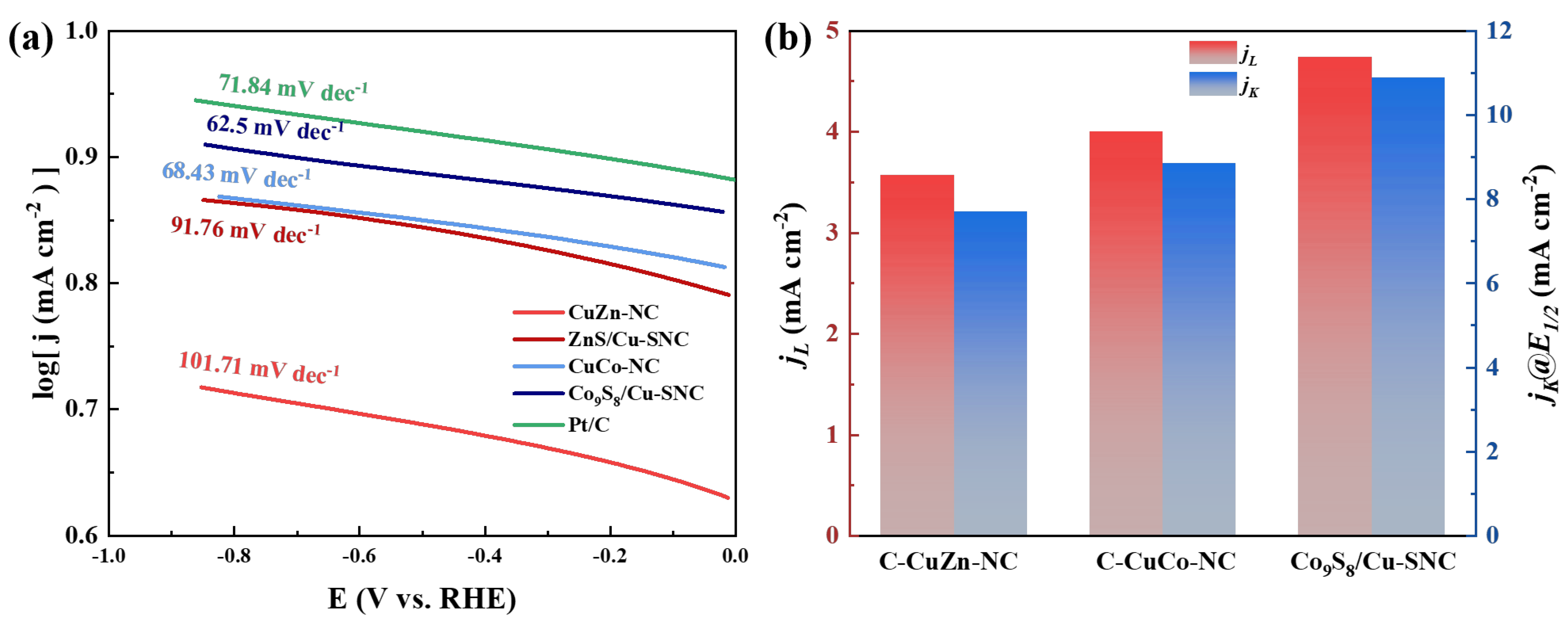
The Tafel slope can be used to analyze the sensitivity of the current response to the applied potential, thereby providing information related to the rate-determining step. As shown in Figure 7a, the Tafel slopes of the four prepared catalysts and the commercial 20 wt% Pt/C catalyst are ranked from large to small as follows: CuZn-NC (101.71 mV dec−1) > ZnS/Cu-SNC (91.76 mV dec−1) > Pt/C (71.84 mV dec−1) > CuCo-NC (68.43 mV dec−1) > Co9S8/Cu-SNC (62.5 mV dec−1). The higher the Tafel slope value, the relatively poorer ORR kinetic reaction rate of the CuZn-NC and ZnS/Cu-SNC catalysts. However, for CuCo-NC and Co9S8/Cu-SNC, the Tafel slopes dropped significantly and were lower than those of the Pt/C catalyst. This shows that the improvement strategy for the Co9S8/Cu-SNC catalyst is successful, and some Co9S8 nanoparticles are evenly distributed on the carbon support modified by S and N. This is conducive to the adsorption and subsequent reduction of O2 molecules, and ultimately improves the ORR kinetics, resulting in a lower Tafel slope value. The larger the limiting diffusion current density, the greater the current that can pass through per unit area per unit time, and the faster the reaction kinetics. As a fuel cell cathode catalyst, it may make the fuel cell have greater power. From Figure 7b, it can be seen that the Co9S8/Cu-SNC catalyst has the largest limiting diffusion current density (4.7 mA cm−2), which is much higher than the other three catalysts. At the same time, it also shows the highest kinetic current density calculated at the half-wave potential. Combined with the above K-L equation and the calculation results of the Tafel slope and kinetic current density, the Co9S8/Cu-SNC catalyst exhibits better kinetic performance in the ORR process. defect-rich carbon and pyridinic/graphitic N sites increase the density and intrinsic activity of ORR active sites, which typically raises the kinetic current density (jk) and shifts E1/2 positively by improving O2 adsorption and facilitating O–O bond activation. Combining structural characterization and performance testing, defect-rich carbon and pyridinic/graphitic N sites increase the density and intrinsic activity of ORR active sites, which typically raises the kinetic current density (jk) and shifts E1/2 positively by improving O2 adsorption and facilitating O–O bond activation [35]. Sulfur doping in the carbon framework and in metal sulfides (e.g., Co9S8) modulates the local electronic structure of adjacent metal-nitrogen centers and creates new, more optimized adsorption sites for O*, OH*, and OOH*, thereby lowering the reaction barrier and resulting in a smaller Tafel slope and higher jk [36].
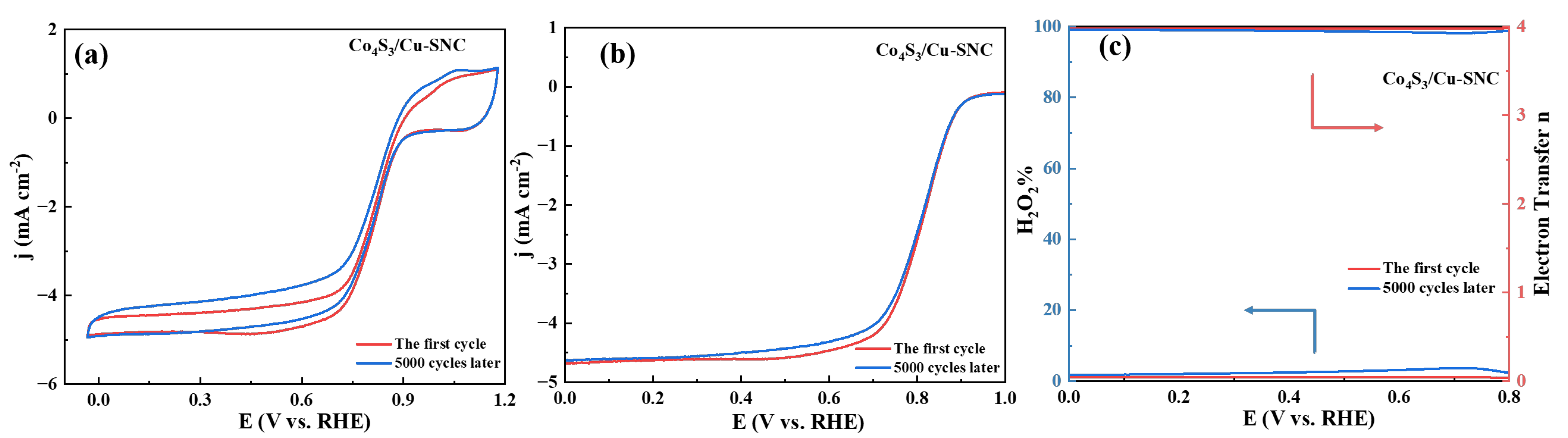
In the comprehensive evaluation of the catalyst, excellent stability is also crucial, which determines the service life of the fuel cell in commercial applications. The stability of the Co9S8/Cu-SNC catalyst was evaluated by accelerated durability testing (ADT). The ADT was performed in O2-saturated 0.1 M KOH by cyclic voltammetry between 0.60 and 1.00 V vs. RHE at a scan rate of 100 mV s−1 for 10,000 cycles, with the catalyst loading kept at ~0.4 mg cm−2. As can be seen from Figure 8a, the initial reduction potential of Co9S8/Cu-SNC remained basically unchanged before and after 10,000 cycles of cyclic voltammetry testing, indicating that its overpotential did not increase due to the accelerated durability test. The half-wave potential E1/2 decayed by only 15 mV after 10,000 cycles of cyclic voltammetry testing, which further demonstrates the excellent durability of the catalyst (Figure 8b). At the same time, we examined the catalyst 4e selectivity before and after the ADT. In the voltage window of 0−0.8 V, H2O2% only increased from 0.7% to 2.5%, while the average electron transfer number just decreased from 3.99 to 3.95. This fully confirms that after the accelerated durability test, the Co9S8/Cu-SNC catalyst still maintains very excellent 4e pathway ORR catalytic ability.

3. Materials and Methods

3.1. Materials and Chemicals

Methanol (CH3OH, 99%) and Zinc nitrate hexahydrate (Zn(NO3)2 • 6H2O, 99.99%) were purchased from Titan Chemical Co., Ltd. (Shanghai, China). Copper nitrate tri-hydrate (Cu(NO3)2 • 3H2O, 99.99%) and Cobalt nitrate hexahydrate (Co(NO3)2 • 6H2O, 99.99%) were purchased from Aladdin Biochemical Technology Co., Ltd. (Shanghai, China). Di-methylimidazole (C4H6N2, 99%) was purchased from Meryer Chemical Technology Co., Ltd. (Shanghai, China). Sublimed sulfur (S, 99%) was purchased from Sinopharm Chemical Reagent Co., Ltd. (Shanghai, China). Potassium hydroxide (KOH, 98%) was purchased from Macklin Biochemical Technology Co., Ltd. (Shanghai, China). Nafion® solution (5 wt%) and the commercial 20 wt% Pt were purchased from Sigma-Aldrich (Shanghai, China). All the chemicals were analytical reagent grade and used without further purification.

3.2. Synthesis of CuZn-NC and CuCo-NC Catalyst

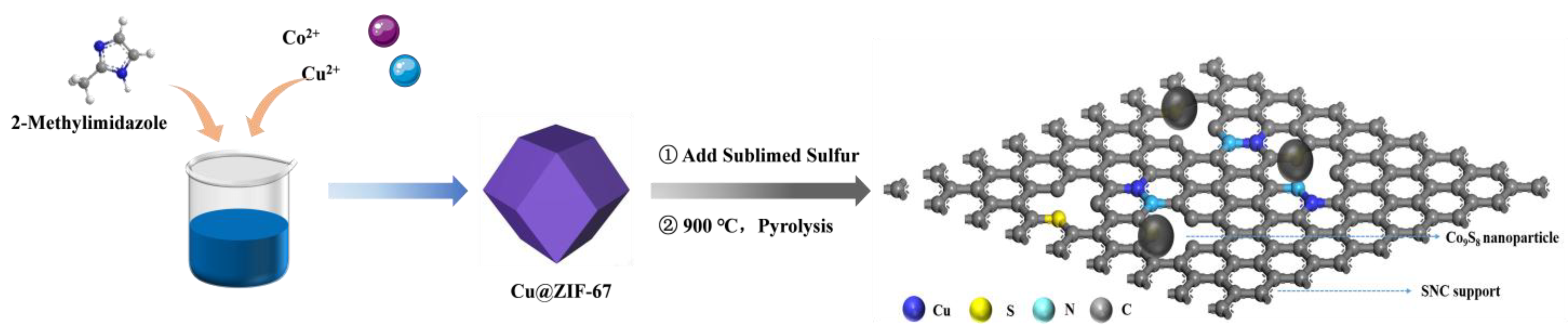
Firstly, the preparation method similar to the traditional ZIF-8 was used. As shown in Figure 9, solution A was prepared by dissolving 3.941 g of 2-methylimidazole in 160 mL of methanol solution, and continuously and vigorously stirring until it was completely dissolved. Then, solution B was prepared by mixing and dissolving 0.873 g of zinc nitrate hexahydrate (Zn(NO3)2·6H2O) or 0.827 g of cobalt nitrate hexahydrate (Co(NO3)2·6H2O) and 0.725 g of copper nitrate trihydrate (Cu(NO3)2·3H2O) in 160 mL of methanol solution with vigorous stirring. In a constant temperature of 30 °C, solution B was quickly poured into solution A while stirring continuously. The mixed continued to be vigorously stirred for 8 h and allowed to stand for two hours. After the reaction, the blue or purple precipitate was separated by centrifugation and methanol washing, and then dried in vacuum at 60 °C for 12 h to obtain a white (Cu@ZIF-8) or purple solid (Cu@ZIF-67).CuZn-NC and CuCo-NC electrocatalysts were obtained by calcining Cu@ZIF-8 and Cu@ZIF-67 precursors. The specific steps were as follows: the Cu@ZIF-8 or Cu@ZIF-67 powder was fully ground and placed in a tube furnace. The temperature was raised to 900 °C at a rate of 5 °C min−1 under argon atmosphere, and the precursor was pyrolyzed at 900 °C for 2 h. After the sample was cooled naturally to room temperature, the black powder was collected. The final products are represented as CuZn-NC and CuCo-NC.

3.3. Synthesis of ZnS/Cu-SNC and Co9S8/Cu-SNC

During the calcination of Cu@ZIF-8 and Cu@ZIF-67 precursors, the S element was introduced by secondary doping. At first, sulfur powder was added and fully mixed with the ZIF materials during the grinding of Cu@ZIF-8 or Cu@ZIF-67. Subsequently, the precursor with sulfur powder was pyrolyzed at 900 °C for 2 h under an argon atmosphere, utilizing the same steps as the pyrolysis method for obtaining CuZn/NC and CuCo-NC, and the obtained black powders were named ZnS/Cu-SNC and Co9S8/Cu-SNC, respectively.

3.4. Structural Characterization

The morphology and microstructural features of samples were examined by transmission electron microscopy (TEM, JEM-2100, JEOL, Tokyo, Japan) High-angle annular dark-field scanning transmission electron microscopy (HAADF-STEM) coupled with energy-dispersive X-ray spectroscopy (EDS) mapping was performed on a Talos F200X microscope (Thermo Fisher Scientific, Waltham, MA, USA) to analyze the elemental distribution. The crystalline structure of the catalysts was determined by X-ray diffraction (XRD, D8 Advance, Bruker, Karlsruhe, Germany) using Cu Kα radiation (λ = 1.5406 Å, 40 kV, 15 mA). Raman spectra were recorded on a LabRAM HR confocal Raman spectrometer (Horiba J.Y., Paris, France) with a 514.5 nm excitation laser. The surface chemical states were investigated by X-ray photoelectron spectroscopy (XPS, Thermo Scientific K-Alpha+, Waltham, MA, USA), and all binding energies were calibrated against the C 1s peak at 284.8 eV.

3.5. Electrochemical Tests

All electrochemical measurements were conducted on the Biologic (SP-50e) workstation (Seyssinet-Pariset, France) by a three-electrode system at room temperature in 0.1 M KOH. The RDE or RRDE coated by catalysts served as the working electrode, an Ag/AgCl (saturated KCl) electrode as the reference electrode, and graphite as the counter electrode. All potentials shown in this study were converted to reversible hydrogen electrode (RHE) potentials according to the following formula: E (vs. RHE) = E (vs. Ag/AgCl) + 0.0592 pH + 0.2046.
The RRDE tests were performed at a ring electrode potential of 1.274 V (vs. RHE), with a scan rate of 5 mV s−1 and an electrode rotation rate of 1600 rpm. The number of electron transfers (n) and H2O2 yield (H2O2%) were calculated according to the following formulas:
H O 2 % = 200 × i R N i D + i R N
n = 4 × i R N i D + i R N
where, iR represents the ring current collected at the Pt ring, iD represents the disk current, n is the number of electron transfers, and N is the current collection efficiency of the RRDE, typically taken as 0.37.
The catalytic kinetic current density (jk) can be calculated using the Koutecky-Levich (K-L) equation:
1 j = 1 j k + 1 j L
in which, j is the current density, and jk and jL are the kinetic current density and limiting diffusion current density, respectively.

4. Conclusions

In this study, N, S co-doped carbon nanosheets loaded with transition metal sulfides have been successfully synthesized using ZIF-8 and ZIF-67 precursors with in situ Cu incorporation and secondary sulfurization. The resulting ZnS/Cu-SNC and Co9S8/Cu-SNC catalysts were characterized by TEM, XRD, Raman, and XPS, confirming the formation of uniformly distributed metal sulfide nanoparticles and effective dual N/S doping within the carbon matrix. The structural modifications induced by sulfur incorporation enhanced defects and graphitic-N content, which contributed to improved electronic conductivity and exposure of active sites. Electrochemical evaluation demonstrated that Co9S8/Cu-SNC exhibited a half-wave potential of 0.83 V vs. RHE, high limiting diffusion current density (4.7 mA cm−2), and near-ideal 4e selectivity with minimal H2O2 generation, approaching the performance of commercial 20 wt.% Pt/C. Furthermore, the catalyst maintained excellent durability after 10,000 ADT cycles, with only slight decreases in half-wave potential and electron transfer number. These results indicate that the synergistic combination of transition metal sulfides and N, S co-doped carbon effectively promotes oxygen adsorption, accelerates ORR kinetics, and stabilizes active sites, providing a promising design strategy for high-performance and durable non-precious metal ORR catalysts for fuel cell cathodes and related electrochemical energy conversion systems.

Author Contributions

Conceptualization, S.H.; methodology, S.H., D.L., Y.Z. and M.Z.; formal analysis, S.H., D.L., M.Z. and C.Z.; investigation, J.W. and C.Z.; data curation, S.H. and M.Z.; writing—original draft preparation, M.Z.; writing—review and editing, S.H., D.L., and Y.Z.; supervision, D.L. and Y.Z.; project administration, M.Z. and D.L.; funding acquisition, D.L. All authors have read and agreed to the published version of the manuscript.

Funding

This work is financially supported by the National Key Research and Development Program (2023YFB4006100). It was sponsored by the State Key Laboratory of Intelligent Green Vehicle and Mobility under Project No. KFZ2403.

Data Availability Statement

The raw data supporting the conclusions of this article will be made available by the authors upon request.

Acknowledgments

The authors thank the Research Center of Analysis and Test of Ningbo Institute of Materials Technology & Engineering, CAS, for their help with characterization.

Conflicts of Interest

The authors declare no conflicts of interest.

Abbreviations

The following abbreviations are used in this manuscript:
PEMFCProton Exchange Membrane Fuel Cells
jRThe current density of the ring electrode in the Rotating Ring-Disk Electrode
jDThe current density of the disk electrode in the Rotating Ring-Disk Electrode
jkDynamic current density
jLLimit diffusion current density
ORROxygen reduction reaction
RHEReversible Hydrogen Electrode
ID/IGD peak and G peak intensity ratio
TATransverse acoustic
1LOFirst-order longitudinal optical
2LOSecond-order longitudinal optical

References

  1. Ayiania, M.; Smith, M.; Hensley, A.J.R.; Scudiero, L.; McEwen, J.-S.; Garcia-Perez, M. Deconvoluting the XPS spectra for nitrogen-doped chars: An analysis from first principles. Carbon 2020, 162, 528–544. [Google Scholar] [CrossRef]
  2. Cha, M.S.; Lee, J.Y.; Kim, T.-H.; Jeong, H.Y.; Shin, H.Y.; Oh, S.-G.; Hong, Y.T. Preparation and characterization of crosslinked anion exchange membrane (AEM) materials with poly(phenylene ether)-based short hydrophilic block for use in electrochemical applications. J. Membr. Sci. 2017, 530, 73–83. [Google Scholar] [CrossRef]
  3. Chen, C.J.; Wu, Y.L.; Li, X.L.; Ye, Y.T.; Li, Z.L.; Zhou, Y.F.; Chen, J.; Yang, M.Z.; Xie, F.Y.; Jin, Y.S.; et al. Modulating Fe spin state in FeNC catalysts by adjacent Fe atomic clusters to facilitate oxygen reduction reaction in proton exchange membrane fuel cell. Appl. Catal. B Environ. Energy 2024, 342, 123407. [Google Scholar] [CrossRef]
  4. Chen, F.; Zhang, Z.; Liang, W.; Qin, X.; Zhang, Z.; Jiang, L. Synthesis of Co4S3/Co9S8 nanosheets and comparison study toward the OER properties induced by different metal ion doping. Chin. Chem. Lett. 2022, 33, 1395–1402. [Google Scholar] [CrossRef]
  5. Han, W.; Li, C.; Jiang, Y.; Ma, Z.; Zhang, Y.; Yan, X.; Zheng, X. Atomically-dispersed Fe-Nx and C–S–C ordered mesoporous carbons as efficient catalysts for the oxygen reduction reaction in a microbial fuel cell. J. Alloys Compd. 2021, 852, 156994. [Google Scholar] [CrossRef]
  6. Yang, G.; Zhu, J.; Yuan, P.; Hu, Y.; Qu, G.; Lu, B.A.; Xue, X.; Yin, H.; Cheng, W.; Cheng, J.; et al. Regulating Fe-spin state by atomically dispersed Mn-N in Fe-N-C catalysts with high oxygen reduction activity. Nat. Commun. 2021, 12, 1734. [Google Scholar] [CrossRef]
  7. Huang, L.; Zaman, S.; Tian, X.; Wang, Z.; Fang, W.; Xia, B.Y. Advanced Platinum-Based Oxygen Reduction Electrocatalysts for Fuel Cells. Acc. Chem. Res. 2021, 54, 311–322. [Google Scholar] [CrossRef]
  8. Jam, J.E.; Dizaji, H.R.; Molaei, M. Synthesis of ZnS and rGO/ZnS Nanocomposite, Application for Photodegradation of Methylene Blue and Heavy Metal Ions Detection in Water. J. Fluoresc. 2025. [Google Scholar] [CrossRef]
  9. Kim, H.C.; Huh, S. Porous Carbon-Based Supercapacitors Directly Derived from Metal-Organic Frameworks. Materials 2020, 13, 4215. [Google Scholar] [CrossRef]
  10. Yan, D.; Kong, L.A.-O.; Xu, B.; Yang, B. One-Step Synthesis Strategy for a Platinum-Based Alloy Catalyst Designed via Crystal-Structure Prediction. Molecules 2024, 29, 5634. [Google Scholar] [CrossRef]
  11. Liao, M.; Chin, T.K.; Luo, X.F.; Chuang, Y.C.; Perng, T. Formation Characteristics of Pt-Ni Alloy Nanoparticles Fabricated by Nanolamination of Atomic Layer Deposition in Hydrogen. Small 2024, 20, 2404943. [Google Scholar] [CrossRef]
  12. Liu, C.; Li, H.; Chen, J.; Yu, Z.; Ru, Q.; Li, S.; Henkelman, G.; Wei, L.; Chen, Y. 3d Transition-Metal-Mediated Columbite Nanocatalysts for Decentralized Electrosynthesis of Hydrogen Peroxide. Small 2021, 17, 2007249. [Google Scholar] [CrossRef] [PubMed]
  13. Liu, Y.; Fu, F.; Salmon, L.; Espuche, B.; Moya, S.; Berlande, M.; Pozzo, J.L.; Hamon, J.-R.; Astruc, D. Facile MOF Support Improvement in Synergy with Light Acceleration for Efficient Nanoalloy-Catalyzed H2 Production from Formic Acid. ACS Appl. Mater. Interfaces 2023, 15, 23343–23352. [Google Scholar] [CrossRef] [PubMed]
  14. Lu, Y.; Hu, Z.; Wang, Y.; Wang, X.; Gu, D.; Wu, Z. Facile synthesis of mesoporous carbon materials with a three-dimensional ordered mesostructure and rich FeNX/C-S-C sites for efficient electrocatalytic oxygen reduction. Colloids Surf. A Physicochem. Eng. Asp. 2022, 654, 130103. [Google Scholar] [CrossRef]
  15. Mandal, M. Recent advancement on anion exchange membranes for fuel cell and water electrolysis. ChemElectroChem 2021, 8, 36–45. [Google Scholar] [CrossRef]
  16. Meng, L.; Wang, B.; Rong, Y.; Zhang, S.; Cai, T.; Ding, C.F.; Yan, Y. Metal/heteroatom-doped carbon-based hybrid material as the matrix for rapid and high-throughput identification of phthalate esters in complex samples by laser desorption/ionization. Mikrochim. Acta 2025, 192, 327. [Google Scholar] [CrossRef]
  17. Paul, S.; Kao, Y.-L.; Ni, L.; Ehnert, R.; Herrmann-Geppert, I.; van de Krol, R.; Stark, R.W.; Jaegermann, W.; Kramm, U.I.; Bogdanoff, P. Influence of the Metal Center in M-N-C Catalysts on the CO2 Reduction Reaction on Gas Diffusion Electrodes. ACS Catal. 2021, 11, 5850–5864. [Google Scholar] [CrossRef]
  18. Xiao, W.; Huang, J.; Yu, C.; Xiang, X.; Lin, M.; Wen, L.; Liang, W.; Shen, P.K.; Tian, Z.Q. Atomically dispersed rare earth dysprosium-nitrogen-carbon for boosting oxygen reduction reaction. J. Colloid Interface Sci. 2025, 684, 87–96. [Google Scholar] [CrossRef]
  19. Sarma, S.C.; Mishra, V.; Vemuri, V.; Peter, S.C. “Breaking the O=O Bond”: Deciphering the Role of Each Element in Highly Durable CoPd2Se2 toward Oxygen Reduction Reaction. ACS Appl. Energy Mater. 2022, 3, 231–239. [Google Scholar] [CrossRef]
  20. Sazali, N.; Salleh, W.N.W.; Jamaludin, A.S.; Mhd Razali, M.N. New Perspectives on Fuel Cell Technology: A Brief Review. Membranes 2020, 10, 99. [Google Scholar] [CrossRef]
  21. Wang, D.; Pan, X.; Yang, P.; Li, R.; Xu, H.; Li, Y.; Meng, F.; Zhang, J.; An, M. Transition Metal and Nitrogen Co-Doped Carbon-based Electrocatalysts for the Oxygen Reduction Reaction: From Active Site Insights to the Rational Design of Precursors and Structures. ChemSusChem 2021, 14, 33–55. [Google Scholar] [CrossRef] [PubMed]
  22. Wang, S.; Badreldin, A.; Li, Y. Metal-nitrogen-carbon catalysts for electrochemical CO2 reduction: From design to industrial applications. Chem. Commun. 2025, 61, 10484–10504. [Google Scholar] [CrossRef] [PubMed]
  23. Wang, W.; Li, T.; Komarneni, S.; Lu, X.; Liu, B. Recent advances in Co-based co-catalysts for efficient photocatalytic hydrogen generation. J. Colloid Interface Sci. 2022, 608, 1553–1575. [Google Scholar] [CrossRef] [PubMed]
  24. Xiao, F.; Wang, Q.; Xu, G.L.; Qin, X.; Hwang, I.; Sun, C.J.; Liu, M.; Hua, W.; Wu, H.W.; Zhu, S.; et al. Atomically dispersed Pt and Fe sites and Pt–Fe nanoparticles for durable proton exchange membrane fuel cells. Nat. Catal. 2022, 5, 503–512. [Google Scholar] [CrossRef]
  25. Peng, Y.; Zhang, F.; Zhang, Y.; Luo, X.; Chen, L.; Shi, Y. N,S-Doped hollow carbon nanosheet-encapsulated Co9S8 nanoparticles as a highly efficient bifunctional electrocatalyst for rechargeable zinc–air batteries. Dalton Trans. 2022, 51, 12630–12640. [Google Scholar] [CrossRef]
  26. Li, Y.; Wang, C.; Cui, M.; Chen, S.; Gao, L.; Liu, A.; Ma, T. Facile synthesis of ZnS decorated N, S co-doped carbon polyhedron as high efficiency oxygen reduction reaction catalyst for Zn-air battery. Appl. Surf. Sci. 2020, 509, 145367. [Google Scholar] [CrossRef]
  27. Huang, K.; Zhang, W.; Devasenathipathy, R.; Yang, Z.; Zhang, X.; Wang, X.; Chen, D.-H.; Fan, Y.; Chen, W. Co nanoparticles and ZnS decorated N, S co-doped carbon nanotubes as an efficient oxygen reduction catalyst in zinc-air batteries. Int. J. Hydrogen Energy 2021, 46, 30090–30100. [Google Scholar] [CrossRef]
  28. Yang, Q.; Li, L.; Lin, C.X.; Gao, X.L.; Zhao, C.H.; Zhang, Q.G.; Zhu, A.M.; Liu, Q.L. Hyperbranched poly(arylene ether ketone) anion exchange membranes for fuel cells. J. Membr. Sci. 2018, 560, 77–86. [Google Scholar] [CrossRef]
  29. Yang, Z.G.; Xu, H.M.; Shuai, T.Y.; Zhan, Q.N.; Zhang, Z.J.; Huang, K.; Dai, C.; Li, G. Recent progress in the synthesis of transition metal nitride catalysts and their applications in electrocatalysis. Nanoscale 2023, 15, 11777–11800. [Google Scholar] [CrossRef]
  30. Yuan, S.; Weng, M.; Liu, D.; He, X.; Cui, L.; Asefa, T. Hollow Spherical (Co, Zn)/N, S-Doped Carbons: Efficient Catalysts for Oxygen Reduction in Both Alkaline and Acidic Media. ACS Sustain. Chem. Eng. 2019, 7, 18912–18925. [Google Scholar] [CrossRef]
  31. Zhang, J.; Zhu, W.; Pei, Y.; Liu, Y.; Qin, Y.; Zhang, X.; Wang, Q.; Yin, Y.; Guiver, M. Hierarchically Porous Co-N-C Cathode Catalyst Layers for Anion Exchange Membrane Fuel Cells. ChemSusChem 2019, 12, 4165–4169. [Google Scholar] [CrossRef]
  32. Zhang, M.; Hu, S.; Zhang, X. In situ synthesis of N/S co-doped Cu-based graphene-like nanosheets as high efficiency electrocatalysts for oxygen reduction reaction. Int. J. Hydrogen Energy 2023, 48, 18268–18279. [Google Scholar] [CrossRef]
  33. Zhang, W.; Yao, X.; Zhou, S.; Li, X.; Li, L.; Yu, Z.; Gu, L. ZIF-8/ZIF-67-Derived Co-N(x)-Embedded 1D Porous Carbon Nanofibers with Graphitic Carbon-Encased Co Nanoparticles as an Efficient Bifunctional Electrocatalyst. Small 2018, 14, 1800423. [Google Scholar] [CrossRef]
  34. Zhang, X.; Jia, L.; Liu, Y.; Wang, Z.; Qin, J.; Wang, Q.; Zhao, X.; Zhong, M.; Lang, J.; Xu, G.; et al. Power Production and Degradation of Pesticide Wastewater Through Microbial Fuel Cells with the Modified Activated Carbon Air Cathode by Hollow-Carbon and Carbon-Encapsulated Structures. Molecules 2024, 29, 5675. [Google Scholar] [CrossRef]
  35. Lv, Q.; Si, W.; He, J.; Sun, L.; Zhang, C.; Wang, N.; Yang, Z.; Li, X.; Wang, X.; Deng, W.; et al. Selectively nitrogen-doped carbon materials as superior metal-free catalysts for oxygen reduction. Nat. Commun. 2018, 9, 3376. [Google Scholar] [CrossRef]
  36. Zhang, W.; van Dijk, B.; Wu, L.; Maheu, C.; Tudor, V.; Hofmann, J.P.; Jiang, L.; Hetterscheid, D.; Schneider, G.F. Role of vacancy defects and nitrogen dopants for the reduction of oxygen on graphene. ACS Catal. 2024, 14, 11065–11075. [Google Scholar] [CrossRef]
Figure 1. XRD patterns of (a) ZnS/Cu-SNC and CuZn-NC catalysts, (b) Co9S8/Cu-SNC and CuCo-NC catalysts; Raman spectra of (c) ZnS/Cu-SNC and CuZn-NC catalysts, (d) Co9S8/Cu-SNC and CuCo-NC catalysts.
Ijms 27 00434 g001
Figure 2. TEM spectra of (a) CuZn-NC, (b) CuCo-NC, (c) ZnS/Cu-SNC, and (d) Co9S8/Cu-SNC.
Ijms 27 00434 g002
Figure 3. The HAADF-STEM and elemental mapping images of (a) CuZn-NC, (b) CuZn-NC, (c) ZnS/Cu-SNC, and (d) Co9S8/Cu-SNC.
Ijms 27 00434 g003
Figure 4. (a) XPS survey spectra, (b) high-resolution C 1s spectra, (c) high-resolution N 1s spectra, and (d) high-resolution Cu 2p spectra of CuZn-NC, CuCo-NC, ZnS/Cu-SNC and Co9S8/Cu-SNC.
Ijms 27 00434 g004
Figure 5. (a) High-resolution S 2p spectra, (b) High-resolution Co 2p spectra, and (c) High-resolution Zn 2p spectra of CuZn-NC, CuCo-NC, ZnS/Cu-SNC and Co9S8/Cu-SNC catalysts.
Ijms 27 00434 g005
Figure 6. (a) Cyclic voltametric curves in N2-saturated (dashed line) and O2-saturated (solid line) 0.1 M KOH solutions at the scan rate of 10 mV s−1, (b) LSV curves at 1600 rpm, (c) The jD and jR, (d) H2O2% and electron transfer number calculated by RRDE curves from 0.2 V to 0.8 V of CuZn-NC, CuCo-NC, ZnS/Cu-SNC, Co9S8/Cu-SNC and commercial 20 wt.% Pt/C catalysts.
Ijms 27 00434 g006
Figure 7. (a) Tafel plot comparison of the samples and (b) The jL and jk of CuZn-NC, CuCo-NC, ZnS/Cu-SNC, Co9S8/Cu-SNC catalysts.
Ijms 27 00434 g007
Figure 8. (a) The CV curves of Co9S8/Cu-SNC catalyst before and after10,000 cycles ADT; (b) LSV curves of Co9S8/Cu-SNC catalyst before and after 10,000 cycles ADT; and (c) H2O2% and electron transfer number of Co9S8/Cu-SNC catalyst before and after ADT, in O2-saturated 0.1 M KOH.
Ijms 27 00434 g008
Figure 9. Schematic illustration of the preparation of the Co9S8/Cu-SNC catalyst.
Ijms 27 00434 g009
Table 1. The content of different N species in N 1s high-resolution spectra of CuZn-NC, CuCo-NC, ZnS/Cu-SNC and Co9S8/Cu-SNC catalysts.
SamplePyridinic-NM−NPyrrolic-NGraphitic-NOxidized-N
CuZn-NC37.08%15.18%15.96%21.93%9.84%
ZnS/Cu-SNC27.25%12.74%17.02%24.09%18.9%
CuCo-NC21.07%15.74%28.90%29.22%5.34%
Co9S8/Cu-SNC17.39%12.34%21.73%30.91%17.63%
Disclaimer/Publisher’s Note: The statements, opinions and data contained in all publications are solely those of the individual author(s) and contributor(s) and not of MDPI and/or the editor(s). MDPI and/or the editor(s) disclaim responsibility for any injury to people or property resulting from any ideas, methods, instructions or products referred to in the content.